--A
An Architecture for Adaptable Wireless Networks
by
Sunil Kaliputnam Rao
Submitted to the Department of Electrical Engineering and Computer Science in partial fulfillment of the requirements for the Degree of
Master of Engineering in Electrical Engineering and Computer Science at the
Massachusetts Institute of Technology May 18th, 2000
Copyright Massachusetts Institute of Technology 2000. All rights reserved.
A u th or .. ...
Department of Electrical Engineering and Computer Science May 18th, 2000
C ertified by. ...
John V. Guttag Professor, Computer Science and Engineering rhesis Supervisor
Accepted by . ...
Arthur C. Smith Chairman, Department Committee on Graduate Theses
An Architecture for Adaptable Wireless Networks
by
Sunil Kaliputnam Rao Submitted to the
Department of Electrical Engineering and Computer Science May 18th, 2000
in partial fulfillment of the requirements for the Degree of Master of Engineering in Electrical Engineering and Computer Science
ABSTRACT
This thesis demonstrates the benefits of using a software based, adaptable wireless network protocol stack for voice applications. A design for a Controller Module which facilitates adaptation in the physical layer of wireless devices is presented. Using the
Controller Module, designers may define a set of high level rules that govern when and what type of adaptation should take place in the physical layer. The design includes a protocol which enables Controller Modules to communicate physical layer configuration information to each other. To illustrate the use of the Controller, several Controller policies and their benefits are demonstrated.
The analysis shows that an adaptable physical layer can provide the best service to the application. In particular, voice applications are able to better react to changing channel conditions and optimize physical layer performance using application specific parameters. As wireless devices become even more pervasive, there will be an increased need for adaptable wireless systems which enable greater functionality and flexibility. Thesis Supervisor: John Guttag
Title: Professor, Computer Science and Engineering, Head, Electrical Engineering and Computer Science Department.
Acknowledgements
I would like to thank the following individuals for their support:
0 John Guttag, for his insight and advice throughout my time at the M.I.T.
Laboratory for Computer Science.
0 John Ankorn, for his guidance throughout my thesis research. I have learned a
great deal from working with John.
* Matt Welborn and Steve Garland for their input and suggestions.
0 My parents Raman and Rekha K. Rao who have provided nonstop encouragement
Contents
Introduction 6
1.1 Thesis 6
1.2 Adaptable Physical Layers 7
1.3 Key Motivations 7
1.3.1 Higher Data Rates 7
1.3.2 Appropriate Source Coding and Channel Coding 8 1.3.3 Efficient Use of Spectrum 9
1.3.4 Power Management 9
1.3.5 Protocol Independence 10
1.4 Thesis Scope 10
2 Controller Design 11
2.1 Transmit Side Controller 13
2.2 Receive Side Controller 14
2.3 Quality of Service Interface to the Application 15
2.4 Adaptation Example 15
2.5 Controller Rules 16
2.6 Controller/Physical Layer API 17
2.6.1 Startup 18
2.6.2 Registration 18
2.6.3 Change Parameters 19
2.6.4 Physical Layer/Controller Indications 21
2.7 Quality of Service Interface to the Application 22
2.7.1 Controller/Application Indications 23
2.7.2 Requests 25
2.8 Link Layer Communication 26
2.8.1 Link Layer Connectivity 28
2.8.2 LCP Commands 28
2.8.3 LCP Packet Types 29
2.8.4 Link Control Protocol Uses 30
2.9 Negotiating Physical Layer Adaptation 31
2.9.1 Startup 31
2.9.2 Failure Cases 31
2.9.3 LCP Packet Types 32
2.9.4 Composition of an Physical Layer LCP Packet 32
2.9.5 Negotiating 34
2.9.6 Link Quality Information 35 3 Voice Compression Application 36
4 Related Work 42
4.1 SpectrumWare Project, M.I.T. Laboratory for Computer Science 42
4.2 Odyssey Project, Carnegie Mellon University 43
4.4
4.5
4.6
Voice and Data Internetworking
Dynamic Bandwidth Allocation Algorithm for MPEG Video Fundamental Challenges in Mobile Computing
5 Conclusion and Future Work
5.1 Conclusion
5.2 Future Work
Appendix A Background on Voice Compression
A.1 Speech
A.1.1 Voiced Sounds
A. 1.2 Unvoiced Sounds A. 1.3 Plosive Sounds
A.2 Requirements for Voice Applications
A.3 Voice Compression Algorithms
A.3.1 Waveform Coding A.3.1.1 PCM A.3.1.2 ADPCM A.3.2 Vocoding A.3.3 Hybrid Coding
Appendix B SpectrumWare Example: Packing/Unpacking
B.1 Purpose B.2 Unpacking B.3 Packing B.4 Ratios B.5 VrUnpack B.5.1 Forecast Procedure B.5.2 Work Procedure B.5 Example B.6 VrPack B.6.1 Forecast Procedure B.6.2 Work Procedure
B.7 Summary of Packing/Unpacking Modules
References 44 44 44 45 45 45 46 46 46 46 46 47 47 47 47 49 49 49 51 51 51 52 53 54 54 55 57 60 60 61 63 64
Chapter 1
Introduction
1.1 Thesis
This thesis argues that an adaptable physical layer can provide better service for a wireless application relative to traditional, fixed physical layer configurations. Given goals and constraints from the application, an adaptable physical layer uses a set of high level rules to dynamically change its physical layer properties. This thesis presents the design, implementation, and analysis of a Controller Module that facilitates adaptation in the physical layer of wireless devices. The benefits of an adaptable physical layer are demonstrated for a voice compression application.
The Controller Module is part of the SpectrumWare [1] architecture, a software based approach to designing communication systems. The SpectrumWare approach to signal processing enables a system designer to build flexible and adaptable wireless devices. This level of flexibility is achieved by using software in place of specialized hardware throughout the protocol stack.
CONTROLLER CONTROLLER
Figure 1-1. Two hosts communicating with adaptable physical layers. Given application constraints and goals, the Controller Module at each host manages adaptations to the Transmit and Receive Stack.
1.2 Adaptable Physical Layers
Since many wireless devices are implemented in hardware, they are designed to operate under worst case conditions. The channel bandwidth and power are often fixed in hardware. Additionally, the physical layer parameters such as the modulation format are generally set in hardware.
An adaptable physical layer can provide better service to a wireless application. First of all, an adaptable physical layer enables a wireless application to better react to changing channel conditions. Such a physical layer can inform the application of various parameters such as the bit error rate (BER) of the channel and the physical layer's power consumption. Secondly, an adaptable physical layer enables wireless applications to pro-actively optimize physical layer performance using some application-defined set of metrics. For example, an adaptable physical layer may be used to switch from a carrier frequency with a low signal to noise ratio (SNR) to a carrier frequency with a much higher SNR given that the BER needs to be reduced. Alternatively, the physical layer could use a different channel coder that increases the amount of error correction and thereby reduces the BER.
An adaptable physical layer also enhances the communication ability of a wireless device. Such a device can be communication protocol independent since any two
devices' modulation format may be changed via a software upgrade. One could envision two wireless devices' scanning their database of modulation formats in order to find the best physical layer for the given channel.
1.3 Key Motivations 1.3.1 Higher Data Rates
With an adaptable physical layer, the data rate may be dynamically adjusted as the signal to noise ratio varies for a particular channel. An adaptable physical layer allows the modulation format to be changed as the signal to noise changes. For example, if the
change the modulation format to allow for a higher data rate. If the signal to noise ratio is low at the receiver, then the system could dynamically reduce the number of points in the signal constellation. Given a low signal to noise ratio at the receiver, the transmitter Controller module could also negotiate with the receiver to switch to a carrier frequency with a higher signal to noise ratio. After a successful switch to the less noisy channel, the transmitter Controller module could use a larger signal constellation to obtain a high data rate.
Each of the Controller Modules makes it's decision using input from the
application. As an example, a voice compression application could use a larger data rate obtained by the use of a larger signal constellation to transmit higher quality, less
compressed voice. Given that the Controller Module reacts to a lower signal to noise ratio at the receiver by decreasing the number of points in the signal constellation, the application could adjust by compressing the voice signal to a larger extent. Using this architecture, the application can both react to its environment and pro-actively request certain service from its physical layer.
1.3.2 Appropriate Source Coding and Channel Coding
An adaptable physical layer enables a communication system to dynamically choose appropriate source coding and channel coding modules for a given channel. The source coder and channel coder may be chosen independently.
The application chooses the source coder since it understands the nature of the data. With an adaptable physical layer, the application is able to make an informed choice as to which source coder to use. In particular, the Controller Module can inform the application of the latency of the channel, the data rate available, and the BER. Given these metrics, the application can determine the appropriate source coder module that introduces an acceptable amount of latency and operates within the specified data rate.
The application may also issue a request to the Controller Module to change the physical layer. For example, the application may request that the Controller Module optimize the physical layer to obtain a higher data rate. The application may either use a particular source coder given the current status of the physical layer or dynamically
While the application chooses the appropriate source coder, the Controller
Module determines the best channel coder for a physical layer. The Controller Module is able to obtain the signal to noise ratio from the physical layer and may then determine the bit error rate. Given the bit error rate, the Controller Module can decide on the amount of error correction needed and pick an appropriate channel coder module to use. The
Controller Module should consider the effect of the error correction overhead on the data rate. Additionally, the Controller Module must also consider the latency and
computational complexity of the channel coder module that it chooses.
The Controller Module makes its decisions based upon input from the application and the Controller Rules, a component of the Controller Module which defines the rules for adaptation. For example, if the application requests a lower bit error rate from the physical layer, the Controller Module may either use more error correction, change the modulation format, change the channel altogether, or perform some combination of these operations.
With the appropriate source coder and channel coder, the application is able to obtain superior system level performance. In this manner, each module in the
communication pipeline can work in concert to satisfy the application's objectives.
1.3.3 Efficient Use of Spectrum
An adaptable physical layer enables wireless devices to more efficiently use spectrum. An adaptable wireless network can transmit at a range of carrier frequencies. This enables the system to use under-utilized carrier frequencies to obtain a higher data rate. Aside from changing the carrier frequency, adaptable wireless devices can also increase their channel bandwidth given that portions of the spectrum are available. This can also provide the application with a higher data rate.
1.3.4 Power Management
With an adaptable physical layer, wireless devices can more efficiently manage their power consumption. For example, a Controller Module of the transmitter can
transmits given a low signal to noise ratio at the receiver. As another example, the Controller Module of the transmitter may increase its power so that the system may obtain a lower bit error rate. The application's requests and the Controller Rules can facilitate this adaptability. Thus, while many wireless devices transmit at a fixed power, an adaptable physical layer allows for the appropriate amount of power consumption that satisfies the application's instructions.
1.3.5 Protocol Independence
One main motivation for adaptable physical layer technologies is the ability to implement new protocols on a device with just a simple software upgrade. For example, with new software an adaptable physical layer can implement a variety of medium access schemes such as code division multiple access (CDMA), frequency division multiple access (FDMA), and time division multiple access. Additionally, the software that determines the modulation format may be changed to allow for interoperability. In this manner, adaptable physical layers significantly enhance the functionality of wireless devices.
1.4 Thesis Scope
The major goal of this thesis is to develop the infrastructure in the SpectrumWare system that allows for an adaptable physical layer. The principle component that
facilitates this adaptable physical layer is the Controller Module. The Controller Module has APIs to the application, the transmit stack, the receive stack. The Controller uses these APIs and a set of high level rules to govern when and what type of adaptation should take place in the physical layer. To illustrate the use of the Controller Module several Controller policies and their benefits are demonstrated.
Chapter 2
Controller Design
This chapter introduces the Controller design. The Controller Module has interfaces to the transmit stack, receive stack, and the application. Each host has a Controller Module that facilitates adaptation in its physical layer.
CONTROLLER ECONTROLLER
Figure 3-1. Two hosts communicating over an adaptable physical layer.
When the application is compiled, the mainO program instantiates the Controller Module and passes all of the physical layer module objects to the Controller Module as arguments. The fact that the rules for adaptation are in a Controller Module and not embedded in the application itself is a novel feature of the design. This separation
understand physical layer adaptation and may instead focus on designing systems. Application designers may make use of a particular Controller Module without
investigating the particular details of the adaptation rules. On the other hand, individuals interested in application adaptation may design a set of rules suited for a particular application. With this design of the Controller, application development and application adaptation development may take place independently.
After the Controller Module is instantiated and all of the modules are passed to it as arguments, the Controller Module registers itself with each of the modules. After this registration process has occurred, each of the modules that comprise the physical layer can send indications back to the Controller Module. The Controller Module can also change various parameters in each of the modules.
APPLICATION
TRANSMIT STACK RECEIVE STACK
Figure 3-2. The Controller Module Architecture.
CONTROLLER
SOFTWARE HARDWARE
Each of the modules must maintain an Attribute Table. The Controller designer needs to have access to the Attribute Table of a module.
2.1 Transmit Side Controller
The Transmit Side Controller can change parameters in the Transmit Stack.
Modulation Format Channel Bandwidth
Power
Carrier Frequency
4
Figure 3-3. Transmit Side Controller.
The transmit side controller may modify the bandwidth, power, modulation format, or the carrier frequency.
Bandwidth -The bandwidth is defined as the width of the analog signal at the carrier frequency. The bandwidth is expressed in hertz.
Power -The power parameter denotes the amount of power used by the antenna. The power is expressed in watts.
Modulation Format - The modulation format may be any of the following: 2-PAM, 4-2-PAM, 8-2-PAM, 4-QAM, 16-QAM, 8-VSB. Additional formats could be
Transmit Stack
APPLICATION
Carrier Frequency - The carrier frequency is the frequency at which the analog data is sent. This parameter is expressed in hertz.
2.2 Receive Side Controller
The Receive Side Controller is able to modify the receiver such that it may receive signals transmitted using a variety of physical layer configurations.
APPLICATION Modulation Format Channel Bandwidth Power Carrier Frequency SNR 4
T
Figure 3-4. Receive Side Controller.
The Receive Side Controller can modify the modulation format, bandwidth, power and carrier frequency that it receives. The physical layer can also provide the current SNR to the Receive Side Controller.
2.3 Quality of Service Interface (QOS) to Application
The QOS interface allows an application to make requests to change the data rate, power, bit error rate, and latency of either the transmitting channel or receiving channel.
APPLICATION
Bandwidth, Bit Error Rate, Latency, Power
CONTROLLER
4--Figure 3-5. QOS Controller.
2.4 Adaptation Example
Consider an application that determines that the quality of its input data stream is unacceptable. The application could obtain the current bit error rate from its receive side Controller Module. The application might then send a resource request to the receive side Controller to have the bit error rate reduced to a particular value.
Transmit Stack
a lower bit error rate. The receive side Controller Module cannot make changes to its physical layer unilaterally. The receive side Controller Module must enter into
negotiations with the transmit side Controller Module to make the appropriate changes to its physical layer. Once the receive side Controller and transmit side Controller have reached a consensus, the two Controllers use their APIs to the physical layer modules to make the changes. Communication temporarily stops when the changes to the physical layer are made. The communication resumes when both Controllers have made the appropriate changes to their physical layer.
In summary, the following steps take place:
1. Application monitors QOS parameters using the Controller Module's indications API.
Controller Module monitors physical layer parameters using the physical layer/controller indications API.
2. Application decides to submit a resource request to the Controller Module.
3. Controller Module uses the its set of high level rules, called the Controller Rules, to
determine the physical layer changes that need to be made.
4. Controller Module enters into negotiations with its peer Controller Module.
5. Once consensus is reached, communication temporarily stops while each Controller
Module makes the necessary changes to its physical layer.
6. Communication resumes.
7. Application continues to monitor QOS parameters using the Controller Module's
indications API. Controller Module continues to monitor physical layer parameters using physical layer/controller indications API. The application may initiate step 2 again.
2.5 Controller Rules
The Controller Rules (CR) are a component of the Controller Module. The CR decides what changes to the physical layer need to be made in order to satisfy a particular set of resource requests from the application. The CR are the logic that govern physical layer adaptation.
The CR use five data structures:
1. An array of pointers to module objects: The CR may use this data structure to access
particular modules and modify their internal parameters.
2. An array of pointers to completed physical layer indications queries: Physical layer modules may store their answers to the CR physical layer indications queries in this data structure.
3. An array'of pointers to completed application indications queries. The CR stores
completed application indication queries in this data structure.
4. An array of pointers to application resource request structures: The CR attempts to satisfy each of the resource requests that the application has placed in the application resource request data structure.
5. An array of pointers to negotiation data structures: The CR uses this data structure to
obtain negotiation information from peer Controller Modules.
Figure 4-1. Data Structures that the ControllerRulesO method use.
2.6 Controller/Physical Layer API
The Controller uses the controller/physical layer API to change parameters in the physical layer and receive indications from the physical layer modules.
REGISTER
CHANGE
PARAMETERS
STATUS
Figure 5-1. Physical layer stack and Controller interactions.
2.6.1 Startup
The mainO program instantiates the Controller Module with the list of modules which comprise the physical layer.
// The modules are instantiated
DigitalModulator mod = new DigitalModulator(amplitude, numberofsymbols,
bandwidth, carrier-frequency);
ChannelCoder coder = new ChannelCoder(coding-rate);
// The module objects are passed to the Controller Object
Controller ControllerModule = new Controller(mod, coder);
The Controller Module maintains an array of pointers to these module objects. This array of pointers is termed the Module Array. Using the Module Array, each object can be identified through its index in the array.
2.6.2 Registration
After the Controller module has been instantiated, it registers with each of the physical layer modules.
ModuleArray[1]->register(ControllerModule); ModuleArray[2]->register(ControllerModule);
Since the Controller Module registers with each of the physical layer modules, the module designer does not need to know the name of the Controller Module that may use it. The Controller Module does not make use of the objects in the mainO file directly and therefore provides a layer of abstraction between the Controller Module and the main program. This abstraction provides a separation between the physical layer's adaptation rules and the physical layer itself.
2.6.3 Change Parameters
Each of the physical layer modules implements a procedure called "change". This procedure contains an Attribute Table, which is a mapping between an integer index and each of the parameters in the module. There is a separate Attribute Table for each
module. To make the process of writing a Controller Module user friendly, a designer may use #define statements to replace the attribute index with meaningful variable names.
The change procedure is included in every module. Its specification looks as
follows:
int change(int attributeindex, float value); // returns 0 if successful, -1 if unsuccessful
// sets the attribute which corresponds to the attributeindex to the "value"
The change procedure includes a case statement that maps the attribute number inputted to the various attributes in a module.
/ Internals of the change procedure: case(attribute number)
{
0: amplitude = value; break; 1: numberofsymbols = value; break; default: break;}
The above mapping between physical layer attribute number and the attribute comprises the Attribute Table.
In the following example, the Controller designer replaces the physical layer attribute number with a name. The AMPLITUDE variable is represented by the number
0. This indicates that the zeroth element of the Attribute Table for the DigitalModulator
Module refers to the amplitude. Several other #define statements are also used. The Controller designer must have access to all of the module's Attribute Tables in order to develop a naming scheme.
#define AMPLITUDE 0
#define NUMBEROFSYMBOLS 1 #define OUTPUTSYMBOLBITS 1
On the fourth line, we can see a simple Controller Rule. The statement indicates that if the signal to noise ratio passes below 10 dB the amplitude of the modulator is set to 50, the number of symbols should be fixed to 2, and the number or bits used in the channel coder should be 1.
if(SNR < 10)
{
int a = mod->change(AMPLITUDE, 50);
int b = mod->change(NUMBEROFSYMBOLS, 2);
int c = coder->change(OUTPUT_SYMBOLBITS, 1);
if(a && b && c)
{
printf("success\n");}
else{
printf("error\n");}
2.6.4 Physical Layer/Controller Indications
To receive an indication from a physical layer module the Controller issues a request to the particular module. The request is a structure that identifies the module of interest, the attribute being studied, a timeout counter expressed in milliseconds, a variable in which the value of the attribute is stored, and low and high values which comprise the acceptable window of values. The module is identified by its index in the Module Array described above.
typedef struct
{
int ModuleArray-index; int physical-attribute number; int timeout;
float attribute-value; float low;
float high;
} plindication request;
The Controller Rules set the various parameters of this structure. In this case, our pl-indicationjrequest structure is named request-it.
The Indications procedure of the particular module is passed this structure as an argument. In this case, the 1lt module in the ModuleArray Indications method is being called with a particular pl-indicationjrequest structure, requestit.
ModuleArray[O]->Indications(request it)
When the attribute falls out of the tolerable range of values in the window or when the timeout expires the structure is added to the pl-indications array of
pl-indicationjrequest structures. Next, the ControllerRuleso method is called. The ControllerRulesO method will investigate all of the data structures and can then make appropriate changes to the physical layer.
2.7 Quality of Service Interface to the Application
The point of a Controller Module is to separate the management of the physical layer from the application. A flexible system could be designed which implemented all of the protocol stack in one large level. However, the key to the SpectrumWare
Controller design is that it preserves the layering abstractions that are central to
networking systems. In this vein, the Controller Module maintains a simple interface to the application.
The Controller Module takes parameters that are of interest to the application. For example, the Controller Module provides the application with a data rate metric, a power metric, a bit error rate metric, and a latency metric. A designer can extend this quality of service interface for other metrics by using the conventions described.
As previously mentioned, the application is able to receive indications on these four parameters and make requests to change these four parameters. The combination of indications and requests provide the application with the tools to manage its requirements for the physical layer. The application's requests provide the Controller Rules with the direction that enables it to facilitate the adaptation of the physical layer.
2.7.1 Controller/Application Indications
Using indications from the Controller Module, the application can receive status updates on the QOS parameters. The Controller provides the application with current information regarding the latency, bit error rate, power, and data rate. To receive an indication regarding one of these parameters the application must first complete an indication request.
Each of the four factors or attributes is assigned a number. In this implementation, the following mapping was used:
#define datarate 1 #define latency 2 #define power 3
#define bit_errorrate 4
The application indicationrequest structure describes the attribute of interest, a timeout value, a variable in which the current value is stored, and low and high values which comprise the acceptable window of values. If either the timeout expires or the value of the parameter falls outside the window then the application indicationrequest expires and the Controller Module calls the app-indicationshandler function of the application.
To make a request the application completes an application indicationrequest which is detailed below: typedef struct
{
int attributenumber; int timeout; float attribute-value; float low; float high;}
appindicationrequest;Next, the application stores the application indicationjrequest in the appindication array. For example, the following structure could be defined and stored in the appindication array:
app-indicationjrequest checklatency;
The application can then call the ControllerRules() method.
int status = ControllerRulesO;
The ControllerRules method will look at all of the data structures and attempt to satisfy to indication request. After the ControllerRules completes the appjindication request structure, it can then submit this structure to the application's app-indicationshandler function:
int app-indications handler(appindicationjrequest req 1)
{}
// returns 1 if successful, -1 if unsuccessful
Here the app indicationshandler method is called with the app indicationjrequest structure checkilatency.
app indicationshandler(checkjlatency);
The app-indicationshandler function must be implemented by every application.
The handler may use the structure completed by the ControllerRules() to obtain the current value of the attribute of interest. It may then decide to submit a new indication request or it may change some application feature.
To modify an application indicationjrequest, an application can simply modify the relevant structure in the appindication array and call the ControllerRulesO method. An appindicationjrequest may be canceled by an application by removing the structure from the app.indication array and calling the ControllerRulesO method.
2.7.2 Requests
The application can set goals for the data rate, latency, power and bit error rate. For each of these metrics, the application sets a target value, a maximum value, a minimum value, and a timeout. When the timeout expires, the resource request is terminated.
The application must first complete a resource request structure or
app-resourcerequest. Subsequently, the application adds the appjresource-request structure to the appresource array of structures. Next, it calls the ControllerRulesO method which attempts to satisfy all of the resource requests contained in the
appresource array. The Controller rules may then optimize the physical layer according to the application's resource request.
The resource request is captured in the following structure:
typedef struct
{
int upor down; int attributenumber; int timeout; float target-value; float low; float high; int priority;
}
appjresourcejrequest;The up-ordown parameter indicates whether the request is for the downstream (transmit) or upstream (receive) path. As described above, the data rate, latency, power, and bit error rate are each indexed by an attribute number. This structure also contains a timeout value, which indicates the number of milliseconds the resource request should be active, a target value for the parameter of interest, low and high values for the parameter which comprise a window of acceptable values, and a priority indicator.
Priority 0:
The application does not care about the request. Priority 1:
A request by the application. Priority 2:
A requirement for the application. Priority 3:
A strong requirement for the application.
When optimizing the physical layer, the Controller Rules first optimize priority 3 strong requirements, then priority 2 requirements, then priority 1 requests. Priority 0 requirements are not included in the optimization process.
The application may monitor a resource request using the indications infrastructure described above.
If no physical layer optimizations are in progress or being negotiated with a peer
Controller module, an application may modify or cancel its resource request. If an application attempts to modify a request during these times, the ControllerRuleso function call may fail.
To modify a request, the application simply stores a new appjresource-request in the appjresource array and calls the ControllerRulesO method. To cancel a request the application can remove the particular structure from the app-resource array and call the ControllerRulesO method.
2.8 Link Layer Communication
The Controller Rules may decide to make modifications to the physical layer given high level directions from the application. However, such modifications may not be made unilaterally. These modifications involve communicating and negotiating with a peer Controller Module.
The control messages that flow between these two Controller Modules can change the medium of communication and consequently it is extremely important that there be a reliable channel between the two Controller Modules.
In this design, the link layer communication between the two wireless hosts uses the Point to Point protocol (PPP) with high level data link coding (HDLC). PPP was
chosen because of the powerful semantics included in the specification. In particular, PPP includes a protocol that enables effective negotiation of link layer parameters. The
semantics included in the PPP specification allow for new negotiation parameters to be defined. PPP was also chosen because of the fact that it considers two wireless hosts to be peers.
When two hosts communicate over PPP, they first establish their link layer connectivity. They use special Link Layer Control Packets to negotiate the link layer configuration. Subsequently, the peers use Network Layer Control Packets to negotiate the network layer protocol. At this point, standard packets may flow through the connection.
FRAME FORMAT
Figure 6-1. Link layer frame format.
Protocol:
The protocol field can be either a Link Control Protocol which establishes
connectivity for the link layer, a Network Control Protocol which establishes the network protocol to be used, or standard IP packets and datagrams. The bit representations of these protocols are specified in RFC 1661.
Information:
This field protocol specific headers and the payload.
2.8.1 Link Layer Connectivity
In typical Point-To-Point connections, the link layer control protocol (LCP) is used to negotiate the data frame sizes, detect errors in the configuration, activate header compression, and terminate the link. LCP may also be used to establish authentication between two peers. This implementation extends LCP so that it allows for the
negotiation of physical layer parameters for wireless devices. In particular, the carrier frequency, power, bandwidth, and modulation format may be negotiated.
Eleven types of LCP packets are defined in RFC 1661. A peer can send a LCP packet to another host to propose a link layer option. The receiver can accept or reject the options proposed. The receiver also has the ability to reject certain options and suggest alternative values. The receiver may also refuse to negotiate with the initiator of a LCP packet.
2.8.2 LCP Commands
The Link Control Protocol Packet format is depicted below:
Figure 6-2. LCP packet format Code:
The Code indicates the type of LCP packet. Several types of LCP packets are listed below.
Identifier:
Allows the system to manage requests and replies.
Length:
Data:
The LCP data is sent in the Data section of the packet. The format of the data depends on the type of LCP packet sent.
2.8.3 LCP Packet Types
Configure Request
Using a Configure Request LCP packet, the initiator can suggest various link layer parameters to the receiver. In our setup, an LCP packet which includes the carrier frequency, power, bandwidth, and modulation format can be sent to the receiver. A Configure Ack from the receiver must be received before the Restart Timer at the transmitter expires or else a subsequent Configure Request LCP packet is sent to the receiver.
Configure Ack
A Configure Ack is sent by the receiver of a Configure Request to indicate that all
of the options sent by the initiator in its Configure Request are acceptable. The Configure Ack includes the original parameters sent by the Configure Request.
Configure NAK
A Configure NAK is sent when the Configure Request sent by the initiator is
understandable but not entirely acceptable. The Configure NAK returns the unacceptable options in the Configure Request and also includes a list of potential values for these parameters which would be acceptable. The Configure-NAK may also include additional options that need to be negotiated.
Configure Reject
A receiver of a Configure Request sends a Configure Reject LCP packet either
when it was not able to understand the original Configure Request or when some fields suggested by the Configure Request are considered by the receiver to be non-negotiable.
Terminate-Request
Terminate request packets may be sent by the initiator to request the termination of a link. These packets may be sent in succession.
Terminate Ack
After a terminate ack is received the connection is considered to be closed.
Protocol-Reject
When a peer receives a PPP packet with an unknown protocol field, a Protocol-Reject LCP packet is sent to indicate to the initiator that the protocol is not supported.
Echo-Request and Echo-Reply
An Echo-Request LCP packet can help in testing the quality of the link. The peer sends back an Echo-Reply. This operation can help determine packet loss and round trip times.
Discard-Request
This command lets the sender put a packet out on the link. The receiver is supposed to silently discard the PPP packet.
2.8.4 Link Control Protocol Uses
Negotiate Physical Layer Adaptation for Wireless Devices
Given the architecture described herein, link layer control packets can be used to negotiate the carrier frequency, power, bandwidth, and modulation format for wireless devices. The LCP packets also includes the signal to noise ratio of the receiver of the communication system.
Authentication
In a configure-request a sender can specify that it is requesting authentication from the peer. The two hosts can negotiate on an authentication protocol. Authentication
of Configure Request packets is extremely important. Without authentication, attackers could send harmful Configure Request packets that initiate Controller negotiation of parameters. Such attackers could disrupt the communication between two peers.
Quality Monitoring
This configuration option can allow the peers to negotiate a protocol for link quality monitoring. In this manner, the peers can obtain link quality metrics from one another.
2.9 Negotiating Physical Layer Adaptation 2.9.1 Startup
In order for two hosts to initiate communication, they must begin to communicate over a control channel. Such a control channel defines a set of default carrier frequencies and the default modulation format, power, and bandwidth to be used. Subsequently, the Controller Modules could negotiate new physical layer parameters that would differ from the control channel.
2.9.2 Failure Cases
If the link between the peers degrades to the extent that very little data can flow,
then one or both of the peers may attempt to terminate the link. PPP terminates a connection if no response is received after several retransmissions of a control packet such as a LCP or NCP packet. The Controller Module may send such control packets periodically to determine the quality of the link.
After the communication is terminated by both peers, each may attempt to initiate communication again by using the default control channel and default physical layer parameters.
2.9.3 LCP Packet Types
Each of the LCP packet types are denoted according to their LCP index number. The following table provides the mapping between the index numbers and the LCP packet types. O Configure Request 1 Configure Ack 2 Configure Nak 3 Configure Reject 4 Terminate Request 5 Terminate Ack 6 Protocol Reject 7 Echo Request 8 Echo Reply 9 Discard Request
2.9.4 Composition of an LCP Packet for Physical Layer Configuration Changes The physical layer parameters are embedded in the body of the LCP packet. This thesis presents one possible allocation of bits in the payload:
FIGURE LCP PACKET
Figure 7-1. LCP packet format for wireless, physical layer negotiations.
Flow:
Eight bits are allocated to denote whether the packet refers to the upstream or downstream flow.
00000000 upstream flow 11111111 downstream flow
Mod:
Eight bits are allocated to denote the modulation format.
00000000 -BPSK 00000001 -4-PAM 00000010 -8-PAM 00000011 -4-QAM 00000100 - 16-QAM 00000101 -8-VSB 00000110 -64-QAM Power
Twenty four bits represent the amplitude. In this manner, any value in millivolts from zero to 33,554.431 volts may be specified.
Carrier Frequency
Forty bits represent the carrier frequency. Any value from zero to approximately 1.099e 12 hertz may be expressed.
Channel Bandwidth
Thirty two bits represent the channel bandwidth. Any value in hertz from zero to approximately 4.2949 Gigahertz may be expressed.
SNR:
Sixteen bits represent the signal to noise ratio. Any value in dB from zero to 65.535 dB may be represented.
2.9.5 Negotiating
The negotiation structure specification is:
typedef struct
{
int[][] arrayofattributes;
/ this two dimensional array includes the attributes and an array
// which can include the proposed value in the case of the initiator
// or which may include a set of acceptable values in the case of the // receiving peer
}
negotiation-structure;When the initiating peer's ControllerRules desires to make a change to the physical layer, it completes the negotiation structure with the parameters to be negotiated and proposed values. The ControllerRules method then calls the FrameSender() method with a LCP index number and the negotiationstructure. The FrameSenderO method converts the negotiation structure into an LCP frame that is sent to the receiver.
When a LCP frame is received, the receiving peer's FrameReceiverO method is called with the data frame as an argument. The frame is decoded, converted into a negotiation_structure, and a pointer to the structure is stored in the negotiation-array. The receiving peer's ControllerRules method is then called. The receiving peer's ControllerRules method processes the contents of the negotiation-array. At this point, the receiving peer's ControllerRules may determine whether the proposed changes are acceptable. If the receiving peer's ControllerRules decides to propose alternate values, it may modify the negotiationstructure using the pointer provided to it by the
FrameReceiverO.
Next, the receiving peer's ControllerRules calls the FrameSenderO method with an LCP index number and the negotiation structure. The FrameSenderO uses these inputs to generate a frame ready for transmission.
Negotiation may iterate until either a successful conclusion is reached or until the MAXFAILURE counter expires.
2.9.6 Link Quality Information
The peer Controller Modules may exchange information about the quality of the link. For example, one Controller Module can send an echo-request packet to another Controller Module with its current signal to noise ratio. The Controller Module which is the receiver of this echo-request packet may use this information to gauge how much power to use in transmitting data to the sender of the echo-request packet. The receiver of an echo-request packet must submit an echo-reply with its signal to noise ratio. The "Magic Number" field contains a random number that prevents pathological conditions such as loops.
This signal to noise ratio is represented in the first 16 bits of the data portion of the LCP packet. The echo-request and echo-reply commands can also be used to estimate the round trip time between the sender and the receiver.
Chapter 3
Voice Compression Application
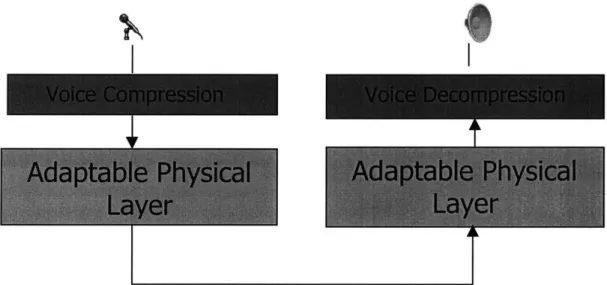
A voice compression application was used to demonstrate the Controller Module's
functionality. Voice compression is a suitable application since there are varying levels of performance, latency, and quality that can be achieved with different compression algorithms. With this application, we demonstrate that there are significant gains in voice quality that can be obtained by changing the degree of source coding in conjunction with the modulation format.
Figure 8-1. Top level diagram of voice application.
The voice application specifies its goals to the Controller Module through the quality of service interface described above. For example, the application may use the quality of service API to specify that it is trying to obtain the highest bandwidth possible. Alternatively, the application may specify that it desires a physical layer that introduces as little latency as possible.
The application receives feedback from the physical layer through its quality of service interface. For example, it may be informed that its current bandwidth has been halved. It may then compress the data to a larger extent in order to cope with the reduced
bandwidth. Under more favorable conditions, the application may compress less to deliver higher quality data. More compression often requires more computation and may result in a lower quality output.
To study the voice application, the following simulation pipeline was constructed:
Figure 8-2. Simulation pipeline.
An audio source module (not shown) receives input from the microphone and is connected to a voice compression module. This compressed voice data is then unpacked from full data bytes into symbols that can be transmitted by the modulator. The output data from the modulator goes into a channel module that introduces additive white gaussian noise into the data stream. At the receiving system, the data stream is filtered and demodulated. Next, the symbol bytes are packed into full data bytes. This data is then decompressed and sent to an audio sink module (not shown) that sends its output to a speaker. All of the aforementioned steps are performed in software.
CHANNEL SNR:
The channel introduces additive white gaussian noise into the system. The signal to noise ratio is used to assess the quality of our channel.
Using the SNR as the figure of merit is reasonable since the SNR is directly related to the bit error rate. The symbols are chosen such that neighboring regions in the constellation only have a one bit difference. Thus, as the SNR decreases, the bit error
Overall Signal to Error Ratio:
The signal to error ratio of the output of the sink module relative to the output of the source module is termed the "overall SER". Errors are introduced by both the voice compression modules and the channel. The compression modules introduce errors when they quantize the signal into discrete levels. The errors that the compression modules introduce are carefully designed to achieve high voice quality. On the other hand, the channel introduces random, additive white Gaussian noise. The contribution of both the errors due to noise through the channel and the errors due to the compression algorithm's quantization levels is represented in the overall SER ratio.
The overall signal to error ratio provides a possible metric for measuring voice quality. Since no standard metric for measuring voice quality exists, the overall SER metric should only be considered as one possible way for determining voice quality.
Since the symbol errors over the channel do not depend on whether the symbol forms the most significant bits of the byte being transmitted or the least significant bits of the byte being transmitted, some symbol errors will contribute more to the overall SER. Coding techniques such as unequal error protection have been shown to mitigate this decrease in overall SER.
The overall SER is an appropriate metric since the magnitude between the transmitted byte and received byte is measured. This metric makes sense for PCM code words. In PCM, the most significant bits are also the most important bits. The first bit represents the polarity, the next three bits represent the particular chord the value falls under, and the final four bits represent the sixteen steps within a chord. (Refer to Appendix A) Using a metric such as the bit error rate would not take into account the importance of the more significant bits. Therefore it would not be appropriate as a metric for measuring voice quality.
In this analysis, three different types of voice compression modules were studied: PCM u-law, 64 kbps
ADPCM, 32 kbps ADPCM, 16 kbps
We use 8-PAM modulation for the ulaw coder, 4-PAM modulation for the
ADPCM 32kbps coder, and BPSK modulation for the 16kbps coder. Thus our test cases
are:
Case 1: PCM 64kbps, 8-PAM Case 2: ADPCM 32kbps, 4-PAM Case 3: ADPCM 16kbps, BPSK
If we compare Case 1 and Case 2, the number of symbols transferred per second has been
halved in Case 2. To offset this lower physical data rate, the amount of compression has been doubled. Thus, each of the test cases in our analysis maintains a consistent
application data rate.
The graph on the following page plots the signal to noise ratio of the channel versus the overall SER ratio for each of the test cases.
Figure 8-3. Analysis Graph.
As the channel SNR decreases, we can see that the 8-PAM, 64kbps curve begins to decline after the channel snr is less than 12. The decline occurs when noise causes a symbol in the signal constellation to be shifted to an incorrect symbol region. After the points in the signal constellation begin to fall out of their correct region due to noise, the error rate rapidly increases.
At a channel SNR of 10, the overall SER for the 8-PAM, 64kbps curve is almost the same as the 4-PAM, ADPCM32 curve. After this juncture, the 8-PAM, 64kbps curve declines rapidly. At a channel SNR of 8.5 the overall SER for the 8-PAM, 64kbps curve is around 18. To prevent the significant loss in overall SER or voice quality, the adaptive system switches to the 4-PAM, ADPCM32 curve at a channel snr of 10. If the system had not switched to the 4-PAM, ADPCM32 curve at a channel signal to noise ratio of 4.7 dB, it would have experienced a 32 dB (-150.4%) smaller overall SER. Without the adaptation, intelligible speech could not be transferred over the channel.
By switching to the 4-PAM, ADPCM32 curve, the overall SER could remain at 26.5 dB until a channel snr of 4.5 dB is reached. At this point, the overall SER declines
for the 4-PAM, ADPCM32 curve as lower channel signal to noise ratios are seen.
Analysis
. -- 8PAM ULAW - 4PAM ADPCM32 W -- BPSK ADPCM16 an 5 ?zM' 10 15 0WOME
Channel SNRAt a channel SNR of about 2.65 the adaptive system switches to the BPSK,
ADPCM16 curve. This allows the system to obtain an overall SER of 15 until a channel
snr of 0.76 is encountered. At lower signal to noise ratios than 0.76, the BPSK,
ADPCM16 curve also declines. It still provides the system with the highest overall SER
relative to the other curves at these low channel signal to noise ratios.
As can be seen in the analysis, the adaptive wireless system can provide good service to an application by picking the modulation format and other physical layer parameters depending on the channel conditions. Other compression modules and modulation formats may provide better overall signal to error ratios at various points in the graph. Additional analysis could study how to deliver the highest voice quality by changing the compression algorithm, channel coder, and modulation format in concert under various channel conditions. This analysis shows that the ability to switch all of these physical layer characteristics allows an adaptive wireless device to deliver superior performance relative to traditional fixed schemes.
Chapter 4
Related Work
4.1 SpectrumWare Project, M.I.T. Laboratory for Computer Science
The Controller Module is a part of the SpectrumWare platform [1] [18] that enables the construction of software radios or wireless devices that perform all of their signal processing in application software. The architecture pushes the software boundary as close to the antenna as possible.
Multiband A
Front end . / . GuPPI
D
Figure 2-1. The hardware in the SpectrumWare system includes a receiver that converts a radio frequency band to intermediate frequency, analog to digital converters which digitize these samples, and a General Purpose 10 card (GuPPI), which feeds these digitized samples through the computer's PCI bus into host memory. Extensions to the Linux operating system minimize costly kernel to user space transitions and ensure fast data transfer. [1]
Using SpectrumWare, functions typically implemented with specialized hardware such as digital modulation and channel coding are instead built in C++ application
software. This approach provides several key advantages. First of all, since the properties of the physical layer itself are flexible, applications will be able to optimize their entire protocol stack depending on the channel conditions. For example, the
Software Radio ADDlicatio Operating System SpectrumWare OS extension
physical layer could dynamically change its modulation format or even change its carrier frequency and channel bandwidth.
The SpectrumWare system pushed the software boundary as close to the analog to digital converter as possible. In this manner, a SpectrumWare device is to a large extent transmission format independent. A device only needs a software upgrade to morph into a different wireless device.
SpectrumWare's unique data pull architecture enables efficient, real-time signal processing for a variety of applications. In the SpectrumWare system, the Sink module, the last module in a signal processing pipeline, requests a block of data from its nearest upstream module. This process continues for each module in the application up until the Source module. SpectrumWare allocates a certain amount of buffer space between each of these modules so that computation can begin.
The signal processing is not performed sample by sample since such a system would incur a high overhead because of function call processing time and would not make good use of caching effects. Rather, the signal processing is performed on blocks of data. One goal is that many of the blocks of data can be placed in the cache, and computed all at once for greater performance. After the data has been "marked" ready by each of the modules, the computation of these samples begins. In this manner, the sink determines the rate at which the entire application runs. Thus, data is computed at the rate that it is required and no faster. For example, an audio sink would be able to specify that it requires the computation of 8000 samples per second.
4.2 Odyssey Project, Carnegie Mellon University
The Odyssey project has studied application-aware adaptation, which allows mobile applications to adapt to their changing resources. The application's API to the Odyssey system allows it to make resource requests and receive indications of parameters of interest. The Odyssey system could be used to manage resources such as the
the operating system level. Thus, it is not able to dynamically make physical layer modifications.
4.3 Point to Point Protocol (PPP) RFC 1661, RFC 1662, RFC 1663
These RFCs describe the details of link layer control packets including bit level descriptions of LCP packets. The details of link layer negotiations are also discussed.
4.4 Voice and Data Internetworking
This text by G. Held describes details of the pulse code modulation and adaptive pulse code modulation compression techniques. Detailed information on voice
compression can be found in this resource.
4.5 A Dynamic Bandwidth Allocation Algorithm for MPEG Video Sources in Wireless Networks
This paper by Y. Iraqi and R. Boutaba describes an algorithm that enables mobile devices to provide good quality MPEG video despite varying bandwidth levels. The algorithm adjusts the level of reserved resources between the mobile device and base station so that the required quality of service is obtained.
4.6 Fundamental Challenges in Mobile Computing
This article by M. Satyanarayanan discusses the motivations for application adaptation. The article discusses several of the particular constraints involved in mobile computing and suggests that adaptation is superior to static, fixed architectures.
Chapter
5
Conclusion and Future Work
5.1 Conclusion
This thesis demonstrates the benefits of an adaptable physical layer for wireless devices. Some of the key strengths of this architecture include the capability to obtain higher data rates through modulation format changes, optimally pick the source coder and channel coder, manage power more efficiently, use more of the available spectrum, and
achieve interoperability over a wide range of protocols. The infrastructure developed in this thesis enables designers to describe adaptation for wireless devices at a high level. This thesis also details a protocol that allows Controller Modules, which facilitate the adaptation in the physical layer, to negotiate wireless physical layer parameters. The analysis illustrates the power of an adaptable physical layer for voice compression applications.
5.2 Future Work
Future work on adaptable physical layers could focus on the Controller Rules needed for a variety of applications or on new communication protocols between Controller Modules.
As an example, future work could more deeply study motivations for adaptable physical layers. Such work could detail the adaptation rules needed for dynamically choosing source coders and channel coders for a particular wireless application.
Future work could also extend the Point to Point Protocol extensions described herein to Point to Multipoint paradigms. In a Point to Multipoint topology, physical layer negotiations may be more challenging. Such work could also describe the fairness
algorithms needed so that the various Controller Modules can cooperate to achieve less congestion in the network and greater utilization of the available spectrum.
Appendix A
Background on Voice Compression
A.1 Speech
Air that passes through our vocal cords and along our vocal tract creates human
speech. The vocal cords are the two pairs of folds of mucous membrane that extend into the cavity of the larynx. The vocal tract is considered to be the entire pipe from the vocal cords to the mouth. Air from the lungs can open the vocal cords and this opening and closing of the vocal cords produces sounds such as human speech. The frequency and pitch of the sound can be controlled by the opening of one's mouth and the tension in one's vocal cords.
Speech can be classified into three categories: voiced sounds, unvoiced sounds, and plosive sounds.
A.1.1 Voiced Sounds
Voiced sounds are created when the vocal cords open and close due to air flow from our lungs. The frequency of the opening and closing of our vocal cords determines the pitch of the speech. Voiced sounds generally show a great deal of periodicity. The frequency of vibration of our vocal cords depends on the tension of the cords and the length of our cords.
A.1.2 Unvoiced Sounds
Unvoiced sounds occur when the vocal folds are already open. In this phase, air from our lungs passes unhindered to our vocal tract. Unvoiced sounds have a higher power level across a broader frequency range and do not exhibit much periodicity.
A.1.3 Plosive Sounds
When the vocal tract is completely closed, high air pressure typically builds up behind our vocal tract. When the vocal tract opens, significant low frequency energy results. This type of sound is termed plosive.
Some speech does strictly fall into any of these three categories but rather is a combination of one of these three types of sounds.
A.2 Requirements for Voice Applications
Voice applications have stringent timing requirements. Data that arrives
significantly after 250 milliseconds generally sounds unacceptable. When compressing data, we must consider the additional voice coding delay that we introduce into our system. Since voice applications are extremely sensitive to delay, we must tradeoff compressing data further and further with the amount of time such compression takes.
A.3 Voice Compression Algorithms
There are three main voice compression techniques: waveform coding, voice coding or vocoding, and hybrid coding.
A.3.1 Waveform Coding
Waveform Coding takes advantage of the regular nature of voice signals. In waveform coding, the voice signal is sampled at the necessary intervals. The coding essentially preserves the amplitude of the sample and enables reconstruction of the original signal at the receiver.
A.3.1.1 PCM
The most common type of waveform coding is Pulse Code Modulation. Pulse Code Modulation (PCM) is utilized in standard telephone networks. The communication carriers use PCM compression to provide toll-quality voice which has a certain clarity, latency, and quality.
There are three steps performed in Pulse Code Modulation. The first step is sampling the analog waveform. A voice channel is often filtered such that it produces a