Exp Brain Res (2004) 157: 215–224 DOI 10.1007/s00221-004-1835-z
R E S E A R C H A RT I C L E S
Gudrun U. Moeller . Christoph Kayser . Fabian Knecht . Peter König
Interactions between eye movement systems in cats and humans
Received: 31 December 2002 / Accepted: 29 December 2003 / Published online: 20 March 2004 # Springer-Verlag 2004
Abstract Eye movements can be broadly classified into target-selecting and gaze-stabilizing eye movements. How do the different systems interact under natural conditions? Here we investigate interactions between the optokinetic and the target-selecting system in cats and humans. We use combinations of natural and grating stimuli. The natural stimuli are movies and pictures taken from the cat’s own point of view with a head-mounted camera while it moved about freely in an outdoor environment. We superimpose linear global motion on the stimuli and use measurements of optokinetic nystagmus as a probe to study the interaction between the different systems responsible for controlling eye movements. Cats display higher precision stabilizing eye movements in response to natural pictures as compared to drifting gratings. In contrast, humans perform similarly under these two conditions. This suggests an interaction of the optokinetic and the pursuit system. In cats, the natural movies elicit very weak optokinetic responses. In humans, by contrast, the natural movie stimuli elicit effectively stabilizing eye movements. In both species, we find a unimodal distribution of saccades for all stimulus velocities. This suggests an early interaction of target-selecting and gaze-stabilizing sac-cades. Thus, we argue for a more integrated view in humans of the different eye movement systems.
Keywords OKN . Saccade . Eye movements . Cats . Humans . Target selecting . Natural stimuli
Introduction
The ocular motor system is highly adapted to direct the eyes toward salient parts of the visual scene. The eyes must first move so that salient features fall on the central
region of the retina, where spatial resolution is greatest. The visual scene must be stabilized on the retina to allow sufficient time for further analysis. Under normal viewing conditions this task is accomplished despite movements of head and body, as well as relative movements within the visual scene itself.
Three different types of orienting eye movements can be distinguished when a viewer directs her eyes to a visual target. These eye movements can be broadly classed as saccades, pursuit movements, and vergence movements (Goldberg 2000). Saccades are rapid, usually conjugate, eye movements, which orient the eyes to regions of interest. They are characterized by high velocity, reaching up to 900°/s in humans. Saccadic eye movements have been well investigated in both cats and primates (Evinger and Fuchs1978; Evinger et al.1981; Guitton et al.1990; Araujo et al. 2001; Leopold et al. 2002). Pursuit move-ments are tracking eye movemove-ments. They ensure that moving objects are retained at a static position on the central region of the retina. Pursuit movements have conventionally been studied using spots of light. Trained cats are able to follow targets moving up to 40°/s, while primates can follow velocities of up to 100°/s (Missal et al. 1995). When target velocity is very high and cannot be matched by tracking eye movements, catch-up saccades are triggered via the retinal slip. These catch-up saccades are in the same direction as the target motion. Finally, vergence movements adjust the viewing angle of each eye to maintain correct correspondence between the two retinal images. Maintaining this correspondence is critical for stereoscopic (depth) vision.
In the vertebrate visual system, the optokinetic reflex and the vestibulo-ocular reflex are responsible for stabi-lization of the retinal image. The optokinetic reflex is triggered by global unidirectional motion of the visual image across the retina (retinal slip). There are two phases of the reflex: a slow phase in which the eyes track the moving visual scene and thus move in the same direction as the image, and a rapid compensatory phase in which the eyes move in the opposite direction. When global motion is sustained the optokinetic nystagmus (OKN) is observed G. U. Moeller . C. Kayser . F. Knecht . P. König (*)
Institute of Neuroinformatics, University/ETH Zürich, Winterthurerstrasse 190,
8057 Zürich, Switzerland e-mail: [email protected] Fax: +41-1-6353053
as an alternation between slow and fast phases. The vestibulo-ocular reflex compensates for movements of head and body and is driven by signals from the vestibular system. Thus, stabilizing eye movements are elicited by visual as well as non-visual sensory inputs.
Target-selecting and target-stabilizing systems are thought to be under separate control by different cortical and subcortical regions (Gaymard et al. 1998; Pierrot-Deseilligny et al. 2002). While the neural control of eye movements appears to be divided into separate systems, the different types of eye movements occur simultaneously under normal conditions. For example, watching scenery from a moving train will elicit scanning and stabilizing eye movements. When searching for an item on the ground during walking, global motion of the scene will induce the OKN, while head movements will elicit the vestibulo-ocular reflex. Additional scanning eye movements will further contribute to the search process.
Here we study the interaction between the OKN and explorative saccades in cats and humans using natural visual stimuli. Natural stimuli were first sampled with a video camera mounted on a cat’s head while it explored freely an outdoor environment. The videos capture natural properties of the cat’s visual input, including head and body movements, but excluding eye movements. We then present the same set of videos to cats and humans while measuring their eye movements. The stimulus set consists of these movies, still pictures taken from the videos, and classical bars for comparison. Furthermore, these stimuli are shown either in their original form, or with super-imposed global motion. Various types of eye movements are elicited by these stimuli, for example saccades scanning the visual scene, saccades during OKN fast phase, eventually catch-up saccades, and tracking eye
movements. This allows us to use the elicited OKN as a probe to investigate the different classes of eye movements and their interaction.
Materials and methods Animal and human subjects
Three adult cats (female, A, B, L, age 2–3 years) and five adult humans (two females, three males, age 22–40 years) participated in our experiments. All subjects had normal vision. This work was approved by the local ethics committee and conformed to federal regulations.
Recording eye movements in cats and humans
Eye movements were recorded with a Dual-Purkinje Image (DPI) eye-tracker (Fourward Optical Technologies, Clute, TX, USA). The movements of the right eye were tracked. For a more detailed description of the method used for non-contact eye-tracking in cats, see Körding et al. (2001). Briefly, each cat had previously received a cranial implant. The implants included two mounts that were used to fix the cat’s head in the eye-tracking setup (Fig.1d). The human subjects were stabilized using a dental bite bar and additionally held with a second bar using an elastic band around the forehead. The advantage of using the DPI eye-tracking technique was the high degree of spatial (<1°) and temporal accuracy (1,000 samples/s). The technique also avoided the need for invasive eye surgery. The eye-tracker produced three analog signals: a horizontal and a vertical output, and a TTL signal (BLINK) indicating when the device was tracking accurately. The signals were amplified and converted to digital form (SynAmp amplifier; Neuro Scan Laboratories, USA).
Eye-tracking measurements from the cats were calibrated using a technique similar to the reversed ophthalmoscope method (Körding et al. 2001). In the measurement from humans, the tracking data were calibrated against a set of fixation points, assessed at the beginning and the end of each trial.
Fig. 1a–d Methods. a Captur-ing natural visual input usCaptur-ing the cat-cam setup. A small CCD camera is mounted on a cat’s head (bottom left), connected by a leash to the VCR, which is carried by the operator (right). b Examples of images acquired from the head-mounted camera. c Linear global motion super-imposed on a natural picture. The red arrows indicate the border where the shift of the picture starts. d The eye-track-ing setup for cats: on the left is the tube in which the cats where placed while viewing the stimuli on the monitor. The DPI eye-tracker is placed on the right side
Artificial and natural stimuli
We recorded the natural movie sequences using a lightweight CCD camera (Conrad Electronics, Hirschau, Germany) attached to the cat’s head using the mounts on the cranial implant. Recordings were made while the cat explored natural environments including forestlands, meadows, and the grounds of the university campus (Fig. 1a). The CCD camera sampled a field of view of approximately 53×71°. Therefore, a large proportion of the cat’s frontal visual field was sampled. Subjects viewed the stimuli on a 19-inch CRT monitor (viewing distance for cat: 50 cm, human: 56 cm; Fig.1d).
The CCD camera was connected via a cable to a standard VHS video recorder (PAL). The experimenter, who accompanied the cat as it moved about freely, carried the video recorder. Due to the movements of the cat, the visual stimuli contain strong flow fields and a quantitative analysis gives an average velocity of 36.1°/s (±21.0°/s) of the linear component of the flow field. Videos were digitized off-line at a temporal resolution of 25 Hz, a spatial resolution of 320×240 pixels (1 pixel=12 min of arc) and a color depth of 16 bits. They were then converted to an 8-bit gray scale version of the original (Fig.1b). We refer to these video recordings as natural movies.
Three classes of stimuli were presented: natural movies (denoted M for movies), natural still pictures (denoted P for pictures), and square-wave gratings (denoted B for bars). Each stimulus was also presented in a modified form, in which leftward, linear global motion was superimposed by drifting the original stimulus through a viewing frame at fixed velocities of 6.25°/s, 12.5°/s and 25°/s (Fig. 1c). As a control we also presented versions of the modified stimuli with global motion in the direction of the remaining cardinal axes (rightward, upward, and downward). To control for possible asymmetries in the intrinsic motion of the natural movies we also presented them in reverse temporal order.
For the natural movies, these conditions were labeled as M0 (no global motion superimposed), M2 (2 pixel per frame equivalent to 6.25°/s global motion superimposed), M4 (4 pixel per frame equivalent to 12.5°/s global motion superimposed), and M8 (8 pixel per frame equivalent to 25°/s global motion superimposed). The still pictures are single frames selected from the original movie sequences. Static and drifting versions of the picture stimuli are denoted as P0, P2, P4, and P8. Finally, the square wave grating stimuli were displayed at 0.1 cycles per degree and oriented vertically. Static and drifting versions of the grating stimuli are denoted as B0, B2, B4, and B8.
Experimental procedure
Since we try to mimic natural viewing conditions, subjects were free to choose the direction of gaze. No training preceded these experiments. Neither reward nor any other kind of feedback was given during the recording session. Each recording session lasted between 16 and 30 min. Cats viewed a single stimuli condition per recording session, while human subjects were presented with each stimulus condition, one after the other, in 35-s trials. All cat and human subjects watched all types of stimuli, except the static bars were omitted for the human subjects. All other aspects of the recordings were identical for cat and human observers. Hence, the human subjects were watching cat-recorded natural stimuli. This raised the question as to whether the potentially different dynamic properties of the cat’s point of view could cause problems in humans? This would be apparent in a reduced tracking performance. If this were the case, we would have to compare different stimulus sets in cats and humans. However, as further described below, our results pointed in the opposite direction. Furthermore, changing too many parameters in our study would have made a systematic comparison difficult, and we decided to compare human and cat performance on the identical stimulus set.
Data analysis
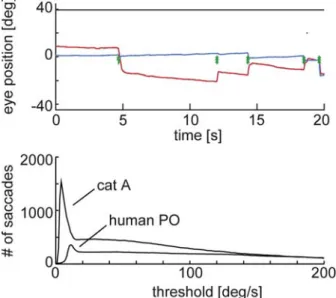
Eye-movement recordings were analyzed off-line. All segments where the TTL (BLINK) signal did not indicate valid eye-tracking were excluded from further analysis (Fig.2top). Eye velocity was defined as the absolute value of the temporal derivative of eye position. Movements corresponding to saccades were identified on the basis of a velocity threshold of 50°/s. Reaching this threshold also determined the onset and offset of a detected saccade. This value was determined empirically from a large sample of cat and human eye movement traces (Fig.2bottom). We then assessed the characteristics of the saccadic movements. Amplitude was defined as the distance between eye position at the start of the saccade and the end of the saccade. Duration was defined as the time difference between saccade onset and offset.
Movements below 50°/s were classified as intersaccadic move-ments. Their characteristics were highly variable, and tended to be influenced by the saccades that preceded and/or followed them, especially in cats (Missal et al.1993). To minimize the impact of these dependencies, the characteristics of the intersaccadic move-ments were computed exclusively from the middle third portion of each intersaccadic movement trace. This procedure leads to results that are robust with respect to variations of parameters. We checked it by visual inspection and found it particularly helpful for the cat data. In order not to compromise the comparison of species, we applied this process to human data as well.
Results
Quantitative saccade characteristics
Quantitative characteristics of saccadic eye movements are computed on the basis of approximately 20,000 cat saccades and 67,000 human saccades. When viewing
Fig. 2 Data analysis. Original traces of eye position recorded from cat A while it viewed natural pictures in which a global motion of 6.25°/s had been superimposed (P2): the horizontal (red) and the vertical (blue) eye movement component versus time. The green asterisks indicate detected saccades, as identified using a velocity threshold. The horizontal black line at 40° indicates the valid respectively used data (TTL signal; top). The number of detected saccades is shown versus the threshold from 0 to 200°/s (data shown for the condition P2, cat A, duration: 20 min; human PO, duration: 70 s; bottom)
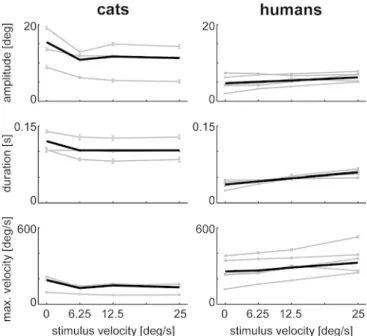
static natural pictures (P0), cats perform between 0.05 to 0.43 saccades per second, while humans perform between 1.72 to 2.83 saccades per second. Figure 3 shows the average amplitude, duration, and maximum velocity of saccadic eye movements made during presentation of natural and modified natural pictures. Looking at averaged data we see larger saccade amplitudes and durations in cats than in humans. For stimulus condition P0, the median amplitude of a saccade is 15.4° in cats and 4.7° in humans (Fig. 3 top). The median duration is 0.12 s in cats and 0.036 s in humans (Fig. 3 middle). Correspondingly, the maximum velocity of saccades is lower in cats than in humans. We observe an average peak velocity of 189°/s in cats and 257°/s in humans (Fig.3bottom). The individual subject data are more variable in cats than in humans. This is, for example, visible in the small scatter of individual data of the human subjects around the average. In contrast, the distribution of saccade characteristics is quite broad in cats. For example, the standard deviation of saccade amplitudes upon presentation of stimulus P0 is 9.45° in cats much larger than the standard deviation of 5.63° found in humans. Similarly, the standard deviation for saccade duration is 0.078 s for cats and 0.049 s for humans. Correspondingly, the standard deviation for maximum saccade velocity for P0 of 140°/s for cats is smaller than the 227°/s observed for humans. Thus, we find systematic differences between cats and humans in their basic characteristics of saccadic responses to static natural pictures.
Superimposed linear global motion has a significant impact on average saccade characteristics. Both cats and humans display OKN in response to the introduction of global stimulus motion (P2, P4, P8). However, in cats the median amplitude, duration, and maximum velocity of eye movements are smaller for moving than for static natural pictures. The opposite is true for human observers. The change in amplitude, duration, and maximum velocity are highly significant for both cats and humans (for both: P<<0.01 P0 versus P8). The standard deviation of saccade characteristics is little dependent on the superimposed linear motion. For saccade amplitude the smallest standard deviation in cats is 6.95° (P2) and the biggest is 9.45° (P0), while for humans they are 5.63° (P0) and 6.08° (P4), respectively. For saccade duration the smallest standard deviation in cat is 0.061 s (P2) and the biggest is 0.078 s (P0), while for humans they are 0.036 s (P2) and 0.060 s (P4), respectively. For the maximum velocity the smallest standard deviation in cats is 100°/s (P2) and the biggest 140°/s (P0), while for humans they are 226°/s (P) and 255°/s (P8), respectively. Thus, we find systematic differences between cats and humans in their basic characteristics of saccadic responses to moving natural pictures.
Saccades elicited by linearly moving pictures
The eye movement traces shown in Fig. 4 illustrate different types of eye movement made by cats and humans, with and without superimposed global motion on natural stimuli. When cats view natural pictures presented without linear global motion (P0), they tend to fixate for long periods. Occasional, large shifts in gaze are observed. In contrast, humans tend to make many small saccades, and relatively few large saccades. When viewing pictures in which linear global motion has been super-imposed, both cats and humans display OKN. Slow eye movements can be seen, followed by a fast saccade in the opposite direction, which corresponds to the slow and fast phase of OKN. Cats display robust OKN up to a global stimulus velocity of 12.5°/s for natural pictures, but at higher velocities the OKN becomes substantially weaker. In contrast, humans display robust OKN up to the highest global velocity tested (25°/s, Fig.4bottom). The effect of global motion velocity on saccadic characteristics reveals a difference between humans and cats. In contrast to humans, cats appear to follow stimulus velocity with slow eye movements that do not match stimulus velocity completely. In order to match stimulus velocity, they may partly perform catch-up saccades. Indeed, in the example of Fig.4, a saccade in the direction of stimulus movement can be seen at the highest stimulus velocity. However, it is also visible that catch-up saccades do not occur that often and do not fully compensate for the low velocity of OKN slow phase. In contrast, humans have not reached their capacity limit of OKN slow phase and still match increasing stimulus velocity. This is visible in larger and faster correcting saccades with faster stimulus velocities. Fig. 3 Saccade characteristics. Amplitude (top), duration (middle),
and maximum velocity (bottom) of cat (left) and human (right) saccades while viewing natural and modified natural stimuli at different stimulus velocities (P0, P2, P4, P8). Data points (gray) indicate median and SEM of individual subjects. The black line shows the averaged data across all subjects. The data points of all cats consist of all recording sessions including 1,549 saccades for P0, 1,597 for P2, 1,507 for P4, and 1,568 for P8. The data points of all humans consist of all recording sessions including 6,884 saccades for P0, 7,296 for P2, 6,981 for P4, and 7,616 for P8
Thus, we can identify qualitative differences between cats and humans in the OKN when examining their responses to pictures moving at different constant velocities.
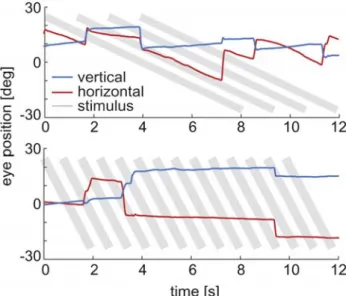
To address the issue of catch-up and anticipatory saccades we present eye movement traces in Fig. 5. Catch-up saccades are defined as eye movements compensating for poor smooth pursuit performance, thereby reducing the discrepancy between gaze direction and target location. As a consequence, during catch-up saccades, the eyes move in the same direction as the target. Catch-up saccades and anticipatory saccades are related to smooth pursuit and our Ganzfeld stimulus is expected not to be optimal to elicit this type of eye movements. Indeed, in cats watching linearly moving Ganzfeld stimuli we observe only a small number of saccades in the direction of stimulus motion. In Fig. 5 (top) one such instance is visible. Around 4 s a saccade in the direction of stimulus motion occurs, reducing the accumulated error of the preceding tracking period. Immediately afterwards the cat continues tracking for nearly 3 s. The noticeable difference in slope leads to an accumulated error of several degrees. Still, the next saccade is directed opposite to the stimulus motion, and no catch-up saccade is observable. During high stimulus motion tracking performance is low, but no appropriate increase in the number of catch-up saccades is observed. Thus, in cats, poor tracking performance is not regularly compensated by catch-up and anticipatory sac-cades.
The changing distributions of saccades depending on stimulus velocities are shown for cats and humans (Fig.6). A number of randomly selected saccades are shown for individual subjects as well as for all subjects. For condition P0 fast eye movements are distributed uniformly in cats and humans (Fig. 6 first row). The horizontal component of eye movement vectors varies over a wide range with an average value near zero (median/mean for
P0 all cats: 0.32°/0.37°, all humans: 0.08°/0.34°). The distribution shifts when global horizontal motion is superimposed. Saccadic movements are directed opposite to stimulus motion, resetting the eye to a position that allows an appropriate slow phase response (median/mean for P2 all cats 4.38°/3.72°, all humans 1.84°/2.17°). In cats, the shift of the distribution increases up to P4 and then decreases for P8 (median/man for P4 5.86°/4.89°, for P8 2.20°/1.04°). In humans, the shift of the distribution increases monotonically with increasing stimulus velocity (median/mean for P4 3.08°/3.46°, and for P8 4.57°/4.94°). Fig. 4 Original data. Cat and
human eye movement traces of the horizontal (red) and the vertical (blue) component from cat subject A (left) and human subject PO (right) while view-ing natural (first row) and mod-ified natural images (second to fourth row) for 20 s. The horizontal black line at 40° indicates the valid respectively used data (TTL signal). Inter-ruptions of the black line in-dicate that the concomitant eye movement traces are excluded from further analysis
Fig. 5 Original data and stimulus velocity. Cat eye movement traces of the horizontal (red) and the vertical (blue) component from cat subject A while viewing natural images moving with stimulus velocity of 6.25°/s (top) and with 25°/s (bottom). Perfect tracking would lead to traces parallel to the gray lines indicating stimulus velocity
For all stimulus velocities, horizontal linear velocity affects only slightly the vertical component of the saccades. The effect of global superimposed motion on the amplitude and direction of eye movements increases for velocities up to 12.5°/s (P4) in cats and up to 25.0°/s (P8) in humans.
Does the fraction of saccades directed in stimulus motion change? We calculate the fraction of saccades within the horizontal leftward pointing sector of 22.5° size. For cats watching the natural images moving at low and middle velocities, this fraction decreases (P0: 11%, P2: 7%, P4: 5%). Only for high stimulus velocity, the fraction of saccades in direction of stimulus motion increases again (P8: 10%). For humans, the fraction of saccades in the direction of stimulus motion is initially higher and decreases monotonically (P0: 26%, P2: 17%, P4: 12%, P8: 8%). Thus, contrary to expectations, in both species the number of saccades in the direction of stimulus motion, which are potentially catch-up saccades, does not increase monotonically with increasing stimulus velocity. Figure 6(bottom row) shows histograms of amplitudes and directions of cat and human saccades at each of the velocities tested for natural pictures. When natural pictures are shown without global motion (P0), target-selecting
saccades are induced. However, when viewing pictures with superimposed motion (P2–P8), stabilizing saccades are induced as well. We now investigate whether we can regard these supposedly distinct kinds of saccades as separable events in recordings of eye position. If target-selecting and stabilizing saccades were indeed separable, then in addition to the peak in the distribution at 0° a second peak would appear toward higher values following addition of global motion. Alternatively, if each saccade reflects the sum of target-selecting and stabilizing saccade components, the entire population of saccades would shift and no peak would remain at 0°. Figure 6 demonstrates that in cats as well as in humans the saccade population is shifted when global motion is superimposed, and no peak for these populations can be identified at 0°. This shift is not associated with a concomitant broadening of the distribution (Fig.6bottom row, standard deviation for cats: for P0 11.2°, P2 8.8°, P4 8.9°, P8 9.6°, standard deviation humans: for P0 6.9°, P2 7.1°, P4 6.8°, P8 6.6°). Hence, scanning and stabilizing eye movement systems, namely those responsible for OKN-fast phase and target-selecting saccades, do not independently trigger saccades, but join together to form one homogeneous saccade population. Fig. 6 Saccade direction and amplitude. Direction and amplitude
of saccades of individual cat subject A (first column), all cats (second column), individual human subject PO (third column), and all human subjects (fourth column) while viewing natural and modified natural pictures (first row P0, second row P2, third row P4, fourth row P8). The amplitude and direction of the saccades are aligned to the origin. For graphical clarity only a randomly selected number of saccades are shown: 100 saccades for individual subjects
and 400 for all subjects. The two histograms at the bottom show distributions of amplitude and direction of the horizontal saccade component of all saccades for the conditions natural and modified natural pictures (P0, P2, P4, and P8). Data are shown from all cat (left) and human subjects (right). Please note: since in this figure the horizontal component of saccades is incorporated, the center of gravity cannot directly be compared with the median saccade amplitude in Fig. 3
Influence of different types of stimuli on saccades As a next step we compare eye movements elicited by each of the three stimulus types with a fixed global
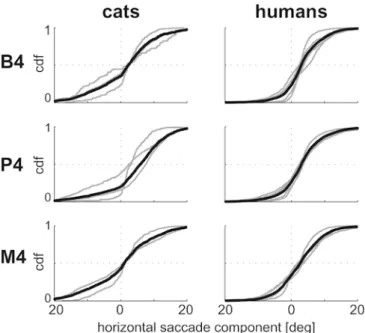
velocity of 12.5°/s. In Fig. 7 the cumulative distribution function of saccade amplitude is shown for gratings (B4), pictures (P4, same data as in Fig.5), and movies (M4). For all cats the distributions are all shifted from zero (Fig. 7 left). The size of the shift, however, differs substantially. Viewing moving pictures, the average shift of the horizontal saccade component is 5.9° (P4). Gratings elicit a shift in the distribution amounting to less than half this value (B4 2.4°). Surprisingly, when viewing the movie, the average shift is the smallest of the three stimulus conditions (M4 1.1°). Thus, in cats, the moving natural pictures elicit the OKN more effectively than movies or gratings. In humans, moving natural pictures elicit an average shift of the horizontal saccade component of 3.1° (P4). Moving gratings and movies lead to comparable shifts (M4 2.7°, B4 3.0°). Thus, in contrast to cats, the movies proved to be effective at eliciting optokinetic eye movements for the human observers.
We compare all stimulus conditions of cats and humans (Fig.8). The effect of the stimulus conditions is quantified by the median of the distribution of the horizontal saccade component. In cats, the size of the average effect for natural pictures increases strongly between no global motion (P0) and medium global motion (P4). When the velocity reaches 25°/s (P8), the effect is reduced by more than 50% (P4 5.9° versus P8 2.2°). In the case of the movie stimuli, the effect is small and does not increase with increasing stimulus velocity. For gratings, the effect peaks at the lowest velocity (B2 6.25°/s) and decreases when velocities were increased further. In humans, we find a monotonic increase in the average effect with increasing stimulus velocity for each of the three stimulus types (Fig.9). The size of the effect is approximately the same for each stimulus type (B8 3.9°, M8 4.1°, P8 4.6°). The Fig. 7 Cumulative distribution function (CDF). CDF of the
horizontal component of saccades from cat (left) and human (right) subjects for various stimulus conditions: bars (top), pictures (middle), and movies (bottom). All stimuli shown here were presented with a superimposed global motion of 12.5°/s, resulting in B4, P4, and M4. The data of P4 are shown in the form of a histogram in Fig. 6. The black lines represent the average across all subjects and all sessions. The gray lines show data from the individual subjects. The crosshairs in dotted lines are shown to ease the access to the difference between the stimuli conditions, for example, the shift of the median
Fig. 8 Saccade displacement. The median displacement of the horizontal saccade component of cat (left) and human (right) subjects is shown versus stimuli motion for all types of stimulus conditions. The color code indicates the stimulus condition: bars (red), movies (green), and pictures (blue). The corresponding lighter
colors represent the data points of the individual subjects. Error bars represent the SEM. The strong colors represent the averaged data across all subjects. The values plotted for B4, P4, and M4 can be compared with Fig. 7, where the CDF crosses the benchmark of 0.5. Please note: there is no data point for humans at B0
consistent effect of global velocity in humans contrasts strongly those found in cats.
Gain of intersaccadic eye movements
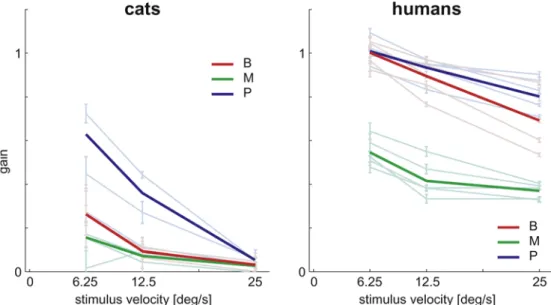
We characterize the properties of intersaccadic intervals using an estimate of the gain between stimulus motion and resulting eye movements (Fig. 9). Gain is defined as the ratio between eye velocity during the intersaccadic interval and the stimulus velocity. It measures how faithfully the gaze follows linear stimulus motion. If the velocity of the eye movement matches stimulus velocity, the gain is 1. If eye movement velocity is lower than stimulus velocity the gain is less than 1. Where the gain is equal to or near zero, we can conclude that stimulus motion has no influence on eye movements made during the intersaccadic interval. Figure9shows that the gain for each stimulus condition is smaller in cats than in humans. These results are consistent with previous findings (de Brouwer et al. 2001). A prominent feature in our results is that the gain consistently decreases with increasing global velocity. In cats, for the fastest stimuli the gains are close to zero. In contrast, even at the highest velocities humans still achieve high gain values (P8 0.80, B8 0.64, M8 0.37). Thus, compared to humans, cats have consistently lower gain and the gain decreases more strongly with increasing stimulus velocity.
Comparing the effect of different stimulus types, the highest gain for cats is found for natural pictures (P2 0.63, B2 0.26, M2 0.16). This shows that the gain is two and four times higher for viewing natural pictures compared to presentation of bars and movies, respectively. In contrast, in humans at low stimulus velocities, bars induce a similar gain as natural pictures (P2 1.09, B2 1.04). The gain then decreases at higher velocities, though the decrease is more pronounced for bars than for pictures (P4 0.99, B4 0.90). When viewing movies, OKN slow phase never achieves such high gain values but is significantly different from zero at all stimulus velocities (M2 0.57, M4 0.42,
M8 0.39). The gain for the movies was as well as for the other stimuli calculated on the basis of the super-imposed stimulus motion, the intrinsic motion was not included. This could influence the OKN performance and thus the gain. Nevertheless, our results show that natural pictures are most efficient in eliciting stabilizing eye movements. Natural movies are not optimal optokinetic stimuli, but humans can still perform stabilizing eye movements, whereas in cats the stabilizing effect is nearly absent.
Discussion
When eliciting target-selecting and stabilizing eye move-ments with natural stimuli we observe different types of interactions. Firstly, the tracking abilities of cats viewing moving natural pictures are surprisingly high. Secondly, we find evidence of an early interaction of optokinetic and target-selecting eye movement systems. Thirdly, in con-trast to cats, humans were well able to stabilize the visual input of a natural movie under head-fixed condition even if the stimulus itself was recorded by freely behaving subjects.
Are the quantitative properties of saccades measured with natural stimuli in agreement with previous studies? Our cat saccades have average amplitude of 15°, duration of 120 ms, and peak velocity of 190°/s. For humans we find saccades with average amplitude 5°, duration 36 ms, and peak velocity 257°/s. Crommelinck and Roucoux (1976) found 15° saccades lasting 80–200 ms with maximum velocities of 120–190°/s measured in drowsy, aroused, and strongly aroused cats. Blakemore and Donaghy (1980) measured in cats 20° saccades lasting 110 ms with maximum velocity of 250°/s. Evinger and Fuchs (1978) found for horizontal saccades with 15° amplitude the duration of 160 ms with peak velocity of 170°/s. For humans, Bahill and Starck (1975) found for 5° saccades the duration of 35 ms with maximum velocity of 250°/s. Note that comparisons between studies must be Fig. 9 Gain. The gain of the
intersaccadic intervals versus the stimulus motion under the various stimulus conditions (bars red, movies green, pictures blue) for cat (left) and human (right) subjects. The strong co-lored lines represent the average across all subjects within each species group; the lighter co-lored lines represent the data with SEM of the individual subjects
made with caution as saccades are strongly influenced by the task being performed and by the state of arousal (Bahill and Stark1975; Crommelinck and Roucoux1976; Galley 1998). Although some variability exists, our saccades measured while viewing natural pictures are compatible with previous results using artificial stimuli.
The maximal velocity of tracking eye movements is higher for natural pictures than for artificial stimuli. Compatible with previous results using gratings (Donaghy 1980) the gain rapidly approaches zero at velocities above 8°/s. The differences in tracking performances raise the question, whether this is a specific effect, i.e., bar stimuli are suboptimal in inducing OKN in cats, or a general effect, for example, related to the level of alertness. Indeed, subjectively (from the human point of view) the natural pictures appear to be more interesting than gratings. However, whether such a difference induces a sustained difference in level of attention during the recording session is unclear. In the present study the movies are the most challenging stimuli. Should they be the most natural and therefore effective stimuli? They induce the poorest tracking performance even at low linear velocities. Currently we do not have evidence that potential differences in state of alertness influences these aspects. We suspect that the intrinsic motion of the natural movies disturbs stabilizing eye movements. This could explain the weak OKN performance and the low gain for natural movies. High-contrast random dot patterns (Maioli and Precht1984) elicited best responses OKN up to 80°/s. Maioli and Precht claim random dot patterns are as effective as the laboratory environment and more effective than a variety of other artificial stimuli. As the duration of recordings is not given we cannot compare the present data with this previous report. Furthermore, Maioli and Precht used amphetamines to keep the cats alert. Never-theless, natural stimuli appear to be the most effective and elicit OKN at high velocities.
To explain why natural pictures are the most effective stimuli, we speculate that pursuit eye movements, which are typically studied using small target stimuli, are also involved when maintaining fixation in real-world scenes. Indeed, maximal velocity of smooth pursuit eye move-ments is rather high and increases further when an optokinetic background is added (Evinger and Fuchs 1978; Missal et al. 1995). Therefore, we speculate that stabilizing eye movements reflect a combination of slow phase OKN and pursuit eye movements. Even if subjects must often track a moving target in front of a stable background under natural conditions, frequently they have to track a moving target in front of a moving (for example, due to ego motion) background. Thus, the OKN and pursuit eye movements may not be strictly separable under natural viewing conditions.
Our experiments were designed to investigate the interaction between target-selecting and stabilizing eye-movement systems. This interaction between the system controlling OKN fast phase and the target-selecting eye movement system may take place early or late in the process underlying the generation of saccades. In
particular, the two systems may each have the possibility to trigger a saccade on their own. The trigger signals from each would converge after the threshold process of saccade initiation. In principle, it would then be possible to assign each individual saccade to one or other system. Given the properties of our stimuli, a bimodal distribution of saccade amplitudes is to be expected: one peak around zero and another at large positive values. Additionally, at very high stimulus velocities, when OKN slow phase does not follow the stimuli perfectly, catch-up saccades could contribute and would accentuate the bimodality.
An alternative model would involve early interaction between the two systems, before saccades are triggered. Here, signals from target-selecting and stabilizing systems would interact and be jointly processed by a non-linear threshold process. Thus, saccades would be influenced simultaneously by both systems and each triggered saccade would contain stabilizing and target-selecting aspects. This hypothesis does not predict a separate peak around 0°. Our observation of a homogeneous and unimodal distribution in both cats and humans favors the latter view. Furthermore, it demonstrates that although catch-up saccades do rarely occur, they are of limited quantitative influence under the used paradigm. In conclusion, we observe an early interaction between the OKN fast phase, a reflex, and target-selecting eye movements, which are considered to be under control of higher-level processes.
During recording of the movie, the cat moved about freely. Under these conditions the vestibulo-ocular reflex contributes to the stabilization of the retinal image. When viewing these movies under head-fixed conditions, move-ment is experienced exclusively via the visual modality. The vestibular inputs that the cat has experienced while moving about freely, are obviously absent to the viewer. Our results show that humans display robust OKN when watching natural movies. Similar conclusions can be drawn from the analysis of gain. This analysis indicates that humans are able to compensate for the absence of vestibular inputs by using the visual input only, and generate appropriate stabilizing eye movements. The much weaker OKN response apparent in cats suggests they cannot compensate for the absent vestibular informa-tion.
Studying interaction between different eye movement systems proves to be a fruitful enterprise. The present data show a clear interaction between supposedly distinct systems: the early interaction between the OKN fast phase and target-selecting eye movements as well as compensa-tion of missing vestibular signals by visual input in humans. Integration of the signals could be resolved using a dynamic hierarchical organization (Schweigart et al. 1999), where a single system dominates a subset of the remaining systems. That humans are able to compensate for absent vestibular inputs is compatible with this dynamical hierarchical scheme. The integration of OKN and target-selecting systems matches better a cooperative model of visual-motor control. We conclude that there is stronger interaction between target-selecting eye
move-ments and the more reflex oriented gaze-stabilizing systems than is assumed in conventional models of eye movement control.
Acknowledgements This work was supported by the Center of Neuroscience Zürich (C.K.), the SNF (grant number 31-65415.01; P. K.), and the EU/BBW (IST-2000-28127; 01.0208-1; G.M., P.K.). We are grateful to T.C.B. Freeman for comments on previous versions of this manuscript.
References
Araujo C, Kowler E, Pavel M (2001) Eye movements during visual search: the costs of choosing the optimal path. Vision Res 41:3613–3625
Bahill AT, Stark L (1975) Overlapping saccades and glissades are produced by fatigue in the saccadic eye movement system. Exp Neurol 48:95–106
Blakemore C, Donaghy M (1980) Co-ordination of head and eyes in the gaze changing behavior of cats. J Physiol 300:317–335 Crommelinck M, Roucoux A (1976) Characteristics of cat’s eye
saccades in different states of alertness. Brain Res 103:574–578 de Brouwer S, Missal M, Lefevre P (2001) Role of retinal slip in the prediction of target motion during smooth and saccadic pursuit. J Neurophysiol 86:550–558
Donaghy M (1980) The contrast sensitivity, spatial resolution and velocity tuning of the cat’s optokinetic reflex. J Physiol 300:353–365
Evinger C, Fuchs AF (1978) Saccadic, smooth pursuit, and optokinetic eye movements of the trained cat. J Physiol 285:209–229
Evinger C, Kaneko CR, Fuchs AF (1981) Oblique saccadic eye movements of the cat. Exp Brain Res 41:370–379
Galley N (1998) An enquiry into the relationship between activation and performance using saccadic eye movement parameters. Ergonomics 41:698–720
Gaymard B, Ploner CJ, Rivaud S, Vermersch AI, Pierrot-Deseilligny C (1998) Cortical control of saccades. Exp Brain Res 123:159– 163
Goldberg ME (2000) The control of gaze. In: Kandel ER, Schwartz JH, Jessel TM (eds) Principles of neural science. McGraw-Hill, New York, pp 782–800
Guitton D, Munoz DP, Galiana HL (1990) Gaze control in the cat: studies and modeling of the coupling between orienting eye and head movements in different behavioral tasks. J Neurophysiol 64:509–531
Körding KP, Kayser C, Betsch BY, König P (2001) Non-contact eye-tracking on cats. J Neurosci Methods 110:103–111 Leopold DA, Plettenberg HK, Logothetis NK (2002) Visual
processing in the ketamine-anesthetized monkey. Optokinetic and blood oxygenation level-dependent responses. Exp Brain Res 143:359–372
Maioli C, Precht W (1984) The horizontal optokinetic nystagmus in the cat. Exp Brain Res 55:494–506
Missal M, Crommelinck M, Roucoux A, Decostre MF (1993) Slow correcting eye movements of head-fixed, trained cats toward stationary targets. Exp Brain Res 96:65–76
Missal M, Lefevre P, Crommelinck M, Roucoux A (1995) Evidence for high-velocity smooth pursuit in the trained cat. Exp Brain Res 106:509–512
Pierrot-Deseilligny C, Ploner CJ, Muri RM, Gaymard B, Rivaud-Pechoux S (2002) Effects of cortical lesions on saccadic eye movements in humans. Ann N Y Acad Sci 956:216–229 Schweigart G, Mergner T, Barnes G (1999) Eye movements during
combined pursuit, optokinetic and vestibular stimulation in macaque monkey. Exp Brain Res 127:54–66