Muonium Chemistry
By PAUL W. PERCIVAL, Physikalisch-Chemisches Institut der Universität Zürich, Winterthurerstr. 190, CH-8057 Zürich
(Received October 27, 1978; revised November 29, 1978)
Hydrogen isotopes I Isotope effects /Muonium / ßSR /Radiolysis / Review
Summary
Muonium is a single-electron hydrogen-like atom with a short-lived elementary particle, the positive muon (μ+, πΐμ = ^ mp, τ = 2.2 X 10"® s) as nucleus. It is formed by stopping high energy μ+ in matter. Spin polarized muons in a magnetic field give rise to
precession signals characteristic of their chemical environment. Three types of species are identifiable by the μ+SR technique: (i) Bare muons, or muons substituted in diamagnetic molecules (in place of protons); (ii) Free muonium; and (iii) Muonium sub-stituted free radicals. Observation of these signals is restricted to times > 10"' s, but their initial amplitudes also contain informa-tion about processes occurring between 10"'1 s and 10"8 s. Muoni-um can be detected in various inert gases and in water, methanol and ethanol. Rates of reaction have been determined directly from the observed signal decay. Comparison of rate constants for muoni-um reactions with the corresponding hydrogen atom data reveals kinetic isotope effects of varying degree. Such results provide valuable material for tests of reaction rate theories. Isotope effects of the structural kind are found for the isotopic muon-electron hyperfine coupling constants measured for the free radicals formed when muonium adds to an unsaturated molecule. The results have been interpreted in terms of the relative occurrence of different radical conformers. The nature of the "early events" in muonium chemistry, which determine the distribution of muons between the various types of muonic species, is a matter of some dispute. Recent evidence from aqueous systems suggests that muonium is formed in the terminal spur of the muon track. This contrasts with the older view that muonium is formed at epithermal energies by electron abstraction from the medium, and that the initial diamagnetic fraction constitutes the products of hot muonium reactions.
1. Introduction
Muonium is the exotic atom consisting of a positive muon (μ+) and an electron. The positive muon is an elementary
particle, a lepton; some important properties are listed in table 1. It is of general interest to the particle physicist [1,2] and finds wide applicability in solid-state physics [3], but its chemical significance [4,5 ] is solely due to its role as the nucleus of the single electron hydrogen-like muoni-um atom. Although the muon has only 1/9 the rest mass of the proton the reduced mass of muonium is within 0.5 % that of H, so that the atomic Bohr radius and ioniza-tion potential are correspondingly close to those of Η (see table 1). From a chemical point of view, then, muonium is a light isotope of hydrogen, and may be expected to undergo analogous reactions [6]:
abstraction (of H, Br) addition, e. g. Mu + R2C = C H2 - > R2C C H2M U , ( 2 ) radical combination, e. g. Mu + -OH MuOH, (3) electron transfer Mu + M "+^ μ+ + Μ(" "1 ) + (4) and Mu + OH" MuOH + e aq (5) If Mu were to react exactly like H, it would of course be uninteresting. However mass differences can influence rates of reaction — the kinetic isotope effect. The large number of factors which influence reactions rates makes it essentially impossible to predict absolute rate constants with any degree of precision. Therefore, tests of reaction rate theories rely to a great extent on the comparison of predicted and experimental kinetic isotope effects. This is particularly so [7] for those empirical computations where parameters are adjusted to give the best fit to ex-perimental results. The inclusion of muonium in the series of hydrogen isotopes (mass ratios 3 : 2 : 1 : 0 . 1 1 ) vastly in-creases the scope of such studies. Furthermore the light-ness of muonium provides a means to investigate the con-tribution of tunnelling in chemical reactions, otherwise more or less experimentally unattainable.
Structural isotope effects may also be studied by means of muonium. Addition reactions, such as eq. (2), lead to muonic radicals whose hydrogen counterparts are often well-known [cf. (CH3)2CCH2Mu and t-butyl]. Comparison
of hyperfine coupling constants, in particular their tem-perature dependencies, leads to information about molec-ular configurations.
Table 1. Muon and muonium properties
Mu + RX —»• MuX + R ·
(1)
Muon (positive) spin mass magnetic moment lifetime Muonium, Mu mass Bohr radius ionization potential lifetime μ 1/2 1/9 mass of proton3.18 proton magnetic moment 2.20 μβ μ + e -1/9 mass of Η 0.532 A 13.539 eV limited by that of μ+
2 PAUL W. PERCIVAL
Applications of muonium are by no means restricted to studies of isotope effects, however. As explained in the following Section, the muon is born with a high degree of spin polarization, and is monitored by a single particle counting technique. It is thus an ideal tracer, being em-ployed in the limit of infinite dilution. Due to the high sensitivity of the method typically 1 06- 1 07 good events
suffice in an experiment, corresponding to irradiation of the sample (a few cm3 volume) with 1 0β- 1 09 μ+.
Damage is therefore kept to a minimum. The short life-time of the muon, 2.2X 10"6 s (independent of chemical
environment), limits study to fast processes, but it is just these that are difficult to investigate by other means. As a further consequence of its production the muon enters the chemical target with high energy (MeV). Its early lifetime is therefore inextricably bound up with physicochemical processes of radiation chemistry nature. The extent of hot atom reactions [8, 9] is still an open question.
2. Experimental considerations
2 . 1 . M u o n p r o d u c t i o n and decay
The decay of pions is utilized to produce muons in suffi-cient number for practical purposes. The pions are them-selves products of nuclear reactions initiated by high ener-gy protons (400—800 MeV). Muonium chemistry experi-ments are therefore restricted to the few sites in the world which have suitable particle accelerators. The proton syn-chrotrons at CERN, Dubna and Lawrence Berkeley Lab-oratory have been used, and also some smaller establish-ments. In recent years, however, the demand for high intensity beams of pions and muons has led to the creation of three "meson factories": LAMPF (Los Alamos Meson Physics Facility), SIN (Swiss Institute for Nuclear Re-search) and TRIUMF (Tri-University Meson Facility, at Vancouver).
The pion decays to give a muon and a neutrino:
tt+ — μ+ + V (6)
Since spin and momentum must be conserved in this reac-tion, and the neutrino has negative helicity, it follows that the spin of the muon is anti-parallel to its momentum (in pion centre-of-mass coordinates). Thus judicious mo-mentum selection of muons from the in-flight decay of pions results in a muon beam of high spin polarization
80%), and momentum typically in the range 5 0 - 1 2 5 MeV/c. Alternatively a low energy "Arizona" beam can be obtained from pions which decay at rest; the resulting muons are essentially monochromatic (29.8 MeV/c). In either case the muons are degraded and stopped in the target of interest.
Whilst in the sample the muon decays, emitting a positron and two neutrinos:
μ+ e+ + vß + ve. (7)
The angular distribution of positrons is anisotropic; the e+ emission probability is proportional to 1 + a cos θ,
where 0 is the angle between the muon spin and positron momentum directions. The asymmetry coefficient α is a function of positron energy, and takes an average value of about 0.3. As a result the variation of positron detection probability in a given direction reflects the evolution of muon spin polarization.
2 . 2 . mSR: M u o n spin r o t a t i o n
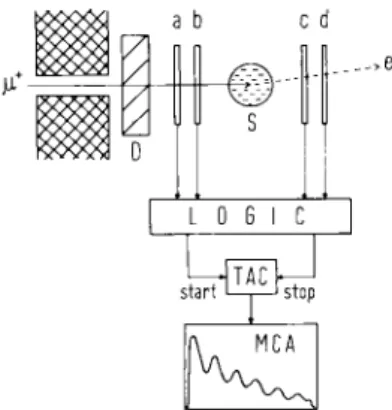
The transverse field ^SR technique is by far the most common experimental method used in the study of muonium chemistry; nowadays it is almost exclusive. A magnetic field perpendicular to the initial muon spin direction is applied to the sample. One or more precession signals ensue, according to the number and type of muonic species created by the stopped muons. Plastic scintillator counters are grouped (in "telescopes") about the sample to detect the passage of individual muons and positrons. The experimental set-up is shown schematically in Fig. 1. To stop in the sample a muon must pass through counters
a and b but not c. Thus the muon stop signature is a - b e. Correspondingly b c-d represents e+ emission in
the forward (muon beam) direction. The two signatures form the start and stop signals for a lifetime counting apparatus consisting of a time-to-amplitude converter, multichannel analyzer, and associated logic units which serve to reject imperfect events. Only unequivocal single
μ+ stop / correlated e+ emission events are retained.
In the absence of a magnetic field the histogram accumu-lated in the multichannel analyzer would depict a single exponential with decay time 2.2 Χ 10"6 s, the muon
life-time. Precession of the muon spin in a magnetic field results in oscillation of the e+ detection probability in the
forward telescope, and gives rise to the wiggles shown in
Fig. 1. Schematic representation of a mSR experimental assembly. Individual muons pass through the collimator, slow down in the degrader (D) and stop in the sample (S), where they decay. Scin-tillator counters (a, b, c and d) detect the passage of the muon and also the decay positron if it is emitted in a suitable direction. The muon lifetime is registered by the time-to-amplitude converter (TAC) and a frequency histogram is accumulated in the
Fig. 2. Schematic representation of a mSR histogram. The ordinate denotes the number of muons which decay to emit their positrons
in a particular direction. Δ / is the individual muon lifetime
Fig. 2. The general form of the histogram is
H=N{B + e~t/T[l+AF(t)]\ , ( 8 )
where Ν is the normalization factor, Β the background and τ the muon lifetime. F(t) is the normalized time-dependence of the muon spin polarization. The asymmetry constant A (typically 0.2) includes the initial beam polar-ization, the coefficient a, and various geometrical factors. These pieces of information are uninteresting, and so it is usual to calibrate the experimental assembly with a standard sample and quote the signal amplitudes in terms of muon polarization fractions P. (Section 8.1).
Three different classes of muonic species are identifiable on the basis of their characteristic precession signals F(t). They are dealt with in the following Section.
3. Muon precession signals 3 . 1 . T h e d i a m a g n e t i c signal
The spins of bare muons, or muons substituted in dia-magnetic molecules (e. g. MuOH) precess at their nuclear Larmor frequency, 13.55 kHz/G. An example of this diamagnetic signal is shown in Fig. 3, together with the ßSR histogram from which it was extracted by removal of background and exponential decay. The resolution of conventional ßSR apparatus is such that the small chemi-cal shifts typichemi-cal of proton nmr are not discernable. The diamagnetic ßSR signal is thus analogous to a very low resolution proton magnetic resonance signal, or more precisely, to the free induction signal induced by the π/2 pulse in Fourier transform nmr.
Almost all substances so far investigated give rise to the diamagnetic signal. Its amplitude in water, simple alco-hols and many other saturated organic compounds cor-responds to about 60% of the original muon polarization.
3 . 2 . M u o n i u m
Muonium is a two-spin system, and its precession signal is correspondingly more complicated than that of the single muon (see Fig. 4). In the absence of a magnetic field the
w cr a> >· aj 4 -o ο 0.3 0.2
f
M
£ 0 a> ε l - o . i - 0 . 2 -0.3 0 1 2 3 4 5 Timers] —Fig. 3. mSR histogram (upper) and diamagnetic signal (lower) from water in a transverse magnetic field of 200 G. The precession signal, AF(t) is obtained from the histogram by subtraction of
the background and removal of the exponential muon decay
0.3
° '30 0.02 0.04 0.06 ΟΰΒ 0.10 0.12 0.14 0.16 0.18 0.20 Time [ μ 5 ]
Fig. 4. Muonium precession signal from quartz in 101 G field
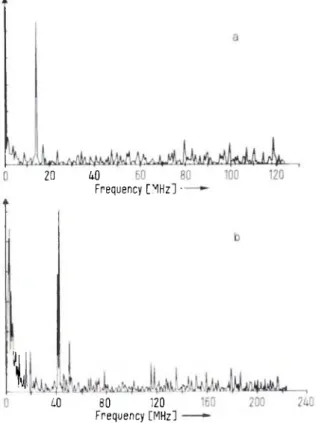
spins combine to give a singlet and a triplet. The degener-acy of the triplet is lifted in a magnetic field; the variation of the four energy levels as a function of field strength is given by the well-known Breit-Rabi diagram (Fig. 5). The dimensionless field parameter χ is given by the ratio: (sum of electron and muon Larmor frequencies) / (muon-electron hyperfine frequency, ω0) . For fields transverse
to the muon spin polarization, four transitions are allowed, giving rise to four characteristic frequencies. Of these, two, denoted by dotted lines in Fig. 5, are too high to be re-solved by conventional ßSR apparatus. The remaining two, depicted by the full lines, give rise to the beat pattern shown in Fig. 4. At very low fields the two observable frequencies become degenerate, as demonstrated by the Fourier transform spectrum [of A )] for water at 10 G (Fig. 6a). This "muonium precession" signal arises from the precession of the triplet coupled {MF = 1)
muon-4 PAULW. PERCIVAL
Fig. 5. Breit-Rabi diagram showing the energy levels of a Two-Spin 1/2 System as a function of magnetic field. The diamagnetic field parameter χ represents the ratio of Larmor to hyperfine frequencies. Of the four transition frequencies allowed in low trans-verse fields, only the two denoted by full lines are resolvable. The transitions marked R are those detected for muonic radicals in
high fields 20 ω Frequency [ M H z ]
-X
40 80 120 Frequency [MHz]Fig. 6. Fourier transforms of the muonium precession signals from water in a) 10 G, and b) 30 G transverse fields
electron spin vector about the magnetic field, and takes the value 1.4 MHz/G (roughly half the electron Larmor frequency). In higher fields the splitting becomes ap-parent (Fig. 6 b ) ; the magnitude of the splitting and the amplitudes of the individual frequencies are functions of
x, i. e. they depend on the magnetic field strength and the
hyperfine coupling constant.
Muonium has been clearly identified in gaseous argon, krypton, xenon and nitrogen [ 1 0 - 1 4 ] ; in quartz, solid C 02 and ice [ 1 5 , 1 6 ] ; and in liquid water, ethanol and
methanol [17, 18]. Muonium-type signals have also been detected in the semiconductors silicon and germanium [16, 19], where further "anomalous muonium" (radical-type) signals have also been discovered [ 1 9 - 2 1 ].
3 . 3 . F r e e radicals
A free radical (electron spin doublet) containing a muon but no other magnetic nucleus would exhibit Breit-Rabi splitting similar to muonium, but modified to account for the smaller muon-electron hyperfine interaction. Of the four precession frequencies, two gain in amplitude with increasing magnetic field and two fall; in the high-field limit only two remain (designated R in Fig. 5). Now, typical organic free radicals contain many magnetic nuclei, in particular protons, so that in general their ßSR spectra are much more complicated than that of muonium. Indeed the multiplicity of frequencies can lead t o a smear-ing out of the signal, so that detection becomes impossi-ble. Nevertheless, in high fields, where the electron Larmor frequency exceeds the muon hyperfine frequency, the spectrum simplifies to the two frequencies found for the muonium case. The situation is akin to the ENDOR of free radicals in solution, where each proton gives rise to a pair of lines split symmetrically about the Larmor pre-cession frequency [22], The magnitude of the splitting
5kG 2k6 1K6 0.6 K6 I u ^ l - . ^ j L i 50 150 200 250
fCMHz]-Fig. 7. Fourier transforms of the precession signals from 2,3-di-methyl-2-butene at various magnetic fields. The diamagnetic sig-nal is denoted by D, and the pair of radical frequencies by R. Not apparent from these Fourier power spectra is that the lower
equals the hyperfine coupling constant. Fourier transform juSR spectra obtained f r o m 2,3-dimethyl-2-butene at dif-ferent magnetic fields are shown in Fig. 7. Given that the lower of the two radical frequencies (R) is in reality negative, it can be seen that they are indeed symmetrical-ly placed about the diamagnetic signal (£>).
3 . 4 . T r a n s f o r m a t i o n s b e t w e e n m u o n i c s p e c i e s When one muonic species is transformed into another with different precession frequencies some or all of the m u o n spin polarization may be lost. This frequently oc-curs in the reactions of muonium. Polarization is con-served only if the reaction rate is large compared with the difference between the initial and final precession frequencies. This can be readily understood as follows: In a slow reaction the lifetimes of individual reactant species are distributed over all or part of a precession period, so that m u o n spins in the reaction product become dephased. Although no individual spins are lost, the en-semble polarization as exhibited by the ßSR histogram is reduced. The same process leads to line broadening in magnetic resonance. Since the precession frequencies are magnetic field dependent, so also will be the amount of polarization conserved in the reaction products. The theory of muon spin polarization during chemical reaction is well developed [23—29], but exceeds the bounds of this introductory article. For illustrative pur-poses, however, the results for the simple case of the one-step reaction muonium -»• diamagnetic products are de-picted in Fig. 8. PD is the polarization conserved in the
diamagnetic products (termed "residual" polarization in the literature), assuming an initial muonium fraction of unity. 1.2 1.0 0.8 0.6 P» OA 0.2 0 100 400 1600 6400 HEG] •
Fig. 8. Magnetic field dependence o f the residual m u o n polariza-tion conserved in the products of the one-step reacpolariza-tion: m u o n i u m -»• diamagnetic products. T h e reaction rates λ are given as
multi-ples of the m u o n i u m hyperfine frequency ( 2 . 8 X 1 01 0) s " '
4. Applications: Historical background
Muonium was first detected by HUGHES et al. [10], using a high pressure argon gas target. The discovery formed part of a long series of experiments principally concerned with the determination of the muonium hyper-fine interval by a number of different methods [30]. An extension of this work led to the first muonium kinetics studies; the decay of the muonium signal in argon was monitored in the presence of trace amounts of reactant gases [31 ]. A major experimental difficulty was the high momentum muon source (Columbia University Nevis Synchrocyclotron), which necessitated the use of gas pressures of the order of 5 0 atm. to obtain m u o n stop rates up to 102 s"1. It is therefore not surprising that the
first systematic studies on gases had to await the develop-ment of the low modevelop-mentum Arizona beam (muon stop rates ~ 104 s"1 in gas targets at atmospheric pressure) at
the Lawrence Berkeley Laboratory [32]. This work has been continued at TRIUMF [ 3 3 - 3 5 ] , and indeed still forms the major part of the muonium chemistry pro-gramme there.
Muonium chemistry in the condensed phase developed in parallel to the gas phase studies, but at other establish-ments. It was known from the earliest experiments with stopped muons [36—38] that the muon polarization (at the diamagnetic frequency) depends on the stopping medi-um. The existence of short-lived muonium figured amongst the first suggestions as to the cause of this phenomenon. The hypothesis was taken u p by a number of scientists in the USSR, who proceeded t o lay the foundations [23, 24, 39] of the theory of muon spin polarization. Experiments at Dubna soon accompanied theoretical developments, the main emphasis being on liquid phase chemistry [40], In particular muonium reaction rate constants were ex-tracted f r o m measurements of the total diamagnetic frac-tion in pure organic compounds and binary mixtures. A comprehensive summary of all except the most recent russian work [41 ] may be found in the review by F l R S O V and G O L D A N S K I I [42]. The reader is cautioned, however, that the quantitative results must now be considered highly unreliable, due to the oversimplified models used in the analysis of experimental data. The " m e t h o d of competing acceptors", for example, takes no account of the fact that there are often two contributions to the measured diamagnetic fraction: an initial part arising f r o m very fast radiolytic or hot atom processes, and the residual polarization from slower thermal reactions.
A far more sophisticated model was developed and applied by Brewer etal. at Berkeley in the early 70's [43-45]. The analysis included the phase as well as the amplitude of the diamagnetic precession signal, and multiple reac-tion paths involving muonic free radicals were also consi-dered. Nevertheless, the complexity of the model makes it unsuited for the unequivocal determination of absolute rate constants, and indeed, certain of the results have been shown to be in error by several orders of magnitude [46 ].
6 PAUL W. PERCIVAL
The breakthrough in muonium reaction kinetics came with the detection of muonium in liquids [17] at one of the newly created meson factories. Unambiguous rate constant determinations are now routinely made at SIN and TRIUMF by direct measurements of muonium decay rates [ 4 6 - 4 8 ] .
The most recent major development in muonium chemis-try is the detection of muonic free radicals [49].
5. Muonium kinetics in the gas phase
In a continuing series of experiments FLEMING et al. [32—35] have determined rate constants for the reactions of muonium with Br2, Cl2, F2, HBr, HCl, HI and 02 in
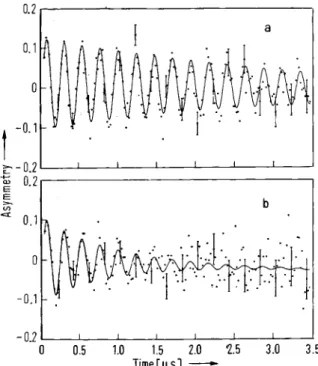
the gas phase. The experimental procedure is as follows: Low energy (Arizona) muons are stopped in a moderator gas target set in a pair of Helmholtz coils. Although the gas pressure used is only slightly above atmospheric the 4.1 MeV muons stop in about 25 cm. (Energy is also lost by passage through various windows and the scintillator counter at the entrance to the gas cell.) Originally argon was used as the moderator, but more recently nitrogen has been used, since more muonium is formed in it. Muonium is detected by means of its precession in a low (2—3 G) magnetic field. The addition of controlled amounts of reactant gas leads to decay of the signal, as demonstrated in Fig. 9. Up to a few million events are recorded for each reactant concentration, and the ^SR histograms are analyzed by a multi-parameter least-squares fitting procedure to determine the decay rates λ. In the course of an experiment 10s —109 muons are stopped in
the target, having negligible effect on the substrate con-centration. The reaction rate is accordingly pseudo-first order:
λ = λ0+ Λ [ 5 ] , (9)
where λ0 is the decay rate in the absence of the reactant
and the bimolecular rate constant k is given by the slope of a plot of λ against concentration [ 5 ] (Fig. 10). The results to date are summarized in table 2, where they
Timers] — •
Fig. 9. Muonium precession signals in a) pure argon gas, and
b) 1.89 Χ ΙΟ- 5 Μ CIj in argon (FLEMING et al. [33])
5 k 'co I—I w ο I CD
•s 2
or c ο CO ro » 1 0' 0 20 iO 60 80 C12[jjiM] •Fig. 10. Relaxation (decay) rates of muonium signals in argon as a function of added Cl2 concentration (FLEMING et al. [33])
Table 2. Reaction rate parameters for Mu and Η in the gas phase
Muonium0 Hydrogen'' Substrate k (295 K) Ea k (295 K) Ea kM/kΗ (295 K) [ 10*0 M"1 s"1 ] [ k J m o l - ' l [ΙΟ10 M"1 s ] [kJ mol"1 ] F2 1.4±0.1 3.9 ±1.0 0 . 0 8 - 0 . 2 5 8 . 8 - 1 0 . 9 5 - 1 9 Cl2 5.1 + 0.2 5.7 ±0.9 0 . 4 - 2 . 3 4 . 4 - 9 . 6 2 - 1 3 Br2 24± 3 2.2 ±1.5 4.2 ±2.1 6 - 3 9 HCl < 0 . 0 0 0 0 3c 0.0042 ±0.0002 13.0 ± 1 . 3 < 0 . 0 0 7 HBr 0.9±0.1 0.21 ± 0 . 0 2 10.9 ± 0.4 3 . 5 - 5 . 3 HI 2 . 5 3 ± 0 . 1 3 0.86± 0.39 5 . 0 ± 1 . 7 1 . 9 - 5 . 7 02 16.0 ±0.07^
a taken from FLEMING et al. [4]
b there are often discrepancies in the literature; for individual values and citations, see FLEMING et al. [4]
c upper limit only
are compared with hydrogen atom data. In addition to room temperature measurements, experiments have been performed at elevated temperatures for F2 and Cl2, and activation energies^ determined. The reaction with ha-lides is clearly
Mu + X2 —* MuX + X, (10)
but it is not possible to distinguish between the two pos-sibilities for the hydrogen halides:
Mu + H X —* MuX + H, (11) and
experimental rate constants. Instead, it is necessary to compute individual values of S(e) with the aid of some suitable theory, before (15) can be integrated and com-pared with experiment. CONNOR etal. [51, 52] have per-formed just such computations for the reactions of Mu, H, D and Τ with F2. Their results emphasize the im-portance of tunnelling at room temperature, and confirm the existence of the "light atom anomaly" - the low degree of product vibrational excitation. They find
= 5.9 at 300 K, apparent activation energies of 4.6 and 8.8 kJ mol"1 for Mu and H, respectively, and ν = 1 as the most populated product vibrational state for the muonium reaction.
Mu + H X - > MuH + X. (12) 6. Muonium kinetics in aqueous solution For the analogous Η atom reactions (12) is greatly favoured
over (11), and this should also be the case for Mu. The chemical reaction expected with oxygen is addition, but as this would necessitate three body encounters to remove excess energy a simple spin exchange process is deemed the more likely.
Despite the large uncertainties and discrepancies in the available Η atom data, it can be seen from table 2 that, ex-cepting HCl, reaction with Mu is faster than with H. The Simple Collision Theory of bimolecular reactions [50] states that
k = av exp {-Em JRT). (13)
The collisional cross-section a is a geometrical quantity, and should be the same for Mu and H. However, the mean relative velocity ϋ is inversely proportional to the square root of the reduced mass for the collision partners. Thus, for reactions of Mu and Η with much heavier atoms and molecules, t7 will be three times larger for Mu than for H. £"min is the minimum energy necessary for reaction, and is related to the experimental activation energy by
a mm 2 (14)
Although the experimental values of Ea for the fluorine
reactions clearly show that £"min is isotope dependent, further analysis on these lines is unrewarding, since Colli-sion Theory provides no way of calculating independ-ently. Instead one must turn to the more sophisticated theories of molecular dynamics.
In terms of the energy dependent reaction cross-section 5 ( e ) , the rate constant at temperature Τ is given by [50]
oo
λ ( Γ ) = ( 2 Λ 7 Λ 7 )3 / 2( π μ ) -1 / 2 J J ( e ) e e~eN/RTde. (15)
Once again a trivial isotope effect arises from the reduced mass dependence. Deviations from this value are assigned to differences in 5(e). Unfortunately, it is impossible to deduce information about reaction cross-sections from
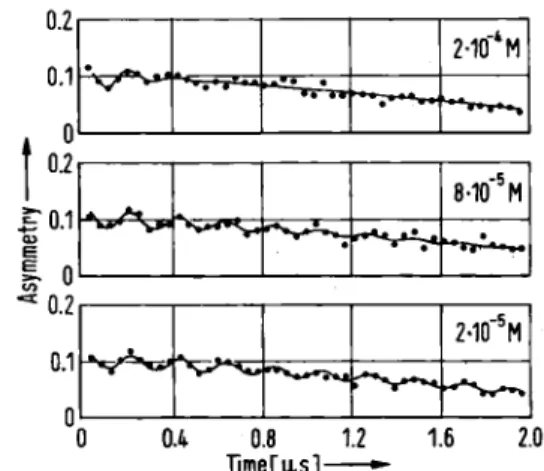
Rate constants for the reactions of muonium in aqueous solution have been determined in a manner entirely analogous to the gas phase studies [46—48 ]. The measure-ments suffer, however, from the small muonium fraction observable in water (20%) [46], compared with that in argon ( ~ 80%) and nitrogen gases ( ~ 100%)1 [14] (cf. Figs. 9 and 11). The results are gathered together in table 3, where they are compared with hydrogen atom data [53], In addition to the data of table 3, upper limits of 10- 7 M"1 s"1 or less have been deduced for the reactions with H+, N a+, K+, Z n2 +, C P , CIO4 and SOi ~ .
The highest rate constants so far determined are those for the reactions with MnO^ and A g+, assumed by anal-ogy with Η to be simple redox processes, e. g.
Mu + MnOä i+ + Μ η Ο Γ
(16)
The rates of both the Mu and Η reactions are probably diffusion limited, and as such depend on the reaction diameters and diffusion constants of the reactants. These parameters are primarily determined by geometrical fac-tors (and not isotopic mass), so that in these cases no"0.1 * Α· J 8·10"5Μ • · • · 0.8 Timers]
Fig. 11. Muonium signals from aqueous solutions of fumaric acid
The data from ref. [14] has been corrected for the effect o f muons which stop in the walls o f the gas cell.
8 PAUL W. PERCIVAL
Table 3. Comparison of rate constants for Mu and Η in aqueous solution"
kH [M"' s"1] [M"' s"1 ] kU diffusion controlled MnO; 2.5X10'° 2.4 X 1Q'° 1 Ag+ 1.6X10¹⁰ 1.15X10'° 0.7 Η abstraction methanol < 3X10⁴ 2.5 X10⁶ > 83 ethanol < 3 X 10s 2.1 X10' > 70 isopropanol ^ 7X10⁵ 6.8 X10⁷ 100 sec. butanol 1.1 X10⁶ 1.3 X10⁸ 118 HCOO" 7.8 X 10' 1.24X10' 16 Br abstraction bromoacetic acid (pH 1) 1.5X10' 2.6 X10⁸ 0.17
2-bromopropionic acid (pH 1) 4.OX 10' 9.5 X 10⁸ 0.24
3-bromopropionic acid (pH 1) - 3X10⁸ 1.7 X10⁸ 0.6 Η addition to olefins maleic acid (pH 1) 1.1X10'° 6 X10" 0.06 fumaric acid (pH 1) 1.4X10¹⁰ 9 X10⁸ 0.06 ascorbic acid (pH 1) 1.8 X 10' 1.1 X10" 0.06 dihydroxyfumaric acid (pH 1) 4.5X10' 9 X10⁷ 2 miscellaneous acetone (pH 1) 8.7 X 10' 2.8 X10⁶ 0.03 HO- 1.7X10⁷ 1.5 X10' 1 NO3 1.5X10' 9 X10⁶ 0.006 phenol 7.2X10' 2 X10' 0.28 o-nitrophenol 8.0X10' 3 X10⁹ 0.38 Tl+ 8.2X10" 1.2 X10⁸ 0.15 SCN- 6.2X10' 2.7 X10⁸ 4.4
a taken f r o m PERCIVAL et a I. [5 ], w i t h the exception of the last four entries (JEAN et at. [48 ]).
kinetic isotope effects are expected. It is interesting t o note that the positronium reaction with M n O j also bears the same rate constant [54],
The other entries in table 3 are for activated reactions. Included are, by analogy with Η [6, 53]: hydrogen atom abstraction, bromine abstraction, addition to olefinic double bonds, and the miscellaneous reactions
MU + ( C H3)2C O - > ( C H3)2C O M U (17)
Mu + OH" - » M u O H + e ^ (18)
Mu + N O j MuO" + N 02 (19)
Mu + C6H5O H - > C6H5M U O H (20)
and Mu + SCN" ^ M u S C N T . (21) Most of the reactions show marked isotope effects;
hydrogen abstraction is slower for muonium, whilst bromine abstraction and most of the addition reactions are faster.
RODUNER et a I. [47] have applied the results of Transi-tion State Theory [50] to interpret the kinetic isotope effects. The rate constant is given by
·*(-£) <
22
>
where Γ is the transmission factor (primarily due t o the effect of tunnelling); ßA, 2B and Q* are the relevant
molecular partition coefficients for reactants and
transi-tion state; and the activatransi-tion energy. It should be noted that, although a common potential energy surface is usually assumed for isotopic reactions (ignoring the small differences that arise f r o m non-adherence to the Born-Oppenheimer Principle), the activation energy E * is generally isotope dependent, since zero-point vibrations in the reactants and transition state must be taken into account. Differences in .Ε* and Γ constitute the most important contributions t o the isotope effect. For the hydrogen abstraction reactions of Mu and Η differences in arise solely in the transition state; the larger zero-point energy for muonium leads t o slower reac-tion, in accord with experimental findings. (Ν. B. There is no conflict with the well-known result that abstraction of Η is faster than abstraction of D. In this case the zero-point energy difference is greater in the reactants.) RODUNER et a I. [47] have performed BEBO calculations to characterize the transition states, and thus calculate + the Ε differences. The predictions were f o u n d to account for the major part of the observed isotope effects, and so it was deduced that tunnelling must play only a minor role. More recent work suggests otherwise, however [55,56]. The influence of tunnelling is very difficult t o estimate, in view of the large theoretical uncertainties involved. For a given barrier shape and size muonium will clearly be favoured over hydrogen, but it would be naive t o ex-pect quantitative predictions by simple evaluation of
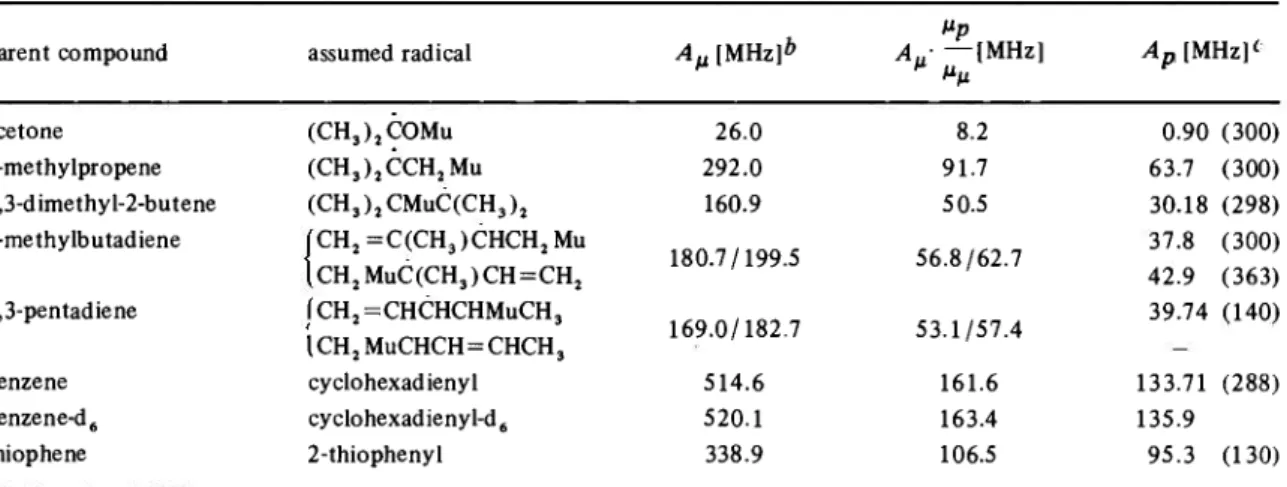
Table 4. Hyperfine coupling constants of muonic radicals and comparison with H-analoguesa
parent compound assumed radical Αμ [MHz]ft
μρ Α„· —IMHz] M "μ Ap [MHz]« acetone 2-methylpropene 2,3-dimethyl-2-butene 2-methylbutadiene 1,3-pentadiene benzene benzene-d6 thiophene (CH3)2COMu (CH3)2CCH2 MU (CH3)2CMUC(CH3)2 CH2=C(CH3)CHCH2MU CH2MUC(CH3)CH=CH2 (CH2=CHCHCHMUCH3 ICH2MUCHCH = CHCH3 cyclohexadienyl cyclohexadienyl-d6 2-thiophenyl 26.0 2 9 2 . 0 160.9 1 8 0 . 7 / 1 9 9 . 5 1 6 9 . 0 / 1 8 2 . 7 514.6 520.1 338.9 8.2 91.7 50.5 5 6 . 8 / 6 2 . 7 5 3 . 1 / 5 7 . 4 161.6 163.4 106.5 0.90 (300) 63.7 (300) 30.18 (298) 37.8 42.9 (300) (363) 39.74 (140) 133.71 (288) 135.9 95.3 (130)
a published [49] and unpublished data from RODUNER et al.
b values at ambient temperature
c from FISCHER and HELLWEGE [58]; temperature (K) in parentheses, where known
standard formulae. Choice of the proper reduced mass to use in the calculations is no trivial problem [57], and any-way the energy barrier of hydrogen abstraction is higher for muonium, thus reducing the expected tunnelling con-tribution [55],
7. Muonic free radicals
Only recently has the nature of, and thence the means to observe muonic radical spectra become fully understood [49], Since then radicals have been detected in liquid samples of a number of organic compounds. The parent molecules giving rise to muonic radicals all contain some degree of unsaturation: a carboxyl group (acetone), a carbon-carbon double bond (e. g. 2-methylpropene), con-jugated double bonds (e. g. pentadiene), or an aromatic
ring (e. g. benzene). In each case the radicals observed are assumed t o be those formed by formal addition of muoni-um, as depicted in table 4. Where more than one radical adduct is possible (e. g. for thiophene) assignment is made in analogy with the known chemistry of the hydrogen atom. Even then, it is not possible to distinguish between the pairs of conjugated radicals formed f r o m the dienes. It is significant, however, that only two radicals are ob-served in such cases (e. g. f r o m 2-methyl-l,3-butadiene, see Fig. 12), and not all four possibilities, as would be the case for non-selective addition.
As mentioned in Section 3.3, the muon-electron hyper-fine coupling constant may be readily measured f r o m a radical spectrum; it is merely given by the difference be-tween the two radical frequencies observed at high field, due account being taken of their polarity. In table 4 the coupling constants are compared with those of the hydro-gen a t o m analogues [58]. In the absence of isotope effects the muon and proton hyperfine constants should be in the ratio of their magnetic moments, βμΙ ί * ρ = 3.1833. The
discrepancies between the last two columns of table 4
clearly demonstrate the existence of isotope effects. In all cases the muon coupling constant is larger than predicted solely f r o m the relative magnetic moments. The explana-tion is based on arguments proposed to explain similar isotope effects observed when Η is replaced by D [59, 60] Due to the nature of radical addition, the hyperfine con-stants are of the " β " type, i. e. the m u o n i u m atom is bound t o an atom adjacent to the radical centre (or
con-0 Γ «2 4 - R , — V.T AL, 0 50 "l0Ö 150 200 250 y[MHz] •
Fig. 12. Fourier transform of the precession signals from 2-methyl-1,3-butadiene at 2 kG
10 PAUL W. PERCIVAL
jugated system). Such constants Aß are known to vary
with the dihedral angle θ (see Fig. 13) between the bond to the muonium atom and the axis of symmetry of the p-orbital (plane of π-system) containing the unpaired electron:
Αβ( θ ) = Β0 + B i cos2 θ (23)
B0 and Bl are constants; B^ is usually much larger than
B0, and typically takes the value 140 MHz for proton coupling in alkyi radicals. The value of A^ determined by experiment depends on the expectation value < cos2 θ >,
which takes the value 1/2 in the high temperature limit, where all values of θ are equally probable, i. e. there exists free rotation about the bond joining the a and β atoms. In general, the probability of a given value of θ depends on the potential energy of the conformation and the temperature. Conformers with θ — π/2 have eclipsed substituents, and the increased zero-point vibrational motion in muonic radicals leads to higher potential energy (steric hindrance). Thus these conformers, which have the lowest values of Α ^ θ ) , are less probable for muonic radicals at a given temperature, and higher mean values < A ^ > ensue.
Although rotation as described above can be excluded for small ring systems, such as in the cyclohexadienyl radical, the same considerations apply to the effect of non-equivalent sites resulting from out-of-plane deforma-tions of the ring [61].
Another promising field of investigation with muonic radicals, albeit one still in its infancy, is radical kinetics. In contrast to muonium kinetics only minor or negligible kinetic isotope effects are to be expected (except where reaction is at the Mu site). Muonium would therefore merely act as a tracer atom, and could find application in radical reactions difficult or even impossible to study by other means.
8. Early events in muonium chemistry
8 . 1 . I n f o r m a t i o n f r o m signal a m p l i t u d e s The term "early events" is used here to designate the physico-chemical processes that lead to the distribution of muon spin polarization amongst the various muonic species and their individual precession frequencies. In-cluded are the means of formation of muonium, radicals and diamagnetic compounds, radiolytic and epithermal reactions, and fast depolarization processes. All these processes occur at times short compared with that neces-sary for direct mSR detection (i. e. t < 10"7 s), so that the
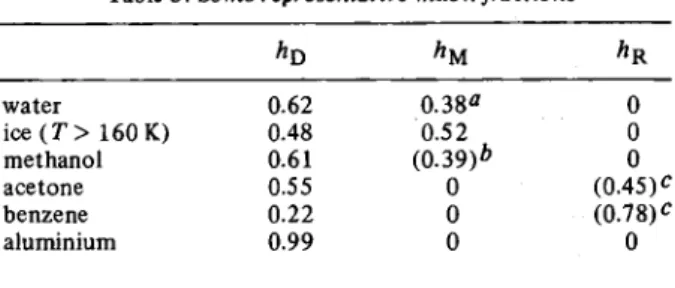
available information is contained in the initial amplitudes of the /iSR precession frequencies. The measured ampli-tudes are usually scaled to give the fractional polarizations ΡΌ, i>M and PR by comparison with a standard ( PD = 1.0
for CC14). In the ideal case the polarizations directly
re-present the distribution of muons, designated Λ0, AM
Table 5. Some representative muon fractions
h o λΜ Λ R water 0.62 0 . 3 8a 0 ice ( T > 160 K) 0.48 0 . 5 2 0 methanol 0.61 ( 0 . 3 9 ) * 0 acetone 0.55 0 ( 0 . 4 5 )c benzene 0 . 2 2 0 ( 0 . 7 8 )c aluminium 0.99 0 0
a from NO3 scavenging experiments; observed Pyi = 0.20
* assumed value; observed Pfj[ = 0.19
c assumed value; PR difficult to determine
and hR; but only in the absence of depolarization. Some representative muon fractions are given in table 5. As pointed out in Section 3.4 reactions of muonic species lead in general to depolarization. This is particularly im-portant for muonium. Thus many free radical scavengers employed in radiolysis studies (Section 8.3) react with thermalized muonium with the result that its signal is quenched (i>M = 0). If the rate is high enough part of the
polarization will be carried over into the reaction products. In this case the measured PD will be a sum of the initial
fraction /iD and the residual polarization P ^ . The two
contributions may be separated by exploiting the magnetic field dependence of PK& (Fig. 8). Detailed description of
such analyses may be found in a recent paper by PERCIVAL et al. [62], Application has so far been limited to aqueous
systems.
Polarization may also be lost by purely physical pro-cesses — spin relaxation. The decay of both diamagnetic [63, 64] and muonium [65] signals has been followed in solutions of paramagnetic ions. As is well known in mag-netic resonance [66], coupling of the magmag-netic moments of the ion and the muonic species provides a pathway for total polarization loss via fast spin-lattice relaxation inher-ent in the ion. If depolarization is fast enough no preces-sion signal remains. Nevertheless, it is also possible for spin relaxation to lead to a reduction in signal amplitudes without altering the observed lifetimes — but only if the interacting paramagnetic species is transient. Free radicals produced as a result of radiolysis fulfil this condition, and are thought to be the cause of the so-called "missing frac-tion" of polarization in water and alcohols (Section 8.3). The mechanism differs from that involving paramagnetic ions in that the transient radicals do not exhibit efficient spin-lattice relaxation. Coupling of the spins results in transfer of part of the polarization to the undetected spe-cies; no polarization is lost to the lattice.
8 . 2 . M u o n i u m f o r m a t i o n in gases
The fraction of muons that thermalize as muonium has been measured for several inert gases, both at high [12] and low [13, 14] pressures. There is general agreement that no muonium forms in helium and neon, a large frac-tion is found in argon, and that even more (perhaps the
total μ+ fraction is neutralized) is formed in xenon and nitrogen. The quantitative discrepancies in the literature (0.63 < < 0.85 for Ar) are attributable to two experi-mental difficulties: (1) the diffuse nature of the stopping medium leads to a large spread of stopping sites, so that reliable calibration of signal amplitudes in terms of polari-zation fractions is virtually impossible; and (2) the dia-magnetic signal is likely to include a contribution from muon stops in the walls of the gas cell and in the detec-tors themselves.
In simple terms, electron capture during the slowing down of a heavy positive ion occurs when the velocity becomes comparable to that of orbital electrons in the stopping medium. This corresponds to a muon kinetic energy of several keV. Many electron loss-capture cycles take place before the final stopped state ( ~ 102 for μ+ [30]), the
nature of the final state depending particularly on the cross-sections of the charge-changing processes at low energy. These depend on charge and velocity only, so that the results of hydrogen beam studies [67] may be applied. Unfortunately, little or no data is available for the crucial low energy regime.
That muonium is formed from epithermal μ+ is proven
by its observation in argon and nitrogen, which have ioniza-tion potentials 15.8 and 15.6 eV, respectively [I. P. (Mu) = 13.54 eV], Furthermore, any thermal reaction would give rise to a relaxation of the diamagnetic signal in argon. However, it has been suggested [14] that μ+ survival in noble gases is anyway unlikely since molecular ions of the type Νβμ+ are predicted to be stable; it was assumed, probably quite correctly, that these species will be formed at a rate faster than the muon decay.
Any attempt to apply the above gas phase concepts to muonium formation in liquids soon runs into difficulties. Collisions are much more frequent in condensed media, and may not be treated as isolated events. To estimate the muon stopping power in water MOZUMDER [68 ] made use of the experimental proton charge-changing cross-sections in isoelectronic neon; but he also admits that the effective charge of a track particle is higher at low velocities in condensed media than that calculated on the basis of gas phase results. Because of this more radiolysis damage is to be expected towards the end of muon tracks in liq-uids. Due to its light mass the low energy muon/muonium will be markedly scattered by collisions with heavier nuclei and atoms, so escape (of neutral muonium) from regions of damage will not be so facile as was previously assumed [45], Possible reactions of muons and muonium with radiolysis products in water are discussed in the following Section.
8.3. Liquids: Radiolysis e f f e c t s
The polarizations of the two muon signals detected in pure water (H2 0 ) are PD = 0.622 ± 0.006 and /*M = 0.196 ± 0.003 [62]. It is remarkable that their sum is less than unity, in contrast to the results for ice, where ΡΌ = 0.480 ± 0.004 and A , = 0.52 ± 0.02, above 160 K. Scavenging
studies with NO J [62] have led to the conclusion that and that the missing fraction in water is due to depolarized muonium ( h ^ + h ^ = 1).
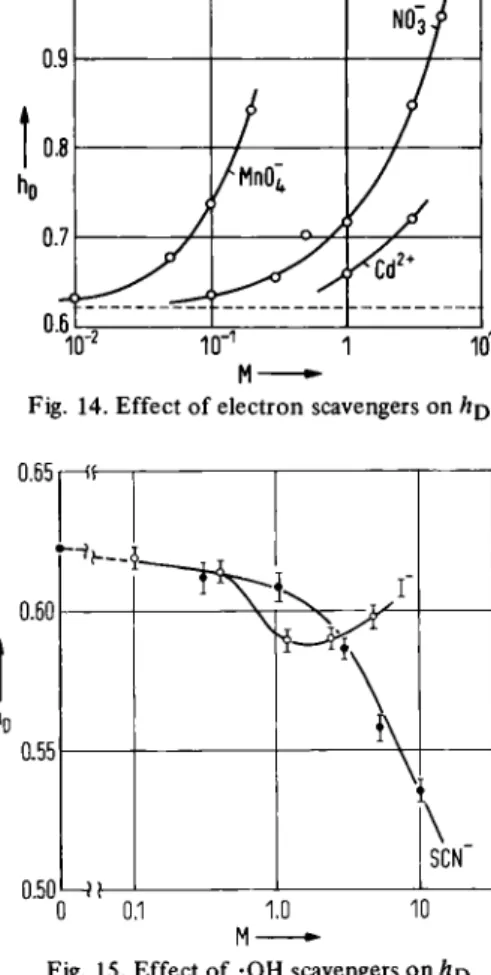
High concentrations of NO J were further found to bring about an increase in , as was also the case for other powerful electron scavengers (Fig. 14) [62]. On the other hand, a reduction in hD was found for high concentra-tions of SCN", an efficient ·ΟΗ scavenger, although a second scavenger, I", displayed more complex behaviour (Fig. 15) [69]. The results indicate that the muon distribu-tion is governed by reacdistribu-tions of the muon (or muonium) with the chief transient radicals created in the radiolysis of water [70], The high concentrations of scavengers re-quired implies that the : hu partitioning takes place at very short times, t < 10"11 s. Furthermore, the in-activity of high acid concentrations (up to 5M) is con-sistent with the involvement of the dry electron. ( H20+ is known to be ineffective in scavenging the precursor of e ^ [71 ].) The hydrated electron, however, may well be the cause of the missing fraction, since this is scavengeable by 0.1 Μ NO J [62]. A reaction scheme inspired by the spur model of positronium formation [54, 72, 73] is consistent with the above.
[e". . . μ*. . .·0Η]
At the end of its track, in the so-called terminal spur, the muon is in the immediate neighbourhood (within a few nm) of the radiolysis products e~ and ·ΟΗ. If the muon and electron combine muonium is formed, otherwise the muon will hydrate and end up substituted in a water mole cule:
μ+ + H20 —• MuOHj (24)
MuOH2 + H20 —> Mu0H + H30+. (25)
Clearly removal of e~ will result in less hM and
propor-tionately more hD- On the other hand scavenging of -OH, which competes with μ+ for e"
•OH + e~ - » OH" (26) increases the probability of muonium formation, and
is reduced. The analogous inhibition [54, 72, 73] and en-hancement [74] of positronium formation are well docu-mented.
Once formed, muonium might react with a further radical (and so contribute to Λβ) or survive to be observed. A third possibility entails a non-reactive encounter with a transient radical, whereby spin polarization may be lost
12 PAUL W. PERCIVAL NO~3f /ΜΠΟ ;
</
A t 10""' 10" 101M-Fig. 14. Effect of electron scavengers on Λρ
0.60 0.55 0.50 — « — — — < \ I"
\
\
—Ϊ ί—\
\
SCN" 0 0.1 1.0 10 Μ •Fig. 15. Effect of ·ΟΗ scavengers on hD
(transferred to the radical's unpaired electron) in a manner not unlike the radical pair mechanism of chemically in-duced magnetic polarization [75].
In ice, hydration, or trapping processes are slower than in water, so it is not surprising that more muonium is formed. Similarly the reduced survival rate of electrons in ice [76] minimizes the chance of encounters which lead to the missing fraction.
The muon fractions in the simple alcohols (e. g. MeOH, table 5) are very similar in magnitude to those of water, and the spur model should presumably also apply to these liquids. It is significant that for ethanol is constant, with mean value 0.601 ± 0.003, from room temperature right down to the frozen state (unpublished results from this laboratory). This indicates that the processes which determine hD are not in competition with electron and
muon solvation. Electron solvation in ethanol requires 2.3 Χ 10"1 1 s a t 293 Κ and lasts up to 2X 10"7 s a t 150 Κ
[77, 78], The conclusion is that muonium formation takes place before electron solvation, as was suggested by the aqueous scavenging experiments. Analogous results from positronium formation [79] and picosecond pulse radioly-sis [80] experiments have been explained in the same way. 8 . 4 . H o t a t o m c h e m i s t r y ?
If muonium is formed at epithermal energies then the possibility of hot atom reactions must be considered. In fact, in earlier work [45] the whole of h ^ was attributed to the diamagnetic products of such reactions. However,
not only does the radiolysis model provide an alternative interpretation of , certain specific experimental results indicate that hot reactions can at most make a minor contribution in aqueous systems. Thus, freezing of water brings about a reduction in hO, with corresponding
in-crease in the muonium fraction (table 5); the effect is even more marked for D20 [62]. These results are in
strong contrast to the findings of recoil tritium studies [81,82], as is the temperature dependence displayed by hO below 160 Κ [62],
Finally, within the hot atom hypothesis the reduction in found in SCN" scavenging experiments [69] would represent an increased efficiency of muonium thermali-zation — a most unlikely explanation.
A small contribution from hot reactions cannot be excluded on the basis of the above remarks, but the question still arises: Why are hot reactions so unimportant for muoni-um when 79% of recoil tritimuoni-um atoms react in this fashion [81 ]? One point that may be of significance is that for a given kinetic energy (e. g. for which the tritium-water reac-tion has a large cross-secreac-tion), the velocity of Mu is more than 5 times that of T. Perhaps the interaction time of a muonium atom and a water molecule is simply too short at those energies at which tritium reacts? It is significant that theoretical calculations for H, D and Τ show an iso-tope effect favouring the heaviest atom [83]. The evidence against hot reactions is at present restricted to aqueous systems, since only these have been subjected t o intensive study [62], FLEMING etal. [4] have analyzed the measured
diamagnetic fractions in binary mixtures of organic liquids entirely in terms of hot reactions. Plots of ΡΌ against
volume fraction for CH30H/CHC13 and CH3OH/C6H6
were found to be linear, implying indiscriminate reactions of muonium. The explanation offered is that epithermal muonium has but a short time (i. e. narrow energy gap) during which reaction is possible, and that during this period it is essentially in contact with one molecule only. The great difficulty with the hot atom hypothesis in muoni-um chemistry is that it is almost impossible to test it in any way. Quantitative theoretical models are strictly only ap-plicable to the gas phase (where there is a dearth of muoni-um chemistry data), and anyway imply the existence of the perfect moderator - which has yet to be discovered. The problem is perhaps partly semantic [84], since the high electron density in condensed matter defies strict differentiation between an energetic atom and its positive ion.
The concerted epithermal process
»MuOH + H
M U * + H20 - * / / + H + e - + - O H ( 2 7 )
»• Mu + H20
has many characteristics of the radiolysis model described in Section 8.3, and recent pulse radiolysis results suggest that the dry electron is scavenged while still epithermal [80]. As is often the case in scientific disputes the issues become clouded in time.
Acknowledgements
Discussions with my co-workers on the muonium chemis-t r y p r o j e c chemis-t , P r o f . H . FISCHER, D r . J . HOCHMANN a n d E . RODUNER h a v e c o n t r i b u t e d m u c h t o m y u n d e r s t a n d i n g , and have thus made the writing of this review possible. I f u r t h e r t h a n k P r o f . FISCHER f o r his c o m m e n t s o n e a r l y drafts of the manuscript. Support from the Swiss National Foundation for Scientific Research is acknowledged. References
1. WEISSENBERG, A. O.: Muons, North-Holland, Amsterdam 1967.
2. HUGHES, V. W., WU, C. S. (eds.): Muon Physics, Academic Press, New York 1975, vols. 1 - 3 .
3. SCHENCK, Α.: On the Application of Polarized Positive Muons in Solid State Physics. In: Nuclear and Particle Physics
at Intermediate Energies (1976) (J. B. WARREN, ed.) Plenum
Publ. Corp., New York 1976.
4. FLEMING, D. G., GARNER, D. M., VAZ, L. C., WALKER, D. G , BREWER, J. H., CROWE, Κ. M.: Muonium Chemistry - A Review. In: Positronium and Muonium Chemistry (H. J. ACHE, ed.) Advances in Chemistry Series, American Chemical Society, in press.
5. PERCIVAL, P. W., RODUNER, E., FISCHER, H.: Radiation Chemistry and Reaction Kinetics of Muonium in Liquids. In: Positronium and Muonium Chemistry (H. J. ACHE, ed.) Advances in Chemistry Series, American Chemical Society, in press.
6. NETA, P.: Reactions of Hydrogen Atoms in Aqueous Solu-tions. Chem. Rev. 72, 533 (1972).
7. JAKUBETZ, W.: Gas-phase Muonium Chemistry, Isotope Effects, and Collision Theory: Theoretical Investigations of the Mu + F j and Mu + Cl2 Reactions and their Isotopic Counterparts. In: Proc. 1st. int. Topical Meeting on Muon
Spin Rotation, Rorschach, Sept. 1978, Hyperfine Interactions,
in press.
8. URCH, D. S.: Chemical Reactions of Nuclear Recoil Particles in Gases and Liquids. In: Radiochemistry (A. G. MADDOCK, ed.) MTP Internat. Rev. Science, Inorg. Chem. Series Two, Vol. 8, Butterworths, London 1975, p. 49.
9. OLDERSHAW, G. Α.: Reactions of Photochemically Generated Hot Hydrogen Atoms. In: Gas Kinetics and Energy Transfer, Vol. 2 (P. G. ASHMORE, R. J. DONOVAN, eds.) Chemical Society Specialist Periodical Reports, London 1977, p. 96. 10. HUGHES, V. W., McCOLM, D. W., ZlOCK, K., PREPOST, R.:
Formation of Muonium and Observation of its Larmor Pre-cession. Phys. Rev. Letts. 5, 63 (1960).
11. THOMPSON, P. Α., AMATO, J. J., CRANE, P., HUGHES, V. W., MOBLEY, R. M., zu PUTLITZ, G., ROTHBERG, J. E.: Determination of Muonium Hyperfine Structure Interval through Measurements at Low Magnetic Fields. Phys. Rev. Letts. 22, 163 (1969).
12. STAMBAUGH, R. D., CASPERSON, D. E., CRANE, T. W., HUGHES, V. W., KASPAR, Η. F., SOUDER, P., THOMPSON, P. Α., ORTH, Η., zu PUTLITZ, G., DENISON, Α. B.: Muoni-um Formation in Noble Gases and Noble-Gas Mixtures. Phys. Rev. Letts. 3 3 , 5 6 8 (1974).
13. B A R N E T T , Β. Α., CHANG, C. Υ., Y O D H , G. Β., C A R O L L , J .
B., ECKHAUSE, M., HSIEH, C. S., KANE, J. R., SPENCE, C. B.: Muonium-Formation Measurements in Low Pressure Argon Gas. Phys. Rev. A 11, 39 (1975).
14. M1KULA, R. J., GARNER, D. M., FLEMING, D. G., MAR-SHALL, G. M., BREWER, J. H.: Muonium Formation in Gases. In: Proc. 1st. Int. Topical Meeting on Muon Spin
Rota-tion, Rorschach, Sept. 1978, Hyperfine Interactions, in press.
15. MYASISHCHEVA, G. G., 0BUKHOV, YU. V., ROGANOV, V. S., FIRSOV, V. G.: A Search for Atomic Muonium in Chemically Inert Substances. Zh. Eksp. Teor. Fiz. 53, 451 (1967) [English trans. Sov. Phys. J E T P 2 6 , 298 (1968)]. 16. GUREVICH, I. I., IVANTER, I. G., MELESHKO, Ε. Α.,
NIKOLSKII, Β. Α., ROGANOV, V. S., SELIVANOV, V. I., SMILGA, V. P., SOKOLOV, Β. V., SHESTAKOV, V. D.: Two-Frequency Precession of Muonium in a Magnetic Field.
Zh. Eksp. Teor. Fiz. 60, 471 (1971) (English trans. Sov. Phys. J E T P 3 3 , 253 (1971)].
17. PERCIVAL, P. W., FISCHER, H., CAMANI, M., GYGAX, F. N., RUEGG, W., SCHENCK, Α., SCHILLING, H., GRAF, H.: The Detection of Muonium in Water. Chem. Phys. Letts. 39, 333 (1976).
18. PERCIVAL, P. W.: discussion remarks. In: Radiation Effects
in Liquidsand Solids, Far. Disc. Chem. Soc. 63, 192 (1977).
19. BREWER, J. H., CROWE, Κ. M., GYGAX, F. N., JOHNSON, R. F., PATTERSON, B. D., FLEMING, D. G., SCHENCK, Α.: Anomalous μ+ Precession in Silicon. Phys. Rev. Letts. 31, 143 (1973).
20. PATTERSON, B. D., HINTERMANN, Α., KUENDIG, W·, MEIER, P. F., WALDNER, F., GRAF, Η., RECKNAGEL, Ε., WEIDINGER, Α., WICHERT, ΤΗ.: Anomalous Muonium in Silicon. Phys. Rev. Letts. 40, 1347 (1978).
21. GRAF, Η., HOLZSCHUH, Ε., RECKNAGEL, Ε., WEIDINGER, Α., WICHERT, ΤΗ.: Anomalous Muonium in Germanium. In:
Proc. 1st. Int. Topical Meeting on Muon Spin Rotation,
Ror-schach, Sept. 1978, Hyperfine Interactions, in press.
22. ATHERTON, Ν. M.: Electron Spin Resonance, Ellis Horwood, Chichester 1973, ch. 10, p. 363.
23. NOSOV, V. G., YAKOVLEVA, I. V.: Depolarization of μ+ Mesons in Solids. Zh. Eksp. Teor. Fiz. 43, 1750 (1962) [English trans. Sov. Phys. JETP 16, 1236 (1963)]. 24. IVANTER, I. G., SMILGA, V. P.: Theory of the Muonium
Mechanism of Depolarization of μ+ Mesons in Media. Zh. Eksp. Teor. Fiz. 54, 559 (1968) [English trans. Sov. Phys. JETP 27, 301 (1968).]
25. IVANTER, I. G., SMILGA, V. P.: Contribution to the Theory of the Chemical Reactions of Muonium. Zh. Eksp. Teor. Fiz. 55, 1521 (1968) [English trans. Sov. Phys. JETP 28, 796(1969)]. 26. IVANTER, I. G., SMILGA, V. P.: The Theory of M+-Meson
Depolarization with Allowance for the Process of Charge Ex-change or Formation of Unstable Chemical Compounds. Zh. Eksp. Teor. Fiz. 60, 1985 (1971) [English trans. Sov. Phys. JETP 33, 1070(1971)].
27. BREWER, J. H., GYGAX, F. N„ FLEMING, D. G.: Mechanism for μ+ Depolarization in Liquids - Muonium Chemistry with Radical Formation. Phys. Rev. A 8, 77 (1973).
28. FISCHER, W. E.: Muon Depolarization in Presence of Several Chemical Channels. Helv. Phys. Acta 49, 629 (1976). 29. PERCIVAL, P. W., FISCHER, H.: Theory and Analysis of μ+
Spin Polarization in Chemical Systems. Chem. Phys. 16, 89(1976). 30. HUGHES, V. W., MCCOLM, D. W., ZlOCK, K., PREPOST, R.:
Muonium I. Muonium Formation and Larmor Precession. Phys. Rev. A 1, 595 (1970) and 2, 551 (1970).
31. MOBLEY, R . M., BAILEY, J. M., CLELAND, W. E., HUGHES, V. W., ROTHBERG, J. E.: Muonium Chemistry. J. Chem. Phys. 4 4 , 4 3 5 4 (1966).
32. FLEMING, D. G., BREWER, J. H., GARNER, D. M., PIFER, A. E., BOWEN, T., DELISE, D. Α., CROWE, Κ. M.: Muonium Chemistry in Gases: Mu + Br2. J. Chem. Phys. 64, 1281 (1976). 33. FLEMING, D. G., GARNER, D. M., BREWER, J. H., WARREN,
J. B., MARSHALL, G. M., CLARK, G., PIFER, A. E., BOWEN, T.: The Chemical Reaction of Muonium with Cl2 in the Gas Phase. Chem. Phys. Letts. 48, 393 (1977).
34. FLEMING, D. G., BREWER, J. H., GARNER, D. M.: Muoni-um Chemistry in the Gas Phase. Ber. Bunsenges. Phys. Chem. 81, 159 (1977).
35. GARNER, D. M„ FLEMING, D. G., BREWER, J. H.: Muoni-um Chemistry: Kinetics of the Gas Phase Reaction Mu + F2 MuF + F f r o m 300 to 400 K. Chem. Phys. Letts. 55, 163(1978).
36. G A R W I N , R . L., L E D E R M A N , L. M., W E I N R I C H , M.:
Observations of the Failure of Conservation of Parity and Charge Conjugation in Meson Decays: the Magnetic Moment of the Free Muon. Phys. Rev. 105, 1415 (1957).
37. FRIEDMAN, J. I., TELEGDI, V. L.: Nuclear Emulsion Evi-dence for Parity Nonconservation in the Decay π+-«·μ+ e+. Phys. Rev. 106, 1290(1957).
38. SWANSON, R. Α.: Depolarization of Positive Muons in Con-densed Matter. Phys. Rev. 112, 5 8 0 (1958).
39. FIRSOV, V. G., BYAKOV, V. M.: Chemical Reactions In-volving Muonium. A Method for Determining the Absolute Rate Constants and other Reaction Parameters. Zh. Eksp. Teor. Fiz. 47, 1074 (1964) [English trans. Sov. Phys. JETP 2 0 , 7 1 9 (1965)].
14 PAUL W. PERCIVAL
40. BABAEV, A. I., B A L A T S , M. Y A . MYASISHCHEVA, G. G., OBUKHOV, YU. V., R O G A N O V , V. S., FIRSOV, V. G.: An Experimental Investigation of Chemical Reactions Involving Muonium. Zh. Eksp. Teor. Fiz. 50, 877 (1966) [English trans. Sov. Phys. JETP 23, 583 (1966)].
41. MINAICHEV, Ε. V., MYASISHCHEVA, G. G., OBUKHOV, YU. V., R O G A N O V , V. S., SAVEL'EV, G. I., SMILGA, V. P., FIRSOV, V. G.: The Effects of Electrolytes on the Depolariza-tion of Positive Muons. Zh. Eksp. Teor. Fiz. 66, 1926 (1974) (English trans. Sov. Phys. JETP 39, 946 (1974)].
42. FIRSOV, V. G., GOLDANSKII, V. I.: Muonium. In: Radio-chemistry (A. G. MADDOCK, ed.) MTP Internat. Rev. Science, Inorg. Chem. Series T w o , Vol. 8, Butterworths, London 1975,
p. 1.
43. BREWER, J. H., CROWE, K. M., JOHNSON, R. F., SCHENCK, Α., WILLIAMS, R. W.: "Fast" Depolarization of Positive Muons in Solution - the Chemistry of Atomic Muonium. Phys. Rev. Letts. 27, 297 (1971).
44. BREWER, J. H., CROWE, Κ. M., G Y G A X , F. N., JOHNSON, R. F., FLEMING, D. G., SCHENCK, Α.: Muonium Chemistry in Liquids: Evidence for Transient Radicals. Phys. Rev. A 9, 495 (1974).
45. BREWER, J. H., CROWE, K. M., G Y G A X , F. N., SCHENCK, Α.: Positive Muons and Muonium in Matter. In: Muon Physics
Vol. 3. Chemistry and Solids (V. W. HUGHES, C. S. WU, eds.) Academic Press, New York 1975, p. 3.
46. PERCIVAL, P. W., RODUNER, E., FISCHER, H., CAMANI, M., G Y G A X , F. N., SCHENCK, Α.: Bimolecular Rate Con-stants for Reactions of Muonium in Aqueous Solutions. Chem. Phys. Letts. 47, 11 (1977).
47. RODUNER, E., PERCIVAL, P. W., FISCHER, H., CAMANI, M., G Y G A X , F. N., SCHENCK, Α.: Rate Constants for Reac-tions of Muonium in Aqueous SoluReac-tions. In: Mesons in Matter, Proc. Int. Symp. on Meson Chemistry and Mesomolecular Proc-esses in Matter, Dubna, June 1977* p. 326.
48. JEAN, Y . G , BREWER, J. H., FLEMING, D. G., G A R N E R , D. M., M I K U L A , R. J., V A Z , L. C., W A L K E R , D. C.: Reactiv-ity of Muonium Atoms in Aqueous Solution. Chem. Phys. Letts. 57, 293 (1978).
49. RODUNER, E., PERCIVAL, P. W., FLEMING, D. G., HOCH-MANN, J., FISCHER, H.: Muonium-Substituted Transient Radicals Observed by Muon Spin Rotation. Chem. Phys. Letts. 57, 37 (1978).
50. NICHOLAS, J.: Chemical Kinetics. A Modem Survey of Gas Reactions, Harper & Row, London 1976.
51. CONNOR, J. N. L., JAKUBETZ, W., MANZ, J.: Muonium Chemistry: Quantum Mechanical Calculations for the Collinear Reaction Mu+F2 (u = 0) MuF (υ' « 3) + F . Chem. Phys.
Letts. 45,265 (1977).
52. CONNOR, J. N. L., JAKUBETZ, W., MANZ, J.: Isotope Ef-fects in the Reaction X + F2 XF + F (X = Mu, H, D, T ) :
A Quantum Mechanical and Information Theoretic Investi-gation. Chem. Phys. 28, 219 (1978).
53. A N B A R , M „ ROSS, F., ROSS, A. B.: Selected Specific Rates of Reactions of Transients from Water in Aqueous Solution. II. Hydrogen Atom, Nat. Stand. Ref. Data Ser., Nat. Bur. Stand. (U. S.) 51, U. S. Government, Washington 1975. 54. ELDRUP, M., S H A N T A R O V I C H , V. P., MOGENSEN, Ο. E.:
Inhibition of Ps Formation by Strong Ps Quenchers. Chem. Phys. 11, 129 (1975).
55. RODUNER, E., FISCHER, H.: The Importance of Tunnelling in Chemical Reactions of Muonium. In: Proc. 1st. Int. Topical Meeting on Muon Spin Rotation, Rorschach, Sept. 1978, Hyperfine Interactions, in press.
56. RODUNER, E.: private communication.
57. H A R M O N Y , M. D.: Quantum Mechanical Tunnelling in Chemistry. Chem. Soc. Rev. 1, 211 (1972).
58. FISCHER, H., HELLWEGE, K.-H. (eds.): Magnetic Properties of Free Radicals. Part b. Organic C-Centred Radicals, Landolt-Börnstein, New Series, Group II, Vol. 9, Springer-Verlag, Berlin 1977.
59. FESSENDEN, R. W.: ESR Studies of Internal Rotation in Radicals. J. Chim. Physique 61, 1570 (1964).
60. L L O Y D , R. V., WOOD, D. E.: Free Radicals in an Adamantane Matrix. XI. Electron Paramagnetic Resonance Study of Confor-mations in the (3-Halo-tert-butyl Radicals. J. Am. Chem. Soc. 97,5986 (1975).
61. YIM, Μ. B., WOOD, D. E.: Free Radicals in an Adamantane Matrix. X. Electron Paramagnetic Resonance and INDO Study of Fluorinated Cyclohexadienyl Radicals. J. Am. Chem. Soc. 97, 1004(1975).
62. PERCIVAL, P. W., RODUNER, E., FISCHER, H.: Radiolysis Effects in Muonium Chemistry. Chem. Phys. 32, 353 (1978). 63. SCHENCK, Α., WILLIAMS, D. L., BREWER, J. H., CROWE, Κ. M., JOHNSON, R. F.: Decay of the Coherent Spin Preces-sion of Polarized Positive Muons in Paramagnetic MnCl2
Solu-tions. Chem. Phys. Letts. 12, 544 (1972).
64. MINAICHEV, Ε. V., MYASISHCHEVA, G. G., OBUKHOV, YU. V., R O G A N O V , V. S., SAVEL'EV, G. I., FIRSOV, V. G.: " S l o w " Depolarization of Positive Muons in Aqueous Solu-tions of Paramagnetic Ions. Zh. Eksp. Teor. Fiz. Pis. Red. 19, 149 (1974) [English trans. Sov. Phys. JETP Letts. 19, 92 (1974)].
65. JEAN, Y. C., BREWER, J. H., FLEMING, D. G., W A L K E R , D. C.: Spin-Conversion of Muonium by Interaction with Para-magnetic Ions. To be published.
66. POOLE, C. P., F A R A C H , Η. Α.: Relaxation in Magnetic Re-sonance, Academic Press, New York 1971.
67. T A W A R A , H., RUSSEK, Α.: Charge Changing Processes in Hydrogen Beams. Rev. Mod. Phys. 45, 178 (1973). 68. MOZUMDER, Α.: Charged Particle Tracks and their
Struc-ture. In: Advances in Radiation Chemistry (M. BURTON, J. L. MAGEE, eds.), Wiley-Interscience, New York 1969, Vol. 1, p. 1.
69. PERCIVAL, P. W.: Participation of the OH Radical in the Terminal Muon Spur. In: Proc. 1st. Int. Topical Meeting on Muon Spin Rotation, Rorschach, Sept. 1978, Hyperfine Inter-actions, in press.
70. DRAGANIC, I. V., D R A G A N I C , Z. D.: The Radiation Chemis-try of Water, Academic Press, New York 1971.
71. LAM, Κ. Y., HUNT, J. W.: Picosecond Pulse Radiolysis-VI. Fast Electron Reactions in Concentrated Solutions of Scav-engers in Water and Alcohols. Int. J. Radiat. Phys. Chem. 7, 317 (1975).
72. MOGENSEN, Ο. E.: Spur Reaction Model of Positronium Formation. J. Chem. Phys. 60, 998 (1974).
73. T A O , S. J.: The Formation of Positronium in Molecular Sub-stances. Appl. Phys. 10, 67 (1976).
74. DUPLATRE, G., ABBE, J. CH., MADDOCK, A . G., HAESS-LER, Α.: Inhibition and Enhancement of Positronium Forma-tion in Aqueous SoluForma-tions of Halides, Sulfide and Thiocyanate. Radiat. Phys. Chem. 11, 199 (1978).
75. MUUS, L. T., ATKINS, P. W., M C L A U C H L A N , Κ. Α., PETERSON, J. B. (eds.): Chemically Induced Magnetic Polari-zation, Reidel, Dordrecht 1977.
76. BUXTON, G. v., GILLIS, Η. Α., KLASSEN, Ν. V.: T w o Types of Localized Excess Electrons in Crystalline D2 Ο Ice. Can. J.
Chem. 55, 2385 (1977).
77. CHASE, W. J., HUNT, J. W.: Solvation Time of the Electron in Polar Liquids. Water and Alcohols. J. Phys. Chem. 79, 2835 (1975).
78. GILLES, L., BONO, M. R., SCHMIDT, M.: Electron in Cold Alcohols: A Pulse Radiolysis Study in Ethanol. Can. J. Chem. 55,2003 (1977).
79. B Y A K O V , V. M., G R A F U T I N , V. I., K O L D A E V A , Ο. V., MINAICHEV, Ε. V., NICHIPOROV, F. G., OBUKHOV, YU. V., STEPANOVA, O. P.: Investigation of Nonsolvated Electron Reactions by Means of the Positron Annihilation Method. Chem. Phys. 24,91 (1977).
80. HUNT, J. W., CHASE, W. J.: Temperature and Solvent De-pendence of Electron Scavenging Efficiency in Polar Liquids: Water and Alcohols. Can. J. Chem. 55, 2080 (1977). 81. T A C H I K A W A , E., A R A T O N O , Y.: The Reactions of Recoil
Tritium Atoms with Water. Energetic and Thermal Reaction Yields. J. Inorg. Nucl. Chem. 38, 193 (1976).
82. A R A T O N O , Y., T A C H I K A W A , E.: The Reactions of Recoil Tritium Atoms with Water. III. Apparent Phase Effect Between Liquid and Solid Phases. J. Inorg. Nucl. Chem. 39, 555 (1977). 83. MALCOLME-LAWES, D. J.: Reactions of Energetic Hydrogen
Atoms with Bromine and Hydrogen Bromide. J. Chem. Soc. Faraday II 74, 182 (1978).
84. MOGENSEN, Ο. E.: Track Effects and Muonium Formation. In: Proc. 1st. Int. Topical Meeting on Muon Spin Rotation, Rorschach, Sept. 1978, Hyperfine Interactions, in press.