FACULTY OF SCIENCES
INSTITUTE OF BIOLOGY
UNIVERSITY OF NEUCHÂTEL
PHD THESIS
Biodiversity conservation and sustainable management in the vineyard
agroecosystem:
an integrated approach for different trophic levels
Author:
Valeria TRIVELLONE
Thesis comittee:
Prof. Edward A.D. MITCHELL (UNIVERSITY OF NEUCHÂTEL),thesis director
Dr. Marco MORETTI (SWISS FEDERAL RESEARCH INSTITUTE WSL)
Prof. Louis-Félix BERSIER (UNIVERSITY OF FRIBOURG,CH)
Prof. Sergio RASMANN (UNIVERSITY OF NEUCHÂTEL)
Prof. Raphaël ARLETTAZ (UNIVERSITY OF BERN,CH)
Rue Emile-Argand 11 2000 Neuchâtel - Suisse Tél: + 41 (0)32 718 2100 E-mail: [email protected]
IMPRIMATUR POUR THESE DE DOCTORAT
La Faculté des sciences de l'Université de Neuchâtel
autorise l'impression de la présente thèse soutenue par
Madame Valeria TRIVELLONE
Titre:
“Biodiversity conservation and sustainable
management in the vineyard agroecosystem: an
integrated approach for different trophic levels”
sur le rapport des membres du jury composé comme suit:
- Prof. Edward A.D. Mitchell, directeur de thèse, Université de Neuchâtel, Suisse
- Prof. ass. Sergio Rasmann, Université de Neuchâtel, Suisse - Prof. Louis-Félix Bersier, Université de Fribourg, Suisse - Dr. Marco Moretti, WSL, Bellinzone, Suisse
- Prof. Raphaël Arlettaz, Université de Berne, Suisse
This work was funded by Federal Office for the Environment (FOEN), Bern (contract no. 06.0127.PZ / L21 1-1 867) (BioDiVine project), the Swiss Federal Research Institute WSL, the Fondo Cotti, the Cantonal Department DECS in Tessin (Advanced Research grant), Agroscope, and the Natural History Museum in Lugano.
Abstract
In the general introduction the importance to preserve biodiversity and ecosystem functioning in agroecosystems and the basic ideas which have oriented the present thesis were presented. Firstly, we presented results of biotic and abiotic factors affecting species composition and their related functional traits (Chapters 2 and 3). In 2009, a pilot study provided useful preliminary insights for the present study with respect: to selection of effective sampling techniques for arthropods, to develop the main study design, to assess statistical analysis techniques, and to develop further research questions and hypotheses. The Auchenorrhyncha (Insecta: Hemiptera: Fulgoromorpha and Cicadomorpha) were used as model taxon. Environmental and management variables accounted for most of the variance in the Auchenorrhyncha (leafhoppers hereafter) assemblages. In particular, pesticide use (insecticide and herbicide) and mowing of embankments were the best management predictors of leafhopper species composition. With increasing management pressure, the number of indicator species and particularly the specialists (i.e. stenotopic and oligotopic species) decreased dramatically. In 2011, an extensive study was carried out to highlight the relative importance of environmental factors and biotic interactions shaping community assemblages at two trophic levels: plants (primary producers) and leafhoppers (phytophagous). The tested models explained more than half of the variation in plant and leafhopper assemblages (51.8% and 54.1%, respectively), and the most important variables were topographic (mainly slope of sampling sites) and biotic ones. Abiotic filtering processes were relatively more important than biotic ones (plants: 9.6% vs 4.9%; leafhoppers: 14.8% vs 3.8%). Species co-occurrence of overall plant and leafhopper communities showed a clear evidence of non-randomness segregated patterns. However, pairwise co-occurrence analyses showed an aggregated pattern for polyphagous and common leafhoppers species (15 species pairs out of 20) and for monophagous leafhoppers and their potential host plants; and a high frequency of segregated species pairs for plant communities (40 out of 57).
Secondly, we produced a list of indicator plant species predictive of high taxonomic and functional biodiversity values. We considered ten widely used functional traits and selected six taxonomic and functional biodiversity indices. We used a two-step multivariate analysis to select 52 species significant indicators for high and mid-to-high biodiversity values. Out of all indicator species, 24 (46%) were exclusively selected by functional biodiversity indices whereas only 10 (19%) were associated with taxonomic indices. Eighteen (35% of the total) species were selected by both types of indices. Our results emphasized the need to consider functional aspects of biodiversity in diversity-conservation strategies when the objectives are to preserve both taxonomic diversity and ecosystem functioning (Chapter 4).
measure botanical quality in the vineyard agroecosystem. This framework was devised based on four criteria for the selection of indicator plant species: 1) Management intensity, 2) Components of biodiversity, 3) Vulnerability and threat of extinction, 4) Real and potential harm to biodiversity. Applying the framework to the vineyards of Southern Switzerland allowed to select a total of 118 species (Chapter 5).
Lastly, we investigated the role of leafhoppers as vectors of two plant pathogens (phytoplasmas) which cause two important diseases to grapevine (Flavescence dorée- FD and Bois noir- BN). The diseases control strategies are not always effective and an in-depth study on the epidemiological cycles of the pathogens at regional scale is of paramount importance. In this study, we investigated the occurrences of known and potential vectors of phytoplasmas in vineyards and the multilocus sequence typing (MLST) approach was used to characterize the genetic diversity of phytoplasma isolates in the insect bodies. Out of 167 leafhopper species recorded, 27 were known or potential vectors of phytoplasmas and five of those tested positive for phytoplasmas.
Scaphoiodeus titanus was infected by 16SrV-D subgroup phytoplasma and no clear relationship
between its population density and disease outbreaks was observed. Orientus ishidae harboured 16SrV-C and 16SrV-D subgroups suggesting its potential role in spreading 16SrV-C phytoplasma isolates from arboreal plants to grapevine, and FD-D from grapevine to grapevine. Hyalesthes
obsoletus was infected by BN phytoplasmas, tuf-types a and b, however it was collected with
relatively low abundance. Reptalus panzeri and R. cuspidatus tested positive to tuf-type b, but only
R. cuspidatus was common and abundant in the investigated vineyards. To define the range of
alternative vectors using a detailed approach on regional scale provides background information to get a more clear vision on the spreading of phytoplasmas in the vineyards (Chapter 6).
We discuss the general consequences of our findings in the frame of sustainable management strategy of vineyards, as well as future lines of research in a concluding chapter.
Résumé
Dans l'introduction générale, nous précisons l'importance de la conservation de la biodiversité et du fonctionnement des écosystèmes dans les agroécosystèmes ainsi que les réflexions à la base de la présente thèse.
Nous avons tout d’abord présenté les résultats en rapport avec les facteurs biotiques et abiotiques qui affectent la composition des espèces et leurs traits fonctionnels (Chapitres 2 et 3). En 2009, une étude pilote a fourni des indications préliminaires utiles pour la présente étude en ce qui concerne: le choix de techniques d'échantillonnage efficaces pour les arthropodes, l’élaboration de la conception de l'étude principale, l’évaluation des techniques d'analyse statistique ainsi que le développement d'autres questions et hypothèses de recherche. Les Auchenorrhynches (Insecta: Hemiptera: Fulgoromorpha et Cicadomorpha) ont été utilisés comme taxons modèle. Les variables liées à l'environnement et à la gestion expliquent la plupart de la variance dans les communautés des Auchenorrhynches (cicadelles ci-dessous). En particulier, l'utilisation de pesticides (insecticides et herbicides) et la fauche des talus se sont révélés être les meilleurs prédicteurs de la composition des espèces indicatrices des cicadelles : Lorsque la pression de gestion augmente, le nombre des espèces indicatrices, et en particulier les spécialistes (c'est-à-dire les espèces oligotopes (et stenotopes), diminuent dramatiquement. En 2011, une large étude a été conduite afin d’évaluer l’importance relative des facteurs environnementaux et des interactions biotiques qui déterminent les communautés biologiques à deux niveaux trophiques: végétaux (producteurs primaires) et cicadelles (phytophages). Les modèles testés expliquent plus de la moitié de la variation dans les communautés végétales (51.8%) et de cicadelles (54.1%). Les variables les plus importantes ont été de nature topographique (principalement la pente du site d’échantillonnage) et biotique. Les processus abiotiques ont été plus importants que les processus biotiques (végétaux: 9.6% vs 4.9%; cicadelles: 14.8% vs 3.8%). La co-occurrence des espèces de végétaux et de cicadelles a clairement révélé une distribution ségréguée non-aléatoire des communautés. Cependant, l’analyse de co-ocurrence par paires a mis en évidence un distribution agrégée pour les espèces de cicadelles polyphages et communes (15 couples d’espèces sur 20) et pour les cicadelles monophages et leurs plantes hôtes potentielles ainsi qu’une haute fréquence de couples ségrégués pour les végétaux (40 sur 57).
En deuxième lieu, nous avons établi une liste de plantes indicatrices qui prédisent des valeurs plus élevées de la biodiversité taxonomique et fonctionnelle. Nous avons examiné 10 caractères fonctionnels largement utilisés et nous avons sélectionné 6 indices taxonomiques et fonctionnels. Nous avons utilisé une analyse multivariée à deux niveaux pour sélectionner 52 espèces indiquant de façon significative des valeurs élevées ou des valeurs moyennes à élevées de la biodiversité. Parmi les espèces indicatrices, 24 (46%) ont été exclusivement sélectionnées par les indices de
Dix-huit espèces (35% du total) ont été sélectionnées à partir des deux types d'indices. Nos résultats soulignent la nécessité de tenir compte des aspects fonctionnels dans les stratégies de conservation de la biodiversité lorsque les objectifs sont de préserver tant la diversité taxonomique que le fonctionnement des écosystèmes (Chapitre 4).
En troisième lieu, nous avons proposé un cadre conceptuel comme outil de sélection d'indicateurs en vue de mesurer la qualité botanique du vignoble. Ce cadre a été élaboré sur la base de quatre critères: 1) intensité de gestion, 2) composants de la biodiversité, 3) vulnérabilité et menace d'extinction, 4) dommages réels et potentiels pour la biodiversité. L'application du cadre sur les vignobles au sud de la Suisse nous a permis de sélectionner un total de 118 espèces (Chapitre 5). Enfin, nous avons étudié le rôle des cicadelles comme vecteurs de deux agents pathogènes des plantes (phytoplasmes) causant deux maladies importantes de la vigne (flavescence dorée FD et bois noir BN). Comme les stratégies de lutte contre la maladie ne sont pas toujours efficaces, il est essentiel de faire une étude approfondie sur les cycles épidémiologiques des agents pathogènes au niveau régional. Dans cette étude, nous avons étudié l'incidence des vecteurs connus et potentiels de phytoplasmes dans les vignobles par une approche de typage génétique par séquençage multi-locus (MLST) pour caractériser la diversité génétique des isolats de phytoplasme dans le corps des insectes. Sur l’ensemble des 167 espèces de cicadelles identifiés, 27 étaient vectrices connues ou vectrices potentiels de phytoplasmes et cinq d'entre elles se sont révélées être infectées. Scaphoiodeus titanus était infecté par le phytoplasme du sous-groupe 16SrV-D et il n’a pas été observé de relation claire entre la densité de la population et l’apparition de la maladie. Orientus ishidae était infectée par les sous-groupes 16SrV-C et 16SrV-D, ce qui suggère un rôle potentiel de transfert du phytoplasme 16SrV-C sur la vigne à partir de plantes arborescentes et du 16SrV-D entre plants de vigne. Hyalesthes obsoletus était infectée par le phytoplasme BN, tuf-types a et b, mais la collecte était relativement faible. Reptalus panzeri et R. cuspidatus étaient infectées par type de tuf b, mais seule R. cuspidatus était commune et abondante dans les vignobles étudiés. En définissant la gamme des vecteurs alternatifs à l’aide d’une approche détaillée au niveau régional, il est possible d’obtenir des informations de base en vue de mieux comprendre la propagation des phytoplasmes dans les vignobles (Chapitre 6).
Dans le chapitre final, nous discutons les conséquences générales de nos résultats dans le cadre de la stratégie de gestion durable des vignobles, ainsi que les lignes de recherche futures.
Contents
Abstract iRésumé iii
Chapter 1 General Introduction ... 7
1.1 Agricultural areas as opportunities for biodiversity and ecosystem conservation 7 1.2 Wine-growing regions in Switzerland ... 9
1.3 Rationale of the thesis: concept of sustainability and integrated production ... 10
1.4 Aim and outline of the thesis ... 10
1.5 Additional scientific papers and conferences ... 12
1.6 Description of study area ... 12
1.6.1 Location ... 12
1.6.2 Selection of vineyards: study design ... 13
1.6.3 Taxa target ... 14
1.6.4 Abiotic factors ... 16
Chapter 2 Management pressure drives leafhopper communities in vineyards in Southern Switzerland ... 23
Chapter 3 Determinants shaping community assemblages and species co-occurrence patterns between trophic levels…. ... 45
Chapter 4 Indicators for taxonomic and functional aspects of biodiversity in the vineyard agroecosystem of Southern Switzerland ... 73
Chapter 5 Comment évaluer la qualité botanique des surfaces agricoles de promotion de la biodiversité? L’agroécosystème viticole au Sud des Alpes suisses comme cas d’étude ... 107
Chapter 6 A regional-scale survey to define the known and potential vectors of grapevine yellows phytoplasmas in vineyards South of Swiss Alps ... 121
Chapter 7 General discussion ... 157
Chapter 1 General Introduction
1.1 Agricultural areas as opportunities for biodiversity and ecosystem
conservation
Agro-ecosystems cover nearly one-third of the world’s landmass and in the European continent alone about 50% (Millennium Ecosystem Assessment 2005). Hence, the land area is heavily influenced by cropland, planted pastures, and livestock grazing systems. Agriculture provides easily measured services to satisfy the needs of people, such as food, fiber and bio-energy production (FAO 2011), but also a range of other social and environmental outcomes, some positive and some negative (externalities) (Morris & Burgess 2012). Among these, environmental services have received the greatest attention in the last 50 to 60 years, in particular the impacts of negative externalities of agricultural activities, preservation of biodiversity and impacts of positive externalities of agriculture. Agriculture is a part of an ecosystem rather than being external to it. Consequently, all farming activities can change the natural environment in many ways with consequences beyond field margins. Agricultural intensification by use of high-yielding crop varieties, fertilization, irrigation, and pesticides has had well-known negative consequences. These include de-regulation of climate and biogeochemical cycles, depletion of soil fertility, discharge of hazardous substances, disrupting sources of food and shelter for wild biodiversity, but also a fundamental reduction of genetic diversity in agricultural products due to market needs (Matson
et al. 1997). On the other hand, positive environmental externalities—such as water supply,
nutrient fixation, soil formation, maintaining of the farmland biodiversity, flood control, and carbon sequestration—can also be provided by adopting sustainable agriculture practices (Rasul 2009; Bowe & der Horst 2015). For all these reasons, agriculture could pose a threat to wild plants, animal species, natural ecosystem functions, and services upon which both humans and wildlife depend (Gaigher & Samways 2010; Tscharntke et al. 2012; Bohan et al. 2013). Nevertheless, agriculture presents an opportunity to realize “win-win” situations where biodiversity is supported by sustainable rural development (Poláková et al. 2011; Fehér & Beke 2013). Given that demands on global agricultural production are increasing with no counter trend signals, it is imperative to move towards trade-offs between increased productivity and enhance conservation of biodiversity and related ecosystem services. Achieving this milestone, however, requires quantitative knowledge about ecosystem responses to land use (DeFries, Foley & Asner 2004).
In this respect, productive, environmentally friendly, and socially responsible agriculture depends on the integration of ecological, economic, and social points of view. This concept was unified under the term “eco-agriculture” coined in 1970 by Charles Walters in the belief that unless
agriculture was ecological it could not be economical (Walters 2003). An agroecosystem cannot have ecological integrity unless it also has social and economic integrity. It cannot be socially just unless it is also ecologically and economically just. Further, it cannot be economically viable unless it is ecologically and socially viable (Kristiansen et al. 2006). Promoting eco-agriculture is the main focus for sustainable production which is brought to fruition at two main levels: individual and collective. The first level is related to the choices of each single farmer and his or her capability to use natural resources efficiently, conserving them and ensuring sustainable production. In the second, positive and negative environmental externalities caused by agriculture generate social demands that must be satisfied by action that is collective, and thereby, political (Arzeni, Esposti & Sotte 2001; Paillotin 2013). In this perspective, it is necessary to consider farmland habitats in all of the various biodiversity and ecosystem conservation measures (Kleijn et al. 2011). In particular, biodiversity protection regimes throughout the agricultural landscape are important to support the single farmers, the entire agriculture sector and, last but not least, the value of natural areas in the vicinity of farming areas. Given that political structures will need to develop effective biodiversity protection and appreciation measures, and that individuals will be required to accept these responsibilities, it is important that the concept of agricultural biodiversity be clearly defined and understood by all concerned. Although the Convention on Biological Diversity (1992) does not contain a definition of agro-biodiversity, in Decision V/5—adopted during the Fifth Conference of the Parties of CBD (COP-V) in 2000—agricultural biodiversity is defined as “a broad term that includes all components of biological diversity of relevance to food and agriculture, and all components of biological diversity that constitute the agroecosystem: the variety and variability of animals, plants and microorganisms, at the genetic, species and ecosystem levels, which are necessary to sustain key functions of the agroecosystem, its structure and processes” (Santilli 2013).
The complexity of the concept itself forces the need for specific action to maintain biodiversity for each of the three levels mentioned in the above definition. In Europe, there are currently no biodiversity conservation policies that are capable of reaching this goal. In particular, ecosystem services collectively represent a component of biodiversity that is still difficult to measure, monetize, and integrate into agroecosystem conservation measures (Kleijn & Sutherland 2003; Power 2010; Batáry et al. 2015).
Scientific research on agriculture should provide background knowledge and solutions based on an interdependent process, and provide support towards the formalizing of policies for the protection of biodiversity. On one hand, it should define the potential of biodiversity existing in a given area, the characteristics of biological relationships between habitats, and the resilience of agro-ecosystems to disturbances. On the other hand, it should also implement innovative tools and sustainable solutions to utilize and manage natural resources.
In recent decades, traditional scientific approaches to biological diversity conservation—that are merely based on the protectionist point of view (the intrinsic value of biodiversity)—have gradually shifted towards and integrated the conservation of ecologically important species which
play a crucial role in ecosystems, leading to the conservation of ecosystem processes mediated by biological communities (Ehrlich 2002; Turner et al. 2007; Goldman et al. 2008; Eigenbrod et al. 2009).
The relationship between crops and the associated wild environment changes profoundly according to the type of cultivated plant and edaphic conditions, making it impossible to generalize regarding the management systems to adopt. For example, with perennial commercial crops, cover crops (permanent presence of a diversified resident flora) are usually used in association with the cultivated plant representing an opportunity to convert a monoculture into a more biologically diverse agroecosystem. Vineyard are considered one of the most important perennial crops and the management activities can cause considerable environmental impacts and income (Costantini & Barbetti 2008; Lalevic et al. 2013; Lieskovský & Kenderessy 2014). For this reason, vineyards can represent a good model for the development and planning of management strategies for the purpose of enhancing biodiversity in the field.
1.2 Wine-growing regions in Switzerland
Switzerland is a small yet highly diverse country, with around 65% of its land area covered by high mountains, and arable land accounting for about 10%. The viticulture area—which covers 15,000 hectares (ha)—represents about 0.3% of the total land area and plays an important role in shaping the geographical and economic landscape. Swiss policy has always paid close attention to the preservation of agricultural heritage, including the conservation of some of the world's most picturesque yet inconvenient vineyards, which are mainly located in the western French part of the country. The most distinctive vineyards are dislocated on terraces and steep slopes, and are usually scattered in small plots (national mean < 1 ha per grower). More than 85% of all vineyards are cultivated in an environmentally-friendly way (Viret 2013).
Wine-growing areas in Switzerland are notably grouped into three main regions based on linguistic boundaries: French-, German-, and Italian-speaking. The first one encompasses mainly the Cantons of Geneva, Vaud, Valais, Freiburg, Neuchâtel, Jura and the Lake of Biel area in the canton of Bern. The second includes, the Cantons of Basel-Country, Basel-City, Solothurn, Aargau, Schaffhausen, Thurgau, St. Gallen, Glarus, Zurich, Schwyz, Zug, Lucerne, Obwalden, Nidwalden, Appenzell Outer Rhodes and Appenzell Inner Rhodes, Uri, the Grisons, and Bern, with the exception of the Lake of Bienne area. The last area is the only Italian-speaking canton of Ticino and a small part of the canton of Grisons. In terms of their extension, the four most important viticultural cantons are: Valais (5,000 ha), Vaud (3,878 ha), Geneva (1,494 ha) and Ticino (1,100 ha).
From a biological point of view, it is more appropriate to use floristically-defined regions (biogeographical regions) as defined by Wohlgemuth (1996)- based on a study by Gonseth et al. (2001)- which consider both flora and fauna in the differentiation of regions. Overall, a total of six main regions can be identified. According to this regionalization, it is possible to group the most
comprises the cantons of Vaud and Geneva, the Central Western Alps which comprises the cantons of Valais and the South side of the Swiss Alps which consists of the canton of Ticino and a small part of the canton of Grisons. In the present study, we consider this last region as the study area.
1.3 Rationale of the thesis: concept of sustainability and integrated production
In recent years, socio-environmental issues have become an integral part of agricultural policy objectives worldwide. The concept of sustainable agriculture arises from the need to “sustain” the production of food that respects and reflects the needs or priorities of the various components within a community. These include, for example, maintaining high quality standards and authenticity of food and life products, maintaining a viable economy, the improvement of environmental and landscape quality, and the right to benefit from a healthy environment. Given that these legitimate needs must coexist in harmony within a productive framework, it becomes evident that the fundamental key lies in the identification of points of integration that can facilitate these interests. The search for an ideological framework wherein multiple community interests may be integrated is a participative process where all interested parties (social, institutional, and scientific community stakeholders) identify production guidelines, and management solutions and orientations through constant mediation and negotiation.
The foundations of sustainable production, as well as any resultant decisions and actions, require definition at the regional level, since residential communities are in constant evolution and often have varying needs.
At the international level, the notion of production that best represents the principles of sustainability are found in the Integrated Production concept - see Baggiolini (1990) for a review. In Switzerland, the rules of Integrated Production for vineyards were introduced in 1991. However, at the end of the 1970s, Mario Baggiolini promoted and actively supported Integrated Production that he defined as
“a new paradigm in which nature and techniques, biology and chemistry, experience and progress, and quality and quantity, must all be integrated together in order to render agriculture ecologically and economically viable” Baggiolini (translated from the original Italian).
This thesis is rooted in the perspective of the sustainable integration of scientific and biological facets in the process of vineyard production in southern Switzerland. In addition, it is hoped that this work may make a contribution towards the strengthening of the participative and integrative process that reflects the social interests in the region in question in this study.
1.4 Aim and outline of the thesis
The main focus of this thesis is twofold: first, to define which type of factors (management regime, environmental characteristics, biological interactions and landscape composition, and
configuration) affect species composition and their related functional traits, and second, to root issues related to biodiversity and pest management within the framework of sustainable production.
Chapter 2: Management pressure drives leafhopper communities in vineyards in Southern Switzerland
In 2009, a pilot study was conducted that provided useful preliminary insights for the present study. Twenty-four study transects in total from the 8 main viticultural areas in Southern Switzerland were set up. Leafhoppers were used as taxa model to investigate the relative contribution of several abiotic factors that influence taxonomic and functional biodiversity. The study’s outcomes facilitated the following for the present investigation:
• the selection of the most effective sampling techniques with respect to arthropods
• the development of the main study design
• the assessment of proposed statistical analysis techniques
• the development of further research questions and hypotheses.
Chapter 3: Determinants shaping community assemblages and species co-occurrence patterns between trophic levels
In 2011, we investigated the relative importance of environmental factors and biotic interaction shaping community assemblages by applying a multi-analytical approach. Analyses were conducted on two taxa: plants (producers) and leafhoppers (phytophagous), in vineyard agroecosystem in southern Switzerland. Results of this study were useful to generate hypotheses on the mechanisms underlying the coexistence between species observed both to local and regional scale.
Chapter 4: Indicators for taxonomic and functional aspects of biodiversity in the vineyard agroecosystem of Southern Switzerland
Selecting reliable indicators is a crucial step in assessing the effectiveness of agri-environmental schemes with respect to biodiversity conservation and its associated services. Ecological direct payments (subsidies) to promote a high level of biodiversity in Swiss vineyards are only granted for high quality vineyards whose value is calculated based on a list of plant species of particular interest. In order to identify indicator plant species associated with high levels of both taxonomic and functional biodiversity, a two-step multivariate analysis approach was applied.
Chapter 5: Comment évaluer la qualité botanique des surfaces agricoles de promotion de la biodiversité? L’agroécosystème viticole au Sud des Alpes suisses comme cas d’étude
In Switzerland, subsidies to provide ecological services are granted to 16 types of land uses for the promotion of biodiversity. The system whereby quality value is attributed varies according to the kind of surface. In any case, for vineyards, available instruments used in such evaluations appear to be partially inadequate and, at any rate, not immediately applicable to the diverse biogeographical contexts across Switzerland. For this reason, a conceptual framework to select reliable indicator species based on different criteria is proposed.
Chapter 6: A regional-scale survey to define the known and potential vectors of grapevine yellow phytoplasmas in vineyards South of Swiss Alps
Management practices in vineyards may affect biodiversity inside fields as well as in their surroundings. Nevertheless phytosanitary concerns can impose mandatory measures with the aim to eradicate the spread of pests. This is the case with phytoplasmas that cause grapevine yellow diseases. In this chapter, an evidence-based approach for the management of phytoplasma diseases in vineyards is outlined, in order to obtain information on the occurrence of phytoplasmas in insects.
Chapter 7: General discussion
The specific outcomes achieved throughout fundamental research into factors that affect biodiversity in vineyards have led to practical implications related to sustainable management in vineyards. The relationship between basic and applied scientific research is discussed.
1.5 Additional scientific papers and conferences
This thesis is based on 5 original articles, but also additional scientific papers (5 faunistic and 1 floristic) and 7 outreach articles. Overall 4 conference presentations given by myself arose from the present study (see Appendix 1:A1).
1.6 Description of study area
1.6.1 Location
The study area is located in Southern of Swiss Alps and the wine-growing area comprises an area of about 1’100 ha which produce about 50’000 hectoliters of wine annually (Office de statistique du canton du Tessin 2003-2014). Vineyards are generally small (ranges 3-6 hectare), on steep slopes and scattered throughout the territory, usually with a permanent natural green cover and more rarely with bare soil due to mechanical and/or chemical weed control. The insubric climate of the study region is influenced by the presence of lakes and alpine ranges which defined climatic conditions characterized by winters, which are normally dry and sunny, sometimes windy (Foehn from the North) and with periods of snow cover. The mean annual precipitation ranges from 1600 (S) to 1700 mm (N), and mean monthly temperatures from 0.5 (N) to 1.6 °C (S) in January and from 21.2 (N) to 23.5 °C (S) in July (Spinedi & Isotta 2004). Nowadays, more than 80% of vineyards planted in the region are dominated almost entirely by Merlot; it is a non-autochthonous cultivar
Box 1. Stratified random selection process of study vineyards.
A total of 1’177 vineyard surfaces with a minimum area of 2’000 m2 were
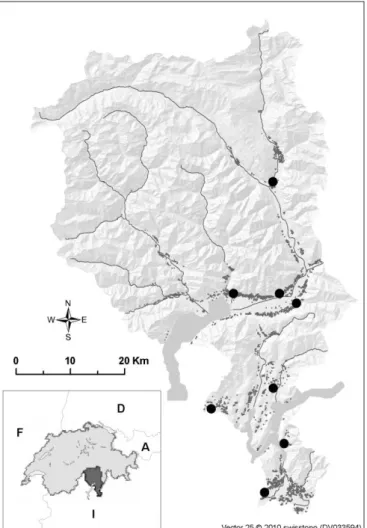
selected by means of VECTOR25 (Swisstopo, 2013). The 48 vineyards were randomly chosen within three nested categories. The first level of splitting was based on aspect of the surface with two groups of vineyards: twenty-four vineyards north-facing (NE/NW) and twenty-twenty-four south-facing (SE/SW). The second nested splitting was based on slope of the surface: Flat and Slope; the first one encompasses sites with slopes less than 5°, the second one encompasses sites with slopes more than 10° including terraced vineyards only. The third level of splitting regards the type of landscape unit dominating in the area of 500 m of radius around the study vineyards, each aspect-slope group was separated in three sub-groups: vegetated open area (O), forest (F) or settlements (S). Location of the studied vineyards is reported in the map on the left and in Chapter 4 (Appendix 4:A1).
which was introduced in southern Switzerland in the early 20th century, mainly because of the phylloxera outbreak. In the same period the specialized grape growing has slightly replaced mixed cultivation systems (grapevine, oats, barley and wheat) which have been gradually abandoned (Rossi 1908).
1.6.2 Selection of vineyards: study design
Forty-eight vineyards were chosen according to a stratified random selection process across the study area (Figure 1:1) by means of vector data of the land use (Vector25, Swisstopo) and a georeferenced geographical system (ArcGis 10). With the aim to capture the higher variability between vineyards, three main factors were considered in the selection of sites: slope, aspect and type of surrounding landscape unit. In Figure 1:1 a scheme of study design with a detailed description of selection process (Box 1).
Figure 1:1 Study design for the vineyards selection in the Southern Swiss Alps region.
1.6.3 Taxa target
I used plants and arthropods as target taxa because they are known to be reliable bioindicators for some important reasons: may reflect trends in species richness and community composition, cost-effective to use, are linked through feeding relationships, their small size with short generation time (arthropods) and sedentary (plants) makes them sensitive to environmental changes, etc. (for an overview see Gerlach, Samways and Pryke (2013). I chose eight taxa overall representing 4 trophic levels: vascular plants (as primary producer); Auchenorrhyncha (Hemiptera: Fulgoromorpha and Cicadomorpha) and Curculionoidea (Coleoptera) (as herbivores); Carabidae (Coleoptera) and Araneae (as predators), and Isopoda and Diplopoda (as detritivores).
Biological inventories of target taxa were obtained by applying a stratified sampling scheme which provided accuracy in the sampling and statistical validity. Vineyards were ideally divided in 3 zones tracing the configuration in parallel strips typical for the vineyard: flat inter-row spacing (I width ranging from 155 to 185 cm), on-row spacing (R part of vineyard floor below the vine canopy with a standard width of 50 cm) and sloped inter-row spacing (S always permanently covered with natural vegetation and sometimes with stone walls) (see the scheme in figure 1:2). The aforementioned zones were sampled with different sampling methods.
Vascular plants
Two vegetation surveys were conducted in June and August in 2011. In this two periods most of early spring and late summer flowering plants are present. Species percentage cover of vascular plants was estimated within five 1m x 1m grids for each zone (relevès) randomly distributed over each vineyard within an area of 2000 m2. Londo’s relative cover value (percentage of cover) was assigned for each individual species according to the slightly modified Londo cover-abundance scale (Londo 1976). The grid was placed five times in each zone, and ten relevès (5 from inter-row and 5 from row) in flat vineyards and fifteen relevès (5 from inter-row , 5 from row and 5 from slope inter-row) in terraced vineyards were performed. Overall, 1'200 relevès were collected throughout the vegetation surveys. Species nomenclature follows Lauber & Wagner (2009).
Figure 1:2 Representation of a "vineyard model" with 3 zones: I flat inter-row spacing, R
Arthropods
Sampling of arthropods was carried out in 2011 over eight periods at monthly intervals, from April to October, covering the main activity period of arthropods (Hatley & Macmahon 1980; Brandmayr & Brandmayr 1986; Alikhan 1995; Stewart 2002). Based on a pilot survey (Trivellone et
al. 2012) four effective sampling techniques were selected with the aim to intercept the total
diversity in terms of number of species (Marshall & Canada 1994; Yi et al. 2012). Each sampling device was operated within an area 2000 m2 at the center of the vineyard.
1. Pitfall trapping. Two pitfall trap stations were installed 20 m from field edges and 10m from each other, ensuring statistical independence of samples. A pitfall trap station consisted of four 200ml cups (diameter= 7 cm; height = 12 cm) placed along the vine row space and inserted into the ground 0.5 m apart. Each cup was half-filled with a saline (NaCl) solution and covered by a transparent PVC-roof. The traps were opened one week per month for a total of eight sampling periods. This kind of trap was exploited mainly to collect predators and detritivorous (e.g. Carabidae, Aranea, Isopoda, Diplopoda).
2. Yellow sticky trapping. Two yellow sticky traps were vertically placed in the vine canopy close to the pitfall trap station. Traps were opened during one week per month. Yellow sticky traps were used mainly to collect the arthropods strictly linked with grapevine. Yellow seems to be the best colour for trapping the arthropods, even if various kinds of insects react differently to different colours. However, bright yellow effectively collects most of winged "Homoptera" and parasitic Hymenoptera (Gibb & Oseto 2006).
3. D-vac suction sampling. The vegetation of the vineyard floor was sampled one time per month with a D-Vac suction sampler (D-Vac Suction Sampler Stihl SH 86 modified by EcoTech® https://www.ecotech-bonn.de/de/, with an opening diameter of the suction tube of 15 cm) and the device was operated for 120 seconds/sample and two samples were collected from the inter-row and the slope vegetation, respectively. The D-vac sampler was employed to sampling the arthropods associated with the vineyard floor vegetation. However, this technique is not suitable for large and heavy individuals which are underestimated (Mommertz et al. 1996).
4. Beating tray sampling. Thirty vine branches per sample were hand-shaked over an entomological umbrella (1m x 1m), collecting all arthropods fallen down. A total of two samples per vineyard were collected.This kind of umbrella has more surface area than the classical entomological net for sweeping and it is particularly suitable for cultivated arboreal plants and for all insects with low fly capability and all insects with an instinctive propensity to simulate death (White & Peterson 1998). Sixteen sites with a high percentage of surrounding forest were chosen to test the hypothesis that the presence of forests could influence the biodiversity of arthropods as well as the degree of insect pest infestation. In this aim, along a selected ecotone zone between vineyard and forest , the first three sampling techniques were employed and one sampling station was established.
Sixteen sites with higher percentage of forest in the surroundings were chosen and one sampling station was established along the buffer ecotone between vineyard and forest. Overall, 3’336 samples were collected throughout the study. All the collected individuals were grouped at the Order level, labeled and conserved in 70% alcohol and sent to specialists for identifications of the adult specimens to the species level. I identified all adults of Auchenorrhyncha group.
1.6.4 Abiotic factors
The selection of abiotic factors used as explanatory variables was based on the ecology of the studied taxa and on the knowledge acquired from the literature (Joern and Laws (2013) for a review). Overall, 36 variables grouped in 6 categories (management, topography, chemical and physical property of soil, plant structure of wild vegetation cover, composition of landscape in a 200 m radius and composition of landscape in a 500 m radius) were considered. An overview of the selected environmental variables is reported in Chapter 3 (Appendix 3:A2).
REFERENCES
Alikhan, A.M. (1995) Terrestrial Isopod Biology. Taylor & Francis. Arzeni, A., Esposti, R. & Sotte, F. (2001) Agricoltura e natura. F. Angeli.
Baggiolini, M. (1990) Production Intégrée en Suisse. I. Aperçu historique de la "production agricole intégrée". Bulletin de la Société entomologique Suisse, 63, 493-500.
Batáry, P., Dicks, L.V., Kleijn, D. & Sutherland, W.J. (2015) The role of agri-environment schemes in conservation and environmental management. Conservation Biology, 29, 1006-1016.
Bohan, D.A., Raybould, A., Mulder, C., Woodward, G., Tamaddoni-Nezhad, A., Bluthgen, N., Pocock, M.J.O., Muggleton, S., Evans, D.M., Astegiano, J., Massol, F., Loeuille, N., Petit, S. & Macfadyen, S. (2013) Networking Agroecology. 49, 1-67.
Bowe, C. & der Horst, D.v. (2015) Positive externalities, knowledge exchange and corporate farm extension services; a case study on creating shared value in a water scarce area. Ecosystem Services, 15, 1-10.
Brandmayr, P. & Brandmayr, T.Z. (1986) Phenology of ground beetles and its ecological significance in some of the main habitat types of Southern Europe. Proceedings of the 17° Int. Congress of Entomology, Hamburg, den Boer et al.: Carabid Beetles, pp. 195-220. Gustav Fischer Stuttgart, New York.
Convention on Biological Diversity (1992). Rio de Janeiro on 5 June 1992. Available online: https://www.cbd.int/convention/text/
Costantini, E.A.C. & Barbetti, R. (2008) Environmental and visual impact analysis of viticulture and olive tree cultivation in the province of Siena (Italy). European Journal of Agronomy, 28, 412-426. DeFries, R.S., Foley, J.A. & Asner, G.P. (2004) Land-use choices: balancing human needs and ecosystem function. Frontiers in Ecology and the Environment, 2, 249-257.
Ehrlich, P.R. (2002) Human Natures, Nature Conservation, and Environmental Ethics: Cultural evolution is required, in both the scientific community and the public at large, to improve significantly the now inadequate response of society to the human predicament. BioScience, 52, 31-43.
Eigenbrod, F., Anderson, B.J., Armsworth, P.R., Heinemeyer, A., Jackson, S.F., Parnell, M., Thomas, C.D. & Gaston, K.J. (2009) Ecosystem service benefits of contrasting conservation strategies in a human-dominated region. Proceedings of the Royal Society of London B: Biological Sciences, 276, 2903-2911.
FAO (2011) FAO in the 21st century: ensuring food security in a changing world. (ed. F.A.A.O.O.T.U. NATIONS). Rome, Food and Agriculture Organization of the United Nations.
Fehér, I. & Beke, J. (2013) The rationale of sustainable agriculture. Iustum Aequum Salutare, IX, 73-87.
Gaigher, R. & Samways, M.J. (2010) Surface-active arthropods in organic vineyards, integrated vineyards and natural habitat in the Cape Floristic Region. Journal of Insect Conservation, 14, 595-605.
Gerlach, J., Samways, M. & Pryke, J. (2013) Terrestrial invertebrates as bioindicators: an overview of available taxonomic groups. Journal of Insect Conservation, 17, 831-850.
Gibb, T.J. & Oseto, C.Y. (2006) Arthropod Collection and Identification: Field and Laboratory Techniques. Academic Press.
Goldman, R.L., Tallis, H., Kareiva, P. & Daily, G.C. (2008) Field evidence that ecosystem service projects support biodiversity and diversify options. Proc Natl Acad Sci U S A, 105, 9445-9448. Gonseth, Y., Wohlgemuth, T., Sansonnens, B. & Buttler, A. (2001) Les régions biogéographiques de la Suisse – Explications et division standard. Documents Environnement Nr./n o 137, pp. 47 p. Office fédéral de l’environnement des forêts et du paysage, Bern.
Hatley, C.L. & Macmahon, J.A. (1980) Spider community organization: Seasonal variation and the role of vegetation architecture. Environmental Entomology, 9, 632-639.
Joern, A. & Laws, A.N. (2013) Ecological mechanisms underlying arthropod species diversity in grasslands. Annu Rev Entomol, 58, 19-36.
Kleijn, D., Rundlof, M., Scheper, J., Smith, H.G. & Tscharntke, T. (2011) Does conservation on farmland contribute to halting the biodiversity decline? Trends Ecol Evol, 26, 474-481.
Kleijn, D. & Sutherland, W.J. (2003) How effective are European agri-environment schemes in conserving and promoting biodiversity? Journal of Applied Ecology, 40, 947-969.
Kristiansen, P., Taji, A., Reganold, J.P. & Publishing, C. (2006) Organic Agriculture: A Global Perspective. CSIRO Publishing.
Lalevic, B., Sivcev, B., Raicevic, V., Ranzovic Vasic, Z., Petrovi, N. & Milinkovic, M. (2013) Environmental impact of viticulture: biofertilizer influence of pruning and wine waste. Bulgarian Journal of Agricultural Science, 19, 1027-1032.
Lauber, K. & Wagner, G. (2009) Flora Helvetica, 4th edn edn. Paul Haupt Bern.
Londo, G. (1976) The decimal scale for releves of permanent quadrats. Vegetatio, 33, 61-64.
Lieskovský, J. & Kenderessy, P. (2014) Modelling the effect of vegetation cover and different tillage practices on soil erosion in vineyards: a case study in Vráble (Slovakia) using water/sedem. Land Degradation & Development, 25, 288-296.
Marshall, S.A., Anderson, R.S., Roughley, R.E., Behan-Pelletier, V. & Danks H.V. (1994) Terrestrial Arthropod Biodiversity: Planning a Study and Recommended Sampling Techniques. Biological Survey of Canada. Available online:
https://www.google.ch/url?sa=t&rct=j&q=&esrc=s&source=web&cd=1&ved=0ahUKEwj10rqQttT MAhUBEpoKHR9RA48QFgghMAA&url=http%3A%2F%2Fbiologicalsurvey.ca%2Fpublic%2FBsc%2FC
ontroller%2FPage%2Fbriefs%2Fplanningastudy.pdf&usg=AFQjCNF5n-30jSo2G96bBdnwJ3Fmi6iHcw&sig2=fb
Matson, P.A., Parton, W.J., Power, A.G. & Swift, M.J. (1997) Agricultural Intensification and Ecosystem Properties. Science, 277, 504-509.
Millennium Ecosystem Assessment (2005) Ecosystems and Human Well-being: Synthesis. Island Press, Washington, DC.
Mommertz, S., Schauer, C., Kösters, N., Lang, A. & Filser, J. (1996) A comparison of D-Vac suction, fenced and unfenced pitfall trap sampling of epigeal arthropods in agro-ecosystems. Annales Zoologici Fennici, 33, 117–124.
Morris, J. & Burgess, P.J. (2012) Chapter 1 Modern Agriculture and Implications for Land Use and Management. Environmental Impacts of Modern Agriculture, pp. 1-34. The Royal Society of Chemistry.
Office de statistique du canton du Tessin (2003-2014) Vendemmia (in ettolitri), secondo il tipo, per
cantone, in Svizzera. Available online:
http://www3.ti.ch/DFE/DR/USTAT/index.php?fuseaction=dati.home&tema=43&id2=285&id3=289 &c1=07&c2=02&c3=04.
Paillotin, G. (2013) European Agricultural Research in the 21st Century: Which Innovations Will Contribute Most to the Quality of Life, Food and Agriculture? Springer Berlin Heidelberg.
Poláková, J., Tucker, G., Hart, K., Dwyer, J. & Rayment, M. (2011) Addressing biodiversity and habitat preservation through Measures applied under the Common Agricultural Policy. Report Prepared for DG Agriculture and Rural Development (ed. I.f.E.E. Policy). London.
Power, A.G. (2010) Ecosystem services and agriculture: tradeoffs and synergies. Philos Trans R Soc Lond B Biol Sci, 365, 2959-2971.
Rasul, G. (2009) Ecosystem services and agricultural land-use practices: a case study of the Chittagong Hill Tracts of Bangladesh Sustainability: Science, Practice, & Policy, 5, 15-27.
Rossi, G. (1908) La ricostruzione dei vigneti del Cantone Ticino. Veladini, Lugano.
Santilli, J. (2013) Agrobiodiversity: towards innovating legal systems. Renewing innovation systems in agriculture and food (ed. D.H. Coudel E., Soulard C.T., Faure G. & Hubert B. (Orgs.)), pp. 167-184. Wageningen Academic Publishers, Wageningen.
Spinedi, F. & Isotta, F. (2004) Il clima del Ticino. Dati statistiche e società, 2, 5-39.
Stewart, A.J.A. (2002) Techniques for sampling Auchenorrhyncha in grasslands. Denisia, 4, 491– 512.
Swisstopo. 2013. VECTOR25. Available online
http://www.swisstopo.admin.ch/internet/swisstopo/fr/home/products/landscape/vector25.html
Trivellone, V., Pollini Paltrinieri, L., Jermini, M. & Moretti, M. (2012) Management pressure drives leafhopper communities in vineyards in Southern Switzerland. Insect Conservation and Diversity, 5, 75-85.
Tscharntke, T., Clough, Y., Wanger, T.C., Jackson, L., Motzke, I., Perfecto, I., Vandermeer, J. & Whitbread, A. (2012) Global food security, biodiversity conservation and the future of agricultural intensification. Biological Conservation, 151, 53-59.
Turner, W.R., Brandon, K., Brooks, T.M., Costanza, R., da Fonseca, G.A.B. & Portela, R. (2007) Global Conservation of Biodiversity and Ecosystem Services. BioScience, 57, 868-873.
Viret, O. (2013) Viticulture in Switzerland and integrated production of grape. IOBC-WPRS Meeting of the Working Group on "Integrated Protection and Production in Viticulture". Ascona, Switzerland.
Walters, C. (2003) Eco-Farm, An Acres U.S.A. Primer: The definitive guide to managing farm and ranch soil fertility, crops, fertilizers, weeds and insects while avoiding dangerous chemicals 3rd revised edition edn. Acres USA.
White, R.E. & Peterson, R.T. (1998) The Beetles of North America. Houghton Mifflin.
Wohlgemuth, T. (1996) Biogeographical Regionalization of Switzerland Based on Floristic Data: How Many Species are Needed? Biodiversity Letters, 3, 180-191.
Yi, Z., Jinchao, F., Dayuan, X., Weiguo, S. & Axmacher, J.C. (2012) A Comparison of Terrestrial Arthropod Sampling Methods. Journal of Resources and Ecology, 3, 174-182.
Appendices
Material 1:A1. List of additional scientific papers (5 faunistic and 1 floristic), 7 outreach articles and 4 conference presentations arising from the present study.
Additional non-ISI papers
1. Cara C., Milani M., Trivellone V., Moretti M., Pezzati B., Jermini M. 2013. La minatrice americana della vite (Phyllocnistis vitegenella Clemens): dinamica delle popolazioni e potenziale di biocontrollo naturale in Ticino. Bollettino della Società ticinese di scienze naturali, 101: 75-80.
2. Trivellone V., Pedretti A., Caprani M., Pollini Paltrinieri L., Jermini M., Moretti M. 2013. Ragni e carabidi dei vigneti del Canton Ticino. Bollettino della Società ticinese di scienze naturali, 101: 63-72.
3. Hänggi A., Stäubli A., Heer X., Trivellone V., Pollini Paltrinieri L., Moretti M. 2014. Eleven new spider species (Arachnida: Araneae) for Switzerland discovered in vineyards in Ticino - What are possible reasons?. Bulletin Mitteilungsblatt SEG-SSE, 87:215-228
4. Germann G., Trivellone V., Pollini Paltrinieri L., Moretti M. 2013. First record of the adventive weevil Gymnetron rotundicolle Gyllenhal, 1838 from Switzerland (Coleoptera, Curculionidae). Bulletin Mitteilungsblatt SEG-SSE, 86: 1-5.
5. Trivellone V., Knop E., Turrini T., Andrey A., Humbert J.-Y., Kunz G. 2015. New and remarkable leafhoppers and planthoppers (Hemiptera: Auchenorrhyncha) from Switzerland. Bulletin Mitteilungsblatt SEG-SSE. 88: 273-284.
6. Bellosi B., Trivellone V., Jermini M., Moretti M., Schönenberger N. 2013. Composizione floristica dei vigneti in Ticino. Bollettino della Società ticinese di scienze naturali, 101: 55-60.
Outreach articles
1. Bogyo D., Vilisics F., Moretti M., Trivellone V. 2013. Isopoda and Diplopoda fauna of vineyards in Southeast-Switzerland. 12th Central European Workshop on soil zoology, April 8th-11th 2013, České Budějovice (Czech Republic). Abstract book: 14.
2. Trivellone V., Moretti M. 2013. Vigneti della Svizzera italiana: una fonte importante di biodiversità. Forestaviva, 52, 8.
3. Moretti M., Trivellone V. 2013. Découverte de nouvelles espèces d’invertébrés dans les vignobles du Tessin. Revue suisse de Viticulture, Arboriculture, Horticulture, 45(6): 377. 4. Trivellone V. 2014. I margini tra bosco e aree coltivate: un’opportunità per la valorizzazione
5. Trivellone V., Jermini M., Moretti M., Cara C. 2015. Interfaccia bosco-aree agricole: un mosaico paesaggistico ricco di parassitoidi utili. Agricoltore Ticinese, 36, 13.
6. Jermini M., Trivellone V. 2015. Combiner les modes d’échantillonnage pour affiner les strategies de lute. Revue suisse de Viticulture, Arboriculture, Horticulture, 47(4): 213.
7. Trivellone V., Moretti M. 2015. Weinberge im Tessin enthüllen unerwartet hohe Biodiversität. Diagonal, 1, 20-21.
Conference presentations
1. Trivellone V., Jermini M., Angelini E. 2015. Occurrence of Leaf- and Planthoppers known and potential vectors of phytoplasmas in vineyards of Southern Switzerland. IOBC-WPRS Conference of Working Group on “Integrated Protection and Production in Viticulture”, Vienna, October 2015. Abstract Book and talk.
2. Trivellone V., Filippin L, Jermini M., Angelini E. 2015. Molecular characterization of phytoplasma strains in leafhoppers inhabiting the vineyards agroecosystem in Southern Switzerland. 3rd International Phytoplasmologist Working Group Meeting. Mauritius, January 2015. In: Phytophatogenic Mollicutes, 5(1): S45-S46. DOI: 10.5958/2249-4677.2015.00018.3 and talk. 3. Trivellone V., Pedretti A., Caprani M., Pollini Paltrinieri L., Jermini M., Moretti M. 2013.
Arthropods as bio-indicators in vineyard agroecosystem. IOBC/WPRS Meeting of the Working Group “Integrated Protection and Production in Viticulture”, Ascona (Switzerland), 13th - 17th October, 2013. Abstract Book: 121 and talk.
4. Trivellone V., Schönenberger N., Bellosi B., Jermini M., de Bello F., Mitchell E.A.D., Moretti M. 2013. How to select indicator plant species for taxonomic and functional biodiversity in the ecosystems affected by humans. XXIII Congresso Società Italiana di Ecologia, Ancona, 16th-18th September, 2013. Exstended abstract and talk.
Chapter 2 Management pressure drives
leafhopper communities in vineyards in
Southern Switzerland
Metcalfa pruinosa (Say, 1830) on grapevine shoot (photo: V. Trivellone)
Valeria Trivellone, Lucia Pollini Paltrinieri, Mauro Jermini and Marco Moretti
Abstract
1. The effects of the current changes in traditional agricultural practices in the Alps on the biodiversity affecting ecosystem functions and services are little known. Vineyards are among the oldest anthropogenic environments of high cultural and natural value that shape the landscape of large areas in Central and Southern Europe. In several mountain regions of the Alps, vineyards are a valid alternative to the landscape homogenization that has followed post-cultural land abandonment and agriculture intensification. Key unanswered questions remain regarding the relative contribution of several factors that influence biodiversity, and the level in management pressure with regards to taxonomic and functional diversity enhancement.
2. To answer these questions, we sampled leafhoppers (Auchenorrhyncha) as a model taxon using different standard techniques along 24 vine transects within 8 vineyard complexes in Southern Switzerland. Each transect included one vine row, vine canopy, its interrow, and the adjacent slope; the latter two were permanently grass-covered. Data were analyzed using a four-step approach.
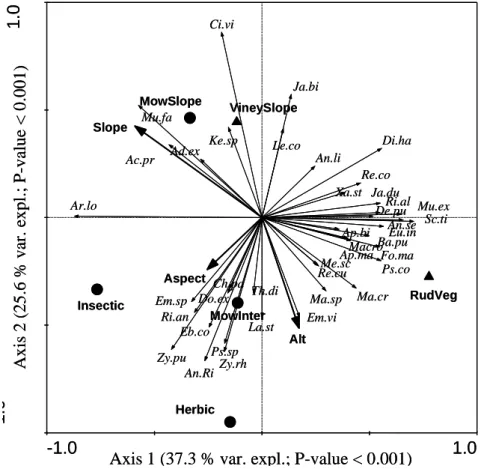
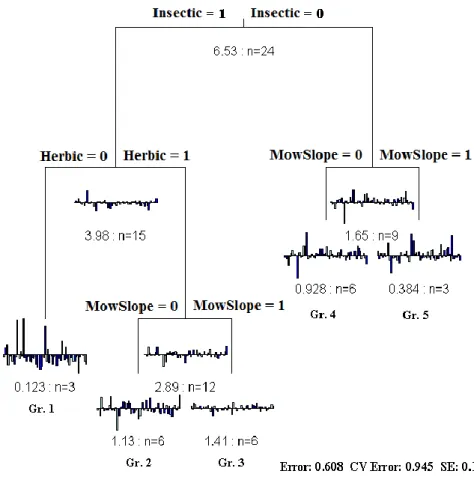
3. Environment (5 variables) and Management (4 variables) accounted for most of the variance in the leafhopper assemblage. Pesticide use (insecticide and herbicide) and slope mowing are the most important management predictors of leafhopper species composition.
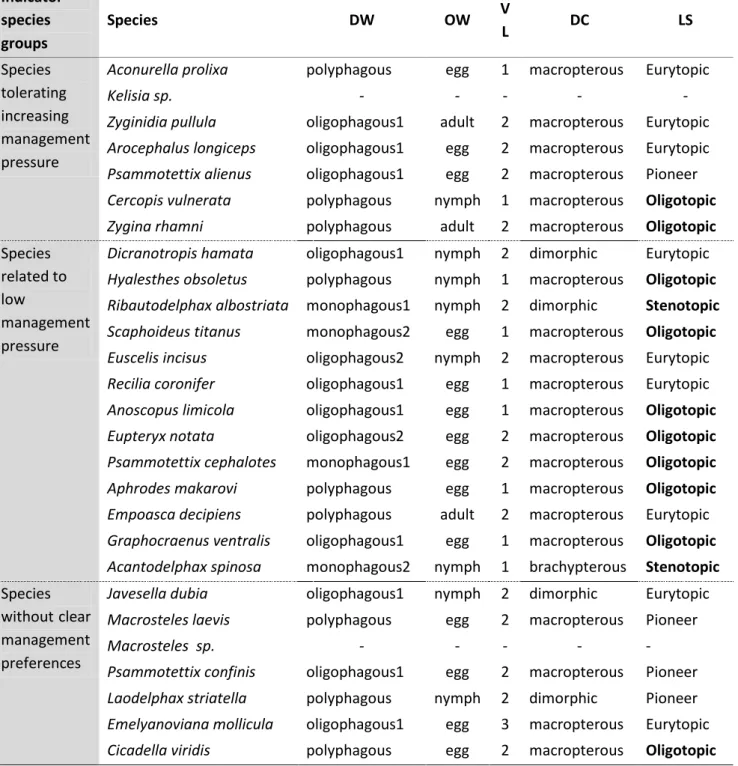
4. With increasing management pressure (i.e. pesticide and mowing), the number of indicator species and particularly the specialists (i.e. stenotopic and oligotopic species) decreases dramatically.
5. To promote taxonomic and functional complexity of communities in vineyard systems, we suggest low management pressure with moderate use of pesticide and a low intensity regime of slope mowing.
Keywords Auchenorrhyncha, insecticide, biodiversity, conservation, indicator species, functional traits, grassland, invertebrates.
Introduction
Global agricultural policy is undergoing significant changes towards new approaches that take into account the multifunctional concept (IAASTD, 2008). In this perspective, the conservation of both natural resources and ecosystem services is fundamental to provide the indispensable base for the production of essential goods and services for human survival (Díaz et al., 2007). Biodiversity is a necessary underlying component of goods and ecological services and land-use practices, especially in grassland ecosystems, have been identified as the single major cause of biodiversity loss in recent years (Chapin et al., 2000; Vile et al., 2005; Díaz et al., 2006; Kremen et al., 2007). In particular, grasslands in the Alps are currently going through a series of profound changes with
unknown consequences on both biodiversity and related ecosystem functions and services. In the last few decades, human activity has modified the landscape and biodiversity in the Alps through intensification of agricultural practices in some areas as well as abandonment of traditional practices in others (e.g. Chemini & Rizzoli, 2003; Sergio & Pedrini, 2007; Fischer et al., 2008). The vineyard is a valuable element of alpine landscape shaped by cultural traditions and natural conditions. By adopting ecological management, it is possible to preserve biodiversity and increase the stability and resilience of the agroecosystem while also maintaining the benefit drawn by farmers. Several studies have shown that farming practices and management regimes of vineyard grasslands are the most important factors determining biodiversity of plants and invertebrates (e.g. Di Giulio, et al., 2001; Costello & Daane, 2003; Ponti et al., 2005; Thomson & Hoffmann, 2007; Sharley et al., 2008; Bruggisser et al., 2010). Other factors that might contribute to biodiversity enhancement and structuring in vineyard systems and in vineyard grasslands in particular are local environmental conditions (especially in mountain regions) and the spatial arrangement of the locations (ecological connectivity). Schweiger et al. (2005) suggested that management effort should be focused on habitat connectivity and land-use intensity, which are the factors that account for most of the variability of arthropod communities in several agricultural landscapes. Central to understanding community distribution and biodiversity in grassland systems in mountain regions is knowledge of the relative importance and interaction between management practices, local environmental conditions and the spatial arrangement of the locations. In particular, our study aimed (i) to assess the relative contribution of management, environment and space variables on the invertebrate community assemblages of the vineyard system; (ii) to examine the effect of different management measures on invertebrate species composition; (iii) to define indicator species of grass-covered vineyard under different management practices and to characterize them from a functional perspective; (iv) to propose management guidelines to enhance taxonomic and functional diversity in vineyard grasslands in the Alps.
To answer to these points, we selected Auchenorrhyncha (Hemiptera: Fulgoromorpha and Cicadomorpha), leafhoppers hereafter, as our model taxon, as it represents an important taxonomic group of both conservation and agronomic concern in vineyard systems. Leafhoppers are widely used as indicators of changes in management and composition of grassland systems (see Biedermann et al., 2005 for a review).
Materials and methods
Study area and sampling designThe study was carried out in the main vineyard region of Southern Switzerland, along a North-South gradient from Biasca (46°21'N–8°57'E) to Stabio (45°51'N–8°55'E), Canton Ticino (Fig. 2:1; Pythoud, 2007 for details). The study area has a moist, warm temperate climate, with a mean
0.5 (N) to 1.6 °C (S) in January and from 21.2 (N) to 23.5 °C (S) in July. Vineyards are mainly located along south-facing steep terraced slopes (256-436 m a.s.l.) with grapevine rows along slope lines. Vineyards are often composed of small areas scattered at different suitable sites but grouped in geographical units (vineyard complexes), which are divided by morphological or anthropogenic structures and surrounded by settlements, gardens, semi-natural open habitats and forest edges.
Data sampling
We designed the data sampling to include between- and within- vineyard variability, as our case study. In the study area, we selected 8 vineyard complexes, 4 in the southern and 4 in the northern part of the main vineyard region, to maximise the geographical variance between vineyard complexes (distance between vineyards: minimum 9 km; maximum 21 km) as an important source of variation of biotic and abiotic conditions. Within each vineyard complex, we selected three 20 m x 6 m sampling transects (transect hereafter) consisting of one vine row, vine canopy, interrow and adjacent slope (if present). The latter two were permanently covered by herb layer, thus grassland vegetation cover constituted the main environment within our vineyard system. The three transects were located in the upper, middle and low sector of each vineyard
Figure 2:1 Location of the eight vineyard complexes (black dot) selected for our study within the vineyard region (dark-grey areas) of Southern Switzerland.
complex (distance between transects: minimum 20 m; maximum 40 m) to include the within-vineyard complex variability given by their particular geomorphological conditions. There were 24 transects in total.
In each transect, leafhoppers were sampled from 4 May to 29 July 2009 for a total of four sampling periods, covering the main activity period of leafhoppers in vineyards. We used three standard methods that permitted the sampling of species from different life forms and strategies (see Stewart, 2002 for a review). Species with low mobility (i.e. brachypterous and ground-dwellers) were sampled using pitfall traps, which consisted of 3 plastic beakers (opening diameter 75 mm) recessed into the soil and arranged in a line, at a distance of 50 cm, in the middle of the transect and filled with a saturated salt solution and some drops of detergent as a surfactant. Vacuum aspiration (D-Vac Suction Sampler Stihl SH 86 modified by EcoTech®; http://www.ecotech-bonn.de/, with an opening diameter of the suction tube of 15 cm; 120 seconds on 60 sampling points per transect) and sweep netting (opening diameter of 35 cm; 80 sweeps per transect) were used to sample species living on the low and upper grass layer, as well as on the vine canopy along the transects. Pitfall trap, vacuum and sweep net samples were collected once every 3-4 weeks during the sampling period.
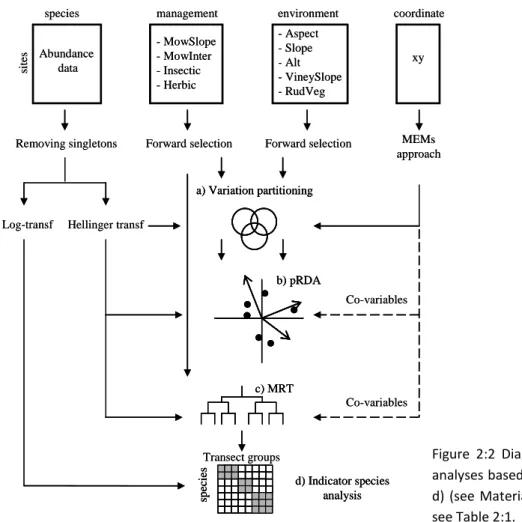
Additionally, we sampled three groups of explanatory variables in each transect (Tab. 2:1), including five environment variables (i.e. aspect, slope of the transect, altitude, presence of vineyard slopes and vegetation type), four management variables (i.e. mowing of the slope, mowing of the interrow, application of insecticide and application of herbicide) and three spatial variables (see next section).
Table 2:1 List of environmental, management and spatial variables forming the initial pool of predictors used to model the community composition of leafhoppers.
Group of variable Code Type of
variable Description Environment
Aspect ASPECT Continuous* Xtr = cos[radiant (X - 45°)] + 1 (Beers et al., 1966)
Slope of the transect SLOPE Continuous*
Altitude ALT Continuous*
Presence of vineyard slopes VINEYSLOPE Binary 0 = absence; 1 = presence
Vegetation type RUDVEG Binary 0 = dry meadow; 1 = ruderal
Management
Mowing of the slope MOWSLOPE Binary 0 = no; 1 = yes
Mowing of the interrow MOWINTER Binary 1 = 2-3 cuts per year; 2 = 4-5 cuts per year
Application of insecticide INSECTIC Binary 0 = no application; 1 = 2 applic. per year on the
vine canopy
Application of herbicide HERBIC Binary 0 = no application; 1 = 2 applic. per year on the
vine row
Space
Moran’s eigenvectors map MEM Continuous Three selected eigenvectors after Dray et al.
(2006) (see section Spatial data)
Spatial data
To consider the influence of the spatial arrangement on leafhopper assemblages at both small and large scales, we used the Moran’s eigenvector maps (MEMs) approach. This technique belongs to the Principal Coordinates of Neighbour Matrices family of analyses, and was first proposed by Borcard and Legendre (2002) and further developed by Dray et al. (2006). It is increasingly used to assess the spatial influence on community structure in ecological studies. MEMs are constructed from a spatial weighting matrix (W) calculated by the Hadamard product of a connectivity matrix (B) by a weighting matrix (A). The B matrix is based on spatial coordinates while the neighbourhood between transects is constructed using the distance criteria of nearest neighbors. Finally, Moran’s eigenvectors and eigenvalues are calculated on the spatial weighting matrix, and the eigenvector matrix that explains the largest part of the leafhopper community is selected. For more details, see Dray et al. (2006) for the mathematical aspects, and Sattler et al. (2010) for an application.
Species and species traits
All adult leafhopper specimens were identified at species level by the first author. Nomenclature follows Ribaut (1936, 1952), Della Giustina (1989), Holzinger et al. (2003) and Biedermann and Niedringhaus (2009). Voucher specimens of each species are deposited in the Natural History Museum of Lugano, Switzerland.
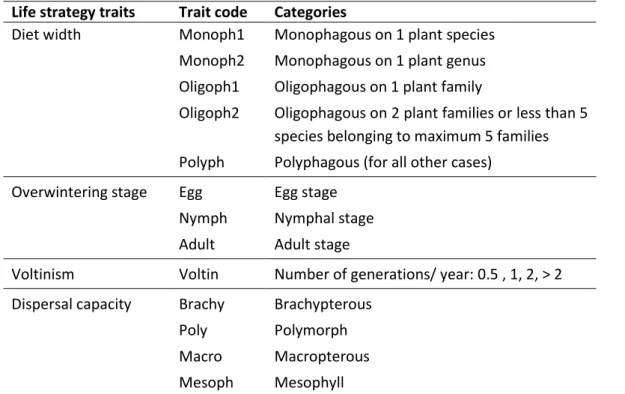
Each species was described in terms of four traits (i.e. Diet width, Overwintering stage, Voltinism and Dispersal capacity; see Appendix – Table 2:A1) after Nickel and Remane (2002) and Nickel (2003). According to the classification of grassland Auchenorrhyncha proposed by Achtziger and Nickel (1997) and Nickel and Achtziger (2005), different combinations of ecological traits defined four groups (Pioneer, Eurytopic, Oligotopic and Stenotopic) of synthetic life strategies with differential responses to management.
The Pioneer and Eurytopic species are defined as generalists and Oligotopic and Stenotopic species as specialists.
Data analyses
We used four complementary statistical methods to answer our questions (see a-d in Fig. 2:2 for an overview).
To quantify the relative contribution of the three sets of variables (Management, Environment and Space; see Table 2:1) we hierarchically partitioned the variability in the community data of the 24 transects (see a in Fig. 2:2) (Borcard et al., 1992; Anderson & Gribble, 1998; Legendre & Legendre, 1998). All the management and environmental variables were included in the analysis after the forward selection by Dray et al. (2007) (P = 0.05 after 9999 random permutations) and the double-stopping procedure by Blanchet et al. (2008) did not eliminate any variables. The variation explained in each Redundancy Analysis (RDA) model was reported as the adjusted coefficient of