Influence of Honey Bee, Apis mellifera, Hives and Field Size on
Foraging Activity of Native Bee Species in Pumpkin Fields
DEREK R. ARTZ,1CYNTHIA L. HSU,
ANDBRIAN A. NAULT
Department of Entomology, Cornell University, New York State Agricultural Experiment Station, 630 W. North Street, Geneva, New York
Environ. Entomol. 40(5): 1144Ð1158 (2011); DOI: http://dx.doi.org/10.1603/EN10218
ABSTRACT The purpose of this study was to identify bee species active in pumpkin Þelds in New York and to estimate their potential as pollinators by examining their foraging activity. In addition, we examined whether foraging activity was affected by either the addition of hives of the honey bee, Apis
melliferaL., or by Þeld size. Thirty-Þve pumpkin (Cucurbita spp.) Þelds ranging from 0.6 to 26.3 ha, 12 supplemented with A. mellifera hives and 23 not supplemented, were sampled during peak ßowering over three successive weeks in 2008 and 2009. Flowers from 300 plants per Þeld were visually sampled for bees on each sampling date. A. mellifera, Bombus impatiens Cresson, and Peponapis pruinosa (Say) accounted for 99% of all bee visits to ßowers. A. mellifera and B. impatiens visited signiÞcantly more pistillate ßowers than would be expected by chance, whereas P. pruinosa showed no preference for visiting pistillate ßowers. There were signiÞcantly more A. mellifera visits per ßower in Þelds sup-plemented with A. mellifera hives than in Þelds not supsup-plemented, but there were signiÞcantly fewer
P. pruinosa visits in supplemented Þelds. The number of B. impatiens visits was not affected by supplementation, but was affected by number of ßowers per Þeld. A. mellifera and P. pruinosa visits were not affected by Þeld size, but B. impatiens visited fewer ßowers as Þeld size increased in Þelds that were not supplemented with A. mellifera hives. Declining A. mellifera populations may increase the relative importance of B. impatiens in pollinating pumpkins in New York.
KEY WORDS Bombus impatiens, Peponapis pruinosa, pollination, Cucurbita spp.
Pollinators provide an essential ecosystem service that is important to both natural and agricultural systems, providing as much as 200 billion dollars in pollination services worldwide (Klein et al. 2007, Kremen et al. 2007, Aizen et al. 2009, Gallai et al. 2009). Many insect-pollinated crops rely on both native bee species and the introduced honey bee, Apis mellifera L., for pol-lination (Klein et al. 2007, James and Pitts-Singer 2008), and both natural and agroecosystems experi-ence spatial and temporal variation in the diversity and abundance of pollinators that visit ßowers for nectar and pollen (Gomez and Zamora 1999, Petanidou et al. 2008, Brunet 2009, Artz et al. 2010).
In areas of high commercial agricultural production, managed A. mellifera are particularly important pol-linators because of their ability to pollinate many dif-ferent crops and because their colonies are large and relatively easy to transport. Many growers rely on managed A. mellifera as the sole bee species to provide the majority of pollination services, particularly for crops with high pollination requirements (Free 1993, Delaplane and Mayer 2000). The economic value at-tributed to A. mellifera for crop pollination in the
United States is estimated to be 14.6 billion dollars annually (Morse and Calderone 2000).
Native bee species also play a major role in polli-nating commercial crops. In CaliforniaÕs Central Val-ley, Kremen et al. (2002a,b) reported 30 native bee species, mostly solitary bees, visiting watermelon
[Cit-rullus lanatus(Thunb.) Matsum. & Nakai] ßowers. In the mid-Atlantic United States, Shuler et al. (2005) assessed the abundance and assemblage of pollinators visiting pumpkin and squash (Cucurbita spp.) and found that the squash bee, Peponapis pruinosa (Say), a native, solitary ground-nesting species, was the most abundant pollinator on 15 of the 25 farms; A. mellifera and bumble bees, Bombus spp., were the other most abundant pollinators visiting pumpkin and squash ßowers in that study. Also in the mid-Atlantic United States, Winfree et al. (2007) documented 46 bee spe-cies visiting watermelon ßowers in 23 small Þelds (⬍1 ha), and Julier and Roulston (2009) reported a diverse bee community visiting pumpkin ßowers in various-sized Þelds. In these studies, native pollinators visited ßowers frequently enough to maximize fruit yield. Native bees provide pollination services to a variety of crops in the United States with an estimated economic value of 3.07 billion dollars annually (Losey and Vaughan 2006), and their role in pollinating agricul-1Corresponding author, e-mail: [email protected].
tural crops may become even more important if A.
melliferapopulations continue to decline (NRC 2006, vanEngelsdorp et al. 2011).
Pumpkin production in New York ranks high na-tionally with an annual value that averages approxi-mately 38 million dollars (USDA-NASS 2008). Pump-kin is a cucurbit crop, Cucurbita spp., with high pollination demands requiring insect vectors to trans-fer pollen from staminate ßowers to pistillate ßowers (Hurd et al. 1974, Kevan et al. 1988). Previous polli-nation studies in the mid-Atlantic United States iden-tiÞed a number of bee species visiting pumpkin ßow-ers including A. mellifera, Bombus spp., P. pruinosa,
Melissodes bimaculataLepeletier (Apidae), and sev-eral halictid bees, Lasioglossum spp., Agapostemon spp., and Halictus spp. (Halictidae) (Fronk and Slater 1956, Willis and Kevan 1995, Shuler et al. 2005, Julier and Roulston 2009). Pumpkin ßowers are also visited by various other non-Apoid insects such as striped cucumber beetles, Acalymma vittatum (F.), and spot-ted cucumber beetles, Diabrotica undecimpunctata
howardiiBarber, both major herbivores of pumpkins and vectors of the bacterial wilt pathogen, Erwinia
tracheiphila(Smith) (Metcalf and Lampman 1989, Met-calf et al. 1995). Despite their frequent visitation to ßow-ers, cucumber beetles (Coleoptera: Chrysomelidae) are not important pollinators because they carry small amounts of pollen (Andersen and Metcalf 1987; D.R.A., personal observation). The most common native insect pollinators of pumpkin in New York are not well known. The importance of a bee species as a pollinator of a particular crop is somewhat dependent on foraging behavior (NeÕeman et al. 2006, James and Pitts-Singer 2008). For example, in Utah, Tepedino (1981) found that P. pruinosa preferred summer squash staminate ßowers over pistillate ones, whereas A. mellifera vis-ited more pistillate ßowers than staminate ones. These results suggested that A. mellifera foragers were pref-erentially foraging for nectar resources from pistillate ßowers. These Þndings highlighted how different bee species may favor one ßower type over another during foraging, and that these pollinator preferences and discrimination abilities may inßuence plant reproduc-tive success. Highly preferred pistillate ßowers pre-sumably would receive more visits, thus increasing the probability of pollen deposition and pollination suc-cess (Galen 1989, Mele´ndez-Ackerman and Campbell 1998). Preference for visiting staminate or pistillate ßowers in pumpkin Þelds is not known for the most common pollinator species in New York.
The abundance of a particular pollinator in a crop during bloom, measured by visitation frequency to crop ßowers, may also provide insight into the relative importance of a species as a pollinator. Some bee species may exclusively visit pumpkin ßowers and may be abundant throughout the growing season, whereas others may visit pumpkin ßowers only when other ßoral-rich resources are not available, potentially re-sulting in fewer visits to pumpkin ßowers (Eickwort and Ginsberg 1980, Keasar et al. 2002). In New York, pumpkin growers can rent A. mellifera hives to try and increase pollination success and yield in their Þelds,
although many growers believe that the activity of native pollinators and feral A. mellifera is sufÞciently high to provide adequate pollination of their pumpkin crops. Past studies have shown that native pollinators visit ßowers frequently enough to provide sufÞcient pollination services for cucurbit crops grown in small Þelds (⬍1 ha) (Winfree et al. 2007), but this trend is not known for larger Þelds (⬎1 ha), which are typical in New York. The relative activity of A. mellifera and native bee species in pumpkin Þelds supplemented and not supplemented with A. mellifera hives and the effect of Þeld size on ßower visits by A. mellifera and native bee species have not been studied in New York. The principal objectives of this study were to: 1) identify and estimate the relative number of visits for bee species that visit pumpkin ßowers in commercial Þelds in New York, 2) compare the number of ßower visits to staminate and pistillate pumpkin ßowers for the most common bee species, 3) test whether the number of ßower visits by A. mellifera and native bee species differs between Þelds supplemented or not supplemented with A. mellifera hives, and 4) describe the impact that Þeld size has on ßower visits by the most common bee species. We do not provide quan-titative data on how bee visits relate to fruit yield (see Artz and Nault 2011); rather, we identify the most common bee species and discuss the implications of their foraging activity on pollination services in pump-kin Þelds.
Materials and Methods
Study System. Pumpkins are annual plants that have been cultivated in the Americas for their nutritious seeds and fruit since the beginning of plant domesti-cation and agricultural development (Whitaker and Davis 1962, Nee 1990). All four of the main domesti-cated pumpkin species, Cucurbita pepo L., C.
argyro-spermaHuber (⫽C. mixta Pang.), C. maxima Duch., and C. moschata (Duch. ex Poir.) originated in either North or South America (Whitaker and Bird 1949, Whitaker 1981, Decker 1988). Pumpkins are monoe-cious plants, bearing separate staminate and pistillate ßowers on the same plant, but staminate ßowers gen-erally outnumber pistillate ßowers (range,么;乆; 5:1Ð 11:1) (Whitaker 1931, Nepi and Pacini 1993, Dela-plane and Mayer 2000). Plants produce large ßowers that last one day, typically opening at dawn and closing by late morning or early afternoon (Tepedino 1981; D.R.A., unpublished data). Staminate ßowers are typ-ically produced Þrst in the season and provide both nectar and pollen, whereas pistillate ßowers open later and only offer nectar as a reward for foraging insects (Free 1993, Delaplane and Mayer 2000). In New York, pumpkins are planted from late May to early July and ßowers are produced from July to early September.
Study Sites and Sampling Procedure. This study was conducted during the period pumpkins bloom (July to September) in the Finger Lakes region of New York in 2008 and 2009. Thirty-Þve pumpkin Þelds (2008: n⫽ 12; 2009: n⫽ 23) were sampled in this study, ranging from 0.6 to 26.3 ha (average Þeld size was 3.5 ha).
Fields were selected with no prior knowledge as to whether they would or would not be supplemented with hives, different Þelds were used each year, and the majority of Þelds were commercial Þelds. Six of the commercial Þelds in 2008 and in 2009 were supple-mented with A. mellifera hives. In addition to the commercial Þelds, each year several Þelds were lo-cated at Cornell UniversityÕs New York State Agricul-tural Experiment Station (NYSAES). The average (⫾SE) Þeld size of supplemented Þelds was 6.7 ⫾ 1.9 ha (range: 2.0 Ð26.3 ha) and the average (⫾SE) Þeld size of nonsupplemented Þelds was 1.9 ⫾ 0.5 ha (range: 0.6 Ð10.9 ha).
Within each Þeld, ßowers from plants were sampled in three 10-m transects along each of the ÞeldsÕ four sides and three 10-m transects in the center of the Þeld. Plants in most Þelds were in rows spaced 1.5 m apart and plants were spaced 1 m apart within rows. The sampling unit was a transect that consisted of two rows (3 m by 10 m in length [area⫽ 30 m2]) that included 20 plants. The total number of bees visiting pumpkin ßowers in each transect in each Þeld was counted once a week for three consecutive weeks, which spanned the majority of the period ßowers were produced. In total, 300 plants were sampled each week in each Þeld (⫽3 transects ⫻ 5 locations in Þeld⫻ 20 plants ⫽ 300 plants) and, for each year, bees were sampled from a total of 900 plants per Þeld (⫽300 plants⫻ 3 sampling dates). Though the number of plants sampled was constant, the number of ßowers sampled per Þeld per sampling date varied between 378 and 1958 (average⫾ SE: 803 ⫾ 32).
Sampling was conducted between 0600 Ð1100 hours EDST on sunny to partly cloudy days with minimal wind. Transects were sampled in 5- to 10-min intervals by slowly walking in between the two rows, and ßow-ers on each plant were sampled for ⬇10Ð15 s. Ob-servers scored the number of bee visits to ßowers on each plant in the transect, bee species, sex of ßower, and number of ßowers in the transect. A “visit” was recorded if the bee came in contact with any of the ßoral parts. Because not all Þeld observers could re-liably differentiate the sex of bees visiting ßowers, this information was not recorded. A subsample of insect visitors were collected and identiÞed in the lab, and voucher specimens were deposited at the Insect Col-lections at Cornell University (CUIC), Ithaca, NY.
Bee Pollinator Survey. Every bee species encoun-tered visiting pumpkin ßowers was identiÞed during the 2008 and 2009 seasons. The total number of bee visits for each species was calculated for each year by summing the number of visits over time for the 12 Þelds in 2008 and the 23 Þelds in 2009. The mean number of bee visits per Þeld also was calculated separately for each year. Because A. mellifera, B.
im-patiens,and P. pruinosa were the most common species visiting ßowers in this study, the following sections focus on these species.
Flower Preference and Nectar Studies. To deter-mine if visitation to pistillate and staminate ßowers was inßuenced by nectar volume or concentration, nectar production was measured in pumpkin ßowers,
Cucurbita pepovariety ÔMystic PlusÕ F1, in two Þelds in 2008 and two Þelds in 2009 located at NYSAES. Nectar from other pumpkin varieties was not sampled be-cause volume and concentration are similar among C.
pepo varieties (Ashworth and Galetto 2002, Hladun and Adler 2009). Flower buds were randomly selected a day before they were expected to open and bagged with nylon mesh screen to exclude insect visitors and to minimize effects on nectar production (Wyatt et al. 1992). On the morning of anthesis, the nylon mesh screen was removed and nectar was collected by de-structively sampling ßowers and removing petals and obstructive ßoral tissue by using clean razor blades. Nectar was extracted from the base of the nectary using 50-l micropipette tubes (Drummond ScientiÞc Co., Broomall, PA), and the volume was calculated based on the length of the nectar column in the mi-cropipette tubes by using published conversion pro-tocols (Kearns and Inouye 1993). Nectar concentra-tions were measured as sucrose equivalents by using a hand-held refractometer (Eclipse 45Ð 03, Bellingham and Stanley, Tunbridge Wells, United Kingdom), which was washed with distilled water and wiped dry between samples. Differences between the total num-ber of bee visits summed over the three sample dates to staminate and pistillate ßowers and the natural sex ratio of ßowers in the Þelds were analyzed using2 tests. Statistical analyses for ßower preferences were performed using SPSS 14.0 software (SPSS 2005).
Foraging Dynamics Between Bee Species within Flowers. The mean number of bee visits per ßower by A. mellifera, B. impatiens, and P. pruinosa visiting pumpkin ßowers was compared for each of the three weeks separately. Data were collected as described in the Study Sites and Sampling Procedure section. Be-cause commercial Þelds were planted at different times resulting in various starting bloom dates, each Þeld was standardized at the onset of ßowering so that the Þrst sampling date (week 1) was approximately 1 wk after initial pumpkin ßowering for that particular Þeld. Initial bloom times for individual Þelds varied from 1 to 5 d.
Data were analyzed separately for each sample date, for each year and for Þelds supplemented or not sup-plemented with A. mellifera hives by using PROC GLM (SAS Institute 2007). Means were compared using LSMEANS at P⬍ 0.05 (SAS Institute 2007). The response variable was the mean number of bee visits per ßower per Þeld for each sample date for each species and the independent variable was the bee species. Data were normalized using the loge trans-formation before analysis. For B. impatiens, the num-ber of visits per ßower was adjusted by adding 0.01 before transformation so that dates when no B.
impa-tienswere observed could be included in the analyses. Untransformed means are presented in the results.
Effects of Supplementation, Field Size and Other Bee Species on Bee Visits. All regression models were analyzed using PROC GLM (SAS Institute 2007). For all analyses, the response variable was the mean num-ber of bee visits per ßower calculated by summing bee visits and dividing by the total number of ßowers for
each Þeld for each sample date, then averaging across the three sample dates for each Þeld. The independent variables labeled Þeld size, mean number of ßowers, and mean number of bee visits per ßower were loge -transformed before analysis. For B. impatiens, the number of visits per ßower was adjusted by adding 0.01 before transformation so that dates when no B.
impatiens were observed could be included in the analyses. Type III sums of squares were used to assess the signiÞcance of variables in the regression models. If the regression model was not signiÞcant, P values are only presented in the text for the overall model and not for the individual main effect terms. Interaction terms that were not signiÞcant (P⬎ 0.05) were not included in the Þnal models. SigniÞcant interactions were analyzed by separating the data by a categorical variable (supplementation or year) and reanalyzing each subset of data. Figures show results by using untransformed data.
All Three Species Combined. The regression model tested for the effects of supplementation with A.
mel-liferahives, Þeld size, mean number of ßowers per Þeld and year on the mean number of bee visits per ßower, also included all 2- and 3-way interaction terms. There were signiÞcant interactions between year and the number of ßowers per Þeld, and between whether a Þeld was supplemented and Þeld size. Sep-arate regression models were estimated for each year testing supplementation, Þeld size, and the mean num-ber of ßowers and all 2-way interaction terms, and separate regression models were estimated for Þelds that were supplemented and Þelds that were not sup-plemented testing the effects of Þeld size, mean num-ber of ßowers and year, and all 2-way interaction terms. For nonsupplemented Þelds, the regression showed signiÞcant interactions between year and Þeld size, and between year and the number of ßowers per Þeld. The data for nonsupplemented Þelds was ana-lyzed further by year to estimate the effects of Þeld size and the number of ßowers per Þeld and the 2- way interaction between Þeld size and the number of ßowers.
A. mellifera and B. impatiens Combined. Prelimi-nary results and previous research (Artz and Nault 2011) suggested that the role of P. pruinosa may not be as important in determining Þnal fruit yield as the other two species. A separate regression using the mean number of total A. mellifera and B. impatiens ßower visits and excluding visits by P. pruinosa was used to estimate the relationship between bee visits by these two species and testing the effects of supple-mentation, Þeld size, mean number of ßowers per Þeld and year, and included all 2- and 3-way interaction terms.
A. mellifera. The regression model testing the ef-fects of supplementation, Þeld size, mean number of ßowers, year, and the mean number of bee visits per ßower for B. impatiens and P. pruinosa on the mean number of A. mellifera visits per ßower included all 2-way interaction terms. There were signiÞcant inter-actions between supplementation and Þeld size, num-ber of ßowers and year, and the data were further
analyzed separately by whether the Þeld was supple-mented or not, and separately by year.
B. impatiens. The regression model testing the ef-fects of supplementation, Þeld size, mean number of ßowers, year, and the mean number of bee visits per ßower for A. mellifera and P. pruinosa on the mean number of B. impatiens visits per ßower included all 2-way interaction terms. There were signiÞcant inter-actions between supplementation and Þeld size and the data were further analyzed separately by whether the Þeld was supplemented or not.
P. pruinosa. The regression model testing the effects of supplementation, Þeld size, mean number of ßow-ers, year, and the mean number of bee visits per ßower for A. mellifera and B. impatiens on the mean number of P. pruinosa visits per ßower included all 2-way interaction terms. There were signiÞcant interactions between supplementation and the mean number of A.
melliferavisits per ßower and the data were further analyzed separately by whether the Þeld was supple-mented or not.
P. pruinosa Foraging Behavior. During data collec-tion we observed that P. pruinosa appeared to avoid foraging in pumpkin ßowers that contained A.
mel-liferaand B. impatiens workers. To examine this pos-sibility, the proportion of ßower visits to ßower ap-proaches by P. pruinosa for ßowers that contained a single dead A. mellifera worker, a dead B. impatiens worker, or no bee was compared. This experiment was conducted in a 0.6-ha pumpkin (Cucurbita pepo L., variety ÔMystic PlusÕ F1) Þeld located at NYSAES in 2010. Data were collected from 30 August to 2 Sep-tember between 0700 Ð1000 hours on replicate clusters of three staminate pumpkin ßowers (n⫽ 48). Flowers were selected that were as close to each other (10 Ð75 cm apart) as possible. For each group, ßowers were randomly assigned either a dead A. mellifera worker, dead B. impatiens worker, or nothing (control ßower). Bees used in the experiment were cyanide-killed the week before the experiment and then positioned on the petal of the ßower. Observers sat 1Ð1.5 m away and watched ßowers for 30 min and recorded approaches and visits by P. pruinosa to any of the experimental ßowers. An approach to one of the experimental ßow-ers by P. pruinosa was counted only if it oriented to the ßower and ßew within 10 cm. A visit was counted if P.
pruinosalanded on the experimental ßower. Male and female P. pruinosa were not distinguished. Tests of two proportions were used to compare proportions of vis-its between ßowers with dead A. mellifera and control ßowers, between ßowers with dead B. impatiens and control ßowers, and between ßowers with dead A.
mellifera and ßowers with dead B. impatiens (Zar 1999).
Results
Bee Pollinator Survey. Sixteen species of bees, in-cluding A. mellifera, representing 13 genera and three families, were observed and collected from pumpkin ßowers from 35 commercial Þelds in the Finger Lakes region of New York (Table 1). A. mellifera, B.
impa-tiens,and P. pruinosa were the most abundant pump-kin ßoral visitors in both years and they represented 99% of all bee visits to ßowers (Table 1). B. impatiens was the only species of Bombus recorded from pump-kin ßowers throughout the 2-yr study. In total, 13 and 10 non-Apis bee species were recorded visiting pump-kin ßowers in 2008 and 2009, respectively (Table 1).
A. mellifera, B. impatiens,and P. pruinosa were ob-served in all 35 Þelds sampled. Mean number of ßower visits per Þeld by A. mellifera, B. impatiens, and P.
pruinosavaried between years and among Þelds sam-pled (A. mellifera range⫽ 47Ð389 in 2008; range ⫽ 74 Ð341 in 2009; B. impatiens range⫽ 42Ð224 in 2008; range⫽ 2Ð51 in 2009; P. pruinosa range ⫽ 32Ð998 in 2008; range⫽ 46Ð389 in 2009). Overall, there was a similar mean number of A. mellifera visits to pumpkin ßowers per Þeld in 2008 and 2009 (Table 1). In con-trast, there were six times more B. impatiens visits per Þeld in 2008 than in 2009, and there were more P.
pruinosavisits on average per Þeld in 2008 than in 2009 (Table 1). The remainder of this paper focuses on foraging activity by A. mellifera, B. impatiens, and P.
pruinosa.
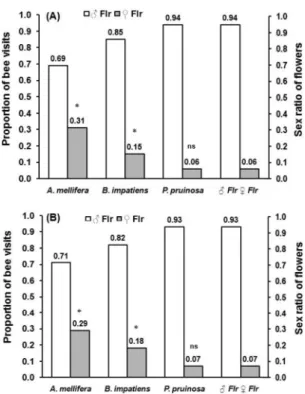
Flower Preference and Nectar Studies. A. mellifera visited signiÞcantly more pistillate ßowers than they would have if they randomly visited pistillate and staminate ßowers in the Þeld in 2008 (2
1⫽ 20.7; P ⬍ 0.001; Fig. 1A) and 2009 (2
1⫽ 16.4; P ⬍ 0.001; Fig. 1B).
B. impatiensalso visited signiÞcantly more pistillate ßowers than expected by chance in 2008 (2
1⫽ 4.3;
P⫽ 0.038; Fig. 1A) and 2009 (2
1⫽ 5.5; P ⫽ 0.019; Fig. 1B). P. pruinosa visits to pistillate and staminate ßow-ers mirrored the natural proportion of pistillate and staminate ßowers in the Þelds in 2008 (2
1⫽ 0; P ⫽ 1.0; Fig. 1A) and 2009 (2
1⫽ 0; P ⫽ 1.0; Fig. 1B). Pistillate ßowers produced on average three times more nectar than staminate ßowers in all four Þelds
Table 1. Bee species observed in 35 pumpkin fields in New York in 2008 (nⴝ 12) and 2009 (n ⴝ 23)
Family and species Total numbers
(mean per Þeld) in 2008
Total numbers (mean per Þeld) in 2009 APIDAE:
Apis melliferaL.a 1,747 (146) 3,577 (156)
Bombus(Pyrobombus) impatiens (Cresson) 1,272 (106) 384 (17)
Melissodes(Melissodes) bimaculata Lepeletier 24 (2) 69 (3)
Peponapis(Peponapis) pruinosa (Say) 2,585 (215) 3,344 (145)
Triepeolus(Doeringiella) remigatus (F.) 3 (0.3) 3 (0.1)
Xylocopa(Xylocopoides) virginica (L.) 0 (0) 1 (0)
HALICTIDAE:
Agapostemon sericeus(Forster) 2 (0.2) 2 (0.1)
Augochlora pura(Say) 2 (0.2) 0 (0)
Augochlorella aurata(Smith) 4 (0.3) 0 (0)
Augochloropsis metallica(F.) 1 (0.1) 9 (0.4)
Halictus(Halictus) ligatus Say 3 (0.3) 2 (0.1)
Halictus(Halictus) rubicundus (Christ) 0 (0) 1 (0)
Lasioglossum(Lasioglossum) coriaceum (Smith) 2 (0.2) 0 (0)
Lasioglossum(Lasioglossum) leucozonium (Schrank)a 17 (1.4) 1 (0)
Lasioglossum(Lasioglossum) zonulum (Smith) 7 (0.6) 0 (0)
MEGACHILIDAE:
Megachile(Callomegachile) sculpturalis Smitha 1 (0.1) 0 (0)
Total bee abundance 5,670 (473) 7,393 (321)
aIntroduced species.
Total numbers represent the number of bee visits to 900 plants per Þeld (300 plants⫻ 3 weekly sampling dates). Mean numbers represent average number of bee visits per Þeld for each species. Each ßower was visually inspected for bees for 10 Ð15 s.
Fig. 1. Visits by Apis mellifera, Bombus impatiens, and Peponapis pruinosato staminate and pistillate pumpkin ßow-ers in New York commercial Þelds in (A) 2008 and (B) 2009. A total of 33,752 ßowers were sampled in 2008 pooled across 12 Þelds. A total of 50,573 ßowers were sampled in 2009 pooled across 23 Þelds. Asterisks over columns indicate sig-niÞcant (P⬍ 0.001) differences between the proportion of bee visits to pistillate ßowers compared with the natural proportion of pistillate ßowers in Þelds.
sampled across both years (mean⫾ SE) (乆 ⫽ 95.2 ⫾ 5.3l; 么 ⫽ 33.6 ⫾ 1.7 l) (Table 2). There was no difference in nectar concentration between pistillate ßowers and staminate ßowers in three of four Þelds sampled, but staminate ßowers had statistically more concentrated nectar than pistillate ßowers in one of the four Þelds sampled (mean⫾ SE) (乆 ⫽ 36.1% ⫾ 0.5;么 ⫽ 41.1% ⫾ 0.6) (Table 2).
Foraging Dynamics Between Bee Species Within Flowers. 2008. The only signiÞcant differences in the number of visits per ßower between the three bee species occurred on week 2 in both nonsupplemented and supplemented Þelds. In pumpkin Þelds not sup-plemented with A. mellifera, there were consistently more P. pruinosa visits to pumpkin ßowers each week compared with the number of visits by A. mellifera and
B. impatiens,but this difference was only signiÞcant on
week 2 (F⫽ 5.6; df ⫽ 2, 15; P ⫽ 0.0155) (Fig. 2A). There was no difference between the number of ßower visits by A. mellifera and B. impatiens on any of the 3 wk. In pumpkin Þelds supplemented with A.
mellifera, there were consistently more A. mellifera visits to pumpkin ßowers each week compared with the number of visits by B. impatiens and P. pruinosa, and the difference was also only signiÞcant on week 2 (F⫽ 5.5; df ⫽ 2, 15; P ⫽ 0.0158) (Fig. 2B). There were no signiÞcant differences between ßower visits by B.
impatiensand P. pruinosa.
2009. In pumpkin Þelds not supplemented with A.
mellifera, there were signiÞcantly more A. mellifera and P. pruinosa visits to pumpkin ßowers each week compared with the number of visits by B. impatiens (week 1: F⫽ 32.1; df ⫽ 2, 48; P ⬍ 0.0001; week 2: F ⫽ 28.2; df⫽ 2, 48; P ⬍ 0.0001; week 3: F ⫽ 19.1; df ⫽ 2,
Table 2. Nectar volume and concentration in Cucurbita pepo var. ‘Mystic Plus’ F1 sampled from NYSAES Research Farms in 2008 and 2009
Nectar vol.a
Nectar concn.a
Field name Field name Field name Field name
Year Flower N RS 59 RN 41 RS 59 RN 41
2008 Staminate 10 39.41⫾ 3.93 a 30.94⫾ 2.04 a 41.05⫾ 0.58 a 39.10⫾ 0.43 a
Pistillate 10 93.64⫾ 17.97 b 84.16⫾ 6.33 b 36.05⫾ 0.46 b 39.50⫾ 0.40 a
Year Flower N RN 47 Gates 20 RN 47 Gates 20
2009 Staminate 10 26.50⫾ 2.92 a 37.71⫾ 2.95 a 40.05⫾ 2.38 a 39.45⫾ 0.47 a
Pistillate 10 95.53⫾ 7.55 b 107.26⫾ 6.63 b 40.65⫾ 0.68 a 40.45⫾ 0.42 a
aFor each year, means within a column with different letters are signiÞcantly different (P⬍ 0.05).
Flowers were bagged the day before and destructively sampled the next morning at anthesis. Numbers represent mean⫾ SE. Nectar volume is inl and nectar concentration is in % sucrose equivalents.
Fig. 2. Mean number of Apis mellifera, Bombus impatiens, and Peponapis pruinosa visits per ßower per Þeld during a 3-wk period in Þelds (A and C) not supplemented or (B and D) supplemented with A. mellifera hives in 2008 and 2009 in New York. Columns represent total mean bee visits broken down within each column by species. Asterisks over columns indicate at least one signiÞcant difference between bee species (P⬍ 0.05, PROC GLM).
48; P⬍ 0.0001) (Fig. 2C). The number of visits per ßower by A. mellifera and P. pruinosa did not differ signiÞcantly on any sampling date (P⬎ 0.05). Results were similar for pumpkin Þelds supplemented with A.
mellifera;there were signiÞcantly more visits to pump-kin ßowers by A. mellifera and P. pruinosa than by B.
impatiens(week 1: F⫽ 12.7; df ⫽ 2, 15; P ⫽ 0.0006; week 2: F⫽ 24.0; df ⫽ 2, 15; P ⬍ 0.0001; week 3: F ⫽ 7.9; df⫽ 2, 15; P ⫽ 0.0046) (Fig. 2D), and there were no signiÞcant differences between ßower visits by A.
melliferaand P. pruinosa.
Effects of Supplementation, Field Size, and Other Bee Species on Bee Visits. The presence or absence of
A. mellifera hives, Þeld size, the mean number of ßowers per Þeld and year were all signiÞcant factors in predicting the mean number of bee visits per ßower for different combinations of the three bee species and each species alone (Table 3).
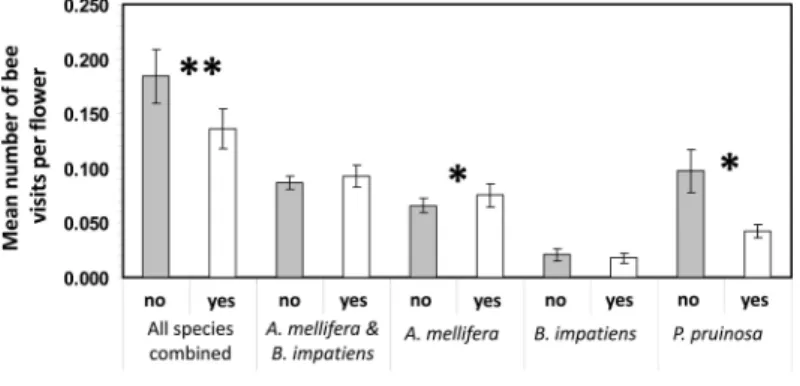
All Three Species Combined. Fields supplemented with A. mellifera hives had signiÞcantly fewer total bee visits per ßower than nonsupplemented Þelds
(mean⫾ SE) (supplemented Þelds: ⫽ 0.136 ⫾ 0.013 bees per ßower; nonsupplemented Þelds:⫽ 0.184 ⫾ 0.02 bees per ßower) (Fig. 3). Field size was not a signiÞcant factor on its own in predicting the total number of bee visits but there was a signiÞcant inter-action between Þeld size and supplementation. There were signiÞcantly more bee visits per ßower in 2008 than in 2009 (mean⫾ SE) (2008: ⫽ 0.191 ⫾ 0.036 bees per ßower; 2009:⫽ 0.156 ⫾ 0.011 bees per ßower). There was a signiÞcant negative relationship between the number of ßowers per Þeld and the number of bee visits per ßower; the more ßowers per Þeld the fewer bee visits per ßower (Table 3).
In the Þrst regression model there were two signif-icant interactions; one between year and the number of ßowers per Þeld, and one between whether a Þeld was supplemented and Þeld size (Table 3). Separate regression models were estimated for each year test-ing supplementation, Þeld size and the number of ßowers and neither model was signiÞcant (2008: model, F⫽ 3.2; error df ⫽ 4, 7; P ⫽ 0.0857; 2009: model,
Table 3. Generalized linear model regression results testing the effects of supplementation with A. mellifera hives, field size, mean number of flowers per field and year for the three species combined, and for each species independently
Species Source/variablea df Estimateb F P Rb A. mellifera, B. impatiens,and P. pruinosacombined
Overall model, error 6, 28 Ð 3.65 0.0083 0.44
Supplementation 1 Ð 11.51 0.0021
Field size 1 Ð 1.11 0.3002
Mean no. of ßowers 1 ⫺3.72 8.09 0.0082
Year 1 ⫺12.37 5.21 0.0303
Supplementation*Þeld size 1 Ð 6.96 0.0135
Mean no. of ßowers*year 1 Ð 4.88 0.0355
A. mellifera Overall model, error 9, 25 3.65 0.0049 0.57
Supplementation 1 Ð 5.61 0.0259
Field size 1 Ð 1.95 0.1750
Mean no. of ßowers 1 Ð 3.71 0.0655
Year 1 Ð 0.01 0.9378
B. impatiensper ßower 1 ⫺0.0689 0.81 0.3769
P. pruinosaper ßower 1 ⫺0.2598 4.37 0.0469
Supplementation*Þeld size 1 Ð 4.48 0.0444
Supplementation*ßowers 1 Ð 5.58 0.0262
Supplementation*year 1 Ð 5.45 0.0279
B. impatiens Overall model, error 7, 27 9.08 ⬍0.0001 0.70
Supplementation 1 Ð 2.62 0.1172
Field size 1 Ð 0.59 0.4483
Mean no. of ßowers 1 ⫺4.2594 7.72 0.0098
Year 1 ⫺3.1199 32.39 ⬍0.0001
A. melliferaper ßower 1 ⫺0.5444 1.58 0.2196
P. pruinosaper ßower 1 ⫺0.5804 3.58 0.0693
Supplementation*Þeld size 1 Ð 6.77 0.0148
P. pruinosa Overall model, error 7, 27 4.27 0.0027 0.53
Supplementation 1 Ð 7.41 0.0112
Field size 1 ⫺0.1372 0.87 0.3580
Mean no. of ßowers 1 ⫺0.8300 0.99 0.3279
Year 1 ⫺0.2510 0.37 0.5488
A. melliferaper ßower 1 Ð 0.99 0.3290
B. impatiensper ßower 1 ⫺0.1460 2.35 0.1366
Supplementation*A. mellifera 1 Ð 10.08 0.0037
aA “*” indicates a signiÞcant interaction between these two terms in the model.
bA “Д indicates estimates for this parameter were not uniquely estimable using PROC GLM (SAS v. 9.1).
For the three individual species, additional variables representing the mean number of ßower visits per ßower for the other two bee species were included in the analyses. Field size, the mean number of ßowers, and the mean number of bee visits per ßower were loge-transformed
F⫽ 1.7; error df ⫽ 4, 18; P ⫽ 0.1960). However, when
the data were analyzed separately based on whether the Þeld was supplemented with A. mellifera hives or not, there were signiÞcant relationships, but only for Þelds that were nonsupplemented; the regression model for supplemented Þelds was not signiÞcant (Supplemented: model, F⫽ 0.9; error df ⫽ 5, 6; P ⫽ 0.5447). For Þelds that were not supplemented with A.
melliferahives, there was a signiÞcant effect of Þeld size, the mean number of ßowers, and year on the number of total bee visits per ßower (Table 4). The
number of total bee visits per ßower decreased as both Þeld size increased and the number of ßowers in-creased (Table 4). In addition, there were signiÞcantly more bee visits per ßower in 2008 than in 2009 (mean⫾ SE) (2008: ⫽ 0.245 ⫾ 0.064 bee visits per ßower; 2009:⫽ 0.163 ⫾ 0.014 bee visits per ßower). There were also signiÞcant interactions between year and Þeld size and between year and the number of ßowers per Þeld (Table 4). The data for nonsupple-mented Þelds were analyzed separately by year to address these interactions. In 2008, both Þeld size and
Fig. 3. Mean number of bee visits per ßower per Þeld for pumpkin Þelds supplemented and not supplemented with Apis melliferahives in New York in 2008 and 2009. SigniÞcant differences between the number of bee visits in supplemented and nonsupplemented Þelds are indicated with ** for P⬍ 0.01 and with * for P ⬍ 0.05.
Table 4 Generalized linear model regression results for fields that were not supplemented with A. mellifera hives testing the effects of field size, mean number of flowers per field, and year for the three species combined, and for each species independently
Species Source/variable df Estimate F P R2
A. mellifera, B. impatiens,and P. pruinosacombined
Overall model, error 5, 17 5.62 0.0031 0.62
Field size 1 ⫺5.5622 7.69 0.0130
Mean no. of ßowers 1 ⫺17.2747 12.02 0.0029
Year 1 ⫺59.1067 11.94 0.0030
Field size*year 1 2.7308 7.38 0.0147
Flowers*year 1 8.6983 11.79 0.0032
A. mellifera Overall model, error 5, 17 6.21 0.0019 0.65
Field size 1 ⫺0.1420 1.12 0.3043
Mean no. of ßowers 1 ⫺0.0072 0.00 0.9921
Year 1 0.4056 1.12 0.3043
B. impatiensper ßower 1 ⫺0.0918 1.42 0.2502
P. pruinosaper ßower 1 ⫺0.3757 8.59 0.0093
B. impatiens Overall model, error 5, 17 7.92 0.0005 0.70
Field size 1 ⫺0.9937 8.44 0.0099
Mean no. of ßowers 1 ⫺4.4593 5.68 0.0291
Year 1 ⫺3.2681 13.36 0.0020
A. melliferaper ßower 1 ⫺0.8386 1.42 0.2502
P. pruinosaper ßower 1 ⫺0.8464 3.90 0.0649
P. pruinosa Overall model, error 5, 17 3.69 0.0192 0.52
Field size 1 ⫺0.3550 3.31 0.0867
Mean no. of ßowers 1 ⫺1.6839 2.70 0.1184
Year 1 ⫺0.6305 1.14 0.3002
A. melliferaper ßower 1 ⫺0.8932 8.59 0.0093
B. impatiensper ßower 1 ⫺0.2203 3.90 0.0649
For the three individual species, additional variables representing the mean number of ßower visits per ßower for the other two bee species were included in the analyses. Field size, the mean number of ßowers, and the mean number of bee visits per ßower were loge-transformed
the number of ßowers had signiÞcant negative rela-tionships with the mean total number of bee visits (Nonsupplemented Þelds 2008: model, F⫽ 14.9; error df ⫽ 2, 3; P ⫽ 0.0278; Þeld size: F ⫽ 12.6; df ⫽ 1, estimate ⫽ ⫺2.8314; P ⫽ 0.0380; mean number of ßowers: F ⫽ 19.0; df ⫽ 1, estimate ⫽ ⫺8.5764; P ⫽ 0.0224). In 2009, the regression model testing Þeld size and number of ßowers was not signiÞcant (Non-supplemented Þelds 2009: model, F⫽ 0.9; error df ⫽ 2, 14; P⫽ 0.4213).
There were individual Þelds in the nonsupple-mented data set that appeared to be inßuential. The nonsupplemented data were reanalyzed excluding the largest Þeld, 10.9 ha, and the qualitative results for main effects and interactions presented in Table 4 remained signiÞcant (Nonsupplemented Þelds minus largest Þeld: model, F ⫽ 5.1; error df ⫽ 5, 16; P ⫽ 0.0054). However, excluding the Þeld that had the highest number of bee visits per ßower, 0.55 bee visits per ßower, changed the regression and the regression model presented in Table 4 was not signiÞcant (Non-supplemented Þelds minus Þeld with highest bee visits per ßower: model, F⫽ 1.5; error df ⫽ 5, 16; P ⫽ 0.2375). Regression models excluding the interaction terms with year also were not signiÞcant, and the reduced model, including only Þeld size, mean number of ßow-ers, and year was not signiÞcant (Nonsupplemented Þelds minus Þeld with highest bee visits per ßower: model, F⫽ 1.0; error df ⫽ 3, 18; P ⫽ 0.4067).
A. mellifera and B. impatiens Combined. When the mean number of ßower visits by P. pruinosa was ex-cluded from the analysis, interactions were not sig-niÞcant and the regression model for A. mellifera and
B. impatienscombined consisting of only the four main effect terms (supplementation, Þeld size, year, and mean number of ßowers per Þeld) was not signiÞcant (model, F⫽ 0.4; error df ⫽ 4, 30; P ⫽ 0.8425) (Fig. 3). A. mellifera. Supplementation was a signiÞcant fac-tor affecting the mean number of visits to pumpkin ßowers by A. mellifera. The number of A. mellifera visits per ßower in supplemented Þelds was signiÞ-cantly greater than the number of A. mellifera visits in nonsupplemented Þelds (mean ⫾ SE) (Supple-mented Þelds:⫽ 0.075 ⫾ 0.01 A. mellifera per ßower; nonsupplemented Þelds:⫽ 0.066 ⫾ 0.007 A. mellifera per ßower) (Fig. 3) (Table 3). The number of ßower visits by P. pruinosa had a signiÞcant negative effect on the number of ßower visits by A. mellifera; as the number of P. pruinosa visits per ßower increased, the number of A. mellifera visits decreased (Fig. 4) (Table 3). Field size was not a signiÞcant factor as a main effect, but there was a signiÞcant interaction between supplementation and Þeld size, and there were sig-niÞcant interactions between supplementation and the number of ßowers per Þeld and year (Table 3). Separate regression models were estimated for sup-plemented and nonsupsup-plemented Þelds. The regres-sion model that included only Þelds that were sup-plemented with A. mellifera hives was not signiÞcant (A. mellifera: model, F ⫽ 1.3; error df ⫽ 5, 6; P ⫽ 0.3711). In Þelds that were not supplemented, there was a signiÞcant negative relationship between the
number of ßower visits by P. pruinosa and the number of ßower visits by A. mellifera, which was similar to the results for all Þelds combined (Table 4). Field size, the number of ßowers, and year were not signiÞcant fac-tors predicting the mean number of ßower visits by A.
melliferain nonsupplemented Þelds (Table 4). B. impatiens. The mean number of ßowers and year were signiÞcant main effect factors predicting the number of B. impatiens visits per pumpkin ßower. As the number of ßowers per Þeld increased the number of visits by B. impatiens decreased, and there were signiÞcantly more visits by B. impatiens in 2008 than in 2009 (mean⫾ SE) (2008: ⫽ 0.043 ⫾ 0.008 B.
impa-tiensvisits per ßower; 2009:⫽ 0.008 ⫾ 0.001 B.
impa-tiens visits per ßower) (Table 3). The number of ßower visits by the other two species did not affect the number of B. impatiens visits per ßower (Table 3). There was a signiÞcant interaction between supple-mentation and Þeld size, but neither supplesupple-mentation nor Þeld size alone were signiÞcant main effect factors (Fig. 3) (Table 3). Separate regression models were estimated for supplemented and nonsupplemented Þelds, and the regression model for Þelds that were supplemented with A. mellifera hives was not signif-icant (B. impatiens: model, F⫽ 4.0; error df ⫽ 5, 6; P ⫽ 0.0612). In Þelds that were not supplemented, there was a signiÞcant negative relationship between Þeld size and ßower visits by B. impatiens; as Þeld size increased the number of B. impatiens visits per ßower decreased (Fig. 5) (Table 4). Similar to the results of the regression that included both supplemented and nonsupplemented Þelds, there was a negative rela-tionship between the number of ßowers per Þeld and the number of B. impatiens visits per ßower, and there were signiÞcantly more visits by B. impatiens in 2008 than in 2009 (mean⫾ SE) (2008: ⫽ 0.056 ⫾ 0.013 B.
impatiensvisits per ßower; 2009:⫽ 0.008 ⫾ 0.002 B.
impatiensvisits per ßower) (Table 4).
There were individual Þelds in the nonsupple-mented data set for B. impatiens only that appeared to be inßuential (Fig. 5). The nonsupplemented data were reanalyzed excluding the largest Þeld, 10.9 ha, and the qualitative results for the regression model and all the variables in the model presented in Table
Fig. 4. Relationship between the mean number of ßower visits by Apis mellifera and the mean number of ßower visits by Peponapis pruinosa in Þelds that were not supplemented with A. mellifera hives in New York in 2008 and 2009 (P⬍ 0.05, PROC GLM).
4 remained signiÞcant (Nonsupplemented Þelds mi-nus largest Þeld: model, F⫽ 9.3; error df ⫽ 5, 16; P ⫽ 0.0003). Excluding the Þeld that had the highest num-ber of B. impatiens visits per ßower, 0.11 B. impatiens visits per ßower, did not change the qualitative results for the regression model or the individual variable results presented in Table 4 (Nonsupplemented Þelds minus Þeld with highest B. impatiens visits per ßower: model, F⫽ 6.2; error df ⫽ 5, 16; P ⫽ 0.0022). Excluding both of these potentially inßuential Þelds did not change the qualitative results for the regression model or the individual variable results presented in Table 4 (Nonsupplemented Þelds minus both Þelds: model,
F⫽ 7.4; error df ⫽ 5, 115; P ⫽ 0.0011).
P. pruinosa. Supplementation was a signiÞcant fac-tor affecting the mean number of visits to pumpkin ßowers by P. pruinosa. The number of ßower visits by
P. pruinosawas signiÞcantly lower in Þelds supple-mented with A. mellifera hives than in those Þelds not supplemented (mean⫾ SE) (Supplemented Þelds: ⫽ 0.043⫾ 0.006 P. pruinosa per ßower; nonsupplemented Þelds:⫽ 0.098 ⫾ 0.020 P. pruinosa per ßower) (Fig. 4) (Table 3). Field size was not a signiÞcant factor for P.
pruinosaalone or as an interaction term (Table 3). The number of ßower visits by A. mellifera had a signiÞcant negative effect on the number of ßower visits by P.
pruinosa(Fig. 4), and there was a signiÞcant interac-tion between supplementainterac-tion and the mean number of A. mellifera visits per ßower (Table 3). Separate regression models were estimated for supplemented and nonsupplemented Þelds and, for Þelds that were supplemented with A. mellifera hives, the regression was not signiÞcant (P. pruinosa: model, F⫽ 0.6; error df⫽ 5, 6; P ⫽ 0.7378). In Þelds that were not supple-mented, there was a signiÞcant negative relationship between the number of ßower visits by P. pruinosa and the number of ßower visits by A. mellifera, similar to the results for all Þelds combined (Table 4). Field size, the number of ßowers, and year were not signif-icant factors predicting the number of ßower visits by
P. pruinosain nonsupplemented Þelds (Table 4). P. pruinosa Foraging Behavior. In total, 434 P.
pru-inosaapproached one of the three treatment ßowers in this study. In total, 109 P. pruinosa approached ßowers containing dead A. mellifera, but only 11 ap-proaches were classiÞed as visits. In total, 120 P.
pru-inosaapproached ßowers containing B. impatiens, but only six visited. In contrast, control ßowers received 84
P. pruinosavisits out of 121 approaches. A signiÞcantly greater proportion of P. pruinosa visited control ßow-ers compared with the proportions visiting ßowßow-ers containing dead bees (Control versus A. mellifera: Z⫽ ⫺5.67; P ⬍ 0.001; Control versus B. impatiens: Z ⫽ ⫺6.99; P ⬍ 0.001), but there was no difference be-tween the proportions of visits to ßowers with dead A.
melliferaand dead B. impatiens (A. mellifera versus B.
impatiens: Z⫽ 1.47; P ⫽ 0.1421) (Fig. 6).
Discussion
A. mellifera, B. impatiens,and P. pruinosa were the most commonly observed bee species visiting pump-kin ßowers in this 2-yr study, accounting for 99% of all bee visits. When the three species were combined, there were signiÞcantly more bee visits per ßower in Þelds that were not supplemented with A. mellifera hives, which might suggest that supplementation may be negligible for improving crop production. How-ever, pollination services provided by bees are depen-dent on foraging activity and, in our study, the foraging activities of these three species varied in ways that could affect their relative effectiveness as pollinators of pumpkins in New York. For example, A. mellifera and B. impatiens visited pistillate ßowers more often than would be expected by random chance compared with P. pruinosa, whose visits mirrored the natural proportions of pistillate and staminate ßowers in the Þeld. The mean number of ßower visits by A. mellifera and P. pruinosa was affected by the presence or ab-sence of supplemental A. mellifera hives and there were signiÞcant effects of one species on the other, whereas B. impatiens was signiÞcantly affected by Þeld size and the number of ßowers in a Þeld, and not by the presence of other bee species. The remaining
Fig. 5. Relationship between the mean number of ßower visits by Bombus impatiens and Þeld size in Þelds that were not supplemented with Apis mellifera hives in New York in 2008 and 2009 (P⬍ 0.05, PROC GLM).
Fig. 6. Proportion of Peponapis pruinosa that visited sta-minate pumpkin (Cucurbita pepo variety ÔMystic PlusÕ F1) ßowers of those that they approached when offered choices between ßowers occupied by a dead Apis mellifera worker, dead Bombus impatiens worker, or no bee (control) (n⫽ 109, 120 and 205 for A. mellifera worker, B. impatiens worker and the control). Different letters above the bars represent sig-niÞcant differences at (P⬍ 0.05,2).
discussion focuses on the implications of these results on pollination services provided by these three species in pumpkin Þelds in New York.
A. mellifera, B. impatiens,and P. pruinosa were com-monly detected in all 35 pumpkin Þelds sampled. Julier and Roulston (2009) also noted A. mellifera, B.
impa-tiens,and P. pruinosa as the most abundant bee species visiting pumpkins in Virginia and Maryland. The 13 other bee species in our study were rarely observed visiting ßowers. The number of common bee species in our study is similar to bee faunas in other plant-pollinator studies where a few species dominate (Thomson 1980, Herrera 1987, Cane and Payne 1993, Kallimanis et al. 2009). Winfree et al. (2007) reported a more diverse assemblage of bee pollinators in wa-termelon Þelds in New Jersey and Pennsylvania. Of the 46 bee species they observed visiting watermelon ßowers, 32 were small halictid bees compared with nine halictid bee species in our study.
Variation in foraging behavior among the three common bee species in our study may have important inßuences on pollination success and crop yield (Klinkhamer and de Jong 1990, Hodgins and Barrett 2008, Elliott and Irwin 2009). Results from the ßower gender preference experiment showed that the pro-portion of visits by P. pruinosa closely matched the natural sex ratio of ßowers in the Þelds, indicating that
P. pruinosado not prefer foraging in pistillate ßowers more than male ßowers. In contrast, signiÞcantly more
A. melliferaand B. impatiens visited pistillate ßowers than would be expected by random chance, suggesting that A. mellifera and B. impatiens exhibited preferen-tial foraging for pistillate ßowers. Our Þndings are in agreement with those of Tepedino (1981), who found that A. mellifera showed a signiÞcant preference for pistillate summer squash, C. pepo, ßowers in Utah. However, compared with P. pruinosa, A. mellifera was not a better pollinator of summer squash, despite showing a signiÞcant preference for pistillate ßowers. In our study, by preferentially visiting more pistillate ßowers, A. mellifera and B. impatiens increase the probability of per visit pollen transfer to stigmas dur-ing a foragdur-ing bout (Harder and Wilson 1997). For-aging and yield studies by Artz and Nault (2011) found that B. impatiens deposited more than three times the amount of pollen grains per stigma per visit than A.
melliferaor P. pruinosa, and, of the three species, P.
pruinosawas a less effective pollinator of pumpkin than A. mellifera and B. impatiens. Field observations of A. mellifera and B. impatiens showed that these species also spent signiÞcantly more time foraging in pistillate ßowers than P. pruinosa (Artz and Nault 2011). Flower preference and ßower handling time are two important parameters in explaining pollina-tion efÞciency in pollinators (Herrera 1987, NeÕeman et al. 2006) and can inßuence pollination success for plants with sexually dimorphic ßowers (Costich and Meagher 2001, Ashworth and Galetto 2002).
An important component of pollinator attraction is the quality and quantity of ßoral rewards, particularly nectar and pollen (Canto et al. 2008, Kaczorowski et al. 2008). Empirical studies have shown that
pheno-typic and genetic variation in nectar traits can have signiÞcant direct and indirect impacts on pollination success (Galen and Newport 1988, Mitchell 2004, Sal-zmann et al. 2007, Majetic et al. 2009). In our study, pistillate ßowers produced signiÞcantly more nectar than staminate ßowers. Both A. mellifera and B.
im-patiens are primarily nectar foragers collecting su-crose-rich nectar for colony support and brood ex-pansion (Seeley 1995, Heinrich 2004), and this may be one reason why A. mellifera and B. impatiens individ-uals were more likely to be observed in nectar-rich pistillate ßowers in 2008 and 2009.
Vegetable growers often place A. mellifera hives in pumpkin Þelds to ensure fruit set and increase fruit size. In our study, there were signiÞcantly more A.
melliferavisits per ßower in pumpkin Þelds supple-mented with A. mellifera hives. However, when all three species were combined, there were signiÞcantly fewer bee visits per ßower in supplemented Þelds. When visits by P. pruinosa were excluded from the analysis, there was no signiÞcant effect of supplemen-tation on the mean number of bee visits by A. mellifera and B. impatiens combined, suggesting that though visits by A. mellifera were higher in supplemented Þelds, visits by B. impatiens made up the difference in nonsupplemented Þelds. When the ßower visits by the three species were compared on a weekly basis, the mean number of ßower visits by A. mellifera was sig-niÞcantly higher than the other two species on only one occasion, week 2 of 2008 in the supplemented Þelds. It is possible that growers who intend to en-hance pollination services of their pumpkin crop by supplementing Þelds with A. mellifera hives may gain little, if any, additional pollination because B.
impa-tiensand P. pruinosa increase the number of per ßower visits in nonsupplemented Þelds to be equal to or exceed visits in supplemented Þelds.
Supplementation of pumpkin Þelds with A.
mel-lifera hives had an effect on how the other bee species responded to Þeld size, the mean number of ßowers per Þeld, and to the presence of other spe-cies of bees. For all three spespe-cies, there were sig-niÞcant interactions between the effects of supple-mentation with A. mellifera hives and other factors. In nonsupplemented Þelds, both A. mellifera and P.
pruinosahad signiÞcant negative effects on one an-other, as the mean number of ßower visits by one species increased, the mean number of ßower visits by the other species decreased (Fig. 4). Results from our behavioral experiment showed that P.
pru-inosa avoided visiting pumpkin ßowers that con-tained either A. mellifera or B. impatiens (Fig. 6). Findings that P. pruinosa discriminate against ßow-ers occupied by heterospeciÞcs are in agreement with other studies that examined behavioral re-sponses and ßower discriminating choices by soli-tary and social bees (Dukas 2001, Abbott 2006, Yokoi and Fujisaki 2011).
A. melliferamay directly and indirectly compete for ßoral resources with native bees in both natural and agricultural ecosystems worldwide (Paini 2004, Thom-son 2004, GoulThom-son and Sparrow 2009, Shavit et al.
2009). Moreover, many empirical studies have docu-mented various interspeciÞc behavioral interactions at ßowers and noted that these interactions may have both negative and positive implications for pollination success (Corbet et al. 1995, Irwin and Brody 1999). For example, Greenleaf and Kremen (2006) reported an increase in honey bee effectiveness in pollination of hybrid sunßowers (Helianthus annuus L.) via behav-ioral interactions with the local native bee communi-ties. SpeciÞcally, pollination efÞciencies of A. mellifera increased because of displacement by foraging native bees, resulting in more A. mellifera visits, which in-creased seed yields attributed to the increase in pollen transfer and deposition by A. mellifera. Furthermore, despite considerable variation in pollination efÞcien-cies of wild bees foraging on sunßower, wild bees contributed to pollination services indirectly (i.e., via behavioral interactions with A. mellifera) and directly (direct pollination) in this system. Although we do not have experimental evidence to support that pollina-tion efÞciencies of bees are negatively or positively inßuenced in pumpkin by the presence of supplemen-tal A. mellifera hives, anecdosupplemen-tal evidence suggests that interspeciÞc interactions in pumpkin ßowers may be inßuencing bee movement and pollen transfer among plants. Additional experiments are planned to study behavioral responses of A.
mel-liferaand B. impatiens to the presence of heterospe-ciÞcs and to quantify interaction intensities among bees at pumpkin ßowers and how these interactions affect interplant movement, pollen deposition, and pollination success.
Field size was not a signiÞcant factor predicting the mean number of A. mellifera visits per ßower or the number of visits by P. pruinosa, but was signiÞcant for
B. impatiensin nonsupplemented Þelds. Because A.
melliferais known to forage up to 12 km or more, and often forage for ßoral resources several kilometers away from their colonies (Beekman and Ratnieks 2000, Steffan-Dewenter and Kuhn 2003), it may not be as sensitive to Þeld size as the other two species. Visscher and Seeley (1982) found that the median distance of A. mellifera foragers was 1.7 km away from colonies, and that most of the foraging activity was ⬎0.5 km away from colonies. Supplementing a crop with A. mellifera hives will provide direct pollination services to that crop because some foraging will occur near the hive, but other crops nearby are also likely to beneÞt as a consequence of long-distance foraging behavior by A. mellifera workers. In the mid-Atlantic United States, Shuler et al. (2005) and Julier and Roul-ston (2009) found a statistically similar number of A.
melliferavisiting squash and pumpkin ßowers on farms with and without A. mellifera hives, suggesting that feral or managed A. mellifera individuals, or both, move in from the surrounding landscape to forage in nonsupplemented pumpkin Þelds.
P. pruinosa is a ground-nesting bee and many ground-nesting bees restrict their nesting sites to edges of agricultural Þelds (Cane 2008). We observed
P. pruinosanests along margins of several convention-ally tilled Þelds (D.R.A., unpublished data). As Þeld
size increases and the perimeter to area ratio de-creases, we expected fewer P. pruinosa in the larger Þelds, and possibly fewer feral B. impatiens. Unfortu-nately, Þelds were selected before we knew which Þelds would be supplemented with A. mellifera hives. Consequently, supplementation and Þeld size were confounded variables in our study; supplemented Þelds tended to be larger, with a mean size of 6.7 ha, and nonsupplemented Þelds tended to be smaller, with a mean size of 1.9 ha. Supplemented Þelds aver-aged over three times the area of nonsupplemented Þelds and the Þeld perimeter to area ratio was greater for the smaller, nonsupplemented Þelds compared with larger, supplemented ones. This may help explain why there were signiÞcantly more P. pruinosa in non-supplemented Þelds compared with non-supplemented Þelds, and Þeld size may not have been a signiÞcant factor predicting P. pruinosa visits in the nonsupple-mented Þelds if there was not a sufÞcient range in Þeld sizes to detect an effect of Þeld size. In contrast, B.
impatienswas affected by Þeld size in the nonsupple-mented Þelds. As Þeld size increased, the mean num-ber of B. impatiens visits per ßower decreased. Work by Artz and Nault (2011) showed that pumpkin fruit weight and seed set resulting from visits by B.
impa-tienswere signiÞcantly higher than A. mellifera on a per-visit basis. Therefore, supplementation of larger Þelds with B. impatiens may be useful.
When all three bee species were combined in an analysis, the mean number of ßowers per Þeld had a signiÞcant negative effect on the mean number of bee visits per ßower, suggesting that there may a dilution response. As the number of ßowers in the Þeld in-creased, the number of bee visits per ßower decreased. Analyzing the three species independently showed that B. impatiens was the most sensitive to ßower density, but the effect was only signiÞcant in non-supplemented Þelds. In Þelds that were not supple-mented with A. mellifera, there was a signiÞcant neg-ative relationship between the mean number of ßowers and the mean number of B. impatiens visits per ßower.
Recent declines in A. mellifera populations have stressed the need to examine the contribution of al-ternative pollinators to pollination services of plants in both natural and managed systems. Several agricul-turally-important crop plants, like cucurbits, require insect pollinators for some or all of their reproduction, so identifying common native bee species and ways to enhance and promote their populations may be cru-cial for mitigating the effects of declining A. mellifera populations and the pollination services they provide. Furthermore, determining which bee species are most effective in a particular crop will provide insights into implementing on-farm and habitat management prac-tices that will beneÞt the pollinators and improve and sustain crop yields. Based on results presented in this study and those reported by Artz and Nault (2011), declining A. mellifera populations may increase the relative importance of B. impatiens in pollinating pumpkins in New York.
Acknowledgments
We thank E. Abbott, M. Bekauri, C. Boutard-Hunt, L. Duque, B. English-Loeb, M. L. Hessney, M. Lopez-Uribe, J. Petzoldt, K. Reiners, H. Schoonover, and B. Viertel for Þeld assistance. We are grateful to all the growers who allowed us to survey bees on their Þelds. We thank J. Ascher, B. Danforth, and E. R. Hoebeke for help with identifying insects and R. Kaczorowski with assistance with nectar sampling techniques. We thank S. Despa, S. Sadigov, and F. Vermeylen who provided helpful ad-vice on the statistical methods. We thank J. Petersen for helpful comments on the manuscript. This research was funded by Federal Formula Funds and Federal Hatch Funds.
References Cited
Abbott, K. R. 2006. Bumblebees avoid ßowers containing
evidence of past predation events. Can. J. Zool. 84: 1240 Ð 1247.
Aizen, M. A., L. A. Garibaldi, S. A. Cunningham, and A. M. Klein. 2009. How much does agriculture depend on
pol-linators? Lessons from long-term trends in crop produc-tion. Ann. Bot. 103: 1579 Ð1588.
Andersen, J. F., and R. L. Metcalf. 1987. Factors inßuencing
distribution of Diabrotica spp. in blossoms of cultivated Cucurbitaspp. J. Chem. Ecol. 13: 681Ð 699.
Artz, D. R., and B. A. Nault. 2011. Performance of Apis
mellifera, Bombus impatiensand Peponapis pruinosa (Hy-menoptera: Apidae) as pollinators of pumpkin. J. Econ. Entomol. 104: 1153Ð1161.
Artz, D. R., C. A. Villagra, and R. A. Raguso. 2010.
Spatio-temporal variation in the reproductive ecology of two parapatric subspecies of Oenothera cespitosa (On-agraceae). Am. J. Bot. 97: 1Ð13.
Ashworth, L., and L. Galetto. 2002. Differential nectar
pro-duction between male and female ßowers in a wild cu-curbit: Cucurbita maxima ssp. andreana (Cucurbitaceae). Can. J. Bot. 80: 1203Ð1208.
Beekman, M., and F.L.W. Ratnieks. 2000. Long-range
for-aging by the honey-bee, Apis mellifera L. Funct. Ecol. 14: 490 Ð 496.
Brunet, J. 2009. Pollinators of the Rocky Mountain
colum-bine: temporal variation, functional groups and associa-tions with ßoral traits. Ann. Bot. 103: 1567Ð1578.
Cane, J. H. 2008. Pollinating bees crucial to farming
wild-ßower seed for U.S. habitat restoration. In R. R. James and T. Pitts-Singer (eds.), Bees in agricultural ecosystems, Oxford University Press, New York.
Cane, J. H., and J. A. Payne. 1993. Regional, annual and
seasonal variation in pollinator guilds: intrinsic traits of bees (Hymenoptera: Apoidea) underlie their patterns of abundance at Vaccinium ashei (Ericaceae). Ann. Ento-mol. Soc. Am. 86: 577Ð588.
Canto, A., C. M. Herrera, M. Medrano, R. Pe´rez, and I. Garcia. 2008. Pollinator foraging modiÞes nectar sugar
composition in Helleborus foetidus (Ranunculaceae): an experimental test. Am. J. Bot. 95: 315Ð320.
Corbet, S. A., N. M. Saville, M. Fussell, O. E. Prys-Jones, and D. M. Unwin. 1995. The competition box: a graphical aid
to forecasting pollinator performance. J. Appl. Ecol. 32: 707Ð719.
Costich, D. E., and T. R. Meagher. 2001. Impacts of ßoral
gender and whole-plant gender on ßoral evolution in Ecballium elaterium(Cucurbitaceae). Biol. J. Linn. Soc. 74: 475Ð 487.
Decker, D. S. 1988. Origin(s), evolution, and systematics of
Cucurbita pepo(Cucurbitaceae). Econ. Bot. 42: 4 Ð15.
Delaplane, K. S., and D. F. Mayer. 2000. Crop pollination by
bees. CABI Publishing, Oxon, United Kingdom.
Dukas, R. 2001. Effects of perceived danger on ßower
choice by bees. Ecol. Lett. 4: 327Ð333.
Eickwort, G. C., and H. S. Ginsberg. 1980. Foraging and
mating behavior in Apoidea. Annu. Rev. Entomol. 25: 421Ð 446.
Elliott, S. E., and R. E. Irwin. 2009. Effects of ßowering plant
density on pollinator visitation, pollen receipt, and seed production in Delphinium barbeyi (Ranunculaceae). Am. J. Bot. 96: 912Ð919.
Free, J. B. 1993. Insect pollination of crops, 2nd ed.
Aca-demic, London.
Fronk, W. D., and J. A. Slater. 1956. Insect fauna of cucurbit
ßowers. J. Kans. Entomol. Soc. 29: 141Ð145.
Galen, C. 1989. Measuring pollinator-mediated selection on
morphometric ßoral traits: bumblebees and the alpine sky pilot, Polemonium viscosum. Evolution 43: 882Ð 890.
Galen, C., and M.E.A. Newport. 1988. Pollination quality,
seed set, and ßower traits in Polemonium viscosum: com-plementary effects of variation in ßower scent and size. Am. J. Bot. 75: 900 Ð905.
Gallai, N., J-M. Salles, J. Settele, and B. E. Vaissie`re. 2009.
Economic valuation of the vulnerability of world agri-culture confronted with pollinator decline. Ecol. Econ. 68: 810 Ð 821.
Gomez, J. M., and R. Zamora. 1999. Generalization vs.
spe-cialization in the pollination system of Hormathophylla spinosa(Cruciferae). Ecology 80: 796 Ð 805.
Goulson, D., and K. R. Sparrow. 2009. Evidence for
com-petition between honeybees and bumblebees; evi-dence on bumblebee worker size. J. Insect Conserv. 13: 177Ð181.
Greenleaf, S. S., and C. Kremen. 2006. Wild bees enhance
honey beesÕ pollination of hybrid sunßower. Proc. Natl. Acad. Sci. USA 103: 13890 Ð13895.
Harder, L. D., and W. G. Wilson. 1997. Theoretical
per-spectives on pollination. Acta Hortic. 437: 83Ð101.
Heinrich, B. 2004. Bumblebee economics. Harvard
Univer-sity Press, Cambridge, Massachusetts.
Herrera, C. M. 1987. Components of pollinator “quality”:
comparative analysis of a diverse insect assemblage. Oikos 50: 79 Ð90.
Hladun, K. R., and L. S. Adler. 2009. Inßuence of leaf
her-bivory, root herher-bivory, and pollination on plant per-formance in Cucurbita moschata. Ecol. Entomol. 34: 144 Ð152.
Hodgins, K. A., and S.C.H. Barrett. 2008. Natural selection
on ßoral traits through male and female function in wild populations of the heterostylous daffodil Narcissus trian-drus.Evolution 62: 1751Ð1763.
Hurd, P. D., E. G. Linsley, and A. E. Michelbacher. 1974.
Ecology of the squash and gourd bee, Peponapis pruinosa, on cultivated cucurbits in California (Hymenoptera: Apoidea). Smithson. Contrib. Zool. no. 168: 1Ð17.
Irwin, R. E., and A. K. Brody. 1999. Nectar-robbing bumble
bees reduce the Þtness of Ipomopsis aggregata (Polemo-niaceae). Ecology 80: 1703Ð1712.
James, R. R., and T. L. Pitts-Singer. 2008. Bee pollination in
agricultural ecosystems. Oxford University Press, New York.
Julier, H. E., and T. H. Roulston. 2009. Wild bee abundance
and pollination service in cultivated pumpkins: farm man-agement, nesting behavior and landscape effects. J. Econ. Entomol. 102: 563Ð573.