The adaptive potential of a survival artist: characterization of
the in vitro interactions of Toxoplasma gondii tachyzoites with
di-cationic compounds in human
fibroblast cell cultures
CHRISTIAN KROPF1, KARIM DEBACHE1, CHRISTOPH RAMPA1, FABIENNE BARNA1,
MICHELLE SCHORER1, CHAD E. STEPHENS2, MOHAMED A. ISMAIL3,4,
DAVID W. BOYKIN3and ANDREW HEMPHILL1*
1
Institute of Parasitology, Vetsuisse Faculty, University of Berne, Switzerland 2
Department of Chemistry and Physics, Augusta State University, Augusta, Georgia 30904-2200, USA 3
Department of Chemistry, Georgia State University, PO Box 4098, Atlanta Georgia, USA 4
Department of Chemistry, College of Science, King Faisal University, PO Box, Hofuf 31982, Saudi Arabia
(Received 30 June 2011; revised 29 August 2011; accepted 5 September 2011; first published online 19 October 2011)
S U M M A R Y
The impact of di-cationic pentamidine-analogues against Toxoplama gondii (Rh- and Me49-background) was investigated. The 72 h-growth assays showed that the arylimidamide DB750 inhibited the proliferation of tachyzoites of T. gondii Rh and T. gondii Me49 with an IC50of 0·11 and 0·13μM, respectively. Pre-incubation offibroblast monolayers with 1 μMDB750 for 12 h and subsequent culture in the absence of the drug also resulted in a pronounced inhibiton of parasite proliferation. However, upon 5–6 days of drug exposure, T. gondii tachyzoites adapted to the compound and resumed proliferation up to a concentration of 1·2μM. Out of a set of 32 di-cationic compounds screened for in vitro activity against T. gondii, the arylimidamide DB745, exhibiting an IC50of 0·03μMand favourable selective toxicity was chosen for further studies. DB745 also inhibited the proliferation of DB750-adapted T. gondii (IC50= 0·07μM). In contrast to DB750, DB745 also had a profound negative impact on extracellular non-adapted T. gondii tachyzoites, but not on DB750-adapted T. gondii. Adaptation of T. gondii to DB745 (up to a concentration of 0·46μM) was much more difficult to achieve and feasible only over a period of 110 days. In cultures infected with DB750-adapted T. gondii seemingly intact parasites could occasionally be detected by TEM. This illustrates the astonishing capacity of T. gondii tachyzoites to adapt to environmental changes, at least under in vitro conditions, and suggests that DB745 could be an interesting drug candidate for further assessments in appropriate in vivo models.
Key words: Toxoplasma gondii, di-cationic pentamidine analogues, arylimidamides, proliferation, tachyzoites, in vitro models.
I N T R O D U C T I O N
The obligatory intracellular apicomplexan parasite Toxoplasma gondii is one of the most successful para-sites on this planet. It infects members of Felidae as definitive hosts, and has a wide range of intermediate hosts, including warm-blooded animals and humans (Tenter et al. 2000; Dabritz and Conrads, 2010). Approximately one third of the human population is infected with T. gondii worldwide, but despite the high prevalence, in the vast majority of cases disease is benign and asymptomatic (Barratt et al. 2010). However, clinical problems can arise in 2 situations. First, in individuals with an immature immune sys-tem or in immune-compromised patients infection can lead to toxoplasmic encephalitis (TE) or even death. TE occurs as a result of the reactivation of brain
cysts that encapsulate slowly proliferating brady-zoites, which then undergo bradyzoite-to-tachyzoite stage conversion, and is common in chronically infected patients, which receive immunosuppressive therapy or suffer from human immunodeficiency virus (HIV) infection (Tenter et al.2000; Barratt et al.
2010; Henriquez et al. 2010). Secondly, congenital toxoplasmosis poses a major health risk upon primary maternal infection during pregnancy, leading to placental or fetal infection (or both), which often results in abortion or damage of the fetal tissues (Feldman et al.2010). In addition, T. gondii is also a highly significant economic and veterinary medical concern in the livestock industry, and as such rep-resents an important zoonosis (Dubey,2009).
Toxoplasmosis begins generally mildly or is asymp-tomatic, with an acute phase in which tachyzoites invade the cells, divide rapidly, and disseminate throughout the host. With the onset of the host im-mune response, the proliferative tachyzoite stage is replaced by the quiescent bradyzoites, which form tissue cysts predominantly located in the central
* Corresponding author: Institute of Parasitology, Vetsuisse Faculty, University of Berne, Länggass-Strasse 122, CH-3012 Berne, Switzerland. Tel: + 41 31 631 2384. Fax: + 41 31 631 2477. E-mail: andrew.hemphill@vetsuisse. unibe.ch
nervous system (CNS) and muscle tissue, where they do not cause apparent immunopathology and can persist for many years, up to a lifetime ( Carruthers and Suzuki,2007; Laliberté and Carruthers, 2008). The chemotherapeutical options for the treatment of toxoplasmosis are limited. A synergistic combi-nation therapy comprised of sulfadiazine and pyri-methamine, targeting the synthesis and the reduction of folic acid in tachyzoites, has been shown to be the most efficient option (Montoya and Liesenfeld,
2004). However, adverse reactions can occur, which include haematological toxicity and hyper-sensitivity. Another option employs clindamycin-pyrimethamine combination therapy, but this treatment is also prone to side effects (Pereira-Chioccola et al. 2009). The major problem in the treatment of T. gondii infection is the non-e ffective-ness of compounds against bradyzoites that are enclosed in tissue cysts (Barratt et al.2010).
Pentamidine and its analogues represent a class of broad-spectrum antimicrobial compounds, with activities against a wide range of intracellular and extracellular protozoan parasites (Soeiro et al.2005; Wilson et al.2008; Buckner and Navabi,2010). Since its discovery, pentamidine has been successfully applied to treat African trypanosomiasis, leishma-niasis, and malaria in humans, and the pentamidine-derivative diminazene aceturate is commonly used for trypanosome chemotherapy in livestock (Werbovetz,2006). More recently, novel analogues, known as arylimidamides, with a more favourable pharmacokinetic profile, improved bioavailability and lower host toxicity were shown to be effective against Leishmania donovani and Trypanosoma cruzi in vitro and in vivo (Wang et al.2010; Batista et al.
2010a).
The in vitro efficacy of pentamidine and some pentamidine analogues against T. gondii has been demonstrated previously (Lindsay et al.1991), and proliferation inhibitory properties were reported at concentrations of around 10μg/ml. More recently, Leepin et al. (2008) demonstrated the in vitro efficacy of a set of arylimidamides (DB750, DB766, DB786, DB811, formerly named reversed diamidines), which inhibited the proliferation of T. gondii and the closely related Neospora caninum with IC50s at
submicro-molar concentrations ranging between 0·16 and 0·66μM (= 0·14–0·5 μg/ml), indicating the potential of these di-cationic compounds, especially DB750 and DB786, for chemotherapeutical purposes. DB811 was recently reported to inhibit the prolifer-ation of the related apicomplexan Besnoitia besnoiti in Vero cells at an IC50of 0·08μM(Cortes et al.2011).
Here, we further explore the in vitro characteristics of DB750 in relation to T. gondii. We demonstrate that, despite low IC50in 3-day growth assays,
Toxo-plasma tachyzoites could readily adapt to this com-pound during culture within a few days, while this was not possible for the closely related N. caninum.
Screening of additonal di-cationic compounds for anti-Toxoplasma activity lead to the identification of DB745, which inhibited the proliferation of T. gondii tachyzoites at an IC50of 0·03μM. Also, the effects of
DB745 and DB750 were evaluated by transmission electron microscopy analysis of DB750-adapted and non-adapted T. gondii parasites.
M A T E R I A L S A N D M E T H O D S
Culture media, buffers and reagents
Unless otherwise stated, all tissue-culture media were purchased from Gibco-BRL (Zurich, Switzerland) and biochemical reagents were from Sigma (St Louis, MO, USA). The di-cationic compounds used in this study were synthesized at the Department of Chemistry and Center for Biotechnology and Drug Design, Georgia State University, USA. They were kept as a dry powder or as stock solutions of 1 mg/ml in dimethyl sulfoxide and were stored at−20 °C. Cell culture and parasite purification
Vero cells were maintained in RPMI 1640 medium supplemented with 5% fetal calf serum (FCS), 2 mM L-glutamine, 50 U of penicillin/ml, and 50μg of streptomycin/ml at 37 °C with 5% CO2 in
tissue-culture flasks and were trypsinized 3 times a week. Human foreskinfibroblasts (HFF) were maintained in Dulbecco’s modified Eagles’s medium (DMEM) with 10% FCS, 50 U of penicillin/ml, and 50μg of streptomycin/ml at 37 °C with 5% CO2in
tissue-cultureflasks. Cultures were trypsinized once a week. Toxoplasma gondii Me49, T. gondii Rh, T. gondii-β-gal, (a transgenic strain with Rh-background expressing β-galactosidase; McFadden et al. 1997) were cultured in Vero cells (Scheidegger et al.2005). Intracellular parasites were harvested by trypsiniza-tion of infected Vero cells, followed by repeated passages through a 25-gauge needle at 4 °C, and sep-aration from cell debris on a Sephadex-G25 column as described previously (Hemphill, 1996). Purified tachyzoites were used to infect HFF monolayers as described below.
In vitro drug treatment assays employing T. gondii Me49 and DB750-adapted T. gondii_DB750 by quantitative real time PCR
HFF cells were grown to confluency in 24-well tissue-culture plates, either adherent to glass cover-slips or directly on the plastic surface. Each well was infected with 5 × 10⁴cell culture-derived and freshly purified T. gondii tachyzoites re-suspended in DMEM containing 5% FCS, 50 U of penicillin/ml, and 50μg of streptomycin/ml (= full medium). Following incubation for 1 h at 37 °C in a 5% CO2
washing in DMEM, and 1 ml of full medium was added, containing the compounds at concentrations as indicated in the individual experiments. In some experiments, DB750 (1μM) was added to parasites and/or host cells already prior to infection, as indi-cated below. For a list of some of these compounds refer toTable 1. Each experiment included controls such as (i) parasite-infected HFF in full medium containing respective concentrations of the DMSO-solvent and (ii) uninfected HFF monolayers in drug-containing full medium to assess selective toxicity. The cultures were maintained at 37 °C in a 5% CO2
atmosphere during different periods of time as indi-cated below, and were inspected daily by light microscopy. Samples for quantitative real time PCR analysis were taken by removal of the medium and addition of a mixture of 200μl of phosphate-buffered saline (PBS), 180μl of lysis buffer and 20 μl of proteinase K (DNAeasy Kit, QIAGEN, Basel, Switzerland). Samples were stored at −20 °C until further analysis was carried out. The quantification of parasites was done by qPCR according to previously described protocols (Costa et al. 2000; Scheidegger et al.2005). As external standards, samples contain-ing the DNA from 0, 10, 100, and 1000 T. gondii tachyzoites were included. The parasite numbers in the experimental samples were deduced by interp-olation from the standard curve.
In vitro drug treatment assays employing T. gondiiβ-gal
These assays were done essentially as previously described (Müller et al.2009). HFF monolayers were grown to confluency in 96-well flat-bottommed microtitre plates. For each assay, 8 wells were used. Uninfected control-HFF received 200μl of full medium, all other monolayers were infected with 100μl of full medium containing 2×10³freshly puri fi-ed T. gondii β-gal tachyzoites as above. After 1 h, drug- and solvent-control samples were added, and
plates were incubated for 72 h at 37 °C/5% CO2. In
some experiments, DB750 or DB745 (1μM) were added already prior to infection, either to the host cells or to the parasites, as indicated below. Subse-quently, plates were centrifuged at 80g for 5 min at 20 °C, the medium was removed, and wells were washed once with 200μl of PBS and centrifuged again. Each well received 90μl of PBS containing 0·05% Triton-X-100 and 10μl of the enzyme sub-strate (5 mMchlorophenylred-β-galactoside in PBS), and the absorption was read at various time-points. As determined by McFadden et al. (1997), the initial velocity (ΔA570/min) was proportional to the num-ber of tachyzoites down to 50 per well.
Determination of IC50values
IC50values of selected compounds (seeTable 1) were
determined in cultures treated for 72 h with drugs at different concentrations ranging from 0 to 2 μM. IC50 values were calculated after the logit-log-transforma-tion of the relative growth (RG; control = 1) accord-ing to the formula ln[(RG/(1-RG)] = a × ln(drug concentration) + b and subsequent regression analysis by the corresponding software tool contained in the Excel software package (Microsoft, Seattle, WA, USA).
Assessment of host cell toxicity
HFF were seeded into 24-well tissue-culture plates and were grown to confluency. Medium was removed and 2 ml containing the compounds of interest (DB702, DB745, DB1127 and DB1282) were added at concentrations between 0·5, 1, 2, and 3μM. Con-trols received corresponding amounts of DMSO-solvent. After 3 days of culture, the medium was replaced with fresh medium containing the same amounts of the drugs, and culture was repeated for another 3 days. Monolayers were inspected micro-scopically on a daily basis and, at day 6, cell death was Table 1. IC50determination of selected compounds against different Toxoplasma gondii strains, and
assessment of HFF toxicity
(IC50 s are given inμM+ /−S.D. Three strains were evaluated: T.g. β-gal is a transgenic strain (Rh-background) that expressesβ-galactosidase constitutively. T.g. Me49 is a cyst-forming strain, T.g._DB750 was generated by culture of T.g. Me49 in the presence of 1·2μMDB750. (–) indicates not tested.)
Compound-name IC50(μM) T.g.β-gal colorimetric assay IC50(μM) T.g. Me49 qPCR IC50(μM) T.g._DB750 qPCR HFF toxicity (μM) light microscopy DB750 0·11 + /−0·006** 0·13 + /−0·021** 0·48 + /−0·03 > 2* DB745 0·03 + /−0·002 0·03 + /−0·016 0·07 + /−0·08 > 2* DB702 0·15 + /−0·007 (—) (—) > 1* DB1282 0·23 + /−0·016 (—) (—) > 0·5* DB1127 (—) (—) (—) < 0·5*
* Values are given for exposure of HFF to drugs for 2 × 3 days at 37 °C, 5% CO2,and induction of 50% or greater cell death. ** Values are in a similar range to that previously determined for T. gondii Rh (0·16μM) by real time PCR (Leepin et al. 2008).
assessed by trypsinization, staining of cells with Trypan blue, and counting the live and the dead cells in a Neubauer chamber.
Determination of the effects of DB745 treatment on extracellular T. gondiiβ-gal
T. gondiiβ-gal tachyzoites (2×10⁵parasites in 1 ml) were re-suspended in warmed (37 °C) or pre-cooled (4 °C) full medium, and were incubated at the respective temperature for 30 min. Subsequently, tubes were complemented with 1μMDB745, or the respective concentration of solvent (DMSO), and were further incubated for either 2 h or 4 h at 4 °C and 37 °C, respectively. Subsequently, the tachyzoites were centrifuged at 300g for 10 min at 4 °C, and were re-suspended in 1 ml of full medium. Then 100μl of the suspension was used per well of a 96-well plate to infect a HFF monolayer grown to confluency, and 8 wells were used for 1 experimental assay. The 96-well plates were placed at 37 °C in 5% CO2 for 72 h.
Assessment of tachyzoite numbers was done by dete-ction of β-galactosidase activity as described above (McFadden et al.1997; Müller et al.2009).
In vitro adaptation of T. gondii Me49 to increased concentrations of DB750 and DB745
Confluent HFF monolayers were infected with T. gondii Me49 in small tissue-culture flasks and were exposed to a stepwise increase in drug concen-tration over time, starting with 0·05μM for DB750 and 0·02μMfor DB745. The drug concentration was elevated stepwise every 3–4 days by 0·05 and 0·02 μM, respectively, with daily evaluation by light micro-scopy. The drugs reached maximum concentrations of 1·2μMfor DB750 and 0·46μMfor DB745. Every 6–9 days, parasites were passaged onto fresh HFF by trypsinization of infected cultures, washing them in PBS, and adding them to fresh monolayers previously grown overnight. For both compounds a further increase in drug concentration had to be terminated due to host cell toxicity as judged by microscopical assessment.
Proliferation of non-adapted T. gondii tachyzoites and DB750-adapted T. gondii_DB750 in the presence and absence of DB750
Confluent HFF monolayers, grown in 24-well tissue-culture plates, were infected with 103freshly purified non-adapted T. gondii or DB750-adapted T. gondii_ DB750 in full medium for 1 h at 37 °C/5% CO2.
Subsequently wells received DB750 to afinal concen-tration of 1·2μM, or the appropriate amount of solvent (DMSO) alone, and were further incubated at 37 °C/5% CO2. Sample collection was done at 12 h,
36 h, 60 h, 84 h, 108 h, 134 h and 158 h following
initiation of drug treatment. For this, the super-natants were removed, wells were trypsinized, and cells were collected by centrifugation at 340g for 10 min at 4 °C. DNA was purified and samples were processed for quantitative real-time PCR, both as described above.
Differential immunofluorescence staining of extracellular and intracellular T. gondii Me49 tachyzoites
The protocol previously applied for N. caninum (Hemphill et al.1996; Naguleswaran et al.2003) was used. In short, non-adapted T. gondii Me49 and T. gondii_DB750 were resuspended in full medium to 5 × 10⁷parasites/ml. Parasites were treated or not with 1μM DB745 for 1 h at 37 °C. Subsequently, 100μl of parasite suspensions were allowed to settle onto HFF cell monolayers grown on poly-L-lysine (100μg/ml) coated glass coverslips in 24-well tissue-culture plates at 37 °C and 5% CO2for 40 min.
Sub-sequently, coverslips were rinsed in PBS and were placed into fixation buffer containing PBS/3% para-formaldehyde/0·05% glutaraldehyde for 10 min at 22 °C. The coverslips were washed extensively in PBS and were incubated in PBS containing 1% bovine serum albumin (BSA) and 50 mM glycine (blocking buffer) for 30 min. The first antibody layer (polyclonal rabbit anti-T. gondii antiserum; Scheidegger et al.2005) was applied at a dilution of 1:500 in blocking buffer for 25 min, followed by 3 washes in PBS, and the secondary antibody (goat anti-rabbit-Texas red (Becton Dickinson Immuno-cytometry Systems)) at a 1:200 dilution for 25 min. After washing in PBS (3 times × 5 min), cells were per-meabilized by placing the coverslips into pre-cooled methanol and acetone (× 20 °C) for 5 min each. After rehydration in PBS, coverslips were placed into blocking buffer, and were labelled with the same polyclonal rabbit anti-Toxoplasma gondii antiserum (1:500), and with a goat anti-rabbit-FITC (Becton Dickinson Immunocytometry System) at a 1:200 dilution. Specimens were then washed extensively (1 min in 2 × concentrated PBS for 1 min, followed by additional rinses 5 × 5 min in PBS). Finally, coverslips were mounted onto glass slides using Vectashield mounting medium containing DAPI (Vector Laboratories, Burlingame, USA). Results were obtained by inspection of 20 randomized chosen fields (with at least 15 host cells) at 40 times magnification on a Nikon ECLIPSE 80i fluor-escence microscope using all 3 channels. By counting the FITC-labelled parasites the overall number of T. gondii tachyzoites was determined. The number of parasites located on the surface of the HFF cells was determined by counting the Texas red immuno-labelled tachyzoites. Finally, the number of intra-cellular parasites was calculated.
Transmission electron microscopy (TEM)
HFF monolayers grown in 25 cm2 tissue-culture flasks were infected with T. gondii Me49 or with T.gondii_DB750. At 2 days post-infection, treatment with DB750 or DB745 were initiated, both at 1μM. Samples were collected 24 h later, by removing the medium, washing the monolayers twice with 100 mM sodium cacodylate buffer (pH 7·2), and fixation in 100 mMsodium cacodylate buffer, pH 7·3, containing 2·5% glutaraldehyde for 2 h. Then specimens were washed twice with 100 mMcacodylate buffer, scraped off with a rubber policeman, and centrifuged at 100g for 10 min at 4 °C. Post-fixation was done in cacodylate buffer containing 2% OsO4 at 22 °C.
Subsequently, specimens were washed in water pre-stained in 1% uranyl acetate in water for 30 min, followed by an extensive wash with water. The samples were dehydrated in a graded series of ethanol (30, 50, 70, 90, and 100%), and were embedded in Epon 820 epoxy resin as described by Leepin et al. (2008). The resin was polymerized at 65 °C for 24 h. Ultrathin sections (*80 nm) were cut on a Reichert and Jung ultramicrotome and were loaded onto 300-mesh copper grids (Plano GmbH, Marburg, Germany), and stained with uranyl acetate and lead citrate (Hemphill et al.2004). Grids were viewed on a Philips 400 transmission electron microscope (TEM) operating at 80 kV.
R E S U L T S
In vitro activity of DB750 against T. gondii Rh and T. gondii Me49
As determined by real time PCR quantification, DB750 was previously shown to be active against T. gondii Rh (Rh-strain) tachyzoites, with an IC50of
0·16μM(Leepin et al.2008). In order to investigate whether T. gondii Me49 (Me49-strain) tachyzoites exhibit a similar susceptibility, infected HFF mono-layers were subjected to increasing concentrations of DB750 (0–2 μM) for a period of 72 h. Real time PCR showed that DB750 inhibited growth of T. gondii Me49 with an IC50of 0·13μM, which was in the same
range, as previously reported for T. gondii Rh tachyzoites (Leepin et al.2008).
To further characterize the effects of DB750 in T. gondii tachyzoites, and to facilitate screening for other potentially interesting compounds in a more cost-effective manner, a T. gondii transgenic strain (T. gondiiβ-gal; Rh-background) was employed that constitutively expressed β-galactosidase (McFadden et al.1997). DB750 inhibited proliferation of T. gondii β-gal with an IC50 of 0·11μM (see Table 1). Thus,
T. gondii Rh, T. gondii β-gal, and T. gondii Me49 exhibited similar susceptibility to the action of DB750.
Further investigations were carried out employing T. gondii β-gal (Fig. 1). As expected, culture of
T. gondii β-gal tachyzoites in HFF for 72 h in the presence of 1μMDB750 did not result in tachyzoite proliferation, regardless of whether the drug was added 1 h after infection or during the invasion phase (see Fig. 1A, B). As previously observed for N. caninum (Leepin et al. 2008), incubation of un-infected HFF monolayers with 1μMDB750 for 12 h prior to infection, and subsequent infection with T. gondii tachyzoites and culture for 72 h, also did not result in any parasite growth (seeFig. 1C). In order to investigate whether the activity of DB750 was main-tained in the supernatant of HFF monolayers after 12 h of treatment, freshly purified T. gondii tachy-zoites were suspended in the medium supernatant originating from HFF cultures treated for 12 h, and were used for infection and culture on fresh HFF monolayers for 72 h. T. gondii tachyzoites readily proliferated in that pre-used medium (Fig. 1D).
T. gondii tachyzoites can readily adapt to the effects of DB750 treatment in vitro
In order to establish whether T. gondii tachyzoites would be able to adapt, or possibly acquire resistance, to DB750, we cultured T. gondii Me49 tachyzoites in HFF monolayers, by increasing the drug concen-tration stepwise every 2–3 days, starting at 0·05 μM and ending at 1·2μM. Upon exposure to concen-trations of more than 1·2μM DB750 for more than 10 days, HFF monolayers exhibited aberrant mor-phological alterations, which indicated toxic effects upon longer-term exposure (data not shown). Never-theless, a DB750-adapted T. gondii strain with Me49 background (T. gondii_DB750) was generated which still readily proliferated at 1·2μMdrug concentration. The ability of T. gondii_DB750 to resist elevated drug concentrations was retained after freezing of
Fig. 1. Effects of DB750 against Toxoplasma gondii β-gal employing 72 h in vitro-growth assays. (A) T. gondii tachyzoites were allowed to infect HFF monolayers and 1μMDB750 was added 1 h later. (B) DB750 was added already during the invasion phase. (C) HFF monolayers were cultured for 12 h in medium containing 1μM DB750, washed extensively with medium, and freshly isolated T. gondii tachyzoites were added subsequently. (D) Freshly purified T. gondii tachyzoites were re-suspended in the medium supernatant obtained from (C) and added to HFF monolayers. Note the inhibition of parasite growth in (A), (B) and (C), and extensive parasite proliferation in (D). Shown is 1 of 3 experiments with essentially identical outcome.
infected cells in liquid nitrogen using a medium composed of FCS/10% DMSO, short-term storage in liquid nitrogen, and subsequent thawing and culture in DB750-containing medium. The proliferation of T. gondii_DB750 in the presence of different con-centrations (0–2 μM) of DB750 was assessed in 72 h-growth assays in HFF, and yielded an IC50 of
0·48μM, which was almost 4 times higher than that for the non-adapted strain (0·13μM; seeTable 1).
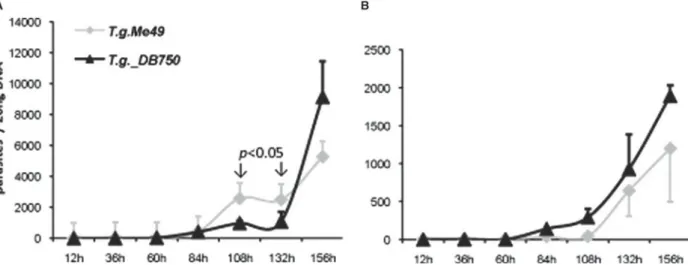
Subsequently, the proliferation-kinetics of non-adapted T. gondii Me49 and T. gondii-DB750 within a time frame of 156 h were comparatively assessed by real time PCR in the presence and absence of 1·2μM DB750, respectively (Fig. 2). Within thefirst 84 h of culture in the absence and presence of DB750 both T. gondii strains exhibited similar growth kinetics. Subsequently, in the absence of DB750, the non-adapted T. gondii Me49 tachyzoites proliferated at a significantly higher rate (P<0·05) compared to T. gondii_DB750, until the time-point 156 h post-infection, at which the numbers of T. gondii_DB750 increased dramatically (Fig. 2A). In the presence of 1·2μMDB750 (Fig. 2B), the DB750-adapted strain was proliferating slightly more rapidly from 84 h post-infection onwards until the end of the assay. However, surprisingly, a substantial proliferation of non-adapted T. gondii Me49 tachyzoites could be observed from 84 h post-infection onwards, and the parasite numbers of the two strains were not signi fi-cantly different at any time-point. Thus, DB750 did not exhibit parasiticidal activity against non-adapted T. gondii Me49 tachyzoites when applied at high (1·2μM) concentration. Conversely, T. gondii Me49 tachyzoites rapidly adapted to the action of the compound within the short time frame of 5–6 days of treatment. The same potential to readily adapt to DB750 treatment was observed for T. gondii β-gal tachyzoites (data not shown).
In vitro screening of di-cationic pentamidine derivatives against T. gondii tachyzoites leads to the identification of DB745
T. gondiiβ-gal tachyzoites were used for the screen-ing of a series of selected di-cationic pentamidine derivatives, including 10 di-arylimidamides (DB666, DB667, DB702, DB710, DB745, DB780, DB786, DB865, DB891, or DB930), 6 diamidines (DB1282, DB1341, DB1362, DB1407, DB1450 or DB1479), 15 newly generated mono-arylimidamides (DB1980, DB1996, DB1997, DB2001, DB2002, DB2006, DB2007, DB2018, DB2036, DB2045, DB2048, DB2074, DB2079, DB2081, or DB2083), and the di-guanidino analogue DB1127, all at an initial con-centration of 1μM. Evaluation of β-galactosidase activity after 72 h of exposure to these drugs revealed that the mono-arylimidamides tested did not show any adverse effects on T. gondii proliferation nor on host cells, but proliferation-inhibitory effects were imposed by the di-arylimidamides DB702 and DB745, the di-guanidino-analogue DB1127, and the di-amidine DB1282 (seeTable 1).
Assessment of host cell toxicity by light micro-scopical inspection of uninfected HFF monolayers exposed to increasing concentrations of the drugs (0, 0·5, 1, 2 or 3μM) twice/day for 3 days revealed that DB1282 induced over 50% cell death already at 1μM, and DB1127 lead to 80% HFF death at a concen-tration of 0·5μM. Fifty % of viable HFF compared to untreated samples were found in cultures treated with 2μMDB702 (Table 1). For DB745, treatments with 0·5–2 μM did not result in adverse reactions in HFF monolayers, while at 3μMa 50% reduction in viable HFF was observed. Thus, DB745, with an IC50 for T. gondii β-gal of 0·03 μM, and favourable
selective toxicity was selected for further study (seeTable 1).
Fig. 2. Proliferation kinetics of Toxoplasma gondii Me49 and DB750-adapted T. gondii_DB750 in HFF monolayers. (A) Growth curves in the absence of DB750 and (B) in the presence of 1·2μMDB750. Parasite quantification was performed by quantitative real time PCR at different time-points as indicated in the x-axis over a period of 156 h. Shown is 1 of 2 experiments with essentially identical outcome. P values <0·05 indicate significant differences in parasite numbers of the two strains when cultured in the absence of DB750.
Characterization of the effects of DB745 on proliferation and host cell invasion of non-adapted (T. gondii Me49) and DB750-adapted
(T. gondii_DB750) tachyzoites
DB750 and DB745 exhibit a similar molecular structure (Fig. 3A). They differ in molecular weight (590·46 and 655·60, respectively), and in contrast to DB750, DB745 possesses an ethyl-moiety on each of the 1′-positions of the aryl rings. The proliferation of non-adapted T. gondii Me49 and T. gondii_DB750 in the presence of 1μM DB745 was assessed in 72 h growth-assays, and compared with T. gondii_DB750 tachyzoites treated with 1·2μMDB750 (Fig. 3B). As expected, DB745 completely blocked the prolifer-ation of non-adapted T. gondii Me49 tachyzoites (IC50= 0·03μM; see Table 1). The DB750-adapted
T. gondii_DB750 tachyzoites readily underwent proliferation in the presence of 1·2μM DB750 (IC50= 0·48μM; see Table 1), but were significantly
impaired in the presence of DB745 (IC50of 0·07μM;
seeTable 1). However, the inhibition of proliferation was significantly less pronounced as for non-adapted T. gondii Me49.
In order to investigate whether DB745 also had an impact on extracellular T. gondii tachyzoites, T. gondiiβ-gal tachyzoites were separated from their
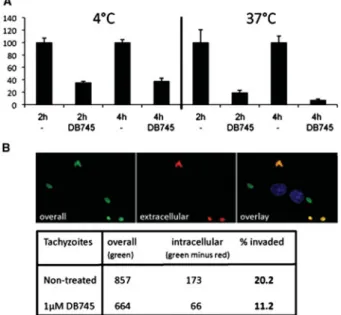
host cells and exposed to DB745 (1μM) for periods of 2 h and 4 h, either at 4 °C or at 37 °C (Fig. 4A). Subsequently, the drugs were removed, and parasites were added to HFF monolayers, and proliferation of tachyzoites was assessed after 72 h. Upon incubation of isolated tachyzoites at 4 °C, DB745 already had a profound impact on the infectivity of the parasites, yielding a reduction of tachyzoite numbers of approxi-mately 60% after both 2 and 4 h exposure-time to the drug. At 37 °C, the impact of DB745 on parasite infectivity was even more pronounced, yielding a reduction in parasite numbers of 80% after 2 h, and over 90% upon 4 h of extracellular exposure to DB745 (Fig. 4A). This suggested that DB745 impaired the viability of extracellular parasites in a time- and temperature-dependent manner.
The effect of DB745 on host cell invasion was assessed using T. gondii Me49 and employing immunofluorescence microscopy and applying a
Fig. 4. Effects of DB745 on the infectivity of
extracellular Toxoplasma gondii tachyzoites. (A) T. gondii β-gal tachyzoites were incubated in the presence or absence of 1μMDB745 for 2 h or 4 h, either at 4 °C or at 37 °C. They were then used for infection and
proliferation in HFF monolayers for a period of 72 h prior to quantification of β-galactosidase activity. Results in terms of parasite proliferation are presented as a percentage in relation to treatments without drug (given as 100%β-galactosidase activity). The assays were done in quadruplicate. (B) Assessment of DB745-mediated inhibition of invasion of T. gondii Me49 tachyzoites by immunofluorescent distinction of intracellular and extracellular parasites. Results were obtained by differential staining and subsequently counting the parasites in 20 randomly chosenfields at 40 times magnification. Extracellularly located parasites fluoresce with Texas-red and the overall number of parasites was determined by FITC-staining. Note the reduction of invasive parasites after incubation with 1μMDB745 for 1 h. Shown are the results of 1 of 2 experiments with essentially identical outcome.
Fig. 3. Properties of DB750 and DB745. (A) Structures and molecular weights of DB750 and DB745. (B) Proliferation inhibitory effects of DB750 and DB745 over a period of 72 h. Parasite quantification was done by quantitative real time PCR. In (B) the proliferation of Toxoplasma gondii Me49 over a period of 72 h was completely inhibited by the presence of 1μMDB745 (left). T. gondii_DB750 proliferation was not inhibited by the presence of 1·2μMDB750 (middle), but significantly impaired by the presence of 1μMDB745 (right). Shown is 1 of 2 experiments with essentially identical outcome.
differential staining procedure that allowed distinc-tion of intracellular and extracellular parasites (Hemphill et al. 1996; Naguleswaran et al. 2003). Following exposure of non-adapted T. gondii Me49 tachyzoites to 1μM DB745 for 1 h, parasites were washed and allowed to interact with HFF monolayers for 1 h (Fig. 4B). As a control, non-treated parasites were subjected to the same procedure without com-pound. Of 857 non-treated tachyzoites, 173 (20·2%) were located within host cells. In contrast, in DB745-treated samples the overall number of counted para-sites was reduced to 664 tachyzoites and only 66 (11·2%) were found to be intracellular (Fig. 4B). No such effect was seen when T. gondii-DB750 tachy-zoites were exposed to DB745 treatment, and when non-adapted T. gondii Me49 tachyzoites were ex-posed to DB750 (data not shown).
In vitro adaptation of T. gondii Me49 tachyzoites to DB745
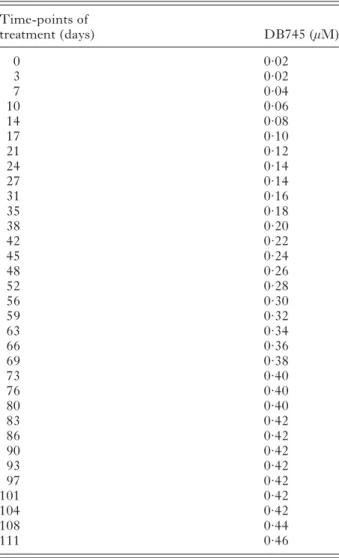
In order to explore the potential of T. gondii Me49 tachyzoites to adapt to DB745 treatment, the concen-tration of the drug during the culture of infected HFF monolayers, starting at 0·02μM, was increased stepwise by 0·02μMevery 3–4 days (seeTable 2). As for DB750, T. gondii Me49 tachyzoites exhibited an astonishing capacity to also adapt to DB745, albeit at a much slower speed, but finally still undergoing proliferation up to a concentration of 0·46μM. Rapid adaptation to increasing concentrations of DB745 as previously observed for DB750 was not possible. At higher concentrations, exposure to DB745 during periods of 10 days or longer lead to deterioration of the HFF monolayers. Thus, besides exhibiting a higher anti-parasitic activity compared to DB750, DB745 also showed an increased host cell toxicity. The IC50of DB745 for this DB745-adapted strain
was not determined.
Effects of DB745 on the ultrastructure of T. gondii tachyzoites
Differences in efficacy of DB745 against non-adapted and DB750- adapted T. gondii_DB750 tachyzoites were also detectable at the ultrastructural level. HFF monolayers infected with T. gondii_DB750 or non-adapted T. gondii were treated with 1μMDB750 and DB745, respectively, for 24 h, and were processed for TEM (Figs 5and6). In non-adapted T. gondii Me49 both, DB750 (Fig. 5B) and DB745 (Fig. 5C, D) induced severe morphological alterations in parasite ultrastructure, as can be seen by, for example, the for-mation of increased cytoplasmic vacuoles with mem-branous and often granular content, the presence of membrane stacks, and electron-dense inclusions. In DB750-adapted T. gondii_DB750 tachyzoites (Fig. 6) there were no obvious differences observed in the ultrastructure of untreated (Fig. 6A) and
DB750-treated T. gondii_DB750 tachyzoites (Fig. 6B), confirming the complete adaptation of these parasites to the drug. In contrast, populations with different degrees of structural alterations were detected in cultures infected with T. gondii_DB750 tachyzoites and treated with DB745. In some instances seemingly viable parasites with normal or only slightly aberrant ultrastructural organization (Fig. 6C and D) could be seen, often in the direct vicinity of tachyzoites that exhibited extensive cytoplasmic distortions such as increased vacuoliza-tion and membranous inclusions (Fig. 6C, E). These aberrant structural changes point towards severe metabolic impairment of affected tachyzoites. In ad-dition, numerous non-viable tachyzoite-remnants were detected in DB745-treated cultures (Fig. 6F). Table 2. Schedule for the establishment of a DB745-adapted Toxoplasma gondii Me49 line
(At indicated time-points the medium was replaced with new medium containing either slightly elevated concen-trations (+ 0·02μM) of DB745, or (at the later time-points) medium was changed with drug concentration unchanged as indicated. Every 6–10 days cultures were trypsinized and seeded onto fresh HFF monolayers. At day 111 and a DB745 concentration of 0·46μM, host cell monolayers exhibited clear signs of disintegration and the adaptation process was stopped.)
Time-points of treatment (days) DB745 (μM) 0 0·02 3 0·02 7 0·04 10 0·06 14 0·08 17 0·10 21 0·12 24 0·14 27 0·14 31 0·16 35 0·18 38 0·20 42 0·22 45 0·24 48 0·26 52 0·28 56 0·30 59 0·32 63 0·34 66 0·36 69 0·38 73 0·40 76 0·40 80 0·40 83 0·42 86 0·42 90 0·42 93 0·42 97 0·42 101 0·42 104 0·42 108 0·44 111 0·46
D I S C U S S I O N
Although pentamidine was synthesized already in the 1930s, it has remained the only aromatic diamidine that is widely used in the clinic, especially against human stage 1 African trypanosomiasis caused by Trypanosoma brucei gambiense, but also against Pneu-mocystis pneumonia caused by PneuPneu-mocystis jiroveci, and against leishmaniasis, and Candida albicans infections (Werbovetz,2006). A number of arylimi-damides, including DB702, DB750, DB766, DB786, DB811 and DB889 exhibited good in vitro activity against Trypanosoma cruzi, N. caninum, B. besnoiti or L. donovani (Stephens et al. 2003; Silva et al.
2007a, b; Leepin et al.2008; Cortes et al.2011), and DB766 effectively reduced the parasite burden in the blood and heart of T. cruzi-infected mice at a dose of 100 mg/kg/day given orally and intraperitoneally (Batista et al.2010a). Thus, the goal of this inves-tigation was to study the interactions of T. gondii tachyzoites with DB750, which had shown interest-ing properties in a previous study (Leepin et al.
2008), and possibly identify other compounds with
good in vitro activity. This included effects of these compounds on intracellular proliferation, host cell toxicity, parasiticidal activity, the involvement of the host cells in drug activity, and the potential of these parasites to adapt to the adverse conditions during in vitro drug treatment.
The di-cationic molecules used here have been designed to have improved pharmacokinetic proper-ties by including aryl groups on one of the amidine nitrogen atoms (Wang et al. 2010) and DB750 was an obvious drug candidate due to its low IC50against
T. gondii Rh (0·23μM), and low toxicity in HFF mono-layers (Leepin et al.2008). Previous studies had also shown that the HFF host cells actually participated in the activity against closely related N. caninum tachyzoites, most likely by taking up the drug and providing the host cell with a ‘memory effect’, thus exerting the anti-parasitic activity against intracellu-lar tachyzoites even in the absence of added drug (Leepin et al.2008). However, DB750 did not affect the viability and invasive capacities of extracellular N. caninum and T. gondii Rh tachyzoites (Leepin et al.2008). Moreover, recent in vivo studies in mice
Fig. 5. TEM of the effects of DB750 and DB745 (1 μM, 24 h) against Toxoplasma gondii Me49 tachyzoites cultured in HFF. (A) Control without drug treatment, with T. gondii Me49 tachyzoites surrounded by a parasitophorous vacuole membrane (pvm) and exhibiting cytoplasmic organelles such as nucleus (nu), rhoptries (rop) and dense granules (dg). Scale bar = 0·7μm. (B) T. gondii Me49 tachyzoites incubated in the presence of DB750, exhibiting extensive
vacuolization, and substantial degradation of the cytoplasmic architecture (v). Scale bar = 0·9μm. (C) Shows a group of T. gondii Me49 tachyzoites incubated in the presence of DB745 (Scale bar = 0·9μm), and (D) displays a higher
magnification view of the parasite indicated by the large arrow (Scale bar=0·4 μm). In (D), note the presence of cytoplasmic vacuoles, either seemingly empty orfilled with a meshwork of filamentous and granular material of unknown origin (v) and the large stacks of membrane adjacent to the nucleus (nu). In all drug-treated samples, the pvm appeared still largely intact and clearly discernible.
experimentally infected with the N. caninum tachy-zoites showed that DB750-treatment, applied intra-peritoneally at 2 mg/kg/day for a period of 14 days, had a benefitial impact by reducing clinical signs of neosporosis and diminishing the cerebral parasite load (Debache et al. 2011). Thus, we attempted to characterize the effects mediated by DB750 in 2 different strains of T. gondii, Rh and Me49, which represent strains of high and low virulence in mice, respectively (Dardé,2008).
By employing 72 h-growth assays, DB750 IC50
values for the two Toxoplasma strains, T. gondiiβ-gal
(Rh background) and T. gondii Me49, were shown to be in the similar low range (0·11–0·16 μM) of the previously reported IC50 for T. gondii Rh (Leepin
et al. 2008). Thus, the assessments of parasite proliferation by a colourimetric assay based on the quantification of β-galactosidase activity (McFadden et al.1997) and the quantification of parasite numbers by quantitative real time PCR produced similar results.
Similar to what was previously reported for N. caninum, DB750 retained its anti-parasitic activity against T. gondii also upon pre-treatment of host cells
Fig. 6. TEM of the effects of DB750 and DB745 (1 μM, 24 h) against DB750-adapted Toxoplasma gondii-DB750 tachyzoites cultured in HFF. (A) Control, displaying T. gondii_DB750 tachyzoites without drug treatment. Typical components such as the parasitophorous vacuole membrane (pvm), rhoptries (rop), dense granules (dg) and micronemes (mic) at the apical pole of the tachyzoites are clearly discernible. The arrow points towards the conoid. Scale bar = 1μm. (B) T. gondii_DB750 tachyzoites incubated in the presence of DB750. Note that these parasites seem largely unaffected by the drug treatment. (C–F) T. gondii_DB750 cultured in the presence of DB745; in (C) tachyzoites exhibiting only moderate alterations and still exhibiting a largely intact cytoplasmic organization (vertical arrow), and another tachyzoite with increased vacuole formation (horizontal arrow) are shown. (D) Higher magnification view of (C). Scale bars in (C) = 0·9μm, in (D)=0·4 μm. (E) and (F) Show tachyzoites that exhibit more severe alterations due to drug treatment such as intracytoplasmic vacuoles (v), lipid droplet formation (ld) and a general desintegration of the cellular
architecture. Scale bars in (E) and (F) = 0·5μm. In all drug-treated samples, the pvm appeared still intact and clearly discernible.
for prior to infection and subsequent culture for 72 h in the absence of the drug. In addition, no anti-parasitic activity could be seen in the corresponding HFF-medium supernatant. The lack of DB750-activity in medium supernatant after 12 h of incu-bation with HFF could be potentially explained (i) by metabolic degradation of DB750 or (ii) by highly efficient drug-uptake by the host cells. The fact that the anti-parasitic effect was retained in these pre-treated HFF cells but was no longer evident in the corresponding medium supernatant supports the notion of DB750 being actively taken up by HFF monolayers and subsequently retained in the host cell cytoplasm. How this is achieved is not known; passive and active transport could be involved. Ming et al. (2008) identified a human organic cation transporter for which pentamidine and furamidine act as sub-strates, and possibly such transporters could mediate DB750 uptake into HFF. In addition, intracellular accumulation of DB750 within the HFF monolayers could be responsible for the toxicity that was detected upon culture of infected fibroblasts for more than 10 days in the presence of DB750 at concentrations higher than 1·2μM.
Although the promising IC50 values achieved in
72 h assays indicated that T. gondii tachyzoites were highly susceptible to DB750 treatments, it became clear that these parasites exhibited a surprising ability to rapidly adapt to approximately 10 times higher drug concentrations within 5–6 days following initia-tion of treatment. The resulting DB750-adapted T. gondii strain, T. gondii_DB750, had an IC50 of
0·48μMand could still undergo proliferation in HFF at a drug concentration of 1·2μM. In comparison to T. gondii, the closely related N. caninum (Nc-1 and Nc-Liv isolates) did not exhibit the ability to rapidly adapt to such high concentrations of DB750. DB750 adaptation of Neospora populations could only be achieved after several weeks of careful and stepwise increase of drug concentrations up to 0·2–0·3 μM. Thus, although phylogenetically closely related, the two species seem to exhibit a different adaptation profile. Most likely, T. gondii has a more sophisticated metabolic machinery to deal with adverse life con-ditions, and it would be interesting to investigate the molecular mechanisms involved. In any case, the lower potential of Neospora to react to environmental changes could be a determining factor that limits the range of potential intermediate hosts of this para-site in comparison to T. gondii (Hemphill et al.2006; Dubey et al.2007). Thus, a higher degree offlexibility on the transcriptional and translational level (re-viewed by Bougdour et al.2010) may have enabled T. gondii tachyzoites to adapt to the arylimidamide compound DB750 within this short time span.
By monitoring the growth of T. gondii Me49 and T.gondii_DB750 in the presence of DB750 over time, the capacity of T. gondii_DB750 to proliferate at a slightly higher rate compared to non-adapted
parasites was demonstrated. However, the fact that T. gondii Me49 tachyzoites were able to adapt to 1·2μM DB750 and resume proliferation in such a short time frame was surprising. Adaptation could be accompanied by an increased expression of genes coding for components of the Toxoplasma detoxi fica-tion machinery, such as e.g. ATP-binding cassette (ABC) transporters, which represent an important family of membrane proteins involved in drug re-sistance and other biological activities (Sauvage et al. 2009). A prominent ABC transporter, P-glycoprotein (TgABC.B1 and TgABC.B2) poten-tially mediating transport of the drug out of the cell, are associated with the membrane in tachyzoites, and is constitutively expressed in all 3 virulent types. On the other hand, another adaptation mechanism could involve the reduced uptake of drug, due to the down-regulation of certain adenosine transporter activities, which are involved in diamidine uptake (Matovu et al.2003; Witola et al.2004). For instance, homo-logues to the P2 aminopurine transporter in T. brucei are found in the Toxoplasma genome (www.toxodb. org). This protein normally transports essential adenosine and adenine, but is also responsible for the efficient transfer of pentamidine and the diami-dine DB75 into the trypanosome interior (Lanteri et al. 2006). Down regulation of the expression of such adenosine transporters would then, besides limit-ing diamidine uptake, also limit the uptake of other essential molecules such as aminopurines, which are important for proliferation. This could explain the initial reduced proliferation of T. gondii_DB750 compared to T. gondii Me49 in the absence of DB750. Evidently, thesefindings on DB750 did not allow high expectations in terms of a potential in vivo efficacy of DB750 against T. gondii infection. As a consequence, we aimed to search for additional active di-cationic compounds with increased anti-parasitic activity, leading to the identification of DB745.
DB750 and DB745 exhibit a highly similar mol-ecular structure. However, the change of the hydro-xyl groups on the benzene ring to ether-coupled ethyl groups could have provided DB745 with an increased metabolic resistance and membrane permeability, since the compound is slightly more lipophilic (log P at pH 7·4 = 3·82; Wang et al.2010), which could in turn increase the chances of the drug passing several layers of membrane, including the host cell plasma membrane, parasitophorous vacuole membrane, para-site membrane, and the membrane of a potential target organelle. Which target is actually affected by DB745 is not clarified to date. Current evidence suggests that aromatic diamidines bind to AT-rich sites in the DNA minor groove, and thus inhibit transcription or the interaction with DNA-binding enzymes such as topoisomerases or nucleases (Wilson et al. 2008). This indicates that these com-pounds could influence gene expression, and thus many diverse cellular functions could be affected.
In kinetoplastids, fluorescence microscopy had demonstrated that these drugs associate with the kinetoplast DNA, which is in agreement with the observed mitochondrial swelling seen in T. cruzi upon incubation with diamidines (Batista et al.
2010b). However, neither DB750 nor DB745 exhibit fluorescent properties, thus it was not possible to localize these drugs, neither within the host cells nor within the parasites.
DB745 did not only affect the proliferation of intracellular T. gondii tachyzoites, but also exhibited pronounced effects upon treatment of extracellular parasites. This showed that, in order to be active DB745 is not required to be metabolized by the host cell. In contrast, DB750 did not affect the viability of extracellular N. caninum and T. gondii Rh tachyzoites (Leepin et al.2008) nor did it have an impact on the invasive properties of T. gondii Me49 tachyzoites. Thus, the decrease in the IC50(from 0·13μM(DB750)
to 0·03μM(DB745)) against T. gondii Me49 could be due to an added effect such as the impairment of extracellular parasites. As a consequence, T. gondii Me49 adaptation to the effects of DB745 treatment took place much less efficiently and only after ex-tended periods of time. Rapid adaptation to DB745, as seen for DB750, was not possible.
The impact of pre-treatments on the viability of T. gondii Me49 tachyzoites with DB745 at 37 °C was time dependent, and these effects were less pro-nounced upon pre-treatment at 4 °C and, at lower temperature, time independent. By employing an adhesion/invasion assay that allowed distinction be-tween adhering tachyzoites and intracellular tachy-zoites, the negative impact of DB745-treatments of extracellular tachyzoites was confirmed micro-scopically. The fact that the IC50 of DB745 for
T. gondii_DB750 was about 2 times higher compared to the IC50 for T. gondii Me49 (0·07μM versus
0·03μM) can be explained by the similarities in structure of DB750 and DB745, thus adaptation to DB750 must have had some cross-protective effect. HFF monolayers infected with T. gondii Me 49 and T. gondii_DB750 were exposed to either DB750 or DB745, both at 1μMfor 24 h, and the effects were monitored by TEM. As expected, DB750 did not affect T. gondii_DB750, while DB745 clearly had a much higher impact. However, seemingly structu-rally unharmed parasites were occasionally visible. This indicates and confirms that a certain degree of cross-adaptation had taken place in some tachyzoites, but not in all. This also clearly shows that DB745, although highly effective in 3 day-growth assays, does not readily kill all parasites, even at high concen-trations, allowing adaptation to take place in some tachyzoites.
In conclusion, we have demonstrated an astonish-ing ability of the apicomplexan parasite T. gondii to adapt to the effects of the arylimidamide DB750 within a time span of 5–6 days in culture. DB750 had
previously provided encouraging data on selective anti-Toxoplasma efficacy in vitro. Thus our findings question the value of short-term (e.g. 72 h) in vitro assays for the evaluation of anti-Toxoplasma proper-ties, and corresponding investigations that include longer-term in vitro drug exposure could provide more reliable results. T. gondii could also adapt to (less) elevated levels of DB745, although only after many weeks in cell culture. Drug adaptation is also likely to happen in vivo, since chemotherapeutical treatment failures when employing pyrimethamine, sulfadiazine and clindamycine have been reported frequently (Dedicoat and Livesley, 2006; Ribera Pasquet et al.1998). Clearly, Toxoplasma represents a true survival artist, and this illustrates the inherent difficulties in obtaining reliable and efficacious drugs for the treatment of toxoplasmosis. Arylimidamides, however, represent a class of compounds that could serve this cause. DB745 should be followed up in an appropriate in vivo model, and the molecular mechanisms of the outstanding adaptive potential of T. gondii must be elucidated in future studies.
A C K N O W L E D G E M E N T S
Many thanks are addressed to Norbert Müller for critical comments on the manuscript. We are grateful to Furio Spano (Istituto Superiore di Sanità, Rome, Italy) for providing us with T. gondii Me49, and to David Sibley (Washington University, St Louis, MO, USA) for his gift of T. gondii β-gal. This study was financed through the Swiss National Science Foundation (grant no. 31003A_127374/1).
R E F E R E N C E S
Barratt, J. L., Harkness, J., Marriott, D., Ellis, J. T. and Stark, D. (2010). Importance of nonenteric protozoan infections in immunocompromised people. Clinical Microbiology Reviews23, 795–836.
Batista, D. G., Batista, M. M., de Oliveira, G. M., do Amaral, P. B., Lannes-Vieira, J., Britto, C. C., Junqueira, A., Lima, M. M., Romanha, A. J., Sales Junior, P. A., Stephens, C. E., Boykin, D. W. and Soeiro, M. N. (2010a). Arylimidamide DB766, a potential chemother-apeutic candidate for Chagas’ disease treatment. Antimicrobial Agents and Chemotherapy54, 2940–2952.
Batista, D. G., Pacheco, M. G., Kumar, A., Branowska, D., Ismail, M. A., Hu, L., Boykin, D. W., and Soeiro, M. N. (2010b). Biological, ultrastructural effect and subcellular localization of aromatic diamidines in Trypanosoma cruzi. Parasitology137, 251–259.
Bougdour, A., Braun, L., Cannella, D. and Hakimi, M. A. (2010). Chromatin modifications: implications in the regulation of gene expression in Toxoplasma gondii. Cellular Microbiology12, 413–423.
Buckner, F. S. and Navabi, N. (2010). Advances in Chagas disease drug development: 2009–2010. Current Opinion in Infectious Diseases 23, 609–616.
Carruthers, V. B., and Suzuki, Y. (2007). Effects of Toxoplasma gondii infection on the brain. Schizophreny Bulletin33, 745–751.
Cortes, H. C., Muller, N., Boykin, D. W., Stephens, C. E. and Hemphill, A. (2011). In vitro effects of arylimidamides against Besnoitia besnoiti infection in Vero cells. Parasitology138, 583–592.
Costa, J. M., Pautas, C., Ernault, P., Foulet, F., Cordonnier, C. and Bretagne, S. (2000). Real-time PCR for diagnosis and follow-up of Toxoplasma reactivation after allogeneic stem cell transplantation using fluorescence resonance energy transfer hybridization probes. Journal of Clinical Microbiology38, 2929–2932.
Dabritz, H. A. and Conrad, P. A. (2010). Cats and Toxoplasma: implications for public health. Zoonoses and Public Health57, 34–52.
Dardé, M. L. (2008). Toxoplasma gondii,“new” genotypes and virulence. Parasite 15, 366–371.
Debache, K., Guinaud, C., Kropf, C., Boykin, D., Stephens, C. E. and Hemphill, A. (2011). Experimental treatment of Neospora caninum-infected mice with the arylimidamide DB750 and the thiazolide nitazo-xanide. Experimental Parasitology129, 95–100.
Dedicoat, M. and Livesley, N. (2006). Management of toxoplasmic encephalitis in HIV-infected adults (with an emphasis on resource-poor settings). Cochrane Database Systemic Reviews19;3, CD005420.
Dubey, J. P. (2009). History of the discovery of the life cycle of Toxoplasma gondii. International Journal for Parasitology39, 877–882.
Dubey, J. P., Schares, G. and Ortega-Mora, L. M. (2007). Epidemiology and control of neosporosis and Neospora caninum. Clinical Microbiology Reviews20, 323–367.
Feldman, D. M., Timms, D. and Borgida, D. F. (2010). Toxoplasmosis, parvovirus, and cytomegalovirus in pregnancy. Clinical Laboratory Medicine 30, 709–720.
Hemphill, A. (1996). Subcellular localization and functional characteriz-ation of Nc-p43, a major Neospora caninum tachyzoite surface protein. Infection and Immunity64, 4279–4287.
Hemphill, A., Gottstein, B. and Kaufmann, H. (1996). Adhesion and invasion of bovine endothelial cells by Neospora caninum. Parasitology112, 183–197.
Hemphill, A., Vonlaufen, N., Naguleswaran, A., Keller, N., Riesen, M., Guetg, N., Srinivasan, S. and Alaeddine, F. (2004). Tissue culture and explant approaches to studying and visualizing Neospora caninum and its interactions with the host cell. Microscopy and Microanalysis 10, 602–620.
Hemphill, A., Vonlaufen, N. and Naguleswaran, A. (2006). Cellular and immunological basis of the host-parasite relationship during infection with Neospora caninum. Parasitology133, 261–278.
Henriquez, F. L., Woods, S., Cong, H., McLeod, R. and Roberts, C. W. (2010). Immunogenetics of Toxoplasma gondii informs vaccine design. Trends in Parasitology26, 550–555.
Laliberté, J. and Carruthers, V. B. (2008). Host cell manipulation by the human pathogen Toxoplasma gondii. Cellular and Molecular Life Science 65l, 1900–1915.
Lanteri, C. A., Stewart, M. L., Brock, J. M., Alibu, V. P., Meshnick, S. R., Tidwell, R. R. and Barrett, M. P. (2006). Roles for the Trypanosoma brucei P2 transporter in DB75 uptake and resistance. Molecular Pharmacology70, 1585–1592.
Leepin, A., Stüdli, A., Brun, R., Stephens, C. E., Boykin, D. W. and Hemphill, A. (2008). Host cells participate in the in vitro effects of novel diamidine analogues against tachyzoites of the intracellular apicomplexan parasites Neospora caninum and Toxoplasma gondii. Antimicrobial Agents and Chemotherapy52, 1999–2008.
Lindsay, D. S., Blagburn, B. L., Hall, J. E. and Tidwell, R. R. (1991). Activity of pentamidine and pentamidine analogs against Toxoplasma gondii in cell cultures. Antimicrobial Agents and Chemotherapy35, 1914–1916. Matovu, E., Stewart, M. L., Geiser, F., Brun, R., Mäser, P., Wallace, L. J., Burchmore, R. J., Enyaru, J. C., Barrett, M. P., Kaminsky, R., Seebeck, T. and de Koning, H. P. (2003). Mechanisms of arsenical and diamidine uptake and resistance in Trypanosoma brucei. Eukaryotic Cell2, 1003–1008.
McFadden, D. C., Seeber, F. and Boothroyd, J. C. (1997). Use of Toxoplasma gondii expressing beta-galactosidase for colorimetric assessment of drug activity in vitro. Antimicrobial Agents and Chemotherapy 41, 1849–1853.
Ming, X., Ju, W., Wu, H., Tidwell, R. R., Hall, J. E. and Thakker, D. R. (2009). Transport of dicationic drugs pentamidine and furamidine by
human organic cationic transporters. Drug Metabolism and Disposition37, 424–430.
Montoya, J. G. and Liesenfeld, O. (2004). Toxoplasmosis. Lancet. 363, 1965–1976.
Müller, J., Limban, C., Stadelmann, B., Missir, A. V., Chirita, I. C., Chifiriuc, M. C., Nitulescu, M. G. and Hemphill, A. (2009). Thioureides of 2-(phenoxymethyl)benzoic acid 4-R substituted: a novel class of anti-parasitic compounds. Parasitology International58. 128–135. Naguleswaran, A., Müller, N. and Hemphill, A. (2003). Neospora caninum and Toxoplasma gondii: a novel adhesion/invasion assay reveals distinct differences in tachyzoite-host cell interactions. Experimental Parasitology104, 149–158.
Pereira-Chioccola, V. L., Vidal, J. E. and Su, C. (2009). Toxoplasma gondii infection and cerebral toxoplasmosis in HIV-infected patients. Future Microbiology4, 1363–1379.
Ribera Pascuet, E., López Aldeguer, J., Pérez Elías, M. J. and Podzamczer Palter, D. (1998). Cerebral toxoplasmosis. Enfermeria. Infecciology. Microbiology Clinica16 Suppl 1, 45–51.
Sauvage, V., Aubert, D., Escotte-Binet, S. and Villena, I. (2009). The role of ATP-binding cassette (ABC) proteins in protozoan parasites. Molecular and Biochemical Parasitology167, 81–94.
Scheidegger, A., Vonlaufen, N., Naguleswaran, A., Gianinazzi, C., Müller, N., Leib, S. L. and Hemphill, A. (2005). Differential effects of interferon-gamma and tumor necrosis factor-alpha on Toxoplasma gondii proliferation in organotypic rat brain slice cultures. Journal of Parasitology 91, 307–315.
Silva, C. F., Batista, M. M., Mota, R. A., de Souza, E. M., Stephens, C. E., Som, P., Boykin, D. W. and Soeiro, M. N. (2007a). Activity of“reversed” diamidines against Trypanosoma cruzi “in vitro”. Biochemical Pharmacology15, 1939–1946.
Silva, C. F., Meuser, M. B., De Souza, E. M., Meirelles, M. N., Stephens, C. E., Som, P., Boykin, D. W. and Soeiro, M. N. (2007b). Cellular effects of reversed amidines on Trypanosoma cruzi. Antimicrobial Agents and Chemotherapy51, 3803–3809.
Soeiro, M. N., De Souza, E. M., Stephens, C. E. and Boykin, D. W. (2005). Aromatic diamidines as antiparasitic agents. Expert Opinion in Investigational Drugs14, 957–972.
Stephens, C. E., Brun, R., Salem, M. N., Werbovetz, K. A., Tanious, F., Wilson, W. D. and Boykin, D. W. (2003). The activity of diguanidino and ‘reversed’ diamidino 2,5-diarylfurans versus Trypanosoma cruzi and Leishmania donovani. Bioorganic Medicinal Chemistry Letters 16, 2065–2069.
Tenter, A. M., Heckeroth, A. R. and Weiss, L. M. (2000). Toxoplasma gondii: from animals to humans. International Journal for Parasitology30, 1217–1258.
Wang, M. Z., Zhu, X., Srivastava, A., Liu, Q., Sweat, J. M., Pandharkar, T., Stephens, C. E., Riccio, E., Parman, T., Munde, M., Mandal, S., Madhubala, R., Tidwell, R. R., Wilson, W. D., Boykin, D. W., Hall, J. E., Kyle, D. E. and Werbovetz, K. A. (2010). Novel arylimidamides for treatment of visceral leishmaniasis. Antimicrobial Agents and Chemotherapy54, 2507–2516.
Werbovetz, K. (2006). Diamidines as antitrypanosomal, antileishmanial and antimalarial agents. Current Opinion in Investigational Drugs6, 147–157. Wilson, W. D., Tanious, F. A., Mathis, A., Tevis, D., Hall, J. E. and Boykin, D. W. (2008). Antiparasitic compounds that target DNA. Biochimie90, 999–1014.
Witola, W. H., Inoue, N., Ohashi, K. and Onuma, M. (2004). RNA-interference silencing of the adenosine transporter-1 gene in Trypanosoma evansi confers resistance to diminazene aceturate. Experimental Parasitology 107, 47–57.