HAL Id: hal-01813395
https://hal.archives-ouvertes.fr/hal-01813395
Submitted on 18 Jul 2018HAL is a multi-disciplinary open access archive for the deposit and dissemination of sci-entific research documents, whether they are pub-lished or not. The documents may come from teaching and research institutions in France or abroad, or from public or private research centers.
L’archive ouverte pluridisciplinaire HAL, est destinée au dépôt et à la diffusion de documents scientifiques de niveau recherche, publiés ou non, émanant des établissements d’enseignement et de recherche français ou étrangers, des laboratoires publics ou privés.
Automatically Selecting the Best Dependency
Annotation Design with Dynamic Oracles
Guillaume Wisniewski, Ophélie Lacroix, François Yvon
To cite this version:
Guillaume Wisniewski, Ophélie Lacroix, François Yvon. Automatically Selecting the Best Depen-dency Annotation Design with Dynamic Oracles. Conference of the North American Chapter of the Association for Computational Linguistics: Human Language Technologies, Association for Compu-tational Linguistics, Jun 2018, New Orleans, United States. pp.401 - 406, �10.18653/v1/N18-2064�. �hal-01813395�
Proceedings of NAACL-HLT 2018, pages 401–406
Automatically Selecting the Best Dependency Annotation Design with
Dynamic Oracles
Guillaume Wisniewski1, Oph´elie Lacroix2 and Franc¸ois Yvon1
1LIMSI, CNRS, Univ. Paris-Sud, Universit´e Paris-Saclay, F-91405 Orsay, France 2Siteimprove, Sankt Annæ Plads 28, DK-1250 Copenhagen, Denmark [email protected], [email protected], [email protected]
Abstract
This work introduces a new strategy to com-pare the numerous conventions that have been proposed over the years for expressing de-pendency structures and discover the one for which a parser will achieve the highest pars-ing performance. Instead of associatpars-ing each sentence in the training set with a single gold reference, we propose to consider a set of ref-erences encoding alternative syntactic repre-sentations. Training a parser with a dynamic oracle will then automatically select among all alternatives the reference that will be predicted with the highest accuracy. Experiments on the UD corpora show the validity of this approach.
1 Introduction
Multiple annotation conventions have been pro-posed over the years for representing dependency structures (Hajiˇc et al., 2001;De Marneffe et al.,
2014). The divergence between annotation guide-lines can result from the theoretical linguistic prin-ciples governing the choices of head status and de-pendency inventories, the tree-to-dede-pendency con-version scheme or arbitrary decisions regarding closed class words, such as interjections or discur-sive markers, the syntactic role of which is debat-able. Several works have shown that the choice of a dependency structure can have a large impact on parsing performance (Silveira and Manning,2015;
de Lhoneux and Nivre,2016;Kohita et al.,2017) and on the performance of downstream applica-tions (Elming et al.,2013).
A natural way to decide which syntactic repre-sentation is the best is to choose the one for which a standard parser will achieve the highest parsing performance (Schwartz et al., 2012; Husain and Agrawal, 2012; Noro et al., 2005). Implement-ing this general principle faces two challenges: i) defining a learning criterion that can predict which dependency structure will be the easiest to learn ii)
finding a way to explore a potentially large num-ber of annotation schemes that describe all combi-nations of several design decisions.
This work shows that the dynamic oracle of
Goldberg and Nivre(2013) can straightforwardly uncover the most learnable dependency represen-tation among a predefined set of possible refer-ences.1 Rather than associating each sentence in the training set to a single reference, we propose to consider a set of references encoding alterna-tive syntactic representations. Training a parser with a dynamic oracle will then automatically se-lect among all alternatives the reference that will be predicted with the highest accuracy.
This article is organized as follows: we first re-view standard structural transformations studied in the literature that will be used to build a treebank annotated with multiple references (§2). We then show how the dynamic oracle of Goldberg and Nivre (2013) can be used to train a parser when each sentence is associated to a set of references and explain how it can be used to define a learn-ability criteria (§3). An experimental evaluation of our approach is presented in §4.
2 Dependency Transformations
In this section, we explain how to automatically transform the reference UD treebanks (Nivre et al.,
2016), to build corpora in which each sentence is annotated by a set of possible trees.
The UD project aims at developing cross-linguistically consistent treebank annotations for many languages by harmonizing annotation schemes between languages and converting exist-ing treebanks to this new scheme. Several recent papers (Kohita et al.,2017;de Lhoneux and Nivre,
2016; Silveira and Manning, 2015; Popel et al.,
1Contrary to unsupervised parsing, our approach does not
aim at discovering a dependency structure and rather relies on the existence of several hand-crafted references.
2013) have investigated whether the choices made to increase the sharing of structures between lan-guages hurt parsing performance and have iden-tified a variety of choice points in which more than one design could be advocated. Most of these points are related to the issue of headness: contrary to most works in theoretical linguistic, UD assumes that function words should be cate-gorically subordinated to content words to maxi-mize the similarity of dependency trees across lan-guages (Osborne and Maxwell,2015).
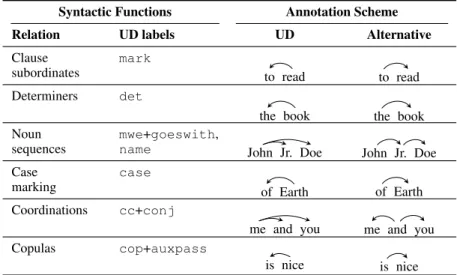
The alternative representations we consider are summarized in Table 1. They mostly consist in demoting the lexical head and making it depen-dent on a functional head. We designed a set of handcrafted rules2to convert dependencies be-tween these two schemes. Each application of a rule creates a new tree in the set of references that is being built. As shown in Figure1, the result-ing set of references encodes all possible combi-nations of the considered transformations.
... pour la peine ... case det root ... pour la peine ... case det root ... pour la peine ... det case root ... pour la peine ... case det root
Figure 1: Examples of all the annotations generated by applying the rules of Table1. The UD reference is in solid black.
3 Training a Dependency Parser with Multiple References
Dynamic Oracle In a transition-based parser (Nivre, 2008), a parse is computed by perform-ing a sequence of transitions buildperform-ing the parse tree in an incremental fashion. A partially built dependency tree is represented by a configuration c; when in c, applying a transition t results in the parser moving to a new configuration denoted c◦t. At each step of the parsing process, every pos-sible transition is scored by a classifier (e.g. a lin-ear model), given a feature representation of c and
2A more detailed description of the transformations can
be found in (Wisniewski and Lacroix,2017). The source code is freely available on the first author web site.
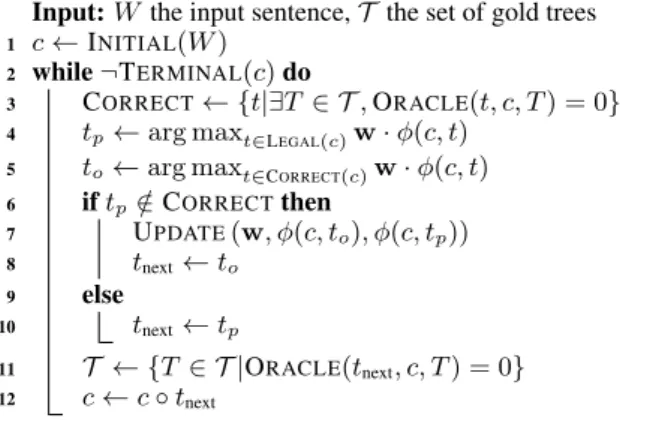
Algorithm 1: Training on one sentence with multiple references (see text for notations).
Input: W the input sentence, T the set of gold trees
1 c← INITIAL(W )
2 while ¬TERMINAL(c)do
3 CORRECT← {t|∃T ∈ T , ORACLE(t, c, T ) = 0}
4 tp← arg maxt∈LEGAL(c)w· φ(c, t) 5 to← arg maxt∈CORRECT(c)w· φ(c, t)
6 if tp∈ C/ ORRECTthen 7 UPDATE(w, φ(c, to), φ(c, tp)) 8 tnext← to 9 else 10 tnext← tp 11 T ← {T ∈ T |ORACLE(tnext, c, T ) = 0} 12 c← c ◦ tnext
model parameters w; the score of a derivation (a sequence of transitions) generating a given parse tree is the sum of its transition scores. Parsing thus amounts to finding, starting from the initial configuration INITIAL(W ), the derivation having
the highest score, typically using greedy or beam search.3
Algorithm 1 formalizes the training procedure when the dynamic4 oracle ofGoldberg and Nivre (2013) is used: for each sentence, a parse tree is built incrementally and at each step, if the pre-dicted transition prevents the creation of a gold dependency, the parameters are updated, accord-ing, for instance, to the perceptron rule (l.7). Er-roneous transitions can efficiently be found us-ing the ORACLE(t, c, T )function formally defined in (Goldberg and Nivre, 2013) as computing the number of dependencies of a gold parse tree T that can no longer be predicted when a transition t is applied in configuration c.
During training, it often happens that several transitions are equally good: in such situations, the training algorithm breaks ties among oracle tran-sitions according to the model current prediction (l.5). As suggested in the imitation learning litera-ture (Daum´e III and Marcu,2005;Ross and Bag-nell, 2010), this strategy enables to sample those configurations that will be the most similar to the ones seen when predicting a new dependency tree:
3In this work we only consider greedy parsers. Extending
the proposed approach to beam parsers would prevent dis-carding a reference because one of the its transition is too hard to predict (i.e. has a very low score), which would, intu-itively, results in even better predictions.
4Algorithm1only uses the non-deterministic property of
the oracle and not its completeness. Even if we use the most common term, ‘dynamic oracle’, our approach only requires the former property.
Syntactic Functions Annotation Scheme Relation UD labels UD Alternative Clause mark
to read to read subordinates
Determiners det
the book the book Noun mwe+goeswith,
John Jr. Doe John Jr. Doe sequences name
Case case
of Earth of Earth marking
Coordinations cc+conj
me and you me and you Copulas cop+auxpass
is nice is nice
Table 1: Annotation schemes in the UD treebanks and standard alternatives.
it is a way to let the parser explore more specif-ically the part of the search space it prefers and is more likely to see at test time (Aufrant et al.,
2017). Using a dynamic oracle usually results in substantial improvements in accuracy compared to static oracles.
Considering Multiple References Implement-ing the trainImplement-ing algorithm described above only re-quires the ability to detect whether a transition will cause an erroneous dependency. It can naturally be extended to the case of multiple references: a transition is considered correct as long as it can predict at least one of the gold trees; when moving to a new configuration, trees that can no longer be generated are removed from the set of references, in order to make sure the parser will not mix the dependencies of two gold trees (l.11).
Upon full completion of parsing, there will re-main only one surviving reference that has been selected according to the model current predic-tions. This reference corresponds to the depen-dency structure that is the most similar to the hy-pothesis the parser would have predicted at test time and can therefore be described as the refer-ence the parser prefers: intuitively, Algorithm 1
will thus identify the reference that will be pre-dicted with the highest accuracy.
4 Experiments
Data We separately apply to the 7 dependen-cies considered the transformations described in Section 2on the 38 languages of the UD project
(v1.3), resulting in 266 transformed corpora.5 To evaluate the ability of the proposed method to identify the ‘best’ dependency structure, we con-sider fully as well as partially transformed sen-tences: a sentence with n dependencies of interest will generate 2nreferences.
For each condition (i.e. a language and a trans-formation), a dependency parser is trained using (a) the original data annotated with UD conven-tion, (b) ‘transformed’ data in which each sentence is associated to a reference in which all dependen-cies of interest have been transformed and (c) the data associated with a set of reference containing all the partially transformed references (including the original and transformed references).
Parser We use our own implementation of an arc-eager unlabeled dependency parser with a dy-namic oracle and an averaged perceptron, using the features described in (Zhang and Nivre,2011) which have been designed for English and have not been adapted to the specificities of the other languages.6 Training stops when the UAS esti-mated on the validation set has converged.
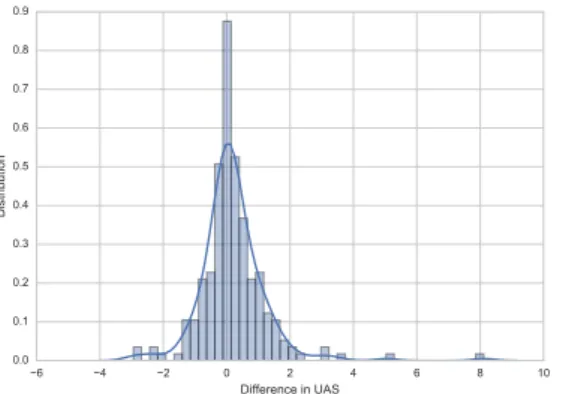
Impact of Transformations Figure 2 shows the distribution of differences in UAS between a parser trained on the original data (setting (a)) and a parser trained on the transformed data (setting (b)). To evaluate the proposed transformations, we follow the approach introduced in (Schwartz et al.,
544 transformed corpora were identical to the original
cor-pora as the transformation can not be applied (e.g. there are no multi-word expression in Chinese).
6Note that the proposed approach can be apply to other
2012) consisting in comparing the original and the transformed data on their respective references.
As expected, the annotation scheme has a large impact on the quality of the prediction, with an average difference in scores of 0.66 UAS points and variations as large as 8.1 UAS points. These results show that, contrary to general be-lief (Schwartz et al., 2012; Kohita et al., 2017), the UD scheme is not sub-optimal for monolin-gual parsing: the difference in UAS is negative in 93 conditions and positive in 129. Table2details for each dependency the when the UD scheme re-sults in better predictions.
6 4 2 0 2 4 6 8 10 Difference in UAS 0.0 0.1 0.2 0.3 0.4 0.5 0.6 0.7 0.8 0.9 Distribution
Figure 2: Distribution of differences between the UAS achieved on the UD and transformed corpora. Positive values indicate better prediction performance with UD annotations.
case 44.7% mark 58.3% det 80.5%
cc 89.4% mwe 50.0% name 45.8%
cop 25.0%
Table 2: Percentage of times a parser trained and eval-uated on UD data (setting (a)) outperforms a parser trained and evaluated on transformed data (setting (b)).
Training with Multiple References To assess the impact of training with multiple references (setting (c)), we first evaluate the capacity of Al-gorithm 1 to consistently select a single annota-tion scheme during training. We count, in each conditions, the number of times the reference that has survived training was following the original scheme and the number of times it was following the transformed scheme. For 74.7% of the condi-tions, the reference that has survived training was following the same annotation scheme for more than 70% of the training examples. This obser-vation proves the ability of the parser to commit itself to a single annotation scheme.
Learnability Criterion The training procedure proposed in this article was designed to uncover the dependency structure that will optimize pars-ing accuracy. In this section we evaluate whether this goal is achieved, by counting the number of conditions in which the annotation scheme that has survived training the most often (in setting (c)) is indeed the one that achieves the best performance on the test set, as evaluated by testing a parser in settings (a) and (b).
We will consider, as baselines, two measures of the ‘learnability’ of a treebank, the predictabil-ity of an annotation scheme (Schwartz et al.,
2012) and the derivation perplexity (Søgaard and Haulrich,2010). Contrary to our approach, these two measures aims at deciding which of two an-notations schemes will achieve the best parsing accuracy without actually training and testing a parser. The predictability is defined as the en-tropy of the conditional distribution of the depen-dent PoS knowing the head PoS. The derivation perplexity is the perplexity of 3-gram language model estimated on a corpus in which the words of a sentence appear in the order in which they are attached to their head.7
Table 3 reports the number of times, averaged over languages and transformations, that each measure of learnability is able to predict which of two competing annotation schemes will yield the best parsing performance. These results clearly show that the approach we propose to evaluate the ‘learnability’ of an annotation scheme outper-forms existing criteria and is able to select the an-notation convention that achieves the highest pars-ing performance.
metric learnability
predictability 64.8%
derivation complexity 62.6%
multiple references 76.3%
Table 3: Number of times a given learnability mea-sure is able to predict which annotation scheme will result in the best parsing performance. ‘multiple references’ corresponds to the approach proposed in this work.
7Similarly to (Søgaard and Haulrich,2010), we consider
a trigram language model but use Witten-Bell smoothing as many corpora are too small to use Kneser-Ney smoothing.
5 Conclusion
This work introduces a new strategy to compare the numerous representations that have been pro-posed over the years for expressing dependency structures and discover the one that is easiest to learn. Experiments with the popular transition-based parser on the UD corpora show the validity of the proposed approach.
In future work, we would like to evaluate the impact of annotation conventions on other kind of parsers and to find the properties of a dependency tree that facilitate its prediction. We also plan to find ways to easily annotate sentences with multi-ple references (e.g. by indicating that the head of word can be chosen arbitrarily) and eliminate the constraint that references should be trees.
Acknowledgments
This work has been partly funded by the Agence Nationale de la Recherche under Par-SiTi project (ANR-16-CE33-0021) and MultiSem project (ANR-16-CE33-0013).
References
Lauriane Aufrant, Guillaume Wisniewski, and Franc¸ois Yvon. 2017. Don’t stop me now! Using global dynamic oracles to correct training biases of transition-based dependency parsers. In Pro-ceedings of the 15th Conference of the Euro-pean Chapter of the Association for Computa-tional Linguistics: Volume 2, Short Papers. Associa-tion for ComputaAssocia-tional Linguistics, Valencia, Spain, pages 318–323. http://www.aclweb.org/ anthology/E17-2051.
Hal Daum´e III and Daniel Marcu. 2005. Learn-ing as search optimization: approximate large margin methods for structured prediction. In ICML ’05: Proceedings of the 22nd interna-tional conference on Machine learning. ACM Press, New York, NY, USA, pages 169–176.
https://doi.org/http://doi.acm. org/10.1145/1102351.1102373.
Miryam de Lhoneux and Joakim Nivre. 2016. Should Have, Would Have, Could Have. Investigating Verb Group Representations for Parsing with Univer-sal Dependencies. In Proceedings of the Work-shop on Multilingual and Cross-lingual Methods in NLP. Association for Computational Linguistics, San Diego, California, pages 10–19. http:// www.aclweb.org/anthology/W16-1202. Marie-Catherine De Marneffe, Timothy Dozat,
Na-talia Silveira, Katri Haverinen, Filip Ginter, Joakim
Nivre, and Christopher D. Manning. 2014. Uni-versal stanford dependencies: a cross-linguistic ty-pology. In Nicoletta Calzolari (Conference Chair), Khalid Choukri, Thierry Declerck, Hrafn Lofts-son, Bente Maegaard, Joseph Mariani, Asuncion Moreno, Jan Odijk, and Stelios Piperidis, edi-tors, Proceedings of the Ninth International Con-ference on Language Resources and Evaluation (LREC’14). European Language Resources Associ-ation (ELRA), Reykjavik, Iceland.
Jakob Elming, Anders Johannsen, Sigrid Klerke, Emanuele Lapponi, Hector Martinez Alonso, and Anders Søgaard. 2013. Down-stream effects of tree-to-dependency conversions. In Proceedings of the 2013 Conference of the North American Chap-ter of the Association for Computational Linguis-tics: Human Language Technologies. Association for Computational Linguistics, Atlanta, Georgia, pages 617–626. http://www.aclweb.org/ anthology/N13-1070.
Yoav Goldberg and Joakim Nivre. 2013. Training deterministic parsers with non-deterministic oracles. Transactions of the Association for Computational Linguistics 1:403–414.
https://transacl.org/ojs/index. php/tacl/article/view/145.
Jan Hajiˇc, Barbora Vidov´a-Hladk´a, and Petr Pajas. 2001. The Prague Dependency Treebank: Annota-tion Structure and Support. In Proceedings of the IRCS Workshop on Linguistic Databases. Univer-sity of Pennsylvania, Philadelphia, USA, pages 105– 114.
Samar Husain and Bhasha Agrawal. 2012. Analyzing parser errors to improve parsing accuracy and to in-form tree banking decisions. Linguistic Issues in Language Technology 7.
Ryosuke Kohita, Hiroshi Noji, and Yuji Matsumoto. 2017. Multilingual back-and-forth conversion be-tween content and function head for easy depen-dency parsing. In Proceedings of the 15th Confer-ence of the European Chapter of the Association for Computational Linguistics: Volume 2, Short Papers. Association for Computational Linguistics, Valen-cia, Spain, pages 1–7. http://www.aclweb. org/anthology/E17-2001.
Joakim Nivre. 2008. Algorithms for deterministic incremental dependency parsing. Comput. Lin-guist. 34(4):513–553. https://doi.org/10. 1162/coli.07-056-R1-07-027.
Joakim Nivre, ˇZeljko Agi´c, Lars Ahrenberg, Maria Je-sus Aranzabe, Masayuki Asahara, Aitziber Atutxa, Miguel Ballesteros, John Bauer, Kepa Bengoetxea, Yevgeni Berzak, Riyaz Ahmad Bhat, Cristina Bosco, Gosse Bouma, Sam Bowman, G¨uls¸en Ce-birolu Eryiit, Giuseppe G. A. Celano, C¸ar C¸¨oltekin, Miriam Connor, Marie-Catherine de Marneffe, Arantza Diaz de Ilarraza, Kaja Dobrovoljc, Timo-thy Dozat, Kira Droganova, Tomaˇz Erjavec, Rich´ard
Farkas, Jennifer Foster, Daniel Galbraith, Sebas-tian Garza, Filip Ginter, Iakes Goenaga, Koldo Go-jenola, Memduh Gokirmak, Yoav Goldberg, Xavier G´omez Guinovart, Berta Gonz´ales Saavedra, Nor-munds Gr¯uz¯itis, Bruno Guillaume, Jan Hajiˇc, Dag Haug, Barbora Hladk´a, Radu Ion, Elena Irimia, An-ders Johannsen, H¨uner Kas¸kara, Hiroshi Kanayama, Jenna Kanerva, Boris Katz, Jessica Kenney, Si-mon Krek, Veronika Laippala, Lucia Lam, Alessan-dro Lenci, Nikola Ljubeˇsi´c, Olga Lyashevskaya, Teresa Lynn, Aibek Makazhanov, Christopher Man-ning, C˘at˘alina M˘ar˘anduc, David Mareˇcek, H´ector Mart´ınez Alonso, Jan Maˇsek, Yuji Matsumoto, Ryan McDonald, Anna Missil¨a, Verginica Mititelu, Yusuke Miyao, Simonetta Montemagni, Keiko So-phie Mori, Shunsuke Mori, Kadri Muischnek, Nina Mustafina, Kaili M¨u¨urisep, Vitaly Nikolaev, Hanna Nurmi, Petya Osenova, Lilja Øvrelid, Elena Pas-cual, Marco Passarotti, Cenel-Augusto Perez, Slav Petrov, Jussi Piitulainen, Barbara Plank, Martin Popel, Lauma Pretkalnia, Prokopis Prokopidis, Ti-ina Puolakainen, Sampo Pyysalo, Loganathan Ra-masamy, Laura Rituma, Rudolf Rosa, Shadi Saleh, Baiba Saul¯ite, Sebastian Schuster, Wolfgang Seeker, Mojgan Seraji, Lena Shakurova, Mo Shen, Na-talia Silveira, Maria Simi, Radu Simionescu, Katalin Simk´o, Kiril Simov, Aaron Smith, Carolyn Spadine, Alane Suhr, Umut Sulubacak, Zsolt Sz´ant´o, Takaaki Tanaka, Reut Tsarfaty, Francis Tyers, Sumire Ue-matsu, Larraitz Uria, Gertjan van Noord, Vik-tor Varga, Veronika Vincze, Jing Xian Wang, Jonathan North Washington, Zdenˇek ˇZabokrtsk´y, Daniel Zeman, and Hanzhi Zhu. 2016. Universal de-pendencies 1.3. LINDAT/CLARIN digital library at Institute of Formal and Applied Linguistics, Charles University in Prague. http://hdl.handle. net/11234/1-1699.
Tomoya Noro, Chimato Koike, Taiichi Hashimoto, Takenobu Tokunaga, and Hozumi Tanaka. 2005.
Evaluation of a japanese cfg derived from a syntac-tically annotated corpus with respect to dependency measures. In Proceedings of the Fifth Workshop on Asian Language Resources (ALR-05) and First Symposium on Asian Language Resources Network (ALRN). http://aclweb.org/anthology/ I/I05/I05-4002.pdf.
Timothy Osborne and Daniel Maxwell. 2015. A histor-ical overview of the status of function words in de-pendency grammar. In Proceedings of the Third In-ternational Conference on Dependency Linguistics (Depling 2015). Uppsala University, Uppsala, Swe-den, Uppsala, SweSwe-den, pages 241–250. http:// www.aclweb.org/anthology/W15-2127. Martin Popel, David Mareˇcek, Jan ˇStp´anek, Daniel
Ze-man, and Zdnk ˇZabokrtsk´y. 2013. Coordination structures in dependency treebanks. In Proceed-ings of the 51st Annual Meeting of the Associa-tion for ComputaAssocia-tional Linguistics (Volume 1: Long Papers). Association for Computational Linguistics, Sofia, Bulgaria, pages 517–527. http://www. aclweb.org/anthology/P13-1051.
Stephane Ross and J. Andrew (Drew) Bagnell. 2010. Efficient reductions for imitation learning. In Pro-ceedings of the 13th International Conference on Ar-tificial Intelligence and Statistics (AISTATS). pages 661–668.
Roy Schwartz, Omri Abend, and Ari Rappoport. 2012. Learnability-based syntactic annotation de-sign. In Proceedings of COLING 2012. The COL-ING 2012 Organizing Committee, Mumbai, India, pages 2405–2422. http://www.aclweb.org/ anthology/C12-1147.
Natalia Silveira and Christopher Manning. 2015. Does Universal Dependencies need a parsing representa-tion? An investigation of English. Depling 2015 310.
Anders Søgaard and Martin Haulrich. 2010. On the derivation perplexity of treebanks. In Proceedings of Treebanks and Linguistic Theories 9.
Guillaume Wisniewski and Oph´elie Lacroix. 2017.
A systematic comparison of syntactic represen-tations of dependency parsing. In Proceedings of the NoDaLiDa 2017 Workshop on Univer-sal Dependencies (UDW 2017). Association for Computational Linguistics, Gothenburg, Sweden, pages 146–152. http://www.aclweb.org/ anthology/W17-0419.
Yue Zhang and Joakim Nivre. 2011. Transition-based Dependency Parsing with Rich Non-local Features. In Proceedings of ACL 2011, the 49th Annual Meet-ing of the Association for Computational LMeet-inguis- Linguis-tics: Human Language Technologies. Association for Computational Linguistics, Portland, Oregon, USA, pages 188–193. http://www.aclweb. org/anthology/P11-2033.