Constitutive Modeling of Active Polymers
byScott V. Therkelsen B. S. Mechanical Engineering The University of Iowa, 2002
SUBMITTED TO THE DEPARTMENT OF MECHANICAL ENGINEERING IN PARTIAL FULFILLMENT OF THE REQUIREMENTS FOR THE DEGREE OF
MASTER OF SCIENCE IN MECHANICAL ENGINEERING AT THE
MASSACHUSETTS INSTITUTE OF TECHNOLOGY January 05
C 2005 Scott V. Therkelsen. All rights reserved The author hereby grants to MIT permission to reproduce
and to distribute publicly paper and electronic copies of this thesis document in whole or in part
~1 Signature of Author:
Certified by:
Department of Mechanical Engineering January 24, 2005
Mary C. Boyce Professor Mechanical Engineering
Thesis Supervisor Accepted by: AAUEWSETTS INSTRWE OF TECHNOLOGY
MAY
0
5 2005
Lallit Anand sor of Mechanical Engineering Graduate OfficerConstitutive Modeling of Active Polymers
by Scott Therkelsen
Submitted to the Department of Mechanical Engineering on January 24, 2005 in Partial Fulfillment of the Requirements for the Degree of Master of Science in
Mechanical Engineering
Abstract
This thesis develops a three-dimensional constitutive model of active polymeric materials, including changes in material volume and properties due to actuation.
Active polymers reversibly change shape, volume and/or material properties in response to some external stimulus. Electric fields are a common driving force for this actuation, though changes in pH, temperature, magnetic field, or visible light have been studied in their role as stimuli.
The study and future use of conducting polymer actuators i important because of their potential to meet and exceed the capabilities of currently available materials in a variety of fields, most notably in the field of artificial muscles.
This thesis first reviews the basic principles of continuum mechanics, followed by a review of the classical and current statistical mechanics based constitutive models for rubber-like materials. A theoretical model for reversibly swelling active polymer gels is presented. Material responses to different homogeneous deformation conditions are then studied as a function of swelling. The effect of inert rigid filler particles on the swelling behavior of an active polymer is then studied using a closed-form solution of a boundary value problem developed in the literature. The constitutive model is also used in a study of the behavior of a bimorph strip, noting that the responsive nature of active polymers is often mechanically accentuated by layering with other materials, with implications for future work on transient analysis. Finite element analysis is implemented for verification and analysis of the boundary value problem.
Thesis Supervisor: Mary C. Boyce
Acknowledgments
I would like first to thank Mary Boyce, my advisor over the last two years on this project. Her support and guidance for this work is rivaled only by her patience and perseverance. The range of knowledge and interests she provided was invaluable for the successful completion of this work.
I extend thanks to Simona Socrate for her general support and for assistance with some lengthy derivations. David Parks also deserves thanks for his class on elasticity that was the seed for this project, as well as his review of portions of the analysis. Likewise, I would like to acknowledge the important contributions by Mats Danielsson and Ethan Parsons for creating and assisting with the implementation of the computational models of multiparticle arrays. I would like to thank Ian Hunter and his research group -particularly Patrick Anquetil for sharing his knowledge and resources, as well as his assistance fabricating polypyrrole samples.
I would also acknowledge the extremely helpful and seemingly always available Una Sheehan for the uncountable list of small favors and helpful answers she provided. Leslie Regan, Ray Hardin, and Pierce Hayward also deserve thanks for their aid.
Past colleagues have been instrumental in assisting my academic research and helping me keep perspective, most notably including Babak Cohanim, Rajdeep Sharma, Hang (Jerry) Qi, Adam Mulliken, Mike Bauerly, Kristi Schmidt, and all the members of the MIT graduate soccer club.
I acknowledge the National Defense Science and Engineering Graduate fellowship program for financial support of this work. Likewise, the Dupont/MIT Alliance and the MIT Institute for Soldier Nanotechnologies helped support this research.
Lastly, I would like to thank my family without whose support none of this would have been possible. To my mom Sandy, my dad Ken, and my brother Ryan. And especially to
Contents
Abstract Acknowledgments Contents List of Figures Chaptei Chapte 1: Introduction ... 1.1 Active Polymers 1.1.1 Overview 1.1.2 History 1.2 Objective1.3 Scope of the Work 1.4 Reference
r 2: Review of Continuum Mechanics ... and A Statistical Mechanics Based
Constitutive Model of Rubber Elasticity 2.0 List of Symbols 2.1 Kinematics 2.2 Stress 2.3 Constitutive Equations 2.3.1 Statistical Mechanics 2.3.2 Strain-Energy Functions 2.3.2.1 Thermodynamics 2.3.2.2 Stress 2.4 Reference Chapter 3: 3.1 3.2 Swelling ... Kinematics
Constitutive Equations of Swelling Behavior
2 3 4 6 11 11 11 18 20 20 20 23 23 24 26 28 28 32 32 35 38 39 40 42
3.2.1 Statistical Mechanics of Swelling 42 3.2.2 Strain-Energy Functions of Swelling Behavior 46
3.2.2.1 Thermodynamics 46
3.2.2.2 Stress 47
3.3 Reference 49
Chapter 4: Examples and Results ... 50
Chapter 5: Application: Filled Polymers ... 61
5.1 Filled Polymers: Background 61
5.2 Spherical Shell Model 62
5.2.1 Kinematics and Boundary Conditions 62
5.2.2 Stress Analysis 66
5.3 Finite Element Analysis/Conclusions 72
5.4 The Multiparticle Representative Volume Element 76 5.5 The Cylindrical Representative Volume Element 80
5.6 Reference 83
Chapter 6: Future Work and Conclusion ... 84 6.1 Future Work: Transient Analysis and the Bilayer Strip 84
6.1.1 Model Description 85
6.1.2 Model Results: Steady State 89
6.1.3 Transient Analysis and Future Work 91
6.2 Conclusions 92
6.3 Reference 93
Figure 1.1 p. 1 1 Figure 1.2 p. 1 1 Figure 1.3 p. 12 Figure 1.4 p. 13 Figure 1.5 p. 14 Figure 1.6 p. 15 Figure 1.7 p. 15 Figure 1.8 p. 16 Figure 2.1 p. 24 Figure 2.2 p. 26 Figure 2.3 p. 27 Figure 2.4 p. 3 3 Figure 2.5 p. 3 4 Figure 3.1 p. 40
List of Figures
Schematic of polyethyleneSchematic of a polymer gel
The chemical structure of polypyrrole
Polypyrrole with local charge carriers
The chemical structures of PVA and PAA
The chemical structure of PVA-PAA gel
Schematic of PVA-PAA immersed in neutral water
Expansion and contraction of a PVA-PAA gel from [1.15]
Reference and current configurations of a body
Traction vectors on infinitesimal surface elements
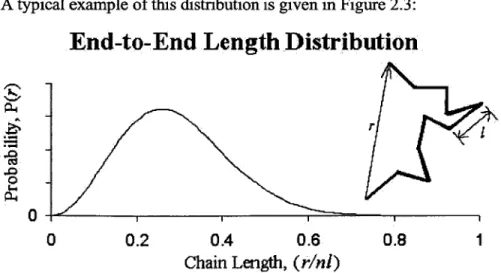
Gaussian statistical distribution of polymer chain end-to-end lengths
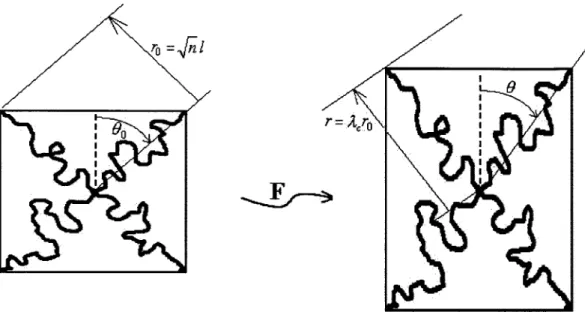
8-chain model representative volume element
Deformation of the 8-chain polymer network under a tension loading
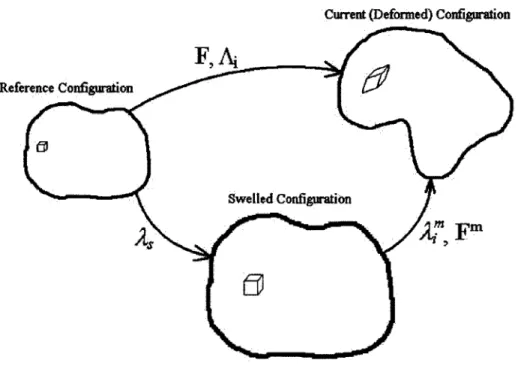
Schematic representation of the multiplicative
Figure 3.2 p. 42 Figure 3.3 p. 4 3 Figure 3.4 p. 46 Figure 4.1 p. 50 Figure 4.2 p. 51 Figure 4.3 p. 52 Figure 4.4 p. 5 3 Figure 4.5 p. 5 4 Figure 4.6 p. 5 4 Figure 4.7 p. 5 5 Figure 4.8 p. 5 5 Figure 4.9 p. 56 Figure 4.10 p. 56 Figure 4.11 p. 5 7 Figure 4.12 p. 5 7
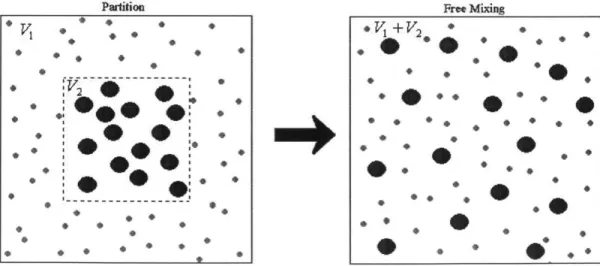
Rigid chamber with two types of particles initially separated and then allowed to mix
Schematic of a polymer separated from fluid particles and then allowed to mix
Balance of network tension and osmotic pressure in a swelled polymer
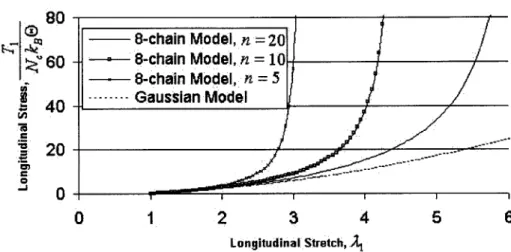
Comparison of Gaussian and 8-chain models for simple tension
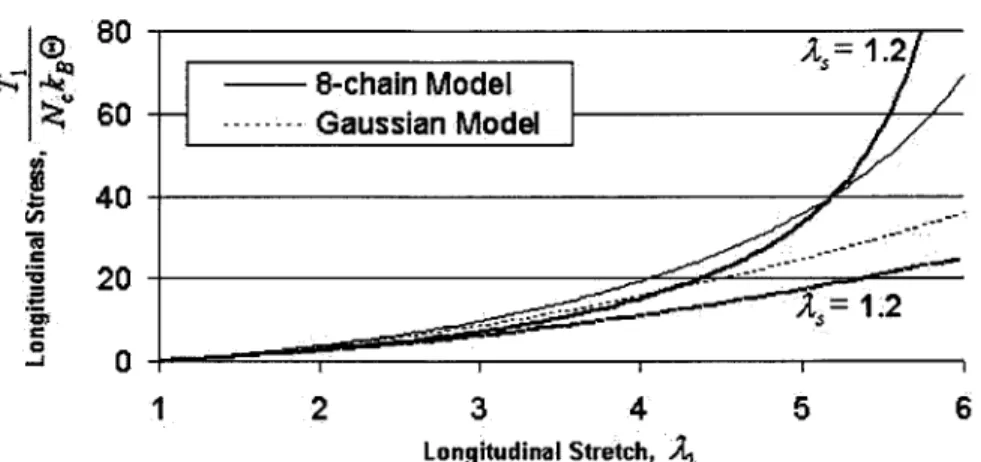
Comparison of Gaussian and 8-chain models for simple tension, including swelling effects
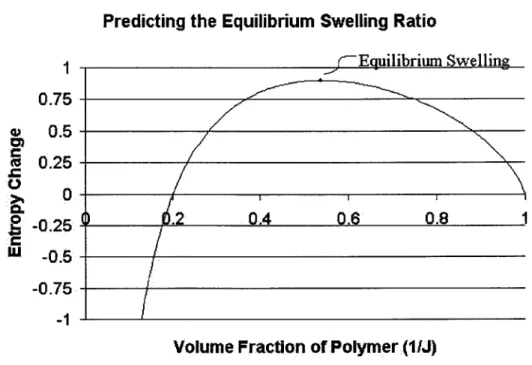
Total entropy change at different swelling ratios for a Gaussian polymer/solute
Osmotic pressure and total hydrostatic tension during uniaxial loading
Stress-strain response to uniaxial tension and swelling, 8-chain model
Stress-strain response to uniaxial tension and swelling, Gaussian model
Stress-strain response to uniaxial tension, small stretch regime
Stress-strain response to uniaxial tension, varying cross-link density
Stress-strain response to uniaxial compression with swelling
Stress-strain response to simple shear with swelling
PVA-PAA gel uniaxial deformation, experimental (from [4.1])
PVA-PAA gel uniaxial deformation, theoretical (from [4.1])
Figure 4.13 p. 58 Figure 4.14 p. 5 9 Figure 5.1 p. 61 Figure 5.2 p. 62 Figure 5.3 p. 63 Figure 5.4 p. 64 Figure 5.5 p. 65 Figure 5.6 p. 69 Figure 5.7 p. 7 0 Figure 5.8 p. 71 Figure 5.9 p. 72 Figure 5.10 p. 72 Figure 5.11 p. 7 3 Figure 5.12 p.7 4 Figure 5.13 p. 76
PVA-PAA gel uniaxial deformation, 8-chain prediction
PVA-PAA gel equibiaxial deformation, 8-chain prediction
A hypothetical material randomly filled with particles
A hypothetical material divided using Voronoi tessellation
Schematic representation of the initial, reference, and deformed configurations of a spherical shell representative volume element (from [5.2])
The reduction in swelling caused by increased filler content (spherical shell results)
The reduction in swelling at different unconstrained swelling ratios (spherical shell results)
Radial interfacial stress as a function of the initial swelling ratio
Hoop and radial stress distributions at various swelling levels
Hoop and radial stress distributions at various volume fractions of filler
Spherical shell geometry in finite element model
Computer generated mesh of the spherical geometry
An example radial stress distribution
Hoop and radial stress distributions - a comparison between the analytical solution and the computational
solution
A translucent display of the multiparticle mesh Figure 5.14 p. 77 Figure 5.15 p. 7 7 Figure 5.16 p. 78 Figure 5.17 p. 78 Figure 5.18 p. 7 9 Figure 5.19 p. 80 Figure 5.20 p. 82 Figure 5.21 p. 82 Figure 6.1 p. 8 4 Figure 6.2 p. 84 Figure 6.3 p. 85 Figure 6.4 p. 85 Figure 6.5 p. 8 5 Figure 6.6 p. 86 Figure 6.7 p. 86
A spherical cell compared to Voronoi tessellation
A cutaway view of the undeformed multiparticle mesh
A cutaway view of the swelled multiparticle assembly with Von Mises stress
Comparison of stress-strain characteristics for the filled and unfilled polymer
A circular cylinder with embedded cylindrical particle
The reduction in swelling caused by increased filler content (cylindrical shell results)
The reduction in swelling at d ifferent unconstrained swelling ratios (cylindrical shell results)
Sketch of a fiber grabbed by a microfinger
A microrobot arm moves a bead across a system of polyurethane tracks
A schematic picture of a cell clinic consisting of a microcavity and lid
Basic schematic of a bilayer strip
Deflection of a bilayer strip
A cross section of an encapsulated bilayer actuator
Figure 6.8 p. 87 Figure 6.9 p. 87 Figure 6.10 p. 8 8 Figure 6.11 p. 88 Figure 6.12 p. 88 Figure 6.13 p. 89 Figure 6.14 p. 90
Bilayer strip, modeled after Figure 6.4
Sectioning the bilayer strip to exploit symmetry
The rigid body constraint on the bilayer strip
Constraints applied along symmetry planes
An 8-node brick mesh of the bilayer strip
Bending of the bilayer strip due to swelling action with contours of vertical displacement
Deflection of a "thick" bilayer strip plotted with Von Mises stress contours
Chapter 1: Introduction
1.1 Active Polymers 1.1.1 Overview
The word polymer is derived from the Greek polu meaning many (poly) and meros meaning parts. The "parts" are repeating chemical units that are covalently bonded to each other to form long chains. These chains may consist of many thousands to millions of repeating units, and so polymer molecules are usually of very high molecular weight. For example, a molecule of polyethylene consists of a CH2 unit repeated tens of thousands of times. This may be indicated by writing (CH2),
where the subscript n indicates the degree of polymerization and takes on a large value. Schematically, polyethylene may be represented in several ways, for example:
H
H
C
C/
H
H H
C
C
H
Hi H
Figure 1.1: Traditional schematic representations of polyethylene.
Representations like those found in Figure 1.1 can be chemistry books, however they are unfortunate in that important feature of the polymer chain - its flexibility.
found in they fail
most high school to grasp the most
Rather than the rigid structures implied in Figure 1.1, polymer molecules should be thought of almost as microscopic string, able to take on an exceedingly large number of configurations. When many of these long chains are conglomerated into
an elastic network, they become tangled and are more likely to form a network either simply due to physical entanglement or due to chemical crosslinking between chains. In a polymer gel, an interstitial fluid occupies the space between the chains, and the chains keep the fluid in place. This system is shown schematically in Figure 1.2:
Crossfinks
Interstitial Fluid
Polymer Chain Segments Figure 1.2: Schematic of a polymer gel.
The term polymer gel refers to a polymeric network combined with an interstitial fluid. A familiar example is the soft contact lens, a polymer gel consisting of poly(hydroxyethyl methacrylate) as the polymer network, and saline as the interstitial fluid [1.1].
Polymer gels are relatively compliant and can easily be deformed by external stimuli. As early as 1948, Kuhn [1.2], Breitenbach and Karlinger [1.3], and Katchalsky and Oplatka [1.4] independently found that water-swollen polymer gels can convert chemical energy directly into mechanical work under isothermal conditions. This conversion of microscopic chemical free energy to macroscopic mechanical work is the motivation behind the study of active polymer gels. Applications for such a material abound: actuators, sensors chemical valves, delivery controllers, selective separation, and so on [1.5-1.10]
Active polymers reversibly change shape, volume and/or material properties in response to some external stimulus. Electric fields are a common driving force for this actuation [1.11][1.12][1.13][1.14], though changes in pH [1.15], temperature [1.16], magnetic field [1.17] [1.18], or visible light [1.19] have been studied in their role as stimuli. Below, we briefly review these various categories of active polymers.
First, polymer gels that are activated by electric fields are often called conducting polymer actuators. The ability of conducting polymers to conduct electricity is an unusual capability for an organic material, made possible by their unique structure. Most organic compounds have strong covalent bonds that prevent electron mobility, but the conjugated backbone found in conducting polymers allows some degree of electron delocalization.
The study and future use of conducting polymer actuators is important because of their potential to meet and exceed the capabilities of currently available materials in a variety of fields. Many conducting polymers (e.g. polypyrrole) respond with forces that exceed that of mammalian skeletal muscle by up to two orders of magnitude [1.11]. This makes this material class a promising candidate for an artificial muscle. The chemical structure of polypyrrole is given in Figure 1.3:
Polypyrrole
H
H
H
nFigure 1.3: The chemical structure of polypyrrole.
The polymerization of the pyrrole monomers does not in general result in a neutral polymer as it is depicted in Figure 1.3. In fact, the charged backbone is what
enables polypyrrole to conduct electrons. A more appropriate representation is shown in Figure 1.4, which includes local positively charged portions of the backbone balanced by anions [1.11]:
Polypyrrole
HH
H
Figure 1.4: Polypyrrole with local charge carriers.
Electrical work is converted to mechanical work through chemical or electrochemical interactions that result in oxidation or reduction of the polymer chains. The oxidation state of the polymer causes a flux of ions to or from the material. This leads to conformational changes in the chain structure and an increase (or decrease) in volume of the material. Using this mechanism, this class of materials has been able to produce many forms of bending gel "fingers" [1.13][1.20][1.21], self-folding boxes (on a micro scale) [1.22], and underwater swimming devices that mimic the motion of a fish [1.20][1.23]. NASA is considering this type of material for the robotic arm on an interplanetary vehicle, as well as a lens dust wiper [1.24]. Because they are lightweight, they have excellent power-to-weight ratios as well.
Currently, there are several areas of understanding that prevent the implementation of these useful materials. Perhaps the most important of these is the lack of an accurate and predictive constitutive model. For example, in an engineering application, a designer may wish to predict the strains and displacements caused by a specific actuation mechanism and loading. A constitutive model predicts the strain response to a given stress field (or vice-versa). In the case of a conducting polymer actuator, the displacement would be predicted given the applied voltage and loading, for example. The degree of accuracy of these predictions under a variety of loading conditions indicates the quality of the constitutive model.
Actuation of a conducting polymer is the result of molecular level interactions. Advances in material processing make it conceivable that future materials could be rationally designed from the molecular level up, tailoring material properties to achieve a desired performance. Once again, a constitutive model whose underpinnings lay in the molecular structure of the material is a major stepping stone in the endeavor to create new and better performing actuators. Indeed, it may be possible to prescribe from the constitutive model, a priori, the necessary molecular structure to subsequently develop a better performing material.
Another class of active polymer that has been investigated extensively are those activated by changes in pH. Marra [1.15] and Marra, Ramesh, and Douglas [1.25]
studied a specific active polymer gel (poly(acrylic acid)-poly(vinyl alcohol) or PVA-PAA) that is responsive to changes in pH. Marra cites three forces that balance to determine the equilibrium swelling level of PVA-PAA. First, the cross-linked polymer gel network (as in Figure 1.2) has a specific equilibrium volume. Elastic forces resist any changes from this equilibrium state. Next, there is a pressure associated with the mixing of polymer and interstitial fluid, which will be explored in detail in the body of the work (see Chapter 3). Lastly, Marra cites the presence of charged side groups (like the positive local charges shown in Figure 1.4) as a source of internal forces. In order to maintain neutrality within the gel, the free ions from the surrounding fluid enter to balance the local charge. Regardless of the number of fixed charges, the concentrations of ions within the gel will always be greater than the concentrations in the surrounding fluid. As a result, the gel absorbs more water and expands in order to reduce the concentration gradients. Flory [1.26] describes the ionic pressure, 7i, within the gel due to the fixed charges by:
7r, = RE) i - v(c,* - c,),(11
(z
where i is the number of fixed charges per polymer unit, c is the molar concentration of polymer units, z is the valence of the fixed charges, v is the number of different ionic species present in the gel, ci is the molar concentration of the free ions within the gel, c is the molar concentration of free ions in the surrounding fluid, R is the universal gas constant, and ( is the absolute temperature.
Marra studied PVA-PAA extensively as a model gel. PVA and PAA have the following chemical structures:
PVA
PAA
H H
OH
HC=O
1 1--
C.-C-H
H
I
H H
Figure 1.5: The chemical structures of PVA and PAA.Using solvent casting and crosslinking techniques (see [1.15], Sections 2.3 and 2.4), PVA and PAA can be formed into a relatively simple, safe, and easy to fabricate
H H
H H
HH
I
I
I
I
I
I
C-C
-C-C-C
I
I
I
H
OH
H
H OH
0
OH
OH
I
II
H
C=O
H C=O
H C=O
I
I
I
I
1
1
c-C
C-C
-C
I
I
I
I
I
I
H H
H H
HH
Figure 1.6: The chemical structure of PVA-PAA gel.
The reversible swelling caused by changes in pH may be understood by representing the PVA-PAA system schematically as in Figure 1.2:
H2
H20
H20 COOH
H20
Figure 1.7: Schematic of a PVA-PAA gel immersed in neutral water.
The carboxyl side-groups on the PAA monomers are shown explicitly in Figure 1.7
because they are involved in the chemical reactions that make actuation possible. If the gel in Figure 1.7 is immersed in basic solution, these carboxyl side-groups react with the free (OH -) hydroxide ions to form water molecules, leaving fixed negative
charges on the polymer network. This creates ionic forces that cause the network to
absorb more water (swell) and expand in volume. The network elasticity forces balance this swelling until a new equilibrium is reached. Likewise, placing the network in an acidic solution causes the free (H') hydrogen ions to bond to fixed
negative charges on the polymer network. This neutralizes the gel and the elastic forces cause water to be expelled from the system and the volume to contract. This reversible cycle is given in Figure 1.8:
H20 H20 H20 Move Contracted Gel to Basic H20 Solution COOH COOH H20 H20
Gel in Equilibrium in Acid (Contracted) H++ OH--+ H20 H++ COO~ -+ COOH Wateris Expelled H20 I H21 H2 Move Expanded H20 Gel to Acidic Solution H20 COO COO 2 HH20 H20 H0 H20 H120 HH 2 COOH COOH 20 HH 01U+H-* 120 OH ~+H+ -+ H20
OH+ COOH -* COO+H 20 Water is Absorbed
H20
H2 2 H20
120
GiH2r (H
Gel in Equilibrim in Base (Fxpanded) Figure 1.8: Expansion and contraction of a PVA-PAA gel. When a contracted gel is moved to a basic solution, the free ions diffuse in and out due to concentration gradients. The carboxyl side-groups then react with the free hydroxide ions to form water molecules, leaving fixed negative charges on the polymer network. Ionic forces are created, causing the gel to absorb water and expand. When placed in an acid, the free ions again diffuse in and out of the gel. The free hydrogen ions then bond to the fixed negative charges and neutralize the gel. The ionic forces are eliminated, water is expelled, and the gel contracts [1.15- Figure 1.7].
Marra developed a finite-deformation elastic constitutive model utilizing an evolving internal variable to describe the mechanical behavior of active polymer gels, applied specifically to the PVA-PAA system. The material parameters used in the constitutive model are determined from uniaxial and biaxial test performed on the PVA-PAA gels in both the fully expanded and fully contracted states.
Temperature changes in the surrounding environment have also been observed as a mechanism for actuation. Matsuo and Tanaka [1.16] reported discontinuous volume-phase transitions in spherical N-isopropylacrylamide gels. The phenomena they observe are interpreted in a similar way to the familiar gas-liquid phase transition, and appear to be universal to any type of gel. The gel is swollen at lower temperatures and undergoes a sharp collapse at a higher transitional temperature. The transition point varies between about 34*C and 60*C, depending on the concentration of the ionizable group in the network. Matsuo and Tanaka explore
the first-order kinetics of the swelling/shrinking of the gel and model it as a collective diffusion process. They report that the time constant for the process varies approximately with r2, though there are several discrepancies between the model and the experimental data including a "slowing down" when the final transition temperature is near the transition threshold and a plateau region during the shrinking process. They also observe the differences between swelling and shrinking, most strikingly the formation of "bubbles" on the surface of the spheres during shrinking that resemble the local swelling of weak portions of an inflated balloon.
Introducing magnetic nanoparticles into the polymer gel has created a completely different type of polymeric actuator. Zrinyi, Szab6, and Barsi [1.17] call these magnetic field sensitive gels ferrogels. The ferrofluid that surrounds the polymer network is a colloidal dispersion of magnetic particles with a typical size of about 10 nm. When an external magnetic field is applied, an instantaneous shape distortion occurs and dissipates upon removal of the field. In their review of magnetic field sensitive polymeric actuators [1.17], Zrinyi, Szab6, and Barsi reported the behavior of a PVA hydrogel filled with magnetite (Fe304) particles. Adhesive forces attached the magnetite particles in the swelling liquid to the network chains. When no external magnetic field is present, the collection of randomly oriented single domain particles gives the gel no net magnetization. Under the action of a magnetic field, the particles tend to align and produce a blk magnetization. Removal of the field causes a relaxation as the magnetic dipole moments randomize over time. The gradual randomization of the internal fields can be expressed in terms of relaxation times due to Brownian rotation of the magnetic moments with the rotation of the individual particles as well as randomization due to the Neel mechanism - a rotation of the magnetic moments inside the particles.
The Brownian motion is a function of temperature, and is restricted by the polymer network attached to and surrounding the particles.
This class of actuating materials seems to apply mostly towards applications of linear actuation. The changes in material properties and dimensions are highly anisotropic - depending greatly on the applied magnetic field and the microstructure of the material. Uniform changes in volume seem to be negligible.
Once again, a greater understanding of magneto-elastic coupling in these gels will facilitate such applications as reversible switches, sensors, micromachines, and energy-transducing devices. Eventually, using computers and a thorough understanding of their properties, ferrogels may be coordinated and controlled as
artificial muscles.
Suzuki and Tanaka [1.19] elaborated on a class of gels senstitive to ultraviolet light. The ultraviolet light initiates an ionization reaction in the gel that creates internal osmotic pressure which induces swelling. When the light is removed, the polymer gel collapses. The process is slow because it relies on the photochemical ionization and subsequent recombination of ions. Suzuki and Tanaka found that gels
containing N-isopropylacrylamide and the light-senstitive chromophore, trisodium salt of copper chlorophyllin undergo phase transitions induced by visible light. Because ihese transitions are due only to the direct heating of the network polymers by the light, they are very fast and thus more useful in applications. Experiments were reported at a variety of temperatures, pHs, and light intensity levels.
Regardless of the actuation mechanisms, it is clear that active materials have established a niche that continues to expand into a wide variety of applications. They are already widespread in the field of energy conversion, effectively converting light, heat, electrical, chemical, and magnetic energy reversibly into mechanical work. Active polymers are also used to store and manage energy as they are integrated into fabrics and military uniforms. For example, bioresponsive polymeric fabrics are under study that enable heat, moisture, and nutrients from the human body to trigger biological reactions in the material that will suppress body odor or add water-repellency to clothing as needed [1.27]. The future of these bioresponsive materials, as well as the diverse array of active polymers described above, relies heavily and universally on a thorough understanding and characterization of the unique mechanisms that make them function.
1.1.2 History
Swelling and shrinking in polymer gels was first reported by Kuhn [1.2] and Katchalsky [1.28] in 1949. Since then, many researchers have explored this topic using a variety of different methods. Beginning with the publishing of his classic work in 1953, Flory [1.26] was the first to rigorously address the physics and chemistry of gel swelling. He used free energies and internal pressures to predict the equilibrium volume of the swelled network. Next, Tanaka and Fillmore [1.29] used a continuum mechanics-based model to predict the swelling behavior when dry, neutral gels are placed in water. Their model shows that swelling time is proportional to the square of the linear dimension of the gel and to the diffusion coefficient of the polymer network. Chiarelli and De Rossi [1.30] adapted this to their poroelastic model, where the polymer network and interstitial fluid are considered as separate materials and overall mechanical behavior is determined using mixture theory. This model is inaccurate at large deformations because it still assumes the linear elasticity of the polymer network.
Numerous attempts have been made to accurately describe swelled polymers in the large deformation regime. Nagy [1.31] and Horkay and Zrinyi [1.32] used Mooney-Rivlin material laws to describe gels. Material properties were assumed to remain constant, and only one-dimensional deformations were considered. Humphrey and Rajagopal [1.33] proposed a large-deformation fmite-thermoelastic constitutive theory for elastomers that includes volume change through thermal expansion. This model only allows for relatively small volume changes compared to the swelling attainable by polymer gels. The previously described works by Marra et. al. [1.15][1.25] introduced an evolving internal state variable to model changes in material properties induced by swelling.
In 1991, a new field of active materials was opened when Baughman, Shacklette and Elsenbaumer first proposed conducting polymer-based actuators [1.34]. Since then, no fewer then thirty articles by ten or more research groups have been written on the subject of conducting polymer actuators (see [1.11], Section 2.2). These studies began with the demonstration of bilayer actuators, to be discussed in Chapter 6, which showed qualitative deformations with little quantitative information about performance. The introduction of linear actuators helped to standardize a benchmark from which different experiments could be compared. However, it was Baughman, Shacklette, and Elsenbaumer who first fully appreciated the tremendous potential of the volume changes associated with the changes in oxidation state when employed as actuators. Conducting polymer actuators show promise of outperforming mammalian muscle, but are hampered by a dependence on encapsulation in a liquid environment, as well as a consistent constitutive model. Both of these issues have been addressed in the literature (for example, see [1.35]), but there is substantial room for improvement.
Madden, et al. [1.35] have explored the material properties and performance of conducting polymer actuators. They have made substantial contributions to the field in the understanding of the fundamental actuation mechanisms, and the relationships between fundamental limiting material properties such as ionic diffusion rate, charge carriers, strain to charge ratio, and salt draining. The understanding of the limitations on performance of existing conducting polymers will provide directions for improvement in future generations.
Besides those works outlined in Section 1.1.1, many other researchers have made advances that impact the field of active materials. For example, Garikipati, et al [1.36], have treated biological tissue growth and resorption in a continuum mechanics setting. Their treatment uses balance laws and constitutive relations to deduce the relationships between multiple species (solid and fluid). They note the full extent of coupling between mass transport and mechanics that emerges from the thermodynamics. These deductions have direct analogies to the systems of polymers and interstitial fluids that will be explored extensively in the following chapters.
Smela [1.37] recently provided an excellent review of the use of electroactive polymer actuators in commercial biomedical applications. She notes the growing interest in systems with lifelike (biomimetic) movements and the difficulties that conventional actuators have in achieving these motions. Bilayer strips operating in liquid electrolytes and in air are reviewed and discussed, as well as linear actuators and microactuators. Smela asserts the usefulness of these materials in commercial applications such as blood vessel connectors, Braille displays, cochlear implants, artificial sphincters, microvalves, and steerable catheters; however, an improved understanding of how the synthesis conditions determine the material properties, as well as a predictive physics-based model that captures the dominant actuation mechanisms is needed. The future study of these materials should be focused on characterization of the actuation mechanisms, optimization of the actuator design, and consistent and thorough attention to performance metrics such as strain, stress, work, and lifetime [1.37].
1.2 Objective
The primary goal of this thesis is to develop a three-dimensional constitutive model of active polymeric materials, including changes in material volume and properties due to actuation.
1.3 Scope of the Work
This thesis first reviews the basic principles of continuum mechanics, followed by a review of the classical and current statistical mechanics based constitutive models for rubber-like materials (Chapter 2). Then, the theoretical model for reversibly swelling active polymer gels is presented (Chapter 3). Different material responses to some common loadings subject to a swelled state are then presented and discussed (Chapter 4). Next, the model is incorporated into an updated and complete solution of a problem previously addressed in the literature, the swelling of a particle-filled elastomer (Chapter 5). The theory is also applied to the classical example cf a bilayer strip (Chapter 6). Finite element analysis is implemented for verification (Chapters 5) as well as the conclusion and discussion of future work (Chapter 6).
1.4 Reference
[1.1] Contact Lenses, 0. Dabezies (ed.), vol. 1, 2 ed. Boston, MA: Little Brown and Company, 1988.
[1.2] W. Kuhn, Experimentia 5:318, 1949.
[1.3] J. W. Breitenbach, H. Karlinger, Monatsh Chem 80:211, 1949.
[1.4] A. Katchalsky, A. Oplatka, Proc 4th Intern Cong Rheology, part 1. E. H. Lee
and A. L. Copley (eds), Interscience Publishers, p. 73, 1965.
[1.5] Y. Osada, Advances in polymer sciences. Springer, New York, 82:1, 1987. [1.6] D. DeRossi, K. Kajiwara, Y. Osada, A. Yamauchi (eds), Polymer gels.
Plenum Press, New York, 1991.
[1.7] Y. Osada, J. P. Gong, Prog Polym Sci, Pergamon Press, 18:187, 1993. [1.8] Y. Osada, S. B. Ross-Murphy, Scientific American, 268:82, 1993.
[1.9] A. Wassermann, Size and shape changes of contractile polymers. Pergamon Press, New York, 1960.
[1.10] A. H. Clark, S. B. Ross-Murphy, Adv Polym Sci, 83:57, 1987. [1.11] J. D. W. Madden, Ph. D. Thesis, MIT, Boston, MA, 2000.
[1.12] Y. Hirose, T. Shiga, A. Okada, T. Kurauchi, "Gel actuators driven by and electrical field," Journal of Materials Science, vol. 28, pp. 21-26, 1993. [1.13] T. Shiga, Y. Hirose, A. Okada, T. Kurauchi, "Electrically driven polymer
gel finger working in the air," Journal of Intelligent Material Systems and Structures, vol. 4, pp. 553-557, 1993.
[1.14] Y. Osada, M. Hasebe, "Electrically activated mechanochemical devices using polyelectrolyte gels," Chemistry Letters, pp. 1285-1288, 1985.
[1.15] S. P. Marra, Ph.D. Thesis, The Johns Hopkins University, Baltimore, MD,
2000.
[1.16] E. S. Matsuo, T. Tanka, "Kinetics of discontinuous volume-phase transition of gels," Journal Chemical Physics, vol. 89, pp. 1695-1703, 1988.
[1.17] M. Zrinyi, D. Szab6, L. Barsi, "Magnetic Field Sensitive Polymeric Actuators," Y. Osada and D. E. DeRossi (Eds.) Polymer Sensors and Actuators. New York, Springer, New York, pp. 385-408, 2000.
[1.18] A. H. Mitwalli, T. A. Denison, D. K. Jackson, S. B. Leeb, T. Tanaka, "Closed-loop feedback control of magnetically-actived gels," Journal of
Intelligent Material Systems and Structures, vol. 8, pp. 596-604, 1997. [1.19] A. Suzuki, T. Tanaka, "Phase transition in polymer gels induced by visible
light," Nature, vol. 346, pp. 345-347, 1990.
[1.20] T. Kurauchi, T. Shiga, Y. Hirose, A. Okada, "Deformation behaviors of
polymer gels in electric field," Polymer Gels Fundamentals and Biomedical
Applications, D. De Rossi, K. Kajiwara, Y. Osada, and A. Yamauchi, Eds. New York: Plenum Press, pp. 237-246, 1991.
[1.21] R. Lumia, M. Shahinpoor, "Microgripper design using electro-active
polymers," Proceedings of the 1999 SPIE Smart Structures and Materials Symposium, Electroactive Polymer Actuators and Devices, Y. Bar-Cohen
(ed.), vol. 3669, pp. 322-329, 1999.
[1.22] E. Smela, 0. Inganis, I. Lundstr6m, Science, 268, p. 1735, 1995.
[1.23] M. Shahinpoor, "Conceptual design, kinematics and dynamics of swimming robotic structures using ionic polymeric gel muscles," Smart Mater Struct., vol. 1, pp 91-94, 1992.
[1.24] Y. Bar-Cohen, S. Leary, M. Shahinpoor, J. 0. Harrison, J. Smith, "Electro-Active Polymer (EAP) actuators for planetary applications," Proceedings of
the 1999 SPIE Smart Structures and Materials Symposium, Electroactive Polymer Actuators and Devices, Y. Bar-Cohen (ed.), vol. 3669, pp. 57-63,
1999.
[1.25] S. P. Marra, K. T. Ramesh, A. S. Douglas, "Characterization and modeling of compliant active materials," Journal of the Mechanics and Physics of
Solids, Vol. 51 (9), pp. 1723-1743, 2003.
[1.26] P. J. Flory, Principles of Polymer Chemistry. Ithaca, NY: Cornell University Press, 1953.
[1.27] A. Fowler, D. J. Ellis, S. B. Warner, J. Morgan, M. Toners, "Development of Bio-Active Fabrics," National Textile Center Brief June 2001, Materials
Competency MOO-D3, p. 22.
[1.28] A. Katchalsky, "Rapid swelling and deswelling of reversible gels of polymeric acids by ionization," Experimentia, vol. 5, pp 319-320, 1949. [1.29] T. Tanaka, D. J. Fillmore, "Kinetics of swelling of gels," Journal of
Chemical Physics, vol. 70, pp. 1214-1218, 1978.
[1.30] P. Chiarelli, D. De Rossi, "Determination of mechanical parameters related to the kinetics of swelling in an electrically activated contractile gel,"
Progress in Colloid and Polymer Science, vol. 78, pp. 4-8, 1988.
[1.31] M. Nagy, "Some new aspects of research on polymer gels," Colloid and Polymer Science, vol. 263, pp. 245-265, 1985.
[1.32] F. Horkay, M. Zrinyi, "Studies on mechanical and swelling behavior of polymer networks on the basis of the scaling concept. 6. Gels immersed in
polymer solutions," Journal of Macromolecular Science - Physics, vol.
B25, pp. 307-334, 1986.
[1.33] J. D. Humphrey, K. R. Rajagopal, "Finite thermoelasticity of constrained elastomers subject to biaxial loading," Journal of Elasticity, vol. 49, pp. 189-200, 1998.
[1.34] R. H. Baughman, R. L. Shacklette, R. L. Elsenbaumer, "Micro electromechanical actuators based on conducting polymers," P. I. Lazarev, Editor, Topics in Molecular Organization and Engineering, Vol. 7: Molecular Electronics. Dordrecht: Kluwer, 1991, 267.
[1.35] P. G. A. Madden, J. D. W. Madden, P. A. Anquetil, N. A. Vandesteeg, I. W.
Hunter, "The relation of conducting polymer actuator material properties to
performance," IEEE Journal of Oceanic Engineering, 29 (3), pp. 696-705,
July 2004.
[1.36] K. Garikipati, E. M. Arruda, K. Grosh, H. Narayanan, S. Calve, "A continuum treatment of growth in biological tissue: the coupling of mass
transport and mechanics," Journal of the Mechanics and Physics of Solids, IN PRESS.
[1.37] E. Smela, "Conjugated Polymer Actuators for Biomedical Applications," Adv. Mater., 15, pp. 481-494, March 17 2003.
Chapter 2: Review of Continuum Mechanics and
A Statistical Mechanics Based Constitutive Model
of Rubber Elasticity
Continuum mechanics is a tool for describing the macroscopic mechanical behavior of materials. The subject of continuum mechanics roughly comprises the following basic ingredients (see for example Holzapfel [2.1], Ogden [2.2], or Slaughter [2.3]): (i) kinematics (the study of motion and deformation)
(ii) balance principles (the mathematical description of the fundamental laws of physics governing the motion of a continuum; for example, mass balance and equilibrium)
(iii) constitutive laws describing the material dependent relationships between quantities (e.g. stress-strain, stress-strain rate, strain-viscosity)
All of these ingredients take place at the microscopic level, indeed, at the atomic level. Atoms move around and stretch their bonds while exchanging energy with neighbors. But the billions (trillions!) of atoms involved in even the smallest material volumes make an atomistic approach to understanding unattainable in most situations. Continuum mechanics amounts to an approximation of the situation. Quantities like density, temperature, and velocity are all averages of a large group of atoms in a small volume of material. A very large group of data comprising all the information about each atom in a larger body is thus reduced drastically to a few useful quantities, which are more easily understood and manipulated. Let us review
each of the basic ingredients in turn.
2.0 List of Symbols
The continuum mechanics notation given below will be used throughout the work, essentially following that of Gurtin [2.4]:
P Material point of a body in the reference configuration
X(P) Vector function giving the position of point P in a reference configuration
x(X) Vector function giving the position of point P in the deformed configuration
F(X)= aDeformation gradient
IX)
J= det F> 0 Determinant of F
F = RU= VR Polar decompositions of F
U, V Right and left stretch tensors; positive definite and symmetric
R Rotation tensor; proper orthogonal
C = FTF, B = FFT Right and left Cauchy-Green strain tensors E - (FTF - I) Green-Lagrange strain tensor
2
T Cauchy (true) stress tensor
P First Piola-Kirchoff (nominal) stress tensor
e
> 0 Absolute temperature2.1 Kinematics
Kinematics is the study of motion and deformation. At each instant in time, a body occupies a unique region 2 in space. One may select arbitrarily an initial time t = 0 at which the legion Qo the body occupies is called the initial configuration. It is most convenient to select an initial time at which the body is undeformed and under no external loading. This is the undeformed or reference configuration of the body. At some time t > 0, the body occupies a new region Qt called the deformed or
current configuration:
Corrent (Deformed) Configwration
Reference Configuration
at time t = 0 at time t
Figure 2.1: The reference and current configurations of a body occupying region a The location of each particle P of material in the reference position is identified by its position vector X relative to some arbitrary origin 0. In the deformed configuration, the location of point P is given by the position vector x. Unless otherwise noted, scalar, vector, and tensor quantities are denoted with uppercase letters in the reference configurations and lowercase letters in the current
configuration.
In general, each particle in the reference configuration must have a one-to-one mapping to a particle in the deformed configuration. The displacement of a particle
in a body relates its deformed position to its reference position:
u(X, t) = x(X, t) - X (2.1)
Displacements are measurable quantities. The velocity field and acceleration field
may be written:
_ax(X,t) av(X,t) a2x(X,t)
v(X, t)= , a(X, t) = = 2 (2.2)
Deformation occurs when there is relative displacement between internal points. The most fundamental quantity used to describe the deformation of a material point is the deformation gradient F, a second-order tensor defined by
_ax(X)
F(X) = Grad x(X) (2.3)
We can rearrange the differential in (2.3) to obtain
F(X)dX= dx (2.4)
Equation (2.4) describes how an arbitrary line element dX transforms under the deformation to the line element dx. Because a non-zero line element in the reference configuration may not be annihilated, dx must be non-zero and FdX # 0. If FdX # 0 for all dX # 0, then F is a non-singular tensor. This imposes the equivalent, but more conveniently manipulated restriction
det F# 0 (2.5)
The volume ratio J gives the ratio of the current volume to the reference volume, and is defined by
J det F >0 (2.6)
Strain is a tensor measure of deformation independent of rotation and can be described in many ways depending on the choice of configuration used to evaluate strain as well as the manner in which stress is described (discussed later). The right and left Cauchy-Green tensors, C and B respectively, used predominantly throughout this work are given by:
C=FTF (2.7)
B= FFT (2.8)
Both strains are symmetric positive definite (such that u -Cu> 0 for all u # 0).
The stretch A is the ratio of the current length of a material line element to its reference length. Because a non-zero material length in the reference configuration must have greater than zero length in any deformed configuration, A > 0.
Any deformation characterized by F may be decomposed into a pure stretch and a pure rotation. The unique polar decompositions of F are:
F = RU = VR, (2.9)
where U and V are the right (or material) and left (or spatial) stretch tensors respectively. The rotation tensor R is proper orthogonal (RTR = I, where I is the identity tensor). The eigenvalues of the stretch tensor are the principal stretches, A2. The symmetry of C and B are evident by substituting U and V into (2.7) and (2.8):
C=UTRTRU= UTU = U2 (2.10)
B= VRRTVT= VVT= V2 (2.11)
Also, given that R is a proper orthogonal rotation tensor, det R = 1. Since det F > 0 then
det U > 0 (2.12a)
det V > 0 (2.12b)
Now that we have a framework from which to understand and express the motion and deformation of a material, we must establish a method for relating that deformation to the internal forces it produces.
2.2 Stress
The motions described in the previous section give rise to interactions between neighboring material points. Important among these interactions is stress, a measure of the intensity of force per unit area. Stress is a second-order tensor. Different stress tensors may be defined with respect to the reference configuration, the current configuration, or some intermediate material position. Depending on the situation, a specific measure of stress may be most convenient.
A traction vector represents a force vector measured per unit surface area. The
vector t represents the force per unit area in the current configuration and is called
the Cauchy (or true) traction vector. Whereas, the vector p is the first Piola-Kirchhoff (or nominal) traction vector, as reproduced from [2.1] in Figure 2.2, and
is defined in the reference configuration as the force per unit reference area:
Cument (Deformed) Configuration
F
Reference Configkration I
*X
Figure 2.2: Traction vectors acting on infinitesimal surface elements wi th outward unit normals [2.1]
Figure 2.2 shows an imaginary plane cutting through a body intersecting the material point given by X In the reference configuration, the vector N is the unit vector normal to the cutting surface S. The nominal traction vector p is associated with infinitesimal area dS at point X In the current configuration, the Cauchy
traction vector t points in the same direction as p and is associated with the current infinitesimal area ds and the unit normal n.
Cauchy's stress theorem states that there exist unique second-order tensor fields T and P such that
t(x, t,n)= T (x, t)n , (2.13)
and
p(X, t, N) = P(X, t)N , (2.14)
where T is the Cauchy (or true) stress tensor and P symbolizes the first Piola-Kirchhoff (or nominal) stress tensor.
The two stresses are alternative representations of the same state of stress; if given one, the other can be determined using Nanson's formula. Nanson's formula is a relation between a material surface in the reference and current configurations (see for example [2.1] - [2.4]). It maps a surface area and its normal from reference configuration to current configuration:
ds=JF dS (2.15)
Using Nanson's formula, the two stresses in (2.13) and (2.14) are related:
P=JTF -T, (2.16)
or
T = T T=J-1PF T (2.17)
As with any second-order tensor, we may solve the eigenvalue problem to obtain principal stresses and principal directions:
[T - T, 1]nj = 0; for Inil = 1, (2.18)
where 7j are the three principal normal stresses that correspond to three principal directions specified by eigenvectors ni.
2.3 Constitutive Equations
A constitutive theory attempts to model real behavior of materials using mathematical models. The principles of statistical mechanics, along with the laws of thermodynamics, are used to model polymer networks, as developed in the following sections.
2.3.1 Statistical Mechanics
The statistical mechanics treatment begins with the assumption of a material structure consisting of randomly oriented long molecular chains. The direction in space of each link in the polymer chain is entirely random and bears no relation to the direction of any other link in the chain. To visualize the situation, one may picture, for example, a molecule of polyethylene containing thousands of C-C bonds. Each of these bonds has a rotational degree of freedom along one axis. Because the number of links in the chain, n, is very large (ranging from 102 to 10) and each link has a degree of flexibility, the chain will take on a randomly kinked shape. It is appropriate to picture this randomly kinked chain as a very long piece of string. Using the random walk model and classic statistical arguments (e.g. refer to Flory [2.5] or Doi [2.6]), we may write the probability distribution of the end-to-end length, r, of an isolated polymer chain as:
p(r)= 2 exp( 3 2), (2.19)
P~) 2nn12 2n12
where 1 is the length of each link in the chain [2.7]. The probability distribution in (2.19) is well known - it is a Gaussian statistical distribution. The probability density of a chain lying between r and r+dr is
P(r) = 47Cr2p(r) (2.20)
A typical example of this distribution is given in Figure 2.3:
End-to-End Length Distribution
r
0 0
0 0.2 0.4 0.6 0.8 1
Chain Length, (rini)
The entropy of the statistical chain is found according to the general principles of statistical thermodynamics from the Boltzmann result that the entropy of a system is proportional to the logarithm of the number of configurations available to it. If we fix one end of the chain at the origin and the other within a small volume element dr , the number of configurations available is given by the probability density multiplied by that volume element, p(r)dr. Therefore, the entropy of a single chain is
s = kB ln(p(r)dr), (2.21)
where kB is Boltzmann's constant.
Next, we substitute the probability function from (2.19) to obtain the entropy for a single chain:
S = kB { 1
j
3 2- + ln(dr) (2.22)2 2n12 2n12
Under tension, each polymer chain stretches to accommodate the deformation. Because this stretching reduces the number of possible configurations the chain can take, the configurational entropy will decrease. It is important to note that the tension in the chain is not caused by a change in energy, but by the change in entropy. The release of this tension acts to return the chain to a state with more allowable configurations, a state with higher entropy. It is for this reason that polymer chains are sometimes called entropy springs.
The entropy of a single chain, as derived in (2.22), is a useful result from which to derive the change in entropy of a polymer network under some arbitrary deformation. Kuhn [2.8] recognized the fact that the elasticity of rubber (perhaps the most common and most studied of the polymer gels) derives from the thermal motion of the polymer chains. He derived a simple but physically insightful classical theory of rubber elasticity that is still practical today. It hinged on a few critical assumptions, the validity of which will be explored.
The fundamental assumptions based on the original theory of Kuhn are reproduced here as they are given in [2.9]:
1. The network contains N chains per unit volume, a chain being defined as the segment of molecule between successive points of cross-linkage. A cross-link is a chemical junction point between molecular chains. Cross-linking produces a coherent network that does not allow all the molecules to move independently, as they would in a liquid.
2. The average squared initial end-to-end distance between cross-linkage sites is taken to be the root-mean square end-to-end distance, (r,2). Applying (2.21) to
(2 Or 2 P(r)dr
(r2) = = n12 (2.23)
fP(r)dr
3. There is no change of volume due to mechanical loading.
4. The network deforms affmely: the components of length of each chain are assumed to deform microscopically in the same ratio as the corresponding dimensions of the macroscopic material.
5. The entropy of the network is the sum of the entropies of each individual chain,
as given in (2.22).
Stretching a chain from its initial length, ro, to its deformed length, r, results in a change in entropy. To illustrate, suppose a rectilinear coordinate system is employed such that
(r2) = (xfo)+ (x2 )+ (x2e), (2.24)
and the current end-to-end length is thus given by r)
= (X)+ (X2 + (X), (2.25)
where the
( )
indicate the expected or average value of the expression within.The change in entropy of a single chain due to deformation is determined by comparing the entropy of the deformed position (also called the "current configuration") to the entropy of the initial position (also called the "reference configuration") using equation (2.22):
As= = kB { 2 - + ln(dr) -k h 2 - + ln(dro) (2.26)
Note that the first term from (2.22) cancels out. It is constant because the number of bonds and the bond length for a given molecule do not change in the current context. Furthermore, in actual practice we are only concerned with the differences of entropy between two states, so this term will always be ignorable.
This reduces (2.26) to the following, upon rearranging terms:
F
3r2 3r2 drAs =kBj- + kB 1 - (2.27)
2n12 2n 2J ~ 1droJ
For the moment, let us adhere to the incompressibility assumption 3 above and conclude that the differential volume element, d, must remain the same in the deformed and reference configurations, and thus drop the volume ratio term from (2.27). We are left with a simplified version of the change in entropy for a single chain:
As = -kB ( (2.28)
2n12
The affme deformation assumption implies that the deformed configuration of a material point may be simply represented, as in (2.25), in terms of its reference position and the macroscopic principal stretch components:
(r =x)(x)( =(if3(Axo+AX2e (2.29)
Observe that (2.28) may now be rewritten in terms of its components as
As = -kB 212 10 ) 0 0 (2.30)
The vector ro, whose length is given by r2 =X2 +X2
+X x, has no preference for
any direction. Therefore, the components of ro nmst be indistinguishable and so must, on average, be of equal length:
2
2 2 2 (231
x1o = x20 = x30 _
(2.31)
3 Using this observation, (2.30) is generalized to
As = B (2.32)
We can further simplify (2.32) by incorporating assumption 2 for the representative
value of the initial chain length, (r) = n12
AS = -kB{.1(2+2u+2 3)} (2.33)
Finally, if there are N chains per unit volume, as stipulated in assumption 1, and if the total entropy of the network is the sum of the entropies of each individual chain, as required by assumption 5, then the total change in entropy of the network per unit reference volume in terms of the principal stretch state is
AS = -- NkB(4 +Ak22+ -3)- (2.34)
2
If we relax assumption 3 and allow for a volume change, the additional term found in (2.26) is relevant. Following the same procedure as above (see for example Wall and Flory [2.10], Flory [2.11], Bischoff et al. [2.12]), the total entropy change including the effects of volume change is
AS =- NkB(N 4 +,g - 3)+ NkBln(J) (2.35)
2
where J = 1A2A3 =
J
is the volume ratio. This term is usually negligible forpurely mechanical loadings, however it is significant for the proper development of the swelling framework to be discussed in the next chapter.
2.3.2 Strain-Energy Functions 2.3.2.1 Thermodynamics
The elastic strain energy function for a material may be developed using thermodynamic principles in conjunction with (2.35). From the first law of thermodynamics, the change in internal energy Ae of a process per unit mass is
Ae = AQ + AW (2.36)
where AQ is the heat absorbed by the system and AW is the work done on the system by external forces. If we assume the material is purely elastic (i.e. the material returns reversibly to its reference configuration upon unloading), then the second law defines the entropy change AS:
eAS= AQ, (2.37)
where 9 is the absolute temperature.
For an ideal rubber, internal energy is assumed to be a function of 0 alone (see for example Treloar [2.9] chapters 2 and 13). Consequently, for a given reference temperature the change in internal energy, e, during an isochoric deformation F is zero [2.1]:
e(F)I, = 0 (2.38)
Now (2.36) may be simplified,
-AQ=AW, (2.39)
and (2.37) may be substituted,
AW = -OAS. (2.40)
Substituting the change of entropy derived from the Gaussian statistical mechanics approach in (2.34), the work done on the polymer network to deform it from the stress-free reference position to the current deformed position for an isochoric deformation is
UG = NkB0(A++A32-3)- (2.41)
2
A subscript is used in (2.41) and henceforth to indicate which statistical model the strain-energy was derived from. In this case, UG indicates a form obtained using Gaussian statistics.
To account for the usually negligible compressibility effects, we must include the additional entropy term due to volume change from (2.35):
UG = 1NkB0( +A2 + A -3)-NkBOln(J) (2.42)

![Figure 2.2: Traction vectors acting on infinitesimal surface elements wi th outward unit normals [2.1]](https://thumb-eu.123doks.com/thumbv2/123doknet/14459180.520169/26.918.164.739.704.925/figure-traction-vectors-infinitesimal-surface-elements-outward-normals.webp)