HAL Id: hal-01807804
https://hal.archives-ouvertes.fr/hal-01807804
Submitted on 5 Jun 2018
HAL is a multi-disciplinary open access
archive for the deposit and dissemination of
sci-entific research documents, whether they are
pub-lished or not. The documents may come from
teaching and research institutions in France or
abroad, or from public or private research centers.
L’archive ouverte pluridisciplinaire HAL, est
destinée au dépôt et à la diffusion de documents
scientifiques de niveau recherche, publiés ou non,
émanant des établissements d’enseignement et de
recherche français ou étrangers, des laboratoires
publics ou privés.
Grouping conversational markers across languages by
exploiting large comparable corpora and unsupervised
segmentation
Laurent Prevot, Matthieu Stali, Shu-Chuan Tseng
To cite this version:
Laurent Prevot, Matthieu Stali, Shu-Chuan Tseng. Grouping conversational markers across languages
by exploiting large comparable corpora and unsupervised segmentation. 11th Workshop on Building
and Using Comparable Corpora, May 2018, Miyazaki, Japan. �hal-01807804�
Grouping conversational markers across languages by exploiting
large comparable corpora and unsupervised segmentation
Laurent Prévot
1,2, Matthieu Stali
1, Shu-Chuan Tseng
31 Aix-Marseille Univ, LPL, Aix-en-Provence, France 2 Institut Universitaire de France, Paris, France 3 Institute of Linguistics, Academia Sinica, Taipei, Taiwan
Abstract
This work approaches Conversational and Discourse Markers (hereafter DM) from a radical data-driven perspective grounded in large comparable corpora of French, English and Taiwan Mandarin conversations. The key features of our approach are (i) to account for lexicalization as a by-product of unsupervised segmentation applied to our corpora, (ii) to exploit simple metrics for clustering DM (both within a language and within multilingual clusters). We explore the benefits and the drawbacks of such a radical approach to DM. In particular we compare the DM clusters obtained from traditional segmentation into tokens (as given by manual transcription of the corpora) vs. unsupervised segmentation. The metrics on which we ground the clustering experiments are based on contrast between (i) short vs. longer utterances distribution and (ii) position within longer utterances.
1. Introduction
Leaving aside some interesting descriptive studies, there are not many attempts to perform systematic and quantitative comparative analysis of social inter-actions (such as conversations and task-oriented di-alogues) from a linguistic perspective. Language re-sources and natural language processing tools still rely on written canonical data. In the context of studying, comparing and exploiting social interactions; in which speech is fiercely spontaneous and exhibits its own pat-terns; appears to be a major handicap. Once situated within a multilingual or translational task, it becomes even more difficult to handle by adding the bias to-wards written canonical data of each language before being able to consider the multilingual or translational aspects themselves. Thus, we propose here to adopt a relatively shallow and data-intensive approach to con-sider directly the spoken data without passing through resources and tools created for canonical written data. Comparable corpora are extremely useful for a range of Human Language Technology tasks but also for ex-ploring phenomena across languages. In this paper we are developing a data-driven approach to study dis-course and interactional markers (hereafter DM) in a comparative way thanks to large conversational com-parable corpora. Our work aims at identifying and grouping discourse markers into homogeneous classes through a purely bottom-up approach carried out on large corpora. Studying discourse markers has a long history in linguistics and corpus linguistics (see Sec-tion 2.) but our approach combine some methodolog-ical choices that makes it original. This approach re-lies on rather large comparable conversational corpora across the languages scrutinized (introduced in section 3.). Moreover those corpora have to be transcribed. More precisely the two key ingredients are (i) to ex-plore unsupervised segmentation of our data sets as explained in 4.1. ; (ii) to explore a set of distributional measures of the word-like units for characterizing them
(See 4.2.). Finally, in our experiments, standard clus-tering techniques are used to obtain groups of clusters that we try to label with categories in section 5..
2. Discourse Markers
Discourse markers, such as like and well in English to quote a few, are key elements in conversations which help speakers build their speech’s structure. The main issue when studying DMs lies in the lack of consensus and thus in the various definitions and denominations that can be found among works in the literature related to conversational speech. We can mention the following terms, being the most frequently used: discourse markers (Schiffrin, 1988; Fraser, 1999); pragmatic markers (Furko, 2009; Garric and Calas, 2007), discourse particles (Schourup, 1985; Fischer, 2006), spoken particles(Fernandez, 1994; Fernandez-Vest, 2015) and discourse connectives (Roze et al., 2010; Lenk, 1998).
Even though we can understand why a catego-rization task for DMs remain difficult given their poly-functionality and the various stages of functional multi-word expressions’ lexicalization, scholars would usually agree on several main aspects. DMs’ primary functions are described as being related to a relatively defined set of functions: turn-taking system, discourse relations cuing, discourse structuring, interpersonal relationships marking, speech management or polite-ness (Fischer, 2006).
Recently, linguists have been interested in automati-cally identifying DMs for translation purposes. Some results have shown there were discrepancies between bilingual dictionaries translations and the semi-manual annotation ones for a given pair of DMs from two different languages (Roze and Danlos, 2011). Other works include The TextLink project1 which is
cally analyzing this aspect, by focusing on discourse-annotated corpora to allow cross-linguistic studies of discourse. The corpus based method seems an ade-quate tool for caterorizing DMs as it unites a theo-retical task consisting in setting parameters of defini-tion variables with an empirical study on spontaneous speech corpora (Crible et al., 2015).
3.
Data
The comparable corpora we used for this experiment were : the CoFee collection of corpora (Prévot et al., 2016) (made of CID (Blache et al., 2009), Map-Task(Gorisch et al., 2014) and DVD(Prévot et al., 2016)) together with DECODA corpus for French ; Switchoard transcripts for English (Godfrey et al., 1992) ; and Academia Sinica conversational cor-pora (MCDC, MTCC, MMTC) for Taiwan Mandarin (Tseng, 2013). We experimented with various subcor-pora and across languages as illustrated in table 1 and with different potentials base units: syllables and let-ters for French; Characlet-ters, Pinyin (with and without tone) for Mandarin and only letters for English.
Corpus # Tokens # pseudo-Utterances
CID 125 619 13 134 MTR 42 016 6 425 MTX 36 923 5 830 DVD 64 023 7 989 DECODA (part) 580298 88 982 French 851202 122 360 MCDC 316 422 61 000 MTCC 122 200 26 000 MMTC 34 500 8 300 Mandarin 472 000 95 000 SWBD (English) 2 967 028 391 592
Table 1: Corpora used in the study
Some of those corpora are truly comparable while it is more debatable for others. MTR + MTX on French and MTCC for Mandarin are perfectly comparable since they have been recorded using the same protocol. CID for French and MCDC + MMTC are also very similar by nature. English Switchboard is perhaps a bit different in principle but in practice, it shares most of the features present in the previous corpora. The less similar of the set is French DECODA since it is recorded in a specific context (call center of Paris pub-lic transportation enquiries number). However, we add criterion during the extraction to try to avoid too many corpus specificities in a given language. Overall, all those corpora are truly conversational ones exhibiting the usual range of phenomena involved in fiercely spon-taneous and interactional speech data. For all these corpora, the transcripts have been force-aligned at the word level.
Concerning the transcription, a standard orthographic transcription had been adopted for thes corpora. The spokenb particles do have standardized written forms in French (euh, mh,...) and English (uh, um, mh...). In
the Taiwan Mandarin corpora, discourse particles, dis-course markers, and fillers were transcribed with capi-tal letters to distinguish themselves from foreign words such as English. Fillers are transcribed according to their phonetic forms. For instance, UHN is equivalent to uhn in English; MHM is something that is fre-quently observed in Mandarin, but not in English. In particular, multi-syllabic fillers are transcribed in one single unit, separated by H, e.g. UHNHN. See (Tseng, 2013) for more details.
4. Methodology
4.1. Segmentation
We use non-supervised machine learning algorithms (based on Branching Entropy, already applied to writ-ten Mandarin (Magistry and Sagot, 2012; Magistry, 2013)) for segmenting our sequence of characters com-ing from the conversational transcripts into our base
units (spoken tokens). There are currently better methods for segmentation, especially for Chinese Word Segmentation, but they require extremely large corpus that are not available for spoken language. Moreover, we were interesting in using the very same methodol-ogy on Mandarin, French and English with the idea in mind that the data set segmented in this same way across the languages could exhibit less divergence than being biased by the written form tradition of each lan-guage.
More precisely we use Eleve2 (Extraction de LExique
par Variation d’Entropie - Lexicon extraction based on the variation of entropy) toolkit. This method is helpful for our study because it allows us to get units grounded on the same principles and therefore not being biased by written processing techniques or conventions employed in different languages. Such an approach results in a new starting point for the type of lexical experiments we will perform later. An illustration of new units for French and English created by our approach are illustrated by Table 2. A benefit of such an approach is that we do not have to define what an individual word or multi-word expression is. We have done our experiments both with traditional segmentation (space-based) and with the output of unsupervised segmentation (in which, for example, ’you-know’, turned out to be a unit). For a related work see (Dobrovoljc, 2017) which compare different association measures applied to discourse marker items.
While our unsupervised segmentation is very interest-ing to gather functional multi-words expressions into one unit as a result of the segmentation, it also presents some issues. For example, in French and English, it tends to split bound morphemes such as plural and gender marks as well as some verbal inflections. How-ever, for our purpose of studying DM this feature should not be an issue.
French English Mandarin
tu-vois you-know
mh-mh uh-huh MHMHM
ah-ouais oh-yeah 對 A
c-est-vrai that-s-right,that-s-true
et-euh , donc-euh and-uh, and-um et-puis, mais bon and-then
comme-ça like-that
dans-le, sur-le in-the
il-y-a there-is
Table 2: Examples of word like units created at seg-mentation stage (’-’ in the units correspond to spaces
in a traditional transcription)
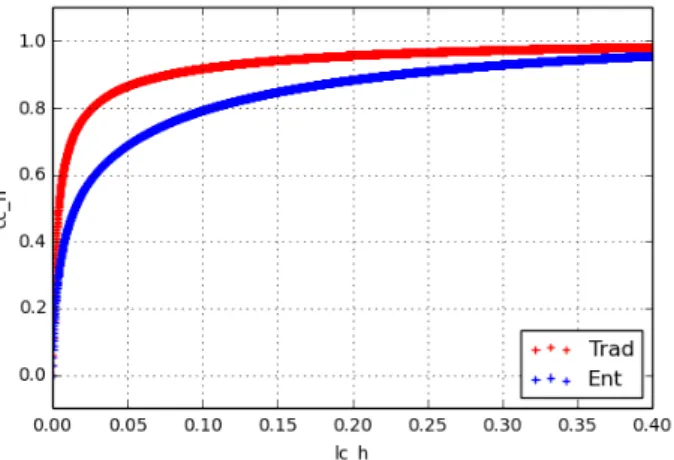
Figure 1: Comparative lexical growth (French) be-tween traditional segmentation and Branching-entropy (x-axis : Coverage of the lexicon ; y-axis: Coverage of the corpus) segmentation
The unsupervised segmentation step provides a segmented corpus and a derived lexicon. In fig-ure 1), we illustrate the lexicon coverage vs. corpus coverage of traditional vs. unsupervised segmentation. In these corpora, we approximate the notion of utter-ance by using Inter-Pausal Units defined by continu-ous stretches of speech in between pauses of at least 200 milliseconds. Therefore, both our lexical units and our utterances are objective as possible, only relying on speech timoing and on the transcript.
4.2. Quantitative measures
Scores We argue that conversationally speaking,
words distribution -Discourse Markers in particular-varies significantly depending on the type of utter-ances they occur in. A first relevant method being easy to apply in the study of conversation consists in separating the shortest sentences from the longer ones. Besides, it is a known fact that DMs can be found at specific positions in utterances (initial, median, final) with the initial and final ones being the most frequent (Aijmer, 2013; Filippi-Deswelle, 1998; Fraser, 1998; Muller, 2005; Stali, 2015; Stali, 2016). We propose
to cross the two parameters mentioned above (type of utterance vs position in the utterance) to chart DMs. Based on those two principles, we define a series of val-ues aiming at characterizing quantitatively any form of the corpus (N : corpus size, S: number of tokens in short utterances, L: number of tokens in longer utterances, Fall: frequency of the token, Fshort:
fre-quency of the form in short utterances;Flong:frequency
of the form in non-short utterances, Fini:frequency
of the form in initial position of longer utterances,
Ff in:frequency of the form in final position of longer utterances
• Fall
N : relative frequency
• Fshort
S : relative frequency of the form within short
utterance forms • Flong
L : relative frequency of the form within longer
utterance forms • Fshort
Fall : tendency to occur in short utterances
• Fshort+Fini+Ff in
Fall : a sort of ”dm-hood” of the form
(tendency to occur in all canonical DM and inter-actional markers positions)
• Fini
Flong : tendency to occur in initial position within
longer utterances • Ff in
Flong: tendency to occur in final position within
longer utterances
We also use some of those scores to filter the set of items under consideration. More precisely we tested different thresholds for relative frequency and dm-hood scores. For French and Mandarin, we made sure that the relative frequency threshold was met for at least two-subcorpora in order to avoid domain-based items that could come from Maptask or DECODA corpora. This was both impossible and unnecessary to do on Switchboard corpus which is a lot larger and already more diverse thematically.
5.
Experiments
In the context of this work, we were interested in com-paring the clustering (and its implicit discourse marker characterization) in two approaches: traditional to-kenisation and unsupervised segmentation. After seg-menting the data sets and computing the scores as de-scribed in the previous sections we processed as follows. We filtered for relative frequency (threshold= 0.0005) and dm-hood (threshold= 0.3). Since we are at an exploratory stage of our work, those thresholds were chosen after inspection of results for a range of values for the both of them. We normalized all the resulting values, then applied PCA to the output and checked the explained variance ratio for deciding a number of principal components. The way DM are spread into the dimensions is illustrated for English DM in Figures 2 and 3 for traditional and unsupervised segmentation
Figure 2: English DM plotted on the 2 principal com-ponents, based on traditional segmentation
Figure 3: English DM plotted on the 2 principal com-ponents, based on unsupervised segmentation
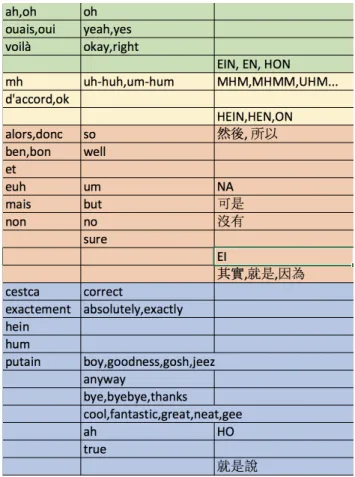
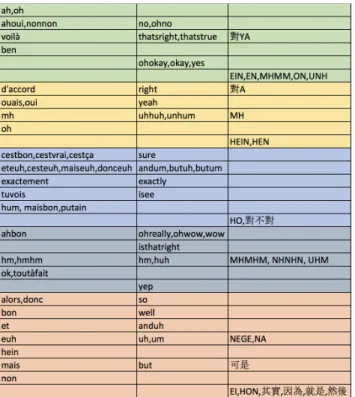
respectively. Finally, after using the elbow techniques to determine an optimum number of clusters, we com-puted the clusters presented in Figures 4 and 5 for tra-ditional and unsupervised segmentation respectively. It is not straightforward to label the resulting clusters. However, it is possible to identify some known groups of markers in the clusters. We attempted to use the same color for similar clusters in both tradition and unsupervised results. Concerning traditional segmen-tation, the green and the yellow clusters host typical feedback items and a relative good match across lan-guages. The division into two clusters is probably due to the fact that the items in the green cluster, in addi-tion to be used frequently isolated as feedback items, may also occur in initial position (which is less the case for the ’yellow’ items). Similar structure is ob-served for the unsupervised segmentation.
The ’blue’ cluster corresponds to more evaluative and attitudinal items, at least for French and English. It is interesting to note that our very rough distributional measures are able to discriminate those items from the previous yellow and green clusters. We can see there is an adequate match between French and English but
Figure 4: Cluster (one per color) grounded on tradi-tional segmentation
not so much for Mandarin.
Finally the red cluster includes at least two kinds of items: discourse connectives but also filled pauses and even interactional management items (French ’hein’ in the unsupervised case). This is probably due to a lack of discrimination capacity for forms occurring within longer utterances at different places. For ex-ample, we know that ’hein’ tends to be more final but it is not enough to generate a specific cluster. An-other explanation can be found in abandoned utter-ances. Those abandoned utterances typically end with a filled pause marker (French ’euh’, English ’um,uh’, Mandarin ’NEGE’, ’NA’. This (frequent) phenomenon therefore tends to make those items more distribution-ally similar to final particles like hein. Similarly, it may be rather surprising to see contrast connectives (
mais / but / 可是) in those clusters. As mentioned
above, this is probably due to unfinished utterances or utterance segmentation (based on pauses). However, in this cluster, there is a very satisfying match across the three languages.
6. Conclusion and Future Work
The exploration of DM spaces based on comparable corpora allowed us to show it remains possible to iden-tify DM clusters, even through a cross-linguistic ap-proach. The benefits of the unsupervised segmenta-tion are not clear at this stage, specially for Mandarin
Figure 5: Cluster (one per color) grounded on unsu-pervised segmentation
data. However, the method and approach adopted tend to demonstrate that the traditional segmentation already benefits from adapted transcription conven-tion which includes rules for grouping specific words together. However, we believe it might be interesting to dig further in how much can be achieved without too many supervisions and bias from written resources. In the future, our first objective is to deeper scrutinize the elements in the structure of the Mandarin utterances which prevents DMs to be better clustered correctly with French and Mandarin items.
7. Bibliographical References
Aijmer, K. (2013). Understanding pragmatic markers:
a variational pragmatic approach. Edinburgh:
Ed-inburgh University Press.
Blache, P., Bertrand, R., and Ferré, G. (2009). Cre-ating and exploiting multimodal annotated corpora: the toma project. Multimodal corpora, pages 38–53. Crible, L., Bolly, C. T., Degand, L., and
Uygur-Distexhe, D. (2015). Mdma: un modèle pour
l’identification et l’annotation des marqueurs discur-sifs ”potentiels” en contexte. Discours. Revue de
linguistique, psycholinguistique et informatique. A journal of linguistics, psycholinguistics and compu-tational linguistics, (16).
Dobrovoljc, K. (2017). Multi-word discourse markers and their corpus-driven identification. International
Journal of Corpus Linguistics, 22(4):551–582.
Fernandez-Vest, J. (2015). Detachments for cohesion:
toward an information grammar of oral languages,
volume 56. Walter de Gruyter.
Fernandez, M. J. (1994). Les particules énonciatives dans la construction du discours. Linguistique
nou-velle.
Filippi-Deswelle, C. (1998). La relation dite de
con-cession - Etude de Though, Although, Even Though et Even If antéposés en anglais contemporain. Paris:
Université Paris 7.
Fischer, K. (2006). Approaches to Discourse Particles. Amsterdam: Elsevier.
Fraser, B. (1998). Contrastive discourse markers in english? Discourse markers: Descriptions and
the-ory, pages 305–312.
Fraser, B. (1999). What are discourse markers?
Jour-nal of Pragmatics, (31):931–952.
Furko, P. B. (2009). The pragmatic marker - discourse
marker dichotomy reconsidered - the case of ’well’ and ’of course’. dea.lib.unideb.hu.
Garric, N. and Calas, F. (2007). Introduction à la
pragmatique. Paris: Hachette Education.
Godfrey, J. J., Holliman, E. C., and McDaniel, J. (1992). Switchboard: Telephone speech corpus for research and development. In Acoustics, Speech, and
Signal Processing, 1992. ICASSP-92., 1992 IEEE International Conference on, volume 1, pages 517–
520. IEEE.
Gorisch, J., Astésano, C., Bard, E. G., Bigi, B., and Prévot, L. (2014). Aix map task corpus: The french multimodal corpus of task-oriented dialogue. In LREC, pages 2648–2652.
Lenk, U. (1998). Marking discourse coherence
-Functions of discourse markers in Spoken English.
Gunter Narr Verlag Tübingen.
Magistry, P. and Sagot, B. (2012). Unsupervized word segmentation: the case for Mandarin Chinese. In
Proceedings of the 50th Annual Meeting of the ACL,
pages 383–387.
Magistry, P. (2013). Unsupervised Word
Segmenta-tion and Wordhood Assessment. Ph.D. thesis, Paris
Diderot; Inria.
Muller, S. (2005). Discourse markers in native and
non-native English discourse. John Benjamins
Pub-lishing.
Prévot, L., Gorisch, J., and Bertrand, R. (2016). A cup of cofee: A large collection of feedback utter-ances provided with communicative function anno-tations. In Proceedings of 10th Language Resources
and Evaluation Conference, Portoroz.
Roze, C. and Danlos, L. (2011). Traduction (automa-tique) des connecteurs de discours. TALN 2011,
Montpellier, (18).
Roze, C., Danlos, L., and Muller, P. (2010). Lexconn: A french lexicon of discourse connectives.
Proceed-ings of Multidisciplinary Approaches to Discourse (MAD 2010), Moissac, France.
Schiffrin, D. (1988). Discourse markers. Language, (64):633–637.
Schourup, L. (1985). Common discourse particles in
English conversation. New York: Garland.
dis-course markers during Twitch’s streams. Master’s
Degree at Université d’Avignon.
Stali, M. (2016). Les marqueurs discursifs genre et
du coup: une étude comparative de corpus.
Mas-ter’s Degree at Laboratoire Parole et Langage, Aix-Marseille Université.
Tseng, S.-C. (2013). Lexical coverage in Taiwan Mandarin conversation. International Journal of
Computational Linguistics and Chinese Language Processing, 1(18):1–18.