HAL Id: hal-01735123
https://hal.archives-ouvertes.fr/hal-01735123
Submitted on 13 May 2020
HAL is a multi-disciplinary open access
archive for the deposit and dissemination of
sci-entific research documents, whether they are
pub-lished or not. The documents may come from
teaching and research institutions in France or
abroad, or from public or private research centers.
L’archive ouverte pluridisciplinaire HAL, est
destinée au dépôt et à la diffusion de documents
scientifiques de niveau recherche, publiés ou non,
émanant des établissements d’enseignement et de
recherche français ou étrangers, des laboratoires
publics ou privés.
When Artificial Intelligence and Computational
Neuroscience meet
Frédéric Alexandre, Peter Ford Dominey, Philippe Gaussier, Benoît Girard,
Mehdi Khamassi, Nicolas P. Rougier
To cite this version:
Frédéric Alexandre, Peter Ford Dominey, Philippe Gaussier, Benoît Girard, Mehdi Khamassi, et
al.. When Artificial Intelligence and Computational Neuroscience meet. Springer. A guided tour of
artificial intelligence research, Interfaces and applications of artificial intelligence, 3, 2020, Interfaces
and Applications of Artificial Intelligence, 978-3-030-06170-8. �hal-01735123�
Neuroscience meet
Fr´ed´eric Alexandre, Peter F. Dominey, Philippe Gaussier, Benoˆıt Girard, Mehdi Khamassi, and Nicolas P. Rougier
Abstract Computational Intelligence and Artificial Intelligence are both aiming at building machines and softwares capable of intelligent behavior. They are conse-quently prone to interactions, even if the latter is not necessarily interested in un-derstanding how cognition emerges from the brain substrate. In this chapter, we enumerate, describe and discuss the most important fields of interactions. Some are methodological and are concerned with information representation, processing and learning. At the functional level, the focus is set on major cognitive functions like perception, navigation, decision making and language. Among the salient charac-teristics of the critical contributions of Computational Neuroscience to the develop-ment of intelligent systems, its systemic view of the cerebral functioning is particu-larly precious to model highly multimodal cognitive functions like decision making
Fr´ed´eric Alexandre
Inria Bordeaux Sud-Ouest; LaBRI UMR 5800; IMN UMR 5293; CNRS; Universit´e de Bordeaux; Bordeaux INP; France. e-mail: [email protected]
Peter F. Dominey
Inserm 1208 Stem Cell and Brain Research Institute, Human and Robot Cognitive Systems, 18, avenue du doyen Jean L´epine 69675 Bron cedex, e-mail: [email protected] Philippe Gaussier
ETIS (ENSEA, University of Cergy Pontoise CNRS UMR 8051), 2, avenue Adolphe-Chauvin B.P. 222, 95302 Cergy-Pontoise Cedex, France, e-mail: [email protected]
Benoˆıt Girard
Sorbonne Universit´es, UPMC Univ Paris 06, CNRS, Institute of Intelligent Systems and Robotics (ISIR), F-75005 Paris, France, e-mail: [email protected]
Mehdi Khamassi
Sorbonne Universit´es, UPMC Univ Paris 06, CNRS, Institute of Intelligent Systems and Robotics (ISIR), F-75005 Paris, France, e-mail: [email protected]
Nicolas P. Rougier
Inria Bordeaux Sud-Ouest; LaBRI UMR 5800; IMN UMR 5293; CNRS; Universit´e de Bordeaux; Bordeaux INP; France. e-mail: [email protected]
and language and to design cognitive architectures for the autonomous behavior of robots.
1 Introduction
The goal of Computational Neuroscience (CN) is to study relations between brain structures and functions by the means of information processing techniques [Marr, 1982; Schwartz, 1990; Churchland and Sejnowski, 1992; Dayan and Abbott, 2001]. This scientific domain has to deal more specifically with three major topics, neu-ronal processing, learning and brain functions and aims at establishing its achieve-ments by the design of hardware and software systems to be compared with brain performances. It has consequently large overlaps with connectionism, machine learning and cognitive science but it is also different because it is specifically in-terested in understanding how these topics are implemented in real brains, with pos-sible effects in neuroscience and in psychology.
Artificial Intelligence (AI) is another scientific domain overlapping CN. Though AI is not directly interested in understanding the brain, it is also a computational science aiming at building machines and softwares capable of intelligent behavior. There are consequently many fields where these two domains could cross-fertilize but others are more confrontational because each of the two domains relies on spe-cific bases not to say dogmas.
In this Chapter, we propose to visit several fields of interest to better understand the rich relations betwen AI and CN. Some fields are directly related to some cog-nitive functions that have been deeply studied in AI and where CN has investigated and modeled the cerebral structures generally reported to be mainly involved in this cognitive function. This is the case with decision making and related processes of action selection and reinforcement learning involving basal ganglia (section 5) and also with language and the central role of the prefrontal cortex (section 6). Other fields are more methodological since CN can be also useful to propose to AI orig-inal, efficient and robust mechanisms for information representation. We begin to evoke here the problem of the level of description in computational models, from neurons to symbols (section 2), and turn to the representation of sensory informa-tion in the cortex (secinforma-tion 3) and to their multimodal integrainforma-tion in the hippocampus (section 4). Having mentioned these points of influence in computational mecha-nisms and in cognitive functions will be a good basis for discussion proposed in section 7.
2 From Neurons to Symbols
Initial modeling approaches of neuronal functioning [McCulloch and Pitts, 1943] and learning [Hebb, 1949] in the middle of the X Xthcentury are often considered
to be at the root of the development of both CN and connectionism (artificial neural networks without biological inspiration, presented in Chapter 12 of Volume 2), even if oldest efforts exist (as discussed by [Brunel and van Rossum, 2007]), particularly related to neuron excitability, in the context of CN.
At more microscopic levels of description, CN is also interested in understanding the behavior of single neurons through the dynamic evolution of their membrane po-tential, as it is the case for example in another seminal model by Hodgkin & Huxley [Nelson and Rinzel, 1995] or in other models dedicated to lower levels of descrip-tion like dendrites, axons or even ion channels. Building such biophysical models is important to understand how neurons process information how they compute -and some bottom up approaches propose to build on them up to the brain level -and high level cognitive functions. This is specifically the case with huge simulation projects like the Blue Brain Project [Markram et al., 2015] and more recently the Human Brain Project, but many researchers wonder if such ascending projects are constrained enough to drive directly from sub-neuronal levels to cognition [Fr´egnac and Laurent, 2014; Chi, 2016]. In some way, the reciprocal criticism is sometimes given to cognitive psychology, stating that a descending approach, purely driven with functional consideration, is too vague to anchor in biological reality.
This is reminiscent of the duality in AI between the difficulty of making symbols emerge from numerical computation and the reciprocal Symbol Grounding Problem [Harnard, 1990]. This duality has been nicely addressed by D. Marr considering the visual brain as an information processing system, with the Tri-Level Hypothesis [Marr, 1982]. He proposes to define the computational level, describing the (vi-sual) functions of the brain, the implementational level describing the underlying neuronal circuitry and, in-between, argues for an algorithmic level including the representations and processes employed by the implementational level to create the computational level.
Another property of this intermediate level is that it can be partly disconnected from the other two levels. At some moment, it can be interesting to wonder how cognitive functions are implemented by lower level mechanisms or to wonder how some mechanisms can result from a precise neuronal circuitry without having all the three levels of analysis in mind. Beyond the domain of vision, this fruitful anal-ysis is often used by researchers exploiting a certain formalism of computation, like bayesian statisticians describing the brain [Friston, 2012] or theoreticians defin-ing neuronal operations at the level of the population of neurons [Coombes, 2005] in reference to biological data about arrangements of neurons in repetitive circuits [Hubel et al., 1978]. Apart from the huge bottom-up projects mentioned above, most of the research in CN aiming at studying cognitive functions exploit such interme-diate algorithmic levels with intermeinterme-diate processing units (representing circuits or populations of neurons) and intermediate mechanisms (representing connectivity or learning rules).
Connectionism (artificial neural networks without biological inspiration) has also been used to encode, combine and manipulate symbols (Connectionist Symbol Pro-cessing [Sun and Alexandre, 1997]) and has been confronted to similar problems as AI and particularly to the Frame Problem, related to the difficulty of adequate
knowledge representation. This is also illustrated in the Searle’s Chinese Room [Searle, 1980], where an agent can appear as intelligent by manipulating syntactic rules but turns out to have no knowledge about the meaning of its responses. This has been studied in Embodied AI [Pfeifer et al., 2007] by creating loops between the agent and its environment, through sensors and actuators, to create circular low-level sensorimotor relations, instead of elaborating complex high low-level formal rules [Brooks, 1990]. This approach is also frequently used in CN, often concerned by perception and action, with the brain seen as a way to associate them, as we are going to describe in the next sections.
3 Sensory Perception, Cortex and Unsupervised Learning
In the brain, the representation of information begins at the lower level by the rep-resentation of perceptual information received by sensors and has been primarily studied in the somatosensory system. The primary somatosensory cortex (S1 or SI) is a part of the cerebral cortex that is situated in the lateral postcentral gyrus, pos-terior to the central sulcus. It is, together with the primary motor cortex (anpos-terior to the central sulcus), one of the first cortex to develop and certainly one of the most important. SI is innervated by sensory receptors (thermoreceptors, mechanorecep-tors, chemoreceptors and nociceptors) that originate from both the surface of the body (e.g. skin) and from inside the body (e.g. bones and joints).
Even though the somatotopic organization of the cortex has been hypothesized more than a century ago by John Hughlings Jackson (1886) while studying epileptic patients, its existence was really demonstrated in the forties [Penfield and Boldrey, 1937; Marshall et al., 1937; Adrian, 1941]. This has been since then illustrated with the so-called sensory homunculus representation based on the work of Wilder Pen-field using electrical stimulations on epileptic patients (even though this homuncu-lus does not make justice to the amazing work of Wilder Penfield). These studies highlighted the somatotopic organization of the cortex and demonstrated a point-to-point correspondence between the surface of the body and the somatosensory cortex. However, such orderly representations are not restricted to the somatosensory cortex and, using similar approaches in the auditory, visual and motor domain [Diamond and Neff, 1957; Hubel and Wiesel, 1969; Merzenich and Kaas, 1980; Gould et al., 1986; Kaas, 1994], a large number of topographic maps have been described all over the cortex for different modalities (tonotopic maps, retinotopic maps, motor maps). But they have different properties. Early observations of [Leyton and Sherring-ton, 1917] (as reported in [Lemon, 2008]) on the adult anthropoid apes demonstrated the ability of the motor cortex to recover from extensive cortical lesions. The authors hypothesized consequently the existence of a neural substrate and/or a mechanism for such extensive recovery. However, about forty years later, Hubel and Wiesel published a very influential paper [Hubel and Wiesel, 1959] that promoted the idea of fixed cortical representations following the post-natal developmental period (the so-called critical period). This hypothesis has prevailed for a long time until the
studies of [Merzenich and Kaas, 1982; Kaas et al., 1983; Kaas, 1991] provided ex-perimental evidence for the somatosensory cortex reorganization after a peripheral nerve injury or amputation in the adult monkey.
The initial formation of these maps depends on a number of mechanisms occur-ing at the different stages in the development of the brain and the body and relies essentially on a complex molecular axon guidance [Tessier-Lavigne and Goodman, 1996] and a local selection of synapses and connections, based on temporal crelations [Katz and Shatz, 1996]. However, the exact mechanisms behind such or-ganization has puzzled researchers for quite a long time. How can you preserve neighboorhood relationships during the course of development such that ultimately, two neighbor skin patches tend to activate two neighbor cortical patches? Either you have to consider a genetic encoding where each cell “knows” where to connect or you have to consider an autonomous process that results in such orderly organiza-tion.
This latter hypothesis has been proposed in the seventies by Willshaw and von der Malsburg [Willshaw and von der Malsburg, 1976] with the idea of a self-organization. They proposed a model of the retina considering a set of cells that have short-range excitation (cooperation) and long range inhibition (competition). The distance between cells is provided by their actual position onto the cortical sheet, hence providing an explicit topology. They used this model to explain the for-mation of representation in V1 using a model of the retina that already possessed a topography. This model had a great influence and provided a very elegant explana-tion to the aforemenexplana-tionned quesexplana-tion. Some years later, Kohonen [Kohonen, 1982] proposed an alternative model where he got rid of the lateral connectivity in favor of a winner takes all algorithm as well as an explicit lateral connectivity function. This model has become popular far beyond the computational neuroscience domain since it also provided an elegant solution to any vector quantization problem (see Chapter 12 of Volume 2).
Vector quantization (VQ) refers to the modelling of a probability density func-tion into a discrete set (codebook) of prototype vectors (a.k.a. centroids) such that any point drawn from the associated distribution can be associated to a prototype vector. Most VQ algorithms try to match the density through the density of their codebook: high density regions of the distribution tend to have more associated pro-totypes than low density region. This generally allows to minimize the distortion as measured by the mean quadratic error. For a more complete picture, it is to be noted that there also exist some cases where only a partition of the space occupied by the data (regardless of their density) is necessary. In this case, one wants to achieve a regular quantification a priori of the probability density function. For example, in some classification problems, one wants to achieve a discrimination of data in terms of classes and thus needs only to draw frontiers between data regardless of their respective density. Such vector quantization can be achieved using several methods such as variations of the k-means method [Macqueen, 1967], Linde–Buzo–Gray (LBG) algorithm [Linde et al., 1980] or neural network models such as the self-organizing map (SOM, a priori topology) [Kohonen, 1982], neural gas (NG, no topology) [Martinetz et al., 1993] and growing neural gas (GNG, a posteriori
topol-ogy) [Fritzke, 1995]. Nonetheless, the SOM algorithm remains the most popular in the field of computational neurosciences since it gives a plausible account on the or-ganization of receptive fields in sensory areas where adjacent neurons share similar representations as explained previously.
However, the stability and the quality of this self-organization depends heavily on a decreasing learning rate as well as a decreasing neighbourhood function. This is a major drawback of most neural map algorithms because it is thus necessary to have a finite set of observations to perform adaptive learning starting from a set of initial parameters (learning rate, neighbourhood or temperature) at time tidown to
a set of final parameters at time tf. In the framework of signal processing or data
analysis, this may be acceptable as long as we can generate a finite set of samples in order to learn it off-line. However, from a more general point of view, it is not always possible to have access to a finite set and we must face on-line learning as for example during a robotic task. The question is thus how to achieve both stability and plasticity.
To answer this question, variants of the original SOM learning algorithm have been proposed where the time dependency has been removed (see [Rougier and Boniface, 2011] for example). Based on several experiments in both two-dimensional, high-dimensional and dynamic cases, these variants allow for on-line and continu-ous learning ensuring a tight coupling with the environment. Following up on these ideas, [Detorakis and Rougier, 2012, 2014] investigated the formation and main-tenance of ordered topographic maps in the primary somatosensory cortex and the reorganization of representations after sensory deprivation or cortical lesion. Their model is based on neural field theory using plastic feed-forward thalamocortical connections while cortico-cortical connections drive the competition mechanism.
Beyond these limitations, the original self-organizing map by Kohonen has be-come ubiquitous in the artificial intelligence landscape for learning and representing simple sensory information. SOM has been and is still used in a huge number of works in both image and signal processing, pattern recognition, speech processing, artificial intelligence, etc. Hundreds of variants of the original algorithm exist today [Kaski S. and Kohonen, 1998; Oja et al., 2003] such that it is literally impossible to review all of them here. Being both simple to implement and fast to compute, it is used in a wide variety of tasks ranging from navigation, compression, encoding, feature selection, and many others.
However, for the representation of more complex multimodal information (of “objects”), some other cerebral structures are necessary, namely, the hippocampus. This structure plays a central and critical role in the integration of various sources of information as well as in the encoding of multimodal regions such as the associative cortex. We now evoke the main ingredients of these complex processes.
4 The Hippocampus for Multimodal Binding
4.1 Functional Organization of the Hippocampus: Implication for
Learning
The hippocampal system (HS) seems to participate in a lot of cognitive functions. In humans and animals, the HS plays an important role in spatial cognition but also in more general memorization processes. One important fact is that the hippocampus (Hip), a part of the HS with a seahorse shape, is connected through the entorhinal cortex (EC) to all the cortical associative areas. This makes the HS a very special convergence point to integrate multimodal information [McClelland et al., 1995]. The bilateral ressection of the hippocampi in human causes a severe anterograde amnesia while the ability to learn new skills remains intact [Scoville and Milner, 1957]. Moreover, Alzheimer disease targets first the hippocampus and induces the same kind of memory issues. All these researches suggest the HS plays a major role in the formation of new memories and more specifically in episodic and autobio-graphic memories. Most of these memories would next be recoded at the cortical level by mechanisms which are still not well understood.
The HS can be seen as a generic tool to index or to build hash codes of the cor-tical activity [Teyler and DiScenna, 1986] in order to detect and learn in a fast way new events that cannot be easily detected by cortical neurons [Cohen and Eichen-baum, 1993; Eichenbaum et al., 1994; Bunsey and EichenEichen-baum, 1996; Buzs´aki, 2013; Buzs´aki and Moser, 2013] because of the practical limitation of the neurons connectivity. As a matter of fact, ”typical” neurons are connected to around 10 000 other neurons limiting the capability of one neuron to detect complex events re-lated to the co-occurence of signals present in different sensory cortical areas for in-stance1. Using the ”small world” connectivity found in the brain allows any neuron in the cortex to contact any other neuron with a quite limited number of intermedi-ate neurons. Yet, building such a network cannot be done in one shot. The neocortex is characterized by a slow learning rate and overlapping distributed representations allowing the extraction of the general statistical structure of the environment, while the hippocampus learns rapidly, using separated representations to encode the de-tails of specific events while suffering minimal interference [O’Reilly and Rudy, 2000] providing both structures a quite complementary role in learning. This dual system for learning and memorization could be used in AI to limit the learning to the statistic of ”important” events.
This fast learning capability of the Hip is supported by the properties of the Long Term Potentiation (LTP) found in the granular cells of the dentate gyrus (DG) and in the pyramidal cell of the Cornu Ammonia areas (CA). The specific organization of the recurrent connections in the CA3 region has been exploited in numerous models of auto associative memories [Marr et al., 1971; Hopfield, 1982; McNaughton and
1We can imagine this limitation is due to wiring issues: if some neurons were connected to all the
neurons in other cortical areas, the size and weight of the brain would increase dramatically due to the space need for the dendritic trees of these neurons.
Morris, 1987] in order to explain pattern completion or pattern retrieval and even for the learning of sequences of events. In these models, the dentate gyrus (DG), one of the major inputs to CA3 is supposed to perform pattern separation or pattern orthogonalization of the activities coming from and through EC [Marr et al., 1971; McNaughton and Morris, 1987; Treves and Rolls, 1994]. More recent theories pro-pose that the hippocampus is a predictive auto-encoder [Gluck and Myers, 1993] playing a major role in detecting new complex events and allowing their learning thanks to its reciprocal connections with the septal nuclei which controls the acetyl-choline (ACh) neuromodulation [Hasselmo et al., 1995, 1996]. The ACh provided by the medial septum seems to mediate the learning and memory capabilities in the rest of the brain. For instance, it has been shown that lesions of the HS disrupt the acquisition of long-latency conditioned responses [Berger and Thompson, 1978] such as the eyeblink conditioning learned in the cerebellum [Thompson, 1986; Kim et al., 1995].
Hence, the neurobiological results teach us the brain uses at least two memory systems: the cortex learns on the long term but slowly the statistical structures of our interactions with the environment while the HS learns quickly (but for a maximum of few weeks) some compressed codes allowing to detect novelty and to control cortical learning.
4.2 The Hippocampus in Navigation Tasks: an Example of
Multimodal Integration
The discovery of place cells in the hippocampus [O’Keefe and Dostrovsky, 1971; Morris et al., 1982] and later the discovery of grid cells [Fyhn et al., 2004] in the dorso median entorhinal cortex (dMEC) has emphasized the role of the hippocam-pus in spatial cognition. In this framework, the HS is supposed to play a specific role in spatial cognition and even to constitute a ”cognitive map” [O’Keefe and Nadel, 1978]. A lot of works have focused on explaining how neurons in Hip can become specific to a given place. Some of the models start from visual information and show that a code built from the concatenation of several visual inputs is sufficient to rec-ognize one place [Arleo and Gerstner, 2000; Milford et al., 2004; Krichmar et al., 2005]. The use of more specific codes to recognize one place as a constellation of landmark x azimuth couples (using conjunctive cells) is also used to improve gen-eralization capabilities [Zipser, 1985; Bachelder and Waxman, 1994; Gaussier and Zrehen, 1995] when the animal is moving. Other models are using the distance in-stead of the azimuth [Burgess et al., 1997] or can use both since the elevation can be seen as a distance measure [Giovannangeli et al., 2006]. Yet, most of these models suppose that some place-action associations can be learned presumably thanks to the output of the Hip in the direction of the basal ganglia to control the direction of the action to be performed in a given place (see next section for more details on the basal ganglia).
The nature of the inputs and their coding can have very important impact on how place recognition can be used. For instance, if the azimuth information is coded thanks to a 1 dimension neural field (a bubble of activity centered on the neuron as-sociated to a given azimuth) then the landmark-azimuth conjunctions are sensitive to the azimuth variation between the learned place and the actual place. The result-ing place cells exhibit very large and reliable place fields [Gaussier et al., 2000; Giovannangeli et al., 2006]. In a room of 10x10m, the place field can easily be 2x2 m and can scale with the size of the environment. It is really an interesting property since after the learning of few place-action associations in the vicinity of a ”goal” location, the competition between actions allows reaching the goal place from never visited places and from locations far away from the learned places2. In this case, the capability of one neuron to recognize one place is no more important. It is only the rank of the place cells activity level (their firing rate) that matters: the action is chosen according to the winning place (competitive process). This is an important change from classical place cells models since the issue is no more to recognize one place but to be able to reach that place. In real world conditions, being sure of recognizing one place can be quite difficult when landmarks are moved or occluded (the effect of these changes on the cells activities can be higher than when mov-ing away from the learned place). Yet, the rank of the place cells will remain the same: all the neurons are usually impacted in the same way if landmarks are ran-domly hidden or displaced. For instance, using 40 visual landmarks while learning places allows maintaining a good homing behavior even if more than half of the landmarks are hidden (basically 2 to 3 well recognized landmarks are sufficient). This generalization capability can also be very interesting to find a shortcut or to perform a detour according to the experimental situation. Moreover, if the landmark x azimuths conjunctions are selected in a 180 degrees image instead of a 270 de-grees panorama then the cell activities are no more place cells but view cells and could explain the recording of ”view cells” in the monkey hippocampus [Rolls and O’Mara, 1995] as opposed to the place cells in the rat. Yet, the place fields found in the CA region of the Hip look like really small (size about 20 cm) as compared to the large place fields described here. One hypothesis could be that those place cells would be located before the Hip in the ventromedial part of EC and that they would not be considered as place cells because of their broad receptive field [Quirk et al., 1992]. The small place fields in the Hip would be explained by the result of a competition layer allowing to obtain place field with a size equal to the mean dis-tance between the learned places. In a new environment these cells will continue to react and provide some activities allowing to recognize the new places as a com-pound code. However, these visual place cells cannot explain how place cells can be maintained in the dark.
This approach is sometimes opposed to models supposing place cells are primar-ily built from path integration information [McNaughton et al., 1996; Touretzky and Redish, 1996; Redish and Touretzky, 1997] and that the HS is dedicated to spatial cognition. These models suppose path integration is computed in a discrete way
2to the extend that these places still belong to the same visual environment i.e. that they are in the
using a pre-existing two dimensional grid of neurons to store successive positions [Wan et al., 1994; Touretzky and Redish, 1996; Samsonovich and McNaughton, 1997; Redish and Touretzky, 1997; Clark and Taube, 2012]. Starting from a given place, the integration of velocity signal and direction of movement (supported by head direction cells) allows predicting a new position and then an update from place to place.
Hence, event if these different models differs in the way they suppose the place cells are built, all of them emphasize the role of the hippocampus in merging mul-timodal information: i.e exteroceptive information (vision, tactile, odor...) and pro-prioceptive information (speed, orientation,...). Robotics experiments provide an in-teresting way to test the limitations and the emergent properties of these different models.
4.3 Grid Cells in the Entorhinal Cortex : Information
Compression and Coding
The seminal finding of grid cells3in EC [Hafting et al., 2005] has reinforced the idea
of the HS as a cartesian map. The models based on a direct computation of place recognition from the association of the dynamical memory of the departure place and a speed vector have been transformed to use the grid cells instead of the place cells [McNaughton et al., 2006; Fuhs and Touretzky, 2006; Burak and Fiete, 2009]. In these attractor models, grid activity is explained by the folding of a 2-dimensional Cartesian map representing the physical environment (a torus which has the advan-tage that it avoids the side effects related to the borders of the map). As pointed out by [Burak and Fiete, 2006], the first continuous attractor models [Fuhs and Touret-zky, 2006; McNaughton et al., 2006; Samsonovich and McNaughton, 1997] work correctly only if the activity bubble moves exactly in register with the rat position. In other words, the network must precisely integrate rat velocity (which, in turn, must fit the environment discretization used in the simulation). If speed or movement di-rection does not correspond exactly to the parameters used for the discretization of the grid (in terms of angle and distance4), there is an accumulation of errors induc-ing a rapid blurrinduc-ing of the grid activity [Burak and Fiete, 2006]. [Burak and Fiete, 2009] proposed a solution for this issue. Yet, this model has still a lot of constraints on the network connectivity to work correctly. But above all, these models suppose that the entorhinal cortex and/or the hippocampus are devoted to navigation (see ”the hippocampus as a cognitive map” [O’Keefe and Nadel, 1978]) and still need visual information for the (re)calibration of the path integration system.
However, if the hippocampus is not dedicated to spatial computation how to ex-plain grid cell activities in the EC [Hafting et al., 2005]? [Gaussier et al., 2007;
3grid cells: cells with a spatial firing frequency related to the wandered distance and direction of
the animal movements.
Jauffret et al., 2015] propose that grid cell activity results from a special case of the compression of the cortical activity projected onto the EC in order to build a hash code usable by the HS to recover information and detect complex novel states. Hence, grid cell activity would result from the simple projection and merging of a long-distance path integration onto the dorso medial entorhinal cortex (dMEC). Using a kind of modulo projection such that the same cell is activated from neurons associated to different distances allows the building of a very compact code with grid activity able to differentiate correctly different locations if the modulo factors are prime.
Recent studies on the lateral entorhinal cortex (LEC) and the way it can merge vi-sual information for instance could reconcile both approaches. However, it is a mat-ter of debate whether the hippocampus performs the path integration by itself or is just a generic structure to build a compact code of some path integration performed outside the hippocampus [Gaussier et al., 2007]. Anyhow, these works have led to efficient bio-inspired architectures [Gaussier and Zrehen, 1995; Gaussier et al., 1998; Krichmar et al., 2005; Milford and Wyeth, 2008] merging path integration and visual information in order to build robust place cells and to recalibrate path integration [Arleo and Gerstner, 2000; Gaussier et al., 2007; Jauffret et al., 2015].
4.4 Implication of the Hippocampus in Planning and Transition
Recognition
Using direct place-action associations either with a strict recognition of place (need of learning a large number of places to pave regularly the environment) or with a competition mechanism (allowing to build a Voronoi tessellation of the environment and playing with the generalization properties of place cells) allows obtaining good performances in repetitive tasks (learning an habitual behavior).
When the goals can change, the place-action associations need to be relearnt (long procedure) or need to be duplicated for each potential context or goal (with as many motor mappings as the number of goals). Reinforcement learning lacks some plasticity to explain specific learning capabilities such as latent learning [Tolman, 1948]. In this case, it is useful to learn independently the graph or the cognitive map connecting the known places so as to use them for planning the route in the direction of any known place without the need for more learning [Mataric, 1991; Schmajuk and Thieme, 1992; Guazzelli et al., 1998]. If we suppose a fronto-parietal cognitive map is ultimately built from the known places using Hebbian learning (neighbor places are connected to each other), several update rules allow to see the shortest path to reach a given goal location. For instance, if the connection weights are constant (or inversely proportional to the distance or to the difficulty to reach a place) and if the neuron activity for one node on the cognitive map is the maximum of the incoming activities then after the diffusion of the goal activity onto the map,
following the maximum gradient of activity allows taking the shortest path to reach that goal location.
Yet, there is a need for introducing an algorithm to read this gradient information since at a given place, the rat has not access to the activity in future places (until it reaches one of them). This problem is usually solved by using an ad hoc algorithm having a global view of the cognitive map to select the next place to be reached5but
as far as we suppose the neurons are only performing local computations there is a clear homonculus issue. One solution is to use a vicarious trial and error approach [Schmajuk and Thieme, 1992], where the animal is checking the different alternative directions before choosing the most active one. This solution is correct if important changes can be perceived from the decision point (i.e. the jonction where the choice has to be made).
Unfortunately, in a real size environment, it is more likely that corridors or paths will look like quite identical for over long distances making this approach ineffi-cient. One solution is to suppose the hippocampus role might be to predict transi-tions of multimodal events [Schmajuk, 1991; Grossberg and Merrill, 1996; Banquet et al., 1997]. Working with ”transition cells” instead of classical steady state place cells solves the issue of the cognitive map readout by building a graph of transition cells and allowing a given transition cell to be connected to a single action [Revel et al., 1998; Gaussier et al., 2002; Banquet et al., 2005; Hirel et al., 2013]. As a matter of fact, building a cognitive map is no longer learning to connect for instance place ”A” to place ”B” then next to place ”C” but is learning instead that transition ”AB” is connected to transition ”BC”. If the current recognized place is ”A” and ”A” is connected to ”B” and ”D” for instance then the transitions ”AB” and ”AD” will have the same activity when being in A (both transition are predicted at the same level). If a diffusion activity from the goal to the different transitions on the map adds a little more activity to ”AB” than ”AD” then the action associated to ”AB” will win and the agent can move in the correct direction since one transition is always associated to one unique direction of movement.
Coming back to the hippocampus, learning temporal transitions implies to have access both to the previous and the current places and in parallel to be able to in-tegrate the movement from A to B (i.e. the heading direction of the animal [Sharp, 1999] when going from ”A” to ”B”). In our case, we consider two kinds of short term memories inside the HS. First, the recurrent connections in the dentate gyrus (DG) between the granular cells and the mossy cells could allow building a tem-poral trace that the CA3 pyramidal cells can use to learn when a new place will be reached (let’s say when ”B” will be reached from the memory trace of the previous place ”A”). Next, CA1 neurons could use a more rustic short term memory relying on EC3 pyramidal cells (and built from EC2 activities) to build transition cells in CA1. Then, CA1 activity could be propagated to the fronto-parietal network to build long term cognitive maps and also to the nucleus accumbens (ACC) to learn and pro-pose the different possible transitions. Finally, the neurons in the ACC receiving the activities from the fronto-parietal network and the activity from EC1 could decide
about the transition to be selected. Interestingly, recent results on ”time cells” in the hippocampus [Naya and Suzuki, 2011; Kraus et al., 2013; Pfeiffer and Foster, 2013; Eichenbaum, 2014] are coherent with this view of the hippocampus as a system to predict temporal transitions [Hirel et al., 2013].
In conclusion, the HS is mainly known and studied in rodents for its implication in navigation tasks while in primates and humans it is known to participate also in higher cognitive functions such as the building of autobiographical memories. The specific architecture and connectivity of the hippocampal system makes it important for the building of declarative (or explicit) memories as opposed to the procedural (or implicit) memories directly stored in the cortical and subcortical structures. The HS capability to build a spatio-temporal code and to perform fast or even one shot learning is a crucial element to build place codes for navigation tasks, to predict transitions between multi modal states and even to implement some timing proper-ties for sequences learning and recognition. The complementary role of the HS and cortex in the building of different kind of memories is certainly a key element for the understanding of the human intelligence and our capability to filter the huge amount of data our brain faces during real life interactions. It is clear that mimicking the way the hippocampus is interacting with the cortical areas and the basas ganglia could be helpful in AI when facing the management of big data in real time conditions. Moreover, neurobiological data and robotics experiments show that at least for nav-igation tasks, recognizing perfectly a place is not necessary to reach that place in a robust way. Hence recognizing a place or an object is much more being able to come back to that place or to grasp and act on that object. As opposed to a purely passive recognition scheme, a sensory-motor approach of cognition has strong impact on the way information has to be coded and emphasizes the importance of taking into account the action selection in all the stages of the cognitive processes (i.e. even in the design of a pattern recognition system).
5 Action selection, reinforcement learning and the basal ganglia
5.1 The Basal Ganglia as a Central Action Selection Device in the
Brain
The basal ganglia are a group of inter-connected subcortical nuclei, which receive massive convergent input from most regions of cortex, hippocampus and amyg-dala and output to targets in the thalamus and brainstem. It is thus considered as a priviledged region in the brain having access to diverse information (from sensori-motor, emotional, motivational and reward information to associative memory and episodic memory) and directly influencing motor regions [Alexander et al., 1990; Voorn et al., 2004]. It has even been hypothesized to implement some sort of di-mensionality reduction – formalized as a similar process to a Principal Component
Analysis – in order to sort out the most important and relevant features among the large amount of information to which an individual is confronted in order to de-cide which motor response should be performed at a given moment [Bar-Gad et al., 2000].
One of the main theories of the role of the basal ganglia is that it constitutes a neural substrate of a central action selection device within the brain [Mink, 1996; Redgrave et al., 1999; Gurney et al., 2001a,b]. The theory explicitly makes interest-ing links with the problem of module selection within distributed, modular control architectures in the field of Engineering. It argues that a central selection device minimizes the number of connections as well as human prior knowledge. While a distributed selection architecture requires inhibitory interconnections between all modules, a central selection device only requires connections between each mod-ule and itself. While a subsumption architecture [Brooks, 1986] requires a prepro-grammed, fixed priority scheme, a central selection device can compare modules with a common currency (thus enabling learning mechanisms as described below).
These features have attracted the attention of several researchers in Artificial In-telligence and Robotics, who wanted to study the potential benefits of neuro-inspired basal ganglia action selection models for artefacts compared to Engineering meth-ods [Prescott et al., 1999; Girard et al., 2003; Khamassi et al., 2005; Girard et al., 2005; Khamassi et al., 2006; Girard et al., 2008]. In particular, Girard and colleagues have shown that such basal ganglia models have some persistance properties which enable a robot to save more energy than a classical winner-takes-all mechanism [Gi-rard et al., 2003]. The anatomical loops that the basal ganglia form with the cortex and the thalamus provide a feedback mechanism to the action selection mechanism, enabling a selected channel (or action) to have a slight bonus over competing chan-nels during the competition at the next time step. Hence the persistance in action selection. Such a feedback is particularly relevant to avoid ”hesitations” in the sys-tem when two channels have the same saliency and are thus oscillatorily selected one after the other, resulting in the absence of any displacement by the robot. In other words, such a persistance mechanism can help solving the Buridan donkey paradox, which in extension to a discussion raised by Aristotle suggests that a don-key having to choose between food and water, and being as hungry as thirsty, would remain unable to decide, immobile and would die from starvation.
Another interesting property of action selection mechanisms in the basal gan-glia is that they operate through disinhibition rather than excitation of the selected action [Chevalier and Deniau, 1990]. Basal ganglia output nuclei are indeed toni-cally inhibiting their motor targets, so that the selection of an action results in the suppression of the inhibition of the corresponding channel (hence a disinhibition). This results in a faster action initiation compared to alternative mechanisms where action selection would result in the initiation of a motor command. Moreover, it has been shown in the occulomotor domain that such inhibition mechanisms enable to prevent the blocking of voluntary sight orientation movements by compensatory eye movements due to the vestibulo-occular reflex [Berthoz, 2002].
The basal ganglia is not only fed with cortical input information (i.e. neurotrans-mission) but is also strongly modulated by neuromodulators such as dopamine,
no-radrenaline, serotonin and acetylcholine. These neuromodulators have been hypoth-esized to perform a meta-control or meta-learning process on top of basal ganglia ac-tion secac-tion mechanisms [Doya, 2002]. They have been shown to both affect neural plasticity and instantaneous gain modulations of information transmission [Servan-Schreiber et al., 1990; Reynolds et al., 2001]. One of the advantages of such neu-romodulation mechanisms is that they enable to reduce the combinatorial explosion in the number of required channels to represent different variations of the same ac-tion. For instance, rather than representing a different channel for the same action performed with different response vigors, with different speeds of movements, or in relation to different contexts and goals, the neuromodulatory system can learn to perform different levels of modulations on the same action channel [Niv et al., 2007; Humphries et al., 2012].
Finally, the basal ganglia are anatomically organized into different territories which form different parallel loops with different cortical and thalamic territories [Alexander et al., 1990; Voorn et al., 2004]. Such organization is well conserved through evolution [Redgrave et al., 1999; Prescott et al., 1999; Stephenson-Jones et al., 2011]. Since each basal ganglia territory and group of nuclei is seen as roughly organized in the same manner as other territories [Gerfen and Wilson, 1996], such a parallelism permits a reuse of the same selection mechanisms applied to different ac-tion domains (locomotor, oculomotor, etc.), different levels of selecac-tion (movement selection, action selection, action plan selection, strategy selection, goal selection). These parallel loops are thus considered as engaged in different cognitive functions such as motor, associative, limbic and oculomotor [Alexander et al., 1990; Haber et al., 2000; Uylings et al., 2003]. An architecture with two simulated basal ganglia loops has for example been successfully used in a robotic task to select among both appetitive actions (directions of movement) and consumatory ones (stops at differ-ent reloading stations) and to coordinate them [Girard et al., 2005]. Furthermore, the limbic loop having a privileged access to reward as well as other emotional infor-mation from the amygdala, hypothalamus and brainstem, and being in a position of influence over other loops through neuromodulatory projections, this suggests that the limbic loop of the basal ganglia may play a central role in learning [Graybiel, 1998; Bornstein and Daw, 2011; Ito and Doya, 2011; Khamassi and Humphries, 2012; van der Meer et al., 2012].
5.2 The Basal Ganglia as a Center for Reinforcement Learning
Animals’ ability to learn from their own experience and errors, in particular in the context of sparse reward and punishment signals, is considered to rely on reinforce-ment learning processes [Doya, 2000; Foster et al., 2000; Balleine and O’Doherty, 2010; Khamassi and Humphries, 2012; van der Meer et al., 2012; Palminteri et al., 2015]. The most central theory, developed in the field of Artificial Intelligence, cur-rently considers that such learning relies on: 1) the competition between actions, resulting in action selection as a function of the actions’ relative probabilities; 2) the
anticipation of the value of rewards and punishments that could follow the execu-tion of the acexecu-tion; 3) the computaexecu-tion of a reward predicexecu-tion error comparing what was expected with what is actually obtained; 4) the use of such a reward prediction error as a feedback (i.e. positive, negative or null reinforcement signal) to update either the probability of the performed action or the predictive value associated to the action and to the stimuli present in this context [Sutton and Barto, 1998].
This formalism can be seen as an extension of the Rescorla-Wagner model [Rescorla and Wagner, 1972] developed in Psychology, in which learning requires prediction errors to explain various properties of associative learning during ani-mals classical conditioning. Prediction errors can indeed explain the blocking phe-nomenon – when a stimulus B cannot be associated with a reward if it is presented together with a stimulus A which is already fully predictive of the reward –, and cases of overexpectation – when the concomittant presentation of two reward pre-dictive stimuli influences behavior as if they were adding up, to form a stronger prediction.
A particular subgroup of RL algorithms implementing what is called Temporal-Difference (TD) learning extends the Rescorla-Wagner model in that prediction er-ror signals contain three terms rather than two. The Rescorla-Wagner indeed com-pares past expectation with present outcome (e.g. reward). The TD learning rule adds to this comparison a term representing future expectations of reward. As a consequence, a reinforcement signal can be computed even before the reward is attained by comparing temporally consecutive expectations of reward – hence the term Temporal-Difference: e.g. when an action leads to a situation or state where reward expectations are higher than previous ones, this action should be reinforced. Since nearly twenty years, this theory has provided Neuroscientists with formal tools which contributed to important breakthroughs in the understanding of neural correlates of learning. Reinforcement Learning models turned out to be able to ex-plain a wide range of adaptive behaviors experimentally observed both in humans (e.g. [Frank et al., 2009; Balleine and O’Doherty, 2010]) and in non-human animals (e.g. [Yin and Knowlton, 2006; Khamassi and Humphries, 2012]). This formalism also enabled to explain a variety of neural correlates of learning [Schultz et al., 1997; Khamassi et al., 2008]. The most striking example and probably the most central in the field is the observation that phasic responses of dopaminergic neurons (which send massive neuromodulatory projections to the basal ganglia [Haber et al., 2000]) follow the profile of reward prediction errors as they are formalized by the RL the-ory: an increase in activity when the outcome of action is better than expected; a decrease in activity when it is worse than expected; an absence of response when it meets the expectations [Schultz et al., 1997]. In addition, the third term of the learn-ing rule mentioned above enables TDRL models to account for reward anticipation signals in the rat ventral striatum (the main nucleus in the limbic part of the basal ganglia) [Khamassi et al., 2008] as well as in some dopaminergic neurons [Bellot et al., 2012].
The accumulation of neurophysiological results corroborated by this computa-tional theory has also enabled to establish that the learning of reward values and action values depends on plasticity in projections from the cortex to the basal
gan-glia (in particular to the striatum, the main input structure of the basal gangan-glia), and that these adjusments depend on dopaminergic signals sent from the substan-tia nigra pars compacta and the ventral tegmental area [Barto, 1995; Houk et al., 1995; Schultz et al., 1997; Reynolds et al., 2001]. Numerous computational mod-els of the basal ganglia were derived from these experimental results [Houk et al., 1995; Schultz et al., 1997; Doya, 2000; Joel et al., 2002; Khamassi et al., 2005; Frank, 2005; Guthrie et al., 2013; N’Guyen et al., 2014], and were built on the cen-tral assumption mentioned above that the basal ganglia play a critical role in action selection [Redgrave et al., 1999; Gurney et al., 2001a,b].
Strikingly, this field of investigation has entertained an important dialog between AI and Neuroscience. One of the main recent examples is the interest that neuro-scientists have gained for the distinction between different types of TDRL algo-rithms in the field of AI, namely: Actor-Critic, Q-learning, SARSA. These three al-gorithms use different information in their learning rule, which is respectively based on state value (independent from the action), the maximal action value in the current state, the value of the action chosen to be performed in the current state at the next timestep. These three variations of TDRL thus lead to different profiles of reward prediction error signals. As a consequence, several neuroscience groups have de-signed experiments to specifically investigate whether reinforcement signals in the brain are consistent with either Actor-Critic, Q-learning or SARSA. Contradictory results have been obtained by different groups so far [Morris et al., 2006; Roesch et al., 2007; Bellot et al., 2012]. There could exist differences between species (mon-keys and rats) or between experimental configurations (presentation of single versus pairs of reward predicting stimuli). Future dialogs between Neuroscience and AI thus promise fertile exchanges along this line of research.
Finally, in the last decade computational neuroscientists have discovered that the classical distinction between learning strategies considered in AI and Machine Learning, namely model-based and model-free RL, also applies to Neuroscience by capturing different experimentally observed behavioral strategies in mammals, and related brain activities in different networks involving different basal ganglia territories [Daw et al., 2005; Khamassi and Humphries, 2012; Doll´e et al., 2018]. More precisely, it turns out that mammals often start learning a task by trying to build an internal model of the task states, actions and transitions between them. This enables initial flexible behavior – which in particular enables to quickly adapt to task changes – in parallel to the slower acquisition of model-free local action values in the background. Once the latter learning process has converged – if the stability and familiarity of the task permit this long convergence – it starts expressing its learned behavioral sequences. This permits to free the parts of the brain which are responsible for model-based decisions (including the prefrontal cortex), thus enabling quicker but at the same time more rigid action selection. If the task changes after a long period of stability, it is more difficult for mammals to break their habits and adapt to the new task contingencies.
Nevertheless, this line of Neuroscience research promises interesting future in-spiration for AI by investigating how the brain efficiently coordinates these different types of learning. For instance, Daw and colleagues have suggested that the relative
uncertainty within each learning system could help the brain decide which system should control behavior at any given moment [Daw et al., 2005]. In addition, more recent models can explain a variety of animal behavior in different tasks by em-ploying a meta-controller which meta-learns which learning system was the most efficient in each state of each task [Doll´e et al., 2018]. This suggests principles for the coordination of multiple learning systems which could inspire Artificial Intelli-gence in return. Recent applications of these principles to Robotics suggest that this can work on real robots in a variety of tasks [Caluwaerts et al., 2012; Renaudo et al., 2014]. While classical AI-based robots usually try to solve a given problem with a single algorithm (either planning or reinforcement learning), trying to make this al-gorithm the best possible on the considered solution, it turns out that different prob-lems require different algorithms [Kober et al., 2013]. Here the neuro-inspired solu-tion suggests that a system or cognitive architecture coordinating multiple learning processes (as it is the case in the basal ganglia) may benefit from the advantages of each process/algorithm, and may learn by itself which one is the most appropriate in each given situation [Caluwaerts et al., 2012; Renaudo et al., 2015; Khamassi et al., 2016]. While this may lead to good but suboptimal performance in a given problem (at is the case for mammals), this may enable the agent to adapt to many different situations, which could be of great potential interest for Artificial Intelligence re-search. In return, more recent developments in AI and Robot learning permitting to efficiently and dynamically tune the exploration-exploitation trade-off in reinforce-ment learning [Wang et al., 2016; Khamassi et al., 2018] as well as to bootstrap learning with prioritized experience replay [Schaul et al., 2015] could greatly in-spire future improvements of reinforcement learning models in Neuroscience [Caze et al., 2018].
6 Language and the prefrontal cortex
As the most recent arrival in the long evolution of the primate cortex, the prefrontal cortex (PFC) is considered to one of the pillars of higher cognitive function [Fuster, 1991; Goldman-Rakic, 1987; Miller and Cohen, 2001; Wang et al., 2015]. Gener-ally speaking, there is a transition in the posterior to anterior extent of the cortex from sensory-motor functions posteriorly to progressively more integrated and ab-stract functions as we move more anterior in cortex, culminating in prefrontal cortex [Fuster, 1991]. Thus, PFC has been a candidate for numerous computational mod-els [Bastos et al., 2012; Dominey et al., 1995; Duncan, 2001; O’Reilly and Frank, 2006]. Complimentary to its place as a highly associative area, one of the princi-pal neurophysiological characteristics of prefrontal cortex is the density of local recurrent connections [Goldman-Rakic, 1987]. A second neurophysiological char-acteristic of the prefrontal cortex is its privileged relation with the basal ganglia and thalamus. We will see how these characteristics can lead to impressive computa-tional capabilities.
The computational power of recurrent networks has traditionally been demon-strated in a number of domains [Douglas et al., 1995; Hermans and Schrauwen, 2012; Pearlmutter, 1995]. One of the great challenges in modeling recurrent net-works concerns how to adapt the recurrent connection weights, as it is difficult to assign credit to recurrent connections [Pearlmutter, 1995]. When an input excites the network, activation can circulate through the recurrent connections numerous times before the output is generated. If the output is incorrect, and one wants to modify a recurrent connection in order to reduce the error, one must keep in memory the different roles of this connection throughout the numerous cycles of activation. A number of technical solutions that can involve cutting of the recurrent history to sim-plify the credit assignment, or unrolling the recurrent cycles, have been employed [Elman, 1990; Jordan, 1986; Pearlmutter, 1995]. The resulting recurrent neural net-work (RNN) models have a long and rich history in cognitive science [Cleeremans and McClelland, 1991; Elman, 1991].
An alternative approach is to retain the rich temporal dynamics within recurrent network, with no cutoff, by maintaining the recurrent connections fixed, and mod-ifying connections between the recurrent units and the output units. This approach was first invented by Dominey and colleagues [Dominey, 1995; Dominey et al., 1995]. Later it was again independently developed by Maass as the liquid state ma-chine [Maass et al., 2002], and by Jaeger as the echo state network [Jaeger, 2001; Jaeger and Haas, 2004]. These three approaches have been integrated under the title of reservoir computing [Lukosevicius and Jaeger, 2009].
The initial motivation for these recurrent networks was to understand how the prefrontal cortex encodes sequential structure. Barone and Joseph [Barone and Joseph, 1989] studied neural activity in the prefrontal cortex of monkeys that had been trained to perform a sequence learning task that involved watching the presen-tation of a visual sequence on a response button board, and then after a short delay, reproducing the sequence by touching the buttons on the board in the same order that they were presented. They observed that neurons in the dorsolateral prefrontal cortex (DLPFC) displayed two characteristic responses to stimuli in the sequence task. First, as had previously been observed, the neurons were spatially selective, with preferences for stimuli in particular locations in the retinal image. The second characteristic was new, and revolutionary: many of these neurons also displayed a “sequence rank” effect, that is, they had preferences for stimuli that had appeared first, second or last in the input sequence. Thus, the spatial selectivity in many neu-rons was modulated by the rank or order of the element in the sequence. This indi-cated that DLPFC embodies a mechanism for discriminating the order of items in a perceptual sequence.
These observations motivated us to develop a recurrent network that received retinotopic (spatially organized) inputs, and combined these inputs with mixed ex-citatory and inhibitory connections. We reasoned that this would lead to a form of mixed selectivity combining spatial location and sequence rank, as observed in the primate. This is indeed what we observed, thus demonstrating that such recurrent networks have significant sequence learning capability, and that their coding corre-sponds to that seen in the prefrontal cortex [Dominey et al., 1995].
More recently we have used this same type of reservoir model to solve a rather complex task where the system should search for the one rewarded target amongst four possibilities, then repeat that response for several rewards, before starting anew with the search for the new rewarded target. Model neurons showed a remarkable similarity to neurons recorded in the primate anterior cingulate cortex, including the non-linear mixture of task relevant parameters [Enel et al., 2016]. It is now consid-ered that these recurrent networks with feedback have universal computing prop-erties [Maass et al., 2007, 2002]. Intuitively, the recurrent connections project the inputs into an infinitely high dimensional space that incorporates past history. Mod-ifiable readout neurons can then be trained to select the appropriate representation for the task at hand.
Such universal computing should be appropriate for language learning. Language learning can be characterized as learning from paired sentence-meaning examples how to generate the corresponding meaning for a new sentence. In order to have a simplified version of such a task, we looked to neurolinguistic tasks used to mea-sure human language comprehension. Caplan and colleagues developed a task that exploited nine different sentence types, and measured patients ability to perform thematic role assignment, or to determine who did what to whom [Caplan et al., 1985]. Typical sentences tested included
1. Dative passive: The elephant was given to the monkey by the rabbit. 2. Subject-Object relative: The elephant that the monkey hit hugged the rabbit. Patients were asked to read such sentences, and then by pointing to pictures, indicate in order the agent, the object and the recipient of the described actions. Patients with lesions in the left hemisphere, in the region surrounding the sylvian fissure, displayed deficits in using these grammatical cues to determine who did what to whom. Instead, they relied on the so called canonical order and indicating that the first mentioned noun was the agent, second object, third recipient [Caplan et al., 1985].
We reasoned that this thematic role assignment problem could be considered as a sequence processing problem, where the system should take the input sentence and reorder the nouns (if necessary) into the agent, object, recipient order, based on the grammatical function words like “was”, “to” and “by”. In this context, meaning can be represented in a predicate-argument form such as “predicate(agent, object, recipient)”, and sentences are represented as sequences of words. As illustrated in figure 1, these grammatical words are processing the recurrent network (that we posit to be in BA47 PFC region), and the open class words (nouns and verbs) are held in a working memory (that we posit to be in prefrontal cortex BA44). Through learning, the system associates different states of activity in the recurrent network with selection of different elements in the working memory, thus linking different sentence forms with different re-ordering of the open class elements into the agent, object, recipient order, as required for Caplan’s task [Dominey et al., 2003].
For example, “It was the cat1that the dog2chased3” becomes “The dog2chased3 the cat1”. From an abstract perspective, this corresponds to an abstract structure ABC-BAC which is a sequence of six elements where the second triplet is a
system-atically transformed version of the first [Dominey et al., 1998]. Interestingly this model made a strong prediction about the equivalent processing of linguistic se-quences (i.e. sentences) and non-linguistic abstract sese-quences in the brain: both sen-tences, and non-linguistic abstract sequences that required a systematic re-ordering of certain elements should recruit a common brain network for structure processing, while language should require additional processing to integrate semantic contents.
Fig. 1 A. Neural network model of fronto-striatal system for sentence and non-linguistic abstract sequence processing (from [Dominey et al., 2009]). B. Neural activity for sentence and abstract sequence processing (from [Hoen et al., 2006]). Common activity for sentences and sequences in red (corresponding to recurrent network and structure mapping), and language specific activity in green (corresponding to integration of semantic content into grammatical structure via ventral pathway and BA45).
One of the remarkable features of language processing, and thus a key property for any model of language processing is the ability to learn grammatical structure from a limited number of examples, and to generalize this learning to new grammati-cal sentences. By using more optimized learning techniques to learn the associations between activity in the recurrent network and the corresponding responses, we have demonstrated such generalization. Figure 2 illustrates the updated reservoir model for language comprehension, and generalization performance on untrained sentence types in a parameter exploration where network parameters are systematically var-ied.
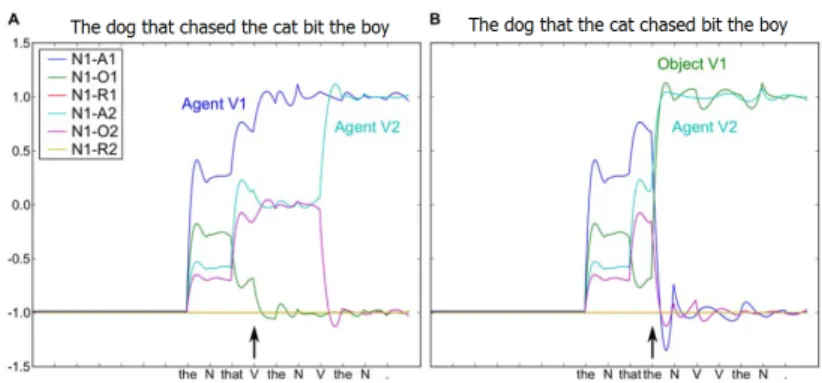
An interesting property of the behavior of the network can be seen in Figure 3. The two panels illustrate activity in the readout neurons that code for the semantic role of the first noun in two different grammatical types. In the second sentence, this noun is the agent or subject of the main (second) verb and the object of the relative (first) verb. The two sentences are identical up to the arrival of the fourth word. In the subject-subject sentence depicted in A, the model accurately predicts what happens and there is little change in the output indicated at the arrow. In the less frequent subject-object sentence in B, the model’s prediction must be updated at the arrival of the fourth word causing a large visible change in activity. This is
Fig. 2 Simplified reservoir model for sentence comprehension. A. Grammatical words are input to the reservoir. Through learning, connections from reservoir to the readout can associate patterns of activity in the reservoir with activation of neurons that represent the semantic role (predicate, agent, object or recipient) for each semantic word in the sentence. B. Performance error in comprehension in a test of generalization to new untrained constructions. Note an extended parameter space with good generalization.
precisely the kind of activity change that is seen in the human brain in response to lower frequency grammatical structures, referred to as the syntactic positive shift or P600 (a positivity that comes 600ms after the offending word) [Frisch et al., 2002; Hagoort and Brown, 2000].
We have seen that recurrent network models of PFC can perform complex tasks like language comprehension. Recent work at the forefront between computational neuroscience and machine learning has contributed to the concept that the prefrontal cortex is a recurrent network that has universal coding properties. Rigotti and col-leagues have shown that recurrent reservoir networks inherently display mixed se-lectivity in their single units, and that this mixed sese-lectivity is precisely the high dimensional coding required for solving complex cognitive tasks [Fusi et al., 2016; Rigotti et al., 2013]. Interestingly this is the same kind of mixed selectivity that we modeled (mixing spatial location and sequence rank) in our first instantiation of the reservoir concept [Dominey et al., 1995], where a network of neurons connected by fixed recurrent connections provides a universal high dimensional encoding, and modifiable connections allow the system to learn to associate these representations with the desired output. Future research should attempt to further understand these neurocomputational systems, and address questions concerning how the encoding of task related context can render these systems even more powerful.
7 Conclusion
AI and CN are two scientific domains developing their own formalisms but they are both interested in understanding how cognitive functions can emerge from
com-Fig. 3 Processing of Subject-Relative and Object-Relative sentences in corpus where subject-relatives are more frequent than object-subject-relatives. A. Subject-relative. For the word “V” following “that”, there is relatively small change in the readout neurons, indicating that the predictions of the model were essentially confirmed. B. Object-relative. For the “the” following “that”, there is a significant shift in activity, corresponding to a reassignment of the most probable coded meaning. From [Hinaut and Dominey, 2013].
putational mechanisms. Specifically, CN takes a strong inspiration from the brain circuitry, which is undoubtly a choice source of information to study the emergence of cognitive functions. Accordingly, CN can provide AI with original and first-hand mechanisms related to cognition. In addition, Neuroscience is a very dynamical do-main extracting more and more information from the mysterious brain, and CN is perpetually renewed by following these progresses and sometimes contributing to them. In this Chapter, we have proposed some illustrations on important questions on which the domains can interact.
The problem of representation of information is a central issue in AI, from the Physical Symbol System hypothesis to more recent questions evoked in most Chap-ters of Volume 1, about the representation of complex objects or events [Russell and Norvig, 2003]. Whereas the existence in the cortex of topographic maps of neu-rons responding each to preferential stimuli (cf. section 3) can give arguments for localized representations at the symbolic and subsymbolic levels, the dynamics of recurrent networks in the PFC (cf. section 6) and the hippocampus (cf. section 4) is rather reminiscent of distributed encoding. It is also important to mention that the corresponding neuronal models are associated to well explored learning rules that allow to build both kinds of representation from sampling in the environment. Concerning the elaboration of information representation, a related topic is about the opposition between top down and botton up approaches in AI (cf. section 2). Pieces of evidence have been proposed here that Marr’s algorithmic level could be fed with sensory information in an ascending way and controled in the opposite way by structures like the PFC (cf. section 6).
Whereas learning is a central mechanism in cognition, it has a particular status in AI. Sometimes it is not directly addressed and it is believed that information can be efficiently injected in a cognitive system as formalized knowledge. Sometimes
![Fig. 1 A. Neural network model of fronto-striatal system for sentence and non-linguistic abstract sequence processing (from [Dominey et al., 2009])](https://thumb-eu.123doks.com/thumbv2/123doknet/14217461.483009/22.918.252.664.290.496/neural-striatal-sentence-linguistic-abstract-sequence-processing-dominey.webp)