by Kent E. Pryor B.A., Chemistry Rice University, 1994
SUBMITTED TO THE DEPARTMENT OF CHEMISTRY IN PARTIAL FULFILLMENT OF THE REQUIREMENTS FOR THE DEGREE OF
DOCTOR OF PHILOSOPHY at the
MASSACHUSETTS INSTITUTE OF TECHNOLOGY September 1999
C 1999 Kent E. Pryor. All Rights Reserved.
The author hereby grants to MIT permission to reproduce and to distribute publicly paper and electronic copies of this thesis document in whole or in part.
A /I Signature of Author: s/ Department of Chemistry June 7, 1999 Certified by: Accepted by:
V Professor
Julius
Rebek,Jr.
Thesis Supervisor AChairman, Departmental
Professor Robert W. Field Committee on Graduate Studies in Chemistry
)
MASSACHUSETT INSTITUTE
This doctoral thesis has been examined by a Committee of the Department of Chemistry as follows:
Professor Rick L. Danheiser:
Chairman
Professor Julius Rebek, Jr.:
Professor Daniel S. Kemp:
The Activated Core Approach to Combinatorial Chemistry
byKent E. Pryor
Submitted to the Department of Chemistry on June 7, 1999 in Partial Fulfillment of the Requirements for the Degree of
Doctor of Philosophy.
ABSTRACT
We have devised a means by which almost any number of small molecules can be generated simultaneously using entirely solution-phase chemistry through combinatorial methods. The tactic involves taking a relatively rigid core structure with multiple functional groups and reacting it with chemical complements as a mixture. This method combines the numerical advantages of split synthesis on the solid support with the homogeneous reaction
conditions of the solutions phase. We have prepared libraries of from 1 to >100,000 components and have devised deconvolution strategies to identify the most active structures for a given biological target.
Refinements to the previously-reported synthesis of polyurea libraries on 9,9-dimethyl xanthene cores is presented, as well as the development of entirely new core molecules based on glycolurils and bipyridines. These new core structures present functional groups in increasingly diverse orientations and incorporate binding motifs within the cores themselves. In each case, methodology to produce chemical libraries in a clean, one-pot reaction has been developed in conjunction with methodology to produce any arbitrary single member of a library with building blocks installed in a paricular substitution pattern.
New linkers between the core molecule and building blocks have been introduced, and libraries based on a number of different core molecules have been screened for biological activity in a number of different assays. In particular, individual potent plasminogen activator inhibitor-1 antagonists have been identified from among initial large bipyridine core molecule libraries. Additionally, a new two-phase assay system to determine residual enzyme activity in the presence of an inhibitor candidate has been developed. Its application successfully identified a new xanthene-based elastase inhibitor from a library.
Thesis Supervisor: Professor Julius Rebek, Jr.
Title: Director, The Skaggs Institute for Chemical Biology and Professor, Department of Chemistry, The Scripps Research Institute
Biographical Note
Kent E. Pryor was born in Houston, Texas on June 22, 1972. He lived there for 22 years, graduated first in his class from Bellaire High School in 1990 and attended Rice University as a National Merit Scholar. He earned a B.A. in Chemistry (magna cum laude) from Rice in May, 1994. While at Rice, he was a Robert A. Welch Undergraduate Research Fellow in the laboratories of Prof. John L. Margrave, where he worked on the chemical vapor deposition of thin diamond films and the development of methods to study the thermophysical properties of levitated liquid metals. In 1993 he was elected to Phi Lambda Upsilon and won the Zevi and Bertha Salzburg Memorial Award for Excellence in Chemistry. In 1994, he was elected to Phi Beta Kappa and was named the 1993-1994 NASA/Texas Space Grant Consortium Scholar of Rice University.
Mr. Pryor spent the summers of 1993 and 1994 as a summer intern at the Hoechst Celanese Technical Center in Corpus Christi, Texas, where he developed novel bidentate phosphine ligands for hydroformylation catalysts. He then moved from his native Texas to graduate school at the Massachusetts Institute of Technology, where he held a National Science Foundation Graduate Research Fellowship. He joined the research group of Prof. Julius Rebek, Jr. and started his research into the activated core approach to combinatorial
chemistry. When Prof. Rebek took a new position as the Director of the Skaggs Institute for Chemical Biology at The Scripps Research Institute in La Jolla, California, Mr. Pryor followed his advisor to his new laboratories as a non-resident MIT graduate student. While living on his third coast, he continued his combinatorial chemistry research and entered into several collaborative research projects with other chemistry, vascular biology, and molecular biology research groups.
Upon the completion of his doctoral defense, Mr. Pryor will take a position as a Research Scientist at Corvas International, Inc., where he will initially work on the development of new cancer therapies based on PAI-1 antagonists.
Mr. Pryor is the author or co-author of 14 papers, patents, and patent applications and has made several public presentations of his work. The papers include "Containerless Thermophysical Property Measurements for Liquid Metals," 1994, "Synthesis and Screening of Small Molecule Libraries Active in Binding to DNA," 1997, "The Activated Core Approach to Combinatorial Chemistry: A Collection of New Core Molecules," 1998, "Multifunctionalized Glycolurils," 1999, and "A Rapid Method to Identify Exo-Protease Inhibition," 1999. He has written six patents titled "Synthesis of and Hydroformylation with Fluoro-substituted Bidentate Phosphine Ligands," issued 1996-1998, and three patent applications titled "Activated Core Molecules for the Synthesis of Libraries of Compounds in Combinatorial Chemistry,"filed 1998, "Glycolurils in Combinatorial Chemistry,"filed 1999, and "Bipyridine PAI-1 Antagonists,"filed 1999.
Acknowledgements
First of all, I would like to thank Prof. Rebek for his support and encouragement during my tenure as a graduate student in his research group. I consider myself to be very fortunate to have worked in a group where I had both the freedom to design and pursue my own research projects and the intellectual input of an exceptional chemistry mentor for the asking.
I also want to thank two research technicians who worked with me at various times
during my graduate school career, Ellen Choi and Christina Cueto. Ellen has been wonderfully helpful on several different projects in a variety of roles, and I am deeply indebted to her. Christina, while working with me for less than a year, made significant contributions to the PAI project. I am glad that I had the opportunity to work with both of them.
There is a lot of effort behind the scenes that is required to keep the scientific research going, and I thank Jean Harrington, Michelle Bateman, and Janette Lundgren for all of their help in this regard. Jean worked very hard for us during the transition from MIT to Scripps. Michelle all but adopted us once we got to Scripps and took wonderful care of us. In the last several months, Janette has been enormously helpful and has become a good friend.
I appreciate the efforts of my external collaborators on our joint projects. Ed
Madison has been wonderful to work with on the PAI project, and I am looking forward to working together even more closely with him in the future. I also thank
Jim
LaClair for working with me on the protease inhibitor project.The Rebek group has been a great place in which to work. When I joined the group, I worked closely with Jerry Shipps, who remains my friend to this day. While I have not shared projects with any group members recently, I have shared lab space with Carina Horn, Jonathan Toker, and Doris Pupowicz, each of whom kept me entertained in different ways.
My fellow graduate students Brendan O'Leary, Ron Castellano, and Jose Rivera, who have
all been with me since my time at MIT, have not only been good friends, but have been great resources for chemistry, too. I have appreciated their advice and insight over the years.
Finally, my parents' unconditional support throughout my life in everything I have put my mind to has been instrumental in getting me to the point where I am today, and it is impossible for me to thank them enough for that.
Table of Contents
A bstract...5
Biographical N ote...7
A cknow ledgem ents ... 9
C hapter 1. Introduction
...
15
1.1 A n introduction to com binatorial chem sitry... 15
1.2 Polymer-supported methods for generating libraries ... 16
Spatially separate synthesis ... 16
Pooling strategies ... 17
Soluble polym er supports ... 19
1.3 Solution phase com binatorial chem istry... 19
1.4 T he activated core approach... 22
1.5 Design considerations for the activated core approach... 23
The core...23
The linker...27
T he building blocks ... 28
1.6 The screening of libraries... 29
Chapter 2. Xanthene Di- and Tetraureas via isocyanates
...
31
2.1 Introduction to xanthene tetraureas... 31
2.2 Background-B-chlorocatecholborane usage in urea formation... 33
2.3 Isolation of isocyanates ... 34
X anthene tetraisocyante... 34
Adamantane tetraisocyante... 36
2.4 Deconvolution of xanthene tetraurea libraries...37
2.5 Identification of xanthenes active in binding to DNA... 39
2.6 E xp erim en tal ... 39
Chapter 3. The Bipyridine Core Molecule...
51
3.1 Synthesis and validation of the bipyridine core... 51
3.2 Attempts to incorporate isocyanates in the bipyridine core... 53
3.3 Deconvolution of the bipyridine core molecule ... 54
4-Bromo-2,6-pyridinediamides-intermediates for deconvolution... 55
Stannane test reactions... 56
Synthesis of a tetraheterosubstituted bipyridine ... 57
Alternative routes to heterosubstituted bromopyridines... 58
3.4 Applications of bipyridine libraries in binding to TAR RNA ... 59
3.5 E xp erim en tal ... 62
Chapter 4. Bipyridines as PAl-1 Antagonists...
90
4.1 Plasminogen Activator Inhibitor ... 90
4.2 Initial library synthesis...91
4.3 Second round of library synthesis ... 93
4.4 An unusually active library...95
4.5 Mixed amide/acid candidates... 97
4.6 E xperim ental ... 100
Chapter 5. Glycoluril Core Molecules...126
5.2 The glycoluril tetraacid core m olecule... 127
5.3 G lycoluril diacid core m olecules ... 129
5.4 A ctivation of the glycoluril core m olecules ... 131
Pentafluorophenyl esters... 133
U se of coupling reagents... 134
5.5 Site differentiation on the tetrasubstituted glycoluril core ... 136
Bis(ethyl ester) /bis(benzyl ester)... 136
Bis(benzyl ester)/bis(2,2,2-trichloroethyl ester) ... 137
5.6 Experim ental... 139
Chapter 6. Reduced A m ide Linkers...173
6.1 Introduction ... 173
6.2 Synthesis of core polyalcohols ... 174
6.3 Mitsunobu reactions with 2,4-dinitrobenzenesulfonamides ... 175
Synthesis of 2,4-dinitrobenzenesulfonamides... 175
The M itsunobu reaction... 176
6.4 M ixed am ide/am ine linkers ... 178
Synthesis of a m ixed am ide/am ine stannane... 178
Synthesis of a m ixed am ide/am ine bipyridine... 179
Synthesis of a bipyridine with three types of substituents ... 179
6.5 Experim ental... 180
Chapter 7. A Rapid Method to Identify Protease Inhibitors...203
7.1 Introduction ... 203
7.2 A ssay D evelopm ent ... 204
7.4 Experim ental ... 208
Appendix: Diversity calculations
...
217
A .1 Bipyridine tetra-substituted core...217
A .2 Pyridine di-substituted core...218
A .3 X anthene tetra-substituted core...219
A .4 X anthene di-substituted core ... 220
A .5 G lycoluril tetra-substituted core ... 221
A .6 G lycoluril is-di-substituted core...222
A .7 G lycoluril trans-di-substituted core...223
Chapter 1. Introduction
1.1 An introduction to combinatorial chemsitry
The term "combinatorial chemistry" has no single definition, but practitioners in the field seem to apply it fairly broadly to mean any methodology in which multiple compounds bearing some structural or synthetic relationship to each other are produced either together or in parallel. Scientific advances on a variety of fronts, all subsumed by the mantle of combinatorial chemistry, have been made at an ever-increasing pace; the explosive growth of the field has caused the American Chemical Society to start publishing another new journal,
The Journal of Combinatorial Chemistry, at the beginning of this year to cover the subject in
detail. A number of books on combinatorial chemistry have also been published recently.' Combinatorial chemistry has primarily been used in the context of medicinal chemistry, both to help identify lead compounds and to optimize leads into better drug candidates. However, the same approaches have also been used to create libraries for a variety of other purposes, such as catalysis,2 metal coordination, optical sensing,4 and
I Some examples are: (a) Wilson, S. R.; Czarnik, A. W. Combinatorial Chemisty: Synthesis and Appication; John Wiley & Sons: New York, 1997. (b) Obrecht, D.; Villalgordo, J. M Solid-Supported Combinatorial and Parallel
Synthesis of Small-Molecular- Weight Compound Libraries; Pergamon Press: London, 1998. (c) Gordon, E. M.;
Kerwin, J. F. Combinatorial Chemistry and Moecular Diversity in Drug Discovery; John Wiley & Sons: New York,
1998.
2 (a) Cong, P. J.; Doolen, R. D.; Fan, Q.; Giaquinta, D. M.; Guan, S. H.; McFarland, E. W.; Poojary,
D. M.; Self, K.; Turner, H. W.; Weinberg, W. H. Angew. Chem., Int. Ed. Eng. 1999, 38, 484-488. (b)
Gennari, C.; Nestler, H. P.; Piarulli, U.; Salom, B. Uebigs Ann. Recueil1997, 637-647. (c) Kobayashi, S.;
Nagayama, S. J. Am. Chem. Soc. 1996, 118, 8977-8978. (d) Cole, B. M.; Shimizu, K. D.; Kureger, C. A.;
Harrity, J. P. A.; Snapper, M. L.; Hoyveda, A. H. Angew. Chem., Int. Ed. Engl 1996, 35, 1668-1671.
3 (a) Albrecht, M.; Blau, 0.; Frohlich, R. Chem. Eur. J. 1999, 5, 48-56. (b) Berg, T.; Simeonov, A.; Janda, K. D. J.
Comb. Chem. 1999, 1, 96-100. (c) Gilbertson, S. R.; Wang, X. Tetrahedmn Lett. 1996, 37, 6475-6478. (d)
Francis, M. B.; Finney, N. S.; Jacobsen, E. N. J. Am. Chem. Soc. 1996, 118, 8983-8984.
superconductivity,5 just to name a few of the other fields to benefit from combinatorial techniques.
Chemical libraries can be synthesized in a variety of different ways. Very broadly, they can be divided by the phase in which the libraries are being prepared. Solid phase techniques can be used in which all library members are covalently attached to a polymer support during synthesis. Several variations on this theme exist and are discussed in Section 1.2 below. Solution phase methodologies have also been applied, and a description of the development of one particular solution phase technique constitutes the bulk of this dissertation.
1.2 Polymer-supported methods for generating libraries
Spatially separate synthesis
Perhaps the most straightforward approach to library synthesis is to keep each individual compound spatially separated from its fellows in a defined array. When the compounds are spatially separate, direct structure-activity relationships are obtained from biological evaluation. The primary disadvantage of this approach, however, is that the number of compounds that can be synthesized is more limited than with other approaches. Another disadvantage, common to all solid-phase techniques, is that all of the required chemistry to produce the desired library compounds must be adapted to work on the solid phase.
Geysen and co-workers prepared the first combinatorial library in spatially separate format in 1984.6 They synthesized a library of peptides using functionalized pins they developed that were compatible with 96-well microtiter plates. Pin technology has been
5
Xiang, X.-D.; Sun, X.; Briceno, G.; Lou, T.; Wang, K-A.; Chang, H.; Chen, S.-W.; Schultz, P. G. Sdence 1995,
268, 1738-1740.
improved since then using other polymers and linkers and by increased loading to accommodate other chemical applications.
At Affymax, Fodor and co-workers have developed methods in which large libraries (100,000 compounds) are built on a silicon wafer with photolithographic methods.' The application of this methodology is limited, for the most part, to DNA diagnostic tests because it requires photolabile protecting groups and support-bound biological assays. Combinatorial materials chemistry is most commonly performed on wafers as arrays. This method lends itself particularly well to applications such as the identification and optimization of new luminescent compounds, which are easy to screen because devices that measure light intensity and color are readily available. Researchers at Symyx have screened libraries of 25,000 at a time on silicon wafers and have discovered improved red phosphors' and a new class of blue-white phosphors.10
Pooling strategies
The earliest pooling strategies were independently developed by Furka," Lam,2 and
Houghten.1 3 They each employed a split and mix procedure to generate mixtures of peptides
on solid support. In a split synthesis, equal portions of the support resin is reacted in separate reaction vessels with different monomers. After the reactions are complete, the resins are washed and combined. At this point a common transformation, such as the removal of a protecting group, can be performed. Equal portions of the well-mixed resin are
7 Maeji, N. J.; Valerio, R. M.; Bray, A. M.; Campbell, R. A.; Geysen, H. M. React. Pom. 1994, 22, 203-212.
8 Fodor, S. P. A.; Read, J. L.; Pirrung, M. C.; Stryer, L.; Lu, A. T.; Solas, D. Science 1991, 251, 767-773.
9 Sun, X. D.; Gao, C.; Wang, J. S.; Xiang, X. D. AppL Phys. Lett. 1997, 70, 3353-3355.
10 Wang, J.; Yoo, Y.; Gao, C.; Takeuchi, I.; Sun, X.; Chang, H.; Xiang, X. D.; Schultz, P. G. Science 1998, 279,
1712-1714.
1 Furka, A.; Sebestyen, F.; Asgedom, M.; Dibo, G. Int.
J.
Pep. Potein Res. 1991, 37, 487-493.12
Lam, K. S.; Salmon, S. E.; Hersh, E. M.; Hruby, V. J.; Kazmierski, W. M.; Knapp, R. J. Nature 1991,354,
82-84.
13 Houghten, R. A.; Pinilla, C.; Blondelle, S. E.; Appel, J. R.; Dooley, C. T.; Cuervo, J. H. Nature 1991, 354,
next charged again to separate reaction vessels, and a second monomer is attached. This cycle of splitting and pooling is continued until the desired number of monomers is attached. These combinatorial methods, while originally developed for peptides, have also been
applied to the synthesis of unnatural biopolymers and small molecules.
At the end of a split synthesis, each individual bead theoretically is carrying a single product. This "one compound, one bead" approach has been used to identify the active components in a biological assay directly in some cases. With certain assays of support-bound compounds, it is possible to identify an active compound by allowing the candidate to bind to a radiolabeled or fluorescent-labelled receptor or dyes and picking out radioactive, fluorescent, or colored beads." Otherwise, the compounds can be cleaved from the resin and screened in solution.
To deconvolute, or the identify actives from, a library synthesized by split and mix methods, chemical or biochemical tags can be attached to the resin during the synthesis of the library. DNA was the early choice for tagging,5 but it is unfortunately not chemically stable under many of the reaction conditions frequently used in organic synthesis. To circumvent this problem, encoding has been performed with peptides prepared from amino acids that have relatively unreactive side chains" or gas chromatography-electron capture (GC-EC) tags that are inert to most of the reaction conditions typically employed.'" Radiofreqency tagging has been developed to completely avoid any potential chemical
14 (a) Burger, M. T.; Still, W. C.
J.
Org. Chem. 1995, 60, 7382-7383. (b) Cheng, Y.; Suenga, T.; Still, W. C.J.
Am. Chem. Soc. 1996, 118, 1813-1814.15 Needles, M. C.; Jones, D. G.; Tate, E. H.; Heinkel, G. L.; Kochersperger, L. M.; Dower, W. J.; Barrett, R. W.;
Gallop, M. A. Proc. Natl Acad Sdc 1993, 90, 10922-10926.
16 Vetter, D.; Tate, M. M.; Gallop, M. A. Bioconjugate Chem. 1995, 6, 319-322.
17 Ohlmeyer, M. H.; Swanson, R. N.; Dillard, L. W.; Reader, J. C.; Asouline, G.; Kobayashi, R.; Wigler, M.; Still,
incompatibilities, instead depending on radio emitters embedded in each bead or reaction chamber.18
Soluble
polymer
supDorts
At the interface between solid phase techniques and true solution phase techniques lies the application of soluble polymer supports. Janda and co-workers' have built chemical libraries attached to polyethylene glycol monomethyl ether, which is soluble in a number of potential reaction media. Each reaction step is carried out under homogeneous conditions, providing the advantages of solution phase chemistry. After each step, the polymer support is precipitated with ether or ethanol and the resin is filtered, thereby eliminating non-bound reagents and reaction byproducts.
1.3 SoLution phase combinatorial chemistry
A less-frequently used complement to adapting solution phase chemistry to polymer-supported combinatorial synthesis is the development of protocols for entirely solution phase combinatorial synthesis. Only a limited number of examples of solution libraries have been published so far;' however, there are a number of potential benefits to be derived from solution phase approaches. There is no need to develop attachment/detachment chemistry for the polymer support, and the range of chemistry available for solution phase reactions is greater than that for solid supported chemistry (although advances on this front continue to be made at an astonishing pace). Additionally, solution phase approaches are not limited in
18 (a) Xiao, X-Y.; Nova, M. P. Comb. Chem. 1997, 135-152. (b) Nicolaou, K. C.; Xiao, X.-Y.; Parandooch, Z.;
Senyei, A.; Nova, M. P. Angew. Chem., Int. Ed Engl 1995, 34, 2289-2291.
19 (a) Han, H.; Wolfe, M. M.; Brenner, S.; Janda, K. D. Pc. Nat. Acad Sc. 1995, 92, 6419-6423. (b) Gravert,
D. J.; Janda, K. D. Chem Rev. 1997, 97,489-509.
2 While fewer research groups are publishing solution phase approaches, the field is still broad enough to be the subject of a recent Tetrahedmn Symposium-in-print: Coffen, D. L., ed. Tetrahedmn 1998, 54, No. 16.
scale, and thus are particularly useful for the preparation of larger samples for extensive testing or archival purposes.
The disadvantages of solution phase combinatorial chemistry relative to solid phase approaches are the relative complexity of product isolation and the potential difficulties in the identification of active compounds from among a solution phase mixture. Solution phase approaches generally depend on extractive workups or the application of scavenger resins to remove unreacted reagents.' In certain cases, chromatography has been used to purify solution phase mixtures,2 although this is unfortunately not broadly applicable.
Parallel solution phase synthesis of individual compounds eliminates the problem of active compound identification by allowing direct testing of each compound individually. Multicomponent coupling reactions, such as the Ugi reaction,' have been used for generating solution libraries.2 4 The Ugi condensation involves the reaction of four different building blocks in one pot. Upon reaction completion, the product of the Ugi condensation, often in high yield, precipitates out of solution.
Boger and co-workers have developed other parallel solution phase techniques for combinatorial synthesis. They have reported two approaches that entail the dimerization linkage of iminodiacetic acid diamides25 using symmetrical dicarboxylic acids or the olefin
21
(a) Kaldor, S. W.; Siegel, M. G.; Fritz, J. E.; Dressman, B. A.; Hahn, P. J. Tetrahedron Lett. 1996, 37, 7193-7196. (b) Kaldor, S. W.; Fritz, J. E.; Tang, J.; McKinney, E. R. Bioorg. Med Chem. Lett. 1996, 6,
3041-3044.
22 Boger, D. L.; Chai, W.; Ozer, R. S.; Anderson, C.-M. Bioorg. Med. Chem. Lett. 1997, 7,463-468.
23 Ugi, I.; Domling, A.; Horl, W. Endeavour 1994, 18, 115-122.
24 (a) Keating, T. A.; Armstrong, R. W.
J.
Am. Chem. Soc. 1995, 117, 7842-7843. (b) Weber, L.; Walbaum, S.;Broger, C.; Gubernator, K. Angew. Chem., Int. Ed. Engl 1995, 34, 2280-2282. (c) Keating, T. A.; Armstrong,
R. W.
J.
Am. Chem. Soc. 1996, 118, 2574-2583.25 (a) Cheng, S.; Comer, D. D.; Williams, J. P.; Myers, P. L.; Boger, D. L. J. Am. Chem. Soc. 1996, 118, 2567. (b)
Boger, D. L.; Tarby, C. M.; Myers, P. L.; Caporale, L. H.
J.
Am. Chem. Soc. 1996, 118, 2109. (c) Cheng, S.;Tarby, C. M.; Comer, D. D.; Williams, J. P.; Caporale, L. H.; Myers, P. L.; Boger, D. L. Bioorq. Med Chem.
1996,4, 727.
metathesis reaction to join and randomize the length of the linking tether." They have also demonstrated the preparation of higher order libraries containing up to eight variable groups by coupling iminodiacetic acid diamides with tricarboxylic acids or sequential couplings with
dicarboxylic acids.27
One benefit of screening compounds as mixtures, however, is the much-reduced number of individual screens required to test a given number of compounds. We have identified two low-micromolar DNA intercalators from an initial body of approximately 10,000 compounds in a total of about 20 assays, thereby demonstrating the efficiency of this method.2 Berk, Rohrer, and co-workers at Merck recently reported the solid phase synthesis of nonpeptide somatostatin agonist candidates, which they cleaved from support and screened as mixtures in solution.29 They identified a number of subtype-selective agonists by
deconvolution of their mixtures with far fewer screens than if they had attempted to synthesize and screen individual compounds, providing yet another example of the benefit to be gained by solution phase screening of mixtures, even when solid phase synthesis techniques produce the compounds.
27 Boger, D. L.; Ducray, P.; Chai, W.; Jiang, W.; Goldberg, J. Biooqg. Med Chem. Lett. 1998, 8, 2339-2344. 28 Shipps, G. W., Jr.; Pryor, K. E.; Xian, J.; Skyler, D. A.; Davidson, E. H.; Rebek, J., Jr. Proc. Natl. Acad Sd.
1997, 94, 11833-11838. See also Section 2.5 below.
29 Rohrer, S. P.; Birzin, E. T.; Mosley, R. T.; Berk, S. C.; Hutchins, S. M.; Shen, D. M.; Xiong, Y. S.; Hayes, E. C.; Parmar, R. M.; Foor, F.; Mitra, S. W.; Degrado, S. J.; Shu, M.; Klopp, J. M.; Cai, S. J.; Blake, A.,; Chan, W. W. S.; Pasternak, A.; Yang, L. H.; Patchett, A. A.; Smith, R. G.; Chapman, K. T.; Schaeffer, J. M. Sdence
1.4 The activated core approach
000
C~c
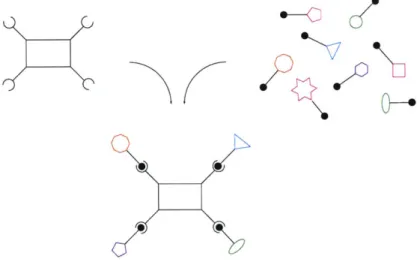
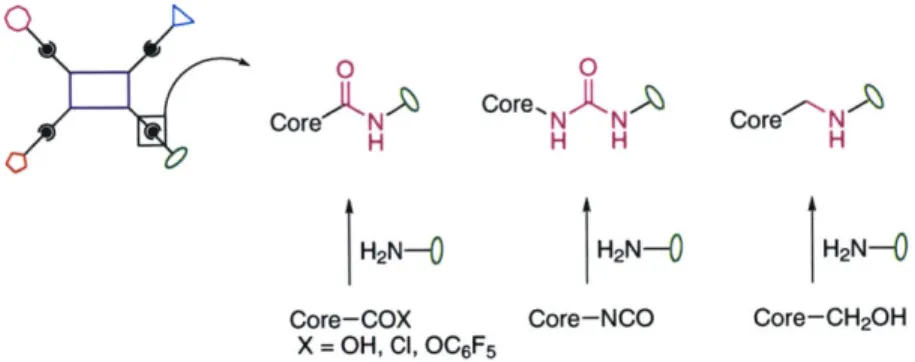
Figure 1. A schematic representation of the activated core molecule approach to combinatorial chemistry. An activated core molecule is shown on the left. It is reacted with a mixture of building blocks, and the final library is composed of a statistical mixture of all possible substitutional isomers. Covalent linker chemistry is represented by the complementary balls and sockets.
In contrast to parallel synthesis, this group has chosen to use simultaneous solution phase reactions in a method we call the "activated core" approach. The tactic involves taking a relatively rigid core structure with multiple functional groups and reacting it with chemical complements as a mixture (see Figure 1). Like combinatorial methods involving synthesis on soluble polymer supports, this method combines the numerical advantages of split synthesis on solid support with the homogeneous reaction conditions of the solution phase. We have prepared libraries of from 1 to greater than 100,000 components and have devised deconvolution strategies to identify the most active structures for a given biological target.
Other groups have also reported single-step solution phase synthesis of combinatorial libraries. Smith and co-workers prepared a library of potentially 1600 amides
by reacting 40 acid chlorides with 40 nucleophiles.30 The library was screened as 80 sample mixtures in a matrix format, allowing immediate deconvolution. A similar sublibrary format was used by Pirrung and Chen, who prepared a series of carbamate mixtures which were screened for acetylcholinesterase inhibitory activity."
Even more similar is the SPSAF (Solution Phase Simultaneous Addition of Functionalities) approach taken by An, Cook, and co-workers at Isis Pharmaceuticals. They have synthesized unsymmetric polyazacyclophane12 and linear" scaffolds and utilized them
for the generation of a variety of mixture libraries, and they have evaluated the libraries' biological activity in antibacterial and HIV-1 tat/TAR protein-RNA disruption assays.
1.5 Design considerations for the activated core approach
The core
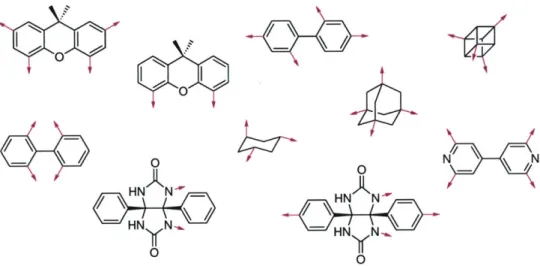
The activated core approach can be divided into three components: the core, the linker, and the building blocks. Each can be designed to give the desired level of diversity (numbers of compounds) and/or the desired physical property (solubility, shape space, chemical functionality). A selection of core molecules developed in this group is shown below in Figure 2.
In initial studies in this research group, xanthene and cubane tetraacid chlorides were reacted with mixtures of amino acid esters to form polyamide libraries. These libraries were subsequently successfully screened for activity against trypsin, and a deconvolution scheme
30 Smith, P. W.; Lai, J. Y. Q.; Whittington, A. R.; Cox, B.; Houston, J. G. Bioorg. Med Chem. Lett. 1994, 4, 2821-2824.
3 1
(a) Pirrung, M. C.; Chen, J. J. Amer. Chem. Soc. 1995, 117, 1240-1245. (b) Pirrung, M. C.; Chau, J. H. L.; Chen J. Chem. BioL 1995, 2, 621-626.
3
2 (a) An, H.; Cook, P. D. Tetrahedron Let. 1996,37,7233-7236. (b) An, H.; Haly, B. D.; Cook, P. D. Bioorg. Med.
Chem. Lett. 1998, 8, 2345-2350. (c) An, H. Y.; Wang, T.; Mohan, V.; Griffey, R. H.; Cook, P. D. Tetrahedron
1998, 54, 3999-4012. (d) An, H. Y.; Haly, B. D.; Cook, P. D. J. Med Chem. 1998, 41, 706-716. 3 3
was applied to identify the active compounds.3 4 One drawback to the cubane core molecule is its high degree of symmetry, which disallows differentiation of the four reactions sites; this
drawback is shared by the adamante core molecule, as well.
?h
\ / N N HN
HN N-V HN AN'w. HN YN".. HN N-. 0Figure 2. A selection of core molecules for combinatorial chemistry developed in the Rebek group.
Other core molecules were subsequently introduced," and were chosen to provide different orientations of the attached building blocks and new functionalities within the core. The properties of the core molecule have (in several assays) been critical to activity, as libraries made with the same building blocks and linkages have had very different activity levels.36
The symmetry of the core molecule, the number of reaction sites, and the number of building blocks used in the diversity-forming reaction all determine the total number of compounds produced in the final library. This is illustrated in Figure 3. Three different core
34 (a) Carell, T.; Wintner, E. A.; Rebek, J., Jr. Angew. Chem., Int. Ed EngL 1994,33,2061-2064. (b) Carell, T.;
Wintner, E. A.; Bashir-Hashemi, A.; Rebek, J., Jr. Angew. Chem., Int. Ed Engl 1994, 33, 2059-2061.
35 (a) Pryor, K. E.; Shipps, G. W., Jr.; Skyler, D. A.; Rebek, J., Jr. Tetrahedron 1998, 54, 4107-4124. (b) Pryor, K.
E.; Rebek, J., Jr. Org. Lett. 1999, in press. See also Chapters 3 and 5 below.
36
Carell, T.; Wintner, E. A.; Sutherland, A. J.; Rebek, J., Jr.; Dunayevskiy, Y. M.; Vouros, P. Chem. Biol. 1995, 2,
molecules A, B, and C are given, and the library size when each is reacted with a particular number of building blocks is graphed. In all cases, the combinatorial rule, x = m!/n!(m-n)!, is applied to determine the number of combinations x in which m building blocks can be taken in n groups. This number of combinations is then scaled by a "symmetry multiplier," which is the number of different structural isomers that can be formed with m building blocks. This number obviously varies according to the symmetry of the core molecule. Compound A, incorporating only two reaction sites, produces far smaller libraries than either of the tetrasubstituted compounds B or C. Between the tetrasubstituted compounds, the freedom of rotation about the bipyridyl bond in compound B increases its symmetry relative to compound C, thereby decreasing the size of libraries produced with core B. The calculations of library sizes for several core molecules can be found in the Appendix.
040
HN YN-,., 0 A 12000 10000 8000 6000 4000 2000 0 2 N N B 4 6 8Figure 3. A
molecules.graph of library size vs. number of building blocks for three different core
0 C mA wB 10 12 40 0 0
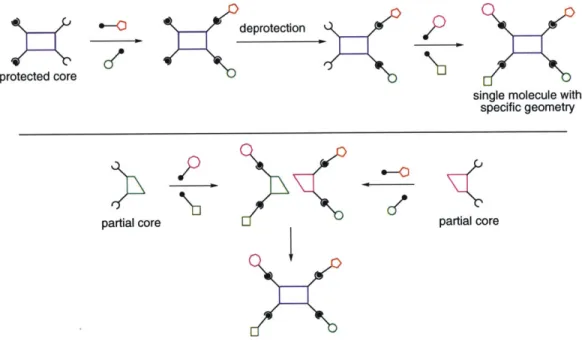
0-For any given core molecule, methodology to produce chemical libraries in a clean, one-pot reaction must be developed in conjunction with methodology to produce any arbitrary single member of a library with building blocks installed in a particular substitution pattern. Two different approaches to this problem suggest themselves (see Figure 4). One method is by the incorporation of orthogonal protecting groups at the various substiution points and building up individual compounds in a stepwise reaction/deprotection scheme. Another method is to take a convergent approach wherein the building blocks are installed on a partial core molecule and in a final step the core molecule is assembled with all of its building blocks already attached in their proper positions. Examples of both of these
methods will be described in subsequent chapters.
*- 0 deprotection
protected core
single molecule with specific geometry
0-10
partial core partial core
Figure 4. Two approaches to library deconvolution. Top: Sequential reaction/deprotection. Bottom: Convergent method.
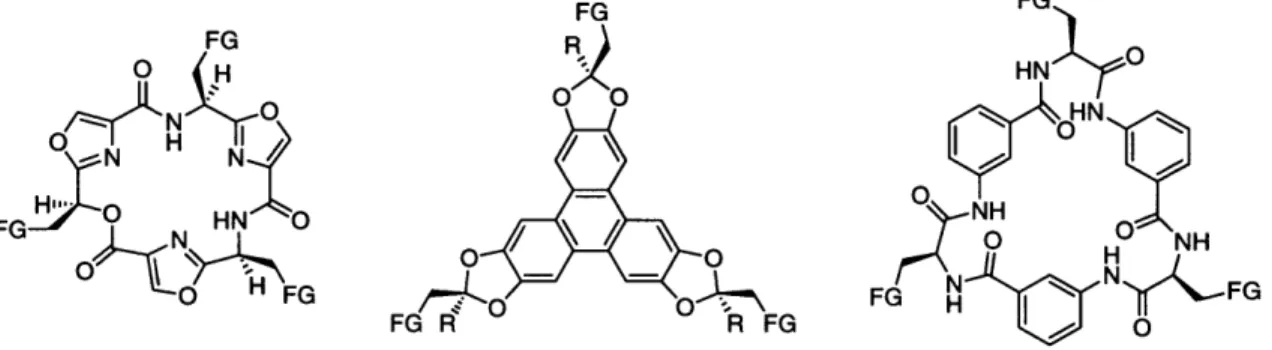
A recent new direction in core molecule design within this research group has been the development of large platforms with convergent functional groups (see Figure 5).7 The advantage of such systems lies in presenting the diversity on a well-defined surface.
FG FG FG R) N H HN N H NNlP 0 H 11 N N 0 / \ 0 0 NH 0 0 H 0~~ N~L
i
0 H FG /o
+ FG N FG FG R R FG 0Figure 5. C3 and C3v symmetric platforms developed with potential application as core
molecules for combinatorial chemistry.
The linker
The linker chemistry between the core and the building blocks is another key consideration for designing libraries using the activated core approach. In a perfect world, the linker chemistry would provide linkages between building blocks and core in 100% yield and absolute purity, as well as being robust under building block deprotection conditions, any conceivable screening conditions, and prolonged storage. We have tried to approximate this as closely as possible, and have made use of three types of linker chemistry in particular, as shown in Figure 6.
37 (a) Mink, D.; Mecozzi, S.; Rebek, J., Jr. Tetrahedmn Lett. 1998, 39, 5709-5712. (b) Waldvogel, S. R.; Wartini, A.
R.; Rasmussen, P. H.; Rebek, J., Jr. Tetrahedn Lett. 1999, 40, 3515-3518. (c) Rasmussen, P. H.; Rebek, J., Jr. Tetrahedon Lett. 1999, 40, 3511-3514.
0 0
Core N Core N N Core N
H H H H
H2N-=-0 IH2N-4 H2N-O
Core-COX Core-NCO Core-CH2OH
X = OH, CI, OC6F5
Figure 6. The choice of core molecule functionality provides different linker possibilities.
Amides, ureas, and amines are accessible by the reaction of amines with activated acids, isocyanates, or methyl alcohols, respectively.
The formation of amides by the reaction of amines with core acid chlorides has already been discussed. We have since extended amide formation to make use of core pentafluorophenyl esters rather than acid chlorides in cases where core functionality would itself be incompatible with acid chlorides (see Chapter 5). The formation of ureas was first introduced by the dealcoholation of core carbamates followed by addition of amine building blocks,38 but a more recent refinement involves the direct synthesis, isolation, and reaction of core isocyanates (see Chapter 2). Finally, methyl amines, or reduced amides, are available through the reaction of core methyl alcohols with amines protected as sulfonamides in a Mitsunobu reaction" (see Chapter 6).
The building blocks
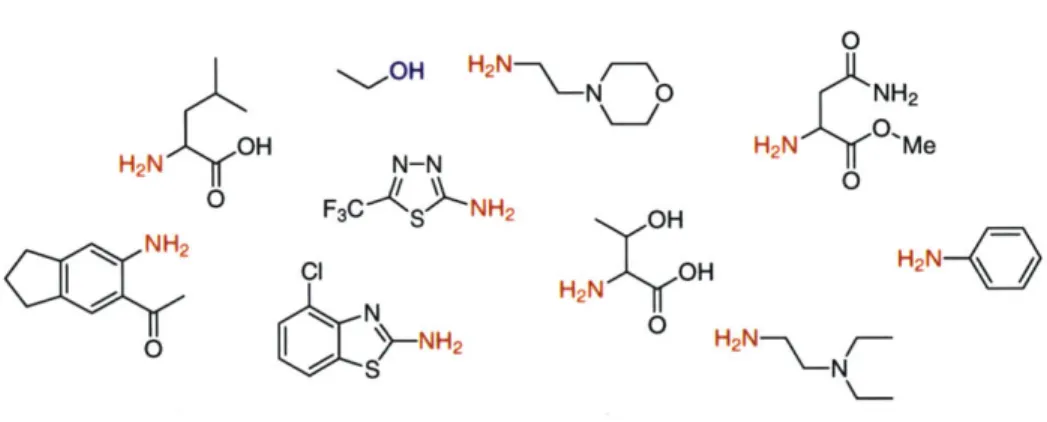
The building blocks we use are chosen for a variety of reasons. Availability, compatibility with intended linker chemistry, and diversity in structure are perhaps the most important of these. In general, we have stayed with variously-substituted primary amines (see Figure 7), which satisfy all of the above requirements. A wide variety of amines, including variously-protected amino acids, are commercially available, providing us with a ready supply
38 Shipps, G. W., Jr.; Spitz, U. P.; Rebek, J., Jr. Bioorg. Med Chem. 1996, 4, 655-657.
39Fukuyama, T.; Cheung, M.; Jow, C.-K.; Hidai, Y.; Kan, T. Tetrahedron Let. 1997, 38, 5831-5834.
of different chemical structures. Additionally, the strong nucleophilicity of amines facilitates amide and urea formation, and the ready conversion of amines to sulfonamides suitable for use in the Mitsunobu reaction allows an extension of the amine building block utility. In certain cases, ethanol has been used as a building block to provide an unsubstituted position in the final molecules (see Chapters 3 and 4).
0 OH H2N-N 0 NH2 H2N OH N-N H2N 0Me F3C SXNH2 OH 0 C NH2 CIN OH H2N
o
NH2 H2N NFigure 7. A small sampling of building blocks applied in the activated core approach.
1.6 The screening of ibraries
While the development of chemistry related to the production of libraries by the activated core approach has been a primary focus of our research efforts, the synthesis of libraries and the evaluation of their biological activity has been an important second step. Libraries based on the bipyridine core molecule with four acid chloride reaction points have shown activity in inhibiting the protein-protein interaction between tissue-type plasminogen activator (t-PA) and plasminogen activator inhibitor-1 (PAI-1) (see Chapter 4). Several rounds of screens identified certain crucial building blocks, and we subsequently discovered that we could get increased activity by making use of a partially-hydrolyzed tetraacid chloride core molecule, thereby introducing free carboxylic acid groups into our polyamide libraries. To date, we have found two compounds which have been shown to be among the most active compounds ever identified for the inhibition of the t-PA/PAI-1 interaction.
Other current projects include the development of new methods to screen libraries of small molecules against RNA targets (see Chapter 3) and to rapidly identify small molecule exo-protease inhibitors (see Chapter 7). Using an LC-MS system to identify the individual components of the library, our collaborators intend to use columns with the RNA bound to beads to separate compounds of interest from the library. We will attempt to show that by using multiple columns with different RNA molecules attached to the beads, we can select molecules form a library that bind to the RNA of interest both tightly and specifically.
On the protease front, we have developed a two-phase assay system to determine the residual enzyme activity in the presence of an inhibitor candidate by following the migration of an organic-soluble fluorescent dye from the aqueous phase, where it is covalently bound to an enzyme substrate and does not fluoresce, into a layer of mineral oil upon enzymatic cleavage from the substrate. By using a very small amount of mineral oil relative to the volume of the aqueous phase, the dye can be concentrated many-fold, substantially increasing the sensitivity of the assay system. The result is an assay that can easily identify inhibitors by visual inspection, and simple extensions of the process allow quantitation of the inhibitory activity by fluorescence spectroscopy.
Chapter 2. Xanthene Di- and Tetraureas via isocyanates
1
2.1 Introduction to xanthene tetraureas
A number of considerations, including synthetic access, versatility,2 lack of apparent
toxicity3 and attractive physical properties make the tetrasubstituted xanthene (Figure 1) a desirable core molecule. In the latter regard, xanthenes have a strong UV chromophore for easy detection and are soluble in chlorinated organic solvents but nearly insoluble in hexanes/ether mixtures. This differential solubility allows for crude purifications following library synthesis using liquid-liquid extractions and, after deprotection, by precipitation from ether/hexane. Finally, the four sites for reaction on the xanthene core allow a large number of compounds to be formed using only a limited number of building blocks (eight building blocks give 2,080 compounds while 16 building blocks give 32,896 compounds).
The xanthene tetraureas (Figure 1) present an electron-rich aromatic scaffold capable of intercalation into DNA4 and forming 7r-7r stacks with aromatic side chains of proteins. The thickness of the 9,9-dimethyl center may disfavor some of these binding modes, but the ureas at the 4 and 5 positions provide a cavity (see Figures 1 and 2) which is known to bind carboxylates strongly. In addition, all four ureas provide numerous hydrogen bonding donor and acceptor sites for molecular recognition. Molecular modeling calculations6 were used to
1
Portions of this chapter have been previously published and are being used with permission from the National Academy of Sciences. Shipps, G. W., Jr.; Pryor, K. E.; Xian, J.; Skyler, D. A.; Davidson, E. H.; Rebek, J., Jr. Proc. Nat. Acad Sc. 1997, 94, 11833-11838. Much of the work in this chapter was undertaken in collaboration with Dr. Gerald Shipps, and also appears in his Ph.D. thesis. Shipps, G. W., Jr. Ph. D. Thesis1996, Massachusetts Institute of Technology, Cambridge.
2 Shimizu, K. D.; Dewey, T. M.; Rebek, J., Jr.
J.
Am. Chem. Soc. 1994, 116, 5145-5149. 3 Birman, V. B.; Chopra, A.; Ogle, C. A. Tetrahedron Lett. 1996, 37, 5073-5076.4 Dugas, H. Biooqganic Chemistry 1996, Springer, New York.
s Hamann, B. C.; Branda, N. R.; Rebek, J., Jr. Tetrahedron Leat. 1993, 34, 6837-6840.
6 Mohamadi, F.; Richards, N. G. J.; Guida, W. C.; Liskamp, R.; Lipton, M.; Caufield, C.; Chang, G.;
minimize a few tetraurea structures and revealed a planar, disc-shaped presentation of the building blocks (see Figure 1).
4 5
Figure 1. A polytube rendering of an MM2* minimized tetraalanine tetraurea. Several contact surfaces are available, including the 2,4; 4,5; 5,7; and 2,7.
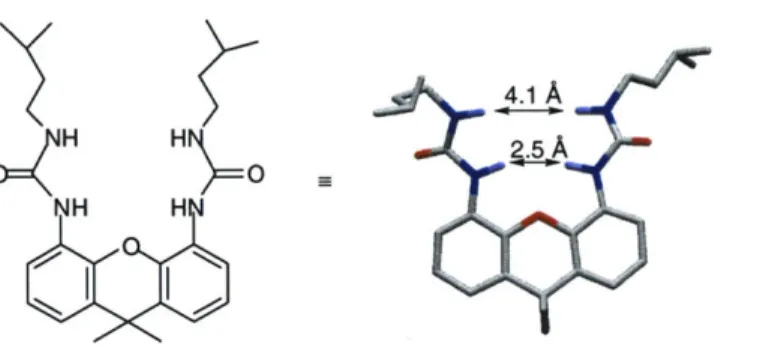
Finally, the use of the urea linkage conformationally limits the building blocks, as rotation about the urea N-C bond and the core-carbonyl bonds at the 4 and 5 positions are restricted. For example, the solution and solid-state structure of a 4,5-diurea xanthene has been determined (Figure 2).7 These studies showed that the urea N-H groups are directed inward (toward the xanthene oxygen) and create a binding pocket between them. The carbonyl oxygens are directed outward and are available for intermolecular hydrogen bonding. This preorganization reduces the entropic cost of binding to target molecules.
4.1 A
NH H
NH
Figure 2. A polytube rendering of the x-ray crystal structure of a xanthene diurea.' Note the orientation of the ureas. Nuclear Overhauser effect NMR studies suggest a similar solution phase structure.5
2.2 Background-B-chLorocatechoLborane usage in urea formation
Xanthene tetraacid 1, previously used as its acid chloride as a core molecule for combinatorial polyamide synthesis,8 was taken as the starting point for building combinatorial urea libraries, as well. In an initial approach, Shipps, et al.,9 made use of a procedure introduced by Valli and Alper'0 in which a carbamate (urethane) is subjected to B-chlorocatecholborane-induced dealcoholysis to yield an isocyanate in situ, followed by addition of an amine to provide the final urea. This scheme required a xanthene tetracarbamate as the core molecule, and thus xanthene tetraethylcarbamate 2 was synthesized in a two-step, one-pot reaction from tetraacid 1 (Scheme 2).
8 Carell, T.; Wintner, E. A.; Rebek, J., Jr. Angew. Chem., Int. Ed. EngL 1994, 33,2061-2064.
9 Shipps, G. W., Jr.; Spitz, U. P.; Rebek, J., Jr. Bioorg. Med Chem. 1996, 4, 655-657.
10
H H
HOOC COOH EtO N N OEt
1. (COC)2, cat. DMF0 0 2. TMS-N3, EtOH 0 COOH COOH O NH HN 0 OEt OEt 1 2
F
1H
H
B-CI OCN NCO RHN N N NHR
Occ amines (RNH) Y Y
TEA, A NCO NCo OY NH HN 0
NHR NHR
Scheme 1. Synthesis of tetraurea xanthenes using B-chlorocatecholborane.
2.3 Isolation of isocyanates
Xanthene tetraisocyanate
While the B-chlorocatecholborane approach to the synthesis of xanthene polyureas had its utility, it also suffered from a number of drawbacks, including sensitivity of the key reagent to air and moisture, difficulty in reaction workup, and dependence on multiple reaction steps for each point of diversity in the core. Isolation of the core isocyanates was advantageous for a number of reasons. The condensation reaction would be reduced merely to the addition of free-based amines directly to the activated core, and a simple aqueous acid wash would be sufficient workup. Additionally, if the polyisocyanates could be isolated and purified, the final purity of the libraries could be improved since the total number of reactions per site would be limited to one.
Given these considerations, we undertook studies to try and isolate the xanthene tetraisocyanate. A successful synthesis thereof is shown in Scheme 2. We introduced an alternative method to synthesize the requisite xanthene tetraacyl azide from tetraacid
chloride 3,8 making use of aqueous sodium azide in acetone," which allowed the intermediate to be cleaned by extraction prior to the Curtius rearrangement. This next step was carried out in refluxing toluene without isolating the potentially-explosive tetraacyl azide, yielding tetraisocyanate 4 in overall 95% yield.
CIOC COC 1. NaN3, water, OCN NCO
acetone
0 2. toluene, 0
COC COC reflux NCO NCO
3 4
Scheme 2. Synthesis of the xanthene tetraisocyanate core molecule.
The tetraurea libraries were then synthesized by reacting the tetraisocyanate core molecule simultaneously with a mixture of amines in a single reaction vessel. Simple liquid-liquid extraction (dichloromethane-1 N citric acid) eliminated excess amines after the reaction, then the libraries were treated with neat TFA to cleave the acid-labile protecting groups. This deprotection liberates hydrophilic functions and enhances solubility in aqueous solutions for screening. Following deprotection, the libraries could be precipitated by the addition of ether/hexanes (1:1); filtration allowed removal of the soluble remnants of the amino acid side-chain protecting groups and isolation of the tetraureas.
Xanthene diisocyanate
Because the xanthene 4 and 5 positions are close in space, steric interactions between a building block attached at one of these positions and a nucleophile attacking at the other could introduce concentration biases during library synthesis. Previously-published methods' were used to verify that statistical mixtures of compounds were indeed formed in the libraries. Accordingly, the 4,5-xanthenediisocyanate 7 was synthesized (Scheme 3), and was used to synthesize diureas for HPLC and CE-MS analysis. The results of these diurea studies
supported the claims of predictable, approximately statistical product distributions. Diisocyanate 7 proved to be a such a versatile intermediate that it was used to synthesize diureas for studies in molecular recognition reported elsewhere.'
1. BuLi, TMEDA, heptane, A N N (COC) 2, cat. DMF
I I
I
I
-
I
I
-O - 2. C02 (s), 49% / quant. O
COOH COOH COCl COCl
5 6
1. aq. NaN3, acetone
I
I
2. toluene, A, 72% I
NCO NCO
7
Scheme
3. Synthesis of the xanthene diisocyanate core molecule.Xanthene diacid 5 was prepared by the dilithiation of 9,9-dimethylxanthene" followed by quenching the dilithio species with dry ice, and was then converted into diacid chloride 6 with oxalyl chloride. The diacyl azide was formed in situ from the diacid chloride with aqueous NaN3 in acetone, and was converted to the diisocyanate 7 in a manner
analogous to tetraisocyanate 4 above.
Adamantane tetraisocyante
While the study of the xanthene polyisocyanates was underway, a revisiting of the tetrasubstituted adamantane core3 was also considered. Fellow graduate student Gerald
Shipps had previously made use of adamantane tetraacid chloride 8 as a core molecule for tetraamide libraries. An extension of this core to tetraisocyanate 9 for the production of tetraurea compounds was successful by the application of similar methodology to the xanthene case (Scheme 4).
12 Hillebrand, S.; Bruckmann, J.; Kruger, C.; Haenel, M. W. Tetrahedron Lett. 1995, 36, 75-78.
COOH COCI COOMe
1) (COC0)2, cat DMF, MeOH,TEA
COOH 2) hv C1OC COCI 34%, 2 steps MeOOC COOMe
CIOC MeOOC
(impure)
COOH COCI NCO
NaOH (aq) (COC0)2, cat DMF 1. NaN3
85% HOOC 90% CIOC CC 2A 2CH OCN NCO
'12 COCI88% C
HOOC CIOC 8 ON
Scheme
4. Synthesis of adamantane tetraisocyanate 9.While the adamantane tetraisocyanate was well-behaved chemically, disadvantages to tetrasubstituted adamantane libraries, such as the large volume of the tetrafunctionalized core and particularly the inaccesibility of differently-substituted derivatives suitable for deconvolution, discouraged further use of the core.
2.4 Deconvolution of xanthene tetraurea libraries
BnOOC COOBn BnOOC COOBn
I
1.NaN3|
I
0 2. A, 81% C
COCI CoCI NCO NCO
10 11
Scheme 5. Synthesis of a site-differentiated xanthene intermediate for the deconvolution of tetraurea libraries.
The development of a method for obtaining unsymmetrical tetraureas is shown in Scheme 5. The dibenzylester diacid chloride 1014 served as a precursor to a urea-based core structure which distinguished the "top" two sites from those at the bottom. The benzyl ester protecting groups are easily removed using hydrogenolysis,15 a procedure compatible with most peptide protecting groups. The diacid chloride 10 was converted to the diacyl azide
14 Carell, T.; Wintner, E. A.; Sutherland, A. J.; Rebek, J. Jr.; Dunayevskiy, Y. M.; Vouros, P. Chem. Biol 1995, 2,
171-183.
using sodium azide in acetone as above and then heated to give the diisocyanate dibenzyl ester 11.
Xanthene 11 could then be reacted with one or more amines, depending upon the stage of the deconvolution sequence (Scheme 6). If one (in the case shown, Leu t-butyl ester) or two different amines are condensed with 11 a separation can be performed to give purified diureas 12. Hydrogenolysis cleaves the benzyl ester groups and gives the diacid diurea 13. Activation of the acid groups as acid chlorides proved, unfortunately, to be incompatible with acid-sensitive functionality on the protected amino acids (i.e., the t-butyl esters), or the urea function itself, for that matter. Instead, the diacid was converted to the mixed anhydride with ethyl chloroformate using triethylamine as the base in acetone (Scheme 6). Without purification, the mixed anhydride was treated with sodium azide to furnish the diacyl azide (22). Rearrangement was effected by heating the diacyl azide in toluene, and the diisocyanate dileucine diurea 14 was obtained. Then, one (Phe
t-butyl
ester in the case of 15) or more amines could be reacted with 14 to give the desired tetraurea(s).BnOOC COOBn HOOC COOH
0 0
Leu-OtBu NH HN H,/ NH HN
TEA O=( )=O quant. O=< )=0
98% tBuOOC NH H COOtBu tBOOC H H COOtBu
12 CN 0 N C Phe-OtBu, , TFA O=( =o TEA 75% NH HN tBuOOC H COOtBu 14 1) NEt3 2) CICOOEt 3) NaN3, A 4 14 94% 13 COOH COCH NH HN NH HN HOOC~ 15 COCH
2.5 Identification of xanthenes active in binding to DNA
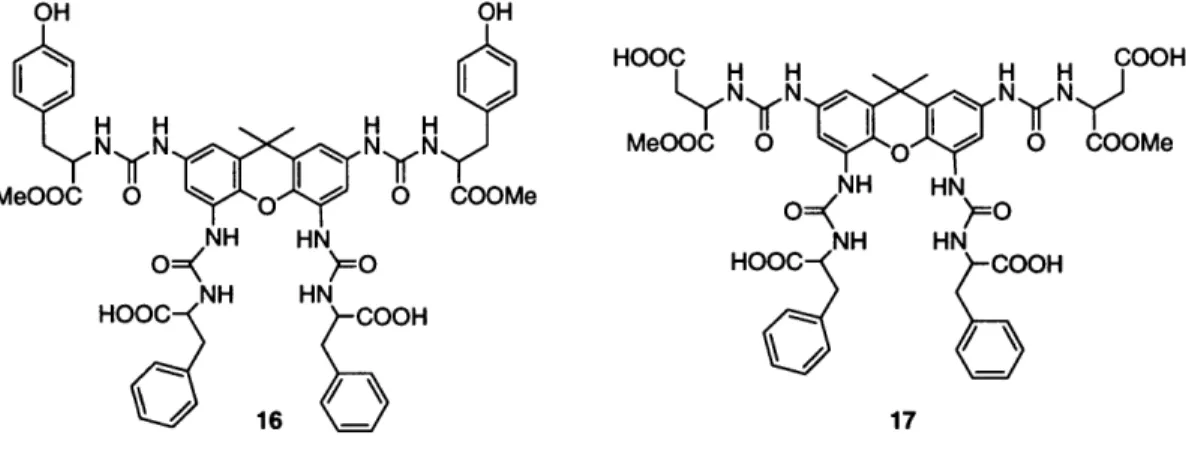
Xanthene libraries prepared both with the B-chlorocatecholborane method and, after its discovery, the xanthene tetraisocyanate method were assayed for activity in the inhibition of DNA/Zn-finger transcription factor complex formation. The assays were performed by collaborators in the Division of Biology at CalTech, and the library preparation and deconvolution was performed primarily by coworkers of the author. A detailed description of this particular project can be found elsewhere, and the results are summarized here. From five initial libraries of 2080 compounds each, two compounds (Figure 3) were shown to be active in binding to DNA at 5- to 10-pM concentration. The selection process that identified two active compounds from a pool of approximately 10,000 required only about 20 assays, and is therefore one of the most efficient procedures in that regard.
OH OH
HOOC H H H H COOH
H H H H YN
iN N Y NN
NN N N MeOOC 0 q 0 COOMe
MeOOC 0 0 0 COOMe ONH HN=O
NH HN NH HN
O= OHOOC COOH
NH HN
HOOC COOH
16 - 17
Figure 3. Structures of the two xanthene tetraureas active in binding to DNA.
2.6 Experimental
General
All reagents were purchased from Aldrich Chemical Company and were used without further purification except as noted. Amino acid esters, PyBOP, and EDC*MeI were acquired from Novabiochem (San Diego, CA). Deuterated solvents were obtained from
Cambridge Isotopes Laboratories and deuterated chloroform was dried over 4A molecular sieves. HCl refers to a
1N
stock solution. NMR spectra were recorded on either a Bruker AC-250, a Bruker AM-300, or a Bruker DRX-600; TMS was used as a reference in some chloroform-d spectra, otherwise residual solvent was used as a reference. Either a Finnegan Mat 8200 (for EI) or a VG ZAB-VSE (for FAB) mass spectrometer was used to ascertain masses. FT-IR spectra were obtained on a Perkin Elmer Paragon 1000 PC FT-IR Spectrometer. Silica gel chromatography was performed with Silica Gel 60 (EM Science or Bodman, 230-400 mesh). TLC analysis was performed using glass-bound Silica Gel 60 (F254) plates. DMAP=
N,N-dimethyl-4-aminopyridine, DPPA = diphenylphosphoryl azide, EDCeMeI = 1-(3-dimethylaminopropyl)-3-ethylcarbodiimide methiodide, PyBOP benzotriazole-1-yl-oxy-tris-pyrrolidino-phosphonium hexafluorophosphate.HPLC
For tetraester tetraureas (before deprotection) a C18 reverse-phase column (Rainin Microsorb-MV, 4.6 x 250 mm, 5 pm, 100
A) was used for HPLC analysis with a flow rate of
1 mL/min. A linear gradient of 100% water to 100% MeCN over 30 min with a total run time of 45-50 min was used for most runs. The detection wavelength was 268 nm (Xmax forthe xanthene tetraurea fragment), and the extinction coefficients of the tetraureas were assumed to be equal. After deprotection a C8 reverse-phase column (Waters Symmetry, 3.9 x 150 mm, 5 jm, 100
A) was used employing similar gradients and a 1 mL/min flow rate.
2,4,5,7-Tetraisocyanato-9,9-dimethylxanthene (4).
To a solution of tetraacid chloride 3 (0.40 g, 0.76 mmol) in dry acetone (20 mL) at 0 *C was added a solution of sodium azide (0.81 g, 12.5 mmol) in 2 mL water. A precipitate immediately formed, and the mixture was stirred for 30 min. The resulting slurry was extracted with methylene chloride (2 x 100 mL), and the organic layer was dried over MgSO4, filtered, and concentrated to about one-tenth its original volume. Toluene (20 mL)
was added, and the remaining methylene chloride was evaporated. The toluene solution was refluxed for 1.5 h under argon, cooled to rt, then filtered through a fine frit to remove traces of suspended solids. Concentration of the solution afforded 4 (0.270 g, 95/) as a beige solid. mp 173-1760C. 'H NMR (250 MHz, CDCb3): 8 6.93 (d, J= 2.4 Hz, 2H), 6.79 (d, j= 2.4 Hz, 2H), 1.59 (s, 6H). 13C NMR (62.9 MHz, CDCl3):
6
141.54, 131.25, 129.16, 126.98, 124.72,123.26, 119.82, 119.46, 35.13, 31.04. HRMS (EI) m/ calcd for [CI9HON405]* 374.0651
found 374.0643.
I - I 1 r_ - r
9,9-DimethvL-4,5-xanthene dicarboxylic acid (5).
9,9-Dimethylxanthene (2.00 g, 9.5 mmol), dry heptane (100 mL), and TMEDA (3.5 mL, 24 mmol) were combined and degassed with Ar for 15 min before n-BuLi (1.6 M in hexane, 15 mL, 24 mmol) was added. The solution was warmed to reflux under Ar for 15 min, then allowed to cool to rt. The reddish solution was canulated onto a large excess of dry ice, allowed to stand for 1 h, then EtOAc and 2 M HCl were added until most of the solids dissolved and the pH
=
1. The layers were separated and the aqueous layer was extracted twice with EtOAc:THF (20:1). The combined organic layers were rinsed once with brine and dried over Na2SO 4. Upon concentration a white solid precipitated. The flask was then cooledto 0 0C, and 5 (1.39 g, 49%) was isolated asa slightly yellow powder upon filtration. Additional material (-0.2 g) could be recovered from the orange filtrate but contained about 15% of an impurity. m.p. 248-249 *C. 1H NMR (250 MHz, DMSO-d): 8 12.9 (br. s, 2H), 7.80 (dd, J= 7.8, 1.7 Hz, 2H), 7.69 (dd, J 7.7, 1.5 Hz, 2H), 7.23 (t, J= 7.8 Hz, 2H), 1.61 (s, 6H). "C NMR (62.9 MHz, DMSO-d): 5 166.19, 147.72, 130.72, 130.40, 129.45, 123.57, 119.93, 33.85, 31.94. HRMS (EI) m/ calcd for [C17H1 4OJ]* 298.0841 found 298.0839.
IJK.
S 20
9,9-DimethyL-4,5-xanthene dicarboxylic acid chloride (6).
To the suspended diacid 5 (0.75 g, 0.25 mmol) at 0 'C in ethanol-free chloroform (100 mL) was added oxalyl chloride (4.0 mL, 46 mmol) and DMF (5 pL). Within 15 min a clear solution was evident and the contents were warmed to reflux under a drying tube for 1 h. The solution was evaporated to dryness, 5 mL dry toluene was added, and the mixture was again evaporated, yielding 6 (0.84 g, quant.) as a pale yellow solid. m.p. 144-146 *C. 'H NMR (250 MHz, CDCl3): 8 7.92 (dd,
J
= 7.7, 1.5 Hz, 2H), 7.68 (dd, J = 7.9, 1.5 Hz, 2H),7.25 (t, J= 7.8 Hz, 2H), 1.66 (s, 6H). "C NMR (62.9 MHz, CDCl3): 5 163.55, 163.34, 131.57,
131.22, 131.11, 123.65, 34.41, 31.99. HRMS (EI) m/ calcd for [C17H2Cl2O3]*' 334.0163
found 334.0160. ) I j 1 R 7. 6.1 0 5.'s 5