Novel microsatellite DNA markers
indicate strict parthenogenesis and few
genotypes in the invasive willow sawfly
Nematus oligospilus
V. Caron
1*, M. Norgate
1, F.J. Ede
2, T. Nyman
3,4and P. Sunnucks
11
Australian Centre for Biodiversity, School of Biological Sciences, Monash
University, Clayton, Victoria 3800, Australia:
2Biosciences Research Division,
Department of Primary Industries, PO Box 48, Frankston, Victoria 3199,
Australia:
3Department of Biology, University of Eastern Finland, PO Box
111, FI-80101, Finland:
4Institute of Systematic Botany, University of Zurich,
Zollikerstrasse 107, CH-8008 Zurich, Switzerland
Abstract
Invasive organisms can have major impacts on the environment. Some invasive
organisms are parthenogenetic in their invasive range and, therefore, exist as a
number of asexual lineages (= clones). Determining the reproductive mode of
invasive species has important implications for understanding the evolutionary
genetics of such species, more especially, for management-relevant traits. The willow
sawfly Nematus oligospilus Förster (Hymenoptera: Tenthredinidae) has been
introduced unintentionally into several countries in the Southern Hemisphere
where it has subsequently become invasive. To assess the population expansion,
reproductive mode and host-plant relationships of this insect, microsatellite markers
were developed and applied to natural populations sampled from the native and
expanded range, along with sequencing of the cytochrome-oxidase I mitochondrial
DNA (mtDNA) region. Other tenthredinids across a spectrum of taxonomic
similarity to N. oligospilus and having a range of life strategies were also tested.
Strict parthenogenesis was apparent within invasive N. oligospilus populations
throughout the Southern Hemisphere, which comprised only a small number of
genotypes. Sequences of mtDNA were identical for all individuals tested in the
invasive range. The microsatellite markers were used successfully in several sawfly
species, especially Nematus spp. and other genera of the Nematini tribe, with the
degree of success inversely related to genetic divergence as estimated from COI
sequences. The confirmation of parthenogenetic reproduction in N. oligospilus and the
fact that it has a very limited pool of genotypes have important implications for
understanding and managing this species and its biology, including in terms of
phenotypic diversity, host relationships, implications for spread and future adaptive
change. It would appear to be an excellent model study system for understanding
evolution of invasive parthenogens that diverge without sexual reproduction and
genetic recombination.
*Author for correspondence Fax: + 61 3 9905 5613
E-mail: [email protected]
Bulletin of Entomological Research (2013) 103, 74–88 doi:10.1017/S0007485312000429 © Cambridge University Press 2012
https:/www.cambridge.org/core/terms. https://doi.org/10.1017/S0007485312000429
Keywords:
microsatellite isolation, cross-amplification, invasive species, asexual
reproduction, Tenthredinidae
(Accepted 29 May 2012; First published online 29 August 2012)
Introduction
Invasive organisms can have major impacts on the environments they invade. They have an effect on biodiversity and are one of the main causes of extinction (Diamond,1989; Courchamp et al.,2003; Raven & Yeates,2007). They can also deeply affect communities and change ecosystem processes (e.g. Atkinson & Cameron,1993; Lonsdale,1999; Mack et al., 2000; Levine et al.,2003; Sanders et al.,2003). Due to increased human movement and climate change, the prevalence of invasive organisms is likely to increase in the future (Hobbs & Mooney,2005).
Knowledge of the biology, natural history and biological requirements of a given invasive organism is valuable in order to facilitate management and control, and to predict potential distribution. For example, information on genetic variation and reproductive mode of a species can contribute to predicting its longer-term impacts. Due to a typically small number of individuals initially introduced, many invaders experience bottlenecks due to low genetic variation in the introduced population (Lambrinos,2004). Invasive organisms may undergo rapid evolution to adapt to local conditions, although this is more likely if genetic variation is high for evolution to act upon (Lee, 2002; Kawecki & Ebert,2004). Furthermore, genetic variation can affect the capacity to colonize and invade (Tagg et al.,2005; Crawford & Whitney, 2010) and thus has important implications in terms of the success of invaders (Roman & Darling, 2007; Lucek et al., 2010).
Invasive organisms sometimes shift from sexual reproduc-tion to obligate or facultative parthenogenesis in their invasive range (e.g. Moran,1992; Dybdahl & Lively,1995; Sunnucks et al.,1996). Without any need for mating, parthenogenesis allows populations to increase quickly, with a two-fold reproductive advantage compared to sexual populations (Maynard Smith,1978). Although rapid increase in population size is an advantage for parthenogens, genotypic variation may be very low; and, in the absence of genetic recombination, natural selection is unable to act on individual genes or chromosomal regions. In situ adaptation, therefore, may be considered less likely. Thus, the success of parthenogenetic invasive organisms has been attributed mainly to phenotypic plasticity or to the introduction of different specialized asexual genotypes (Peccoud et al., 2008). Nonetheless, evolution by mutation can occur and lead to new phenotypes of ecological significance (Lynch, 1985; Sunnucks et al., 1998; Loxdale, 2008).
There are different types of parthenogenesis, with different consequences for population genotypic variation. Automictic parthenogenesis involves meiosis and, therefore, the possi-bility of recombination (so daughters differ genetically from their mothers), although some forms result in increasing and high homozygosity. In apomictic parthenogenesis, new forms or clones can occur only following mutation and chromosomal rearrangements, and so daughters are genotypically very
similar to their mother (Suomalainen, 1962). Genotypic variation is generally expected to be low in apomictic parthenogenesis, although this depends on rates of formation of new asexual lineages from sexual ancestors, population sizes and mutation rates (Loxdale, 2008, 2009). In many parthenogens, individuals capable of sexual reproduction can also be produced.
Molecular tools have revolutionized our understanding of population biology and ecology. Of all the genetic markers available, high resolution microsatellite markers are by far the most commonly used in ecological studies (Selkoe & Toonen, 2006). Microsatellites or simple sequence repeats (SSRs) are repeated motifs of one to six bases found mainly in the non-coding areas of the genome and have several favourable properties as genetic markers (Sunnucks, 2000). They are typically selectively neutral and highly length-variable (Chambers & MacAvoy, 2000), and this polymorphism makes them very applicable to focus on fine-scale questions that were previously impossible to tackle (Zane et al., 2002; Selkoe & Toonen,2006). For example, their variability makes them ideal for distinguishing individual genotypes and assessing levels of gene flow between populations (Lowe et al.,2004). They are also well suited for assessing mating strategies and reproductive modes. For example, sexual and asexual populations are readily distinguished (e.g. Gómez & Carvalho,2000; Wilson et al.,2002; Vorburger et al.,2003).
The willow sawfly, Nematus oligospilus (Hymenoptera: Tenthredinidae), is native to North America (southern Alaska to Mexico) and Eurasia (Ireland to the Himalayas), where it is widespread (Smith,1979), whilst it has been introduced into Argentina (Dapoto & Giganti,1994), South Africa (Urban & Eardley,1995), New Zealand (Berry,1997; Charles et al.,1998) and Australia (Bruzzese & McFadyen2006; Ede et al.,2007). It has spread quickly after each new introduction (Dapoto & Giganti,1994; Urban & Eardley,1995; Cowie,2006; Caron, 2011). Population densities can increase rapidly, resulting in defoliation of willow trees and substantial damage in some areas (Cowie,2006; Ede et al.,2009). On the basis of natural history data such as only females being observed, N. oligospilus is thought to be parthenogenetic in its invasive range, whereas both sexes occur in the native range (Charles et al., 1998; Koch & Smith,2000). However, rare and unobserved sexual reproduction is common in parthenogens (Hurst et al.,1992). If it can be established that it is indeed parthenogenetic in its invaded range, N. oligospilus provides an opportunity to study the ongoing ecology and evolution of an invasive species that has lost sexual reproduction. Effective molecular markers are necessary to establish the reproductive mode, spread and population dynamics of N. oligospilus.
Like all Hymenoptera, the ancestral reproductive mode for tenthredinid sawflies is haplodiploidy (arrhenotoky); females are the product of fertilization and have two copies of each chromosome, whilst males arise from unfertilized eggs and carry only a maternal haploid set of chromosomes (Normark, 2003). Parthenogenesis occurs in many species and is obligate Strict parthenogenesis and few genotypes in N. oligospilus 75
https:/www.cambridge.org/core/terms. https://doi.org/10.1017/S0007485312000429
in some (Craig & Mopper,1993). In some insects, males are unknown (Benson, 1950), while in others, a few males are produced and their role is ambiguous (Craig & Mopper,1993). Both apomictic and automictic parthenogenesis occur in tenthredinids (Suomalainen,1962; Knerer,1993).
Tenthredinid sawflies have been relatively little studied compared to other groups of Hymenoptera. Nonetheless, due to interesting life characteristics, such as their reproductive mode and feeding strategies, and because tenthredinids have undergone recent evolutionary radiation, they can be studied in order to investigate ecological and evolutionary theories concerning host-plant relationships, trophic inter-actions, speciation and adaptive radiation (Knerer, 1993; Roininen et al.,1996; Price et al.,2005; Nyman et al.,2006a, 2010). However, little has so far been done on population biology and mating systems of this group taking advantage of highly-resolving molecular markers such as microsatellites. Previous population studies on phylogeography have used allozymes (Müller et al.,2004), while studies into heritability of defence traits were conducted using laboratory crosses (Müller et al.,2003). Most other molecular genetic studies on this group have used mitochondrial DNA (Nyman et al., 2006a, 2010; MacQuarrie et al., 2007). Microsatellites devel-oped for N. oligospilus could also prove useful for other sawfly species, although microsatellites developed from one species are typically less likely to be useful in genetically more distant species. Success of cross-amplification depends on the group targeted (e.g. Primmer et al.,1996; Zane et al.,2002; Zenger et al.,2003; Wilson et al.,2004; Barbarà et al.,2007; Palma-Silva et al.,2007).
The aims of the present study were twofold. The first was to determine the reproductive mode of N. oligospilus with the level of asexual (clonal) diversity by developing and applying microsatellite markers. Since sawflies represent an interesting study group, the second aim was to assess the applicability of the microsatellites so designed in different sawfly species of varying relatedness to N. oligospilus.
Materials and methods Study organisms
Nematus oligospilus individuals from different parts of the invasive range were used for the study. Individuals originated from South Africa, the North and South Island of New Zealand, and from eastern and western Australia. Although widespread, N. oligospilus is inconspicuous in its native range (Pschorn-Walcher, 1982). Individuals thought likely to be N. oligospilus were collected from Arizona, USA from sites where previous studies have been performed on this species (Carr et al.,1998) and in Montreal, Canada at a specific site where several specimens preserved in insect collections originated (V. Caron, personal observation). Other species chosen for this study, such as Nematus brevivalvis Thomson, were closely related to N. oligospilus as shown in previous studies (Nyman et al.,2010), while some other species were less closely related, belonging to other nematine tribes (e.g. Pristiphora spp.) and other subfamilies (e.g. Caliroa cerasi L., Rhadinoceraea sp. and Endelomyia aethiops F.;table 1).
The tenthredinid species assessed here encompassed different life strategies. Some are gall-formers such as Euura mucronata Hartig (Nyman, 2002). Pristiphora angulata Lindqvist is a facultative miner of flower buds, while the others are external feeders. Many are parthenogenetic,
including C. cerasi, E. aethiops and Pristiphora erichsonii Hartig (Benson,1950). Species like N. pavidus and Nematus iridescens Cresson are gregarious; the other species tested are primarily solitary but can occur at high population densities, as seen in N. oligospilus in its invasive range (Ede,2009). Many of the species chosen in this study are economically important. For example, C. cerasi (pear or cherry slug) can cause important damage to fruit trees (Carl,1972) and has been accidentally introduced to several countries including New Zealand and Australia (Naumann et al., 2002). Similarly, P. erichsonii, commonly known as the larch sawfly, can become a destructive pest of larch Larix sp. (Boévé,2004).
Microsatellite development
DNA was extracted using the 2 × CTAB extraction protocol (Grosberg et al., 1996) from legs of four N. oligospilus individuals collected from different areas in Australia and preserved in 96% ethanol. Microsatellite loci were developed using the FIASCO enrichment protocol (Zane et al.,2002) with minor alterations. The initial digestion did not contain Bovine Serum Albumin (BSA) and the pre-amplified product was cleaned with 0.1 volume of 3M NaOAc and 2.5 volume of 100% ethanol, followed by an overnight incubation at–20°C. The product was then centrifuged at 13,200 rpm (Centrifuge 5415D, Eppendorf, Hamburg, Germany) for 30 min and 70% ethanol washed. The DNA pellet was resuspended in 30μl of 1 × TE. After cleaning, 400 ng of the pre-amplified PCR product was hybridized to two probes, (AC)17and (ATT)17,
which were then captured with Streptavidin MagneSphere Paramagnetic Particles (Promega, Madison, WI, USA) as described in Roberts & Weeks (2009). PCR products amplified from the enriched DNA pool were cloned using a TOPO TA Cloning Kit for Sequencing according to the manufacturer’s instructions (Invitrogen). Eighty-seven clones were com-mercially sequenced (Macrogen Inc., Seoul, Korea).
DNA extraction for microsatellite screening
Between 250 and 1300 N. oligospilus individuals, most at the larval stage, were tested for each microsatellite locus, while six to ten individuals of each of the other sawfly species were screened. DNA was extracted from individuals preserved in 96% ethanol using the salting-out DNA extraction protocol described in Sunnucks & Hales (1996). DNA pellets were re-suspended in 50 to 100μl of 1×TE buffer.
Microsatellite screening
Following sequencing of DNA clones enriched for micro-satellites, 43 primer pairs were designed using Primer3 v.0.4.0. (Rozen & Skaletsky,2000) (table 2). One primer of each pair was labelled with infra-red dyes IRD™700 or IRD™800 (LI-COR Biosciences, Lincoln, NE, USA). PCR reactions contained: 1μl of 10×Taq buffer, 0.8μl of 25mM MgCl2,
1.6μl of 1.25mM dNTPs, 0.5μl of 10mg ml 1BSA, 0.4μl of Taq
Polymerase (Fermentas, Burlington, Canada), 0.5μl of 1μM of each primer, 0.3μl of 1μM of IRD™700 or IRD™800, 1μl of DNA template and Milli-Q water for a total volume of 10μl. Cycling conditions were: 94°C for 4 min, 35 cycles of 94°C for 1 min, 55°C for 30 s, 72°C for 1 min, with the annealing temperature of the first five cycles reducing by 1°C per cycle, the remaining 30 cycles having an annealing temperature of 50°C, all followed by a final extension of 72°C for 5 min. V. Caron et al.
76
https:/www.cambridge.org/core/terms. https://doi.org/10.1017/S0007485312000429
Multiplex reactions were prepared using the Qiagen PCR multiplexing kit (Qiagen, Hilden, Germany) when possible, to a maximum of 13 loci per PCR, following the manufacturer’s instructions. PCR products were electrophoresed with LI-COR Global IR2 two-dye DNA sequencers (models 4200 and 4300).
Mitochondrial DNA (mtDNA) analysis
To estimate genetic similarities within N. oligospilus and among species, Cytochrome oxidase I mtDNA was sequenced using primers HCO1490 and LCO2198 (Folmer et al.,1994). Seventy-four N. oligospilus individuals were assayed from 18 sites (14 in Australia, three from New Zealand, one from South Africa), and the mtDNA was also sequenced for one to eight individuals of the other sawfly species. The PCR reaction contained 2.5μl of 10×Taq buffer, 2μl of 25mM MgCl2, 4μl of
1.25 mM dNTPs, 12.25μl of 1mg ml 1 BSA, 1.25μl of Taq Polymerase (Fermentas), 1.25μl of 10μM of primer HCO and LCO, 0.5μl of DNA template to a total of 25μl. Cycling conditions were: 95°C for 5 min; 30 cycles at 95°C for 45 s, 50°C for 45 sec, 72°C for 1 min; 72°C for 10 min. PCR products were precipitated with 3M NaOAc and ethanol as described above for microsatellite development. Dried DNA pellets were commercially sequenced (Macrogen Inc.).
Analyses
Microsatellites were genotyped visually in Saga Generation 2 software (LI-COR). The number of alleles and genotypes, and expected heterozygosity were calculated in GENALEX 6 (Peakall & Smouse,2006). Mitochondrial DNA sequences were edited and aligned in Geneious Pro 5.3.4 (Biomatters Ltd, Auckland, New Zealand). Maximum like-lihood phylogenetic trees were computed in MEGA version 5
(Tamura et al.,2011). The best model of molecular evolution was chosen using the maximum likelihood fits of different nucleotide substitution models. The substitution model with the lowest Bayesian information criterion (BIC) was the General Time Reversible model with gamma distributed rates and was used to compute a tree for the whole dataset with 100 bootstrap re-samplings. To assess if there was a relationship between percent divergence and the number of loci amplified, a linear regression was done with p-distance expressed as a percentage sequence difference between each haplotype and that of N. oligospilus from the invasive range, in SYSTAT 13 (Cranes Software International Ltd, Bangalore, India). To determine if microsatellite evolution had a direc-tional bias and if smaller and larger alleles of heterozygotes were equally likely to mutate, Pearson’s chi square tests for goodness-of-fit were used. A mutation was assumed to have occurred when a rare multilocus genotype differed at only one allele compared to a very common genotype (Wilson et al., 2003).
Results Microsatellite development
Of 87 clones sequenced, 79 (91%) contained microsatellite sequences. Six unclear sequences that contained microsatel-lites were discarded. Where clones yielded similar sequences, only one of each group was developed as a locus. Fifteen clones contained two microsatellite sections. AC repeats were by far the most common, with 61 clones containing between five and 23 repeats. GA, GAA or GAAAA repeats were also relatively common, with ten sequences ranging between four and 100 repeats. AAT and ATT were shorter and rarer; only six sequences contained them. Many of the microsatellite sections were impure (table 2). Four sequences containing
Table 1. Sawfly species used in this study with the source, host plant, collector and number of individuals used (N )
Subfamily Tribe Species name Source Host plant N Collector
Nematinae Nematini Nematus oligospilus
(Förster)
Australia Salix sp. (Salicaceae) 1062 V. Caron
New Zealand 246 V. Caron
Bethlehem, South Africa 26 C. Eardley
Nematus oligospilus (Förster)
Flagstaff, AZ, U.S.A. Salix lasiolepis (Salicaceae) 10 V. Caron
Nematus sp. Montreal, Qc, Canada Salix sp. (Salicaceae) 8 V. Caron
Nematus iridescens (Cresson)
Flagstaff, AZ, United States
Populus sp. (Salicaceae) 8 P. Price
Nematus pavidus (Lepeletier)
Stow, England Salix sp. (Salicaceae) 4 V. Caron
Harpenden, England 4 V. Caron
Nematus brevivalvis (Thomson)
Kevo, Finland Betula pubescens (Betulaceae) 6 L. Kapari
Eitelius dentatus (Lindqvist)
Parikkala, Finland Salix phycifolia (Salicaceae) 8 H. Roininen
Euura mucronata (Hartig)
Kilpisjärvi, Finland Salix glauca (Salicaceae) 3 T. Nyman
Abisko, Sweden 5 T. Nyman
Nematinae Pristiphorini Pristiphora angulata
(Lindqvist)
Oulu, Finland Spirea chamaedryfolia
(Rosaceae)
8 T. Nyman
Pristiphora erichsonii (Hartig)
Ellsworth, ME, U.S.A. Larix sp. (Pinaceae) 1 C. Linnen
Joensuu, Finland 7 T. Nyman
Heterarthrinae Caliroini Caliroa cerasi (L.) Melbourne, Vic,
Australia
Prunus sp. (Rosaceae) 8 V. Caron
Endelomyia aethiops (Fabricius)
Joensuu, Finland Rosa sp. (Rosaceae) 8 T. Nyman
Blennocampinae Phymatocerini Rhadinoceraea sp. Keret, Russia Veratrum album
(Melanthiaceae)
8 H. Roininen
Strict parthenogenesis and few genotypes in N. oligospilus 77
https:/www.cambridge.org/core/terms. https://doi.org/10.1017/S0007485312000429
minisatellites were also detected. All 43 loci could be successfully amplified using N. oligospilus DNA as PCR template. Two loci (WF1 and WF43) yielded undefined products and were discarded after initial screening. WF19 also gave inconsistent results and was eventually discarded.
Reproductive mode and genotypic diversity in N. oligospilus All N. oligospilus from the invasive range screened shared a single allele at 23 (56.1%) of the 41 loci tested. Of the remaining 18 loci showing heterozygosity, few alleles were found; for 14 loci, there were only two alleles, while WF2, WF4, WF35 and WF40 had three. Furthermore, a maximum of three genotypes per locus were identified in invaded range N. oligospilus (table 2). Of these, 18 heterozygous loci, seven presented the same heterozygote in all invaded range individuals, so 11 were useful to discriminate among genotypes of invasive range individuals. One main genotype was discerned from the invasive range. There were 16 other closely related genotypes, of which 14 were different from the common genotype at only one allele of one locus, while the other two genotypes were different at two loci. Differences between alleles were apparently due to single mutations with alleles losing or gaining one repeat. The mutational process did not have apparent directional size bias (Pearsonχ2= 1.0,
df = 1, P = 0.317) and the smaller allele was not significantly more likely to undergo mutation than the larger allele (Pearsonχ2= 0.818, df = 1, P = 0.366). Low variation was also
seen in mtDNA sequences; all N. oligospilus sequenced from South Africa, New Zealand and Australia had identical mtDNA sequences (fig. 1).
Except for a single individual, all N. oligospilus in this study proved to be diploid (indicated by heterozygous loci) and are thus likely to be female. One apparent haploid individual (thus most likely a male) was detected during screening; the individual was collected as a larva, so could not be sexed physically. The lack of haploids combined with the distri-bution of a very common genotype and an array of rare, but closely related genotypes (despite considerable polymor-phism) suggest that obligate or facultative parthenogenesis (‘functional parthenogenesis’) is by far the most likely reproductive mode for N. oligospilus in its invaded range. The low genotypic diversity is unlikely to be caused by low power in the genetic assay; the loci can readily distinguish different genotypes when they are present in other species (next section) and, with 18 multi-allelic loci, would detect new sexually-produced genotypes in the sampled invaded range with extremely high certainty.
Other sawfly species
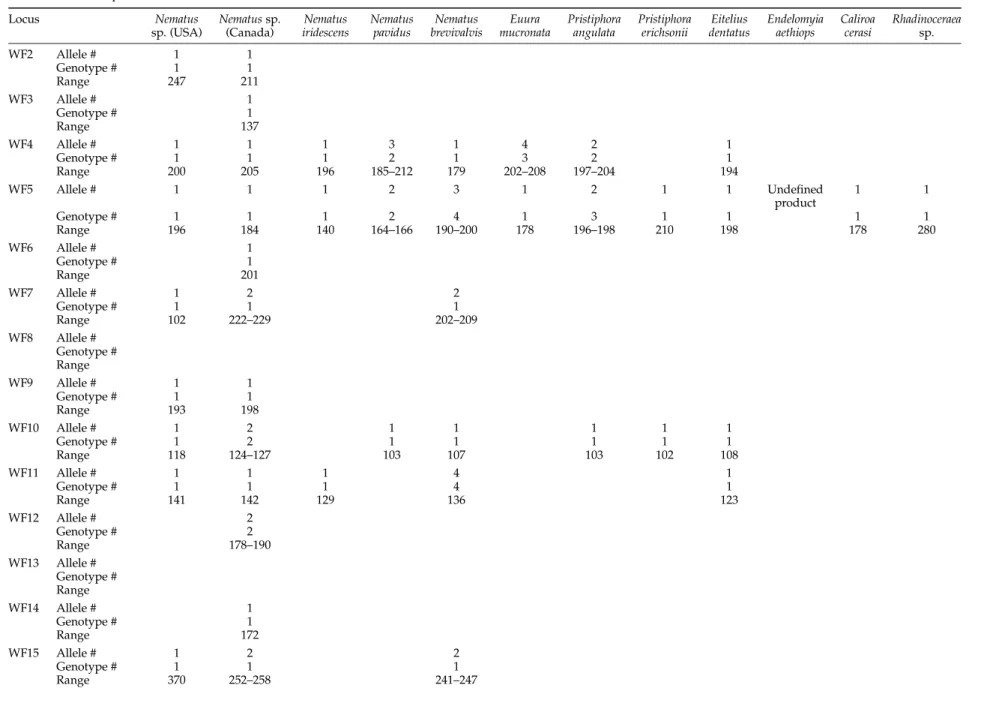
Many of the loci developed for N. oligospilus also amplified successfully in other sawfly species. Only two loci were specific to N. oligospilus. Most loci amplified in up to five of the species tested, and a few loci amplified in eight or more, including WF5 which amplified in all species tested (table 3). When they did amplify, most microsatellites had alleles unique to each species. Twenty-one loci revealed intraspecific variation, often in multiple species (table 3). Microsatellite loci useful in discriminating N. oligospilus genotypes were not more likely to differentiate between individuals of other species. Allele diversity was the highest for Nematus sp. (Canada) (53), followed by N. brevivalvis (47) and N. pavidus (33), despite low samples sizes (6–8), as compared with >1300
N. oligospilus. There was considerable genotypic diversity in these other species; most individuals bore different genotypes, with the exception of N. iridescens and Nematus sp. (Arizona, USA). This reinforces the low genotypic diversity of N. oligospilus, in which individuals nearly all had the same genotype (table 3). The majority of individuals of most sawfly species screened were heterozygous at some loci, indicating they were likely to be female and therefore would reproduce parthenogenetically. In two exceptions, N. brevivalvis and P. angulata, genotypic patterns were consistent with the presence of haploid males and diploid females.
The different sawfly species screened with the new microsatellite markers were related to N. oligospilus to different extents as estimated from mtDNA sequences (fig. 1). Members of the tribe Nematini formed a distinct group, while the tribe Pristiphorini formed a sister group. The three other species, Rhadinoceraea sp., C. cerasi and E. aethiops, were placed at the base of the tree in a less-defined cluster. The most closely related to N. oligospilus was Nematus sp. collected in Canada, while Nematus sp. collected in Arizona was in a sister clade with N. brevivalvis. Nematus pavidus COI sequences were monophyletic but fell in two distinct branches. Euura mucronata and Eitelius dentatus had modest support for grouping within Nematus.
The percentage COI sequence divergence between invaded range N. oligospilus and other taxa was strongly negatively correlated with the percentage of loci amplifying in the other taxa (R2= 0.92, F
1,11= 176.8, P < 0.001) (fig. 2). Successful
amplification of loci in Nematus sp. varied between 29% for N. iridescens and 95% for the Nematus sp. from Canada, while Nematus sp. from Arizona, USA, had 56% success. The three more divergent species, Endelomyia aethiops, C. cerasi and Rhadinoceraea sp., each had only one locus amplifying (2.4%), while the success rate for Pristiphora species was*13%.
Discussion
Reproductive mode and clonal diversity in N. oligospilus Some of the most successful invaders are parthenogenetic (e.g. Corrie et al.,2002; Jokela et al.,2003; Mergeay et al.,2006; Budde et al., 2011). Nematus oligospilus is reported to be parthenogenetic in its invasive range (Urban & Eardley,1995; Koch & Smith,2000), which is supported by the present data. Males are thought non-existent, but could be merely rare or morphologically unrecognized. The microsatellite markers suggest that N. oligospilus daughters are diploid and bear no recombined copies of their mother’s microsatellite genotypes. Microsatellites indicated extremely rare haploid males in the invasive range– a single one was found in the >1300 individuals screened here. Although male(s) thus occur, their role is unknown; sexual reproduction has not been detected in this study according to the genotypic data. Given the number of variable loci, any new sexual recombination producing the screened individuals would have been detected very easily. Nematus oligospilus, therefore, can be recognized as a function-ally parthenogenetic organism within its invasive range. Apomictic and automictic parthenogenesis can be hard to discern when using few molecular markers (Rabeling et al., 2009), especially when recombination levels are very low (Kellner & Heinze,2011). In this study, the large number of microsatellite markers used showed no recombination, and heterozygosity was maintained; N. oligospilus is, therefore, unlikely to be automictic, and hence more likely to be V. Caron et al.
78
https:/www.cambridge.org/core/terms. https://doi.org/10.1017/S0007485312000429
Table 2. Characteristics of microsatellite loci isolated from Nematus oligospilus. Locus name, primer sequence, core repeat in sequenced clone, number of individuals tested (N ), number of alleles, number of genotypes, number of base pairs lost or gained when compared to main genotype (M), observed (Ho) and expected (He) heterozygosity, range of allele size, and FIS
Locus Primers (5′–3′) Repeat N N allele N genotype M (bp) Ho He Allele size FIS
WF2 F ATGTATCGGGAGTCCAATGC (CTT)5* (AC)7 1264 3 4 2 0.704 0.467 209–211 0.506
R TCGATAACGATATCTGTGTTACGAG
WF3 F CAGGAAGTAACTAGTGGCTCAAAC ACC GAG (AC)4 641 1 1 0 0 0 137 –
R CTCGTCATCTTCGTGATTCG
WF4 F TGTTCGCTGGTTGGAATAGC (AC)5GA (AC)8 364 3 2 + 2 0.997 0.503 204–210 0.986
R TATCGCAGGAAAACCGTACC
WF5 F TAACCAATAGGGGCGAAGTG (AC)12 398 1 1 0 0 0 199 –
R AGCTTGGGGTAGGTTTTTCC
WF6 F TGGATCTGTGGGACACAATG (GA)2AA (GA)5* (AC)11 1158 1 1 0 0 0 204 –
R CTCGTCGGGCAAGACTCTG
WF7 F TGTTGGCAGCATTTCTGTTC (AC)7AGAT (AC)3 526 1 1 0 0 0 228 –
R AGCCAGACTTGGCTCATTTC
WF8 F TGGACGAACTTGAGTTGCAG (AC)23 468 1 1 0 0 0 286 –
R CGAGATATCGACAAAACTGTGG
WF9 F GAGCACCCCTCACGTACC (AC)10 1119 2 2 6 0.999 0.500 204–210 0.998
R CAATTCCTATCCTGCGATCC
WF10 F GGCTTAGGCTCCCACTTCTC (AC)2(TC) (AC)6 1285 1 1 0 0 0 124 –
R AACTGCATTCCACGTTTTACG
WF11 F GATTTTCCCGATCGTACTAACC (AC)6GTACC (AC)3 1276 1 1 0 0 0 142 –
R TGCACTCGCGTATTGTTCTC
WF12 F CATGAAGAAAATCGCCCTTC (AC)10(AG)13 1258 1 1 0 0 0 185 –
R CCCCACTTCCCAAAATTCTC
WF13 F CCTCTGACTATTTTCATTTCACG (AC)14 1255 2 3 + 2 0.006 0.008 127–129 0.197
R TCATTTCTAAATCGAGGGAAGC
WF14 F GGATGGACTGAAAGCCAGAG (AC)3TC (AC)5 1194 1 1 0 0 0 171 –
R TTGGACCCAAGCTAAACTCAC
WF15 F CACTACCTTGGAAGATTTGTTG (AC)12 1222 2 2 + 6 0.999 0.500 264–270 0.998
R AGGATTTGACCCTGGACCTC
WF16 F GTGGCTGCAGTAGTCAGTGG (AC)5GAAT (AC)2AG (AC)3AG (AC)2 1215 1 1 0 0 0 295 –
R AGCAGGACAGCAAAACCTTG
WF17 F GCCCAGTTGGTCAAATCC (AC)3AA (AC)6 253 2 1 0 1.000 0.500 185–187 0.992
R CATTTCTTGGCGTCGTGTAG
WF18 F AACAGGCCGTGATTCGAG (AC)2CCCACC (AC)5 505 1 1 0 0 0 132 –
R CATGGCGAGAGACTGATACG WF19 F AGTGGAAAATACTCGCAGAGC (AC)16 293 2 1 0 1.000 0.500 147–164 1.000 R CGTCCACACGTCGCATAC Strict parthenogenesis and fe w genotypes in N. oligospilus 79 https:/www.cambridge.org/core/terms . https://doi.org/10.1017/S0007485312000429 Downloaded from https:/www.cambridge.org/core
. University of Basel Library
, on
10 Jul 2017 at 16:10:24
Table 2. (Cont.)
Locus Primers (5′–3′) Repeat N N allele N genotype M (bp) Ho He Allele size FIS
WF20 F TTTGCAGGCATGAGAGTCAG ACC (AC)7 1268 2 2 + 2 0.001 0.001 136–138 0.000
R AAGTGAACGTAATTAGATGCAGATG
WF21 F CATCAAATTTCACGTGGACAG (AAT)3AAC (AAT)8 1265 2 2 3 0.999 0.500 334–337 0.998
R TCTTCTTCCGTATGCTTCGAG
WF22 F AATAATTGGAGCAATATGTCG (AC)2AT (AC)2CCACGC (AC)3ATAC 368 1 1 0 0 0 263 –
R ACGAGCGTGGTGAGAAAATG
WF24 F GGTCGTTTGAACGGAACATAG (AC)2CC (AC)3AG (AC)3 367 1 1 0 0 0 283 –
R TCTGCTTAGATGGATGGATCG
WF25 F TTGTTCGGGAAGGTAAGTCAG (CTT)6* (CTT)6 1002 2 2 6 0.001 0.001 513–519 0.000
R CGAGAATCCTGTTGCGTGAG
WF26 F CGTCAGCTTGTCTTTTCGAG (AC)8 1274 2 1 0 1.000 0.500 417–419 1.000
R CGGTGGTTGTACGCTCGTC
WF27 F GAAAGCTGAATGCGGTATTTTC (AC)2GC (AC)7AG (AC)3 1274 2 2 2 0.999 0.500 120–122 0.998
R CAACGATAATAAAGTGTCCGATG
WF28 F GGACAGATGTGTGGAAATCG (AC)2A (AC)4T (AC)3 313 2 1 0 1.000 0.500 200–250 –
R ACGCCTGCAGAAGTTAGGAC
WF29 F CCATATCAGAGAGCCGTTC (AC)11 540 1 1 0 0 0 169 –
R GGAACGTGAGGGACACTGAG
WF30 F GGCTTTAGTGAGCTGAGATAGTCG (CTT)5* (AAC)7* (CTT)10 1198 2 2 2 1.000 0.508 403–415 0.969 R CCGATCAGTCGATCCGTTAG
WF31 F ACCTATGAGTCTGGCGGATG (ATT)3AGA (ATT)2 295 1 1 0 0 0 173 –
R TTGGGATCTTTGGCTAATGC
WF32 F GGGCAACGTAATGTGGAAAG (AC)8 1246 2 2 2 0.998 0.500 163–165 0.995
R CAACCCCTGCAATAAACACC
WF33 F GAGGCAGAAGCAGTTTTTGG (AC)4AA (AC)7 466 1 1 0 0 0 420 –
R CGTACCGACTTTCCGTCTTC
WF34 F TGCGTGTTATCTGACTCAAGG (AC)5GCACCCAT (AC)3 1272 1 1 0 0 0 276 –
R ACGTTACCCGGAAGATCAAG
WF35 F CACGTTGCTATCCACTTTAC (AC)14 1274 3 2 2 1.000 0.501 185–193 0.995
R AAATCATAGAGGCTGACCAC
WF36 F CCTCGCTAATCAATCCAC (AC)2CC (AC)2CCACCC (AC)3AG (AC)2 484 1 1 0 0 0 200 –
R GCGATATGGAGGAGATAAAG
WF37 F CGATCTTCAATTCGGTCTAC (AC)2AT (AC)4(GC)2(AC)4 1195 1 1 0 0 0 279 –
R TTCTCATGTTCTTCAACG WF38 F AATACCAGAAACAACCGAAG GCTTCT (GCTTT)2GCTTC 1295 1 1 0 0 0 121 – R TTTCTACAGGCGTAGAGTGG WF39 F GAAGCGTGTGGCATAATC (GAAA)4 1259 1 1 0 0 0 219 – R CTGCTCAACCAGTCTTTAC WF40 F TTTTCTGGGTGCAGGTTATTG (AC)11 1169 3 2 ± 2 0.999 0.520 176–184 0.920 R GGAAAATAATGATACAAACTCTGTTG
WF41 F CGCTTGTTAGAGCCTTGGTC (AT)3(AC)10 1258 2 1 0 1.000 0.500 285–287 1.000
R CGGTTTGTGCAGCTTACAATG WF42 F GCGAATATTTTGGTGCTATCC (AC)8 302 1 1 0 0 0 200 – R CCAGCAGGCTATAGACTACGTTC V . Caro n et al. 80 https:/www.cambridge.org/core/terms . https://doi.org/10.1017/S0007485312000429 Downloaded from https:/www.cambridge.org/core
. University of Basel Library
, on
10 Jul 2017 at 16:10:24
apomictic (i.e. reproduces parthenogenetically by mitotic copying of the maternal genome). Parthenogenesis being the sole reproductive mode helps explain the fast population growth observed in previous studies in the Southern Hemisphere (Dapoto & Giganti, 1994; Urban & Eardley, 1995; Charles & Allan,2000; Ede et al.,2007).
In its native range, N. oligospilus has sexual females and males (Koch & Smith, 2000). Thus, the parthenogenesis experienced in the Southern Hemisphere is geographical, where parthenogenesis occurs only in some of the range of the organism. The native range of N. oligospilus is extensive, covering most of North America and Europe all the way to the Himalayas (Smith, 1979; Liston, 1995), and it is likely to represent a species complex (Schmidt & Smith, 2009). We cannot discern if the species has a complete absence of sexual reproduction until native populations are assessed thoroughly. Two potential N. oligospilus populations were assessed in this study: Nematus sp. from Arizona and
Montreal. When comparing mtDNA sequences, and consider-ing the relatively modest proportion of microsatellite loci that amplified, Nematus sawflies collected in Arizona are likely to be a different species to N. oligospilus found in the Southern Hemisphere. The COI sequence divergence of 7.2% is in the range usually seen between members of different species of flying insects (e.g. Hebert et al.,2003,2004; Park et al.,2011). In contrast, the Nematus sp. collected in Montreal had lower mtDNA sequence divergence (2.6%) and high microsatellite locus cross-amplification, and could be conspecific with N. oligospilus. Although, it is unknown if the source of N. oligospilus is parthenogenetic or if sexual reproduction occurs, the high genotypic diversity of Nematus sp. from Montreal indicates sexual reproduction in a close relative.
Genotypic (clonal) diversity is very low in the invasive range of N. oligospilus. The combination of microsatellites and mtDNA sequences in this study showed that the invasive sawfly found in South Africa, New Zealand and Australia are
Fig. 1. Maximum likelihood phylogeny of the sawfly species estimated applying the GTR-G substitution model for the mitochondrial DNA cytochrome-oxidase I sequences. The number of microsatellite loci amplifying for each species is given in parentheses.
Strict parthenogenesis and few genotypes in N. oligospilus 81
https:/www.cambridge.org/core/terms. https://doi.org/10.1017/S0007485312000429
Table 3. Characteristics of microsatellite loci isolated from Nematus oligospilus screened on different sawfly species (number of alleles, number of genotypes, range of allele lengths). Empty cells indicate no amplification
Locus Nematus sp. (USA) Nematus sp. (Canada) Nematus iridescens Nematus pavidus Nematus brevivalvis Euura mucronata Pristiphora angulata Pristiphora erichsonii Eitelius dentatus Endelomyia aethiops Caliroa cerasi Rhadinoceraea sp. WF2 Allele # 1 1 Genotype # 1 1 Range 247 211 WF3 Allele # 1 Genotype # 1 Range 137 WF4 Allele # 1 1 1 3 1 4 2 1 Genotype # 1 1 1 2 1 3 2 1 Range 200 205 196 185–212 179 202–208 197–204 194 WF5 Allele # 1 1 1 2 3 1 2 1 1 Undefined product 1 1 Genotype # 1 1 1 2 4 1 3 1 1 1 1 Range 196 184 140 164–166 190–200 178 196–198 210 198 178 280 WF6 Allele # 1 Genotype # 1 Range 201 WF7 Allele # 1 2 2 Genotype # 1 1 1 Range 102 222–229 202–209 WF8 Allele # Genotype # Range WF9 Allele # 1 1 Genotype # 1 1 Range 193 198 WF10 Allele # 1 2 1 1 1 1 1 Genotype # 1 2 1 1 1 1 1 Range 118 124–127 103 107 103 102 108 WF11 Allele # 1 1 1 4 1 Genotype # 1 1 1 4 1 Range 141 142 129 136 123 WF12 Allele # 2 Genotype # 2 Range 178–190 WF13 Allele # Genotype # Range WF14 Allele # 1 Genotype # 1 Range 172 WF15 Allele # 1 2 2 Genotype # 1 1 1 Range 370 252–258 241–247 V . Caro n et al. 82 https:/www.cambridge.org/core/terms . https://doi.org/10.1017/S0007485312000429 Downloaded from https:/www.cambridge.org/core
. University of Basel Library
, on
10 Jul 2017 at 16:10:24
WF16 Allele # 2 1 2 Genotype # 1 1 1 Range 267–280 293 264–276 WF17 Allele # 1 Genotype # 1 Range 186 WF18 Allele # 1 2 1 1 Genotype # 1 2 1 1 Range 132 132–135 129 132 WF19 Allele # Undefined product Undefined product Genotype # Range WF20 Allele # 1 2 1 Genotype # 1 2 1 Range 129 134–136 125 WF21 Allele # 2 1 1 2 3 3 5 2 Genotype # 1 1 1 2 3 3 4 1 Range 305–317 339 300 282–284 343–347 303–309 276–286 276–279 WF22 Allele # 1 1 1 Genotype # 1 1 1 Range 270 263 267 WF23 Allele # 2 1 1 2 3 1 Genotype # 2 1 1 2 3 1 Range 230–232 232 239 226–230 237–241 235 WF24 Allele # 1 Genotype # 1 Range 284 WF25 Allele # 1 Genotype # 1 Range 508 WF26 Allele # 2 2 2 4 4 3 2 Genotype # 1 1 1 2 2 4 1 Range 410–412 398–420 288–296 238–246 384–412 454–460 495–501 WF27 Allele # 2 2 5 1 2 Genotype # 1 1 5 1 1 Range 203–209 128–130 122–131 116 108–110 WF28 Allele # 2 2 Genotype # 1 1 Range 250–280 198–247 WF29 Allele # 1 2 1 1 1 Genotype # 1 1 1 1 1 Range 169 169–171 162 166 166 WF30 Allele # 1 Genotype # 1 Range 512 Strict parthenogenesis and fe w genotypes in N. oligospilus 83 https:/www.cambridge.org/core/terms . https://doi.org/10.1017/S0007485312000429 Downloaded from https:/www.cambridge.org/core
. University of Basel Library
, on
10 Jul 2017 at 16:10:24
Table 3. (Cont.) Locus Nematus sp. (USA) Nematus sp. (Canada) Nematus iridescens Nematus pavidus Nematus brevivalvis Euura mucronata Pristiphora angulata Pristiphora erichsonii Eitelius dentatus Endelomyia aethiops Caliroa cerasi Rhadinoceraea sp. WF31 Allele # 1 1 Genotype # 1 1 Range 176 174 WF32 Allele # 2 Genotype # 1 Range 162–163 WF33 Allele # 2 1 3 2 2 1 Genotype # 1 1 3 2 2 1 Range 410–418 412 396–407 416–424 404–405 413 WF34 Allele # 1 Genotype # 1 Range 276 WF35 Allele # 3 2 Genotype # 4 1 Range 180–189 170–175 WF36 Allele # 1 1 1 1 5 1 1 Genotype # 1 1 1 1 5 1 1 Range 186 199 187 179 189–200 180 188 WF37 Allele # 2 Genotype # 2 Range 253–273 WF38 Allele # 1 1 Genotype # 1 1 Range 109 117 WF39 Allele # 1 1 1 2 6 1 Genotype # 1 1 1 2 5 1 Range 198 219 198 186–188 191–208 189 WF40 Allele # 3 Genotype # 3 Range 166–194 WF41 Allele # 1 2 1 3 1 1 3 2 2 Genotype # 1 2 1 2 1 1 2 1 1 Range 295 290–292 296 282–286 282 279 298–302 288–290 288–290 WF42 Allele # 1 1 1 1 1 1 1 1 1 Genotype # 1 1 1 1 1 1 1 1 1 Range 195 202 210 190 205 196 204 220 184
Total no. loci 23 39 12 14 21 11 6 5 11 – 1 1
N 10 8 8 8 6 8 8 8 8 8 8 8 No. aleles 30 53 12 33 47 19 14 7 14 – 1 1 No. genotypes 2 8 1 6 6 6 8 1 1 – 1 1 Ho 0.151 0.220 0.024 0.079 0.152 0.043 0.053 0.024 0.073 – – – He 0.113 0.146 0.012 0.131 0.168 0.060 0.051 0.012 0.037 – – – FIS 0.144 0.401 1.000 0.423 0.043 0.337 0.075 1.000 1.000 – – – V . Caro n et al. 84 https:/www.cambridge.org/core/terms . https://doi.org/10.1017/S0007485312000429 Downloaded from https:/www.cambridge.org/core
. University of Basel Library
, on
10 Jul 2017 at 16:10:24
extremely genetically similar. They have apparently identical mtDNA sequences (certainly in the COI region), and micro-satellite loci showed very similar (often identical as far as could be discerned) alleles and genotypes. Differences seen among N. oligospilus clones in the invasive range could be due to either the introduction of different clonal lineages or to mutations arising since introductions. Success of some invasive species has been attributed to the introductions of multiple clones, as in the pea aphid, Acyrthosiphon pisum Harris (Peccoud et al.,2008). In the case of N. oligospilus, the low number of closely related clones and one widespread ‘main’ genotype suggest one or very few colonization events. In apomictic parthenogens, genotypes can be altered by mutations and chromosomal rearrangements (Loxdale,2010). Slippage mutation during the replication of DNA is the main mutational process occurring in microsatellites (Schlotterer & Tautz, 1992). In N. oligospilus loci having more than one genotype, the difference between alleles of the main genotype and the novel alleles were the equivalent of losing or gaining a microsatellite repeat with equal probability. This shows that the differences in clonal lineages arose following non-directional mutations, at least roughly consistent with the stepwise mutation model, in which mutations are by single repeat slips rather than larger ones and unbiased in direction (Chambers & MacAvoy,2000). Further work is necessary to assess the spatial and temporal distributions of those clones, as well as their dispersal and host relationships.
Other sawfly species
Cross-amplification success of the new microsatellite markers was high for some other sawfly species tested. Relative to N. oligospilus, the proportions of additional genotypes discovered per individual screened were higher in some species, even though few individuals were screened for each species and most originated from a single site. Species such as C. cerasi are also thought to be parthenogenetic in Australia since males have not been collected (Naumann et al., 2002), while other species such as N. brevivalvis were inferred here to be sexual, showing more allelic diversity in a few individuals than N. oligospilus over a large part of its invasive range as here sampled.
As shown in other studies of broad taxonomic groups, here the more closely related to N. oligospilus a species was, the
more successful microsatellite amplification (Zenger et al., 2003; Primmer et al.,2005). Overall, the genus Nematus and the tribe Nematini had high proportion of successful amplifica-tion. The Pristiphorini tribe had lower success, but most loci that did amplify revealed multiple alleles. A review on the success of cross-amplification of microsatellites shows that different taxonomic groups have different success rates. As a generalization for arthropods, over 60% of loci developed for a species will amplify in congenerics. This decreases rapidly for different genera in the same family (Barbarà et al.,2007). Since largest genera in the Nematinae subfamily tend to be paraphyletic (Nyman et al.,2006b), it would not be judicious to predict the success of microsatellite markers at the level of genus; instead, the present results suggest that COI mtDNA sequence divergence is a very good predictor. In general though, microsatellite markers developed in this study are likely to be generally useful within the tribe Nematini, and still useful but less so for members of other tribes and subfamilies. Due to their fairly high cross-amplification, carefully chosen microsatellite markers from the suite as here developed would allow the simultaneous study of several species, allowing comparison between species having different life strategies and reproductive modes (and indeed elucidating those modes in the first place). Furthermore, some genera such as Euura have been more thoroughly studied than others and already form strong model systems (Craig et al., 1992; Roininen et al., 1996; Hjalten & Price,1997; Nyman, 2002; McGeoch & Price,2005; Price & Hunter,2005). Microsatellites used in conjunction with such models could be useful to test further ecological and evolutionary theories.
Conclusions
To manage an invasive species effectively, knowledge of its biology and ecology are essential. Reproductive mode and genotypic diversity can contribute to predicting impacts, distribution and population densities of invasive species. The present study showed that N. oligospilus is functionally parthenogenetic within its invasive range, with populations comprising only a small number of very closely related clones, which might go some way to explaining the rapid population growth seen in the introduced range (Caron, 2011). In Australia and other Southern Hemisphere countries, N. oligospilus would appear to be an excellent study system for understanding evolution of invasive parthenogens that diverge without sexual reproduction. Furthermore, the micro-satellites as developed represent useful tools for new and more highly-resolving approaches in well-established model systems, but also to study multiple species simultaneously.
Acknowledgements
We would like to thank colleagues for sharing samples (H. Roininen, C. Eardley, P. Price, C. Linnen and L. Kapari), A. Weeks for methodological advice, G. Perdomo, T. Hunt and D. Clements for technical assistance, A. Pavlova, C. Schmuki and T. Draper for useful discussions and H. Loxdale and an anonymous reviewer for helpful suggestions on the manu-script. This research was funded by Holsworth Endowment, the Department of Primary Industries Nancy Millis Postgraduate Award, North East Catchment Management Agency, West Gippsland Catchment Management Agency, North Central Catchment Management Agency and Melbourne Water. 100 y = –6.0754x + 98.902 R2 = 0.9227 80 60 % Ioci amplifying 40 20 0 0 5 10 15 20 % divergence mtDNA
Fig. 2. Relationship between the percentage of loci amplifying successfully and the percentage of interspecific sequence divergence as compared to the mitochondrial DNA cytochrome-oxidase I gene from Nematus oligospilus in the invasive range.
Strict parthenogenesis and few genotypes in N. oligospilus 85
https:/www.cambridge.org/core/terms. https://doi.org/10.1017/S0007485312000429
References
Atkinson, I.a.E. & Cameron, E.K.(1993) Human influence on the terrestrial biota and biotic communities of New Zealand. Trends in Ecology and Evolution 8, 447–451.
Barbarà, T., Palma-Silva, C., Paggi, G.M., Bered, F., Fay, M.F. & Lexer, C. (2007) Cross-species transfer of nuclear micro-satellite markers: potential and limitations. Molecular Ecology 16, 3759–3767.
Benson, R.B. (1950) An introduction to the natural history of British sawflies (Hymenoptera: Symphyta). Transactions of the Society for British Entomology 10, 45–134.
Berry, J.A. (1997) Nematus oligospilus (Hymenoptera:
Tenthredinidae), a recently introduced sawfly defoliating willows in New Zealand. New Zealand Entomologist 20, 51–54. Boévé, J.L. (2004) Sawflies (Hymenoptera: Tenthredinidae). pp. 1949–953 in Capinera, J.L. (Ed.) Encyclopedia of Entomology. Dordrecht, The Netherlands, Kluwer Academic Publishers.
Bruzzese, E. & McFadyen, R.(2006) Arrival of the leaf-feeding willow sawfly Nematus oligospilus Förster in Australia– pest or beneficial. Plant Protection Quarterly 21, 43–44.
Budde, K.B., Gallo, L., Marchelli, P., Mosner, E., Liepelt, S., Ziegenhagen, B. & Leyer, I.(2011) Wide spread invasion without sexual reproduction? A case study on European willows in Patagonia, Argentina. Biological Invasions 13, 45–54.
Carl, K.P. (1972) On the biology, ecology and population dynamics of Caliroa cerasi (L.) (Hym., Tenthredinidae). Zeitschrift für Angewandte Entomologie 71, 58–83.
Caron, V.(2011) Ecology and evolution of the invasive willow sawfly Nematus oligospilus Förster. School of Biological Sciences, Clayton, Victoria, Australia, Monash University. Carr, T.G., Roininen, H. & Price, P.W.(1998) Oviposition
pre-ference and larval performance of Nematus oligospilus (Hymenoptera: Tenthredinidae) in relation to host plant vigor. Environmental Entomology 27, 615–625.
Chambers, G.K. & MacAvoy, E.S. (2000) Microsatelllites: consensus and controversy. Comparative Biochemistry and Physiology Part B 126, 455–476.
Charles, J.G. & Allan, D.J.(2000) Development of the willow sawfly, Nematus oligospilus, at different temperatures, and an estimation of voltinism throughout New Zealand. New Zealand Journal of Zoology 27, 197–200.
Charles, J.G., Allan, D.J. & Fung, L. (1998) Susceptibility of willows to oviposition by the willow sawfly, Nematus oli-gospilus. pp. 230–234 in Proceedings of the 51st New Zealand Plant Protection Conference. 11–13 August 1998, Hamilton, New Zealand.
Corrie, A.M., Crozier, R.H., Van Heeswijck, R. & Hoffmann, A. A. (2002) Clonal reproduction and population genetic structure of grape phylloxera, Daktulosphaira vitifoliae, in Australia. Heredity 88, 203–211.
Courchamp, F., Chapuis, J.L. & Pascal, M. (2003) Mammal invaders on islands: impact, control and control impact. Biological Reviews 78, 347–383.
Cowie, B.(2006) Overcoming the threat posed by willow sawfly Nematus oligospilus. A review of research needs and possible options. Christchurch, New Zealand, Environmental Management Services Ltd.
Craig, T.P. & Mopper, S.(1993) Sex ratio variation in sawflies. pp. 61–93 in Wagner, M.R. & Raffa, K.F. (Eds) Sawfly Life History Adaptations to Woody Plants. San Diego, CA, USA, Academic Press.
Craig, T.P., Price, P.W. & Itami, J.K.(1992) Facultative sex-ratio shifts by a herbivorous insect in response to variation in host plant quality. Oecologia 92, 153–161.
Crawford, K.M. & Whitney, K.D. (2010) Population genetic diversity influences colonization success. Molecular Ecology 19, 1253–1263.
Dapoto, G. & Giganti, H.(1994) Bioecologia de Nematus desantisi Smith (Hymenoptera: Tenthredinidae: Nematinae) en las provincias de Rio Negro y Neuquen (Argentina). Bosque 15, 27–32.
Diamond, J.M.(1989) The present, past and future of human-caused extinctions. Philosophical Transactions of the Royal Society of London, Series B 325, 469–477.
Dybdahl, M.F. & Lively, C.M. (1995) Diverse, endemic and polyphyletic clones in mixed populations of a freshwater snail (Potamopyrgus antipodarum). Journal of Evolutionary Biology 8, 385–398.
Ede, F., Hunt, T., Clements, D. & Caron, V.(2009) Willow sawfly activity in Victoria: 2007–2009. Frankston, Victoria, Australia, Victorian Department of Primary Industries.
Ede, F.J.(2009) Can international experience help us to predict the potential impacts of willow sawfly (Nematus oligospilus Förster) on willow populations in Australia? Plant Protection Quarterly 24, 62–66.
Ede, F.J., Caron, V. & Clements, D. (2007) Willow sawfly activity in Victoria: the 2006/07 season. Frankston, Victoria, Australia, Victorian Department of Primary Industries. Folmer, O., Black, M., Hoeh, W., Lutz, R. & Vrijenhoek, R.
(1994) DNA primers for amplification of mitochondrial cytochrome c oxidase subunit I from diverse metazoan invertebrates. Molecular Marine Biology and Biotechnology 3, 294–297.
Gómez, A. & Carvalho, G.R.(2000) Sex, parthenogenesis and genetic structure of rotifers: microsatellite analysis of con-temporary and resting egg bank populations. Molecular ecology 9, 203–214.
Grosberg, R.K., Levitan, D.R. & Cameron, B.B. (1996) Evolutionary genetics of allorecognition in the colonial hydroid Hyractinia symbiologicarpus. Evolution 50, 2221–2240. Hebert, P.D.N., Cywinska, A., Ball, S.L. & Dewaard, J.R.(2003) Biological identifications through DNA barcodes. Proceedings of the Royal Society of London, Series B: Biological Sciences 270, 313–321.
Hebert, P.D.N., Penton, E.H., Burns, J.M., Janzen, D.H. & Hallwachs, W.(2004) Ten species in one: DNA barcoding reveals cryptic species in the neotropical skipper butterfly Astraptes fulgerator. Proceedings of the National Academy of Sciences of the United States of America 101, 14812–14817. Hjalten, J. & Price, P.W.(1997) Can plants gain protection from
herbivory by association with unpalatable neighbours?: A field experiment in a willow-sawfly system. Oikos 78, 317–322.
Hobbs, R.J. & Mooney, H.A.(2005) Invasive species in a changing world: the interactions between global change and invasives. pp. 310–331 in Mooney, H.A., Mack, R.N., Mcneely, J.A., Neville, L.E., Schei, P.J. & Waage, J.K. (Eds) Invasive Alien Species-A new Synthesis. Washington, DC, USA, Island Press. Hurst, L.D., Hamilton, W.D. & Ladle, R.J. (1992) Covert sex.
Trends in Ecology and Evolution 7, 144–145.
Jokela, J., Lively, C.M., Dybdahl, M.F. & Fox, J.A.(2003) Genetic variation in sexual and clonal lineages of a freshwater snail. Biological Journal of the Linnean Society 79, 165–181.
Kawecki, T.J. & Ebert, D.(2004) Conceptual issues in local ad-aptation. Ecology Letters 7, 1225–1241.
V. Caron et al.
86
https:/www.cambridge.org/core/terms. https://doi.org/10.1017/S0007485312000429
Kellner, K. & Heinze, J. (2011) Mechanism of facultative parthenogenesis in the ant Platythyrea punctata. Evolutionary Ecology 25, 77–89.
Knerer, G.(1993) Life history diversity in sawflies. pp. 33–60 in Wagner, M.R. & Raffa, K.F. (Eds) Sawfly Life History Adaptations to Woody Plants. San Diego, CA, USA, Academic Press.
Koch, F. & Smith, D.R. (2000) Nematus oligospilus Förster (Hymenoptera : Tenthredinidae), an introduced willow sawfly in the Southern Hemisphere. Proceedings of the Entomological Society of Washington 102, 292–300.
Lambrinos, J.G. (2004) How interactions between ecology and evolution influence contemporary invasion dynamics. Ecology 85, 2061–2070.
Lee, C.E.(2002) Evolutionary genetics of invasive species. Trends in Ecology and Evolution 17, 386–391.
Levine, J.M., Vila, M., D’antonio, C.M., Dukes, J.S., Grigulis, K. & Lavorel, S.(2003) Mechanisms underlying the impacts of exotic plant invasions. Proceedings of the Royal Society, Series B: Biological Sciences 270, 775–781.
Liston, A.D.(1995) Compendium of European Aawflies. Gottfrieding, Germany, Chalastos Forestry.
Lonsdale, W.M.(1999) Global patterns of plant invasions and the concept of invasibility. Ecology 80, 1522–1536.
Lowe, A., Harris, S. & Ashton, P. (2004) Ecological Genetics: Design, Analysis and Application. Carlton, Victoria, Australia, Blackwell Publishing.
Loxdale, H.D.(2008) The nature and reality of the aphid clone: genetic variation, adaptation and evolution. Agricultural and Forest Entomology 10, 81–90.
Loxdale, H.D. (2009) What’s in a clone: the rapid evolution of aphid asexual lineages in relation to geography, host plant adaptation and resistance to pesticides. pp. 535–557 in Schön, I., Martens, K. & Van Dijk, P.J. (Eds) Lost Sex: The Evolutionary Biology of Parthenogenesis. Berlin, Germany, Springer-Verlag.
Loxdale, H.D. (2010) Rapid genetic changes in natural insect populations. Ecological Entomology 35, 155–164.
Lucek, K., Roy, D., Bezault, E., Sivasundar, A. & Seehausen, O. (2010) Hybridization between distant lineages increases adaptive variation during a biological invasion: stickleback in Switzerland. Molecular Ecology 19, 3995–4011.
Lynch, M. (1985) Spontaneous mutations for life-history char-acters in an obligate parthenogen. Evolution 39, 804–818. Mack, R.N., Simberloff, D., Lonsdale, W.M., Evans, H.,
Clout, M. & Bazzaz, F.A. (2000) Biotic invasions: causes, epidemiology, global consequences, and control. Ecological Applications 10, 689–710.
MacQuarrie, C.J.K., Langor, D.W. & Sperling, F.a.H. (2007) Mitochondrial DNA variation in two invasive birch leaf-mining sawflies in North America. The Canadian Entomologist 139, 545–553.
Maynard Smith, J. (1978) The Evolution of Sex. Oxford, UK, Cambridge University Press.
McGeoch, M.A. & Price, P.W.(2005) Scale-dependent mechan-isms in the population dynamics of an insect herbivore. Oecologia 144, 278–288.
Mergeay, J., Verschuren, D. & De Meester, L.(2006) Invasion of an asexual American water flea clone throughout Africa and rapid displacement of a native sibling species. Proceedings of the Royal Society, Series B: Biological Sciences 273, 2839–2844.
Moran, N.A.(1992) The evolution of aphid life cycles. Annual Review of Entomology 37, 321–348.
Müller, C., Zwaan, B.J., De Vos, H. & Brakefield, P.M. (2003) Chemical defence in a sawfly: genetic components of variation in relevant life-history traits. Heredity 90, 468–475.
Müller, C., Barker, A., Boeve, J.L., De Jong, P.W., De Vos, H. & Brakefield, P.M.(2004) Phylogeography of two partheno-genetic sawfly species (Hymenoptera: Tenthredinidae): re-lationship of population genetic differentiation to host plant distribution. Biological Journal of the Linnean Society 83, 219–227.
Naumann, I.D., Williams, M.A. & Schmidt, S.(2002) Synopsis of the Tenthredinidae (Hymenoptera) in Australia, including two newly recorded, introduced sawfly species associated with willows (Salix spp.). Australian Journal of Entomology 41, 1–6.
Normark, B.B.(2003) The evolution of alternative genetic systems in insects. Annual Review of Entomology 48, 397–423. Nyman, T.(2002) The willow bud galler Euura mucronata Hartig
(Hymenoptera: Tenthredinidae): one polyphage or many monophages? Heredity 88, 288–295.
Nyman, T., Farrell, B.D., Zinovjev, A.G. & Vikberg, V.(2006a) Larval habits, host-plant associations, and speciation in nematine sawflies (Hymenoptera: Tenthredinidae). Evolution 60, 1622–1637.
Nyman, T., Zinovjev, A.G., Vikberg, V. & Farrell, B.D.(2006b) Molecular phylogeny of the sawfly subfamily Nematinae (Hymenoptera : Tenthredinidae). Systematic Entomology 31, 569–583.
Nyman, T., Vikberg, V., Smith, D.R. & Boevé, J.-L.(2010) How common is ecological speciation in plant-feeding insects? A‘Higher’ Nematinae perspective. BMC Evolutionary Biology 10, 266.
Palma-Silva, C., Cavallari, M.M., Barbará, T., Lexer, C., Gimenes, M.A., Bered, F. & Bodanese-Zanetti, M.H.(2007) A set of polymorphic microsatellite loci for Vriesea gigantea and Alcantarea imperialis (Bromeliaceae) and cross-amplification in other bromeliad species. Molecular Ecology Notes 7, 654–657.
Park, D.-S., Foottit, R., Maw, E. & Hebert, P.D.N. (2011) Barcoding Bugs: DNA-Based Identification of the True Bugs (Insecta: Hemiptera: Heteroptera). Plos one 6, e18749. Peakall, R. & Smouse, P.E.(2006) GENALEX 6: Genetic analysis
in Excel. Population genetic software for teaching and re-search. Molecular Ecology Notes 6, 288–295.
Peccoud, J., Figueroa, C.C., Silva, A.X., Ramirez, C.C., Mieuzet, L., Bonhomme, J., Stoeckel, S., Plantegenest, M. & Simon, J.C.(2008) Host range expansion of an introduced insect pest through multiple colonizations of specialized clones. Molecular Ecology 17, 4608–4618.
Price, P.W. & Hunter, M.D. (2005) Long-term population dy-namics of a sawfly show strong bottom-up effects. Journal of Animal Ecology 74, 917–925.
Price, P.W., Roininen, H. & Ohgushi, T.(2005) Adaptive radi-ation into ecological niches with eruptive dynamics: a com-parison of tenthredinid and diprionid sawflies. Journal of Animal Ecology 74, 397–408.
Primmer, C.R., Møller, A.P. & Ellegren, H.(1996) A wide-range survey of cross-species microsatellite amplification in birds. Molecular Ecology 5, 365–378.
Primmer, C.R., Painter, J.N., Koskinen, M.T., Palo, J.U. & Merilä, J.(2005) Factors affecting cross-species microsatellite amplification. Journal of Avian Biology 36, 348–360.
Pschorn-Walcher, H. (1982) Unterordnung Symphyta,
Pflanzenwespen. pp. 4–234 in Schwenke, W. (Ed.) Die
Strict parthenogenesis and few genotypes in N. oligospilus 87
https:/www.cambridge.org/core/terms. https://doi.org/10.1017/S0007485312000429
Forstschadlinge Europas, Bd. 4. Hautflugler und Zweiflugler. Hamburg, Germany, P. Parey.
Rabeling, C., Lino-Neto, J., Cappellari, S.C., Dos-Santos, I.A., Mueller, U.G. & Bacci, M. (2009) Thelytokous partheno-genesis in the fungus-gardening ant Mycocepurus smithii (Hymenoptera: Formicidae). Plos one 4, e6781.
Raven, P.H. & Yeates, D.K.(2007) Australian biodiversity: threats for the present, opportunities for the future. Australian Journal of Entomology 46, 177–187.
Roberts, J.M.K. & Weeks, A.R. (2009) Permanent genetic re-sources added to Molecular Ecology Rere-sources Database 1 May 2009–31 July 2009. Molecular Ecology Resources 9, 1460–1466.
Roininen, H., Price, P.W. & Tahvanainen, J.(1996) Bottom-up and top-down influences in the trophic system of a willow, a galling sawfly, parasitoids and inquilines. Oikos 77, 44–50. Roman, J. & Darling, J.A.(2007) Paradox lost: genetic diversity
and the success of aquatic invasions. Trends in Ecology and Evolution 22, 454–464.
Rozen, S. & Skaletsky, H.J.(2000) Primer3 on the WWW for general users and for biologist programmers. pp. 365–386 in Krawetz, S. & Misener, S. (Eds) Bioinformatics Methods and Protocols: Methods in Molecular Biology. Totowa, NJ, USA, Humana Press.
Sanders, N.J., Gotelli, N.J., Heller, N.E. & Gordon, D.M.(2003) Community disassembly by an invasive species. Proceedings of the National Academy of Sciences of the United States of America 100, 2474–2477.
Schlotterer, C. & Tautz, D.(1992) Slippage synthesis of simple sequence DNA. Nucleic Acid Research 20, 211–215.
Schmidt, S. & Smith, D.R. (2009) Selandriinae, a subfamily of Tenthredinidae new to Australia, and a review of other Australian Tenthredinidae (Hymenoptera: Symphyta). Australian Journal of Entomology 48, 305–309.
Selkoe, K.A. & Toonen, R.J.(2006) Microsatellites for ecologists: a practical guide to using and evaluating microsatellite mar-kers. Ecology Letters 9, 615–629.
Smith, D.R.(1979) Suborder Symphyta. pp. 3–137 in Krombein, K. V., Hurd, P.D.J., Smith, D.R. & Burks, B.D. (Eds) Catalog of Hymenoptera in America North of Mexico. Washington, DC, USA, Smithsonian Institution Press.
Sunnucks, P. (2000) Efficient genetic markers for population biology. Trends in Ecology and Evolution 15, 199–203. Sunnucks, P. & Hales, D.F. (1996) Numerous transposed
se-quences of mitochondrial cytochrome oxidase I–II in aphids of the genus Sitobion (Hemiptera: Aphididae). Molecular Biology and Evolution 13, 510–524.
Sunnucks, P., England, P.R., Taylor, A.C. & Hales, D.F.(1996) Microsatellite and chromosome evolution of parthenogenetic Sitobion aphids in Australia. Genetics 144, 747–756. Sunnucks, P., Chisholm, D., Turak, E. & Hales, D.F. (1998)
Evolution of an ecological trait in parthenogenetic Sitobion aphids. Heredity 81, 638–647.
Suomalainen, E. (1962) Significance of parthenogenesis in the evolution of insects. Annual Review of Entomology 7, 349–366. Tagg, N., Innes, D.J. & Doncaster, C.P. (2005) Outcomes of reciprocal invasions between genetically diverse and ge-netically uniform populations of Daphnia obtusa (Kurz). Oecologia 143, 527–536.
Tamura, K., Peterson, D., Peterson, N., Stecher, G., Nei, M. & Kumar, S.(2011) MEGA5: Molecular evolutionary genetics analysis using maximum likelihood, evolutionary distance, and maximum parsimony methods. Molecular Biology and Evolution 28, 2731–2739.
Urban, A.J. & Eardley, C.D.(1995) A recently introduced sawfly, Nematus oligospilus Forster (Hymenoptera: Tenthredinidae), that defoliates willows in southern Africa. African Entomology 3, 23–27.
Vorburger, C., Lancaster, M. & Sunnucks, P. (2003) Environmentally related patterns of reproductive modes in the aphid Myzus persicae and the predominance of two ‘superclones’ in Victoria, Australia. Molecular Ecology 12, 3493–3504.
Wilson, A.C.C., Sunnucks, P., Blackman, R.L. & Hales, D.F. (2002) Microsatellite variation in cyclically parthenogenetic populations of Myzus persicae in south-eastern Australia. Heredity 88, 258–266.
Wilson, A.C.C., Sunnucks, P. & Hales, D.F. (2003) Heritable genetic variation and potential for adaptive evolution in asexual aphids (Aphidoidea). Biological Journal of the Linnean Society 79, 115–135.
Wilson, A.C.C., Massonnet, B., Simon, J.C., Prunier-Leterme, N., Dolatti, L., Llewellyn, K.S., Figueroa, C.C., Ramirez, C.C., Blackman, R.L., Estoup, A. & Sunnucks, P.(2004) Cross-species amplification of microsatellite loci in aphids: assessment and application. Molecular Ecology Notes 4, 104–109.
Zane, L., Bargelloni, L. & Patarnello, T. (2002) Strategies for microsatellite isolation: a review. Molecular Ecology 11, 1–16. Zenger, K.R., Eldridge, M.D.B., Pope, L.C. & Cooper, D.W. (2003) Characterisation and cross-species utility of micro-satellite markers within kangaroos, wallabies and rat kan-garoos (Macropodoidea: Marsupialia). Australian Journal of Zoology 51, 587–596.
V. Caron et al.
88
https:/www.cambridge.org/core/terms. https://doi.org/10.1017/S0007485312000429