DOI 10.1007/s11257-010-9088-y
O R I G I NA L PA P E R
Design and implementation of a web-based Tailored
Gymnasium to enhance self-management
of Fibromyalgia
Luca Camerini · Michele Giacobazzi ·
Marco Boneschi · Peter J. Schulz · Sara Rubinelli
Received: 16 November 2009 / Accepted in revised form: 25 November 2010 / Published online: 16 December 2010
© Springer Science+Business Media B.V. 2010
Abstract The aim of this article is to describe the design and development of an online gymnasium that proposes personalized exercise videos to users affected by fibromyalgia. Fibromyalgia syndrome is a chronic condition characterized by wide-spread pain in muscles, ligaments and tendons, usually associated with sleep disorders and fatigue. Physical exercise is considered as an important component of non-phar-macological treatments of this pathology, and the internet is praised as a powerful resource to promote and improve physical exercise. Yet, while online personalization of health interventions to consumers must be grounded on empirically based guide-lines, guidelines for fibromyalgia-targeted exercises are scant. The achievements pre-sented in this paper are twofold. Firstly, we illustrate how we reached definition of the relevant factors for tailoring exercise videos in relation to fibromyalgia. Secondly,
L. Camerini (
B
)· M. Giacobazzi · M. Boneschi · P. J. SchulzInstitute of Communication and Health, Università della Svizzera Italiana, Via G. Buffi 13, 6904 Lugano, Switzerland
e-mail: [email protected] M. Giacobazzi e-mail: [email protected] M. Boneschi e-mail: [email protected] P. J. Schulz e-mail: [email protected] S. Rubinelli
Department of Health Sciences and Health Policy, University of Lucerne and Swiss Paraplegic Research, 6207 Nottwil, Switzerland
we explain the general framework of the application that is composed of an interview module (that investigates the determinant values of a specific user), an adaptation module (presenting the tailored set of exercises) and a logging component (used to monitor users’ interactions with the website). The paper concludes with a discussion on the strengths and weaknesses of the proposed approach.
Keywords Personalized online information system· Tailoring health communication· Health technology · Fibromyalgia · Self-management
1 Introduction
The aim of this article is to describe the design and development of an online gym-nasium tailored to users affected by fibromyalgia syndrome (FMS). According to the American College of Rheumatology (Wolfe et al. 1990), fibromyalgia is a condi-tion characterized by chronic widespread pain and tenderness in 11 or more of the 18 specific tender point sites. Although the medical evidence is still lacking precise diagnostic criteria for FMS, there are three major symptoms that are usually associ-ated with the disease: pain, sleep disorders and fatigue (Clauw 2008;Arnold et al. 2008;Belt et al. 2009). Alongside these somatic factors, there are other psycholog-ical dimensions that are observed in fibromyalgia patients, such as anxiety, stress, depression and many more (Goldenberg 1989;Buskila and Cohen 2007;Wilson et al. 2009). People affected by FMS usually face other concurring conditions including diabetes, high blood pressure and back pain. The FMS is currently treated with both pharmacological and non-pharmacological interventions.
Considering the non-pharmacological option, it is particularly important for indi-viduals to learn how to manage their disease following an appropriate self-management program. Achieving good results in improving self-management ability is not a trivial issue.
The effectiveness of self-management programs for chronic conditions requires practice, help and constant support (Lorig et al. 2002). A growing body of literature shows that, in this scenario, the internet can play a decisive role (Wantland et al. 2004; Lorig et al. 2008). Different kinds of interventions have proven to be effective in enhancing individuals’ self-management, such as through online-support groups (van Uden-Kraan et al. 2008), tailored messages (van Koulil et al. 2008;Lustria et al. 2009), online exercises (van den Berg et al. 2007) and a combination of these strategies in a unified online self-management program (Lorig et al. 2006).
The rationale for developing eHealth interventions to support fibromyalgia patients lies in the economic impact of this syndrome and in the evidence that fibro-myalgia requires a high level of continuity of care and social support. From an eco-nomic perspective, FMS is estimated to cost 7,813 euros per year per patient, and the incremental cost of worsening conditions is between 865 and 1,453 euros per year per patient (Annemans et al. 2008;Spaeth 2009). From a medical perspective, FMS has a strong impact on psychological factors and quality of life. The perceived level of pain, the dissonance due to legitimacy issues, the lack of coping strategies and social support produce undesirable consequences such as depression, job loss,
and social isolation. As a sum, fibromyalgia badly impacts the overall quality of life (Choy et al. 2010). The present investigation is a contribution to address these issues.
As part of a project financed by the Swiss National Science Foundation, we have started a research program focused on the enhancement of self-management through a web-based application called “ONESELF”. This platform, originally dedicated to chronic Lower Back Pain (cLBP), provided a combination of information and inter-active services to users. The overall structure of the website and the findings of pre-vious research about its effects are described elsewhere (Schulz et al. 2007). In June 2008, a new version of the ONESELF website was released, including a new section that is addressed to people affected by FMS. Both thematic areas are managed by experts in health communication and by health professionals. To make users exercise more often, we created an interactive gymnasium by relying on the body of theo-ries in the field of tailoring communication interventions. ‘Tailoring’ was defined by Rimer and Kreuter as the process to create individualized communication by gath-ering and assessing personal data related to a given health outcome. This process aims at determining the most appropriate information or strategies to meet a person’s unique needs (Rimer and Kreuter 2006). To this respect, tailoring is a concept imply-ing adaptivity and personalization. In the taxonomy of adaptive hypermedia systems proposed byBrusilovsky(1996,2001) a tailored health system is a specific kind of online information system that supports the performance of a specific behavior. As we shall explain hereafter, the adaptation works at the level of multimedia presenta-tion and is mostly based on users’ personal traits and characteristics. The interceppresenta-tion between tailoring and user modeling in the healthcare setting was reviewed byCawsey et al.(2000). These authors argue that personalized information has been shown to be effective in terms of users’ satisfaction with the system and report examples of different evaluations (e.g.Reiter et al. 1995;Buchanan et al. 1995;Brusilovsky and Pesin 1998). Furthermore, they present an evaluation of a personalized health sys-tem for patients with cancer that is similar to our project in terms of its ultimate goals. The evaluation showed significant results in terms of users’ preferences for personalized information when these were compared with static and fixed content presentation.
Indeed, according to the tailoring concept, online interventions that are fixed, static and standardized in terms of multimedia contents for every user undertak-ing a certain health program run the risk of beundertak-ing ineffective. Users can better adhere and be more compliant in respect to a health proposal if its contents are offered in a personalized fashion (Kroeze et al. 2006). Thus, our main goal was to create an online gymnasium tailored to the specific needs of every individual user of our program. This goal posed many challenges and proved to be criti-cal in terms of design. In the next sections, we introduce these challenges and explain how we dealt with them. We, then, illustrate how the results of our anal-ysis have been implemented technologically. Eventually, we introduce a prelimi-nary evaluation of the personalized system and underline the main drawbacks of this study.
2 The Tailored Gymnasium
2.1 Tailored Gymnasium: what we know, we do not know
Our approach to tailoring is a revisited version of the one proposed byKreuter et al. (2000). Traditional tailoring aims to persuade an intended audience to change or rein-force behavior, and it is designed on a set of behavioral theories (seeSuggs 2006for a review). In our perspective ‘tailoring’ aims to maximize the appropriateness of the treatment exercises to the specific situation of users. To do so, we developed a tool to extract from a pre-existing corpus of exercises a selection of the most adequate for a user in a specific condition. This corpus, defined with the help of physiotherapists who are active in the Italian speaking part of Switzerland, consists of 39 different exercises specifically addressed for FMS affected users.
These exercises are presented to the user in two forms: textual and visual. Each exercise is described in detail and is accompanied by a set of images and a video showing how to perform it correctly. The interface of an exercise is reported in Fig.1. Reaching a rationale to extract the most suitable exercises for each user was a prob-lematic aspect of our project. As pointed out byLustria et al.(2009) having valid guide-lines at disposal is a necessary requisite for the realization of a tailored intervention of quality. As we suggest, the list of possible advantages of having guidelines include: (1) Matching with high-quality criteria. The review on health-related web
interven-tions conducted by Eysenbach in 2002 emphasized the accuracy of the contents as one of the main quality criteria for these applications (Eysenbach et al. 2002). By accuracy, Eysenbach refers to the need for health information to match with Evidence Based Medicine criteria. These reliable criteria represent the starting point for designing a tailored application that can produce high quality content.
(2) Translation into algorithms. Algorithms are, by definition, finite-state
proce-dures to solve a certain problem. The construction of a tailoring algorithm requires a procedure to extract relevant content, which has to be codified in clear rules. In cases where this prerequisite is not reached, it may be impossible to translate general guidelines into a tailoring algorithm.
(3) Refinement of the tailoring rules. There is a direct relationship between the level
of details of the guidelines and the level of refinement of the extraction proce-dure for tailoring. Specifically, the more detailed the guidelines are, the more the tailoring procedure will result in a refined extraction of contents.
(4) Boosting the testing phase. Having clear guidelines at disposal is essential to
boost the testing of the tailoring application. The testing is conducted by means of a feedback evaluation process of the contents extracted by the system. The more defined the guidelines, the easier to compare results from case tests. (5) Increase the data extraction validity. One of the main outcomes to evaluate the
face effectiveness of a tailoring application is the overall validity of the selected contents. When clear guidelines are at disposal, a straight comparison can be made between the system suggestions and the ones that would result from the guidelines.
Fig. 1 Tailored Gymnasium interface of a single exercise
If there is, then, a need to have clear and evidence-based guidelines, in dealing with FMS we were faced with the problem that these guidelines are still not well de-fined or are somewhat controversial (Goldenberg et al. 2004; Goldenberg 2008). Häuser et al. (2009) conducted a systematic review of the guidelines to manage FMS, which showed an inconsistency among recommendations for treatments. Thus, for example, the American Pain Society (APS) and the Association of the Scientific Medical Societies in Germany (AWMF) consider aerobic exercise among the high-pri-ority treatments, while the European League Against Rheumatism (EULAR) indicates a set of pharmacological options as the best practice to address FMS.
In the following section, we explain how we remedied this lack of specific infor-mation, and reached an understanding of the determinants for designing the online gymnasium.
2.2 Methodology
There are many important factors that can influence the efficacy of a tailored health intervention but are not directly related to the health problem addressed. We refer, particularly, to the specific characteristics of the population to be served. Indeed, in the perspective of tailoring a health message, it is crucial to investigate the values of the audience, its cultural norms and living patterns.
We conducted this investigation in order to determine how to discriminate among the different exercises and to propose a specific set of exercises to each individual user. The analysis of the determinants for the tailoring process was grounded on previous research for fibromyalgia and focused on the general characteristics of the syndrome (e.g.,Bennett et al. 2007;Jones et al. 2008;Ittersum et al. 2009), management strategies and indications (e.g.Goldenberg et al. 2004;Carville et al. 2008;Goldenberg 2008; Sarzi-Puttini et al. 2008;Häuser et al. 2009), and physical exercise (Mannerkopi and Iversen 2003;Mannerkopi 2005;Busch et al. 2008a,b;Brosseau et al. 2008;Suman et al. 2009). Alongside reviewing the literature, we collected original data through interviews with a team of FMS experts and their patients. Interviews were repeated during the development of the tool, in order to verify that the design of the Tailored Gymnasium was correctly addressing the problem and that the choice of determinants was prudent. The technique known as ‘Knowledge Acquisition’ (KA, Reiter et al. 2003) was chosen as the preferred strategy to gather necessary information. More specifically, we used two components of the KA approach as described byReiter et al. (1997): direct acquisition of knowledge and group discussions, both involving health professionals and patients. The involvement of patients, or users, in the KA process is not common in the literature, however we believe that a psychosomatic condition as FMS involves a major component of subjective judgment about one’s own health status. Furthermore, this procedure allowed us to gain knowledge from the confron-tation of experts and patients’ preferences, enabling a more holistic approach to KA. Different possible variables were investigated and discussed with health professionals with the aim of defining which one could be used in the actual tailoring application.
More specifically we interviewed two physiotherapists and one medical doctor spe-cialized in rheumatology. Among the patients we could exploit the experience of five fibromyalgia patients: they were women aged between 40 and 65 and all of them had been suffering from FMS for more than five years. Both patients and experts were asked about their experience with physical training in fibromyalgia and, in particular, about what characteristics of exercises were related the most to successful outcomes in relation to specific contexts and situations. Experts were specifically asked to assign a level of difficulty to exercises, we used this information to select, classify and eval-uate the exercises. Patients provided useful information about which exercise-related determinants played a role in creating the right motivation to perform training in different moments of the day and different contexts.
The result of our investigation is a set of determinants that can make an exercise suitable for a specific fibromyalgia user (see Table1). As we explain below, some of these determinants have been included in the tailoring algorithm, while others were not considered as discriminant.
Table 1 Elicited variables for fibromyalgia tailoring
Determinant name Included Excluded
Available time X
Pain X
Time of day (level of fatigue) X
Available tools X Localization X Level of difficulty X Experience X User judgment X Sex X Age X Additional FMS information X 2.3 Results 2.3.1 Included determinants
Available time: An exercise session and program takes time. This is a simple and
unmistakable factor in determining which (or how many) exercises can be proposed to users. Proposing too long (or too many) exercises might discourage a user who would feel unable to complete the session. Offering too few exercises would be a “waste” of very important resources; not just the time, but also the drive to exercise.
Pain: From the very beginning of the research, pain was identified as one of the
most important determinants. In people affected by fibromyalgia the level of pain can change drastically from one day to another, or even between different moments throughout the day. A high level of pain can prevent individuals from doing many exercises, but some selected physical activity can be of great help even when the pain is acute. On the other hand, days when the pain is not severe should be fully exploited with proper exercise sessions that can help to strengthen and reinforce the muscles, reducing the likelihood of increasing pain in the future. The kind of exercises suitable and useful for the patient therefore depends on the current level of pain. This determi-nant should be assessed before any training session. Auto-assessment in this case can be partially misleading. Some people often tend to define their pain as very severe, even if it varies a lot over the course of several days. For this reason we decided to investigate the current level of pain in comparison with the perceived usual mean level of pain. The measurement of the actual level of pain compared with the perceived mean level could lead to a better assessment of the real level of pain felt by users.
Time of day (level of fatigue): Depending on the time of the day, we can make
assumptions regarding the amount of fatigue that users feel. FMS sufferers are often more tired in the morning, since the syndrome is usually linked to sleeping disorders. However, they can also be very tired in the evening, due to the amount of activity conducted during the day. When they are extremely tired, some kinds of exercises are
more suitable than others, while other kinds should be avoided. When they are not tired, more difficult but rewarding exercises could be proposed in order to strengthen the muscles and reduce pain. Furthermore, there is a general distinction amongst the kinds of exercises that should be done at different times of day, regardless of fibromy-algia or other pathologies. For example, laborious exercises should not be executed in the evening, while stretching can be of great help in getting a refreshing night’s sleep.
Available tools: Some exercises might require specific tools, such as balls, exercise
mats or chairs. If users do not have such material available, they would not be able to do these specific exercises. A good system should avoid disappointing the user by suggesting unfeasible actions. This could be overcome in two different ways: by excluding exercises that have a material component, or by assessing which objects the user has at their disposal. In our approach we decided to ask users about the avail-ability of a few common objects used in many of the suggested exercises. In this way, we could include some very useful exercises without having to ask the user too many different questions.
Localization: Fibromyalgia can lead to more acute pain in specific parts of the
body. Thus, it is useful to focus the exercise on parts of the body that are more in need of training and reinforcement. In some situations it can also be important to avoid exercising the wrong areas of the body, particularly those that hurt more. We considered the possibility of asking users about which parts of the body hurt the most and which parts they would like to train. In the final implementation we decided to focus on the preferred body parts to train, thus narrowing the possibilities to arms, legs and the torso. While the attention to more specific parts of the body and to the problem of localized pain appears to be significant, we did not manage to properly include this level of refinement in the tailoring algorithm and final implementation. Indeed, a definition of guidelines in reference to a more specific pain localization was not possible because the experts were in disagreement.
Level of difficulty: Some exercises are more difficult and tiresome than others. Even
if the perception of the level of difficulty of an exercise can change drastically between different people, it is possible to classify individual perceptions on a general level of difficulty scale. More strenuous exercises can be more helpful in improving the muscle strength and decreasing the level of pain. Yet, it can also be very hard and frustrat-ing. Even if exercises for fibromyalgia are usually light and rarely imply very difficult movements, individuals should only undergo exercises that they feel comfortable with and are willing to take on.
Experience: Having new exercises at every session can be very challenging and
interesting for a patient, and therefore lead to a more assiduous use of the tool. How-ever, when users find an exercise that they like, it is likely that they want to repeat it and gain specific experience in that training. Our tool takes into account a distinction between users who always want new content and others who stick to the old ones. Users are asked at the beginning of any session whether they prefer to receive new exercises or familiar ones that are already tested.
User judgment: Among the different exercises suggested by the system during the
training sessions, each user has their own favorite and disliked exercises. A good tai-loring tool should propose and focus more on the exercises that users prefers than on those that they dislike. Questions can be asked to choose among the best exercises
those that a user prefers. When choosing between two exercises that a new user has never tried before, the strategy is to select the one other users have preferred during their training sessions.
2.3.2 Excluded determinants
Sex: Gender proved not to be a relevant determinant when assigning exercises to users.
The same exercises can be suitable for both men and women; no differences in training indications were found in relation to sex. Fibromyalgia mainly affects females, but traditional gym groups are attended by both sexes and no difference in the physical activity level can be observed.
Age: Users’ age was not considered a key determinant. The suggested exercises
are suited to any age group. Elderly people tend to ease the exercises by reducing the extent of the movements, the duration of exercising or the number of repetitions. Nevertheless, they can usually benefit from the same exercises as younger people.
Additional FMS information: Other information about the state of the syndrome
was taken into consideration as possible determinants such as, for example, the period of suffering from FMS and whether or not it prevents people from conducting daily work activities. In the final assessment these variables were, however, not considered since they did not seem to influence the types of exercise that users should do.
In conclusion, 14 variables were considered and discussed with the experts and eight of them have been included in the tailored process: available time, pain, time of day/level of fatigue, available tools, localization, level of difficulty, experience and user judgment.
3 Implementation
3.1 General tailoring framework
A tailored application is usually composed of two main modules: an interview com-ponent, used to retrieve the data needed to tailor an intervention according to the characteristics and needs of an audience, and an adaptation component that displays a tailored message to users. Data provided by users are elaborated through algorithms that produce the results shown in the feedback (see Fig.2).
The development of the gymnasium comprised the following elements: a) a corpus of video recorded exercises previously introduced, b) the list of eight determinants and c) a set of rules to combine them. Our algorithms serve the purpose of relating patients’ conditions to specific exercises.
In the interview module of the tool, users are asked to answer a series of questions leading to the evaluation of the eight determinants. In this phase the system receives a self-reported set of data which represents the starting point of the algorithms. Some of the questions are optional, and if the patient chooses not to answer these parameters, they will not influence the extraction procedure.
The adaptation module of the Tailored Gymnasium shows, in the beginning, five warm-up exercises that remain the same in every session for each patient. This warm-up
Fig. 2 Outline of the general program framework
phase is essential to prepare patients to face new and perhaps more physically demand-ing exercises. The patient is asked to execute them for 10 min before continudemand-ing to the tailored training. Personalized exercises are shown one at a time, once the warm-up phase is concluded. Each tailored exercise is introduced with a video that presents its execution and a textual step-by-step description. Exercises can also be rated on a 1 to 5 scale. Users can leave comments about each exercise and its performance, and have the further option to stop the training session at any moment. Upon completion of the session of exercises (or when users decide to end the training), they receive a recapitulation of the performed exercises.
The Tailored Gymnasium was designed in the perspective of being used repeat-edly over time. To extract exercises that are specific for contingent conditions, the assessment should be repeated each time that a new session of exercises is started.
Finally, the gymnasium also includes a logging module used to record users’ inter-actions with the application. This component stores all the answers received from an individual user, the list of the actual videos shown in any single session and all feed-back received (including votes, textual comments and whether an exercise has been completed or not). This information is stored in a database and is available for use in the tailoring algorithms.
3.2 Raw and intermediate variables
The first two phases of implementation of a tailored intervention consist of the defini-tion of raw variables and the computadefini-tion of intermediate variables. Raw variables con-tain the data collected directly from the participant or from a user profile, in the original format in which they are registered. Intermediate variables are created by transform-ing raw variables into a more usable form. Transformation can include mathematical calculations, categorization, summarization and other techniques (usually expressed through a formula). In the case under investigation, we have moved from the eight
determinants to the definition of raw and intermediate variables. A synthesis of these variables is presented in Table2. Our approach combines data from the assessment with information stored by the logging component through the use of the tailoring tool itself.
This solution was aimed at combining the three kinds of adaptation suggested by Kobsa et al.(2001): adaptation to user data, to usage data, and to environment data. User’s raw and intermediate variables represent the first criteria for personalization in the system. However, the combination of this user-generated data with the interactions with the system recorded by the logging component allows expanding the selection to the specific usage of the system. Eventually, some variables (e.g. Time of the Day and Available Tools) go in the direction of considering environmental and contextual aspects of the users’ actual situation.
3.3 The matching algorithm
The definition of the extraction algorithm is original and differs from the standard approach described byKreuter et al.(2000). The algorithm starts from a given set of exercises, coded with the appropriate metadata. The goal of the algorithm is to extract from a given set of exercises, appropriate for patients with FMS, the ones that best fit the particular situation of a patient. This corpus is actually composed by 39 exercises presented in a complete list on the ONESELF website; this list is organized in func-tional categories (Relaxation, Mobilization, Stretching, Stabilization, Massage). Each exercise was coded with appropriate metadata, describing its specific characteristics such as the position in which it should be executed, the level of difficulty and the part of the body involved, the tools needed for the execution.
The first step in the algorithm is called Boolean exclusion (Fig.3). Exercises that require specific tools (rubber balls or a theraband) are excluded from the corpus if the user does not have access to these tools. During the initial assessment, the user is asked about their available tools.
The second step is the ranking. The exercises are ordered in a single list according to a value called “score”. This value is calculated by integrating many of the recovered variables. It represents an estimate of the suitability of the exercise for the patient’s present situation. This process is presented in Figs.4and5.
The elaboration of raw and intermediate variables together with the metadata of a specific exercise allows for the creation of six new “ranking variables”. Each one of these variables describes the estimated suitability of the exercise in one of these par-ticular dimensions in respect to the specificity of a patient’s needs. A weighted mean of the ranking variables is used to obtain a final adequacy score for each exercise. The weights of the variables have been defined together with health professionals in regard to the importance of the exercise dimensions (Table3).
All variables can vary between one and ten, where ten is the best score of adequacy. If a variable is not requested or computable (for example if the user did not request a specific part of the body to train) it is ignored in the calculation of the average.
The first variable (DifficultyVsPain) matches the pain level of the user with the difficulty level of the exercise: when the pain is light the patient is confronted with
Ta b le 2 Ra w and intermediate v ariables Determinant V ariable name (type) D escription V alues (if ra w )/formula (if intermediate) T ime av ailability T imeA v ailable (R) T he amount of time that the user declares to ha v e at disposal 10 = less than 1 0 m in 15 = 15 min 20 = 20 min 30 = 30 min 31 = more then 30 min P ain P ainLe velGeneral (R) A ssessment o f the actual pain le v el o f the patient F rom 1 (v ery light pain) to 1 0 (v ery se v ere pain) P ainLe velRelati v e (R) A ssessment o f the actual le v el o f p ain compared to the “a v erage” pain 1 = pain is more se v ere than usual 0 = usual p ain − 1 = pain is lighter than usual P ainLe vel (I) Estimation o f the pain le v el, according to v alues from the assessment R_P ainLe velGeneral + R _P ainLe velRelati v e T ime of day A ctualT ime (R) T ime of the d ay in which the session is started (calculated according to serv er time) A time o f the day , expressed in h ours and minutes: HH:MM I_P artOfTheDay Actual part of the d ay IF R_ActualT ime < 12 THEN “morning” ELSE IF R _ActualT ime > 18 THEN “e v ening” ELSE “afternoon” A v ailable tools S mallBallA v ailable (R) D oes the user ha v e a small ball to use for ex ercise? T rue / F alse BigBallA v ailable (R) D oes the user ha v e a b ig ball to use for ex ercise? T rue / F alse P artnerA v ailable (R) D oes the user ha v e a p artner that can help them ex ercise? T rue / F alse MattressA v ailable (R) D oes the user ha v e an av ailable ex ercise m at? T rue / F alse TherabandA v ailable (R) D oes the user ha v e a theraband to ex ercise? T rue / F alse Localization P artOfBody (R) U sers preferences for a specific body part to train 0 = no preference “A rm s” = arms “Le g s” = le gs “T orso” = torso
Ta b le 2 continued Determinant V ariable name (type) D escription V alues (if ra w )/formula (if intermediate) Le v el o f d ifficulty Difficulty (R) U sers preference for h arder o r easier ex ercise 0 = no preference “Harder” = harder ex ercises “Normal” = normal ex ercises “Simpler” = simpler ex ercises Experience Ne wExercises (R) U sers preference for n ew ex ercises or already seen videos 0 = not answered 0 = no preference “Ne w ” = ne w ex ercises “Kno wn” = kno wn ex ercises “Both” = both k ind o f ex ercises ExPerformed (R) T his v ariable expresses w hether a g iv en ex ercise X h as been assigned to the actual user in a specific session, and h as been actually performed Tr u e = ex ercise p erformed F alse = ex ercise not performed T imesExPerformed (I) The number o f times that a certain user “UserX” performed a g iv en ex ercise “e x erciseX” COUNT (*) W HERE Ex ercise = “ExerciseX” AND User = “UserX” AND R_ExPerformed = Tr u e User judgement ExV o te (R) T his v ariable expresses the v o te that an ex ercise recei v ed from a specific u ser in a gi v en tailoring session 0 = ex ercise not judged b y the user From 1 (e x ercise that the user did not lik e) to 5 (e x ercise fi rmly appreciated by the u ser) UserV o te5 (I) The av erage v o te that the ex ercise “e x erciseX” recei v ed from “UserX” A V G(R_ExV o te) WHERE E x ercise = “ExerciseX” AND User = “UserX” AND R_ExV o te > 0 UsersV ote5 (I) The av erage v o te recei v ed from exerciseX, considering all application user A V G(R_ExV o te) WHERE E x ercise = “ExerciseX” AND R_ExV o te > 0 R ra w v ariable, I intermediate v ariable
Fig. 3 Exclusion of exercises that are not suitable, due to lack of material
Fig. 4 Ranking of exercises Table 3 Ranking variables
Variable name Description Weight
DifficultyVsPain Is the exercise difficulty adequate to the pain level of the patient? 3 PreferredDifficulty Does the exercise difficulty matches with the patient’s preference? 3 NewOrOld Is the exercise new (or “old”)? Does this match with user preference? 2 UserVote10 The average vote assigned to the exercise by the user (scaled from 1 to 10) 2 UsersVote10 The average vote assigned to the exercise by all website users (scaled from
1 to 10)
1 PartOfBody Is the exercise specific for the part of the body that the user wants to train? 3
Fig. 5 Variables used in the ranking calculation
more difficult exercises, when the pain is severe a higher score is assigned to simpler exercises.
The PreferredDifficulty variable applies the same criteria using the preferred level of difficulty set by the user. The score increases as the difficulty of the exercise difficulty gets closer to the patient’s choice.
The “NewOrOld” variable is calculated only if the user prefers new rather than old exercises. Exercises that correspond to the user’s requirements receive a higher score. The two variables connected to the users vote (UserVote10 and UsersVote10) are simple conversions on a ten point scale of the corresponding intermediate variables.
The PartOfBody variable can only assume two values, ten if the exercise is actually effective for the required part, one if it is not. This strong distinction, combined with the high weight of the variable, assures a boost in the ranking of the exercises involving the preferred part of the body.
Once the exercises have been evaluated and ordered, they are divided into different tables according to their functional category (e.g. Relaxation, Mobilization). The last step in the selection of videos is the extraction from these tables (Fig.6).
At this point in the algorithm, a new set of rules is used to select exercises from these tables. As shown in Fig.7, different percentages are assigned to each functional category, according to the level of pain (expressed as Low, Medium or High) and the moment of the day (expressed as Morning, Afternoon or Evening). The level of pain and the moment are, indeed, two relevant factors for the treatment prescription to FMS patients. Percentages have been determined with the help of health professionals, and represent the probability that an exercise that belongs to a specific functional cate-gory is selected and proposed to the user. One exercise at a time is selected through a weighted random extraction of a category. The first exercise in the ranking order that has not yet been assigned is returned from the list belonging to the selected category. In particular situations, some kinds of exercises should be avoided; therefore not every functional category is present in all the available combinations. For example,
Fig. 6 Extraction of exercises from the categories tables
Fig. 7 Distribution in categories
patients with a high level of pain are suggested to do exercises exclusively from the Relaxation and Mobilization categories in the morning and evening, since they are usually the most tired then. The extraction process is repeated until all eligible exer-cises have been added to the final list. The exerexer-cises are finally delivered to the user in order of extraction.
3.4 Use-case scenarios
In order to provide an overview of the algorithm described and to better understand the tailoring process from the point of view of a user, we introduce two use-case scenarios to highlight each step of the procedure. The first one is about Maria, a new proactive ONESELF user (Table4). The second one describes the case of Anna, a tired woman who has already used the Tailored Gymnasium (Table5).
Table 4 Use-case scenario 1 Scenario 1
User profile Maria is 51 years old. She is an English teacher with good competences in navigating web pages. She has been suffering from fibromyalgia for 5 years. She tried different treatments and she is used to search information about the disease on the web
Context of use Maria just created an account on Oneself.ch. She is at home in a room with enough space to perform each exercise but she doesn’t have any specific tools (as balls or mattress). She has more than 20 min available for exercising. It’s early in the morning and Maria has a high level of pain, in particular in the legs. However, she is very proactive and enthusiastic about trying the new online tool
Goal Maria wants to perform useful exercises even if they are difficult Tasks Maria wants to get different exercises to train her legs. She needs clear
descriptions and examples of the exercises. She wants to perform them right now
Scenario description 1. Maria enters the Tailored Gymnasium 2. She answers 6 different questions:
a. Time available: 30 min b. Tools available: none c. Pain level: 7/10
d. Pain level comparison: better than an average day e. Exercise difficulty: difficult
f. Part of the body to train: legs
3. Maria gets five standard warm-up exercises in the same webpage: she performs all of them in 10 min, following the instructions
4. After completing the warm-up Maria adds a comment on the entire warm-up phase
5. She decides to proceed with her training and asks for the first tailored exercise
6. Maria receives and executes an exercise that aims to improve balance. Maria gives her rating and leaves a comment
7. Maria asks for other exercises. She receives 3 relaxation exercises, 2 stretching exercises, 2 mobilization exercises. Three of the exercises were specific for the legs. Maria rates and comments all the exercises
8. After successfully completing the session, she views a recapitulation page 9. Maria exits the gymnasium.
4 Evaluation
Evaluating a tailored intervention is all but a trivial procedure and presents many burdens and limitations (Eysenbach 2005;Suggs et al. 2005), even if some general guidelines have been proposed (Science Panel on Interactive Communication and Health 1999). In this study, we used a survey methodology to evaluate the perceived benefits of the Tailored Gymnasium for patients affected by fibromyalgia. Addition-ally, we used the data gathered from the users of the Tailored Gymnasium, such as
Table 5 Use-case scenario 2 Scenario 2
User profile Anna is 56 years old. She is a housewife and she has been suffering from fibromyalgia for more than 10 years. She is taking drugs for her pain, and she started a physical training program in the last year. She received specific indications from her physiotherapist to perform exercises at home with the help of Oneself but she is not an expert in surfing the web
Context of use Anna created a Oneself account two months ago and she already used the Tailored Gymnasium. She is at home in a room with enough space to perform each exercise and she has a big ball, a theraband and her husband can help her in exercises requiring a partner. She has about 20 min available for exercising. It’s about lunch time and Anna has a moderate level of pain, all over her body. She is tired because she couldn’t sleep well last night
Goal Anna doesn’t want to perform difficult excersises.
Tasks Anna wants to get different exercises to train all her body. She needs clear descriptions and examples of the exercises. She wants to perform them right now. She prefers to see already performed exercises because she is satisfied with previously tailored sessions
Scenario description 1. Anna enters the Tailored Gymnasium 2. She answers 6 different questions:
a. Time available: 20 min
b. Tools available: the system suggests to Anna the available tools of her last session. Anna doesn’t change the answers because she has the same tools (big ball, theraband, a partner)
c. Pain level: 5/10
d. Pain level comparison: as usual
e. New or already seen exercise: she already used the tailored gym so she chooses to see already performed exercises
f. Exercise difficulty: normal
g. Part of the body to train: no preferences
3. Anna gets five standard warm-up exercises she already knows in the same webpage: she performs four of them following the instructions in 10 min 4. After completing the warm-up, Anna doesn’t add any new comments. Indeed,
she already expressed her opinion during the last use
5. She decides to proceed with her training and asks for the first tailored exercise 6. Anna receives an exercise that aims to improve balance but she does not
perform it because she has some vertigo. She decides to skip it and she explains in the appropriate field her motive
7. Anna asks for other exercises. She receives 1 stretching, 1 mobilization and 1 relaxation exercise. She performs the first two exercises and she notices that she has never before executed the last one. However, the website explains that the exercise fits her situation even if it is a new one, so she decides to execute it 8. Anna rates and comments on the last exercise
9. The system suggests to Anna a final exercise in order to complete the session. However, Anna is tired and she doesn’t want to proceed. She decides to finish the training by clicking on the appropriate button
10. Anna views a recapitulation page 11. Anna exits the gymnasium
Table 6 Demographic characteristics of the sample
Variable name Percent Mean (SD)
Sex Male 5.7 – Female 94.3 – Education None 1.9 – Elementary school 3.2 – Middle school 16.6 – High school/equivalent 65 – University 13.4 – Age – 48.4 (10.1)
Health status (FIQ)a – 52.9 (20.5)
Years since first FMS diagnosis – 5.4 (4.7)
Base N= 157 patients.
a The Fibromyalgia Impact Questionnaire is a standard measure of Health Status for fibromyalgia patients.
It ranges from 0 (totally healthy) to 100 (strong impact of the syndrome)
the ratings of the exercises and the open comments, as a further proxy to evaluate the system. Analysis on the data stored by the logging module of the system has been conducted qualitatively.
Overall, this evaluation is to be considered as a preliminary step that is to be ex-panded to a randomized controlled trial. Despite its pilot nature, the evaluation offers some interesting insights on the actual preferences and comments of the first users of the Tailored Gymnasium.
The evaluation of the Tailored Gymnasium was accomplished during a four month period. A total of 157 patients affected by fibromyalgia were involved in the evalua-tion process and all of them completed the survey. The demographic characteristics of the sample of users are reported in Table6. Unfortunately, data on usage of the Tailored Gymnasium are very weak. As reported in Table7, the patients spent a mean of 25(79.6) min on the system, with a mean number of visits of 2.5(3.8). These results not only suggest that any indication provided by the evaluation survey should be care-fully interpreted, but also that the usage distribution is quite non-normal, i.e., very few users (N = 13) used the system a lot and the majority used it only once. The system will require more time to be fully exploited by the users. For these reasons, the quantitative results are mostly limited to the descriptive level.
In the survey evaluation, we were interested in investigating a number of questions related to a) perceived usefulness of the Tailored Gymnasium, b) willingness to keep on using it in the future and c) comparison with the Classic Gymnasium (not tailored to patients’ needs).
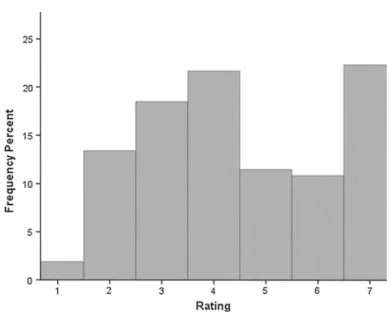
The usefulness of the Tailored Gymnasium was assessed on a 7-point Likert scale ranging from 1 (completely useless) to 7 (completely useful). The mean rating was 4.5(1.7). The rating distribution is shown in Fig.8.
Table 7 Evaluation indicators descriptive characteristics
Variable name Mean SD
Time spent on the Classic Gymnasium (in min) 25 79.6
Time spent on the Tailored Gymnasium (in min) 9.3 63.21
Visits to the Classic Gymnasium (count) 1.52 3.2
Visits to the Tailored Gymnasium (count) 2.5 3.8
Usefulness rating for the Classic Gymnasium 3.8 1.9
Usefulness rating for the Tailored Gymnasium 4.5 1.7 Intention to visit the Classic Gymnasium in the future 3.6 1.3 Intention to visit the Tailored Gymnasium in the future 4.9 1.7
Fig. 8 How useful was the Tailored Gymnasium for you? (1= completely useless, 7 = completely useful)
The distribution is quite homogeneous and the data are distributed across all the response options. The intention to visit the Tailored Gymnasium in the future was assessed on a 7-point Likert scale ranging from 1 (I will not use it) to 7 (I will surely use it). The mean rating was 4.9(1.7).
Another interesting insight to evaluate the Tailored Gymnasium is the comparison with the Classic Gymnasium. This latter section is basically a non-tailored version of the Gymnasium, where patients can access the exercises selecting them from a categorized set listing all the material in the database. In this case, no user parameters are requested by the system and the users choose the exercises autonomously. Thus, the Classic Gymnasium is not personalized at all. Access to the exercises requires the selection of one of the main functional categories (Relaxation, Mobilization, Stretch-ing, Stabilization, Massage) and the system presents the users with the full list of exercises belonging to the selected category. Because of its static and fixed nature, the
Classic Gymnasium might posit some issues when compared to the Tailored Gymna-sium, as we will discuss in the next section on the study limitations.
Anytime the users logged into the ONESELF website they could select the Clas-sic or the Tailored version of the Gymnasium. The mean rating of the usefulness of the Classic version of the Gymnasium was 3.8(1.9). The mean rating of intention to visit it in the future was 3.6(1.3). The comparison with the ratings of usefulness of the Tailored version and the intention to visit it in the future indicates a significant mean difference (t = 5.3, df = 156, p < 0.001 for usefulness; t = 3.8, df = 156,
p< 0.001 for the intention to visit the section in the future). This result is consistent
with the findings ofCawsey et al.(2000) that cancer patients significantly preferred a personalized information system. As previously mentioned, however, these data can provide only an indication of the preferences of the users, since they did not used the system frequently enough. Below, we complement this provisional evaluation with a qualitative analysis based on users’ feedbacks.
Data gathered from the users by the logging module point to two major findings. First of all, the users could give a vote to each exercise upon completion, by marking up to five “stars” at the end of the exercise interface, so that the vote ranges from 1 to 5. The mean (SD) vote of the exercises was 4.2(1.1), indicating an overall satisfaction with the multimedia exercises proposed by the system on the basis of the user characteristics. Secondly, users could leave open comments on each exercise or at the end of the whole exercise session. The users of the Tailored Gymnasium posted a total of 182 comments. A qualitative inductive inspection of these comments revealed some macro categories of comments that are useful to evaluate the user experience with the Tailored Gymnasium. The resulting categories are:
(a) Added value comments. These are comments on the perceived added value of the Tailored Gymnasium. The added value is often associated to improvements in well-being, self-management ability, and enhanced interaction due to multimedia contents. Following are some examples of these comments (translations made by the authors, user names have been replaced by codes):
‘[…] the personal trainer is a stimulus to work harder’—User001 ‘I feel better in my body and in my mind. Thanks.’—User002
‘The videos are far more helpful than simple figures and images. A very useful project, thanks.’—User003
‘Very useful exercises are presented: they perfectly match my needs.’— User004
‘I’m tired but happy to have concluded the exercises…I need to train my body to be able to sleep tonight.’—User005
‘This exercise is indeed one of my favorites, while I do it the pain to my arms and shoulders is incredibly reduced.’—User006
(b) System feedbacks. These are comments related to feedbacks and indications on the actual interface of the system and on the possible interactions. Most of the feedbacks were about the possibility of watching the videos and to perform the exercises standing in front of the computer. Some users who were not experts in computer use reported that they still could access and use the Tailored Gymna-sium. These are some examples of this category:
‘I think that the exercise where you have to stand can be better performed than the ones where you have to sit or to lay down.’—User007
‘I think the system allows me to learn the exercises step by step. I would also like to have some audio recordings.’—User008
‘Everything is very easy to use and the video exercises are easy to follow.’— User009
‘I can do exercises standing in front of the screen. Greets to everybody!’— User010
(c) Critiques and possible improvements. These comments relate to critiques or sug-gestions for improvements of the personalized system. Two kinds of improve-ments emerge from the comimprove-ments: adding more exercises and improve content multimediality. More specifically, some users would have liked to be presented with more exercises that are specific for the part of the body that hurts the most in a certain moment. Moreover, the videos are presented with no audio recordings. They are meant to help the visual representation of the correct way to perform an exercise, however the importance of a voice recording of the written explanation has emerged as an important missing element in the system. Following are some examples of this comments category:
‘I started doing the exercises. Could it be possible to have some more [exer-cises] to be performed in the water or in a swimming pool?’—User 011 ‘I would like to have a background music, so that I do not feel alone when performing the exercises.’—User012
‘I think there are not enough exercises to strengthen the legs.’—User013 ‘I would need more exercises to train the lumbar muscles that are always stiff.’—User014
‘The only problem [of the system] is that the audio is missing.’—User015 (d) Gratifications. These are comments that report messages of gratefulness to the
health professionals and the system staff members. Interestingly, some of them are framed as the users were actually talking to the system (e.g. ‘Thanks to this personal trainer’—User016). This is a proxy that personalization has proven to be very effective in creating a realistic human-computer interaction.
These results represent a first indication of the benefits that a tailored approach to self-management can bring to people affected by the fibromyalgia syndrome. In order to establish a causal effect of the tailored intervention over the health status of the patients we are currently conducting a randomized experiment as part of a broader randomized controlled trial to test the effectiveness of the interactivity components on patients’ health outcomes.
5 Study limitations
There are some limitations of this study that are worth to be mentioned, as they may provide directions for future implementations and research. We divide the limits of the study in three groups that reflect the three main topics of this research: Knowledge Acquisition of relevant determinants for the tailoring algorithm, technical choices, and system evaluation.
5.1 Knowledge acquisition of relevant determinants
Despite the ability of the KA approach to elicit some very relevant determinants to implement the tailoring algorithm, we underline an important methodological lim-itation of our investigation. More specifically, the knowledge translation approach (Reiter et al. 2003) that we adopted to elicit the relevant guidelines and variables does
not guarantee exhaustiveness in the identification of the determinants. Further
inves-tigation is needed to assure a comprehensive overview of the grounding criteria to tailor messages to fibromyalgia patients. One attempt could be to match the general criteria for exercise prescription defined by the American College of Sport Medicine (American College of Sport Medicine 2005).
In the outcome, during the elicitation process we considered some other deter-minants that, however, we could not include in the current tailoring, such as users’ training habits and the presence of absence of vertigo. Indeed, these determinants are not defined well enough and agreed among the experts to be implemented in an automatic algorithm.
5.2 Technical choices
A tailored solution based on a corpus of texts, images, and videos is just one of many possible adaptation strategies. AsBrusilovsky(1996,2001) pointed out, there is a complex taxonomy of adaptive hypermedia systems. Our approach to tailoring focused on the extraction of the contents that were more suited according to the user profile, but did not consider other possible adaptations, such as textual or interface personalization (as, for example, inCawsey et al. 2000). Also, other forms of content presentation were not considered, such as the adoption of embodied conversational agents instead of video files. These alternative forms may improve the user experience and further refine the level of personalization of the whole system.
5.3 System evaluation
As argued before, the evaluation is a pilot study. This provides interesting insights on users’ judgment of the personalized system, but is not free of drawbacks. First of all, the quantitative indicators of effectiveness should not be limited to users’ satisfaction, but consider also individual characteristics such as users’ self-management ability, knowledge, and health outcomes. These indicators have been included in an extended randomized controlled trial that is currently ongoing.
Secondly, the comparison between a personalized intervention and a static one posits some problems for evaluation accuracy. Some biases (e.g. adoption bias) may interfere with the reliability and the validity of the results. Similar to ceiling effects, it may happen that the static version of the virtual gymnasium requires too much effort from the users, who tend to prefer the tailored version just because the system decides in their place and not for the real advantages due to adaptation and personalization.
Eventually, other potential confounders should be controlled in a formal and com-plete quantitative evaluation, such as question framing effects (i.e. it is possible that
the way a certain question in the interview module is asked influences the attitudes of the users, and thus their actual response to the question).
All these issues, alongside a refinement of the qualitative insights, are currently being considered in a full and extensive evaluation of the system.
6 Conclusion
The purpose of this article was to describe the design and implementation of a tai-lored intervention to enhance self-management in patients affected by FMS. The main results can be summarized in a) the definition of relevant determinants for tailoring health videos to people experiencing this peculiar and chronic condition and b) the implementation of an algorithm to automate the tailoring process. In so doing, we have adopted an essentially qualitative approach that operationalizes patients’ and health professionals’ point of view on fibromyalgia exercises and makes them fit to users’ preferences, health status and available means. This is an important achievement if we consider that, as Wherton and Monk pointed out (2008), technologists do not often consider the needs of users. Also, it is an approach that avoids applying stereotypical preferences that often are less than ideal (van Vugt et al. 2009).
Additionally, this study is an attempt to shed light on the implications that user modeling has for eHealth and health communication research (and vice versa). The design of a personalized health system, in fact, must consider the balance between evidence based medical guidelines, the feasibility of their implementation, and the modeling of the system. Considering the lack of guidelines on this issue, our initiative appears as a first attempt to identify relevant factors to discriminate amongst physical exercise options in a corpus of videos, and adapt them to the patients’ profile and environmental situation.
Acknowledgments We would like to thank Monique Lemmens, PT, Guido Mariotti, MD, Nicola Keller, MD and the staff of the Lega Ticinese per la Lotta Contro il Reumatismo (LTCR) for their valuable help and support to this study.
References
American College of Sport Medicine : ACSM’s Guidelines for Exercise Testing and Prescription. (Lippincott Williams & Wilkins, Baltimore 2005)
Annemans, L., Wesseley, S., Spaepen, E., et al.: Health economic consequences related to the diagnosis of fibromyalgia syndrome. Arthritis Rheum. 58(3), 895–902 (2008)
Arnold, L.M., Bradley, L.A., Clauw, D.J., et al.: Evaluating and diagnosing fibromyalgia and comorbid psychiatric disorders. J. Clin. Psychiatry 69(10), e28 (2008)
Belt, N.K., Kronholm, E., Kauppi, M.J.: Sleep problems in fibromyalgia and rheumatoid arthritis compared with the general population. Clin. Exp. Rheumatol. 27(1), 35–41 (2009)
Bennett, R., Jones, J., Turk, D.C., et al.: An Internet survey of 2,596 people with fibromyalgia. BMC Musculoskeletal Disord. 9, 8–27 (2007)
Brosseau, L., Wells, G.A., Tugwell, P., et al.: Ottawa panel evidence-based clinical practice guidelines for aerobic fitness exercises in the management of fibromyalgia. Phys. Ther. 88(7), 857–871 (2008) Brusilovsky, P.: Methods and techniques of adaptive hypermedia. User Model. User-Adapt. Interact.
6(2–3), 87–129 (1996)
Brusilovsky, P., Pesin, L.: Adaptive navigation support in educational hypermedia: an evaluation of ISIS-Tutor. J. Comput. Inform. Technol. 6(1), 27–38 (1998)
Buchanan, B., Moore, J., Forsythe, D., Carenini, G., Ohlsson, S., Banks, G.: An intelligent interactive system for delivering individualized information to patients. Artif. Intell. Med. 7(2), 117–154 (1995) Busch, A.J., Thille, P., Barber, K.A., et al.: Best practice: E-model—prescribing physical activity and
exercise for individuals with fibromyalgia. Physiother. Theory Pract. 24(3), 151–166 (2008a) Busch, A.J., Schachter, C.L., Overend, T.J., et al.: Exercise for fibromyalgia: a systematic review. J.
Rheu-matol. 35(6), 1130–1144 (2008b)
Buskila, D., Cohen, H.: Comorbidity of fibromyalgia and psychiatric disorders. Curr. Pain Headache Rep. 11(5), 333–338 (2007)
Carville, S.F., Arendt-Nielsen, S., Bliddal, H., et al.: EULAR evidence-based recommendations for the management of fibromyalgia syndrome. Ann. Rheum. Dis. 67(4), 536–541 (2008)
Cawsey, A.J., Jones, R.B., Pearson, J.: The evaluation of a personalized health information system for patients with cancer. User Model. User-Adapt. Interact. 10(1), 47–72 (2000)
Choy, E., Perrot, S., Leon, T., et al.: A patient survey of the impact of fibromyalgia and the journey to diagnosis. BMC Health Serv. Res. 10, 102–110 (2010)
Clauw, D.J.: Assessing and diagnosing fibromyalgia in the clinical setting. J. Clin. Psychia-try 69(11), e33 (2008)
Eysenbach, G.: The law of attrition. J. Med. Internet Res. 7(1), e11 (2005)
Eysenbach, G., Powell, J., Kuss, O., et al.: Empirical studies assessing the quality of health information for consumers on the world wide web: a systematic review. J. Am. Med. Assoc. 287(20), 2691–2700 (2002) Goldenberg, D.L.: Psychological symptoms and psychiatric diagnosis in patients with fibromyalgia.
J. Rheumatol. 19(Suppl. Nov.), 127–130 (1989)
Goldenberg, D.L.: Multidisciplinary modalities in the treatment of fibromyalgia. J. Clin. Psychiatry 69(Sup-pl. 2), 30–34 (2008)
Goldenberg, D.L., Burckhardt, C., Crofford, L.: Management of fibromyalgia syndrome. J. Am. Med. Assoc. 292(19), 2388–2395 (2004)
Häuser, W., Thieme, K., Turk, D.C.: Guidelines on the management of fibromyalgia syndrome—a system-atic review. Eur. J. Pain 14(1), 5–10 (2009)
Ittersum, M.W., van Wilgen, C.P., Hilberdink, W.K.H.A., et al.: Illness perceptions in patients with fibro-myalgia. Patient Educ. Couns. 74, 53–60 (2009)
Jones, J., Rutledge, D.N., Jones, K.D., et al.: Self-assessed physical function levels of women with fibro-myalgia: a national survey. Womens Health Issues 18(5), 406–412 (2008)
Kobsa, A., Koenemann, J., Pohl, W.: Personalized hypermedia presentation techniques for improving online customer relationships. Knowl. Eng. Rev. 16(2), 111–155 (2001)
Kreuter, M., Farrell, D., Olevitch, L., Brennan, L.: Tailoring Health Messages. Customizing Communication with Computer Technology. Lawrence Erlbaum Associates, Mahwah (2000)
Kroeze, W., Werkman, A., Brug, J.: A systematic review of randomized trials on the effectiveness of computer-tailored education on physical activity and dietary behaviors. Ann. Behav. Med. 31(3), 205–223 (2006)
Lorig, K.R., Bodenheimer, T., Holman, H., et al.: Patient self-management of chronic disease in primary care. J. Am. Med. Assoc. 288(19), 2469–2475 (2002)
Lorig, K.R., Ritter, P.L., Laurent, D.D., et al.: Internet-based chronic disease self-management: a random-ized trial. Med. Care 44(11), 964–971 (2006)
Lorig, K.R., Ritter, P.L., Laurent, D.D., et al.: The internet-based arthritis self-management program: a one-year randomized trial for patients with arthritis or fibromyalgia. Arthritis Care Res. 59(7), 1009– 1017 (2008)
Lustria, M.L., Cortese, J., Noar, S.M., et al.: Computer-tailored health interventions delivered over the web: review and analysis of key components. Patient Educ. Couns. 74, 156–173 (2009)
Mannerkopi, K.: Exercise in fibromyalgia. Curr. Opin. Rheumatol. 17(2), 190–194 (2005)
Mannerkopi, K., Iversen, M.D.: Physical exercise in firbomyalgia and related syndromes. Best Pract. Res. Clin. Rheumatol. 17(4), 629–647 (2003)
Reiter, E., Mellish, C., Levine, J.: Automatic generation of technical documentation. Appl. Artif. Intell. 9(3), 259–287 (1995)
Reiter, E., Cawsey, A., Osman, L. Roff, Y.: Knowledge acquisition for content selection. In: Proceedings of the 6th European workshop on Natural Language Generation, pp. 117–126 (1997)
Reiter, E., Robertson, R., Osman, L.M.: Lessons from a failure: generating tailored smoking cessation letters. Artif. Intell. 144(1–2), 41–58 (2003)
Rimer, B.K., Kreuter, M.W.: Advancing tailored health communication: a persuasion and message effects perspective. J. Commun. 56, S184–S201 (2006)
Sarzi-Puttini, P., Buskila, D., Carrabba, M., et al.: Treatment strategy in fibromyalgia syndrome: where are we now?. Semin. Arthritis Rheum. 37(6), 353–365 (2008)
Schulz, P.J., Rubinelli, S., Hartung, W.: An Internet based approach to enhance self-management of chronic low back pain in the Italian-speaking population of Switzerland: results from a pilot study. Int. J. Public Health 52(5), 286–294 (2007)
Science Panel on Interactive Communication and Health: In: Eng, T.R., Gustafson, D.H. (eds.) Wired for Health and Well-Being: The Emergence of Interactive Health Communication. US Department of Health and Human Services, US Government Printing Office, Washington, DC (1999)
Spaeth, M.: Epidemiology, costs, and the economic burden of fibromyalgia. Arthritis Res. Ther. 11(3), 117– 118 (2009)
Suggs, L.S.: A 10-year retrospective of research in new technologies for health communication. J. Health Commun. 11(1), 61–74 (2006)
Suggs, L.S., Cowdery, J.E., Carroll, J.B.: Tailored program evaluation: past, present, future. Eval. Program Plann. 29(4), 426–432 (2005)
Suman, A.L., Biagi, B., Biasi, G., et al.: One-year efficacy of a 3-week intensive multidisciplinary non-pharmacological treatment program for fibromyalgia patients. Clin. Exp. Rheumatol. 27(1), 7–14 (2009)
van den Berg, M.H., Schoones, J.W., Vliet Vlieland, T.P.: Internet-based physical activity interventions: a systematic review of the literature. J. Med. Internet Res. 9(3), e26 (2007)
van Koulil, S., Lankveld, W., Kraaimaat, F.W., et al.: Tailored cognitive-behavioral therapy for fibromyalgia: two case studies. Patient Educ. Couns. 71, 308–314 (2008)
van Uden-Kraan, C.F., Drossaert, C.H.C., Taal, E., et al.: Empowering processes and outcomes of partici-pation in online support groups for patients with breast cancer, arthritis or fibromyalgia. Qual. Health Res. 18(3), 405–417 (2008)
van Vugt, H.C., Konijn, E.A., Hoorn, J.F., Veldhuis, J.: When too heavy is just fine: creating trustworthy e-health advisors. Int. J. Hum. Comput. Stud. 67(7), 571–583 (2009)
Wantland, D.J., Portillo, C.J., Holzemer, W.L., et al.: The effectiveness of web-based vs non-web-based interventions: a meta-analysis of behavioral change outcomes. J. Med. Internet Res. 6(4), e40 (2004) Wherton, J.P., Monk, A.F.: Technological opportunities for supporting people with dementia who are living
at home. Int. J. Hum. Comput. Stud. 66(8), 571–586 (2008)
Wilson, H.D., Robinson, J.P., Turk, D.C.: Toward the identification of symptoms patterns in people with fibromyalgia. Arthritis Care Res. 61(4), 527–534 (2009)
Wolfe, F., Smythe, H.A., Yunus, M.B., et al.: The American College of Rheumatology 1990 crite-ria for the classification of fibromyalgia. Report of the Multicenter Critecrite-ria Committee. Arthritis Rheum. 33(2), 160–172 (1990)
Author Biographies
Luca Camerini is a doctoral candidate at the Institute of Communication and Health, Università della Svizzera Italian. He holds a MSc in Communication Technologies from the Università della Svizzera Itali-ana. His dissertation project focuses on the impact of eHealth interactive applications on people affected by chronic conditions (project ONESELF). The present paper is grounded in this research project. His research interests include health communication, tailoring and adaptivity, patients’ empowerment and health literacy. Michele Giacobazzi is a researcher at the Institute of Communication and Health, Università della Svizzera Italiana. He holds a MSc in Communication Technologies from the Università della Svizzera Italiana. He is involved in several research projects that encompass technology and health. His research interests range from technology design, usability, implementation, and its impact on patients’ life and health professionals’ working practice.
Marco Boneschi is a researcher at the Institute of Communication and Health, Università della Svizzera Italiana. He holds a MSc in Communication Technologies from the Università della Svizzera Italiana.
Together with the first and the second author, he is involved in several research projects that encompass technology and health. His research interests include health communication, user modeling, and tailoring. Peter J. Schulz is Professor for Communication Theories and Health Communication at the School of Com-munication Sciences and director of the Institute of ComCom-munication and Health, Università della Svizzera Italiana. His recent research and publications have focused on consumer health literacy and empowerment, argumentation in health communications, and the epidemiology of prescription drug misuse. He is author of five books and editor of three books. He serves in the editorial and advisory boards of several journals and is Associate Editor of the journal Patient Education and Counseling. Since 2003 he is Guest Professor at the Virginia Technological University, USA.
Sara Rubinelli is a Senior Scientist at the Department of Health Sciences and Health Policy of University of Lucerne and Swiss Paraplegic Research, Switzerland. She holds a degree in Classics and Philosophy from the Catholic University of Milan (I), and a PhD from the University of Leeds (UK) in the areas of logic, argumentation theory and rhetoric. Sara’s research interests circle around philosophy of health, health communication and academic communication. Specific areas of research and teaching include theories and models of health and well-being, ontologies for health, epistemology of science, mass-health communica-tion (health promocommunica-tion and advertising), interpersonal communicacommunica-tion, expert-to-lay knowledge translacommunica-tion and curricula development.