Regulations in the Commodity Trading Sector
Should the commodity trading industry in Switzerland be more regulated and, if so, how?
Bachelor Project submitted for the obtention of the Bachelor of Science HES in International Business Management
by
Nikola VOLCHKOV
Bachelor Project Advisor: Brian LEWIS
Declaration
This Bachelor Project is submitted as part of the final examination requirements of the Haute école de gestion de Genève, for athe Bachelor of Science HES-SO in International Business Management.
The student accepts the terms of the confidentiality agreement if one has been signed. The use of any conclusions or recommendations made in the Bachelor Project, with no prejudice to their value, engages neither the responsibility of the author, nor the adviser to the Bachelor Project, nor the jury members nor the HEG.
“I attest that I have personally accomplished this work without using any sources other than those cited in the bibliography. Furthermore, I have sent the final version of this document for analysis by the plagiarism detection software URKUND using the address supplied by my adviser”
Geneva, 30 May 2017
Acknowledgements
I would particularly like to thank my mentor and adviser, Mr. Brian Lewis, for his valuable advice throughout this research. I would also like to thank my professor in the Commodity Trading branch, Mr. Robert Piller, who, thanks to the quality of his teaching, enabled me to discover this fascinating field and encouraged me to undertake this research.
Executive Summary
Commodity trading is a sector which is essential to our development, prosperity, and economic growth. It is relatively unknown and perceived differently depending on the viewpoint of the observer. Many think of it as the exploitation of resources in resource-rich countries, others only of the transport of goods from producers to consumers, while others focus on “speculation” and its association with financial markets, which can create risk. Given the importance of commodity trading across the world and recent financial crises, the question arises as to the adequacy of regulations that exist or should exist to improve visibility and control in this sector.
This research is motivated by such an aspect of the adequacy or sufficiency of current regulations. As Switzerland has experienced favorable economic results from this sector, whilst also being a global hub, this study aims to analyze and provide conclusions or recommendations to the question "Should the commodity trading industry in Switzerland be more regulated, if so, how?".
Switzerland, much as some other countries in the world, has seen the development of commodity trading in a spectacular way in recent years. As an important economic sector operating in the country, ranging from oversight of the extraction of raw materials, transport and trade, along with the roles of banks and the utilisation of financial products, there are many questions about the proper regulation that is needed. However, Switzerland remains a merchanting center (trade for companies themselves and third parties, both inside and outside of Switzerland). As a result, we may not be very concerned about the resource or extraction-related aspects that are more the responsibility of producers. However, as an international hub for this activity, Switzerland must respect and promote international standards in all areas.
Because there are many facets to commodity trading, it is not easy to answer the above question without limiting the scope. This study therefore focuses on the following elements: the physical aspects of commodity trading, financial derivatives, and banking activities in order to draw conclusions on the legal and regulatory framework.
the acceptability and interpretation of international regulations. Often it is national regulations that apply, inspired by international recommendations.
Switzerland is an important center in commodity trading. This study presents economic facts and figures which show its superiority in many fields and especially its competitiveness in this sector. The impact of commodity trading on the Swiss economy is very important and surpasses that of tourism or banks. However, new centers are emerging, especially Singapore, because of its position and its political and economic stability. Others are also on the way to increasing their market share, for example the United Arab Emirates. Swiss regulators must take this into account, mainly owing to the ease of relocating merchanting activities.
After studying these aspects of commodity trading regulations, as well as the development of Switzerland and especially Singapore alongside other commodity trading hubs in the world, we have come to the following conclusions for Switzerland, which answer the question originally asked (they will be developed further in a special chapter):
• Promote self-regulation and better communication in the commodity trading industry,
• Avoid the "best-in-class" syndrome,
• Preserve the attractiveness and competitiveness of commodity trade businesses, • Participate actively in international regulatory bodies,
• Strengthen transparency by adopting international regulations in physical operations,
• Increase transparency in product flows,
• No need to change regulations in financial derivatives,
• No need for more banking regulations linked to commodity trading operations. This research does not cover all aspects and issues that may arise in the area of commodity trading. It does not, therefore, address human rights, environmental protection, resource extraction and social responsibility issues, areas that are often referred to in discussion forums or by NGOs, and receive widespread public attention. In spite of this, given that Switzerland holds a very important place in the field of commodity trading, we will also make some recommendations for Swiss regulators in this field, since it is important to preserve Switzerland’s reputation, credibility and attractiveness.
Contents
Regulations in the commodity trading sector ... 1
Declaration ... i
Acknowledgements ... ii
Executive Summary ... iii
Contents... v
List of Figures ... vi
1. Introduction ... 1
2. Commodities and trading ... 4
3. Domains under observation for commodity trading regulations ... 5
3.1 Physical operations... 5
3.2 Financial derivatives ... 6
3.3 Banking activities ... 6
4. Commodity trading industry in Switzerland ... 8
4.1 Major trading companies operating in Switzerland ... 8
4.2 Swiss position in the commodity trading industry ... 10
4.3 International competition and Switzerland's position in trading industry ... 18
5. Brief overview of Singapore as a competitive trading sector ... 20
6. Physical Operations and associated regulations ... 22
7. Financial Derivatives and associated regulations ... 25
8. Banking regulations concerning commodity trading ... 29
8.1 Money laundering ... 33
9. Commodity trading regulation seen by practitioners ... 35
9.1 Financial Conduct Authority (technical commodity specialist) ... 35
9.2 CFTC member ... 36
10. Recommendations for commodity trading regulations in Switzerland ... 38
11. Conclusion ... 43
Bibliography ... 47
List of Figures
Figure 1 – Major trading companies by turnover in 2016 ... 9
Figure 2 – Major trading companies by capital in the Lake Geneva region ... 9
Figure 3 – Major trading companies by capital in Zug... 10
Figure 4 – Major trading companies by capital in Ticino ... 10
Figure 5 – Relative weight of commodity trading in Switzerland by type (2012) .... 13
Figure 6 – Net revenue progression from commodity trading companies in Switzerland (2012) ... 13
Figure 7 – Receipts from tourism, merchanting, and financial services abroad by banks, in millions of Swiss francs (left scale) and share of GDP (nominal, based on expenditure metric, right scale) ... 14
Figure 8 – Progression of the impact of merchanting over GDP ... 15
Figure 9 – Distribution of merchanting companies by canton ... 15
Figure 10 – Market share of trading centers... 17
Figure 11 – Ranking of commodity trading centers by competitiveness... 19
Figure 12 – Share of yearly financing by banks (percentages) ... 30
Figure 13 – Ten major borrowers from banks in 2015 and 2016 (in M USD) ... 30
Figure 14 – Receipts from merchanting and financial services abroad by banks, in % of GDP ... 31
1. Introduction
Commodity trading plays an important role in the global economy by providing means to allocate resources from producers to consumers worldwide.
The commodity trading industry has grown significantly in Switzerland over the last three decades, with turnovers now being recorded in tens of billions of US Dollars. There is a lot of different information published by mainstream media and non-governmental organizations concerning trading companies, ranging from successes to reputational issues. Generally, their activity is still not very well understood by society.
On the other hand, the banking sector, another significant contributor to the Swiss economy, has been continuously highly supervised and responded to the changing regulatory environment with increasing ability to demonstrate compliance. Their regulator in Switzerland, the FINMA, has, alongside other international regulatory authorities, been driving this momentum within the Financial Services and Banking activities. One of the primary roles of FINMA is to ensure the industry’s solid reputation and the on-going stability of our Financial Services sector in Switzerland.
That being said, whilst it is known that commodity trading companies have to comply with many different regulations globally, on physical and paper trading, one can ask: Who is the regulator in the commodity trading sector? The answer cannot be easily formulated due to the fact that many sectorial and local regulations are fragmented in the different countries and regions that deal in commodity trading.
Globally, we have seen many non-governmental organizations and others that insist this sector be more regulated. However, trading companies and their partners are already complying with a large amount of regulations in their day-to-day activities. The situation is similar for Switzerland where some non-governmental organizations are actively asking for specific commodity regulations within the country.
The research that is done in this work answers the initial research question: "Should the commodity trading industry in Switzerland be more regulated and, if so, how?"
The objectives and deliverables of this work are the following:
• General overview and presentation of major commodity-related regulations in main commodity trading sectors worldwide.
• Explanatory table of all relevant regulations in the commodity trading sector in major centers and particularly in Switzerland.
• Main characteristics of regulations in Switzerland compared to those in other main commodity trading centers. What should be done better in Switzerland? • Highlights on practitioners’ perception of regulatory issues in today's commodity
market.
Commodity trading is an activity that is spread among many different economic sectors and domains: extraction, transportation, storage, shipping, financing, testing, etc., and is conducted worldwide in different countries and political regimes. It is impossible to present regulations in all of these domains; this is why we will mainly focus on three distinct commodity trading activities: physical commodity transactions or operations, financial derivatives, and financing through the banking sector. These subjects will be explained in Chapter 3.
Chapter 2 contains a brief overview of what comprises commodity trading. This is a short introduction for those unfamiliar with the commodity domain.
Chapter 4 will focus on depicting the commodity trading big picture in Switzerland. This chapter will provide a global overview of how the sector is developed within the country, the impact of commodity trading in Switzerland, the major actors and trading centers. Presenting the big picture of the sector in Switzerland is important in order to understand the impact of this industry on our economy and why commodity trading should be preserved as one of the main contributors to our Global Domestic Product (GDP). Switzerland is a commodity giant, but this industry remains obscure for the population. A brief overview of Singapore as a major trading center will be given in Chapter 5. Chapter 6 will focus on regulations on physical transactions and associated regulations. Because physical operations are executed on a worldwide basis, regulations are an international concern. This is why this chapter provides an analysis of the regulations put in place in major centers over the globe. Nevertheless, Switzerland, by itself, is not particularly concerned about physical operations regulations because trading companies are mainly merchanting and the commodity does not cross the borders of the country. In Chapter 7 we will explain international regulations on financial derivatives and how global trading is regulated in this domain. Switzerland is a major financial center along with Singapore, the United states and other hubs. It is important to understand the global
structure regulations related to financial derivatives. As a dominant financial center for derivative trading (OTC and exchange), over-regulation should be avoided within the country, but Switzerland should participate to align with the regulations in other countries. Chapter 8 will be dedicated to regulations on banks as the main providers of funds to finance commodity trading. Banking regulations by themselves, however, may be considered indirectly as trading regulations. This chapter will explain how and which banking regulations are related to the commodity industry. To be able to compare how Switzerland is regulated in this sector, it is useful to present how other financial sectors regulate their banks.
In addition to research on commodity-related regulations, a former professional member of the US Senate Agriculture Committee and CFTC as well as a member of the Financial Conduct Authority (FCA) have been interviewed on the impact, the risks and adequacy of commodity trading regulations on the market. The conclusions from these discussions will be presented in Chapter 9.
Based on the research presented in the previous chapters, Chapter 10 will be dedicated to recommendations for Swiss commodity trading regulations. This will consider the three domains under observation. Other considerations on human rights, environmental protection and social responsibility will not be treated. This chapter contains my personal answers to the initial research question.
A conclusion on commodity trading regulations and their effectiveness will finally be drawn in Chapter 11.
Appendix 1 contains major regulations for commodity trading for the domains under observation.
2. Commodities and Trading
Commodity trading should be understood as the allocation (buying and selling) of basic goods from regions that actively produce them to those that face a shortage. These goods are commonly called commodities. As opposed to finished goods, commodities are interchangeable and are used for all kind of purposes. These goods are particularly used as inputs in the process of producing other finished or semi-finished goods. Commodities are mainly produced in specific regions or countries known as producers that have the capacity to produce great quantities of such goods. Other countries that do not have such a production need these goods for their own consumption or to produce different finished goods. Thus, commodities are transported worldwide between producers and consumers.
Moving raw material from producers to consumers effectively contributes to economic growth worldwide. The whole value chain of commodity exploitation encompasses the extraction and trading of commodities, refinement, and distribution. Some companies are specialized in one or another process in this value chain, while others are active on more than one of these processes.
Commodities are suitable for trading on exchanges, assuming there is little difference among producers, and are subject to some specific standards known as basic grade. This is the case with a barrel of crude oil, cotton, sugar, gold, natural gas, etc. Technological progress is also introducing some new examples of commodities that can be exchanged, such as internet bandwidths, cellular phone minutes, cloud computing or electricity supply.
Purchases and sales of commodities are usually made on an exchange platform, allowing for standardization of the quality and quantity of goods which can be purchased on a spot (immediate purchase) or on a futures market. These are legal agreements allowing to buy or sell commodities at some predefined price on a specified future date. Futures are used by purchasers or sellers of goods, but also by investors trying to benefit from the evolution of commodity prices over time. The difference between commodities and securities traded on an exchange is that commodities are specific contracts, while shares are predefined and listed on a stock exchange.
3. Domains Under Observation for Commodity Trading
Regulations
Commodity trading activities are spread among various economic sectors (extraction, transportation, control and testing, financing, banking, insurance) executed in multiple geographic regions, touching environmental, political and ethical aspects of general business, and are essential for the world economy. There is a wide range of different goods traded, from energy to minerals, metals, and agricultural products. They are associated to the problems of transportation, extraction, logistics, financing, testing, legal aspects, human rights, taxation, etc. This variety of angles under which the commodity trading industry may be observed entails a great amount of regulations and propositions to strengthen their effectiveness. Specific regions and countries, industries of all sectors, politicians and ordinary people are all concerned by the importance and the impact of this global activity. Switzerland is particularly concerned about regulations in the commodity sector due to its major role in the industry.
There are regulations or legal frameworks that are already in place or will come out in every domain concerned by commodity trading. Because it is impossible to summarize or explain every single regulation in each of the domains mentioned earlier, we will concentrate our research only on mid-stream commodity trading, considered to be core commodity trading businesses: physical operations, financial derivatives and trade finance (banks). All other aspects and impacts of commodity trading, such as environmental, human rights, the taxation of merchant activities, ethical or social responsibility, will be intentionally left aside. Switzerland is not a producer and a major importer of commodities, but it is a major merchanting hub and a trade finance center. What follows is a brief introduction into the three domains under observation. A more detailed analysis of the regulations in these domains will be provided in the next chapters.
3.1 Physical operations
3.2 Financial derivatives
Financial derivatives are investment products, generally associated with futures, OTC or options, which allow a subscriber to mitigate a potential risk related to an eventual fluctuation on commodity prices. These instruments allow for sharing (hedging) the risks inherent in trading commodities because of the elapsed time from purchase to the final delivery of goods to the buyer (variations in asset price, default of a creditor or buyer, exchange or interest rate fluctuation, destruction or loss of assets, etc.). Traders, as intermediaries, or final buyers use financial derivatives to share or mitigate this risk. For example, airline companies often use derivatives to hedge their expenditures in fuel all over the year (UK PARLIAMENT 2010). These instruments also allow market participants or investors to speculate on variances of asset prices.
Financial derivatives and pure market operators who only speculate particularly on food and oil are often criticized for their potential influence on artificial price rising, mainly because they have no real interest in the underlying assets. The arguments of those opposed to using derivatives for pure speculation combined with the lack of transparency of the whole market means that this activity can lead to systemic risks taken by banks that potentially harm the financial system as a whole (UK PARLIAMENT 2010). However, financial derivatives still are very important and beneficial for the development of commodity trading: one can say that modern commodity trading could not operate as it does without such instruments. Due to the importance of this domain and in order to preserve the liquidity and effectiveness of the market, the industry needs regulations on derivatives. Nevertheless, the risk for the system persists mainly because of the purpose for which such instruments are used. This system is beneficial for hedging but dangerous if only used for speculation. In order to maintain market liquidity and circumvent systemic risk, we should avoid the default of a major institution known as a "too big to fail". Switzerland is very much involved in the financial derivatives industry and related services. The regulations in this domain can potentially have a great impact not only on this specific economic sector, but also to the whole commodity trading industry in the country.
3.3 Banking activities
Banks play an essential role in commodity trading. Without banking services, commodity trading would not be as developed as it is today. Because of their financing power, many
banks are also active directly as commodity traders. The following are the main domains were banks provide their services in commodity trading: counterparty for derivatives (covering price risk), provision of instruments for commodity trading, foreign exchange contracts, and financing.
Offering exchange rate services is also a major bank activity. Trading in different currencies (buying and selling) around the globe is related to exchange rate risks. Banks therefore offer products such as futures on exchange rates which allow traders to protect themselves from exchange rate fluctuations over time.
Companies and traders can use banks as counterparty using derivatives. Banks generally accept to pay the spot market price of a derivative against a fixed payment from the trader.
Banks issue guaranties for payments from the buyer upon the delivery of goods. Various instruments are used such as letter of credit, escrow account or other warranties. Performance bonds are also used to guarantee the buying party the delivery of goods under a signed contract.
Because the trading industry is a necessity, foreign and Swiss regulations should facilitate and enable more transparent transactions, while imposing rules that prevent money laundering or other criminal operations. The impact of these regulations on the trading sector will also be analyzed.
Switzerland is a major banking center. The development of trade-related banking services has increased in recent years, and the Swiss banking sector plays a crucial role in the development of commodity trading as provider of financial services, borrower, and third party in financial derivatives. The Swiss banking industry is already very well regulated mainly through FINMA, the Swiss financial market supervisor, but there are some specific considerations concerning the trading industry that will be developed in the following chapters.
4. The Commodity Trading Industry in Switzerland
In order to better understand the importance of regulatory frameworks for the commodity trading industry in Switzerland, it is crucial to be well aware of the volumes and other economic facts relating to this sector. This will be done in this chapter.
4.1 Major trading companies operating in Switzerland
Switzerland, being one of the main trading hubs in the world, hosts some of the largest trading companies or their branches. These companies are active in all commodity trading domains, but mainly in merchanting activities. The importance of Switzerland as a commodity trading center will be extensively explained in the following chapters, but it is important to note the major players.
There are no official statistics in Switzerland about the commodity trading sector. The General Classification of Economic Activities (NOGA 2016) does not present commodity trading as a separate category: This economic activity is encompassed in some other categories under wholesale trading or under holding companies (FDF 2013), so it is difficult to determine precisely which companies are fully active in the commodity trading business. However, some NGOs such as Public Eye (PE1 2016), which is very critical about the commodity sector in Switzerland, argue that the activity is not regulated enough and contributes to poverty and environmental damage in the world. Public Eye has published several statistics on trading companies operating in Switzerland. According to this source, some of the major Swiss trading companies or Swiss branches of trading companies that also participate in extraction are: Trafigura, Vitol, Gunvor, Mercuria and Glencore.
Figure 1 –Major trading companies by turnover in 2016
Source: BIL (2017).
The three following figures contain lists of the ten biggest commodity trading companies ranked by capital in three major regions in Switzerland: Lake Geneva, Zug and Ticino (PE2 2017).
Company name Turnover (In B CHF)
Activity
Glencore 156 Metals, energy, agricultrure
Vitol 155 Oil
Figure 2 – Major trading companies by capital in the Lake Geneva region
Source: PE2 (2017)
Figure 3 – Major trading companies by capital in Zug
Source: PE2 (2017)
Company
Capital
(CHF)
U ps tr ea m (e xt ra ct iv e) Tr ad in g M id st re am Do w ns tr ea m En er gy M et als a nd M in er als So ft C om dt ie s Cargill International SA 183'000'000 X X Gunvor SA 170'000'000 X X X X X Oryx Energies SA 100'000'000 X X X X Metinvest International SA 50'000'000 X X DTEK Trading SA 49'100'000 X X X X Geogas Trading SA 38'000'000 X X MKS (Switzerland) SA 30'000'000 X X X AWB (Geneva) SA 25'790'000 X XTereos Commodities Suisse SA 20'000'000 X X
Lia Oil SA 19'880'000 X X X X
Area of activities (Group level) Commodity family (Group level)
Company
Capital
(CHF)
U ps tr ea m (e xt ra ct iv e) Tr ad in g M id st re am Do w ns tr ea m En er gy M et als a nd M in er als So ft C om dt ie sEast Metals AG (Evraz Group) 280'000'000 X X
Wintershall Oil AG 182'000'000 X X
Xingu Agri AG 146'484'520 X X
Tatneft Oil AG 123'003'000 X X
Phillips 66 GmbH 49'504'000 X X X
OMV Supply Trading AG 37'900'000 X X
Statoil (Orient) AG 30'246'000 X X X
Afro Minerals Trading AG 23'100'000 X X
Stemcor AG 11'371'000 X X
CVAceros AG 10'800'000 X X
Area of activities (Group level)
Commodity family (Group level)
Figure 4 – Major trading companies by capital in Ticino
Source: PE2 (2017)
4.2 Swiss position in the commodity trading industry
Switzerland is ranked as one of the main commodity trading centers and already has a long tradition. The commodity trading industry has developed steadily over the last years and major players in this industry have chosen to locate their headquarters in centers such as Geneva, Zug or Lugano. Switzerland’s appeal certainly results from an ecosystem that is favorable for this activity composed of numerous competent and efficient banks and other intermediaries, from the political and legal stability of the infrastructures, its good geographic position and qualified available labor force. The sector’s gross income increased from 1.3 billion Swiss francs in 2001 to 20 billion in 2011, and currently accounts for approximately 3.5% of the Swiss GDP, which is more than tourism and the machine industry (JABER Samuel, 2016). It has had the strongest growth among all economic sectors in the country over the last 20 years.
In Switzerland, more than 500 companies and approximately 10,000 employees work in the commodity trading industry, which also includes shipping, inspection and financing. According to several statistics, Geneva employs directly 5,000 people in the commodity trading sector and 2,500 in others in jobs that are linked to this area, which represents half of the employment in the banking sector (FDF 2013).
The development of the trading industry in Switzerland is due not only to the opening of branches of large foreign companies (such as Lukoil or Total, respectively Litasco and Totsa). Many new companies were created and became rapidly successful: Südelectra
Company
Capital
(CHF)
U ps tr ea m (e xt ra ct iv e) Tr ad in g M id st re am Do w ns tr ea m En er gy M et als a nd M in er als So ft C om dt ie s Sytco AG 16'000'000 X X Duferco SA 12'750'000 X X Bulk Trading SA 3'000'000 X X ENET Energy SA 3'000'000 X XSimatrade SA, Lussemburgo, succursale di Lugano 3'000'000 X X
Telf AG 3'000'000 X X X
Commodity General Trading Intl SA 2'500'000 X X
MMK Steel Trade AG 1'200'000 X X
Cibra Resources Sa 1'000'000 X X
DP Trade SA 1'000'000 X X
Area of activities (Group level)
Commodity family (Group level)
AG, founded in 1926 by a group of private banks gave birth to the Xstrata group in 1999. Marc Rich & Co. became Glencore in 1994, and Mercuria, a Geneva-based company founded in 2004 by a group of commodity traders, has turned into one of the largest oil commodity traders in the world (FDF 2013).
Because of the growing importance of the sector and generated tax revenues, Switzerland should carefully preserve this asset from other competing centers, including China, Singapore, the UK, and the United States. In this sense, regulations play a crucial role as another external factor in addition, as said previously, to its ecosystem of qualified persons, a developed and stable banking system, political stability, its economic situation, and suitable time zone.
What is called the commodity industry can be subdivided basically into two major sectors: the extraction and the trading of commodities. Some companies are active in every field, from production and refining to trading and shipping. Lukoil or Total are examples of such companies. The majority of actors in the commodity industry in Switzerland are service companies that offer the trading, purchasing, and shipping of goods throughout the entire supply chain. Many different companies are also active in related domains such as financing, consulting, and support.
The commodity trading industry is essentially an international activity where companies deal with a wide range of actors on a global basis, including countries and governments. By being a trading hub and known worldwide for its banking industry that manages one-third of the world's wealth, Switzerland could be exposed to criticism regarding its environmental and social impact. To be protected from these concerns, Switzerland should be active in the elaboration of frameworks and regulations and be compliant to them.
The commodity trading business has a long tradition in Switzerland. Some companies, which are still in business today, started their activities back in the 18th century, such as Paul Reinhart AG the cotton trader, established earlier under the name of Geilinger & Blum. Many companies have gone through mergers and acquisitions to form today some of the biggest names in this industry, and others decided to establish their headquarters
1974. Some trading companies, such as Mercuria founded in 2004, have had tremendous growth, and today it is one of the main actors in energy trading worldwide (FDF 2013).
The economic impact of trading companies in Switzerland, as we saw earlier, is very important. These companies are particularly active in "merchanting", which means purchasing goods from sources abroad and selling the same goods to buyers outside of the country without transiting in Swiss territory and without any custom duties.
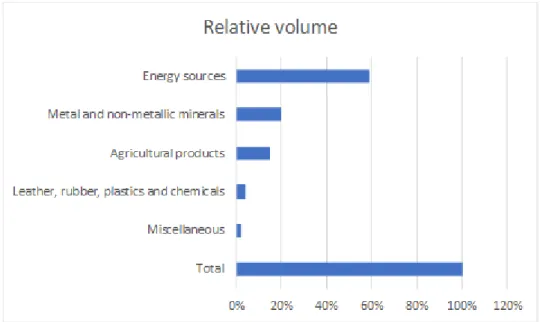
There are no viable statistics on the economic impact of commodity trading companies in Switzerland, but if we take a look at merchant statistics, considering that these are generated mainly by trading companies in Switzerland with goods not imported for actual consumption, then we can deduce the following (Fig. 5):
Figure 5 – Relative weight of commodity trading in Switzerland by type
(2012)
Source: SNB (2012)
Pursuing the statistics on economic volumes, the figures are as follow: the revenue from trading outside of Switzerland was estimated in 2011 to be 763 billion, which is greater than the Swiss GDP. The progression of net revenues of trading companies in Switzerland in recent years is shown on Fig. 6.
Figure 6 – Net revenue progression from commodity trading companies in
Switzerland (2012)
Source: SNB (2012)
Revenue from the merchanting industry in the overall GDP surpassed that of tourism in 2010 at 2.7%, and the banking sector at 2.6%. The relative evolution of percentage of GDP from different sectors is shown in Fig. 7.
0 5 10 15 20 25 2000 2007 2011
Revenue in B CHF
Figure 7 – Receipts from tourism, merchanting, and financial services
abroad by banks, in millions of Swiss francs (left scale) and share of GDP
(nominal, based on expenditure metric, right scale)
Source: FDF (2013)
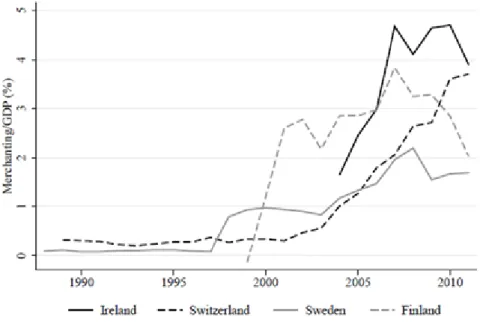
Figure 8 shows the constant progression of the impact of merchanting on GDP in Switzerland compared to three other countries: Ireland, Finland and Sweden for 2010.
Figure 8 – Progression of the impact of merchanting on GDP
Source: BEUSCH (2013)
The evolution of the number of registered merchanting companies in Switzerland and their distribution among the main cities is shown in Fig. 9. This is only an estimate because there is no obligation for companies to be declared if their sales volume does not exceed CHF 100,000 per quarter and if they are not registered in the commercial register.
The importance of Geneva and Zug in this relative distribution is rising. This is probably due to an ecosystem that is favorable to merchanting activities and also the presence of specialized banks which support its activity.
In order to estimate the number of companies and employees working in the commodity trading sector, one can use statistics available from professional associations. Data from the Geneva Trading and Shipping Association - GTSA, Lugano Commodity Trading Association - LCTA and Zug Commodity Association - ZCA are as follows (FDF 2013):
• Geneva, the number of companies actives in commodity trading is approx. 400 and the number of employees is estimated to be 8,000,
• Lugano, the number of companies active in commodity trading is approx. 70 and the number of employees is estimated to be 1,000,
• Zug: The Office of Economic Promotion of the Canton of Zug estimates that trading in the canton of Zug contributes to roughly 25% of the canton’s GDP. Similar statistics were produced in a jointly published study in 2010 by the Swiss Bankers Association and The Boston Consulting Group (FDF 2013), which estimates that there are roughly 520 trading companies in Switzerland among which 370 in the Lake Geneva region, and 50 in Zug and Lugano. These companies operate along the entire value chain (purchasing, shipping, financing, testing and selling) with approximately 8,000 employees in Geneva and 2,500 in Zug and Lugano.
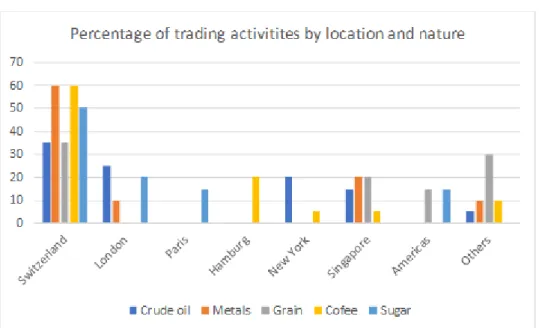
The relative importance of Switzerland in the trading industry is shown in Fig. 10. Beyond statistics that show the importance of the commodity trading business in Switzerland, it is important to note that some of the major trading companies have their headquarters or main representatives in our country. Some of these companies are highly vertically integrated while others are more specialized. Companies established in Switzerland dealing exclusively with energy resources include: Gunvor, Litasco, Trafigura, Mercuria and Vitol. Companies dealing mainly in the agricultural sector are Louis Dreyfuss and Cargill. They maintain large trading divisions in Switzerland even though their headquarters are respectively in the USA and Rotterdam.
Figure 10 – Market share of trading centers
Source: FDF (2013)
As we drill down to regions in Switzerland that have developed the largest trading activities, the Lake Geneva region is the most important. The data for this region are as follows (FDF 2013):
• Favorable ecosystem for trading in commodities (banks, merchanting, shipping, testing),
• 1/3 of the world trade in crude oil, • 75% of Russian crude oil,
• 1/2 of the global trade in coffee and sugar, • No 1 in grain, oilseed and cotton trading, • No 1 in commodity trade financing and testing, • 22% of shipping commodities worldwide
Zug is the second most important center for trading companies in Switzerland (FDF 2013). The data are as follows:
• Glencore and Xstrata deal with copper, zinc and coal trading and are major players in the world,
4.3 International competition and Switzerland's position in the
trading industry
Companies establishing branches in a specific country are not only subject to the local tax, they also present a good opportunity for local providers, employment and subcontractors. This is why many countries try to attract foreign investors in various ways.
The main advantages of Switzerland are: developed infrastructures (airports, communication systems, schools, etc.),a highly developed and internationally recognized banking sector, a favorable ecosystem including a qualified workforce, educated managers, international communities and good schools, moderate taxes and a geographic location allowing for trade activities the same day between the American continent and Asia, for example.
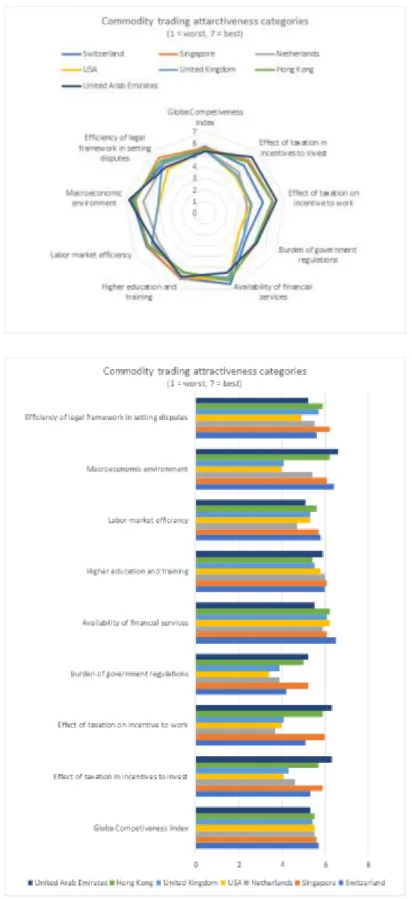
A comparison of main commodity trading centers can be made through several categories of competitiveness used in Global Competitiveness Report 2014-2015 published by the World Economic Forum (WEF 2016) - see Figure 11.
Categories that are the most attractive to commodity trading include: • Effect of taxation on incentive to invest,
• Effect of taxation on incentive to work, • Burden of government regulations, • Availability of financial services, • Higher education and training, • Labor market efficiency, • Macroeconomic environment,
• Effectiveness of the legal framework in settling disputes.
Switzerland is not first in every criterion under observation. However, globally, its position may be estimated as the most competitive for the commodity trading business. All these categories are not equally important for commodity trading. Among these categories Switzerland is the most performant in: the availability of financial services, the macroeconomic environment, and labor market efficiency.
The fact that Switzerland is a political dwarf, but a giant in commodity trading will certainly have an impact on the strategy one should adopt regarding regulations. Switzerland is not isolated in the global economy and is neither a producer nor a big consumer of commodities. Its economy is oriented through exportation and international commerce and the fact that it is largely dependent on conditions on the global market. Regulators in Switzerland should also take into account the competitiveness and attractiveness factor when deciding on the evolution of the regulatory framework for the commodity trading industry. This aspect will be developed in the chapter dealing with recommendations for Swiss regulators.
5. Brief overview of Singapore as a competitive trading
sector
To better understand how competition works in the commodity trading industry, the example of Singapore should be presented.
Singapore’s presence in the commodity sector has increased steadily during the last decades due to many different key factors, such as its geographic position in Southeast Asia in the same time zone as China and Australia, and the ease of doing business (political, infrastructural, tax and regulations). They have an internationally recognized regulatory framework with fiscal benefits for companies which positively influences its attractiveness. The port of Singapore is the biggest in the world for Bunkering and the second for Containers. The stability of the institutions that are present in the region, together with its favorable geographic position for maritime freight makes Singapore the fastest growing hub for commodity trading.
The Monetary Authority of Singapore (MAS) acts as the Central Bank of the country and ensures its economic growth and attractivity. This is why it is important to compare how one of the biggest trading hubs behaves with regard to legislation that is put in place. The country has two principal laws on commodity trading: The Commodity Trading Act (CTA) issued by the International Singapore Board (IE Singapore) that regulates OTC derivatives and spot contracts, and the Securities and Futures Act (SFA administered by MAS) which regulates futures contracts. Futures contracts are also regulated by the Financial Advisers Act (FAA), also issued by MAS.
The Commodity Trading Act (CH 48 A) provides guidelines on the commodity market, clearing houses, licenses, accounting to be kept by brokers and audits mandated by the
boards, the conduct of the commodity business and its risks, the different powers of the board, the offenses (fraud, bucketing, and price manipulation) and other rules on secrecy, the prevention of false reports and the immunity of boards and employees. All firms acting in the commodity sector in Singapore must be licensed and obey the rules of the CTA (unless under certain provisions).
In a broader view, the CTA restricts the activity of unlicensed trading houses and private traders, and the possibility of conducting illegal trading activities. It was developed to protect the investors. It forbids bucketing, for example, the principle of attracting clients by using various methods that are profitable for the firm, such as making repetitive contracts to earn commissions
The Securities and Futures Act regulates the activity in the securities, futures and derivatives domain. It is issued to reduce the risk of doing business and to promote a market that is suitable and transparent for trading activities.
By looking at Singapore, the Swiss regulators can see an example of a regulatory framework which is adapted to the particular economic needs of a commodity trading hub. In Singapore, the same Authority is acting as the Monetary Supervisor and the central bank which is not the case in Switzerland. Singapore seems to be not over-regulated to favor the business prosperity. However, it is effectively regulating the monetary and the physical trading through a single Authority.
6. Physical Operations and Associated Regulations
The first perspective of commodity trading is the physical operations. We will talk about direct and indirect (management) physical operations. There are many regulations on physical operations, but the market is less transparent about them.Switzerland is less concerned about physical operation regulations than other countries that produce or import goods (exception for gold needed by its industry). As the country is a merchanting hub, regulations on transportation cover mainly domestic freight (railway and roads) and to some extent the storage of oil for domestic consumption. To make a comparison, other hubs, producers and large consumers such as Singapore, China, the US and Brazil, are more concerned about regulations on maritime freight, pipelines and the storage of goods. Regulations covering physical operations in Switzerland (rail and road) are very compliant with European standards (UNECE). Various regulations such as the regulation on energy markets integrity and transparency (REMIT), have been issued by the EU, and Switzerland complies with them. In the physical operations sector, the aim is to protect the consumer and the environment. As companies are trading hazardous goods around the world and in large volumes, the risks of spills or other damage that lead to hazardous consequences are evident. Therefore, such activities must be standardized, regulated and supervised to mitigate those risks. The United Nations and the European Union regularly issue regulations, directives and norms through multiples bodies to keep pace with constantly evolving technical improvements and to ensure safety on inland and waterway transportation.
For instance, the European Parliament and Council issued a directive « directive 2008/68/EC of the European Parliament and of the Council of 24 September 2008 on the inland transport of dangerous goods ». Its aim is to ensure that the goods are transported with safety and the highest precaution.
The European Committee for Standardization is recognized by the European Union and the European Free Trade Association as a platform responsible for standardization at the European level. It joins the national standards in various fields such as chemicals, transportation, and energy of its 34 member countries to meet the needs of companies and organizations within the EU.
Regarding railway transportation, the European Union Agency for Railways (ERA) provides a framework to establish a single railway market for the transportation of goods, and to ensure the safety and functioning of the market. The Agency publishes annual reports on its performance. Switzerland complies with this framework.
Focusing on goods, the wide variety of commodities traded globally have different properties that can become a potential threat for the environment and society. The transportation and delivery of hazardous goods such as gases, explosives, flammable liquids and radioactive materials through different regions, needs to be standardized and easily visible. The classification and labelling of such goods is thus required. In the European Union, the European Chemical Agency (ECHA) issued the Classification, Labelling and Packaging regulation, called CLP 2009, to make trading easier in order to better manage the risks (ECHA 2017).
Today, a major issue in the sector is the trade of diesel with a high concentration of sulfur, commonly called "dirty diesel" in Africa. Some NGOs argue that Swiss traders are selling dirty diesel to Africa that is harming the local population and the environment. Such activity, although not considered illegal, may have irreversible effects on the African continent. As per the NGOs, companies are benefiting from the low requirements on product quality and are intentionally selling these products to make bigger margins. The first step that needs to be taken in order to fight this issue is to require that African governments lower the amount of sulfur authorized in dirty diesel. Secondly, companies should be fined for this kind of activity, and governments from the countries where dirty diesel is produced must forbid its export. Regarding Switzerland, where the major companies that sell dirty diesel are based, the government should require that companies pursue their activities with respect for human rights. Ghana has already issued new regulations to prohibit the import of diesel that has more than 50 ppm of sulfur (compared to 3000 pm previously) (PE2 2017).
The extractive industry is located in different countries and involves government authorizations and contracts with extractive companies. Therefore, financial flows between extractive companies and governments should be more transparent. The Extractive Industry Transparency Initiative (EITI) promotes rules and disclosures for such payments. There is also the Dodd-Frank Act in the USA, and Financial Reporting and Transparency from the EU that act as regulators in the extractive industry. Also, some new initiatives have been issued to strengthen physical commodity trading, such as the Joint Organizations Data Initiative Oil (JODI Oil) and the Agricultural Market Information
Switzerland hosts major companies dealing with physical operations. In order to preserve the overall reputation and credibility of the Swiss milieu, it is important to actively monitor the regulatory framework and control company activities. Swiss regulatory authorities are tasked with overseeing the transactions made by Swiss companies or branches worldwide in order to preserve the country’s reputation and comply with international requirements on physical trading by providing information to companies.
7. Financial Derivatives and Associated Regulations
Regulating financial flows and derivatives is a priority for Switzerland due to the large number of financial institutions that are present within the country. Regulations in this domain are numerous and the country is actively developing this framework in coordination with the G20 and other commodity hubs. The ecosystem in Switzerland is favorable for this activity and great attention should be given to providing an adequate regulatory framework.In a modern economy, there is no trading without derivatives. This means that in the process of buying and selling, trading companies protect themselves against various risks that will be stated below.
For trading companies, the practice of hedging is a means to transfer or limit the risk of price changes over time. This is done through financial instruments offered by banks or other financial institutions. Financial investors contribute to the liquidity of commodity derivatives markets. Some commodity derivatives are traded on stock exchanges but some of them are not. These products are also called over-the-counter or OTC derivatives. The biggest advantage of OTCs is their flexibility and capacity to adapt to the specific needs of each party, unlike exchange derivatives that must be highly standardized.
The main reason we need regulations in financial derivatives is the perceived lack of transparency on OTC derivatives markets. This opacity was clearly expressed in the Treasury and Financial Services Authority paper, Reforming OTC Derivatives Markets: "positions and exposures of firms in OTC derivatives markets were not sufficiently
transparent to other market participants or to regulators" (UK PARLIAMENT 2010). Basel
III regulation is following this principle and requires the banks to have a sufficient capital at disposal to cover the risk of default in the market. The risk comes from a lack of visibility of all the positions taken by the market participants and their exposure to risk. Without this visibility, the market can collapse or witness less liquidity for certain derivatives. This also prevents regulators from monitoring the market in order to avoid systemic risk.
are issued by banks as a guarantee of payment even after the insolvency of a counterparty. However, these kinds of protections may be insufficient basically because of the absence of controls and capacity to assess the real value of the underlying assets by an independent body. Today, only contractors or issuers of a CDS are able to estimate the real value of underlying assets. CDS by themselves are used as a speculative instrument, which may increase systemic risk. Today there is no regulation on CDS and one can buy CDS products without ownership of the underlying asset. Because this kind of transaction is not used for hedging, some regulators suggest limiting their usage to only traders for their own transactions (UK PARLIAMENT 2010).
The Lehman Brothers default in 2008 may be considered the first major case of default of obligations under OTC contracts. However, many experts argue that this collapse was not due to their OTC positions, which were conveniently covered by hedging positions, and the crisis would have been much greater without these operations on the OTC derivatives market (Wholesale Market Brokers' Association and the London Energy Brokers' Association - WMBA/LEBA) - (UK PARLIAMENT 2010). It is therefore interesting to note that the share of OTC derivatives on commodities related to the total OTC derivatives traded is of 0,5%, according to the BIS Quarterly Review, June 2012 (FDF 2013).
The main regulator in CDS and other financial derivatives in the USA is the Commodity Futures Trading Commission (CFTC). This independent agency is in charge of regulating the trading of financial derivatives in the commodity trading market. Some kind of enforcement of the rules is supervised by the National Futures Association (NFA) - a self-regulatory organization. In other countries, this role is played by the national supervision of financial institutions such as FINMA in Switzerland or MAS in Singapore. The Dodd-Frank Act divides regulatory authority over swap agreements between the CFTC and the Security and Exchange Commission (SEC). According to the SEC "The SEC has regulatory authority over ‘security-based swaps’, which are defined as swaps based on a single security or loan or a narrow-based group or index of securities" and "The CFTC has primary regulatory authority over all other swaps, such as energy and agricultural swaps. The CFTC and SEC share authority over ‘mixed swaps’, which are security-based swaps that also have a commodity component". (SEC 2015)
Supervision of the global trade in commodity derivatives is regulated mainly by the Financial Stability Board (FSB) that promotes international financial stability : "The FSB
promotes global financial stability by coordinating the development of regulatory, supervisory and other financial sector policies and conducts outreach to non-member
countries. It achieves cooperation and consistency through a three-stage process, including monitoring implementation of agreed policies". Another international body that
promotes transparency in commodity derivatives is the International Organization of Securities Commissions (IOSCO) through its "Principles for the Regulation and Supervision of Commodity Derivatives Markets". To increase transparency in derivative trading, the G20 has mandated the Financial Stability Board (FSB) to make propositions for OTCs and other trading operations. Concerning OTC, IOSCO recommends the establishment of a central repository of transactions in order to allow access to data on OTC derivatives. This raises privacy issues, such as the possibility to publish statistics or other confidential information on who is dealing with what kind of assets. There is no country today that has fully implement this kind of regulation (FDF 2013).
All major financial supervising bodies or regulatory authorities for financial institutions such as FINMA in Switzerland, HKMA in Hong Kong, MAS in Singapore or SEC in the USA are indirectly supervising the financial derivatives market through the banking and financial sector (see below). All security traders must be licensed by financial market supervisory authorities in developed countries and the major exchanges for commodity derivatives are located in London, New York, and Chicago.
Commodity derivatives are regulated in the European Union via the Markets in Financial Instruments Directive (MiFID). Physical commodity traders, dealing on regulated exchanges were benefiting from an exemption under MiFID and were not subject to this regulation , but could probably be in the MiFID II proposal. Only those trading in derivatives exclusively for their own purpose will still be exempted from this regulation. Regarding Switzerland, oversight authorities such as FINMA may be authorized to limit positions on commodity derivative exchanges in order to mitigate the systemic risk as seen previously. All exchanges in Switzerland are supervised by FINMA and self-regulation has been set up by the exchanges themselves (Federal Act on Stock Exchanges and Securities Trading (SESTA)). Only security dealers licensed by FINMA can participate in a Swiss exchange under SESTA. Traders who are not active in the financial industry do not require such a license, because they are not considered professional dealers. Swiss authorities and FINMA are expected to make some
EU and USA are adopting the same principles. In the USA, this will be done through the Dodd-Frank Act and in Europe through the European Market Infrastructure Regulation (EMIR) and the implementation of MIFID II. However, companies that are using OTC derivatives to hedge their own positions and the underlying physical asset they own would be exempted from these regulations. This means that commodity traders would probably be exempted from it as well. (FDF 2013).
Banking and regulations on financial institutions are going to be developed in the next chapter. However, it is useful to note that regulating banking operations alone is probably not sufficient to regulate financial derivatives effectively. Regulations on financial derivatives are important because financial derivatives such as CDS can jeopardize new regulations for banking funds, such as Basel III. As stated by Vania Stavrakeva from the London Business School (FORBES 2013): "One might wonder why countries with strong
moral hazard need derivative regulation on top of minimum bank capital requirements. Minimum bank capital requirements, for the most part, target standard bank lending and proprietary bank trading instruments such as equity and bonds. Even if minimum bank capital requirements serve their role of containing excessive lending and investment in risky assets, banks can still shift risk using derivative contracts such as Credit Default Swap (CDS) contracts. Given the recent increase in minimum bank capital requirements in Basel III, banks might find it relatively cheaper to shift risk using derivative contracts, such as CDS contracts."
In the United States the CFTC, through the Commodity Exchange Act, currently requires all professional swap dealers in the OTC market who trade swaps regularly to be licensed if they are not yet registered as such (CFTC 2017). Swap dealers should also be members of the National Futures Association, which enforces the CFTC's requirements on transparency and disclosure.
8. Banking Regulations on Commodity Trading
Trading in commodities needs stability in the political, legal and regulatory environment. The financial sector plays a crucial role in all transactions, mainly in the process of securing and hedging the risk, but also in the traditional financing of transactions. For banks and the financial sector, trading activity is an attractive market to provide financial instruments for traders and to borrow funds. It helps diversify their traditional banking activities.
Nevertheless, the multitude of regulations imposed on banks today are likely to make it harder for smaller companies to take out credit. These regulations are not always directly linked to the financing of trading activities, but tend to impose stricter conditions on banks, resulting in more difficulties for them to engage large amount of funds needed by traders worldwide. (DB 2017) - See Figure. 12. Because today 80% of all trading companies depend on banks, banking regulations indirectly regulate commodity trading as well (EGGERT 2017). This figure shows that 56% of global trades are financed by at least 80% by banks.
Figure 13 – Ten major borrowers from banks in 2015 and 2016 (in M
USD)
Source: EGGERT (2017)
Commodity trading and the financial industry are closely linked (see Fig. 13). Commodity traders need financial support from banks and their financial instruments and derivatives to manage the risk of price fluctuations. Thus, the financial industry is a major player in commodity derivatives markets. Their main value added is to make this market liquid and to offer products and funds that commodity traders may use in their day-to-day activity (see Fig. 14).
The financing trading industry raises the question of regulations and transparency in products and financial flows. Tax and finance regulations also play a crucial role for traders, intermediaries and financial institutions.
Banking regulations can be expressed in many different ways and forms. In many countries, such as Switzerland, laws concerning business in general, and banks in particular, are part of federal legislation. Examples are: Banking Law and the Law on Financial Market Supervision. More detailed aspects are regulated under governance ordinances such as the Banking Ordinance or FINMA ordinances. The Swiss Financial Market Supervisory Authority (FINMA), the only independent regulatory authority, issues ordinances, circulars, guidelines, directives and recommendations for the banking and financial sector. The Swiss Bank Association takes part in defining the regulatory framework for banks. Each bank must have its own inspection and auditing supervision,
0 10000 20000 Trafigura Glencor Vitol Noble Group Lundin Petroleum Mercuria International Petroleum Investment…
Gunvor Petroleum Development Oman LLC…
Olam International
Top 10 borrowers 2015 and 2016
but FINMA has the authority to commission these companies to carry out inspection and auditing for the banks (STAUB 2017).
Figure 14 – Receipts from merchanting and financial services abroad
by banks, in % of GDP
Source: EGGERT (2017)
According to the Swiss Bank Association: " In Switzerland, as in many other countries,
the financial sector belongs to the most strictly regulated branches of the national economy. Banking and financial sector regulation plays a correspondingly important role in determining the attractiveness of a location for financial services" (STAUB 2017)
Financial regulations covering international trade and derivative instruments encompass a number of rules, some of which are not yet fully implemented worldwide. The Financial Stability Board (FSB) of the G20 decided to straighten the transparency in commodity derivatives. The International Organization of Securities Commissions (IOSCO) also published its Principles for the Regulation and Supervision of Commodity Derivatives
Since commodities are traded worldwide, financial intermediaries and banks also have the issue of the transparency of financial flows between the extractive industry, local governments and their respective financing activities. The Extractive Industries Transparency Initiative (EITI) proposes principles to regulate this for all financial intermediaries, promoting the disclosure of the payments to local governments and intermediaries. This regulation is strongly compliant with the Dodd-Frank Act in the USA, and financial reporting and transparency directives from the European Union.
Banks are the main provider of funds to finance commodity trading worldwide. The trading industry could not perform as it does without this active support from the financial industry. Raising large amounts of money is a prerequisite to purchasing commodities. Swiss-based banks provide roughly 70% to 80% of all commodity trade financing (FDF 2013). Examples of such banks are BNP Paribas, ING, Crédit Agricole and Société Générale. The letter of credit is traditionally one of the main instruments used in the commodity trade. It is issued by a buyer's bank and guarantee the regulation of payment upon termination of a transaction and presentation of the shipping and inspection documents to the buyer's bank. Some variances exist (the bank may become owner of the goods for a period of time, but the principle is still the same). Some banks are specialized in this type of financing, including some cantonal banks, ING, French banks such as BNP Paribas, Crédit Agricole and Société Générale and the two larger Swiss banks, UBS and Crédit Suisse.
The role played by the commodity trade and related derivatives markets in the increase in price of commodities in recent years has been questioned in public debate. Are we, as consumers of goods, dependent on traders? What is the responsibility of the commodity trade industry in the pricing of goods? Are banks stimulating speculation and is this the reason for the price increase? This is why financing regulations are gaining in importance. The International Organization of Securities Commissions (IOSCO) and the Financial Stability Board (FSB) try to enforce commodity trading principles in order to ensure that financing does not influence commodity prices, that risk mitigation through financial derivatives is not used for speculation, and that prices cannot be manipulated. Thus, they are aimed to assess the effectiveness of trade finance.
FINMA is the regulator for the Swiss banking industry and is a member of IOSCO. All financial intermediaries for traders in Switzerland must be authorized or licensed by FINMA. The smooth financing of transactions should be beneficial for price stabilization and market liquidity. The Federal Act on Stock Exchanges and Securities Trading (SESTA) supervises the self-regulation of stock exchanges whose administrative
structures and operations must be approved by FINMA. Exchanges themselves may impose limits on positions. Simply stated, all participants on the Swiss exchange must be licensed by FINMA as dealers and act under SESTA rules. These rules are not applicable to proprietary traders who do not need a license from FINMA because security dealing is not their primary business. Commodity traders are basically this type of actor, because they use commodity derivatives for their hedging purposes, assuming that derivatives are not their primary business.
Exchanges in commodity derivatives in the EU are regulated through the Markets in Financial Instruments Directive (MiFID). Traders in physical commodities on a regulatory exchange will be submitted to more strict regulations under MiFID II, which was proposed recently. Traders who do not use commodity derivatives will also be more strictly regulated under MiFID II.
Regulation authorities will probably be more intrusive in the exchange market and be able to impose limits on positions concerning commodity derivative exchanges. To give an example, in the USA, all the participants in commodity derivatives exchanges are supervised by the Commodity Futures Trading Commission (CFTC), applying the Commodity Exchange Act (CEA). If there are reasonable suspicions of manipulation on the market, the CFTC is authorized to investigate every aspect of the market, including not only commodity derivatives, but also physical and OTC markets. There are also some self-regulatory organizations that supervise the exchanges, such as the National Futures Association (NFA), the Chicago Mercantile Exchange, and ICE Futures.
Derivative trading and physical trading are regulated differently. Physical trading is not supervised by FINMA, but security traders are and must be licensed.
In addition to supervision, authorization and licensing from FINMA, banks and other financial intermediaries are subject to IOSCO Principles for the Regulation and Supervision of Commodity Derivatives Markets. Furthermore, the Basel III regulation imposes stricter capitalization and liquidity for banks not only in Switzerland, but for all financial intermediaries.