HES-SO Valais-Wallis • rue de la Plaine 2 • 3960 Sierre
Bachelor Thesis 2017
Web application of physiological data
based on FHIR
Student
: Camille Pellaton
Professor
: Michael Schumacher
Submitted the 2
ndof August 2017
Sources of the illustrations of the title page
http://www.techno-soft.com/assets/images/HL7-FHIR.jpg
https://i.embed.ly/1/display/resize?key=1e6a1a1efdb011df84894040444cdc60&url=http%3 A%2F%2Fhl7.se%2Fwp-content%2Fuploads%2F2016%2F02%2Ffhirbanner-2.png
Acknowledgments
Thanks to:- Michael Ignaz Schumacher, professor at the HES-SO Valais-Wallis and collaborator at the Institute of Information Systems of the HES-SO Valais-Wallis, for proposing this Bachelor thesis and for his guidance during the realization of the thesis.
- Fabien Dubosson, collaborator at the Institute of Information Systems of the HES-SO Valais-Wallis for his precious advice, guidance and information.
Abstract
This paper works toward implementing a prototype demonstrating some of the capabilities of the FHIR specification. The specification requires a clear understanding of its different components in order to be successfully implemented, therefore the primary concern of this work is to understand and analyse FHIR’s concepts.
The research conducted in this work revealed that FHIR is a well-designed specification, based on a powerful data model and technologies. Therefore, it sould help solving the interoperability issues of the healthcare eco-system. It has also been pointed that since FHIR is a recent standard, many of its uses and benefits are still to be discovered. Moreover, FHIR integrates well in the current health information technology context since it can be used in addition to existing standards.
The analysis of the currently used technologies to implement FHIR evidenced that HAPI FHIR java library was the most suited library to develop a FHIR-based application in this work. Indeed, HAPI provides more capability and a better usability than alternative libraries. Implementing FHIR in a web application helped determined that FHIR does enable fast implementation and thus, can potentially drastically decrease the cost of systems integration in the healthcare industry.
The objectives of this Bachelor thesis have been reached in 396 hours using the Scrum framework. Scrum features have facilitated the development of this work, in particular the creation of a product backlog and structuring the development with sprints in which user stories from the product backlog are broken into tasks.
Table of Contents
Acknowledgments ... III Abstract ... IV List of Tables ... VIII List of Figures ... IX List of listings ... XI List of Abbreviations ... XII
Introduction ... 1
1 Entering FHIR’s world ... 3
1.1 FHIR’s origin ... 3
1.1.1 HL7 International ... 3
1.1.2 The interoperability issues ... 4
1.1.3 Why standards are needed ... 5
1.1.4 HL7 v2 ... 5
1.1.4.1 The need to integrate ... 5
1.1.4.2 The messages ... 6
1.1.5 HL7 version 3 ... 7
1.2 The need for FHIR ... 9
2 The FHIR standard ... 11
2.1 Resources ... 12
2.1.1 Validation ... 15
2.2 The four Paradigms ... 16
2.2.1 RESTful API... 16
2.2.1.1 REST ... 17
2.2.1.2 FHIR RESTful API ... 18
2.2.2 Services ... 20
2.2.3 Messaging ... 21
2.2.4 Documents ... 22
2.3 Security and privacy ... 23
2.4.1 Profiles ... 23 2.4.2 Profiling artifacts ... 24 2.4.3 Conformance resources ... 24 2.5 Use cases ... 26 2.5.1 PHR viewer ... 26 2.5.2 Document repository ... 27 2.6 Workflows ... 27 2.6.1 Workflow patterns ... 28 3 Implementations analysis ... 30 3.1 Databases ... 30 3.1.1 FHIRbase ... 32
3.1.1.1 Documentation and analysis ... 33
3.2 Framework: Aidbox ... 33
3.2.1.1 Features ... 34
3.2.1.2 Documentation and analysis ... 35
3.3 Libraries ... 35
3.3.1 The HAPI-FHIR Java library ... 35
3.3.1.1 Data model ... 37
3.3.1.2 RESTful Client ... 37
3.3.1.3 RESTful Server ... 37
3.3.1.4 Documentation and analysis ... 38
3.3.2 FHIR .NET API ... 38
3.3.2.1 Spark ... 39
3.3.2.2 Documentation and analysis ... 39
3.4 Platform: SMART ... 40
3.4.1 Data model ... 41
3.4.2 SMART JS client ... 42
3.4.2.1 Documentation and analysis ... 43
3.4.3 SMART on FHIR Python client ... 43
3.4.3.1 Documentation and analysis ... 46
3.4.4 SWIFT-SMART IOS client ... 46
3.4.4.1 Documentation and analysis ... 48
3.4.5 Comparative table ... 48
4 Prototype ... 52
4.1 Context ... 52
4.2 Use-cases ... 53
4.3 Disclaimer ... 53
4.4 Project Architecture ... 54
4.4.1 Overview of the client application ... 54
4.4.2 FHIR Test server ... 55
4.4.3 Database ... 57
4.5 Implementing FHIR client with HAPI-FHIR library... 58
4.5.1 Application server connection ... 59
4.5.2 Understanding the FHIR resources ... 60
4.5.3 Manipulating the resources ... 62
4.5.3.1 Creation ... 63 4.5.3.2 Read ... 68 4.5.3.3 Update ... 68 4.5.3.4 Deletion ... 69 4.5.3.5 Search ... 69 4.5.3.6 Vread ... 70 4.5.3.7 HAPI’s evaluation ... 71 Conclusion ... 74 References ... 76
Appendix I: FHIR message example ... 84
Appendix II: FHIR mind map ... 87
Appendix III: Weight tracker function ... 90
List of Tables
Table 1 - FHIR profiling artifacts adapted from (HL7 International, n.d.-p) ... 24 Table 2 - Comparision table, author’s data ... 50 Table 3 - Vital-signs profiles adapted from (HL7 International, n.d.) ... 62
List of Figures
Figure 1 – HL7 v2 Message (HL7 International, 2010)... 6
Figure 2 - HL7 v3 RIM (Nawanan Theera-Ampornpunt, 2015, p. 40) ... 7
Figure 3 – FHIR and v2 (‘Use cases of FHIR’, n.d.) ... 10
Figure 4 – FHIR resources structure (HL7 International, n.d.) ... 12
Figure 5 – base resource (HL7 International, n.d.) ... 14
Figure 6 – UML diagram of a Domain Resource (HL7 International, n.d.) ... 14
Figure 7 - Patient resource in JSON and HTML narrative ... 15
Figure 8 - validation tools (HL7 International, n.d.-x) ... 16
Figure 9 - REST maturity model (Martin Fowler, n.d.) ... 16
Figure 10 - FHIR API interactions (HL7 International, n.d.-h) ... 18
Figure 11 - FHIR security subsystem (HL7 International, n.d.-t) ... 23
Figure 12 - Resource profiling (David Hay, 2014, p. 3) ... 25
Figure 13 – FHIR integration with EHR (Sangem, 2016) ... 26
Figure 14 - simple RESTful workflow pattern (HL7 International, n.d.-z) ... 28
Figure 15 - FHIR worflow management pattern (HL7 International, n.d.-aa) ... 29
Figure 16 – FHIR server MySQL database schema (Grahame Grieve, 2012) ... 31
Figure 17 – Querying the patient table of FHIRbase (Health Samurai Team, n.d.) ... 32
Figure 18 - sample patient stored (Health Samurai Team, n.d.) ... 33
Figure 19 - An Aidbox box ... 34
Figure 20 - HAPI-FHIR usage patterns (University Health Network, n.d.-b)... 36
Figure 21 - Fluent style method calls (University Health Network, n.d.-c) ... 37
Figure 22 - REST Search operation (FHIR Developer Days, 2014) ... 39
Figure 23 – The SMART App Gallery (‘SMART App Gallery’, n.d.) ... 41
Figure 24 – FHIR JS resources’ creation (niquola, 2014) ... 42
Figure 25 – SMART js search (SMART Health IT, 2017b) ... 42
Figure 26 – Python client class structure (SMART Health IT, 2017) ... 43
Figure 27 – Patient resource UML (HL7 International, n.d.-n) ... 44
Figure 28 - patient class of the python client (SMART Health IT, 2017e) ... 45
Figure 29 – working with FHIR data Python (client-py, 27 August 2014/2017) ... 45
Figure 31 – Patient resource’s attributes SWIFT (SMART Health IT, 2017c) ... 48
Figure 32 - Architecture of FHIR project (University Health Network, n.d.-b) ... 54
Figure 33 - pom.xml dependencies, source: author’s data ... 55
Figure 34 - MySQL Database schema, source: author’s data ... 58
Figure 35 - HAPI FHIR app Java Build Path, source: author’s data ... 58
Figure 36 - HAPI STU 3 Javadoc (‘ContactPoint (HAPI FHIR Structures - DSTU3 2.5 API)’, n.d.) ... 59
Figure 37 - Practitioner JSON example, source: (HL7 International, n.d.-o) ... 61
Figure 38 - FHIR search query ... 65
Figure 39 – Bundle of Body weight resource on the server ... 66
Figure 40 - Constants of gender enum (University Health Network, n.d.-a) ... 68
Figure 41 - setting a telephone number attribute ... 71
List of listings
Listing 1 - V3 message sample, code source: (René Spronk, 2007) ... 8
Listing 2 - FHIR server configuration file based on http://hapifhir.io/doc_jpa.html ... 57
Listing 3 - FHIR connection java class ... 60
Listing 4 - Patient resource creation ... 64
Listing 5 - Observation resource creation ... 65
Listing 6 - Practitioner resource creation, source: application code ... 67
Listing 7 - HAPI patient resource read interaction ... 68
Listing 8 - Patient update ... 68
Listing 9 - patient deletion ... 69
Listing 10 – patients search with one parameter... 69
Listing 11 - Searching by URL ... 70
List of Abbreviations
API : Applications Programming Interface BLOB : Binary Large OBject
CDA : Clinical Document Architecture CRUD : create, read, update and delete DB : database
DSTU : Draft Standards for Trial Use EHR : electronic health record
FHIR : Fast Healthcare Interoperability Resources, : Fast Healthcare Interoperability Resources HIMSS : Healthcare Information and Management Systems Society
HIT : health information technology HL7 : Heath Level Seven
HL7 v2 : Health Level Seven version 2 HTTP : HyperText Transfer Protocol
IHE : Integrating the Healthcare Enterprise
ISO : International Organization for Standardization IT : information technology
JSON : JavaScript Object Notation MRN : Medical Record Number MSH : Message Header
NoSQL : Not only SQL OBR : Observation Request OBX : Observation
PID : Patient Identification
RDBMS : relational database management system RDF : Terse Resource Description Framework REST : representational state transfer
RIM : Reference Information Model
SMART : Substitutable Medical Applications, Reusable Technologies SOA : service-oriented architecture
SPA : single-page application SSL : Secure Sockets Layer
STU : Standard for Trial Use, : Standard for trial use Turtle : Terse RDF Triple Language
UML : Unified Modeling Language URL : Uniform Resource Locator v2 : version 2
v3 : version 3
XDS : HE Cross-Enterprise Document Sharing XML : Extensible Markup Language
Introduction
As healthcare is progressively becoming paperless, the need for the exchange of clinical data between health information systems is increasing. Standards have provided health institutions with the possibility to widely implement the exchange of data within their information systems. For instance, allowing the patients data to be shared amongst different services of a hospital or across hospitals and organizations. As of today, the most implemented interchange standard within health information systems is the Health Level Seven version 2 (HL7 v2) standard. V2 has significantly improved the way medical systems can exchange data and how they can use the exchanged information in multiple innovative manners. Indeed, more suitable care can now be provided and the probability of making diagnostic errors has decreased. Nevertheless, HL7 v2 has shown its limits regarding implementation costs and interoperability resulting in a lack of efficient electronic data exchange across institutions, for example, between private practices and hospitals.
A recent survey (Transcend Insights, 2017) on the patients’ expectations of medical information sharing indicates that 64% of patients use a medical device or a mobile application to monitor their health, out of which, 71% think that this data could be helpful to practitioner and should be recorded in their health history. Because of the initiative to include the patients into their own health and because of the need for cheaper and more interoperable solutions, in 2014, the healthcare industry has seen emerged a new HL7 standard called the Fast Healthcare Interoperability Resources (FHIR).
FHIR is full of promises: real-time data access, usage of current web technologies, freely available, a focus set on the implementation to enable the creation of fast and cost-effective solutions and ensure semantic interoperability. FHIR has the capabilities to improve and broaden the existing analytical process of clinical data.
This works aims to understand the capabilities provided by the FHIR specification as well as testing some of those capabilities to evaluate FHIR against its promises. This paper focuses firstly on analyzing and presenting the different concepts of the FHIR specification by analyzing the context amongst which it has been created and the previously developed HL7 standards to understand the reasons behind its conception. In a second phase, existing tools to
implement FHIR-based solutions will be analyzed and evaluated in order to determine which technology is the most suited to develop a web application based on FHIR.
The final part of this paper aims to present the application prototype realized and to provide an insight of the creation of a FHIR-based client application. The application prototype illustrates some of the capabilities of FHIR, evidenced by the research conducted in this work, with the practical implementation of FHIR in a web application.
1 Entering FHIR’s world
The Fast Healthcare Interoperability Resources (FHIR) is a standard for the electronic exchange of health data. It has been designed by the Heath Level Seven (HL7) organization. The purpose of this specification is to enable a better interoperability in healthcare information systems. FHIR is a web-based toolbox, set of rules and frameworks defining how the exchange of clinical data should be excecuted between different healthcare applications and systems (HL7 International, n.d.-v).
FHIR makes interoperability faster and easier to implement than existing standards, which leads to being able to create much cheaper solutions than by using alternatives.
FHIR is based on previous HL7 standards which it combines and improves: HL7 version 2 (v2), version 3 (v3) and the Clinical Document Architecture (CDA) (HL7 International, n.d.-v).
The FHIR specification is entirely based on the concept of resources. A resource is a small piece of information that represents a real-world entity such as a patient, a location or an appointment. For its purpose of exchanging clinical data, FHIR determines four different paradigms to be used:
- The representational state transfer (REST) Applications Programming Interface (API) - Messaging - Documents - Services (HL7 International, n.d.-g).
1.1 FHIR’s origin
1.1.1 HL7 International
The HL7 International is a non-profit standards creating organization. It is globally well represented since it has members in more than 50 countries (Rouse & Sutner, 2015). The best way to understand its purpose is to reading its mission statement - “To provide standards that empower global health data interoperability.” (HL7 International, n.d.-a) - and its vision: “A world in which everyone can securely access and use the right health data when and where they need it.” (HL7 International, n.d.-a).
1.1.2 The interoperability issues
Nowadays, hospital information systems are composed of a variety of systems provided by different vendors. Those systems must work together by exchanging their data so that laboratorians, physicians, nurses and other actors of healthcare can, for example, access the electronic data relative to a patient. Furthermore, clinical data must be shared across institutions such as between a hospital system and a private practice system to enable a practitioner to consult his patient’s data. Another example is the transmission of a prescription from a physician to a pharmacist.
Interoperability is a key point in making great sustainable healthcare information systems. In the health informatics context, interoperability means that separate medical systems or software can communicate without compromising the data, and this, without an extreme amount of effort (Datar, 2016). With interoperable health systems, the actors implicated in patient care use systems that can not only exchange data, but can also interpret and use the data in a meaningful manner to provide better medical care. Healthcare Information and Management Systems Society’s (HIMSS) definition of interoperability includes “[…] the ability of health information systems to work together within and across organizational boundaries in order to advance the effective delivery of healthcare for individuals and communities.” (HIMSS, 2013).
Communication is the key to providing good healthcare. A technical1 and semantical2
interoperability guarantee that systems will be able to communicate, but the supreme goal of interoperability is to reach a clinical interoperability level, meaning that clinicians from different teams are able to transfer patients’ care and this, by providing seamless care (Benson & Grieve, 2016).
Improving interoperability in healthcare has been the mission of the HL7 international over the past three decades. HL7 has released different standards helping solve the interoperability issue in the healthcare industry: HL7 v2, v3 and FHIR.
1 Moving data from one system to another, not caring about the content’s meaning 2 Data is understood and can be interpreted by both systems
1.1.3 Why standards are needed
Standards are present in most aspects of the everyday life, to mention one in many, the notable International Organization for Standardization (ISO) that regulates from sanitary conditions of food to formats for time representation. Standards permit defining agreed-upon rules and definitions to ensure, for instance, safety, quality and communication. In health information technology (HIT), standards provide rules to define a common language and way of exchanging health data between and across organizations (Shaver, 2007). Standards enable the exchange of data by providing exchange formats for the data, data elements (the content to be shared) linked in data models and terminologies. Thus, standards are indispensable to achieve healthcare interoperability.
1.1.4 HL7 v2
The most notorious standard HL7 has developed to date is the HL7 v2. Considered as one of the base standards for the HL7 FHIR standard, HL7 v2 is a messaging standard for exchanging health data. Unlike FHIR, v2 is a database query language that allows to send messages to forward or retrieve electronic health information (Rouse & Sutner, 2015). According to HL7, this standard is the most implemented in healthcare worldwide. In HL7 v2, segments represent entities of the real world and hence resemble FHIR’s resources (HL7 International, n.d.-b).
1.1.4.1 The need to integrate
HL7 v2 was designed to facilitate the creation of interfaces between healthcare systems. Before, custom interfaces had to be implemented in order for systems to communicate together. Custom interfaces require plenty of programming on the sending and the receiving applications, therefore these interfaces are expensive. As a result, only few custom interfaces were implemented in hospitals (Shaver, 2007).
The HL7 approached the integration problematic by creating a standard defining 80 percent of the interfaces between systems and leaving 20 percent up for clients’ customization.
HL7 v2 was thought to reduce integration costs thus enabling a wider range of institutions to build or migrate to integrated information systems. The use cases of the HL7 v2 standard provide an insight into why such integrated systems are needed (Wood, n.d.):
- Doctors need to be able to stay connected to specialists during patient’s care - Enable a connection between doctors and pharmacists in order to reduce errors - Different hospitals need to connect their hospital information systems(HIS)
- The electronic health record (EHR) of a patient should be retrievable by any health application within the hospital information systems.
1.1.4.2 The messages
V2 determines the structure of the exchanged messages between systems but also the content of the data to be sent. Each of those messages are sent upon a trigger event as, for instance, a patient’s appointment (iNTERFACEWARE Inc., 2008).
Figure 1 – HL7 v2 Message (HL7 International, 2010)
The above message sends observations and results to a requiring system. This type of message could be sent from a laboratory system to a hospital system, for example. The content being sent is known by interpreting the type of message contained in the message header segment (MSH), here the code is ORU^R01 which indicates that the content of the message contains observations and results. R01 represents the trigger event.
Some segments are required in this type of messages, including the message header, the patient identification (PID) and the observation request (OBR). Some are optional and repeatable like the observation (OBX) segment. V2 messages are mostly composed of simple primitive types such as strings or numbers (Corepoint Health, n.d.).
As noticeable, v2 messages lack of human readability and the syntax is not simple to apprehend.
1.1.5 HL7 version 3
HL7 v3 messaging standard attempts to improve over the HL7 v2 standard. The main issues of v2 that v3 tried to solve were the lack of a persistent data model, the lack of users and roles definitions and important flexibility of the standard. These issues lead the v2 to be somewhat inconsistent and incomplete. The v3 standard addressed these issues, it is therefore not backward compatible since it is a more detailed and rigid framework.
This newer standard defines a clear data model and precise definitions. It allows less flexibility and thus makes it easier for the implementation of interfaces. Therefore, v3 messaging standard is a cheaper option to implement and to maintain than the v2 standard.
To be more detailed and consistent, HL7 v3 was built as a model-based methodology and established the Reference Information Model (RIM) of the healthcare information domain, a set of data types and a strong domain terminology (Beeler, n.d.). The RIM is an information model providing classes and elements to be used to compose v3 messages.
Figure 2 - HL7 v3 RIM (Nawanan Theera-Ampornpunt, 2015, p. 40)
The image above presents the v3 RIM’s main classes. It is structured by five key concepts: Entity, Role, Participation, Act and Act Relationship. Data content of HL7 v3 messages are defined by this information model (HL7, 2002, p. 1). The Act class stem from the purpose of the v3 messages of documenting the actions taken in a patient’s care.
1. <POLB_IN224200 ITSVersion="XML_1.0" xmlns="urn:hl7-org:v3" 2. xmlns:xsi="http://www.w3.org/2001/XMLSchema-instance">
3. <id root="2.16.840.1.113883.19.1122.7" extension="CNTRL-3456"/> 4. <creationTime value="200202150930-0400"/>
5. <!-- The version of the datatypes/RIM/vocabulary used is that of May
6. 2006 -->
7. <versionCode code="2006-05"/>
8. <!-- interaction id= Observation Event Complete, w/o Receiver
9. Responsibilities -->
10. <interactionId root="2.16.840.1.113883.1.6"
11. extension="POLB_IN224200"/> 12. <processingCode code="P"/>
13. <processingModeCode nullFlavor="OTH"/> 14. <acceptAckCode code="ER"/>
15. <receiver typeCode="RCV">
16. <device classCode="DEV" determinerCode="INSTANCE">
17. <id extension="GHH LAB" root="2.16.840.1.113883.19.1122.1"/> 18. <asLocatedEntity classCode="LOCE">
19. <location classCode="PLC" determinerCode="INSTANCE">
20. <id root="2.16.840.1.113883.19.1122.2" extension="ELAB-3"/> 21. </location>
22. </asLocatedEntity> 23. </device>
24. </receiver>
25. <sender typeCode="SND">
26. <device classCode="DEV" determinerCode="INSTANCE">
27. <id root="2.16.840.1.113883.19.1122.1" extension="GHH OE"/> 28. <asLocatedEntity classCode="LOCE">
29. <location classCode="PLC" determinerCode="INSTANCE">
30. <id root="2.16.840.1.113883.19.1122.2" extension="BLDG24"/> 31. </location>
32. </asLocatedEntity> 33. </device>
34. </sender>
35. <!-- Trigger Event Control Act & Domain Content -->
36. </POLB_IN224200>
Listing 1 - V3 message sample, code source: (Spronk, 2007)
Messages are sent using the Extensible Markup Language (XML) representation. The code snippet above shows a sample message. Line 19 is a good example of the linkage to the RIM, the classCode “PLC” refers to the Place entity defined in the RIM.
Even though it has many advantages over the HL7 v2 standard, HL7 v3 will likely not replace it. Since it is not backward compatible, any migration to v3 from v2 will have considerable costs. When creating v3 applications and if a communication with v2 applications is needed, the new v3 applications will need to be able to speak not only v3 but also v2. This double cost
of implementation discourages healthcare providers from adopting the HL7 v3 standard (Johnson, 2012, p. 20).
1.2 The need for FHIR
Since HL7 v2 left too much space for customization, a lot of variants exist and caused a major problem for integration of data between health systems and institutions. Additionally, the v2 has a very particular and unique syntax that makes it tedious to implement. Another thing to point at is its lack of security and authentication capabilities, very problematic in healthcare to include distant applications in the exchange (e.g. applications for patients). These reasons cause problems for the v2’s interoperability and make it unsuited for mobile use (Datar, 2016).
On the other hand, HL7 v3 has not managed to conquer an important share of the healthcare market. Not only since it is also too expensive to implement but because it is too complex. Yet another problem of the v3 it that it was not thought to be implemented directly:
The philosophy is that the models are starter templates that will then be constrained for use by the implementing region or party. This places a large burden of work on the implementer. It also virtually guarantees that no two real-world implementations will be compatible and blocks international software vendors and solution providers from being able to offer consistent solutions across regions and languages. (Bender & Sartipi, 2013)
HL7 v2’s and v3’s lack of interoperability, consistency and youth encouraged HL7 to think of a better standard that could benefit from HL7 standards’ years of experiences. To the increasing demand for a more modern and easier solution for interoperability, HL7 responded with a trendy web-based specification: FHIR. Moreover, there was a real need for clinical data mobile access that HL7 addressed by offering real-time APIs access.
However, institutions will not likely invest in changing their working information systems to FHIR-based systems in the near future. FHIR has to co-exists with older standard and “[…] will be a standard that can be used to translate between standards and allow those systems
that are legacy systems using an older standard to still exchange information within the ecosystem of health information data” (Landi, 2016).
As an example, the figure below shows how FHIR could work along with HL7 v2 standard. The HIS sends a v2 message to the Corepoint Integration Engine, the data is then pushed on the FHIR repository and made available to mobile applications (‘Use cases of FHIR’, n.d.).
Figure 3 – FHIR and v2 (‘Use cases of FHIR’, n.d.)
In the medical framework, several different actors that need to exchange confidential data are found. Not only physicians, laboratorian, pharmacists, specialists and administrative members but, more recently, patients tend to be included into their own healthcare. This also led to the need for more flexible and mobile-friendly interoperability solutions (Hay, n.d.).
FHIR gives HL7 a fresher look with its REST architecture. It is also very familiar since it is using well known technologies like JavaScript Object Notation (JSON), XML, HyperText Transfer Protocol (HTTP), Secure Sockets Layer (SSL) and OAuth.
FHIR opens the discussion of the creation of an application platform providing medical applications, like the one existing for Android. This way, FHIR applications created for one system could be made available for millions of others, significantly reducing medical applications development costs. The increasing competitivity would encourage vendors to propose better programs (Landi, 2016).
Another great fact about FHIR is that it is freely available for implementers and numerous open-source implementations can be found, which is not the case for previous HL7 standards. This follows the original idea of FHIR: creating a fast (to implement) specification. It also solves the main problem of healthcare institutions of the cost of interoperability solutions.
2 The FHIR standard
This chapter focuses on selected FHIR specification’s concepts. Since FHIR is a recent standard, it is important to analyze its concepts and capabilities to be able to implement it in a solution and to fully identify its potential benefits. The FHIR specification is vast, it could not be covered entirely in the context of this work, therefore only the main concepts and the one needed to implement FHIR have been selected for this analysis. At first, it might be difficult to build a mental visualization of FHIR, consequently a mind map3 has been appended to this
paper. Since not much documentation is available on the FHIR specification, the main source of documentation for this analysis is the FHIR specification itself.
The current version of the FHIR specification is the version 3.0.1 of the Release 3 Standard for Trial Use (STU). This latest release succeeds to the Draft Standards for Trial Use (DSTU) 2 and the DSTU 1.
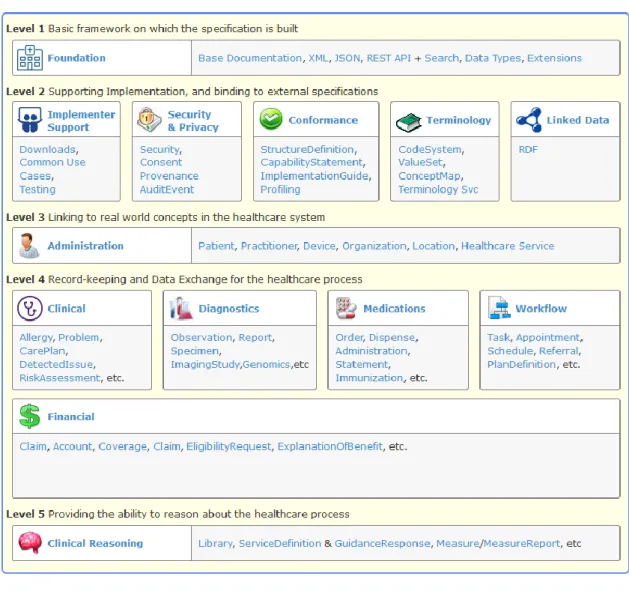
HL7 has categorized the specification in distinct modules grouped in five levels, as illustrated in the following figure. The next subchapters introduce some of the most important modules composing FHIR. The modules gather and structure FHIR’s features, elements and concepts.
Figure 4 – FHIR resources structure (HL7 International, n.d.)
The first level, the foundation module, explains the specification’s key elements: the resources and the four exchange paradigms defined. Level two supports the implementation, the Implementer Support module is presented in the work by describing FHIR Common Use, the Security and the Conformance elements. Level three contains administrative resources and is therefore treated in the “Resources” subchapter 2.1. Finally, the Workflow module will be presented.
2.1 Resources
FHIR defines several different types of resources to save and exchange data. Resources are the core concept of the FHIR specification. They are the modular representations of clinical and administrative entities. Resources can be grouped together in what is called a “bundle”.
HL7 classifies the resources in 6 main sections (HL7 International, n.d.-r):
- Clinical: containing all the resources representing the content of a clinical record - Identification: comprises the entities involved in the healthcare
- Workflow: includes the different tasks of a care process
- Financial: concerns the billing and payment ability of the specification
- Conformance: encompass the resources used during development, testing and managing FHIR
- Infrastructure: belong in the level 1 module “Foundation”, it contains resources providing useful base functionalities such as a “binary” resource to store non FHIR resource format, it also defines the “bundle” resource used to group several different resources.
Some resources are typically clinical whilst others are business entities such as the resources of the section “Financial” or “Administration”. These are made for the end users to display and manipulate them, whereas some are used by the systems to give specific information such as the resources in the “Conformance” section. An exhaustive list of all the resources can be found on the HL7 FHIR’s website4.
As previously said, FHIR is built on this concept of resource. They can either be represented in XML, in JSON or in Terse Resource Description Framework (RDF) Triple Language (Turtle) format for the exchange (HL7 International, n.d.-f).
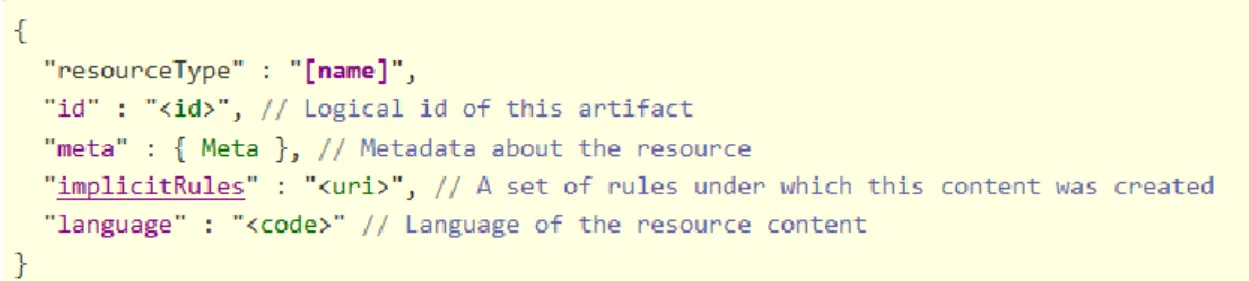
Some attributes (also called elements) of a resource are required whereas others are optional. A resource must have a known identity such as a Uniform Resource Locator (URL), a type, structured data items and a version identifier. Some optional elements have been defined for every resource: an identity, meta data, a language and a reference to implicit rules. These, represented in JSON on the figure 5, are just some elements that a resource may contain, it could also contain other resources, text, extensions and many other attributes (HL7 International, n.d.-q).
Figure 5 – base resource (HL7 International, n.d.)
Extending the base resource, FHIR defines a domain resource that is then extended by all the resources except “Bundle”, “Parameter” and “Binary”. Each other resource type respects this domain resource’s structure and is redefined to its specific needs. The domain resource adds the definition of a narrative (human readable text) that indicates the content of the resource. The Domain resource enables resources to include related resources and extensions.
Figure 6 – UML diagram of a Domain Resource (HL7 International, n.d.)
FHIR defines the usage of all the resources contained in the specification, for instance, the Patient resource is used according to HL7 for “Demographics and other administrative information about an individual or animal receiving care or other health-related services.” (HL7 International, n.d.-n).
The figure 7 shows a JSON representation of a Patient resource. This resource includes a reference to a Practitioner resource in order to assign a general practitioner to this patient. Below the code, the narrative representation is displayed. The narrative is contained in the “div” attribute of the Patient resource.
The “id” attribute represents the FHIR id of the resource attributed by the FHIR server upon the resource’s creation. This id must be unique and cannot be changed. On the other hand, the “value” attribute of the “identifier” element represents the Medical Record Number
(MRN) used by medical institutions to identify their patients in their systems. This id can be manipulated in the resource and is therefore used for the MRN which is subject to change (HL7 International, n.d.-n).
Figure 7 - Patient resource in JSON and HTML narrative
2.1.1 Validation
FHIR supports the validation of resources. Validating resources is the process of checking that the resources are valid according to the following aspects (HL7 International, n.d.-x):
- Structure: ensure that the content of the resource is defined by the specification - Cardinality: validate the correctness of the cardinality of all properties
- Values Domains: ensure that values of properties are conformant to the set of rules defined for the specific types
- Coding: check that codes and displays used are valid
- Invariant: ensure the invariants5, constraints are properly followed
- Profiles: check that the resource conforms to the profile6 referenced
- Questionnaire: verify that a response to a Questionnaire is valid against the Questionnaire
5 https://www.hl7.org/fhir/conformance-rules.html#constraints 6 See chapter 2.4.1
The following table shows the different validation tools suggested by the specification. The aspects supported for the validation are indicated for each tool.
Figure 8 - validation tools (HL7 International, n.d.-x)
2.2 The four Paradigms
FHIR supports four paradigms to exchange data: RESTful API, Services, Messaging and Documents (HL7 International, n.d.-g). This paper focuses mostly on the RESTful approach since, to this day, it is the most used by implementers and it is also the one chosen to be implemented in the application prototype that has been developed during this work.
2.2.1 RESTful API
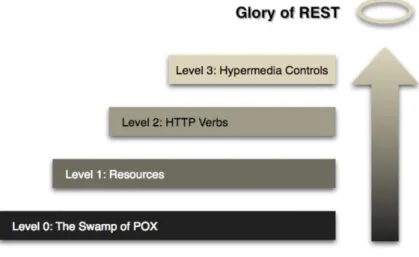
FHIR can be referred to as a RESTful specification, indeed it defines “a uniform connector interface” (Fielding, 2000), known as FHIR RESTful API, enabling a stateless client-server communication. FHIR core specification supports the Level 2 of the Richardson REST Maturity model, Level 3 is supported with the usage of extensions.
FHIR supports Level 2 since it is using HTTP for interactions, it defines resources that can be requested individually and it exploits HTTP verbs (GET, PUT, POST, DELETE) for its operations. The hypermedia controls of Level 3 can be supported by adding extra data in resources containing links to further interactions (HL7 International, n.d.-h).
2.2.1.1 REST
The representational state transfer is an architecture style granting interoperability between systems over the internet. The REST idea is to use a simple way of communicating between machines, which is commonly HTTP. HTTP-based REST uses HTTP commands to perform create, read, update and delete (CRUD) operations (Elkstein, n.d.).
REST is a style of software architecture and not a standard. It defines how networked resources are to be addressed and, on a bigger scale, how the web works. It was first presented by Roy Fielding in his doctoral thesis (cited in Douglas K Barry, n.d.). It is a popular choice for the development of web-services. Applications following REST principles are referred to as RESTful applications whereas APIs adhering to REST principles are called RESTful APIs (Rouse, n.d.).
REST defines five main principles:
- A uniform interface: the interface between clients and servers uses a well-defined set of methods to manipulate resources. Each resource must be identified in the requests with, for example, an URI. Each message must contain enough information for the server to process it. Resources are separated from the representations send to the clients (XML, JSON…) (‘What is REST?’, n.d.).
- Stateless interactions: the server does not hold the client’s state between requests. All the information needed by a request must be contained by it.
- Cacheable: responses can be cached by clients
- Client-server: the client and the server are separated, the client is responsible for the requests and the server for the response and data storage
- Layered system: a client cannot tell whether it is connected to an intermediate or an end server (Servage, 2013).
2.2.1.2 FHIR RESTful API
The API defines a set of operations that can be performed on FHIR resources. Servers should provide a Capability Statement resource describing which operations and resources they support (HL7 International, n.d.-h).
FHIR defines the following interactions:
Figure 10 - FHIR API interactions (HL7 International, n.d.-h)
Interactions may be used with the following form: VERB [base]/[type]/[id]
{?_format=[mime-type]}. [base] represents the Service Base URL where all the resources
defined by the interface are located. The usage of HTTPS is optional but production exchange of healthcare information shall use SSL (HL7 International, n.d.-h). The following subchapters present the most current API interactions.
2.2.1.2.1 Read
The read interaction is used to request the current content of a resource from the server (HL7 International, n.d.-h). For example, if a client requests the current state of a patient resource with “20207” as id from a FHIR RESTful test server, the read interaction will take this form:
2.2.1.2.2 Vread
The vread interactions allow retrieving a specific state of a resource. It is essentially a read operation which has the version of the resource specified. Vread is performed using a HTTP GET command as follow: GET [base]/[type]/[id]/_history/[vid] {?_format=[mime-type]}. Servers supporting the FHIR API should support resources versioning, if not, it should be explicitly declared in their capability statement (HL7 International, n.d.-h).
2.2.1.2.3 Update
Update is performed with: PUT [base]/[type]/[id] {?_format=[mime-type]}. It simply creates a new version of an existing resource on the server. The request body is a resource with the same id as the resource in the URL, if not the server will respond with a HTTP 400 error code.
A conditional create has been defined by FHIR allowing clients to update resources based on other criteria than their ids. The command is the following: PUT [base]/[type]?[search
parameters]. HTTP PATCH command can be used to update resources when one does not
need or have permission to update an entire resource (HL7 International, n.d.-h).
2.2.1.2.4 Delete
The delete interaction erases a resource. It is performed by the HTTP DELETE command knowing the id of the resource: DELETE [base]/[type]/[id]. The resource will no longer be found through search operations. It is possible to specify some types of resources that cannot be deleted and it is also possible not to enable deleting resources at all. As for updating, a conditional delete exists and allows deleting resources based on other parameters than their ids (HL7 International, n.d.-h).
2.2.1.2.5 Create
Creating a resource is achieved by an HTTP POST command. The id of the resource will be allocated by the server. The create URL has the form: POST [base]/[type]
{?_format=[mime-type]}. The request body must contain a FHIR resource. Once the resource has been
successfully created, the server returns the new id and version id of the resource.
It is possible to use a conditional create so that a resource is created only if no such resource can be found on the server (HL7 International, n.d.-h).
2.2.1.2.6 Search
The search interactions can be operated with either the GET or the POST command. The GET command is formed as GET [base]/[type]{?[parameters]{&_format=[mime-type]}},
whilst the POST command is formed as POST
[base]/[type]/_search{?[parameters]{&_format=[mime-type]}}. Those two search queries
look for all resources of a given type on the server. Servers shall support both versions of the search interaction because of how GET and POST might be handled by proxies and user agents. Several search parameters apply to all FHIR resources: _content, _id, _lastUpdated, _profile, _query, _security, _tag, _text and _filter. For instance, to search a patient based on its id the following query is used: GET [base]/Patient?_id=23. When searching for one resource, a bundle will be returned by the server, therefore when the client is certain of the existence of the resource on the server, a read operation is more appropriate (HL7 International, n.d.-s).
The FHIR specification lists all the search parameters defined for each type of resource directly on each resource’s page (e.g. the patient page7).
2.2.2 Services
FHIR data exchange can be conceived as a service-oriented architecture (SOA). SOA is a well-known architecture in the software industry. Fundamentally, it can be considered as being a set of exposed services. As in real life, a provider offers a service to a consumer. The consumer obtains the result of the service without further considerations on how the result was achieved behind the scenes. In the information technology (IT) domain, services which represent business functions are made available to other systems through standard protocols (Phelps, 2007).
To do so, the web-services technology is the most commonly used communication protocols. Web-services are exposed on the internet by providing applications, then the consuming applications can send and receive data by invoking those networked services (Doglas, n.d.).
Even though FHIR resources are created to best fit the RESTful API approach, it is possible to design an exchange architecture following the services approach. FHIR defines the two following SOA approaches:
- FHIR + WS* represents FHIR implementations using the web services stack as the
communication protocol instead of REST. This would include use of FHIR resources as payload parameters in SOAP calls, for example
- FHIR + SOA Pattern illustrates the impact of applying interaction patterns, exception
handing and role definition, guided by SOA practices, atop an implementation technology (SOAP, REST, or others).
(HL7 International, n.d.-u)
FHIR could benefit from interesting SOA capabilities such as its low-coupling framework, its expertise in transactional integrity within distributed systems and its consistency in exception handling (HL7 International, n.d.-u). FHIR and SOA implementations combined may be a wise choice to make since “SOA provides guidance for how components interact, how to partition responsibilities, and how to manage workflows among different parts of systems, all of which have potential utility in FHIR implementation settings.” (HL7 International, n.d.-u).
It is important to bear in mind that FHIR resources have been thought to be exploited by a RESTful implementation and implementing FHIR with SOA could engender a great amount of additional work.
2.2.3 Messaging
FHIR also defines a messaging exchange framework which enables sending routed messages from systems to systems to exchange content. This mechanism can either be implemented on the RESTful API or use an independent messaging system.
This exchange was not designed to complete the RESTful API, but only to allow implementers to choose the way they want to exchange their content. It resembles HL7 v2 exchange mechanism and may be interesting for v2 familiarized developers.
This exchange is event driven, a message is sent when triggered by an event such as a new prescription for a patient or a newly scheduled meeting. A message is in fact a bundle of resources which first resource is of type MessageHeader (HL7 International, n.d.-j). The appendix I of this work contains a FHIR message example to illustrate this point. Indeed, it is easier to understand how messages are formed by going through a concrete instance.
2.2.4 Documents
FHIR delineates a document exchange framework allowing systems to transmit documents. This framework is strongly based on HL7 CDA standard.
Documents are bundles of resources of type “Document” that contain a Composition resource as their first entry, followed by the resources creating the actual content of the document. The resources forming the content of the message are referenced by the Composition. The bundle gathers the whole content of the document into one unique XML or JSON document (HL7 International, n.d.-d). The Composition resource is described by HL7 as:
A set of healthcare-related information that is assembled together into a single logical document that provides a single coherent statement of meaning, establishes its own context and that has clinical attestation with regard to who is making the statement. While a Composition defines the structure, it does not actually contain the content: rather the full content of a document is contained in a Bundle, of which the Composition is the first resource contained. (HL7 International, n.d.-c)
A FHIR document is immutable and has a fixed representation created either by humans, organizations or devices. It can be exchanged and stored by systems. FHIR documents can be signed to ensure the document’s authenticity. A binary resource may be included in the document to contain the stylesheet that will be used to nicely render the document for human readers.
FHIR also provides a document reference resource for documents that are not assembled in FHIR (pre-existing documents) (HL7 International, n.d.-d).
2.3 Security and privacy
FHIR not being a security protocol, it does not provide any security features. Nevertheless, as security and privacy of data are crucial elements in healthcare FHIR has been designed to work with many existing security solutions. FHIR describes how to protect a FHIR server with access controls and authorizations and how to keep tracks of the events performed with audit logging. FHIR advocates that implementations use existing security standards towards providing the encryption of communications, avoidance of information leaks on error occurrence, deactivation of scripts injection into narrative resources, logs records to track abnormal access behaviors and control of data access (HL7 International, n.d.-t).
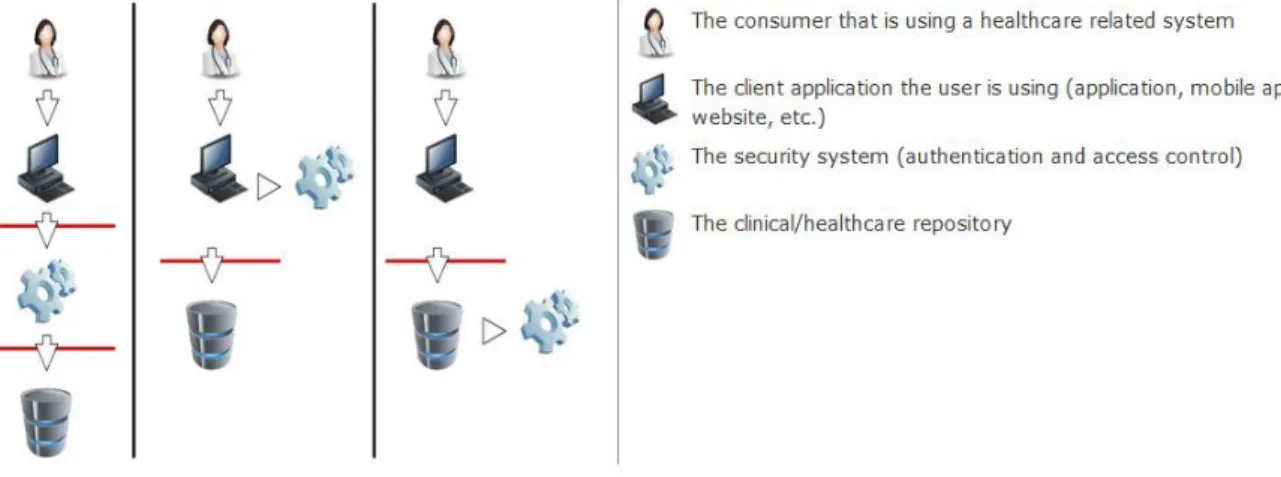
As a matter of fact, a production FHIR system will require a security system to be established. The following figures presents some integration possibilities.
Figure 11 - FHIR security subsystem (HL7 International, n.d.-t)
2.4 Conformance
2.4.1 Profiles
The FHIR specification defines foundations, on which many different solutions can be created, by providing base resources, frameworks and APIs. Since FHIR is intended to be used by a wide industry, adjustments and adaptations may occur so that the solution fits the implementers’ need. An item or package of these adaptations is known as a “profile”, while the process of adapting FHIR to specific use case’s need is referred to as “profiling”. A profile is in fact a “normal” FHIR resource that can be handled by any FHIR server (HL7 International, n.d.-p).
Common adaptations would be defining rules about (HL7 International, n.d.-p):
- The usage of the resources specifying weather they are used or not and what components have been added or restricted
- The API features available and how to use them
Since FHIR is used in the vast industry of healthcare, many similar or overlapping adaptations may exist in different countries, institutions or for different vendors. FHIR implementations and resources shall declare the profiles they conform to. Servers list the profiles they support and check clients’ conformances. Resources declare their conformances in their metadata by referencing a profile by its URL (HL7 International, n.d.-p).
2.4.2 Profiling artifacts
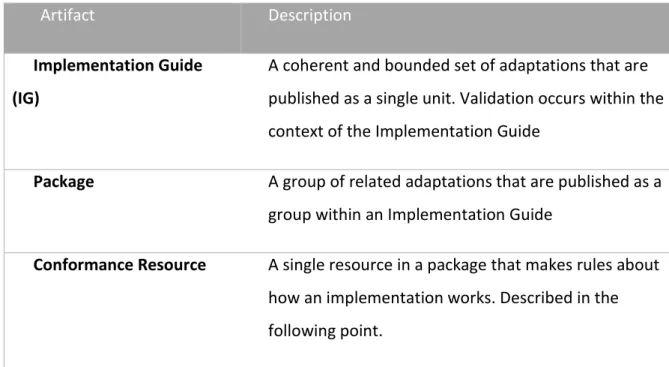
FHIR provides a set of artifacts for profiling, they are presented in the table below.
Artifact Description
Implementation Guide (IG)
A coherent and bounded set of adaptations that are published as a single unit. Validation occurs within the context of the Implementation Guide
Package A group of related adaptations that are published as a
group within an Implementation Guide
Conformance Resource A single resource in a package that makes rules about
how an implementation works. Described in the following point.
Table 1 - FHIR profiling artifacts adapted from (HL7 International, n.d.-p)
2.4.3 Conformance resources
FHIR defines the need and usage of a conformance resource:
Typically, Implementation Guides both restrict and extend APIs, resources and terminologies. FHIR provides a set of resources that can be used to represent and share the
decisions that have been made, and allows implementers to build useful services from them. These resources are known as the conformance resources. (HL7 International, n.d.-p)
With these conformance resources, implementers can perform several tasks on the APIs: indicate what calls can be made and in which cases using the CapabilityStatement resource, offer additional search operations and search parameters that are not defined by the core specification (OperationDefinition and SearchParameter resource). They can also define how a resource, extension or datatype is used in the implementation with the StructureDefinition resource. The StructureDefinition resource allows to describe the elements used, indicate the one that are not and the extensions a resource or datatype supports (HL7 International, n.d.-p). This resource can also be used to describe how a particular resource references a ValueSet
resource defining the code values used and supported by that particular resource (e.g. LOINC
codes).
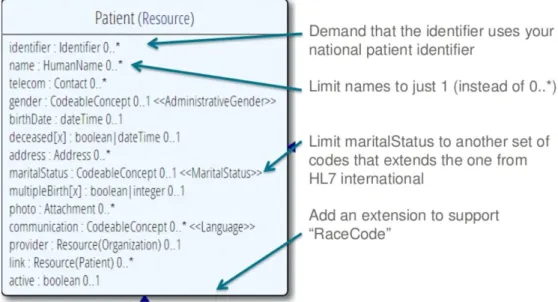
For instance, a profile (Conformance resource) can be used to restrict a resource element’s cardinality or to limit the possible values it might take. It also allows to add new properties to a resource by extending it. The following image shows some interesting usage of a profile.
2.5 Use cases
FHIR describes several use cases that can be implemented with the FHIR standard. The following two use cases are presented: Personal Health Record (PHR) viewer and document repository. It is important to note that FHIR will be implemented to meet many other use cases, therefore the examples provided below are in no way an exhaustive listing of FHIR’s uses.
2.5.1 PHR viewer
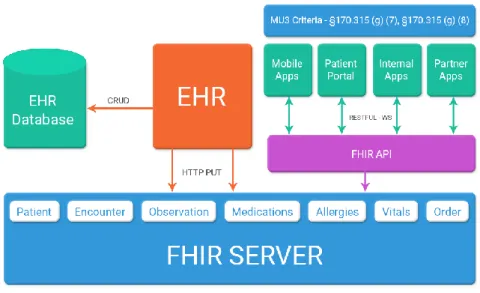
An EHR system exposes a FHIR server that allows client applications to perform search and read operations on the Patient resource and on a set of clinical resources. This use case is illustrated by the schema below.
Figure 13 – FHIR integration with EHR (Sangem, 2016)
Further interactions could be allowed to client applications such as update. This use case would typically be defined by a scenario in which patients can have access to their personal health data via a mobile application or a patient portal (HL7 International, n.d.-w).
A simulation of this use case has been implemented in the prototyping phase of this work. The project developed in the context of this work is, indeed, a simulation of the above real-world use case since no EHR system has been integrated in the project. The EHR has been replaced by a web interface allowing the patient medical record’s creation, modification and deletion.
2.5.2 Document repository
Integrating medical information from different sources can be done with the build of a patient-centric document repository.
Integrating the Healthcare Enterprise’s (IHE) HE Cross-Enterprise Document Sharing (XDS) profile has been adopted as the main framework to create those types of repositories as “XDS allows for a federated system of repositories with a registry to provide coordinated access to the documents” (HL7 International, n.d.-w). FHIR provides the same capabilities as XDS and can be used to create more modern and user-friendly interfaces. Those interfaces can also easily be integrated to existing XDS environment. Furthermore, HL7 and IHE are currently working together to enhance the IHE Mobile access to Health Documents (MHD) profile8 (IHE,
n.d.).
2.6 Workflows
Workflows are the essence of healthcare whether automated or not. Automated workflows improve the medical care in such a manner that many errors can be avoided and simplifies the work of care providers. FHIR is concerned with workflow management and aims to standardize the processes, activities and roles necessary to interoperable workflow executions. FHIR resources can be used in workflows without necessarily using FHIR for the execution although FHIR provides several mechanisms for that purpose. In some cases, the management of the execution of workflows might not even be required, FHIR supports these cases and allows handling them in a simple manner such as shown on Figure 14 (HL7 International, n.d.-y).
FHIR defines a set of resources (activities) that are used within workflows, three categories exist (HL7 International, n.d.-y):
- Request: the resource requiring an action to be taken - Appointment, Task, MedicationRequest…
- Events: resources expressing that an action has been taken
- Encounter, Observation, SupplyDelivery, DiagnosticReport…
- Definitions: resources describing an action that can be done (time-independent)
8 The profile defines a HTTP interface for XSD-based in order to access medical document from “mobile” applications
- PlanDefinition, Measure, Questionnaire…
2.6.1 Workflow patterns
The simplest workflow architecture using FHIR would be that (HL7 International, n.d.-z): 1. The placer system Perfoms a RESTful create or update interaction on a resource of
the receiver RESTful endpoint.
2. The receiver then replies with an HTTP status indicating the state of the request and the response that can be provided in the payload of the HTTP response.
Figure 14 is another example of a workflow architecture. The following steps are defined (HL7 International, n.d.-z):
1. The placer system creates a resource of the request category on the filler FHIR server. This resource possesses a tag element indicating that action has to be taken upon the resource.
2. The filler sends a HTTP status code indicating that the resource has successfully been created.
3. After a certain time, the filler sends an event resource to the placer’s resource endpoint. The event resource references the request with a link (basedOn) to identify the resource for which the action has been fulfilled.
4. The placer system replies with a 201 HTTP status code indicating that the resource has been created.
Those two examples illustrate the basic mechanism of FHIR workflow management, in addition, the specification defines more advanced management patterns that manage the execution of workflows. The figure below shows an example of such a pattern. As it can be seen, the state of execution of the workflow is now trackable (tasks completed or not). As the previous example, this pattern manages the workflow using the FHIR API.
3 Implementations analysis
This chapter treats the current state of FHIR implementations. Some of the databases, libraries and frameworks that can be used to build FHIR systems will be reviewed. This paper does not claim that the tools presented are the only ones available to implement FHIR. The libraries, frameworks and databases presented, found as a result of the research conducted, have been analyzed in order to determine which library or framework use will best fit the creation of a FHIR-based application.
3.1 Databases
3 different approaches exist for FHIR object’s storage (McKenzie, 2014):
- Storing the XML or JSON representation directly in a Not only SQL (NoSQL) Database - Storing the XML or JSON as a Binary Large OBject (BLOB) and save the index data in
a table
- Mapping the objects to a classic relational database (DB)
The NoSQL approach is interesting in the FHIR context since most of the storage consist of storing objects in JSON format, a semi-structured type of data. JSON storage is handled natively in most NoSQL databases and thus does not require a lot of transformation in order to be persisted, retrieved and used in the application. NoSQL enables high performances on great volumes of data. It is also often cheaper to use since a lot of the databases are open-source.
To store JSON or XML objects it is also possible to use a relational database management system (RDBMS) and store them as a BLOB. The BLOB has the ability of storing binary data and is therefore often used to store audio files, images or multimedia files. Moreover, using a BLOB avoids having to do character conversions to the database’s text format and allows the storage of larger JSON documents (Oracle, n.d.).
Figure 16 – FHIR server MySQL database schema (Grieve, 2012)
The figure above shows an example of a database schema that could be used to store FHIR resources and build a database supporting FHIR capabilities such as indexing, versioning and advanced searching. The actual content of the resource is in the table FhirVersions in the [Content] column.
Supporting FHIR in a complete manner, be fully conformant, requires a well thought database model and might require a lot of different stored procedures in furtherance of keeping conformance to the specification. Building such a database will request special effort in modeling and maintenance since FHIR is still in development and thusly subject to change. The last option consists of storing the objects in a usual textual way in a relational database like MySQL, Oracle, Derby…, or in an object-oriented database such as PostgreSQL. Some new features of the RDBMS allow storing JSON in a native NoSQL-ish way enabling better search capabilities (Oracle, n.d.).
3.1.1 FHIRbase
FHIRbase is an open-source database designed by Health Samurai Team to store and retrieve data in FHIR format and is now ready for production use. It is an extension of the well-known PostgreSQL database. The interaction with a FHIRbase DB is done using a PostgreSQL client with SQL syntax. To date, FHIRbase supports the DSTU-2 version of the FHIR specification.
Instead of directly inserting, updating and deleting data inside the FHIRbase, stored procedures are used so that all the different actions required on data changes can be performed. Since PostgreSQL has a native support for JSON format (jsonb type), JSON is the format in which FHIRbase chose to store the FHIR resources. If XML is preferred in an application, it is always possible to convert the JSON with some code in the application directly (Health Samurai Team, n.d.-d).
Figure 17 – Querying the patient table of FHIRbase (Health Samurai Team, n.d.)
Figure 17 shows the structure and the data types of the patient table as conceived by FHIRbase. The JSON representation of the resource is stored using the native jsonb type, as explained before. The other types are texts and timestamps.
FHIRbase
Git: https://github.com/fhirbase License: MIT License
Type: open-source
With FHIRbase table structures, a patient resource is stored as following:
Figure 18 - sample patient stored (Health Samurai Team, n.d.) 3.1.1.1 Documentation and analysis
All the documentation on FHIRbase is available online9. They have set up a nice working
environment with tutorials, technical documentation, a demo, an installation guide and code samples. All information needed can be found very easily which should make working with FHIRbase enjoyable.
The project can be downloaded from GitHub10. It obtained 72 stars and has one main
contributor niquola who is backed up by three others less committed contributors. Niquola works also on the fhir.js library as well as on Aidbox, which will be introduced later in this work.
3.2 Framework: Aidbox
As well as offering FHIRbase, Health Samurai Team offers free protected FHIR test servers and a cloud backend platform called Aidbox. Once an Aidbox account has been created, it is possible to create a “box” which corresponds roughly to a FHIR server instance. The Figure 19 shows the interface to manage a box with Aidbox.
9http://fhirbase.github.io/index.html 10https://github.com/fhirbase/fhirbase-plv8
Aidbox
Website: https://aidbox.io/index.html License: Entreprise License
Type: free
Figure 19 - An Aidbox box
Aidbox has several out-of-the-box tools such as users, groups, security and client management. It also includes a DB console to interact with the underlaying FHIRbase and a REST console to operate on the FHIR sever.
Aidbox allows to deploy single-page application (SPA) directly into a dedicated box. More complex applications work with aidbox as well, but require isolated web servers for their hosting.
Aidbox proposes several different usages, one can use it as (Health Samurai Team, n.d.-a): - An API facade
- A backend
- A clinical data repository - An integration bus
3.2.1.1 Features
Aidbox provides a database to store health data, a FHIR compliant REST API for data access and exploit. It is also OAuth secured and enables the creation of security policies to restrict access to data. It also includes an interface for the user management and a registration module (Health Samurai Team, n.d.-b).
3.2.1.2 Documentation and analysis
The documentation is well structured. At the same place11, everything needed to get
started with Aidbox and the implementation of an application using it can be found. If not, they have a reactive costumer service that will answer questions.
Technical documentation, Implementation guide, user guide, code samples and even a sample app are available freely on their website. Although the documentation is not yet finished, it is already valuable and usable.
3.3 Libraries
3.3.1 The HAPI-FHIR Java library
HAPI-FHIR is a java library that enables FHIR capability in an application. It is an open-source implementation of the FHIR specification. It has primarily been developed by the University Health network to build a FHIR RESTful server communicating with various data storages and repositories. The aim of this library is to allow fast, flexible and conformant implementations of FHIR. It provides not only a RESTful FHIR client but the API allows to create a RESTful FHIR server.
11https://aidbox.io/docs/Features.html
HAPI-FHIR
Git: https://github.com/jamesagnew/hapifhir/releases License: Apache Software version 2.0
Type: open-source Logo: http://hapifhir.io/
Figure 20 - HAPI-FHIR usage patterns (University Health Network, n.d.-b)
HAPI can be utilized mainly in four different manners that are illustrated by the image above. Further explanations on those four manners (University Health Network, n.d.-b):
1. Usage of a parser and an encoder to enable a conversion between the application and FHIR’s data model.
2. Use the HAPI FHIR client in an application to retrieve or save resources onto an external server.
3. External FHIR client can interact with the application by accessing the HAPI FHIR server. 4. Another way of implementing with HAPI FHIR is to deploy a HAPI JPA/Database server
and develop applications to work with it
HAPI API supports both XML and JSON encoding. For a better testability, a public open-source test server built with HAPI-FHIR is available on the internet12 (University Health
Network, n.d.-b).