Journal of conductivity. VoL I0. No. 5, t997
ed-State Specific Heat of the Type-II Superconductor
0.77Zr0.~3
Ma
fie Fields up to Boz
A. meNtein, ~z A. Junod, ~ E. Walker, ~ B. Revaz, ~ J. Y. Genoud, 1"3 and G. Triscone ~
Received 20 May 1997
In order to document the behavior of the mean-field mixed-state sp~ific heat of an isotropic, strongly type-II supe~onductor (i.e., ,Mth a large value of the Ginzburg parameter tc), and to provide a bas~ for comparison with hibh-temFerature superconductors, we measured the st~Nfic heat C of the alloy Nbo.77Zrom with Tc = 10.8 K,
Bo2(O)-
7.9 T, in magnetic fielcLs B = 0, 0.2, 1.0, 12, 2.0, Z4, 3.0, 3.3, 4.0, 4.4, 4.8, 5.2, 6.0, 6.6, 7.2 and t0 T. The values of the upper cTiticaA field Bo2(T), thermod:mamfic critical field Be(T), Ginzburg parameter K(T), rand cc, e ~ i ~ t7(B)=
limr_.o(C(KB)/T)
are d ~ v e d from the sp~ific heat data and found to be in ~ e e m e n t with the GLAG theo~r in the dirty lkmit. The behavior of the mixed-state s~cific h ~ t is analyzed in ofC~t/T, 8(C,,t/r)/c?B,
andg(C~t/T)/ST
vs. T curv~, where C~t is the electronic contribution to the specific heat.W O R D S : T y ~ - I I s-ape~onductivity; mixed state; specific heat; Nb~-xZrx.
1. O D U C T I O N
Specific heat is one of the few bulk t h e ~ o - d y n ~ c probes of the rconducting state, and as such was studied exten~vely in both classic and high- t ture superconductors. In classic suwrconduc- tors, i.e, those studied re 1986, with criticaJ tem- peraPares T~ n o t ex g ~ ~ h ~ t city m~asuremenU e s t a b ~ h e d the e~stence of a in the electronic density of states (DOS) at fine F e ~ i level, of the order of A(0)~3.5keT~, showed an a ~ o s t ideal example of a mean-field, second-order t r ~ i f i o n o g at To, with a specific heat jmrnp on the order of
AC(T~)~l.47Tc,
and generally allowed one to correlate qualitatively the electron and p h o n o n density of states and the c r i t i ~ l temperature as predicted by the BCS theory [1], t ~ n g into account suitable corrections fi?r retardation effects~D4partement de Phyfique de la Mati~re Condenshe, Universit6 de C~bve, CH-1211 Gen&~'e 4, Switzerland.
2present a d & ~ : Institute for Metal Physics, Russm~n Academy of s, 620219 Ekaterinbm-g, R~sia.
~Present address: Ind R~earch U_miteG Gracefield Research
Center, Material Physics, PO Box 31-310, Lower Hutt, New Z~land.
527
[2,3]. ~ e reqlAred fianctionals of the electron and p h o n o n DOS, i.e., the Sommerfeld constant 7, the Debye tempe e | and various moments (co n> of the phonon DOS F(co), could be extracted from the specific heat cmwes in the normal state (see, e.g., [4]). M a ~ e t i c fields were mostly applied for this pin-pose, to extend the normM-state data below Tc when s ~ p l e extrapolations were unreliable. Although this method is usefial for type-I superconductors, the suppression does not exceed 0.38 K per Tesla for p a r a m a g n e t i ~ l y ~ _ i t e d t?~e-II superconductors. Most measurements were performed below 8 T in rea- sonably priced N b - T i m a ~ e t s ; rare early measure- ments were accomplished in fields as high as ~ 20 T [5,6]. As a result, the m ~ e d state ~ecific heat of extreme tFpe-II superconductors cannot be consid- ered as well documented experimentally, even in the classic case. On the theoretical side, expressions for the m~xed-state specific heat were obtained only in the temperature limit T<<
Tc,
reflecting a superconducting DOS l o c a t e d in the vortex cores and growing lin- early with the magnetic field B [7,8].The discovery of high-temperature supercon- ductors has led to a dramatic renewal of interest in type-II superconductivity, in particular the behavior
528 Mirmelstein, Junod, Walker, Revaz, Genoud, and Triscone
of thermodynamic quantities such as the magnetiza- tion and the specific heat. Considerable differences with respect to classic superconductors arise from the fact that the coherence length { is extremely small, approaching atomic dimensions, and anisotropic. Critical fields are now on the order of 102 to 103 T, and anisotropies are so large that some properties can be considered as two-dimensional; the coherence volume is so small that the mean-field behavior is lost, while critical fluctuations play an important role near the transition [9]. The origin of pairing is an unsettled question, and indirect ingormation on its mechanism, such as the symmetw of the order parameter, have been vividly debated [10-13]. Although the shift of Tc caused by available fields is modest, it is found that the field nevertheless has a dramatic effect on the specific heat anomaly at T~ and on the low-temperature specific heat. These effects are believed to convey fun- damental information on the phenornenology of high- Tc superconductors, and detailed knowledge of the behavior of the mean-field component of the specific heat in the mixed state in the whole range of both tem- perature (0 < T_< T~) and field
(0 < B <_
Bc2)
is often required for the analysis of the experimental data.Recently the specific heat of two classic type-II superconductors, PbMo6Ss and NbSe2, was studied in magnetic fields up to 14 T [14-16]. PbMo6Ss is a Chevrel-phase, strongly coupled superconductor that approaches some microscopic parameters of high-To superconductors, such as the Fermi energy and the coherence length, but contrasts with its low aniso- tropy. Due to the very high value of the upper critical field Be2(0) = 52 T [ 14,16] the normal-state specific heat cannot be measured directly. A conspicuous difference with the theoretical prediction [7,8] is the considerable reduction of the mixed-state "linear" term at low temperature: only half of the mean-field contribution
~/TB/Bc2
is found at To/10. 2H-NbSe2 is a layered compound that shows the effect of aniso- tropy on a type-II, strongly coupled superconductor. Due to the large coherence volume, superconducting fluctuations are not observable in zero field. The new feature found for this superconductor is the nonlinear growth of the mixed-state linear term with the field for B>Bel [15,16].The aim of the present study is to document the behavior of the mean-field mixed-state specific heat of a strongly type-II (i.e., with a large value of the Ginzburg parameter tc), isotropic superconductor across the whole range of temperatures 0 < T_< Tc and fields 0 < B_< Bc2. The bcc substitutional alloy system Nb~-xZrx has a maximum T c of 10.8 K near x = 0 . 2 5
[17]. Nb0.75Zr0.25 is a strong coupling superconductor with
(dBc2/dT)r,~:
- 1 T / K [ 18], gap ratio2A(O)/k,~Tc=4.2,
thermodynamic critical field &(0) = 0.25 T, ~ ~ 20, coherence length ~(0) = 64 A, Sommerfeld constant ?/~:9 m J / ( K 2 g-at.), and atornic volume V= 11.7 cm2/g-at. [4]. The coherence volume contains more than 10 4 atoms, and theret:ore super- conducting fluctuations are not observable in zero field. Thus, it is a good candidate for our purpose. In this paper, we present specific heat measurements for a Nbo.TvZr0.23 sample with a very narrow zero-field superconducting transition in magnetic fields up to B > Be2. The values of the upper critical field &2(T), thermodynamic critical field Be(T), Ginzburg param- eter v(T), and linear term coefficient )/(B) are derived from the specific heat data and found to be in agree- ment with G L A G theory in the dirty limit. The behavior of the mixed-state specific heat is docu- mented in terms ofC~JT, O(C~,/T)/OB,
andO(C~I/
T)/OT
vs. T curves, where C~, is the electronic contri- bution to the specific heat.2. E X P E R I M E N T A L
The sample suitable for the purpose of the present study should have Tc near the maximum of the Nbl-xZrx system, and as narrow a superconducting transition as possible. This is not a trivial task due to peculiarities of the phase diagram [19]. The sample was selected from a series of specimens, including single crystals and ingots with various heat treat- ments. The chosen ingot with cornposition Nb0.77Zr0.23
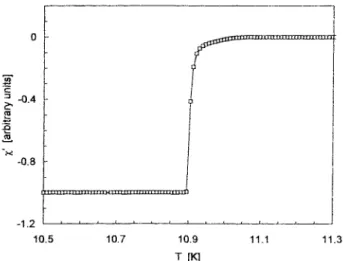
was produced by electron bombardment zone melting in vacuum. The cooling was rapid enough to prevent the precipitation of the a-phase, which is a sluggish process. A small piece of the ingot was cut and probed by ac susceptibility measurements in 0 . 1 0 e rms. The fi.dl width of the superconducting transition between the 10 to 90% levels did not exceed 60 m K (Fig. 1). A sample of 24.8 mg in mass was cut from the same ingot for heat capacity measurements.
The total specific heat C was measured between 1.3 and 20 K in magnetic fields of 0, 0.2, 1.0, 1.2, 2.0, 2.4, 3.0, 3.3, 4.0, 4.4, 4.8, 5.2, 6.6, 7.2, and 10 T by a relaxation technique. Details are given in [16]. The accuracy, controlled using different masses of Ag and Cu, is • to • including all fields; the relative accuracy vs. field changes is better. Note that the field was applied or changed above Tc in order to ensure equilibrium conditions in the thermodynamic sense. Because the mixed-state magnetization is small, we do not make a distinction between B and ~toH.
Mixed-State Specific Heat of Nbo.77Zro.23 529 m c ::a 41.4 -*3.8
(
l~l~ i Jr J i l l 11 i [ I I l I J i l l , , i : l l 11 [ [ 1 I I ]1 1 i i I l J i ] I I ] ] [ i I i i[i ]fill41 i i i [ i I I I i l J ] i'i'[l"l I I I ! I 9 i I i
10+7 10+9 11.1 11.3
T IN
- 1 . 2 ' 1 0 . 5
Fig. 1. AC susceptibility of the Nbo.77Zro.23 sample measured in a field of 10 ~ T rms, 80 Hz.
3. PA~SULTS AND DISCUSSION 3.1. Mixed-State Specific Heat
Figure 2 shows the specific heat curves
C / T
vs. temperature squared for the Nb0.vvZr0.23 sample measured in different fields. In agreement with ac sus- ceptibility measurements, the zero-field specific heat anomaly is ~60 mK wide. Since the zero-field data obtained in the present study are in good agreement with previous specific heat measurements for a Nbo.75Zro.25 polycrystal published in [4], where a full Eliashberg analysis of the zero-field specific heat was carried out, we shall concentrate here on the effect of the magnetic field. Basically, the field shifts the temperature of the specific heat step, reduces its amplitude, broadens the jump, and increases the6 0 +,., e~ ~ : 40 --a E o 20 , . . . ~ ... , . . . ! .... 9 . . . i ~ ... 100 200 300 T 2 [K 2] 400 7 2
Fig. 2. Total specific heat C/T vs. up to 20 K for Nbo.77Zro.23 in various fields B = 0 (full squares), 0.2, 1.0, 1.2, 2.0, 2.4, 3.0, 3.3, 4.0, 4.4, 4.8, 5.2, 6.0, and 7+2 T (lines), and 10.0 T (open circles).
specific heat in the limit of low temperatures. For B = 7.2 T, only traces of a superconducting transition are seen (Fig. 2), and at B = 10 T the superconducting anomaly has completely disappeared. Above
To(B),
the curvesC~ T
vs. T 2 (or vs. T) for all fields coincide within experimental accuracy. Therefore, the specific heat measured at 10 T can be taken as the n o d a l - state specific heat (7,,(T), thus giving the Sommerfeld constant 7 = 9 . 1 5 • 2 g-at.). It should be emphasized that downward integration of A C / T - (C,( T, B) - C,(T)) / T vs. T, where C,. is the specific heat in the superconducting state, results in AS-= S,(T, B) - &(T)--+0 at T-+0 within experi- mental uncertainty for all fields including B = 0 (Table I, last two columns). This proves that the procedure that consists in applying or changing the field above Tc, in the normal state, ensures equilibrium condi- tions in the thermodynamic sense.Figure 3 shows the electronic specific heat for the sample under study in the f o ~ (C,.(T, B ) - C , ( T ) ) / T vs. 7'. Note that this is a straightforward difi2erence between raw experimental points; the complication of phonon background subtraction is avoided. From the data of Fig. 3, we can immediately determine the behavior of the mixed-state specific heat in the low- temperature limit for all fields. At
T ~ To~ 1 O,
the only observable contribution is a mean-field, mixed-state linear term that grows almost proportionally toB/Be2(O),
in agreement with theoretical predictions [7,8] (Fig. 4). At higher temperatures, the exponential rise of C~(T) is due to excitations across the tempera- ture-dependent gap A(T).Another characterization of the mixed-state specific heat that is directly measurable in a wide tem- perature range is given by the derivative of the specific heat with respect to magnetic field
O(C/T)/OB,
obtained by finite differences from consecutive fields (Fig. 5). Note again that no background subtraction is required to calculate this quantity because the lat- tice specific heat does not depend on B. For a classic type-II superconductor in the absence of thermal fluctuations, the field derivative ofC / T
is described phenomenologically by [ 16]0(C/T)__~ r
o ( r - To(B))
8 B Be2(0)
+ ?'J(B)
cS(T- To(B))
(1)where
O(x)=_l-j+~.a(x')dx '
is the step function, andJ(B)=(AC//TT)r,{m
is the dimensionless specific530 Mirmetstein, Junod, Walker, Revaz, Genoud, and Tdscone
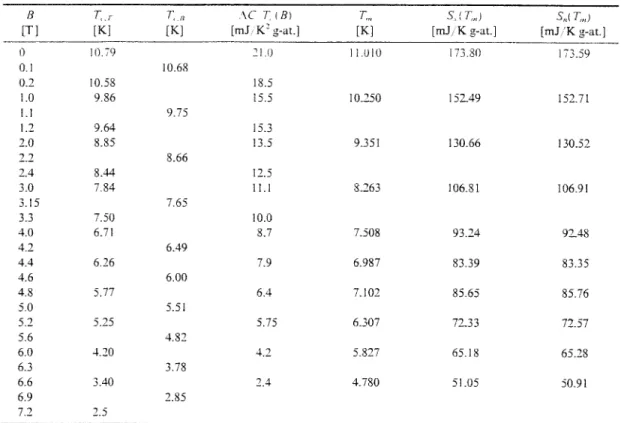
Table I. Superconducting Transition Temperature T,., Specific Heat Jump (AC/T)r~r (Idealized Value as Described in the Text), and Entropy of the Superconducting State S,. and Normal State & at a Temperature ~,, SIi~tly Above
T,(B) for Nb077Zr,~.~ for Different M a ~ e t i c Fields"
r,.~ r,:, \ C T, ~B} T,,, S, (T,~,) &,(T,,,) [T] [K] [K] [mJ/K-" g-at.] [K] [ m J / K g-at.] [ m J / K g-at.]
0 10.79 21.0 11.010 173.80 173.59 0.1 10.68 0 2 10.58 18.5 1.0 9.86 15~5 I 0.250 15Z49 152.7 I 1.1 9.75 1.2 9 . 6 4 15.3 2.0 8.85 13~5 9.35I 130.66 130.52 2.2 8.66 2.4 8 . ~ 12.5 3.0 7.84 1 I. 1 8263 106.81 106.9 I 3.15 7.65 3.3 7.50 10.0 4.0 6.71 8.7 7.508 93.24 92.48 4.2 6.49 4.4 6.26 7.9 6.987 83.39 83.35 4.6 6.00 4.8 5.77 6.4 7.102 85.65 85.76 5.0 5.51 5.2 5.25 5.75 6507 72.33 72.57 5.6 4.82 6.0 4.20 4.2 5.827 65.18 65.28 6.3 3.78 6.6 3.40 2.4 4.780 51.05 50.9I 6.9 2.85 7.2 2.5
a t e . T and T,.,,~ are determined by the position of the peaks in ~?(C..,,, TJ,~?T and ?.(C T)/(PB. respectively.
20 15 10 --a E 5 O 0 o -10 .1 0 2.5 5 7.5 10 12_5 15 T[K]
Fig. 3. l~fference between the spedfic heat of Nbo.77 in the superconducting state and in the normal state m e a s u ~ d in B = 10 T vs. Lernperature T. Tlne fields are B = 0 (full squares), 0.2, 1.0, 1.2, 2.0, 2.4, 3.0, 3.3, 4.0, 4.4, 4.8, 5.2, 6.0 T (lines), and 7.2 T (open squares). 10 8 - m II 4 2 0 0 2 4 6 8 10 B [ T I
Fig. 4. Coefficient of the linear term of the spec~c heat in the mixed state in the I o w - t e m ~ t m r e limit vs. m a s t i c field for Nbo.,v~a.23. The fialI Iine ~ t 7g/Bca-
heat jump, e.g., J ( 0 ) = 2 in the two-fluid model. The first term represents the n~lixed-state contribution below To(B) in the Makh-de Gennes approximation [7,8], and the second one accounts for the suppression
of the jump (A C//T) ~ over a~ infimitesimai tempera- ture interval AT=AB/(dB~/dT). The enn-opy increase from T = 0 to T > 7"._.(0) is left unchanged by the magnetic field. This constraint gives a relation
Mixed-State SpeciNc Heat of Nbo.77Zro.~ -5 - 1 0 - 1 5 c ~
~
-20 cD -25 - 3 0 7.2-6.6 T -o- 6 . ~ . 0 T - - - 6.0-5.2 T 5.2-4.8 T 4.8-4.4 T 4.4-4.0 T 3.~3.0 T -o- 2.4-2.0 T -35 ' . . . " ... J .. . . ' . . . ' . . . 0 2 4 6 8 10 T [K]Fig. 5. Derivative of the specific heat C~ T with respect to the mag- netic field vs. temperature for Nbo.77Zro.23. The derivative is obtained by finite differences from consecutive fields listed in the legend.
between the dimensionless jump J(B) and the slope of the upper critical field"
Tc(B) dBc2 J(B) = (2) Bc2(0) dT Therefore" a ( C / T ) ~-_ ... 7 ... [O ( T - Tc(B)) c~B B c 2 ( 0 ) - r c ( B ) 6 ( r - To(B))] (3)
This formula allows one to reconstruct the specific heat anomaly in zero field starting from the normal state at B>B~2(0), and summing up elementary contributions at lower fields"
C~, (T, B = 0 ) t ~~ c?(C/T)
T = / + J8 dB (4)
Assuming, t-or example, a parabolic approximation for the temperature dependence of the upper critical field, Bcz(T) = Bc2(0)(1 - t2), one obtains C(T, B = O)/T = 3yt 2, t =_ T/'~: < 1, which is the two-fluid model obeyed by many medium to strong coupling super- conductors at not too low temperatures.
From Fig. 5, the field derivative of the specific heat in the mixed state c?( C/' T) / cPB is approxinaately equal to 1.5 m J / ( T K 2 g-at.) below the superconduct- ing transition, and stays almost temperature and field independent, in conformity with Eq. (3). Thus, the mixed-state specific heat G( T, B) - C=( T, O) / r is pro- portional to the magnetic field not only in the limit of low temperatures (Fig. 4), but also almost up to
To(B). Note that the dip of 0(C,,./T)/c3B varies strongly
531
with Tc(B). Its amplitude (in units of m J / ( T K 2
g-at.)) can be approxLmated by 0 . 1 ~ ( B ) 2"65. Accord- ing to Eqs. (1)-(3), the area under the dip should be proportional to T~(B) to preserve the conservation of entropy; consequently its width should vary as
Tc(B) -~'65. This agrees qualitatively with the observed
broadening, the origin of which will be discussed later.
3.2. Determination of ~=(B), Bc2 (T), and Be(T)
In order to proceed further, we first determine the values of To(B). The practical definition is not unique. The inflection point of the electronic specific heat, i.e., the temperature at which 0(Cei/T)/c3 T has its maximum negative value in the specific heat jump, defines Tc.r(B) (Table I, first column). The position of the maximum negative value of O(C/T)/OB
(Fig. 5) gives another bulk determination Tc, B(B)
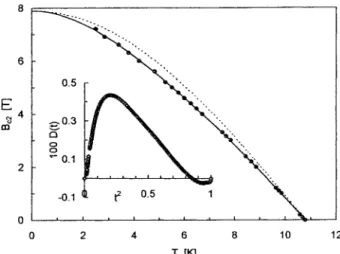
(Table I, second column). For the latter, it is not necessary to remove the lattice contribution. Both definitions of course coincide in the case of an ideally sharp second-order transition. As shown in Fig. 6, they do in practice within error limits, and allow a precise determination of the phase boundary in the (B, T) plane. The Bc2(T) curve follows the theoretical W H H function in the dirty limit [20], thus confirming earlier findings [18]. The implicit W H H ftmction in the case a = X = 0 is conveniently approximated by
Bc2(T)/Bc2(O) ~ (l-t2)(1 - 1.181t2+l.614t3-O.712t4),
t = T/T,. ; in particular, Bc2(0) = -0.693Tc(dBc2/
dT)tr,. A fit to the experimental points yields the
E ,.,4 o 0 . . . * I i . . . . i i . . . i . . . ~ ... t . . . r l ~ , . . . 0 2 4 6 8 1 0 1 2 T [K]
Fig. 6. Upper critical field as a function of temperature for Nbo.77Zr0.23 determined by the position of the peak of (?(C//T)/0B
or O(C,4/T)/cPT (closed circles). The full line is a fit of the W H H
function in the dirty limit, with 7",.= 10.79 K and B,.2(0)=7.9 T. The broken line represents B,.2(T) in the BCS limit. Inset: deviation function of the thermodynamic critical field.
e Tc = I0.79 K and B~z(0)=7.9 T ( ~ kn F i ~ 6). N o t e ~ a t the
the BCS in fion t o ~ Bd~ T) ~ ~'-Bc(0) ( I -- ~)( 1.77-- 0.43t 2 + 0.07?) [21 ] ( d o ~
Fig 6).
W e can n o w ~ the st_ate
h ~ t in m o ~ de . P,~ ted out m on 3.1, th~ low- limit
~(C/T)/~B~7/Bc,_(O),
~ a t(C~(T.B)-C,(T, O))/TT~B/B~2(O),
B < 0), in c l o ~ t ~- [7,8]. conWibufion ~ ,an t o c ~ as c h ~ t o f t~e
n ing m ~ v o n ~ ~ r ~ . At
so t hi t m ~ can be from
~
5, c3(C/T)/~?B
is about 1.5 m J / ( T K ~ g-aL) 1.3?/B~(0),~
C,(T. B ) - C,(T, O)/TT~
13B//B~2(O). ~
o e r w o r ~ d-stateheat ~ alw p r o ~ ~ o n a A to
B/B~(O),
the
p t o r ~ ~ t m dent m the
w h e ~ ta
tiM.
We ~na~ to ~ m t m n 3.3.~ e o f fine tic h ( A C / T )
~m
at t f i e t ~ w ~ ob by fions o f
C/T
from above and from ~ l o wT~.~B),
and by roq g ~ a t ~ e enh"opy ad j ~ t below Tc.r(B) equal to the entropy removed j ~ t aboveT~r(B)
( T a N e L co ).H g o b ~ n e d To, the j ~ p m zero fiel& ~ d the n o r m S - s t a t e cific heat, we o~n cal te the thermodynamic critical field B ~ ( ~ "
~ ( r )
jr162
dT'
J~~'-
dT" C~(
T")
-- C.( T")
T"
(5)
where V= 11.7 can3/g-at. N the atomic v o l - ~ e for N~o.yvZo.z3. The value of B~ at T = 0 is 0.256 T. Its temperature dependence follows very c l o ~ l y the two- fluid parabolic law, with a m um derivation
D(t)=Bc(T)/Bc(O)-(1-tz) ~-
+0.005 at t2= 0.2 (Fig. 6, inset), in qualitative agreement -Mth pre,Aous results [4]. In the weak-coupling, BCS case, the maxi- m u m deviation would b e - 0 . 0 3 7 at t 2 =0.49.3.3. SpecLfic H e a t J ~ p at T~(B) and GLazburg Parameter ~ ( T )
We can now calculate the values of the Ginz- burg parameters S:l(T) and ~:2(T) in the notation of Eilenberger [22]:
Bc2(T)=,//2u:~Bc(T)
(6) 15 10 0 ... ~ " ~ L _t * ~ I . . . . 1 . . . . t , . . . ! . . . , . . . 0 2 4 6 8, 10 "12 Tt~ F ~ 7. T ~ dep o f tl'~ G m g~ ( sq ) ~ ~-z (~_,lt ) f o r N b o . ~ Z r r (6) a~d (7). V I. 16Uo(2tc~-- l) (7) rare d of ~-1(T) m'~d ~cz(~ ~ ~ o ~ m 7. ~ [ ~ ] , ~ , ( T ) ~ d g z ( T ) m the value at T--* T~ theel of fine g st, ate
. .A~ a t i ~ p
at ~ e tion from tlhe no s m ~ to the ~ e d r e d u ~ in amp ~ i t h to the j u m p at the tion from the no state to the ~ n d s t n ~ m
B=O,
w ~ h is ~..~en by R s equation:( if
= - -
v(8)
TA o ) fl o ~(o)
~ e value of the c h ~ t j u m p at the transition from the normal state to the ~ e d stare fiound to be p ~ionaI to
1-B/B~z(O)
for 0.2 T < B__<_ B~2(0) (Fig. 8). The quantity 1 - B/Bc2(0) can be visua a s the volume fraction of the sample that is locally smperconductmg, i.e., outside of the vortex cores counmd with an effective area 2Jv~ z. The difference between the zero-field and the in-field tran- sitions shows up as an upturn at B-+0 on the fight of Fig. 8. This difference is also directly apparent in Fig. 3. The ratio between the zero-field j u m p and the in- field j u m p extrapolated to B = 0 (lull line in Fig. 8) is 1.16, in agreement with Eqs. (6)-(8). Note that the coefficient 1.16 arises for a triangular vortex lattice, i.e., when interactions between vo~ices are taken into account. The curve for the lowest nonzero field inMixed-State Sp~ific Heat of Nbo.yTZro.z3 533 25 20 ca 15 rll "a 10 0 <~ . . . ! . . . ! . . . ! . . . I . . . 0 0.2 0.4 0.6 0.8 1 1 -B/B~(0)
Fig. 8. Specific heat jump (AC/T)r,{8) vs. 1-B/&2(O) (full squares) for ~*rb0.77Zr0.23 , all fields included. The open circle shows
the value of the specific heat jump in B - 0 divided by a factor 1.16. The line through the full symbols represents the dependence
(AC/'T)~(m= [(AC/T)F,(B=o)/1.16][ I - B/Bc2(O')].
these experiments ( B = 0 . 2 T) has an intermediate behavior. A similar dependence of the specific heat j u m p on the m a ~ e t i c field was reported in [6] for Nb3Sn.
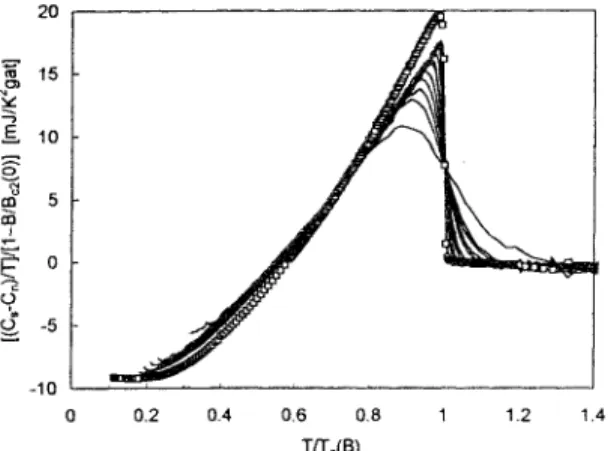
As a matter of fact, the proportionality between the mixed-state specific heat and 1-B/Bc2(O) is not limited to the j u m p at Tc(B). As shown in Fig. 9, the AC (T, B ) / T vs. T curves for B > 0.2 T can be col- lapsed over most of the intermediate temperature range by plotting ( ( C , - C , , ) / T ) / ( 1 - B / B c 2 ( O ) ) vs.
T/T~ (B). In the low-temperature limit, this is a direct
consequence of the M a k i - d e Gennes contribution
20 15 % - - , a c D m 5 J o, -10 0 0.2 0.4 0.6 0.8 1 1.2 1.4 T,'Tc(B )
Fig. 9. Zero-field (open squares) and mixed-state (lines) electronic specific heat difference ( C , . ( K B ) - C , ( T ) ) / T - A C ( T , B ) / T in
various magnetic fields for Nbo.77Zr0.23, normalized by the "effec- tive superconducting fraction" 1-B/Bc2(O), vs. reduced tempera- ture T/Tc (B). The fields are B = 1.0, 1.2, 2.0, 2.4, 3.0, 3.3, 4.0, 4.4, 4.8, 5.2, and 6 T.
with C / T proportional to B/Bc2(O). N e a r To, the symmetry of the vortex lattice plays a role, as shown by the factor 1.16 that arises there. One sees that the magnetic field excludes some entropy from the transition region, which must be redistributed at lower temperature to obey the third law of thermodynamics. This causes a subtle change of the shape of the mixed- state specific heat. Even if the curves for B > 0.2 T were rescaled by a factor 1.16, their normalized shape would differ from that of the B = 0 curve. F o c a l l y , the collapse of the curves for B > 0.2 T in Fig. 9 means that we can define a dimensionless scaling function f b y
y T - Be2(0) f ( t s ) , t s = T c ( B )
which implies the following relation for the field derivative" #B
)
1 I
Be2(0) - f ( t , ) +
d in Tc (B) d In (Bc:(0) - B) tB](
~0)
The f i a n c t i o n f m u s t have the property f ( 0 ) = - 1 , and consequently relation (10) includes the particular case O(C/T)/c~B= ?'~Be2 at T ~ 0 . With some rather strong assumptions, e.g., the power laws f ( t s ) = 3t 2 - 1 and Bc2(T) = Bc2(0)(1 - t2), this propri- ety would hold exactly up to Tc. If BCS functions were used both f o r f andBc2(T),
cI(C/T)/aB would tend to zero at T,:, at variance with experiment. The experimental f i n the present case is close to the aver- age between the BCS and 3t 2 - 1 functions, and Bcz(T) follows the W H H dependence. In these condi- tions, Eq. (10), based on the observed scaling prop- erty, reproduces the smooth increase of O(C,/T)/OBfrom 7/Bc2 at r<< Tc to ~ 1.3 (y/Be2) in the mid-T~ range.
3.4. Broadening of the Superconducting Transition in a Magnetic Field
The broadening of the superconducting transi- tion that results fl~om the application of a magnetic field can be described by generalizing Eq. (3). The 5- ~anction is replaced by its broadened counterpart:
5 ( T - T ~ ( B ) )
x - A T - ~c(B) 17
A 1
~B" 1 + x 2
534
Mirmelstein, Junod, Walker, Revaz, Genoud, and Triscone
The field dependence of the dip width in
O(C/T)/(?B
(Fig. 5) is described by an exponent n near 1.5 for
Nb0.77Zr0.23. This leads us to conclude that the sys-
tematic broadening of the initially sharp transition, which simulates the effect of the fluctuations, results fi~om local variations of the mean free path in the dirty limit. If broadening was due to thermal fluctuations of the order parameter, the typical transition width in a magnetic field of 4 T would be on the order of 60 mK, whereas the observed transition width is larger by an order of magnitude. Besides, fluctuation effects lead to exponents n < 1 [16]. Alternatively, local variations of the mean free path lead to a co~esponding distribu- tion of the upper critical field ABc2 via a distribution of the Ginzburg parameter ~c, while the thermo- dynamic critical field, i.e., the condensation energy, remains uniform throughout the sample. Such a broadening results in a field-dependent transition width AT,:(B) varying as
i ] I)-1
A Tc (B) _ ABe2d
In b To(0) B~2(0)dt
b(t)~
Bc2(t)
a~(0)
(12)The curves
c~(C/T)/c?B
vs. T (Fig. 5) measured in various fields B > 2.4 T collapse onto a single curve (Fig. 10) when they are normalized to their peak value and plotted as a function ofT-Tc(B)/ATc(B).
The fact that they do does not depend on the value of ABe2. The latter parameter is determined by the width of the common curve, with the resultABc2
~ 1 T. At0.5 9 --, 0 "tO tD r E O -6.5 o m 7.2--6.6 T ~' "~ o o 6 . 6 ~ . 0 T . ' * 6.0-5.2 T o 5.2-4.8 T A 4.8-4.4 T ,L 4 . 4 ~ . 0 T e 3.3-3.0 T -1.5 L .. . . ~ . . . -2 -1 0 1 2 [ T - T J B ~ / A T c ( B )
Fig. 10. Derivative of the total specific heat C/'T with respect to
the magnetic field near To(B), normalized to - 1 at the minimum,
vs. reduced temperature (T-T,.(B))/A~(B), where AT..(B) is
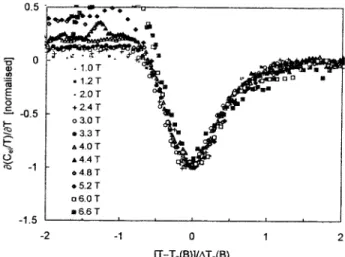
given by Eq. (12). 0.5 ~ ' 0 I/1 O -0.5 o A 4 . 0 T A 4 . 4 T o 4 . 8 T o 5 . 2 T a 6 . 0 T a 6 . 6 T -1.5 ... -1 o 1 2 [T-TJB)]/ATc(B)
Fig. 11. Derivative of the electronic specific heat C~t / T with respect to temperature near T~(B), normalized to - 1 at the minimum, vs.
reduced temperature ( r - Tc (B))/AT.~. (B).
lower fields, the experimental field mesh is too crude to allow a precise determination of
O(C/T)/OB;
but the same scaling holds at all fields _> 1 T for the equivalent plot of 0(Cet/T)/c~T, which may be calcula- ted with a better resolution, but requires fi~st the sub- traction of the lattice contribution (Fig. 11).4. C O N C L U S I O N
The behavior of the mixed-state specific heat of Nb0.77Zr0.23, which can be considered as a reference type-II classic superconductor (Table II), is docu- mented in t e ~ s of
AC/T
vs. T andO(C/T)/c~B
vs. T curves. The field causes a shift of the transition toward lower temperatures, and an increase of the electronic specific heat in the superconducting state. The bulk measurements of To(B) by closely spaced specific heat experknaents from 0 to Bc2(0)=7.9 T shows an almost perfect W H H [20] dependence. The difference between the transitions to the MeissnerTable II. Parameters Characterizing Nb77Zr23 a
Nb75Zr25 NbvvZrz3 [4] (this work) Tc (K) 10.78 10.79 V (cm3/g-at.) 11.67 11.67 Bc (T) 0.249 0.256 Bc2 (T) 7.9 ~c(0) 21.8 ~:( Tc) 15.9 7 (mJ/K2 g-at.) 8.96 9.15 AC/TTc 2.23 2.30
Mixed-State Specific Heat of
Nbo.77Zro.z3
state and to the Shubnikov state is observed. The systematic broadening of the initially sharp transition, which simulates the effect of fluctuations, results from. local variation of the mean free path in the dirty limit. The mixed-state specific heat (Cs(K B) - C,(T, 0)) /
?'T
is proportional toB/B~2(O),
in close agreement with theory [7,8], almost up to Z=.(B). This contribu- tion at low temperature is understood as the specific heat of nonsuperconducting electrons in the vortex cores. Its extended validity almost up to T~ appears to be a particular property of moderately strong cou- pling superconductors.A C K N O W L E D G NTS
The authors are gratetSal to M. Decroux for ac susceptibility measurements, and to J. Muller and J. Sierro for useful discussions. This work was sup- ported by the Fonds National Suisse de la Recherche Scientifique.
REFERENCES
1. J. Bardeen, L. N. Cooper, and J. R. Schrieffer, Phys. Rev. 108,
1175 (I957).
2. W. L. McMillan, Phys. Rev. 167, 331 (1968).
3. P. B. Allen and R. C. Dynes. Phys. Rev. B 12, 905 (1975).
535
4. A. Junod, J.-L. Jorda, and J. Muller, J. Low T er~p. Phys. 62,
301 (1986).
5. G. R. Stewart and B. L. Brandt, Phys. Rev. B 29, 3908 (1984).
6. M. N. Khlopkin, Sou. Phys. JETP 63, 164 (1986).
7. C. Caroli, P. G. de Gennes, and J. Matricon, Phys. Left. 9,
307 (1964) Phys. komtens. Mater. 3, 380 (I965).
8. K. Maki, Physics 1.21 (1964) 1, 127 (1964).
9. M. B. Salamon, S. E. Inderhees, J. P. Rice, B. G. Pazol, D.
M. Ginsberg, and N. Goldenfeld, Phys. Rev. B 38, 885 (1988).
10. R. C. Dynes, Solid State Commun. 92, 53 (I994).
11. J. R. Schrieffer, Solid State Commun. 92, I29 (1994).
12. C. C. Tsuei, J. R. Kirtley, C. C. Chi, L. S. Yu-Jahnes, A.
Gupta, T. Shaw, J. Z. Sun, and M. B. Ketchen, Phys. Rev.
Lett. 73, 593 (1994).
13. Ya. G. Ponomarev, N. B. Brandt, C. S. Khi, S. V. Tchesnokov, E. B. Tsokur, A. V. Yarygin, K. T. Yusupov, B. A. Aminov, M. A. Hein, G. Mfiller, H. Piel, D. Wehler, V. Z. Kresin,
K. Rosner, K. Winzer, and Th. WolL Phys. Rev. B 52, 1352
(1995).
14. D. Sanchez, Ph.D. thesis No. 2652 (University of Geneva, I994), unpublished.
15. D. Sanchez, A. Junod, J. Muller, H. Berger, and F. Levy,
Physica B 2 ~ , 167 (1995).
16. A. Junod, in StudYes oJ" Hi gh-7"emverature Superconductors,
Vol. I9, A. V. Narlikar, ed. (Nova Science Publishers, New York, 1996), pp. 1-68.
17. J. K. Hulm and R. D. Blaugher, Phys. Rev. 123, 1569 (1961).
18. L. J. Neuringer and Y. Shapira, Phys. Rev. 148, 231 (1966).
I9. R. P. Elliott, Constitution of Binary Alloys, First Supplement
(McGraw-Hill, New York, 1965), p. 279.
20. N. R. Werthamer, E. Helfand, and P. C. Hohenberg, Phys.
Rev. 147, 295 (1966).
21. L.P. Gor'kov, Zh. Eks~. Teor. Fiz. 37, 833 (1959),[Soviet Phys.
JETP 37(10), 593 (1960)].