INTRODUCTION
Alternative housing systems are gaining importance due to consumers’ demands. The goal of these systems is to enable laying hens to display natural behavior as much as possible while simultaneously ensuring sani-tary and economical egg production. For commercial alternative (noncage) housing systems, such as multiti-er aviaries, many diffmultiti-erent designs exist (Fröhlich et al., 2011). Recently, nests have been placed on tiers within the aviary (henceforth called integrated nests) instead of along the walls of the hen house (henceforth called wall-placed nests). To develop and design nests that are suitable for laying hens and therefore to maximize nest use, laying hens’ preferences were tested previously. High-placed nests (Lundberg and Keeling, 1999) and corner nests are favored (Riber, 2010). The quality of
the nest floor (Huber et al., 1985; Appleby and Smith, 1991; Petherick et al., 1993; Struelens et al., 2008), the nest color (Hurnik et al., 1973; Zupan et al., 2007), il-lumination (Dorminey, 1974), and the seclusion of the nest sites (Appleby and McRae, 1986; Struelens et al., 2008; Buchwalder and Fröhlich, 2011) were reported as important factors for nest choice. Nest site preferences differ among individuals, and consistent nest and floor layers can be distinguished in laying hens (Cooper and Appleby, 1996, 1997; Kruschwitz et al., 2008; Zupan et al., 2008). In addition to the physical characteristics of the nest, the rearing conditions and social interactions among hens while nest searching are also important fac-tors for nest choice (Appleby et al., 1984; Appleby and McRae, 1986; Cooper and Appleby, 1995; Lundberg and Keeling, 1999; Colson et al., 2008; Riber, 2010). Searching behavior for a suitable nest site has changed little throughout domestication and is therefore still important to laying hens kept under commercial condi-tions (Duncan et al., 1978; Kruschwitz, 2008). Search-ing begins up to 3 h before oviposition and is character-ized by increased locomotion and inspection of several nest sites (Huber et al., 1985; Sherwin and Nicol, 1993;
Nest use is influenced by the positions of nests and drinkers in aviaries
T. L. Lentfer ,*
1S. G. Gebhardt-Henrich ,*
2E. K. F. Fröhlich ,* and E. von Borell †
* Swiss Federal Veterinary Office, Centre for Proper Housing: Poultry and Rabbits, Burgerweg 22, CH-3052 Zollikofen, Switzerland; and † Institute of Agricultural and Nutritional Sciences, Faculty of Natural
Sciences III, Martin-Luther-University Halle-Wittenberg, Theodor-Lieser-Str. 11, D-06120 Halle, Germany ABSTRACT The influence of the nest location and the
placement of nipple drinkers on nest use by laying hens in a commercial aviary was assessed. Twenty pens in a laying hen house were equipped with the same commer-cial aviary system, but the pens differed in the nest lo-cation and the placement of nipple drinkers. Nests were placed along the walls in 10 pens, and nipple drinkers were installed in front of the nests in 5 of these pens. The other 10 pens were equipped with nests placed on a tier within the aviary (integrated nests). Nipple drinkers were installed in front of the nests in 5 of these pens. A total of 225 Lohmann Selected Leghorns were housed per pen. The hens were offered 4 nests per pen: 2 facing the service corridor of the laying hen house and 2 facing the outdoor area. The numbers of nest eggs and mislaid eggs were counted daily per pen. At 25, 36, and 43 wk of age, the nest platforms were videotaped
and the behavior of laying hens in front of the nests was analyzed. The nest location affected the stationary and locomotive behaviors in front of the nests. Hens in front of the integrated nests and the nests with drinkers displayed more stationary behaviors than hens in front of wall-placed nests or nests without drinkers. No dif-ference in the number of nest eggs could be detected, but the integration of the nests inside the aviary led to a more even distribution of hens while nest searching. In the pens with wall-placed nests, significantly more hens laid eggs in the nests at the wall near the service corridor than at the wall near the outdoor area. Due to this imbalance, crowding in front of the preferred nests occurred and pushing and agonistic interactions on the nest platforms were significantly more frequent. Place-ment of nipple drinkers in front of nests had no effect on the number of eggs laid in those nests.
Key words: laying hen , nest site , behavior , aviary system , nipple drinker
2013 Poultry Science 92 :1433–1442 http://dx.doi.org/ 10.3382/ps.2012-02718
ENVIRONMENT, WELL-BEING, AND BEHAVIOR
1433
Received August 27, 2012. Accepted February 3, 2013.
1 Present address: Federal Office for Agriculture and Food,
Deich-manns Aue 29, D-53179 Bonn, Germany.
2 Corresponding author: [email protected]
Cooper and Appleby, 1996). In aviary systems, nest choice is typically limited to one type of standardized rollaway group nest. The drinkers are often placed in front of nests to facilitate the use of nests and to avoid mislaid eggs. As young hens use the drinkers, they may become familiar with the location of the nests.
A previous investigation of an experimentally altered aviary system showed that the accessibility of inte-grated nests was lower than that of wall-placed nests because many hens would stand on platforms in front of integrated nests. In some cases, this led to agonis-tic interactions between the hens in front of the nests (Lentfer et al., 2011). Placement of drinkers in front of nests might exacerbate crowding of hens in front of the nests. Therefore, we tested the effects of nest integra-tion and the presence of drinkers in front of the nests in regard to nest use and behavior on nest platforms in a commercial aviary system. Because those effects have not been examined before, we assumed that there would be more crowding on nest platforms in front of integrated nests with drinkers due to hens searching for nests as well as conspecifics drinking or moving up and down between the tiers.
Crowding on nest platforms was supposed to have a negative impact
a) on laying hen welfare because crowding may in-crease agonistic interactions because of competi-tion for nests, and
b) on laying performance because crowded nest platforms may provoke hens to search for alter-native locations and mislay eggs.
In contrast, we hypothesized that wall-placed nests would be more appropriate because only hens searching for a nest would be present on the nest platforms. The animal density on those nest platforms would be low, offering hens the opportunity to actively search for a suitable nest. The presence of drinkers in front of these nests might moderately increase the number of hens on the platforms.
MATERIALS AND METHODS
Birds and Housing
The study involved a total of 4,500 non-beak-trimmed Lohmann Selected Leghorn hens. All 1-d-old chickens were raised until 18 wk of age in a breeding barn with 8 separate pens equipped with different aviary systems [4 pens with Landmeco Harmony, Landmeco A/S, Øl-god, Denmark (4.89 × 4.55 m); 4 pens with Inauen Natura, R. Inauen AG, Appenzell, Switzerland (4.86 × 3.92 m)]. All pens were equipped with perches, nipple drinkers, manure belts, automatic chain feeding, room heating, and windows that exposed the birds to natu-ral daylight in addition to the recommended lighting program. At 18 wk of age, the hens were assigned to
20 pens along a service corridor in a laying hen house. Each pen had a separate covered outdoor area littered with wood shavings and equipped with nipple drinkers, which was accessible from 1000 to 1600 h. In each pen, 225 individuals (112 from the Landmeco aviary plus 113 from the Inauen aviary) were housed and banded with a spiral leg band (Spiralring gemischt, 16 mm, Fieger Brutmaschinen & Kleintierzubehör, Untertu-ttwil, Switzerland) of a pen-specific color. The pens were separated by wire-mesh dividers. The floor area (230 × 705 cm) was covered with wood shavings and straw, and a 4-tiered aviary (Bolegg Terrace, Rihs Agro AG, Seon, Switzerland) was placed in the middle of each pen, giving a stocking density of 7.4 hens/m2
ac-cessible floor. Four Vencomatic Classic Sidebelt Nests (l: 113 cm, w: 48 cm, h: 30 to 50 cm, Vencomatic BV, Eersel, the Netherlands) were available in each pen, of-fering 1 m2 nest space per 96 hens. The nest floor was
covered with green soft rubber nest pads (Vencomatic BV, Eersel, the Netherlands). All nests were equipped with a 30-cm-wide, 113-cm-long grid platform and a metal perch (diameter: 32 mm) of the same length po-sitioned at a 10-cm distance from the grid in front of the nest entries (Figure 1). The 4 nests were placed on the second tier of the aviary, with 2 facing the service-corridor and 2 facing the outdoor area. For each second pen, those integrated nests were hidden and made inac-cessible with a nontransparent plastic cover. In these pens, the nests, which were equal in design and num-ber, were placed along the walls: 2 at the wall at the service-corridor and 2 at the wall at the outdoor area. Nipple drinkers were installed in front of the nests in 5 of the pens with integrated nests and in 5 of the pens with wall-placed nests. Eighteen nipple drinkers were available in each pen. In pens with nipple drinkers in front of the nests, 12 nipples were placed above the nest platforms and 6 additional nipples were placed on the first tier of the aviary. In pens without nipple drink-ers above the nest platforms, 12 nipples were placed on the first tier of the aviary and 6 additional nipples were placed on the third tier. A lighting schedule was standardized consisting of a day length of 15 h (0200 to 1700 h) using artificial lighting with a 15-min twilight phase at the beginning and end of the light period. Window curtains were lifted from 0500 to 1600 h to provide additional natural light inside the pens. The room temperature was maintained at 18°C (±2°C). A chain feeding system was installed on the first and on the third tier of the aviary, and a commercial standard layer diet according to breeder guidelines was provided ad libitum. Trough-length per pen was 16 m, and the troughs were automatically filled at 0300, 0500, 0800, 1000, 1300, 1500, and 1630 h.
Data Collection
The number of eggs per pen that were laid in the nests (nest eggs) and the number of eggs per pen that were
mislaid on the floor or elsewhere in the aviary (mislaid eggs) were recorded every day from 19 wk until 44 wk of age. Fewer than 7 eggs/225 hens were laid before 19 wk; full egg production was reached around 24 wk. For technical reasons, the 2 nests installed at the same posi-tion within a pen (near service-corridor or near outdoor area) were regarded as one nest. Therefore, the number of eggs laid in the 2 nests at the same position within the pen was pooled before analysis. Mortality was re-corded daily to determine the percentage of hens per pen that died over the course of the experiment.
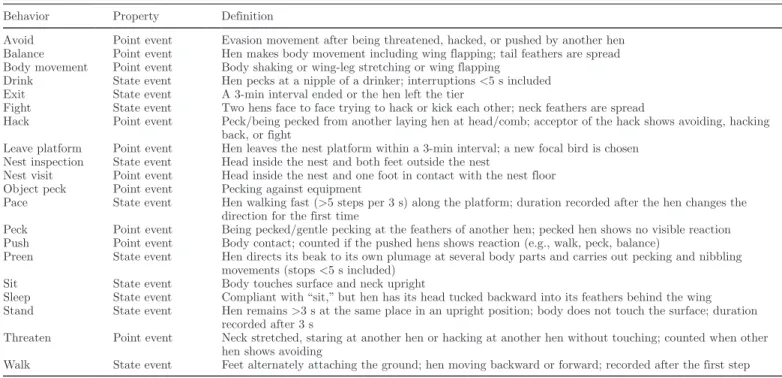
At 25, 36, and 43 wk of age (before the ceiling fans were turned on), all the nest platforms were filmed for 10 h with digital cameras (Samsung 200X WDR Power Zoom; Conrad CCD Color Pin Camera with IR 380 TVL, Conrad Electronic AG, Wollerau, Switzerland) after artificial illumination started. Two cameras were installed in each pen the day before filming so that the hens could become accustomed to the equipment. The recordings were made with a Multieye-Hybrid re-corder (Artec Technologies AG, Diepholz, Germany). The data were stored on external hard discs, and the recordings were analyzed by continuous focal animal sampling and scan sampling according to Martin and Bateson (1993) using The Observer XT (Noldus Infor-mation Technology, Wageningen, the Netherlands). A total of 48 min per pen at each age were observed using the continuous focal animal sampling method during the first 3 min of every quarter hour throughout the main laying period. The main laying period was de-fined from 1 h after artificial illumination started until 4 h later, according to the results of a previous study (Lentfer et al., 2011). The laying hen standing in the
center of the nest platform (as defined by the position of its feet) was chosen as the focal bird. Every 3-min interval or if the focal bird left the platform within the 3-min interval, a new focal bird was chosen. The observed behaviors are listed in Table 1. The frequen-cies (point events) and durations (state events) of be-haviors were recorded. Scan samples were conducted at the beginning of each 3-min interval by counting the number of hens on the platform and the perch in front of the nests. The light intensity and air velocity were measured to assess their influence on nest eggs because an unequal distribution of eggs was recorded within the pens equipped with wall-placed nests. The measuring dates were scheduled at the end of the experiment so as not to interfere with behavioral data sampling. The light intensity on nest platforms and inside the nests was measured at 41 wk of age. The measurements of 6 directions (to the ground, top, left, right, front, and back) were taken at the center of all nest platforms and at the right corner inside each nest using a luxmeter (Mavolux digital, Gossen GmbH, Nürnberg, Germany). The average of the 6 measures per nest and platform was used for the analyses.
The horizontal and vertical air velocity in front of the nests was measured at 41, 43, and 45 wk of age (Ther-mo Air I, Schiltknecht Messtechnik AG, Gossau, Swit-zerland). The measurements at 41 wk of age were as-sumed to reflect air velocity conditions throughout the laying cycle. At 43 wk of age, the ceiling fans above the wall-placed nests near the service corridor were turned on low speed for 72 h to increase the air velocity on the nest platforms. Those fans had not previously been in service. To examine whether higher air velocities in Figure 1. Illustration of the 4 different treatments based on 4 example pens. Left: wall-placed nests without nipple drinkers; middle left:
in-tegrated nests without nipple drinkers; middle right: wall-placed nests with nipple drinkers; right: inin-tegrated nests with nipple drinkers. The gray block in the middle of the pens represents the position of the aviary block, the dotted lines represent the doors, black rectangles display the nests, the white rectangles with a black line in front illustrate the nest platforms with the perch, and the black dots are nipple drinkers above the nest platforms. Five repetitions of these pen arrangements were present along the service corridor.
front of the nests lead to a reduction in the number of eggs laid in those nests, the same approach was per-formed at 45 wk of age, when the rotation of the ceil-ing fans was increased to generate higher air velocities in front of the nests. Nest eggs and mislaid eggs were recorded the day after the ceiling fans were turned on.
Experimental Design
The factors of nest integration (integrated or wall-placed) and nipple drinkers in front of the nests (yes or no) were completely crossed in a 2 × 2 factorial ar-rangement. The following full model was used:
Yijklm = µ + nesti + drinkerj + nest positionk + agel
+ (nest × drinkerij) + (nest × nest positionik)
+ (nest × ageil) + (drinker × nest positionjk)
+ (drinker × agejl) + (nest position × agekl)
+ (nest × drinker × nest positionijk)
+ (drinker × nest position × agejkl)
+ (nest × drinker × nest position × ageijkl) + εijklm,
where Yijklm = measurement of penm at agel in nest
positionk; i = wall-placed or integrated; j = yes or no; k
= closer to the service corridor or closer to the outdoor area; l = 25, 36, or 43 wk of age; and m = 1 to 20.
Nest integration, nipple drinkers, nest position, and age were used as fixed factors. The pen was modeled as a subject factor in the repeated statement of PROC MIXED using SAS 9.13 (SAS Institute Inc., Cary, NC). Nonsignificant interactions (P > 0.2) were pooled.
Con-trasts were calculated using differences of least squares means. All behavioral parameters and the number of hens in front of nests were analyzed using SAS, and the laying performance and environmental parameters (light intensity and air velocity) were analyzed with NCSS (NCSS 2007, J. Hintze, Kaysville, UT). The fol-lowing data were log-transformed to reach normal dis-tribution before the analyses: number of mislaid eggs, light intensity, number of nest inspections, walking duration, drinking duration, and number of hens on nest platforms. In the case of the transformed data, raw data are presented. The durations are presented in seconds, whereas point events are presented as counts. Hack, threat, fight, push, and avoid were summarized as agonistic interactions and sit, sleep, stand, preen, drink, and nest inspection were summarized as sta-tionary behaviors. The walking duration (P < 0.001) and the number of nestbox inspections (P = 0.01) had interactions with age. Therefore, these variables were analyzed separately for the 3 ages to facilitate inter-pretation.
To assess the influence of air velocity on the number of eggs laid in the nests, the correlation between the air velocity on the nest platforms and the number of eggs laid in the related nests was calculated (Pearson cor-relation). The air velocity measurements per pen and weeks of age were averaged, and the differences in air velocity between 41 and 43 wk of age as well as between 41 and 45 wk of age were calculated. Additionally, dif-ferences in the number of nest eggs laid inside the nests the first day after the ceiling fans were turned on, com-pared with the day before, were calculated. Afterward, the Pearson correlation between the differences in air velocity and nest eggs was determined.
Table 1. Definitions of sampled behaviors
Behavior Property Definition
Avoid Point event Evasion movement after being threatened, hacked, or pushed by another hen Balance Point event Hen makes body movement including wing flapping; tail feathers are spread Body movement Point event Body shaking or wing-leg stretching or wing flapping
Drink State event Hen pecks at a nipple of a drinker; interruptions <5 s included Exit State event A 3-min interval ended or the hen left the tier
Fight State event Two hens face to face trying to hack or kick each other; neck feathers are spread
Hack Point event Peck/being pecked from another laying hen at head/comb; acceptor of the hack shows avoiding, hacking back, or fight
Leave platform Point event Hen leaves the nest platform within a 3-min interval; a new focal bird is chosen Nest inspection State event Head inside the nest and both feet outside the nest
Nest visit Point event Head inside the nest and one foot in contact with the nest floor Object peck Point event Pecking against equipment
Pace State event Hen walking fast (>5 steps per 3 s) along the platform; duration recorded after the hen changes the direction for the first time
Peck Point event Being pecked/gentle pecking at the feathers of another hen; pecked hen shows no visible reaction Push Point event Body contact; counted if the pushed hens shows reaction (e.g., walk, peck, balance)
Preen State event Hen directs its beak to its own plumage at several body parts and carries out pecking and nibbling movements (stops <5 s included)
Sit State event Body touches surface and neck upright
Sleep State event Compliant with “sit,” but hen has its head tucked backward into its feathers behind the wing Stand State event Hen remains >3 s at the same place in an upright position; body does not touch the surface; duration
recorded after 3 s
Threaten Point event Neck stretched, staring at another hen or hacking at another hen without touching; counted when other hen shows avoiding
RESULTS
Number of Hens
Different from our expectations, most of the hens were found in front of the wall-placed nests near the service corridor, and the fewest hens were found in front of the wall-placed nests near the outdoor area (t16
= 15.98; P < 0.0001; Table 2). The distribution of hens in front of the integrated nests was much more even, with most hens at nests facing the service-corridor with drinkers and the fewest at nests facing the outdoor area without drinkers (t16 = 4.89, P < 0.0002). The
pres-ence of drinkers generally increased the number of hens; however, this effect depended on the interaction with nest position and integration (t16 = 6.11, P < 0.0001).
With increasing age, the hens were distributed more evenly. The treatment combinations with higher num-bers of hens had fewer hens with age, and treatment combinations with lower numbers of hens had more hens with increasing age (interaction between nest in-tegration and age: F1,93 = 5.78, P = 0.02).
Laying Performance
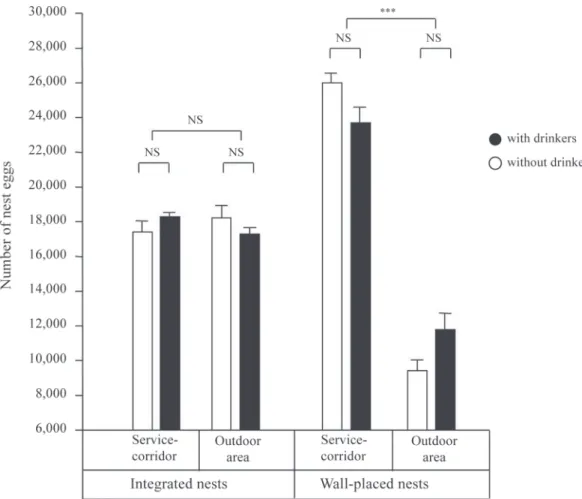
A high correlation was found between the number of nest eggs at the observation days and the average number of hens present in front of this nest throughout the main laying period (r = 0.82, P < 0.001). The total number of eggs laid in a specific nest throughout the experiment depended on the interactions between nest integration (integrated or wall-placed), the presence of nipple drinkers, and the nest position with respect to the service corridor or outdoor area (F1,16 = 5.92, P
= 0.03, Figure 2). No differences between the pens re-garding the number of eggs could be detected (F16,3620
= 0.18, P = 0.99). The total number of mislaid eggs was higher in pens with wall-placed nests than in pens with integrated nests (F1,16 = 9.57, P = 0.01), but in
general, the number of mislaid eggs in relation to all eggs laid from 19 till 44 wk of age was low. On aver-age, 0.79% of the eggs were mislaid in pens with wall-placed nests compared with 0.53% of all eggs in pens with integrated nests. The presence of nipple drinkers above the nest platforms did not influence the number of mislaid eggs (F1,16 = 0.20, P = 0.66). Mortality was
2.4% on average, and no differences could be detected between the pens with or without nipple drinkers above the nest platforms (F1,16 = 0.29, P = 0.60) and
be-tween those with integrated or wall-placed nests (F1,16
= 1.84, P = 0.19).
Behavior
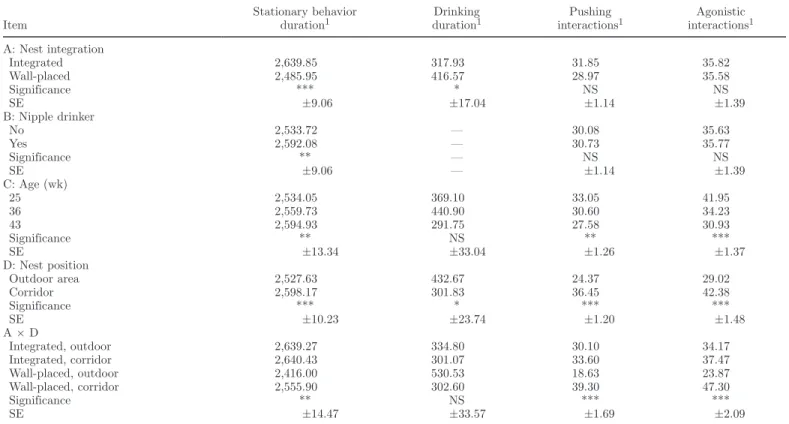
Nest location (including whether the nest was inte-grated into the aviary and whether it was closer to the service-corridor or to the outdoor area) affected sta-tionary and locomotive behaviors in front of the nests (Table 3). The hens with integrated nests (P < 0.0001)
and with drinkers in front of the nest (P = 0.002) dis-played more stationary behaviors than hens with wall-placed nests and without drinkers in front of the nests. With increasing age, the hens generally became more stationary (P = 0.009). Most pushing and other agonis-tic interactions were performed by hens in front of wall-placed nests near the service corridor (P < 0.0001).
Table 2. Analysis results for the number of hens, presented as
the means ± SE
Item Number of hens1
A: Nest integration Integrated 7.61 Wall-placed 8.87 Significance ** SE ±0.17 B: Nipple drinker No 7.89 Yes 8.59 Significance *** SE ±0.23 C: Age (wk) 25 8.33 36 8.24 43 8.14 Significance NS SE ±0.29 D: Nest position Outdoor area 7.08 Corridor 9.39 Significance *** SE ±0.19 A × C Integrated, 25 7.54 Integrated, 36 7.53 Integrated, 43 7.74 Wall-placed, 25 9.13 Wall-placed, 36 8.94 Wall-placed, 43 8.54 Significance * SE ±0.35 B × C No, 25 7.69 No, 36 7.88 No, 43 8.08 Yes, 25 8.97 Yes, 36 8.59 Yes, 43 8.21 Significance ** SE ±0.42 A × D Integrated, outdoor 7.24 Integrated, corridor 7.98 Wall-placed, outdoor 6.93 Wall-placed, corridor 10.81 Significance *** SE ±0.18 A × B × D
Integrated, no, corridor 7.61 Integrated, no, outdoor 7.03 Integrated, yes, corridor 8.34 Integrated, yes, outdoor 7.45 Wall, no, corridor 11.13 Wall, no, outdoor 5.77 Wall, yes, corridor 10.48 Wall, yes, outdoor 8.09
Significance ***
SE ±0.20
1All other interactions were calculated but are not shown because of
the lack of significance.
Hens with wall-placed nests walked more frequently in front of the nests than hens with integrated nests (P < 0.0001), and hens with wall-placed nests walked mostly in front of the nests near the outdoor area (P = 0.001; Table 4). The same finding was true for nest inspec-tions (Table 5). Hens with wall-placed nests inspected nests more often than hens with integrated nests (P = 0.001). Nests close to the outdoor area were more often inspected than nests near the service corridor at 43 wk (P = 0.04), and wall-placed nests near the outdoor area were inspected most often at ages 36 and 43 wk (25 wk: P = 0.60, 36 wk: P = 0.001, 43 wk: P = 0.018). Nests without drinkers in front of them were inspected more often at 36 wk (P = 0.007). There were no sig-nificant differences due to nest position and location for nest visits (data not shown). The drinking duration was only analyzed for pens with drinkers in front of the nests (Table 3). Hens drank longer if they had the nests along the walls than if they had integrated nests (P = 0.032). They also drank longer in front of nests close to the outdoor area than in front of integrated nests (P = 0.028).
Light Intensity and Air Velocity
The illumination was equal at 0.6 lx inside each nest, but the light intensity on the nest platforms was af-fected by the nest position (F1,16 = 16.44, P < 0.001)
and the presence of nipple drinkers (F1,16 = 6.69, P =
0.02). Illumination was brighter in front of nests near the service corridor than in front of those near the out-door area. The placement of nipple drinkers above the nest platforms reduced the illumination. A moderate correlation between the number of eggs placed inside the nest and the illumination on nest platforms was detected (r = 0.41, P = 0.008).
Differences in air velocity above the nest platforms were obvious at 41 wk of age (ceiling fans turned off). There was a higher air velocity in front of the wall-placed nests than in front of the integrated nests (F1,14
= 111.77, P < 0.001). Overall, the air velocity measure-ments were in the range of 0.01 to 0.55 m/s, and air velocity and the number of eggs laid in the related nests were not correlated (wk of age 43: r = −0.25, P = 0.13; wk of age 45: r = −0.31, P = 0.06).
DISCUSSION
The interaction of placement of nests and drinkers within an aviary system affected the distribution of lay-ing hens in front of the nests durlay-ing the hours of egg-laying. Unexpectedly, there was a highly uneven dis-tribution in front of wall-placed nests on both sides of the aviary. More eggs were laid in the wall-placed nests along the wall near the service corridor than along the wall near the outdoor area (P < 0.05). The preference Figure 2. Total number of nest eggs laid in wall-placed and integrated nests at different nest positions. ***P < 0.001.
for integrated nests facing the service corridor rather than for nests facing the outdoor area was much less pronounced.
The cause for the preference of the nests near the service corridor is not clear because preferences due to
the quality of the nest floor (Huber et al., 1985; Apple-by and Smith, 1991; Struelens et al., 2005, 2008), nest seclusion (Duncan et al., 1978; Appleby and McRae, 1986; Struelens et al., 2008), or nest color (Zupan et al., 2007) can be excluded. Farmers and researchers
re-Table 3. Behavior analysis results presented as the means ± SE
Item Stationary behavior duration1 durationDrinking 1 interactionsPushing 1 interactionsAgonistic 1
A: Nest integration Integrated 2,639.85 317.93 31.85 35.82 Wall-placed 2,485.95 416.57 28.97 35.58 Significance *** * NS NS SE ±9.06 ±17.04 ±1.14 ±1.39 B: Nipple drinker No 2,533.72 — 30.08 35.63 Yes 2,592.08 — 30.73 35.77 Significance ** — NS NS SE ±9.06 — ±1.14 ±1.39 C: Age (wk) 25 2,534.05 369.10 33.05 41.95 36 2,559.73 440.90 30.60 34.23 43 2,594.93 291.75 27.58 30.93 Significance ** NS ** *** SE ±13.34 ±33.04 ±1.26 ±1.37 D: Nest position Outdoor area 2,527.63 432.67 24.37 29.02 Corridor 2,598.17 301.83 36.45 42.38 Significance *** * *** *** SE ±10.23 ±23.74 ±1.20 ±1.48 A × D Integrated, outdoor 2,639.27 334.80 30.10 34.17 Integrated, corridor 2,640.43 301.07 33.60 37.47 Wall-placed, outdoor 2,416.00 530.53 18.63 23.87 Wall-placed, corridor 2,555.90 302.60 39.30 47.30 Significance ** NS *** *** SE ±14.47 ±33.57 ±1.69 ±2.09
1All other interactions were calculated but are not shown because of the lack of significance. Durations are shown in seconds; interactions are shown
as frequencies.
*P < 0.05; **P < 0.01; ***P < 0.001.
Table 4. Behavior analysis results (walking) presented as the means ± SE
Item duration,Walking 1 25 wk duration,Walking 1 36 wk duration,Walking 1 43 wk
A: Nest integration Integrated 188.7 185.0 158.9 Wall-placed 362.9 356.3 336.7 Significance *** *** *** SE ±16.06 ±20.62 ±18.80 B: Nipple drinker No 282.1 283.5 256.5 Yes 269.4 257.8 239.1 Significance NS NS NS SE ±22.89 ±28.68 ±26.86 C: Nest position Outdoor area 278.8 313.3 283.4 Corridor 272.7 228.0 212.2 Significance NS ** * SE ±22.79 ±25.06 ±23.78 A × C Integrated, outdoor 180.0 169.7 150.3 Integrated, corridor 197.3 200.2 167.5 Wall, outdoor 377.6 456.8 416.5 Wall, corridor 348.1 255.8 256.9 Significance NS *** *** SE ±15.88 ±18.97 ±16.22
1All other interactions were calculated but are not shown because of the lack of significance. Durations are
shown in seconds.
ported laying hen preferences for nests at the end of a row as well as for different heights of nests (Appleby et al., 1986; Struelens et al., 2005; Riber, 2010). However, in our experiment, the 4 nests in each pen were at the same height, all adjoining the sides of the pen. The side preference is even more difficult to understand because during the time of egg-laying and filming, the outdoor area was closed and no one was using the service cor-ridor. Possibly, hens developed a negative association with the outdoor area due to fear-eliciting stimuli be-cause they were inexperienced using an outdoor area because outdoor areas were not available in the breed-ing barn. Laybreed-ing the eggs furthest away from the out-door area may be the consequence of searching for the most secure nest.
Differences in the light intensity on the platforms may be a reason for the different nest use because the most illuminated platforms were in front of the pre-ferred nests. This finding is consistent with Dorminey (1974), who reported that hens preferred to lay in the nests facing the wall under a bulb rather than in those at the wall opposite the bulb. An influence of air ve-locity above the nest platforms was not evident be-cause the correlation between increased air velocities and decreased nest eggs was weak. Additionally, the fact that hens preferred nests with higher air velocities on platforms is contrary to our expectation that hens would avoid higher air velocities. It is possible that the air velocity was not high enough to influence the laying hen behavior because all measurements were lower than the recommended maximum air velocity of <0.6 m/s in laying hen houses.
It is possible that asymmetrically equipped hen hous-es are at risk for unequal use of nhous-ests more than are symmetrical houses. In our case, the pens with inte-grated nests can be considered more symmetrical than pens with wall-placed nests. The number of animals in front of the nests paralleled the number of eggs laid in those nests. According to Carmichael et al. (1999), we assumed inactive behavior to be associated with crowd-ing on the nest platforms of the preferred nests. How-ever, our results clearly show that there were more ago-nistic interactions and more pushing in front of nests with more hens than in front of less-crowded nests. Pos-sibly stationary behavior is associated with crowding on nest platforms but if crowding exceeds the tolerable level of the hens, agonistic interactions occur that the hens actively try to avoid (e.g., leave the platform). It is known that competition for nests during the main laying period leads to an increase of agonistic interac-tions (Freire et al., 1998; Lundberg and Keeling, 1999). Odén et al. (2002) observed considerable aggression in front of nests at 25 commercial laying hen farms with aviary systems. The stocking density in our experiment of 7.4 hens per m2 of accessible floor, as well as the 1 m2 of nest space per 96 hens, are in accordance with the Swiss Animal Protection Regulations (2008). As the hens aged, the occurrence of agonistic interactions and pushing decreased. Perhaps the laying time of the individuals was distributed more evenly throughout the main laying period with the hens’ increasing age, as observed by the authors in a previous experiment with Lohmann Selected Leghorn in aviary systems (T. L. Lentfer, unpublished data), which may lead to fewer
Table 5. Behavior analysis results (nest inspections) presented as the means ± SE
Item Nest inspections,1 25 wk Nest inspections,1 36 wk Nest inspections,1 43 wk A: Nest integration Integrated 16.35 16.65 15.5 Wall-placed 24.35 30.35 33.75 Significance *** *** *** SE ±1.06 ±1.83 ±2.09 B: Nipple drinker No 21.35 26.85 27.2 Yes 19.35 20.15 22.05 Significance NS ** NS SE ±1.50 ±2.50 ±2.83 C: Nest position Outdoor area 21.9 27.2 28.45 Corridor 18.8 19.8 20.8 Significance NS NS * SE ±1.48 ±2.20 ±2.67 A × C Integrated, outdoor 17.3 15.5** 15.1 Integrated, corridor 15.4 17.8** 15.9 Wall, outdoor 26.5 38.9** 41.8 Wall, corridor 22.2 21.8** 25.7 Significance NS ** * SE ±1.66 ±2.09 ±2.21
1All other interactions have been calculated but are not shown because of the lack of significance. Inspections
are shown as frequencies.
agonistic interactions in front of nests. Alternatively, less nest searching behavior could have been performed with age (Cooper and Appleby, 1996) or the average prelaying period could have decreased, which would also lead to fewer hens in front of nests at the same time.
The density of hens in front of nests may also have affected the number of mislaid eggs. The percentage of mislaid eggs differed between pens with wall-placed nests and those with integrated nests. However, this percentage was generally acceptable because, on aver-age, fewer than 1% of all eggs were mislaid, a figure that is low in comparison with other studies (Dorminey, 1974; Rietveld-Piepers et al., 1985; Cooper and Apple-by, 1996; Wall et al., 2002). When wall-placed nests were available, the hens laid approximately two-thirds of all eggs inside the nests that were placed near the service corridor. Therefore, more hens were standing simultaneously in front of those nests throughout the main laying period. This crowding in front of the pre-ferred nests may have created a shortage of acceptable nests (Riber, 2010) or led to competition (Sherwin and Nicol, 1993), causing hens to lay their egg elsewhere in the pen. At 25 wk of age, hens in pens with wall-placed nests showed more walking activity than their conspe-cifics in pens with integrated nests. This observation may be indicative of prolonged nest-seeking behavior of hens laying outside the nests because the nests did not meet the hens’ requirements for an appropriative nest (Cooper and Appleby, 1996, 1997). However, the rate of mislaid eggs does not reflect this finding. Alter-natively, hens may have walked longer in front of wall-placed nests near the outdoor area because they had more space to do so. The same pattern applied to nest inspections. The number of nest inspections was high-est for wall-placed nhigh-ests near the outdoor area. Zupan et al. (2008) considered a reduced frequency of nest-seeking behavior to indicate a state of certainty and contentment when laying experience increased. The high frequency of inspections of wall-placed nests near the outdoor area might mean that those nests did not meet the hens’ requirements for an adequate nest site, and the low number of eggs laid there reflects this sup-position.
The effect of nipple drinkers in front of the nests on behavioral parameters was weak. In accordance with Niebuhr et al. (2009), our results indicate that the pres-ence of nipple drinkers in front of nests did not lead to an increase in nest inspections or a reduction of mislaid eggs as the manufacturers of aviary systems have some-times reported (personal communication). The hens in front of the nests with nipple drinkers were more sta-tionary, most likely because drinking hens were stand-ing in front of the nests without movstand-ing and therefore prevented conspecifics from walking along the platform. Their drinking behavior might also have been disturbed because hens in front of less-frequented nests drank for a longer time than hens in front of wall-placed nests near the service corridor or integrated nests.
In conclusion, we demonstrated differences in laying hen behavior due to the presence or absence of drink-ers in front of nests and between aviary systems with integrated nests compared with wall-placed ones. The results of our study indicate that integrated nests may lead to a more even distribution of laying hens among the available nests, but further research is needed be-cause differences in light intensity and the design of the aviary may have interfered. Nipple drinkers on the nest platforms did not increase the number of eggs laid in those nests and were therefore inadequate to prevent mislaid eggs.
ACKNOWLEDGMENTS
We thank the Aviforum for maintenance and bird keeping. This work was supported by grants from the Federal Veterinary Office (project no. 2.07.03) and is part of the PhD thesis of T. L. Lentfer at the Institute of Agricultural and Nutritional Sciences at the Martin-Luther-University Halle-Wittenberg.
REFERENCES
Appleby, M. C., S. N. Maguire, and H. McRae. 1986. Nesting and floor laying by domestic hens in a commercial flock. Br. Poult. Sci. 27:75–82.
Appleby, M. C., and H. McRae. 1986. The individual nest box as a super stimulus for domestic hens. Appl. Anim. Behav. Sci. 15:169–176.
Appleby, M. C., H. E. McRae, I. J. H. Duncan, and A. Bisazza. 1984. Choice of social conditions by laying hens. Br. Poult. Sci. 25:111–117.
Appleby, M. C., and S. F. Smith. 1991. Design of nest boxes for lay-ing cages. Br. Poult. Sci. 31:667–678.
Buchwalder, T., and E. K. Fröhlich. 2011. Assessment of colony nests for laying hens in conjunction with the authorization pro-cedure. Appl. Anim. Behav. Sci. 134:64–71.
Carmichael, N. L., A. W. Walker, and B. O. Hughes. 1999. Laying hens in large flocks in a perchery system: Influence of stocking density on location, use of resources and behaviour. Br. Poult. Sci. 40:165–176.
Colson, S., C. Arnould, and V. Michel. 2008. Influence of rearing conditions of pullets on space use and performance of hens placed in aviaries at the beginning of the laying period. Appl. Anim. Behav. Sci. 111:286–300.
Cooper, J. J., and M. C. Appleby. 1995. Nesting behavior of hens: Effects of experience on motivation. Appl. Anim. Behav. Sci. 42:283–295.
Cooper, J. J., and M. C. Appleby. 1996. Individual variation in prelaying behavior and the incidence of floor eggs. Br. Poult. Sci. 37:245–253.
Cooper, J. J., and M. C. Appleby. 1997. Motivational aspects of individual variation in response to nestboxes by laying hens. Anim. Behav. 54:1245–1253.
Dorminey, R. W. 1974. Incidence of floor eggs as influenced by time of nest installation, artificial lighting and nest location. Poult. Sci. 53:1886–1891.
Duncan, I. J. H., C. J. Savory, and D. G. M. Wood-Gush. 1978. Ob-servations on the reproductive behavior of domestic fowl in the wild. Appl. Anim. Ethol. 4:29–42.
Freire, R., M. C. Appleby, and B. O. Hughes. 1998. Effects of social interactions on pre-laying behaviour in hens. Appl. Anim. Behav. Sci. 56:47–57.
Fröhlich, E., K. Niebuhr, L. Schrader, and H. Oester. 2011. What are alternative systems for poultry? Pages 1–22 in Alternative Systems for Poultry. V. Sandilands and P. M. Hocking, ed. CABI, Wallingford, UK.
Huber, H. U., D. W. Fölsch, and U. Stähli. 1985. Influence of vari-ous nesting materials on nest site selection of domestic hen. Br. Poult. Sci. 26:367–373.
Hurnik, J. F., B. S. Reinhart, and G. I. Hurnik. 1973. The effect of coloured nests on the frequency of floor eggs. Poult. Sci. 52:389–391.
Kruschwitz, A. 2008. Evaluation des Legeverhaltens bei Legehennen und Untersuchungen zur Nestwahl unter Berücksichtigung der Motivation für den Nestzugang zu arbeiten. Inaugural-Disser-tation, Institut für Tierhygiene und Öffentliches Veterinärwesen der veterinärmedizinischen Fakultät der Universität Leipzig und Bundesamt für Veterinärwesen, ZTHZ, Schweiz.
Kruschwitz, A., M. Zupan, T. Buchwalder, and B. Huber-Eicher. 2008. Nest preference of laying hens (Gallus gallus domesticus) and their motivation to exert themselves to gain nest access. Appl. Anim. Behav. Sci. 112:321–330.
Lentfer, T. L., S. G. Gebhardt-Henrich, E. K. F. Fröhlich, and E. von Borell. 2011. Influence of nest site on the behaviour of laying hens. Appl. Anim. Behav. Sci. 135:70–77.
Lundberg, A., and L. Keeling. 1999. The impact of social factors on nesting in laying hens (Gallus gallus domesticus). Appl. Anim. Behav. Sci. 64:57–69.
Martin, P., and P. Bateson. 1993. Measuring Behavior: An Introduc-tory Guide. Cambridge University Press, Cambridge, UK. Niebuhr, K., C. Arhant, F. Smajlhodzic, A. Wimmer, and K.
Za-ludik. 2009. Evaluierung neuer Haltungssysteme am Beispiel von Volieren für Legehennen. https://www.dafne.at/prod/ dafne_plus_common/attachment_download/73bb088dbf81062b b82fe3c17f51c35e/Endbericht%20Volierenprojekt_Proj_100184_ ITT_2009.pdf.
Odén, K., L. J. Keeling, and B. Algers. 2002. Behavior of laying hens in two types of aviary systems on 25 commercial farms in Sweden. Br. Poult. Sci. 43:169–181.
Petherick, J. C., E. Seawright, and D. Waddington. 1993. Influence of quantity of litter on nest box selection and nesting behaviour of domestic hens. Br. Poult. Sci. 34:857–872.
Riber, A. B. 2010. Development with age of nest box use and gregar-ious nesting in laying hens. Appl. Anim. Behav. Sci. 123:24–31. Rietveld-Piepers, B., H. J. Blokhuis, and P. R. Wiepkema. 1985.
Egg-laying behavior and nest-site selection of domestic hens kept in small floor pens. Appl. Anim. Behav. Sci. 14:75–88.
Sherwin, C. M., and C. J. Nicol. 1993. A descriptive account of pre-laying behavior of hens housed individually in modified cages with nests. Appl. Anim. Behav. Sci. 38:49–60.
Struelens, E., F. A. M. Tuyttens, A. Janssen, T. Leroy, L. Audoorn, E. Vranken, K. de Baere, F. Ödberg, D. Berckmans, J. Zoons, and B. Sonck. 2005. Design of laying nests in furnished cages: Influence of nesting material, nest box position and seclusion. Br. Poult. Sci. 46:9–15.
Struelens, E., A. van Nuffel, F. A. M. Tuyttens, L. Audoorn, E. Vranken, J. Zoons, D. Berckmans, F. Ödberg, S. van Dongen, and B. Sonck. 2008. Influence of nest seclusion and nesting mate-rial on prelaying behavior of laying hens. Appl. Anim. Behav. Sci. 112:106–119.
Swiss Animal Protection Regulations. 2008. Federal Department of Economic Affairs, Federal Veterinary Office. April 23, 2008. SR 455.1.
Wall, H., R. Tauson, and K. Elwinger. 2002. Effect of nest design, passages, and hybrid on use of nest and production performance of layers in furnished cages. Poult. Sci. 81:333–339.
Zupan, M., A. Kruschwitz, T. Buchwalder, B. Huber-Eicher, and I. Ŝtuhec. 2008. Comparison of the prelaying behavior of nest layers and litter layers. Poult. Sci. 87:399–404.
Zupan, M., A. Kruschwitz, and B. Huber-Eicher. 2007. The influ-ence of light intensity during early exposure to colours on the choice of nest colours by laying hens. Appl. Anim. Behav. Sci. 105:154–164.