HAL Id: hal-00918637
https://hal.inria.fr/hal-00918637
Submitted on 17 Dec 2013
HAL is a multi-disciplinary open access
archive for the deposit and dissemination of
sci-entific research documents, whether they are
pub-lished or not. The documents may come from
teaching and research institutions in France or
abroad, or from public or private research centers.
L’archive ouverte pluridisciplinaire HAL, est
destinée au dépôt et à la diffusion de documents
scientifiques de niveau recherche, publiés ou non,
émanant des établissements d’enseignement et de
recherche français ou étrangers, des laboratoires
publics ou privés.
Efficient Data-Intensive Event-Driven Interaction in
SOA
Quirino Zagarese, Gerardo Canfora, Eugenio Zimeo, Iyad Alshabani, Laurent
Pellegrino, Françoise Baude
To cite this version:
Quirino Zagarese, Gerardo Canfora, Eugenio Zimeo, Iyad Alshabani, Laurent Pellegrino, et al..
Effi-cient Data-Intensive Event-Driven Interaction in SOA. SAC ’13, the 28th Annual ACM Symposium
on Applied Computing, Mar 2013, Coimbra, Portugal. pp.1907-1912, �10.1145/2480362.2480715�.
�hal-00918637�
Efficient Data-Intensive Event-Driven Interaction in SOA
Quirino Zagarese,
Gerardo Canfora,
Eugenio Zimeo
Department of Engineering University of Sannio Benevento, Italy[email protected]
Iyad Alshabani,
Laurent Pellegrino,
Françoise Baude
INRIA, I3S-CNRS Universitéde Nice Sophia Antipolis, France
[email protected]
ABSTRACT
This paper presents a middleware that enables the efficient delivery of events carrying large attachments. We transpar-ently decouple event-description from event-data, in order to avoid useless data-transfers and modifications to endpoints business logic. Our solution relieves the event-delivery sys-tem of large data transfers, by enabling direct, but trans-parent, publisher to subscriber data-exchange. The experi-ments show that we can reduce the average event delivery time by half, compared to a standard approach requiring the full mediation of the event-delivery system.
Keywords
web-services, SOA, EDA, publish-subscribe, data-intensive applications
1.
INTRODUCTION
Service Oriented Architecture (SOA) has represented an important milestone in software architecture evolution in supporting flexible design of complex and multi-organization applications [4]. Loose coupling and interoperability among software components constitute the main drivers of this ar-chitectural model: the former is achieved by spatially decou-pling services through specific mediators, such as registries and brokers, the latter by exploiting standard protocols and semantics.
In spite of its flexibility, the architectural model is typ-ically implemented by exploiting procedural programming models, which emphasize remote service calls and workflows. Even though this model can be pragmatically applied to a large class of applications, it fails in some domains where events represent first-class concepts to deal with.
Many computer systems, especially embedded ones, are designed to respond to events: the thermostat signals a low value of the environmental temperature and sends a com-mand to turn on the boiler. However, up to now, many of the systems whose logic is based on external events have
Permission to make digital or hard copies of all or part of this work for personal or classroom use is granted without fee provided that copies are not made or distributed for profit or commercial advantage and that copies bear this notice and the full citation on the first page. To copy otherwise, to republish, to post on servers or to redistribute to lists, requires prior specific permission and/or a fee.
SAC’13March 18-22, 2013, Coimbra, Portugal.
Copyright 2013 ACM 978-1-4503-1656-9/13/03 ...$10.00.
been implemented in limited areas and often they are visible to the user. As computer systems become more in-terconnected they start to handle an increasing number of events (e.g. an order management system may receive or-ders from a web site and notify other systems, such as the financial one, to check for example whether a credit card is valid, and the warehouse, to verify that inventory to ful-fill the order is present). In this new scenario, some new properties characterize software systems: event propagation (events are propagated to any interested party that is listen-ing to some events to process); timeliness (systems publish events as they occur instead of storing them locally); asyn-chrony (the system that fires an event does not wait for the receiving system). These properties significantly change the behavior of SOA-based systems. Call stack based interaction assumes that one thing happens after another, identifying a single path of execution where the caller’s does not continue to run until the called method completes. If invocations are slow or carry a large amount of data, call stack based in-teractions become inefficient, and if the services to call are not known a priori, even poorly flexible. Communicating through events, on the other hand, introduces an important shift of responsibility. It allows components (a) to be decou-pled, since the caller is no longer aware of the sequence of functions to execute and the components that will execute them, (b) to keep the state which are interested in, since they do not query other systems for information but instead exploit their own copy of the required data.
Events represent state transitions and are commonly mod-elled as messages comprising a header, that contains message-specific information like priority or expiration time, and a payload, that contains user-specific information [6].
In SOA, event-driven messaging [5] enables the exchange of messages driven by events and subscriptions, thus avoid-ing inefficient pollavoid-ing interactions. Typically, these messages can be used to carry documents (Document Message pat-tern) or files (File Transfer patpat-tern) when state transitions occur [9]; for these reasons, messages typically include at-tachments to carry large amount of data, as proposed by
modern Enterprise Service Bus (ESB) like JBossESB1
. On the other hand, the bigger is the size of such attach-ments, the more effort is delegated to the event-delivery ser-vice, especially when the amount of events grows. Moreover, the event subscriber may not be able to handle the attach-ment, thus wasting the resources employed to transfer it.
The main contribution of this paper is an architectural solution supporting transparent publisher-to-subscriber
di-1
rect data transfers. We provide a mean to move the re-sources belonging to an event from the publisher directly to the subscriber, thus avoiding large data-transfers from/to the event-delivery system. The resources are moved only if needed by the subscriber, in order to avoid useless trans-fers. The subscriber is not aware of the “lazy” nature of the transfer and accessing the attachments does not imply any further coding effort. The proposed solution extends a pub-/sub infrastructure which allows for semantic description of events, by means of the Resource Description Framework (RDF) data meta-model [11].
The remainder of the paper is organized as follows. tion 2 describes the context that originated this work. Sec-tion 3 details our architecture and presents a pub/sub sce-nario. Section 4 focuses on data-transfers and explains how we avoid the useless ones to increase system efficiency. Sec-tion 5 analyses the performances in terms of average event delivery time and shows the improvements that can be achieved by employing our data-transfer technique. Section 6 dis-cusses some meaningful related work. Finally, section 7 con-cludes the paper and introduces future work.
2.
MOTIVATING CONTEXT
This work originates from the context of the PLAY 2
project. PLAY is a platform that allows for “event-driven interaction in large highly distributed and heterogeneous ser-vice systems”. The core of the platform is the EventCloud (EC): a component that offers the possibility, for services, to communicate in a loosely coupled fashion thanks to the pub-/sub paradigm. Subscribers register their interest in some type of events in order to asynchronously receive the ones that are matching their concerns. Events descriptions, inside the EC, are represented as sets of quadruples. Quadruples are in the form of (context, subject, predicate, object) where each element is a dubbed RDF term in the RDF [11] ter-minology. The context value identifies the data source; the subject of a quadruple denotes the resource, the statement is about; the predicate defines a property or a characteristic of the subject; finally, the object presents the value of the property.
Since the EC supports content-based subscriptions, for-mulated as SPARQL [15] queries, subscribers can specify fine-grained constraints on each RDF term of quadruples. Each published event is stored on the EventCloud to be re-trieved later, by means of a standard RDF datastore. Stor-ing events can be useful to create a knowledge-base that may be used at any time to provide statistics or to corre-late events (e.g. by employing a Complex Event Processing engine).
The high level of expressiveness offered by the EC event-format makes it ideal for open environments. On the other hand, the EC has not been designed for the delivery of at-tachments. In order to keep such expressiveness and to en-able attachments delivery, we have extended its features by applying the Decorator pattern [17].
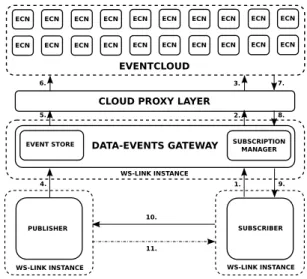
The resulting architecture is depicted in Figure 1. Pub-lishers and subscribers do not directly interact with the EventCloud, which is wrapped, and employ an event-format that enables attachments. An event contains a semantic de-scription, which is the EC event itself, a list of attachment descriptors and the attachments themselves. An attachment
2
http://www.play-project.eu/
PUBLISHER SUBSCRIBER
WS-LINK INSTANCE WS-LINK INSTANCE
WS-LINK INSTANCE
DATA-EVENTS GATEWAY CLOUD PROXY LAYER
EVENTCLOUD ECN ECN ECN ECN ECN ECN ECN ECN ECN ECN ECN ECN ECN ECN ECN ECN ECN ECN ECN ECN 1. 2. 3. 4. 5. 6. 10. 11. 9. 8. 7.
EVENT STORE SUBSCRIPTIONMANAGER
Figure 1: Proposed middleware architecture can be either a resource (e.g. a file) or a data-structure. In the former case, the corresponding descriptor contains in-formation like the name and the mime-type. In the latter case, the descriptor may provide the language-specific type (i.e. the Java fully qualified name of the class, in case the event should be handled only by Java-based subscribers) or a URI to the WSDL document describing such structure. The URI can be employed to enable dynamic instantiation on the subscriber-side.
Publisher and subscribers now interact with Data-Events Gateways, that are responsible for decoupling event-descr-iptions, containing RDF quadruples, from event-data, that is not used for subscription matching. Next section details how a pub/sub interaction takes place in the proposed ar-chitecture.
3.
EXTENDING THE EVENTCLOUD
The architecture described in Figure 1 enables the deliv-ery of messages containing attachments, by means of the Data-Events Gateway. This component is able to correlate EC native events and Data-Events. Attachments are never imported into the EC, to prevent efficiency issues due to the storing process.
A simple publish-subscribe scenario can better explain the role of each component inside the architecture. When a ser-vice wants to subscribe for a specific kind of event, it acts with the gateway that exposes a WS-Notification inter-face3
. The gateway prescribes a specific subscription struc-ture. A subscription can be either topic or content-based: in the first case, the content is a simple string represent-ing the topic; in the second case, a query language can be specified and the content is a query written in this language (currently SPARQL).
The subscription is performed by invoking the subscribe operation exposed by the gateway (interaction 1 in Figure 1). The gateway is responsible for collecting all the subscriptions and saving them to a Subscription Manager (SM). Then, it subscribes itself to the EC, by interacting with the Cloud Proxy Layer (CPL) (interactions 2 and 3). The CPL en-ables a high level of flexibility, since it decouples the gate-way from the EC : if these components are deployed locally
3
to each other, the CPL will enact interaction 3 by means of a local method invocation; on the contrary, if the EC is remotely deployed, the interaction will follow the WS-Notification standard. The EC, itself, is in charge to handle both topic and content-based subscriptions, by employing a matching algorithm, whose details can be found in [2].
Our first contribution is a two-layered subscription sys-tem, where gateways act as filters. When new external sub-scriptions arrive, the gateway layer stores them, checks if there are other subscriptions for the same topic (or kind of content), by querying the SM, and, if not, registers itself to the EC layer for the specified type of events. The subscrip-tion is finally stored in the EC. Despite this work does not address scalability aspects, it is worth noticing that the ar-chitecture can scale horizontally, since gateways can be repli-cated. Consider a scenario including X external subscribers for topic T ; in this scenario, if an event related to T occurs, it is dispatched to all the subscribers in O(X) messages, if only one gateway has been deployed and a round-robin ap-proach is assumed. Anyway, if Y gateways are deployed and the subscribers are uniformly assigned to all of them, the event is dispatched in O(X/Y ) messages, since different gateways can serve different sets of subscribers, in parallel.
When a service raises an event, this will be sent to the gateway by invoking its notify operation (4). When the event is received by the gateway, the latter is in charge of creating an identifier for the event, adding it to its descrip-tion and forwarding the descripdescrip-tion to the EC (5, 6). The whole event is kept inside an Event Store (ES), that is local to the gateway. There is no need to move the whole event inside the EC, since only its description is used to match ex-isting subscriptions. Once the event description enters the EC, it will be inspected to verify if it matches any previous subscription. In case of matching, the EC notifies the gate-way, by means of the CPL (7, 8). The gateway extracts the event identifier from the event description, queries the ES to retrieve the whole event and, finally, dispatches it to the actual subscribers, by means of the SM (9).
Despite the described architecture avoids attachments trans-fers from/to the EC, attachments are moved from publish-ers to gateways, and then back to subscribpublish-ers. To achieve a higher degree of efficiency, attachments could be transferred from publishers, directly to subscribers. Moreover, such op-timization should not impact on the design of publishers’ and subscribers’ business logic. Next section addresses both the efficiency and transparency concerns.
4.
IMPROVING DATA-TRANSFERS
EFFI-CIENCY
Our main contribution is an architectural solution to en-able direct data-transfers from publishers to subscribers. We have designed and realized WS-Link: a Java-based frame-work that enables configuration-by-exception of data-transfer aspects, for the attributes of those entities that are exchanged during web-services invocations.
It extends the DynO4WS framework, that provides Dy-namic Object Offloading capabilities to web-services
end-points, by taking advantage of the Apache CXF4
message interception API. DynO4WS (Dynamic Offloading for Web-Services) is a middleware aimed at decoupling the semantics of service invocations from the way data is moved between
4
http://cxf.apache.org/
interacting service-endpoints. To this end, the framework allows for the customization of the transfer process of the attributes belonging to entities exchanged during service in-vocations. Such customization takes place by plugging a LoadingStrategy (see Figure 2). This abstract component decides which attributes, inside an entity that is going to be sent as an IN/OUT parameter of a service invocation, should be serialized at once, and which ones should be made avail-able for later access (because they are not likely to be used by the remote endpoint or they exhibit a considerable size). In the latter case, the attributes are made available from an OffloadingRepository.
One key feature of the framework is its transparency: de-velopers do not have to change any line of code of the end-points business logic, thanks to a dynamic proxing system we extensively describe in [21]. When offloading takes place, the framework adds specific meta-data to the header of the outgoing SOAP message concerning which attributes have not been sent yet, and how they can be retrieved. When the framework instance on the remote endpoint receives the message, the ProxyManager generates a proxy according to such meta-data, thus hiding the loading strategy.
WS-Link extends our previous work by implementing a specific Loading Strategy that enables fine-grained configu-ration for those attributes that should not be transferred as in a common web service interaction, by means of Java an-notations [3]. The customization can take place by means of three key annotations. @Strategy allows the developer to specify a component that is in charge of deciding when the marked attribute should be transferred. Basically, an at-tribute can be transferred when the invocation takes place, or on-demand, when the remote endpoint actually needs its value. Anyway, there can be several reasons to choose be-tween these options and some of them depend on the run-time value of the attribute. For instance, if the size of the attribute is negligible, it could be useless to delay its trans-fer. The framework lets the designer plug its own strategy and configure it at the attribute level, by means of key-value pairs that can be nested inside the @Strategy annotation (using the @StrategyParam syntax). Every time an event is raised, the framework retrieves the value of the @Strategy annotation, along with the nested key-value pairs, and in-vokes the shouldOf f load method that each strategy must implement. The strategy can dynamically decide if the an-notated attribute should be serialized, since at each invoca-tion it receives a map containing the key-value pairs declared inside the @Strategy annotation and the event instance. The implementing strategy cannot be selected at runtime, but a strategy could apply different criteria, based on runtime in-puts.
@Consistency can be used to indicate if it is necessary to keep a serialized copy of the attribute value, as it was at the moment of the invocation, in case its transfer is going to be delayed, according to the strategy. The default value for this parameter is “MAKE COPY”, since it guarantees that the receiving endpoint will obtain the same value as if no delayed transfers took place. If the attribute is not likely to change during the period between the service invocation and the attribute access, a “KEEP REFERENCE” consistency value can be employed; in this case, a pointer to the attribute is kept until it is requested or the entity it belongs to gets garbage-collected on the receiver side. This last aspect is handled by the DynO4WS framework, by creating
PUBLISHER WS-LINK INSTANCE
10. 11.
DynO4WS OUTGOING REQUEST INTERCEPTOR WS-LINK OFFLOADING REPOSITORY WS-LINK LOADING STRATEGY 4.1 4.2 4.3 4.4 4.5 4.6 SUBSCRIBER WS-LINK INSTANCE
DynO4WS INCOMING REQUEST INTERCEPTOR DynO4WS
PROXY MANAGER WS-LINK INSTANCE
DATA-EVENTS GATEWAY
EVENT STORE SUBSCRIPTION
MANAGER
DynO4WS OUTGOING REQUEST INTERCEPTOR WS-LINK OFFLOADING REPOSITORY WS-LINK LOADING STRATEGY DynO4WS INCOMING REQUEST INTERCEPTOR
DynO4WS PROXY MANAGER 4.7 4.8 4.9 9.1 9.2 9.3 9.4 9.5 9.6 9.7 9.8 9.9 NETWORK
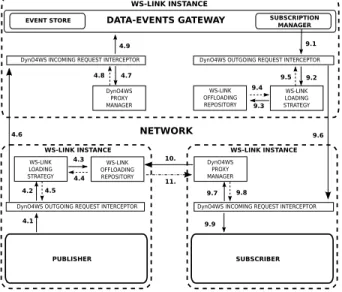
Figure 2: Detailed architectural view explaining how to enable transparent direct pub/sub data-transfers, by means of WS-Link.
Listing 1: WS-Link based configuration of attach-ments in the Event class
@Strategy ( impl = P u r e L a z y S t r a t e g y . c l a s s ) @Cons iste ncy ( C o n s i s t e n c y T y p e .KEEP REFERENCE) @Encoding ( EncodingType .XML)
private byte[ ] a t t a c h m e n t s ;
dynamic proxies for the exchanged entities and intercepting their garbage-collection. Finally, the @Encoding annotation allows for the customization of the serialization format (cur-rently XML or JSON) as well as the possibility to enable message compression.
It is worth to explain the role of the WS-Link framework inside the architecture depicted in Figure 1. For this pur-pose, Figure 2 gives more details about how we enable direct data-transfers. When the publisher raises an event, this is handled by the WS-Link framework, before it is sent to the gateway. In order to delay their transfer, we have config-ured the attachments attribute of our Event class, as shown in Listing 1.
The WS-Link framework detects the annotated attributes5
on the publisher-side and enacts the offloading process,
ac-cording to the value of the declared annotations. Since
the attachments should be transferred on-demand, WS-Link saves them in a local repository6
and adds meta-data to the outgoing SOAP message, indicating how these attachments can be retrieved (interactions from 4.1 to 4.5).
When the event reaches the gateway (4.6), another in-stance of WS-Link decodes the SOAP message and instan-tiates a dynamic proxy that hides the “laziness” of the at-tachments transfer (4.7 to 4.9). This proxy holds the remote references to attributes and is kept until the event gets
de-5
In this phase we group the attachments together in a single attribute, but more attributes can be added, by extending the Event class, to create custom events where each attach-ment can be managed in a different way.
6
The “local” term should not be intended in a strict way. By default, the repository is deployed locally, but it can be shared among several remote instances of WS-Link, in order to take advantage of network topology and to keep the attachments available, if the publisher goes offline.
livered to all the subscribers. The gateway does not need to inspect the attachments, so it will never trigger an at-tachment transfer. Before the gateway sends the event to a subscriber, WS-Link copies the meta-data inside the proxy to the outgoing SOAP message (9.1 to 9.5).
Listing 2 details how remote references are encoded into SOAP messages. The SOAP header refers to the invocation of notify performed by the gateway. Line 2 shows both the id of the current call and the one related to the message sender. Lines from 3 to 10 show how the event attachments can be retrieved. Attribute cid at line 4 refers to the call that generated the attachments attribute (the invocation of notify performed by the publisher). Attribute host at line 5 indicates the endpoint of the repository hosting the attach-ments. Finally, the id at line 7 prescribes how to query such repository, to retrieve the desired element.
The meta-data is finally decoded by the WS-Link instance at the subscriber-side. This process, whose details can be found in [22], is called “Attribute Loading Delegation”; in this case, the gateway delegates the publisher’s repository to make the attachments available for subscribers.
Listing 2: SOAP header containing metadata for proxy instantiation, produced when the Gateway invokes the notify operation exposed by the sub-scriber.
1 < s o a p : H e a d e r >
2 < wslink cid = " 1 4 9 6 7 1 4 9 0 5 0 0 7 8 " nid = " G a t e w a y " > 3 < param name = " O " > 4 < field cid = " 1 4 9 6 4 3 4 1 6 6 0 0 1 4 " 5 host = " http: / / 1 0 . 0 . 0 . 9 :9999 / D y n O 4 W S / repo ? wsdl " 6 name = " a t t a c h m e n t s " > 7 < id >{ nid:Pub , c i d : 1 4 9 6 4 3 4 1 6 6 0 0 1 4 , param:O , n a m e : a t t a c h m e n t s } 8 </ id > 9 </ field > 10 </ param > 11 ... 12 </ wslink > 13 </ s o a p : H e a d e r >
Once the event is delivered to the subscriber (9.6), its WS-Link instance creates a new proxy, that is able to retrieve the attachments, directly from the publisher (9.7 to 9.9). A typical subscriber-side logic should inspect the descrip-tion of the event, in order to understand why such event arrived (e.g. by checking the topic). Subsequently, it should check the attachment descriptors, to decide if it is able to handle the attachments, and possibly inspect the attach-ments themselves. Each of these attributes can be accessed by invoking the corresponding getter method of the event class. When a getter method is invoked on a proxy gener-ated by the Proxy Manager, the latter checks if the value has been already transferred to the local endpoint; if not, it triggers an invocation to a remote repository, according to the meta-data attached to the incoming SOAP message. In our case, when the getAttachments method, inside the event class, is invoked, the Proxy Manager retrieves the at-tachments from the repository at the publisher-side (10, 11). Thanks to the dynamic proxing system, both publisher’s and subscriber’s business logic can take advantage of delegation, without modifying any line of code. The WS-Link frame-work transparently avoids useless transfers, thus increasing the efficiency of our pub/sub system, as proven in the fol-lowing evaluation.
5.
PERFORMANCE EVALUATION
In order to evaluate our solution, we have realized a proto-type based on the EventCloud middleware and the WS-Link framework. The evaluation process has been organized into two phases. In the first phase, we have measured the average time, needed to deliver an event containing an attachment, if no attribute loading delegation is performed. In such sce-nario, the event is completely transferred from the publisher to a Data-Events Gateway and eventually to the subscriber. In the second phase, we enable attribute loading dele-gation, by means of the WS-Link framework, in order to avoid useless data-transfers. In this case, the attachment is “offloaded” to a publisher’s local repository and eventu-ally moved directly to the subscriber. In a real scenario, subscribers may access or not the event attachments. Our solution can take advantage of this behaviour, since a data-transfer is triggered only if required by the subscriber. How-ever, in our tests we consider a situation where subscribers always access the attachments of the event, since we want to evaluate the overhead added by our middleware in the worst case.
The process has been repeated for three kinds of events, respectively carrying 1MB, 10MB and 100MB-sized attach-ments, in order to simulate different media like images, doc-uments and videos.
Considering that the offloading process adds a compu-tational overhead, as documented in [22], we have evalu-ated our solution for three different network throughputs (10Mb/s, 100Mb/s, 1Gb/s), in order to verify what are the network conditions under which such overhead may become unacceptable. Finally, the tests have been run on three nodes, respectively hosting the publisher process, the gate-way and the subscriber, equipped with a Intel Xeon E5520 CPU @ 2.27GHz and 12 GB of DDR3 memory.
Figure 3(a) shows the average delivery time for an event carrying a 1MB attachment. By avoiding useless data-transfers the WS-Link framework can lead to an improvement of 53.8%, for the 10Mb/s throughput test, 56.1%, for the 100Mb/s test and 56.5% for the 1Gb/s one. The 10MB attachments tests results (Figure 3(b)) show that performances decrease if a higher throughput network is considered (respectively 45%, 28.7% and 18.2% of improvement for the considered throughputs). This behaviour is confirmed in the last round of tests (Figure 3(c)), where an improvement of 47% is achieved for a 10Mb/s throughput network, but a worse result (27.5% for the 100Mb/s test and -11.4% for the 1Gb/s one) is ob-tained when high-throughput networks are considered.
These anomalies are due to a still not mature implemen-tation of the un/marshaling components employed by the WS-Link framework. In facts, our tests show that encour-aging performances can be achieved, if the serialization time is negligible compared to transfer one7
. We are confident that better results can be achieved by adapting the CXF se-rialization components to our needs. Moreover, the 10Mb/s throughput tests show that our current implementation is already competitive for internet-based scenarios8
.
7
In the 100MB attachment tests, the serialization time cor-responds to 8.62% of the total delivery time, when a 10Mb/s network throughput is considered, 46.39% for a 100Mb/s throughput and 82.52% for a 1Gb/s one.
8
The considered 10Mb/s throughput corresponds to the av-erage Internet speed at the time we are realizing this work (http://www.netindex.com/)
6.
RELATED WORK
Merging EDA, semantic event processing and SOA is gain-ing increased attention from researchers and industry. Many works are focusing on the combination between the pub/sub paradigm and semantic technologies [8, 7] while others focus on the adoption of the pub/sub paradigm itself for web ser-vices [6, 18]. Eugester et al. [6] give a comprehensive survey about the pub/sub communication paradigm. Indeed, most of the efforts concentrate more on the definition of protocols rather than on improving the efficiency of data exchanges.
In [18], the authors propose to combine pub/sub and Web-Services to overcome the request/response model. To carry out a data-transfer, the publisher notifies the subscriber about the availability of data to be retrieved through a fur-ther and explicit request/response interaction. In our work, we keep the request-response mechanism, but we make it completely transparent, by means of dynamic proxies. In [19] the authors provide a system based on their DSProxy as a cross-platform solution. It provides store-and-forward capability to SOAP messages, by applying compression of SOAP and XML and facilitating the traversal of multiple heterogeneous networks. Despite the authors try to offer a lightweight Web-Service based standard solution, they do not address huge volumes of SOAP messages or attachments, as addressed by our solution.
The authors in [10] offer an experimental pub/sub infras-tructure to be used with Web-Services enabled applications. They demonstrate that the performance gap between tradi-tional event-based technologies and the Web-Services based approach is not necessarily significant. They emphasize the decoupling characteristics of the Web-Services and event-based design, and they propose a pub/sub infrastructure compliant with the WS-Notification standard. In any case, this solution does not take into account the nature of the data exchanged between services by means of the pub/-sub mechanism. This aspect is extensively addressed in our work.
Nevertheless, how to deliver huge data among Web-Services by means of pub/sub, remains an unanswered question in the community. Data-centric pub/sub has been addressed by the Data Distribution Service (DDS) OMG standard [14] and by some related research papers [16, 12]. The purpose of the specification is to provide a common application level interface that defines the data-distribution service. How-ever, the DDS approach requires the data to be transferred to a global data space. Managing global data might in-troduce some performance degradation due to distribution unawareness. This problem should be addressed by optimiz-ing the distribution of the global space accordoptimiz-ing to data consumption, similarly to the approach in [20], where the authors propose to explicitely characterize (micro)objects with some non-functional properties that guide the deploy-ment in a distributed environdeploy-ment. Our solution employs a global space only for event descriptions, while the attach-ments store can be distributed, to take advantage of network topology. Moreover, we exploit declarative statements to in-form the underlying middleware about the specific semantics that characterize the interaction, in order to improve per-formance and scalability.
7.
CONCLUSION
There is an increasing need for business and communica-tion flexibility, that can be achieved by combining Service
Transfer time [ms] Network throughput [Mb/s] with ws−link without ws−link 10 100 1000 0 500 1,000 1,500 2,000 2,500 3,000 3,500 4,000 (a) 1MB attachments 0 5,000 10,000 15,000 20,000 1 Transfer time [ms] Network throughput [Mb/s] with ws−link without ws−link 10 100 1000 (b) 10MB attachments 0 20,000 40,000 60,000 80,000 100,000 120,000 140,000 160,000 180,000 Transfer time [ms] Network throughput [Mb/s] with ws−link without ws−link 10 100 1000 (c) 100MB attachments Figure 3: Comparison of average event-delivery time with and without attribute loading delegation Computing and Event-Driven Architectures. In this
con-text, it is crucial to provide solutions to efficiently exchange large amounts of data. We have presented a middleware, integrating the WS-Link framework and the EventCloud in-frastructure, that allows for efficient, data-intensive, event-driven communication. Our evaluation shows that we can reduce the average event delivery time, compared to a fully mediated solution, but we are planning to improve our re-sults, by optimizing the serialization process for large attach-ments. Moreover, we want to verify the degree of scalability characterizing our platform.
The flexibility of the event-driven paradigm (and pub/-sub communication model) has been successfully applied to scientific workflows, as described in [13, 1]. Anyway, these works focus on the paradigm itself and do not address large data exchanges. Therefore, our next step will be the appli-cation of our solution to achieve a higher level of efficiency for data-intensive scientific workflows.
Finally, we want to add autonomicity features to our mid-dleware, so that repositories can be shared, replicated or migrated, based on runtime workload, in order to improve scalability, availability and fault-tolerance.
Acknowledgements
This work is supported by Province of Benevento, EU FP7 STREP project PLAY and French ANR project SocEDA.
8.
REFERENCES
[1] A. Alqaoud, I. Taylor, and A. Jones. Scientific workflow interoperability framework. International Journal of
Business Process Integration and Management,
5(1):93–105, 2010.
[2] F. Baude, F. Bongiovanni, L. Pellegrino, and V. Quema. D2.1 requirements eventcloud. Technical report, European Commission, 2011. Project Deliverable PLAY.
[3] J. Bloch. JSR 175: A metadata facility for the Java programming language.
http://jcp.org/en/jsr/detail?id=175, Sept. 30, 2004. [4] T. Erl. Service-Oriented Architecture: Concepts,
Technology, and Design. Prentice Hall PTR, Upper Saddle
River, NJ, USA, 2005.
[5] T. Erl. SOA Design Patterns. Prentice Hall PTR, Upper Saddle River, NJ, USA, 1st edition, 2009.
[6] P. T. Eugster, P. A. Felber, R. Guerraoui, and A.-M. Kermarrec. The many faces of publish/subscribe. ACM
Comput. Surv., 35(2):114–131, June 2003.
[7] F. Facca, S. Komazec, and M. Zaremba. Towards a semantic enabled middleware for publish/subscribe applications. In Semantic Computing, 2008 IEEE
International Conference on, pages 498 –503, aug. 2008.
[8] I. Filali, F. Bongiovanni, F. Huet, and F. Baude. A survey of structured p2p systems for rdf data storage and retrieval.
Transactions on Large-Scale Data-and Knowledge-Centered Systems III, pages 20–55, 2011.
[9] G. Hohpe and B. Woolf. Enterprise Integration Patterns:
Designing, Building, and Deploying Messaging Solutions.
Addison-Wesley Longman Publishing Co., Inc., Boston, MA, USA, 2003.
[10] B. Kowalewski, M. Bubak, and B. Bali´s. An event-based approach to reducing coupling in large-scale applications. In Proceedings of the 8th international conference on
Computational Science, Part III, ICCS ’08, pages 358–367,
Berlin, Heidelberg, 2008. Springer-Verlag.
[11] O. Lassila, R. Swick, et al. Resource description framework (rdf) model and syntax specification, 1998.
[12] C. Lee, J. Hwang, J. Lee, C. Ahn, B. Suh, D.-H. Shin, Y. Nah, and D.-H. Kim. Self-describing and data propagation model for data distribution service. In
Software Technologies for Embedded and Ubiquitous Systems, volume 5287 of LNCS, pages 102–113. Springer
Berlin / Heidelberg, 2008.
[13] G. Li, V. Muthusamy, H.-A. Jacobsen, and S. Mankovski. Decentralized execution of event-driven scientific workflows. In Services Computing Workshops, 2006. SCW ’06. IEEE, pages 73 –82, sept. 2006.
[14] G. Pardo-Castellote. Omg data-distribution service: Architectural overview. In ICDCSW, page 200, 2003. [15] E. Prud’Hommeaux and A. Seaborne. Sparql query
language for rdf. W3C working draft, 4(January), 2008. [16] M. Ryll and S. Ratchev. Towards a publish / subscribe control architecture for precision assembly with the data distribution service. In Micro-Assembly Technologies and
Applications, volume 260 of IFIP International Federation for Information Processing, pages 359–369. Springer
Boston, 2008.
[17] A. Shalloway and J. Trott. Design patterns explained : a
new perspective on object-oriented design. Addison-Wesley,
Boston, Mass., 2004.
[18] I. Silva-Lepe, M. Ward, and F. Curbera. Integrating web services and messaging. In Web Services, 2006. ICWS ’06.
International Conference on, pages 111 –118, sept. 2006.
[19] E. Skjervold, T. Hafsø ande, F. Johnsen, and K. Lund. Enabling publish/subscribe with cots web services across heterogeneous networks. In Web Services (ICWS), 2010
IEEE International Conference on, pages 660 –668, july
2010.
[20] J.-M. S. Wams and M. van Steen. Simplified distributed programming with micro objects. In FOCLASA, pages 1–15, 2010.
[21] Q. Zagarese, G. Canfora, and E. Zimeo. Dynamic object offloading in web services. In Proceedings of SOCA and
RTSOAA, KASTLES, LCPS, pages 58–65, 2011.
[22] Q. Zagarese, G. Canfora, E. Zimeo, and F. Baude. Enabling advanced loading strategies for data intensive web services. In ICWS, 2012.