HAL Id: halshs-00959723
https://halshs.archives-ouvertes.fr/halshs-00959723
Submitted on 15 Mar 2014HAL is a multi-disciplinary open access archive for the deposit and dissemination of sci-entific research documents, whether they are pub-lished or not. The documents may come from teaching and research institutions in France or abroad, or from public or private research centers.
L’archive ouverte pluridisciplinaire HAL, est destinée au dépôt et à la diffusion de documents scientifiques de niveau recherche, publiés ou non, émanant des établissements d’enseignement et de recherche français ou étrangers, des laboratoires publics ou privés.
Analytic essay on the domestic statuary of central
Hunan. The cult to divinities, parents and masters
Alain Arrault
To cite this version:
Alain Arrault. Analytic essay on the domestic statuary of central Hunan. The cult to divinities, parents and masters. Journal of Chinese Religions, Taylor and Francis, 2008, 36, pp.1-53. �halshs-00959723�
Journal of Chinese Religions 36 (2008) 1
Analytic Essay on the Domestic Statuary of
Central Hunan:
The Cult to Divinities, Parents, and Masters
A
LAINA
RRAULTEcole française d’Extrême-Orient (EFEO) University of Liège (Belgium)
Introduction
T
hanks to the financial support of the CCK Foundation and the Beaufour-Ipsen Tianjin Pharmaceutical Co., the Beijing Centre of the Ecole Française d’Extrême-Orient has been engaged in a research project entitled “Taoism and Local Society,” since 2002. The project was based on the computerized cataloging of three collections of polychrome wood statuettes originating in the Hunan region. Two are private collections and the third belongs to the Hunan Provincial Museum, the same that houses the Mawangdui relics. At this point, the cataloguing of two collections is complete, that of Patrice Fava (hereafter noted as PF) and that of the Museum (hereafter noted as MH).1 Other than their differing origins, the particularity of these collections—compared to the one constituted by De Groot at the turn of the 20th century in the Fujian area, which one can visit in Lyon and in Leiden2—resides in the fact that the statuettes have been consecrated and that they contain an yizhi 意旨 (consecration certificate) precisely indicating the name of the statuette, those who commissioned it, theThis paper was translated into English by Daniel Burton-Rose. John Lagerwey has kindly read this article and made very helpful remarks and suggestions; David Palmer and James Robson carefully corrected and amended the last version. I also benefited from two anonymous reviewers’ corrections.
1
See Arrault ed, in collaboration with Michela Bussotti, Patrice Fava, Li Feng, Zhang Yao et al, Les statuettes religieuses du Hunan. 1. La collection Patrice Fava, and Alain Arrault ed, in collaboration with Michela Bussotti, Deng Zhaohui, Li Feng, Shen Jinxian, Zhang Yao, Les statuettes religieuses du Hunan. 2. La collection du musée du Hunan.Two other collections are currently being catalogued: one belonging to Yan Xinyuan, a private collector from Hunan (cataloguing by the present author); and one belonging to an American antique dealer in Milwaukee (cataloguing by James Robson).
2
These two collections are stored at the Muséum d’histoire naturelle de Lyon and the National Museum of Ethnology in Leiden. A catalogue of these approximately 250 statuettes is published in Z. Werblowski, “Catalogue of the Pantheon of Fujian Popular Religion”, p. 111-186. An exhibition was held in 2003 at the Muséum d’Histoire naturelle de Lyon, cf. Emmons, Dieux de Chine.
sculptors, the precise location of the home where it was installed, the reason for the cult, the date of consecration, and generally a series of talismans intended to invoke the divinities.3 Based on the data currently at our disposal, we propose, first of all, to present these statuettes from a quantitative, temporal and geographical point of view, and secondly, to do a preliminary analysis of the three types of cults which are evoked in them: cults to divinities, parents and masters.
1. General Presentation
1.1. Cataloguing
In order to cross-analyze all the statuettes, we used a computerized relational database, with the format, entries and functions created for this purpose. Each statuette and its content has a corresponding data-card divided in two parts: in addition to the cataloguing number,4 the first part provides the origin, place of acquisition and identity of the person to whom it was dedicated, information on the material aspect of the statuette, the size, the physical attributes—which include the “magical gestures” (shoujue 手訣) and a precise description concerning the quality and the nature of the sculpture, the coloring and other details that reveal the different stages of manufacture—the clothes and the headgear. This part closes with an inventory of objects (consecration certificate, medicinal packets, paper money, etc.) found in the cache in the back of the statuette. The second part contains an inventory of all the information provided on the consecration certificate (see Pl. 1a), beginning with the nature of the writing itself (handwritten or printed), the address of the donor(s), as well as his or their names, the name of the religious lineage, the reason for the consecration, a description of the talismans, the name of the sculptor and the date of consecration. Two final columns are dedicated to notes and remarks, and the problems that can arise in understanding certain data (see Pl. 1b). The computer program was designed in such a way that all the fields can be an object of research. The cataloguing of the two collections followed the same protocol, with the exception of certain editing rules that time and experience permitted us to improve.
3
This kind of statuette was first presented by Keith Stevens, “Altar Images from Hunan and Kiangsi.” See also Stevens, “Portraits and Ancestral Images on Chinese Altars”.
4
The cataloguing number of the PF collection begins by “T” followed by four ciphers, the one of MH by four ciphers.
Pl. 1a: Example of a consecration certificate, made for the consecration of a statuette for He gong Falei (1765-1836) by his son, daughter-in-law, grandsons and granddaughter
in 1840 (T0781) ©EFEO
Cote 編號: T0781 Collection 收藏者: FH
Lieu d'acquisition 來源:
Provenance 出處: 湖南省安 縣
Nom et identité de la statue 像名: 賀 法 生 <父親> 贺 法 (符 籙)
Biog. 生 : (1765)生于乾隆乙酉 九 (1836)終于 刀(初)五 [未] (符 籙) Inscriptions 記: 賀 法 生(像 正面) Taille 雕像尺寸: 通高: 29.5 cm; 像高: 24.2 cm; 底 前高: 5.3 cm; 寬: 13.2 cm; 厚: 7.7 cm Posture 姿態: 坐姿 Attributs 器物: 符水碗( 手) 牌(右手) Mudra 手勢: 山訣( 手) Description 描述: 像爲木質, 雕,刻 般 像體保存基本完整 通喉時留 的從臓箱到頭的管洞(喉管),外觀也可 看到鼻 耳處的小孔洞 體表 熏黑,只 能辨出紅 黑 色漆迹 漆 幾處剝落,露出漆 木料本色 人像 頭 邊眼 角各 皺紋,嘴角 側各 皺紋 頭戴 帽,身 穿長衫,腰系帶,外 穿 領 四系扣 寬袖褙子 背刻成 椅狀,刻出椅背 扶手 椅腿 Cache 臓箱: 意旨( 紙) 藥( 袋)
Yizhi Cote numérotation 意旨編號及序號: T0781 Dimensions 尺寸: 8.2 x 47.7 cm Nature du document 意旨簡述: 刻本 Adresse 地址: 湖南省長沙府安 縣資 鄉 都思九保 Noms de temples 廟名: 大屋冲廟王本祠土地祠 Commanditaires 信 : 賀英集 室人 王氏 長男 聯[ ] 男 喜 男 双喜 女孩 虫秀 右係合家人眷等 <奉 喜修信 > Secte 教派: 無 Motivations du culte 意 : 爲因女孩虫秀身体不安, 心叩許 ... (刻)叨蒙 感, 不 昧 恩,惟願通靈顕應, 吉祥, 保人口清泰, 保 畜 安,男增 ,女 納千祥,耕者豐收,求財運遂,[開]點威儀顕赫,求之 感,叩之即灵,瞻之在 前,俨然 ,鎮乾坤之海岳, 法界之 山,保固人民既 投 报德报 ,賜 賜寿,災厄消除,吉祥高照, 在 中, 叨保 , 亨通,萬般 意 Ecritures talismaniques 符, 簶: 18 個符諱:1.紫微 2.(雨+漸+帝) 3.(雨+ 罡) 4.( ) 5.(雨 +金 ) 6.(雨+鬼+ ) 7.(雨+鬼+ ) 8.(雨+鬼+明) 9.(雨+開) 10.(雨+ ) 11.古佛 12. 陰 13. 陽 14. 15.中 16. 17.(勅 [ ]賀 法 本命 辰 罡) 18.(勅 五路猖兵土地 罡)
Auteur (sculpteur, officiant,...) 刊造人: 劉 華 <丹青處 > 刘錦華 [刻] <處 前[卿]>
Date : (1840)擇取皇 時 良 開 大吉
Remarques 附注: 無
Problèmes 問 : 無
Pl. 1b: Sample of completed data-card (T0781)
1.2. Quantitative Data
The addresses of the 1,780 data-cards of the PF (909) and MH (871) collections show that the greatest number of statuettes come from Anhua district in Hunan, followed, in order, by Xinhua, Ningxiang, Yiyang, Xiangxiang, Shaoyang, Wugang and Longhui (see Table 1). Table 1: Geographical distribution of the statuettes
Place name 地名 Number of
occurrences 當案 Place name 地名
Number of occurrences 當案 Anhua 安 314 Xinning 新寧 3 Xinhua 新 187 Changning 常寜 2 Ningxiang 寧鄉 112 Hengyang 衡陽 1 Yiyang 益陽 49 Xiangtan 湘潭 1 Xiangxiang 湘鄉 24 Liling 醴陵 1 Shaoyang 邵陽 13 Lianyuan 源 1 Wugang 岡 8 Hunan 湖南省 7 Longhui 隆回 4 Total 727 Guangxi Province: 3 (PF) Guanyang 灌陽: 1 Quanzhou : 25 Jiangxi Province : 7 (PF) Chongren 崇仁: 1 Fengcheng 豐城: 4 Linchuan 臨 (Fuzhou 撫 ): 1 Tonggu 銅鼓: 16 Unknown origin:7 980 Uncertain origin:8 64 Total entries: 1781 5
These two localities are situated in Northern Guangxi province, a few km from the Southern border of Hunan.
6
Tonggu is located in Northwest Jiangxi, a short distance from the Northeast boundary of Hunan. Linchuan, Fengcheng and Chongren are located in central Jiangxi, within a radius of about 50 km from each other.
7
This figure corresponds to the total number of statuettes for which no address is given, but for which other data are preserved in the yizhi or on inscriptions on the statuette itself, such as the date or the identity of the statuette, the sponsors or the sculptors.
8
Total number of statuettes with incomplete addresses – not indicating the province or the district, or for which the address data is insufficient to determine the location with certitude.
Map 1: Geographical distribution of statuettes in Hunan Province
The geographic distribution of the statues indicates that the epicenter of their production was in central and northwestern Hunan province (see Map 1), with several statues also coming from the adjoining provinces of Jiangxi and Guangxi (the PF collection).9 This region corresponds, more or less, to that which certain specialists have designated as the region of Meishan culture (Meishan wenhua 梅山文 ). The way in which this culture was brought to the fore during the 1980s, with a thematic symposium organized for the first time in the 1990s, can certainly raise questions regarding the birth of this culture, which one could suspect of having been born of ideologico-touristical reasons, as was the case with a number of other local “cultures” during the same period. It should thus be pointed out that the name Meishan exists in historical texts, at least since the History of the Song (Songshi 宋史), and that certain certificates mention it explicitly.10 Nevertheless, the nature, components, and characteristics of this culture remain to be defined, an immense debate into which we will not enter in the
9
Prof. Wang Yucheng, of the China Academy of Social Sciences, drew our attention to two statuettes with identical characteristics to those in Hunan, but crafted in Tongchuan county, Sichuan province, in 1899. However, the statuette’s sponsors were emigrants to Sichuan, and consecrated these statuettes to honour masters from the Huguang 湖廣 region which, during the Qing, referred to the present-day provinces of Hubei and Hunan. Our thanks to Mr. Wang Yucheng for this precious information.
10
The expression Meishan used for designating statuettes (Meishan shenxiang 梅山神像), spiritual masters (Meishan zushi 梅 山 祖 師) or a religious order (Meishan zhengjiao 梅 山 正 教), appears in certificates dating from the beginning to the mid 19th century.
course of this study, except to mention in passing that they impact such complex factors as the supposed antiquity of the culture of non-Chinese ethnicities (Miao 苗 and Yao 瑤), the process of Sinicization starting with the Northern Song, the regular dispatch of troops to subdue local rebellions, and the migrations of significant numbers from the border regions, notably Jiangxi, towards Hunan as early as the Song and the Ming dynasties.
0 5 10 15 20 25 30 16 09 16 73 16 82 16 87 17 13 17 19 17 25 17 41 /5 0 17 51 /6 0 17 61 /7 0 17 71 /8 0 17 81 /9 0 17 91 /0 0 18 01 /1 0 18 11 /2 0 18 21 /3 0 18 31 /4 0 18 41 /5 0 18 51 /6 0 18 61 /7 0 18 71 /8 0 18 81 /9 0 18 91 /0 0 1 901 /1 91 0 19 11 /2 0 19 21 /3 0 19 31 /4 0 19 41 /5 0 19 51 /6 0 19 61 /7 0 19 80 19 83 19 87 19 90 19 91 19 92 19 97
Anhua Xinhua Ningxiang Yiyang Xiangxiang Shaoyang Wugang Longhui Unknown
Graphic 1: Geographical and chronological distribution of the Hunan statuettes (PF and MH collections)11
If we add the temporal dimension,12 to the spatial dimension (see Graphic 1)we notice that the oldest statue is preserved at the Hunan Provincial Museum and is dated—despite the absence of certificates, but thanks to an inscription engraved on its pedestal—1609 (Pl. 2)13. By means of morphological resemblance it can be linked to two other statuettes—of different dates
11
In the interest of clarity, we have retained only those localities with a number of occurrences superior or equal to four.
12
We based our findings on the consecration dates mentioned in the certificates. In the case of a double consecration, we have only kept the first date. For this reason in particular, in light of the fact that we cannot exclude the possibility of the manipulation of certificates, thus lacking reliable dating in the object itself, we cannot assert, particularly for the oldest, that the consecration date effectively corresponds to the date of statuette production.
13 For more details, see Michela Bussotti, “Hunan zhongbu diqu jiating diaoxiang de lüeshu.”A
private collector from Hunan, Mr.Li Kui 李魁, owns a statuette for which the date, inscribed on the back of the cache door, is 1594, and which is dedicated to an exorcistic master, Zhou jun Fakui Liulang 周君法魁六郎.
(1778), granted, but of the same collection—one of which carries the name of Shangyuan
yipin tianguan cifu ziwei dadi 品 官賜 紫微大帝, the “Grand Emperor Ziwei (the
name of the most important star at the center of the universe) Who Dispenses Happiness, Celestial Officer of First Rank of the Highest Origin.” The three statuettes should thus represent the divinities of the highest, middle and lowest Origin (shang, zhong, xia Yuan , 中, ), that is the Officers of Heaven, Earth and Water (tian, di, shui guan 地水官). The statuette from 1609, would have been situated on the altar to the left of the two others, as the Middle Origin (Zhongyuan erpin 中 品) or the Officer of the Earth.14
A statuette dated to 1673 from the district of Xinhua, representing a master of exorcism (fashi 法師 or what was locally called shigong 師 ), Xie Falong 謝法隆 (Pl. 3), was commissioned by a Zhang 張 family.15 The Zhang family designated the figure with the expression lao waizu 老外祖, the old ancestor of the “outer” lineage, which is to say that it concerns the maternal line. Chronologically, the next in order is a woman, Zhang shi Sanniang 張氏 娘 (Pl. 4), Zhang the Third Lady, to whom, in the district of Anhua in 1713, an effigy was consecrated requesting the protection of the mistress of the house who was pregnant at the age of 39 sui. In 1725, it was the turn of the celestial marshal Ma 馬 帥 (Pl. 5) to be rendered in the form of a statue and placed on an altar in the same district.
14
One set of the same style comes from the FH collection (T1026-A, -B, -C). The name of the divinities is missing. Its record indicates that it comes from the district of Fengcheng in the province of Jiangxi. The divinity Zhongyuan erpin xianguan dadi 中元二品仙官大帝, coming from the district of Quanzhou in the province of Guangxi and consecrated in 1898 (T1008), represents probably the same divinity as the one of 1609.
15
For an historical approach to this kind of master in the Song Dynasty, rendered in English as “Ritual Masters”, see Davis, Society and the Supernatural in Song China.
Pl. 2: The Officer of the Earth, 1609, h. 25.7 cm, 0819/C: 847 Cliche Hunan Museum ©EFEO
Pl. 3: Xie Falong, Xinhua, 1673, h. 45 cm, T0604 Cliche Zhang Chaoyin ©EFEO
Pl. 4: Zhang shi Sanniang, Anhua, 1713, h. 28.5 cm, T0103
Cliche Claude Delhaye ©EFEO
Pl. 5: Ma yuanshuai, Anhua, 1725, h. 31 cm, 0172/C: 806 Cliche Hunan Museum ©EFEO These oldest examples are representative of a significant part of the two collections. We have thus far seen the Three Officers, a master of exorcism invested with liturgical powers for driving out malevolent forces and object of a cult reserved to ancestors, a woman, here charged with the protection of pregnancy, and a Celestial Marshal, also of national repute, upon whom one calls in rituals to exterminate disturbance-causing demons.
The 18th century saw an increase in the appearance of statuettes, with a peak following the second half of the 19th century and into the beginning of the 20th. Production declined very rapidly, for well-known political reasons, after 1949, but has continued discreetly, including during the Cultural Revolution, as is attested by several examples that were “saved from the deluge.” The liberalization of the 1980s naturally coincided with renewed production. At present, a number of sculptors—notably in the Xinhua district —have reopened their workshops in order to meet the pressing demand for new bright and shiny statuettes.16
2. Divinities and Men
Before getting into the details on the specific individuals represented by the statuettes, we
16
should emphasize that we are in the presence of a statuary for a household cult. Consecrations are rarely of the “communal” type, carried out by persons of different families (see Tables 2 and 3). The relatively small size of the statuettes – most often around 20 cm tall – and the indications, albeit unsystematic, that they were installed in the family altar for its protection
(zuozhen jiatang 鎮家堂, jiatang gongfeng 家堂供奉, zuozheng jiatang 坐正家堂, etc.)
confirm that we are dealing with a domestic statuary. However, we can surmise that the larger statues—measuring between several dozen cm to over one metre tall—especially those in the MH collection, were destined for temples, and, in spite of the absence of written information, they would have required more space than that allowed in a domestic altar which, if we rely on contemporary observations, contains one or several niches rarely less than 20 cm high.17
The categories we have chosen do not claim to detail the process leading to the cult of a specific individual—whether it is an ahistorical deity, a nature cult, or a deified historical figure—nor do they identify the original status of the figure (celebrity, unnatural death, etc.), whether the cult was officially recognized or not, or whether it is a divinity associated with a specific social group (patron saint of a guild). The categories employed in this study are simply based on the fact that a “national” cult can be observed throughout China, even if this cult has historical and regional variations; that the territory of a “local” cult is limited to a part of China, be it transregional, regional, or strictly local. In the latter case, a local cult may very well overlap with an ancestral cult: ancestor in one family, he becomes a local deity in another; in the same manner, a master can be the direct master of an initiate and the ancestral master of a religious lineage for another.18 In other words, the categories chosen are operational in the context of an albeit simplified description of the religious situation of a specific region from the 18th century to the early 20th century—from a synchronic perspective, since deities of all categories could be found on the altars of the sponsors. This is not a hagiography, but rather a picture of the cults.
2.1. National Divinities
The number of statuettes of national pantheon divinities is relatively important, on the order of 20% in the two collections. Despite this common characteristic, the two collections nevertheless reveal remarkable differences. Taken as a whole, the PF collection contains a greater number of “Daoist” divinities than the MH collection, which, inversely, is remarkable for the predominance of Buddhist divinities (see Tables 2 and 3).
Table 2: Statuettes of national divinities in the PF collection
Name of divinities Number Familial
consecration
Communitarian consecration
17
For a typology of domestic altars, see Feng Yunxing, “Fengjia shan jumin shenkan wenhua diaocha.” Field research conducted in Hunan in 2003 revealed an altar containing large-scale deity statues, paid from communal fundraising, but we can wonder if this represents a past custom or if it is an exception resulting to the near disappearance of temples in Hunan.
18
We will see further below that distinctions can be made thanks to the names used by sponsors to designate them.
The God and Goddess of the Prefecture of Destinies of the Eastern Kitchen of the Nine Heavens
九 東厨司命府君張 相 (張單字梓
郭), 李氏 人(玉 人)
(3)
42 39
Lu Ban, god of carpenters 魯班 師 (-587?)生期定 戌歲 午時 (T0210) (-587)生於定宮( ) 戌歲 午時生五 初七 時得 五尺 斗大 (5) 20 15 King of Medicine 藥王 (孫 真君, 孫真人) (2) 13 10 1
God of the Southern Peak
南嶽聖帝 11 11 Bodhisattva of Compassion 南無救苦難靈感觀世音菩薩, 觀音大 (1) 7 6 Guan Yu 關聖帝君 6 6 Marshal Zhao 趙 帥 (1) 5 4 God of Earth 中宮土地 (土地 ) (3) 4 1 Great emperor of Thunder
大帝
尊 大將佛*
祖大帝*
3 3
The Supreme Lord Lao 老君
(1)
2 1 The Great Emperor of the Authentic
真 大帝 (1) Hua Tuo
華佗( ) 2 2
Patriarch Buddha of the Heavens?
諸 佛祖 2 2
Jade emperor
玉皇大帝 1 1
Great Inspector Emperor of Dongling?
東陵觀鑑察大帝 1 1
Great Emperor of the Five Saintly Officials?
[五]皇 聖靈官大帝
1 1
Great Emperor and Official of the Five Numinous Manifestations and Seven Jewels of the Smithy
爐頭七寶五顯靈官大帝
1 1
Great Emperor of the Ox
牛(皇)大帝 1 1
Great Emperor and Master Patriarch
祖師大帝19 1 1
Great Emperor and Second Grade Immortal Official of the Middle Origin
中 品 官大帝
1 1
King of the Five Sacred Peaks 五岳朝王 1 1
Guan Ping 關 (1)
1 Third Marshal and Venerable Master of
Exorcism or The Three marshals and Venerable Masters of Exorcism?
法主尊師 帥
1 1
Celestial Lord Wang
王 君 1 1
General Liu Meng
劉[猛]將軍 1 1
Meng the Great Protector and Perfected
One 1 1
19
孟 尉真人 King of the Peak?20
岳王 1 1
The Second Saintly Celestial Concubine
大聖 娘 1 1
Numinous Snake and Crocodile King
蛇鱷灵王[菩]薩 1 1
Numinous King of Good and Evil
善惡靈王 1 Missing Dipamkara 華 [烟]佛 1 1 Zhang Daoling 張 陵 (1) 1 Pu’an 庵 1 1
Perfected Lord Erlang
郞真君 1 1
Immortal Lord Xu Xun
許[遜]( )君 1 1
Sun Bing the Perfected One
孫臏真人 1 1
Li the Immortal Perfected One
李 真人 1 1
Wang the Immortal Perfected One
汪 真人 1 1
Total 144 117 5
Table 3: Statuettes of national divinities in the MH collection
Name of divinities Number Familial
consecration
Communitarian consecration Bodhisattva of Compassion Guanyin
南無救苦救難觀世音, 觀音大土 (65)
80 15 Sovereign Lord Guan Yu
關聖帝君 關聖帝君 ( 31) 44 11 20
God of the Southern Peak 南嶽聖帝
(9)
14 1 Guanyin the Bodhisattva of
Compassion for Having Babies 子觀音
(12)
13 1
Celestial Lord Wang
王 君(王 帥) (7) 11 4 Luo Han 羅 (7) 10 1 Amitaba 南無 弥 佛 (6) 7 1 King of Medicine (Sun the Perfected
One) 藥王(孫 真人) ( 3) 6 3 God of Wealth 財 菩薩 (4) 5 1 Grand Emperor of Authentic Martial
Virtue / [Great Emperor of] the Mysterious Northern Heaven of Authentic Martial Virtue 真 大帝
方真 [大 ][帝]
(2)
4 2
Heavenly Venerable of Universal Transformation 尊 (3) 4 Yama 君羅王 焰摩尊 (1) 3 2 Heavens? 諸 2 1
Marshal Zhao 趙 帅 2 1 Sakyamuni 迦牟尼 (1) 2 1 Bodhisattva 菩薩 (1) 2 Patriarch Hua Tuo
華 祖師 1
Emperor Lord of the Sacred Peaks
岳王帝主 1
Left Assistant of the Passes of Inspection [of fate]?
都督關
1 1
Hegemon of Rivers
鎮 王爺 1 1
Zhang the Perfected One
張真人 1 1
Lord Zhang the God of the Kitchen
張相 1 1
King Yang Si
楊泗王爺 1 1
Manjusri
文殊菩薩 1
Imperial Mother of Heavenly Immortals
皇母
1 Bodhisattva of the Evil Serpents?
蛇恶菩薩 1 1
Great Emperor of Purple Subtlety, Celestial Official of the First Grade Who Confers Blessings
品 官賜 紫微大帝
1 1
Judge of the Department of Destinies
判官 司 1 1
Venerable Judge?
Marshal Ma
馬 帥 1 1
Venerable..emperor?
帝[ ]尊[ ] 1
Vaisravana, Guardian of the North
多聞 王 1
Dhrtarastra, Guardian of the East
持國 王 1 Celestial King 王 1 Guan Ping 關 (1) 1 God of the Earth
土地 (1)
1
Total 153 50 5
(number): number of divinities whose identity deduced based on iconography
The conditions and drive behind the collector’s impulse can tip the balance to favor one type of statue over another. The PF collection is the product of a collector well-versed in Daoist studies, who took the time to get to know and appreciate the statuettes on sale in antiques markets of Peking over a ten year period. The MH collection was born under very different circumstances. Stacked in wooden crates and seized by customs officials in Changsha in 1984, they were intended for sale on foreign art markets, starting with that of Hong Kong. No doubt the sender, who was convicted for this attempt to illegally export Chinese patrimony, was primarily motivated by the lure of rapid gain with relatively large sized statues. Consciously or not, he must have had in mind lovers of Buddhist art, which generally enjoyed a reputation and an interest greater than that of Daoist art, which was still poorly known.21 Notwithstanding the vagaries of collecting, taken together the two collections allow us to have a more balanced and precise idea of the nature and production of statuettes in central Hunan and, consequently, of the religious situation in the region.
Classified by the number of instances (see Table 2), the divinities who occupy the first seven places in the PF collection are, in order, Zaowang 竈王, Lu Ban 魯班, Yaowang 藥王,
Nanyue shengdi 南嶽聖帝, Guanyin 觀音, Guangong 關 , Zhao yuanshuai 趙 帥.
What could be more natural than that the Kitchen God, and his wife, whose role is to watch over the affairs of the family, figures into the highest rank of the domestic statuary (Pl. 6)? The name is stated as Jiutian dongchu siming fu jun 九 東廚司命府君, the Lord of the
21
The first great international exhibition on Taoist Art was held in Chicago in 2000. See Little & Eichman, Taoism and the Arts of China.
Prefecture Director of Destiny of the Eastern Kitchen of the Nine Heavens; sometimes abbreviated so as only to retain their principal role: the director of destiny (siming 司命). The civil name of the gentleman, Zhang Ye 張 , as well as that of his wife, Li shi furen 李氏 人, are mentioned. Sometimes the gentleman’s name is given in its entirety: Zhang, personal name Dan 單, with the designation Ziguo 子郭 or Ziguo 梓郭. Traditionally, families paid particular attention to these gods installed in the house, notably when, several days before the New Year, they had to go to the Celestial Court to present a tally of the good deeds—but also the bad ones—committed by members of the family. The vows or intentions set out in the consecration certificates are generally vague:
侍奉長生香炳,求保人 清吉, 畜 肥, 吉祥,万般 意, 在 中,
叨庇
Holding the incense of longevity, I implore Your protection so that men may be at peace, the domestic animals fat, business good, that everything is accomplished according to our wishes, and that in a general manner all that is found under the light be protected.
These propitiatory formulas, which sometimes conceal the true and concrete motivations, take a more precise turn when addressed to the Kitchen God. One might ask that their father or son recover from an illness, or they might seek longevity for their grandmother. In the twelve concrete cases, occular ailments are invoked three times. For a boy who, in 1877, was a year old and suffered from multiple illnesses and difficulties, a vow (xu yuan 許 愿 ) was pronounced before the god. A number of years later, in 1882, when the wish had been granted, the act of return of grace (huan yuan 還愿) was done, consisting of the sculpting of a new statue in the form of the god in order to repay his good deeds.
Pl. 6: The god [left] and the goddess [right] of the kitchen, Ningxiang?, 1929, h. 23.6 cm, T1031
Cliche Claude Delhaye ©EFEO
With Lu Ban and the Medicine God, we are dealing with professionals (Pl. 7). Lu Ban, protector of all the guilds relating to construction (carpenters, cabinetmakers, roofers, bridge and boat builders, etc.) and for this reason also designated by the name Great Divinity of the
Ink-Cup Marker and the Five-Foot Ruler (Wuchi modou dashen 五尺 斗大 ), is said to
have been born in 587 B.C (T0305). One asks him to ensure that the craft (shouyi 手藝) be profitable; one presents oneself as a woodworker (mujiang 木 ) or a journeyman (gongshi 師), but this would be to forget that these guilds equally imply a religious formation. The disciples studied the orthodox doctrine of Lu Ban (Lu Ban zhengjiao 魯班正教), the secret formulas (fajue 法訣), talismans (fufa 符法) and the use of lustrous water; they were accepted and initiated by the masters to whom they paid homage. To enter into the guild was also to enter into a religious lineage.22 It did not suffice to learn construction methods, it was necessary to also know how to chose the place and to determine the propitious proportions of a new house, to complete the necessary rites to cut and hew the wood, place the top beams— the critical moment of construction—and, possibly, exorcise living spaces.
22
See Feng Wangxing, “Lu Ban shu zai banwu jianzhu ji richang shenghuo zhong de yunyong,” 908-921.
Pl. 7: Lu Ban, Ningxiang?, 1983, h. 25.6 cm, T0618 Cliche Zhang Chaoyin ©EFEO
Represented by the tiger and the dragon that he healed, the Medicine God, Yaowang 藥王 (Pl. 8), alias Sun Simiao 孫思邈, or simply Sun Zhenren 孫真人,23 was part of the thirteenth generation of doctors, among whom are found Shennong 農, Leigong , Wang Shuhe 王叔和, Zhang Zhongjing 張仲 , the prince of Mount Xue 雪山 子 (?), all the monks, patriarchs, and Daoists . . finally arriving at the local divinity Zhang Wulang 張五郎, then to the founder of the lineage (qijiao 啟教), Yang Falong 楊法龍 (T0185). Thus are inscribed a good thirty names, the masters belonging to this line, listed individually on the paper as one does during rituals of invitation of divinities, an obligatory and oft-repeated exercise. The disciples, who unlike the others do not carry the distinctive stamp of the master of rituals (i.e., an ordination name with fa), naturally have many reasons to invoke Yaowang: because they themselves have entered into the orthodox doctrine of Yaowang (Yaowang zhengjiao 藥王正 教), or, more simply, because they have moved and opened a new medicinal plants shop. Hua Tuo 華佗 (Pl. 9), renowned doctor of the end of the Han and beginning of the Three Kingdoms, executed by the King of Wei because had suggested trepanation to heal the king’s headaches, is also present on the altar of the masters of the art, but to a lesser degree. He seems to have been favored by healers who used water and talismans (shuishi 水師) in their therapies.24 As with the preceding disciple of Yaowang, the disciple Jiang Youqing 姜 卿,
23
Concerning the God of Medicine, see Unschuld, Medicine in China, 88-94, and Fang Ling, Une tradition sacrée de la médecine chinoise ancienne.
24
initiation name Famao 法茂, in 1892 records the list of the masters of his lineage in Anhua district, who, after eleven names, mentions an ancestral master (shizu 師祖), a grand master (shitai 師 ), a master (shigong 師 ), then finally his initiation master (dushi 師) Jiang Faming 姜法鳴, having taken care to indicate the dates of birth of each of these (T0700). We here have 15 names, including the sponsor’s. If we assume that this is a genealogy of masters, the founder would have lived about 400 years earlier, i.e around 1500. The terms shizu, shitai and shigong would thus represent the “great grandfather”, the “grandfather” and the “father” of the initiation master, knowing that the great grandfather and grandfather do not carry the surname Jiang.25
Pl. 8: Yaowang (God of Medicine), Xiangtan, Qing dynasty, h. 33.6 cm, T0185
Cliche Zhang Chaoyin ©EFEO
Pl. 9: Hua Tuo, Ningxiang, 1892, h. 22 cm, T0604 Cliche Zhang Chaoyin ©EFEO
makes reference to Hua Tuo in the ritual for invoking divinities and in talismans. Our thanks are warmly extended to Fang Ling, who brought to our attention this manuscript, which she obtained during field research in Hunan.
25
Pl. 10: Yaowang, h. 30.3 cm, 0828/c: 1719 Cliche Hunan Museum ©EFEO
Nanyue shengdi 南嶽聖帝, the God of the Southern Peak, located on Hengshan in southeastern Hunan province, was de rigueur on familial altars (Pl. 11). One goes to the holy sites on pilgrimage to make or to deliver vows, or, for lack of a better option, to the local temple that is dependent on the mother temple. So it is that He Jiubin 賀就賓 went to Zhurong Peak 融峰, located on the summit of Hengshan and the final destination of all pilgrimages, on behalf of his mother who was afflicted with an eye malady (T0717). The wife of Liu Xingjie 刘星 also suffered from a grave eye malady. Medicine changed nothing. It was only after she implored Nanyue shengdi and drank his miraculous tea that she finally recovered her sight (T0428).
Pl. 11: The God of the Southern Peak, h. 23 cm, 0410/C:1399 Cliche Hunan Museum ©EFEO
Guanyin 觀音, Guan Yu 關羽, Zhao Gongming 趙 明, under their multiple names of
investiture, were also expected to receive the homage of the faithful. Guanyin, the
compassionate one, is depicted carrying a child (songzi Guanyin 子觀音) in the MH
collection; Guan Yu, the warrior and the protector, the ancestral Buddha and the Heavenly Venerable who Harmonizes and Subdues the Demons of the Three Realms (Sanjie fumo
xietian datianzun 界伏魔協 大 尊), is often with his adopted son Guan Ping 關 , the
carrier of the seal; Zhao Gongming, the God of Wealth in his martial or lettered version, is one of the four grand marshals of celestial troops (with Wang 王, Ma 馬, and Yin 殷) and is one of the most frequently invoked deities in the rituals of the region. Many others respond to the roll-call: the Jade Emperor, the God of Thunder (Leishen ), Laozi in his deified form, other celestial marshals (Wang tianjun 王 君), one or two female divinities and some unknowns like Dongling guan jiancha dadi 東陵觀鑑察大帝. One of these, the Grand Emperor of the Smithy (Lutou qibao wuxian lingguan dadi 爐頭七寶五顯靈官大帝) (Pl. 12), is incontestably the patron of the guild of metal-workers, whether forgers, minters, or those who worked with iron, bronze, silver or gold.26 As with Lu Ban and Yaowang, it was a disciple, answering to the name Zuo Gansheng 幹生 and newly ordained by his master, who installed it on his altar in 1906 (T0522).
26
Concerning this corporation and his religious practices, see Liu Guozhong, Tang Haochu, “Lengshui jiang, Xinhua jinshu jiagong gongjiang xinyang xisu diaocha,” 778-797.
Pl. 12: The God of the Smithy (Lutou qibao wuxian lingguan dadi), Ningxiang?, 1906, h. 23.5 cm, T0522
Cliche Zhang Chaoyin ©EFEO
As we indicated earlier (see Table 3), the Buddhist deities in the MH collection, the Guanyins, Luohans and other Amitabhas, are clearly more numerous than the divinities of the other pantheons. Nonetheless, the top 10 are Nanyue (pl. 12), a celestial marshal (Wang yuanshuai 王 帥) and Yaowang (pl. 10). In other words, the presence of certain divinities is confirmed, despite the difference in the conditions and the constitution of the collection. To close this panorama of divinities, I would like to evoke the few communitarian cults that emerge from study of the two collections. In general, the statuettes commissioned by devotees with different family names, gathering people who, in most cases, if not from the same neighborhoods, are at least from the same locale, are of a larger size -- in the vicinity of 40-50 cm -- than the average of the “domestic” statuettes. In the PF collection, we have a statue of Yaowang, of Wuhuang shangsheng lingguan dadi 五皇 聖靈官大帝; in the MH collection, a
statuette of Zuodu duguan 都督關, Panguan zuosi 判官 司, Panguan [ ] zun 判官[ ]尊.
The identity of the latter remains to be determined, but he clearly occupied the office of inspector or judge—those who send the dead to hell or to paradise—generally associated with the God of the City (Chenghuang 城 ), or the God of the Eastern Peak (Dongyue dadi 東嶽 大帝). Nonetheless, a commonality exists between the two collections and concerns the cult for the immortals: Li xian zhenren 李 真人 (Pl. 13) and Wang xian zhenren 汪 真人 (Pl. 14) commissioned by the same donors in the PF collection,27 and Zhang zhenren 張真人 (Pl.
27
15) for the MH collection.
Pl. 13: Wang xian zhenren, Yiyang,1936, h. 24.6 cm, T0689
Cliche Zhang Chaoyin ©EFEO
Pl. 14: Li xian zhenren, Yiyang, 1936, h. 27.2 cm, T0702 Cliche Zhang Chaoyin ©EFEO
Pl. 15: Zhang zhenren, Shaoyang, 1836, h. 40.5 cm, 0741/C: 1627 Cliche Hunan Museum ©EFEO
the Song dynasty and who went to live at a mountain in Xinhua, where they meet Tong jun Yilang 童君 一郎. See Wu Qiming, “Qingxu dao si xianzhen diaocha baogao,” 108-138.
2.2. Local Deities, Ancestors and Masters
The distinction between local deities, ancestors and masters is not an easy one to establish. With the exception of certain local deities recognized as such, for example Zhang Wulang,28 some local deities are also ancestors for a family, or masters of a specific initiation lineage and masters can also be ancestors and ancestors can be masters. Nonetheless, we can determine the nature of the cult on the basis of the name used by the sponsor to designate the statue, as well as the existence of several statues of the same individual who was the object of extra-lineage cults in different localities, or on the basis of the title used in the name of the statuette, and other criteria that will be discussed below. To begin, using the consecration certificate which, besides the dates of consecration, sometimes provides the dates of birth of the individual being worshipped, we will analyze the data, in which there is virtually no distinction between local divinities, ancestors and masters. (see Table 4).
Table 4: Dates of birth of represented individuals according to location (PF collection)
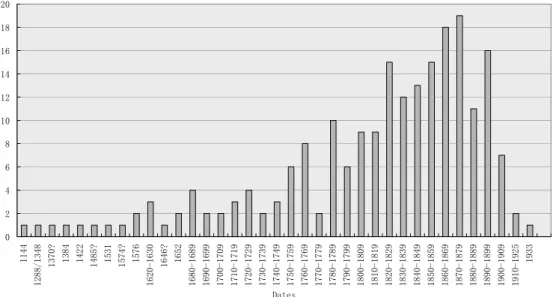
No Date Anhua 安 Xinhua 新 Yiyang益陽 Xiangxiang湘鄉 Shaoyang邵陽 Ningxiang寧鄉 Longhui隆回 Origin uncertain Without address Total T0839 1144 1 1 T0459 1288/1348 1 1 T0295 1370? 1 1 T0765 1384 1 1 T0373 1422 1 1 T0146 1485? 1 1 T0390 1531 1 1 T0010 1574? 1 1 1576 2 2 1620-1630 3 3 T0406 1646? 1 1 1652 1 1 2 1680-1689 3 1 4 1690-1699 1 1 2 1700-1709 1 1 2 1710-1719 1 1 1 3 1720-1729 1 2 1 4 1730-1739 1 1 2 1740-1749 2 1 3 28 See below p. 29-30.
1750-1759 4 2 6 1760-1769 5 1 2 8 1770-1779 1 1 2 1780-1789 4 2 1 1 2 10 1790-1799 2 1 1 2 6 1800-1809 3 3 1 1 1 9 1810-1819 6 2 1 9 1820-1829 4 4 1 1 1 1(湖南) 3 15 1830-1839 2 2 1 2 1? 1 12 1840-1849 4 3 1 2 2 1 13 1850-1859 6 1 2 3 1(湖南) 2 15 1860-1869 4 1 1 2 1(湖南) 1(湖南) 1? 7 18 1870-1879 2 4 2 2 4 1 1? 3 19 1880-1889 3 1 2 3(湖南) 2? 1 11 1890-1899 4 2 1 1 1 4 1(湖南) 2 16 1900-1909 2 1 1 1 2 7 1910-1925 1(湖南) 1 2 T0042 1933 1(湖南) 1 Total 73 34 15 11 3 28 2 15 32 213
Statuettes Birthday 0 2 4 6 8 10 12 14 16 18 20 1144 1288/1348 1370? 1384 1422 1485? 1531 1574? 1576 1620-1630 1646? 1652 1680-1689 1690-1699 1700-1709 1710-1719 1720-1729 1730-1739 1740-1749 1750-1759 1760-1769 1770-1779 1780-1789 1790-1799 1800-1809 1810-1819 1820-1829 1830-1839 1840-1849 1850-1859 1860-1869 1870-1879 1880-1889 1890-1899 1900-1909 1910-1925 1933 Dates
Graphic 2: Chronological Distribution of Statuettes According to Birthday
One Master Xia 夏君 was born in 1144,29 at the hour wu 午 of the sixth day of the fourth month. In 1946 his distant disciple, Wang Baiyun 王 雲, established a cult to him (T0839). Born under the Yuan, the grand ancestor (taizu 祖) Shao Faxing 邵法 (b. 1288?) was invoked by one of his descendants of the twentieth generation or so, along with the descendant’s sons and a daughter-in-law, in order to intercede on behalf of the descendant’s wife, née Liu, whose “body is not appeased” (shenti bu an 身體不安) (T0459). Less than a dozen individuals who lived under the Ming found themselves honored with a cult three or four centuries later. One of them, Wu Yongdao 吳永 (Pl. 16), has a very developed biography. Part of the seventh generation of Wus installed in Chang’an 常安 (in the canton of Chang’an in Anhua or the Chang’an north of Liuzhou 柳 , in the present-day province of Guangxi?), Yongdao came into being in the hour you 酉 of the sixth day of the fourth month of the year 1485. He passed a studious youth and acquired a knowledge of rites, then took for his first wife a lady Kuang and for his second a lady née Li 李. During the Zhengde era (1506-1521), due to “disruptions caused by brigands”, eighty ruffians attacked a village where they killed one member of the Wu’s clan. Unable to tolerate this, Wu took leave of his father and mother, parted from his wives, assembled a band and dashed off in pursuit of the brigands. They caught up with them at Shuangjiangkou 雙 口 in Ningxiang district. During the battle, Wu, always at the fore, was injured in the little village of Ma’ao, but managed to return
29
nonetheless. With this epic episode behind him, the hero settled in Anhua where everyone praised his merit. The prefectural authorities recommended that he be inducted into the Imperial Hall of Golden Bells (Jinluan dian 金鑾殿), while an imperial decree conferred upon him an investiture and a memorial pavilion. In Ma’ao, a temple of Loyal Subjects (Zhongchen miao 忠臣廟) was established for him. His effigy was exposed during the spring and autumn sacrifices dedicated to the God of the Earth (she 社). Whether “summoning the wind and calling the rain,” or, evidently, exterminating brigands and capturing thieves, as well as bringing sons and daughters, no task was too great for Wu Yongdao, the grand bodhisattva (pusa mohesha 菩薩摩荷沙, that is to say pusa mokesa 摩訶薩, bodhisattava mahasattva)!
Pl. 16: Wu Yongdao (1485-?), Anhua, 1799, h. 35 cm, T0146 Cliche Zhang Chaoyin ©EFEO
Apart from the brave and filial Wu, the others are all masters of ritual, such as Zou Faling 鄒法靈, born in 1576. A statuette of him was commissioned at great expense by the Luo 羅 family of Xinhua in the 1870s and to whom Luo Shilin 羅世林, a medium (jiaoma 腳馬) of the family, asked that he “carry incense and fire in the ten regions” (shifang xingxiang zouhuo 方行香走火), which is to say that in the four directions one could call upon his services (T0095).
Though one cannot rule out the possibility a priori, the antiquity of the birthdates obviously does not indicate that the established cult began during the Song, the Yuan or the Ming. It does, however, clearly demonstrate that the genealogy does not extend beyond these periods, and that the ritual efficacy of ancestors or of individuals whose religious function,
usually marked by the seal of the master of martial arts and exorcism, was recognized. This efficacy was exactly the salient trait of the masters of exorcism, in contrast to Daoist priests (daoshi ), whose distinguishing feature was, among others, the practice of “lettered” (wen 文) rituals.
2.2.1. Local Deities
Before entering into a detailed discussion of strictly local deities, it seems opportune to include in this list divinities situated between the national cult and the local cult; what we might call “universal local deities” (see Table 5). The same holds true for the cult to the Supreme God of Camphor 樟樹 , a tree cult, visible in all of China and generally linked to the cult of the God of the Soil, whose altar is placed at the foot of pluri-centenarian trees. The Zou 鄒 family of Xinhua district commissioned the statuette for the mother, née Wang 王, whose fate, revealed by a divinatory calculation of the date of her birth, was to be stricken by the nefarious spirits Kui 魁 and Gang 罡. The Zou family, with a son and a daughter, is associated in this cult with other donors, the Yangs 楊 and a Liang 梁, which makes this cult a communal cult, whose sworn witnesses (zhengmeng 証盟) were no less than the master of the place (dizhu 地主), Zeng Fawang 曾法網, and the master of the family (jiazhu 家主), Zou Fabiao 鄒法 (T0659).
Zhang Wulang 張五郎 is to an equal extent one of the well known deities, but one whose influence seems to be confined to the south of China. His cult is, in fact, attested to in the sect of Lüshan 閭山 in Fujian province. His place of birth is sometimes located in Jiangxi, sometimes in Guangxi, but he reigned uncontested in Hunan province. His surname is “the overturner of altars and the destroyer of temples” fantan pomiao 翻壇破廟 or the overturner of altars and grottoes fantan daotong 翻壇倒硐, not because he is known for his elimination of these sacred places, but because he is depicted upside down, his feet above and his head below. This unorthodox position came to him, according to one local legend, by way of a fight with a ferocious tiger that chased him off a cliff. Zhang’s fall was stopped by a bush growing on the cliff side, but unfortunately he was head-first at the time; he died as a result.30 Another legend has it that this condition came about following his ritual competition with the Most High Old Lord (Taishang laojun 老君). Zhang Wulang went to study with the Old Lord, but the studies rapidly turned into a competition. The Old Lord threw him more and more difficult challenges, and he was only able to overcome them thanks to the aid of Jiji (急急, 吉 吉, or 姬姬), the daughter of the Old Lord, who had fallen in love with Zhang at first sight. The two lovers finally manage to escape, which provokes a murderous rage in the father, who throws “flying swords” (feijian 飛劍) to exterminate them. Once again, Jiji succeeds in deceiving her father by convincing him that they are dead. In order to be sure that the Old Lord can never find Zhang Wulang, Jiji fixes him in an upside-down position, so that he no
30
longer has “either face or eyes.”31 In the region of Meishan, Zhang is the God of Hunters: tiger hunters, hunters of small and big game, hunters with rifles, trappers. Hence one of the motivations for invoking Zhang Wulang is the following:
I will enter the mountain to hunt game, I will kill wild animals that I will bring to the altar, I will dismember them until death ensues. I implore you to protect me, disciple of the king of Meishan, that my body be more than thousands of fathoms high, that my fires illuminate the sky, that my current dog be transformed into 24 dogs entering the mountain such that . . . Today, clasping my hands, I wish that the reverser of altars ancestor descend in person (onto the altar) (T0496).
Zhang Wulang has many identities, notably that of Zhang Zhao erlang 張 趙 郎 , but especially that of Zhang Shikui 張世魁. It was a certain Xie of the district of Ningxiang, initiated as a master of rituals and as a Buddhist, who addressed Zhang Shikui, the marshal of the army of furies (chang 猖), in order to obtain his help, so that “horses and chariots don’t stop, that to a thousand calls, there are a thousand responses; that to ten thousand calls, there are ten thousand miracles” (T0704). Zhang, chief of the Five Furies (Wuchang 五猖), is also the one who sacrifices a rooster to them; thus he is represented with a knife in his right hand and a rooster in his left (pl. 17).
Pl. 17: Zhang Wulang, Ningxiang, 1947, h. 21 cm, T0612 Cliche Zhang Chaoyin ©EFEO
31
Table 5: The local deities in the PF and MH collections
Name of the local divinities Number Familial
consecration Communitarian consecration Zhang Wulang 張五郎 (張五郎 5) 4 師祖翻壇到洞 張五郞 T0823 1 [番]張祖師 T0496 1 番(翻)壇張世魁祖師 T0704 13 1 Zhao jun Fazheng
趙君法正
(1686)原生于康熙丙寅 五
卯時建生 T0256(2)
13 8
Xiao jun Yilang 肖君 郎 生於 午 九 初九辰時 [ ] 君 郎 生于 辰 [...]九[ ][...] 0028/C:872 5 5 Wu jun Yongdao 吳君永 T0146-2-1 吳 T0146-2-2 本命生于乙 四 初 酉時建 生 T0354 3 3
Mao jun Shiqi’lang
毛君 七郎 2 2
Wang jun Dou Sanlang 王君斗 郎 T0090 T0742-3-2
2 2 Wang jun Qilang
王君七郎 2 2
Zeng jun Shisi’lang gong 老祖 四郎 T0126
四世祖曾君諱仲綸行 四郎 T0148
Cao jun Wan shiyilang 君萬 郎 T0817 君萬 郎 生于本[ ] 午 五 午 時建[生] T0169 2 2 Li Wan sanlang 李萬 郎 2 2
Jiang jun Sanlang 蔣君 郎
生于萬曆 子 五 時
生 T0365 T0389
2 2
Huang jun Jiuba’lang 君九 郎 生于 子七 五 子時建生 T0655 君九 郎 原命生於萬歴 子 七 五 子 時生子宫 T0749 2 2
Zou Faling gong 邹法灵 T0095-6-1 顕應 鄒 法靈 T0095-6-2 (1576)原命生于萬歷四 丙子 初五 辰旹(時)降生 T0095-6-1 (1576)生于萬利(歷)丙子 初 五 辰時[生] T0095-6-2 鄒法靈 T0291 (1576)生於明萬歷丙子 初五 辰時生 2 2
Luo jun Sanlang
罗君 郎 2 2
Zhangshu taishen
樟樹 T0659 1 1
Xiao jun Sanlang
蕭君 郎 0405/C:1615 1 1
Xu jun Sanlang (dizhu)
Zeng Faqing Ganying Sanlang 曾法清感應 郎 命生於乙 午時生行 庚 壽 歲 不料於本 四 辰時去世 1 1
Feng jun Shisanlang (dizhu)
地主馮君 郞 T0405 1 1
Liu jun Yilang
刘君 郎 1
Liao jun Yilang/ Jiulang 廖君 郎 [...]T0396-2-1 廖君九郎
生[於] 子四 初 辰時生
T0396-2-2
1 1
Yang jun Wan Shijiulang 楊君萬 九郎
原命生于正通 庚[辰]歲九
午時生 T0664
1 1
Yang jun Jiulang
楊君九郎 T0838 1 1
Zeng jun Wanlang
曾君萬郎 T0666 1 1
Peng jun [Tai]lang 彭君[ ]郎
本命生于 丑 初 辰時建
生 T0697
1 1
You jun Sanlang
游君 郎 T1021 1 1
Yuan jun Fashan (benjia dizhu)
本家地主 袁君法閃 T0511 1 1
Chen jun Doulei (dizhu)
陳君斗 T0096-4-2 1 1
Dun jun Faxian
頓君法 T0239 1 1
Xia jun [ ][long] 夏君[ ][隆]
(1144) 生于紹 子 四 初
午時生 T0839
Yan jun Fakui 鄢君法魁 T0763-2-1 法師 鄢君法魁 T0763-2-2
1 1
Xiao jun Erlang
肖君 郎 0308/C:1476 1
Wan jun Jiulang
晚君九郎 0309/C:1418 1
Feng jun Sanlang
奉君 郎 0445/C:805 1
Deng jun Qilang 鄧君七郎
生於癸丑[岁] 戌時
0020/C:1522
1
TOTAL 79 73 2
Besides the divinities situated between the two categories or “national” and “local”, we have selected the statuettes whose names include the word “lang” 郎. Many interpretations have been given to this term: some remind that it was a “title” employed, beginning in the Song dynasty, for the sons of the family, with the addition of the ordinal number 1, 2, 3, … following the order of birth. In the same vein, these are the disciples of the same master, to whom lang is attributed preceding an ordinal number corresponding to “first disciple”, “second disciple”, etc. In the central region of Hunan, the local specialists relate this designation to the degree of a master of exorcism, who, as a function of his years of training, includes at the beginning of his career the word fa 法 in his initiation name (three years), then, as the years go by, that of jun 君 (six years) and finally that of lang (nine years), which designates a master at the peak of his career. Others claim that lang is obtained after three generations in a shigong family. In any case it is certain that among the Yao and the She 畲, all males are initiated and receive an ordination name containing the character fa 法 and that those whose names begin with the character lang were necessarily initiated. We find the same procedure of langming 郎名, faming 法名 and duming 名 in the Hakka genealogies, which supposes an initiation ritual called fengchao 奉 朝 , conducted for the groom before his wedding. This practice, which is also a process of ancestralisation (since the initiate thus enters the family’s genealogy) has disappeared, at least among the Hakka, by the 18th century.32
Let us remember first and foremost that we are in a religious context, in the frame of a cult devoted to a divinized person; a situation, after all, entirely different than a strictly familial setting. It is not irrelevant that the “langs” are in most cases the object of worship
32
See Chan Winghoi, “Ordination Names in Hakka Genealogies: A Religious Practice and Its Decline,” 65-82. According to the author, it was the wave of genealogy-writing which led families to adopt more “literary” names.
outside of what, strictly speaking, constitutes the family, even if the cult most often remains limited to a village, or possibly a district. Frequently paired with lang, designations such as shizu 師祖 (lineage master), or dizhu 地主, master of the place, necessarily designate the individuals whose sphere of influence far exceeds the direct line of the family. In the ritual books of the region, the ancestral masters of the line particular to a master of rituals are generally invoked after the enumeration of the great divinities of the national pantheon, and followed by the list of the founding masters of the line (benshi 本師), finally arriving at the direct masters of the officiant. The expression “master of the place,” in contrast to “master of the family” (jiazu 家主), even if the two types are sometimes confused (the jiazhu of a family can become a dizhu for the other families, or a heteronymous allied family can have as jiazhu that of the prominent local family), refers to the explanation that is provided by the religious specialist to the individuals who, in distant times, were known for their religious merit. That merit was based on the efficacy of their rituals (fali 法力), their exceptional capacity to resolve—with divinities as intermediaries and in a ritual manner—bad weather, droughts, invasions of insects and of brigands. In short, they were known for their charisma and not simply for being the founders of a clan. The same holds true for the masters of the family who are known within a family for playing a particular role, and not simply for being the first to have established the family in Hunan (shizu 始祖). Outside of the article or designation attached to the family name, the particular status of these local divinities resides in their long life. They tend to be venerated three, four centuries or more after their birth, a phenomenon that reveals their extraordinary stature and saintliness.
Of Xiao jun Yilang 肖君 郎 we have five statuettes coming from Anhua, Xinhua (2), Shaoyang and Xinning, thus covering a vast territory from the northern to the southern parts of Hunan province (pl. 18). It is, however, not certain if it is the same person in each case, but the cult that is dedicated to him is always carried out by devotees whose family name differs from his. The first consecration took place in 1872, the others at the beginning of the 20th century. The five members of the Zuo family, of whom the first two are either brothers or first cousins, performed this consecration for a specific occasion: the statue was made for the birth of three sons in Xinhua district—which brings the number of statuettes to three just for Xinhua. During a move to Xinning, it was soiled by a stove moved by a woman and the divinity demanded that the Zuos remake it, and a sum of 3,200 cash (wen 文) was allocated to this end (T0545).
Pl. 18: Xiao jun Yilang, Shaoyang, 1872, h. 24 cm, T0087 Cliche Claude Delhaye ©EFEO
Wang jun Qilang 王君七郎 and Zeng jun Shisi’lang 曾君 四郎 and Feng jun Sanlang
奉君 郎 are mentioned in the liturgical calendar of Qin Guorong 秦國榮, a Daoist priest (daoshi ) also ordained as a master of exorcism (fashi 法師), who resides in Xinhua. A Chen 陳 of Anhua (T0072) and a Zou family of Xinhua (T0415) pay homage to Wang-the-seventh, the first in 1872, the second at an undetermined date.
In the 1910s, the lord Zeng receives a cult in the same village from two of his distant descendants, a cult not conducted by a man of the Zeng family, but by a mother née Zou 鄒, and another née Zhou 周 , both married to a Zeng and accompanied by their sons and daughters-in-law. The woman Zou addressed herself to a grand ancestor, a famous “Confucian” (ru 儒) of the Song, who was said to have cleared the mountain, “made the foxes flee”, and learned his art (fa 法) to the equal of the immortals in the Fuzhou 撫 prefecture of Jiangxi (T0126). In regard to the woman Zhou, who, among other things, expressed wishes for her health and longevity, she alludes to an ancestor of the fourth generation, of the given name Zhonglun 仲綸, who transmitted the Yuanhuang 皇 teachings within the family, and the true teaching of the Dao and the De of the Old Lord (Laojun 老 君 ). Due to this transmission everyone in the three cantons (xiang 鄉) in the district of Xinhua honored him, and the clan was able to profit from his good deeds (T0148).
The lords Xu 許, Feng 馮, Chen 陳 and Yuan 袁 are referred to as being masters of the place (dizhu). Feng-the-thirteenth was consecrated in 1867 by Wu Biyang 伍荜楊, with his wife, née Liu 劉, his son Fawei 位, his daughter-in-law née Chen, his grandsons and his
granddaughter (T0405). Even though the location is incomplete, one can suspect, in regards to the statue of Xu jun Sanlang 許君 郎, which was consecrated in 1879 by a woman Liu 劉
married to a Wu 伍 and her grandsons Fada [ ] , Fayuan [ ]遠 and Fahuang [ ]煌
(T0008), that those who consecrated it, while not exactly belonging to the same family, do belong to a branch of first cousins of the Wu. The first consecration of Chen jun Doulei 陳君 斗 dates back to 1743 and the second to 1924 (T0096). Undoubtedly, these are descendants of the Guo 郭 family who, two centuries earlier and in the identical location, paid homage to lord Chen. Yuan jun Fashan 袁君法閃 is the master of the place of the family 本家地主, a complicated way of saying that the local divinity Fashan is to an equal extent the ancestor of Yuan Keyou 袁[克]友 who, in 1926, dedicated this statue to him (T0511).
The last two examples show without a doubt that the designation lang is not a condition sine qua non for designating local divinities. Zhao Fazheng 趙法正, born in 1686, is from this point of view remarkable. He alone is represented by a dozen statues that come from Anhua district, but from different villages and families, and nearly all of which date from the Republican period.33
Perhaps we would have omitted Dun jun Faxian 頓君法 (Pl. 19) from our list if the manuscript of “the opening of eyes” (consecration ritual of a statuette) of a sculptor of the district of Xinhua, Feng Xiaoyuan 奉孝 , did not carry his name inscribed among his ancestral masters, who are organized in two distinct lists. The first list carries the sixteen names of the founders of the lineage of the province of Jiangxi, who must in fact correspond to 13 generations (three have Ting 廷 for their generational character, and the other the character Yong 永); the second, that which must designate the benshi 本師, entitled “the founders of the Yuanhuang sect” 皇啟教,34
starts with Dun Faxian and includes 12 names total. The statue of Dun was consecrated in 1798 (T0329). Lord Dun, then, must have been born at least around 1700 and probably well before, around the 16th century, if one supposes that a generation corresponds on average to 30 years, the thirteenth generation (13 x 30 = 390 years), that of Feng Xiaoyuan, is located around the second half of the 20th century (x + 390 = 1950, x = 1560).
33
See Michela Bussotti, “Hunan zhongbu diqu “Jiating diaoxiang”de lüeshu.”
34
Yuanhuang 元皇is the name of a sect, or an order, that according to the local religious specialists refers to the shigong (or fashi), master of exorcism, versus Former Heaven (Xiantian) order which designates the taoist priests (daoshi). The term yuanhuang appears very frequently in the collections and concerns Anhua, Xinhua, Ningxiang and Yiyang districts. The first occurrences date from 1794 and 1798. The name of Yuanhuang is always associated with the use of talismans, and esoteric invocations (zhou 咒) and formulas (jue 诀), for expelling demons, and pestilence, in order to return to a peaceful situation. See Alain Arrault, “Religious Practice in China”. Some local sources indicate that Yuanhuang is a contraction of the name given to Laozi during the Tang dynasty: Xuanyuan huangdi 玄元皇帝, see Li Xinwu, “Lengshui jiang Yang Yuanzhang tan shigong yu daoshi de yitong bijiao,” 273.
Pl. 19 : Dun jun Faxian, Xinhua, 1798, h. 22.6 cm, T0239 Cliche Zhang Chaoyin ©EFEO
We have already met Wu Yongdao, born in 1485, who was known for his martial exploits. In the canton of Chang’an 常安, in Anhua, Kang Lisi 康立思 and his family consecrated a statuette to Wu, whom they refer to as yuhua zhushi 羽 祖 師 , the spiritual master “transformed into a feathered being”. The consecration was accompanied by an explicit request for the wife of the second son, who has health problems (T0354). In 1947, it’s the turn of Yu Lijun 喻理均 of the Changfeng 常豐 canton of Anhua to be a devotee of Wu Yongdao (T0298). Zou Faling 鄒法靈 is also one of our acquaintances. Born at the end of the Ming, one of his two statuettes contains several certificates and talismanic writings, two of which might lead one to believe that we are in the presence of a first consecration followed by a second, a practice consisting of re-consecrating the same statuette and of keeping the preceding certificate with the new one, a phenomenon that we find in other statues. We’re evidently dealing with the same family, the Luos 羅 of Xinhua who, one knows not why, have chosen to mention the expenses pertaining to a statuette whose dimensions, it is true, are larger than the average (40 cm). The devotees have spent a little less than 300 cash (wen) on an indeterminate date. They did this because the principal contributors Luo Mingshi 羅明实 and Luo Shiyu 羅世育 were stricken by the nefarious spirits Kui and Gang. The second document, with Luo Fuwen 羅傳文 at its head, lists all the contributors and their financial contributions, the total of which amounted to a little less than 5,000 cash, this time for the protection in particular of the medium (jiaoma 腳馬) Luo Shilin 羅世林 who, curiously, carries the same generational character as Luo Shiyu (are we really in the presence of two consecrations, or of two consecrations whose dates were close to one another?). The only date
that we have is that of 1879, placed before a group of talismans (T0095). As we have seen, between 1903 and 1906 the statuette of Xiao jun Yilang had cost the Zuos 3,200 cash, the cost of which probably included the fee of the sculptor, but also that of the consecration ritual. The second statuette of Zou was commissioned by a woman, née Peng 彭, married to a Luo, and residing in the district of Shaoyang, located to the south of that of Xinhua. Madam Peng, who presented herself as a disciple whose destiny was determined by the sixth star of the Northern Bushel, is, like Luo Mingshi and Luo Shiyu, under the nefarious influence of Kui and Gang (T0291).
2.2.2. Ancestors
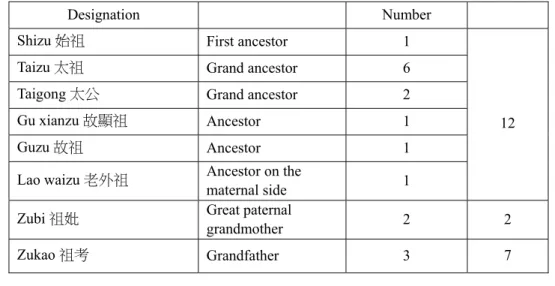
That one makes statuettes for national divinities is a common phenomenon in all China and elsewhere. It is, however, less common to run into locally anchored divinities whose cult sometimes does not go beyond the boundaries of neighboring villages. But one characteristic of the Hunan statuettes is in how they represent ancestors, distant or close, in sculpture.35 We know that this practice seems to have appeared at least from the Song, with the statues of the imperial family, in spite of the constant calls to orthodoxy by the Confucian literati, who recommended using funeral tablets and not images for the cult of ancestors.36 The prescription against images was visibly loosened during the Qing dynasty, since this period saw the appearance of painted portraits of direct ancestors, the origin of the current custom of placing a photo of the deceased on the altar. But to this day, outside of Hunan, it is very rare to find evidence of statuary dedicated to members of the family.
Table 6: Types of designation for the statuettes dedicated to members of the family
Designation Number
Shizu 始祖 First ancestor 1
Taizu 祖 Grand ancestor 6
Taigong Grand ancestor 2
Gu xianzu 故顯祖 Ancestor 1
Guzu 故祖 Ancestor 1
Lao waizu 老外祖 Ancestor on the
maternal side 1
12
Zubi 祖妣 Great paternal
grandmother 2 2
Zukao 祖考 Grandfather 3 7
35
Keith Stevens was the first to point out this type of statuary, see K. Stevens, “Portraits and Ancestral Images on Chinese Altars.”
36
See on this subject, P. Ebrey, “Portrait Sculptures in Imperial Ancestral Rites in Song China”, and “The Incorporation of Portraits into Chinese Ancestral Rites.”
Zufu 祖父 Grandfather 2
Dengcao zufu 祖父 Grandfather 1
Lao zugong 老祖 Paternal grandfather 1
Zumu 祖母 Grandmother 1 1
Tang bozu 堂伯祖 Paternal grand uncle 1
Gupo 姑婆 Paternal grand aunt 1
Jiatang gupo 家堂姑婆 Paternal grand aunt 1
3 Fuqin 父親 Father 21 Xiankao 考 Father 15 Xiankao 顯考 Father 5 Fu 父 Father 4 Gu xiankao 故 考 Father 3 Xianfu 父 Father 1
Qinggu xiankao 清故 考 Father 1
Fuqin fushui 父親符水 Father 1
Fuqin lingshen 父親靈 Father 1
Xianshi xiankao fuqin 逝
顕考[父]親 Father 1
53
Mu 母 Mother 4
Muqin 母親 Mother 3
Xianbi muqin 妣母親 Mother 1
Tangmu 堂母 Mother 1
Laomu 老母 Mother 1
Gumu 故母 Mother 1
Cimu 慈母 Mother 1
12
Bofu 伯父 Paternal uncle 5
Shuzu 叔祖 Paternal uncle 1
Shufu 叔父 Paternal uncle 2
Shu waizu 叔外祖 Maternal uncle? 1
9
Bomu 伯母 Aunt (wife of the