Efficiency and safety in using a stainless steel ballast at a peritoneal dialysis catheter tip :
the Limousin experience.
Efficacité et sécurité d’utilisation d’une noix de lestage en acier inoxydable du cathéter de Dialyse Péritonéale : l’expérience du Limousin
B. Larivière-Durgueil1, R. Boudet1, M.Essig2, S. Bouvier3, A. Abdeh4, C. Beauchamp1, M. Ciobotaru1 1 Centre hospitalier de Brive, Néphrologie-Dialyse, 2 APHP Amboise-Paré, Néphrologie-Hémodialyse,
3Centre Hospitalier Régional Universitaire Dupuytren Limoges, Chirurgie digestive, générale et endocrinienne, 4Centre hospitalier de Brive, Chirurgie viscérale et digestive
Résumé
Objectif : Evaluer le risque de récidive de migration du cathéter de DP après la mise en place d’une noix de lestage. Matériel et méthodes : Etude rétrospective de 1999 à 2014 sur les patients en DP suivis dans la région Limousin comparant deux groupes : groupe lest (mise en place d’un embout en acier inoxydable à l’extrémité intra-péritonéale du cathéter) de 26 patients et groupe témoin de 204 patients. Etait évalué la survenue d’un épisode de migration du cathéter après la mise en place du lest. Les objectifs secondaires étaient (i) de déterminer les facteurs causaux ayant mené au lestage du cathéter, (ii) de s’assurer de l’absence de majoration des complications infectieuses et mécaniques ou d’impact sur les critères d’épuration et la survie du cathéter. Résultats : Plus d’un an après la mise en place du lest, il y avait une absence de récidive de migration dans 86.6% des cas. Il n’y avait pas de majoration du risque infectieux (OR=0.5-IC95% [0.22 ; 1.13]) ou de complications mécaniques (OR=1.77- IC95%[0.77 ; 4.05]). Les critères d’adéquation étaient similaires : KT/V total à 2.37 (groupe témoin) et 2.28 (groupe lest) (p= 0.63). La survie du cathéter lesté était superposable à celle du groupe témoin (p= 0.983). Trois facteurs causaux ont été identifiés : la Dialyse Péritonéale Automatisée (DPA) (OR=0.38-IC95% [0.16 ; 0.9]), l’échec d’emblée de la technique (OR=19.48-IC95% [7.67 ; 49.48]) et une incarcération de l’omentum (OR=15.84-IC95% [5.81 ; 43.21]). Conclusion : L’olive de lestage utilisée semble prévenir la récidive de migration sans qu’il n’y ait de répercussion en termes de complications infectieuses ou mécaniques, ni sur les critères de dialyse ou la survie. Cependant ce cathéter ne dispose pas de marquage CE, ce qui limite actuellement son utilisation.
Le
B
ulletin de la
D
ialyse à
D
omicile
journal officiel du Registr e de D ialyse Péritonéale de Langue Française RDPLF www .rdplf.or g Summary
Objective: To assess the recurrence of PD catheter migration after the introduction of a walnut ballast. Materials and Methods: Retrospective study from 1999 to 2014 of PD patients followed in Limousin. Were compared two groups: ballast group (patients who benefited from the establishment of stainless steel ballast at the intraperitoneal catheter extremity) with 26 patients and control group with 204 patients. The primary endpoint was the occurrence of an episode catheter’s migration after ballast’s establishment. Secondary objectives were (i) to determine the causal factors leading to the catheter weighting, (ii) to ensure the safety of the procedure on the following criteria: infectious complications, mechanicals complications, epurations criteria, and catheter’s survival. Results: More than one year after the implementation of the ballast, no recurrent migration was observed in 86.6% of cases. It wasn’t found an increased risk of infections (OR = 0.5, 95% CI [0.22, 1.13]) or mechanical complications (OR = 1.77- 95% CI [0.77, 4.05]) between the two groups. The adequation criteria were similar: KT / V total : 2.37 in the control group and 2.28 in the ballast group (p = 0.63). The survival of the ballast catheter was comparable among the two groups (p = 0.983). Three causal factors that led to the ballast were identified: automated peritoneal dialysis (APD) (OR = 0.38, 95% CI [0.16, 0.9]), the failure from the first use of the catheter (OR = 19.48, CI 95 % [7.67, 49.48]) and the incarceration of the omentum (OR = 15.84, 95% CI [5.81, 43.21]). Conclusion: The ballast used in these study appears to prevent recurrence of migration, without any impact in terms of infectious or mechanical complications, or on the dialysis criteria or on catheter’s survival. However this catheter does currently not have an EC authorization.
INTRODUCTION
In France, just over 6% of patients undergoing renal re-placement therapy are on peritoneal dialysis. However, 8% of hemodialysis transfers are due to a peritoneal dia-lysis catheter malfunction. The migration of the catheter into the peritoneal cavity may be the cause of these dys-functions. Although there are several techniques for re-positioning the catheter in the small pelvis, these are not always conclusive in the short, medium, or long term. Around 1997, a stainless steel ballast was developed in Limousin (a region in the southwest of France) to be placed at the intraperitoneal tip of the catheter in order to avoid its displacement (1). To determine the effective-ness of this weighting system (called self-locating ca-theter) in terms of dislocating recurrence and safety of use, we performed a retrospective study of patients who received such treatment.
MATERIAL AND METHODS
This retrospective study was conducted in patients fol-lowed by peritoneal dialysis in Limousin. The data col-lected included all patients who received a peritoneal dialysis catheter (control group) and those who, after an episode of catheter dislocation, had benefited from the introduction of a so-called self-locating catheter (ballast group). Data were collected from the patients’ medical records. The first publication of the weighting nut used in this study dates from September 1999, and the present report extends from this dating to May 1, 2014.
The primary objective was to assess the risk of cathe-ter dislocation recurrence, using a self-locating cathecathe-ter after a catheter migration episode with a conventional non-ballast catheter. The primary endpoint was the oc-currence of an episode of catheter migration into the ab-dominal cavity after the addition of a weighting ballast to the catheter.
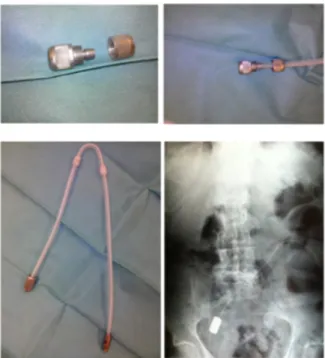
The secondary objectives were to determine causal fac-tors leading to the need of using a catheter with ballast and to evaluate the safety of the ballasted catheter in terms of mechanical complications, infectiousness, and the ade-quacy and survival of the technique. The catheters were surgically placed by four experienced surgeons. These same surgeons placed the catheters and fixed to them the ballast when needed. These were straight Tenckhoff ca-theters in the city of Limoges and swan-neck Tenckhoff catheters in the city of Brive. The weighting system is a stainless steel olive weighing 15g, equipped with a tip with clamping nuts and placed at the intraperitoneal end of the catheter (Figure 1). It was made by Dussartre
Company in Haute-Vienne. Although the introduction of the olive required a new surgical procedure, it did not require the introduction of a new catheter.
The statistical analysis was done using the R software. For the main endpoint we used a Kaplan Meier survival curve to determine migration-free catheter survival at a time of “t” (t being by default the day of the analysis sta-tistics). For each of the secondary endpoints, we looked separately at whether there were significant differences between the ballast and control groups: a logistic regres-sion was used to search for causal factors and for the evaluation of infectious and mechanical complications. In the case where there was little or no event in one of the two groups, an exact test of Fischer and / or a χ² was used. For dialysis adequacy criteria a multiple li-near regression system was adopted. A student’s t test was required for average comparisons. When comparing categorical data a χ² test was used.
RESULTS
Study population
The flowchart (Figure 2) represents the achievement of the study population. In the end, statistical analyzes were conducted on 230 patients (252 catheters): 204 pa-tients with an unweighted catheter and 26 papa-tients with a ballasted dialysis catheter. One hundred and fifty-five patients (168 catheters) were excluded (three catheters placed outside the region, 152 files with too much mis-sing data).The epidemiological characteristics of the en-tire population and of each group are summarized in the
journal officiel du Registr e de D ialyse Péritonéale de Langue Française RDPLF www .rdplf.or g
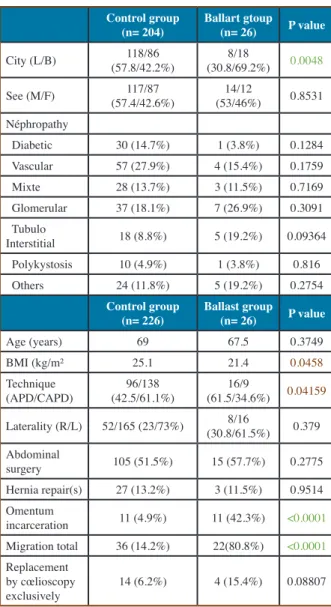
tables referred to (Tables I and II). The distribution of males and females was similar across the cohort. The average age was 68.25 years (17–96 years). In addition, there were significantly more patients in CAPD than in APD, but the distribution within groups was similar, al-though the proportion of CAPD patients appeared to be greater in the control group (p = 0.04159). Statistically significant, there were more patients with no weighted catheter in Limoges compared to Brive (p = 0.0048). Pa-tients in the ballast group appeared to have a lower BMI (21.4 kg/m²) than those in the control group (25.1 kg/ m²) (p = 0.0458-95% CI [0.05, 4.77]). There was signi-ficantly more incarceration of the omentum and at least one migration episode in the ballast group (p <0.0001).
Of the 26 patients who received a ballast, three (11.5%) had a recurrence of migration. The average time to recur-rence after ballasting was 175.3 days (26–443 days). The incidence rate of new catheter migration was approxi-mately 0.007 or 0.7 catheters loss per 100 patient-mon-ths. In the analysis of migration-free survival at time «t,» there was no further catheter migration in 95.8% of cases at 26 days (0.958, 95% CI [0.0408–1]) and in 86.6% of journal officiel du Registr e de D ialyse Péritonéale de Langue Française RDPLF www .rdplf.or g
Figure 2 : Diagramme de flux de l’étude
Table I: Epidemiological characteristics of the entire cohort Total (n = 230) City (L/B) 126/104 (54.8/45.2%) Sex (M/F) 131/99 (57/43%) Age (years) 72 Total (n = 252) Technique : APD/CAPD 109/143 (43.3/56.7%) Laterality : R/L (n=241) 60/181 (24.9/75.1%) Abdominal surgery 120 (52.2%) Hernia(s) treatment 30 (13%) Hemodialysis need 15 (6%) Omentum incarceration 22 (8.7%) Lest 26 (10.3%) Migration 53 (21%)
Table II: Demographic characteristics of the two study groups recurrence of the migration after the installation of a ballast
Control group
(n= 204) Ballart gtoup (n= 26) P value
City (L/B) (57.8/42.2%)118/86 (30.8/69.2%)8/18 0.0048 See (M/F) (57.4/42.6%)117/87 (53/46%)14/12 0.8531 Néphropathy Diabetic 30 (14.7%) 1 (3.8%) 0.1284 Vascular 57 (27.9%) 4 (15.4%) 0.1759 Mixte 28 (13.7%) 3 (11.5%) 0.7169 Glomerular 37 (18.1%) 7 (26.9%) 0.3091 Tubulo Interstitial 18 (8.8%) 5 (19.2%) 0.09364 Polykystosis 10 (4.9%) 1 (3.8%) 0.816 Others 24 (11.8%) 5 (19.2%) 0.2754 Control group
(n= 226) Ballast group (n= 26) P value
Age (years) 69 67.5 0.3749 BMI (kg/m² 25.1 21.4 0.0458 Technique (APD/CAPD) (42.5/61.1%)96/138 (61.5/34.6%)16/9 0.04159 Laterality (R/L) 52/165 (23/73%) (30.8/61.5%)8/16 0.379 Abdominal surgery 105 (51.5%) 15 (57.7%) 0.2775 Hernia repair(s) 27 (13.2%) 3 (11.5%) 0.9514 Omentum incarceration 11 (4.9%) 11 (42.3%) <0.0001 Migration total 36 (14.2%) 22(80.8%) <0.0001 Replacement by cœlioscopy exclusively 14 (6.2%) 4 (15.4%) 0.08807
fections (OR = 0.5827–95% CI [0.24, 1.42]), tunnel in-fections (OR = 0.2921–95% CI [0.04; 2.24]), or exit-site infections (0.–95% CI [0.15; 1.10]) (Table VI).
The logistic regression analysis showed no difference between the two groups, either for all the mechanical complications (OR = 1.77–95% CI [0.77; 4.05]) or for those taken one by one: hernias (OR = 1.751–95% CI [0.5517; 5.558]), peri-catheter leaks (OR = 0.78–95% CI [0.1; 6.28]), extrusion of the outer cuff (OR = 6.17–IC 95 % [0.98, 38.75]), and flow problems other than cathe-ter migration (OR = 1.23 [0.4; 3.82]. An exact Fischer cases at 443 days (0.866, 95% CI [0.0727–1]) (Table
III). The life duration of the catheter before placement of the ballast was on average 234 days (7.7 months), while the life duration of the catheter after placement of the ballast was 511 days (16.8 months).
Results on the secondary endpoints Causal factors of catheter ballast use
Statistically significant, CAPD was protective (0.38, 95% CI [0.16–0.9]) even after removing a possible city-related effect (0.3, 95% CI [0.12–0.72]). It would be 3.3 times more likely to have a weighted catheter when the patient was on APD compared to CAPD. The use of a ballast was significantly greater following incarcera-tion of the omentum in the catheter (OR = 15.84, 95% CI [5.81–43.21]). Failure to initiate the technique was si-gnificantly greater in the ballast group with an Odds Ra-tio (OR) of 19.48 [95% CI: 7.67–49.48], with, however, a city effect. Indeed, there was seven times less failure in the initiation of the technique in Limoges compared to Brive. Not significantly, patients with lower BMIs had more use of ballast (OR = 0.9, 95% CI [0.81–1]). The increase of 1 kg/m² BMI could be associated with a de-crease of 1.1 times the risk of using a ballast. A 0.5-fold increase in this risk was observed when the catheter was placed using the Moncrief-Popovich method (buried ca-theter) (OR = 2.01, 95% CI [0.79, 5.14]). Regarding the site of implantation of the catheter, the history of abdo-minal surgery, the completion of hernia repair(s) during the placement of the catheter, or the delay between the date of catheter implantation and the initiation of the me-thod, there were no significant differences between the two groups (Table IV).
Complications, adequacy, survival of the technique
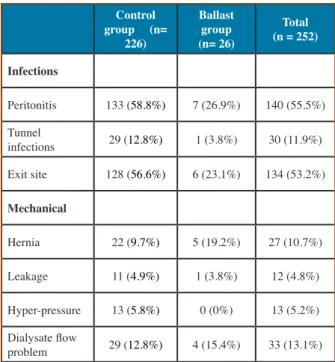
The number of peritonitis and exit-site infections ap-peared to be similar in both groups (Table V). In the logistic regression analysis, no more infectious compli-cations were found in the ballast group compared to the control group. This is as true for infections as a whole (OR = 0.5–95% CI [0.22, 1.13]) as for dialysis fluid
in-journal officiel du Registr e de D ialyse Péritonéale de Langue Française RDPLF www .rdplf.or g
Table III: Survival without weighted catheter migration
Patients récidive (days)Delay ballast- Survival IC 95%
MC 26 0.958 [0.0408–1] TK 57 0.917 [0.0564–1] BH 443 0.866 [0.0727–1]
Table IV: Causal factors for setting up a ballast according to a logistic regression
Studied causal factor OR [IC 95%]
Laterality : left versus
right 0.67 (0.28; 1.64) Technique : CAPD versus APD 0.38 (0.16 ; 0.9) Abdominal surgery antecedent 1.57 (0.69; 3.57) Hernia(s) repair 0.96 (0.27; 3.42) BMI 0.9 (0.81; 1) Embedded catheter 2.01 (0.79; 5.14) Initial failure 19.48 (7.67; 49.48) Omentum incarceration 15.84 (5.81; 43.21)
Table V : Epidemiological characteristics in terms of infection, mechanical complications, and adequacy for the two groups studied (control and ballast)
Control group (n= 226) Ballast group (n= 26) Total (n = 252) Infections Peritonitis 133 (58.8%) 7 (26.9%) 140 (55.5%) Tunnel infections 29 (12.8%) 1 (3.8%) 30 (11.9%) Exit site 128 (56.6%) 6 (23.1%) 134 (53.2%) Mechanical Hernia 22 (9.7%) 5 (19.2%) 27 (10.7%) Leakage 11 (4.9%) 1 (3.8%) 12 (4.8%) Hyper-pressure 13 (5.8%) 0 (0%) 13 (5.2%) Dialysate flow problem 29 (12.8%) 4 (15.4%) 33 (13.1%)
test showed no significant difference between the two groups (p = 0.3724) in terms of intra-abdominal hy-per-pressure problems.
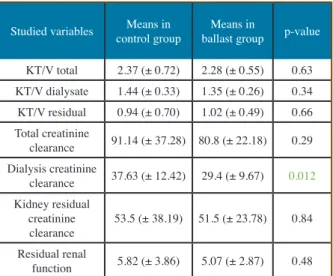
As for the dialysis adequacy parameters for the ballast group, the analyses could only be carried out on the results after the implementation of the ballast (Table VII). Indeed, only one patient had been able to benefit from a dialysis adequacy test before the introduction of the ballast. The mean overall KT / V was 2.37 (± 0.72) in the control group and 2.28 (± 0.55) in the ballast group. There was no significant difference between the two groups for all of the adequacy criteria, with the ex-ception of the weekly clearance of dialysate creatinine (p = 0.012). It was not possible to compare peritoneal permeabilities with too many missing data.
Regarding the survival of the technique, at the time of analysis, there were 37 live patients in the control group (14.7%) and four live patients in the ballast group (15.3%). The mean duration of treatment was 594 days (1.6 years); the median was 1.2 years in the control group and 532 days (1.5 years) and 0.8 years [49 days–4.3 years] respectively in the group ballast. There was no statistically significant difference (p = 0.7935) in terms of duration of treatment or in terms of the reasons for stopping the technique (death, renal transplantation, withdrawal to hemodialysis for inade-quacy, dysfunction of the catheter, or infection).
As shown in Figure 3, the survival of the weighted dialysis catheter is not inferior to that of an unweighted catheter (p = 0.983).
DISCUSSION
The migration of the catheter out of its original posi-tion is a frequent complicaposi-tion of peritoneal dialysis and not inconsequential. Several techniques are available to reposition it in the lower abdominal area. Setting up a ballast may be a solution. Indeed, in this study, a recur-rence of migration was observed in only three of our 26 patients (11.5%). At 26, 57, and 443 days, the absence of recurrence of migration was found at 95.8, 91.7, and 86.6% respectively. In the ballast group, the percentage of migration before ballast was 80.8% and decreased by a factor of 7 after ballast. In the control group this percen-tage was 14.2%. In 1993, Di Paolo et al. presented for
journal officiel du Registr e de D ialyse Péritonéale de Langue Française RDPLF www .rdplf.or g
Table VI: Comparison of the two groups in the occurrence of infectious and mechanical complications
Studied complica-tions OR (IC 95%) Total infections 0.5 (0.22; 1.13) OR (IC 97.5%) Peritonitis 0.5827 (0.24; 1.42) Tunnel infection 0.2921 (0.04; 2.24) Exit-site infections 0.4017 (0.15; 1.10) OR (IC 95%)
Total mechanical complications 1.77 [0.77; 4.05] Hernias 1.751 [0.5517; 5.558] Peri-catheter leak 0.78 [0.1; 6.28] External cuff extrusion 6.17 [0.98; 38.75] Intra-abdominal hyperpressure NA
Table VII: Averages and comparison of treatment criteria between the two groups (Cl creatine: weekly clearance of creatinine in L/ wk/1.73m², FRR: residual renal function in ml/min).
Studied variables control group Means in ballast groupMeans in p-value
KT/V total 2.37 (± 0.72) 2.28 (± 0.55) 0.63 KT/V dialysate 1.44 (± 0.33) 1.35 (± 0.26) 0.34 KT/V residual 0.94 (± 0.70) 1.02 (± 0.49) 0.66 Total creatinine clearance 91.14 (± 37.28) 80.8 (± 22.18) 0.29 Dialysis creatinine clearance 37.63 (± 12.42) 29.4 (± 9.67) 0.012 Kidney residual creatinine clearance 53.5 (± 38.19) 51.5 (± 23.78) 0.84 Residual renal function 5.82 (± 3.86) 5.07 (± 2.87) 0.48
Figure 3 : Survival curve of dialysis catheters in the control group (red) and the ballast group (blue)
the first time a new type of catheter called «self-locating catheter» (2) based on the same principle and leading to the completion of several studies. The Tenckhoff-type straight catheter was compared to the self-locating ca-theter. The results showed a significant superiority of the self-locating catheter compared to the conventional ca-theter with respect to the various complications studied (3). Spanish teams have also experimented with this type of catheter by comparing it with not only Tenckhoff’s catheter but also the «coil» catheter. The self-locating catheter group had statistically significantly survival and less migration occurrence (4). Bergamin et al. in Switzerland obtained the same findings (5). Other me-thods have been explored to limit the displacement of the catheter in the peritoneal cavity: the internal fixation of the catheter to the abdominal wall by nonabsorbable wire (6), the Mayo Clinic doctors attached a testicular prosthesis to the distal end of the catheter, the latter ha-ving the role of ballast (7). In the prospective study of Di Paolo et al. (2) (3), the self-locating catheter had 0.8% migration compared to 12% in their control group in a statistically significant manner. Our percentage migra-tion in the control group of 11.5%, is superimposable to their study. However, patients on peritoneal dialysis did not systematically benefit from an abdomen X-ray without preparation at the initiation of the technique or in follow-up. A certain number of migrations could thus have gone unnoticed in the absence of symptomatolo-gy. It would have been interesting to know exactly how many patients who had a catheter migration. Routinely performing an abdominal X-Ray without preparation could have helped to determine the risk factors for dia-lysis catheter migration, to more accurately analyze the survival of migrated and weighted catheters relative to the rest of the population.
The Italian study shows an overall survival curve at 14 months of about 93%. The Swiss study (5) had an overall survival of about 80% at the same time. In our cohort, the survival of the ballast group is of the same order. In the Swiss study, the incidence rate without catheter dysfunction was 0.01 catheter per month spent on PD (approximately the loss of one catheter per 100 patients/ month). In our study this rate was 0.007 (i.e., loss of 0.7 catheter per 100 patients/month). The «self-locating ca-theter» seems to have proved its interest (2) (3) (4) (5) and its safety in the various studies where it has been studied and has the advantage of having a CE marking, which is not the case of the ballast studied here. The introduction of a weighted catheter seems to retain its advantages even in case of previous surgical procedures (17).
In addition, fluoroscopic or laparoscopic repositioning
techniques have variable rates of failure and relapse (8) (9). In Simon’s study, the initial success rate increased from 85% to 50% at 30 days (9). The absence of recur-rence in our study seems much more durable in the long term. However, it was noted that there was little attempt at repositioning and laparoscopy. No notion of laxative therapy was found to try to reposition the catheter. It is possible that this information was not collected in the file. The few identified patients (fewer than 10 patients in total) to benefit from repositioning using «conven-tional» methods did not allow us to compare them with those who received a ballast. In five patients who had this type of technique, they finally benefited from the implementation of the ballast.
The causes of catheter migration are poorly detailed in the literature. The superiority of one catheter over ano-ther is still subject to debate, although «coil» catheters appear to be causing more migration (10). In the litera-ture, the incarceration of the omentum seems to be in-volved in 35 to 80% of cases according to the series (11), followed by the presence of intraperitoneal adhesions. The patient with the shortest post-ballast migration re-currence had a lot of adhesions. In contrast, buried ca-theters do not appear to be associated with an increased risk of migration or catheter dysfunction (12) (13), parti-cularly in terms of incarceration of the omentum or obs-truction with fibrin (14). Note that these considerations seem to be revisited if the catheter remains buried for too long (15). Moreover, the quality and the habit of the surgical gesture seem to be two crucial points. The lite-rature tells us that patients with a smaller body surface area and a lower BMI would tend to have more catheter dysfunction (16). Our results are similar: patients with lower BMIs were more likely to have a ballast, but with no statistically significant difference. The flow rate and intraperitoneal flow imposed on the catheter is greater in APD, which may explain why patients with APD have benefited more from the introduction of a ballast. In ad-dition, it is recognized that the position of the catheter must be optimum in APD, the latter taking place at night in an extended position.
Infectious complications represent the first cause of dis-continuation of the technique. The overall incidence of infection in the weight group was 0.1 patient-months be-fore the introduction of the ballast and 0.01 patient-mon-ths after the introduction of it. In the control group, the occurrence of this event was 0.06 patient-months. The introduction of the ballast, although requiring a new surgical procedure, is therefore not associated with an increase in the rate of infection. In the studies conducted by Di Paolo and Bergamin, a reduction in the infection rate was observed in the group of patients carrying the self-locating catheter. The occurrence of mechanical
journal officiel du Registr e de D ialyse Péritonéale de Langue Française RDPLF www .rdplf.or g
complications was not increased by the introduction of the ballast olive, and the occurrence of these types of complications was similar to those obtained in the lite-rature.
This study has several negative points. Since this is a retrospective study, it is always difficult to compare the cases with the controls without forgetting that there is a memory bias (missing data). The study spans a period of 15 years, during which practices and consideration of peritoneal dialysis has shown changes and advan-cements. Patients are therefore not strictly comparable over time. Finally, the sample of the ballast group includes only a small number of individuals compared to the rest of the population, which can be a source of misinterpretation. Indeed, for the analysis of the main judgment criterion a nonparametric test was preferred in front of a small number in the ballast group, in order to maintain a certain robustness and to accept losing power.
CONCLUSION
Using a ballast olive to keep the catheter in the pelvic position may be a solution. In this study, we observed an absence of recurrence of migration in 86.6% of cases beyond 15 months. In addition, catheter ballasting does not appear to be associated with an increase in infec-tious complications or other mechanical complications. Currently, the ballast used does not bear the CE (Eu-ropean Conformity to Requirements) marking. Since a self-locating catheter has already been developed, has demonstrated its effectiveness, and is already marketed, the use of the catheter seems more acceptable, especially if it exists. Predictive factors for dysfunction such as the use of APD, a low BMI or if the catheter is going to be buried.
CONFLITS D’INTERET
The authors declare that they have no conflict of interest for this article
BIBLIOGRAPHIE
1 - T. Dantoine, D. Bénévent, C. Lagarde,C. Leroux-Robert. Lestage du cathéter de dialyse péritonéale. Bulletin Dialyse Péritonéale 1999;9(2).
2- Cavagna R, Tessarin C, Tarroni G, Casol D, De Silvestro L, Fabbian F. The self-locating catheter: clinical evaluation and comparison with the Tenckhoff catheter. Perit Dial Int J Int Soc Perit Dial. déc 1999;19(6):540-543.
3 - Di Paolo N, Capotondo L, Sansoni E, Romolini V, Simola
M, Gaggiotti E, et al. The self-locating catheter: clinical expe-rience and follow-up. Perit Dial Int J Int Soc Perit Dial. août 2004;24(4):359-364.
4 - Minguela I, Lanuza M, Ruiz de Gauna R, Rodado R, Ale-gría S, Andreu AJ, et al. Lower malfunction rate with self-lo-cating catheters. Perit Dial Int J Int Soc Perit Dial. 2001;21 Suppl 3:S209-212.
5 - Bergamin B, Senn O, Corsenca A, Dutkowski P, Weber M, Wüthrich RP, et al. Finding the right position: a three-year, single-center experience with the « self-locating » catheter. Pe-rit Dial Int J Int Soc PePe-rit Dial. oct 2010;30(5):519-523. 6 - Chen W-M, Cheng C-L. A simple method to prevent peri-toneal dialysis catheter tip migration. Perit Dial Int J Int Soc Perit Dial. oct 2007;27(5):554-556.
7- Stucky C-CH, Mason MC, Madura JA, Harold KL. A Tech-nique to Address Peritoneal Dialysis Catheter Malfunction. JSLS. 2010;14(4):608-610.
8 - Julian TB, Ribeiro U, Bruns F, Fraley D. Malfunctioning peritoneal dialysis catheter repaired by laparoscopic surgery. Perit Dial Int J Int Soc Perit Dial. déc 1995;15(8):363-366. 9 - Simons ME, Pron G, Voros M, Vanderburgh LC, Rao PS, Oreopoulos DG. Fluoroscopically-guided manipulation of malfunctioning peritoneal dialysis catheters. Perit Dial Int J Int Soc Perit Dial. déc 1999;19(6):544-549.
10 - Xie J, Kiryluk K, Ren H, Zhu P, Huang X, Shen P, et al. Coiled versus straight peritoneal dialysis catheters: a rando-mized controlled trial and meta-analysis. Am J Kidney Dis Off J Natl Kidney Found. déc 2011;58(6):946-955.
11 - Chen G, Wang P, Liu H, Zhou L, Cheng M, Liu Y, et al. Greater omentum folding in the open surgical placement of peritoneal dialysis catheters: a randomized controlled study and systemic review. Nephrol Dial Transplant. 3 janv 2014;29(3):687-697.
12- Prischl FC, Wallner M, Kalchmair H, Povacz F, Kramar R. Initial subcutaneous embedding of the peritoneal dialysis ca-theter--a critical appraisal of this new implantation technique. Nephrol Dial Transplant Off Publ Eur Dial Transpl Assoc - Eur Ren Assoc. août 1997;12(8):1661-1667.
13 - Crabtree JH, Burchette RJ. Peritoneal dialysis catheter embedment: surgical considerations, expectations, and com-plications. Am J Surg. oct 2013;206(4):464-471.
14 - Elhassan E, McNair B, Quinn M, Teitelbaum I. Prolonged duration of peritoneal dialysis catheter embedment does not lower the catheter success rate. Perit Dial Int J Int Soc Perit Dial. oct 2011;31(5):558-564.
15 - Brown PA, McCormick BB, Knoll G, Su Y, Doucette S, Fergusson D, et al. Complications and catheter survival with prolonged embedding of peritoneal dialysis catheters. Nephrol
journal officiel du Registr e de D ialyse Péritonéale de Langue Française RDPLF www .rdplf.or g
Dial Transplant Off Publ Eur Dial Transpl Assoc - Eur Ren Assoc. juill 2008;23(7):2299-2303.
16 - Martínez-Mier G, Luna-Castillo M, Ortiz-Enríquez JJ, Avila-Pardo SF, Fernández V, Méndez-López MT, et al. Fac-tors associated with early peritoneal dialysis catheter replace-ment in Veracruz, Mexico. Nefrol Publ Of Soc Esp Nefrol. 14 mai 2012;32(3):353-358.
17 - Outcomes of the Weighted Peritoneal Dialysis Catheter in Patients at Risk of Percutaneous Catheter Failure, par Stephen Stonelake et al. Perit Dial Int March-April 2019 39:142-146; published ahead of print November 25, 2018
Received 19/11/04, accepted after revision 19/11/21, published 19/12/15 journal officiel du Registr e de D ialyse Péritonéale de Langue Française RDPLF www .rdplf.or g
Open Access This article is licensed under a Creative Commons Attribution 4.0 International License, which permits use, sharing, adaptation, distribution and reproduction in any medium or
format, as long as you give appropriate credit to the original author(s) and the source, provide a link to the Creative Commons license, and indicate if changes were made. The images or other third party material in this
article are included in the article’s Creative Commons license, unless indicated otherwise in a credit line to the material. If material is not included in the article’s Creative Commons license and your intended use is not permitted by statutory regulation or exceeds the permitted use, you will need to obtain permission directly from the