INTRODUCTION TO MEDICAL STUDENTS’
ETHICAL ISSUES : A NARRATIVE REVIEW
Thesis
Publicly submitted and defended on the: / /
2020
BY :
Mrs Hajar CHOUDALY
Born on August the 05
th, 1994 in Salalah Sultanat d’Oman
To obtain a diploma of
Doctor of Medicine
Keywords : Medical students - Medical ethics education - Ethical dilemmas - Moral dilemmas
Committee of examiners :
Mr. Ahmed AL HIJRI PRESIDENT
Professor of Anesthesia-Resuscitation
Mrs. Fadila AIT BOUGHIMA ADVISOR
Professor of Forensic Medecine
Mr. Brahim LEKEHAL EXAMINER
Professor of Peripheral Vascular Surgery
Mr. Mohammed Anass MAJBAR EXAMINER
Professor of Digestive Oncologic Surgery
Mrs. Maryam FOURTASSI EXAMINER
Professor of Physical and Rehabilitation Medicine
ROYAUME DU MAROC
UNIVERSITE MOHAMMED V DE RABAT FACULTE DE MEDECINE ET DE
PHARMACIE RABAT
*Enseignants Militaires
UNIVERSITE MOHAMMED V DE RABAT
FACULTE DE MEDECINE ET DE PHARMACIE - RABAT DOYENS HONORAIRES :
1962 – 1969 : Professeur Abdelmalek FARAJ 1969 – 1974 : Professeur Abdellatif BERBICH 1974 – 1981 : Professeur Bachir LAZRAK 1981 – 1989 : Professeur Taieb CHKILI
1989 – 1997 : Professeur Mohamed Tahar ALAOUI 1997 – 2003 : Professeur Abdelmajid BELMAHI 2003 - 2013 : Professeur Najia HAJJAJ – HASSOUNI
ADMINISTRATION:
Doyen Professeur Mohamed ADNAOUI
Vice-Doyen chargé des Affaires Académiques et estudiantines
Professeur Brahim LEKEHAL Vice-Doyen chargé de la Recherche et de la Coopération
Professeur Toufiq DAKKA Vice-Doyen chargé des Affaires Spécifiques à la Pharmacie
Professeur Younes RAHALI Secrétaire Général :
*Enseignants Militaires
1. ENSEIGNANTS.·CHERCHEUR S MEDECINS ET PHARMACIENS
PROFESSEURS DE L'ENSEIGNEMENT SUPERIEUR:
Décembre 1984
Pr. MMOUNI Abdelaziz Médecine Interne - Cl inique Royale Pr. MAAZOUZI Ahmed Wajdi Anesthésie -Réanimation
Pr. SETTAF Abdellatif Pathologie Chirurgicale
Décembre 1989
Pr. ADNAOUI Mohamed Médecine Interne-Doyen de la FMPR
Pr. OUAZZANI Taïbi Mohamed Réda Neurologie
Janvier et Novembre 1990
Pr. KHARBACH Aîcha Gynécologie .Obstétrique Pr. TAZI Saoud Anas Anesthésie Réanimation
Février Avril Juillet et Décembre 1991
Pr. AZZOUZI Abderrahim Anesthésie Réanimation- Doyen de FMPQ Pr. BAYAHIA Rabéa Néphrologie
Pr. BELKOUCHI Abdelkader Chirurgie Générale Pr. BENCHEKROUN Belabbes
Abdellatif
Chirurgie Générale Pr. BENSOUDA Yahia Pharmacie galénique Pr. BERRAHO Amina Ophtalmologie
Pr. BEZAD Rachid Gynécologie Obstétrique Méd. Chef Maternité des Orangers Pr. CHERRAH Yahia Pharmacologie
Pr. CHOKAIRI Omar Histologie Embryologie Pr. KHATTAB Mohamed Pédiatrie
Pr. SOUIAYMANI Rachida Pharmacologie ·Di r. du Centre National PV Rabat Pr. TAOUFIK Jamal Chimie thérapeutique
Décembre 1992
Pr. AHALIAT Mohamed Chirurgie GénéraleDoyen de FMPT Pr. BENSOUDA Adil Anesthésie Réanimation
Pr. CHAHED OUAZZANI Laaziza Gastro-Entérologie Pr. CHRAIBI Chafiq Gynécologie Obstétrique Pr. EL OUAHABI Abdessamad Neurochirurgie
Pr. FELIAT Rokaya Cardiologie Pr. JIDDANE Mohamed Anatomie
Pr. TAGHY Ahmed Chirurgie Générale Pr. ZOUHDI Mimoun Microbiologie
*Enseignants Militaires Mars 1994
Pr. BENJAAFAR Noureddine Radiothérapie Pr. BEN RAIS Nozha Biophysique Pr. CAOUI Malika Biophysique
Pr. CHRAIBI Abdelmjid Endocrinologie et Maladies Métaboliques Doyen de la FMPA
Pr. EL AMRANI Sabah Gynécologie Obstétrique
Pr. ERROUGANI Abdelkader Chirurgie Générale- Directeur du CHIS
Pr. ESSAKALI Malika Immunologie
Pr. ETTAYEBI Fouad Chirurgie Pédiatrique Pr. IFRINE Lahssan Chirurgie Générale
Pr. RHRAB Brahim Gynécologie -Obstétrique Pr. SENOUCI Karima Dermatologie
Mars 1994
Pr. ABBAR Mohamed* Urologie Inspecteur du SSM
Pr. BENTAHIIA Abdelali Pédiatrie
Pr. BERRADA Mohamed Saleh Traumatologie - Orthopédie Pr. CHERKAOUI Lalla Ouafae Ophtalmologie
Pr. IAKHDAR Amina Gynécologie Obstétrique
Pr. MOUANE Nezha Pédiatrie
Mars 1995
Pr. ABOUQUAL Redouane Réanimation Médicale
Pr. AMRAOUI Mohamed Chirurgie Générale
Pr. BAIDADA Abdelaziz Gynécologie Obstétrique
Pr. BARGACH Samir Gynécologie Obstétrique
Pr. EL MESNAOUI Abbes Chirurgie Générale
Pr. ESSAKALI HOUSSYNI Leila Oto-Rhino-Laryngologie
Pr. IBEN ATIYA ANDALOUSSI Ahmed
Urologie
Pr. OUAZZANI CHAHDI Bahia Ophtalmologie
Pr. SEFIANI Abdelaziz Génétique
Pr. ZEGGWAGH Amine Ali Réanimation Médicale
Décembre 1996
Pr. BELKACEM Rachid Chirurgie Pédiatrie
Pr. BOUIANOUAR Abdelkrim Ophtalmologie
Pr. EL AIAMI EL FARICHA EL Hassan
Chirurgie Générale
Pr. GAOUZI Ahmed Pédiatrie
Pr. OUZEDDOUN Naima Néphrologie
*Enseignants Militaires Novembre 1997
Pr. ALAMI Mohamed Hassan Gynécologie-Obstétrique
Pr. BIROUK Nazha Neurologie
Pr. FELIAT Nadia Cardiologie
Pr. KADDOURI Noureddine Chirurgie Pédiatrique
Pr. KOUTANI Abdellatif Urologie
Pr. I.AHLOU Mohamed Khalid Chirurgie Générale
Pr. MAHRAOUI Chafiq Pédiatrie
Pr. TOUFIQ Jallal PsychiatrieDirecteur Hôp.Ar.-razi Salé Pr. YOUSFI MALKI Mounia Gynécologie Obstétrique
Novembre 1998
Pr. BENOMAR ALI Neurologie Doyen de la FMP Abulcassis Pr. BOUGTAB Ahdesslam Chirurgie Générale
Pr. ER RIHANI Hassan Oncologie Médicale Pr. BENKIRANE Majid* Hématologie
Janvier 2000
Pr. ABID Ahmed* Pneumo-phtisiologie Pr. AIT OUAMAR Hassan Pédiatrie
Pr. BENJELLOUN Dakhama Badr .Sououd Pédiatrie
Pr. BOURKADI Jamal-Eddine Pneumo-phtisiologieDirecteur Hôp. My Youssef Pr. CHARIF CHEFCHAOUNI Al
Montacer
Chirurgie Générale Pr. ECHARRAB El Mahjoub Chirurgie Générale Pr. EL FTOUH Mustapha Pneumo-phtisiologie Pr. EL MOSTARCHID Brahim* Neurochirurgie
Pr. TACHINANTE Rajae Anesthésie-Réanimation Pr. TAZI MEZALEK Zoubida Médecine Interne
Novembre 2000
Pr. AIDI Saadia Neurologie
Pr. AJANA Fatima Zohra Gastro-Entérologie Pr. BENAMR Said Chirurgie Générale Pr. CHERTI Mohammed Cardiologie
Pr. ECH.CHERIF EL KETTANI Selma Anesthésie-Réanimation
Pr. EL HASSANI Amine Pédiatrie • Directeur Hôp. Cheikh Zaid Pr. EL KHADER Khalid Urologie
Pr. GHARBI Mohamed El Hassan Endocrinologie et Maladies Métaboliques Pr. MDAGHRI ALAOUI Asmae Pédiatrie
Décembre 2001
Pr. BALKHI Hicham* Anesthésie-Réanimation Pr. BENABDELJLIL Maria Neurologie
*Enseignants Militaires
Pr. BENAMOR Jouda Pneumo-phtisiologie Pr. BENELBARHDADI lmane Gastro-Entérologie Pr. BENNANI Rajae Cardiologie
Pr. BENOUACHANE Thami Pédiatrie Pr. BEZZA Ahmed* Rhumatologie Pr. BOUCHIKHI IDRISSI Med Larbi Anatomie Pr. BOUMDIN El Hassane* Radiologie Pr. CHAT Latifa Radiologie
Pr. DAALI Mustapha* Chirurgie Générale Pr. EL HIJRI Ahmed Anesthésie-Réanimation Pr. EL MAAQILI Moulay Rachid Neuro-Chirurgie
Pr. EL MADHI Tarik Chirurgie-Pédiatrique Pr. EL OUNANI Mohamed Chirurgie Générale
Pr. ETTAIR Said Pédiatrie • Directeur Hôp Univ. Cheikh Khalifa Pr. GAZZAZ Miloudi* Neuro-Chirurgie
Pr. HRORA Abdelmalek Chirurgie GénéraleDirecteur Hôpital Ibn Sina Pr. KABIRI EL Hassane* Chirurgie Thoracique
Pr. lAMRANI Moulay Omar Traumatologie Orthopédie
Pr. LEKEHAL Brahim Chirurgie Vasculaire Périphérique V-D chargé Aff Acad.
Est.
Pr. MEDARHRI Jalil Chirurgie Générale Pr. MIKDAME Mohammed* Hématologie Clinique Pr. MOHSINE Raouf Chirurgie Générale
Pr. NOUINI Yassine Urologie
Pr. SABBAH Farid Chirurgie Générale
Pr. SEFIANI Yasser Chirurgie Vasculaire Périphérique Pr. TAOUFIQ BENCHEKROUN Soumia Pédiatrie
Décembre 2002
Pr. AL BOUZIDI Abderrahmane* Anatomie Pathologique
Pr. AMEUR Ahmed * Urologie
Pr. AMRI Rachida Cardiologie
Pr. AOURARH Aziz* Gastro-Entérologie Dir. Adj. HMI Mohammed V
Pr. BAMOU Youssef * Biochimie-Chimie
Pr. BELMEJDOUB Ghizlene* Endocrinologie et Maladies Métaboliques
Pr. BENZEKRI Laila Dermatologie
Pr. BENZZOUBEIR Nadia Gastro-Entérologie
Pr. BERNOUSSI Zakiya Anatomie Pathologique
Pr. CHOHO Abdelkrim * Chirurgie Générale
Pr. CHKIRATE Bouchra Pédiatrie
Pr. EL AlAMI EL Fellous Sidi Zouhair Chirurgie Pédiatrique
Pr. EL HAOURI Mohamed * Dermatologie
Pr. FILALIADIB Abdelhai Gynécologie Obstétrique
Pr. HAJJI Zakia Ophtalmologie
*Enseignants Militaires
Pr. KRIOUILE Yamina Pédiatrie
Pr. MOUSSAOUI RAHALI Driss* Gynécologie Obstétrique
Pr. OUJILAL Abdelilah Oto-Rhino-Laryngologie
Pr. RAISS Mohamed Chirurgie Générale
Pr. SIAH Samir * Anesthésie-Réanimation
Pr. THIMOU Amal Pédiatrie
Pr. ZENTAR Aziz* Chirurgie Générale
Janvier 2004
Pr. ABDELIAH El Hassan Ophtalmologie
Pr. AMRANI Mariam Anatomie Pathologique
Pr. BENBOUZID Mohammed Anas Ota-Rhine-Laryngologie
Pr. BENKIRANE Ahmed* Gastro-Entérologie
Pr. BOUI.AADAS Malik Stomatologie et Chirurgie Maxille-faciale
Pr. BOURAZZA Ahmed* Neurologie
Pr. CHAGAR Belkacem* Traumatologie Orthopédie
Pr. CHERRADI Nadia Anatomie Pathologique
Pr. EL FENNI Jamal* Radiologie
Pr. EL HANCHI ZAKI Gynécologie Obstétrique
Pr. EL KHORASSANI Mohamed Pédiatrie
Pr. HACH Hafid Chirurgie Générale
Pr. JABOUIRIK Fatima Pédiatrie
Pr. KHARMAZ Mohamed Traumatologie Orthopédie
Pr. MOUGHIL Said Chirurgie Cardia-Vasculaire
Pr. OUBAAZ Abdelbarre * Ophtalmologie
Pr. TARIB Abdelilah* Pharmacie Clinique
Pr. TIJAMI Fouad Chirurgie Générale
Pr. ZARZUR Jamila Cardiologie
Janvier 2005
Pr. ABBASSI Abdellah Chirurgie Réparatrice et Plastique
Pr. ALLALI Fadoua Rhumatologie
Pr. AMAZOUZI Abdellah Ophtalmologie
Pr. BAHIRI Rachid Rhumatologie Di recteur Hôp. Al Ayaché Salé
Pr. BARKAT Amina Pédiatrie
Pr. BENYASS Aatif Cardiologie
Pr. DOUDOUH Abderrahim * Biophysique
Pr. HAJJI Leila Cardiologie (mise en disponibilité)
Pr. HESSISSEN Leila Pédiatrie
Pr. JIDAL Mohamed* Radiologie
Pr. LAAROUSSI Mohamed Chirurgie Cardio-vasculaire
Pr. LYAGOUBI Mohammed Parasitologie
Pr. SBIHI Souad Histo-Embryologie Cytogénétique
*Enseignants Militaires AVRIL 2006
Pr. ACHEMLAL Lahsen* Rhumatologie
Pr. BELMEKKI Abdelkader* Hématologie
Pr. BENCHEIKH Razika O.R.L
Pr. BIYI Abdelhamid* Biophysique
Pr. BOUHAFS Mohamed El Amine Chirurgie ·Pédiatrique
Pr. BOULAHYA Abdellatif* Chirurgie Cardio-Vasculaire.Di recteur Hôpital Ibn
SinaMar
Pr. CHENGUETI ANSARI Anas Gynécologie Obstétrique
Pr. DOGHMI Nawal Cardiologie
Pr. FELIAT Ibtissam Cardiologie
Pr. FAROUDY Mamoun Anesthésie-Réanimation
Pr. HARMOUCHE Hicham Médecine Interne
Pr. IDRISS LAHLOU Amine* Microbiologie
Pr. JROUNDI Laila Radiologie
Pr. KARMOUNI Tariq Urologie
Pr. KILI Amina Pédiatrie
Pr. KISRA Hassan Psychiatrie
Pr. KISRA Mounir Chirurgie - Pédiatrique
Pr. LAATIRIS Abdelkader* Pharmacie Galénique
Pr. LMIMOUNI Badreddine* Parasitologie
Pr. MANSOURI Hamid* Radiothérapie
Pr. OUANASS Abderrazzak Psychiatrie
Pr. SAFI Soumaya* Endocrinologie
Pr. SEKKAT Fatima Zahra Psychiatrie
Pr. SOUALHI Mouna Pneumo - Phtisiologie
Pr. TELLAL Saida* Pr. ZAHRAOUI Rachida
Biochimie
Pneumo- Phtisiologie
Octobre 2007
Pr. ABIDI Khalid Réanimation médicale
Pr. ACHACHI Leila Pneumo phtisiologie
Pr. ACHOUR Abdessamad* Chirurgie générale
Pr. AIT HOUSSA Mahdi * Chirurgie cardia vasculaire
Pr. AMHAJJI Larbi * Traumatologie orthopédie
Pr. AOUFI Sarra Parasitologie
Pr. BAITE Abdelouahed * Anesthésie réanimation
Pr. BALOUCH Lhousaine * Biochimie-chimie
Pr. BENZIANE Hamid * Pharmacie clinique
Pr. BOUTIMZINE Nourdine Ophtalmologie
Pr. CHERKAOUI Naoual * Pharmacie galénique
Pr. EHIRCHIOU Abdelkader * Chirurgie générale
Pr. EL BEKKALI Youssef * Chirurgie cardio-vasculaire
Pr. EL ABSI Mohamed Chirurgie générale
*Enseignants Militaires
Pr. EL OMARI Fatima Psychiatrie
Pr. GHARIB Noureddine Chirurgie plastique et réparatrice
Pr. HADADI Khalid * Radiothérapie
Pr. ICHOU Mohamed * Oncologie médicale
Pr. ISMAILI Nadia Dermatologie
Pr. KEBDANI Tayeb Radiothérapie
Pr. LOUZI Lhoussain * Microbiologie
Pr. MADANI Naoufel Réanimation médicale
Pr. MAHI Mohamed * Radiologie
Pr. MARC Karima Pneumo phtisiologie
Pr. MASRAR Azlarab Hématologie biologique
Pr. MRANI Saad * Virologie
Pr. OUZZIF Ez zohra Biochimie-chimie
Pr. RABHI Monsef * Médecine interne
Pr. RADOUANE Bouchaib* Radiologie
Pr. SEFFAR Myriame Microbiologie
Pr. SEKHSOKH Yessine * Microbiologie
Pr. SIFAT Hassan * Radiothérapie
Pr. TABERKANET Mustafa "* Chirurgie vasculaire périphérique
Pr. TACHFOUTI Samira Ophtalmologie
Pr. TAJDINE Mohammed Tariq* Chirurgie générale
Pr. TANANE Mansour * Traumatologie-orthopédie
Pr. TLIGUI Houssain Parasitologie
Pr. TOUATI Zakia Cardiologie
Mars 2009
Pr. ABOUZAHIR Ali * Médecine interne
Pr. AGADR Aomar * Pédiatrie
Pr. AIT AIJAbdelmounaim * Chirurgie Générale
Pr. AKHADDAR Ali * Neuro-chirurgie
Pr. ALLALI Nazik Radiologie
Pr. AMINE Bouchra Rhumatologie
Pr. ARKHA Yassir Neuro-chirurgie Di reçteur Hôp. des Spécialités Pr. BELYAMANI Lahcen • Anesthésie Réanimation
Pr. BJIJOU Younes Anatomie
Pr. BOUHSAIN Sanae * Biochimie-chimie Pr. BOUI Mohammed * Dermatologie Pr. BOUNAIM Ahmed * Chirurgie Générale
Pr. BOUSSOUGA Mostapha * Traumatologie-orthopédie
Pr. CHTATA Hassan Toufik* Chirurgie Vasculaire Périphérique Pr. DOGHMI Kamal * Hématologie clinique
Pr. EL MALKI Hadj Omar Chirurgie Générale Pr. EL OUENNASS Mostapha* Microbiologie Pr. ENNIBI Khalid * Médecine interne
*Enseignants Militaires
Pr. HASSIKOU Hasna * Rhumatologie Pr. KABBAJ Nawal Gastro-entérologie Pr. KABIRI Meryem Pédiatrie
Pr. KARBOUBI Lamya Pédiatrie
Pr. IAMSAOURI Jamal * Chimie Thérapeutique Pr. MARMADE Lahcen Chirurgie Cardio-vasculaire Pr. MESKINI Toufik Pédiatrie
Pr. MESSAOUDI Nezha * Hématologie biologique
Pr. MSSROURI Rahal Chirurgie Générale Pr. NASSAR lttimade Radiologie
Pr. OUKERRAJ Latifa Cardiologie
Pr. RHORFI Ismail Abderrahmani * Pneumo-Phtisiologie
Octobre 2010
Pr. ALILOU Mustapha Anesthésie réanimation
Pr. AMEZIANE Taoufiq* Médecine InterneDirecteur ERSSM Pr. BEIAGUID Abdelaziz Physiologie
Pr. CHADLI Mariama* Microbiologie
Pr. CHEMSI Mohamed* Médecine Aéronautique Pr. DAMI Abdellah* Biochimie, Chimie P r. DARBI Abdellatif* Radiologie
Pr. DENDANE Mohammed Anouar Chirurgie Pédiatrique Pr. EL HAFIDI Naima Pédiatrie
Pr. EL KHARRAS Abdennasser* Radiologie
Pr. EL MAZOUZ Samir Chirurgie Plastique et Réparatrice Pr. EL SAYEGH Hachem Urologie
Pr. ERRABIH lkram Gastro-Entérologie Pr. LAMALMI Najat Anatomie Pathologique Pr. MOSADIK Ahlam Anesthésie Réanimation Pr. MOUJAHID Mountassir* Chirurgie Générale Pr. NAZIH Mouna* Hématologie
Pr. ZOUAIDIA Fouad Anatomie Pathologique
Decembre 2010
Pr. ZNATI Kaoutar Anatomie Pathologique
Mai 2012
Pr. AMRANI Abdelouahed Chirurgie pédiatrique Pr. ABOUEWAA Khalil * Anesthésie Réanimation Pr. BENCHEBBA Driss * Traumatologie-orthopédie Pr. DRISSI Mohamed * Anesthésie Réanimation Pr. EL AIAOUI MHAMDI Mouna Chirurgie Générale Pr. EL OUAZZANI Hanane * Pneumophtisiologie Pr. ER-RAJI Mounir Chirurgie Pédiatrique Pr. JAHID Ahmed Anatomie Pathologique Pr. RAISSOUNI Maha * Cardiologie
*Enseignants Militaires Février 2013
Pr. AHID Samir Pharmacologie Pr. AIT EL CADI Mina Toxicologie
Pr. AMRANI HANCHI Laila Gastro-Entérologie Pr. AMOR Mourad Anesthésie Réanimation Pr. AWAB Almahdi Anesthésie Réanimation Pr. BEIAYACHI Jihane Réanimation Médicale Pr. BELKHADIR Zakaria Houssain Anesthésie Réanimation Pr. BENCHEKROUN Laila Biochimie-Chimie Pr. BENKIRANE Souad Hématologie
Pr. BENNANA Ahmed* Informatique Pharmaceutique Pr. BENSGHIR Mustapha * Anesthésie Réanimation Pr. BENYAHIA Mohammed * Néphrologie
Pr. BOUATIA Mustapha Chimie Analytique et Bromatologie Pr. BOUABID Ahmed Salim* Traumatologie orthopédie
Pr BOUTARBOUCH Mahjouba Anatomie Pr. CHAIB Ali * Cardiologie
Pr. DENDANE Tarek Réanimation Médicale Pr. DINI Nouzha * Pédiatrie
Pr. ECH-CHERIF EL KEITANI Mohamed Ali
Anesthésie Réanimation Pr. ECH-CHERIF EL KEITANI Najwa Radiologie
Pr. ELFATEMI Nizare Neure-chirurgie Pr. EL GUERROUJ Hasnae Médecine Nucléaire Pr. EL HARTI Jaouad Chimie Thérapeutique Pr. EL JAOUDI Rachid * Toxicologie
Pr. EL KABABRI Maria Pédiatrie
Pr. EL KHANNOUSSI Basma Anatomie Pathologique Pr. EL KHLOUFI Samir Anatomie
Pr. EL KORAICHI Alae Anesthésie Réanimation Pr. EN-NOUALI Hassane * Radiologie
Pr. ERRGUIG Laila Physiologie Pr. FIKRI Meryem Radiologie
Pr. GHFIR lmade Médecine Nucléaire Pr. IMANE Zineb Pédiatrie
Pr. IRAQI Hind Endocrinologie et maladies métaboliques Pr. KABBAJ Hakima Microbiologie
Pr. KADIRI Mohamed * Psychiatrie Pr. LATIB Rachida Radiologie
Pr. MAAMAR Mouna Fatima Zahra Médecine Interne Pr. MEDDAH Bouchra Pharmacologie Pr. MELHAOUI Adyl Neuro-chirurgie Pr. MRABTI Hind Oncologie Médicale Pr. NEJJARI Rachid Pharmacognosie
*Enseignants Militaires
Pr. OUBEJJA Houda Chirugie Pédiatrique Pr. OUKABLI Mohamed * Anatomie Pathologique
Pr. RAHALI Younes Pharmacie GaléniqueVice-Doyen à la Pharmacie Pr. RATBI Ilham Génétique
Pr. RAHMANI Mounia Neurologie Pr. REDA Karim * Ophtalmologie Pr. REGRAGUI Wafa Neurologie Pr. RKAIN Hanan Physiologie Pr. ROSTOM Samira Rhumatologie
Pr. ROUAS Lamiaa Anatomie Pathologique Pr. ROUIBAA Fedoua * Gastro-Entérologie Pr SALIHOUN Mouna Gastro-Entérologie
Pr. SAYAH Rochde Chirurgie Cardio-Vasculaire Pr. SEDDIK Hassan * Gastro-Entérologie
Pr. ZERHOUNI Hicham Chirurgie Pédiatrique Pr. ZINE Ali * Traumatologie Orthopédie
AVRIL 2013
Pr. EL KHATIB Mohamed Karim * Stomatologie et Chirurgie Maxillo-faciale
MARS 2014
Pr. ACHIR Abdellah Chirurgie Thoracique Pr. BENCHAKROUN Mohammed * Traumatologie- Orthopédie Pr. BOUCHIKH Mohammed Chirurgie Thoracique Pr. EL KABBAJ Driss * Néphrologie
Pr. EL MACHTANI IDRISSI Samira * Biochimie-Chimie
Pr. HARDIZI Houyam Histologie-Embryologie-Cytogénétique Pr. HASSANI Amale * Pédiatrie
Pr. HERRAK Laila Pneumologie Pr. JANANE Abdellah * Urologie
Pr. JEA.IDI Anass * Hématologie Biologique Pr. KOUACH Jaouad* Génycologie-Obstétrique Pr. LEMNOUER Abdelhay* Microbiologie
Pr. MAKRAM Sanaa * Pharmacologie Pr. OUIAHYANE Rachid* Chirurgie Pédiatrique Pr. RHISSASSI Mohamed Jaafar CCV
Pr. SEKKACH Youssef* Médecine Interne Pr. TAZI MOUKHA Zakia Génécologie-Obstétrique
DECEMBRE 2014
Pr. ABILKACEM Rachid* Pédiatrie
Pr. AIT BOUGHIMA Fadila Médecine Légale
Pr. BEKKALI Hicham * Anesthésie-Réanimation
Pr. BENAZZOU Salma Chirurgie Maxillo-Faciale
*Enseignants Militaires
Pr. BOUCHRIK Mourad* Parasitologie
Pr. DERRAJI Soufiane* Pharmacie Clinique
Pr. DOBLALI Taoufik Microbiologie
Pr. EL AYOUBI EL IDRISSI Ali Anatomie
Pr. EL GHADBANE Abdedaim Hatim* Anesthésie-Réanimation
Pr. EL MARJANY Mohammed* Radiothérapie
Pr. FEJJAL Nawfal Chirurgie Réparatrice et Plastique
Pr. JAHIDI Mohamed* O.R.L
Pr. lAKHAL Zouhair* Cardiologie
Pr. OUDGHIRI Nezha Anesthésie-Réanimation
Pr. RAMI Mohamed Chirurgie Pédiatrique
Pr. SABIR Maria Psychiatrie
Pr. SBAI IDRISSI Karim* Médecine préventive, santé publique et Hyg.
AOUT 2015
Pr. MEZIANE Meryem Dermatologie
Pr. TAHIRI Latifa Rhumatologie
PROFESSEURSAGREGES :
I.
JANVIER 2016
Pr. BENKABBOU Amine Chirurgie Générale
Pr. EL ASRI Fouad* Ophtalmologie
Pr. ERRAMI Noureddine* O.R.L
Pr. NITASSI Sophia O.R.L
JUIN 2017
Pr. ABI Rachid* Microbiologie
Pr. ASFALOU Ilyasse* Cardiologie
Pr. BOUAYTI El Arbi* Médecine préventive, santé publique et Hyg.
Pr. BOUTAYEB Saber Oncologie Médicale
Pr. EL GHISSASSI Ibrahim Oncologie Médicale
Pr. HAFIDI Jawad Anatomie
Pr. OURAINI Saloua* O. R.L
Pr. RAZINE Rachid Médecine préventive, santé publique et Hyg.
Pr. ZRARA Abdelhamid* Immunologie
II.
NOVEMBRE 2018
Pr. AMELLAL Mina Anatomie
Pr. SOULY Karim Microbiologie
Pr. TAHRI Rjae Histologie-Embryologie-Cytogénétique
NOVEMBRE 2019
Pr. AATIF Taoufiq * Néphrologie
Pr. ACHBOUK Abdelhafid * Chirurgie Réparatrice et Plastique Pr. ANDALOUSSI SAGHIR Khalid * Radiothérapie
*Enseignants Militaires
Pr. BASSIR RIDA ALLAH Anatomie
Pr. BOUATTAR TARIK Néphrologie
Pr. BOUFETTAL MONSEF Anatomie
Pr. BOUCHENTOUF Sidi Mohammed * Chirurgie Générale Pr. BOUZELMAT Hicham * Cardiologie
Pr. BOUKHRIS Jalal * Traumatologie-orthopédie Pr. CHAFRY Bouchaib * Traumatologie-orthopédie
Pr. CHAHDI Hafsa * Anatolmie Pathologique
Pr. CHERIF EL ASRI Abad * Neurochirugie
Pr. DAMIRI Amal * Anatolmie Pathologique
Pr. DOGHMI Nawfal * Anesthésie-réanimation Pr. ELALAOUI Sidi-Yassir Pharmacie Galénique
Pr. EL ANNAZ Hicham * Virologie
Pr. EL HASSANI Moulay EL Mehdi * Gynécologie-obstétrique Pr. EL HJOUJI Aabderrahman * Chirurgie Générale Pr. EL KAOUI Hakim * Chirurgie Générale Pr. EL WALI Abderrahman * Anesthésie-réanimation
Pr. EN-NAFAA Issam * Radiologie
Pr. HAMAMA Jalal * Stomatologie et Chirurgie Maxillo-faciale
Pr. HEMMAOUI Bouchaib * O.R.L
Pr. HJIRA Naoufal * Dermatologie
Pr. JIRA Mohamed * Médecine Interne
Pr. JNIENE Asmaa Physiologie
Pr. LARAQUI Hicham * Chirurgie Générale
Pr. MAHFOUD Tarik * Oncologie Médicale
Pr. MEZIANE Mohammed * Anesthésie-réanimation Pr. MOUTAKI ALLAH Younes * Chirurgie Cardio-vasculaire
Pr. MOUZARI Yassine * Ophtalmologie
Pr. NAOUI Hafida * Parasitologie-Mycologie
Pr. OBTEL Majdouline Médecine préventive, santé publique et Hyg. Pr. OURRAI Abdelhakim * Pédiatrie
Pr. SAOUAB Rachida * Radiologie
Pr. SBITTI Yassir * Oncologie Médicale
Pr. ZADDOUG Omar * Traumatologie Orthopédie
*Enseignants Militaires
2. ENSEIGNANTS-CHERCHEURS SCIENTIFIQUES
PROFEURS/Prs. HABILITES
Pr. ABOUDRAR Saadia Physiologie Pr. AlAMI OUHABI Naima Biochimie-chimie
Pr. AIAOUI KATIM Pharmacologie
Pr. AIAOUI SLIMANI Lalla Naïma Histologie-Embryologie
Pr. ANSAR M'hammed Chimie Organique et Pharmacie Chimique Pr .BARKIYOU Malika Histologie-Embryologie
Pr. BOUHOUCHE Ahmed Génétique Humaine
Pr. BOUKLOUZE Abdelaziz Applications Pharmaceutiques Pr. CHAHED OUAZZANI Lalla Chadia Biochimie-chimie
Pr. DAKKA Taoufiq Physiologie Pr. FAOUZI Moulay El Abbes Pharmacologie
Pr. IBRAHIMI Azeddine Biologie moléculaire/Biotechnologie Pr. KHANFRI Jamal Eddine Biologie
Pr. OUIAD BOUYAHYA IDRISSI Med Chimie Organique Pr. REDHA Ahlam Chimie
Pr. TOUATI Driss Pr. YAGOUBI Maamar
Pharmacognosie
Environnement, Eau et Hygiène Pr. ZAHIDI Ahmed Pharmacologie
Mise à jour le 11/06/2020 Khaled Abdellah
Chef du Service des Ressources Humaines FMPR
To anyone near and far who helped shape the one
I am today.
To my beloved whose prayers and faith embraced
me along this journey.
To the medical student I was,
To the wisdom seeker I will remain to be,
To Professor Ahmed Al Hijri, President of the committee of
examiners:
You were the first professor, I was fortunate to meet, who
bother to recall all his students’ names. You taught me what it
is to be a decent physician, a humble professor and a great
colleague. You are my role model.
I pledge, for everything I learned from you, to keep your
legacy.
To Professor Fadila Ait Boughima, Advisor of the present
thesis:
Three years ago, with your art of teaching, you returned me to
the school seats and restored my passion to assist to lectures.
This year, your endorsement of this work has invigorated me.
I express, today, with a sincere sense of reverence, my
appreciation for you.
To Professor Brahim Lekehal, Member of the committee of
examiners:
Dear Mr. the Vice Dean,
I acknowledge my profound admiration for your ceaseless and
unconditional support for all medical students in our school.
Your hospitality and encouragement revive the portrait of
decent authority.
To Professor Mohammed Anass Majbar, Member of the
committee of examiners:
I am appreciative for introducing me to the world of scientific
research through your Jiraha initiative.
Your memory will ever be kept alive in all my subsequent
research.
To Professor Maryam Fourtassi, Co-advisor and Member of
the committee of examiners:
I am ineffably thankful and indebted for illuminating my
potential, nurturing my confidence, and for the freedom you
accorded to me to do things on my own way.
Without your scientific guidance and your emotional support
in every step of this endeavor, this work would never have
I am pleased to acknowledge:
Dr. Adnan Althobaiti, Assistant Professor of Gifted &
Talented Education in Umm Al- Qura University for
enriching the content of this work.
Dr. Mohamed Saeedi, Mr. Abdulrahman Qatomah for
assistance with the databases search.
Mr. Majed Al Ahdal for introducing the aforementioned
colleagues to me.
y
List of Tables
Table 1 : Keywords ... 18 Table 2 : Search strategy for EMBASE ... 20 Table 3 : Search strategy for MEDLINE ... 21 Table 4 : Search strategy for PsycINFO ... 21 Table 5 : Ethical dilemmas categories ... 57
List of Box
Box 1 : Main ethical issues categories in the medical literature ... 56 Box 2 : Students’ arguments to explain the no-action behavior in an ethically questionable situation ... 59
List of figures
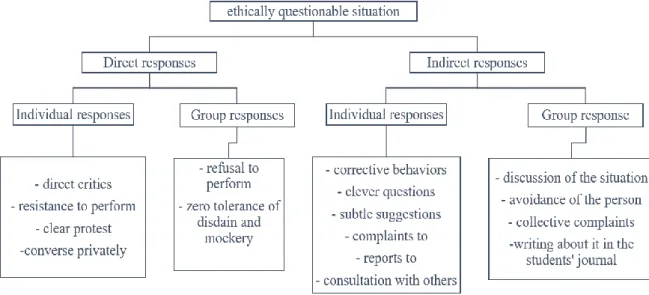
Figure 1 : Students’ behavior in ethically questionnable situations ... 58
List of Appendix
Appendix 1: Full text of the classic Hippocratic oath, the Louis Lasagna oath, the Declaration of GenevaAppendix 1 :, and the Prayer of Maimonides. ... 91 Appendix 2 : Example of regulations of students’ observation and performance of physical examination: ... 98 Appendix 3 : Medical students’ initiatives in regard of interactions with pharmaceuticals’ industries ... 102 Appendix 4 : About informed consent: ... 107
TABLE OF
CONTENTS
CHAPTER ONE: INTRODUCTION ... 1 BACKGROUND ... 2
SECTION1:INITIATION TO ETHICAL FUNDAMENTALS ... 4 1/About Ethics: ... 4 2/About Ethical theories: ... 6 Utilitarian theory: ... 6 Deontology or duty-based theory: ... 7 Virtue theory: ... 7 3/About the Oath: ... 9 SECTION2:INITIATION TO EDUCATIONAL FUNDAMENTALS... 11 1/About the hidden curriculum: ... 11 2/About the moral development ... 13 SECTION 3:HOW MEDICAL STUDENTS DEFINE ETHICAL DILEMMAS? ... 15
CHAPTER TWO: METHODS ... 16 1/Definition of a narrative review: ... 17 2/Aims of the present narrative review: ... 17 3/Keywords: ... 18 4/Inclusion and exclusion criteria: ... 18 5/Definitions of the Databases: ... 19 6/Search strategies of electronic Databases: ... 19 6.a-EMBASE: (EMBASE Classic + EMBASE: 1947 to present) ... 20 6.b-MEDLINE: (1947 to present) ... 21 6.c-PsycINFO: (1987 to present) ... 21 7/Other resources: ... 22 8/Competing interests:... 23 9/Correspondence: ... 23 CHAPTER THREE: RESULTS ... 24 SECTION ONE: WITH THE PATIENT ... 25 1/Who are you? ... 25
1.a/The ethical dilemma: ... 25 1.b/The question of identity: ... 25 1.c/Attitudes of medical students: ... 26 1.d/The apprehensions and motives behind entitling the student Doctor: ... 27 2/Physical examination: ... 32 2.a/The ethical dilemmas: ... 32 2.b/The question of privacy: ... 32 2.c/Examination of anesthetized patients without previous consent: ... 33 2.d/Examination of conscious patients: ... 34 3/Performing clinical procedures: ... 37 3.a/The ethical dilemmas: ... 37 3.b/The question of invasiveness and complications: ... 37 3.c/Grounds: ... 38 3.d/Motives behind unethical clinical procedures: ... 39 SECTION2:WITH THE SENIORS ... 42
1/ The ethical dilemmas: ... 42 2/ The question of hierarchy within hospitals: ... 42 2.a/ The military model: ... 43 2.b/The sports model: ... 43 2.c/The mechanical model: ... 44 3/ Grounds: ... 44 4/ Categories of ethical dilemmas with seniors:... 45 4.a/ The order is presumed to be technically inappropriate: ... 46 4.b/ The order is appraised to be ethically inappropriate: ... 46 4.c/ The superior’s behavior is appraised to be ethically inappropriate: ... 47 When superiors lie to their superiors: ... 47 When superiors disdain their subordinates: ... 49 SECTION3:WITH THE DRUG INDUSTRY ... 50 1/ The ethical dilemmas: ... 50 2/ The question of conflict of interest: ... 50
Physicians’ own biases: ... 50 Industries’ persuasion tools: ... 52 3/ Grounds: ... 52 CHAPTER FOUR: DISCUSSION AND RECOMMENDATIONS ... 55 1/DISCUSSION: ... 56 2/RECOMMENDATIONS: ... 61 LIMITATIONS OF THE THESIS ... 63 REFERENCES LIST ... 65 ABSTRACTS ... 86 APPENDIX ... 90
1
CHAPTER ONE:
INTRODUCTION
2
Background
Most of the contemporary medical ethics curricula tend to overemphasize issues related to research, life-sustaining treatments, euthanasia, procreational decisions; which are within practitioners’ area of concern, to the detriment of ethical dilemmas that face medical students during their training and are inherent to their unique position in the clinical setting1–3. Important as the former matters are, they conversely transcend the trainees’ decision-making area and do not pursue their ongoing moral development2. Admittedly, medical schools ought to arm students with the theoretical fundamentals and competences imperative to achieve professional standards of competent physicians, but their educational programs should be crafted with an eye on the learners’ primary relevant issues1.
When novice medical trainees enter clinical settings, they find themselves in a perplexing position where they have to acquire medical knowledge, strengthen clinical skills, adhere to the hierarchy of healthcare teams, interact with patients and care for them, and get positive evaluations1,4,5. Balancing all these competing objectives, while trying to preserve individual integrity, is as source of ethical quandaries69. Remarkably and despite the imperative need to address the aforementioned issues, a code of silence has prevailed among medical students, encouraged by a lack of interest amid faculty members2. It seems apparent that both professors and students are keen to discuss patient problems, healthcare innovations and milestones, yet they are loath to open up discussions pointing out deficiencies in training programs and suggesting proper solutions2.
Auspiciously, in recent years, educators have started to shed lights on these students’ specific dilemmas to better understand their roots and implications. Authors from USA1,6–9 ,Canada10, UK11, Iran3, and Israël occupation entity12 had undertaken web-based and paper surveys, called trainees for interviews, held focus groups, revised clerkship logbooks and analyzed students’ dissertations. Their studies’ findings provided a starting point in defining and framing the conflicting situations that clinical apprentices do commonly face in the wards2. The courage of medical trainees who unveiled what usually remains silent hardship would be best acknowledged if these issues are finally well-addressed by educators2. Further, by opening this discourse, educators would recall the former version of themselves, should they have
3
overlooked their own training struggles and would be willing to engage in movement toward reform2.
As far as the researcher and advisor of the present thesis are aware, there is no review that summarize the findings of qualitative and quantitative studies addressing the ethical dilemmas specific to medical students. When available, such reviews would help to guide researchers who intend to investigate on this matter in a given setting.
In an endeavor to discern this subject, the present thesis intends to explore and have a closer acquaintance, within the lights of the literature, of the foremost ethical struggles that medical students encounter, with the parallel objective to introduce briefly some basic concepts related to ethics and medical education.
4
Section1: Initiation to ethical fundamentals
1/About Ethics:
The World Medical Association defines medical ethics as “the branch of ethics that deals
with moral issues in medical practice13.” It is worth highlighting that there is a debate on the
nuance between morality and ethics14. it is claimed that ethics – which is also referred to as professional medical ethics – pertain to the regulatory body that reflects the norms of behavior of the profession whereas morality; or philosophical ethics, is to be apprehended as a norm-giving framework above all and not profession-dependent15,16.
The first code of ethics to be appeared was written by Sun Szu-Miao in China back in the 7th century CE17. In the Occident, Thomas Percival was a pioneer in this field and released his
work in 1803, which constituted the foundation of the primary code of medical ethics, published by the American Medical Association (AMA) in 184717. In the second half of the 20th century,
the socio-economic and political transformations along with the biomedical revolution have metamorphosed the modern healthcare practice18,19. Therefore, the conventional medical ethics were more questioned than ever before.
In 1979, Beauchamp et Childress released the first edition of their book “Principles of biomedical ethics” where they elucidate the “4 principles approach” which has become the common reference for medical practitioners. Those 4 principles are as follows:
1/ Respect for autonomy:
Each patient is free to decide whether to accept or decline any medical intervention20. This “patient’s right” sustain the core of the concept of informed consent20. It has to be
mentioned that all theories that underlie this principle call for two requirements: liberty and agency21. Liberty is defined as “independence from controlling influences” and agency as “capacity for intentional action”21.
2/ Non-maleficence:
The obligation of non-maleficence outweigh that of beneficence as the classical aphorism says “Primum non nocere: Above all [or first], do no harm”21. It compels physicians to
5
deliberately avoid causing harm to patients21. Medical practice underlies two varieties of
“harm”. It could either relate to the collateral effects that could appear unintentionally from the right treatments or to the injurious consequences of a practitioner’s negligence22.
3/ Beneficence:
Physicians do not only pledge to honor the autonomy of patients and avoid them harm, they also have to act in their best interests21. Yet, an important question arises, and with it emerges a significant part of ethical dilemmas: who decides what is the best for a patient and according to what criterias20?
Pellegrino and Thomasma introduced a novel model of beneficence where they had integrated some autonomy’s concepts23. They proclaimed that the principle of respect for
patient’s autonomy is inseparable from that of beneficence. The latter does not necessarily supersede the former nor does autonomy outweigh the other principles. Contemporary medical practice encompasses instances of patient choice along with junctures of required paternalism18. Thus beneficence is a bidirectional principle24.
4/ Justice:
Justice is defined as “fair, equitable, appropriate treatment in light of what is due or owed to persons”21. This principle subsumes two elements: equitability and distributive justice. The
former requires that patients with alike health conditions ought to be taken care of equally, irrespective of nonmedical considerations such us economic or social status20. In respect of the
latter, it asserts that medical care providers have a moral duty to distribute available resources justly considering the inevitable reality of the dearth thereof 20.
In reference to the principlism perspective, an ethical dilemma is thus defined as a disagreement among the four principles20. When they are consistent, the path to follow is plain and there is no ethical matter to be addressed20. Yet, many ethicists contend that the principlism approach restrains the moral vision and do support other perspectives that grant a more comprehensive and realistic view on ethical issues, inter alia, care-based ethics, feminist ethics, and narrative ethics20.
6
2/About Ethical theories:
It seems reasonable to proclaim that a good comprehension of the ethical debates’ roots requires first, an overview on the leading theories of ethical reflection.
Utilitarian theory:
It is founded on the concept of utility that is welfare21. Utilitarianism is the epitome of consequentialism that encompasses all theories that determine the appropriateness of an action in reference to its consequences21. Hence, the upholders of this approach consider an act ethical if it generates the foremost outcome21. Yet they differ from one another on which values to be optimized21. On the face of things, it may appear simple to limit all the moral aspects of an action to its consequences. Yet, classic utilitarianism is founded on intricate and distinct concepts about the righteousness of a given act25:
The concept of actual consequentialism: the righteousness of an act only hinges on the present consequences (versus potential or forthcoming consequences).
The concept of direct consequentialism: the righteousness of an act only hinges on the straight consequences of the act (irrespective of the agent’s motivation or other factors). The concept of evaluative consequentialism: the righteousness of an act only hinges on
the value associated with its consequences.
The concept of hedonism: the value of the consequences relies solely on pleasures and pains thereof without considering other gains such us liberty or knowledge.
The concept of maximizing consequentialism: the righteousness of an act only hinges on which consequences are supreme (not only acceptable).
The concept of aggregative consequentialism: the supreme consequences are defined by a function of the values of parts of these consequences. (in lieu of the rankings of the ensembles of consequences).
The concept of total consequentialism: the righteousness of an act only hinges on the total gain in the consequences (rather than the mean gain per individual).
The concept of universal consequentialism: the righteousness of an act only hinges on the consequences for all individuals (in lieu of a specific person or group).
7
The concept of equal consideration: the gains to one individual count inasmuch as comparable gains to another one.
The concept of agent-neutrality: consequences are not preferred over others in reference to the agent’s view.
These concepts are all endorsed by classic utilitarians but other moral theorists could admit some without the others25.
Deontology or duty-based theory:
It is also called Kantian approach as its fundamentals are pervaded by Immanuel Kant’s philosophy21. Kant advocates that humans ought to act morally, not merely do they have the
freedom to behave so26. He proclaims that morality proceeds from rationality as the reason is inherent in human beings21. Two major principles constitute the core of this theory. The universality of moral rules – known as the categorical imperative – and the respect for others. Kant defines the former concept as “I ought never to act except in such a way that I can also will that my maxim should become a universal law”27. It means that any responsibility,
that one would consider a moral responsibility, would concern oneself insofar as it concerns anyone else28. The latter concept is described as “so act that you use humanity, whether in your own person or in the person of any other, always the same time as an end, never merely as means” 28. This implies that every person shall be considered as an end in herself or himself
and never as solely an intermediary to others’ interest21. Accordingly, it is inadequate to favor the interest of one person over that of another20. In essence, Kantians assesses the appropriateness of individuals’ actions on accomplishing their moral duties to others. If so, they are considered to act ethically20.
Virtue theory:
Aristotle defines a virtue as “a habitual disposition to act well”29. It is a trait of character,
revealed regularly, that it is good for an individual to endorse30.His philosophy portrays a
virtuous person as a person who have the right motive to do the right action which implies that a right act is not systematically virtuous31. It emphasizes on the motivations and character traits
8
Virtue proponents proclaim that theories founded on the obligation concept are ineffectual to yield decent behavior since formal regulations could never substitute virtuous judgments32,33. Hence, it would be more reasonable to emphasize on fostering laudable character traits in humans in preference to rely on their compliance with the rules.
Taylor in his introductory chapter argues that it would appear to be more constructive to consider all ethical theories inasmuch as they seem to be complementing each other20. Physicians have a duty to act morally as virtuous humans as well as to what professional standards impose20.
- If a person missed the virtues, he or she could behave ethically, but his or her motives to do so would be merely for reasons of self-preservation, and thus under challenging conditions, this person could prefer self-interest above ethics.20
- If one concentrated on nurturing virtues, irrespective of obligations and the repercussions of oneself actions, one might build an illusory confidence in one’s own decency.20
Consequently, only by concomitantly relying on one’s own virtues, the nature and domain of one’s obligations, and the repercussions of one’s acts, could a person expect to behave as ethically as possible under any circumstance20.
9
3/About the Oath:
An oath is outlined as “a solemn voluntary pledge usually invoking a divine witness. It is the declaration of a principle and a guarantee of the oath taker’s trustworthiness, binding the individual personally”17. Over the history of medicine, different oaths appeared, inter alia, the oath of Hippocrates in Greece, the oath of Charaka Samhita in India, and the oath of Asaph in the Middle east17. Charaka Samhita is a prestigious ancient medical text in India34. The oath mentioned therein is to be taken by medical apprentices at the beginning of their learning journey34. About the oath of Asaph, it was composed by a Jewish physician Asaph Harofe who resided in Middle east back in the 6th century35. For the purpose of the present thesis, it will be expatiated solely upon the Hippocratic Oath.
Hippocrates had initiated the discourse on ethical principles in response to the lack of formal regulations and professional standards that ought to guide medical practice and reprimand unethical behavior among Greece physicians17. Scribonius Largus, a Roman physician, was the first to refer to the Hippocrates Oath followed by Saint-Jerome who claimed that Hippocrates impelled his apprentices to take an oath prior to practice24.
Hippocrates Oath is a 250 words text comprised of 4 sections24:
-the preface in which the oath performer invokes Gods of healing24.
-the commitment of the oath performer to the medical corps and to the community with regard to the communication and diffusion of medical knowledge24.
-the third paragraph is deemed to be the cornerstone of the oath and the soul of medical ethics: It defends the precepts of beneficence, non-maleficence, confidentiality, regard for human life, professionalism, and proscription of abusive sexual behavior. These ethical precepts give an insight on the moral principles of medicine that prevailed in that early historical epoch24.
-the epilogue where it is presented the recompenses for complying with the Oath values and the penalties if they were ignored36.
10
The Wittenberg faculty in Germany was the pioneer institution in introducing the Hippocratic Oath in its foundation statutes back in 150837. Later after the French Revolution,
laureates of Montpellier University seized the initiative and swore in Latin the Hippocratic Oath in their graduation ceremonies37. Thenceforth, medical schools through Europe and the United States of America (USA) have endorsed the practice and started to compel their graduates to take the Oath37.
Today, nearly all North American38–40, British41, and Australasian42 medical schools, as well as other countries’ colleges notably Morocco, continue to require oath taking, usually at graduation. However, few have retained the original Greek Oath. In fact, most medical schools ,even in Greece itself17, substituted the classic text for more adapted pledges, namely the Declaration of Geneva, the Prayer of Maimonides, the Louis Lasagna text, student-authored oaths, and other modified versions17,38,43.It is worth to call medical pedagogues attention to reappraise the oath-taking practice so as to preclude its relegation to merely a ritualistic recitation17,44. Medical alumni have to learn about the considerable history of the Hippocratic Oath, its essence and the changes it had undergone to respond to the contemporary ethical questions before swearing to adhere to it45 .According to this, it can be argued that reciting the Oath during the white coat ceremonies – in the beginning of medical training – shall be repudiated since junior students could hardly realize the pledge’s magnitude45. Besides, the
devotion to patient care required in the Hippocratic approach may disagree with the training objectives of medical apprentices45.
Until today, Hippocrates Oath continues to be a valuable fount of medical ethics29,46, even though it has been challenged by the political, legal and socio-economic constraints that modern societies have encountered since the mid-196017. According to the British historian of medicine Nutton37, The flexibility of the Oath enables it to endure the important changes in medical care and ethics. Further, it allows contemporary practitioners to endorse the essence of the Oath, in tandem with the reappraisal of its elements so to answer the submerging ethical questions47.
The full text of the original Hippocratic Oath, the Declaration of Geneva, the Louis Lasagna text, and the Prayer of Maimonides can be found in the Appendix1.
11
Section2: Initiation to educational fundamentals
1/About the hidden curriculum:
Medical students encounter and interact daily with a variety of beliefs, attitudes and behaviors in the clinical milieu and outside lecture theatres48,49. These non-formal facets of the learning environment play a part in shaping trainees own convictions and behaviors and might deflect the objectives of the formal curriculum and impede students’ moral development50.
Educators subsume all these facets under the concept of “hidden curriculum”51–53 and
claim it to be a key element for a thorough discernment of the educational process54–56 . In this sense, any endeavor to reform medical education without considering the informal curriculum would appear to be unavailing57. Following this perspective, Lempp and Seale carried out
semi-structured interviews with medical apprentices from a UK college to articulate their views in respect of their learning journeys, informal curriculum’s aspects included. The researchers identified four themes; namely (1) personal encouragement, (2) haphazard teaching, (3) the importance of hierarchy and (4) getting ahead by being competitive51.
About the first theme, students stated that mentors, who were competent in their specialty, devoted to teaching and good at communication with their patients, colleagues, and trainees played a crucial role in enhancing their motivation51. It is worth to note that in another study, the absence of positive role models in the educational environment was proved to be detrimental and could lead to a disinterest among apprentices58.
In respect of the haphazard teaching in clinical settings, the students reproached the unavailability of teachers and the adventitious adjustments of the lectures’ calendar, which were described to be frequent, and increased their absenteeism’s rate51. Faculty members’ business
is often due to the multidimensional nature of their roles and the resulting imbalance between clinical, teaching, and academic duties52.
Exploring the clinical training milieu would not be without referring to the conundrum of hierarchy, which will be unpacked thoroughly in the third chapter of the present thesis. Referring to Lempp and Seale study findings, trainees disclosed several incidents where they were humiliated by their superiors after a substandard physical examination or improper answer.
12
Coming to the fourth theme, the participants outlined that an ambiance of rivalry prevailed over the cooperation spirit among classmates51. Each student strove to attract the head
of medical team attention and impress the supervisors in order to surpass other students and pave the way for their personal career51.
Bigdeli and his team came up with about comparable findings in an Iranian setting, albeit with a different classification and more diverse themes52. In their study, medical students mentioned the gap between what is taught in manuals and what is performed by healthcare teams and had concluded that, in clinical settings, educational manuals were worthless. Further, they reported situations where the patients’ rights and dignity were violated. Besides, they stated that they were perturbed by supervisors’ negative comments about the future of the career and the “named” expectations they needed to exceed to secure an employment.
All these themes, among others, constitute a covert curriculum which some experts proclaim to be more influential than the academic one48,49. In fact, it appears worth quoting from Wolf that “medical education is a professional socialization experience that involves not only the acquisition of knowledge and skills but also, and perhaps more important, the acquisition of attitudes, values, and a sense of ethics”59.
13
2/About the moral development
The question of the moral development of medical students cannot be approached without defining first the appropriate terminology related to, namely (1) moral sensitivity, (2) moral reasoning, (3) moral commitment, and (4) moral behavior60. To act ethically, medical trainees have to:
(1) Identify the ethical dilemma.
(2) Ascertain the conflicting principles beneath it and infer what is right. (3) Be engaged to do what is right.
(4) Act according to what is right.
Considerable knowledge about moral development of individuals ensues from the studies of Carol Gilligan and Lawrence Kohlberg5. The theory of Kohlberg identifies three general stages of moral development viz preconventional, conventional, and postconventional61,62. The first stage refers to the child who defines right and wrong based on punishment and cannot extrapolate from situations. In the second stage, adolescents determine the righteousness of an act in reference to social norms and what is accepted by others. Thus, they may accommodate their behaviors only to adhere to the group. Individuals attain the third stage when they start to define their moral precepts irrespective of social norms or authority pressure. Yet Gilligan states that the work of Kohlberg represents a male approach of moral development63. According to her studies, females do morally develop through interpersonal relationships based on three different levels. During the first level, persons concentrate on their self-interest. Subsequently, they start to outweigh others’ interests. Thereafter, in the third level, they try to find a balance between self and other interests. In fact, Gilligan’s approach advocates for a caring moral orientation that emphasize on relationships63. Many researchers deem that the two moral perspectives of Gilligan and Kohlberg complement each other64,65.
When medical students join clinical settings, they are supposed to be in the postconventional stage of moral development64,66. However, the ethical challenges of wards may potentially compel them to revert to the conventional moral level67. Hence, different tests were used to assess the moral development of medical apprentices, inter alia, the Defining Issues Test (DIT) that relies on participant’s answers to a set of supposed dilemmas, and the
14
test of moral sensitivity based on clinical situations68. Benbassat cited in his narrative review 5
cross-sectional and 6 longitudinal studies that could not detect, in reference to the DIT, an increase in moral reasoning among the medical students who participated in the investigations68. More, he referred to 3 cross-sectional studies that noticed a decrease in moral sensitivity in senior students subsequent to its improvement over the first years of learning in Canadian and Japanese colleges. These findings drew attention to whether clinical learning retrogrades the moral development, how and to what extent?
Emotional68 and moral distress5,69 have been claimed to be key factors in shaping the moral development of medical students. The demanding structure of the formal curriculum and the tension it generates, lead trainees to lose sight of the moral image amidst all the academic challenges they have to face70,71. In parallel, students find themselves in an apathetical and inimical clinical milieu where they have to adhere to tacit and pronounced rules while preserving their ethical integrity5,69.
With an eye toward promoting the moral development of their students, faculty members ought to support the trainees along their process of socialization within wards. This mission would not be easy since each medical trainee could be at a different developmental stage and therefore would cope variously with ethical challenges5. Accordingly, some students may
pursue their moral development irrespective of all difficulty5. Others may acquiesce, with more
15
Section 3: How medical students define ethical dilemmas?
Ethical dilemmas are often defined in literature as situations where moral values require or seem to require that an agent embraces two or more conflicting attitudes, in a way that renders the accomplishment of the demanded actions impossible21. Put differently, they are cases when “an agent ought both to do and not do something”72. However, it is claimed that such definitionencompasses only some ethical problems of medical practice yet not all73. In fact, Mayer concluded in her study that general practitioners consider as ethical dilemmas not merely cases of conflicting choices but also situations related to emotion, relationships, oneself's pain and reputation73. Thus, the question about what cases medical students view as ethical dilemmas is worth pondering.
In reference to salient literature, medical students endorsed four perspectives to describe ethically problematic situations:
(1) Emotionally perturbing cases in which medical trainees feel helpless or speechless, experience pain, guilt or resent74. Alas, common ethics literature accord insubstantial interest to emotion73,74 albeit its importance in ethical education were highlighted75,76. Focusing merely on rules and precepts does not capture all the areas of moral life77.Hence, an orientation towards an ethics of care that takes into account emotions and relationships merits consideration63,77.
(2) Cases related to the duty and responsibilities of medical trainees8,10,74,78,79: This category covers situations in which students feel that their capacity or scope of responsibility are exceeded or they are uncertain about the limits of their accountability. Lack of supervision or whether a student could disclose the diagnosis to a patient are examples of these cases.
(3) Cases that pertain to the legal scope: medical students label issues of statutory medical practice and legal responsibility of physicians as ethical problems80. They concentrate on what it could be done “safely”, within the bounds of law, in lieu of what it ought to be done80.
(4) Conflicting choices or competing alternatives: these cases subsume under the common definition of ethical dilemmas.
16
CHAPTER TWO:
METHODS
17
From March 16, 2020 to June 16, 2020, a narrative review of literature was conducted to identify the ethical dilemmas medical students encounter during their clinical training. To find relevant papers, 3 Databases were searched: MEDLINE (Ovid), EMBASE (Ovid), PsycINFO (Ovid).
1/Definition of a narrative review:
Narrative review or literature review is an unsystematic, non-exhaustive synthesis of formerly published papers81. It introduces a broad overview on a problem82,83 and presents a comprehensive account of the status of scientific knowledge in respect of it84. There is no structured methodology for identification of studies and no appraisal of quality of papers included84. Thus, the findings of a review of literature are not replicable84. Authors of narrative reviews ought to be aware of the bias related to this type of studies81.
2/Aims of the present narrative review:
To identify the ethical dilemmas medical students encounter during their clinical training.
To retrieve unethical situations from the experiences and narratives of medical students.
To understand the underlying ethical questions behind these dilemmas. To ascertain the roots of these ethical dilemmas.
To extract experts’ recommendations, ethical guidelines, and policies. To determine how medical students cope with unethical situations.
18
3/Keywords:
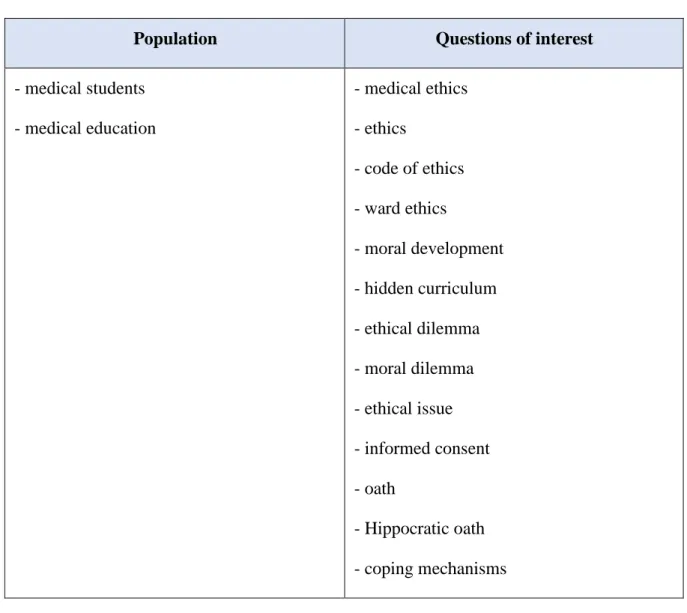
A preliminary research was conducted to identify relevant keywords. Table 1 : Keywords
Population Questions of interest
- medical students - medical education - medical ethics - ethics - code of ethics - ward ethics - moral development - hidden curriculum - ethical dilemma - moral dilemma - ethical issue - informed consent - oath - Hippocratic oath - coping mechanisms
4/Inclusion and exclusion criteria:
The population of interest was limited to undergraduate medical students. Studies which assessed the ethical dilemmas faced by interns or residents were excluded. Likewise, research which defined ethical issues of trainees’ nurse were removed. There were no restrictions on the design of studies nor their settings. In respect of the language, studies in Arabic, French and English were eligible.
19
5/Definitions of the Databases:
5.a- MEDLINE85:It is a bibliographic database related to the U.S National Library of Medicine and encompasses beyond 26 million references of journal papers that approach life sciences issues. Articles are indexed using Medical Subject Headings (MeSH terms).
5.b- EMBASE86:
It is a biomedical literature database, developed by Elsevier and includes more than 32 million articles of journals notably MEDLINE titles. Papers are indexed according to Elsevier’s Life Science thesaurus Emtree. The database is accessible through several platforms.
5.c- PsycINFO87:
It is a database developed by the American Psychological Association (APA) and subsumes beyond 4 million peer-reviewed references related to behavioral and social knowledge.
5.d- Ovid88:
It is an online research platform developed by the Wolters Kluwer group. It hosts beyond 100 databases, more than 1400 peer-reviewed journals, and over 6000 books. Its content touches a variety of scientific fields namely healthcare subjects, behavioral and social science, engineering areas, and agriculture disciplines.
6/Search strategies of electronic Databases:
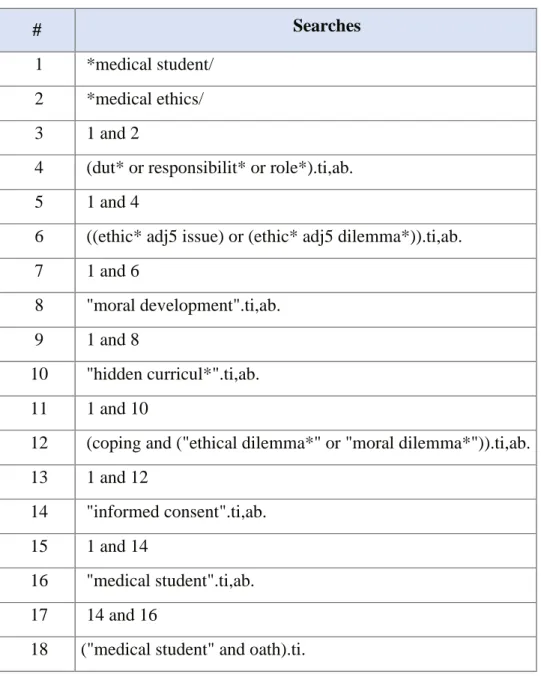
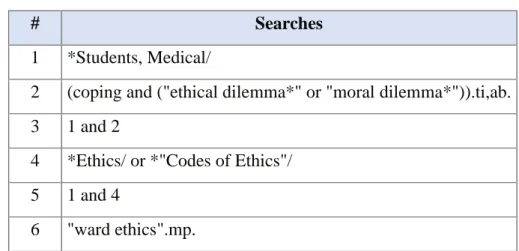
To identify studies, a strategy for MEDLINE (Ovid), EMBASE (Ovid), PsycINFO (Ovid) was developed using relevant subject headings and text words. Titles and Abstracts were screened to determine pertinent papers.
20
6.a-EMBASE: (EMBASE Classic + EMBASE: 1947 to present) Table 2 : Search strategy for EMBASE
# Searches
1 *medical student/
2 *medical ethics/
3 1 and 2
4 (dut* or responsibilit* or role*).ti,ab.
5 1 and 4
6 ((ethic* adj5 issue) or (ethic* adj5 dilemma*)).ti,ab.
7 1 and 6
8 "moral development".ti,ab.
9 1 and 8
10 "hidden curricul*".ti,ab.
11 1 and 10
12 (coping and ("ethical dilemma*" or "moral dilemma*")).ti,ab.
13 1 and 12
14 "informed consent".ti,ab.
15 1 and 14
16 "medical student".ti,ab.
17 14 and 16
21 6.b-MEDLINE: (1947 to present)
Table 3 : Search strategy for MEDLINE
# Searches
1 *Students, Medical/
2 (coping and ("ethical dilemma*" or "moral dilemma*")).ti,ab.
3 1 and 2
4 *Ethics/ or *"Codes of Ethics"/
5 1 and 4
6 "ward ethics".mp.
6.c-PsycINFO: (1987 to present)
Table 4 : Search strategy for PsycINFO
# Searches 1 Medical Students/ 2 *Medical Students/ 3 Ethics/ 4 1 and 3 5 "moral development".ti,ab. 6 2 and 5
7 (coping and ("ethical dilemma*" or "moral dilemma*")).ti,ab.
8 2 and 7
9 *Medical Education/
22
7/Other resources:
7.a- Reference lists:
After identification of salient research, their reference lists were reviewed to identify other relevant studies.
7.b- Citation searching:
A search of papers who cited the relevant studies identified was conducted and eligible research were added to the present review.
7.c- Dissertations and Thesis searching:
A search of the DISSERTATIONS AND THESES GLOBAL (ProQuest) Database was undertaken to determine pertinent theses (Doctoral and Maser dissertations).
About ProQuest89:
It is a platform associated with the Cambridge Information Group. It provides access to several databases that encompass references of, inter alia, dissertations and thesis, books, newspapers, magazines, and peer-reviewed journals.
About DISSERTATIONS AND THESES GLOBAL Database90:
It is a product of the ProQuest interface and incorporates beyond 5 million materials. It is the foremost comprehensive selection of master’s theses and doctoral dissertations.
Search strategy: - April 21, 2020:
TI,AB,SU(“medical student*”) AND TI,AB,SU (“ethic*”). - May 15, 2020:
TI,AB,SU(Theorie*) AND TI,AB,SU("medic* ethic*"). 7.d- Books:
Ward Ethics: Dilemmas for Medical Students and Doctors in Training. Cambridge University Press (2001).
23
Medical Ethics Manual (World Medical Association): Third Edition 2015. Mending Bodies, Saving Souls: A history of Hospitals. Oxford University Press
(1999).
Principles of Biomedical Ethics. Oxford University Press (Seventh Edition).
8/Competing interests:
The researcher and advisor of the present work declare no competing interest.
9/Correspondence:
24