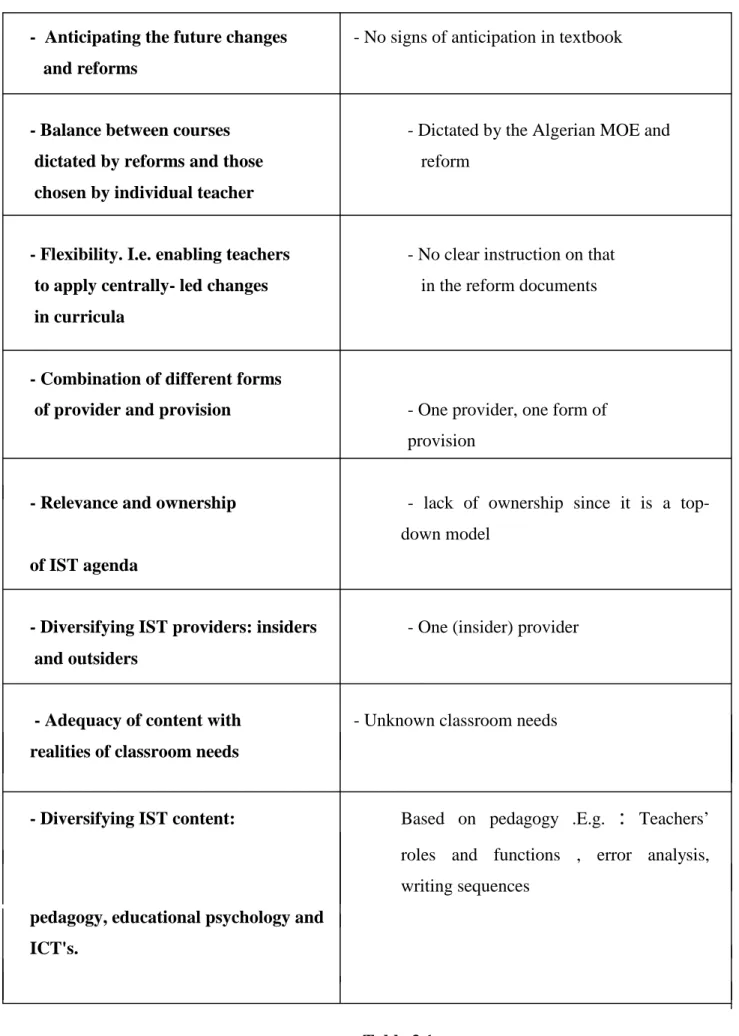
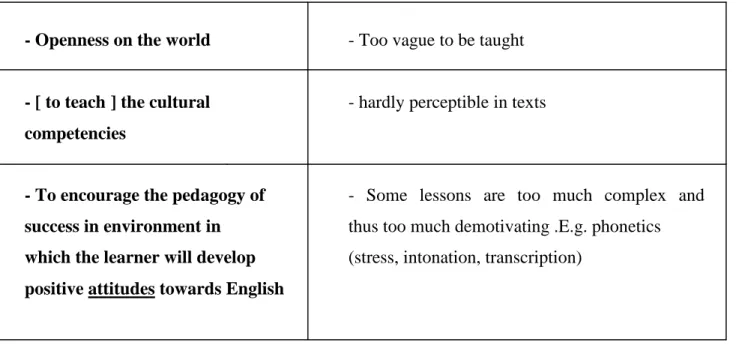
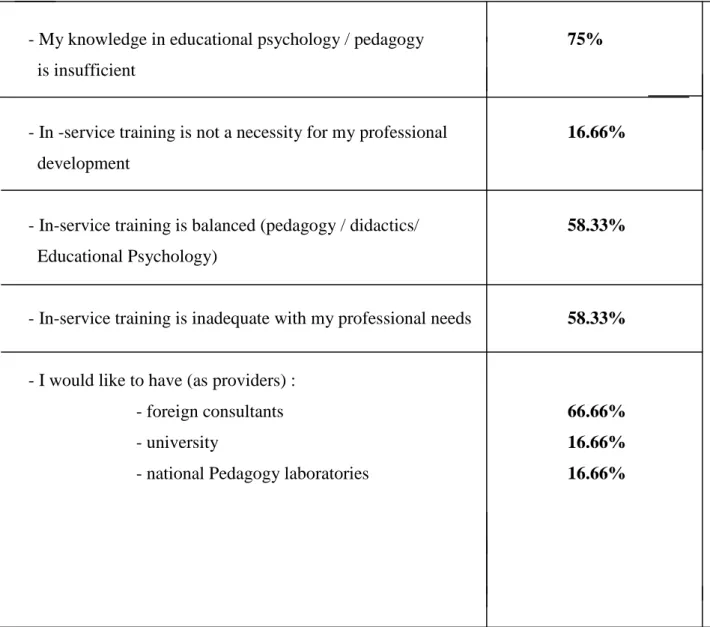
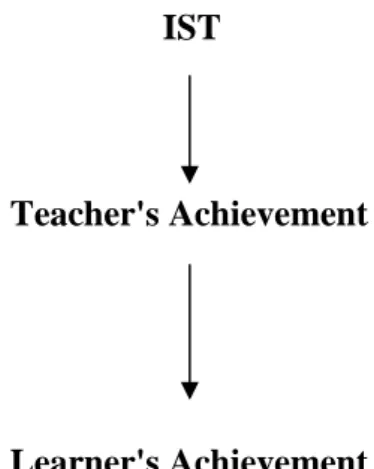
MINISTRY OF HIGHER EDUCATION AND SCIENTIFIC RESEARCH UNIVERSITY OF ORAN ES - SENIA
FACULTY OF LETTERS, LANGUAGES AND ARTS DEPARTMENT OF ANGLO-SAXON LANGUAGES
THESIS SUBMITTED IN FULFILMENT OF THE REQUIREMENTS FOR THE DEGREE OF MAGISTER IN EDUCATIONAL PSYCHOLOGY
AND DIDACTICS
By
Mr Kassim Boudjelal SAFIR
Members of the Jury:
Dr. LAKHDAR BARKA .S.M as President of the Jury University of Oran
Pr. MILIANI .M as Supervisor University of Oran
Dr. BEDJAOUI .F as Examiner University of S-Belabess
2007
FAILURE IN LANGUAGE LEARNING IN
SECONDARY SCHOOLS:
To my parents …
Acknowledgements
I would like to begin thanking all my teachers present and former, who
really helped me to shape and share this modest work.
I am grateful in the first place to Professor Mohamed Miliani who has
always cared and guided us in the jungle of educational psychology and
didactics.
As I should be grateful To Dr Lakhdar–Barka .S.M for his patience,
devotion, and inspiring thoughts.
To Dr Belkhenchir, for her kindness and sterling efforts to introduce us to
the world of ESP.
To my colleagues and library staff, for their precious contributions.
To my pupils who were always proud of their teachers and with whom I
learnt a lot.
ABBREVIATIONS
ICT’s Information and Communication Technologies.
INTASC Interstate New Teacher Assessment and Support Consortium.
IST In-service training.
MOE Ministry of Education.
NBPTS National Board for Professional Teaching Standards.
NCAT National Council for Accreditation of Teachers.
NCTM National Council of Teachers of Mathematics.
NCTE National Council of Teachers of English.
Abstract
It became a paradigm shift to say that dealing with educational issues is a hard, complex task for researches, whether at a professional level in universities or at a smaller scale in lycées. Thus, language learning problematics are not exceptions.
Through the present tentative to comprehend failure in language learning, a correlation with the teachers' psycho-pedagogical in-service training (IST) seems to be theoretically a relative good track to follow. Besides, the role of universities in that in-service training could be another avenue to explore.
It is also well documented that learning is effective if affective, however do affectivists have the means of their policy, if we know that a single secondary teacher in Algeria deals with an average of 100 pupils daily? What if it is simply a problem of feasibility and transferability of those theories in our classrooms? They may be successful beyond our frontiers where teachers are not as overloaded as ours, whereas implementing them in our schools with all the implications and complexities that can crop up is another story.
Teachers are aware of the huge responsibility and the tremendous complexity of their tasks at school. That is why they are disarmed to face their daily problems whether at a cognitive level or affective one. So, a reinvented in-service training added to long life learning is a necessity to prevent their deprofessionalization and their helplessness to face failure at different stages of teaching and learning .Yet, there is still confusion about what to learn and what to unlearn as well.
Throughout this thesis, one could just raise problematics and try to approach them through reflection, analysis, possible recommendations, and momentary « solutions » that paradoxically might become « problematics » someday. For, meanwhile these lines are written new concepts would have replaced the fashionable concepts of affectivism or even the outmoded concept of motivation or school itself to be replaced by other « newest » ones that nobody can predict .
TABLE OF CONTENT
Dedication I Acknowledgements II Abbreviations III Abstract VI General introduction 1Chapter One
Failure and Language learning in theory
1.1 Introduction 6
1.2 Review of the literature 6
1.3 A comparison between the studies 9
1.3.1 Similarities 9
1.3.2 Differences 9
1.4 Redefining the concepts 10
1.4.1 Failure 10
1.4.2 Language 11
1.4.3 Learning 12
1.4.4 Language learning 13
1.4.4.1 The cultural dimension 13
1.4.4.2 Socio-psychological dimension 13
1.4.4.3 The cognitive dimension 14
1.4.4.4 The affective dimension 14
1.4.5 Educational psychology redefined 14
1.4.6 In-service training 16
1.4.6.1 Map of the terrain 16
1.4.6.2 Changes 16
ii. Psychological 17
1.4.6.3 In-service training redefined 18
1.4.6.4 In-service training delivery 19
1.4.6.5 Content of in-service training in Algeria 21 1.4.7.6 In-service training in educational psychology 21
i. The policy 22
ii. The practice 23
1.4.7 University research and in-service training 24
1.4.8 The profile of teachers redefined 24
1.4.9 Prospective vs. experienced teachers 27
1.5 The causes of failure 28
1.5.1 Intrinsic 28 1.5.1.1 Genetic 28 1.5.2.2 Psycho-effective 29 1.5.2 Extrinsic 30 1.5.2.1 Sociological 30 i. Economical conditions 30 ii. Relational 31 iii. Linguistic 31 vi. Socio-cultural 31 1.5.2.2 Institutional 32 i. Training 32
ii. Pre-service training 33
iii. In-service training 35
vi. Inadequacies / discrepancies 36
Chapter Two
Research tools
2.1 Introduction 39
2.2 The reform documents of May 2005 40
2.2.1 The English curriculum 40
2.2.1.1 The methodology 40
2.2.1.2 The learning / teaching process 40
2.2.1.3 The evaluation 41
2.2.2 The French curriculum 42
2.2.2.1 The theoretical framework 42
2.2.2.2 The cognito-affective aspects 42
2.2.3 The concepts / notions in the reform documents 42 2.2.3.1 cognitivism / metacognitivism in the documents 43
2.2.3.2 The affectivism in the documents 44
2.3 The in-service training programmes of 2000-2005 45
2.3.1 The context of educational reforms 45
2.3.2 The reforms and the in-service training 47
2.3.3 System-based needs vs. individuals-based ones 47
2.3.4 The content of in-service training programmes 49
2.3.5 In-service training content in Algerian lycéees 49
2.3.6 Choice of in-service training content 51
2.4 The questionnaire 53 2.4.1 The context 53 2.4.2 The population 54 2.4.3 The content 54 2.4.4 The methodology 55 2.5 Conclusion 55
Chapter Three
Data Analysis
3.1 Introduction 59
3.2 The in-service training programmes of 2000-2005 60
3.2.1 State of the art 60
3.2.1.1 Content 60
i. One-sidedness 61
ii. Out-datedness 61
iii. Top-down vs. bottom up 62
vi. Ineffectiveness 62
v. Absence of contextual practicality 63
vi.Mode of provision 64
3.2.2 Criteria of IST 65
3.2.2.1 Importance of IST criteria 65
3.2.2.2 Criteria 65
i. Smith and Woeste criteria 66
ii. OECD's criteria 66
iii.ERO's Criteria 67
3.2.3 Theory vs. practice 68
3.3 The reform documents of May 2005 70
3.3.1 State of the art 70
3.3.2 Analysis 70
3.3.2.1 Lexical level 70
i. Semantic haziness 71
ii. Causes of the semantic haziness 71
3.3.2.2 Syntactic level 72
3.3.3 Criteria of curricula 74
3.3.3.1 Validity 75
3.3.3.2 Cultural perspectives 75
3.3.3.4 Operational objectives 76
3.4 Questionnaire 76
3.4.1 Description 76
3.4.2 Results 77
3.4.3 Interpretation 78
3.4.3.1 ICT’s and IST 78
3.4.3.2 Pre-service training 80 3.5. Psychopedagogical aspects 81 3.5.1 Teacher’s motivation 81 3.5.2 Needs 82 3.5.3 Attitudes 82 3.6 Conclusion 83
Chapter Four
Suggestions and recommendations
4.1 Introduction 86
4.2 Professional development 86
4.2.1 IST and learner's performance 86
4.2.2 IST and teacher's performance 87
4.2.3 IST and curriculum content 88
4.2.4 IST and university researches 90
4.3 The notion of needs 92
4.3.1 The different needs 92
4.3.1.1 Institutional needs 93
4.3.1.2 School's needs 94
4.3.1.3 Teacher's needs 94
4.4.1 Contextualized vs. decontextualized studies 95
4.4.2 Towards a flexible model of research 97
4.4.3 Towards creating a data-base 98
4.5 Changing attitudes 98
4.5.1 Changing learners attitudes 98
4.5.2 Changing teachers attitudes 99
4.5.3 Changing policy makers attitudes 100
4.6 Reconsidering principles 102
4.6.1 Flexibility 102
4.6.2 Balance 103
4.6.2.1 Cognitivism and affectivism 103
4.6.2.2 Bottom-up, top-down and bottom- across IST 104
4.6.2.3 Stake-holders needs 104 4.6.3 Cooperation 105 4.6.4 Ownership 106 4.6.5 Lifelong learning 107 4.7 Conclusion 109 GENERAL CONCLUSION 111 Bibliography 115 Appendix: 121 Questionnaire Indexes: 126
Index 1: Tables and figures index 127
General introduction
Language learning has become increasingly complex. A complexity that resulted from context specificity and context dependency. Accordingly, understanding and managing problematics could seem to be extremely hard to solve without comprehending the specificity of a given microcosm, socially speaking.
A novice teacher is already faced with that exciting but challenging task to perceive and manage these tremendous ever-changing educational realities. Besides, new scientific trends tried, and are still trying to assist the novice teacher in his journey which is far from being a pleasant one. The variety of contexts from specific to societal, from micro to macro contexts, adds another dimension of complexity which is really daunting as a prospect. To that complexity, the human factor is another difficulty that has cropped up in the problematics of failure in language learning. Dealing with human beings as factors in developing theories and human affect as variables in research is one of the most controversial issues to consider, evaluate and comprehend.
Different feeder fields such as psychology, neurology and sociology have fostered language learning saving it from its intellectual compartmentalization. Yet, too much is still to be explored and solved. Problem-solving is as everlasting as life, and so are problematics in educational psychology.
Educational psychology as one of the most recent fields has for a long time contributed to language learning / teaching, especially when scientists have insisted, since the seventies, on the urgency to fuse the cognitive and affective domains in the process of research on learning / teaching languages to human beings. That urgency was certainly a result of a falling down of previous trends in the field of language learning. Accordingly, it was a symptom of a failure of those trends which paved the way to the following attempts.
Despite that urgency, few researchers have tackled the issue of failure in Algerian secondary schools. Furthermore, the only references about failure are written beyond our frontiers by foreign researchers and thus decontextualized ones. It became a paradigm to say
that the context as variable is extremely determinant for any research validity and thus efficiency.
The present thesis aims at adding to the current body of knowledge on language learning, mainly the relationship between failure in language learning and the teacher's psychopedagogical in-service training in secondary schools since in-service training is the unique way to update the theoretical knowledge as well as the know-how gained at the university.
This contribution will have these research questions as a theoretical starting point:
1. Is there a correlation between failure in language learning and the teacher's psychopedagogical in-service training?
2. How can universities through researches contribute in that in-service training ?
On the basis of these research questions, the following hypotheses will be examined and proved:
1 .Psychopedagogical developments and the changing realities of classrooms could be compensated by a reinvented, adequate, and longer in-service training based on research in schools and universities.
2 . Universities can help secondary schools to compensate shortcomings in in-service training by:
- creating a dynamics of collaboration with secondary schools, - taking into account research-based criteria,
- and promoting psychopedagogical aspects in in-service training.
In order to backup these hypotheses, the problematics will be approached from a dual theoretical and practical level .To insure maximum objectivity, a correlational approach will be utilized. As tools, a questionnaire fostered by corpora of pedagogical data including the 2005 reform documents and inspectors programmes will be explored and examined.
The questionnaire will be the methodological tool to examine certain issues concerning the population of language teachers in different lycées, and which may confirm the hypotheses concerning their conceptions and attitudes towards pre-service training, in-service training and professional development in language learning as well as needs and recommendation about those issues.
If we might talk about expected results it could only be a sort of ground testing and an exploration of the unknown from the laid down land marks .Therefore in the present thesis one expects to examine and confirm the above hypotheses - in the present context and one should insist on that - and mainly the importance of psychopedagogical training in language learning process and its correlation with success or failure.
Chapter One
Failure and Language learning in theory
1.1 Introduction 6
1.2 Review of the literature 6
1.3 A comparison between the studies 9
1.3.1 Similarities 9
1.3.2 Differences 9
1.4 Redefining the concepts 10
1.4.1 Failure 10
1.4.2 Language 11
1.4.3 Learning 12
1.4.4 Language learning 13
1.4.4.1 The cultural dimension 13
1.4.4.2 Socio-psychological dimension 13
1.4.4.3 The cognitive dimension 14
1.4.4.4 The affective dimension 14
1.4.5 Educational psychology redefined 14
1.4.6 In-service training 16
1.4.6.1 Map of the terrain 16
1.4.6.2 Changes 16
i. Socio-economical changes 16
ii.Psychological 17
1.4.6.3 In-service training redefined 18
1.4.6.4 In-service training delivery 19
1.4.6.5 Content of in-service training in Algeria 21 1.4.7.6 In-service training in educational psychology 21
i. The policy 22
ii. The practice 23
1.4.7 University research and in-service training 24
1.4.8 The profile of teachers redefined 24
1.4.9 Prospective vs. experienced teachers 26
1.5.1 Intrinsic 28 1.5.1.1 Genetic 28 1.5.2.2 Psychological 29 1.5.2 Extrinsic 30 1.5.2.1 Sociological 30 i. Economic conditions 30 ii. Relational 31 iii. Linguistic 31 vi. Socio-cultural 31 1.5.2.2 Institutional 32 i. Training 32
ii. Pre-service training 33
iii. In-service training 35
vi. Inadequacies / discrepancies 36
Chapter One
Failure and Language learning in theory
1.1 Introduction
It could be interesting to examine the research literature on failure in language learning and in-service training through a psychopedagogical scope. It is beneficial in a sense that it could give us a representation of the map of all what could constitute the theoretical background of the present study. It is a way to position oneself, to compare, to back up and discover as well any missing block in the present problematic solving.
1.2 Review of the literature :
Failure in language learning has seen significant investigations over the past twenty years. Most studies have concentrated on the possible causes of failure in learning; others have tackled more specifically the relation between professional development including the correlation in-service training and learners / teachers achievements.
However, few publications have attempted to investigate the possible correlation between failure in language learning and the teacher's in-service training in Educational Psychology or even linked to psychopedagogical aspects. Theses, reviews and articles are the basis of the following review of the literature on professional development or IST including an implicit relationship with failure in learning without specifying language learning.
It could seem worth trying to examine the Algerian theses rather than the "foreign" ones, and to a greater extent the developed countries theses simply because one could say it could bias our conclusions. More than that, we cannot compare the incomparable.
Thirdly, applying others ' theories could sometimes raise problems of contextuality and ecologicality. Yet, we can mention some titles on passant just to show the importance of the problematic and its recurrence.
Though it could be the first time to tackle the present problematic, i.e. failure in language learning from a psychopedagogical angle and the in-service training, several theses have examined and treated language learning from different angles .Many of them have focused on the pre-service training and in-service training or training roughly speaking and tried to solve some aspects of the overall problematic of language learning. Yet, no thesis has tried to explore the in-service n educational psychology, and this is what one should examine through this work.
Three context-based theses have been issued in and outside Algeria. In his PhD. thesis, entitled Teaching English for Specific Purposes: the organization of a communicative approach for higher education in Algeria, written by Bouchagour.Y in Cardiff in 1984, the author " found out that the training of ESP teachers has to be urgently taken into consideration" (quoted in Meddeber,1989:11).
So, according to that thesis training of ESP teachers could be considered as one of the possible factors of failure in language learning. Abdelah Salih Bachir in his memoir de magister in 1986 whose title is : Formation des enseignants de Français langue étrangère au Soudan: présentation critique, "tried to show that both pre-service and in- service are complementary [...]"( Ibid,1989:12).
Meddeber tried through her work (Meddeber, Thesis,1989) to show that there are discrepancies between university education and English teachers daily tasks at secondary schools ,i.e. " that some sort of inadequacy existed between university education outputs and the demands put on secondary teachers of English" (Meddeber,1989:5) . In other words Meddeber tried to focus on the pre-service training as a possible source of failure in the language learning process.
In developing countries, different scopes of study were emphasized. Ayeni Oyo, in his study: the development of teacher education on Oyo State since 1955 (M.ed) thesis written in Cardiff in 1984 recommended "[...] the continuing development of teacher education so as to get more efficiently trained teachers [...]" (quoted in Meddeber,1989:12). Yet, again, he did not mention which sort of training is about.
In his PhD thesis, Booner, DR in Cardiff in 1985 revealed discrepancies between the function and aim of the college of education, which implies a possible failure in achieving training future teachers .
The type of teachers expected to be trained is not clearly delineated by governmental educational policies. That is what was shown in a PhD thesis conducted by Udofot, M, in Bristol in 1986. An interesting study that paramounted the vagueness of objectives in governmental policies, and its possible negative repercussions on the educational outcomes.
Dahawhi, B.M, in his PhD thesis in London 1986 and entitled: systems of training teachers of basic education in the Arab Republic of Egypt, UNESCO's statements, India and Kenya : a comparative study, showed an inadequate teacher training resulting from a lack of harmony between the educational policy and the socio-economic change.
Eighty three studies conducted by several researchers from different western countries displayed the major problems encountered by beginning teachers in their first year after graduating which probably show an inadequate pre-service and in -service training.
Demetriades F.C., in Durham 1985, in his PhD thesis insisted on training teachers after graduation in a pedagogical institute for one year before starting their career. This implies that the teacher pre-service training could -again- be a possible reason of failure in their professional career.
Reports and articles -since easily provided and up-to-date - were the main references of the present thesis. Especially the ERO review, the OECD and Eurydice reports. The (ERO,2000) report in a consistent study has insisted on the changing context of IST and the necessity to reinvent and reform IST mechanisms on the basis of more scientific and empirically based criteria with a special attention on needs analysis and its relation with learning success or failure.
___________________________________________________________________________ ERO : Education Review Office.
The OECD report has broaden the scope for a more eclectic form of training including three forms of research, i.e. self-contained, scientifically and empirically -based studies, which offer a focused , policy-oriented assessment of development in an area of emerging importance where significant innovation is taking place.
The intentions of those reports are to identify key issues in the current state of IST and professional development and briefly to examine how they are being addressed in different western countries.
The following conclusions are key findings shared as consensual preoccupations in those reports :
- Some of the most effective methods of professional development involve on and off-site activity.
- Combining self-development and input from source outside the school. - A need for more systematic identification of needs.
- A better evaluation of programmes and an improved dissemination of these evaluations.
1. 3 A comparison between the studies :
It could be beneficial to examine the common points that create the consensus on that kind of researches.
1.3.1 Similarities :
1. In-service training as a crucial process in learning 2. Teacher training quality could be improved.
3. Better tertiary /college teaching quality means better training. 4. Teacher training effectiveness dependency.
1.3.2 Differences:
Differences in focuses are shown in the above theses:
2. Focus on pre- and in-service training vs. focus on professional development 3. Focus on learning vs. Language learning.
4. Teachers centeredness vs. beginner teachers’ centeredness.
1.4 Redefining the concepts:
The present chapter will be a theoretical map of the terrain or what Thomas Kuhn (1970) called a process of "puzzle solving". It is a real slippery terrain and a moving ground since presuming to define notions and concepts is in itself a risky, contradicting process. Contradicting, in a sense that defining means giving definite words to indefinite ever-changing phenomena and processes.
" It is when a concept changes in meaning that it has the most meaning, at that time ,it is really, an event of conceptualisation "
(Bachelard, in Baruk,1973:80).
1.4.2 Failure :
Failure as a concept has long been subject to debates among intellectuals and educationists. Far from being consensual, this concept has been -paradoxically- "defined" and thus imprisoned in a given theoretical framework, not to say mortgaged and thus fixed according to given ever-changing considerations, which could be considered as an exercise to define the indefinable.
«Everyone, researchers as well as others; would like that everybody rally ONE clear and stable definition preferably his !"
(Perrenoud,1996:3)
Many reflections have noticed that failure is "a multiheaded problem" Covington,1992), "..complex.." (Perrenoud,1996), (Cordié,1993), "..difficult to define.." (Eurydice,2005 ), " ...with variable geometry.." ,"..plural and floating..", "..vague.." (Perrenoud,1996). This multitude of characteristics has made it difficult -not to say impossible- to define.
" It is clear that the concept of failure takes different forms according to the member state in question and is difficult to define "
(Euridyce ,2005: 53)
1.4.3 Language :
One could not be categorical in his statements on that concept / theory too, for " to presume [ defining ] language adequately would be folly" . (J. Wilson 2000:1). Defining is one of the most delicate, questionable exercises a scientist can perform. "A definition is really condensed version of a theory, and a theory is simply - or not simply - an extended definition» ibid. Every theory should, thus, be questioned, put in its context and handled with extreme care.
One should always consider and doubt of terms used in definitions, be it from lay persons, dictionaries and even specialists.
Looking at the various definitions, one could but notice their helplessness and even one-sidedness when defining language. Let us take this example:
" Language is a system of arbitrary vocal symbols which permit all people [... ] to communicate " ( Finocchiaro,1964:8) . How can one be so categorical when stating: vocal symbols when defining "language"? What about the non-vocal ones? And when saying people, can one deduce that language is essentially human?
New fields and sub-fields are suggested in different categories such as :
- The symbolic nature of language
- Kinesics, proxemics and other paralinguistic features - Dialectology, language and culture
- Human language and non -human communication ...
not to mention them all. Of course that does not exclude some common features like:
- Universality - Systematicity
- conventionality .
1.4.4 Learning :
A less controversial term meaning : " [ a ] relatively permanent change in behaviour tendency and is the result of reinforced practice " ( Kimble and Garmezy,1963:133, quoted in J. Wilson,2000). Of course, it cannot be dissociated from teaching which can be defined as "showing or helping someone to learn how to do something, giving instructions, guiding in the study of something, providing knowledge, causing to know or understand " ibid. It seems to be too generic but it is only a step towards deeper analysis when one comes to other levels like: studying vs. learning; thinking vs. learning; learning vs. unlearning and conscious vs. semi- conscious learning.
Jerome Bruner (1966:40-41) noticed that a theory of instruction should specify the following features:
1. The experiences which most affectively implement in the individual a predisposition.
2. The ways in which a body of knowledge should be structured.
3. The most effective sequences in which to present the materials to be learned. 4. The nature and pacing rewards and punishments in the process of learning and teaching.
Learning according to J. Wilson is a " very complex psycho-physical function of familiarization of knowledge and skills ,which is put by effect of internal and external factors". To conclude one might say definitions are endless the endlessness of learning theories.
1.4.5 Language learning :
" Second language learning is not a set of easy steps that can be programmed in a quick do-it-yourself kit " remarked J.Wilson. It is far more complex than that. Talking about language learning, means talking about all theories that tried and try to solve that puzzle of language. It is talking about the various dimensions, i.e. :
1.4.5.1 The cultural dimension
Language means culture. It became really a paradigm to fuse the two dimensions, the linguistic with the cultural one within a common entity." Being a language learner means being a culture learner " (ibid). Yet, culture is in an everlasting change. Is it the case for the language we teach/ learn ? That dynamic is really worth studying and can even be a niche of research to explore, for it could be a source of failure if the learners are decontextualized in non authentic linguistic situations.
1.4.5.2 Socio-psychological dimension :
Mediated by the pedagogy adopted by teachers, teachers and learners roles interactions are central in the learning process in classrooms. Schools represent a physical and social setting where beliefs, preconceptions, routines, values and expectations shape the ever-changing reality of classrooms in a complex socio-psycho-cultural dimension.
" Language teaching and learning take place in a classroom setting which is subject to a set of conventions derived from ' deeper and less accessible social and psychological dimensions of the teacher - learner relationship "
(Wright , quoted in Li, 1999:4)
That relationship is always based on rules, conventions and expectations and any dysfunction of that interaction will become highly threatening, problematic and even a potential risk of eventual failures.
" Failure to fulfill a role can cause serious discrepancies in the role of expectations »
(Wrigh, quoted in Li,1999:4) 1.4.5.3 The cognitive dimension :
As opposed with the behaviourits who have the mechanistic approach as a solution to solve linguistic problems, the cognitivists took a contrasting theoretical stance, and where «thinking, learning and remembering" (Miliani,2003:72) are mental processes to study.
The cognitive school of thought " potentially includes all the inner mediating systems whereby an organism processes stimulus information and constructs, represents, organises,
interprets, and responds to ongoing events . At the human level, this includes thought process involving language and symbols. " ( Wessman, quoted in : Miliani,2003:72).
1.4.5.4 The affective dimension:
The affective dimension in learning is one of the most updated theories in learning and teaching processes. It does not necessary contrast with the cognitive side of language learning but are complementary , because " both are used together, the learning process can be constructed on a firmer foundation. Neither the cognitive nor the affective has the last word" remarked Arnold and Brown.
Damassio went further when he affirmed that «certain aspects of the process of emotion and feeling are indispensable for rationality " (Damassio, quoted in : Arnold, 1999:1) . Actually, almost all the studies made by cognitivists insisted in the fact that " language learning experience will be much more effective when both affect and cognition are considered " ( Arnold and Brown,1999:2). In other words learning is effective if affective.
1.4.6 Educational psychology redefined :
One may define educational psychology as " the study of learners ,learning , and teaching "( Pearson Education ,1995:4) ,or as the "branch of applied psychology that studies children in an educational setting " (Chiron Valdosta,1995) ,which could seem to be definitions for lay men.
However, educational psychology is something more. It is:
" The accumulated knowledge, wisdom, and seat-of-pants theory that every teacher should possess to intelligently solve the daily problems of teaching "
(Pearson Education,1995:1)
Furthermore, Berliner has lengthily insisted on sustaining the changes that are occurring now; and has strongly advocated a modification in the definition of educational psychology. It should not merely be carried out to education, more than that:
" Our job [ educational psychology] is to psychologize about educational problems and issues and not simply to bring psychology to education , as if we are missionaries carrying out the Lord's work "
( Snow, in : Berliner,1984:22)
And this is different from being simply a " middle man" (Berliner). Educational psychology from this scope , should not be just a science to follow but rather a question of talents, perspectives and eclecticism (Berliner).
" It needs to be less strident about pronouncing, ex-cathedra, its findings, a warning that was first given by James. Our science needs to be more tolerant of the teacher and the complexity of the social, moral, and political world of classrooms and schools, as Dewey reminded us "
(Berliner, 1984:22)
It is today well documented that educational psychology " cannot tell teachers what to do, but can give them the principles [...] (Pearson education, 1995:1). So, educational psychology from this new angle should not be considered just as a science that provides us with recipes, but rather a science and an art at the same time. A science that provides us with the principles and an art that provides us with real, genuine decisions in real worlds, and real contexts. At that moment, it can "lend [s] dignity to the work of the educators» (Berliner ).
1.4.7 In-service training:
1.4.7.1 Map of the terrain:
Algeria has been examining the question of in-service training since the eighties through different scientific university-based researches: theses, national conferences and colloquiums. Almost three decades have passed since the first theses in Algeria, and three years since the third national conference held in Algiers in 2003. ( Third National Conference on ELT).
Deep reforms were decided as a response to those universities initiatives. Yet, did the reforms introduced in the educational system respond adequately to researches urgent cries? Did those reforms take into consideration the central priority of in-service training when
drafting the reform guidelines? Are the reforms adequate with the salient recommendations rose by the universities researches? These are the main questions that would guide our exploration of the in-service training situation in Algeria and its possible repercussions on language learning specifically speaking.
1.4.7.2 Changes:
The thesis aim is a revisit of one of the facets that was unintentionally or momentarily deemphasized throughout the former theses. It is a response to the deep inevitable social-economical and especially psychological changes in and outside Algeria since we live the era of globalisation.
1. Socio-economical changes:
Educational systems face the challenges to form learners who will be capable to survive in highly complex and changing world, and the socio-economical norms are no exception. Learners as well as teachers should be made aware of present and even future challenges that face learners. Accordingly, reforms should accompany those changes and prepare schools to prevent any disillusion and avoid any mismatch between school and real life.
Here are some noticed socio-economical changes as reported by researches:
- Unemployment ( Eurydice,1995:2) and "poverty " Covington,1999:9) - Increasing violence and "loosening of public morals" (Ibid)
- Population growth ( Eurydice,1995:2)
- Globalisation (Saner et all,1995:6; UNESCO,1995)
- New complex economical needs UNESCO,1995; ERO,2000; OECD,1998)
" Education appeared essential to economic development and the appearance of a new critical dimension led to the birth of what became known as continuing education and life long learning "
2. Psychological :
Psychopedagogists (Cahen, Gillic,Cordié) as well as other educationists and reports (Frand, Covington, Ecolecon) agree that the current generation of students is different .
" One reason the current generation of students is increasingly restless during and at lectures is a result of frequent neglect of new learning styles and tools".
(Barone,2005:3)
Most of researchers try to draw teachers and teachers trainers to the necessity of "re-inventing" and rethinking the " entire process of education ", for " students who have grown up 'digital' expect to be involved in active ,social learning situations [...] rather than passively absorbing information " (Frand, quoted in Ecolecon,2005)
In other words, learners' styles and attitudes towards learning is a changing process and so should be teachers' styles. A too much face-to-face learning adopting a "talk and chalk" (Wallace), "ex-cathedra" (Maria, David) way of teaching could be perceived by learners as predicted, and thus obsolete style of learning.
Other pychopedagogical changes could be summarised in these:
- Behavioural changes (Frand, 2000)
- Attitudinal changes (Barone, 2005, Cahen1996, Gillic, 1998) - Complexity of needs (ERO2000, OECD, 1998)
- Complexity of the learner's / teacher's psychological profile resulted from socio- economic changes (ibid)
" Schools can no longer be viewed as ivory towers, and the growing diversity of school population requires teachers - in the exercise of their profession - to shift the emphasis from teaching to a type of learning which is based on the pupils own intellectual activity " (Meirieu,1993) . That's why teacher training " upon which the quality of education hinges , should now be examined " ( Eurydice,1995:2) and redefined if we want to reduce what Covington has called the "decline " (Covington,1999:9) of schools and education .
1.4.7.3 In-service training redefined:
It would be really very naive to content oneself with the generic definition of in-service training being defined as the courses of studies done while working to learn new skills. Many aspects of the question of the in-service should be re-examined with more attention and with a specific emphasis on educational psychology.
According to the Eurydice experts ,in-service training is neither a " remedy for deficiencies in initial training " nor a " punitive-corrective" (Saner et all ,1995:2) exercise but a " long term process and a part of continuing education " (ERO,1995:3) which joins Cochran's words when talking about teaching /learning being a " life span process "(Cochran, 2001).
The same experts (Eurydice's) have tried to define in-service training -even if a complex question- as " a variety of activities and practices in which teachers become involved in order to broaden their knowledge ,improve their skills and assess and develop their professional approach " (Eurydice, 1995:3)
( Perron, quoted in Eurydice, 1995:3).So, in-service is broadening knowledge ( theoretical and practical) through:
a. Activities and practices (practical knowledge) b. Acquiring skills
c. Assessing professional approaches d. and finally developing those approaches
In few words in-service training is first of all a question of practice and not a mere theoretical learning for the sake of learning. Practice is "more relevant " ( Willis ,in Meddeber 1989:39) to trainees than theory ,even if there is always a need for theory ( Willis,1981).
On the other hand, in-service is not a mere retraining i.e. a completion of the pre-service training, " it enables teachers to meet their personal as well as their professional needs and encourages the development of autonomy". (Eurydice,1995:3). But the problem with a "need" is that it couldn't always be perceived and followed; sometime difficult to define since it is something extremely dynamic. Autonomy here is another salient criterion for a successful in-service training to meet the teacher's needs within all its dimensions.
It is well documented that up-datedness and readiness to follow an in-service training is really beneficial ( Stevens, 2002 ; Eurydice,1995; Wallace,1995; Esposito 2000 ; Lera, Cela,).
" It could be taken that teachers who have always kept their qualifications up to date would be in a better position for promotion but there is no guarantee of this "
(Eurydice,1995:11)
1.4.7.4 In-service training delivery:
When comparing the organizational mode of in-service in European counties and Algeria, one could notice different approaches:
1. University- based in -service training
2. School -based (Inspectors) in-service training 3. External Advisers/ experts based in-service training
The first question that imposes itself is: which approach was - if we consider the empirical data - or is likely to be successful if one can put forward a hypothesis? One may say that it is easier said than done and that could be really difficult to draw conclusions and be categorical when it comes to educational aspects and criteria of success. Furthermore, there is a clear consensus that no theory - however well documented could it be - can be useful and successful for all contexts everywhere and any time.
Yet, whether they are policy makers, schools or trainers, they should all be eclectic in their approaches - without paying attention to their narrow and sometimes subjective choices of this or that policy when implementing an in-service training programme.
Here is brief comparison between: France, England and Algeria concerning the in-service training modes of delivery:
_____________________________________________
Country
Location(s)
Organiser (s)
___________________________________________________________________________
France Universities, and University
specialized centers specialists
---U.K ,England, Universities, local University
Wales authority centres researchers
+ schools + inspectors
---Algeria Lycées Ministry of Education
inspectors
Table 1.1:In-service training delivery
The same approach could be implemented to compare other organizational aspects of in-service training like : timing, and length provided we get enough data for that . Meanwhile, one can examine the aspect of content basing the research on the provided data in our possession .
1.4.7.5 Content of in-service training in Algeria:
Theoretically, training programmes should show minimum of criteria that include:
1. Learning something new and beneficial
" Learning means showing some sort of change in how we react to what is going on around us ." (Arnold;1999:44)
2. " wide range of topics" (Eurydice,1995: 2) . Something that has never occurred in Algeria if we assume that inspectors follow a national programme to be implemented everywhere.
a. Evaluation / assessment in secondary schools. b. Dealing with adolescent learners.
c. Managing the issue of behavioural problems and violence d. Teaching in sensitive schools
d. Affect in language learning
e. Teaching maladapted learners (dyslexic learners...) f. The I.C.T 's ... to mention only these.
1.4.7.6 In-service training in educational psychology:
There is a traditional paradigm of education that seems to prevail until now. Carl Rogers has critiqued this one-sidedness in analysing the educational issues with these words:
" Education has traditionally thought of learning as an orderly type of cognitive, left brain activity. The left hemisphere of the brain tends to function in ways that are logical and linear [...] It accept only what is sure and clear. It deals with ideas and concepts. [ ...] This is only kind of functioning that is acceptable to our schools and colleagues."
(Rogers, 1983:20, in Arnold, 1999:194).
An attitude that several researches have refused to adopt, and have even combat it.
1. The policy:
Theoretically, secondary school teachers must have a "good knowledge of adolescent’s psychology, of relationship between psychology and pedagogy and of the various learning strategies " (Pedagogical instructions of 1984 ,quoted in Meddeber ,1986:42) . This is what should theoretically be implemented in all schools without any exception.
A good knowledge of adolescent's psychology is a necessity if one wants to understand and comprehend how do adolescents learn / unlearn to relearn in terms of cognition, affectivity and metacognition .Furthermore ," a relation psychology / pedagogy should be perceived to ease, manage and develop the profession towards an "effectiveness" and "expertise " (Cochran - Smith ,2001:3) since the teacher education is no longer a "
normative , natural, or intuitive process " remarked Gardner ( quoted in Cochran -Smith ,2001:6).
New university -based researches discoveries have showed their effectiveness scientifically speaking. It would be really pervert to marginalise and ignore them on a base of some isolated perceptions and mere intuitions.
" The refusal of generations of teachers and educational administrators to benefit from successful experiment and proved theory [...] is an example of human perversity "
(Gatessby, 2003: 48)
Elsewhere, almost all schools have understood that, and after being " influenced by new studies of the scientific basis of teaching and by empirical evidence about effectiveness ,[...] many teacher education programs developed systems for evaluating prospective teachers according to scientific objectives and started performance criteria " (Gage,1972,in Cochran-Smith 2001: 3).
It is now clear that " language learning experience will be much more effective when both affect and cognition are considered " ( Arnold, 1999:348) .Almost the same discourse is developed by (Pastiaux,1997:24; Foulin, Mouchon,1998:4- 118; Arezki, 2004:7-8; Cohen et all, 2004; Cahen 1996:41).
" To know the taught subject- matter is necessary; to know the subject to whom we teach is may be a factor of success [...]
(Cahen,1996:41 )
Besides, practice of that knowledge ( psychology ) is another crucial issue to be examined since a prospective teacher is someone " who has a sound practical pedagogical knowledge " "(Arnold,1999: 347) and accordingly a psychological / psychopedagogical knowledge as well .Pedagogy and educational psychology cannot be separated if we want an "effective language learning" (ibid).
2. The practice:
Before and even after the last reform of Algerian schools in 2005 , and apart from the pedago-cognitive shift towards the very fashionable C.B.A ( Competency-Based Approach ) , no change occurred in the psycho-educational side of language learning. Secondary school teachers still teaching / learning in the traditional outdated way used before the reform. I.e. with the almighty cognitive pedagogy .An exception could be the evaluation system that emphasized the affective effects on teachers. And even if the reform guidelines (2005) have insisted - implicitly- on some affective aspects in the implementation of the new approach, many issues seem to be eclipsed by other cognitive issues that are thought to be prioritized.
Although, it is not the first time such remarks are made on the educational situation. In 1984, Meddeber in her Magister thesis has found out that -concerning the pre-service training - :
a. " [...] no seminars have been organized as follow up to the lectures of psychology and psychopedagogy " ( Meddeber,1984:84)
b. "Most teachers [...] think they received a preparation for job requirements " Meddeber ,1984:113) but forgot that they should pursue adequate and up-dated IST and a long life professional development latter .
1.4.7 University research and in-service training:
Various studies have been issued in and especially outside Algeria. Yet, many questions are worth rising. One of them concerns the usefulness of such studies to develop the official precedent or recent reform.
Do policy makers in education take in consideration those studies? And which one(s) is /are most prevalent? Who is better positioned to select, analyse and implement the findings and on which criteria? Many questions should be answered. Yet, there is a certainty in that flow of incertitude " a great deal of attention to sorting out the result of these studies and drawing policy conclusions from them " (Cochran- Smith,2001:13) should be implemented and encouraged to bridge universities efforts with real life needs.
Universities and research centres, have thus a great responsibility to professionalize, develop, and promote the teachers’ profession if they want them to reach a certain confidence and expertise not just a theoretical one, but a practical as well. Undoubtedly, that will «distinguish [ed] professional educators from lay persons" (Gardner, Yinger, quoted in Chochran-Smith, 2001:6).
1.4.8 The profile of teachers redefined:
Conscious that the outcomes consequences and results of teacher education have become central and critical topics, western researches -especially the U.S - have initiated a revolution in terms of redefining the profile of teachers, that could be theoretically beneficial for our national quest for expertise and professionalization.
Since 1996, the New York Times alone has printed 1,220 articles about teacher quality. This has been urged by the several failures that the preceding policies have known.
Researchers and practitioners in teaching and teaching education have settled down "new standards for teacher education accreditation and curriculum as well. The new focus on outcomes has been described as paradigm shift from inputs to outputs" (NBPTS,2000), a "bold" and "daring plunge into the world of performance standards[...] " (Cochran-Smith,2001:7) ,expertise and professionalization.
Several striking and courageous steps have been decided and implemented in order to fold the old page of amateurism. The reforms to redefine the profession have been introduced as a response to the increasing cries of public opinion polls, since, "education has ranked higher than the economy, the environment, and even crime " (Mostle,1996).
The professionalization of teaching was intended «to make teacher education a state -of-the -art body of knowledge that distinguished professional educators from lay persons " (Gardner,1989; Ynger,1999). It aimed to establish "standards for the advanced certification of highly experienced and successful teachers "(Cochran-Smith, 2001:8).
Several audit organisms were created and work today to implement their special plans, such as the: NBPTS, INTASC .Those kind of national organisms have the last word in terms
of assisting teachers and teachers' trainers and it is the kind of institutions missing in our country today to regulate the educational field.
All the organisms work today on the new outcomes-based approach to evaluating teacher preparation programmes and institutions. Even pedagogical degrees have been created, which has been already advocated by Demetriades in his thesis in 1985 (quoted in Meddeber,1989:15).
The ability based performance was another approach focusing on what students can do with what they know. In other words knowing and doing was the spirit of the changes that ally knowledge and practice.
NBPTS: National Board for Professional Teaching Standards. INTASC: Interstate New Assessment and Support Consortium.
"Taking the radical position that learning from teaching ought to be regarded as the primary task of teacher education across the professional lifespan [...] (Cochran-Smith ,2001,24) was another principle to be taken into account . The new definition "rely centrally on the development of highly qualified teacher work force imbued with knowledge ,skills, and dispositions to encourage exceptional learning" ( Cochran-Smith,24)
Teachers who enter must "remain in the profession not expecting to carry on the business as usual but prepared to teach differently and to join others in major efforts to change the way we think about teaching, schooling, and social change " ( Cochran-Smith,1991,1995)
Teachers should according to various US education organisms:
1. Be committed to student's learning.
2. Be dedicated to make knowledge accessible to all students.
3. Adjust their teaching according to varying student interest, skill, knowledge and background (NBPTS,1994).
4. Understand " how students differ in their approaches to learning and create instructional opportunities that are adapted to diverse learners " (INTASC). 5. Learn to contextualize teaching and to draw upon representations from the student's own experiences and skills.
Through the work of the three organizations (NBPTS, INTASC, NCAT), a powerful consensus has emerged. The standards have framed the image of the:
- Professional teacher - Reflective practitioner.
- Willing and able to engage in collaborative, contextually grounded learning activities.
___________________________________________________________________________ NCAT: National Council for Accreditation of Teachers.
There is an assumption among some teachers that proficiency in teaching is a mere question of experience and common sense. However, the education literature abounds with studies that advocate the necessity for teachers ,whether novice or experienced ,to pursue new reformed models in IST and especially professional development as a long life learning process (Saner et al1994; Maria, David 2002; ERO2000, OECD,1998; Lera2000).
" Part of the professionalisation of teaching and teacher education was mounting recognition that training models were inadequate to the major tasks of teaching and schools reforms and new models of professional development for prospective and experienced teachers were required "
( Cochran-Smith et all ,2001:7)
This clearly means that there is no difference between prospective and experienced teachers when it comes to implement an in-service programme to alleviate any inadequacy between reforms and former in-service models.
Both teachers should "perceive the fact of being students again as positive, because they got to know student's psychology, when a session [ of training] becomes tiring due to the use of ' extended monologue' .As a result, they both got a lesson regarding the things they need to avoid in a classroom with children" remarked a teacher in a study conducted by Gravani and David.(Gravani, David,2002:7).
Teachers "failure" regarding the learners modest results in the Bac whether novice or experienced, is another solid argument against any reluctance to pursue in-service training programmes and an urgent recall into question about the issue of performance.
However, that reluctance could be understood if considered from a certain angle. «Those teachers have adopted an attitude that appeal them to do the minimum while aiming to get the best results possible" (Perrenoud,2001:1). How could those teachers acquire a reflexive practice if we know that they are " acting against their immediate comfort ? " remarked again Perrenoud. It is but a " destabilizing automatisms that they tried to settle down with an extreme difficulty " (Ibid).
Hundred of articles, reports and books have tried to analyse, define and solve the problematics of failure. Yet, without any generalisable success. Furthermore, researchers were too far from being looking at the same direction without being consensual in their approaches and findings.
" Research literature abounds in studies and theories trying to interpret the phenomenon of failure at school , analyzing the situations which give rise to it and defining its causes "
(Gravani, David, 2002:7)
It is an " attempt to show the development and the theoretical differences in research which has marked the twentieth century". Yet, the analysis of the theories given in this report does not claim to be exhaustive. Hence, the focus will be on the institutional causes and mainly the in-service in educational psychology since it represents the core of the problematic.
The causes could be divided into two kinds, intrinsic and extrinsic ones, i.e., learner related causes and environment related ones.
" Many other factors outside the reach of schools are also involved in the decline [...]"
(Covington, 1999:9)
1.5.1 The intrinsic causes:
1.5.1.1 The genetic cause (s):
Represented by what Euridyce call the genetic movement, this school of thought thinks that failure could be explained " in terms of problems and deficiencies intrinsic to the individual which can be detected through tests " (Euridyce,2005:4)
Used at the beginning by Binet and Simon (ibid), those tests were gradually used to assess the genetic potential of individuals and even of social classes.
"Success at school depend on the intelligence which is inscribed in the genetic inheritance and which can be measured by the intelligence quotient "
(ibid)
Yet, the concepts used and the content of the test could not escape a " socio-cultural bias "(ibid), since it denies the differences among learners which leads to a " hierarchical classification of individuals "(ibid). This school held the view that failure justified the selection of individuals on the grounds that " nature destined them to servile tasks or leadership role "(ibid), and that " inequality was natural" (ibid). It seems to be a logical reasoning, but far from any scientific base.
Though this school based its "findings" on a so called biological laws, it was criticized , and has thus based its researches on other avenues like learning and environment.
" There are no genes for madness, language and intelligence " (Euridyce,2005:5)
Even though, there could be what H. Gardner called the " linguistic intelligence " (Sylvestre,2002:2) in his theory on the multiple intelligences. So, genetically related or not, it is a highly complex question to conclude, since science did not say its last word yet.
1.5.1.2 The psycho- affective cause (s):
Many researchers have established the close correlation between failure and particular psycho-affective causes, and well documented books have exposed hundreds of theories in this field.
A variety of terms and concepts came to foster this school of thought and linked it to failure. Among them, the attributional theory (Weiner et al.,1971), self-worth theory (Rosemberg,1965), Maslow theory about motivation (1970), Seligman theory about learned helplessness (1968), to the fashionable metacognition theory (Murphy, Festinger,L 1957, Flavell 1979,Greer,Blank 1977) and metastrategies (Covington,1978), with all their plethora of terms and concepts beginning with ...., : Self esteem, handicapping strategies,
self-justification, self-knowledge, self-worth motive, self-depreciation, self-doubt... and the list is not exhaustive.
The psycho-affective movement made a close relation between «the process of personality building of the child with the progress of his education." (Euridyce, 2005:6). It is also a story of conflicts occurring on several grounds. Conflicts linked to the parents ' separation, linked to rivalry within the family, and other within the child himself caused by the puberty which entails emotional changes that affect more or less in its turn his education.
1.5.2 The extrinsic causes :
1.5.2.1 The sociological cause(s) :
A common opinion estimated Gillic that could be extended into a broader title, i.e., socio-economical factors. Failure or success for this school of thought could be related to different factors according to several researchers:
1. Economical conditions:
Failure or success at school is closely linked to the economical conditions and the learner social background. These conditions could affect positively or negatively the learner's outcome.
Yet, it does not mean that education is a luxury for rich and advantaged class families. Poverty could be also a precious source of motivation to reach higher education and thus to change its own social economical status. Besides, and exceptionally, in education systems where financial recourses are required to make long-term projects, success could only be within middle, and upper financially secure classes.
2. Relational:
We mean by relational, parents / teachers contact. Some researchers have stressed the fact that a lack of contact between teachers and parents from disadvantaged background tends to influence the learners school careers. Educated parents could be sometimes a source of
"pression" or motivation towards both the learners and the teachers. Furthermore, and according to many psychotherapists, in many cases it is the parents who need to be "treated" by psychologists not their children. In other cases, and as mentioned in Gillic research, some teachers need more assistance than the learners to "treat" their psycho-affective problems. If one add to this psychological complexity the socio-communicative one it would become a real puzzle to solve. In that case, the teacher could find himself totally disarmed.
3. Linguistic :
A number of researchers have focused on this linguistic facet related to the sociological factor. The correlation social environment / language mastery are the key concepts of this school of thought. The concept of "sophisticated language" (Language élaboré ) is used here " to show how the linguistic background [and exposure]of the child affects his adjustment to the language of the school from an early stage " (Euridyce,2005:6)
" In a socio-culturally rich environment, the child learns a sophisticated code which corresponds to the code used in school "
(Ibid).
The reverse could entail a " restricted code" which means a poor language deprived from any cultural , linguistic sophistication or any " nuances of expression " . The result could be in the end a "linguistically" handicapped learner.
1.5.2.2 Socio-cultural :
According to the supporters of the socio-cultural deprivation, there is a correlation between the families’ educational practices and children’s success or failure at school.
" Interest shown by parents in their child and its education influences its intellectual development "
(Euridyce,2005:7)
Secondly," the theory of socio-cultural deprivation stresses the fact that the child himself is "deprived" through lack of the cultural references which are necessary for success at school " (ibid). That "deficit" has entailed pedagogy of compensation aiming at reducing that cultural
gap between the different social classes through different remedial educational programmes to cover that parental cultural deficit. Yet, this deprivation could represent a good source of motivation for the learner to excel and overcome those difficulties and access to a higher social class thus to a higher education.
" The teacher - student relationship can be problematic due to cultural differences “
( Hofstede,1986:17)
Whether, it is a question of elitism, intellectualism ,cultural dominance, or cultural deprivation, these theories tried " to establish a statistical correlation between failure and belonging to a specific social group" (Euridyce,2005:11), without being spared from criticism, stating that knowledge is universal and not specific class related.
1.5.2.3 Institutional :
Several researchers have loaded the education institution with the responsibility of failure and "the decline" as Covington put it. These researchers tried to examine and analyze the different spheres of the institutions. Beginning from the universities and ending by Ministries, as if the problematic is purely and merely institutional, which could mean a "clearing through" of schools and the other possible factors of failure as seen above.
1. Training:
Many researches and theses have seen training as a possible factor of failure. (Bright,1968 ; Britten 1985; Edge,1988; Wallace,1991, Bensemmanne,2003; Esposito,2000; Cahen,1996)... Some of them have even seen problematic as "a failure to teach teachers». It is "vagueness in the objectives of official programmes for training teachers" for Dahawi(1986) ; it is " perceived problems of beginning teachers " according to Veenam (1984); it is the length of training course at pedagogical academy [that] ought to be of four years instead of three noticed Demetriade (1985) (ibid).
In conclusion, the above studies have focused on " training" as a possible source or cause of failure without mentioning its phase .
2. Pre-service training :
On the other hand some researchers have focused on pre-service training as a specific source of learners deficit or failure ( Bouchagour, 1984; A.Salih Bachir, 1986; Furlong, Hirst, Pocklington, Miles, 1988 ; McIntyre,1988; Parker, 1966; Sergiovanni , 1977;Gautam, 2000; Sari-Ahmed, 2003, Fasla, M, 2003; Wilson, floden, Ferrini-Mundy,2000; Berliner, 2003)... Broadly speaking one of the common features of theses studies is the following, failure could be a reflection of the shortcoming of the teacher's training pre-service rather than the in-service training .
" The poor achievement level of the student reflects the deficiencies in teacher's training "
( Gautam,2000:1)
And hence, pre-service training as an initial and thus important training could not escape that reflection. For the same researchers a correlation between failure and pre-service is evidence. An inappropriate/ inadequate pre-service training leads to poor achievement level and thus to learners failure.
Inappropriate / deficient pre-service training
Poor learner achievement level
Learner failure
Figure 1.1: relation pre-service and learner's failure
Furthermore, many shortcomings were noticed concerning the pre-service training throughout different researches, which makes it deficient systematically. These are the main shortcomings:
1. Lack of relevance of the training components to the real needs of teachers
2. Inadequate taught (if taught) testing / evaluation systems
3. Inflexibility to rapid changes in social, economic and technological conditions.
However, and having said that,
"There is no best way to train teachers. Success is highly sensitive to context. Perennial formulas, by definition, are hard to find. Yet, given all the difficulties in determining what works in teacher training, it is increasingly clear what does not work.
(Navaro, Verdisco, 2000:2)
So, for pre-service training has a momentous role to play ,it should urgently be reconsidered and reinvented systematically so as to professionalise novice teachers and make them aware of the complexity of their tasks ,and thus the necessity to readapt their teaching flexibly according to the up-dated theories and criteria on a professional agreed standards base.
3. In-service training:
This is exactly what this thesis tries to examine -even if the researches done towards this objective are not worthless or few-. There is a considerable number of studies that aimed to make the correlation between failure and in-service training.
" It has been widely recognised that periodic in-service training is essential in order to compensate for the shortcomings in or lack of training of those teachers who are in the field "
(Gautam, 2000:1)
The main shortcomings that could be noticed on in-service mainly in Algeria are:
1. The inadequate time devoted to teaching the practical aspects of classroom work.
2. Inadequacy of the content of in-service training programme with the real needs of teachers.
3. The absence of training about:
a. Educational psychology b. Assessing / evaluating.
The correlation between in-service training quality and failure is largely backed up. Common sense and empirical data agree:
" Those who have trained longer and harder to do the complex work of teaching do it better "
(Berliner,2003:38)
So, in-service training « clients » as well as providers, should be aware of the ever-changing nature of teaching and learning and the complexity to respond the challenges in classrooms, taking into consideration the necessity to reinvent IST systematically, i.e. whenever there is a need for that change or even reform.
4. Inadequacies / discrepancies :
Another track to be explored and that many researchers have tried to back up through several theses and articles. They have all thought that there are inadequacies or in other cases discrepancies between the pre-service training as an example and English daily tasks, meaning that the university education is inadequate with classroom reality (Meddeber,1989)
One might think that inadequacies or discrepancies are a one way relationship. In other words, pre-service or in-service training could be inadequate with the terrain or the "daily tasks" of schools as Meddeber put it, but tend to forget that the reverse could be also possible, i.e. classroom realities - because of the eternal dynamism of the educational process-could become inadequate with the pre-service training. And change as one of the variable is one of the trickiest and highly complex components of education that nobody and no institution can easily predict. Because " Pedagogy is context dependent " (Cahen et al ,2005:5).