Design of Repeating Projectile Toy Based on Bistable Spring Propulsion
SMASSAiuSETTS INSTITUTE . ~cTECHNOLOGY byAUG
14
2008
Matthew C. BlancoULBROEARIES
SUBMITTED TO THE DEPARTMENT OF MECHANICAL ENGINEERING IN PARTIAL FULFILLMENT OF THE REQUIREMENTS FOR THE DEGREE OF
BACHELOR OF SCIENCE AT THE
MASSACHUSETTS INSTITUTE OF TECHNOLOGY
JUNE 2007
© 2007 Matthew C. Blanco All rights reserved
The author hereby grants to MIT permission to reproduce and to distribute publicly paper and electronic copies of this thesis document in whole or in part in any medium now known or hereafter created.
Signature of Author:
Department of Mechanical Engineering May 11, 200
Certified by:
David Wallace Associate Professor of Mechanical Engineering Sk _ _
•Thesis Supervisor
Accepted by:
John H. Lienhard V Professor of Mechanical Engineering Chairman, Undergraduate Thesis Committee
Design of Repeating Projectile Toy Based on Bistable Spring Propulsion By
Matthew C. Blanco
Submitted to the Department of Mechanical Engineering on May 11, 2007 in partial fulfillment of the requirements for the Degree of
Bachelor of Science in Engineering
as recommended by the Department of Mechanical Engineering
ABSTRACT
Recently, bistable springs have been proven as a viable propulsion method for the standard 1.75" foam balls used in Nerfe projectile toys. This technology was developed at M.I.T. by William Fienup and Barry Kudrowitz, who designed a single-shot hand-popper that utilized a large bistable spring. The goal of this research was to design and develop a projectile toy capable of safely firing multiple foam balls in succession, using this novel propulsion. A structured design process was followed and this toy, the shot-popper, was brought to the alpha-prototype level. Largely this project was a success. Between the shot-popper, and the flat model that came before
it, every module of the toy was shown to function as desired.
Thesis Supervisor: Dr. David Wallace
Acknowledgements
I would like to thank several people for their assistance and support with this project. Firstly, I owe much of the success of this project to my teammates, James Penn and Alan Skaggs. Secondly, Professor David Wallace has provided me with a great deal of guidance, both relating to this research and otherwise. Also, Hasbro® has been kind enough to offer the expertise of its employees, as well as funding throughout this process. Finally, the members of M.I.T.'s CADlab have helped to make this an incredibly enjoyable experience. Thank you all.
Table of Contents
1 Introduction 11 1.1 Background ... 11 1.2 O bjective ... ... 13 2 Design Process 15 2.1 Planning ... 15 2.2 Ideation ... . 16 2.2.1 Early Models ... ... 16 2.2.2 FlatModel ... 17 2.3 Detailed Design ... 19 2.3.1 Alpha Prototype ... 192.4 Testing and Refinement ... 22
3 Conclusion 23 3.1 Future Work ... 23
A Hasbro Inc. Corporate Quality Assurance Safety and Reliability 25
Specification, Projectiles
List of Figures
1-1 Hopper Popper ... ... 11
1-2 HandPoppers ... 12
1-3 State of the Art Nerft Toys ... 13
2-1 Early Prototype ... . 16
2-2 Flat M odel ... ... 17
2-3 Flat Model Conceptualization ... 19
2-4 A lpha Prototype ... 20
2-5 Alpha Prototype Loading Mechanism ... 21
2-6 Alpha Prototype Triggering Mechanism ... 22
1. Introduction
1.1 Background
Nerfe toys, created by Hasbro Inc.®, are popular among children today. These toys fire soft foam projectiles, such as balls or darts, and are currently powered largely by plunger and spring launching mechanisms, and more recently by the Hasbro® Constant Pressure System (CPS). In the last few years, a new propulsion method for these toys has been developed at the Massachusetts Institute of Technology. William Fienup and Barry Kudrowitz, working in the M.I.T CADlab under the supervision of Dr. David Wallace, and in conjunction with Hasbro®, have been using bistable springs to provide the force necessary to propel foam balls. These bistable springs are best described by looking at another toy commonly referred to as Hopper
Poppers. These toys resemble hollow rubber balls, such as racquet balls, cut in half. They are
called "bistable" because they have two stable modes, the first of which is the natural state (Figure 1-la) and the second of which is the inverted state (Figure 1- b). If an inverted popper is triggered it will release its stored energy and revert to its natural state. Triggering can be accomplished in many ways including squeezing, pushing on, or dropping the poppers. Larger, commercially available poppers have been shown to release enough energy to effectively and safely propel the standard 1.75 inch balls used in Nerfo toys [Fienup and Kudrowitz].
(a)
(b)
Figure 1-1: A Hopper Popper in its natural (a) and inverted state (b) [Fienup and Kudrowitz].
Hopper Popper propulsion has been used in multiple versions and iterations of hand-held, single-shot toys. The final design of Fienup and Kudrowitz is shown in Figure 1-2a. This was the first time that Hopper Popper propulsion had been used in projectile toys, and this design went through many iterations. In this version the popper is housed in a small plastic shell. It is loaded by pressing the device down onto a ball, and is fired by pressing the trigger button, which
in turn pushes on the side of the popper. This final version functioned well, and really showed the potential of this type of propulsion. It did, however, suffer from a few problems. The force required to load this toy could prove difficult for a young child to exert. Also, the triggering mechanism was somewhat unreliable.
More recently James Penn has developed a significantly different version of the hand-popper, which is shown in Figure 1-2b. This version was designed to address the loading force problem that was encountered by Fienup and Kudrowitz. The body was composed of a single-piece of compliant silicone rubber. This design resulted in no relative motion between the popper and its housing during loading, which greatly reduced frictional losses. Also, a piece was placed through the center of the popper which concentrated the loading force there. These design considerations effectively reduced the loading force by a factor of two over previous models (from 28.81bs to 141bs). Again, however, triggering reliability was a problem.
In late 2006 Hasbro® began selling a version of this toy, known as the Atom BlasterTM (Figure 1-2c). This version takes the shape of a traditional gun. It implements a standard handle and trigger system, and like the first model, is loaded by pressing the device onto a ball. For this version Hasbro® developed a custom, non-latex popper and a trigger-locking system which prevents the toy from being fired without a ball present.
(a) (b)
Figure 1-2: Hand poppers designed by Bill Fienup and Barry Kudrowitz (a) [Fienup and Kudrowitz], James Penn (b) [Photo courtesy James Penn], and Hasbro® (c) [Hasbro].
1.2 Objective
With a viable bistable spring propulsion mechanism, Hasbro® showed interest in expanding this technology to a more complex toy. The goal of this project was to design and develop a projectile toy capable of safely firing multiple 1.75 inch diameter foam balls in succession, using bistable spring propulsion. This concept will be referred to as the shot-popper from this point on. It was intended that this popper perform similarly to the state of the art, which in this case was most directly the Nerfo Ball BlasterTM (Figure 1-3a), or more recently the ReactorTM (Figure 1-3b). These guns can hold up to seven balls each, and are fired by simply pumping the front handle. They are both relatively low in cost and accuracy [Michal] [Hasbro].
(a) (b)
Figure 1-3: State of the art repeating Nerff ball-firing toys. Ball BlasterTM - 1999 (a), and its redesign the ReactorTM -2006 (b) [Hasbro].
2. Design Process
The overall design approach to the shot-popper largely followed the structured method of product design presented by Karl Ulrich and Steven Eppinger in their text, "Product Design and Development" [Ulrich and Eppinger]. This approach is also used in multiple M.I.T. mechanical engineering courses, including Product Engineering Processes (course 2.009). A structured approach to product design aids in evaluating, making and documenting all important decisions. There were four major steps in the process used for this toy; they were planning, ideation, detailed design, and testing and refinement.
2.1 Planning
The planning stage involves all preliminary information gathering. This includes evaluation of the current marketplace and competition, patents, regulations, and customer needs. It is very important that this step be carried out carefully and thoroughly to minimize the risk of product failure. It is also important that any specifications defined in this stage be left as broad as possible, so as to not limit creative product solutions in the future.
In this case, the project idea came from Hasbro®, and it was taken that they, as the experts, believed there was a market for this toy. Customer needs were fairly straightforward. It was specified that the gun should store and rapidly fire 1.75 inch foam balls using bistable spring propulsion. While achieving this goal it was imperative that the gun be both ergonomic and intuitive in its use. Also, it was obviously crucial that the cocking and triggering forces could be easily exerted by children, ages five years and older. Twenty pounds was set as the upper acceptable limit on these forces. Hasbro® representatives suggested that the toy hold between four and six balls.
Safety is always an important consideration when designing products, especially when these products are targeted at children. Hasbro® has a very explicit set of safety regulations regarding projectile toys entitled, "Corporate Quality Assurance, Safety and Reliability Specification, SRS-045, Projectiles." This document provided some important restrictions for this product, and can be found in its entirety in Appendix A. The most important limitations placed on this particular project are that it must not be capable of firing projectiles other than the standard foam balls. Some common dangerous projectiles are pens, pen caps, markers, marker
caps, paper clips, pen refills, batteries, marbles, and pebbles. Also, the projectile kinetic energy density was not to exceed 1600 J/m2.
2.2 Ideation
The ideation stage generally involves generating a large number of ideas. In many cases at this stage design teams are brainstorming product ideas. In this case, however, the general product was previously defined. Ideation was used to generate different mechanisms and methods that could be used to accomplish the loading, cocking, and triggering challenges that firing multiple balls in succession posed. Once high potential ideas were identified they were tested through sketch model development and experimentation.
2.2.1 Early Models
Early in the design process there were several primitive models used to test certain aspects of the project quickly. One such prototype was created by James Penn and Alan Skaggs. The goal of this simple device was to test the effectiveness of using a mechanical advantage to reduce the force required to invert the popper, and to test cocking the popper from behind. All previous popper devices had been cocked from the front, using a ball directly.
Figure 2-1: An early prototype used to test the idea of cocking the popper from behind, with a mechanical advantage [Photo courtesy James Penn].
This device consisted of a relatively large wheel which was coaxial to a thinner shaft, both of which rotated in an acrylic tube (see Figure 2-1). One end of a string was attached to the thin shaft, and the other to a bolt through the center of the popper. To cock this device the large
wheel was rotated by hand, until the string it wound pulled the popper to its inverted stable state. The ratio in shaft diameters produced a mechanical advantage of approximately four to one. This prototype was successful in showing that the popper can effectively be cocked from behind, and initiated the brainstorming of other mechanical advantage devices. This model did not directly address ball storage, loading or advancement.
2.2.2 Flat Model
The next prototype was quite a bit more complex and complete than any of the early models. This device was used to test chosen designs for cocking, storage and ball advancement, which would persist to the alpha prototype. The aspects not directly tested in this model were triggering and loading. This model will be referred to as the "flat model" from this point forward because of its orientation. As shown in Figure 2-2, this prototype consists largely of plastic parts mounted to sheet aluminum.
Figure 2-2: The "Flat model" which was used to test designs for cocking, storage and ball advancement [Photo courtesy James Penn].
The cocking in this model was accomplished using a coaxial set of gears, one with twelve teeth (hidden in Figure 2-2) and the other with forty-eight (black in Figure 2-2). The large gear was attached to the pumping mechanism by way of a rack, and the smaller gear was mated with two parallel racks. These racks would move in opposite directions as the gears moved, and they took turns engaging the popper bolt. The racks were positioned in such a way that in their starting/ending position there was clearance between their teeth and the teeth of the bolt. It was
necessary that the bolt move freely forward when the popper was triggered. In order for the racks to engage the bolt then they had to be directed inward. This was done by bending the lower rack and using rigid guides in the path of the upper rack, and it was dependent on the flexibility of the racks. Herein lays a very careful balance. The top rack had to be flexible enough to bend along its guides, but it also had to be stiff enough to return to its original shape when not guided. This stiffness was especially important because in the last few millimeters of cocking the second rack had to pull the popper to its stable state, disengage itself from the bolt, and move sufficiently far from the center to clear the path of the bolt's teeth. With this set up both the backward and forward motion of the pump accomplished half of the popper cocking motion, and the cocking force of the popper at the gears was reduced by a factor of four.
Ball storage in this prototype was handled using a two inch inner diameter polyvinyl chloride (PVC) pipe, positioned under the cocking mechanism. An elbow piece was used to move the balls from the horizontal storage tube to their correct vertical orientation in front of the popper. The advancement of balls along the storage tube was accomplished using a long spring, commonly found in Nerfi toys of this sort. The spring, when uncompressed, was slightly longer than the entire loading tube (including elbow) so that it could provide sufficient force to advance even the last ball. Another important part in the ball advancement was the metal bolt placed through the popper. This bolt protruded far enough from the front of the popper to rest on top of the next ball to be loaded. In this way it constrained the balls in the vertical direction when the gun was not cocked. As the popper was cocked this bolt followed the popper backward; it directed the ball below it in the same direction and ultimately positioned it correctly for firing. In the cocked state the ball to be fired was held in place by the force of the balls and spring below it, which pressed it against a stop positioned above the popper. Figure 2-3 is a conceptualization showing the balls and spring in the loading tube.
Figure 2-3: Conceptualization showing balls and the spring in the loading tube r[Image courtesy James Penn].
This prototype was fired by pushing the bolt forward. Multiple options for a trigger were proposed, but retrofitting a trigger to this particular geometry was deemed to be more trouble than it was worth. Loading also was not finalized in this prototype, as balls were loaded by simply forcing them in the front of the gun as the bolt was displaced, which could prove both dangerous and cumbersome if a solid front barrel were adopted.
The flat model was extremely successful in proving both the function of the individual modules described above and also the idea of the shot-popper as a whole. It would serve as the basis for the detailed design of the alpha prototype.
2.3 Detailed Design
All major module decisions are made and tested in the ideation stage. In the detailed design stage they are carefully designed and integrated to produce a functional, ergonomic and aesthetically pleasing product. Prototyping techniques are then used to produce an alpha prototype, which is the first prototype that both looks and acts like the final product should.
2.3.1 Alpha Prototype
The alpha prototype was designed and modeled using SolidWorks® software. It was intentionally styled to resemble a standard shotgun, so that its use was readily apparent. The handle design was provided by Hasbro®, and was based on their research regarding children's hands. Three dimensional computer models were turned into physical parts largely using stereo
lithography (SLA), which is an additive rapid prototyping technique. The assembled alpha prototype is shown in Figure 2-4, and the solid model can be found in Appendix B.
Figure 2-4: The assembled alpha prototype, which was created mostly using SLA.
The cocking mechanism for this version is essentially a more compact version of that used in the flat model (See Appendix B). The size was reduced by making the rack pieces much shorter than they were previously. This had several implications. Firstly, as intended shortening the racks made the entire cocking mechanism much more compact, which in turn reduced material use. However, it also increased the stiffness of the racks (beam stiffness is inversely proportional to its length cubed). This caused a slight problem because of the careful balance of flexibility and stiffness required in the racks, as described above. With some adjustment of the guide rails and the beam thickness this system was made to work consistently.
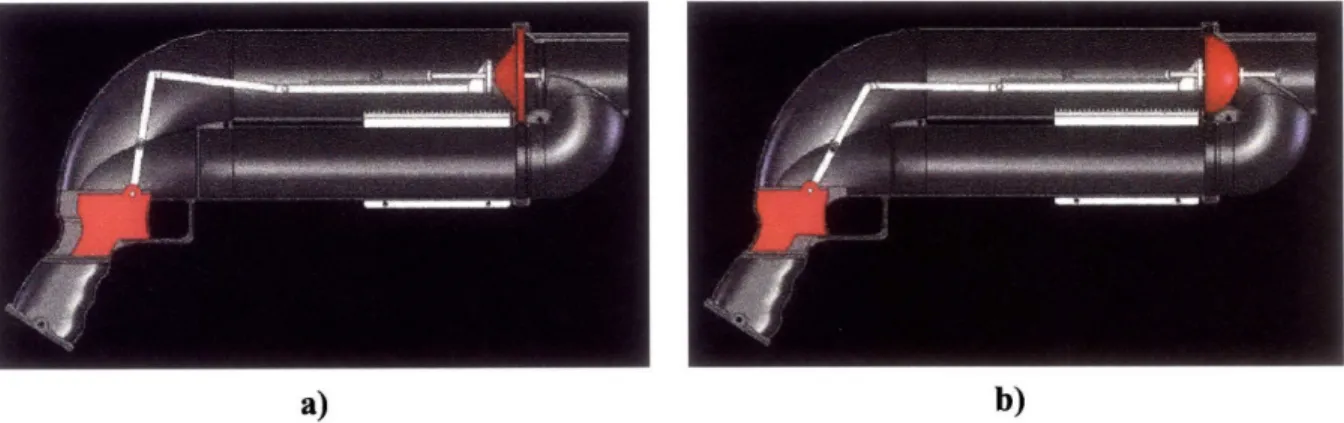
Ball storage and advancement in this prototype were also handled in the same way as they were in the flat model. Other methods were considered, but none were as simple, compact and practical as this lower tube and spring system. For the first time this prototype directly addressed ball loading. Balls are loaded by rotating the elbow piece away from the upper tube and forcing them, against the spring, into the lower tube. A small rod connected to the elbow is moved to accomplish this rotation, and is within reach of the user's pump hand. The loading mechanism is shown in Figure 2-5.
a) b)
Figure 2-5: Loading of the alpha prototype is accomplished by rotating the elbow piece
and placing balls in the lower tube.
This prototype was the first time a formal trigger was implemented. In an effort to make use as intuitive as possible, this trigger took the form of a standard gun trigger. The trigger mechanism consists of the trigger piece and a three piece linkage system. The first linkage is connected to the trigger. It acts as a lever, with a pivot point near its center, and converts the pull of the trigger toward the user's body into a push away from the body on the popper. The bottom of this linkage is constrained horizontally by the trigger, so its vertical orientation changes as the trigger is pulled backwards. For this reason pivoting is accomplished with a slot cut in this linkage, which has a sliding contact with the rod around which the linkage rotates. The second linkage simply converts the motion of the free end of the first linkage, which has a horizontal and vertical component, into a solely horizontal motion for the third linkage to apply to the back of the popper. A spring is used to return the system to its natural state after triggering. The horizontal displacement required to trigger the popper in its cocked state is between roughly one-quarter and one-half of an inch, depending on how tightly the popper is held and some other factors. To ensure consistent triggering a throw of about three-quarters of an inch was designed. This resulted in a comfortable one inch trigger pull. The force required to trigger is determined by the popper, and can easily been applied by a small child. Figure 2-6 shows the triggering mechanism.
a) b)
Figure 2-6: The triggering mechanism in its natural (a) and triggered (b) states.
Overall, the alpha prototype is quite successful, with some qualifications. All of the modules function independently, and can be made to work together. The one module which is not functioning as well as intended is the ball advancement. Balls frequently get jammed in the
elbow because the inside diameter of this piece and of the bottom tube are slightly too small. Also, the rapid prototyping process used resulted in a relatively high-friction surface. This module was made to work by placing smooth tape and baby powder on the inside of the elbow, to reduce friction, and by preloading the advancement spring, to increase the force it exerted. This problem does not warrant much concern because the module functioned well in the flat model, which used a much smoother and larger PVC elbow.
The assembly of the alpha prototype is less than ideal. In order to assembly it one must completely understand the process, and follow a very specific order. Even with an experienced assembler there is a good deal of adjusting and luck involved in the final step of fitting the two halves together. Explicit solutions to both the ball advancement and the assembly problems are discussed in the Future Work section.
2.4 Testing and Refinement
Once the alpha prototype is made it is tested in the testing and refinement stage. In some cases only minor adjustments are needed before the product can go into production. In other cases extensive redesign leads to one or more high level prototypes following the alpha. Specific suggestions for future work on the shot-popper will be discussed in the next section.
3. Conclusion
Largely, this project was a success. The combination of the flat model and the alpha prototype function well as a proof of concept for a repeating shotgun-style toy based on bistable spring propulsion. Between these two versions every important module was proven to work, including those for cocking, triggering, ball loading, storage and advancement. The alpha prototype can hold up to six 1.75 inch foam balls. It resembles a standard shotgun, and thus is intuitive in use. Also, the ball exit velocity is sufficient to produce a fun experience, while at the same time remaining extremely safe. There are a few areas that could use improvement, and so there is certainly room for future work on this project. Hasbro® has expressed a desire for a fully-functional beta prototype.
3.1 Future Work
There were some problems with the alpha prototype that should be addressed in future models. One of these problems was major, and prevented the alpha prototype from working as intended, and some of them were relatively minor, and would slightly improve an aspect of the gun if implemented.
The major problem, as described above, was ball advancement. An overly tight internal diameter of the loading tube and the elbow, combined with a high friction surface there made advancing multiple balls difficult. In the next model it is suggested that this diameter be increased from 1.80" to 2.00", and that a material with a smoother surface be used. These specifications are the same as in the flat model, which functioned very well.
Another important consideration for future models is assembly. One major improvement is easily accomplished. By reversing the orientation of the halves of the slide pieces it is possible that all the gears and racks that have to interact will be assembled on the same side. This eliminates the need to align the large gear and the rack of the slide, which are currently on different sides of the gun, when assembling it. For a prototype, difficult assembly is not a huge deal, but this would cause major problems during mass production.
Some minor changes could include holding the trigger more tightly between the two halves of the gun, possibly by deepening its guide grooves. Also, ergonomics could be slightly improved by aligning the pump with the back of the handle. Currently, there is a torque created when cocking the gun, because the user's trigger-hand is below his pumping-hand.
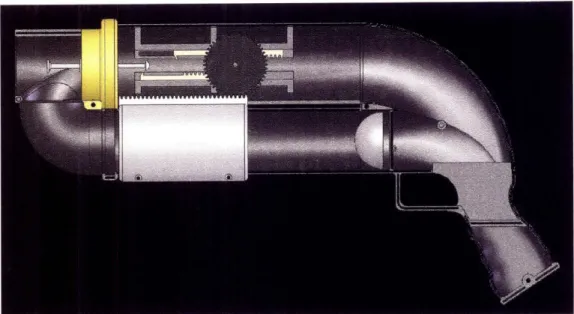
Finally, there are a few simple steps that could be taken to improve the ease of testing this toy. Firstly, it is very difficult to troubleshoot the cocking and triggering mechanisms, because, when the gun is assembled, these modules are completely enclosed in the plastic housing. Testing can be done with the gun open, but is cumbersome because only half of the popper is constrained. A simple piece that can be used to complete the popper housing, when in this open
testing mode would be extremely helpful. An example of what this piece might look like is shown in Figure 3-1. Another possible solution is to design a window into one side of the gun, so that these modules can be observed when the gun is fully assembled.
Figure 3-1: A special piece could be made which would complete the popper holder, so that the cocking mechanism can be observed in this open state, for troubleshooting.
A: Hasbro Inc. Corporate Quality Assurance Safety and Reliability
Specification, Projectiles
IIASBRO INC.
CORPORATE QUALITY ASSURANCiC
SAFIT7' AND RELIAZ IITrY SPECIFICATION
SRS -045
TITLE: PROJECTILES
BY: C. FISCHER APPROVAL:
DATE: JUNE 16 1999 RVi18SION: G
1,. PURPOSE
To establish specifications for the various structural · rleisttics and kinetic patmeters of projectiles
used on Hast~r, Ihe. products. The iment of these specifications is to minimize any potential for injuxy (cspeciaUy eCe injtay) to dhildmn while simuaneoudy maintaining the traditional play vulue represented by prjcctikr• at an ac•ptabk, but under tasonably foreseeable conditions of use and abuse.sakf level. Confnumance to the requirements ofthis specification will also ensure compliance to global requirements for projectiles.
2.0. SCOPE
This specification applies to both toys A) that ai hinendcd to latnch projctiles into frie flight by means
of a discharge mchanism in which the kinetic energy of the projectile is detern-ed by the toy and not by
the user and1 ) certain projectile toys without stored ene•gy (i.e. arrows and darts intended to tb thrown, helicopter rotor propeller blades, bows and arrows and other items intended to W thro•%m hla W~ intended to be caught),
This specification does not apply to discharge mechanisms intended to propel a ground based vehic&dar toy along a track or other surface, nor when a projectile is inaccessible to a child when it leaves the
discharge nuchanisn (e.g. a pin ball machine).
.Projectiks without stored on•rgy are acceptable only for toys wihr a mininum age grade of 3 years and
up.
Projectiles are acceptable only foer toys with a minimum age grade of4 years and up) Projectile guns and bows and arrows are acceptable only tf th o ms with a minitum age grade of 5 years and up.
Helicopter-type projectiles that arc intended for vertical discharges ar only acceptable for toys with a inimum age grade of 6ewars atnd p.
3.0 DEFINITIONS
3.1 PROJECTI ,E WITH STORED ENERGY: an object propeld by means ol'a discharge mechanism
SRS-045 PAGE 2 OF 12
RE V ISION: 0
3.2 PROJECTILE WI'THIOUT STOR)ED ENERGY: An object propelled solely by the eneqrg imparted
by a child.
3.3 DISCHILARGE MECILANISM: an inanimate system for releasing and propelling projectiles.
3.4 PROJECTII TIP -Any portion of a projectile that can reasonably be expected to contact an
impact surface (.g. an eye) during flight. A tip end or leading edge of a projectilek is not the
only possible "tip". On disc or saucer like projctiles, the "'dge" of thl disc is considered as the tip. On rotor-type projectiles that have a ling around the perimeter, all exposed surflces
of the rig should be consideredx "tips".
Note: The requirements of 6.3 appbi to all ~ tips"
See Figtur 2 for a pictoial depiction of the proper radii o a disc-type prqioctile.
3.5 PROTECTIVE TIP: - a c tmponent that is ttached to the ipacting end ofa projectile to minimize injury
if it should impact on the body and also to prevent damage to the projectile on striking a target, or prevent damage to inanimate objects.
3.6 RESII.[ENT TIP: a tip on impact surkace of a projectile that has a Shore A duromter not greater than
55 (.s measured on tlh inmpact surfltce of th tip).
3.7 RIGI)D PROJECTIlES: projectiles with an impact tip that has a shore A durometer that is greater than 55.
3.8 PROJECTILE GUNS IAND BOWS AND ARROWS: are hand-held projectile launchers that are
comparable in scale to a real firean or bovw and arrow. For puqposes of this specificalion, small
prioectile launchers scaled to the size of toy figures (e.g. C.. Joe) are p ý"projectile gurins
4.0. TEST EQUIPMENT
4.1 A radar guna capable of measuring a small projectile (larger than Hisbro small part gage) traveling at a
high speed (eg. I t milesehour).
4.2 Ulasbhro sall parts cylinder (per SRS-0XI, figure 2)
4.3 Laboratory balance with an accuracy of -' 0.1 gram. (i.e. Sauter K800).
4.4 Aluminum foil complying with the requirements of 52.
4.5 A stcel ball having a nominal diameter of 15 nmm and a mass of 14.00 .+- 0.05 grams.
SRS-045
PAGE 3 OF 12 REVISION G
501 TEST PR(OC I)lIRE
5.1 KINETIC ENERGY DETERMINA'IION
5.1.1 Thie kinetic energy (injoues. j) ofa projectile shall be determited fiom tfr th•llo-ing equation: kinetic energy 1 2 ninv
xxvhere: m = mass of projectile (Kg) :md v veloctrX of the projectile (meter sec.)
Conversion it.rtor Meters'ee .447142 x miles hour
5 1.2 'lhe mass of projectilc (kg) shall be determined by weighing a sample on a laboratory balance. A
suleicient sample size (at least 30) of -lmijectiles shall he weighed to detemine the avxrage xweight plus 3 standard dviations. 'This upper limnit veight in
Kg is used lr "'t".
5.1.3 Th:e velocit of a proectile (v) shall be determined by firing a sample fi•• the discharge nmecll ism of the toy projected out in f•rnt of the radar gun. Recording m.p.h.) The velocity of the projectiie shall be calalated fiom the expression
v (meters -seconds) ý mph x .447142. Tih value of v in the cquation is the average of five measu•rements of a given projectile.
5,2 Test tfor Penetration of To Projectiles w ith Stored Energy 5.2.1 Foil
Fron a roll ofaluaninut oilit, ut iout twenty samples measuring 105 mm x 105 minm Ensure that each sample is tfree ti'om abious impertletions inchlding creases or widnkles. Ten samples of alumi$num fil are required to verdf the( quality of the alumuintn fil and ten samples are required i t tst the toy.
5 2.2 Foil Verificaitm.
a) The qutality of the Ioil should be verified as tollows:
b) Place one oflte samples tof fbil between the nto O-rings of the clampitng fnme and clamp the lfoil
betweent the clamps so that the foil diaphragm is evenly tensioned with no creases or wri kles,
c) Place the clamping tfiuan on a substa•-tially horizont-al surtae so that the flbil diaphra'gm makes an
angle h•,etwen 15 degrees and 20 degrees relative to the horizontal.
PAGE 4 OF1 12
REVISION: G
d) Position the steel ball so that when the Lball is released it would fall ficely through a vertical distance of 300 mm to strike the central 25 mm diameter area of the lbil diaphragm.
C) Exatllmine hether or tot the fiil diaphragm miptured, as specified in 5.23
1) If1the steel ball dues not cause the ftil diaphragm to rupture, repeat steps b) to d) a fiuther tbur times. provided that each time the fbil diaphragmn does mit rupture.
g) f all tive of the fbil diaphragms do not rupture, repeat steps h• to d), but this time, drop the steel hall through a height of 500t mm.
h) If the ball causes the ftbil diaphragm to rpture, as specified in .523, repeat steps b) to d) a t•rther fotr timles, proided that each timei the foil diaphratgm does upture.
5.2.3 ntetrprtation
lThe fil diaphragm shall he considered as not ruptired if the tbil shows, without magnification, no split or
hole. A mere dent shall not he considered as a nlpture.
11 l foil diaphragm shall be considered as tuptoevd if the fois sihows. without tuagnification. a split or hole. 'lhe1 ten remaining tbil samples that are to be used to test the toy shall be considered as erifiled as being of a suitable quality if all five samples that were subjected to the ball drop heighl of 500 mm did rupture. 5. 4 TQest Specimen
11w toy sublitted for this test shall be represenltative o' the normal lpopulation anld shall not have been
slkjctied to any nornml use and rclonably lbreseeable abuse tests prior to penetration testing the toy.
5 2.5 Procedure
Ilhe procedure shall he canied out in a conditional etvironment as follows:
a) Place one ofthe verified ibtil samples lti~veen the two )-rings of the clamping riame ard clamp the
foil using lthe cl;mps so that the fil dilphrlag is evenly tensioned with no crease or wrinkles. b) 'lace the chulping thume such that the tbil diaphragm lies in a substantially verlical plane. c) I -Lad the projectile into the disclharge mechanism.
SRS-045 PAGE 5 OF 12 REVISION: G
d) Position tilk toy so that:
1) The end of the toy, thlat is, tihe end of thel projectile or the end of the discharge mechanism Fwiheivher protrudes lirthest, is 150 nml lxm the Ibil diaphragm: and
2) When the projectile s ejected the light path of the projectile would e substantially normal relative to the tfil diaphragm iand th projectile would strike the foil's center as possible,
e) Elect the prqjectile.
) (Observe w\hether r a •t tile p ljlctile ruptures the Ibil diaphragm as specified in 5.23.
g) Repeat steps a) to ) a flhther nine tines using the other nine venriied fil bsamples.
5,2.6 Report
"the report shall state the number of tines die projectile ruptured the ibil diaphragm when the toy was tested in accordance with 5.125.
53 Impact est TesFor Projectiles
Projectiles shall be propelled by their disc•ge m-echanism six times into a concrete block all (or equitivalent srtee) located at a distance 1 ibot (300 nun) plus the length of the pojectile from the front end of the discharge mehantism. 'It discharge mechanism shall •e aimed perpendicular to tlhe wall. 5.4 i se and Abuse Testing
Perfonn all pertinent use abuse life, and enxihvimlental testing on the projectile per the appropriate test
plan fbir its parent product.
5Y5 hmprovised Projectile 'IVst
letermine hrough experimentation if discharge m fchanism is capable of discharging projectiles other tflan the projectile speciically desiged fri use with the disucharge mechanism Testing of improvised projectiles shall include, but is not limited to, tthe ibiloing objects:
SRS-045
PAGE 6 OF 12
REVISION G
(All neasurnements in inches)
A) Correction Pen Cap
1) Pentel (paquing Fluid Correction Pen Oil-Based Quick Dkm.
I8 mi ZLCI-W%
Manuflcturtr: Pentel Co. Ltd. Made in Japan
A t) total l lgth-1. 10 inchIe
maximtun diameter - 0.57 inch
mintilliun diameter --53 inch
B) Marker
I) Pentel Miarker
F50
\Made in Japan
131) total flength -3.3 inches diameter - 0.91 inch 'lip length - 0.28: idth-O. 18 inch
ip Iody: leng)h - 0.70 inch max. diameter-0.65 inch min. diameter-0.36 inch
C) Marker Ca.s
1) Fluorsccnt Pen Cap 7cZbra Pen 2
Thin Size Cap,
2) Fluorescent Pen Cap bZbra Pen 2
h11in Size Cap
3) Fiber Tip Permanent Marker Cap
Arinine 70 High Per lbrance
Xylcne Free EK-70
Mantfiact twr: Shlachihata Product Made in Japan
4) Iiber Tip Pennaneni Marker C(ap Artline 70 1 lighi P•erbrancue Xvene Free EK-700
MIaufectuirer: Shachihata Pmxtuct Made in Japan
C ) lenmgth -0.93 inch
max. diameter - 0.35 inch
mit1. diameter - 0.23 inch
C2) length -1.82 inches max. diameter - 0.58 inchd
rin. diameter - 0128 inch
C3) length - 1,71 inches max. diandeter- 0.66 inch miin. dimuneter -0.51 inch
C4) length - 1-52 inches max. dituneter - 0.70 inch
milt diameter -0.69 inch
DIrnwmnsions
SRS-045 PAGE 7 OF 12 REVISION G I) Paper Clip 1) rIigonal Clip SElephant 'Trigonal
Art. No. PXMi21 Made in China F) Pell
1) Ball Pen Body
Zebra -New Crystal N-5000
Made in Japan 2) Ball Pen Body
Zebra - Hard-Crystald N- 5100
Made in Japan 3) iBall Pe Body Iic uC-1i- 19
4) Ball Pen Cap Zebra N-5000 Made in Japman 5) hall Pen Mleta Nozle
Zebra - Hard Crystal
N-5100 F) Pen Ref•ill
1) Bic ,,C-11-19
IDimeicsions
D 1) length - 1.19 inches
max, diameter -0.37 inch
min. diameter -0 15
diameter of wire -0.04 inch Dimensions
El) length - 4.56 inthies max. diameter - 0.32 inch min. dia-meler - 0.2X) inch
E2) length -4,83 inches max. dinameer - 03.1 inch min. diameter - 0.21 inch
E3) length -5.32 indwhes
max. diameter - 0.29 inch inn. dianmetcr -0.24 inch E4) length -2.32 inches
max. diameter - 0.47 inch mitt diaJeter - 0.25 inch
.5) length - (1,46 inch
max. diameter- 0.22 inch min diameter - 0. 13 inch
D1mensions
1 ) length -5.17 inches
max. diameter -(. 19 inch mini. diameter - 0.12 i2nch 2) 7Zeba Ballpoint Pen Refill BR-6A-IH-BK F2) length 5.48 inches
max. diamtnetr - 0. 12' inch min. diameter - 0.09 inch
SRS-045 PAGE 8 OF 12 REVISION (i 0) Battery I)imenwsions 1) nergizer" AA 2) itnergizer" A\AA 3) "Etlergizei" C Size
II) Mlarble& Pebble 1) Diameter 1"'
i2) Diaieter 0,635"
3) Diamtnar 0X42"
1it) length - 1.74 inches
diameter -0.41 inch
02) length -1.97 length dinmeter - 0-52 inch
03) length -1.95 inches diametler -0.99 inch
Dimen w)i -sions ll) diancte: -1 inch
112) diameter -0.635 inch
113) diamntcr - 0,642
l azard evaitltion of launched impimied projectiles shall include (but is not limnited to) the follohing: 'Tip
radii relative to kinetic energy Ibr rigid pre•.ticiaes, the kinetic energy fbI non-rigid nor resilient tipped pro jectiles; dithe kinetic energy density.
5,6 Projectile Co•nfiguratilon Evaluation
Projectiles attst not have prsjections (i.e. ribs, missiles, fins, etc.) that protrude from the main bodly of the projectile and have the potential to generate a "fishbook" elkct (ierally, projections hial extend 3.116" or more from the body of the protectile and subtend an angle of 30-90X degrees from the body and are not "blended" to the boIht will he considered as having the poteriial to generate a ".is hhook" eficot and are not acceptable ftr use on the Hasbro. Inc.. products, Hoeever. prqjectiles of a size and/or shape such th that they don't penetrate toe he fill depth of the asbro Sutipplemental Test Fixture (see SRS-004, Figure 2) in their noinal flighi orientation shall he considered acceptable regardless of corfigiraton. 'The
confitigatlmon of all projectiles nmustv he approved by Q•ality .A\ssurmance
5.7 t:nexpected Discharging O)f h!jectiles
Ietemnine through expeiimentation if the disdcarge mechanism is capable ofdischarging projectiks in an utrfireseeable, unexpected, or inordinately delayed tthslion. When the projectile is in its noriml launching po.sition only the activating button. kIcr or snwitdh must be capable of discharging the prqjcjtile. Thec actions alnd •nove lmelts of the toy during all of its reasonably forseeable nornal play modes mnust not
SRS-045
PAGE 9 OF 12
REVISION G Also. reasonably ibreseable and notmially expected handling or caLying the toy must not activate ihe discharge mechanlisnm In addition, the pmjetile shouild discharge %ithin a reasonable time priod tater activation, (see 6.8)
5,8 Projectile Kinetic Energy Densitx
'lhc projectile kinetic cmrgy' decnity mist he determined on all projectiles with a kinetic etergy greater
thaem 08joule "Tlhe Projectile Kinetic Energy )ensity is the kinetic energy ofthe projectik divided by its contact area. On non-rigid (i.e including resilient tipped) pmojectiles the contact area is measured by applying a suitable staining agent (e.g. Prussian Blue) to the projectile, btring it at a suitable surface 1 tlot
way and reasuring the area of the re.idual iiiprssion, Area is determined by the following:
Radius in meters: Area II r2
Radius in inches: Area .0 ,06452 HI r lie kinetic energy density is expressed as joules.area. 5.9 Arrows, Darts and Other "'Thrown Items and Bows
11he kinetlic energy of anows, darts and other projectiles. intnded to be thrown shall be imparted to the tprojetile by a adult thlrwing the projectil with the highest reasoably freseeable vekloity. iTo detenmine the highest easonably fre-cabkl velocity, child testing with children of the highest age br which he ttoy is intended may be retquired.
For lxbos, Le an aw intended thebo and etch tthe how anstrd etch the boi' ting using a maxinum fbrce ot f8. lbs. (35.6 neston). as far as the anrow allos•s, but to a 28 inch maxint•nu (71 cm).
6.0 SPEC IFI(CATIONS
6.1 No projectile intendedl to be fired fi'om the toy shall have shair edges per SRS-)03, shnup points per SRS-002, or parts that tit without compression (iL.b.the Ib. weight i's NOT used) into the Hlasbro cylinder per SRS-00O1. (NOTE: pieces that detach as a result of abuse test and canrot ie launched by the discharge mechanism are not projecties).
6.2 No prqjectdie shall have a configunation that generates a "fishhiook" el•it (See 5.61 .
6.3 No projectile itred tom a toy shall have a tip radius less than 2 mm (.08 in-I. 'lThe minimum allowable tip radius increases in direct plrportion to the kinetic energy ofthe projectile per the table below:
SRS-045 PAiGE 10 OF 12
REVISION G
PROJEIC IlE ENE;RGY ALEKVEI M2IINIMIM Al A)W. ABIE TIP RAl)IIS
up to .025 joule 2 nun
from .025 to t05 joule 3 nm-lrion .05 to.10 jouIle 4 mm
li-nm. 10 to 1 5 joule 5 mm
from, 15 to .20joule 6nmm
N(OTE: Any projectile with an enetrg level of .25 joule or greater must he reviewedn and pproved by
Senior Vice President, Hasbro uuality .ssurance,
Projectilcs in the bitmi of: arrows or darts or other missile-shaped objects that are intended to be thrown by the user mst havSe resilient tips with an itpat area of at least 4 enm_ (.620 il)
Helicopter rotor)s and single propellers intended to be powered into vertical or nearly vertical flight by a spring mechainim or similar device u•st have a ring around the perimeter that complies with all the radii requirevments of this section,
6.4 Any p•ojectikl fird from the oys that has a kinetic cergy that exceeds 08 joule (as detenriined by sctionC
5.1) shall have an impact surthiee (s) of a riliient material,
N(E: If the fli:ght dcharacteristic of the pmiectile are sauch that it tumbles or t•ns around in flight when the kinetic energy exceeds .08 joule, then all profile stirl'ees are to be treated as impact surfiaces
O65 Dischargc mechanisms must be unablle to discharge h•artmous imprtoised projectiles
6 6 All projectiles must withstand the impact test for projectilesk (53 ab Ne) withoutL the generation of a lhazardous condition.l
6.7 A protective tip shall not be detached ifron the pronectile when suhjected to torque tension test per
SRS-006 (iec 8 in-lbs torqueiu2)5 lbs tension) and shall not detach or produce or reveal hazardous points or
edges wlten fired into a solid otiect according to test prcedure described in 5.3 above.
6 8 Projectiles must anot he discharged in an unexpected ftshion. Projictiles nmut discharge withlin 4 seconds after laullnch activation (unless there is ampleý waing in the fbnt of lights, sounds, etc.)
(3 li•e Kinetic lEnergy Density of prlijctiles mlust not exceed 1600 joules mn (See section 5.81),
NOTE: Kinetic Energy Dae•ity detennination is not requied for pruiectiles with an energy lvel less than .08 joule.
SRS-045
PAGE 11 OF 12
REVISION G
6. 10 A to>y, lhen tested ian a:cordance with 5,2, shall naot eject a stored energ prqiectile that resulLts in the
rupuring of more than two out ofthe ten Ioil diaphragms.
6. 11 AunX sub~ect to> capable of dischaurgig a projectile with a kinetic enera greater than 0.08 joule must
ca'rv a cautionary statement on the toy (see SRS-070 -Section 4.8).
6. 12 All projectiles must meet alxwe specifications both heibre and after all pertinent utse abuse, lilt and envirormental testing per the appropriate test
plan-6. 13 Sunmry of Selected Requirements
Tip Radii Resilient Tip* K.ED. Foil Test
lPr9jetile Type (Section 63) (64A) (6.9) (6. 1 0)
Rigid Yes Yes No Yes *
Stored energy Yes Ye Yes* Yes** No stored energy Yes Yes Yes" No
*Applies only if K.E. is •- 08 joule
1**Does not apply to disc or saucer type projectiles.
7.01 RlIFIRENC ES
7.1 F963 (ASTMI). sections 4.20 and 8. 15
7-2 Iroduct Safety and ,iability Reporter. 821 81, pp 645-646
7.3 NBS report No. 10-893 "Ocular hjury pote~lial of projctile-type toys. 8.i172
7.4 EN71-: 1998, Sections 4.1 7 and 8.25
7 5 "uidelines for relating childreu's ages to toy chauacteristic', CPSC, (10785, Page 181.
7 6 Australian Standard 1647.2-1992, "Children's Toys (Safety Requirements). Construction•al
TOP VIEW
BECTJON A*A
HT'ES;
I The dfi.Iions p•ntd hall be withiba i •ranre d • J anm.
2 Thi rflcrsioM • saO marlad Jall be 1w- hiS n a olerae *O0. i am.
DlGMSION IlN MhIUIfJIERES
F D PLAN VI F G FRAME
"GURE DD1 PLAN VIEW OF PIAMPING FRAME
AS 14J-l-92 70
S-
Vte
-- ·- --- ----
~1SK PROS~crrCEg
SRS -o 3(
F'tSJRa
2Z.Onw MIN. Fufr. ~ADICIS
References
Fienup, William J. and Barry M. Kudrowitz, 2005. "An Exploration of Concepts in Projectile Toy Design." M.S. Thesis, Department of Mechanical Engineering, MIT. Cambridge, MA. Michal, Matt. Nerf center review. Available on the Internet: http://www.nerfcenter.com, 2003. Hasbro Incorporated. Official website. http://www.hasbro.com, 2007.
Ulrich, Karl and Steven Eppinger, 2004 "Product Design and Development." Third Edition. McGraw Hill, Boston, MA.
![Figure 1-1: A Hopper Popper in its natural (a) and inverted state (b) [Fienup and Kudrowitz].](https://thumb-eu.123doks.com/thumbv2/123doknet/14688131.560647/11.918.148.730.684.917/figure-hopper-popper-natural-inverted-state-fienup-kudrowitz.webp)
![Figure 1-2: Hand poppers designed by Bill Fienup and Barry Kudrowitz (a) [Fienup and Kudrowitz], James Penn (b) [Photo courtesy James Penn], and Hasbro® (c) [Hasbro].](https://thumb-eu.123doks.com/thumbv2/123doknet/14688131.560647/12.918.147.781.678.914/figure-poppers-designed-fienup-kudrowitz-fienup-kudrowitz-courtesy.webp)
![Figure 1-3: State of the art repeating Nerff ball-firing toys. Ball BlasterTM - 1999 (a), and its redesign the ReactorTM - 2006 (b) [Hasbro].](https://thumb-eu.123doks.com/thumbv2/123doknet/14688131.560647/13.918.124.796.443.655/figure-state-repeating-nerff-blastertm-redesign-reactortm-hasbro.webp)
![Figure 2-1: An early prototype used to test the idea of cocking the popper from behind, with a mechanical advantage [Photo courtesy James Penn].](https://thumb-eu.123doks.com/thumbv2/123doknet/14688131.560647/16.918.197.727.654.920/figure-prototype-cocking-popper-mechanical-advantage-photo-courtesy.webp)
![Figure 2-2: The "Flat model" which was used to test designs for cocking, storage and ball advancement [Photo courtesy James Penn].](https://thumb-eu.123doks.com/thumbv2/123doknet/14688131.560647/17.918.172.746.531.816/figure-designs-cocking-storage-advancement-photo-courtesy-james.webp)
![Figure 2-3: Conceptualization showing balls and the spring in the loading tube r[Image courtesy James Penn].](https://thumb-eu.123doks.com/thumbv2/123doknet/14688131.560647/19.918.159.748.136.397/figure-conceptualization-showing-spring-loading-image-courtesy-james.webp)