HAL Id: hal-01320684
https://hal.sorbonne-universite.fr/hal-01320684
Submitted on 24 May 2016HAL is a multi-disciplinary open access archive for the deposit and dissemination of sci-entific research documents, whether they are pub-lished or not. The documents may come from teaching and research institutions in France or abroad, or from public or private research centers.
L’archive ouverte pluridisciplinaire HAL, est destinée au dépôt et à la diffusion de documents scientifiques de niveau recherche, publiés ou non, émanant des établissements d’enseignement et de recherche français ou étrangers, des laboratoires publics ou privés.
Gianfranco Dalla Barba, Marta Brazzarola, Sara Marangoni, Claudia
Barbera, Ilaria Zannoni
To cite this version:
Gianfranco Dalla Barba, Marta Brazzarola, Sara Marangoni, Claudia Barbera, Ilaria Zannoni. A longi-tudinal study of confabulation. Cortex, Elsevier, 2016, �10.1016/j.cortex.2016.05.009�. �hal-01320684�
M
AN
US
CR
IP
T
AC
CE
PT
ED
A longitudinal study of confabulation
Gianfranco Dalla Barba1, 2, 3,4, Marta Brazzarola4, Sara Marangoni4, Claudia Barbera4,
Ilaria Zannoni4
1
INSERM, Paris, France
2
Institut de la Mémoire et de la Maladie d’Alzheimer (IM2A), Département de Neurologie, Hôpital de la Pitié-Salpêtrière, Sorbonne Universités, Université Pierre et Marie Curie-Paris6, Paris, France
3
Dipartimento di Scienze della Vita, Università degli Studi di Trieste, Italy
4
Centro Medico di Foniatria, Unità Operativa Complessa di Riabilitazione Neurocognitiva, Padova, Italy
keywords: confabulation, amnesia
Corresponding author: Gianfranco Dalla Barba Institut de la Mémoire et de la Maladie d’Alzheimer (IM2A), Département de neurologie
Hôpital de la Pitié-Salpêtrière 47, bd de l'Hôpital
75651 Paris Cedex 13
email : [email protected] tel : +33 42 16 75 52
M
AN
US
CR
IP
T
AC
CE
PT
ED
AbstractConfabulation, the production of statements and actions that are unintentionally incongruous to the subject’s history, background, present and future situation, is a rather infrequent disorder, observed in several conditions affecting the nervous system. Little is known about the quantitative and qualitative evolution of confabulation in time. In this study we evaluated longitudinally the evolution of this disorder in a group of severe confabulators, using the Confabulation Battery, a sensitive tool to detect confabulations in various memory domains. It was found that confabulations were stable over time and not temporally limited. It was also found that “Habits Confabulations”, i.e. habits and repeated personal events
mistaken as specific, unique past and future personal episodes, or well-known public events when semantic knowledge is concerned, was the more frequently observed type of
confabulation. Confabulations were also more prominent in the domain of Temporal
Consciousness, i.e. a specific form of consciousness that allows individuals to remember their personal past, to be oriented in their present world and to predict their personal future, than in Knowing Consciousness, i.e. a specific form of consciousness allowing individuals to be aware of past, present and future impersonal knowledge and information. Confabulations showed also persistence, i.e. confabulations at the same questions over time, and consistency, i.e. same type of confabulation at the same question over time. These findings are discussed within the framework of the Memory, Consciousness and Temporality Theory.
M
AN
US
CR
IP
T
AC
CE
PT
ED
IntroductionSome patients with significant memory impairment show confabulation, the production of statements and actions that are unintentionally incongruous to the patient’s history, background, present and future situation (Dalla Barba, 1993a).
This rather infrequent disorder is a classical and pathognomonic sign of Korsakoff’s syndrome (Benson et al., 1996; Bonhoeffer, 1904; Cermak, Uhly, & Reale, 1980; Dalla Barba, Cipolotti, & Denes, 1990; Korsakoff, 1889; Mercer, Wapner, Gardner, & Benson, 1977; Wyke & Warrington, 1960). But confabulation is also observed in patients suffering from ruptured aneurisms of the anterior communicating artery, subarachnoid hemorrhage or encephalitis, head injury (e.g. Baddeley & Wilson, 1986; Dalla Barba, 1993b), Binswanger’s Encephalopathy (Dalla Barba, 1993a); Alzheimer’s disease and frontotemporal dementia (Attali, De Anna, Dubois, & Dalla Barba, 2009; Dalla Barba, Nedjam, & Dubois, 1999; Kern, Van Grop, Cummings, Brown, & Osato, 1992; La Corte, Serra, Boissé, & Dalla Barba, 2010; Nedjam, Dalla Barba, & Pillon, 2000; Nedjam, Devouche, & Dalla Barba, 2004) and aphasia (Sandson, Albert, & Alexander, 1986). Confabulation may also be observed, on occasion, in normal subjects (Dalla Barba et al., 2002; Kopelman, 1987).
Since the early description of this phenomenon, clinicians and scientists have
distinguished between two types of confabulation (Bleuler, 1949; Bonhoeffer, 1904; Flament, 1957; Talland, 1961). Kopelman (1987), synthetizing these distinctions, proposed to
distinguish between "provoked" and "spontaneous" confabulation. According to Kopelman, provoked confabulation reflects a normal response to a faulty memory, whereas spontaneous confabulation reflects the production of an "incoherent and context-free retrieval of memories and associations" (Kopelman, 1987, p.1482) resulting from the superimposition of frontal dysfunction on an organic amnesia. The provoked/spontaneous distinction correctly captures
M
AN
US
CR
IP
T
AC
CE
PT
ED
two extreme forms of confabulation, which may have different underlying neurocognitive mechanisms.
Dalla Barba and co-workers (Dalla Barba & Boissé, 2010; La Corte et al., 2010)
proposed a taxonomy of confabulation based on a qualitative account of their content. Based on clinical and experimental studies showing that confabulations often consist of personal habits, which are considered by the patient as specific personal episodes, Dalla Barba and co-workers found that what they named “Habits Confabulation” (HC) was the more frequently observed type of confabulation in their studies (Dalla Barba & Boissé, 2010; La Corte et al., 2010; Serra et al., 2014).
Confabulation is not associated to any specific brain lesion. It is frequently observed following orbitofrontal lesions, but can occur in patients with lesions in more that twenty anterior and posterior brain regions. Indeed, as proposed by Dalla Barba and La Corte (Dalla Barba & La Corte, 2013; Dalla Barba & La Corte, 2015), what seems to be most important for confabulation is neither aetiology nor locus of damage, but at least partial or unilateral
integrity of the hippocampus. Gilboa and Moscovitch found that out of 79 patients with confabulation two had unilateral perirhinal lesions and one had a unilateral parahippocampal lesion. None of these patients had lesions involving the hippocampus (Gilboa & Moscovitch, 2002). 28 additional confabulating patients not included in Gilboa's and Moscovitch's review had also preserved hippocampus (Dalla Barba & Boissé, 2010).
Drawing on the Memory, Consciousness and Temporality Theory (Dalla Barba, 2002), it has been shown that patients confabulate exclusively (Dalla Barba, 1993a; Dalla Barba, Boissé, Bartolomeo, & Bachoud-Lévi, 1997; Dalla Barba, Cappelletti, Signorini, & Denes, 1997), or significantly more frequently (Dalla Barba, 1993b; Dalla Barba & Boissé, 2010; Dalla Barba, Boissé, Bartolomeo, & Bachoud-Lévi, 1997; Dalla Barba et al., 1990; La Corte, George, Pradat, & Dalla Barba, 2011), in Temporal Consciousness (TC), i.e. a specific form
M
AN
US
CR
IP
T
AC
CE
PT
ED
of consciousness that allows individuals to remember their personal past, to be oriented in their present world and to predict their personal future, than in Knowing Consciousness, i.e. a specific form of consciousness allowing individuals to be aware of past, present and future impersonal knowledge and information.
An open question concerning confabulation is whether or not it should be considered a transient sign observable in the acute or sub acute stage of patients with acquired brain injury. It is uncontroversial that, on some occasions, confabulations may decrease and disappear in few days or weeks, or even suddenly recover (Dalla Barba, Barbera, Brazzarola, &
Marangoni, 2016). However, little is known about the quantitative and qualitative evolution of confabulation in time. To the best of our knowledge, only one study (Schnider, Ptak, von Däniken, & Remonda, 2000) followed up eight confabulators for several months, observing that seven of them eventually stopped confabulating. Unfortunately, the above study doesn’t provide any quantitative measure of confabulation. Another study, (Bajo et al, this issue)
evaluated confabulations longitudinally for 9 months and found that they were
correlated to the severity of memory impairment and toerrors on executive tests.
Little is known about persistence, i.e. confabulations at the same questions over time, and consistency, i.e. same type of confabulation at the same question over time. This information would show to which degree confabulators confabulate randomly and inconsistently, or they tend to confabulate to the same questions, with the same type of content, when tested with the CB at different times. Dalla Barba and co-workers (Dalla Barba et al., 1990) found that in their patient CA persistence and consistency were main features. Tested in different sessions, CA showed a persistence of 91% and a consistency of 78%. In another study on a single
case, Fotopoulou et al (Fotopoulou, Solms, & Turbull, 2004) found that confabulations
were consistent over time.
M
AN
US
CR
IP
T
AC
CE
PT
ED
using the CB, a tool that allows both the quantification and the qualification of confabulation. The prediction is that the quantity and the quality of confabulation should not change in time, provided that the patients’ brain lesion is not progressive. Based on previous studies of the Dalla Barba’s group, it is also predicted that HC would be the more frequently observed type of confabulation, and that confabulations in TC would be more frequent than confabulation in KC.
Materials and methods
Participants
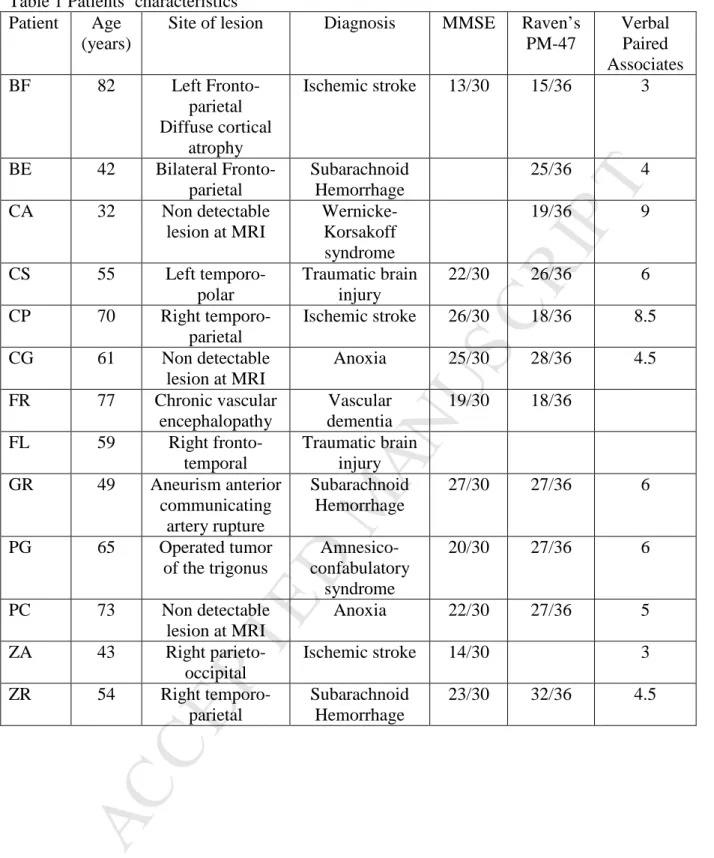
A total of 26 participants entered the study. Thirteen confabulating amnesic (CA) patients (5 female, mean age: 58.6, range: 42-82, years of education: 12, range: 5-17, all right-handed) of various etiologies (see Table 1 for CA patients characteristics) and 13 age and education matched normal controls (NCs, 5 female, mean age: 58.6, range: 42-82, years of education: 14, range: 8-18, all right-handed). None of the patients was in an acute or sub-acute stage, since the pathological event that caused the amnesic confabulatory syndrome occurred at least 2 months before the patients were evaluated for confabulation (mean: 16.2, range: 2-75). All patients had a digit span ≥ 5 and were judged to be normal on bedside tests of oral expression and understanding of oral language. Patients were tested on frontal/executive functions
with the Frontal Assessment Battery. Four of them were impaired on this test, but none
of them confabulated more than the other patients, thus making improbable that, in this
study, confabulation could be traced back to a frontal/executive impairment.; NC were
either spouses of patients or other individuals who volunteered to participate in the research projects of our laboratory. The study was conducted in accordance with the ethical standards laid down in the Declaration of Helsinki (2000).
M
AN
US
CR
IP
T
AC
CE
PT
ED
Insert Table 1 about here ---
Experimental material
Confabulations were collected with the Confabulation Battery [(CB) (Dalla Barba, 1993a; Dalla Barba & Decaix, 2009)]. The CB involves the retrieval of various kinds of information and consists of 165 questions, 15 for each of the following domains:
1) Personal Semantic Memory (age, date of birth, current address, number of children, etc.).
2) Episodic Memory. Episodic, autobiographical questions.
3) Orientation in Time and Place.
4) Linguistic Semantic Memory. Items 16 to 30 of the WAIS vocabulary subtest were selected for a word definition task.
5) Recent General Semantic Memory. Knowledge of facts and people, which have been repeatedly reported in the news during the last ten years. For example, “Who is Ben Laden?”
6) Contemporary General Semantic Memory. Knowledge of famous facts and famous people from 1940 to 1990. For example, “What happened in Paris in May 1968?”
7) Historical General Semantic Memory. Knowledge of famous facts and famous people before 1900. For example, “What happened in 1789?”
M
AN
US
CR
IP
T
AC
CE
PT
ED
8) Semantic Plans. Knowledge of issues and events likely to happen in the next ten years. For example, “Can you tell me what you think will be the most important medical breakthrough likely to take place in the next ten years?”
9) Episodic Plans. Personal events likely to happen in the future. For example, “What are you going to do tomorrow?”
10)“I don’t know” Semantic. These were questions tapping semantic knowledge and constructed so as to receive the response “I don’t know” from normal subjects. For example, “What did Marilyn Monroe’s father do?”
11) “I don’t know” Episodic. These questions tapped episodic memory and were constructed so as to receive the response “I don’t know” by normal subjects. For example, “Do you remember what you did on March 13, 1985?”
Procedure
Questions from the 11 domains were presented to patients, in a semi-randomized order, twice, at T0 and at T1. The mean interval between T0 and T1 was 12.3 months. Responses were scored as ‘correct”, “wrong”, “I don’t know”, and “confabulation”. For episodic memory, responses were scored “correct” when they matched information obtained from the patient’s relatives. Correct responses were self-evident for semantic memory questions. For “I don’t know” questions, both Semantic and Episodic, an “I don’t know” response was scored as correct. Since there is no sufficiently acceptable external criterion capable of defining confabulation, for its detection an arbitrary decision necessarily had to be made. In order to distinguish between a wrong response and a confabulation a clear-cut decision was adopted only for answers to questions probing orientation in time. In this case the most strict criterion was chosen: answers to questions regarding the current year, season,
M
AN
US
CR
IP
T
AC
CE
PT
ED
month, day of the month, day of the week and hour of the day were judged to be confabulations only if erring for more than 5 years, 1 season, 2 months, 10 days, 3 days or 4 hours, respectively. Answers to the other questions of the CB were independently rated as ‘correct’, ‘wrong’, and ‘confabulation’ by four different raters, and interrater reliability was 100%. Minor distortions were considered errors, whereas major discrepancies between the expected and the given answer were considered confabulations, regardless of their content. In other words, generic responses and misplacements were not coded as confabulation if they didn’t show major discrepancies with the expected response. It must be emphasized that the decision as to whether an answer was wrong or confabulatory was never puzzling, although it may have been made on an arbitrary or subjective basis. As far as questions concerning personal and semantic plans are concerned, it might be argued that any possible answer is a confabulation, since, by definition, the future is only “probable” and there is in principle no “correct” answer to questions about the future. Yet, answers concerning the future can be definitely confabulatory when they show a marked discrepancy or a real contradiction with what a predicted future event might be, in view of the present situation. For example, although he was hospitalized and in a wheelchair, to the question “What are you going to do tomorrow?”, one patient answered “I’m going at work”.
Three different, independent raters classified confabulations according to the following criteria:
- Habits: either habits and repeated personal events mistaken as specific, unique past and future personal episodes, or well known public events when semantic knowledge is concerned.
- Misplacements: true episodes and facts misplaced in time and place
- Memory Fabrications: plausible memories, semantic or episodic, without any recognizable link with personal or public events.
M
AN
US
CR
IP
T
AC
CE
PT
ED
- Memory Confusions: confusions with other personal or public events related to the target memory or confusion between family members.
- Autoreferential Contaminations: when patients, questioned about public or historical events, refer to the event in a personal context.
- Semantically Anomalous: confabulations with an extremely bizarre and semantically anomalous content.
Statistical analyses were conducted on the total number of correct responses and confabulations on the CB. Further analyses were conducted on the types of confabulations, as classified according to the criteria described above, and on the persistence and the consistency of confabulation at T1 compared to T0. In all the statistical analyses the α value was set at 0.05 and the familywise error rate was controlled with the Bonferroni correction where appropriate.
Results
NC produced significantly more correct responses than CA for all types of questions (all P<0.01) and they produced only some sporadic confabulation.
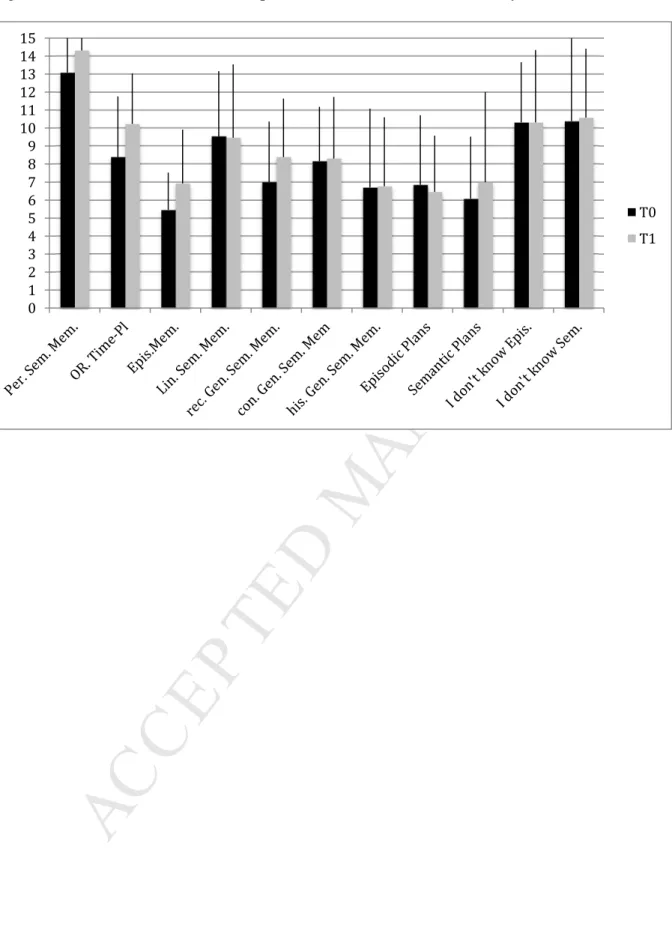
Patients’ number of correct responses at T0 and T1 is reported in Figure 1. ---
Insert Figure 1 about here ---
In CA correct responses did not vary significantly between T0 and T1 (all P>0.05). Statistical analysis (multiple T Tests corrected for multiple comparisons) revealed that they produced significantly fewer correct responses to Episodic Memory questions than to any
M
AN
US
CR
IP
T
AC
CE
PT
ED
other type of question (all P<0.05). They produced more correct responses to Personal
Semantic Memory questions than to any other type of question, except I don’t know Episodic and Semantic questions. No significant differences emerged comparing correct responses to the remaining questions of the CB.
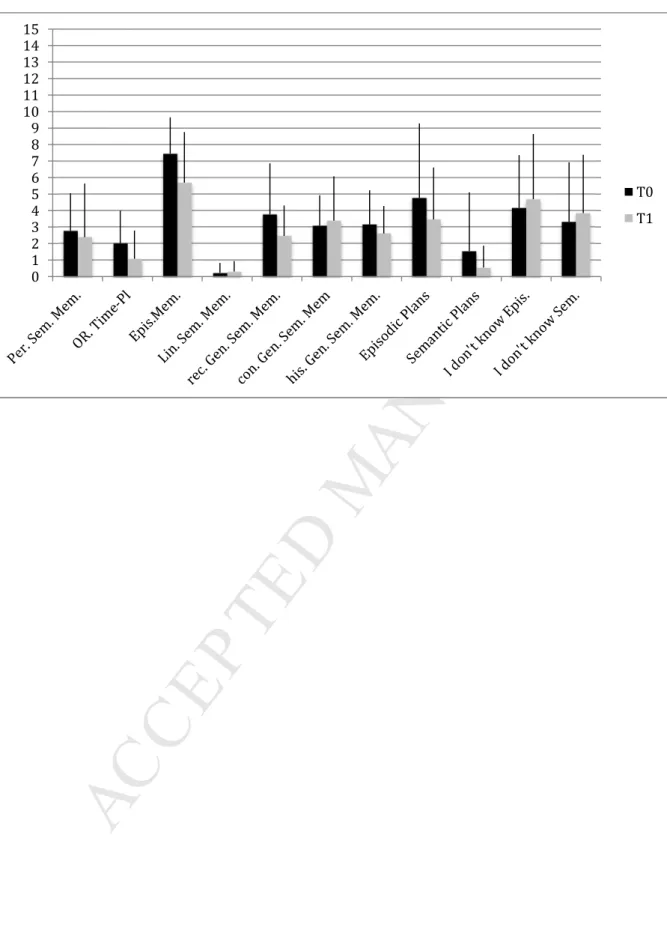
Patients’ number of confabulation at T0 and T1 is reported in Figure 2. ---
Insert Figure 2 about here ---
According to the criteria proposed by the Dalla Barba’s group (Serra et al., 2014) all patients were severe confabulators since they produced at least 40% of confabulations in Episodic Memory questions.
Overall, patients produced 471 and 396 confabulations at T0 and T1, respectively. This difference was not statistically significant. Statistical analyses (multiple T Tests corrected for multiple comparisons) revealed that at T0, patients produced more confabulations to Episodic Memory questions than to any other type of question (all P<0.01). They also produced significantly fewer confabulations to Orientation in Time and Place, Linguistic Semantic Memory and Semantic Plans than to any other type of question (all P<0.01). Exactly the same pattern of results was observed at T1.
Types of confabulation.
The mean percentage of each type of confabulation at T0 and T1 is reported in Figure 3. ---
M
AN
US
CR
IP
T
AC
CE
PT
ED
---Both at T0 and at T1 patients produced more Habits confabulations (HC) than any other type. HC accounted for 37% and 36% of confabulation at T0 and T1, respectively. Misplacements confabulations accounted for 19%, both at T0 and T1. Memory Fabrications accounted for 18% and 20% at T0 and T1, respectively. Memory confusions accounted for 18% and 20% at T0 and T1, respectively. Autoreferential Contaminations and Semantically Anomalous confabulations accounted for less than 2%.
Statistical analyses (multiple T Tests corrected for multiple comparisons) revealed that patients produced significantly more HC, both at T0 and T1, compared to other types of confabulations (all P<0.05). No significant difference emerged comparing other types of confabulations, either at T0 or at T1. Autoreferential Contaminations and Semantically Anomalous confabulations were excluded from the analysis. For all types of confabulation, no significant difference emerged for confabulation produced at T0 and at T1.
Burgess & McNeil (Burgess & McNeil, 1999) described a patient in which specific
events were replaced by routines, Habits confabulations. However, their explanation
was quite different to that proposed here. In fact they attributed this phenomenon to an
executive dysfunction.
Confabulations, Temporal Consciousness and Knowing Consciousness
The CB includes questions measuring Temporal Consciousness (TC), i.e. individuals’ ability to be oriented in their personal temporality, and questions measuring Knowing Consciousness (KC), i.e. individuals’ ability to retrieve information concerning an impersonal past, present and future (Dalla Barba, 2002; Dalla Barba & La Corte, 2015). Measures of TC
M
AN
US
CR
IP
T
AC
CE
PT
ED
in the CB are questions of: Personal Semantic Memory and Orientation in Time and Place, which are measures of the “present” component of TC, Episodic Memory Questions and I Don’t Know Episodic which measure the “past” component” of TC, and Episodic Plans, which measure the “future” component of TC. Measures of KC in the CB are questions of: Linguistic Semantic Memory, recent General Semantic Memory, historical General Semantic Memory, Semantic Plans and I Don’t know Semantic.
Results (Fig. 4) showed that both at T0 and at T1 patients produced significantly more confabulation in TC than in KC (both P<0.01). No significant difference emerged comparing confabulation at T0 and T1 both for TC and KC.
--- Insert Figure 4 about here ---
Persistence and consistency of confabulation.
A further analysis was devoted to detecting whether or not confabulatory responses were given to the same questions at T0 and T1. It was found that confabulations persisted to the same questions at T1 44.7 % of times. We also examined whether persistent confabulation would also show consistent content. This was actually the case for 72.9% of confabulations.
Discussion
This study was aimed at evaluating confabulation longitudinally. Patients were administered the CB twice, at different intervals. The interval between the first and the second administration of the CB varied, but all the patients were in a chronic stage. None of them
M
AN
US
CR
IP
T
AC
CE
PT
ED
was demented or had short term memory or working memory impairment, which could have precluded their inclusion in the study.
Consistent with our prediction, confabulations were stable over time. No significant difference emerged in any of the CB’s domains at T0 and T1. This result is not surprising, since our patients were in a chronic stage and none of them had progressive brain pathology.
Little is known about the duration of confabulation and the structural basis of its recovery. Schnider and colleagues (Schnider, Ptak, von Däniken, & Remonda, 2000) found that
confabulation is temporally limited. They followed up eight confabulators for more that three years. Seven patients eventually stopped confabulating and regained orientation. In some patients recovery might be more abrupt than gradual (Schnider, 2008), but, almost invariably they remain amnesic. Schnider and colleagues made their observation in patients with
orbitofrontal lesions. In our group, the only patient, GR, who had an orbitofrontal lesion due to rupture of an AACoA still confabulated 19 months (T1) after the first presentation of the CB. A possibility suggested by Schnider (2008) to account for recovery of confabulations in his patients is that perilesional areas in the anterior limbic system may, with time, compensate for the impaired inhibitory functions of the damaged areas. However, what these areas
precisely are and do is unknown.
Based on previous studies of the Dalla Barba’s group, we also predicted that HC would be the more frequently observed type of confabulation. Consistent with our prediction, HC were the most frequently type of confabulation produced by our patients, both at T0 and T1. Other types of confabulations were also present, but contributed much less than HC to the total number of confabulatory responses. The great majority of confabulations in this study fall into four categories, HC, Misplacements Confabulations, Memory Fabrications and Memory Confusions (Semantically Anomalous and Autoreferential confabulations were sporadic). These types of confabulations clearly differ in their type of content, which consists
M
AN
US
CR
IP
T
AC
CE
PT
ED
of habits, repeated memories in HC, of temporo-spatial misplacements of true episodes, of episodes that never happened to the subject, or in confusions between true episodes or people in the other types of confabulation. These differences may reflect the involvement and
disruption of different cognitive processes and possibly different underlying neural
substrates. However, these confabulations also show commonalities in that they all show a plausible content. In other words, a hypothetical observer faced to these types of
confabulations, could never recognize them as such, unless he or she is aware of the personal history, background and present situation of the individual who produces them.
HC reflect confabulators tendency to recall as temporally specific memories, events that belong to their habits and routines (Dalla Barba & Boissé, 2010; La Corte et al., 2010). They are more inclined than normal subjects and non-confabulating amnesiacs to produce responses that have a high probability of occurrence in a particular situation. With minor exceptions, such patient’s memories are driven by routines, which they believe persist even when they no longer occur. It is clinically well known, for instance, that hospitalized confabulators, when directly questioned on what they have done the previous day, usually report routine activities from their life before the accident. For example, they may say that the previous day they went to work or that they had dinner at home “as usual”. In this case, irretrievable episodic memories, i.e. events that occurred in a unique and specific temporo-spatial context, are replaced by routines, i.e. multiple, repeated events that didn’t occur in a unique and specific temporo-spatial context. Therefore we can say that multiplicity, i.e. routines and repeated events, is mistaken for uniqueness, i.e. a specific unique event that occurred in a specific, unique temporo-spatial context (such as the previous day).
Confabulators’ tendency to mistake multiplicity for uniqueness has been recently demonstrated by the Dalla Barba’s group (Serra et al., 2014). The authors proposed to
M
AN
US
CR
IP
T
AC
CE
PT
ED
which some items were seen only once at study, whereas others were seen four times. Confabulators, but not non-confabulating amnesiacs, considered repeated items as unique, thus mistaking multiplicity for uniqueness and a significant correlation was found between unique responses to multiple items and the production of HC in the CB.
This study also predicted that confabulations in TC would be more frequent than
confabulation in KC. This was actually the case. On the Confabulation Battery, confabulators produced significantly more confabulation to questions concerning their personal temporality compared to questions concerning impersonal temporality. This confirms previous findings from the Dalla Barba’s group (Dalla Barba et al., 1997b; La Corte et al., 2011; La Corte et al., 2010) and shows that confabulation does not affect only episodic memory, that is, the
patients' ability to consciously recall events and episodes from their personal past, but personal temporality as a whole, i.e. the personal past, present, and future.
Our patients presented heterogeneity of aetiologies and of lesions’ site, confirming that, as proposed by Dalla Barba and La Corte (2013), what seems to be most important for
confabulation is neither aetiology nor locus of damage, but at least partial or unilateral integrity of the hippocampus. None of our patients had hippocampal lesions. The existent evidence overwhelmingly supports the conclusion that at least partially preserved
hippocampus is a necessary condition for confabulation. The hippocampus is reciprocally connected with all association areas. It receives projections from upstream, from neocortical association areas, and projects downstream, through the fornix, to the mamillary bodies, the hypothalamus, the anterior thalamus, the anterior cingulate gyrus, and the orbitofrontal cortex. Lesions to the fornix result in amnesia without confabulation, whereas confabulation has been described for lesions involving all the above neural structures, but sparing the hippocampus. With the exception of lesions involving the fornix, damage at any point of the pathways running downstream the hippocampus produce confabulation, provided that the hippocampus
M
AN
US
CR
IP
T
AC
CE
PT
ED
is, at least partially, preserved. Lesions to structures and pathways projecting from upstream to a preserved hippocampus are also known to produce confabulation (Dalla Barba, 1993). In short, as proposed by Dalla Barba and La Corte (2013), confabulation seems to occur when a preserved hippocampus receives distorted information from more than twenty damaged, predominantly orbitofrontal, brain areas. The predominance of confabulation in TC in this study, compared to confabulation in KC, fits the model proposed by Dalla Barba and La Corte (Dalla Barba & La Corte, 2013; Dalla Barba & La Corte, 2015). According to their model, the hippocampus is crucial both for the normal functioning of TC and as the generator of
confabulations, and that different types of confabulation can be traced back to a distortion of TC resulting from damage or disconnection of brain areas directly or indirectly connected to the hippocampus.
Dalla Barba and co-workers (Dalla Barba et al., 1990) found that in their patient CA persistence, i.e. confabulations at the same questions over time and consistency, i.e. same type of confabulation at the same question over time, were main features. Tested in different sessions, CA showed a persistence of 91% and a consistency of 78%. The present study only partially replicates those findings, since persistence and consistency in our patients were 45% and 73%, respectively. Nevertheless, these findings, especially those concerning consistency, suggest that patients do not confabulate at random, but clearly tend to provide the same response to the same question at different times.
A possible weakness of the experimental design is that the effects of the brain injury were not taken into account. It is well known that different brain lesions may produce different types of confabulation. However, it is
noncontroversial that confabulation can occur for focal or diffuse lesions in more than 20 anterior and posterior brain areas (Dalla Barba & La Corte, 2013). Furthermore, the main goal of this study was to show that confabulation is
M
AN
US
CR
IP
T
AC
CE
PT
ED
persistent in time and that, regardless the lesion’s site it consistently tend to be of the “Habits”.
In conclusion, this is one of the few studies exploring confabulation longitudinally and providing a quantitative and qualitative account. Much is still to be learned on confabulations, their cognitive mechanisms and neural correlates. The quantitative and qualitative analysis presented here will be useful and non negligible for future research in this domain.
M
AN
US
CR
IP
T
AC
CE
PT
ED
Attali, E., De Anna, F., Dubois, B., & Dalla Barba, G. (2009). Confabulation in Alzheimer’s disease: poor encoding and retrieval of over-learned information. Brain, 132, 204–212.
Baddeley, A., & Wilson, B. (1986). Amnesia, autobiographical memory and confabulation. In Autobiographical Memory (pp. 225–252). Cambridge, UK: Cambridge University Press. Benson, D. F., Djenderedjian, A., Miller, B. L., Pachana, N. A., Chang, L., Itty, L., & Mena, I. (1996). Neural basis of confabulation. Neurology, 46, 1239–1243.
Bleuler, E. (1949). Lehrbuch der Psychiatrie. Berlin: Springer Verlag.
Bonhoeffer, K. (1904). Der Korsakowsche Symptomenkoplex in seinen Beziehungen zu den verschiedenen Krankheitsformen. Allgemeine Zeitung Psychiatrie, 61, 744–52.
Cermak, L. S., Uhly, B., & Reale, L. (1980). Encoding specificity in the alcoholic Korsakoff patient. Brain and Cognition, 11, 119–127.
Dalla Barba, G. (1993a). Confabulation: knowledge and recollective experience. Cognitive Neuropsychology, 10(1), 1–20.
Dalla Barba, G. (1993b). Different patterns of confabulation. Cortex, 29, 567–581.
Dalla Barba, G. (2002). Memory, Consciousness and Temporality. Boston: Kluver Academic Publishers.
Dalla Barba, G., & Boissé, M.-F. (2010). Temporal Consciousness and confabulation. Is the medial temporal lobe “temporal”? Cognitive Neuropsychiatry, 15((1/2/3)), 95–117.
Dalla Barba, G., Boissé, M.-F., Bartolomeo, P., & Bachoud-Lévi, A.-C. (1997).
Confabulation following rupture of posterior communicating artery. Cortex, 33, 563–570. Dalla Barba, G., Cappelletti, Y. J., Signorini, M., & Denes, G. (1997). Confabulation: remembering “another” past, planning “another” future. Neurocase, 3, 425–436. Dalla Barba, G., Cipolotti, L., & Denes, G. (1990). Autobiographical memory loss and
M
AN
US
CR
IP
T
AC
CE
PT
ED
confabulation in Korsakoff’s syndrome: a case report. Cortex, 26, 525–534.
Dalla Barba, G. D. D., & La Corte, V. (2013). The hippocampus, a time machine that makes errors. Trends in Cognitive Sciences. http://doi.org/10.1016/j.tics.2013.01.005
Dalla Barba, G., & Decaix, C. (2009). “Do you remeber what you did on March 13 1985?” A case study of confabulatory hypermnesia. Cortex, 45(5), 566–574.
Dalla Barba, G., Mantovan, M. C., Traykov, L., Rieu, D., Laurent, A., & Devouche, E. (2002). The functional locus of intrusions: Encoding or retrieval? Journal of Clinical and Experimental Neuropsychology, 24(5), 633–641.
Dalla Barba, G., Nedjam, Z., & Dubois, B. (1999). Confabulation, executive functions and source memory in Alzheimer’s disease. Cognitive Neuropsychology, 16(3/4/5), 385–398. Dalla Barba, Gianfranco, Barbera, C., Brazzarola, M., & Marangoni, S. (2016). Recovery from confabulation after normo{Citation}tensive hydrocephalus shunting. Cortex; a Journal Devoted to the Study of the Nervous System and Behavior, 75, 82–86.
http://doi.org/10.1016/j.cortex.2015.11.016
Dalla Barba, Gianfranco, & La Corte, V. (2015). A neurophenomenological model for the role of the hippocampus in temporal consciousness. Evidence from confabulation. Frontiers in Behavioral Neuroscience, 9, 218. http://doi.org/10.3389/fnbeh.2015.00218
Flament, J. (1957). La fabulation dans le syndrome de Korsakoff d’étiologie traumatique. Considérations cliniques, psychopathologiques et neuropathologiques à propos d’une
observation de fabulation à caractère mythopathique. Acta Neurologica Belgica, 57, 119–161. Gilboa, A., & Moscovitch, M. (2002). The cognitive neuroscience of confabulation: a review and a model. In The handbook of memory disorders. Chichester: John Wiley & Sons Ltd. Kern, R., Van Grop, W., Cummings, J., Brown, W., & Osato, S. (1992). Confabulation in Alzheimer’s Disease. Brain and Cognition, 19, 172–182.
M
AN
US
CR
IP
T
AC
CE
PT
ED
and Psychiatry, 50, 1482–1487.Korsakoff, S. S. (1889). Etude médico-psychologique sur une forme des maladies de la mémoire. Revue Philosophique, 28, 501–530.
La Corte, V., George, N., Pradat, P., & Dalla Barba, G. (2011). Distorted Teporal Consciousness and preserved Knowing Consciousness in confabulation: a case study. Behavioral Neurology, 24, 307–3015.
La Corte, V., Serra, M., Boissé, M.-F., & Dalla Barba, G. (2010). Confabulation in
Alzheimer’s disease and amnesia: a qualitative account and a new taxonomy. Journal of the International Neuropsychological Society, 16, 967–974.
Mercer, B., Wapner, W., Gardner, H., & Benson, F. (1977). A study of confabulation. Archives of Neurology, 34, 429–33.
Nedjam, Z., Dalla Barba, G., & Pillon, B. (2000). Confabulation in a patient with
frontotemporal dementia and in a patient with Alzheimer’s disease. Cortex, 36, 561–577. Nedjam, Z., Devouche, E., & Dalla Barba, G. (2004). Confabulation, but not executive dysfunction discriminate AD from Frontotemporal dementia. European Joiurnal of Neurology, 11(11), 728–733.
Sandson, J., Albert, M. L., & Alexander, M. (1986). Confabulation in Aphasia. Cortex, 22, 621–626.
Schnider, A. (2008). The confabulating mind: how the brain creates reality. New York: Oxford University Press.
Schnider, A., Ptak, R., von Däniken, C., & Remonda, L. (2000). Recovery from spontaneous confabulations parallels recovery of temporal confusion in memory. Neurology, 55(1), 74–83. Serra, Mara, La Corte, V., Migliaccio, R., Brazzarola, M., Zannoni, I., Pradat-Diehl, P., & Dalla Barba, G. (2014). Confabulators mistake multiplicity for uniqueness. Cortex, 58, 239– 247. http://doi.org/10.1016/j.cortex.2014.06.011
M
AN
US
CR
IP
T
AC
CE
PT
ED
Talland, G. A. (1961). Confabulation in the Wernicke-Korsakoff sindrome. Journal of Nervous and Mental Disease, 132, 361–381.
Wyke, M., & Warrington, E. (1960). An experimental analysis of confabulation in a case of Korsakoff’s syndrome using a tachistoscopic method. Journal of Neurology, Neurosurgery and Psychiatry, 23, 327–333.
M
AN
US
CR
IP
T
AC
CE
PT
ED
Table 1 Patients’ characteristics Patient Age
(years)
Site of lesion Diagnosis MMSE Raven’s PM-47 Verbal Paired Associates BF 82 Left Fronto-parietal Diffuse cortical atrophy Ischemic stroke 13/30 15/36 3 BE 42 Bilateral Fronto-parietal Subarachnoid Hemorrhage 25/36 4 CA 32 Non detectable lesion at MRI Wernicke-Korsakoff syndrome 19/36 9 CS 55 Left temporo-polar Traumatic brain injury 22/30 26/36 6 CP 70 Right temporo-parietal Ischemic stroke 26/30 18/36 8.5 CG 61 Non detectable lesion at MRI Anoxia 25/30 28/36 4.5 FR 77 Chronic vascular encephalopathy Vascular dementia 19/30 18/36 FL 59 Right fronto-temporal Traumatic brain injury GR 49 Aneurism anterior communicating artery rupture Subarachnoid Hemorrhage 27/30 27/36 6 PG 65 Operated tumor of the trigonus Amnesico-confabulatory syndrome 20/30 27/36 6 PC 73 Non detectable lesion at MRI Anoxia 22/30 27/36 5 ZA 43 Right parieto-occipital Ischemic stroke 14/30 3 ZR 54 Right temporo-parietal Subarachnoid Hemorrhage 23/30 32/36 4.5
M
AN
US
CR
IP
T
AC
CE
PT
ED
Fig. 1 Patients’ number of correct responses in the Confabulation Battery at T0 and T1
0 1 2 3 4 5 6 7 8 9 10 11 12 13 14 15 T0 T1
M
AN
US
CR
IP
T
AC
CE
PT
ED
Fig. 2. Patients’ number of confabulation in the Confabulation Battery at T0 and T1
0 1 2 3 4 5 6 7 8 9 10 11 12 13 14 15 T0 T1
M
AN
US
CR
IP
T
AC
CE
PT
ED
Fig. 3. Mean percentage of different confabulation type at T0 and T1.
0 10 20 30 40 50 60 T0 T1
M
AN
US
CR
IP
T
AC
CE
PT
ED
Fig. 4. Mean percentage of confabulation in Temporal Consciousness and Knowing Consciousness at T0 and T1 0 10 20 30 40 50 60 70 80 T0 T1 Temporal Consciousness Knowing Consciousness