Design and Implementation of an Interface for the
Integration of DynaMIT with the Traffic
Management Center
by
Manish Mehta
B.E. (Hons.) University of Roorkee, India (1997)
Submitted to the Department of Civil and Environmental Engineering
in partial
fulfillment of the
requirements for the degreefMASSACHOSETTS INSTIT-UTE
Master of Science in Transportation OFTECHNOLOGY
at the
'
JUN
0 4
2001
MASSACHUSETTS INSTITUTE OF
TECHNOLOG
LIBRARIES
June 2001
@
Massachusetts Institute of Technology 2001. All rights reserved.A uthor .. ...
Department of Civil and Environmental Engineering
May 11,2001
Certified by
...
Moshe E. Ben-Akiva Edmund K.Turner Professor of Civil and Environmental Engineering
Z7 Thesis Supervisor
Certified by
.
Haris N. Koutsopoulos Operations Research Analyst, Volpe National Transportation System Center Thesis Supervisor
Accepted by. ...
Oral Buyukozturk Chairman, Department Committee on Graduate Students
Design and Implementation of an Interface for the
Integration of DynaMIT with the Traffic Management
Center
Manish Mehta
Submitted to the Department of Civil and Environmental Engineering on May 11, 2001
in partial fulfillment of the requirements for the degree of Master of Science in Transportation
Abstract
DynaMIT (Dynamic Network Assignment for the Management of Information to Travelers) is a simulation based real-time system with traffic prediction and guidance generation capabilities. It is intended to operate within Traffic Management Centers (TMC) to provide decision support and pro-active route guidance. The objective of this research is to develop an interface for the Integration of DynaMIT with Traffic Management Centers. A successful integration of DynaMIT within the TMC requires a continuous and real-time exchange of data from multitude of legacy information sources. The proposed interface intends to synchronize the operation of the different information sources and the various components within DynaMIT through a common time server. The interface also converts the sensor and incident data (needed by DynaMIT for state estimation) into a common readable format and similarly converts the guidance provided by DynaMIT into an acceptable format. The system is designed over an extensible Common Object Request Broker Architecture (CORBA), which can help in the implementation of the system across multiple platforms and remote hosts.
The same interface is also used to integrate DynaMIT with MITSIMLab, a laboratory for the evaluation of Dynamic Traffic Management Systems. The Traffic Management Simulator (TMS), within MITSIMLab, emulates the TMC operations and hence can be a good test for the evaluation of the interface as well as DynaMIT, before applying it on real world. Suitable adapters have also been developed on the MITSIMLab side to transfer and receive required data. The interface is applied and tested on two case studies - the Central Artery/Tunnel Network in Boston and a test network in Irvine California. In the Irvine case study the interfaces between MITSIMLab and DynaMIT will replicate exactly the interfaces at the traffic control centers in the test site.
Thesis Supervisor: Moshe E. Ben-Akiva
Professor of Civil and Environmental Engineering Massachusetts Institute of Technology
Thesis Supervisor: Haris N. Koutsopoulos Operations Research Analyst
Acknowledgments
I would like to express my deep gratitude for the constant guidance and support from my advisors, Professor Moshe Ben-Akiva and Dr. Haris Koutsopoulos, during the course of my graduate study. Their insights, suggestions and criticism contributed in large measure to the success of this research. Dr. Koutsopoulos has been a special mentor for me during my stay at MIT and has spent hours going over the fine details and discussing the bigger picture of the implemented research. His patience, encouragement and help, during the ups and downs, have been invaluable and would be difficult to express in words.
My thanks also goes to the Oak Ridge National Laboratories and the Federal
Highway Administration for their financial support. My special thanks also to the MIT Center for Transportation Studies for providing me an opportunity to pursue the graduate program, which itself has been a special experience for me.
My gratitude also goes to Dr. Didier Burton and Bruno for acquainting me with
the systems in the MIT ITS Lab at the beginning of my research.
My stay at MIT and at the ITS Lab has given me many moments and experiences
that I will cherish for all times to come. My friends and colleagues from the ITS program have confirmed my belief that there is always something to learn from everybody. Among these friends are Rama, Tomer, Yosef, Leanne, Angus, Marge, Kunal, Zhili, Srini, Deepak, Dan and many others to whom I will always be thankful. We have had many a useful debates and discussions on academic and not-so-academic
matters, which have all contributed to my education.
Finally, my special thanks to my parents for their love, understanding and encouragement. They have set high standards for me and inspired me to pursue my goals with high integrity and determination.
Contents
1 Introduction
1.1 Dynamic Traffic Assignment Systems ...
1.1.1 DynaM IT ... ... .
1.2 Irvine Traffic Management Center Testbed- An Overview . . 1.2.1 Surveillance Systems . . . . 1.2.2 Control and Guidance Systems . . . .
1.2.3 Incident Management Systems . . . . 1.2.4 Communication Systems . . . .
1.3 Motivation and Research Objective . . . . 1.4 Literature review . . . . 1.4.1 Dynamic Traffic Management Systems . . . . 1.4.2 Evaluation of Dynamic Traffic Management Systems 1.4.3 Interfacing of ATMS/ATIS subsystems . . . . 1.4.4 Architecture for Integration with TMC subsystems .
1.5 Thesis Outline . . . .
2 Integration and Evaluation Requirements
2.1 Off-line Evaluation Requirements . . . .
2.1.1 M ethodology . . . . 2.1.2 MITSIMLab - A Traffic Simulation Laboratory . . .
2.2 Interfacing Requirements for MITSIMLab subsystems . . . .
2.2.1 Tim e Server . . . . 12 . . . . 13 . . . . 13 . . . . 18 . . . . 19 . . . . 20 . . . . 20 . . . . 21 . . . . 22 . . . . 24 . . . . 24 . . . . 27 . . . . 29 . . . . 32 . . . . 34 35 35 36 37 38
2.2.3 Incident Management System . . . . 40
2.2.4 Guidance and Control System . . . . 41
2.2.5 Software and Communication System . . . . 42
2.3 On-line Integration Requirements . . . . 44
2.3.1 Architectural Requirements . . . . 45
2.3.2 Surveillance Interface . . . . 47
2.3.3 Incident Detection Interface . . . . 48
2.3.4 Traffic Control and Route Guidance Interface . . . . 49
3 Interface: Architectural Design 50 3.1 System Architecture . . . . 50
3.1.1 Distributed Implementation . . . . 52
3.1.2 Dynamic Traffic Management Simulator (DTMS) . . . . 54
3.1.3 Traffic Management Center Adaptor (TMCA) . . . . 58
3.1.4 DynaMIT Communicator . . . . 59
3.1.5 Software Environment . . . . 60
3.2 Process Description . . . . 61
3.3 Architecture for MITSIMLab-DynaMIT Interface . . . . 63
3.4 Architecture for TMC-DynaMIT Interface . . . . 66
4 Implementation Framework 4.1 Off-line Evaluation . . . . 4.1.1 Off-line, Open-loop Implementation . . 4.1.2 Off-line, Closed-Loop Implementation . 4.2 On-line Implementation . . . . 4.2.1 On-line, Open-loop Implementation . . 4.2.2 Interface Compliance . . . . 5 Case Study 5.1 Case Study I - Central Artery/Tunnel Network . . . . 5.1.1 The Network . . . . 70 . . . . 70 . . . . 71 . . . . 78 . . . . 85 . . . . 86 . . . . 89 92 93 93
5.1.2 5.1.3 5.1.4 5.1.5 5.1.6 5.2 Case 5.2.1 5.2.2
The Scenarios - Incident in Third Harbor/ Ted Williams Tunnel 95
Measures of Effectiveness (MOE) . . . . 97
Historical Data and Inputs . . . . 98
Route-Choice and Control . . . . 100
R esults . . . . 101
Study II - The Irvine Network . . . . 109
The Network . . . . 109
The Interface . . . . 111
6 Conclusions
6.1 Research Contribution . . . . 6.2 Future Work . . . .
A Sample Data Files
113 113 115
List of Figures
1-1 Overall System Structure of DynaMIT . . . . 1-2 1-3 1-4 1-5 1-6 1-7
The Rolling Horizon Implementation of DynaMIT . Operational Framework of DYNA . . . . Evaluation Framework for DTMS . . . . Interfacing Framework for ADVANCE . . . .
Interfacing Framework for DYNA . . . . DynaMIT's role with ATMS/ATIS subsystems Management Centers . . . .
in the
2-1 Software Architecture of MITSIMLab . . . . 2-2 UC Irvine TMC Testbed Information Flow . . . . .
3-1 Overall Interface Architecture . . . .
3-2 Overview of a CORBA Application . . . . 3-3 3-4 3-5 3-6 3-7 3-8 3-9 3-10
Simultaneous support of Multiple TMC-DynaMIT instances Multiple Server Instantiation for each TMC-DynaMIT pairing Registration of Server Information . . . . Client/Server Location and Communication Process . . . . .
Push/Pull model for providing asynchronous communication . Communication between TMC Adaptor and MITSIMLab . . . Integrated TMC architecture (Phase I) . . . . Integrated TMC architecture (Phase II) . . . .
4-1 Framework for Open-loop Evaluation . . . .
Traffic 15 17 25 29 31 32 33 43 45 51 53 55 57 57 61 62 65 67 69 72
4-2 Framework for Off-line, Open-loop, Implementation (MITSIMLab-side) 74 4-3 Framework for Off-line, Open-loop,Implementation (DynaMIT-side) . 77
4-4 Framework for Closed-loop Evaluation . . . . 79
4-5 Framework for Off-line, Closed-loop, Implementation (DynaMIT-side) 81 4-6 Framework for Off-line, Closed-loop, Implementation (MITSIMLab-side) 83 4-7 Framework for On-line, Open-loop,Implementation of DynaMIT) . . . 87
4-8 DynaMIT system interfaces as specified in ICD (from Summers and Crutchfield (1999)) . . . . 90
5-1 The CA/T Network - Incident in Tunnel . . . . 94
5-2 The Central Artery
/
Tunnel Network (source: http://www.bigdig.com) 94 5-3 The CA/T Network - Representative Sensor Locations . . . . 965-4 OD pairs for the CA/T Network . . . . 96
5-5 Measure of Consistency for Route-Guidance . . . . 102
5-6 Scatter Plot of Travel Times for UnGuided Vehicles . . . . 105
5-7 Scatter Plot of Travel Times for Guided Vehicles . . . . 105
5-8 Comparison of Average Travel Times for All Vehicles . . . . 106
5-9 Comparison of Average Travel Times as a function of Departure Times 107 5-10 The Coded Irvine Network . . . . 110
5-11 The Irvine Network (source: http://www.mapquest.com) . . . . 110
5-12 A snapshot of the DynaMIT-MITSIMLab closed-loop implementation on the Irvine Network . . . . 112
List of Tables
5.1 Origin-Destination Flows and Paths for CA/T Network . . . . 99
5.2 Comparison of Sensor Counts for No-Guidance and Guidance Scenarios 104
Chapter 1
Introduction
Increasing congestion and traffic problems in the major cities around the world, has led to tremendous amount of research and development in the field of Intelligent Transportation Systems (ITS). ITS technologies are being developed to improve efficiency, productivity, and safety of existing transportation facilities, increase mobility, and alleviate the impact of transportation on the environment. A lot of effort has been concentrated on the development of various tools for the optimization of transportation systems. These systems, jointly referred to as Dynamic Traffic Management Systems (DTMSs), are based on a whole ensemble of diverse and complex software systems. In the future, DTMSs, with coordinated Advanced Traffic Management System (ATMS) and Advanced Traveler Information System (ATIS)operations, are supposed to be operated in the Traffic Management Centers (TMCs) to provide advanced traffic management with dynamic route guidance and traffic control. Dynamic Traffic Assignment (DTA) has been one of the most recent developments in this field, receiving extensive attention from transportation researchers worldwide. The real-time DTA system is envisioned as an ATMS and ATIS support system that will reside within a TMC. DTA systems use advanced travel behavior and traffic models to analyze multi-source data to estimate and predict traffic network states. Dynamic modeling and control of a multi-destination traffic network in real-time make these systems fairly complex. DTA systems, in order to operate
and software systems. A successful integration of a DTA system within the TMC requires a continuous and real-time exchange of data from multitude of legacy information sources and diverse software systems, posing some difficult problems for system integration, data communication, interfacing, and synchronization. Design of such an interface for the integration of a DTA system (DynaMIT) with the TMC is the focus of this work.
1.1
Dynamic Traffic Assignment Systems
Dynamic Network Assignment (DTA) systems are the latest generation of real-time support systems, designed to reside in Traffic Management Centers for the support of ATIS and ATMS operations. DTA systems aim at providing route guidance and traffic control based on predicted rather than historically measured traffic conditions. These systems, thus, are dynamic and envisioned to receive real-time and continuous data and disseminate proactive strategies for optimal traffic assignment. As a TMC support system, DTA will interact with other systems within a TMC, including surveillance, incident detection and management, and variable message sign (VMS) systems. DTA systems currently are receiving extensive interest from the transportation research communities and are under active development, validation and evaluation. DynaMIT (Dynamic Network Assignment for the Management of Information to travellers) is one such DTA system being developed at the Massachusetts Institute of Technology (Ben-Akiva et al. (1996a)).
1.1.1
DynaMIT
DynaMIT is a simulation based real-time Dynamic Traffic Assignment system with traffic prediction and guidance capabilities. It is designed to operate in real-time, and accept real-time surveillance data (including real-time sensor and incident data). Based on the surveillance data, DynaMIT estimates and predicts time-dependent Origin-Destination (OD) flows. The system, using the predicted OD flows predicts future traffic conditions, and interfaces with the traffic control system to generate
route guidance consistent with the predicted traffic conditions. Bottom et al. (1998) discuss the importance and generation of consistent anticipatory route guidance. Figure 1-1 gives the overall structure and implementation framework of DynaMIT. DynaMIT is organized around two major simulation tools: Demand Simulator and the Supply Simulator.
The demand simulator itself has two broad functions: (i) it estimates and predicts the time-dependent Origin-Destination (OD) flows, and (ii) calculates driver's decisions in terms of departure time, mode-choice and route-choice. DynaMIT starts with a network representation and a historical estimate of the OD flows. But the actual OD-flows in the network may be very different actual travel demand in the network due to random fluctuations and shifts. DynaMIT can estimate OD flows by using a Kalman Filter approach (Kalidas et al. (1997) and Kalidas (1996)), or using a more generic GLS approach (derived from Cascetta et al. (1993)). The driver's decisions are implemented through various behavioral models, which calculate the probabilities of selecting the various choices the drivers have from their respective choice sets. Utilities for all the available alternatives are calculated based on the various attributes of available choices and their calibrated coefficients. The individual probabilities are calculated using MNL-type models (Ben-Akiva and Lerman (1985)).
The supply simulator is designed as a Mesoscopic Traffic Simulator. It is a time-based simulation model, designed to operate in real-time. Its accuracy (like other time based simulation models) is controlled by the time steps. The simulation of the traffic proceeds through two steps, (i) Update Phase during which the values of the various quantities of interest (e.g. speed, density, etc. ) are updated, and
(ii)Advance Phase, which is used to advance the traffic packets to their new positions.
The simulation network is represented through nodes, links segments and lanes. The supply simulator gets from the demand simulator a list of vehicles. Speed calculations are made using the macroscopic speed-density relationships. The evolution and dissipation of queues is modeled through a deterministic queueing model, and is lane based.
* . Inputs
Historical Real-time Nertwork Surveiollance & Representation Incident Informatioon
Historical Data Calibrated Parameters State Estimation Estimated Demand Demand Supply Simulation on Simulation Assignment Matrix
Prediction-Based Guidance Generation
Information
Strategy
Information Congruity Prediction
Generation f__j Future Network -4 Conditions Guidance Dissemination
Figure 1-2).
The figure shows two roll-overs for the rolling horizon implementation. When the current time is 8:00, DynaMIT does a state estimation past. In this example, the state estimation starts 15 minutes earlier and uses sensor counts during this time period. After the state estimation, DynaMIT would predict thirty minutes in future (in this example). The estimation and prediction computations, for example, may take upto seven minutes. In that case the guidance is disseminated at 8:07. The next set of fifteen minutes aggregated sensor counts would be available at 8:15. DynaMIT would thus roll-over at this time. It again estimates the state at 8:15 and predicts half an hour to the future and disseminates information at 8:22 (taking into account the computational delay). Estimations and predictions would proceed in a similar manner in subsequent intervals.
DynaMIT has two main functions: state estimation and prediction-based guidance generation.
State estimation provides the estimates of the current states in the form of
network state (giving link or segment based flows, queues, speeds and densities) and OD flows. the state estimation is carried out through successive iterations between two simulation tools: Demand Simulator and the Supply Simulator. The
OD estimation utilizes an assignment matrix, that maps OD flow to link counts.
The assignment matrix is obtained through the network state estimation modules which consist of the two subsystems - the mesoscopic simulator and the Behavioral
Module that captures the driver behavior on the network, by predicting driver path
choices and driver response to information and travel guidance. The mesoscopic traffic simulator (described above) simulates the traffic conditions in the network and generates the assignment matrix. The traffic simulator also measures link counts at the sensor locations which are then compared with the sensor counts obtained from the field. If the two match well we achieve congruency. Otherwise, the assignment matrix is again used for OD-estimation and the process is repeated till we achieve congruency.
At 8:00 State Estimation 7;45 8:00 8:07 8:15 8:30 Cp.Delay rediction Horizon At 8:15 State Estimation r A 7;45 8:00 8'5 8:22 8:30 8:45 Comp, Delay
Figure 1-2: The Rolling Horizon Implementation of DynaMIT
iterations are made), the network conditions (which include the estimated OD-flows, link flows, speeds, queues and densities) are preserved as the estimated state.
Prediction-based Guidance Generation is solved as a fixed point problem.
The guidance depends on the expected future traffic conditions, which depend on drivers choice, which in turn depends on the guidance provided. Ben-Akiva et al. (1996a) proposed an iterative approach to solve this problem. We begin with a base guidance case and simulate through the mesoscopic traffic simulator to generate a guidance (based on link travel times). We then do a route-choice based on these travel counts and again generate the travel times. The two travel times are compared till we reach consistency. The best guidance is dissipated to the users. The quality of prediction depends on the current state estimation, which thus needs to be updated at a regular basis. This formulates the rolling horizon approach of solution, as shown in Figure 1-2.
with the various elements and systems in the TMC. The integration of DynaMIT with TMC depends on the system as well as the communication architecture. At the modeling level, DynaMIT needs to have sufficient flexibility to take continuous real-time inputs and disseminate continuous or discrete set of guidance as required
by its user. The TMC should also have an open architecture to support integration
with the DTA system. We would next look at the state of art practices at the traffic management centers and then formulate a set of requirements for interfacing DynaMIT with the TMCs.
1.2
Irvine Traffic Management Center
Testbed-An Overview
DynaMIT is envisioned to operate within a Traffic Management Center as a support for ATMS/ATIS operations. A complete integration of DynaMIT within TMC
depends on the system and communication architecture of the TMC. A TMC itself consists of multiple ITS systems, which include the systems that provide the basic functionality (e.g. controlling signals, collecting data, etc.) and some others that are interfaced to enhance the operational capabilities of the TMC (e.g. the adaptive control systems, route-guidance systems, etc.).
Different TMCs have widely varying architectures and number and types of individual subsystems. The interfacing requirements and the data acquisition and processing capabilities of individual TMCs also vary a lot. This makes the development of a generic interface that would support all the different TMC types, a very difficult problem. All interfaces require some kind of customization at the TMC level. Customization at the TMC-level, would standardize all the data and information that comes out the TMC and this would help in increasing the flexibility of interfacing with multiple types of different support systems. Even though an adaptor specific to the TMC is required for complete application, a good design should
TMCs with minimal modifications.
In order to develop a complete set of interfaces for the individual subsystems, we need to look more specifically at the TMC in hand. In this section we look at the functionality and operations of a specific TMC. Many features and characteristics are common to most TMCs. However as with every TMC, certain features and characteristics are unique.
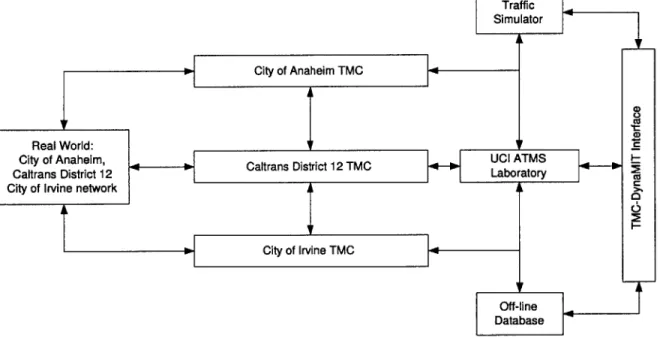
DynaMIT is intended to be field tested at a testbed developed at University of California, Irvine, which receives data directly from the City of Irvine Traffic Management Center, the Caltrans District 12 TMC and the City of Anaheim Traffic Management Center. We will use this test-bed as the focus of our description and describe the different subsystems we need to interface with in order to integrate the DynaMIT operations in real-time. Many of the characteristics discussed here are generic to most of the TMCs and hence this discussion can be extended to represent general characteristics of subsystems in a Traffic Management Centers.
We next describe the different subsystems which need to be interfaced and are of specific interest to this study:
1.2.1
Surveillance Systems
The TMC testbed has developed an extensive surveillance support system to support field testing. Traffic information is collected using a variety of technologies including loop detectors (sensors), video surveillance and closed-circuit television (CCTV), infrared sensors, vehicle probes, and mobile videos. A series of portable Video Image Processing (VIP) systems and supporting wireless communication infrastructure have been deployed as a part of new technology initiative to capture real-time surveillance. These systems work on Spread Spectrum Radio (SSR) technology and have been deployed under the federal Mobile Video Surveillance
/
Communication (MVSC) field operation test project. The video image processing surveillance function processes video images received from two fixed-field-of-view (FFOV) cameras to generate the pertinent data.detector ID, (iii) vehicle loop count, (iv) lane count, (v) speed, (vi) occupancy, (vii) density, and (viii) queueing data. The information is captured by the sensors, processed locally, and aggregated for transmission to the TMC. Regular scanning frequencies are 1/240s and broadcasting frequencies are about 30 seconds.
1.2.2
Control and Guidance Systems
TMCs can have a centralized, distributed, or a hierarchical control mechanism. In a centralized environment, a central facility collects traffic status data and makes traffic control decisions. In a distributed environment, control is performed locally, generally at the intersection level. A hierarchical control configuration is a hybrid between central and distributed control. The Irvine TMC control and guidance systems are designed to be centralized, with a variety of control mechanisms, including Variable Message Signs (VMS), ramp metering, real-time traffic adaptive signal control, highway advisory radio, lane usage control, etc.
In addition, Anaheim has been developing a Motorist Information System (MIS). There are four main component of this system (FHWA (1993)): information kiosks, highway advisory radio, highway advisory telephone, and a CATV feed. These will be strategically placed and play recorded messages to provide guidance. These messages will be updated at a periodic rate to maintain latest information.
1.2.3
Incident Management Systems
The TMC test-bed incorporates automatic incident detection by autonomously spotting conditions of non-recurring congestion. The incident is usually detected through a video input or specific information form the mobile sources. TMC requires some specific information processing capabilities like, integrated data management, real-time traffic simulation model execution, image processing for area-wide surveillance and incident detection, to provide incident management (FHWA
efficiently respond to an incident. The control options include sending advisory messages to VMS, route diversion alternatives via an interface to ATIS or radio broadcasts.
1.2.4
Communication Systems
The testbed system is built upon a wide-area communications network backbone linking the cities of Anaheim and Irvine Traffic Management Centers to the California Department of Transportation's District 12 TMC and with the ATMS research laboratories at the University of California, Irvine, Institute of Transportation Studies. The communication network is based on an ATM infrastructure, designed to be compatible with the existing Teleos ISDN PRI network established by the Caltrans Wide Area Network (WAN). The ATM infrastructure is linked with the Caltrans District 12 TMC and the City of Irvine ITRAC via an OC3 155 Mbps
SONET fiber optics network, and with the City of Anaheim TMC via ATM T-1.
The system also has a MPEG 1 video transmission system, allowing for selection and display of freeway video surveillance cameras within District 12.
The TMCs are equipped with UNIX workstations and numerous PC-compatible machines. The UCI laboratories have SGI IRIX 6.5, SunOS 5.6 and HP UX
11, besides PC-based computers. The fiber optic ATM links enable high speed
exchange of traffic data and video images - both real-time and historical. Several communications interfaces or interties have been developed to perform these exchanges.
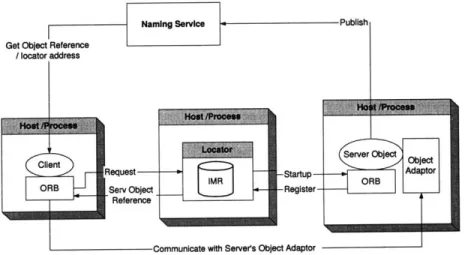
The testbed and TMC is distributed using CORBA (Common Object Request Broker Architecture) to provide to external agents the following services:
(a) real-time data in the form of LDS (raw loop detector data), VDS (processed loop controller data), RMS (processed ramp metering control data, and CMS
(status and message on each Changeable Message Sign).
(b) CCTV switching
(d) Historical Data, and
(e) One switched video channel.
The CORBA services can also be used to develop own interfaces for communication with the rest of the system and for research and prototype deployment in the testbed.
1.3
Motivation and Research Objective
The real-time DTA systems are envisioned to be a part of the TMCs, and thus need to be integrated with the TMCs to realize their design objective. These systems are TMC-independent software systems intended to run in all configurations of TMCs. However the TMC configuration and communication architecture itself is far from standard and shows marked variations in different places. TMC must though comply with an adequate generic system architecture that allows an easy integration/interface of both internal systems and external systems. Efforts so far have been concentrated in developing stand-alone DTA systems. ?)Fernandez:2000)has proposed an open standard architecture that could be possibly used to integrate Dynamic Traffic Management Systems (DTMSs)within TMCs. However, DTA systems work independently and they may not comply with this architecture to enable successful integration. An interface therefore needs to be designed that will act as an intermediate layer enabling the compliance of individual
DTA systems with the overall system architecture within the Traffic Management
Centers.
As a preclude to full-scale field application of the DTA systems, a strong need is felt to evaluate these systems off-line, using a ground-truth simulator'. Such a laboratory-evaluation system can be a very handy research tool and would also help in assessing the performance of the DTA systems before they are introduced on-line. The simulator can be calibrated with field data and hence replicate the "real world"
data that DTA systems are ultimately envisioned to work with. Such an off-line evaluation can serve the following important purposes before the DTA systems are finally integrated with the TMCs:
" Assess the quality of estimation and prediction capabilities of the DTA systems,
using real operational data, and the performance of various models used in the system against real data.
" Assess the benefits and applicability of the outputs generated from these systems
for the actual on-line TMC operations.
* Assess the efficiency and real-time performance of the system and make the required performance improvements.
* Understand and address any problems that might arise in the system and communication architecture of software.
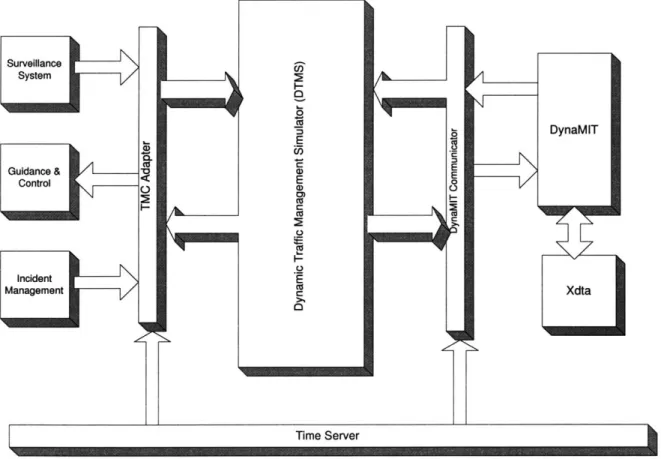
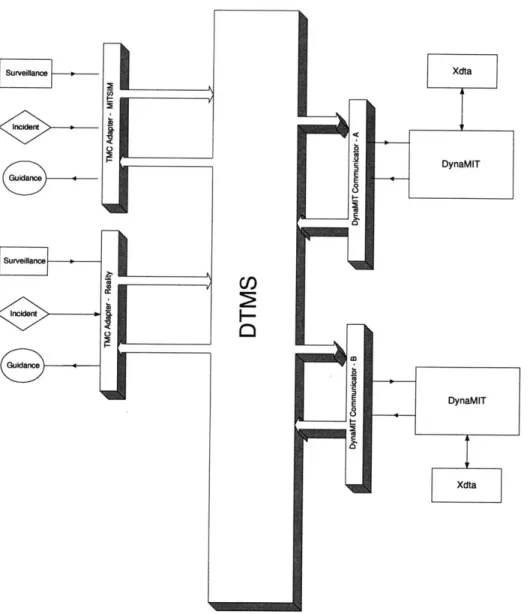
In this research, a system interface is designed that allows integration of DynaMIT with the Traffic Management Centers. The architecture is distributed, using the Common Object Request Broker Architecture (CORBA). The proposed interface intends to synchronize the operation of the different information sources and the various components within DynaMIT through a common time server. The interface also converts the sensor and incident data (needed by DynaMIT for state estimation) into a common readable format and similarly converts the guidance provided by DynaMIT into an acceptable generic format.
The same interface is also used to integrate DynaMIT with MITSIMLab. Ben-Akiva et al. (1996b) proposed the applicability of MITSIMLab (Microscopic Traffic Simulation Laboratory) as a suitable simulation laboratory for the evaluation of Dynamic Traffic Management Systems. A suitable adapter is written on the
MITSIMLab side to establish the communication between MITSIMLab and the rest of the system.
1.4
Literature review
As seen in section 1.3, we have two broadly defined objectives for this study - (i) interfacing of a Dynamic Traffic Assignment system (DynaMIT) with MITSIMLab, (ii) interfacing of DynaMIT with the Traffic Management Centers. In reviewing the previous literature and research, we would thus investigate the following areas of work in order to learn from the experience of the other researchers and their implemented frameworks:
o Dynamic Traffic Assignment and Dynamic Traffic Management systems, o Tools and Methods used for investigating dynamic traffic management systems, o Previous work in interfacing different dynamic traffic control and assignment
systems.
o Proposed designs and architectures for the integration of DTMS with TMCs.
1.4.1
Dynamic Traffic Management Systems
Dynamic traffic management systems include a whole assembly of different integrated and stand-alone dynamic traffic control and guidance systems. Development of such dynamic route guidance systems and dynamic traffic control strategies has been receiving increasing attention over the last decade.
Dynamic Traffic Assignment (DTA) systems have been envisioned to be at the core of many of these different subsystems and processes (FHWA (2000)). The success of many of the DTMS and other ITS subsystems, like the Advanced Traveler Information System (ATIS), Advanced Traffic Management Systems (ATMS), Advanced Public Transportation Systems (APTS), Commercial Vehicle Operations (CVO), and Emergency Management Systems (EMS), is dependent on the availability of timely and accurate estimates of the prevailing and emerging traffic conditions.
DTA systems can provide this capability of traffic estimation and prediction
(1995), Mahmassani et al. (1994), MIT (1996)). Gartner and Stamatiadis (1997)
and Chen and Hsueh (1997) presented the framework for integrating dynamic traffic assignment with real time traffic adaptive control.
DYNA (DYNA (1992-1995)) was developed under the European DRIVE II
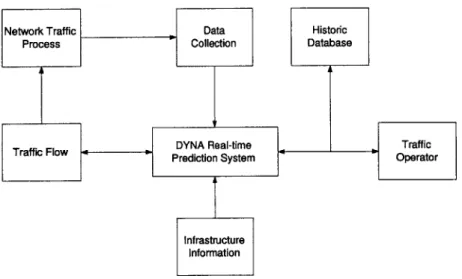
program. It has been designed as a real-time traffic prediction system for an inter-urban motor-way network. The system collects network-wide data through on-line roadside measurement stations, and uses prediction-error feedback to update the traffic state. Figure 1-3 provides the operational framework of the system. The system regularly communicates with the operators at a number of levels, and continuously forecasts in a rolling horizon implementation. DYNA uses both traffic control and travel information strategies, and is based on variety of models which cab be sub-grouped into two categories. Behavioural Traffic Model (B. T.M.) concentrates on
OD flow representation and sub-models that emulate human behavior and traffic
assignment. The second category, Statistical Traffic Model (S. T.M.) focusses on the link density representation of the network traffic. DYNA has been extended by the European Union's Fourth Framework project DACCORD (Hague Group (1997)), to include the implementation and demonstration of a DTMS. DACCORD includes the EUROCOR (Middelham et al. (1994))traffic control project, and the GERDIEN project for systems architecture and traffic prediction.
Network Traffic Data Historic
Process Collection Database
DYNA Real-time Traffic
Traffic Flow Prediction System Operator
Infrastructure Information
The United States Federal Highway Administration (FHWA) initiated a DTA project in 1994, to meet the rapidly emerging needs for a traffic estimation and prediction system. Two separate research project began in 1995 under this initiative under the management of Oak Ridge National Laboratory(ORNL).
DynaMIT (Dynamic Traffic Assignment for the Management of Information to
Travellers) was initiated at Massachusetts of Institute of Technology (MIT). DynaMIT (MIT, 1996; Ben-Akiva et al., 1997) is a real-time system designed to reside in TMCs for the support of ATIS operations. The system architecture and operational features of DynaMIT have been discussed in section 1.1.1.
The second system DYNASMART-X (DYnamic Network Assignment Simulation Model for Advanced Road Telematics) has been developed by University of Texas at Austin (UTX). DYNASMART-X (Mahmassani et al. (1994))is a real-time traffic estimation and prediction system for support of ATMS and ATIS operations. It uses network algorithms and models for trip-maker behavior in response to information in an assignment-simulation framework. DYNASMART-X provides control actions, in the form of information to users about traffic conditions and routes to follow as well as signal control strategies. DYNASMART-X uses microsimulation for individual user decisions, and mesosimulation for traffic flow. Similar to DynaMIT it tries to achieve consistency between predicted network conditions, supplied information and user decisions. It is implemented in a rolling horizon framework and has features to recognizes multiple user classes. Origin-Destination estimation and prediction is an essential part for the simulation-assignment that is being implemented
by DYNASMART-X. It adopts a distributed software implementation using CORBA.
Variety of route guidance systems have been field-tested in the past or are currently under the testing stage. ADVANCE is a real-time in-vehicle route-guidance system that has been tested in suburban area of Chicago.
RT-TRACS (Real-Time Traffic Adaptive Signal Control Strategy) is a program sponsored by FHWA to improve traffic control by performing signal optimization in real-time. RT-TRACS (Tarnoff and Gartner (1993))is intended to be a multi-level
optimally under different traffic and geometric conditions and are accordingly invoked and switched from one to another dynamically to produce best possible results. Five prototypes have been developed and are being evaluated for use in the RT-TRACS program. Three of these prototypes, RHODES from University of Arizona, OPAC from PB Farradyne, and RTACL from the University of Pittsburgh are at the advance state of development.
1.4.2
Evaluation of Dynamic Traffic Management Systems
Traffic management systems can be evaluated either through field tests or through computer-based simulations.
Field Testing is the most direct and definite way of testing traffic management
systems.
A systematic study (McNally (1999)) on the performance evaluation of Advanced
Traffic Control Systems was conducted from 1994 to 1998 in the city of Anaheim, California. Adaptive signal control technologies were evaluated, including SCOOT (2nd generation model) and a 1.5 generation control (1.5GC) approach, and a video traffic detection system (VTDS). The project, in addition to evaluating the performance of the traffic control technologies, examined institutional issues, as well.
A number of other field studies have been conducted under the California
PATH (Partners for Advanced Transit and Highways) ATMIS (Advanced Traveler Management and Information Systems) research. These include the evaluation of Phase I of a PeMS (performance Evaluation Measurement System), called Transacct. The system was located at the University of California, Berkeley, campus, and was used for studies like, estimation of reliable real time speeds, congestion measures, etc. Another study was Dynamic Origin/Destination estimation using true section densities (Sun (1999)). Yet another study has been the Freeway service Patrol project (Petty et al. (1996)), which gets real-time information on the vehicle trip time and distance traveled, using patrol service as probe vehicles.
An example for evaluation of traffic control systems is the study of INFORM
( Information for Motorists), a traffic management system designed for a 40-mile
long highway corridor in Long Island, New York (Smith and Perez (1992)). In the evaluation, motorists response to and effectiveness of ramp metering and variable message sign strategies were evaluated.
A number of projects have also been field tested to evaluate the Advanced
Traveler Information Systems. TravInfo (Miller (1998)) was a field operational test in the San Francisco Bay Area, sponsored by FHWA. The evaluation studied the institutional, technological, and traveler response elements of TravInfo. The technology element focussed on the operational effectiveness of TravInfo's Traveler Information Center and a study of Information Service Providers reaction to and use of TravInfo information. Traveler response investigated public access to and use of different types of information by TravInfo and changes in individual traveler behavior. The ADVANCE project (Bowcott (1993);Saricks et al. (1997)) has another example of field-evaluation of ATIS. A field test for evaluating ADVANCE dynamic route guidance system (Schofer et al. (1996)) was conducted in Chicago's suburban areas. Vehicles equipped with MNA (Mobile Navigation Assistant) acted as probes, sending real time travel information to a traffic management center, which was in turn relayed the information to equipped vehicles to aid in dynamic route planning.
Computer-simulation based evaluations provide a very good alternative to field tests because they are much less expensive and allow greater flexibility in testing lot of different strategies, in a controlled environment.
There have been extensive studies of the performance of traffic control and route guidance systems using simulation. For example, simulation has been used to evaluate the design of ramp metering strategies (Payne (1973)), urban traffic signal controls (Sibley (1985); Yauch et al. (1988)), route diversion (Stephanedes et al. (1989); Barcelo and Ferrer (1995)) and mainline metering (Haboian (1995)). Yang (1997) used a microsimulator to evaluate a dynamic traffic management system. Hasan
(1999) used a microsimulator (MITSIM) to evaluate ramp control algorithms.
Studies integrated traffic management systems, using simulation, have been relatively rare. CORSIM (FHWA (1996)) is being used to study the prototypes of
on an earlier version of INFORMS (IMIS).
Ben-Akiva et al. (1995) identified the different requirements for evaluating Dynamic Traffic Management Systems using simulation and provided an evaluation framework for DTMSs (shown in Figure 1-4). Based on the goals and objectives of the management system, a control strategy is formulated and fed into the simulation laboratory, which then operates on a set of scenarios. Based on the results of the pre-set performance measures, modifications are done in the control strategy till we observe the desired set of results. Because it is capable of realistically simulating the traffic flow in the network and its dynamic interrelationship with the control and route guidance system under consideration (which many of the other simulators lack), MITSIMLab (Yang (1997)) is an effective simulation laboratory for evaluating DTMS (Ben-Akiva et al. (1996b)).
Goals and Objectives of Management Systems
Traffic Control Strategy Decisions
Simulation Scenarios
-- Performance MeasuresI
Figure 1-4: Evaluation Framework for DTMS
1.4.3
Interfacing of ATMS/ATIS subsystems
Literature on the interfaces of dynamic traffic assignment systems with other TMC-based subsystems has very limited. But there are many examples of other guidance and traffic control systems that have been interfaced in the past.
The ADVANCE project, during its testing in the Chicago suburban area, was interfaced with different internal and external subsystems which operated in sync.
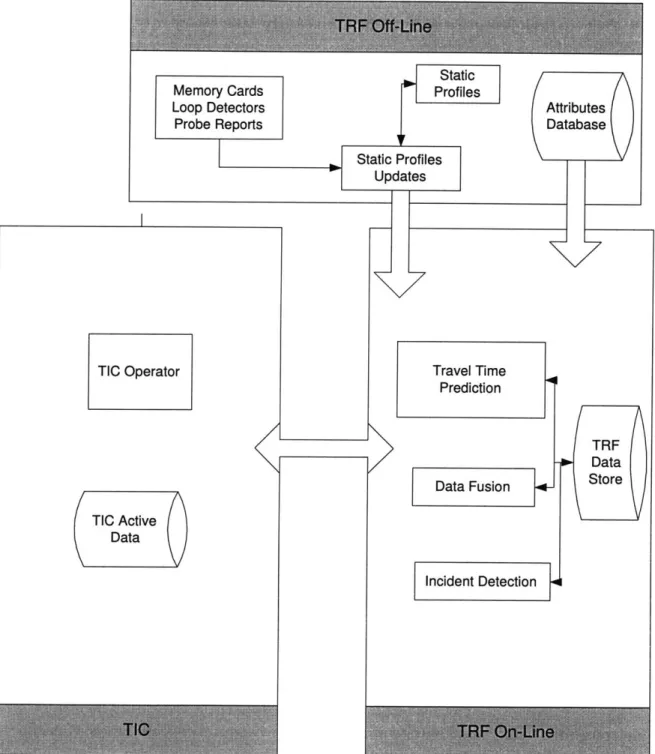
ADVANCE consisted of five subsystems, namely (i) the Traffic Information Center
(TIC) which contained the central facility, the operator interface, etc.; (ii) the Traffic Related Functions (TRF) which includes the traffic algorithms; (iii) the Communications Subsystem (COM) which provides message carrying capability between the TIC and the vehicles in the field; (iv)the Mobile Navigation Assistant
(MNA) which contains in-vehicle route planning and display capabilities; and (v) the
Help Center (HC) which provides for roadside vehicle assistance requests and driver queries.
The data flow between the MNA and TIC was through the COM interfaces on the TIC and MNA sides. the TRF internally contained multiple subsystems - each specific to an algorithmic role, which were interfaced with the TIC which in turn communicated with the MNA in each vehicle. Figure 1-5 shows overall interfacing framework adopted by ADVANCE.
Federal Highway Administrations's, Turner-Fairbank Highway Research Center 2 has taken many initiatives to interface various simulation and traffic control tools. One of the interfacing tool is TSIS (Traffic Software integrated System) which provides state-of-the-art environment for managing, controlling, and coordinating the application of various traffic engineering analysis and simulation tools. It provides a framework for exchanging data between different traffic engineering tools and standard interfaces for communicating with real-time traffic control systems and hardware devices.
The FHWA's Traffic Research Laboratory (TReL)3 has also integrated a hardware-in-the-loop simulation with a video camera sensor collection tool and a real-time traffic adaptive signal control algorithm. It has also developed a communication interface between the signal control algorithm, the sensors, and the CORSIM simulation engine. Elaborate interfacing for CORSIM is being planned in order to allow it to operate as a simulation-based evaluation tool for traffic management systems.
TIC Operator
TIC Active
Data
Static
Memory Cards Profiles
Atiue
Loop Detectors Attributes
Probe ReportsDatabase Static Profiles Updates
\7
Travel Time Prediction TRF Data Data Fusion .0- Str Incident Detectionthe Rotterdam network in Holland. The framework for surveillance interfacing is shown in Figure 1-6. The measurements are obtained from the surveillance station which are average one minute flows, one minute velocities and a congestion indicator that flags a time sequence for which link velocity falls below a critical value. The measurements then pass through several stages of processing, starting with detection at the road surface, local processing to aggregate over 1 minute interval, transmission to intermediate portals where the time stamp is added, and finally transmission to the traffic center. The data arriving at the TMC is then added to a file, which is used
by the system subsequently.
Databae Motorway Network
Surveillance
System
Control Prediction
Measures DYNA & Outputs
Predictor
DYNA
Controller
Figure 1-6: Interfacing Framework for DYNA
1.4.4
Architecture for Integration with TMC subsystems
The real-time traffic estimation and prediction capabilities can be very useful to many subsystems that operate within and outside the Traffic Management Centers. The Travel Management Team at Office of Operations Research and Development (FHWA) identified almost fifty independent ITS (Intelligent Transportation System)
data provided by DTA systems.
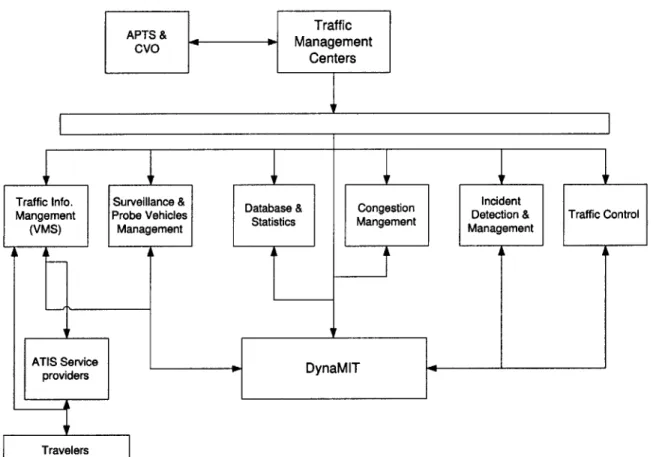
The U.S. Department of Transportation (DOT) has developed a National ITS Architecture4 to promote development of Intelligent Transportation Systems that are uniform and inter-operable. The architecture provides a framework in which the DTA systems are intended to operate and interface. Figure 1-7 provides an overview of the envisioned framework of operation of DTA systems and provides a wholistic view for integration and inetrfacing requirements of DTA systems.
Traffic
APTS & --- Management
OVO Centers
Traffic Info. Surveillance & . Incident
Mangement Probe Vehicles Datbase & Congestion Detection & Traffic Control
(VMS) Management Management
ATIS Service DynaMIT.
providers
r Traveler~s
Figure 1-7: DynaMIT's role with ATMS/ATIS subsystems in the Traffic Management Centers
There is currently no working example of an integrated TMC-DTA system. Ruiz (2000) provided an architecture for integration of Dynamic Traffic Management Systems. The architecture was based on a generic distribution mechanism using CORBA (Common Object Request Broker Architecture), and based on an abstract factory pattern that permits anonymous use of DTMSs within TMCs. The
architecture sought to implement a Publisher/Subscriber pattern to provide parallel programming on top of CORBA's synchronous communication paradigm.
1.5
Thesis Outline
Thesis is organized as follows: Chapter 2 specifies the off-line evaluation requirements for DynaMIT and the implementation requirements for the interface. It also provides the requirements for on-line integration of DynaMIT with the Irvine Traffic Management Center.
Chapter 3 discusses the overall system architecture for interfacing DynaMIT with MITSIMLab for off-line evaluation. It also discuss the design architecture for integration with the Traffic Management Center at Irvine.
The first part of Chapter 4 presents the implementation framework for combined MITSIMLab-DynaMIT operations. The second part discusses the systematic way in which the interface is implemented for DynaMIT-TMC operations. It will also discuss the interfaces's compatibility with the Interface Control Document (ICD) proposed
by FHWA.
Chapter 5 includes two case studies that demonstrate the functional viability of the interface. The first case study is based on the Central Artery Network in Boston. The case study presents results that demonstrate the usefulness of predictive route guidance. It also demonstrates the flexibility of the interfaced MITSIMLab-DynaMIT tool in studying various scenarios useful for evaluating MITSIMLab-DynaMIT. The second case study focusses on the Irvine network. The case study illustrates the effective operational viability of the interface in supporting large networks. It also constitutes a big step forward in terms of the ultimate goal of testing DynaMIT with the real data from Irvine test network. The final chapter concludes the work presented in this study and gives directions for future work in this field.
Chapter 2
Integration and Evaluation
Requirements
We divide this chapter into two parts. In the first part we describe the design requirements of the Interface so that DynaMIT can work in a closed-loop format with MITSIMLab - our ground truth simulator. As mentioned in the previous chapter, such a closed-loop system can be an excellent research tool and a good precursor to the actual on-line integration of DynaMIT with the TMCs. The second part describes the requirements for the integration of DynaMIT with the Traffic Management Centers. Special attention is paid to the Traffic Management Center at Orange County, California, where DynaMIT is intended to be first integrated for field-testing.
2.1
Off-line Evaluation Requirements
Computer Simulation systems provide an effective tool for testing alternate system designs before conducting expensive on-field operational tests. Various individual control elements of traffic management systems have been studied using simulation before. A similar simulation-based approach for evaluating Dynamic Traffic
Management Systems has been proposed by Ben-Akiva et al. (1994a). In the following section we investigate the system and modeling requirements to pursue this line of
approach.
2.1.1
Methodology
Ben-Akiva et al. (1996b) proposed an overall evaluation and design refinement framework for evaluating Dynamic Traffic Management Systems (see Figure 1-4). A simulation laboratory is used to compare the candidate designs against a base case. The inputs to the simulation laboratory are (i) the elements (e.g. surveillance and control devices) and the logic that determines how the system under investigation operates; and (ii) the scenarios against which the system will be tested. A set of performance measures are computed, and then the results are analyzed to suggest any improvements.
Yang (1997) demonstrated the use of MITSIMLab as a possible simulation laboratory for evaluating Dynamic Traffic Management Systems. A more detailed description of MITSIMLab and its subsystems is provided in section 2.1.2 and 2.2.
MITSIMLab has the following essential characteristics that are required for evaluating DynaMIT:
" flexibility to simulate a wide array of traffic management system designs,
networks and control strategies.
" representation of the surveillance system, including real-time sensor counts and
incident detection.
* modeling the response of drivers to real-time traffic information.
* incorporation of guidance (generated by DynaMIT) through a wide array of information dissemination strategies.
* open architecture, which facilitates interfacing and integration.
The effectiveness of the guidance generated by DynaMIT can be tested in MITSIMLab against the base case of no-guidance. The sensitivity of results (benefits) to a variety of design characteristics associated with DynaMIT can also be tested.
2.1.2
MITSIMLab
-
A Traffic Simulation Laboratory
MITSIMLab (Yang and Koutsopoulos (1996); Koutsopoulos et al. (1994) is a traffic simulation laboratory, consisting of a traffic flow simulator (MITSIM) and a traffic management simulator (TMS). To capture the real-time control and routing strategies and simulate the surveillance system, the traffic and network elements are represented in a fairly detailed level. Such detailed modeling is able to capture the stochastic nature of traffic flow and drivers response to route guidance - a feature that is very important for evaluating dynamic traffic management systems.
The Microscopic Traffic Simulator (MITSIM) models the traffic in the network. The road network with the traffic surveillance and control devices are represented in detail to emulate the "real world" elements. The Network consists of nodes, links, segments and lanes. The Surveillance system consists of various forms of detectors. Traffic signal devices, message signs, lane use signs, and special facilities (like Toll Booths, etc.) are also represented. Vehicle trips are generated based on pre-determined origin-destination (OD) tables. MITSIM uses lane-changing and car-following models to move vehicles. Behavioral parameters are assigned randomly based on pre-determined and calibrated user characteristics. Vehicles are moved at a pre-fixed step size according to various constraints.
The Traffic Management Simulator (TMS) has the control and route guidance system. It receives input from the MITSIM surveillance system in the form of real-time traffic measurements. Based on the surveillance data, TMS generates control and route-guidance and updates the traffic signals and signs in the network. TMS can model both pre-timed and reactive systems(adaptive systems where control and route-guidance is provided based on the prevailing traffic conditions). Yang (1997) provides detailed description on design and models of TMS.
There is a very strong coupling between the traffic flow and control strategies. Traffic control and routing strategies effect the traffic flow and control strategies themselves are triggered by the traffic flow as measured by the surveillance system. As a result, TMS and MITSIMLAB can simulate a wide range of traffic control and
advisory services, including:
" Intersection controls such as traffic signals, yield and stop signs.
" Mainline Controls such as lane use signs, variable speed limit signs, variable
message signs, etc.
" Ramp Controls such as ramp metering and speed limit signs.
These signals are controlled by traffic signal controllers, which can be of four types - static, pre-timed, traffic adaptive and metering controllers. Each controller is characterized by a set of data items (such as signal type, controller type, number of
egresses, IDs, etc.), and as the simulation progresses, the controller can switch from
one type to another.
2.2
Interfacing Requirements for MITSIMLab
subsystems
The TMS within MITSIMLab, emulates the operations in the Traffic Management Center. We discuss here the interfacing requirements for each of the subsystems in TMS in order to integrate DynaMIT with MITSIMLab. This would be in many ways very similar to the interfacing requirements for integration of DynaMIT with TMCs. The integration of DynaMIT with the TMS would require interfacing between the following components/ subsystems:
" Surveillance System.
* Incident Management System.
" Time Server.
* Guidance and Control System.
2.2.1
Time Server
Both MITSIMLab and DynaMIT have their individual time clock components. The time clock utility in MITSIMLab is called by multiple objects throughout the software, and plays an important role in determining the step sizes, vehicle movements and control regulation. The simulation speed is governed by the computational time of the algorithms. It can practically proceed as fast as the computational times allow it to. This time may be faster than or slower than the real-time. The speed, however, can be slowed down manually, by changing a parameter that would decrease the advance frequency of MITSIMLab's internal clock. Similarly a different clock component is extensively used within DynaMIT by its supply and demand simulators.
The rolling horizon implementation of MITSIMLab-DynaMIT closed loop would require the TMS to make multiple and discrete calls to DynaMIT for providing prediction-based guidance. Similarly DynaMIT gets the sensor counts and incident data in discrete steps. The exchange of data thus occurs with an accompanying time stamp, which signifies the time interval the data belongs to. This calls for a clear mechanism for communication of a common time between the two systems. Also, MITSIMLab cannot be blocked while DynaMIT is generating guidance. The communication has to be asynchronous. Therefore, the time communication has to be uni-directional rather than bi-directional. Since MITSIMLab simulates the reality in our case, it should act as the time server for closed system.
An interface, thus, is required to be able to provide the timing data from MITSIMLab to DynaMIT. MITSIM and TMS operate with a common clock, and this time message requires to be communicated to DynaMIT on a regular basis. That way DynaMIT always knows the current time in MITSIMLab and can associate appropriate time stamps with the surveillance, incident and guidance data.
2.2.2
Surveillance System
MITSIMLab can simulate the following type of sensors, Yang (1997):
points in the network.
" Vehicle sensors, which extract information on individual vehicles.
" Point to point data sensors, which extract information such as vehicle travel
time from one point in the network to another.
" Area wide sensors such as radar detectors and video cameras.
In addition, external agency reports - e.g. a vehicle passing an incident using a cellular phone to report it - can also be simulated using a probablistic model. A working probability is assigned to each sensor to simulate sensor breakdowns.
MITSIM provides TMS with the real time surveillance data. The data can be provided as per the MITSIM step size or at whatever step size is required by TMS for its control operations.
DynaMIT requires sensor counts from TMC (or from MITSIMLab's TMS) in order to carry out the OD estimation. DynaMIT simulates traffic on its own and generates the traffic counts from the simulation. A comparison of the TMC counts (true counts) and the simulated counts is used to decide whether the OD estimation has converged. If not then DynaMIT readjusts the OD flows and simulates again to obtain a new set of sensor counts. The iterative procedure is repeated on till the TMC and simulation counts converge. DynaMIT has a surveillance component of its own that helps it in recording the sensor counts. All sensors in DynaMIT are link-wide. DyanMIT sensors measure vehicle counts, flows, speed and density.
An interface is required that sends the sensor counts, as observed by MITSIMLab, to DynaMIT. The sensor counts need to be aggregated for the time period DynaMIT estimates the state of the network. Also filtering of sensor and surveillance data is required to report the counts only from the type of sensors used by DynaMIT.
2.2.3
Incident Management System
MITSIMLab reads the incident data from a scenario definition file. Each incident is represented based on the location (segment) where it occurs, and the visibility and