MINISTRY OF HIGHER EDUCATION AND SCIENTIFIC
RESEARCH
UNIVERSITY OF ABDELHAMID IBN BADISS - MOSTAGANEM
FACULTY OF FOREIGN LANGUAGES
DEPARTMENT OF ENGLISH
MASTER IN
DIDACTICS AND APPLIED LANGUAGES
J
SUBMITTED BY: BELABDOUN Sihem
Members of the Board:
Chair Person: Mrs.AdnaniRajaa University of Mostaganem
Supervisor: Dr. BENOSMANE Naziha University of Mostaganem
Examiner: Dr. Benstaali Leila University of Mostaganem
Academic Year: 2019-2020
The Impact of Classroom Interaction Patterns on
Enhancing Learning in EFL classes:
Case of Second Year Secondary School of Mohamed ben
Ahmed Abd Alleghany Mostaganem
I
I dedicate this modest work
To the greatest father in the world, I will be always grateful for his
sacrifice to make me happy, support and confident
To my dear mother, my source of inspiration and encouragement,
for her endless love, support and help
“My father and my mother, thank you for everything”
To my dear brother ‘MILOUD’ and sisters ‘AMINA and HALIMA’
To my best friends:Ahlem, Houria, Bouchra, Halima, Ikram, Souhila, Sarah,
Wissem, Radia, Yacine and Ali
To all my friends and classmates
II
First of all, thanks to ‘God’ who is always with me, helps me and offers me a
great power to complete this work
I am grateful to all my teachers, in particular my teacher and supervisor Dr
“Benosmane Naziha” for her help and guidance
I am also grateful to the jury members
I would like to thank my teacher of English in secondary school
Mr. ‘Harrat Ali’ and my teacher of ICT ‘Boukhatem Lamia’ for their
collaboration
Special thanks go to my teacher of primary school ‘Gouaich Adda’
For his support and encouragement
To my cousin “Laid” for his help from the primary school to university
Last and not least, I would like to thank all teachers and students who
III
Classroom interaction is an important concept in language teaching and learning. It is helpful for the students’ learning process. The purpose of this study is to reveal the different patterns of classroom interaction, its impact on enhancing learning in EFL classes and how can the teachers encourage classroom interaction. In the practical part, the researcher uses different data collection instruments which are the classroom observation and questionnaires for both teachers and students that are conducted to second year foreign languages class of secondary schools of Mostaganem during the academic year 2019/2020, so that this work contains quantitative and qualitative methods.The teachers’ questionnaire is intended to investigate the teachers’ views about the interaction in the classroom and its patterns and techniques. The students’ questionnaire is intended to demonstrate students’ level of interaction and the effect of its patterns on their achievement. There were adequate results about the effect of the classroom interaction on the learners’ achievement.
IV
V
List of tables
Table 1.1 Teacher-centered vs. Learner-centered paradigms ………11
Table 2.1 Pupils’ Gender………25
Table 2.2 Pupils’ participation in the classroom………27
Table 2.3 Teachers' obligation for students to participate………..30
VI
Figure1.2:
Interaction between the teacher and the students………....07Figure 1.3:
Learner-learner interaction………..08Figure 2.1:
Pupils’ level in English speaking and listening skills ………26Figure 2.2:
Pupils’ participation in the classroom……….27Figure 2.3:
Pupils’ participation with peers………..28Figure 2.4:
Teachers’ talk and students’ talk in the classroom……….28Figure 2.5:
Pupils’ preferred patterns of interaction……….29Figure 2.6:
Pupils’ priority when participation with each other………...…29Figure 2.7:
Pupils’ enjoyment concerning the type of work……….30Figure 2.8:
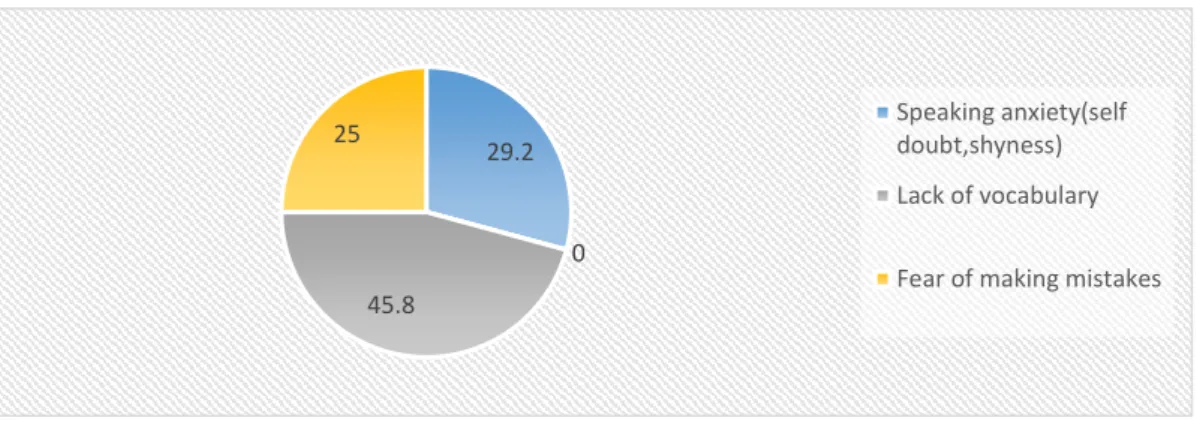
Pupils’ difficulties during participation………..31Figure 2.9:
The materials used by the teacher during the lectures………31Figure 2.10:
Teachers’experience in teaching ………....32Figure 2.11:
Teachers’ techniques of using English……….33Figure 2.12:
Teachers’ motivation techniques ……….33VII Dedication ... I Acknowledgements ... II Abstract ... III List of abbreviations... IV List of tables ... V List of figures ... VI Table of contents... VII
General Introduction ... 1
Chapter One: Literature Review Classroom Interaction 1.1. Introduction ... 3
1.2. Classroom interaction ... 3
1.2.1. Definition of Classroom interaction ... 3
1.3. Classroom interaction and classroom communication ... 5
1.4. The role of classroom interaction ... 5
1.5. Patterns of classroom interaction ... 6
1.5.1. Teacher-learner interaction…...6
1.5.2. Learner-learner interaction………...……… ………...7
1.5.3. Learner-material interaction……….9
1.6. Teacher-centered classes verses students-centered classes ... ..9
1.7. Classroom interaction techniques ... 12
1.7.1. Pair work………..………12
1.7.2. Group work………...……….12
1.7.3. Simulation and role play...13
1.7.4. Discussion ………..……….13
VIII
1.11. The relationship between classroom interaction and classroom
management……….17
1.12. Learning achievement ... 17
1.12.1Classroom interaction and learning achievement ... 18
1.3. Conclusion ... 19
Chapter Two: Methodology Design 2.1. Introduction ... 21
2.2. Research methodology ... 21
2.2.1. The educational setting: ... 21
2.2.2. The participants: ... 21
2.3. The data collection procedure: ... 22
2.4. The description of data tools: ... 22
2.4.1. Classroom observation ... 22
2.4.2. The pupils’ questionnaire ... 23
2.4.3. The teachers’ questionnaire ... 23
2.5. Analysis of data tools: ... 24
2.5.1. Analysis of classroom observation: ... 24
2.5.2. The analysis of pupils’ questionnaire: ... 25
2.5.3. The analysis of teachers’ questionnaire ... 32
2.6. Conclusion ... 40
Chapter Three: Discussion of Findings and Recommendations 3.1. Introduction ... 41
3.2. Finding Discussion and Analysis ... 41
3.2.1. The interpretation of the classroom observation: ... 41
IX
3.3. The interpretation of results ... 45
3.4. Suggestions ... 46
3.4.1. Suggestions for students: ... 46
3.4.2. Suggestions for teachers ... 47
3.5. Limitations of the study ... 47
3.6. Conclusion: ... 48
General Conclusion ... 49
References ... 51
1
Education in general or learning foreign languages need interaction, which basically requires active participation from both part; the teacher and the students. Furthermore, classroom interaction is the way a teacher discusses, converses, talks, expresses ideas and information to students during learning activities. Researchers considered interaction in the classroom as a basic element in learning English as second /foreign language. This led them to look for its influence on students’ achievement.
Classroom interaction patterns are regard as an important concept in language teaching. It plays an important role in the classroom as it affects the relationship between the teacher and the students. Classroom interaction helps students develop their language in the classroom and enables them to cope with their lack of language skills. It gives students the opportunity to get feedback and test their communicative success by sharing ideas with the teacher. Interaction gives the learners opportunities to receive the input provided by the teachers which must be understood by the learners to provide the output. Hence, the lack of these interaction leads to poor production and receiving.
This study aims to show the influence of classroom interaction patterns on students’ achievement in EFL classes, so that to encourage students to participate and teachers to create techniques to increase interaction among the students in the classroom. Therefore, in order to know the impact of the classroom interaction on enhancing learning in EFL classes, it is necessary to ask the following questions:
➢ To what extent can the classroom interaction patterns influence students’ achievement in EFL classes?
• How can teachers encourage classroom interaction? As an attempt to answer these questions, we suggest the following hypotheses:
➢ Classroom interaction patterns can enhance the students’ learning achievement ➢ The use of different techniques in the classroom like group work can promote
the interaction in the classroom
This research is divided into three chapters. The first chapter gives an overview about the literature review. In this chapter the researcher presents the definition of classroom
2
the participants both the learners and the teachers that we worked with, the collected data instruments, and finally the analyses of those data tools. The third chapter discusses the results and the findings of this research with some suggestions and recommendations for both teachers and learners on how to encourage classroom interaction.
Chapter One
Literature Review
Classroom Interaction
3
1.1. Introduction
Learning a language and using it are basically interactive activities that depend on varying types of relationships with others and with cultures as a whole. Teaching and learning are processes that include many variables. These variables interact as learners work to achieve their goals and include new knowledge, behaviors, and skills that add to their set of learning experiences. In second language learning, interaction is the motor of learning and therefore key to improving education.
Hence, classroom interaction is primary factor that contributes in the development of learning English as a second/foreign language. Teachers should encourage interaction in classroom as well learners must be interactive during the lessons. This chapter will deal with the concept of classroom interaction; its definition, role, patterns, techniques; and discuss teachers’ role in the classroom interaction. Finally, it will present the relation between classroom interaction and classroom management, and between the classroom interaction and classroom communication.
1.2. Classroom interaction
1.2.1. Definition of Classroom interaction
In learning English as a foreign language, interaction has been considered as an important element. The term interaction was defined in many English dictionaries. According to Cambridge international dictionary of English, interaction is “an occasion when two or
more people or things communicate with or react to each other” it means, it is a process by
which a group of people share, act and react between them. Meanwhile, the Oxford dictionary, defines the noun ‘interaction’ as a “reciprocal action or influence”. In other words, it is a mutual operation in way that people affect each other.
Classroom interaction concept was also defined by many scholars and researchers from different angles and perspectives. Some scholars agreed that classroom interaction is an action that happened in a collaboration between two or more people. Malamah-Thomas (1987) said: “interaction means acting reciprocally, acting upon each other” (p.7). In other words, it is acting among them similarly. In this sense, Wagner (1994) stated that interaction is a similar event that seeks two objects which are influenced comparably. In this sense, Wagner (1994) also maintained that interaction refers to mutual actions that demand two subjects in an event; according to him interaction appears when both topics and actions affect
4
one another in a naturalway. Therefore interaction can not only happen on one side, there must be an influence by giving and receiving messages.
In addition, Robinson (1994) sees that interaction refers: “to reciprocal face-to face
action. This can be verbal, channeled through written or spoken words, or nonverbal, channeled through touch, proximity, eye-contact, facial expression, gesture, posture, appearance, environmental factors etc.”(p.7). Furthermore, Hadfield and Hadfield (2008),
claim that interaction is a collection of steps which start by choosing the suitable language, taking turns in conversation and asking people to explain and repeat what they are saying whenever is needed, and the important step is to respond to what other people say.
However, the interaction which includes certain people in certain places and occasions has its own name, and one of them is the interaction which happens in the classroom and involves teacher and students is referred to as classroom interaction. Interaction in classroom cannot be realized from one side, there must be a mutual influence through giving and receiving messages in order to communicate and make the learning process more effective.
Malamah-Thomas (1987) proposed a diagram which explains the relationship between the teacher and learners in the classroom during interaction.
Diagram 1.1: Classroom interaction. (Malamah-Thomas, 1987, p. 39)
Malamah Thomas described classroom interactions as a methodological device and as an action followed by a reaction through which learners get feedback. He also asserts that the teacher behaves according to the class, but the classroom reaction later modifies the following work. This definition focuses more importantly on sharing the teacher's actions that can be influenced by student reactions during the classroom interactions.
5
In the same context, Allwright (1984) sees interaction as “the fundamental fact of
classroom pedagogy” (p.156) because everything that happens in the classroom happens
through a process of live person-to person interaction. So,all the processes which are undertaken in the classroom are the result of the direct interaction between one person and another.
Further, Ellis (1999) attempted to define interaction from another perspective which is the ‘social perspective’. This appears when he said interaction is: “the social behavior that occurs
when one person communicates with another” (p.1). Ellis considered that interaction is more
about behavior than action. In other words, growing up in a society requires communication with others in order to develop oneself thoughts and personality, for this reason, Ellis said that interaction is a social behavior. Each person has to be in touch with the others in order to build his attitudes.
1.3 Classroom interaction and classroom communication
Classroom communication is the core of every classroom, but it is so complicated; since interaction requires communication, it can be possible to get lost in the flow of the classroom interaction, because it goes so fast and it requires many participants. Classroom communication requires an effective use of language in order to create an effective interaction. Brown (2001) describes the term interaction “as the heart of communication; it is what communication is all about.” He relates interaction to communication. Interaction can also occur as long as people are communicating each other and giving action and receiving the reaction in one another anywhere and anytime (Nisa, 2010). Another derivative source indicates that "communication" is extracted from the Latin word "communicare" which means transfer or participation. Often this term applies to different people with different issues. In short, we can reciprocally describe communication to be the sharing of ideas and feelings. It facilitates the exchange of information, as it requires contact, so that all interactions are a mutual profession.
1.4 The role of classroom interaction
Interaction in the classroom can occur when the teacher transfers his or her knowledge to the students and the students transform the information they got, and then construct it based on their understanding, value and application (Dewey, 1916). Interaction holds an important role in class since it influences the relationship between the teacher and the
6
students .Classroom interaction allows students to practice their language in classroom, and makes them able to cope with their lack of language knowledge. It offers the students opportunities to get feedback, and to test their communicative success through sharing ideas with the teacher or among the students. The feedback gained as their teacher correct and praise them after they try to interact in classroom. According to Runmei (2008), classroom interaction encourages the students to communicate with others in real situation. Furthermore, it increases participation and stimulates the students’ involvement in the classroom. Then, interaction fuels students’ motivation and helps them see the relevance of teachers’ topics. It can also allow the students to learn and understand how to work with partners, at the same time, it develops and improves the skills of team work.
1.5 Patterns of classroom interaction
Interaction in classroom is viewed as a substantial factor in second /foreign language learning since it occurs in various manners. Among them, there are teacher-learner interaction, learner-learner interaction and learner-material interaction.
1.5.1 Teacher-learner interaction
Teacher-learner interaction is the relationship between the teacher and the learner or a group of learners. According to Harmer (1998), the way a teacher interacts with his students is an important skill that the teacher uses in the learning and teaching processes. For him, language is a skill that is shared between the teacher and students since it depends on how much the learner understands the appropriate inputs for him in the classroom situations. The teacher focuses on the type of input that he must provide to his students because meaningful and understandable inputs cause students to respond to and interact with their teacher. This can be used to collect feedback from activities, elicit information from students, give instructions and amongst other things. In this type of interaction, the teacher plays an important role which is represented in creating an environment that pushes them to interact by asking questions, accepting their ideas, giving positive feedback and involving them in the lectures (Coulthand, 1977). Students can also ask questions about the content or ask about clarification, those questions between the teacher and the students create a kind of interaction. During the learner’s interaction with the teacher, students aim to improve their oral performance besides listening as well, the teacher must be aware and careful of the type and quality of the language he uses, including sound, tone, and cavity because the teacher's speech is a resource for students.
7
(Scrivener,2005, p.85) suggested a graph of the interaction between the teacher and the learners in which he shows the way of teachers' interaction with their students. This diagram shows the exchange in the teaching process where teacher gives information and receive the output from his students.
Diagram 1.2: Interaction between the teacher and the students (Scrivener, 2005, p. 85)
Key:
Teacher interacts with student Student interacts with teacher T teacher
S student
Teacher-learner interaction is one of the most powerful elements within the learning environment, it affects the student’s development, achievement, and performance since the students do much of the talk in the classroom, and present part of the lesson indirectly through their interactions with their teacher.
1.5.2 Learner-learner interaction
Learner-learner interaction occurs between the learner and his classmates in the classroom. In this form of interaction, the teacher plays the role of a monitor and learners are
8
the main participants. It is really important in the sense that it enables learners to exchange their ideas and enhance their communicative abilities. In this regard, Johnson (1995) maintained that this kind of interaction can make learners develop their knowledge and capacities and become more active during the lectures. He strongly argues that student-students interaction may actually be more important for educational success than teacher-student interaction. Likewise, Naegle (2002) said: “talking teacher-students with their peers about the
content of the course is a powerful way for them to reinforce what they have learned” (P.128).
She pointed out that interaction between learners in the classroom is valued because it can promote the learners’ capacities. Student interaction therefore, occurs when learners share information with their peers, and receive feedbacks (Sharp and Huelt, 2005). Besides, studies on interaction indicate that in learners-learners interaction, students receive comprehensible input, opportunities to negotiate for meaning and receive others’ feedback and opportunities to produce modified output (Mackey, 2007).
Many learning theories see that knowledge is built effectively and improves skills through interactions between learners as shown in the following diagram advanced by Scrivener (2005).
Diagram 1.3: Learner-learner interaction (Scrivener 2005 p.86)
Key:
St Students
9
The teachers also encourage this pattern of interaction because it is the way that makes students active rather than passive participants.In other words, growing up in a society requires communication with others in order to develop one’s thoughts and personality.
1.5.3 Learner-material interaction
This type of interaction occurs when students themselves obtain information directly from the educational materials. It takes place when they interact with the text or they are deeply immersed in the content and once students’ access learning materials such as books, dictionaries, handouts, audios, videos...etc. It aims to bring the student to work, to investigate, to discover and to build new and appropriate knowledge. When the teacher uses those materials during the lectures, he wants to see his students’ interaction with the material and its effectiveness on the learning process. This kind of interaction makes the students apply their knowledge in different situations. Furthermore, it may help the students develop new ideas and connect them to their own world while combining them with new information. Learner-material interaction helps to see the range of assimilation the students have about the language. It means to learn new information and to be more understandable, at the same time, the teacher is able to understand how well the comprehension of the students is by seeing how they work with those materials. In addition, the teacher relies on that pattern of interaction to make students improve aspects related to the critical thinking and the oral and written language.
This sort of interaction forms the basis of all educational process (Moore, 1989). Design and development the course materials in different technical forms and use of multimedia enhances the interactivity and effectiveness of interaction. For instance, if the teacher uses several materials in one course can enhance learning better than the use of one material. The effectiveness of learner-material interaction depends on how well the teacher chooses the suitable material and how the students interact with them.
1.6 Teacher-centered classes verses students-centered classes
In order to enhance the teaching and learning process, some scholars suggest to make some changes in order to make the learner as a core element in the classroom. Teachers also are constantly looking for new ways to present the curriculum more effectively. In traditional classrooms where the teacher-centered classes, the students become passive learners, or rather just receptors to teacher knowledge. They have no control over their learning. Teachers make
10
all decisions related to the curriculum and teaching methods. So, the new way that teachers and researchers have been looking for is the students-centered classes which
“is the perspective which focuses on the learners’ experiences, perspectives,
backgrounds, talents, interests, capacities, and needs. It creates a learning environment conducive to learning and promotes the highest levels of motivation, learning, and achievement for all learners”
On the right (McCanbs&Whisler, 1997, p. 9).
In addition, teacher-centered learning was described by Huba& Freed (2000) as the fact that students passively receive information, emphasis is on acquisition of knowledge, and teacher’s role is to be primary information giver and evaluator. There is no room for student’s personal growth. While,Brown (2008) claimed that student centered learning approach gives students ownership over their learning and helps them make necessary decisions and value judgments about the relevance of the content and the methods of teaching to their own lives and interests. In student-centered learning, students play a significant role in designing their own curriculums. The teacher plays the role of facilitator or guide who helps students achieve their goals (Wolk 2010). Peyton, et al. (2010) summarize the student-centered approach to: enhancing interaction between learners, using the native language when possible and suitable, linking education to learners' lives, and teaching learning strategies explicitly.
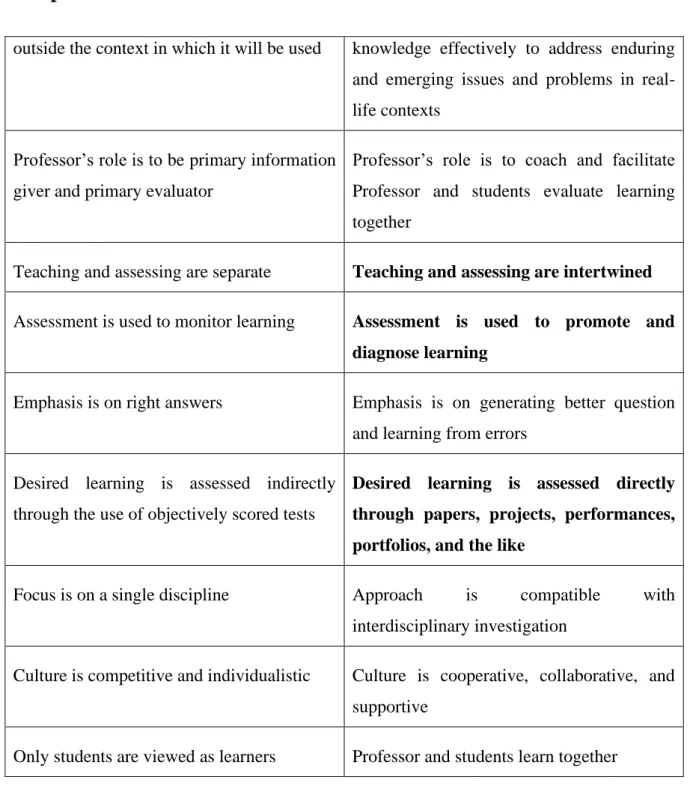
Huba and Freed (2000) made a comparison between teacher-centered and learner-centered paradigms as it is presented in the following table:
Teacher-centered paradigm Learner-centered paradigm
Knowledge is transmitted from professor to students
Students construct knowledge through gathering and synthesizing information and integrating it with the general skills of inquiry, communication, critical thinking, problem solving and so on
Students passively receive information Students are actively involved
11
outside the context in which it will be used knowledge effectively to address enduring and emerging issues and problems in real-life contexts
Professor’s role is to be primary information giver and primary evaluator
Professor’s role is to coach and facilitate Professor and students evaluate learning together
Teaching and assessing are separate Teaching and assessing are intertwined
Assessment is used to monitor learning Assessment is used to promote and diagnose learning
Emphasis is on right answers Emphasis is on generating better question and learning from errors
Desired learning is assessed indirectly through the use of objectively scored tests
Desired learning is assessed directly through papers, projects, performances, portfolios, and the like
Focus is on a single discipline Approach is compatible with interdisciplinary investigation
Culture is competitive and individualistic Culture is cooperative, collaborative, and supportive
Only students are viewed as learners Professor and students learn together
Comparison of Teacher-centered and Learner-centered paradigms (Learner Centered Assessment on College Campuses by Huba and Freed 2000)
Table 1.4: Teacher-centered vs. Learner-centered paradigms (Huba and Freed 2000)
To sum up, in teacher-centered classes material is covered, but not necessarily mastered and the pedagogy is different too. In learner-centered classes, students learn by practice. They engage in the material and practice the discipline.
12
1.7 Classroom interaction techniques
In teaching English as a foreign language (TEFL) the teacher often uses a variety of techniques that make their students interact more when conducting foreign language lessons. The most common interaction techniques are: pair work, group work, discussion, and simulation and role play.
1.7.1 Pair-work
The term pair work was defined in Longmans Dictionary as putting students in small groups of two or three to do an activity together. Moon (2000) also attempts to define pair work as a strategy “to organize them (student) in ways that will maximize opportunities for
learning” (p.53). He ties pair work to learning. Another definition was given by Richards and
Schmidt (2002), pair work is a learning activity that engages learners to work together in pairs. From those definitions, pair work is a technique where two students (i.e. pair) practice a language together, such as: fill in the blanks of information gap activities, write script of play or dialogues and study a written passage.Pair work plays a crucial role in classroom interaction. It increases learners’ opportunities to use the language and to broaden their perspectives. Then, it encourages them to appreciate different opinions of others.Pair work activity increases the amount of talking time of students. So, they can have more chances to share their knowledgewith others and feel independent and autonomous. Pair work activity is known to be quickly done and easy for organizing, however it is considered as noisy process. The fact that led many teachers to avoid it because most of them lose control over their classes.
1.7.2 Group work
The use of group work activities is another frequently cited technique for changing the interactional dynamics for language classroom. Group work is defined as more than one person working together to complete a task or assignment. In the classroom, group work can take many forms; however, the goal is to make students interact with each other and collaborate to complete a unified task. According to Penny (2000) “Group work increases the
sheer amount of learner talk going in a limited period of time and also lowers the inhibitions of learners who are unwilling to speak in front of the full class”(p.121). It means that in group
work, learners perform a learning task through small-groups interaction. It is seen as an activity that increases the amount of learner’s talk. Teachers use group work activities to help students enhance social skills and increase the use of different patterns of classroom
13
interaction which are the teacher-student interaction, the student-student interaction and the student-material interaction. Despite that it can make students noisy but it can reduce the inhibition of learners who are unwilling to interact with the teacher or their classmates.
1.7.3 Simulation and role-play
The most important goals that EFL teachers seek to achieve during their teaching process are: helping students to analyze issues, evaluate actions and decisions, connect classroom knowledge to real world situations, and develop problem solving. Simulations and role play can be effective ways to reach these objectives. They are forms of experiential learning (Russell & Shepherd, 2010). Simulation is designed to replicate a real life situation, having students assume roles where they analyze data, make decisions and solve the problems inherent in the situations. Meanwhile, role play is defined as a strategy in which students are required to act specific roles through saying, doing, and sharing (Altun, 2015). Simulation and role play involve the interaction among students and foster collaboration, enhance their language development and performance, and create enjoyable atmosphere. The significant advantage of these two activities in learning is to increase empathy as they see issues from multiple perspectives.
1.7.4 Discussion
The term discussion is a spoken interaction between three or four speakers, who are then given a particular topic or question to explore. Classroom discussion can bring out students’ interests and motivate them; it’s a chance for them to talk about the things they really care about. Giving and justifying opinions can also bring students a sense of accomplishment, as they are using the language to express ideas. This technique is used to keep students active and make them interact. Furthermore, discussion ensures the use of language meaningfully, interactively and fluently. The main role that a teacher can play in discussion activities is to introduce the topic being discussed; in meanwhile students are motivated and encouraged to speak freely. Hence, they will be able to deal and talk about several topics.
1.8 Teachers’ roles
An effective classroom interaction needs a pleasant atmosphere and a good relationship among participants (teacher and learners) in the classroom. This can be achieved through various ways; one of them is the roles that can the teacher play inside classroom.
14
• The teacher as a controller
Within a classroom interaction, a teacher as a controller is a role that is the more expected. It means that the teacher is in a complete charge of class and the center of attention. Harmer (1991) points out that teachers fulfilling this role, “[…] control not only what the
students do, but also when they speak and what language they use.”(P. 236). It means that
everything is controlled by the teacher and is in his/her responsibility. For example, he/she introduces the target language, gives activities, and guides the students through the content. In addition, Harmer (2001) asserts that the teacher job here is to transmit knowledge from himself to his students.
• The teacher as an Assessor
The teacher can also be regarded as an assessor by providing students with feedback regarding their performance. Telling students about their strengths and weaknesses and praising them in distinct ways. Correcting students’ mistakes in an appropriate manner with paying attention to their reactions, in this regard (Harmer, 1983) said: “gentle correcting
involves showing that incorrectness has occurred, but not making a big fuss about it.”(p.201).
• The teacher as an Organizer
The key to success in the field is the ability of a teacher to organize oneself, the classroom, as well as the students. Organization means that students are in their proper position at the correct time and know what is required from them, and the teacher is ready with planned and successful lessons and evaluation methods. This role is related to the activities that the learners can carry out in the classroom. The way the teacher designs, regulates and arranges pairs and group works, and gives instructions about how well they interact and participate. All activities in the classroom depend on good organization in order to get students engaged and more interested.
• The teacher as a Prompter
Students sometimes lose the thread or become unsure how to proceed; the teacher in this regard can play the role of a prompter. He /she is like a motivator, helps the students
15
when they face trouble in the activities by giving them clues or tips, with this role the class is like more interactive. The teacher then, encourages students to think and to be creative in order to be autonomous and independent.
• The teacher as a Resource
This role involves when the students encounter difficulties in an activity that they are working on. Thus, the teachers act as students’ reliable resource. They can be one of the most important resources students have when; for example, ask how to say or write something and when they want to know what a word or phrase mean. Teachers areready to offer help if needed, available for advice and counsel when the student seek for it.
Despite all the roles that are mentioned above which are the main roles that the teacher can play or must do during the teaching process and especially during classroom interaction, there are other roles that he/she can take in order to create pleasant atmosphere in the classroom, which are the facilitator, the observer and the manager. These roles are all about making learning easier, planning the lesson, structuring the time and observing how the students’ work is going.
1.9 Creating a pleasant atmosphere
Research has indicated that if a positive classroom atmosphere is created, students will learn better and engage more which means that it is one of the most effective and powerful tools teachers can use to encourage students’ learning. Every student must feel safe and important in the classroom in order to enhance learning. The teacher is the one who creates a pleasant atmosphere, it does not happen without efforts. For instance, he /she searches for students’ strengths and build on theme, plans the lessons according to students’ needs and interests and chooses the activities that make them participate. The teacher should avoid showing anger when the students make mistakes because they are still developing social awareness as well as skills. In addition, educators can be moody sometimes because of the personal or professional events, but it is important for them to separate the personal life from the professional one to make the students feel safe, comfortable and to foster learning. Another way of showing a pleasant atmosphere in the classroom is to praise the students frequently and use feedback after any participation or activity. The following strategies are the effective strategies that the teacher should follow to create a positive classroom atmosphere:
16
✓ Showing interest in each individual student
✓ Offering feedback on the performance of each student ✓ Valuing and respecting students’ thoughts and ideas ✓ Building classroom rules and procedures collaboratively
✓ Being objective rather than accusatory when dealing with a student conflict or behavioral issue
✓ Promoting positive peerrelationships
✓ Using warm, inclusive behaviors with the face, body, and words
1.10 Teachers’ feedback
Teachers’ feedback is a mandatory part of the teaching and learning processes. It is a powerful tool for enhancing students’ learning. Sadler (1989) stated that feedback in educational contexts offers the learner sufficient information to reduce the distance between actual output and the expected goal. It is a consequence of teaching and a response to learner performance. Moreover, feedback refers to the input that learners get from their teacher about their performance, which will enable them to enhance their self-correction and achievement. (Sarosdy, et al 2006). The aim of the feedback is to reduce the distance between where the students are and where they supposed to be. Teachers must provide constant feedback, as this way, students will feel cared, and work on their main difficulties along the school year. Effective feedback must be direct at the right level, purposeful, relevant and consistent with the prior knowledge of the students which must include logical connection. In addition, feedback should be gently provided and given immediately. For instance, appraising someone for a good work after a month will not be like when you appraise him immediately. The learner who is receiving the feedback should not feel like he is under attack. There are three types of feedback which are oral, written and peer feedback. The oral once, means the spoken feedback which is provided by the teacher to the students during doing the work. Then, the written feedback is the output which is given after the written activities. It is helpful, the students can refer to it over again. The teacher should use understandable words, locate and correct the error and should awards the correct job. Finally, the peer feedback is a social activity that occurs when the learners correct each other works. It is important because it arises some kind of interaction. To conclude, receiving feedback about learners’ performance reflects their level of achievement.
17
1.11 The relationship between classroom interaction and classroom management
An understanding of how interaction is structured and accomplished by teachers and learners in the classroom provides valuable insights into classroom management. Classroom management refers to the teachers’ decision to support and offer maximum learning opportunities (Krause, Bochner& Duchesne, 2003). It is also the process of conducting and organizing classrooms to ensure maximum learning and prevent disturbances. Furthermore, it entails activities to maintain an atmosphere to provide positive conditions for learning (Berliner 1988). Without classroom management, students would not get the education they deserve and may not feel safe in their school environment.
Richards and Rodgers (2014) suggest that classroom management in EFL classroom allows teachers to monitor students’ actions and teacher-student interaction. This is meant that the interaction between teacher and student is considered as an important element of classroom management. Successful interaction in classroom involves mainly the teachers’ management and organization. In an effective classroom management, all students should feel safe, valued, comfortable, supported and successful. This can be achieved through different ways such as understanding students’ needs, positive interaction between the teacher and students and among students, increasing motivation and effective feedback. Effective classroom management and positive classroom interaction are essential goals for all teachers.
The interaction of teachers and students also can affect the learning achievements, because a smooth interaction will make the students feel reluctant to participate actively in the process of learning. According to Roestiyah (1989) when teachers interact with students who are less intimately, the learning process will be substandard. Therefore, students will hate the teacher, they will get bored and they will not participate. Teachers who teach just for expertization, will not give importance to their learners, as a result, this will lead to low academic achievement.
1.12 Learning achievement
Language learning includes activities that requires interaction that lead to learning achievement. Learning refers to a relatively permanent change in human capabilities that can include knowledge, skills, attitudes, behaviors and competencies that are not the result of growth processes. Likewise, Morris (1971) stated that learning is all about acquiring information, comprehension or mastery of expression, skill or research. It is also a mechanism
18
that the learner improves through exposure to the circumstances. In addition, Slameto (1995) defines learning as a process of ones’ efforts to acquire a new behavior changes as a whole, as a result of his own experience in interaction with their environment.Based on the above understanding, learning is a process that includes series of activities, it is not an outcome or a goal but a process to achieve goals. Learning is not given, but broader than that, it is experienced. The term learning has long been paired with the word achievement which is considered as a competence that a person has in an area of content. It is defined as the result of an activity that has been done, created, pleased and obtained with a determinant way; either individually or in group (Djamarah, 1994). It is a successful performance and something accomplished, especially by superior ability, special effort, great courage, etc. Furthermore, learning achievement refers to the result or level of ability that has been achieved by students after attending a teaching-learning processes within a certain time. It is in form of changes in behavior, skills and knowledge and then it will be measured, assessed and subsequently realized in numbers or statements. In addition, learning achievement defined as the acquisition of knowledge that are improved by subject matter usually indicates by test scores assigned by teachers. It can be conclude that learning achievement is the rate of success of students in schools that are expressed in the form of a numerical value.
1.12.1 Classroom interaction and learning achievement
There are always debatable issues in the teaching and learning processes. One of them is the relationship between classroom interaction and learning achievement. The type of this relationship can be known through a variety of factors that we find in the classroom
interaction and affect students’ achievement in some way, for example, these factors are either positive or negative for learning achievement.
• Motivation
Motivation is defined as “powering people to achieve high levels of performance and overcoming barriers in order to change” in case it is related to learning, the teacher is the one who gives power to hid students in order to perform well. Therefore, it drives the person to behave and act in a particular way. It also drives people’s willingness and desire to do something. Motivation is like the power that can be either external or internal. This power pushes the learner to make efforts to achieve his goals.
19
• Interaction of teachers and students
Teacher-students interaction is widely considered as essential by educators and students alike. This interaction type includes three tasks to be performed by the teacher which are: to stimulate interest and motivation, to organize application of student learning, and to counsel, support, and encourage each learner.The students who establish a strong relationships with their teachers can perform better than students whose relationships with teachers involve some sort of conflict. Teachers can help students improve their learning achievement by clearly expressing positive expectations for each student, giving students equal opportunities to participate in class discussions, and expressing to students that they are confident in their ability to succeed when it comes to their classroom activities.
• Learning tools and curriculum
The lack of tools and materials in schools will not help in improving the students’ learning achievement. Learning tools include for examples libraries, laboratories, using technology aids etc. Purwanto (2004) explains that schools should have enough tools and equipment needed to learn coupled with the good teaching of teachers, teachers' skills in using tools that will simplify and accelerate students’ learning. The importance of materials in language teaching and learning is widely recognized. As Richards (2001) notes:
“Teaching materials are a key component in most language programs. Whether the teacher uses a textbook, institutionally-prepared materials, or his or her own materials, instructional materials generally serve as the basis for much of the language input learners receive and the language practice that occurs in the classroom. In the case of inexperienced teachers, materials may also serve as a form of teacher training – they provide ideas on how to plan and teach lessons”. (p. 251)
On the other hand, the Curriculum which is a number of activities assigned to students. These activities are related to the materials used in teaching. It has been stated that if the curriculum is not good, it will not affect either the process of learning and student achievement.
1.13 Conclusion
It is generally argued that interaction in classroom is helpful for language learning. It can involve a pleasant atmosphere in the classroom with positive relationship between
20
learning process’s participants. Classroom interaction has a big impact on educational setting since it helps students to be successful learners. It provides students with more opportunities to share ideas, collaborate and maximize their talking time through different activities designed by the teacher. Learners and teachers will not be able to achieve progress and improvement without this interaction, it gives the teacher an occasion to present an effective learning and successful learners. At the same time, it makes students achieve their goals, obtain a great deal of awareness about making conversation, working in group and presenting their opinions without fear about others reaction.
Chapter Two
21
2.1. Introduction
This chapter represents the practical side of the study which explores not only whether the classroom interaction has an impact on the achievement of learners of second year High Schools in Mostaganem, but also the different patterns and techniques of interaction that the teacher used to encourage classroom interaction. Furthermore, it includes the description of population in order to give a precise picture of this research. It also highlights the data collection instruments utilized including classroom observation besides the students’ and teachers’ questionnaire.
2.2. Research methodology
In general, research is a way of thinking and finding answers to the questions. The techniques and procedures that need to be used should also be valid and logical. The researcher used two data collection methods which are the classroom observation and the questionnaire for both teachers and students. We used the quantitative method in order to provide numerical values (statistics) about the teachers’ opinions about classroom interaction and its patterns. In order to obtain quantitative insights and statistical analysis, two questionnaires are delivered to the teachers and students with different types of questions (open-ended, close-ended, yes or no questions and multiple choice questions). As for the qualitative method, an observation is devoted for the students in order to examine their level of interaction and the different patterns and techniques of interaction that the teacher used in the classroom.
2.2.1. The educational setting:
This research was conducted in secondary schools of Mostaganem. It deals with second year students and EFL teachers as sample population during the second trimester of the academic year 2019/2020. It aims at investigating the effect of classroom interaction and its patterns on enhancing learning achievement in EFL classes.
2.2.2. The participants:
The participants chosen for this study are second year students in Mohamed ben Ahmed Abd Alleghany secondary school of Mostaganem and EFL teachers of Mostaganem high schools. Due to the circumstances in which the country was passing through in general and Mostaganem in particular. The researcher was unable to complete his research in the
22
institution, and therefore he had to collect information through the use of social networks. The researcher put a questionnaire and published it in groups belonging to English language teachers in secondary schools of Mostaganem. The teachers who answered the questionnaire are EFL teachers of secondary schools of Mostaganem .They were twenty (20) teachers, among them thirteen (13) were females and four (7) males. The selection of the sample of the students was based on the questionnaire done by the researcher. The questionnaire was devoted to second year Students in Mohamed ben Ahmed Abd Alleghany secondary school of Mostaganem .They were divided into six ( 6) classes, the researcher chose one class from the whole number as a sample, they were twenty eight (28) students (male and female) from foreign languages class.
2.3. The data collection procedure:
To collect data, the researcher has chosen two instruments (observation and questionnaire) to evaluate and validate or invalidate the hypothesis of the research, as well as observing the pupils’ interaction in an EFL classroom. On the one hand, the researcher’s aim was to obtain a quantitative data through the use of questionnaires; by knowing the effect of classroom interaction on the learning process. On the other hand, qualitative data was used through classroom observation to explore this phenomenon.
2.4. The description of data tools:
In this research, two instruments were used to collect data which are the classroom observation, the questionnaires for both students and teachers. The purpose of using these triangulation is to gather both qualitative and quantitative data.
2.4.1. Classroom observation
The classroom observation is used in order to know how the classroom interaction patterns affect pupils' achievement. It is based on a check list which is composed of five items.
We wanted to observe the teacher and pupils’ talk during the lesson and also the interaction patterns that are used. As well, we observed the techniques of classroom interaction that the teacher utilized and which of them the pupils liked more. In addition, the researcher intended to know the different roles that the teacher played during the teaching
23
process. We attended fourteen sessions of second year foreign languages class of secondary school in order to be part of the situation and to observe the teaching- learning processes.
The observationcriteriawere not informed teachers and learners. This means that the behavior of both the teacher and the learner was expected to be as usual during the lesson.
2.4.2. The pupils’ questionnaire
The pupils’ questionnaire is designed to reveal the types of interaction and the techniques that students prefer their learning, as well as knowing whichones were most used by the teacher. Also, discovering the level of participation in the classroom. It is formulated of thirteen (13) questions which are a combination of open-ended, close-ended and multiple choices (see appendix p54). The pupils’ questionnaire was conveyed to foreign language class which contained twenty eight (28) pupils in Mohamed Ben Ahmed Abd Alleghany High School of Mostaganem. It consisted of two parts, the first one is about pupils’ gender and level in speaking and listening skills, and the second one is about the pupils’ participation and the techniques they preferred in their learning.
2.4.3. The teachers’ questionnaire
The teachers' questionnaire is aimed at investigating the amount of teachers’ talking as well as students’ talking in the classroom, views about the patterns and the techniques of interaction that are used in the classroom and the main roles that the teacher perform inside the classroom. It is composed of twelve (12) questions which are open-ended questions, close-ended questions and multiple choices questions. The questionnaire was addressed to twenty (20) teachers of secondary schools of Mostaganem. It consists of two sections. (see appendix p 58)
Section one: General information (Q1 and Q2)
This section aims at collecting personal information about the target sample, teachers were asked to specify their gender and the years of teaching experiences in secondary
Section two: classroom interaction (Q3 to Q12)
The purpose of this section is to gather information about the interaction in the classroom. The third, the forth and the fifth questions aim at investigating the techniques used by the teachers to motivate and let the students participate and use the English language. The
24
sixth question is asked to discover the way that the teachers utilize to make the silent students share and explain their ideas. The seventh question is required in order to know if the students enjoy the learner- learner interaction pattern. The eighth question is asked to recognize the teachers’ reaction towards the students’ mistakes during participation. The ninth question aims at checking the materials used during the lectures. The tenth question addresses to know the teacher involvement with the students in doing the activities in the classroom. The eleventh question is about the amount of the teacher talking time. The purpose of the twelfth question is to know if it is possible for the teacher to make all the students interact in the classroom.
2.5. Analysis of data tools:
2.5.1. Analysis of classroom observation:
The researcher used the classroom observation as a tool in order to provide amount of information about the pupils’ and teachers’ daily behaviors in the classroom. During the observation of the learners and the teachers in their educational setting (their classroom), it was difficult to cover all the items selected to be observed. We will mention the most important notes about the items in the check list. (See appendix p53)
In fact, we attended fourteen sessions, to observe the amount of teachers’ and pupils’ talking time in order to know who is the centered of the classroom and how the participation is going between them. In other word, which pattern of classroom interaction is used more or preferred by the teacher and the pupils alike.Furthermore, we observed that the teacher preferred to work in groups. The pupils were working in teams all the sessions attended. In addition,the walls of the classroom were filled with some of the students' works represented in a group of drawings and ideas about topics related to the studied units. The teacher said that this techniques is called a gallery board which means that the teacher gives a topic to the students and asks them to provide ideas about it and then they post it in the wall and each group walk around to read each other ideas.During the observation sessions, it was noticed that pupils are active and talk all the time with the teacher as well as their peers but not much more than the teacher. The teacher always started the session by asking the students about the previous lesson and the pupils respond. When the teacher see that the same pupils replied, they ask other students to answer. Then, the teacher started the new lesson by asking the pupils about their prior knowledge after that presenting the lesson using the data show.
25
Moreover, we remarked that there are different patterns and techniques of classroom interaction that the teacher used to encourage interaction.Due to the choice of the teacher which is putting the pupils in groups, the learner-learner interaction is noticeable. What we observed is that the pupils in groups talked with each other about the task given by using the English language and sometimes they face problem of losing vocabularies , so they attend to use the L1 (Arabic language). Furthermore, the teacher used several materials during the lesson which are: the books, the dictionaries, and the projector (data show), audios, videos and handouts. We remarked that the students enjoy learning with those materials. The teacher gives each group a dictionary in order to check the meaning of any unknown word. He supports his lesson by videos and sometimes audios specially when the aim is listening and speaking skills. For instance, when it is a new unit, he brings pictures to better understanding and then asks the pupils to explain what they represent. We noticed also that he uses the text book when it is reading session. In addition, the teacher plays many roles inside the classroom for example; monitor,organizer, prompter and assessor. He is in complete charge of class, he gives the activities and guide the students through the content. Alike, he motivates and encourages them to participate and share their thoughts and opinions, besides giving them help when it is necessary. Another role that I observed from the teacher is providing feedback on students’ performance all the attended sessions.
2.5.2. The analysis of pupils’ questionnaire:
Section one: General information
Q1: specify your gender
Gender Number Percentage
Female 15 62,5%
Male 09 37,5%
Total 24 100%
Table 2.1: Pupils’ Gender
This tables shows that the majority of the respondents are females 62, 5% whereas the male number is 37, 5%.
26
Q2: How do you consider your level in English speaking and listening skills?
Figure 2.1: Pupils’ level English speaking and listening skills
In this question students are asked to describe their level in speaking and listening skills in the English language, to answer this question students were required to rank their level from good, average and bad. We have 79, 2% of students who have answered by good, and 12, 5% said that their level is bad, besides 8, 3% who claimed that their level is low bad. This shows that the majority of students evaluate their level of using the English language by good.
Section two: Classroom Interaction
Q3: According to you, what is interaction (participation) in the classroom?
The pupils presented the definition of interaction in the classroom according to their opinions and based on their knowledge. Some pupils said that interaction in the classroom is to share and express ideas, to extend opinions and answer questions, others defined it as a way to communicate with the teacher and discuss with peers to exchange and develop ideas. Another definition given by other pupils; it is a key to understand better and present the lecture in a good way. The last presented definition is that the interaction means to raise the hand and asked the permission of the teacher to kindly answer the teachers’ questions as well as the peers. It seems that pupils’ definitions are differed from one pupil to another.
79.20%; 79% 8.30%; 8% 12.50%; 14%, 0, 0% Good Average Bad
27
Q4: Do you participate and share your ideas and opinions in the classroom?
Figure 2.2: Pupils’ participation in the classroom
This question is designed to know if the pupils participate and exchange their ideas and points of views in the classroom. According to the graph, the majority of pupils 83, 3% answer that they interact in the classroom, while 16, 7% reply that they do not participate and share their ideas in the classroom.
The question is open ended in the sense that the students are requested to give the reasons to justify their answers. Some of them answer as follow:
▪ I participate because I like the subject and I can speak English ▪ For showing my ideas
▪ In order to present ideas and correct them if they are wrong ▪ To give my point of view
▪ I do not participate because I am shy
▪ I do not participate because I make mistakes
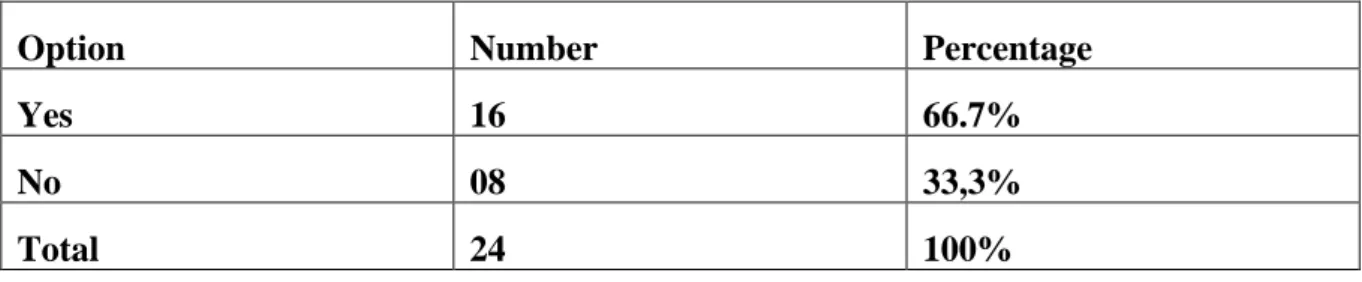
Q5: How often do you participate in the classroom?
Option Number Percentage
Always 11 45, 8%
Sometimes 10 41, 7%
Rarely 02 8, 3%
Never 01 4, 2%
Total 24 100%
Table 2.2: pupils’ participation in the classroom
83.30% 16.70%
28
The researcher asks this question to know either the pupils like to participate; or they do not like to share their ideas. According to the table above 45, 8% responds that they always participate, 41, 7% sometimes participate. While 8, 3% of them reply that they rarely participate and exchange their ideas and opinions, moreover 4, 2% answers that they never interact and talk in the classroom.
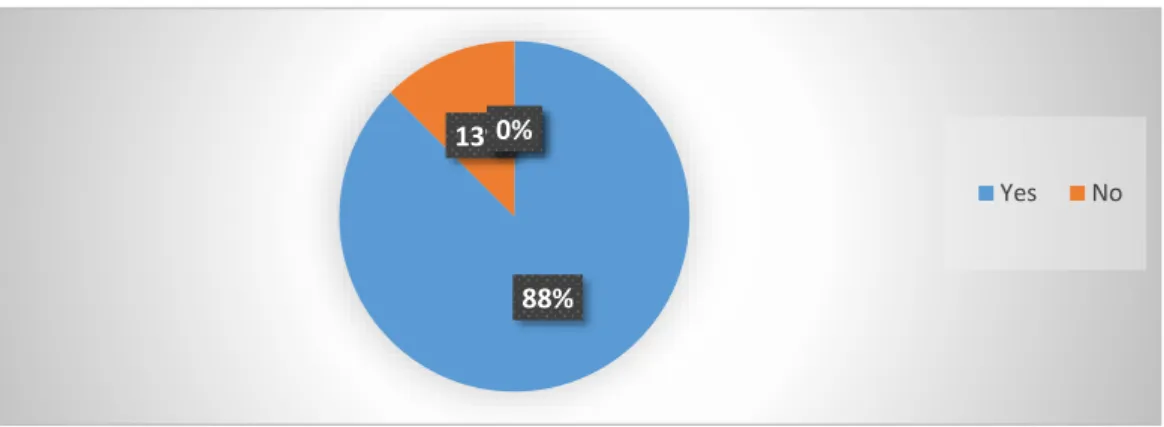
Q6: Does your teacher give you the opportunity to participate in the classroom with your peers?
Figure 2.3: Pupils’ participation with peers
The researcher put this question in order to know if the teachers give their learners the opportunity to participate and share their ideas with each other’s in the classroom. The answers demonstrate that the great majority, 87% answer that they are allowed to exchange their ideas with peers, while 13% replied that they do not have that occasion.
Q7: who talks the most in the classroom?
Figure 2.4: Teacher’ talk and student’ talk in the classroom
88% 13%0%0% Yes No 0.00% 20.00% 40.00% 60.00% 80.00% Teacher T Student T
29
This graph shows the teacher and student talk in the classroom. The majority of our population, 62, 5% answer that the teacher has the most talk in the classroom, while 37, 5% respond that the students have the most talk.
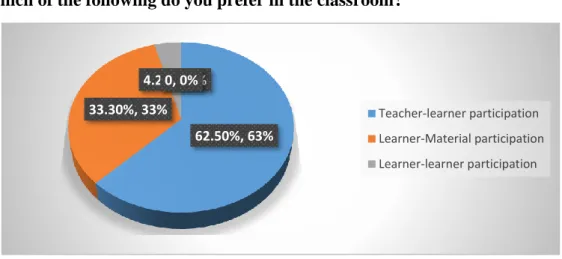
Q8: Which of the following do you prefer in the classroom?
Figure 2.5: Pupils’ preferred patterns of interaction
In this question the researcher wonders to know which pattern of interaction is preferred by the students in the classroom. 62, 5% of students reply that they prefer the teacher-learner interaction, while 33, 3% respond that they like the learner-material interaction. Moreover, 4, 2% answer that the learner-learner interaction is their preference.
Q9: When you participate with your peers in the classroom, do you give priority to:
Figure 2.6: Pupils’ priority when participating with each other
62.50%, 63% 33.30%, 33% 4.20%, 4%0, 0% Teacher-learner participation Learner-Material participation Learner-learner participation 0 33.3 66.7 0 20 40 60 80
use fluent and accurate English express ideas even with incorrect English