HAL Id: hal-00317466
https://hal.archives-ouvertes.fr/hal-00317466
Submitted on 14 Jun 2004
HAL is a multi-disciplinary open access
archive for the deposit and dissemination of
sci-entific research documents, whether they are
pub-lished or not. The documents may come from
teaching and research institutions in France or
abroad, or from public or private research centers.
L’archive ouverte pluridisciplinaire HAL, est
destinée au dépôt et à la diffusion de documents
scientifiques de niveau recherche, publiés ou non,
émanant des établissements d’enseignement et de
recherche français ou étrangers, des laboratoires
publics ou privés.
To cite this version:
V. Kurt, A. Belov, H. Mavromichalaki, M. Gerontidou. Statistical analysis of solar proton events.
Annales Geophysicae, European Geosciences Union, 2004, 22 (6), pp.2255-2271. �hal-00317466�
SRef-ID: 1432-0576/ag/2004-22-2255 © European Geosciences Union 2004
Annales
Geophysicae
Statistical analysis of solar proton events
V. Kurt1, A. Belov2, H. Mavromichalaki3, and M. Gerontidou3
1Institute of Nuclear Physics, Moscow State University, 119899 Vorobievy Gory, Moscow, Russia
2Inst. of Terrestrial Magnetism, Ionosphere and Radio Wave Propagation, Russian Academy of Science (IZMIRAN), Russia 3Nuclear and Particle Physics Section, Physics Department University of Athens, 15771 Athens, Greece
Received: 6 October 2003 – Revised: 11 February 2004 – Accepted: 8 March 2004 – Published: 14 June 2004
Abstract. A new catalogue of 253 solar proton events
(SPEs) with energy >10 MeV and peak intensity >10 protons/cm2.s.sr (pfu) at the Earth’s orbit for three complete 11-year solar cycles (1970–2002) is given. A statistical anal-ysis of this data set of SPEs and their associated flares that occurred during this time period is presented. It is outlined that 231 of these proton events are flare related and only 22 of them are not associated with Ha flares. It is also notewor-thy that 42 of these events are registered as Ground Level Enhancements (GLEs) in neutron monitors. The longitudinal distribution of the associated flares shows that a great number of these events are connected with west flares. This analysis enables one to understand the long-term dependence of the SPEs and the related flare characteristics on the solar cycle which are useful for space weather prediction.
Key words. Interplanetary physics (Energetic particles;
Flare and stream dynamics; Interplanetary shocks)
1 Introduction
Solar energetic particles, high-energy neutral emissions, coronal mass ejections (CMEs) and shock waves associated with fast CMEs determine the space weather at the Earth’s orbit. The most powerful sources of solar energetic particle fluxes observed at 1 AU are flares and interplanetary shock waves. The dynamic of energetic particles within the helio-sphere involves the problems of acceleration, particles escap-ing and spreadescap-ing near the Sun and propagation through the interplanetary medium. Actually, all of the above processes display a high degree of variability that results in the great diversity of the time behavior of the particle fluxes measured at 1 AU.
Significant progress has been made in the understanding of electromagnetic phenomena associated with the particle acceleration during the flares. The basic patterns of par-ticle interplanetary transport and additional acceleration on
Correspondence to: H. Mavromichalaki
the interplanetary shock have been elaborated during the pe-riod between 1960 and 1980 (Dorman and Miroschnichenko 1968; Miroshnichenko, 2001). Pitch angle scattering plays an important role in the particle propagation. Transport in-cludes the diffusion parallel and perpendicular to the mean magnetic field direction, focusing, drift motion under large-scale field changes and sometimes “scatter-free“ propaga-tion. Acceleration can take place at a shock front with the help of additional scattering centers moving relative to the shock (McCracken et al., 1962; Roelof, 1969; Richter et al., 1981; Cliver et al., 1982; Valdes-Galicia et al., 1984; Ma-son et al., 1984; Forman et al., 1986; Reames D. V., 1999; Wibberenz et al., 1992).
For first time Van Hollebeke et al. (1975) using the data from the Goddard cosmic ray experiments on IMPIV and -V, applied the procedure for identifying the associated flare of a solar proton enhancement and summarized the proper-ties of 125 events in which the initiating flare location could be defined. The existence of a “preferable connection re-gion” within 20◦W to 80◦W has been found. It was clarified that the maximum of the fluxes in each energy interval (en-ergy spectrum) and high-en(en-ergy threshold of the spectrum are the most important characteristics of solar energetic par-ticle events. Cane et al. (1988) rested upon numerous original works and formulated that the intensity-time profiles of solar energetic particles display an organization with respect to he-liolongitudes of parent flares, and the existing interplanetary shocks are the controlling agent. They explained the time behavior of solar energetic particles as a function of the lon-gitude within the model framework for the large-scale struc-ture of interplanetary shocks, which are probably driven by the piston of CME.
However, until now a persistent problem in the study of so-lar cosmic rays is the lack of exact information on the timing and on the conditions of accelerated protons spreading and escaping. One approach to understand the variability of the solar energetic particles fluxes measured at 1 AU is a statisti-cal study of their association with solar flares, with the shock wave and CME propagation on a large number of events.
2256 V. Kurt et al.: Statistical analysis of solar proton events
Figure 1a
Figure 1b
0.01 0.1 1 10 100 1000 10000 100000 Pr ot on f lux ( p fu ) Ep>10MeV S25E09, 3B/X13 S27W32, 1N/X2.9 S29W57, 2N/X3.7 S28W106 Ep>100MeV October,1989 10-8 10-7 10-6 10-5 10-4 SXR ( W m-2 ) 4000 6000 8000 10000 C ount r at e/ 15 m in SSC Oulu NM GOES 7, SXR 05-4A 19 20 21 22 23 24 25 26 27 28 29 30Figure 1c
(a)Figure 1a
Figure 1b
0.01 0.1 1 10 100 1000 10000 100000 Pr ot on f lux ( p fu ) Ep>10MeV S25E09, 3B/X13 S27W32, 1N/X2.9 S29W57, 2N/X3.7 S28W106 Ep>100MeV
October,1989 10-8 10-7 10-6 10-5 10-4 SXR ( W m-2 ) 4000 6000 8000 10000 C ount r at e/ 15 m in SSC Oulu NM GOES 7, SXR 05-4A 19 20 21 22 23 24 25 26 27 28 29 30
Figure 1c
(b)
Figure 1a
Figure 1b
0.01 0.1 1 10 100 1000 10000 100000 Pr ot on f lux ( p fu ) Ep>10MeV S25E09, 3B/X13 S27W32, 1N/X2.9 S29W57, 2N/X3.7 S28W106 Ep>100MeV
October,1989 10-8 10-7 10-6 10-5 10-4 SXR ( W m-2 ) 4000 6000 8000 10000 C ount r at e/ 15 m in SSC Oulu NM GOES 7, SXR 05-4A 19 20 21 22 23 24 25 26 27 28 29 30
Figure 1c
(c)
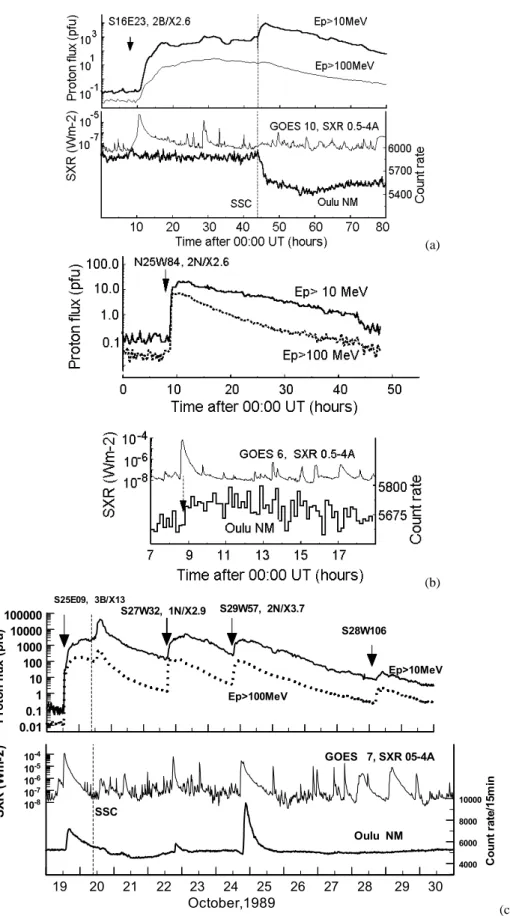
Fig. 1. Typical examples of large solar proton events which occurred on 24 September 2001, 25 July 1989 and during the time interval from 18 October to 31 October 1989, respectively.
According to the National Oceanic and Atmospheric Ad-ministration of the Solar Environment Center (NOAA/SEC) definition, a “solar proton event” (SPE) is the solar energetic particles’ enhancement in which proton flux with energy Ep>10 MeV is greater or equal to 10 part/cm2.s.sr (10 pfu) up to the background level near 1AU. The onset time of a pro-ton event is defined by the first three consecutive 5 min av-erage data points with fluxes greater than or equal to 10 pfu. The end of the event is the last time when the flux was greater than or equal to 10 pfu. This definition allows for multiple proton enhancements to be considered as one proton event.
Several catalogues of SPEs have been created and their data are analyzed within the framework of particle acceler-ation in different sources at or near the Sun (Van Hollebeke et al., 1974; Svestka and Simon, 1975; Basilevskaya et al., 1983; 1986; Sladkova et al., 1990; 1998; Cliver et al., 1991; Stolpovsky et al., 1988; Goswami et al., 1988; Shea and Smart, 1990; Feynmann et al., 1993; Gabriel and Feynmann, 1996; King 1984; Crosby et al., 1993; Mendoza et al., 1997; Gerontidou et al., 2002)
This work presents a new updated catalogue of solar ener-getic particles events for the time interval 1970–2002. Sta-tistical properties of SPEs and their association with neu-tron monitor enhancements as well as some properties of the solar flares, identified as “associated”, are discussed. This catalogue is mainly based on the catalogue of solar pro-ton events edited by Logachev at the Institute of Nuclear Physics of Moscow University (Basilevskaya et al., 1983; 1986; Sladkova et al., 1990; 1998) that covers the time span 1970–1996. In these issues the particle flux time profiles are taken from the Meteor satellite observations (Fedorov, Insti-tute of Applied Geophysics), GOES, IMP and balloon (Lebe-dev Physical Institute of Russian Academy of Sciences) mea-surements and Neutron Monitor Network (NMN), as well. The intensity-time profiles of proton fluxes in several energy bands, the integral proton energy spectrum, as well as in-formation on the possible SPE sources for each event, can be found in these issues. Listing of these events was extended up to now using the issues from NOAA SEC (2002). The NMN database of IZMIRAN (http://www.izmiran.rssi.ru) was also used for identification of the ground level enhancements (GLEs).
2 Catalogue description
Protons can be accelerated to energies more than 10 MeV during the flare development or near the shock front asso-ciated with the CME propagation. Thus, when one speaks about the source of the solar proton event, these two differ-ent sources are mdiffer-entioned. Time profiles of SPEs appear to be different for these two sources and depend on the relative position of the observation point.
In order to demonstrate this difference among SPE char-acteristics, time profiles for three different cases of SPEs are presented in Fig. 1a, 1b and 1c. A typical solar proton event which occurred on 24 September 2001 is given in Fig. 1a.
The “associated flare” of this event occurred with importance 2B/X2 and was located at S16 E23, while the soft X-rays du-ration was about 97 minutes. A coronal mass ejection and a shock wave were associated with this flare. When the in-terplanetary disturbance reached the Earth, a strong geomag-netic storm and a big Forbush decrease started on 25 Septem-ber at 20:25 UT. The peak values of 10 MeV proton flux was achieved at about 08:00–09:00 UT on 26 September, simul-taneously with the minimum value of cosmic ray intensity recorded at NM stations. Time profile of the SPE exhibits two strongly pronounced increases; nevertheless, according to the NOAA SEC definition, proton enhancement is consid-ered as “one” event, and maximum flux values (Tmax and Imax) have been attributed to fluxes registered simultane-ously with the shock.
An exceptional event of our catalogue is the event of 25 July 1989, presented in Fig. 1b. In spite of the fact that the peak flux for Ep>10 MeV protons was only three times greater than the threshold intensity (10 pfu), it was recorded as ground level enhancement at the Earth. The time pro-file of 10 MeV protons was very sharp with a time rise of about 180 minutes. An associated flare with importance X2.6/2N was located at N25W84 and had a total duration of 29 minutes.
The widely known time interval from 18 October to 31 October 1989 is the period with the highest proton fluxes over the history of space explorations. The spectacular time profiles of the protons are presented in Fig. 1c. A power-ful flare at 19 October with importance 3B/X13 was the first one in the series of long duration SXR flares accompanied by SPE. The maximum flux was registered simultaneously with sudden storm commencement (SSC) and Forbush decrease at 09:20 UT on 20 October. Three GLEs were recorded at neutron monitors on 19, 22 and 24 October. The GLEs on 19 and 24 October, having at the South Pole neutron monitor magnitudes greater than of 90% and 200%, respectively, are among the biggest GLEs of the solar cycles 20–23.
In this study the associated sources of each solar proton event with peak flux >10 pfu were found. Contrary to the NOAA/SEC definition, we tried to find and to distinguish a diffusion maximum of each event. Of course, there are events without any association with flares and when an SPE is cre-ated by far eastern flares, the associcre-ated flare identification is poor. The time profile of these events exhibits only one max-imum that coincided in time with the sudden commencement occurence. In this case this is adopted as the maximum value of the event. A list of 253 solar proton events with energy
>10 MeV and peak intensity >10 pfu over the time period 1970–2002 is presented in Table 1. After the numbering of the events the first two columns of this Table are the date and the onset time of each event. The time interval with inten-sity ≥90% of the peak flux (peak duration) and peak flux are given in the next two columns.
T ab le 1. L ist of solar p roton ev ent s with ener g y > 10 MeV and intens ity > 10 pfu for the period 1970 –2002 .
T A B
L
E
I
SOLAR P R OT ON EVENTS " A SSOC IA T ED" H α FLAR ES GL Es Nu m ber Date On set t im e P eak d uratio n P eak f lu x T start T m ax P ositio n Im p. Reg io n NM in cr of Ev ent yy /m m /dd dd/ hh dd/ hh-dd /h h pf u dd/ hh:m in dd/ hh:m in 1 70/ 01 /3 1 3 1/~ 18 3 1/ 20-01 /0 1 20 31 /1 5: 12 3 1/ 15: 35 S23 W 62 2B /M4 105 42 N o 2 70/ 03/ 08 08/ ~1 2 08/ 00-08/ 03 100 08/ 01 :38 08/ 01 :52 S 12 E 10 2B /M5 106 14 N o 3 70/ 03/ 23 23/ ~2 0 23/ 21 -23/ 24 10 23/ 15: 45 23/ 15: 48 N 18 W 62 1N 106 38 N o 4 70/ 03/ 29 29/ ~0 1 29/ 19 60 29/ 00: 32 29/ 00: 46 N 13 W 37 2B /X 2 106 41 No 5 70/ 05/ 30 30/ ~0 2 30/ 20-30/ 21 20 30/ 02: 18 30/ 03: 38 S08 W 30 2B /> M4 107 60 N o 6 70/ 06/ 25 25/ ~2 3 26/ 07-26/ 08 10 25/ 18: 33 25/ 18: 38 N 10 E 11 2B /M3 108 01 No 7 70/ 07/ 23 23/ ~2 3 25/ 00-25/ 01 10 23/ 18: 31 23/ 18: 43 N 09 E 09 1B/X2 108 45 N o 8 70/ 11 /05 05/ ~0 5 07/ 06: 00 40 05/ 03: 08 05/ 03: 30 S 12 E3 6 3B /X 2 11 01 9 N o 9 7 1/0 1/ 25 25/ ~0 0 25/ 07-25/ 18 100 0 24/ 22: 15 24/ 23: 31 N 18 W 49 3B /X 5 111 28 10-100 % 10 7 1/ 04/ 06 06/ ~1 2 06/ 13-06/ 22 40 06/ 09: 36 06/ 09: 44 S 19 W 80 1B/>M 1 11 22 1 No 11 7 1/ 05/ 16 16/ ~1 5 16/ 15-17/ 04 12 Over li m b No 12 7 1/ 09/ 02 0 1/~ 22 0 1/ 22-02/ 14 350 Ove r W li mb 10-100 % 13 72/ 01 /20 20/ ~0 2 20/ 21 -20/ 22 20 19// 16: 39 19/ 16: 44 S 16 E 10 1B 11 69 3 N o 14 72/ 04/ 18 17/ ~2 3 18/ 03-18/ 07 15 N o 15 72/ 04/ 19 19/ ~0 2 19/ 02 100 N o 16 72/ 05/ 28 28/ ~1 4 29/ 01 -29/ 04 10 28/ 13: 10 28/ 13: 32 N 09 E 09 2B /X 5 11 89 5 No 17 72/ 06/ 08 08/ ~1 8 08/ 16-09/ 02 10 N o 18 72/ 06/ 16 16/ ~0 1 17/ 07-17/ 18 10 15/ 09: 51 15/ 09: 58 S 10E 11 1N/M 1 11 92 6 N o 19 72/ 07/ 22 22/ ~0 6 22/ 13-22/ 15 12 22/ 05: 52 22/ 05: 55 S 14 W 00 1F/M 6 11 95 7 N o 20 72/ 08/ 03 03/ ~2 2 04/ 04-04/ 06 > 600 00 03/ 19: 58 N 14E 28 2B 11 97 6 3-10% 21 72/ 08/ 07 07/ ~2 0 09/ 00-09/ 01 > 100 0 07/ 14: 49 07/ 15: 34 N 14 W 37 3B /> X 5 11 97 6 3-10% 22 72/ 08/ 11 11 /~ 13 11 /1 8-11 /2 1 15 11 /1 2: 17 11 /1 2: 47 N 14W 90 1B/M8 11 97 6 No 23 73/ 04/ 29 29/ ~2 1 29/ 22-30/ 04 40 29/ 20: 56 29/ 21 :04 N 14W 73 2B /X 2 1 23 22 <3 % 24 73/ 09/ 07 07/ ~1 2 07/ 55 07/ 11 :4 1 07/ 12: 12 S 18W 46 2B /X 1 125 07 N o 25 74/ 07/ 03 03/ ~2 2 04/ 03-35 03/ 02: 59 03/ 03: 18 S 15E 09 1B 130 43 No 26 74/ 07/ 05 05/ ~1 0 05/ 15-05/ 24 400 04/ 13: 38 04/ 13: 57 S 16W 08 2B 130 43 N o 27 74/ 07/ 06 06/ ~0 0 06/ 03-20 05/ 21 :23 05/ 21 :43 S 15W 26 1B/X 10 130 43 No 28 74/ 07/ 07 07/ ~1 0 07/ 11 -07/ 13 100 07/ 09: 20 07/ 10: 14 S 16W 47 1B/X 1 130 43 NoT ab le 1. C ontinu ed. 29 74/ 09/ 10 10/ ~2 3 11 /24 80 10/ 21 :2 1 10/ 21 :46 N 10E 61 2B /X 5 132 25 N o 30 74/ 09/ 19 20/ 14-20/ 15 100 19/ 22: 20 19/ 22: 40 N 09W 62 2N /X 2 1 32 25 No 31 74/ 09/ 24 23/ ~2 2 24/ 19-24/ 23 50 23/ 12: 00 N 07W 90 1N/M 3 132 25 No 32 74/ 11 /05 05/ ~2 2 05/ 22-05/ 23 80 05/ 15: 29 05/ 15: 38 S 12W 78 1N/X 1 133 10 N o 33 75/ 08/ 21 2 1/~ 18 2 1/ 18-21 /20 152 1/ 15: 09 2 1/ 15: 17 N 26W 74 1B/X 1 138 11 No 34 75/ 08/ 22 22/ ~0 2 22/ 03-22/ 06 10 < 22/0 1: 08 22/ 01 :1 8 N 27W 81 1B/M9 138 11 No 35 76/ 04/ 30 30/ ~2 1 30/ 22-01 /0 1 130 30/ 20: 59 30/ 22: 18 S09W 47 2B /X 2 14 179 3-10% 36 76/ 08/ 22 22/ ~1 2 22/ 17 20 22/ 12: 17 -S02W 90 SN /M3 1 43 66 No 37 77/ 09/ 17 17/ ~0 0 17/ 01 -1 7/ 02 10 16/ 21 :23 16/ 21 :4 1 N 07W 20 2N /M5 149 43 3% 38 77/ 09/ 24 24/ ~0 1 24/ 07-24/ 18 100 O ve r the lim b 3-10% 39 77/ 11 /22 22/ ~1 0 22/ 10-22/ 12 300 22/ 09: 45 22/ 10: 05 N 24W 40 2B /X 1 150 31 10-100 % 40 78/ 02/ 13 13/ ~1 2 13/ 17-134 /1 0 100 0 N 15W 20 2N 15 139 N o 41 78/ 04/ 11 11 /~ 20 11 /20-11 /24 30 11 /1 3: 34 11 /1 4: 10 N 22W 56 2B /X 2 152 21 No 42 78/ 04/ 20 20/ ~0 1 20/ 07 12 19/ 14: 53 19/ 14: 58 N 17W 46 SN /C 1 152 35 N o 43 78/ 04/ 21 2 1/~ 10 25/ 00 12 19/ 14: 53 19/ 14: 58 N 17W 46 SN /C 1 152 66 N o 44 78/ 04/ 29 29/ 05-29/ 19 120 29/ 20: 10 -N 20E 14 2B /X 3 152 66 N o 45 78/ 05/ 07 07/ ~0 4 07/ 03-07/ 08 11 0 07/ 03: 27 07/ 03: 53 N 23W 72 1N/X2 152 66 > 100% 46 78/ 06/ 02 07/ 07: 30 02/ 09: 35 11 3 1/ 10: 09 N 23W 50 M5/2B 11 29 No 47 78/ 06/ 24 23/ ~2 0 24/ 15 10 22/ 16: 43 > 22/2 2: 40 N 18E 16 2B M3 153 68 N o 48 78/ 09/ 23 23/ ~1 0 24/ 02-24/ 18 100 0 23/ 09: 44 23/ 12: 15 N 35W 50 3B /X 1 155 43 3-10% 49 78/ 10/ 09 09/ ~2 2 09/ 23-10/ 02 200 09/ 19: 51 09/ 20: 22 S 18W 61 1B/M4 155 70 N o 50 79/ 02/ 17 17/ ~2 0 17/ 21 35 16/ 01 :44 16/ 03: 15 N 18E 09 3B /X 2 1 58 30 No 51 79/ 06/ 06 06/ ~2 0 06/ 20-06/ 21 330 05/ 04: 55 05/ 08: 38 N 18E 09 2B /X 2 160 51 No 52 79/ 07/ 07 05/ ~1 2 07/ 11 - 10 04/ 19: 03 04/ 21 :1 0 N 11 E 36 1B/M2 16 122 N o 53 79/ 08/ 20 19/ ~0 9 20/ 06-20/ 09 400 18/ 14: 00 18/ 14: 02 S25E 17 SN /X 1 162 39 No 54 79/ 08/ 21 2 1/~ 06 2 1/ 06-21 /08 600 21 /05: 50 2 1/ 06: 13 N 17W 40 2B /C 6 162 39 6% 55 79/ 09/ 17 14/ ~1 2 17/ 07-17/ 21 200 14/ 07: 55 14/ 09: 01 N 07W 08 1B/M3 162 79 No 56 79/ 11 /1 6 15/ ~2 2 16/ 11 60 15/ 20: 21 15/ 21 :42 N 10W 14 1B/M4 164 21 No 57 80/ 02/ 06 06/ ~1 9:0 0 07/ 02-07/ 06 10 05/ 17: 27 05/ 17: 27 S 17 W 09 1B /M3 663 1 No 58 80/ 04/ 04 04/ ~1 6:0 0 04/ 19-04/ 24 10 04/ 14: 54 04/ 15: 09 N 27 W 35 1N /M5 674 0 N o 59 80/ 06/ 21 2 1/~ 02 :0 0 2 1/ 07-21 /08 20 21 /0 1:2 1 2 1/0 1:2 1 N 19 W 90 1B /X 2. 6 689 8 N o 60 80/ 07/ 17 17/ ~2 3:0 0 18/ 16-18/ 20 120 17/ 05: 36 17/ 06: 10 S 12 E0 7 3B /M3 .4 697 8 N o 61 80/ 10/ 15 15/ ~1 2:0 0 15/ 20-15/ 21 20 15/ 05: 24 15/ 07: 28 N 21 E 55 3N /M2 720 4 N o
T ab le 1. C ontinu ed. 62 8 1/ 03/ 30 30/ ~0 9:0 0 30/ 11 10 30/ 00: 17 30/ 00: 47 N 13 W 72 1B /M3 .5 753 5 N o 63 8 1/ 04/ 04 04/ ~0 5:0 0 04/ 05-04/ 22 10 04/ 05: 00 04/ 05: 00 S44 W 87 2N /X 1. 9 753 9 N o 64 8 1/ 04/ 10 10/ 17: 45 10/ 18-10/ 24 40 10/ 16: 32 10/ 16: 51 N 07W 36 2B /X 2. 5 756 8 < 3% 65 8 1/ 04/ 24 24/ 15: 15 24/ 18-24/ 23 160 24/ 13: 46 24/ 14: 08 N 18 W 50 2B /X 5. 9 759 0 N o 66 8 1/ 04/ 28 28/ ~2 4:0 0 29/ 00-29/ 03 100 28/< 21 :05 N 16 W 90 SB /X 1.2 759 0 N o 67 8 1/ 04/ 30 30/ ~1 2:0 0 30/ 18-30/ 19 200 O ve r li m b N o 68 8 1/ 05/ 04 04/ ~2 4:0 0 06/ 10-07/ 24 15 04/ 08: 35 04/ 08: 39 N 15 E 18 1B /M9 .5 762 0 N o 69 8 1/ 05/ 09 09/ 12: 00 09/ 22-09/ 24 150 08/ 22: 01 08/ 22: 14 N 09 E 37 2B /M7 763 8 N o 70 8 1/ 05/ 10 10/ ~0 9:0 0 10/ 09-10/ 15 120 10/ 07: 15 10/ 07: 17 N 03 W 35 1N/M 1.3 762 4 < 3% 71 8 1/ 05/ 16 16/ 17: 00 16/ 18-16/ 24 500 16/ 07: 53 16/ 08: 31 N 11 E 14 3B /X 1. 1 764 4 N o 72 8 1/ 07/ 20 20/ 14: 30 20/ 17-20/ 21 13 20/ 13: 10 20/ 13: 22 S25 W 75 1B /M5 .4 773 6 N o 73 8 1/ 10/ 08 08/ 12: 35 09/ 12-11 /09 70 07/ 23: 15 07/ 23: 15 S 19 E 88 1B /X 3. 6 790 6 N o 74 8 1/ 10/ 12 12/ ~0 8:0 0 12/ 00-14/ 06 280 0 12/ 06: 15 12/ 06: 20 S 18 E 31 2B /X 3. 1 790 6 3-10% 75 8 1/ 12/ 09 09/ ~2 2:0 0 10/ 09-10/ 12 120 09/ 18: 17 09/ 19: 12 N 10 W 21 3B /M5 .2 805 8 N o 76 82/ 01 /3 1 3 1/ 00: 55 3 1/ 11 -3 1/ 20 100 0 30/ 23: 25 30/ 23: 44 S 14 E 14 2B /X 1. 1 820 2 N o 77 82/ 02/ 01 ? 01 /20-02/ 12 350 01 /1 3: 50 0 1/ 14: 07 S 16 W 09 3B /X 2. 6 81 76 No 78 82/ 02/ 08 08/ ~1 3:0 0 08/ 14: 46 15 08/ 12: 04 08/ 12: 23 S 15 W 88 1B/X 1.4 8 176 No 79 82/ 03/ 07 07/ ~0 4:0 0 07/ 04-07/ 09 10 07/ 02: 49 07/ 02: 50 N 19 W 53 2B /X 2. 7 824 0 N o 80 82/ 06/ 06 05/ ~0 0:0 0 05/ 03-09/ 18 30 06/ 16: 30 06/ 16: 36 S09E 25 3B /X 12 820 6 N o 81 82/ 07/ 09 09/ ~1 0:0 0 10/ 09-10/ 19 30 09/ 07: 20 09/ 07: 37 N 18 E 76 3B /X 9. 8 847 4 N o 82 82/ 07/ 17 17/ ~2 3:0 0 17/ 24 15 17/ 10: 28 17/ 10: 32 N 14 W 33 2B /X 3. 2 847 4 N o 83 82/ 07/ 22 22/ 20: 30 22/ 23-22/ 24 200 22/ 16: 48 22/ 17: 07 N 16 W 89 1N /M4 .9 847 4 N o 84 82/ 08/ 14 14/ ~0 6:0 0 14/ 06-14/ 08 20 14/ 05: 06 14/ 05: 07 N 11 W 63 1B/M4 .1 85 11 No 85 82/ 11 /22 22/ 19: 40 22/ 21 -22/ 24 45 22/ 15: 14 22/ 18: 17 S 11 W 36 1N /M4 .7 399 4 N o 86 82/ 11 /23 23/ ~2 2:0 0 24/ 02-24/ 10 35 23/ 11 :09 23/ 11 :20 S06 W 54 1N/M 1.2 399 4 N o 87 82/ 11 /26 26/ 06: 05 26/ 06-26/ 15 150 26/ 02: 30 26/ 02: 36 S 12W 87 2B /X 4. 5 399 4 3-10% 88 82/ 12/ 08 08/ 00: 10 08/ 08-800 07/ 23: 41 07/ 23: 51 S 19 W 86 1B /X 2. 8 400 7 10-100 % 89 82/ 12/ 17 17/ 18: 45 17/ 23-18/ 03 100 17/ 18: 20 17/ 18: 57 S07 W 20 3B /X 10. 1 400 25 N o 90 82/ 12/ 19 19/ 19: 20 20/ 00-20/ 03 100 19/ 15: 08 19/ 16: 32 N 10 W 75 1B /M9 402 2 N o 91 82/ 12/ 26 26/ ~2 0:0 0 27/ 11 -27/ 15 50 26/ 01 :44 26/ 01 :5 1 S 11 W 11 0 1N /C 9. 8 403 3 N o 92 83/ 01 /05 05/ ~1 0:0 0 05/ 12-05/ 14 200 0 05/ 04: 59 05/ 05: 20 S 11 W 123 1N 405 2 N o 93 83/ 01 /06 06/ ~1 5:0 0 06/ 17-06/ 19 20 06/ 08: 06 06/ 08: 12 S 10E 75 1N 405 3 N o 94 83/ 02/ 03 03/ ~0 9:0 0 04/ 06-04/ 08 340 03/ 05: 41 03/ 06: 08 S 17 W 07 2B /X 4. 1 407 7 N o
T ab le 1. C ontinu ed. 95 83/ 04/ 15 15/ ~0 3:0 0 15/ 13-15/ 18 10 15/ 01 :58 15/ 02: 01 S 12 W 90 1B/C3 .9 4 104 No 96 83/ 05/ 15 15/ ~1 0:0 0 15/ 11 20 15/ 08: 39 15/ 08: 45 S 12 W 82 1B/X2 .3 4 173 No 97 83/ 06/ 15 15~ 10: 00 15/ 13-15/ 19 10 Ov er the lim b No 98 84/ 02/ 16 16/ 09: 15 16/ 14 100 Ov er the lim b 10-100 % 99 84/ 02/ 18 18/ ~1 0:0 0 18/ 14-19/ 20 15 17/ 22: 26 17/ 23: 29 N 17 E 81 1N/X2 .3 4 42 1 No 100 84/ 03/ 14 14/ 04: 05 14/ 06-14/ 10 30 14/ 03: 15 14/ 03: 24 S 11 W 43 2B /M2 443 3 N o 10 1 84/ 04/ 25 25/ ~0 6:0 0 26/ 09-26/ 14 700 24/ 23: 56 24/ 00: 01 S 11 E4 5 3B /X 13 447 4 N o 102 84/ 05/ 31 3 1/ 13: 15 3 1/ 14: 15 153 1/ 3 1/ 11 :42 S09W 90 M 1 449 2 N o 103 85/ 01 /22 22/ 04: 15 22/ 04-22/ 20 142 1/ 23: 08 2 1/ 23: 20 S 10 W 40 1N/X4 .7 4 61 7 N o 104 85/ 04/ 24 24/ 14: 30 24/ 16-25/ 10 40 24/ 08: 50 24/ 09: 02 N 05 E 24 2B /X 1. 9 464 7 N o 105 85/ 04/ 26 26/ ~0 0:0 0 26/ 03-26/ 06 11 0 25/ 19: 06 25/ 19: 08 N 06E 03 1B/X 1 464 7 N o 106 85/ 07/ 09 09/ 02: 35 09/ 03-09/ 04 100 09/ 01 :33 09/ 01 :40 S 13 W 25 1N /M2 .9 467 1 No 107 86/ 02/ 05 05/ ~0 2:0 0 05/ 19-10 05/ 12: 34 05/ 12: 47 S07E 06 2N /M3 47 11 No 108 86/ 02/ 06 06/ ~1 0:0 0 06/ 12-06/ 14 140 06/ 06: 18 06/ 06: 22 S07 W 02 2B /X 1.7 4 711 No 109 86/ 02/ 07 07/ ~1 2:0 0 07/ 300 07/ 10: 11 07/ 10: 24 S 11 W2 1 2B /M5 .2 47 11 No 11 0 86/ 02/ 14 14/ 11 :55 14/ 18-14/ 24 200 14/ 09: 09 14/ 09: 22 N 00 W 78 1N/M 6. 4 4 71 3 N o 111 86/ 03/ 06 06/ 18: 35 06/ 19: 30 25 06/ 17: 03 N 02E 01 C4 /1 F 47 17 N o 11 2 86/ 05/ 04 04/ 12: 55 04/ 14-04/ 15 25 04/ 09: 39 N 09W 90 M 1. 2 472 7 N o 11 2 87/ 11 /08 07/ ~2 2:0 0 08/ 10-08/ 12 60 07/ 20: 28 07/ 20: 30 N 31 W 90 1N/M 1 487 5 N o 11 3 88/ 01 /02 02/ ~2 3:0 0 03/ 09-03/ 11 60 02/ 21 :11 02/ 21 :35 S34W 18 3B /X 1.4 4 91 2 N o 11 4 88/ 03/ 25 25/ ~2 2:0 0 25/ 23-26/ 01 38 No f lare No 11 5 88/ 06/ 30 30/ ~11 :0 0 30/ 11 -30/ 15 10 30/ 09: 04 30/ 09: 06 S 16 E2 2 2B /M9 .2 506 0 N o 11 6 88/ 11 /08 08/ ~1 2:0 0 08/ 16-09/ 02 15 07/ 11 :34 07/ 11 :53 S20 W 48 1N/M 3 5 21 2 N o 11 7 88/ 12/ 15 14/ ~1 2:0 0 15/ 03-15/ 08 10 13/ 10: 28 13/ 10: 29 N 20 W 40 1B /C 7 527 8 N o 11 8 88/ 12/ 16 16/ ~11 :0 0 16/ 18-17/ 13 18 16/ 08: 26 16/ 08: 33 N 27 E 33 1B /X 4 527 8 N o 11 9 89/ 03/ 07 09/ ~0 1:0 0 09/ 10-10/ 02 150 06/ 13: 54 06/ 14: 15 N 35E 69 3B /X 5 539 5 N o 120 89/ 03/ 10 10/ ~2 2:0 0 13/ 07-13/ 09 11 5 10/ 18: 48 10/ 18: 50 N 31 E 22 3B /X 4. 5 539 5 N o 12 1 89/ 03/ 17 17/ ~2 0:0 0 18/ 08-18/ 11 100 0 17/ 17: 29 17/ 17: 37 N 33 W 60 2B /X 6. 5 539 5 N o 122 89/ 03/ 23 23/ ~2 2:0 0 23/ 21 -23/ 24 30 23/ 19: 25 23/ 19: 37 N 18 W 28 3B /X 1. 5 540 9 N o 123 89/ 04/ 11 11 /~ 12:0 0 12/ 00-12/ 04 500 10/ 00: 44 09/ 00: 59 N 35 E 29 4B /X 3. 5 N o 124 89/ 04/ 22 22/ ~0 8:0 0 23/ 07-23/ 18 10 22/ 05: 45 22/ 05: 46 N 12 W 39 1N /C 6 545 1 No 125 89/ 05/ 06 06/ ~0 1:0 0 06/ 11 -06/ 14 40 05/ 07: 23 05/ 07: 39 N 30 E 01 3B /X 2 547 0 N o 126 89/ 06/ 18 18/ ~1 5:0 0 18/ 17-18/ 20 10 18/ 14: 40 18/ 14: 44 N 12 W 30 SF 553 6 N o
T ab le 1. C ontinu ed. 127 89/ 07/ 25 25/ ~1 0:0 0 25/ 09-25/ 14 30 25/ 08: 40 25/ 08: 43 N 25 W 84 2N /X 2. 6 560 3 Y es 128 89/ 08/ 12 12/ ~1 4:0 0 13/ 04-13/ 09 900 0 12/ 13: 57 12/ 14: 23 S 16 W 38 2B /X 2. 6 562 9 N o 129 89/ 08/ 15 15/ ~1 0:0 0 15/ 17-15/ 23 31 6 15/ 01 :42 15/ 02: 17 S 16 W 73 1N/X 1 562 9 N o 130 89/ 08/ 16 16/ ~0 1:0 0 16/ 03-16/ 09 100 0 16/ 00: 58 16/ 01 :07 S 15 W 85 2N /X> 12 562 9 10-100 % 13 1 89/ 08/ 17 17/ ~0 8:0 0 17/ 10-17/ 17 63 1 17/ 01 :32 17/ 01 :35 S 17 W 88 SN /X 2,9 562 9 N o 132 89/ 08/ 19 19/ ~2 0:0 0 20/ 03-20/ 04 250 19/ 19: 11 19/ 19: 46 S 18W 125 564 5 N o 133 89/ 08/ 22 22/ ~1 0:0 0 22/ 18-23/ 03 60 22/ 02: 04 22/ 02: 12 S20E 24 1B 565 7 N o 134 89/ 09/ 04 04/ ~1 0:0 0 04/ 05-04/ 10 10 03/ 14: 28 S 18E 16 1B/X 1. 2 566 9 N o 135 89/ 09/ 13 13/ ~0 5:0 0 13/ 08-13/ 11 30 13/ 03: 29 13/ 03: 36 N 17 E 10 2N 568 7 N o 136 89/ 09/ 29 29/ 12: 05 29/ 13-29/ 24 199 5 29/ 10: 00 29/ 10: 05 S32 W 90 2N /X 9. 8 569 8 > 100% 137 89/ 10/ 19 19/ ~1 3:0 0 20/ 15-20/ 18 25 11 9 19/ 12: 29 29/ 12: 39 S25 E0 9 3B /X 13 574 7 10-100 % 138 89/ 10/ 22 22/ ~1 8:0 0 22/ 18-23/ 07 25 12 22/ 17: 08 22/ 17: 19 S27W 32 1N /X 2. 9 574 7 > 100% 139 89/ 10/ 24 24/ ~1 80 0 24/ 20-25/ 03 500 0 24/ 17: 38 24/ 17: 48 S29W 57 2N /X 3. 7 574 7 > 100% 140 89/ 10/ 29 29/ ~0 5:0 0 29/ 08-29/ 12 55 Ov er the limb No No 14 1 89/ 11 /1 5 15/ ~0 7:0 0 15/ 07-15/ 11 70 15/ 06: 38 15/ 06: 56 N 11 W 28 3B /X 3. 2 578 6 10-100 % 142 89/ 11 /26 27/ ~0 2:0 0 28/ 12-28/ 13 130 26/ 17: 49 26/ 18: 15 N 25 W 03 2B /M4 580 0 N o 143 89/ 11 /30 30/ ~1 3:0 0 0 1/0 1-0 1/ 15 199 5 30/ 11 :45 30/ 12: 25 N 24 W 52 3B /X 2. 6 580 0 N o 144 90/ 02/ 03 03/ 03-03/ 08 18 03/ 01 :08 03/ 01 :09 S 10 W 79 1N/M 6. 9 5 91 7 N o 145 90/ 03/ 19 19/ 07: 05 19/ 17-20/ 01 900 19 /0 5:0 8 N 31 W 43 2B /X 1 5 96 9 N o 146 90/ 04/ 07 07/ 22: 40 08/ 00-08/ 15 18 04/ 13: 15 04/ 13: 18 N 23E 72 SN /M7. 1 600 7 N o 147 90/ 04/ 15 15/ ~1 2:0 0 17/ 11 -1 7/ 13 10 15/ 02: 30 15/ 02: 57 N 32 E 54 2B /X 1 602 2 N o 148 90/ 04/ 28 28/ ~0 3:0 0 28/ 18-28/ 20 10 0 28 /0 0: 23 2 8/ 00 :2 4 --- Ov er the limb No 149 90/ 05/ 21 21 /23-22/ 08 41 0 21 /22: 12 2 1/ 22: 17 N 34 W 37 2B /X 5 606 3 10-100 % 150 90/ 05/ 24 24/ ~2 2:0 0 24/ 21 -25/ 03 199 24/ 20: 46 24/ 20: 49 N 36 W 76 1B /X 9 606 3 10-100 % 15 1 90/ 05/ 26 26/ ~2 1 26/ 22-27/ 04 158 --- 2 6/ 20 :4 5 N3 3W 10 4 X 1.4 10-100 % 152 90/ 05/ 28 28/ ~1 0:0 0 28/ 08-29/ 02 45 28/ 06: 01 28/ 06: 01 N 33W 12 1 3-10% 153 90/ 06/ 12 12/ ~1 0:0 0 12/ 14-12/ 20 70 12/ 04: 29 12/ 04: 34 N 10 W 33 2B /M6 608 9 N o 154 90/ 07/ 25 25/ ~2 4:0 0 26/ 04-26/ 10 10 25/ 22: 21 25/ 22: 32 S 14 E5 6 2N /M2 ,3 61 74 No 155 90/ 07/ 30 01 /1 7-01 /22 200 2N / 61 80 No 156 9 1/0 1/3 1 3 1/~ 10:0 0 3 1/ 15-31 /20 200 31 /0 1: 57 3 1/ 02: 00 N 17 W 35 2B /X 1 646 2 N o 157 9 1/ 02/ 25 25/ ~11 :0 0 25/ 11 -25/ 14 10 25/ 08: 09 25/ 08: 22 S 16 W 80 2N /X 1. 2 649 7 N o 158 9 1/ 03/ 22 22/ ~2 3:0 0 24/ 04-24/ 06 430 00 22/ 22: 45 22/ 22: 47 S26 E2 8 3B /X 9 655 5 N o 159 9 1/ 04/ 03 03/ ~0 0:0 0 04/ 05-04/ 12 30 02/ 22: 51 02/ 23: 20 N 14 W 00 3B /M6 .1 656 2 N o
T ab le 1. C ontinu ed. 160 9 1/ 05/ 13 13/ ~0 2:0 0 13/ 04-13/ 11 300 13/ 1:3 5 1:4 4 S07W 90 SN 66 15 N o 16 1 9 1/ 05/ 31 3 1/~ 04 :0 0 3 1/ 09-31 /1 7 20 31 /02: 32 3 1/ 02: 44 N 07E 21 1B 665 4 N o 162 9 1/ 06/ 02 02/ ~1 4:0 0 02/ 19-02/ 23 18 02/ 13: 50 02/ 14: 08 S08 W 20 2B /M2 .8 665 2 N o 163 9 1/ 06/ 04 04/ ~0 5:0 0 07/ 06-08/ 17 280 04/ 17: 00 N 34E 75 3B /X 12 665 9 N o 164 9 1/ 06/ 11 11 /~ 02 :0 0 11 /1 3-11 /1 6 199 5 11 /0 1: 05 11 /02: 27 N 32 W 15 2B /X 12 .5 665 9 3-10% 165 9 1/ 06/ 15 15/ ~0 8:0 0 15/ 09-15/ 17 140 0 15/ 06: 33 15/ 08: 20 N 36 W 70 3B /X 12 665 9 10-100 % 166 9 1/ 06/ 29 29/ ~1 5:0 0 30/ 13-01 /0 1 25 29/ 05: 42 29/ 04: 54 S08 E0 8 SN 669 3 N o 167 9 1/ 07/ 01 0 1/~ 16:0 0 0 1/ 19-02/ 01 100 01 /0 1: 26 0 1/ 02: 34 N 28 E 78 1N /M5 .8 670 3 N o 168 9 1/ 07/ 07 07/ ~0 3:0 0 08/ 05-08/ 07 100 0 07/ 01 :20 07/ 01 :23 N 28 E 00 3B /X 1 670 3 N o 169 9 1/ 07/ 10 10/ ~1 4:0 0 11 /05-11 /07 20 10/ 11 :59 10/ 12: 07 S22 E3 2 2N /M3 .6 67 18 N o 170 9 1/ 08/ 25 25/ ~1 7:0 0 27/ 17-27/ 21 200 25/ 00: 26 25/ 00: 49 N 23 E 76 2B /X 2. 1 680 5 N o 17 1 9 1/ 10/ 28 28/ 14-28/ 17 25 2B 689 1 No 172 9 1/ 10/ 30 30/ ~0 7:0 0 30/ 09-30/ 13 60 30/ 06: 11 30/ 06: 21 S08 W 25 3B /X 2. 5 689 1 No 173 92/ 02/ 07 07/ ~11 :0 0 07/ 11 -07/ 12 60 07/ 11 :40 07/ 12: 02 S2 1 W 53 2B /M3 .7 703 5 N o 174 92/ 03/ 16 16/ ~0 8:0 0 16/ 09-16/ 13 -1 0 15/ 01 :2 1 15/ 01 :46 S 14 E2 9 3B /M7 71 00 No 175 92/ 05/ 08 08/ ~2 2:0 0 09/ 12-09/ 23 158 5 08/ 15: 37 08/ 15: 40 S26 E0 8 4B /M7 .4 71 54 No 176 92/ 06/ 25 25/ ~2 2:0 0 25/ 23-26/ 09 300 25/ 17: 49 25/ 17: 55 N 09 W 69 1B /X 3 720 5 Y es 177 92/ 06/ 28 28/ ~1 2:0 0 28/ 15-29/ 05 20 28/ 05: 14 28/ 05: 20 N 11 W 90 720 5 N o 178 92/ 10/ 30 30/ ~2 0:0 0 31 /02-31 /08 270 0 30/ 15: 41 30/ 17: 30 S22W 61 2B /X 1. 7 732 1 Yes 179 92/ 11 /02 02/ ~0 4:0 0 02/ 06-02/ 15 200 0 02/ 03: 10 02/ 03: 14 S23W 90 2B /X 9 732 1 Yes 180 93/ 03/ 04 04/ ~1 3:0 0 04/ 14-04/ 18 15 04/ 12: 14 04/ 12: 22 S 13W 55 1N/C8 .1 743 4 N o 18 1 93/ 03/ 12 12/ ~2 0:0 0 12/ 21 -1 3/ 04 30 12/ 17: 03 12/ 18: 01 S03W 48 3B /M7 744 0 N o 182 94/ 02/ 20 20/ ~0 3:0 0 21 /07-21 /11 900 0 20/ 01 :38 20/ 01 :4 1 N 09 W 02 3B /M4 767 1 No 183 94/ 10/ 19 19/ ~2 3:0 0 20/ 00-20/ 16 30 19/ 22: 35 19/ 23: 13 N 12 W 24 ?/ M3,2 779 0 N o 184 95/ 10/ 20 20/ ~0 8:0 0 20/ 08-120 /1 5 40 20/ 05: 53 20/ 05: 58 S 11 W 53 1N/M 1.5 79 12 N o 185 97/ 11 /04 04/ 08: 30 04/ 10-04/ 14 72 04/ 05: 54 04/ 05: 58 S 14W 33 X2/ 2B 81 00 No 186 97/ 11 /06 06/ 13: 05 06/ 23-07/ 05 490 06/ 11 :22 06/ 11 :55 S 18W 63 2B /X 9 81 00 Yes 187 98/ 04/ 20 20/ 14: 00 2 1/ 09-21 /1 5 170 0 20/ 10: 21 S43W 90 M 1 8 194 No 188 98/ 05/ 02 02/ 14: 20 02/ 15: 30-02/ 17: 30 150 02/ 13: 34 02/ 13: 42 S 15W 15 M3/ X 1 82 10 Y es 189 98/ 05/ 06 06/ 08: 45 06/ 09-06/ 13 21 0 06/ 07: 14 06/ 08: 09 S 11 W 65 1N/X2 8 21 0 Y es 190 98/ 08/ 24 24/ 23: 55 26/ 03-26/ 18 670 24/ 21 :48 24/ 22: 04 N 35E 09 3B /X 1 830 7 Y es 19 1 98/ 09/ 25 25/ 00: 10 25/ 01 -25/ 02 44 23/ 06: 44 23/ 07: 06 N 18E 09 3B /M7 834 0 N o 192 98/ 09/ 30 30/ 15: 20 30/ 22-01 /04 120 0 30/ 14: 02 30/ 14: 34 N 23W 81 2N /M2 834 0 N o
T ab le 1. C ontinu ed. 193 98/ 11 /08 08/ 02: 45 07/ 23-08/ 04 11 -- ---- --- --- --- No 194 98/ 11 /1 4 14/ 08: 10 14/ 11 -1 4/ 13 31 0 N o f la re 837 7 N o 195 99/ 01 /23 23/ 11 :05 23/ 09-23/ 18 14 22/ 13: 27 22/ 13: 30 N 24W 50 1N 843 9 N o 196 99/ 04/ 24 24/ 18: 04 24/ 21 -25/ 06 32 --- 2 4/ 14 :0 0 W 90 /B3 --- No 197 99/ 05/ 05 05/ 18: 20 05/ 15-06/ 06 14 03/ 05: 48 03/ 05: 36 N 15E 32 2N /M4 852 5 N o 198 99/ 06/ 02 02/ 02: 45 02/ 09-02/ 24 48 01 /~ 19:3 0 C M E N o 199 99/ 06/ 04 04/ 18: 20 04/ 11 -04/ 24 64 04/ 06: 55 04/ 07: 00 N 17W 69 2B /M3 855 2 N o 200 00/ 02/ 18 18/ 00: 00 18/ 11 -1 8/ 15 13 17/ 20: 19 17/ 20: 31 S29E 07 2N /M 1 887 2 N o 20 1 00/ 04/ 04 04/ 20: 55 05/ 08-05 11 55 04/ 15: 11 04/ 15: 34 N 16W 66 2F/C 9 893 3 N o 202 00/ 06/ 07 07/ 13: 35 08/ 06-08/ 15 84 06/ 12: 06 06/ 15: 21 N 20E 18 2X/ 3B 902 6 N o 203 00/ 06/ 10 10/ 18: 05 10/ 18-10/ 24 46 10/ 16: 37 10/ 16: 55 N 22/W 38 3B /M5 902 6 N o 204 00/ 07/ 14 14/ 10: 45 15/ 06-15/ 15 240 00 14/ 10: 12 14/ 10: 21 N 22/W 07 3B /X 5 907 7 Y es 205 00/ 07/ 22 22/ 13: 20 22/ 14-22/ 20 17 22/ 11 :1 9 22/ 11 :25 N 14/W 56 2N /M3 908 5 N o 206 00/ 07/ 28 28/ 03: 00 28/ 05-28/ 14 18 28/ 10: 08 28/ 10: 12 N 12W 80 1N 909 0 N o 207 00/ 08/ 11 11 /1 2: 00 11 /1 6-11 -1 7: 30 17 --- ---- ---- ---- --- No 208 00/ 09/ 12 12/ 15: 55 12/ 21 -1 3/ 09 320 12/ 11 :22 12/ 12: 00 S 17W 09 2N /M 1 9 163 No 209 00/ 10/ 16 16/ 11 :25 16/ 12-16/ 24 15 16/ 07: 28 N 04W 90 M2 91 82 No 21 0 00/ 10/ 26 25/ 14: 00 26/ 00-26/ 06 15 25/ 11 :25 N 00W 90 M2 N o 211 00/ 11 /08 08/ 23: 50 09/ 06-09/ 18 148 00 08/ 22: 59 08/ 23: 10 N 10W 75 1N/M 7 9 21 2 N o 21 2 00/ 11 /24 24/ 15: 20 26/ 15-27/ 03 942 24/ 04: 57 24/ 05: 01 N 20W 05 3B /X 2 923 6 N o 21 3 0 1/0 1/ 28 28/ 20: 25 29/ 03-29/ 06 49 28/ 15: 40 28/ 16: 00 S04W 59 1N/M 1 93 13 N o 21 4 0 1/ 03/ 29 29/ 16: 35 30/ 00-30/ 12 35 29/ 09: 55 29/ 10: 15 N 24W 12 1N/X 1 939 3 N o 21 5 0 1/ 04/ 02 02/ 23: 40 03/ 06-03/ 12 900 0 02/ 21 :32 02/ 21 :5 1 N 14W 82 X2 0 939 3 N o 21 6 0 1/ 04/ 10 10/ 08: 50 11 /1 8-11 /24 355 10/ 05: 06 10/ 05: 26 S23W 09 3B /X 2 94 15 N o 21 7 0 1/ 04/ 15 15/ 14: 10 15/ 18-15/ 24 95 1 15/ 13: 19 15/ 13: 50 S20W 85 2B /X 14 94 15 Y es 21 8 0 1/ 04/ 18 18/ 03: 15 18/ 08-18/ 16 32 1 18/ 02: 11 18/ 02: 14 S20W 11 5 2B /C 2 94 15 Y es 21 9 0 1/ 04/ 28 28/ 04: 30 28/ 04: 30-28/ 05 :3 0 57 26/ 11 :26 26/ 13: 12 N 17W 31 2B /M7 943 3 N o 220 0 1/ 05/ 07 07/ 19: 15 08/ 03-08/ 12 30 07/ 11 :32 07/ 12: 07 N 26W 38 2N 944 5 N o 22 1 0 1/ 06/ 15 15/ 17: 50 15/ 19-16/ 04 26 15/ 10: 13 15/ 10: 01 1N 950 2 N o 222 0 1/ 08/ 10 10/ 10: 20 10/ 10-10/ 14 17 09/ 11 :26 09/ 11 :2 2 ---- --- --- No 223 0 1/ 08/ 16 16/ 01 :35 16/ 04-16 /0 6 49 3 --- ---- --- O ver th e W es t lim b --- No 224 0 1/ 09/ 15 15/ 12: 30 15/ 14: 30-15/ 16: 00 11 15/ 11 :04 15/ 11 :28 S2 1W 49 1N/M 1 960 8 N o 225 0 1/ 09/ 24 24/ 12: 15 25/ 21 -26/ 01 129 00 24/ 09: 32 24/ 10: 38 S 16E 23 2B /X 2 963 2 N o
T ab le 1. C ontinu ed. 226 0 1/ 10/ 01 0 1/ 11 :45 02/ 06-02/ 10 236 0 01 /04: 41 0 1/ 05: 15 S22W 91 M9 960 8 N o 227 0 1/ 10/ 19 19/ 22: 25 19/ 18-19/ 24 11 19/ 16: 13 19/ 16: 30 N 15W 29 2B /X 1 966 1 No 228 0 1/ 10/ 22 22/ 19: 10 22/ 20-23/ 01 24 22/ 17: 44 22/ 17: 59 S 18E 16 2B /X 1 967 2 N o 229 0 1/ 11 /04 04/ 17: 05 05/ 21 -06/ 06 3 17 00 04/ 16: 03 04/ 16: 20 N 06W 18 3B /X 1 968 4 Y es 230 0 1/ 11 /1 9 19/ 12: 30 19/ 21 -20/ 12 34 17/ 04: 49 17/ 05: 25 S 13E 42 1N /M2 970 4 N o 23 1 0 1/ 11 /22 22/ 23: 20 22/ 05-22/ 06 189 00 22/ 22: 32 22/ 23: 30 S 15W 34 2N /M9 970 4 N o 232 0 1/ 12/ 26 26/ 06: 05 20/ 10-20/ 14 779 26/ 05: 40 N 08W 54 1B /M7 974 2 Y es 233 0 1/ 12/ 29 29/ 05: 10 29/ 07-29/ 09 76 28/ 20: 45 X3 976 7 N o 234 0 1/ 12/ 30 30/ 02: 45 31 /1 5-31 /22 108 N o 235 02/ 01 /1 0 10/ 20: 45 11 /03-11 /09 9 1 09/ 17: 42 N 13W 02 2B /M9 .5 9773 No 236 02/ 01 /1 5 15/ 14: 35 15/ 12-15/ 24 15 14/ 05: 25 14/ 06: 27 W li m b M4 N o 237 02/ 02/ 20 20/ 07: 30 20/ 7:2 5-20/8 :1 5 13 20/ 06: 12 20/ 06: 30 N 12W 72 M5/ 1N 982 5 N o 238 02/ 03/ 17 17/ 08: 20 17/ 07-17/ 13 13 15/ 23: 06 15/ 23: 10 S08W 03 M2/ 1F 986 6 N o 239 02/ 03/ 18 18/ 13: 00 18/ 13: 00 53 - N o 240 02/ 03/ 20 20/ 15: 10 20/ 15-20/ 19 19 18/ 02: 54 18/ 02: 16 M 1 987 1 No 24 1 02/ 03/ 22 22/ 20: 20 23/ 12-23/ 22 16 22/ 11 :06 22/ 11 :1 4 W li m b M 1 986 6 N o 242 02/ 04/ 17 17/ 15: 30 17/ 16-17/ 21 24 17/ 08: 24 17/ 08: 26 S 14W 34 M2/2N 990 6 N o 243 02/ 04/ 21 2 1/ 02: 25 2 1/2 1-22/ 03 252 0 21 /0 1: 27 2 1/0 1:5 1 S 14W 08 X 1/F 1 990 6 N o 244 02/ 05/ 22 22/ 17: 55 23/ 09-23/ 12 820 22/ 03: 26 22/ 03: 54 S 19W 56 C 5/ N o 245 02/ 07/ 07 07/ 18: 30 07/ 18-08/ 03 22 07/ 11 :06 07/ 11 :43 W li m b M 1 100 17 N o 246 02/ 07/ 16 16/ 17: 50 17/ 14-17/ 17 234 15/ 20: 30 15/ 20: 08 N 19W 01 X3/ 3B 100 30 N o 247 02/ 07/ 19 19/ 10: 50 19/ 09-19/ 16 13 N o 248 02/ 07/ 22 22/ 06: 55 22/ 21 -23/ 24 28 20/ 20: 42 20/ 21 :30 Se lim b X3 100 39 N o 249 02/ 08/ 14 14/ 09: 00 14/ 12-14/ 20 26 14/ 02: 06 14/ 02: 12 N 09W 54 M2/ 1N 100 61 No 250 02/ 08/ 22 22/ 04: 40 22/ 05-22/ 12 36 4/0 2:0 0 22/ 01 :57 S07W 62 M5/2B 100 69 N o 25 1 02/ 08/ 24 24/ 01 :40 24/ 06-24/ 18 3 17 24/ 01 :27 24/ 01 :1 2 S08W 90 X3/ F 1 100 69 Y es 252 02/ 09/ 07 07/ 04: 40 07/ 16: 30-07/ 17 :3 0 208 05/ 16: 54 05/ 17: 06 N 09E 28 C 3/ 10 102 N o 253 02/ 11 /09 09/ 19: 20 10/ 03-10/ 08 404 09/ 13: 31 09/ 13: 23 S 12W 29 M4/2B 10 180 N o
Figure 2
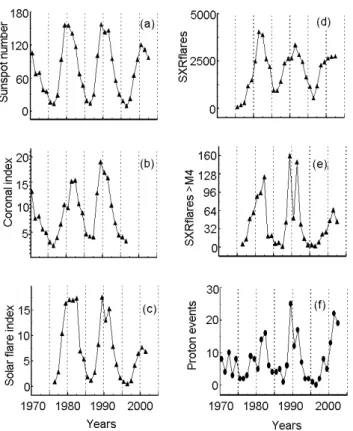
Fig. 2. Time distributions of the yearly values of (a) sunspot ber, (b) coronal index, (c) solar flare index, (d) SXR flares num-ber, (e) SXR flares number with importance > M4 and (f) proton event number with E>10 MeV and peak intensity >10 pfu, during the time interval 1970–2002.
The next five columns concern Ha flares identified as the source of SPEs. These columns consist of onset time, peak time, importance, as well as SXR importance (by GOES clas-sification), flare location and active region number. The last column of the Table indicates cosmic ray variations recorded at the neutron monitors as ground level enhancements. With this catalogue we obtain a possibly homogeneous data set comprising 253 SPEs that provides a significant statistical basis. Furthermore, as the catalogue covers the descending phase of the cycle 20, two solar cycles, 21 and 22, and the ascending phase of the cycle 23, it enables us to analyze the long time dependency of the SPEs and flare-related charac-teristics (Temmer et al., 2001).
In our Table only large events with energy >10 MeV and peak intensity >10 pfu are included, while smaller events with intensity <10 pfu are not selected (Shea and Smart, 1990). Possible differences between our Table and other rel-ative tables are due to the fact that this Table is mainly based on the catalogue of solar proton events edited by Logachev (Moscow University) which is not commonly used. This cat-alogue is a very useful issue, as it collects measurements from Neutron Monitors, balloons and different satellites con-taining time profiles and combined spectra of each event with maximum intensity >1 pfu.
Figure 3
Figure 4
Fig. 3. Time distribution of yearly averaged and maximum intensity of the SPEs flux from 1970 to 2002.
3 Statistical treatment
3.1 Correlation analysis
The relationship of SPEs number with different manifesta-tions of solar activity, such as sunspot number Rz, coronal index (total irradiance of the green corona in line 5303 nm; Rusin and Rybansky, 2002), solar flare index (total energy emitted by Hα flares; Ozguc and Atac, 1994), SXR flares
registered by GOES satellites, is analyzed. All relevant data are extracted from NOAA SEC data base.
Time distributions of these solar activity indices, as well as of the number of SXR flares of importance >M4 over the time interval 1970–2002, covering more than three solar ac-tivity cycles, are presented in Fig. 2. We can say that sunspot numbers, coronal index, solar flare index and SXR flare num-ber differ by their maximum values in cycles 21 and 22 by not more than 20%. On the contrary, the number of solar proton events in the maximum of cycle 22 is double in comparison with cycle 21. The events distribution for solar cycle 22 dif-fers completely from those in the previous cycle. About 70% of these events originated during the three years at the maxi-mum of this cycle, that is in agreement with the result of Shea and Smart (1995). The results can also be confirmed by the calculation of maximum and yearly averaged intensity of the SPEs flux. These intensities appear to be ten times smaller in the period 1970 to 1988 than those in interval 1989 up to 2002, as can be seen in Fig. 3. The increased occurrence rate of the SPEs during solar cycle 22 is in accordance with the number of solar flares of ≥M4 importance.
Comparing yearly values of proton events with sunspot number, coronal index, solar flare index, total SXR flares and SXR flares of ≥M4 importance, we have found that the largest values of the correlation coefficient among these parameters are those for coronal index (0.86±0.05) and for SXR flares with importance ≥M4 (0.81±0.07). Scatter plots and linear approximations of the SPE yearly number de-pendences on the above mentioned parameters, are given in Fig. 4. We do not discuss how the coronal index is connected
V. Kurt et al.: Statistical analysis of solar proton events 2267
Figure 3
Figure 4
Fig. 4. Scatter plots and linear approximations of SPEs yearly num-ber dependences on the total SXR flares, sunspot numnum-ber, solar flare index, coronal index and SXR flares with importance >M4.
03/08/71 02/10/76 01/14/81 12/19/85 11/23/90 10/28/95 10/01/00 Years 0 40 80 120 160 200 240 S un spot num ber -50 -25 0 25 50 A ss oc iat ed f lar es la tit ude Figure 5 -140-100 -60 -20 20 60 100 140 Heliolongitude 10 20 30 40 50 60 S P E 's as so ci a ted f lar e s E W
Number of flares related with SPE Number of flares related with GLE
-140-100 -60 -20 20 60 100 140 Heliolongitude 101 102 103 104 SPE' s m e an fl ux [p fu] E W
SPEs with Ep>10MeV SPEs with GLE
Figure 6
Fig. 5. “Butterfly diagram” of the associated with SPEs flares for the interval 1970–2002 is presented in the lower curve. Time profile of the sunspot number is also given in the upper curve.
with the high-energy particle production, but this fact is re-markable. From the other side it is natural to assume that solar activity with soft X-rays of importance ≥M4 have an ability to emit into interplanetary space protons sufficient to be registered near the Earth’s vicinity as SPEs (Kurt, 1990; Belov et al., 2001).
The interplanetary magnetic field lines constitute an Archimedian spiral in a coordinate system with a fixed Earth-Sun line. An Archimedian spiral leading back to the Earth-Sun is located between 30◦W÷80◦W for a solar wind speed from 700 km/s−1to 300 km/s−1, respectively. A priori, if the “as-sociated” flare is situated inside or near this longitudinal in-terval, the protons have the highest probability to be regis-tered near the Earth’s orbit.
03/08/71 02/10/76 01/14/81 12/19/85 11/23/90 10/28/95 10/01/00 Years 0 40 80 120 160 200 240 S un spot num ber -50 -25 0 25 50 A ss oc iat ed f lar es la tit ude
Figure 5
-140-100 -60 -20 20 60 100 140 Heliolongitude 10 20 30 40 50 60 S P E 's as so ci a ted f lar e s E WNumber of flares related with SPE Number of flares related with GLE
-140-100 -60 -20 20 60 100 140 Heliolongitude 101 102 103 104 SPE' s m e an fl ux [p fu] E W
SPEs with Ep>10MeV SPEs with GLE
Figure 6
Fig. 6. Longitudinal distribution of the associated with SPEs flares and of the flares related to GLEs concerning the number of them (left panel) and the mean flux per 20◦longitudinal interval (right panel).
The longitudinal distribution of the associated SPE flares and the distribution of the flares connected with GLEs are presented in Fig. 6. The associated flares are more widely distributed from the east limb to 120◦W and centered within the longitude interval 40E÷80 W, that is in accordance with previous works (Van Hollebeke et al., 1975; Sladkova and Bazilevskaya, 2000). In our case longitudinal distribution of the associated flare number, as well as of the mean flux of the corresponded SPEs, demonstrate that most of the SPEs originate from flares located western to 70◦W. It is interesting that only one of the GLEs has been registered from a flare located at the solar longitude 30◦E. All the others are created from flares located near the west limb. It is noteworthy that ten of the forty-two GLEs examined here are caused by “over the limb flares.
3.2 Time delay
It is known from γ -line observations that protons can be ac-celerated up to 10–30 MeV energy during the rising phase of the flare and near the time of the flare maximum (Ramaty and Mandzhavidze, 1993; Chupp, 1987; 1996). There are evidences that additional prolonged acceleration takes place when the magnetic field in the flare region undergoes its restoration after the mass ejection and shock wave forma-tion in the lower corona (e.g. Akimov et al., 1996). The exact time of the escaping of accelerated protons from the Sun into interplanetary space is unknown. It means that the zero value (T0=Tescaping) of a time scale cannot be defined
unambiguously. A suggestion was made that the time of the Hα flare onset (Table 1, column 6) is taken as T0for our time
rule. Then, using the time maximum of the SPE as Tmax (Table 1, column 4), the time delay 1T between the proton event maximum and the onset time of the Hα “associated
-6 4 14 24 34 44 54 64 74 Time delay (hours)
0 10 20 30 40 50 60 SP E num ber (a)
Figure 7
-6 4 14 24 34 44 54 64 74Time delay (hours) 0 10 20 30 40 50 60 SP E num ber (a) Figure 7
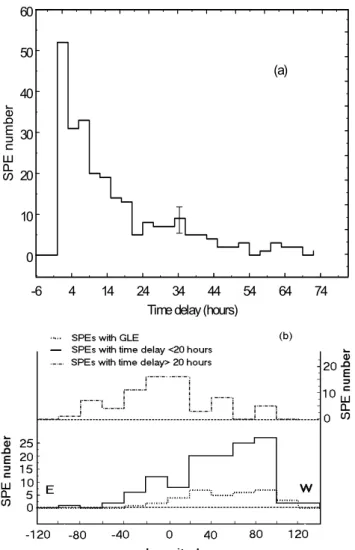
Fig. 7. (a) The SPEs number with respect the time delay between the proton event maximum and the onset time of the Ha “associated flares” is presented. (b) The longitudinal distribution of the SPEs in three cases (with GLE, with time delay <20 h and with time delay
>20 h) is also illustrated.
Table 2. SPEs number and Imean in latitudes >20◦and <20◦.
Latitude SPEs number Imean
(pfu)
>20◦ 59 3524
<20◦ 162 790
flare” 1T=Tmax-T0was calculated. Of course the choice of
T0is not physically correct, but it is acceptable, as the time
resolution of our analysis is greater or equal to one hour.
3.3 Associated solar flares
A number of 231 Hα/SXR flares have been identified with respect to the solar proton events of our catalogue, named as “associated” flares of SPEs. From the rest of the SPEs
some of them can possibly be connected with “over the limb” flares, in some cases the identification could not be done defi-nitely, while some others are related to CMEs, not associated with flares.
Thus, a “butterfly” diagram–that means a time dependence of the solar latitudinal distribution of the “associated flares” is presented in Fig. 5. Monthly values of sunspot number are also given in this Figure, and the arrows indicate the start of each cycle. It is known that solar flares follow the “butter-fly” diagram, by which every cycle starts with flares at high latitudes (greater than 35◦, while it ends with flares at low latitudes. It is interesting to note, that in our case the lati-tudinal distribution of the associated flares seems to have a similar distribution to total flares and sunspot number. How-ever, the sources of SPEs with large fluxes are often located at high latitudes greater than 20◦(Table 2). Apparently, the
protons can propagate easily from relatively high latitudes to the ecliptic plane.
The result of our treatment on SPEs with respect to the calculated time delay 1T is demonstrated in Fig. 7a. One can see a very pronounced maximum in the time delay 1T from 3 to 9 h, followed by a long lasting tail. SPEs can be separated into two groups depending on 1T values: the first one includes events with 1T ≤20 h and the second one re-garding events with 1T≥20 h. Longitudinal distributions of the “associated flares” in these two groups are depicted in Fig. 7b. The distribution of GLEs is also presented in the same figure. “Associated flares” in the first group obviously exhibit the same longitudinal distribution as those associated with GLEs, with most of them located in the Western Hemi-sphere.
This SPEs separation with respect to the time delay be-tween the flare onset and the event maximum was found in accordance with the main properties of the proton’s inter-planetary transport. If an event has 1T ≤20 h, we may be sure that the registered event is “prompt”, that means the pro-ton transport is mainly caused by diffusion (Miroshnichenko, 2001). For the events of the second group an influence of shock waves and CMEs on the particle propagation and ac-celeration is noticeable. Sometimes the events with 1T be-tween 20÷30 h are of “prompt” increases. In some cases the time of the peak maximum Tmax was coincided with a very fast shock arrival at 1 AU. Careful examination of the events with 1T≥30 h shows that these are shock-related events.
3.4 Peak-size distributions
The frequency distributions of our data set at the threshold proton energy of 10 MeV and peak intensity >10 pfu rep-resented by power law as dN/dI=I−ν, where N is the num-ber of events per flux interval and I is the mean particle flux in this interval at energy >10 MeV, are presented in Fig. 8. This figure includes differential frequency-size distributions of the peak value selected SPEs for three separate subsets. The first subset contains the total number of SPEs (upper panel), the second group contains the “prompt” SPEs with time delay <20 h (middle panel) and the third one presents
V. Kurt et al.: Statistical analysis of solar proton events 2269
SPEs associated with GLEs (bottom panel). The first and second cases can be described by power law with expo-nent ν=-1.36±0.04 and ν= -1.30±0.02, respectively. The turnover near two bins (30<Imax<300 pfu) is seen in the peak-size distribution for the events with GLEs caused by threshold effects of the neutron monitors. The power law ap-proximation outside the first bin (30< Imax<100 pfu) gives
ν= 1.12 ± 0.16. It is noticeable that a difference in the slopes between the differential distributions at 10 MeV and
>500 MeV(GLEs) has appeared. Hence, in our study the spectral indices vary from 1.12 to 1.36. Such a difference in the slopes of solar proton events in different energy channels ( >10 MeV, > 30 MeV, > 60 MeV, >100 MeV, > 500 MeV) for the time period 1970–1995 is also reported by Kurt et al. (2002). It indicates the existence of a slope dependence on the proton energy under consideration (Miroschnishenko et al., 2001).
Our results are consistent with spectral indices of solar proton events published earlier, as 1.15±0.1 (Van Holle-beke, 1975), 1.45±0.15 (Belovsky and Ochelkov, 1979), 1.35±0.15 (Kurt, 1990), 1.3±0.12 (Gerontidou et al., 2002). In our case our results are based on the best statistics and give the verification of the spectral index that is very important for the models of flare energy release.
4 Discussion and conclusions
In this work the first attempt to accomplish an extended sta-tistical analysis of solar proton events with energy >10 MeV and peak flux >10 pfu observed at 1 AU through January 1970 to December 2002 is performed. A catalogue of 253 events based upon satellites and ground level observations is created and presented. Solar proton event evolution steps, as time dependence over three solar cycles, longitudinal and lat-itudinal distributions of the parent flares and distribution of the time delay between the Ha flare onset and the SPE maxi-mum are analyzed. The frequency peak flux distributions are also obtained.
Summing up the main results of this study we note that, together with appropriate results published since 1975, our findings provide new and important information about some features of the Sun’s proton productivity and its relation to existing problems of particle acceleration at/near the Sun.
1. It is characteristic that the numbers of SPEs and SXR flares of importance >M4 are almost the same during the solar cycles 21 and 22. It is noted that one per six of these SXR flares is associated with an SPE. In the cycle 21 the number of SXR-flares of importance >M4 is 478 and the number of SPEs is 78, while during the solar cycle 22 the number of SXR-flares of importance
>M4 is 460 and the number of SPEs is 73.
The occurrence rate of SPEs and SXR flares >M4 in relation to other manifestations of solar activity seems to appear as a significant increase during the maximum of solar cycle 22. It means that solar activity with soft
x-1 10 100 1000 10000 100000 10-6 10-5 10-4 10-3 10-2 10-1 100 d N / d I ( G L E s)
Peak flux (pfu)
1970-2002 N = 35 slope = -1.12±0.16 --- fast SPEs (-1.30±0.02) 10-6 10-5 10-4 10-3 10-2 10-1 100 1970-2002 N=145 slope= -1.30±0.02
d
N
/ d
I (
fa
st
S
P
E
s)
10-6 10-5 10-4 10-3 10-2 10-1 100 1970-2002 N=252 slope=-1.36±0.04d
N
/ d
I (to
ta
l SP
E
s)
Figure 8
Fig. 8. Peak size distributions of the total number of SPEs with energies E>10 MeV (upper panel), of the fast SPEs (middle panel) and of the SPEs connected with GLEs (lower panel) that appeared.rays of importance >M4 have an ability to emit protons sufficient to be registered near the Earth’s vicinity as SPEs, but not all of them are accompanied by a proton event.
flares at high latitudes and ends with flares at low lat-itudes. The sources of SPEs with large fluxes are of-ten located at high latitudes greater than 20◦. Pro-tons can propagate easily from relatively high latitudes to the ecliptic plane. On the other hand, the longi-tudinal distribution of the associated flares of SPEs shows a preferable connecting region within 40◦ E-80◦W, which is consistent with previous results (Slad-kova and Basilevskaya, 2000). The most of the SPEs are created by flares, located at solar longitude around 70◦ W. It is in agreement with the distribution of the GLE related flares.
3. The calculated time delay between the proton event maximum and the onset time of the Ha associated flare reveals a pronounced maximum of this time from 3 to 9 h. This maximum is connected with fast events (1T<20 hours), where the proton transport is mainly caused by diffusion, while a long time delay is related to shock events.
4. The best power-law fit for the basic sample of 253 events is attained at a slope of 1.36±0.04 over the entire range of proton intensities 101-105pfu. The difference in the slopes between differential size distributions at
>10 MeV and > 500 MeV, obtained on the best statis-tic, indicates the existence of slope dependence on the proton energy. This result is consistent with other stud-ies (Miroschnishenko et al., 2001; Gerontidou et al., 2002; Kurt et al, 2002).
5. The mechanisms responsible for proton acceleration and SPEs are widely discussed in the literature, with much controversy in particular over the role of flares. Our results not only confirm but give quantitative char-acteristics of the SPE relation to the flares that may be used for prediction of these events and radiation fore-casting (Gabriel and Patrick, 2003).
Acknowledgements. This work is partly supported by the grants
70/4/6255 and 70/4/6890 of the Ministry of Development of the General Secretariat of Research and Technology concerning Greek-Russian Collaboration. Thanks are also due to the Special Research Account of Athens University for supporting this research. The au-thors are grateful to the anonymous referee for very valuable com-ments on this work.
Topical Editor R. Forsyth thanks D. Smart for his help in evalu-ating this paper.
References
Akimov, V. V., Ambroz, P., and Belov, A. V. et al.: Evidence for prolonged acceleration based on a detailed analysis of the long-duration solar gamma-ray flare on 15 June, 1991, Solar Phys.,V. 166, 107–134, 1996.
tistical analysis of solar proton events in different energy chan-nels, Proc. 27th ICRC 2001, 3465–3468, 2001.
Belovsky, M. H. and Ochelkov, Yu. P.: On some pecularities of generation of electromagnetic and corpuscular radiation in solar flares,Izvestia AN SSSR, Phys. Ser., 43, 4, 749–752, 1979. Cane, H. V., Reames, D. V., and von Rosenvinge, T. T.: The role of
interplanetary shocks in the longitude distribution of solar ener-getic particles, J. Geophys. Res., 93, A9, 9555–9567, 1988. Chupp, E. L.: High energy particle production in solar flares (SEP,
gamma-ray and neutron emissions),Physica Scripta, T18, 5–9, 1987.
Chupp, E. L.: Evolution of our understanding of solar flare particle acceleration:(1942–1995), in High Energy Solar Physics, eds.: R. Ramaty, N. Mandzhavidze, and X.-M. Hua, AIP Conference Proceedings, AIP: New York, 374, 3–31, 1996.
Cliver, E. W., Kahler, S. W., Shea, M. A., and Smart, D. F.: Injec-tion onset of ∼2 GeV protons, ∼1 MeV electrons, and ∼100 keV electrons in solar cosmic ray flares,Ap. J., 260, 362–370, 1982. Cliver, E. W., Reames, D. V., Kahler, S. W., Cane, H. V.: Size
distribution of solar energetic particle events, Proc.22ndICRC, Dublin, 3, 25–28, 1991.
Crosby, N. B., Aschwanden, M. J., and Dennis, B. R.: Frequency distributions and correlations of solar X-ray flare parameters, So-lar phys. 143, 275–299, 1993.
Dorman, L. I. and Miroshnichenko, L. I.: Solar cosmic rays, Moskow, Nauka (Fizmatgiz), English Edition for NASA by In-dian national Scientific Documentation Center, Delhi, 1968. Feynman, J., Spitale, G., Wang, J., and Gabriel, S.: Interplanetary
proton fluence model, J. Geophys. Res., 98, A8, 13 281–13 294, 1993.
Forman, M. A., Ramaty, R., and Zweibel, E. G.: The acceleration and propagation of solar flare energetic particles, in: Physics of the Sun, ed: Sturrock P. A., Dordrecht: D. Reidel Publ.Co., Ch.II, 249–289, 1986.
Gabriel, S. B. and Feynman, J.: Power-law distribution for solar energetic proton events, Sol. Phys., 165, 337–346, 1996. Gabriel, S. B. and Patrick, G. J.: Solar energetic particle events:
phenomenology and prediction Space Sci. Rev. 107, 55–62, 2003.
Gerontidou , M., Vassilaki, A., Mavromichalaki, H., and Kurt, V.: Frequency distributions of solar proton events JASTP 64, 482– 490, 2002.
Goswami, J. N., Mc Guire, R. E., Reedy, R. C. et al.: Solar flare protons and alpha particles during the last three solar cycles,J. Geophys. Res., 93, A7, 7195–7205, 1988.
King J.H, Solar proton fluences for 1977-1983 Space Missions,J. Spacecraft and Rockets, 11, 6, 401-408, 1984.
Kurt V. G., Mavromichalaki, H., and Gerontidou, M.: Energy de-pendence of the solar proton events at 1 AU, Proc. “SOLMAG: magnetic Coupling of the Solar Atmosphere Euroconference and IAU Colloquium 188”, 2002.
Kurt, V. G.: Electrons and X-ray emission of solar flares,in Basic Plasma Processes on the Sun, Eds: E. R. Priest and V. Krishan, 409–413, 1990.
Mason, G. M., Gloeckler, G., and Hovestadt, D.: Temporal vari-ations of nucleonic abundances in solar flare energetic particle events. II. Evidence for large scale shock acceleration, Ap. J., 280, 902–916, 1984.
McCracken, K. G.: The cosmic ray flare effect. I. Some new meth-ods of analysis,J. Geophys. Res., 67, 2, 423–434, 1962. Mendoza , B., Medenlez, R., Mirochnichenko, L. I.,
Perez-Enriquez, R.: Frequency distributions of solar proton events, Proc 25th ICRC 1, 81–84, 1997.
Miroshnichenko, L. I.:in Solar Cosmic Rays, Kluwer Academic Publishers, 2001.
Miroshnichenko, L. I., Mendoza, B., and Perez-Enriquez, B.: Size distributions of the >10 MeV solar proton events, Solar Phys. 202, 151–171, 2001.
NOAA SEC Solar proton Events, Solar Geophysical Data, NOAA Boulder Co. 2002.
Ozguc, A. and Atac, T.: The 73- day periodicity of the flare index during the current solar cycle 22, Solar Phys. 150, 339, 1994. Ramaty, R., Mandzhavidze, N., Kozlovsky, B., and Skibo, J. G.:
Acceleration in solar flare: Interacting particles versus interplan-etary particles, Adv. Space Res., 13, 9, 275–284, 1993.
Reames, D. V.: Particle acceleration at the sun and in the helio-sphere, Space Sci. Rev. 90, 413–491, 1999.
Richter, A. K., Verigin, M. I., Kurt, V. G., et al.: The 3 January 1978 interplanetary shock event as observed by energetic par-ticle, plasma and magnetic field devices on board of HELIOS-1, HELIOS-2 and PROGNOZ-6,J. Geophys. Res., 50, 101–109, 1981.
Roelof, E. C.: Propagation of solar cosmic rays in the interplanetary magnetic field, in Lectures in High Energy Astrophysics, Eds: Hogelman and J.R.Wayland,NASA Spec. Publ., Sp 199.111– 135, 1969.
Rusin, V. and Rybansky, M.: Coronal index of solar activity, Solar Phys. 207, 47, 2002.
Shea, M.A. and Smart, D.F, A summary of major solar proton events, Solar Phys.,127, 297-320, 1990.
Shea, M. A. and Smart, D. F.: A comparison of energetic solar pro-ton events during the declining phase of four solar cycles (19–22) Adv. Space Res. 16, 9, 37–46, 1995.
Sladkova, A. I., Basilevskaya, G. A., Ishkov, V. N. et al.: Cata-logue of solar proton events (ed) Y. Logachev, Moscow Univer-sity Press 1990; 1998.
Sladkova, A. I. and Bazilevskaya, G. A.: On the origin of the rel-ativistic protons observed in heliosphere after some solar flares, Adv. Space Res. 21, 559–562, 2000.
Stolpovsky, V. G., Kurt, V. G., and Logachev, Yu. I.: Catalogue solar particle events measured on board Spacecraft VENERA-13, 14. Preprint SINP MSU, No 34, Moscow, 1988.
Svestka, Z. and Simon, P.: Catalogue of solar particle events 1955– 1969 Astrophys. and Space Sci. Library, 49 Reidel Publ. Co, Dordrecht Holland 1975.
Temmer, M. A., Veronig, A., Hanslmeier, W., and Otruba and Messerotti, M.: Statistical analysis of solar Ha flares As-tron.&Astrophys. 375, 1049–1061, 2001.
Valdes-Galicia, J. F. V., Moussas, X., and Quenby, J. J. et al.: Mean free paths and diffusion coefficients for energetic protons at small heliodistances calculated using HELIOS 1 and 2 data, Sol. Phys. V. 91, 399, 1984.
Van Hollebeke, M. A., MaSung, L. S., and McDonald, F. M.: The variation of solar proton energy spectra and size distribution with heliolongitude, Solar Phys., 41, 189–223, 1975.
Van Hollebeke, M. A., Wang, J. R., and McDonald, F. B.: A cata-logue of solar cosmic ray events, X-661-74-27,NASA Goddard Space Flight Center, 1974.
Wibberenz, G., Kunow H., and M¨uller-Mellin R. et al.: Solar ener-getic and shock-accelerated particles observed between 1 and 4 AU by the Kiel electron telescope (KET) on board ULYSSES,J. Geophys. Res. Letters, 19, 12, 1279–1282, 1992.