HAL Id: hal-00317482
https://hal.archives-ouvertes.fr/hal-00317482
Submitted on 31 Jan 2005
HAL is a multi-disciplinary open access
archive for the deposit and dissemination of
sci-entific research documents, whether they are
pub-lished or not. The documents may come from
teaching and research institutions in France or
abroad, or from public or private research centers.
L’archive ouverte pluridisciplinaire HAL, est
destinée au dépôt et à la diffusion de documents
scientifiques de niveau recherche, publiés ou non,
émanant des établissements d’enseignement et de
recherche français ou étrangers, des laboratoires
publics ou privés.
HF-induced airglow at magnetic zenith: theoretical
considerations
E. V. Mishin, W. J. Burke, T. Pedersen
To cite this version:
E. V. Mishin, W. J. Burke, T. Pedersen. HF-induced airglow at magnetic zenith: theoretical
consid-erations. Annales Geophysicae, European Geosciences Union, 2005, 23 (1), pp.47-53. �hal-00317482�
© European Geosciences Union 2005
Geophysicae
HF-induced airglow at magnetic zenith: theoretical considerations
E. V. Mishin1, W. J. Burke2, and T. Pedersen2
1Boston College, Institute for Scientific Research, Chestnut Hill, Massachusetts, USA
2Air Force Research Laboratory, Space Vehicles Directorate, Hanscom Air Force Base, MA 01731, USA
Received: 18 September 2003 – Revised: 19 December 2003 – Accepted: 14 January 2004 – Published: 31 January 2005
Part of Special Issue “Eleventh International EISCAT Workshop”
Abstract. Observations of airglow at 630 nm (red line) and 557.7 nm (green line) during HF modification experiments at the High Frequency Active Auroral Research Program (HAARP) heating facility are analyzed. We propose a theo-retical framework for understanding the generation of Lang-muir and ion acoustic waves during magnetic zenith injec-tions. We show that observations of HF-induced airglow in an underdense ionosphere as well as a decrease in the height of the emitting volume are consistent with this scenario. Key words. Space plasma physics (active perturbation ex-periments; nonlinear phenomena; wave-wave interactions)
1 Introduction
It is well known that injections of power, high-frequency (HF) radio waves strongly perturb ionospheric plasmas. The excitation of airglow at 630.0 and 557.7 nm is a distinctive, visual feature of such HF-induced perturbations (e.g. Sipler et al., 1974; Bernhardt et al., 1989; Pedersen and Carlson, 2001; Gustavsson et al., 2001, 2002; Kosch et al., 2000, 2002a,b; Pedersen et al., 2003). The red (r) and green (g) lines are emitted by atomic oxygen in the O(1D) and O(1S) states with the excitation energies εr=1.96 eV and
εg=4.17 eV, respectively.
Significantly, green-to-red ratios ςgr>0.3 are often
ob-served. Gustavsson et al. (2002) emphasized that ςgr>0.1
requires unrealizable electron temperatures Te>2 eV,
point-ing out the importance of electron acceleration in the high-energy tail. The latter stems from resonant interactions with plasma turbulence generated by heater waves. Stochastic interactions heat the bulk of electrons (e.g. Gurevich et al., 1985; Dimant et al., 1992; Mantas and Carlson, 1996; Gure-vich and Milikh, 1997; Istomin and Leyser, 2003). Both ef-fects are well documented (e.g. Carlson et al., 1982; Gus-tavsson et al., 2001; Rietveld et al., 2003).
Observations from the heating facilities at Tromsø ('69.7◦N, '18.9◦E) and Gakona, Alaska ('62.4◦N,
Correspondence to: E. V. Mishin ([email protected])
145.15◦W) show that the HF-induced airglow maximizes during injections toward magnetic zenith (MZ) (Kosch et al., 2002a; Pedersen et al., 2003). The same is true for the intensity of Langmuir waves (Isham et al., 1999) and elec-tron heating (Rietveld et al., 2003; Dhillon and Robinson, 2003) observed by the EISCAT UHF (f0=933 MHz) radar. Furthermore, the red line at MZ is excited at extremely low effective radiative power (ERP) P0∼2 MW (Pedersen et al., 2003). The power of ion acoustic waves observed by the EIS-CAT UHF radar was found to be enhanced at, and 6◦to the south of, MZ (Dhillon and Robinson, 2003).
The generation of Langmuir (l) and ion acoustic waves in HF modification experiments is usually explained in terms of the parametric decay (PDI) or oscillating two-stream (OTSI) instabilities of ordinary (o) mode heating waves (Fe-jer, 1979). However, o-mode waves with incident angles θ0 outside the Spitze region, θ0>θc, reflect at altitude Hmza few
km below the “standard” reflection altitude H0, where the local plasma frequency fp(H0)'104
√
ne(H0)Hz equals the injected frequency f0. Here, θc=arcsin(
q
fc
fc+f0sinχ ), fcis
the electron gyrofrequency at an altitude of 200 km, neis the
electron density in cm−3, and χ is the conjugate of the mag-netic dip angle. Figure 1 shows a schematic of regions near o-mode reflection at geographic (GZ) and magnetic zenith at Gakona for f0=7.8 MHz.
For a heater ERP P0=150 MW and distance R=250 km, the wave amplitude is E0'5.5
√
P0/R'0.27 V/m (swelling is absent). With ef0=f0[MHz]=6 and Te=0.1 eV, the HF
en-ergy density at the reflection point is W0=
E02
4π∼10
−4n
eTe. It
is sufficient to drive the PDI at H0 (Fejer, 1979) but is not enough for injections toward MZ due to a mismatch of fre-quencies at Hmzand beneath.
Gurevich et al. (2002) suggested that decreased plasma densities, within striations generated by heating waves, per-mit the phase matching necessary for the PDI/OTSI to de-velop. Istomin and Leyser (2003) showed that electrons can be accelerated by upper hybrid waves trapped inside stria-tions. Changes in the refraction index (self-focusing), caused by striations that form within tens of seconds after turn-on, explain some features of the spatial distribution of the
48 E. V. Mishin et al.: HF-induced airglow at magnetic zenith 0.95 1 1.05 −10 −5 0 5 10 f/f0 H − H 0 (km) MZ fp/f0 H o H uhr H mz f uhr/f0 GZ
Fig. 1. Schematic of regions near ordinary-mode reflection for ver-tical and magnetic field-aligned heater pointings. Solid lines des-ignate the plasma (heavy line) and upper hybrid resonance (thin) frequencies; vertical dotted lines show the cutoff frequencies at GZ and MZ, respectively; horizontal dashed lines indicate the heights of reflection at GZ, the upper hybrid resonance, and MZ.
HF-induced airglow. Kosch et al. (2002b) showed that the intensity of red-line emissions decreased when the heating frequency approached an electron gyro-harmonic, pointing out the importance of upper hybrid turbulence at MZ.
On the other hand, Langmuir waves at MZ were seen within ∼10 ms (Isham et al., 1999). In 5-s resolution ob-servations made by Dhillon and Robinson (2003), the ini-tial increase in UHF backscatter, characterized by an over-shoot, was seen coincident with the heater turn-on. Electron temperatures generally increased at heater turn-on, but the maximum increase occurred several seconds later. Mishin et al. (2004) show that during injections toward magnetic zenith the intensities of the green-line emission gained ∼5 R (Rayleighs) within ∼1 s. This period is dubbed the onset of HF-induced airglow. Time scales.1 s appear too short for significant striations to develop (e.g. Gondarenko et al., 1999).
Striations are generated near the upper hybrid resonance height Huhr, where f0=fuhr=
q f2
p+fc2(e.g. Vaskov et al.,
1981; Lee and Kuo, 1983). Hence, the reflection height of an obliquely-injected heating wave must be at least at the same level. For reflection to occur above Huhr during MZ injec-tions, the inequality fc>f0·sinχ must be met. For MZ injec-tions at the HAARP heating facility (χ '14.6◦), Huhr<Hmzif
f0<f0χ'5.4 MHz. However, the strongest airglow occurred at higher f0values (Pedersen et al., 2003) and at altitudes well below H0and Huhr(Kosch et al., 2002a).
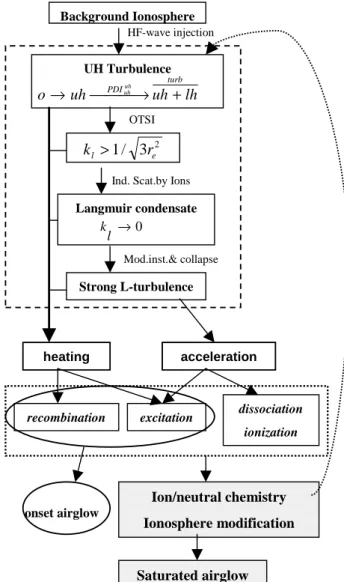
Mishin et al. (2004) suggested a scenario for exciting plasma turbulence with subsequent electron heating and ac-celeration in the HF-illuminated region at MZ. This scenario, depicted in Fig. 2, explores the results of Kuo et al. (1997), who showed that the OTSI can be excited by upper hybrid
UH Turbulence OTSI 2
3
/
1
e lr
k
>
Ind. Scat.by Ions
Strong L-turbulence Mod.inst.& collapse Langmuir condensate heating acceleration turb PDI lh uh uh o→ →uhuh + 0 → l k recombination dissociation ionization excitation onset airglow Ion/neutral chemistry Ionosphere modification Saturated airglow Background Ionosphere HF-wave injection
Fig. 2. Block-diagram from Mishin et al. (2004) showing energy flow in a model of HF-induced airglow at MZ. Shaded boxes indi-cate the steps to be worked out.
(uh) waves. In turn, uh-waves are generated through the lin-ear conversion of the o-mode on pre-existing field-aligned irregularities (Wong et al., 1981) or by the parametric de-cay o→uh + lh (PDIuh
o ) (e.g. Istomin and Leyser, 1995); lh
stands for lower hybrid waves.
The conversion process occurs at Huhr and has no thresh-old. PDIuho develops if E0>E0uh'1.6 ef02 mV/m, pro-vided the corresponding matching conditions are met for xuh=kuh2 re2<1. Here, re is the thermal electron gyroradius
and kuhis the uh-wave vector. Otherwise, Landau damping
of short-scale lower hybrid waves raises the threshold value (Mishin et al., 1997). The rise time of the (primary) uh-wave is τuh∼1–3 ms. When the amplitude of the primary uh-wave
Euhexceeds ∼10 mV/m, it parametrically decays into lower
frequency uh-wave (Zhou et al., 1994). The same is true for subsequently-generated uh-waves.
The OTSI excited by uh-waves produces short-scale, kl>3−1/2/re, Langmuir waves (Kuo et al., 1997). These
waves saturate via spectral transfer toward small kl, due to
induced scattering by ions (e.g. Zakharov et al., 1976). De-pending on the energy density of the uh-turbulence, which depends on the ERP, the induced scattering process may deliver the Langmuir wave energy Wl to the region kl→0
(Langmuir condensate) (Zakharov et al., 1976). The dy-namics of the Langmuir condensate is defined by the mod-ulational instability and collapse, leading to the establish-ment of strong (cavitating) Langmuir turbulence (e.g. Za-kharov, 1972). This makes the generation of Langmuir tur-bulence possible within ∼10 ms, consistent with the Isham et al. (1999) observations.
Collisional damping of high-frequency plasma waves is the major source of electron heating. Resonant lh- and l-wave-particle interactions accelerate electrons. Based on this scenario, Mishin et al. (2004) developed an explanatory model for the growth of emissions from MZ within the first few seconds after the HF transmitter turn on (airglow onset). The model accounts for the roles played by ambient photo-electrons and dissociative recombination of oxygen ions and shows that heating and acceleration of ambient electrons can explain the observed features of the airglow onset at MZ.
A consistent theory of the HF-induced airglow, account-ing for the ion/neutral chemistry, modification of the heated spot, and self-focusing, has yet to be worked out. Pedersen et al. (2003) mentioned that the brightest emissions had a slight tendency to occur very near the critical frequency of the F-layer foF2 , but all emissions cut off sharply at about 0.5 MHz above foF2.
This paper continues our analysis of optical data acquired during the February 2002 campaign at the HAARP heating facility. We focus on intervals when foF2 dropped below the heating frequency, but HF-induced green and red lines at MZ remained. We characterize such events as the HF-induced airglow in an underdense ionosphere and show that this fea-ture can be understood in terms of the above scenario.
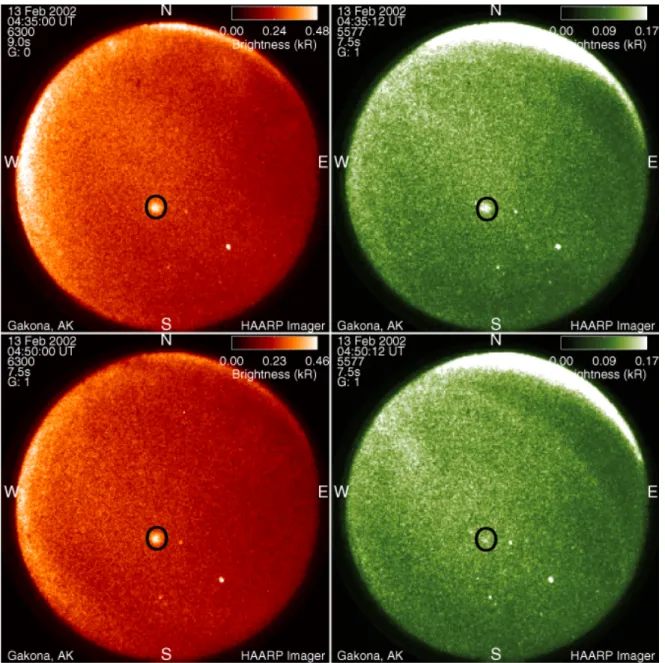
2 Airglow at HAARP in the underdense ionosphere Figure 3 shows all-sky images of the HF-induced red- and green-line emissions observed from the HAARP site during a long, ∼30 min, pulse that began at 04:32:12 UT on 13 Febru-ary 2002 (Pedersen et al., 2003). The data show one of the most intense green-line emissions observed at HAARP. Dur-ing this (twilight) period o-mode waves were injected toward magnetic zenith at f0=7.8 MHz and at full power of 940 KW (ERP P0'165 MW). Exposure durations were 7.5 s.
Figure 4 (top panel) shows the variation of the red- and green-line intensities in the course of the long pulse. The data points are from two red line exposures made at 0 and 24 s after each minute, with one 557.7 nm exposure at 12 s. Simultaneous observations from a digisonde located at the HAARP site showed that the reflection height of a 7.8-MHz o-mode wave at MZ gradually increased from Hmz∼235 to
∼270 km between 04:30 and 04:50 UT. At the same time, the shadow height at the HAARP site increased from ∼230 to ∼300 km following the increasing solar zenith angle and so does the height of the F-peak hmF2. The magnetic conjugate point was sunlit, maintaining a flux of energetic photoelec-trons (e.g. Doering et al., 1975; Peterson et al., 1977) above HAARP most of the time.
To account for natural (background) variations, a polyno-mial fit was made to intensities measured along the magnetic meridian in each all-sky image, with the heated area blocked out. The heater-induced airglow is determined as the differ-ence 1λ=Iλ−bλ between the airglow from the heated
vol-ume Iλ and the background airglow bλ. During heater-off
periods, 1(off )λ was less than ∼3–5 and ∼7–10 R for green-and red-line emissions, respectively. This small difference determines the accuracy of heater-induced airglow measure-ments.
The critical frequency of the F-layer is determined from 5-min digisonde observations at the HAARP site. Apparently, foF2 dropped below the transmitter frequency in the course of this pulse. However, the airglow did not diminish. Fig-ure 5 shows that the HF-induced airglow disappeared only at f oF2<f oF2c'f0−0.5 MHz. A remark is in order. One can argue that the HAARP digisonde points vertically and the ac-tual foF2 at Hmz, that is about 50 km to the south of the local
vertical, might be significantly different. However, this is un-likely, for the local geophysical conditions were very quiet. This conjecture is supported by the small difference between the airglow from the heated volume during heater-off periods and the (barely changing) background airglow about 50 km apart.
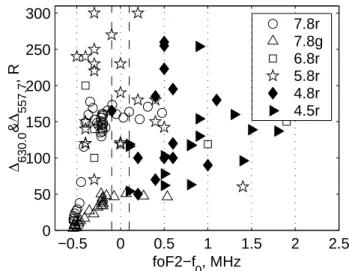
In addition to Figs. 3 and 5, Fig. 6 shows the results of a survey of all the airglow-events with a 50-R or more enhancement in red line emissions observed on clear-sky nights during the February 2002 optics campaign. Appar-ently, for f0≥5.8 MHz airglow is enhanced by heating waves until f oF2≥f oF2c. No enhancements were observed at f oF2<f oF2c. At f0=4.8 and 4.5 MHz the cutoff frequency coincides with f0accurate to within ±0.1 MHz, that is within the accuracy of determination of foF2. It is worth mention-ing that the difference between fp(Hmz(f0)) and f0=7.8, 6.8, 5.8, and 4.8 MHz is about −0.24, −0.2, −0.17, and −0.14 MHz, respectively.
3 Discussion
Mishin et al. (2004) emphasized that the scenario in Fig. 2 works at and below the reflection layer Hmz , provided that
the matching conditions for PDIuho (e.g. Istomin and Leyser, 1995) are satisfied at local values of xuh=k2uhre2<1. During
injections toward MZ standing waves do not form, and the heating wave amplitude at the reflection point does not in-crease relative to that at lower altitudes. Thus, the reflection layer does not stand out as it does for injections within the Spitze region, where the Airy pattern is formed.
50 E. V. Mishin et al.: HF-induced airglow at magnetic zenith
Fig. 3. Heater-induced red- and green-line emissions during the long pulse before (top) and after (bottom) foF2 has dropped below f0. Bold
circles mark the heated spot at MZ. Bright dots outside the circles are stars. The color bars show the brightness from 0 to 0.48 kR and from 0 to 0.17 kR for the red- and green-line emissions, respectively.
The ERP and angular width of the HF beam from the HAARP heater depend on the radiated frequency. Roughly, one can estimate P0∝f02, while the beam has full width at half maximum ∼27◦ and ∼15◦N-S at 3.3 MHz and at 7.8 MHz, respectively. For f0=7.8, 6.8, 5.8, 4.8, and 4.5 MHz, the free space field of the incident wave from the HAARP heater is E0'0.25, 0.2, 0.18, 0.15, and 0.14 V/m, that is E0>E0uh(f0).
From the dispersion relation of uh waves
fuh(xuh) ' fuhr+ 3 2fc (s2−1) s(s2−4)xuh+ (1) (s2−1)2 2s+1s! fc2 fuh(xuh) − sfc xuhs−1
one can readily obtain the value of the uh-wave vector nec-essary for PDIuho to occur at a given altitude H (cf. Istomin and Leyser, 1995) xuh∗ (H, f0) ' 2 3 s(s2−4) s2−1 f0−fuhr(H ) fc(H ) . (2)
This assumes that f0is no closer than ∼0.006fcto an
elec-tron gyro-harmonic s·fcand xuh<0.5. Here, s is defined by
rounding up the fuhr/fc ratio to the nearest integer. Given
fc(Hmz)'1.37 MHz at the HAARP site (from the IGRF
ge-omagnetic field model), the heating frequencies amount to 'fc·5.7, 4.96, 4.23, 3.5, and 3.3, respectively. Apparently,
0 50 100 150 200 ∆ 630.0&557.7 ,R 0436 0442 0448 0454 7.25 7.5 7.75 8 8.25 8.5 UT foF2, MHz b g 630.0 557.7 0.4b r
Fig. 4. Heater-induced red- and green-line emissions during the long pulse on 13 February 2002. Solid and dashed lines show in-tensities of the background green (bg) and (scaled) red (br)
emis-sions, respectively. (bottom) The critical frequency of the F-layer above the HAARP site (diamonds); the solid line represents a spline approximation; dashed and dotted lines show the heating frequency and the plasma frequency at Hmz, respectively.
−0.50 −0.25 0 0.25 0.5 50 100 150 foF2−7.8, MHz ∆ 630.0 & ∆ 557.7 , R
Fig. 5. Variation of the HF-induced red- (circles) and green-line (tri-angles) intensities with foF2 during the long pulse shown in Fig. 4.
5(−), 4(+), 4(−), and 3(+), respectively; (±) stands for the sign of fuh−sfc.
Let us first consider the case f oF2>f0>f0χ'5.5 MHz, that is Hmz(f0)<Huhr(f0). As follows from Eq. (2), the
−0.5 0 0.5 1 1.5 2 2.5 0 50 100 150 200 250 300 foF2−f0, MHz ∆ 630.0 & ∆ 557.7 , R 7.8r 7.8g 6.8r 5.8r 4.8r 4.5r
Fig. 6. Summary plot of the variation of the HF-induced airglow at MZ with f oF2−f0. Here 7.8, ...4.5 stand for f0=7.8, ...4.5 MHz;
rand g indicate red- and green-line emissions; vertical dashed lines show ±0.1 MHz interval.
matching conditions for f0=7.8, 6.8, and 5.8 MHz at the re-flection height Hmz(f0)are satisfied at xuh∗ (f0)<0.5. Impor-tantly, Eq. (2) holds well below Hmz(f0), that is xuh∗ →1 at
H∗(f0)=Hmz(f0)−δHmz(f0). Here, δHmz(f0)amounts to '3.5, 6, and 11.4 km, respectively (the gradient scale-length of a linear plasma density profile of 50 km is assumed).
The volume emission rate (VER) of the red-line emission ηr is mainly defined by the electron temperature
altitude-profile (e.g. Mantas and Carlson, 1996; Mishin et al., 2004). It is very sensitive to the distribution of thermal electrons (TEDF), which may strongly deviate from a Maxwellian dis-tribution (MD) due to inelastic collisions with molecular ni-trogen N2 (Mishin et al., 2000). For ne given, the
TEDF-MD-deviation decreases with altitude as well as collisional deactivation of the O(1D) state. Both effects provide in-creasing ηr(Te) in the course of the twilight observations
(Mishin et al., 2000, 2004). Thus, following Hmz, the
red-line intensity is expected to rise when Hmzapproaches hmF2
or f oF2→fp(Hmz).
On the other hand, the VER of the green-line emission ηg is dominated by suprathermal electrons and increases at
lower altitudes (Mishin et al., 2004). Therefore, the green-line intensity is expected to decrease when foF2 approaches fp(Hmz). These conjectures are consistent with data in
Figs. 5 and 6.
As heating frequencies diminish with time, following foF2, the heated volume rises following δHmz(f0). Thus, for the same ERP, P0, one should expect 1630.0(f0)to increase with decreasing f0>f0χ in an underdense ionosphere. In-deed, from Fig. 6 follows that 1630.0(5.8)>1630.0(6.8) and 1630.0(7.8) even despite the dependence P0∝f02.
After foF2 drops below fp(Hmz), heating waves injected
toward MZ are not reflected. The only consequence is that diminishing fuhr(H ) causes xuh∗ (H ) (Eq. (2)) to increase.
52 E. V. Mishin et al.: HF-induced airglow at magnetic zenith
PDIuh
o develops if the dispersion curve (Eq. (1)) intersects
with f0 at xuh(H )<1. This is possible for f0'5.8 MHz (4.23fc) only if fuhr>4.006fc or fp>5.31 MHz.
Appar-ently, the cutoff frequency is ≈f oF2c. At first glance, the cutoff frequencies for f0=7.8 and 6.8 MHz can be roughly defined by the condition xuh∗ (hmF2, f0)∼1. More precisely, one has to account for the second term in Eq. (1) that lim-its fuh(xuh)−fuhr and determines the location of its maxi-mum ∼fc2/2fuhr at xuh<1 (e.g. Istomin and Leyser, 1995,
2003). As a result, the cutoff frequencies turn out to be close to f oF2c'f0−0.5 MHz.
For f0<f0χ, that is 4.8 and 4.5 MHz, Hmzis located above
the upper hybrid resonance layer and Eq. (2) can be satisfied at Huhrand by ∼15 km below. In this case we expect stria-tions to grow from Huhr. This process is expected to be most efficient near the maximum of the F-peak (fuhr=f0→f oF2), where the vertical plasma density gradient is minimum. De-veloped striations disguise the plasma density profile thereby making it difficult for PDIuho and OTSI to develop below Huhr. As the generation of plasma turbulence is prohibited at lower altitudes, the heater-induced airglow is dominated by heating inside striations (Gurevich et al., 2002) and hence must vanish whenever foF2 drops below f0.
4 Conclusion
The results of an ongoing analysis of optical data acquired during the February 2002 campaign at the HAARP heat-ing facility are presented. Here we focus on observations of the underdense ionosphere, when foF2 drops below the heating frequency but HF-induced green and red lines at MZ remained. We show that this feature can be understood in terms of the scenario for the generation of strong turbulence at magnetic zenith with the OTSI of upper hybrid waves as the primary source of Langmuir waves.
Acknowledgements. This research was supported in part by the HF
Active Auroral Research Program (HAARP) under AFRL contract F19628-02-C-0012 with Boston College and by Air Force Office of Scientific Research under tasks 2311AS and 2311SD.
Topical Editor M. Lester thanks R. Dhillon and another referee for their help in evaluating this paper.
References
Bernhardt, P., Tepley, C., and Duncan, L.: Airglow enhancements associated with plasma cavities formed during ionospheric heat-ing experiments, J. Geophys. Res., 94, 9071–9092, 1989. Carlson, H., Wickwar, V., and Mantas, G.: Observations of fluxes
of suprathermal electrons accelerated by HF excited Langmuir instabilities, J. Atm. Terr. Phys., 12, 1089–1100, 1982.
Dhillon, R. and Robinson, T.: Observations of time dependence and aspect sensitivity of regions of enhanced UHF backscatter asso-ciated with heating, in Abstracts from the 11t hBiannual EISCAT Workshop , 116, SRI International, Menlo Park, CA, USA, Au-gust 2003.
Dimant, Y., Gurevich, A., and Zybin, K.: Acceleration of electrons under the action of intense radio-waves near electron cyclotron harmonics, J. Atm. Terr. Phys., 54, 425–436, 1992.
Doering, J., Peterson, W., Bostrom, C., and Armstrong, J.: Mea-surement of low-energy electrons in the day airglow and day side auroral zone from A tmosphere Explorer C, J. Geophys. Res., 80, 3934–3944, 1975.
Fejer, J.: Ionospheric modification and parametric instabilities, Rev. Geophys. Space Phys., 17, 135–153, 1979.
Gondarenko, N. A., Guzdar, P. N., Milikh, G. M., Sharma, A. S., Papadopoulos, K., and Ossakow, S. L.: Spatio-temporal devel-opment of filaments due to the thermal self-focusing instability near the critical surface in ionospheric plasmas, Izv. VUZ. Ra-diophys., 7, 589, 1999.
Gurevich, A. and Milikh, G.: Artificial airglow due to modifications of the ionosphere by powerful radio waves, J. Geophys. Res., 102, 1389–394, 1997.
Gurevich, A., Dimant, Y., Milikh, G., and Vaskov, V.: Multiple ac-celeration of electrons in the regions high-power radio-wave re-flection in the ionosphere, J. Atmos. Terr. Phys., 47, 1057–1070, 1985.
Gurevich, A., Zybin, K., Carlson, H., and Pedersen, T.: Magnetic zenith effect in ionospheric modifications, Phys. Lett. A, 305, 5, 264–274, 2002.
Gustavsson, B., Br¨andstr¨om, B., Steen, A., Sergienko, T., Leyser, T., Rietveld, M., Aso, T., and Erjii, M.: Nearly simultaneous im-ages of HF-pump enhanced airglow at 6300 ˚A and 5577 ˚A, Geo-phys. Res. Lett., 29, 2220, doi: 10.1029/2002GL015350, 2002. Gustavsson, B., Sergienko, T., Rietveld, M. T. et al.: First
tomo-graphic estimate of volume distribution of HF-pump enhanced airglow emission, J. Geophys. Res., 106, 29 105–29 124, 2001. Isham, B., Rietveld, M., Hagfors, T., LaHoz, C., Mishin, E.,
Kof-man, W., Leyser, T., and van Eyken, A.: Aspect angle depen-dence of HF enhanced incoherent backscatter, Adv. Space Res., 24, 8, 1003–1006, 1999.
Istomin, Y. and Leyser, T.: Electron acceleration by cylin-drical upper hybrid oscillations trapped in density irregulari-ties in the ionosphere, Phys. Plasmas, 10, 2962–2970, doi: 10.1063/1.1578637, 2003.
Istomin, Y. and Leyser, T.: Parametric decay of an electromagnetic wave near electron cyclotron harmonics, Phys. Plasmas, 2, 2084– 2097, 1995.
Kosch, M., Rietveld, M., Hagfors, T., and Leyser, T.: High-latitude HF -induced airglow displaced equatorward of the pump beam, Geophys. Res. Lett., 27, 2817–2820, 2000.
Kosch, M., Rietveld, M., Yeoman, T., Cierpka, K., and Hagfors, T.: The high-latitude artificial aurora of 21 February 1999: An analysis, Advances in Polar Upper Atmosphere Research, 16, 1– 12, 2002a.
Kosch, M. J., Rietveld, M., Kavanagh, A. J., Davis, C., Yeo-man, T., Honary, F., and Hagfors, T.: High-latitude pump-induced optical emissions for frequencies close to the third electron gyro-harmonic, Geophys. Res. Lett., 29, 2112, doi: 10.1029/2002GL015,744, 2002b.
Kuo, S., Lee, M., and Kossey, P.: Excitation of oscillating two stream instability by upper hybrid pump in ionospheric heat-ing experiments at Tromsø, Geophys. Res. Lett., 24, 2969–2972, 1997.
Lee, M. and Kuo, S.: Excitation of upper hybrid waves by a thermal parametric instability, J. Plasma Phys., 30, 30 463, 1983. Mantas, G. and Carlson, H.: Reinterpretation of the 6300- ˚A airglow
based on analysis of Plateville, Colorado, data, J. Geophys. Res., 101, 195–209, 1996.
Mishin, E., Hagfors, T., and Kofman, W.: On origin of outshifted plasma lines during HF modification experiments, J. Geophys. Res., 102, 27 265–27 269, 1997.
Mishin, E., Carlson, H., and Hagfors, T.: On the electron distribu-tion funcdistribu-tion in the F-region and airglow enhancements during HF modification experiments, Geophys. Res. Lett., 27, 2857– 2860, 2000.
Mishin, E., Hagfors, T., and Isham, B.: A generation mechanism of the topside incoherent backscatter during HF modification ex-periments at Tromsø, Geophys. Res. Lett., 28, 479–482, 2001. Mishin, E. V., Burke, W. J., and Pedersen, T.: On the onset of
HF-induced airglow at magnetic zenith, J. Geophys. Res., 109, A02305, doi:10.1029/2003JA010205, 2004.
Pedersen, T. and Carlson, H.: First observations of HF heater-produced airglow at the High Frequency Active Auroral Re-search Program facility: Thermal excitation and spatial structur-ing, Radio Sci., 36, 1013–1026, 2001.
Pedersen, T., McCarrick, M., Gerken, E., Selcher, C., Sentman, D., Carlson, H., and Gurevich, A.: Magnetic zenith enhancement of HF radio-induced airglow production at HAARP, Geophys. Res. Lett., 30, 4, 1169, doi: 1029/2002GL016096, 2003.
Peterson, W., Doering, J., Potemra, T., McEntire, R., and Bostrom, C.: Conjugate photoelectron fluxes observed on Atmosphere Ex-plorer C, Geophys. Res. Lett., 4, 109–112, 1977.
Rietveld, M., Kosch, M., Blagoveshchenskaya, N., Kornienko, V., Leyser, T., and Yeoman, T.: Ionospheric electron heating, optical emissions and striations induced by powerful HF radio waves at high latitudes: Aspect angle dependence, J. Geophys. Res., 108, A4, 1141, doi:10.1029/2002JA009543, 2003.
Sipler, D., Enemark, E., and Biondi, M.: 6300- ˚A intensity varia-tions produced by the Arecibo ionospheric modification experi-ment, J. Geophys. Res., 79, 4276–4280, 1974.
Vaskov, V. V., Gurevich, A., and Karashtin, A. N.: Thermal self-focusing instability of plasma waves near resonance, Geomagn. Aeronomy, English Transl., 21, 724–728, 1981.
Wong, A., Morales, G. J., Eggleston, D., Santoru, J., and Behnke, R.: Rapid conversion of electromagnetic waves to electrostatic waves in the ionosphere, Phys. Rev. Lett., 47, 1340–1343, 1981. Zakharov, V.: Collapse of Langmuir waves, Sov. Phys. J E T P,
Engl. Transl., 35, 908, 1972.
Zakharov, V., Musher, S., and Rubenchik, A.: Weak Langmuir tur-bulence of an isothermal plasma, Sov. Phys. J E T P., 42, 80–86, 1976.
Zhou, H., Huang, J., and Kuo, S.: Cascading of the upper hy-brid/electron B ernstein wave in ionospheric heating experi-ments, Phys. Plasmas, 1, 3044–3052, 1994.