Do Stock Prices Move Together Too Much?
by
Robert S. Pindyck Julio J. Rotemberg
-r-Do Stock Prices Move Together Too Much? *
Robert S. Pindyck
Julio J. Rotemberg
Sloan School of Management
Massachusetts Institute of Technology
current version: April 2, 1990
Abstract
We show that comovements of individual stock prices cannot be justified by eco-nomic fundamentals. This finding is a rejection of the present value model of security valuation. Unlike other tests of this model, ours is robust in that it al-lows for volatility in ex ante rates of return. The only constraint we impose is that investors' utilities are functions of a single consumption index. This implies that changes in discount rates must be related to changes in macroeconomic variables, and hence stock prices of companies in unrelated lines of business should move together only in response to changes in current or expected future macroeconomic conditions. We also show that this constraint implies that any priced factors in the APT model must be related to macroeconomic variables. Hence our results are also a rejection of the APT, so constrained.
* We thank John Driscoll, Christine Chilvers, Patricia Craig, and Rebecca Emerson for research assistance, John Heaton, Bruce Lehmann, Andrew Lo, and Robert Shiller for helpful discussions, and the International Financial Services Research Center at MIT, the MIT Center for Energy Policy Research, and the National Science Foundation for financial support.
Do Stock Prices Move Together Too Much?
Robert S. Pindyck Julio J. Rotemberg
Massachusetts Institute of Technology
1. Introduction
This paper examines the comovement of individual stock prices, and tests whether that comovement can be justified by economic fundamentals. In effect, we test the present value model of security valuation. Unlike other tests of this model, ours is robust in that it allows discount rates to vary. The only constraint we impose is one that appears in most equilibrium models of security valuation: investors' utilities are functions discount rates to vary. The only constraint we impose is one that appears in most equilibrium models of security valuation: investors' utilities are functions of a single consumption index. With this constraint, changes in discount rates must be related to changes in macroeconomic variables such as GNP, interest rates, exchange rates, etc. Then, share prices of companies whose earnings are correlated only through the common effects of macroeconomic variables should move together only when there are changes in current or expected future macroeconomic conditions.
This constraint on the present value model also has implications for the Arbitrage Pricing Theory (APT). According to the APT, the random return on asset i is a linear function of a set of factors, and a random term specific to that asset. Because the risk due to these factors is not diversifiable, the "factor loadings" (the dependence of the random return on each factor) determine the asset's expected return. Most empirical formulations of the APT are not explicit about what these factors are.1 However, we will show that this constraint implies that any priced factors must be related to macroeconomic variables. Hence our test is also a test of the APT, so constrained.
Although factors in the APT must be related to macroeconomic variables, this does 'See, for example, Roll and Ross (1980), and Lehmann and Modest (1988).
not mean that they are necessarily observable. In fact, one would expect unobservable expectations of future macroeconomic variables to constitute important factors. Our sta-tistical methodology explicitly accounts for this.
Much of the debate over the validity of present value models has focused on the behavior of the market as a whole, and in particular on its volatility.2 It is important to be clear about the relationship between excess volatility of the market and excess comovement of individual stocks. Excess volatility can follow from excess comovement; if all stocks move together for reasons unrelated to fundamentals, the market will move more than is justified by those fundamentals. However, excess volatility need not imply excess comovement. For example, the excess movement of the market in each period could be due to changes in the share prices of only one industry or firm.3 Similarly, there could be excessive negative correlation among some securities, which would not imply excess volatility of the market.
We test for excess comovement using earnings and returns data for groups of selected companies. The companies in each group are unrelated according to two criteria. First, they operate in different lines of business; they neither produce similar goods or services, nor do they have important vertical relations with each other. Second, their earnings (nor-malized by nominal GNP) are not significantly correlated. Since the nor(nor-malized earnings are uncorrelated, the firms' stock returns should be correlated only to the extent that they are correlated with macroeconomic factors, i.e., with variables that are related to economy-wide earnings or discount rates. We test whether this is indeed the case.
We conduct our tests in two steps. First, we use an approach similar to that in Burmeister and McElroy (1988a,b), Chen, Roll and Ross (1986), and others who study the APT by focusing on observable factors. Specifically, we run ordinary least squares regressions of stock returns on current and lagged values of macroeconomic variables, and then test whether the residuals of these regressions are correlated across firms. We first run these regressions excluding the return on the market as an independent variable, on the grounds that any correlations between individual returns and a market index should
2
See Shiller (1981) and LeRoy and Porter (1981).
SShiller (1989) argues that the excess market volatility attributable to movements in individual shares vanishes as one considers smaller and smaller firms. But, this source of volatility can remain important as long as all share prices within an industry move together and industry share prices are excessively volatile.
be due to the effects of economic variables. We then include either the lagged dividend-price ratio for the market - a variable that has been shown to have predictive power for stock returns4 - or the return on the market itself. We find that in all cases the regression residuals are highly correlated for every group of companies.
One problem with these regressions is that agents' expectations of future macroeco-nomic variables are likely to be based on more than the current and lagged values of those variables. Any additional information that agents might have about the future course of the economy will presumably be reflected in the stock prices of many firms, and hence can lead to a spurious finding of excess comovement in the least squares regressions. Unfor-tunately, this problem cannot be eliminated by running regressions of current returns on
future values of macroeconomic variables, as is done, for example, by Chen, Roll and Ross
(1986). The reason is that agents can base their investment decisions only on expecta-tions of these variables. The realizaexpecta-tions of these variables represent market expectaexpecta-tions plus expectational errors, and expectational errors can introduce spurious comovement in regressions of current returns on future values of macroeconomic variables.
Following our earlier work on commodity prices (Pindyck and Rotemberg (1989)), we account for agents' expectations through the use of latent variables, which represent unobserved forecasts of macroeconomic variables. Our model then becomes a MIMIC (multiple indicator multiple cause) model. The "indicators," i.e., the variables which are affected by the latent variables, include both the individual stock returns and the actual future values of the macroeconomic variables. The "causes" are any variables useful in forecasting macroeconomic variables. In this case, the causes are current and past values of some economic variables (e.g., the money supply and oil prices), as well as the stock market itself.5
The use of latent variables provides a test of the APT which is quite different from the unobservable factor approach used by, among others, Roll and Ross (1980) and Lehmann and Modest (1988). The reason is that our latent variables are tied to observed future macroeconomic variables, and must be good predictors of those variables. In our work
4See Keim and Stambaugh (1986), Fama and French (1988), and Poterba and Summers (1988).
6
Fischer and Merton (1984) have provided evidence that the stock market is one of the best available predictors of real economic variables.
we use two latent variables, the first representing forecasts of future real GNP growth, and the second representing forecasts of future inflation (and hence discount rates). These latent variables turn out to be significant explanators of individual stock returns; including them substantially increases the percentages of the variations in returns that is explained. Nonetheless, for every group of companies we test, the unexplained movements in returns remain excessively correlated. This finding is a rejection of the APT, at least in its "fun-damentals" form, and is a challenge to the present v,lue model of security valuation.
This paper is closely related to the work of Shiller (1989), who studies comovements between the US and UK markets.6
He shows that market averages as well as expected rates of return on market averages in these two countries nations move together. This finding constitutes strong evidence against the present value model with a constant discount rate. It is less clear that this evidence is inconsistent with the present value model when one allows for plausible variations in discount rates.7
Our work is also related to that of Hansen and Jaganathan (1988). They show how means and covariances of returns can be used to infer a lower bound on the variability of marginal rates of substitution. It is apparent from their formulae that, for given vari-ances in these returns, correlation among them leads to a larger estimate of variability in the marginal rate of substitution. Therefore, comovements in returns contribute to their finding of excessive volatility in marginal rates of substitution.
The early antecedents of this line of work are King (1966) and Meyers (1973). King (1966) argues that most of the correlation in returns is attributable to industry effects.8 However, he also finds significant correlation among the factors that represent industries.
Using slightly different techniques, Meyers (1973) finds even less support for the idea that all return correlations are due to industry factors. He does a principal components analysis and finds that the principal components cannot be interpreted as being due exclusively to industry effects.
6 See King and Whadwani (1989) for an analysis of the interactions between markets in different nations at hourly frequencies.
7Indeed Shiller (1989) cannot reject the versions of his model where the discount rate varies with the rate of return on commercial paper.
SSee also Lee and Vinso (1980) who study the correlation of returns of several oil companies.
We proceed as follows. The next section explains the underlying theory. Specifi-cally, we show that if stock prices represent present values of expected future earnings, and agents' utilities depend on a single consumption good, any priced factor must be macroeconomic in nature. Section 3 lays out our empirical methodology, and relates it to other tests of the APT. Section 4 discusses our choice of companies, and examines the correlations of their earnings and their raw returns. Section 5 presents simple tests of
excess comovement based on least squares regressions of returns, and Section 6 presents
the results of tests based on our latent variable model. Section 7 concludes.
2. The Theory
2.1. The Present Value Model
Our test is based on the standard model in which the stock price of firm i at time t
is the expected present discounted value of earnings. Thus:
Pit = Et
R
(1)
where Et takes expectations conditional on information at time t, Pi,t and A,,
trepresent,
respectively the share price and the earnings per share of company i at time t. The discountfactor for earnings at t + j, Rt,t+j, is the !z
post
return an investor gets from t to t + j.
This return represents the number of units of the numeraire an investor would require ez post to be indifferent between these units and one unit of the numeraire at time t. In other words, it represents the ez post marginal rate of substitution between a unit of the numeraire at t and a unit of the numeraire at t + j. (While this return depends on states of nature, it is not asset specific).The present value model does not require that the discount rates R (or their
expecta-tions) be constant.
9On the contrary, they are likely to vary as macroeconomic conditions
change. For example, shifts in productivity, which can show up as changes in output,interest rates and employment, generally lead to changes in discount rates. So, too, will
9
This distinguishes us from the literature on excess volatility pioneered by Shiller (1981) which considers models with constant discount rates. Actually, these empirical exercises are best thought (as stated by Shiller (1981) and Hansen and Jaganathan (1988)) as showing that discount rates must be extremely variable. Our approach is consistent with any level of volatility of returns as long as this volatility is related to macroeconomic factors.
changes in aggregate demand, such as those generated by changes in government spending or changes in preferences. In fact, in standard models in which utility depends on a single consumption index (such as the intertemporal capital asset pricing model), any change in these discount rates must stem from changes in macroeconomic conditions. This is a fundamental premise and our analysis tests its implications for asset pricing.10
To simplify the derivation of our test we assume that earnings at t are paid out at t. Therefore:
Pi,t-1 = A, +
+
Et1 E 1 t,t+j j=oSince the R's are ex post returns, Rt-l,tRt,t+" is equal to Rt-l,t+j for j > 1. Then, combining these equations after dividing the latter one by Rt-l,t:
Al t
- A),t) =
0,+
Rt-l,t ) = (Et - E- 1) ,t+
The expectation of the left hand side of (4) at time t - 1 is zero. An alternative and perhaps more conventional way of measuring returns to a security is to simply take the ratio of the total payoff of the security to its cost. Given our timing convention, this return for stock
i from t - 1 to t, which we denote by Q1,t, equals Pi,t/(Pi,t-1 - Ai,t-1). Using (2):
sEtOO(Et
-Et_-1)
Ait+
Qi,t = Rt-l,t + Rt-l1,t t1 ,t-(3)
so that
J=0(Et - Et-1) -,t+i
Et-1i,t = Et-1Rt-l,t + Covy [Rt-,t
(4),
Therefore the expected return on stock i at t - 1, EtlQi,t, differs from the expectation at t - 1 of the ex post return Rt-l,t if changes in the expectation of Ai,t+jl/Rtl,t+j are correlated with Rt_l,t. This would be the case if economic news that affects Rt-l,t also leads investors to revise their expectation of future earnings.
As an illustration, consider the common case in which the representative investor has a time additive utility function given by:
00
Et
BU(Ct+j)
p:
(5)
j=0
1 0
If, instead, utility at each point in time depended on several consumption goods, changes in intratemporal relative prices could affect discount rates. The empirical analysis below allows for this possibility, although in a limited way.
where Ct is consumption at t. Then the individual must be indifferent between holding one additional share of the stock forever, and selling it and consuming the proceeds. Thus
(1) holds with
dU(Ct)/dCt
Rt,t+= pdU(Ct)/dCt+ (6)
In this case, the marginal rate of substitution between consumption at t and t + j depends only on the levels of consumption at t and t + j. As a result, the expected return on an individual stock, Et-lQi,t, can differ from Et-lRt-l,t only if there is a non-zero covariance between consumption at t and the expectational revision of the present discounted value of earnings.
Attempts at explaining expected returns relying only on measures of consumer ex-penditure have not been empirically successful.11 This might be due to the difficulty of inferring actual consumption from measured consumer expenditure, and to various nonsep-arabilities in preferences. The use of other macroeconomic variables in explaining expected returns makes sense in the presence of such nonseparabilities. With nonseparable prefer-ences, the marginal rate of substitutin- between consumption at t - 1 and t gener.ally
depends on people's expectations of future consumption, which can be a function of a va-riety of macroeconomic variables. Similarly, the difference between consumer expenditure and consumption depends in part on consumers' holdings of durables, which is a function of individuals' expectation of future macroeconomic conditions.
In the general case, (3) implies that there are two reasons why stock returns can move together. The first is that all returns respond to changes in Rt-,,t, and the second is that the expectational revisions oof j=o[Ai,t+j/Rt_l,t+j] can be correlated. While the first source of comovement is fully attributable to macroeconomic variables which affect
returns (or marginal rates of substitution), the latter can come from common revisions in expected future earnings. However, if firms are in unrelated industries, such common revisions should also be due to macroeconomic variables.
2.2. Implications for Arbitrage Pricing Theory
The APT has two parts. The first is a linear factor model in which ex post returns 1See Singleton (1988) for a survey of this literature.
are linear functions a variety of economic variables (or factors). In such a model Qt,t can be written as:
i,= Xru +
Eit.
(7)
where the vector Xt can include either a collection of returns or some other economic variables. Connor and Korajczyk (1990) show that, under special circumstances, it is possible to derive a linear model such as (7) from optimizing models of the sort that underlie equations (1)-(6). To derive linear models with constant coefficients they have to make functional form assumptions on the utility function (5) or on the process generating returns. Without these assumptions the relationship of ex post returns with other economic variables either has coefficients that change over time or is nonlinear.
Taking such a linear model as given, the APT has a second part in which arbitrage arguments are used to demonstrate that the expected return on asset i is a linear function of the coefficients -i in (7). Those elements of the vector X whose coefficients affect expected returns are priced factors. Investors demand a higher expected return if they are to hold an asset whose return is sensitive to these factors. The usual derivation of this second part of the theory requires that, after including the priced factors in (7), the correlation among the Ei,t's be low.12 If the correlations are important, one would expect risk averse investors to require a higher expected return for holding certain combinations of securities. Thus, the APT requires that after including priced factors, the correlations of the residuals in (7) should be small.
Moreover, the logic of the previous subsection implies that only those variables which are correlated with changes in Rt-l,t can be priced factors. Ex post returns can also be affected by variables which are correlated with the expectational revision:
o A -t+ y
(Et - E ,t-1 -
At-However, it follows from (4) that variables which relate to changes in this expectational revision but are unrelated to Rt-l,t do not affect expected returns and thus cannot be 12 The approximate APT of Chamberlain and Rothschild (1983) as well as that derived by Connor and Korajczyk (1990) only requires that all the eigenvalues of the correlation matrix of the c's be bounded as one adds more securities. However, if the securities one adds have nonzero correlations with the existing securities, the largest eigenvalue tends to rise with the number of securities.
priced factors.
A subset of the variables in X are related to changes in Rt-l,t. Once this subset is included in (7), the residuals Ej,t should have little correlation. Returns of companies
in the same industry might remain correlated but those of less related companies would have to be uncorrelated so that individuals could diversify industry risk. Specifically, for two firms i and k in separate industries, only unexpected changes in macroeconomic variables lead to revisions in both the expectation of CEofAity/Rtit+,] and that of
••C, [Ak,t+j/Rtl,t+j]. Therefore, after including any macroeconomic variables which affect Rt-l,t or lead to common revisions in the expected present discounted value of earnings, the residuals ft and Ek,t in (7) should be uncorrelated.13 This is the implication of the present value model which we test below.
3. Empirical Methodology and Data
We test whether there is excess correlation of returns among companies that are in unrelated lines of business, and whose earnings are uncorrelated after controlling for macroeconomic variables. As explained above, this is a test of the present value model
(1) under the assumption that utility is a function of a single consumption index (which
implies that the ex post returns Rt,t+l depend only on current and expected future values of macroeconomic variables). It is also a test of the APT in that the derivation of the APT requires that the residuals of (7) have little correlation with each other.
Our test is done in three steps. First, we form groups of companies and test whether the earnings of these companies are indeed uncorrelated. Second, we run OLS regressions of the returns of these companies against current and past values of macroeconomic variables, a market index, and the lagged dividend- price ratio, and then test whether the residuals of these regressions are correlated. Third, we estimate a latent variable factor model that accounts for unobserved expectations of future macroeconomic variables, and test whether the errors of this model are uncorrelated across companies, as the present value model would imply.
13
1n general one would expect variables that affect both present discounted values of earnings, to be related to R,-l,t as well. For example, a change in the expected future growth of productivity will change current wealth and consumption, thus affecting current discount rates.
We test both whether earnings and returns correlations differ from zero. One might be interested instead in testing more directly whether the correlation of returns is excessive in light of the correlation of earnings. It is not clear how such a test can be constructed. However, if (i) discount rates are constant, (ii) earnings are the only variable observed
by market participants, and (iii) earnings follow a random walk, then the correlation of
earnings changes should be the same as the correlation of returns. Whether a similar analysis applies more generally to earnings and returns conditional on macroeconomic variables awaits further research.
3.1. Behavior of Earnings
We begin by forming groups of companies whose main business activities are unrelated. Clearly, the size of these groups cannot be very large. For a large enough collection of companies, there is bound to be some overlap in their activities, and this will show up as correlations in earnings. At the same time, we want enough companies in each group to allow for sufficient degrees of freedom in our tests. A reasonable balance is achieved with groups of seven companies.
These groups are chosen so that the activities of the companies have as little overlap as possible. However, to test whether the activities of the companies are indeed unrelated, we examine the correlations of earnings. Since the earnings of all companies tend to respond to changes in GNP, we first condition earnings on this macroeconomic variable. Specifically, we use the ratio of individual earnings to nominal GNP as a measure of conditioned, or normalized, earnings. 14
We work with first differences of these normalized earnings. We start by examining the individual correlations of these first differences. The more relevant question, however, is whether the 21 correlations for each set of companies are statistically significant as a group. To answer this question, for each group of companies we conduct a likelihood ratio test of the hypothesis that the correlation matrix for earnings is diagonal. As shown in Morrison
(1967), the ratio of the restricted and unrestricted likelihood functions is A = IRIN/2, where IR| is the determinant of the correlation matrix. The test statistic is therefore -2 log A,
1 4
We also experimented with regressions of earnings on a variety of contemporaneous macroeconomic variables. The residuals in these regressions were generally no less correlated than the ratice of earnings to GNP that we consider.
which is distributed as X2 with 21 degrees of freedom.
3.2. OLS Regressions
We next examine the correlations of returns. It would not be surprising to find that returns within each group of companies are correlated, even if earnings are uncorrelated, since we expect changing macroeconomic conditions to affect all returns through effects on expected future earnings. At issue is whether these returns remain correlated after controlling for macroeconomic effects.
If investors' expectations of future macroeconomic conditions are based solely on cur-rent and past values of macroeconomic variables, simple OLS regressions can be used to filter out these effects. In this case, regressions of individual ex post returns on a sufficiently
large set of current and lagged macroeconomic variables should lead to uncorrelated residu-als. Such regressions correspond to eqn. (7), with Xt a vector of observable macroeconomic variables.
Should the return on the market be included as a right-hand variable in the estimation of (7)? It should not if all relevant macroeconomic variables have been included, since those variables should account for any comovement of returns. Hence we first run OLS regressions excluding the return on the market. We then repeat these regressions including the market return. We do this for two reasons. First, as shown by Roll (1988) and Cutler, Poterba and Summers (1988), macroeconomic variables explain very little of the movements in market indices. Thus it is likely that regressions that exclude the return on the market will have correlated residuals. Second, given the performance of the CAPM, we expect the market return to pick up at least part of the effect of any omitted factors. It is thus of interest to see whether the correlation among returns disappears when the market return is included. Finally, we also run regressions that include instead the lagged dividend-price ratio for the market as a whole. This variable has been shown to be a good predictor of overall returns.1 5 Although it has no role in the theory, we add it because variables which predict expected returns are likely to predict comovements in returns.
In all of these OLS regressions, we test for excess comovement by comparing the 1
5 See Keim and Stambaugh (1986), Fama and French (1988) and Poterba and Summers (1988). 11
likelihood of the model (7) in which the residual covariance matrix is diagonal to that in
which the residual covariance matrix is unrestricted. This is equivalent to applying the X2
test we discussed above in the context of earnings to the correlation matrix of residuals.
Our regressions are closely related to those run by Chen, Roll and Ross (1986) and
Burmeister and McElroy (1988a,b). It is important to distinguish these from the factor analytic methods used in the bulk of the empirical literature on the APT.16 These factor
analytic methods use linear combinations of other returns as X's on the right hand side
of (7). As with our regressions, these linear combinations are chosen to minimize the
correlation of the E's. The difference is that the resulting factors (linear combinations of
returns) have no economic interpretation. The problem is that many factor structures are consistent with the same data. As a result, it is not possible to determine whether
these factors are related to macroeconomic fundamentals or instead are just a convenient
way of summarizing correlations among returns that cannot be justified on the basis of
fundamentals.
3.3. Latent Variable Models
An important weakness of these regression tests is that investors are likely to base their forecasts of the future values of macroeconomic variables on information that extends
beyond the current and past values of these variables.17 Chen, Roll and Ross (1986) anticipated as much when they included leads of macroeconomic variables as regressors.
The problem with including leads is that investors cannot know the future with certainty, so that these leads are in fact error-ridden measures of expectations. Unfortunately, the
introduction of common explanatory variables subject to measurement error will by itself
lead to correlation among the residuals. The residual in every equation explaining returns is affected by the common measurement error.
Instead of using leads of macroeconomic variables, we use latent variables which rep-resent their unobserved market expectations. These latent variables differ from the
unob-servable factors common in standard implementations of the APT in that they must be
16 See Roll and Ross (1980), Lehmann and Modest (1988) and the references cited therein.
1
7 This hypothesis is considered explicitly by Shiller (1989) who, instead of using latent variables, uses the difference between the stock price and the realized present discounted value of dividends to gauge its empirical significance.
rational forecasts of the future realizations of macro variables.
The model has the following structure. In equation (7), the vector Xt consists of two types of variables. The first are the realizations at t (or earlier) of observable macroeco-nomic variables. The second are the latent variables. Specifically, we rewrite (7) as:
Qt = Mr 1
,
i + rt72,i + Ei,t (8)where Mt is a vector of observable variables, rit is a vector of latent variables at t, and -1,i and -Y2, are vectors of fixed coefficients.
For the time being, we let 'it include market expectations of certain macroeconomic
variables at time t + 1, which we denote by Yt+l. (The analysis would be unchanged if instead of representing expectations of t + 1 realizations, the latent variables were expecta-tions of realizaexpecta-tions further in the future.) Two additional equaexpecta-tions are needed to ensure that the 'r's can be given this interpretation. The first is:
Yt+1 = 'rt + ut (9)
which simply states that the future realizations of each macroeconomic variable equals the corresponding latent variable plus a forecast error.
The second equation is an econometric model for predicting future Y's:
Yt+1 = Mfnao + Ial1 + Eyt+ (10)
In eqn. (10), future values of the Y's are predicted using both current values of a vector of macroeconomic variables M, as well as the values of a vector of some additional variables (or instruments), I. The hypothesis of rational expectations and the requirement that agents observe the variables in It implies that the residuals ut are uncorrelated with both
Xt and It. It is the combination of (9) and (10) which imposes economic structure on the
latent variables.
Several comments about this latent variable procedure are in order. First, the variables in It (the instruments) include any observable variables that are useful for forecasting. It is thus natural to include broad market indices as instruments. The role of these indices
in explaining individual returns then comes from their well established ability to predict macroeconomic variables.18
Once the value of a market index is included as an instrument, it is apparent that we have a model that cannot be rejected on the basis of the volatility of broad indices of stock prices alone. This can be seen by considering a related model where there is only one equation such as (7) and it has the market return, St, on the left-hand side:
St = Mt'1ys + lt%2,S + ES,t (7')
Equations such as this one but with the latent variables Y7 excluded have been esti-mated by Roll (1988) and Cutler, Poterba and Summers (1988), who in both cases obtained very low R2. Suppose that there is a single tl in (7'), a single Y in (9) and (10) and that the
only instrument is the market return, St. Estimation of this model by maximum likelihood under the assumption that the residuals are normal will lead to (7') fitting perfectly. In particular, t7t will be estimated to be equal to Mtao + Stal where, in small samples, a1 will differ from zero with probability one.19 Then, '72,S will equal 1/al while "f,S will equal -a0 so that ES,t is zero.
Similarly, if returns move together only because of their correlation with a broad index, then versions of the model which have the index as the only instrument will have uncorrelated residuals. In this case, the model will easily explain the correlation among returns, if there are many Y's included in (9) and if the individual returns are used as instruments. Just as in tests of the APT based on unobservable factors, proliferation of factors leads to a model which can account for all returns structures. If, on the other hand, we restrict attention to only a few factors (as in most work with unobservable factors), the correlation of returns may not be fully explained by the included latent variables.
We estimate the model given by (8), (9) and (10) for the seven returns in each group, and we consider two j7's which represent forecasts of next quarter's real GNP and rate of inflation. We obtain parameter estimates via maximum likelihood by assuming that all the residuals are normal. We first estimate this system imposing the restriction that
1
8 See Merton and Fischer (1984).
o This obviously ensures that the residual ut is uncorrelated with the instrument S,. 14
the variance-covariance matrix of the E~,t's be diagonal. We then re-estimate it relaxing this constraint. so that we can perform a likelihood ratio test of the validity of these restrictions.
3.4. Data
Our choice of companies was constrained by need for long time series for both quarterly
earnings and returns. We assembled six groups, labelled A to F, each of which contains
seven companies. The names of the companies and their principal lines of business are shown in Table 1.
Quarterly data on earnings were obtained from COMPUSTAT. We use the series for
"Operating Income before Extraordinary Items" for two reasons. First, the extraordinary
items are typically unrelated to earnings from normal operations. Second, they induce
sharp spikes in the series for total earnings, which are such strong outliers that a small
number of them can dominate any measure of correlation constructed with total earnings.
Unfortunately, not all our companies had complete data for "Operating Income before
Ex-traordinary Items". The missing data points were interpolated using data from "Operating
Income Inclusive of Extraordinary Items".
Quarterly returns data were obtained from CRSP by cumulating the three monthly
returns corresponding to each quarter. Thus the return in the first quarter is the return
from the first working day after January 1 to the last working day before March 31. Our
earnings correlations and OLS regressions use data which run from the second quarter
1969 to he fourth quarter of 1987. Data for the macroeconomic variables were obtained
from CITIBASE.
4. The Behavior of Earnings and Returns
The groups of companies in Table 1 were selected to be in unrelated lines of business.
We therefore expect the earnings of these companies (specifically, "Operating Income
be-fore Extraordinary Items") to be uncorrelated, and we check to see whether this is indeed
the case. Earnings are measured in nominal terms and so are affected by both inflation and
the business cycle. We therefore normalize earnings by taking their ratio to nominal GNP.
This ratio exhibits a high degree of autocorrelation, which makes it difficult to compute the statistical significance of correlations in levels. Quarterly differences exhibit very little autocorrelation, so we calculate interfirm correlations for these first differences.
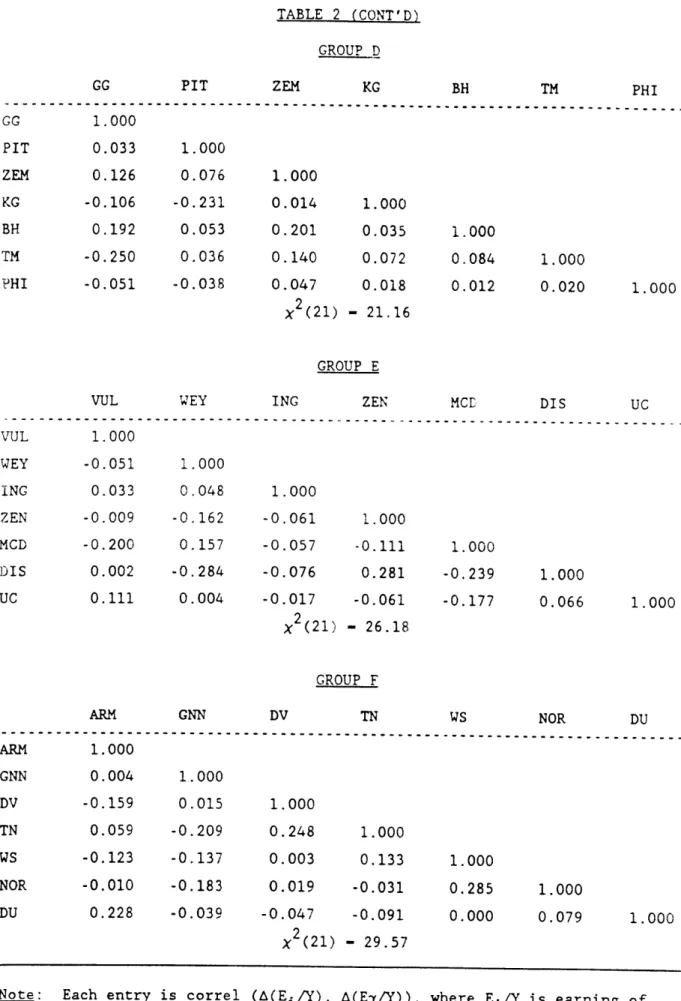
Table 2 shows the correlations of these first differences for each group of companies.
Not,: that all of the correlations are low; there are only two or three in each group that are above .22 in magnitude and hence individually significant at the 5 percent level.20 More important, in each case the correlations are insignificant as a group. This can be seen from the x2 statistics shown below each table, which test the groupwise significance for the 21 correlations in each group. The critical 5 percent level for this statistic is 32.67. Thus, none of the reported statistics are significant at the 5 percent level and we fail to reject the hypothesis that these earnings are groupwise uncorrelated.
Because some individual correlations are significant, we also constructed a seventh group of companies (group G). The companies in this group are also included in the other groups, but were chosen so that within this grouping no individual correlation exceeds
0.13. We report the results for this group at the end of Section 6.
One might argue that earnings are serially correlated, and that these tests fail to account for possible correlations between the change in earnings of one company and lagged changes in earnings for other companies. To allow for this possibility, we regress, for each company, the log change in normalized earnings against the log changes in normalized earnings, lagged one quarter, for the other six companies in the group, as well as real GNP (unlagged and lagged), a time trend, and the time trend squared. We then test whether the lagged changes in earnings can be excluded from all 7 regressions for each group of companies, i.e., a set of 42 restrictions. The test statistics, which are distributed as X2 with 42 degrees of freedom, are 17.43, 17.68, 20.19, 5.65, 12.90, and 18.06 for groups A, B, C, D, E, and F respectively. In this case the critical 5 percent level is 58.12, so that none of these statistics are significant. We conclude that normalized earnings for the companies in each group are uncorrelated, even allowing for a lag.
What about the stock returns for these groups of companies? We also calculated
2 0
With 75 quarterly observations, the critical p* for significance at the 5 percent level satisfies -75log(1 - p*2
) = 3.841 (where 3.841 is the critical value of x2(1)), or p* = .223.
correlation matrices for the raw returns in each group, and the corresponding X2 statis-tics to test the groupwise significance of these correlations. The X2 statistics are 153.52, 172.26, 173.07, 145.08, 224.90 and 262.42 for groups A, B, C, D, E, and F. These are all
highly significant, so we can easily reject the hypothesis that the returns are uncorrelated. We now examine whether these highly correlated returns can be explained by common
macroeconomic effects.
5. Regression Tests
We conduct OLS regression tests by first estimating eqn. (7), with the current and
lagged values of five macroeconomic variables included in the vector X. We choose macroe-conomic variables that could reasonably be expected to broadly affect expected future
earnings and/or discount rates: the log first difference of real GNP (Y), the log first
dif-ference of the GNP deflator (7r), an index of the exchange value of the dollar against ten
other currencies (EXCH), the ratio of aggregate corporate profits before tax (inclusive of
depreciation) to nominal GNP (CPBT), and the three-month Treasury bill rate (TBILL). After running these regressions for each group of companies, we test whether the
resulting residual covariance matrix is diagonal. Table 4 shows the residual correlation
matrices for each group of companies. Observe that nearly all of the individual correlations
are positive and statistically significant. The X2 statistics for the test of a diagonal residual
covariance matrix are equal to 146.38, 172.82, 185.11, 141.85, 209.88 and 247.62 for groups
A, B, C, D, E and F respectively. All of these statistics are significant at the 1 percent level,
allowing us to easily reject the hypothesis that the ci,t's are uncorrelated across firms. In
fact, these statistics are nearly the same as those that were calculated for the raw returns, without filtering out macroeconomic effects. (For groups B and C, the X2 statistics for the OLS residuals are larger than those for the raw returns. Adding explanatory variables
reduces the unexplained variance of returns for each company, but can lead to smaller
reductions in covariances so that the correlations rise.)
As one might expect from these results, macroeconomic variables explain only a very
small amount of the variation in ez post returns. This can be seen from Table 3, which shows test statistics for the hypothesis that a given macroeconomic variable (together
with its lag) can be excluded altogether from the 7 regressions in each group. These test statistics must be compared with the critical value of the X2 distribution with 14 degrees
of freedom. Although every variable (with the exception of real GNP) is significant for at least one group of companies, overall the statistics are low, showing that the explanatory power of these variables is limited.
We also tested several variations on these basic regressions. First, we included the lagged dividend yield on the S&P 500 index as an explanatory variable. As Keim and Stambaugh (1986) and others have shown, this variable is helpful in predicting aggregate stock returns, and as Table 3 shows, it is indeed a significant explanator of returns for all six groups of companies. Hence it is reasonable to expect that this variable can help explain the correlation of individual returns. Indeed, when it is included as a regressor, the X2 statistics for the test of a diagonal residual covariance matrix fall to 139.91, 158.42, 156.01, 119.46, 189.42 and 223.43 respectively. However, all of these statistics are still highly significant.
One might argue that real consumption is more likely than real GNP to broadly affect expected returns. (We chose GNP because it is the underlying determinant of consumption, and it avoids measurement error associated with imputed components of consumption.) We therefore also ran these OLS regressions adding the log change of real consumption of services and nondurables, unlagged and lagged, as additional variables. The results were little changed; the X2 statistics are 141.57, 159.79, 196.24, 144.69, 190.90, and 250.17 respectively.
We also found that adding long term interest rates and the log change of oil prices does little to the test statistics. One variable which does affect the results is the return on the S&P 500 itself. When we included the logarithm of the ratio of the current S&P 500 index to that in the previous quarter, the test statistics dropped to 66.45, 86.59, 91.26, 91.74, 92.34, and 139.48. While this is a substantial drop, these are still highly significant. It is clear from this that the correlation of stock returns for unrelated companies cannot be explained simply in terms of their correlation with broad indices. Since neither observ-able macroeconomic variobserv-ables nor broad market indices can account for the correlations
of returns, we next consider the possibility that these correlations can be explained by
unobserved expectations of future macroeconomic variables.
6. Latent Variable Tests
We begin by estimating eqns. (8), (9) and (10) simultaneously using two latent
vari-ables. The first is the unobserved market expectation of next quarter's rate of growth of
the GNP deflator. Expected inflation is relevant because it is a primary determinant of the
real return on Treasury bills, which in turn affects discount rates, as well expected future
economy-wide profits. The second latent variable is the market's expectation of real GNP
growth, also an important determinant of economy-wide profits. We include in the vector
Mt of observable macroeconomic variables current and lagged values of the following: the
rate of growth of the GNP deflator (7r), the rate of growth of real GNP (Y), corporate
prof-its before tax divided by nominal GNP, (CPBT), the 3-month Treasury bill rate (TBILL),
and the exchange value of the dollar (EXCH). Finally, the vector It of instruments includes
the current and lagged values of the following: the S&P 500 index normalized by nominal
GNP (S), the logarithmic first difference of the monetary base (BASE), and the rate of
growth of the real price of crude oil (CRUDE).
We estimate this system of equations via maximum likelihood, under the assumption that the error terms in each equation are normally distributed. We first perform this
estimation imposing the constraint that the covariance matrix of the ei,t is diagonal, so
that the explanatory and latent variables must account for all of the correlations among returns. We then reestimate the model leaving this covariance matrix unconstrained. Note, however, that even this relatively unconstrained model imposes some constraints; we use
more instruments than latent variables so that the system is overidentified. Estimation is
done using LISREL.2 1 Besides yielding parameter estimates, LISREL computes the value
of the likelihood function, making likelihood ratio tests straightforward.
Parameter estimates for the constrained system are shown in Table 5 for each of the
six groups of companies. Consistent with the results in the previous section, except for
the Treasury bill rate, the observable macroeconomic variables are not very significant as
"See Joreskog and Sorbom (1986) for an introduction to LISREL.
explanators of returns. On the other hand, the latent variable for expected real GNP growth is almost uniformly significant, and the two latent variables together account for much of the correlation of returns that was left unexplained by the simple regression models. Observe that the X2 statistics for a test of a diagonal covariance matrix for the
Ei,t's are 54.97, 48.76, 33.78, 37.43, 42.12 and 45.41 respectively for the six groups. These statistics are much lower than those calculated for the residual covariances of the regression models. Nonetheless, these statistics are significant at the 1 percent level for groups A, B,
D, E, and F, and at the 5 percent level for group C. Thus there is still excess comovement
in returns.
We also estimated alternative versions of these latent variable models as a means of checking the robustness of our results. First, one might argue that using latent variables to represent expectations one quarter ahead accounts for too short a forecast horizon. To test this, we let the latent variables represent expected real GNP growth and inflation two quarters ahead. The results are not very different; the likelihood ratio statistics for the test of a diagonal covariance matrix become 44.56, 48.77, 31.05, and 33.58 respectively for groups A, B, C, and D, and these are all significant at the 5 percent level.22
Second, we checked whether our results are sensitive to the Crash of 1987, which one might view as an outlier. To do this, we reestimated the model using data for the third quarter of 1969 to the third quarter of 1987. The resulting X2
statistics for groups A, B, C, D and E are 53.83, 47.12, 34.13, 34.87 and 41.8 respectively, which are all significant at
the 1 percent level. (Group F did not converge.) These numbers do not differ substantially
from those for the longer time horizon, presumably because we have included the market return as an instrument.
Third, we tested the explanatory power of the lagged dividend yield by including it as an additional explanatory variable. The X2 statistic for group B is 55.57. (We were not able to obtain convergence for the other groups.) Although the dividend yield may have predictive power for the market as a whole, it does not account for the comovement of stock returns.
2 2
We were unable to obtain convergence when estimating the model for groups E and F. We also tried to estimate a model in which the latent variables represent expectations four quarters ahead. This converged only for group B. The test statistic in that case was 48.58, which is significant at the 1 percent level.
Finally, as mentioned above, we formed an additional group of 7 companies (Group
G) from our original 42 companies. This group was chosen so that the correlations of normalized earnings changes are as low as possible, and none are statistically significant at the 5 percent level. (Groups A to F each have two or three correlations that are significant, although the correlations as a group are insignificant.) The companies in this new group are Delta Airlines (DAL), Giant Group Ltd. (GG), International Paper (IP), Chevron (CHV), Newmont Mining (NEM), Stone and Webster (SW), and Melville Corp. (MEL). Table 6A shows the earnings correlations; note that the x2 statistic for the test of groupwise significance is only 10.23.
Despite these insignificant earnings correlations for this group, the residual correla-tions from the OLS regressions of returns and from the latent variable model remain highly significant. The OLS residual correlations, which are shown in Table 6B, are comparable to those in Table 4 for the original six groups of companies. Table 6C shows the residual correlations from the latent variable model of returns. Only two of these correlations are individually significant, but the group is significant at the 5 percent level. Table 7 shows the parameter estimates for the latent variable model. The likelihood ratio statistic for a diagonal covariance matrix is 59.36, which is significant at 1 percent. Thus even when companies are chosen to minimize the correlation of their earnings, we still cannot account for the comovement of their returns.
7. Conclusions
We have argued that correlations among the stock returns for companies in unre-lated lines of business should be due to changes in current or expected future values of macroeconomics variables. Observable variables other than a broad market index explain a negligible amount of the movements in individual returns, and even accounting for a market index leaves returns highly correlated. Adding latent variables that represent un-observable forecasts of economic conditions accounts for some of this correlation, but not all. For every variation of our model that we have tried, and for every group of companies that we have examined, we find excess correlation of returns. If investors' utilities are a function of a single consumption index (as most models of asset pricing posit), then our re-sults are in conflict with the present value model of security valuation, and with Arbitrage Pricing Theory.
Like the related work of Shiller (1989) and Hansen and Jaganathan (1988), our finding of excess comovement casts doubt on the present value model of rational asset pricing. This result is also consistent with Trzcinka (1986), who finds that returns are highly correlated. He shows that a large number of eigenvalues of the covariance matrix of returns tend to grow as one adds more returns, so that one cannot explain these correlations with an approximate APT that has a small number of factors.
One might argue that our tests are incomplete, in that we may have excluded some im-portant macroeconomic variable from our specifications. This possibility cannot be ruled out. This problem is analogous to that which arises in other tests of the APT; if a suffi-ciently large number of factors is included, the model cannot be rejected. The voluminous literature testing the APT thus restricts itself to using only a small number of factors and investigating whether these suffice to explain differences in ex ante returns across stocks. In the same spirit we have studied whether a reasonable number of macroeconomic variables and latent variables can explain the correlation of returns.
It is important to emphasize, however, that simply adding, say, an additional latent variable need not reduce the X2 statistics for our tests of a diagonal covariance matrix. In fact, our recent work on commodity prices shows that adding statistically insignificant
latent variables can increase these statistics.23 In any case, more extensive experiments will be required to determined whether there are other variables that are better explanators of returns and their joint movements.
We have no good explanation for our finding of excess comovement. One possibility
is that the linear factor model is imperfect. In particular, the way returns respond to
un-derlying economic variables might have coefficients that change over time or be nonlinear
and this might induce correlation among the residuals of linear regressions. This
possibil-ity must be taken seriously because the linearpossibil-ity of the response of returns to economic
variables id only an approximation, it does not follow directly from the present discounted value model.
Alternatively, "fads" of some sort may play a role. But, if they do, they are likely to
be quite complicated since our finding of excess comovement holds even when we include
the market return as an explanatory variable in our OLS regressions, and as an instrument
in our latent variable models. In particular, the excessive residual correlations in table 9
display no particular pattern. Our view is simply that current models of rational asset
pricing do not fully explain the comovements of returns, and that more work is needed to
understand the cause of our finding.
2
"In Pindyck and Rotemberg (1989), we tested for excess comovement of commodity prices by first estimating a model with one latent variable, and then with two. The corresponding X2 statistics generally increased.
8. References
Burmeister, Edwin and Marjorie B. McElroy: "Joint Estimation of Factor Sensitivities and Risk Premia for the Arbitrage Pricing Theory," Journal of Finance, 1988. Chamberlain, Gary, and Michael Rothschild, "Arbitrage, Factor Structure, and
Mean-Variance Analysis on Large Asset Markets," Econometrica, 51, 1983, 1281-1304. Chen, Nai-Fu, Richard Roll, and Stephen A. Ross: "Economic Forces and the Stock
Market," Journal of Business, 59, 1986, 383-403.
Cutler, David M., James M. Poterba and Lawrence H. Summers: "What Moves Stock Prices?," Journal of Portfolio Management, 15, 1989, 4-12.
Dybvig, Philip H.: "An Explicit Bound on Deviations from APT Pricing in a Finite Economy," Journal of Financial Economics, 12, December 1983, 483-96.
-- and Stephen A. Ross: "Yes, the APT is Testable," Journal of Finance, 40, Septem-ber 1985, 1173-88.
Fama, Eugene F. and Kenneth R. French: "Dividend Yields and Expected Stock Returns," Journal of Financial Economics,22, October 1988, 3-25.
Fischer, Stanley and Robert C. Merton: "Macroeconomics and Finance: The Role of the Stock Market," in Essays on Macroeconomic Implications of Financial and Labor Markets and Political Processes, K. Brunner and A. Meltzer (eds.), Carnegie-Rochester Conference Series on Public Policy, 21, Autumn 1984, 57-108. Hansen, Lars Peter and Ravi Jaganathan: "Restrictions on Intertemporal Marginal
Rates of Substitution Implied by Asset Prices," mimeo, November 1988 Joreskog, Karl G. and Dag Sorbom: "LISREL User's Guide", 1986
Keim, D., and Robert Stambaugh: "Predicting Returns in the Bond and Stock Mar-kets," Journal of Financial Economics, 17, 1986, 357-90.
King, Benjamin F.: "Market and Industry Factors in Stock Price Behavior," Journal
of Business, 39, January 1966, 139-90.
King, Mervyn and Sushil Wadhwani: "Transmission of Volatility Between Stock Mar-kets," NBER Working Paper 2910, March 1989.
Lee, Cheng F. and Joseph D. Vinso: "Single vs. Simultaneous Equation Models in Capital Asset Pricing: The Role of Firm-Related variables," Journal of Business
Lehmann, Bruce N. and David M. Modest: "The Empirical Foundations of the Arbi-trage Pricing Theory," Journal of Financial Economics, 21, 1988, 213-254.
LeRoy, Stephen F. and Richard D. Porter: "The Present Value Relation: Tests Based on Implied Variance Bounds," Econometrica, 49, 555-74.
McElroy, Marjorie B. and Edwin Burmeister: "Arbitrage Pricing Theory as a Re-stricted Nonlinear Multivariate Regression Model," Journal of Business &
Eco-nomic Statistics, 6, January 1988, 29-42.
Meyers, Stephen L.: "A Re-Examination of Market and Industry Factors in Stock Price Behavior," Journal of Finance, 28, June 1973, 695-706.
Morrison, Donald: Multivariate Statistical Methods, McGraw-Hill, NY, 1967.
Pindyck, Robert S., and Julio J. Rotemberg, "The Excess Co-Movement of Commod-ity Prices," NBER Working Paper 2671, July 1988.
Poterba, James M. and Lawrence H. Summers: "Mean Reversion in Stock Prices, Evidence and Implications," Journal of Financial Economics, 1988
Roll, Richard: "R2," Journal of Finance, 43, July 1988, 541-66.
Roll, Richard and Stephen A. Ross:"An Empirical Investigation of the Arbitrage Pric-ing Theory," Journal of Finance, 35, December 1980, 1073-1103.
Ross, Stephen A.: "The Arbitrage Theory of Capital Asset Pricing," Journal of
Eco-nomic Theory, 13, 1976, 341-360.
Shiller, Robert J.: "Do Stock Prices Move Too Much to be Justified by Subsequent Changes in Dividends?," American Economic Review, 71, 1981, 421-36.
-: "Comovements in Stock Prices and Comovements in Dividends," Journal of
Finance, 44, July 1989, 719-29.
Singleton, Kenneth: "Specification and Estimation of Intertemporal Asset Pricing Models," in B. Friedman and F. Hahn, eds., Handbook of Monetary Economics, North-Holland, 1988.
Trzcinka, Charles: "On the Number of Factors in the Arbitrage Pricing Model,"
Composition of
Symbol Company Name
Table 1 Groups A, B, C, D, E and F Principal Business IP CHV NEM SW
CQ
KR CHL AL BS CMB MES OM STO MUR APD DAL EFU EBS MDP PD FI BH GG KG PHI PIT TM ZEM VUL WEY ING ZEN MCD DIS UC ARM GNN DV TN WS NOR DU Group A International Paper Co.Chevron
Newmont Mining Corp Stone and Webster
Communications Satellite Kroger Chemical Bank Group B Alcan Bethlehem Steel Chase Manhattan Melville Corp.
Outboard Marine Corp Stone Container
Murphy Oil Corp
Group C Air Products and Chemicals
Delta Air Lines Eastern Gas and Fuel Edison Bros. Stores Meredith Corp Phelps Dodge Corp First Interstate Bank
Group D Belding Heminway Giant Group Ltd. Kellogg Co. Phillips Petroleum Pitney-Bowes Times-Mirror Zemex Corp. Group E Vulcan Materials Weyerhauser Ingersoll-Rand Zenith McDonnell-Douglas Disney Union Carbide Group F Armstrong World Industries
Great Northern Nekoosa Dover Corp Tandy Weis Markets Norwest Corp Du Pont paper products oil refining
mining of nonferrous metals
engineering architectural consulting communications services
supermarkets banking
aluminum smelting and refining steel works
banking
clothing stores engines and turbines paper products oil refining
chemicals and industrial gases commercial air carrier
gas company consortium shoe stores
television and print media mining of nonferrous metals banking
industrial threads and yarns cement
food
oil refining
office machinery and supplies television and print media
tin, feldspar, iron powder mining
construction materials
timber and forestry products rock-drilling equipment
consumer electronics
aircraft and defense contracting entertainment products
industrial gases and chemicals furniture
paper products industrial equipment retail consumer electronics supermarkets
banking
TABLE 2
CORRELATIONS OF NORMALIZED EARNINGS CHANGES
GROUP A CHV NEM 1.000 0.007 1.000 0.044 -0.105 -0.141 -0.125 -0.156 -0.284 0.104 0.070 0.099 1.000 0.028 -0.097 -0.226 0.071 -0.004 1.000 0.201 0.223 1.000 0.274 0.030 -0.164 x 2(21) - 30.08 GROUP B MES 1.000 0.137 -0.217 -0.052 -0.164 0.149 0.009 APD 1.000 -0.092 0.064 -0.109 0.102 -0.016 0.004 -0.313 2 x (21) - 31.54 GROUP C DAL 1.000 -0.204 -0.144 0.071 0.176 -0.224 -0.224 -0.090 0.088 1.000 -0.048 -0.121 0.076 0.001 2 x (21) - 29.68 CHV NEM CHL CHL 1.000 -0.096 1.000 CMB 1.000 -0.025 0.077 0.036 CMB MES STO MUR STO MUR 0.251 -0.103 1.000 0.206 1.000 1.000 -0.178 MDP 1.000 MDP APD 0.008 EFU 1.000 0.021 EBS DAL EFU EBS -0.085 0.059 1.000 -0.003 -0.181 0.005 1.000 0.282 0.-16 1.000 -0.016 1.000
TABLE 2 (CONT'D)
GROUP D
PIT ZEM KG BH TM PHI
---GG 1.000 0.033 0.126 -0.106 0.192 -0.250 -0.051 1.000 0.035 0.072 0.018 - 21.16 1.000 0.084 0.012 GG PIT ZEM KG BH TM PHI 1.000 GROUP E VUL WEY ---1.000 -0.051 1.000 0.033 0.048 -0.009 -0.162 -0.200 0.157 0.002 -0.284 0.111 0.004
ING ZEN MCD DIS UC
---.. . .. . ..---1.000 -0.061 -0.057 -0.076 -0.017 x (21) 1.000 -0.111 0.281 -0.061 - 26.18 1.000 -0.239 -0.177 1.000 0.066 1.000 GROUP F ARM 1.000 0.004 -0.159 0.059 -0.123 -0.010 0.228 GNN DV TN WS NOR DU ---1.000 0.015 -0.209 -0.137 -0.183 -0.039 1.000 0.248 0.003 0.019 -0.047 x221 x (21) 1.000 0.133 -0.031 -0.091 - 29.57 1.000 0.285 0.000 1.000 0.079 1.000 is earning of 1.000 0.020 1.000 0.014 0.201 0.140 0.047 x2(21) 1.000 0.076 -0.231 0.053 0.036 -0.038 VUL WEY ING ZEN MCD DIS UC ARM GNN DV TN WS NOR DU
Note: Each entry is correl (A(Ei/Y), A(E-/Y)), where Ei/Y
TABLE 3
2 STATISTICS FOR GROUP EXCLUSIONS OF EXPLANATORY VARIABLES IN OLS REGRESSIONS Group Variable A B C D E F Y 7.68 17.37 8.62 7 9.52 15.23 41.80** EXCH 17.33 28.68* 11.70 CPBT 6.71 10.70 13.53 TBILL 35.51** 20.58 24.80* DIV-1 29.67** 49.37** 79.22.** 7.07 5.07 28.67* 39.61** 5.62 25.65* 4.53 25.60* 34.64** 11.72 76.68** 59.71** 5.49 80.07** 14.73 13.98 12.03 58.44** 2
Note: Entries ?n first five rows are X with 14 degrees of freedom; entries
for DIV-1 are X with 7 degrees of freedom. A * denotes significance at 5%