HAL Id: hal-00317709
https://hal.archives-ouvertes.fr/hal-00317709
Submitted on 3 Nov 2004
HAL is a multi-disciplinary open access
archive for the deposit and dissemination of
sci-entific research documents, whether they are
pub-lished or not. The documents may come from
teaching and research institutions in France or
abroad, or from public or private research centers.
L’archive ouverte pluridisciplinaire HAL, est
destinée au dépôt et à la diffusion de documents
scientifiques de niveau recherche, publiés ou non,
émanant des établissements d’enseignement et de
recherche français ou étrangers, des laboratoires
publics ou privés.
Concerning long-term geomagnetic variations and space
climatology
Karl-Heinz Glassmeier, J. Vogt, A. Stadelmann, S. Buchert
To cite this version:
Karl-Heinz Glassmeier, J. Vogt, A. Stadelmann, S. Buchert. Concerning long-term geomagnetic
vari-ations and space climatology. Annales Geophysicae, European Geosciences Union, 2004, 22 (10),
pp.3669-3677. �hal-00317709�
SRef-ID: 1432-0576/ag/2004-22-3669 © European Geosciences Union 2004
Annales
Geophysicae
Concerning long-term geomagnetic variations and space climatology
K.-H. Glassmeier1,2, J. Vogt2, A. Stadelmann3, and S. Buchert4
1Institut f¨ur Geophysik und extraterrestrische Physik, TU Braunschweig, Germany 2Max-Planck-Institut f¨ur Aeronomie, Katlenburg-Lindau, Germany
3School of Engineering and Sciences, International University of Bremen, Germany 4Swedish Space Research Institute, Uppsala, Sweden
Received: 14 May 2003 – Revised: 2 July 2004 – Accepted: 15 August 2004 – Published: 3 November 2004
Abstract. During geomagnetic polarity transitions the
sur-face magnetic field of the Earth decays to about 25% and less of its present value. This implies a shrinking of the terrestrial magnetosphere and posses the question of whether magne-tospheric magnetic field variations scale in the same man-ner. Furthermore, the geomagnetic main field also controls the magnetospheric magnetic field and space weather condi-tions. Long-term geomagnetic variations are thus intimately related to space climate. We critically assess existing scal-ing relations and derive new ones for various magnetospheric parameters. For example, we find that ring current perturba-tions do not increase with decreasing dipole moment. And we derive a scaling relation for the polar electrojet contri-bution, indicating a weak increase with increasing internal field. From this we infer that the ratio between external and internal field contributions may be weakly enhanced during polarity transitions. Our scaling relations also provide more insight on the importance of the internal geomagnetic field contribution for space climate.
Key words. Geomagnetism and paleomagnetism
(pale-omagnetic secular variation) – Magnetospheric physics (current systems; magnetospheric configuration and dynam-ics)
1 Introduction and motivation
Paleomagnetic studies found convincing evidence for geo-magnetic polarity transitions, with the last one, the Matuyama-Brunhes transition, occurring about 780 000 years ago (e.g. Merrill and McFadden, 1999). During such a polarity transition, the mean intensity of the dipole field decreases to at least ∼25% or less of its present value. Sis-coe and Chen (1975) were the first to study, in more de-tail, the consequences of a polarity transition induced field decrease on the terrestrial magnetosphere. As the stand-off distance RMP of the dayside magnetopause scales as
Correspondence to: K.-H. Glassmeier
RMP∝M1/3, where M is the magnetic dipole strength,
Sis-coe and Chen (1975) suggested that the magnetopause of such a paleomagnetosphere is located at about 8 REand even
closer to the Earth. The present day value is RMP≈10 RE.
Space weather describes the conditions in space that af-fect Earth and its technological systems, for example, power lines and communication satellites (e.g. Pirjola, 2002). Space weather is a consequence of the behavior and dynamics of the Sun, the nature of the geomagnetic main field and the terrestrial magnetosphere and atmosphere. Long-term vari-ations of the main field may thus be as important for space weather as term variations of solar activity, that is long-term variations of the geomagnetic field are of paramount importance for our understanding of space climate. Scaling relations for various processes and parameters of the mag-netosphere are thus very important for our ability to analyse past and forecast future space weather conditions and to eval-uate whether the internal geomagnetic field contribution or solar forcing is more important for space climate considera-tions.
Besides a scaling relation for the magnetopause distance, other scaling relations for various magnetospheric parame-ters have already been suggested. Siscoe and Chen (1975) ar-gue that the polar cap width scales with cosϑ∝M−1/6, where
ϑis the latitude of the polar cap boundary. Vogt and Glass-meier (2001) derive a somewhat different scaling for the po-lar cap width by using the ansatz RT∝Mγ to describe the
dependence of the tail radius RT from M; here, γ is a
scal-ing exponent. Equatscal-ing the magnetic fluxes through the po-lar cap and the tail gives one a scaling relation for the popo-lar cap width: cos ϑ∝Mγ −1/2. Siscoe and Chen’s (1975) esti-mate implies γ =1/3. A corresponding treatment of the prob-lem by Siebert (1977) gives one γ =0, that is the tail radius is found to be independent of the magnetic dipole moment. Based on the recent work by Roelof and Sibeck (1993), Vogt and Glassmeier (2001) suggest γ =1/2 for periods of strong southward interplanetary magnetic field (IMF).
Siscoe and Chen (1975) also tackle the question of ring current variations and estimate that the number and strength of magnetic storms increases with decreasing M. They estimate that the contribution of the storm-time ring current
3670 K.-H. Glassmeier et al.: Long-term geomagnetic variations and space climatology
-800 -600 -400 -200 0 Thousand Years Before Present
0 5 10 15 Dipole Moment [10 22Am 2] SINT800 Paleo Dipole Moments after Guyodo & Valet 1999
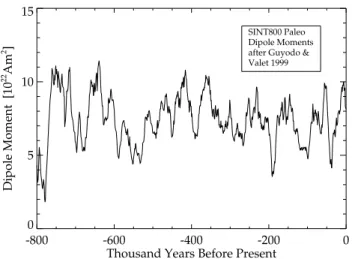
Fig. 1. Dipole moments of the geomagnetic field over the past 800 000 years based on relative paleointensities of SINT800 (after Guyodo and Valet, 1999).
to the equatorial surface magnetic field may be as large as 42% of the equatorial geomagnetic field during a polarity transition.
Indeed, paleomagnetic studies reveal that occasionally brief episodes of extremely rapid field changes are recorded in paleomagnetic data during times of polarity transitions (Coe and Prevot, 1989; Coe et al., 1995). Changes of 300 nT and several degrees per day in a paleomagnetic recording as the Steens Mountain reversal record is hard to be explained as a result of changes in the Earth’s outer core and its dynamo, but most probably require external magnetic field variations as an explanation (Ultr´e-Gu´erard and Achache, 1995; Jack-son, 1995).
Other current systems in the magnetosphere-ionosphere system, such as the polar and the equatorial electrojets, may as well contribute significantly to the total geomagnetic field at the Earth’s surface. This raises the question of whether external geomagnetic variations may become as large as the internal magnetic field strength during polarity transitions. If this hypothesis holds, then major consequences not only for the interpretation of paleomagnetic data will result, but also for the shape and dynamics of the inner magnetosphere, now not mainly governed by the main field, but also by the self-excited external field contributions.
Besides Siscoe and Chen’s (1975) scaling relation for the ring current, no other scaling relations for current systems in the magnetosphere-ionosphere system have been derived. This motivates the present study in which we shall derive ba-sic scaling relations for external geomagnetic variations due to polar and equatorial electrojet currents and their depen-dencies on the internal magnetic field strength, to explore in more detail the importance of long-term geomagnetic field variations for the space climate.
First, we shall derive a scaling law for the ring current contribution which differs from earlier treatments by Siscoe and Chen (1975) and Ultr´e-Gu´erard and Achache (1995).
Second, the ground-magnetic effect of the polar electrojets (PEJ) and its dependence of the magnetic dipole moment is discussed. Third, the equatorial electrojet contribution and the Sq-variations are analyzed. To all the various scal-ing laws we apply estimates of the dipole strength over the past 800 000 years based on relative paleointensities of the SINT800 record (Guyodo and Valet, 1999; Fig. 1) and de-rive the long-term variation of various magnetospheric pa-rameters. It should be noted that the SINT800 data set in-cludes data from the last geomagnetic polarity transition, the Matuyama-Brunhes transition.
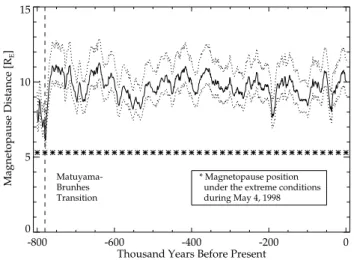
As an example Fig. 2 displays the magnetopause position using the Siscoe and Chen (1975) scaling relation. To ac-count for variations of the magnetopause position due to solar wind dynamic pressure changes observations of long-term solar wind flow variations by Gazis (1996) are used. One hundred-day averages of the solar wind speed at various dis-tances from the Sun indicate a variability of the mean flow speed of the order of ±150 km/s. We used this value to give error bars in Fig. 2, indicating the solar wind driven variation of the magnetopause position.
However, under very extreme conditions the magne-topause can be observed even within the geostationary orbit. In Fig. 2 the position under the extreme conditions of 4 May 1998 is indicated (for details of this event, see Russell et al., 2000). It can be seen from Fig. 2, that even during a polar-ity transition such as the Matuyama-Brunhes transition, the magnetopause under average solar activity conditions never moves closer than about 5 RE. During very strong solar wind
activity the magnetopause can be observed at these positions even today. Space climate variations of the magnetopause distance, as caused by long-term geomagnetic field condi-tions, are thus within current, shorter term space weather variations. It is solar activity which has a more important influence on the magnetopause position.
This implies the question of whether this is true for all the magnetospheric parameters discussed. In particular, we are interested in a more detailed discussion of the strength of the external magnetic field contributions compared to the internal ones. We are thus concluding our contribution with a discussion of the possible effects of the various external geomagnetic field contributions.
In all the following discussions we shall assume that the terrestrial field is of a pure dipole nature. Non-dipolar con-tributions will be neglected for the time being. This results in a considerable simplification of the problem treated but allows for a much more straightforward derivation of first-order scaling relations. It is our intention to study the pos-sible significance of long-term geomagnetic field variations on major magnetospheric parameters. Long-term variations of solar activity might be equally or even more important. Also, the effect of energetic particles in the magnetosphere is not discussed here. A first discussion on this can be found in the work by Vogt and Glassmeier (2000).
2 The ring current contribution
Siscoe and Chen (1975) pointed out that a scaling for the ring current magnetic field at the Earth’s surface can be derived from the Dessler-Parker-Sckopke theorem (e.g. Sckopke, 1966; Wolf, 1995).
Dst ∝
WRC
M . (1)
Here, Dstis a measure for the ring current associated surface
magnetic field and WRCis the total energy of the ring current
particles. A priori it is not justified to assume that WRCis
in-dependent of M, the magnetic dipole strength. Siscoe and Chen’s (1975) scaling, Dst∝M−1/3, implies WRC∝M2/3, a
result based on the assumption that the total ring current en-ergy is proportional to the enen-ergy delivered to the magneto-spheric system by the solar wind. This energy input scales with R2T, the tail cross section. Using RT∝RMP gives one
Siscoe and Chen’s (1975) scaling relation (see also Ultr´e-Gu´erard and Achache, 1995).
A different scaling results if one takes into account that not only the cross section of the magnetosphere, R2T, is decreas-ing with decreasdecreas-ing magnetic moment, but also the volume of that part of the magnetosphere where particle trapping is pos-sible. If this volume is smaller, less particles can be trapped in the ring current region of the magnetosphere. Here, we as-sume that this volume, VRC, scales as VRC∝RMP3 ∝M.
Fol-lowing Vogt and Glassmeier (2001) we use RT∝Mγ, which
gives one
WRC∝RT2RMP3 ∝M2γ +1. (2)
Here, γ >0. With these modifications the scaling relation for the ring current magnetic field is given by
Dst ∝M2γ, (3)
that is, in contrast to the work of Siscoe and Chen (1975) and Ultr´e-Gu´erard and Achache (1995) we find that the ring current associated magnetic field decreases with decreasing dipole magnetic moment.
Taking into account the volume of the ring current is also supported by considering the Burton equation
dDst/dt =Q(t )−Dst/τ, where Q(t) is a source function and
τdenotes the decay rate due to charge-exchange loss of ring-current particles through collisions with neutral geocorona particles (Burton et al., 1975). The steady-state solution of this equation gives one Dst=Q·τ. Now τ can depend on
the dipole strength, since if the magnetosphere is smaller, the ring current forms closer to the Earth, where charge ex-change occurs. Thus, τ should decrease with decreasing magnetospheric volume and dipole moment (G. Siscoe, per-sonal communication). We also expect Q to decrease with decreasing dipole strength. Thus, Dst significantly decreases
with decreasing magnetic field.
The new scaling relation discussed here furthermore guar-antees that for vanishing magnetic moment also, the ring cur-rent vanishes, a result most reasonable as the ring curcur-rent re-quires particle trapping in a magnetic mirror topology. The
-800 -600 -400 -200 0 Thousand Years Before Present
0 5 10 15 Magnetopause Distance [R E ] * Magnetopause position under the extreme conditions during May 4, 1998
Matuyama-Brunhes Transition
Fig. 2. Estimated magnetopause position during the past 800 000 years using the Siscoe and Chen (1975) scaling relation. The error bars indicate the variability of the magnetopause position due to solar wind dynamic pressure variations and have been derived from long-term solar wind flow variations.
new scaling is also supported by observations in the Hermean magnetosphere, indicating that planet Mercury, with its much smaller internal magnetic field, does not support any large ring-current (Russell et al., 1988; Glassmeier, 2000). Ring current magnetic effects are thus of minor importance during polarity transitions following the approach discussed above.
3 Scaling the convection electric field
As we aim at scaling the strength of the PEJ magnetic field we need a proper scaling for the convection electric field in the ionosphere driving these current systems. The iono-spheric electric field EIono is determined by the
magneto-spheric convection electric field Ec, which is related to the
solar wind electric field Esw=−vsw×Bsw via Ec=ηEsw,
where η≈0.2 is the magnetic reconnection efficiency, and
vsw and Bsw denote the solar wind flow velocity and the
interplanetary magnetic field, respectively (e.g. Siscoe and Chen, 1975). Here, we estimate the electric field via the po-tential drop 8 across the dayside magnetopause:
8 ∝ vsw·Bsw·RMP. (4)
We use the magnetopause distance RMP∝M1/3as a measure
of the extension of the dayside magnetopause reconnection region. Solar wind velocity and interplanetary magnetic field magnitude are assumed as constant here. The ionospheric electric field in polar regions scales according to
EI ono ∝ 8/2REcos ϑ ∝ M5/6−γ, (5)
where the divisor 2 REcos ϑ gives the polar cap width to
which the potential is applied. For any value of γ consid-ered above, we conclude that the ionospheric electric field increases with increasing dipole moment.
3672 K.-H. Glassmeier et al.: Long-term geomagnetic variations and space climatology The simple scaling above does not at all take into account
any effect of the ionospheric-magnetospheric current system generated. To first order the region 1 current system can be described as a figure-8 meridional current system (Siscoe et al., 2002), whose magnetic field exhibits a southward field component at the magnetopause in the equatorial plane. Day-side reconnection is thus diminished due to these currents and saturation of the transpolar electric potential results. Sis-coe et al. (2002) provide a suitable model on how to account for these effects. Based on what is called by them the Hill model (Hill et al., 1976), they derive an expression for the saturation of the transpolar potential scaling with M as
8s ∝M4/3/60, (6)
where 60is the constant of proportionality in a relation
scal-ing the Pedersen conductance with M, 6P=60/M.For
de-tails of the conductance scaling, see Sect. 4. From this a suitable scaling relation for the saturation ionospheric elec-tric field is
EIono,s∝8s/cosϑ ∝
1
60
M−γ +11/6, (7)
or, EIono,s∝M13/6, if 60is assumed independent from M and
γ =1/3 is used. Thus, the saturation ionospheric electric field would decrease with decreasing dipole field.
Our derivation of a scaling for the ionospheric electric field and the magnetospheric convection electric field assumes that the magnetospheric convection pattern does not vary much during a polarity transition, an assumption valid only if the magnetospheric magnetic field is still dominated by a magnetic dipole aligned with the rotation axis. If quadrupole or octupole contributions from the internal field become im-portant or even dominate the field or if the orientation of the dipole varies with respect to the Sun-Earth line, then the con-vection pattern may be much different. Thus, we are merely scaling the magnetic field strength dependence, but not its topology change. However, it should be noted that using the Hill model scaling and saturation conditions takes into account quadrupole field contributions resulting from the re-gion 1 magnetosphere-ionosphere current system.
Scaling the convection electric field potential gives one a scaling relation for the plasmapause position. Following Siscoe and Chen (1975) we identify the plasmapause as the
-pause (Brice, 1967), where the saturated convection po-tential 8s∝M4/3/60equals the potential of the corotational
electric field 8cor∝M/r, where r denotes radial distance.
With 8s=8corthe plasmapause position Rpp scales as
Rpp ∝M3γ −11/6, (8)
where a scaling relation for 60, as introduced in the next
section has been used. With γ =1/3 the plasmapause position scales as
Rpp ∝M−5/6, (9)
-1000 -800 -600 -400 -200 0 Thousand Years Before Present
0.0 0.2 0.4 0.6 0.8 1.0
Rel. Plasma Pause Distance
+++ Secular Variation of the Plasmapause Position Present Maximum Mean Minimum Position M-B Transition
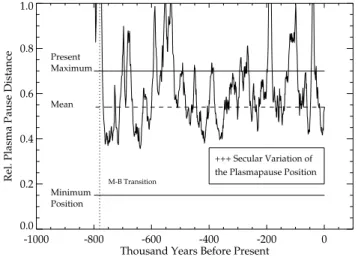
Fig. 3. Estimated relative plasmapause position over the past 800 000 years using the Siscoe and Chen (1975) scaling relation, together with the current day plasmapause position and its variabil-ity.
that is, the plasmapause distance increases with decreasing M. This scaling is different from the previous scaling de-rived by Siscoe and Chen (1975), a result based on taking into account the saturation of the transpolar potential. In the original approach by Siscoe and Chen (1975) this effect was not considered and the convection potential was assumed in-dependent from the internal geomagnetic field contribution.
Figures 3 displays the likely mean position, rpp, of the
plasmapause over the past 800 000 years, normalized to the magnetopause position: rpp=Rpp/RMP∝M−7/6, if γ =1/3
is assumed. The figure also indicates the variability of the current plasmapause position as observed by, for example, Laakso and Jarva (2001) and Moldwin et al. (2002). We con-clude that relative variations introduced by secular changes in the dipole moment are much larger than changes intro-duced by magnetospheric activity. During field lows the plasmapause position may coincide with the magnetopause or is even located at a larger radial distance. This is, of course, unreasonable and indicates that the scaling derived is only applicable for a certain range of dipole moment val-ues. Nevertheless, our scaling relation indicates that the mag-netosphere for smaller dipole moments may be much more rotation dominated than at the present time. The paleomag-netosphere during a reversal is possibly a weak Jovian-type magnetosphere.
4 The polar electrojets
Current systems causing major geomagnetic field variations are the polar electrojets in the auroral zones. During dis-turbed times magnetic field variations of up to 2000 nT have been observed (Allen et al., 1989). The sudden onset of field variations of this strength will cause pronounced geomagnet-ically induced current (GIC) effects (e.g. Pirjola, 2002). Such GIC effects depend on both the rise time of the perturbation,
as well as the maximum strength of the inducing magnetic field. Our scaling relation for the polar electrojet strength allows, for example, one to estimate the maximum strength contribution to GICs.
On the average PEJ variations as estimated using the AE index are of the order of 200 nT. At auroral latitudes the inter-nal field contribution is about 50 000 nT, that is, the present ratio external to internal field contribution is of the order of 1/250. Therefore, such external variations are usually ne-glected when interpreting paleomagnetic data.
Polar electrojet magnetic field variations are mainly de-termined by the ionospheric Hall currents (e.g. Glassmeier, 1987; Kamide and Baumjohann, 1993):
bG∝6HEIono, (10)
where bG is the magnitude of the horizontal component of
the ground magnetic field, EIonothe ionospheric electric field
strength, and 6Hthe height-integrated Hall conductivity. For
simplicity, 6H is assumed to be uniform. Equation (10)
demonstrates that a scaling law for bG requires scaling
re-lations for both, the conductance 6H and the electric field
EIono.
It should be noted that when deriving Eq. (10) we made use of the so-called Fukushima-Bostr¨om-Vasyliunas theorem (Bostr¨om, 1964; Vasyliunas, 1970; Fukushima, 1976), stat-ing that the ground magnetic effect is only due to the mag-netic effect of the Hall currents, while the magmag-netic effect of the Pedersen currents is cancelled by the magnetic effects of the field-aligned and magnetospheric closure currents. This theorem strictly only holds for a uniform conductance distri-bution which, we think, is a fair approximation when deriv-ing scalderiv-ing relations.
The ionospheric Pedersen and Hall conductivities are sig-nificant in a layer where the ions are unmagnetized due to ion-neutral collisions and move partially along the electric field direction, and the electrons are magnetized performing nearly unperturbed E×B drifts. This difference in ion and electron motion gives rise to the Pedersen and Hall currents (Kelley, 1989, pp. 37). For magnetized electrons and par-tially unmagnetized ions the Pedersen and Hall conductivi-ties are (Kelley, 1989, p. 39)
σP = nee B κi 1 + κi2 (11) and σH = nee B κi2 1 + κi2, (12)
where ne=niare the ion and electron number density,
respec-tively, and κi,e=i,e/νi,e are the ratios of the ion and
elec-tron gyro frequencies i,eto their collision frequencies νi,e,
respectively, and the approximation κe 1 is made, which is
valid at all heights above 75 km for the current geomagnetic field strength, and above about 85 km for a geomagnetic field reduced to 10% of its current strength. If the geomagnetic field becomes very low or even vanishes, then the collision
frequencies dominate Eqs. (11) and (12) and the Hall con-ductivity becomes very small.
Equation (12) suggests a scaling relation
σH∝B−1∝M−1. (13)
This scaling relation is justified if one assumes that ne(z)
does not change very much with B0, the background
mag-netic field. In the dayside ionosphere this assumption is cer-tainly justified as ne(z)is mainly determined by solar
insola-tion. In the nightside ionosphere the electron density depends very much on magnetospheric activity and particle precipita-tion.
The ground-magnetic field is determined by the height-integrated conductivity and thus depends on the height distri-bution of the electron density and the collision frequencies. To receive a first estimate of the Pedersen and Hall conduc-tance for the dayside ionosphere we assume an atmospheric and ionospheric structure as described in Kelley (1989) based on the following assumptions: Chapman layer with a maxi-mum at 120 km and a scale height of 10 km, isothermal baro-metric law for the neutral atmosphere density, normalized at 120 km according to the table in Kelley (1989, p. 461), tem-perature profile according to solar maximum conditions with a temperature of 176 K at a height of 90 km, and collision frequencies for electron-neutral, and ion-neutral collisions as given in Appendix B of Kelley (1989).
For the standard ionospheric structure, the σP layer does
not change significantly its vertical shape, and its center moves up in altitude when the ionospheric magnetic field strength decreases. The vertical shape of the σH layer also
becomes thicker in addition to moving upwards. Therefore, when integrating numerically the σP and σH profiles over
the height range 90–290 km, we find for the dayside height-integrated Pedersen and Hall conductances vertical profiles as displayed in Fig. 4.
From this one can derive the following scaling relations:
6P ∝M−1, (14)
6H ∝M−4/3. (15)
They indicate that the conductances increase with decreasing magnetic field. The Cowling conductance, defined via
σC = σP + σH2 σP (16) scales as 6C ∝M−5/3. (17)
The scaling relations derived here are in very good agree-ment with similar relations derived by Richmond (1995) in a different context.
On the nightside the ionospheric electron density ne(z)
de-pends on the precipitation rate and energy of magnetospheric electrons and ions, as well as their interaction with the upper
3674 K.-H. Glassmeier et al.: Long-term geomagnetic variations and space climatology
102
103
104
105
Magnetic Field (nT)
100
101
102
103
104
105
Ionospheric Conductance (S)
_____ Hall
_ _ _ Pedersen
-.-.-.- Cowling
Fig. 4. Dependence of the dayside ionospheric conductances on the ionospheric magnetic field magnitude.
atmosphere. In order to derive a first simple scaling rela-tion for these complex processes we note that the maximum ionospheric electron density ne,maxscales with the
precipita-tion rate, which certainly depends on the particles’ loss cone
λL: ne,max∝sinλLThe width of the loss cone is independent
from the particles’ mass, charge, and energy (e.g. Baumjo-hann and Treumann, 1996). For a dipole field situation as assumed here the loss cone only depends on the field line radius via
sin2λL=(4 · L6−3 · L5)−1/2, (18)
where L is the McIlwain parameter of the field line. The L-value depends on the latitude λInterwhere the field line
in-tersects the Earth’s surface: L=cos−2λInter.
Discussing the polar electrojets we are interested in high-latitudes only where L-values are about L=6 and larger. For these polar situations Eq. (18) can be approximated as
sin2λL=(4 · L6)−1/2∝L−3. (19)
Furthermore, assuming that the intersection latitude is iden-tical with the polar cap latitude, that is λInter=ϑ, gives one a
scaling relation
60∝ne,max ∝sin λL∝M3γ −3/2, (20)
where 60is the parameter introduced in Eq. (7).
Combining the relations (20), (7), (14), and (15) results into the following scalings for the nightside polar ionospheric conductances:
6P ∝M3γ −5/2 (21)
6H ∝M3γ −17/6. (22)
There is no need to derive a corresponding relation for the Cowling conductivity as the equatorial electrojet is a dayside phenomenon.
Having derived scaling laws for the nightside ionospheric conductances, Eqs. (21) and (22), and the saturation iono-spheric electric field, Eq. (7), allows one to deduce a scaling law for the polar electrojet magnetic field:
bG∝M−γ +1/2 (23)
or, adopting the Siscoe and Chen (1975) case γ =1/3,
bG∝M1/6, (24)
that is the ground magnetic field of the polar electrojet in-creases weakly with increasing internal magnetic field.
The above scaling relations are based on several assump-tions, such as the independence of ne(z)on M for dayside
conditions. Furthermore, only a first attempt has been made to estimate the magnetic field dependence of the influence of energetic particle precipitation on the nightside ionospheric conductivity. However, for the time being we take Eq. (23) as a suitable first scaling law for the external magnetic field variation due to the polar electrojets. But it should be kept in mind that this scaling relation has been derived based on assumptions with respect to magnetospheric structure, con-vection pattern, and particle precipitation.
With the above derived scaling law we can now discuss the time evolution of the external magnetic field contribu-tion to the geomagnetic field. Again, using the dipole mo-ments derived from the SINT800 record (Guyodo and Valet, 1999), assuming a present day polar electrojet strength of 200 nT, and an internal field at high latitudes of 50 000 nT. Figure 5 displays the relative strength rPEJ∝M−5/6 of the
polar electrojet field compared to the internal field contri-bution over the past 800 000 years; here γ =1/3 has been assumed. Figure 5 indicates that the polar electrojet contri-bution was almost stable during the time interval represented by the SINT800 record. Only during the Matuyama-Brunhes transition some 780 000 years ago did the relative strength of the PEJ significantly increase. Though the absolute PEJ strength was most probably smaller than today, its contribu-tion to the total field was more pronounced, as the internal contribution decays faster with M than the external contribu-tion. It would require a decrease of the internal contribution by about a factor of 300 during a polarity transition to reach an equal contribution of both the internal and external field.
Table 1. Scaling relations for various magnetospheric parameters. General γ=1/3 γ=0 γ=1/2 RMP M1/3 M1/3 M1/3 M1/3 RP P M3γ −11/6 M−5/6 M−11/6 M−1/3 RT Mγ M1/3 M1/2 cosϑ Mγ −1/2 M−1/6 M−1/2 Dst M2γ M2/3 M EI ono,s Mγ +11/6/60 M13/6/60 M11/6/60 M7/3/60 bG M−γ +1/2 M1/6 M1/2 bEEJ M−2/3 M−2/3 M−2/3 M−2/3 -800 -600 -400 -200 0
Thousand Years Before Present 0.0
0.5 1.0 1.5
Relative Polar Electrojet Magnitude [%]
Polar Electrojet Magnetic Field Contribution in Time M-B Transition
Fig. 5. Estimated relative polar electrojet strength over the past 800 000 years.
5 The equatorial electrojet
Thermal tides (e.g. Volland, 1988), driven by temperature differences between the dayside and nightside atmosphere are the cause of the large-scale ionospheric Sq current system with ground-magnetic variations of the order of 10 nT. Near the geomagnetic equator a spatially confined current system develops, the equatorial electrojet (EEJ). Typical EEJ pertur-bation fields are of the order of 100 nT (e.g. Untiedt, 1967; Hesse, 1982; Onwumechili, 1997). Its spatial localization to about 500 km around the magnetic equator results from space charge effects causing an effective conductivity, the Cowling conductivity σC, determining the strength of this current
sys-tem. From Fig. 4 a scaling relation
6C ∝M−5/3 (25)
is appropriate for the Cowling conductance.
Thermal tides driving the EEJ are independent of the back-ground magnetic field, but the electromotive force u×B driv-ing the electric currents is proportional to M; here u is the tidal wind field. Thus, the EEJ strength scales as
bEEJ ∝M−2/3. (26)
-800 -600 -400 -200 0
Thousand Years Before Present 0 1 2 3 4 5
Relative EEJ Magnitude [%]
Equatorial Electrojet Magnetic Field Contribution in Time M-B Transition
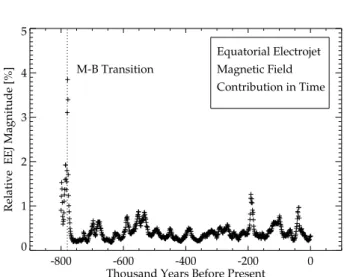
Fig. 6. Estimated relative equatorial electrojet strength over the past 800 000 years.
We therefore conclude that the EEJ intensity increases sig-nificantly with decreasing magnetic field, that is during po-larity transitions. The temporal evolution of this geomag-netic field contribution over the past 800 000 years is dis-played in Fig. 6, assuming a present day EEJ strength of 100 nT and an internal field at the equator of 31 000 nT. EEJ related ground magnetic fields of the order of 400–500 nT are not unrealistic. The ratio external to internal field can be of the order of 1/20. The EEJ may become an important con-tributor to the total field during polarity transitions. It should be noted that the limitations of the scaling of the ionospheric conductances mentioned above do not apply for the EEJ case, as the dayside ionization of the upper atmosphere is mainly caused by solar UV and X-radiation.
6 Summary and conclusions
Scaling relations (see Table 1) for major magnetospheric parameters and ionospheric current systems and their de-pendence on the geomagnetic field have been critically as-sessed and new ones derived, assuming an interaction of the solar wind with a dipolar geomagnetic field. Their temporal
3676 K.-H. Glassmeier et al.: Long-term geomagnetic variations and space climatology evolution over the past 800 000 years has been considered
using estimates of the dipole strength of the Earth magnetic field based on relative paleointensity values of the SINT800 record compiled by Guyodo and Valet (1999). We conclude that, for example, the mean magnetopause distance did not change dramatically in the past. Current extreme positions of this major magnetospheric boundary are well within the range one expects under paleomagnetic field conditions.
We also derived a new scaling law for the plasmapause position, indicating that the relative size of the plasmasphere increases with decreasing moment. This is due to the fact that the corotation electric field decreases less rapidly with M than the saturation convection field. We conjecture that the paleomagnetosphere during a reversal is thus much more rotation dominated than at the present time and possibly exhibits features reminiscent to the Jovian magnetosphere. However, this conjecture needs further confirmation which is beyond the scope of this work.
Different from previous work we argue that the ring cur-rent magnetic field contribution decreases with decreasing geomagnetic field. This has implications for the interpre-tation of periods of extremely rapid field changes observed in paleomagnetic records during times of polarity transitions (Coe and Prevot, 1989; Coe et al., 1995), in that we cannot support the idea of ring current magnetic fields being respon-sible for these observed changes as advocated by, for exam-ple, Ultr´e-Gu´erard and Achache (1995) or Jackson (1995).
As a possible alternative we discuss polar and equatorial electrojets and derive proper scaling relations for their contri-bution to the external geomagnetic field. Based on a simple model we derive a scaling relation indicating that the polar electrojet fields exhibit a weak dependence from the internal dipole moment and decrease proportional to the decrease of the internal field. This scaling is mainly influenced by a sat-uration of the transpolar potential (e.g. Siscoe et al., 2002) governing the ionospheric electric field. Though the iono-spheric conductances increase with decreasing dipole mo-ment this saturation effect leads to the weak, positive depen-dence of the PEJ on M.
However, the relative contribution of the external field in-creases with decreasing internal field, which may be of im-portance especially during intervals of polarity transitions. At equatorial latitudes the EEJ is becoming much more pro-nounced, but never reaches a strength comparable to the in-ternal field contribution.
From our considerations of the various sources of geo-magnetic variations we conclude that the secular change of the dipole component of the geomagnetic field is of minor importance compared to the overall solar wind induced vari-ability of the magnetosphere.
We would like to point out that our scaling relations are only first approaches to the problem. They are based on assuming a dipole magnetosphere, and convection elec-tric fields similar in their topology, as in the present mag-netosphere. Relaxing these limitations by modelling the magnetosphere-ionosphere system in more detail under
con-ditions of a polarity transition is necessary to fully under-stand the problem.
Acknowledgements. KHG is grateful to George Siscoe for
illumi-nating discussions of the problem addressed in this publication. This work has been conducted under the Priority Programme ”Geo-magnetic variations: Space-time structure, processes, and effects on system Earth” of the Deutsche Forschungsgemeinschaft. Financial support under contract GL 142-12/1 is gratefully acknowledged.
Topical Editor T. Pulkkinen thanks three referees for their help in evaluating this paper.
References
Allen, J., Sauer, H., Franck, L., and Reiff, P.: 14 November 1989: Effects of the March 1989 solar activity, EOS Trans. AGU, 1479– 1486, 1989.
Baumjohann, W. and Treumann, R.: Basic Space Plasma Physics, 33f, Imperial College Press, London, 1996.
Brice, N. M.,: Bulk motion in the magnetosphere, J. Geophys. Res., 72, 5193–5201, 1967.
Bostr¨om, R.: A model of the auroral electrojet, J. Geophys. Res., 69, 4983–5000, 1964.
Burton, R. K., McPherron, R. L., and Russell, C. T.: An empirical relationship between interplanetary conditions and Dst, J. Geo-phys. Res., 80, 4204–4214, 1975.
Coe, R. S. and Prevot, M.: Evidence suggesting extremely rapid field variation during a geomagnetic reversal, Earth Planet. Sci. Lett., 92, 292–298, 1989.
Coe, R. S.: M. Prevot, and P Camps, New evidence for extraordi-narily rapid change of the geomagnetic field during a reversal, Nature 374, 687–692, 1995.
Fukushima, N.: Generalized theorem of no ground magnetic effect of vertical current connected with Pedersen currents in the uni-form conductivity ionosphere, Rep. Ionos. Space Res. Jpn., 30, 35–40, 1976.
Gazis, P. R.: Long-term enhancements in the solar wind speed, J. Geophys. Res., 101, 415–424, 1996.
Glassmeier, K. H.: Ground-based observations of field-aligned cur-rents in the auroral zone: Methods and results, Ann. Geophys. 5, 115–126, 1987.
Glassmeier, K. H.: Currents in Mercury’s Magnetosphere, Geo-physical Monograph 118, 371–380, Am. Geophys. Union, Wash-ington, 2000.
Guyodo, Y. and Valet, J. P.: Global changes in intensity of the Earths magnetic field during the past 800 kyr, Nature, 399, 249–252, 1999.
Hesse, D.: An investigation of the equatorial electrojet by means of ground-based magnetic measurements in Brazil, Ann. Geophys. 38, 315–320, 1982.
Hill, T. W., Dessler, A. J., and Wolf, R. A.: Mercury and Mars: The role of ionospheric conductivity in the acceleration of magneto-spheric particles, Geophys. Res. Lett., 3, 429–432, 1976. Jackson, A.: Storm in a lava flow? Nature, 377, 685–686, 1995. Kamide, Y. and Baumjohann, W.: Magnetosphere-Ionosphere
Cou-pling, Springer-Verlag, Berlin, 1993.
Kelley, M. C.: The Earth’s Ionosphere, Academic Press, San Diego, 1989.
Laakso, H. and Jarva, M.: Position and Motion of the Plasmapause, J. Atm. Terr. Phys., 63, 1171–1178, 2001.
Merrill, R. T. and McFadden, P. L.: Geomagnetic polarity transi-tions, Rev. Geophys. 37, 201–226, 1999.
Moldwin, M. B., Downward, L.,Rassoul, H. K., Amin, R., and Anderson, R. R.: A new model of the location of the plasma-pause: CRRES results, J. Geophys. Res., 107, (A11), 1339, doi:10.1029/2001JA009211, 2002.
Onwumechili, C. A.: The equatorial electrojet, Gordon and Breach, Amsterdam, 1997.
Pirjola, R.: Fundamentals about the flow of geomagnetically in-duced currents in a power system applicable to estimating space weather risks and designing remedies, J. Atmos. Terr. Phys., 64, 1967–1972, 2002.
Richmond, A. D.: Ionospheric electrodynamics, in: Handbook of Atmospheric Electroidynamics, edited by: Volland, H., Vol. II, 260, CRC Press, Boca Raton, 1995.
Roelof, E. G. and Sibeck, D. G.: Magnetopause shape as a
bivari-ate function of interplanetary magnetic field Bzand solar wind
dynamic pressure J. Geophys. Res. 98, 21 412, 1993.
Russell, C. T., Baker, D. N., and Slavin, J. A.: The magnetosphere of Mercury, edited by: Vilas, F., Chapman, C. P., and Matth-wes, M. S., Mercury, Arizona University Press, Tuscon, 514– 561, 1988.
Russell, C. T., Le, G.,Chi, P., Zhou, X.-W., Shue, J.-H., Petrinec, S. M., Song, P., Fenrich, F. R., and Luhmann, J. G.: The extreme compression of the magnetosphere on 4 May 1998, as observed by the polar spacecraft, Adv. Space Res., 25, 1369–1375, 2000. Sckopke, N.: A general relation between the energy of trapped
par-ticles and the disturbance field near the Earth, J. Geophys. Res. 71, 3225–3230, 1966.
Siebert, M.: Auswirkungen der s¨akularen ¨Anderung des
Erdmag-netischen Hauptfeldes auf Form und Lage der Magnetosph¨are und die St¨arke der erdmagnetischen Aktivit¨at, Abhandlungen der Braunschweigischen Wissenschaftlichen Gesellschaft, 37, 281, 1977.
Siscoe, G. L. and Chen, C. K.: The paleomagnetosphere, J. Geo-phys. Res. 80, 4675–4680, 1975.
Siscoe, G. L., Erikson, G. M., Sonnerup, B. U. ¨O., Maynard, N. C.,
Schoendorf, J. A., Siebert, K. D., Weimer, D. R., White, W. W., and Wilson, G. R.: Hill model of transpolar potential saturation: Comparisons with MHD simulations, J. Geophys. Res., 107(A6), SMP 8-1, doi:10.1029/2001JA000109, 2002.
Ultr´e-Gu´erard. P. and Achache, J.: Core flow instabilities and geo-magnetic storms during reversals: The Steens mountain impul-sive field variations revisited, Earth Planet. Sci. Lett. 135, 91–99, 1995.
Untiedt, J.: A model of the equatorial electrojet involving merid-ional currents, J. Geophys. Res. 72, 5799–5810, 1967.
Vasyliunas, V. M.: Mathematical models of magnetospheric con-vection and its coupling to the ionosphere, in: Particles and Fields in the Magnetosphere, edited by: McCormac, B. M., 60– 71, D. Reidel, Hinghamn, Mass., 1970.
Vogt, J. and Glassmeier, K. H.: On the location of trapped parti-cle populations in quadrupole magnetospheres, J. Geophys. Res., 105, 13 063–13 071, 2000.
Vogt, J. and Glassmeier, K. H.: Modelling the paleomagnetosphere: Strategy and first results, Adv. Space Res. , 28, 863–868, 2001. Volland, H.: Atmospheric Tidal and Planetary Waves, Kluver
Aca-demic Publisher, Dordrecht, 1988.
Wolf, R. A.: Magnetospheric configuration, in: Introduction to Space Physics, edited by: Kivelson, M. G. and Russell, C. T., Cambridge University Press, Cambridge, 1995.