Directive Antenna Using Metamaterial Substrates
byWeijen Wang
B. S. in Electrical Engineering and Computer Science Massachusetts Institute of Technology, Cambridge, June 2002
Submitted to the Department of Electrical Engineering and Computer Science in Partial Fulfillment of the Requirements for the Degree of
Master of Engineering in Electrical Engineering and Computer Science
at the
MASSACHUSETTS INSTITUTE OF TECHNOLOGY
June 2004
@
Massachusetts Institute of Technology 2004. All rights reserved.Author ...
Depadment of Electrical En geering and Computer Science May 20, 2004 Certified by... Jin Au Kong Thesis Supervisor Accepted by ... ... Arthur C. Smith Chairman, Department Committee on Graduate Students
ASSACHUSETTS INST E. OF TECHNOLOGY
EJUL
2
0
200
BARKER I 11'Directive Antenna Using Metamaterial Substrates
by
Weijen Wang
Submitted to the Department of Electrical Engineering and Computer Science on May 20, 2004, in partial fulfillment of the
requirements for the Degree of
Master of Engineering in Electrical Engineering and Computer Science
Abstract
Using a commercially available software(CST Microwave Studio®), two kinds of sim-ulations have been carried out on different metamaterials in the microwave regime. One is transmission and reflection of a unit cell in a waveguide, and the other is parallel plate slab farfield radiation. The S-parameters are obtained from the wave-guide simulation and are used to retrieve the effective permittivity and permeability with which we can estimate the farfield radiation using analytic method. Thus, by comparing the farfield radiation from two different methods, analytic and slab simu-lation, we find that the analytic method is able to indicate many major features of the slab simulation's farfield results, implying that within a certain frequency range, we can treat the metamaterial as being homogeneous. After comparing the radiation performance of different metamaterial as antenna substrates, a structure is chosen to be optimized in such a way that it improves in radiation power, beamwidth, and bandwidth.
Thesis Supervisor: Jin Au Kong
Acknowledgments
First, I would like to thank Professor Jin Au Kong for giving me the opportunity to do research in electromagnetics. I will always remember how his excellent teaching has inspired me, and helped me in understanding one of the most difficult subjects in the electrical engineering area. I am also thankful for his kindness and encouragement. I am indebted to Dr. George A. Kocur, Professor Steven R. Lerman, Dr. V. Judson Harward, and Professor Ruaidhri M. O'Connor, with whom I have gained valuable experience as a teaching assistant.
I would also like to thank the CETA group members, namely Benjamin E. Bar-rowes, Jianbing Chen, Xudong Chen, Tomasz M. Grzegorczyk, May Lai, Jie Lu, Christopher Moss, Madhusudhan Nikku, Joe Pacheco, Zachary M. Thomas, and Bae-Ian Wu, for their valuable advice and discussions on various topics. I am grateful for the friendship and comradeship from my former and current fellow teaching assis-tants: Sehyun Ahn, Jeffrey M. Bartelma, Liou Cao, Christopher A. Cassa, Curtis R. Eubanks, Peilei Fan, Abdallah W. Jabbour, Bharath K. Krishnan, Hariharan Laksh-manan, Jedidiah B. Northridge, Fernando Perez, and Anamika Prasad.
It has been almost six years since I first joined the great minds at the Mas-sachusetts Institute of Technology. As what the rumors have spread, it has not been easy surviving in this institution. I still remember being doubtful about my college choice after meeting several international Math, Physics, Chemistry, and Informatics Olympiad's medalists during my first day of international orientation. However, the friendships that I have established at MIT have helped me tremendously throughout my undergraduate and graduate years. To all my friends, I am thankful for the com-pany when I stayed up at night, the encouragement when I felt down, the counsel when I was lost, and mostly, the friendship that they have given me. Special thanks to Senkodan Thevendran and Felicia Cox, who have accepted me regardless of good or bad, for their love and patience, and making me a better person. Lastly, I would like to acknowledge Bae-Ian Wu, who has been both a mentor and a friend, for his guidance and support without which this thesis would not have been possible.
Finally, I would like to thank my parents for always trying to provide me with the best education opportunities. Without them, I will not be where I am today. They have never stopped believing in me and giving me the reason and the energy to thrive at wherever I am. To my brother and sister, thank you for always being there for me and bringing joy to my life.
Contents
1 Introduction 2 Methodology 2.1 Prior art . . . .. . . . 2.2 Simulation ... 2.2.1 Radiation setup . . . . 2.2.2 Waveguide setup . . . .2.3 Analytic method for farfield radiation 2.4 Radiation results and normalization .
3 Comparative Study of Different Metamaterial Substrate 3.1 2-D Smith structure . . . . 3.2 1-D Smith structure . . . . 3.3 Pendry structure . . . . 3.4 Omega structure . . . . 3.5 S structure... ... .... ... 3.6 Sum m ary . . . .
4 Optimized Metamaterial Structure
4.1 Optimized unit cell's geometry . . .
4.2 Optimization of cell orientation and
4.3 Comparison with analytic method .
4.4 Summary . . . . . . . . antenna position . . . . . . . . 17 21 22 23 24 26 28 30 37 38 44 49 55 60 66 67 68 70 77 79
5 Conclusion
Bibliography 83
List of Figures
1-1 Dipole emission in a substrate with n = 0 . . . . 19
2-1 M ethodology chart . . . . 21
2-2 Full size rod structure . . . . 24
2-3 Mesh for full size rod structure . . . . 25
2-4 Slab of metamaterial(rod medium) . . . . 26
2-5 Unit cell rod structure in a waveguide . . . . 27
2-6 Retrieval results for rod medium . . . . 27
2-7 Radiation configuration of a linesource in an infinite isotropic slab of thickness d1
+
d2 . . . .. .. . .. . . . . .. . 282-8 Radiation plane of interest . . . . 30
2-9 Radiated power and normalized radiation from analytic method for rod structure ... ... 31
2-10 Radiated power and normalized radiation from simulation for rod full size and slab structure . . . . 32
2-11 Beamwidth for full size rod medium . . . . 33
2-12 Beamwidth for a slab of rod medium . . . . 34
3-1 Unit cell 2-D Smith structure in a waveguide . . . . 38
3-2 Retrieval results for 2-D Smith structure . . . . 39
3-3 Slab of 2-D Smith structure . . . . 40
3-4 Mesh for 2-D Smith structure . . . . 40
3-5 Radiated power and normalized radiation from analytic method and slab simulation for 2-D Smith structure . . . . 42
3-6 3-7 3-8 3-9 3-10 3-11 3-12 3-13 3-14 3-15 3-16 3-17
slab simulation for Pendry structure . . . . Beamwidth for Pendry structure slab simulation Unit cell Omega structure in a waveguide . . . .
Retrieval results for Omega structure . . . . Slab of Omega structure . . . . Mesh for Omega structure . . . . Radiated power and normalized radiation from slab simulation for Omega structure . . . . Beamwidth for Omega structure slab simulation Unit cell S structure in a waveguide . . . . Retrieval results for S structure . . . .
. . . . 53 . . . . 54 . . . . 55 . . . . 56 . . . . 57 . . . . 57
analytic method and . . . . 58
. . . . 59
. . . . 60 . . . . 6 1 3-27 Slab of S structure . . . . .... ... . . . .. . ... .
3-28 Mesh for S structure . . . .
3-29 Radiated power and normalized radiation from analytic method and
slab simulation for S structure . . . .
3-30 Beamwidth for S structure slab simulation . . . .
Beamwidth for 2-D Smith structure slab simulation . . . . Unit cell 1-D Smith structure in a waveguide . . . . Slab of 1-D Smith structure . . . .
Retrieval results for 1-D Smith structure . . . . Mesh for 1-D Smith structure . . . . Radiated power and normalized radiation from analytic method and slab simulation for 1-D Smith structure . . . . Beamwidth for 1-D Smith structure slab simulation . . . . Unit cell Pendry structure in a waveguide . . . . Retrieval results for Pendry structure . . . . Slab of Pendry structure . . . . Mesh for Pendry structure . . . . Radiated power and normalized radiation from analytic method and
43 44 45 46 46 47 48 49 50 51 52 3-18 3-19 3-20 3-21 3-22 3-23 3-24 3-25 3-26 62 63 64 65
4-1 Unit cell optimized structure in a waveguide . . . . 68
4-2 Retrieval results for the optimized structure . . . . 69
4-3 Two different 1-D orientations of unit cells arrangement . . . . 70
4-4 Mesh for the optimized structure . . . . 71
4-5 Radiated power and normalized radiation from slab simulation for Pendry version x and Pendry version y structure . . . . 72
4-6 Beamwidth for Pendry version x structure slab simulation . . . . 73
4-7 Beamwidth for Pendry version y structure slab simulation . . . . 74
4-8 Two different antenna positions . . . . 75
4-9 Radiated power and normalized radiation from slab simulation for dif-ferent antenna positions . . . . 76
4-10 Radiation configuration of a linesource in an infinite anisotropic slab of thickness d1
+
d2 . . . . . .. . . .. . . . . . . . . . . 774-11 Radiated power and normalized radiation from analytic method for Pendry version x and Pendry version y structure . . . . 78
List of Tables
Chapter 1
Introduction
Recently, there has been growing interest in the study of metamaterials both the-oretically and experimentally. Metamaterials are artificial materials synthesized by embedding specific inclusions, for example, periodic structures, in the host media
[1]-[17]. Some of these materials exhibit either negative permittivity or negative
perme-ability [2]-[16]. If both permittivity and permeperme-ability of such materials are negative at the same time, then the composite possesses an effective negative index of refraction
[18] and is referred to as a left-handed metamaterial. The name is used because the
electric field, the magnetic field, and the wave vector form a left-handed system [18]. These metamaterials are typically realized artificially as composite structures that are composed of periodic metallic patterns printed on dielectric substrates. These inclu-sions affect the macroscopic properties of the bulk composite medium which exhibits a negative effective permittivity and/or permeability for a certain frequency band.
One of the first theoretical studies was done by Veselago in the 1960's [18]. He examined the propagation of plane waves in a hypothetical substance with simulta-neous negative permittivity and permeability. He found that the Poynting vector of the plane wave is antiparallel to the direction of the phase velocity, which is contrary to the conventional case of plane wave propagation in natural media. It has been shown by Pendry et al. that a medium constructed with periodic metallic thin wires behaves as a homogeneous material with a corresponding plasma frequency when the lattice constant of the structure and the diameter of the wire are small in
compar-ison with the wavelength of interest [2]. Pendry et al. also showed that split ring resonators can result in an effective negative permeability over a particular frequency region [3]. Only a couple of years ago, Smith, Schultz, and Shelby from the Univer-sity of California-San Diego constructed the first left-handed metamaterial in the microwave regime, and demonstrated experimentally the negative index of refraction
[5].
Many properties and potential applications of metamaterials have been explored and analyzed theoretically. Pendry proposed that left-handed metamaterials could be used to build a perfect lens with sub-wavelength resolution [19]. Studies have been done on backward waves propagation [20, 21], waveguides [22, 23], Cerenkov radiation
[24], resonators [25], and growing evanescent waves [26], etc.
We can view metamaterials as a class of materials broader than left-handed meta-materials. It is a class of materials that enable us to manipulate the bulk permittivity and permeability. To this date, such technology in left-handed metamaterials is best suited for our purpose.
Little research has been done on applications of metamaterials in antenna systems. Emission in metamaterials using an antenna has been recently presented in 2002 by Enoch et al. [27]. Two features are of interest regarding the control of emission: direction and power of emission. Enoch et al. have demonstrated the feasibility of using a rod medium to direct the emission of an embedded source towards the normal of the substrate, thus confining the radiated energy to a small solid angle.
The metamaterial they used was a metallic mesh of thin wires. Such medium can be characterized by a plasma frequency [2]. The effective permittivity can be expressed as
EP = W- /w2
where w, is the plasma frequency and w is the frequency of the propagating elec-tromagnetic wave. From this equation, the effective permittivity is negative when the frequency is below the plasma frequency. When operating at the plasma fre-quency, the effective permittivity is zero, and hence yields a zero index of refraction
air n = 1
n = 0
Figure 1-1: Dipole emission in a substrate with n = 0
(n = jyreC). From Snell's law
sin Ot /sin Oi = ni/nt (1.2)
where i denotes the incident medium and t denotes the transmitted medium, for ni ~ 0, we obtain a Ot of zero regardless of what 9i is. As shown in Figure 1-1, if we place a dipole in a substrate with index of refraction n = 0, the exiting ray from the
substrate will be normal to the surface. Therefore, the closer the operating frequency is to the plasma frequency, the better the directivity. The permittivity just above the plasma frequency can be positive but still less than one. This will correspond to an index of refraction of less than one and close to zero. Then for any incident ray from inside such a medium to free space, the angle of refraction will be close to zero and the refracted rays will be close to normal. This property can be used to control the direction of emission. More specifically, We can expect directive radiation when the absolute value of the index of refraction is less than one and its imaginary part is small. Inspired by Enoch, we proposed to use left-handed like metamaterial, where
ceff and peff will be zero for certain frequencies. Through the manipulation of a
structure's geometry, where Eeff = 0 and pef f = 0 are can be tuned to the desired
frequencies to produce directional emission in a wider band.
By using a commercially available software called CST Microwave Studio® [28],
Chapter 2, methodology for studying antenna radiation in metamaterial substrates will be presented. In Chapter 3, different metamaterials are analyzed for antenna substrates application. Simulation results are compared with specific focuses on beamwidth, bandwidth, and power. In Chapter 4, we will show our optimized re-sults and how other parameters like position of antenna can effect radiation rere-sults. Lastly, Chapter 5 is conclusion.
Chapter 2
Methodology
As discussed in the previous chapter, the objective of this thesis is to develop a methodology to analyze and design metamaterial substrates for directive antenna. In this chapter, we will present the methodology in detail. The flow chart in Figure 2-1 shows the basic elements in our methodology and the process of analysis. We will use the rod medium as an example to illustrate how our methodology works and how it can assist us to optimize a metamaterial structure as a substrate for directive antenna.
one cell
PEC/PMC > S parameters
wavegu ide
Metamaterials
Microwave Studio Analytic formula
parallel plate waveguide radiation
radiation
Farfield
results Figure 2-1: Methodology chart
As seen in the methodology chart, the metamaterial is the starting point of the analysis and is usually composed of periodic structures of metal and dielectric for the microwave region. We can build the structure and perform experiments to determine
what its performance is as an antenna substrate, or we can do numerical simulations, or we can do theoretical studies assuming the substrate is homogeneous. Since exper-iment is the most expensive and time consuming, we will use numerical simulation and theoretical studies first to study the properties of different metamaterials, and later design a metamaterial structure that is good for antenna substrate. Simulating the real size structure requires a lot of memory and simulation time, therefore we will use a slice of metamaterial which is placed in a parallel plate waveguide to approxi-mate the radiation effect. We can also simulate a unit cell of the metaapproxi-material in a waveguide and extract the S-parameters in order to find the effective E and p for all frequencies [29]. With the effective permittivity and permeability, we can calculate the corresponding S-parameters and compare with the ones we obtained from simulation. Furthermore, we can use analytic formula to obtain farfield results with peff and Eeff.
This theoretical farfield results is faster to acquire than the ones from simulating in a parallel plate waveguide. Therefore, for optimization, we will use theoretical method to find a structure with the best theoretical farfield radiation first, then simulate the metamaterial in the parallel plate waveguide.
2.1
Prior art
Enoch et al. has used metamaterial as antenna substrate[27]. The metamaterial they used were layers of copper grids separated by foam. The copper grids has a square lattice with a period of 5.8 mm; each layer has a separation of 6.3 mm. This metamaterial possesses a microwave plasma frequency at about 14.5 GHz. The source of excitation used is a monopole antenna fed by a coaxial cable. The emitting part of the monopole is approximately located at the center of the metamaterial substrate. In the experiment, a ground plane is added to the metamaterial substrate. At 14.65 GHz, it was shown to have the best directivity.
The block of metamaterial substrate can be treated as a homogenous material. Since it has a plasma frequency of _14.5 GHz, the permittivity is closed to zero at this frequency, which means that the index of refraction is closed to zero as well.
From ray theory, the exiting ray from the substrate will be very closed to the normal of the substrate(as shown in Chapter 1).
Changes in the copper grid metamaterial can only change where ecf = 0 is.
However, for the index of refraction n = 0, we do not necessarily have to make
permittivity zero; we can also have peff = 0. The known technology to manipu-late both permittivity and permeability of a structure from the study of left handed metamaterials can be applied. In the next chapter, we will study some known left handed metamaterials as antenna substrates. However, in this chapter we will use rod medium as an example, since it is the simplest metamaterial and we have previous literature to compare our simulation results with. We will use similar aperture size for all our metamaterial substrates, and keep our region of interest in the microwave region. Ground planes will not be used in our study; the main effect will be that the beamwidth will be wider without the ground plane. In the next subsection, we will show how to simulate metamaterials using CST Microwave Studio®.
2.2
Simulation
For simulation, we use CST Microwave Studio®. It uses Finite Integration Tech-nique (FIT)[30] for general purpose electromagnetic simulations. FIT applied to Cartesian grids in the time domain is computationally equivalent with the standard Finite Difference Time Domain(FDTD) method. For high frequency electromagnetic applications, time domain simulations methods are highly desirable, especially when broadband results are needed. FIT therefore shares FDTD's advantageous proper-ties like low memory requirements and efficient time stepping algorithm. However, standard FDTD has poor modeling quality for arbitrarily shaped geometries since it uses staircase approximations. FIT combined with Perfect Boundary Approxima-tion(PBA) can maintain the convenient structured Cartesian grids and permit an accurate modeling of curved structures[31].
The solver that we used for all our simulations is a transient solver. For a wide frequency range, it uses only one computational run for the simulation of a structure's
behaviors[31]. The version of CST Microwave Studio@ that we are using is v4.2. We will be using it for radiation simulation and waveguide simulation.
2.2.1
Radiation setup
Here we will show our simulation setup for getting the farfield radiation. To illustrate the methodology in detail, a simple rod medium will be used as demonstration, which is very similar to what Enoch et al. has used[27]. The full size structure setup for the rod medium is shown in Figure 2-2. Each rod is a cylindrical Perfect Electric Conductor(PEC) structure that has a radius of 0.2 mm, and a length of 250 mm. The period in the x direction is 5.8 mm and in the y direction is 6.3 mm. There are 6 layers of rods in the y direction and 40 repetitions in the x direction. A 50 Q
y
6.3mm x 6
- - ~-~-' ~-~- '250mm
5.8mm x 40
Figure 2-2: Full size rod structure
S-parameter discrete port(dipole) of 1mm in length is placed at the center of the structure for radiation. Mesh type of PBA(usually staircase type will be used if there is no curvature in the structure to save simulation time) is used with mesh density set at 10 lines per wavelength with refinement at PEC edges by 3. The resultant mesh in the x - y plane is shown in Figure 2-3. How the mesh is setup is very important to the
accuracy of our simulation results. It needs to be fine enough to capture the details of the metamaterial structure. It is not as essential here for the simple rod medium as for some other structure which we will encounter later. The open boundary is
Figure 2-3: Mesh for full size rod structure
modeled with Perfectly Matched Layer(PML) of 8 layers and a reflection coefficient of 0.0001. The automatic minimum distance to structure(when using "open(add
space)" as the boundary condition) is one wavelength. Farfield monitors are set up for frequencies from 11 GHz to 17 GHz. Radiation power are calculated at a distance
10 meters away from the excitation source(dipole in all our cases). These are the
typical parameters we use in all our simulations, except for the mesh parameters and farfield monitor frequency range. Farfield results are shown in Section 2.4. Simulating the full size structure takes a lot of memory and as most metamaterial structures are more complicated than periodic rods, more time and even more memory are needed for simulation as well. Therefore, we use a slab of metamaterial in a PEC parallel plate waveguide to approximate the full size structure to save simulation time and memory. The slab setup is as shown in Figure 2-4. The dipole is again placed at the
center of the structure. Mesh parameters are the same as before with the additional option of "Merge fixpoints on thin PEC and lossy metal sheet" chosen. All other parameters stay the same.
5.8mm x 40
6.3mm x 6
--3.33mm
Figure 2-4: Slab of metamaterial(rod medium)
2.2.2
Waveguide setup
In order to study the metamaterial properties in a waveguide, a unit cell is identified from the full size structure and placed in a waveguide to collect the S-parameters. The unit cell for the rod medium is shown in Figure 2-5. The rod here is again modeled with PEC material, and the background as air. The top and bottom sur-face has PEC boundary condition, whereas the left and right has perfect magnetic conductor(PMC) boundary condition, and front and back with open boundary con-dition. These boundary conditions will be the same for all structures' unit cells that we presented in this thesis. A waveguide port is placed at the open boundaries. Mesh density is 10 lines per wavelength; the options of refinement at PEC edges by factor 4 and inside dielectric materials are chosen. With the S-parameter data obtained from the waveguide simulation, we can retrieve the effective p and E for all frequency[29]. An electric plasma frequency of 13.5 GHz is observed from retrieval(see Figure
2-6). Therefore, for farfield radiation, we will be interested in the frequencies around 13.5 GHz, as the index of refraction will be close to zero in that region, and thus will
possibly have beam sharpening effect. Using a rod medium, we can only have eeff to be zero at a certain frequency by changing the periodicity or the radius of the rods and thus making the index of refraction n = 0 at the corresponding frequency.
Ultimately, our goal is to find a metamaterial structure where we can also get [eff
3.33mm
F.3mm
Figure 2-5: Unit cell rod structure in a waveguide
5 4 3 2 1 0 -1 -2 -3 -4 -5 4 3 2 1 2 4 6 8 10 12 14 16 18 20 f/GHz U. -1 --2 - - --3 . -4 . -.-.-. -5 0 2 4 6 8 10 12 14 16 18 20 f/GHz 5 4- 3- 2-1 0 -1 -2 --3 . -4 -5 0 2 4 6 8 10 12 14 16 18 2C f/GHz 5 4- -... Real(e) 3 . . . . -.. Imag(e) 3 2--1 -1 - 2 -. -...--3 . . . -- 4 .. .. .. . .. .. . I.. . .. . 0 2 4 6 8 10 f/GH2 12 14 16 18 20
Figure 2-6: Retrieval results for rod medium
Real(z) - Imag(z) --- --- --- Real(n) -Imag n) ..... g (--. ...-. - Real(p) - Imag(p) I
-where n ~ 0 can be broadened. Consequently we can potentially have a wider band where we can expect beam sharpening. Retrieval results (peff and eff) enable us to relate metamaterials to a homogeneous material, and further assist us to estimate the radiation characteristic as we will demonstrate in the next section.
2.3
Analytic method for farfield radiation
y Region 0 0, /t0 Region 1 E 1,1A X z Region 2 60, P0 - d2
1
Figure 2-7: Radiation thickness d,+
d2configuration of a linesource in an infinite isotropic slab of
Consider a slab with permittivity c, and permeability p1 as shown in Figure 2-7.
Given an embedded linesource oriented in the z direction at the origin, its electric field can be expressed as the following[1])
Eiz =
J
dkxe(kxxiklY)Ein (2.1)where
E -in = I(2.2)
is the spectrum which corresponds to the source at x = 0, y = 0 with magnitude I.
The electric fields in the different regions then can be expressed as follows:
In region 0,
Eoz dkxEfin(Tieikoy)eikxx (2.3)
In region 1,
Elz =
J
dkx Efin(e ±ik1 + Ae iklyy + Be-iky )eikxx (2.4) In region 2,E2Z
J
dkxEin(T2e-ikyy)e ikxx (2.5)By matching the boundary conditions for the tangential electric and magnetic
fields at y = di and y = -d 2, we can find the coefficients T1, T2, A, and B.
2ei(kiy-koy)dipo1 (1 + ei2k1yd2(_ +Pi 1) +i P()
e
ei2kly (d +d2)(~ 1+ poi)2 -(1 + pol) 2 (26
T2 2ei(klykoy)d2po1
+
ei2klydi + POO + P01) (2.7)ei2klY (d+d2)(-1 + P01)2 - (1 +| P01)2
A = -
e
ei2kid2(- ± P01) (i + ei2kiyd1(_1 + P01) + P01) (28)e i2kiy(d1+d2)(1 + P01)2 _ (1 + Pa) 2
B = - ei2kiyd2(_1 +pi) (i ei2kiyd2( + pi0) ±oi) (2.9)
ei2kiy(d1+d2)(-1 + poi)2 _ (1 + P01)2
where
pi = k (2.10)
pu 1 Aikoy
Using farfield approximation, the electric field in region 0 can be simplified as
follows:
Eo= EnkoyT1] dkx I eikoye ik;X = EeinkoyT1 eikor (211
f-00 koy iko Normalizing this electric field to a free space case, we get
Er = (2.12)
Poi
2.4
Radiation results and normalization
In this section, we will show all our different radiation results from different methods and how we compare them. Radiation results are plotted for the plane of interest, the x - y plane, as shown in Figure 2-8 using a parallel plate radiation as an example.
Angle
#
is the angle from the +x axis in the plane of interest. In the frequency bandYx
Figure 2-8: Radiation plane of interest
where index of refraction n ~~ 0, the main beam(most power) is expected to occur at
0 = 900 or
#
= 270' or both. We have two different radiation results: simulation andanalytic. These two methods plot different aspects of farfield radiation, and we want to normalize them in some way such that we can compare our results.
Analytic method shown in Section 2.3 calculates radiation using electric field from an embedded linesource. The resultant farfield calculation is the ratio of the electric field in metamaterial to the electric field in free space. It can then be squared to show the relative power in dB. Simulated farfield radiation calculates the electric fields or power by using farfield approximation. In order to compare radiation results from these different methods, we need to find a way to normalize these data first. We noticed that in all these results, power is involved. In the analytic method, for each direction, the power of each frequency is divided by the power corresponding to the free space case. Therefore, for the same frequency, different radiated powers at different angles will be divided by the same number. However, if the frequency is different, the powers will be divided with a different number. This tells us that there is a different scaling factor for different frequency. Hence, our method for normalizing
all radiation figures is that for each frequency, we calculate the average power in that frequency and normalize(divide) all power data in that frequency with this average. The 3 dB beamwidth calculation will not be affected by this normalization.
Figure 2-9 shows the radiation results obtained from analytic method. From retrieval as discussed in Section 2.2.2, we expect to see directive radiation around the electric plasma frequency of 13.5 GHz. The most directive and high power radiation is seen to center at 13.6 GHz and 13.9 GHz respectively. Shortly after 13.9 GHz, the main beam starts to divert away from q = 90', and form a "U" shape radiation
pattern.
Radiated Power Normalized Radiation
17 5 17 15 16 0 16 10 N N M15 -5 M15 5 O 14 -10 C14 0 13 -15 213 -5 12 -20 12 -10 11 -25 11 -15 0 30 60 90 120 150 180 0 30 60 90 120 150 180 Angle(degree) Angle(degree)
Figure 2-9: Radiated power and normalized radiation from analytic method for rod structure
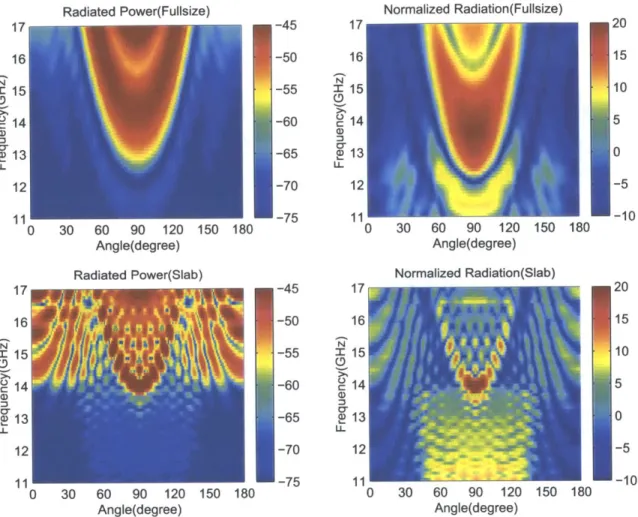
Next, lets look at the radiation results acquired from simulation for both the full size and the parallel plate slab cases in Figure 2-10. For the full size structure simulation, the most directive beam is centered at around 13.7GHz and the high power beam is centered at around 14.4GHz. Similarly like what the analytic results have predicted, the highest power beam takes place after the most directive beam, but with both these frequencies shifted to a slightly higher frequencies. The parallel plate slab case exhibits a directive and high power beam at around 13.8 GHz and 13.9 GHz respectively. The parallel plate slab radiation has higher sidelobes which might be caused by the addition of the two PEC parallel plates. The two simulations are both a little bit different from what is predicted from the analytic method, however, they
do demonstrate similar behavior of a "U" case. Radiated Power(Fullsize) 0 30 60 90 120 150 180 Angle(degree) Radiated Power(Slab) -45 -50 -55 -60 -65 -70 -75 -45 -50 -55 -60 -65 -70 -75
shape radiation pattern as the analytic
17 16 N M 15 14 13 12 11 17 16, '15 S14 13 12 11 Normalized Radiation(Fullsize)
*L"\-WIAU
17 16 N M 15 c 14 13 12 S1 0 30 60 90 120 150 180 0 30 60 90 12U 1bU 180 Angle(degree) Angle(degree)Figure 2-10: Radiated power and normalized radiation from simulation for rod full size and slab structure
Besides power and directivity, we are also interested in the 3 dB beamwidth of the antenna system. The only beamwidth we are interested in are in the region where index of refraction n ~ 0, and where the mainlobe of the radiation in one particular frequency at
#
= 90 (normal to the substrate). Due to possible numerical simulation errors/approximations, we allow the main beam to be slightly away from the normal, given that the beam power at the normal direction is still within the3 dB range of the main beam. We also allow the beam power to oscillates up and
down as long as it is all within a 3 dB window. The bandwidth is decided by having the side lobes to be 10 dB lower than the main beam, given that the beam in the
0 30 60 90 120 150 180 Angle(degree) Normalized Radiation(Slab) 20 15 10 5 0 -5 17 16 M15 c 14 13 U-12 i1 20 15 10 5 0 -5 -10 -I -75 11 a a NV
normal direction is within 3 dB of the main beam. Figure 2-11 shows the maximum power angle at different frequencies and the corresponding 3 dB beamwidths for the full size rod structure; interested bandwidths are the regions colored in yellow. The smallest beamwidth of 200 occurs at 12.8 GHz, and the bandwidth is from 12.8 GHz to 15 GHz. Figure 2-12 shows the figures for the parallel plate slab case, where the smallest beamwidth of 6' happens at 13.7 GHz, and the bandwidth is from 13.7 GHz to 14GHz. 3dB Beamwidth bu 50 M 40 (D 4) "a 30 20 a) LD 10 11 12 13 14 15 16 1 Frequency(GHz) Max Power Angle 100 9 0 - -- -.-.- . -.-8 0 - - - -7 0 - -- -- -- - - --- -.-60 12 13 14 Frequency(GHz) 15 16 7 17
Figure 2-11: Beamwidth for full size rod medium
In Enoch's experiment[27], the best directivity was observed at 14.65 GHz, and the beamwidth at this frequency is 8.90(Note: the experimental results is based on an antenna substrate backed with a ground plane, which we did not put in our analytic method or simulation). Our simulation and analytic results yield similar results regarding where the antenna system has high power and directivity. The exact frequencies differ with each other and with Enoch's experimental results can
-. .. . .- .. ..-. . ..-.
-
..
...
-. . . .. . . . .
..
...
....
..
.
...
.-- -11
3dB Beamwidth 12 100 80 (D 60 0 'a 40 C 20 0 135 120 (D105 S 90 () 75 60 45 1 Figure 2-12: 13 14 Frequency(GHz) Max Power Angle
15 16
.. ... 3. 1 1.
13 14 15 16
Frequency(GHz)
Beamwidth for a slab of rod medium
12 17 17 - . - -. -. -.-. -. -. -. . . . . -- - - -- -- - - -- - -- - - -1 1 .... ... .. .... .. ... . .. ... .. ... .. .. ... ..
be contributed from the difference in exact structure setup and excitation source, simulation's numerical errors/approximations, and experimental noise. We conclude that with this methodology, we can study how a metamaterial structure perform as a directive antenna substrate and further make improvement on the metamaterial structure to yield better results. In the next chapter, we will show how different metamaterials perform as a substrate, and compare their performance.
Chapter 3
Comparative Study of Different
Metamaterial Substrate
In this chapter, we will examine different published metamaterial structures as an-tenna substrate. For each structure, the dimensions of a unit cell will be illustrated. Next, the effective permittivity and permeability will be obtained from the retrieval results based on the S-parameter scattering simulation in a waveguide. For paral-lel plate slab radiation simulation, dimension of the slab and the mesh used will be shown. Lastly, analytic farfield radiation based on retrieved results and simulated farfield radiation will be presented and compared.
These structures are all left handed metamaterials, there will be a region where
n < 0 and the index of refraction n = 0 would occur at the frequencies where either
Eeff = 0 or peff = 0. We are going to evaluate these different structures and see which
one would work best for our purposes. Ideally, we would like to find a structure which is easy for tuning and manufacturing; then, we would optimize the structure such that it will exhibit higher power, better beamwidth, and wider bandwidth.
At the end of this chapter, a summary of results and comparisons of these different structures will be presented.
3.1
2-D Smith structure
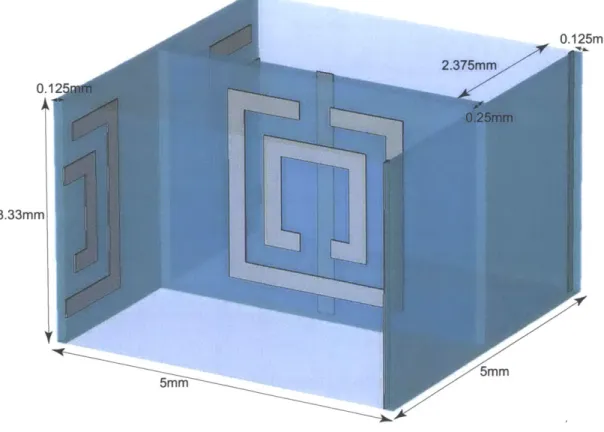
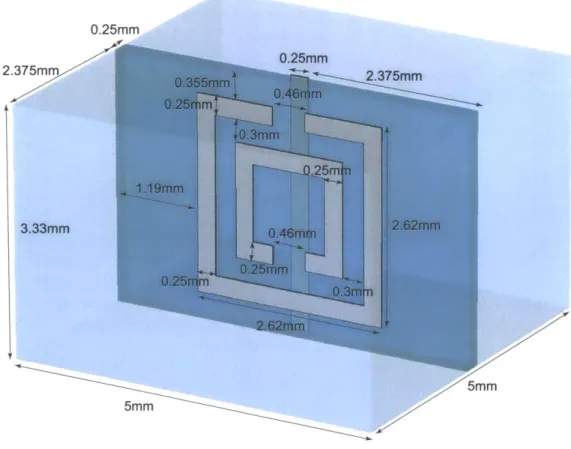
The first classic metamaterial structure is Smith's structure, so we'll first examine how it works as an antenna substrate. A unit cell 2-D Smith structure can be seen in Figure 3-1 and the 1-D dimensions is as shown in Figure 3-7. The dimension of this metamaterial structure is taken from a paper published by Shelby et al. in 2001[12]. The unit cell is then placed in a waveguide to collect the S-parameters scattering data. Since the waveguide has PEC and PMC boundaries, we need to choose a unit cell that is as symmetrical as possible.
The metal part of the structure is modeled with PEC. The dielectric is lossless with a relative permittivity of 4. Background is free space. These parameters will be used for all the structures we investigate in this chapter and beyond. Figure 3-2 shows the
0.125mm
0.12
3.33mm
Figure 3-1: Unit cell 2-D Smith structure in a waveguide
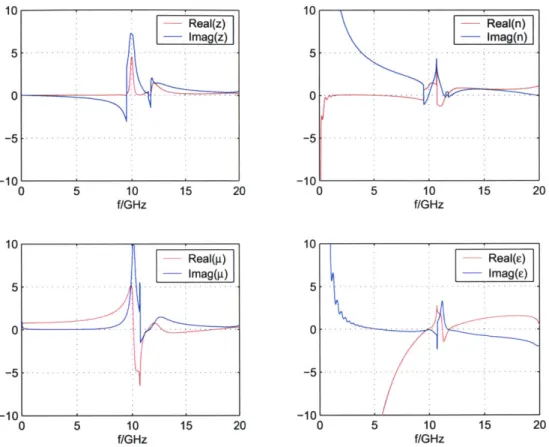
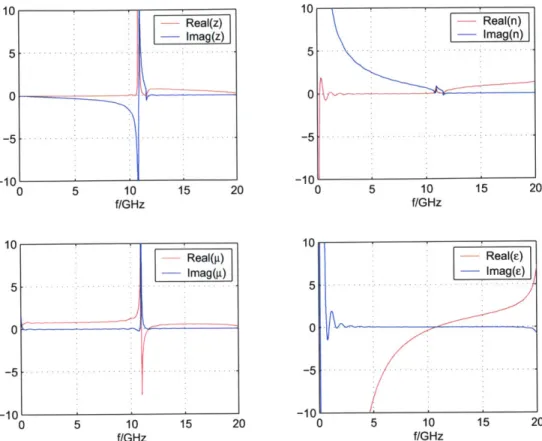
retrieval results from the unit cell. It is not a very clean results compared to the 1-D unit cell one as shown in Figure 3-9. From both the 1-D and 2-D retrieval results, we
can estimate that we will see some directive radiation in the normal direction(# = 0)
from around 10 to 11 GHz. The radiation results from analytic method using the 2-D retrieval data is shown in Figure 3-5. A slab of this 2-D Smith metamaterial substrate
10 10 Real(z) - Real(n) -Imag(z) -- lmag(n) 5 . . .-. -.. 5 -. . -. . . . . . . . .-- - -.. .... ... .... 5... 0 0 -5 -- -5 -- -.--10, -10 0 5 10 15 20 0 5 10 15 20 f/GHz f/GHz 10 10 - Real(p) -- Real(e) - Imag(g) Imag(E) 5 -5 0 0.... ... -5- -5 -101 -10, 0 5 10 15 20 0 5 10 15 20 f/GHz f/GHz
Figure 3-2: Retrieval results for 2-D Smith structure
will look like the one shown in Figure 3-3. The period in both the x and y direction is
5 mm. There are a total of 35 layers in the x direction and 5 layers in the y direction.
The excitation dipole is again placed in the center of the substrate. Farfield monitors are set up for frequencies from 8 GHz to 22 GHz with 0.1 GHz intervals. In order to get accurate simulation results, the mesh setup is important. Before starting the radiation simulation, we need to make sure our mesh looks fine enough to capture the details of the structure. In Figure 3-4, the mesh used for parallel plate radiation is shown. Mesh line density is 15 lines per wavelength. The mesh type is staircase mesh. No refinement at PEC edges or inside dielectric. Fixed points are merged for thin PEC and lossy metal sheets.
Figure 3-3: Slab of 2-D Smith structure
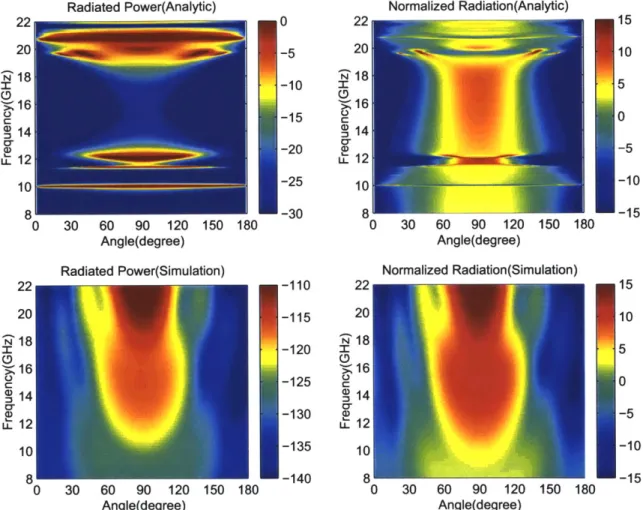
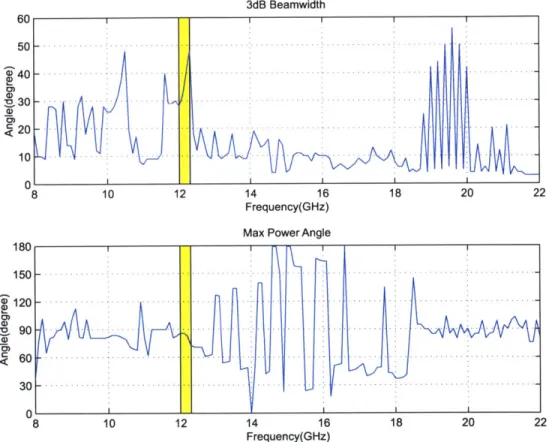
Lastly, the radiation results from both analytic and simulation are shown in Fig-ure 3-5, and the 3 dB beamwidth from the simulation results are shown in FigFig-ure 3-6. As we mentioned in Chapter 1, we are likely to see directive radiation when Inj < 1
with imaginary part of n being small(small loss). According to the 2-D retrieval results, we should expect to see directive radiation from about 11.5 GHz to 12GHz, since in this region, both the real part and the imaginary part of n is small. Therefore, we see directive radiation in such range in the analytic radiation, but it is obviously not very sharp beam, as the strength is almost evenly distributed among all the dif-ferent
#
angles for one single frequency. This is mainly due to the uncleaned 2-D retrieval results. In the slab farfield simulation, the directivity is not very strong un-til higher frequencies are reached, which should correspond to the plasma frequencies of the rods(vertical metal strips on one side of the dielectric). There are somewhat directive radiation between 12GHz and 17GHz, however not very strong, which is probably due to the fact that the loss is still relatively high in that region. The best directivity starts around 19 GHz, and the best beamwidth is about 290. To conclude, this structure is relatively isotropic in two directions, but harder to retrieve and hence harder to predict from analytic method what the radiation figure would look like. As for its performance as an antenna substrate, it did not improve on what rods alone could offer us.Normalized Radiation(Analytic) 0 30 60 90 120 150 18C Angle(degree) Radiated Power(Simulation) 0 30 60 90 120 150 180 Angle(degree) 0 -5 -10 -15 -20 -25 -30 -110 -115 -120 -125 -130 -135 -140 22 20 -18 M . 16 C S14 Cr u- 12 10 81 0 22 20 N 18 '16 2 14 10 8 30 60 90 120 150 18( Angle(degree) Normalized Radiation(Simulation)
-
-
-0 30 60 90 120 Angle(degree) 150 18Figure 3-5: Radiated power and normalized radiation from analytic method and slab simulation for 2-D Smith structure
22 20 'Ri18 S16 Cr 2 $ 14 u- 12 10 8 22 20 -N18 316 8 14 u. 12 10 8 15 10 5 0 -5 -10 -15 15 10 5 0 -5 -10 -15 Radiated Power(Analytic)
3dB Beamwidth 20 00 - -.-.- -8 0 -- - -.-.-.-.-.-.-60 - - - - -40 - -20 -8 10 12 14 16 18 20 2 Frequency(GHz) Max Power Angle
00 90 - - - -80 - - - -.-.-70 - - - -6 0 -- . - . . .. .-.. -.. . -.. . . .. . . . .-.. - . .. . .-.. 50 ji-0 0) 0 0) C 0) 0 0) 0 V 0 0) C 2 22 1 1 8 10 12 14 16 18 20 Frequency(GHz)
Figure 3-6: Beamwidth for 2-D Smith structure slab simulation
3.2
1-D Smith structure
2-D metamaterials are nice in the sense that it provides us with a relatively isotropic
material property in the x - y plane. However, construction of a rigid 2-D structure is
hard. Looking at the waveguide transmission/reflection results for 1-D Smith struc-ture, the S21 has a wide band where its value is close to 0 dB. It suggests that 1-D
Smith might give better radiation power. 1-D structures are easier to fabricate and construct. The unit cell dimension is as shown in Figure 3-7. The 1-D structure we investigate here has the dielectric strips aligned in the y direction for slab simulation and the setup is shown in Figure 3-8. There are 6 unit cells in the y direction and
36 unit cells in the x direction; periodicity in both directions is 5 mm. The materials
used are the same as the ones used for the 2-D structure. The retrieval results are
2.375mm
5mm
Figure 3-7: Unit cell 1-D Smith structure in a waveguide
Figure 3-8: Slab of 1-D Smith structure
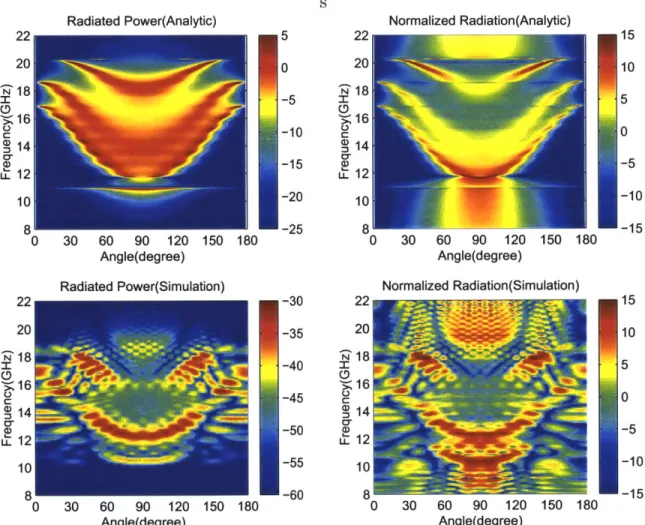
Figure 3-11. The radiation mesh setup for this structure is very similar to 2-D Smith; the main difference is the mesh in the x - z plane(see right half of Figure 3-10). Most of the mesh parameters are kept the same as the 2-D case, where the main change is the mesh line density to 18 lines per wavelength from 15. The radiation results are shown in Figure 3-11. The analytic and simulation results are similar but with some slight frequency shift. This implies that the retrieval of effective permittivity and permeability are more accurate for the 1-D case, and hence gave a better ana-lytic radiation pattern. The radiation power has improved compared to the 2-D case, however, not the directivity, nor the bandwidth. The radiation beamwidth resulted from simulation can be seen in Figure 3-12.
10 -Real(z) -Imag(z) 0 -5 --- --05 10 15 2( f/GHz 10 - Real(g) - Imag(A) 5-0 0 5 10 f/GHz 15 20 5 0 -5 -10 0 5 10 f/GHz 15 20 10 - Real(E) - Imag(E) 5 0 -5 ~4n 0 5 10 f/GHz 15 20
Figure 3-9: Retrieval results for 1-D Smith structure
I
-t
-Figure 3-10: Mesh for 1-D Smith structure
Real(n) - mag(n) -.. .. . . . . .. . . . . -0
-S Radiated Power(Analytic) 0 30 60 90 120 150 Angle(degree) 5 0 -5 -10 -15 -20 -25 180 Radiated Power(Simulation) -30 -35 -40 -45 -50 -55 -60 0 30 60 90 120 150 180 Angle(degree) 22 20 -N 18 516 S14 u 12 10 8 0 22 20 218I 16 Cr 0*S2 IC Normalized Radiation(Analytic) 30 60 90 120 Angle(degree) 150 180 15 10 5 0 -5 -10 -15 Normalized Radiation(Simulation) 15 -5 -10 -15 0 30 60 90 120 150 180 Angle(degree)
Figure 3-11: Radiated power and normalized radiation from analytic method and slab simulation for 1-D Smith structure
22 20 -18 16 S14 LL 12 10 8 22 20 N 16 M 0 8% 1 C S14 LL 12 IC 6
3dB Beamwidth 60 5 0 -- - -.-.-.- -40 - - - -~30 - -- --- ~ 20 - - - -10 - .--01 8 10 12 14 16 18 20 2 Frequency(GHz) Max Power Angle
150 - -. -. .. -.-.-12 0 -. . .-.. -.-.-90 --. -- 6 3 0 -.-.- ..-.-.--.-.-. n 8 10 12 14 16 Frequency(GHz) 18 20
Figure 3-12: Beamwidth for 1-D Smith structure slab simulation
0 0 a 0 0 a C 0 0) 0 V 0 0) C 22 2
3.3
Pendry structure
Another classic example of metamaterials is the Pendry structure[32]. The unit cell we used and its dimensions are as illustrated in Figure 3-13. We mainly scaled the original Pendry structure to work in the microwave regime. With the S-parameters
0.5mm 1.17mm
6mm
5.04mm
Figure 3-13: Unit cell Pendry structure in a waveguide
obtained from the PEC-PMC waveguide simulation, retrieval is done and shown in Figure 3-14. There is a resonant frequency at about 8 GHz. From 8.5 to 12 GHz, index of refraction n ~ 0, but the imaginary part of n is slightly large. Therefore, instead of seeing directive radiation for all frequencies between this range, we might only have it around the two end frequencies. As what we expect, the analytic results as shown in Figure 3-17 show that there are stronger directivity at around 8.5 GHz and 12 GHz, but the region in between have a much lower directivity. Pendry structure is one-dimensional, so we will use the similar radiation simulation setup as the 1-D Smith
0 5 10 15 2 f/GHz 0 5 10 f/GHz 0 IV 5 0 -5 10 in Real(E) -- Imag(E) 5 --0 - -5-15 20 --Real(n) --Imag n) 0 5 10 15 2 f/GHz 0 5 10 f/GHz 15 20
Figure 3-14: Retrieval results for Pendry structure 5 0 -5 -10 10 5 0 -5 0 - Real(z) -- Imag(z) -. . .. . . .-.. . . .. . - Real(g) - Imag(s) ..... ....- ... .. -.. . ..-. --.. . . . -H I _1 "
structure. We have 6 unit cell repeated in the y direction and 64 unit cell repeated in the x direction. The periodicity is 5.04 mm in the y direction and 2.84 mm in the x direction. The mesh setup for this radiation simulation is as seen in Figure 3-16 and
Figure 3-15: Slab of Pendry structure
the radiation results from analytic method and simulation is presented in Figure
3-17. The corresponding beamwidth results for simulation is shown in Figure 3-18.
Pendry structure has its maximum beam power mainly directed along the normal direction(<$ = 900) which is good for our directive antenna purposes. The beamwidth
however is somewhat a bit too large to be ideal. The simulation results is not exactly what we have predicted from retrieval and analytic method; we do not see two strong directivity areas. It might be that the loss is too large in the area of interest (8.5 GHz to 12 GHz), which we can somewhat see in our simulation results.
Normalized Radiation(Analytic) 0 30 60 90 120 150 180 Angle(degree) Radiated Power(Simulation) 22 20 N 18 16 8 14 L 12 10 8 22 20 N 18 16 C S14 LL 12 10 8 10 5 0 -5 -10 -15 -20 -100 -105 -110 -115 -120 -125 -130 22 20 N 18 16 12 10 8 0 22 20 -18 16 C D 14 LL 12 10 8 0 30 60 90 120 150 18C Angle(degree) Normalized Radiation(Simulation) 30 60 90 120 150 18( Angle(degree)
Figure 3-17: Radiated power and normalized radiation from analytic method and slab simulation for Pendry structure
0 30 60 90 120 150 180 Angle(degree) 15 10 5 0 -5 -10 -15 15 10 5 0 -5 -10 -15 Radiated Power(Analytic)
3dB Beamwidth
8 10 12 14 16 18 2
Frequency(GHz) Max Power Angle
310 12 14 161 - -.-.- .. .. .. .. .. .. .. .. .. ..- -.. -.. . .. - ...--. . . .. . . . .. . . ..-. -. -. -.-.-.-.-.-. . . . .. .. . . .. . . . ... .. . . 8 10 12 14 16 18 Frequency(GHz)
Figure 3-18: Beamwidth for Pendry structure slab simulation
20 120 100 80 *560 C 40 20 2 0) a) *0 a) 0) C 110 100 90 80 70 0
3.4
Omega structure
Recently, there are some new metamaterial structures being explored. One of which is an Omega-shaped structure[14].The unit cell and its dimensions are presented in Figure 3-19. The retrieval results for this Omega structure is shown in Figure 3-20.
0.4mm
1.05mm
3.33mm
4mm 2.5mm
Figure 3-19: Unit cell Omega structure in a waveguide
We can see that the retrieval results are not very clean for frequencies below 11 GHz. This might be caused by the increased complexity of the structure, since the rod are coupled with the rings, which means that the permittivity and permeability are coupled. However, we see that at around 11.4 GHz and 16.8 GHz, n ~ 0 and the imaginary part of n is closed to zero, so we should be able to have regions where we observe directive radiation. The analytic radiation, which is plotted in Figure 3-23, only has one directive radiation region centered around 17 GHz. We also see that there are a lot of "ringing" effects from 12 to 14 GHz, which we would not be able to
tell from the retrieved data. The slab of metamaterial used for parallel plate radiation 5 10 15 20 f/GHz 5 10 15 20 f/GHz Figure 3-20: Retrieval 20 10 0 -10 5 10 0 5 10 f/GHz 0 5 10 f/GHz
results for Omega structure
is shown in Figure 3-21. There are a total of 6 by 72 unit cells with periodicity of 4 mm and 2.5 mm respectively. Figure 3-22 shows the mesh used for radiation. Due to the more complicated structure, limited memory, and a big aperture size, the mesh would have been better if it is even finer, but it is not permitted with the available resource. However, it should be able to tell us the approximate behavior of such structure as an
antenna substrate. The radiation results from both analytic method and simulation are shown in Figure 3-23. The corresponding beamwidth from the simulation result is shown in Figure 3-24. We see some "ringing" effect in our simulation results similar to the analytic results and there are some relatively high radiation directivity from 16 to 17 GHz and around 14 GHz. However, the beamwidth at these frequencies are too wide. Therefore, the Omega structure is not a good structure to use as a substrate for directive antenna.
-Real(z) IMag(Z) -. . . . . -.. .-.. . -. -. . 10 0 -10 -20 20 10 1 0 -10[ 0A 15 20 -_Real(p) - Imag(g) -.. . . . - . . .. . - . .. . -. 0 0 - Real(E) - Imag(E) I0 0-1 0 .. . .. - - . . .-.. 0 15 20 -- Real(n) -- Imag(n) . .-.. .-. V~ - -...- .... I 2 1 -2
-Figure 3-21: Slab of Omega structure
Radiated Power(Analytic) 5 0 -5 -10 -15 -20 -25 0 30 60 90 120 150 180 Angle(degree) Radiated Power(Simulation) 0 30 60 90 120 150 Angle(degree) 22 20 18 16 C S14 u- 12 10 8 22 20 18 16 C Cr $ 14 LL 12 10 8 Normalized Radiation(Analytic) 1N18 16 C1 a) LiL 12 10 8 0 30 60 90 120 150 180 Angle(degree) Normalized Radiation(Simulation) 22 20 'N' 18 316 2 14 a' a) U- 12. 10 8 0 30 60 90 120 150 180 Angle(degree)
Figure 3-23: Radiated power and normalized radiation from analytic method and slab simulation for Omega structure
-50 -55 -60 -65 -70 -75 -80 180 15 10 5 0 -5 -10 -15 15 10 5 0 -5 -10 -15
3dB Beamwidth 80 4 0 - -. -. .-. . .-. -. . . . -. . . . 120-0 8 10 12 14 16 18 20 2 Frequency(GHz) Max Power Angle
10 1 5 0 - - . .. -.. . -.. . . -.. . . . -. . . -. .. .. .. 1 2 0 -. . . . . . . . . . . . . . . . . . . 90 60 - - -... 3 0 -.-.. -..-. 8 10 12 14 16 Frequency(GHz)
Figure 3-24: Beamwidth for Omega structure slab simulation C C 4 0 C) 0) C) V ii-0) 2 22 18 20
3.5
S
structure
0.5mm 1mm 5.4mm 0. 4mm 2.5mmFigure 3-25: Unit cell S structure in a waveguide
Another novel metamaterial is a coupled "S" shaped structure[15]. There are no obvious ring or rod parts any more, but it still has the properties of having an electric plasma frequency and an magnetic resonant frequency. The unit cell is shown in Fig-ure 3-25 and the corresponding retrieval results in FigFig-ure 3-26. Since the S structFig-ure does not have any curvature, the retrieval results are relatively clean. Similarly, S also have two frequencies where loss is low and n ~ 0. They are around 12.2 and 20 GHz, and index of refraction is approximately zero in between these two frequencies but the loss is large. Therefore, in the analytic method, we see that in this region there are relatively high directivity, however, the radiation power is relatively low.
The slab of S structure is as seen in Figure 3-27. Identical to the Omega structure, the slab is consist of 6 by 72 unit cells with the corresponding periodicity of 4mm and
10 10 Real(z) - Real(n) Imag(z) - Imag(n) 5 . -. . . ..-.. . . .- . . .-. . 5 . . . . -.. 0 0 -5 -5 -10 -10 0 5 10 15 20 0 5 10 15 20 f/GHz f/GHz 10 10 -- Real(p) - Real(E) - Imag(p) - Imag(E,) 0 -5 - - -1 -0 --0 5 10 15 20 -10 5 10 15 20 f/GHz f/GHz
2.5 mm. The mesh setup for slab simulation is shown in Figure 3-28. In Figure
3-Figure 3-27: Slab of S structure
29, we show the analytic and simulation results and they display similar radiation
patterns. They both show some "ringing" effects. Furthermore, as predicted in the analytic method, there are some directivity from about 12 GHz to 20 GHz, but with low power. The only very high directivity only takes place at higher frequency of 20.2 GHz for the analytic case and 21.3 GHz for the simulation case. The beamwidth for the slab simulation is shown in Figure 3-30. The best is 180 at 21 GHz.
- -~ --I