HAL Id: insu-02957324
https://hal-insu.archives-ouvertes.fr/insu-02957324
Submitted on 10 Nov 2020
HAL is a multi-disciplinary open access
archive for the deposit and dissemination of
sci-entific research documents, whether they are
pub-lished or not. The documents may come from
teaching and research institutions in France or
abroad, or from public or private research centers.
L’archive ouverte pluridisciplinaire HAL, est
destinée au dépôt et à la diffusion de documents
scientifiques de niveau recherche, publiés ou non,
émanant des établissements d’enseignement et de
recherche français ou étrangers, des laboratoires
publics ou privés.
Distributed under a Creative Commons Attribution - NonCommercial - NoDerivatives| 4.0
Inferring geostatistical properties of hydraulic
conductivity fields from saline tracer tests and
equivalent electrical conductivity time-series
Alejandro Fernandez Visentini, Niklas Linde, Tanguy Le Borgne, Marco Dentz
To cite this version:
Alejandro Fernandez Visentini, Niklas Linde, Tanguy Le Borgne, Marco Dentz.
Inferring
geo-statistical properties of hydraulic conductivity fields from saline tracer tests and equivalent
elec-trical conductivity time-series.
Advances in Water Resources, Elsevier, 2020, 146, pp.103758.
ContentslistsavailableatScienceDirect
Advances
in
Water
Resources
journalhomepage:www.elsevier.com/locate/advwatres
Inferring
geostatistical
properties
of
hydraulic
conductivity
fields
from
saline
tracer
tests
and
equivalent
electrical
conductivity
time-series
Alejandro
Fernandez
Visentini
a,∗,
Niklas
Linde
a,
Tanguy
Le
Borgne
b,
Marco
Dentz
ca Institute of Earth Sciences, University of Lausanne, Lausanne CH-1015, Switzerland b Université de Rennes 1, CNRS, Géosciences Rennes UMR 6118, Rennes 35042, France c IDAEA-CSIC, Jordi Girona 18-26, Barcelona 08034, Spain
a
r
t
i
c
l
e
i
n
f
o
Keywords:
Equivalent electrical conductivity Approximate Bayesian computation Geostatistics
Solute spreading and mixing Hydrogeophysics
a
b
s
t
r
a
c
t
WeuseApproximateBayesianComputationandtheKullback–Leiblerdivergencemeasuretoquantifytowhat extenthorizontalandverticalequivalentelectricalconductivitytime-seriesobservedduringtracertestsconstrain the2-DgeostatisticalparametersofmultivariateGaussianlog-hydraulicconductivityfields.Consideringaperfect andknownrelationshipbetweensalinityandelectricalconductivityatthepointscale,wefindthatthehorizontal equivalentelectricalconductivitytime-seriesbestconstrainthegeostatisticalproperties.Thevariance, control-lingthespreadingrateofthesolute,isthebestconstrainedgeostatisticalparameter,followedbytheintegral scalesintheverticaldirection.Wefindthathorizontallylayeredmodelswithmoderatetohighvariancehavethe bestresolvedparameters.Sincethesalinityfieldattheaveragingscale(e.g.,themodelresolutionintomograms) istypicallynon-ergodic,ourresultsserveasastartingpointforquantifyinguncertaintyduetosmall-scale het-erogeneityinlaboratory-experiments,tomographicresultsandhydrogeophysicalinversionsinvolvingDCdata.
1. Introduction
Time-lapse electrical geophysical methods are popular in hydro-geology (e.g.,Binley et al., 2015; Singha et al., 2015) as they pro-videnon-intrusivemeansforremote anddensespatio-temporal sam-plingrelatedtoflowandtransportprocesses.Amongthese,the direct-current(DC)methodiscost-effective,easytoemployandprobablythe mostcommonlyused(Binleyetal.,2015).Ithasbeenthoroughly as-sessedthroughnumericalinvestigations(e.g.,Vanderborghtetal.,2005; SinghaandGorelick,2005;FowlerandMoysey,2011),laboratoryand controlledtankexperiments (Slater etal., 2000;Koesteletal.,2008; Jougnotetal.,2018),andfieldinvestigations(e.g.,Dailyetal.,1992; Binleyetal.,2002;SinghaandGorelick,2005).
DCmeasurementsaregenerallybasedontwopairsof electrodes: onepairforestablishingaknownelectricalcurrentbetweentwopoints, andtheother formeasuringtheresultantelectrical voltagebetween twootherpoints(e.g.,KellerandFrischknecht,1966).Inthecontext of time-lapseDCtomographicexperiments,themeasurementprocess is repeatedusingmultiplecurrent andvoltageelectrodepairsat dif-ferentpositions,andthemeasurementprotocolisrepeatedovertime. Suchameasurementprocessisoftenreferredtoastime-lapse Electri-cal ResistivityTomography(ERT),anditoutputstime-seriesof elec-tricalresistances(voltageoverinjectedcurrent)thatinsaturated me-diacarryinformationaboutthetime-evolutionofthesalinity
distribu-∗Correspondingauthor.
E-mailaddress:[email protected](A.FernandezVisentini).
tion(e.g.,LesmesandFriedman,2005).Thetime-lapse ERTmethod hasbeenappliedduringconservativesalinetracerteststoextractboth flow and transport information. Retrieval of hydraulic conductivity fromsuchdataisdiscussed,forexample,inKemnaetal.(2002)and Vanderborght etal.(2005) andtherangeof applications span from thecalibration of meanhydraulic conductivity values (Binley et al., 2002) to retrieval of the full distribution of hydraulic conductivity (PollockandCirpka,2012).Extractionofsolutetransportparameters hasbeenstudiedindetailand(Kemnaetal.,2002),forinstance, pro-videda fielddemonstrationofretrievingequivalent1-Dstream-tube advective-dispersive transportparameters in thecontext of 3-D con-servative saline transport, results later corroborated numerically by Vanderborghtetal.(2005).Also(Koesteletal.,2008)inferredthe3-D distributionofsolutevelocitiesanddispersivitiesinasoilcolumnusing time-lapseERTdata.
Overtime,theuseofgeoelectrical-monitoredtracertestshasevolved fromqualitativeanalysessuchassalineplumemotiondetectionand geometry delineation (e.g., Slater et al., 2000) to obtain quantita-tiveandspatially-resolvedhydrologicalconstraints. Nevertheless, us-ingtime-lapse DCdataforquantitativehydrogeologicalpurposes re-mainsapersistentchallenge(Singhaetal.,2015).Thischallengeis inti-matelyrelatedtotheuse oftime-lapse inversionmethodologies that provide resolution-limitedtime-evolvingimagesofelectrical resistiv-ityorconductivitythroughtime(Singhaetal.,2015).Themost com-monapproachtotranslateresultinggeophysicaltime-lapsetomograms
https://doi.org/10.1016/j.advwatres.2020.103758
Received10July2020;Receivedinrevisedform18September2020;Accepted19September2020 Availableonline19September2020
0309-1708/© 2020TheAuthors.PublishedbyElsevierLtd.ThisisanopenaccessarticleundertheCCBY-NC-NDlicense (http://creativecommons.org/licenses/by-nc-nd/4.0/)
intosalinitydistributionsrestsontwostrongassumptions.Thefirstis thatthereexistsapetrophysicalrelationship,(e.g.,Archie,1942),with knownspatially-invariantparametersdefinedatthediscretizationscale ofthetomogram,implyingthatitcorrespondstotheRepresentative El-ementaryVolume(REV)scale(Hill,1963)ofbulkelectrical conductiv-ityand,consequently,thattheimpactofsalinityheterogeneityis neg-ligiblebelowthisscale.Thesecondassumptionisthattheresolution ofthegeophysicaltomogram isthesameasthemodeldiscretization, whichishardlytrueforanyelectricalsurvey.Inreality,thetomogram representsspatially-varyingweightedaveragesoveramuchlarger vol-ume(e.g.,Friedel,2003).Withthesetwoassumptions,temporal differ-encesintime-lapsetomogramscanreadilybetranslatedintoestimates of salinitydifferences.Unfortunately,thisapproachtypicallyleadsto anunderestimationofactualtracermasswitherrorsoftenapproaching oneorderofmagnitude(e.g.,Binleyetal.,2002;SinghaandGorelick, 2005;Laloyetal.,2012).Researchhasaddressedthesecond assump-tionbyupscalingthepetrophysicalrelationshiptothetomographic res-olutionusingeitherlinearizedinversetheory(Day-Lewisetal.,2005; Nussbaumeretal.,2019)orMonteCarlo-basedsimulationapproaches (e.g.,Moyseyetal.,2005).
Inthiswork,weareprimarilyconcernedwiththefirstassumption, namelythattheimpactofsalinityvariationsisnegligiblebelowagiven scale.Toavoidcomplicationsinherenttotomographicimaging,we fo-cushereonthecaseofatime-evolvingequivalentelectricalconductivity tensorofa2-Dsquaresampleofunitlengththatisinvadedbyasaline (i.e.,electricallyconductive)tracer.Inatomographicsetting,thisscale canbethoughtofasthemodelresolutionatagivenlocationofinterest. Forthiscase,theequivalentelectricalconductivityinagivendirection isreadilyobtained,basicallybydividingtheelectriccurrentwiththe im-posedvoltage.Thetotalcurrentisthemacroscopicfluxoftheinternal currentdensityfield(i.e.,thedistributionofsmall-scalecurrentswithin thesample)that,foragiveninternaldistributionoflocalconductivities, isestablishedsuchthatitsassociatedenergylossduetoJoule’s dissipa-tion, integratedoverthedomain,isminimized(e.g.,Feynmanetal., 2011;Bernabé andRevil,1995).Thisgoverningprincipleleadsto pat-ternsofcurrentchannellinganddeflectionthroughandfromhighand lowelectricalconductivityzones,respectively,anditgovernsthetime variationsofthecurrentdensityfieldasthesalinetracerinvadesthe sample(e.g.,LiandOldenburg,1991).Accuratepredictionofthe time-evolutionoftheequivalentelectricalconductivityofthemedium,thus, requiresaccountingforinteractionsoccurringthroughoutthedomain and,givenanarbitrarily-shapedtime-evolvingelectricalconductivity field,thisremainsanopenupscalingproblembelongingtothefamilyof conductivityupscalinginspatiallynon-stationaryfields(e.g., Sanchez-Vilaetal.,2006andreferencestherein).Thecurrentlackofphysically accurateupscaling proceduresimpedes reliablequantitativeanalyses ofasalineplume’sfatefromgeoelectricalmonitoring.Forinstance,in themostcommoncasewhereArchie’spetrophysicallaw(Archie,1942) isusedtoinferthemeansalineconcentrationwithinthesamplefrom itsequivalentelectricalconductivity,theunderlyingassumptionisthat theinternalelectricalconductivityfieldbehavesasanadditive prop-ertythatcanbeupscaledbytakingitsarithmeticaverage.Thisisonly trueiftheelectricalconductivityfieldisconstantorifitsdistribution is layeredandtheequivalentelectrical conductivityismeasured par-alleltothislayering,correspondingtotheupperWienerbound(e.g., MiltonandSawicki,2003).Ingeneral,sinceportionsofthe concentra-tionfieldareby-passedbytheestablishedcurrentpatterns,theupper Wiennerbounddoesnotapplyandthisleadstotheabove-mentioned apparentmasslossasdemonstrated,forexample,inarecentlaboratory study(Jougnotetal.,2018).Theseissuesalsoimpacttheperformanceof manyfully-coupledhydrogeophysicalinversionapproachesand model-ingstudiesthatinterpretequivalentelectricalconductivitytime-series using equivalenttransportparameterswithin anadvective-dispersive description(e.g.,Kemnaetal.,2002;Vanderborghtetal.,2005;Koestel etal.,2008).Onamorepositivenote,thediscussionabovealsosuggests
thatelectricalconductivitytime-seriesatagivenscalecarrystatistical informationontheconcentrationfieldanditstemporalevolution.
Hereweinvestigatetowhatextenttracertestsassociatedwith time-seriesofequivalentelectricalpropertiesapre-definedscalecanbeused toinfergeostatisticalpropertiesofhydraulicconductivityfieldsbelow thisscale.ThisisachievedbyconsideringinferencewithinaBayesian inferenceframework(e.g.,Gelmanetal.,2013;Tarantola,2005),more specificallythroughanApproximateBayesianComputationalapproach (e.g.,Beaumontetal.,2002;Sissonetal.,2018).Forcomparison pur-poses,themassbreakthroughcurveisalsoevaluatedanditsinformation contentiscomparedtoitselectricalpeers.UsingaBayesianapproach al-lowsassessingtheinformationgainedonthepropertiesofinterestwith respecttotheirassumedpriorstatistics.Weperformourstudyusinga databaseconsistingof105synthetically-generatedequivalentelectrical
conductivitytensorandmassbreakthroughtime-series collected dur-ingsalinetracertestswithina2-Ddomainwithhydraulic heterogene-ityprescribedbymultivariateGaussianfields.Weconsider advectively-dominatedsolutetransport(i.e.,highPécletnumbers),wherethe con-centrationfieldevolutionispredominantlydeterminedbythe under-lyingflow field,which inturn depends on theunderlying hydraulic conductivityfieldundertheconstantappliedpressuregradient.Inthis study,weconsideridealizedscenariosasitisassumedthatthereisno spatialvariationsinpetrophysicalpropertiesandthatthepetrophysical relationshipisknown.
InSection2 wereview thebasicgoverning equationsdescribing groundwaterflow,solutetransportandelectricalconductiontogether withtheirnumericalimplementations.InSection3weintroducethe in-ferenceproblemofinterestalongwiththeBayesianinferencetools.The mainresultsarepresentedanddiscussedinSections4and5, respec-tively.Section6concludesthepaper.
2. Governing equations and problem setup 2.1. Groundwaterflow
Forsteady-stateflowandintheabsenceofsourcesorsinks,mass conservationofanincompressiblefluidisexpressedbythecontinuity equationforthespecificdischarge q(x) :
∇.q (x )=0, (1)
where x =(𝑥,𝑦)𝑇 denotesthe2-Dpositionvectorandxandythe hor-izontalandverticalcoordinates,respectively.Darcy’slawrelates q (x ) withthehydraulicconductivityfield𝐾(x )andthehydraulicheadℎ(x ) via
q(x) =−𝐾(x )∇ℎ(x ). (2)
AdoptingDarcy’slaw,thegroundwaterflowequationreads: ∇𝐾(x )∇ℎ(x )+𝐾(x )∇2ℎ(x )=0. (3)
It is customary totreat thelog-hydraulic conductivity field 𝑌(x ) (≡ ln(𝐾(x ))withinageostatisticalframeworkwith𝑌(x )modelledasa second-orderspatially-stationaryergodicrandomfunction.Inthisstudy, weconsidermultivariate-Gaussianrandomfields withanexponential covariancestructure(e.g.,Rubin,2003)withamean𝜇Yandavariance 𝜎2
Y.Theintegralscalesofthefieldareexpressedbytheintegralscale 𝐼yintheverticaldirectionandananisotropyfactor𝜆 (=𝐼x∕𝐼y).After
specifying𝐾(x ),theflowfield q (x )isobtainedbysolvingEq.(3)with prescribedboundaryconditions(Section2.4.2).
2.2. Solutetransport
Theevolutionoftheconcentrationfield𝑐(x ,𝑡)ofapassivetracer be-ingtransportedwithinthesteady-stateflow-fieldq (x )canbedescribed withinanEulerianframeworkusingtheadvection-dispersionequation
where𝜃 istheporosityand D isthedispersiontensor.Inthisstudywe assumeaspatially-constantporosityanddispersiontensor,and further-moreweassumezerodispersivity.InthiscaseandconsideringEq.(1), Eq.(4)simplifiestotheadvection-diffusionequationwithconstant co-efficients:
𝜃 𝜕𝑐
𝜕𝑡 +q (x ).∇𝑐−𝜃𝐷𝑚∇2𝑐=0, (5)
whereDmdenotesthemoleculardiffusioncoefficient.Aftersolvingfor
𝑐(x ,𝑡),theflux-weightedtracermass-breakthroughtime-seriesM(t)are definedby
𝑀(𝑡)=∫Γ𝑜𝑢𝑡𝑞𝑥
(x )𝑐(x ,𝑡)𝑑x
∫Γ𝑜𝑢𝑡𝑞𝑥(x )𝑑x
, (6)
with𝑞𝑥(x )beingtheflow-componentinthex-directionandΓoutthe
out-flowboundaryofthemodeldomain.
2.3. DCconduction
ElectricchargeconservationisintheDCproblemexpressedbythe continuityequationofthecurrentdensityfieldJ(x,t) attime-lapse ac-quisitiontimet.Intheabsenceofcurrentsourcesandnetaccumulation ofelectriccharge,ittakesthefollowingform:
∇.J (x ,𝑡)=0. (7)
Ohm’slawrelates J (x ,𝑡)withtheelectricalconductivity𝜎(x ,𝑡)and theelectricfield E (x ,𝑡)viathelinearrelationship J (x ,𝑡)=𝜎(x ,𝑡)E (x ,𝑡). Adopting thequasistaticapproximation, ∇×E (x ,𝑡)=0,allows to ex-pressE (x ,𝑡)=−∇𝜙(x ,𝑡),where𝜙(x ,𝑡)istheelectricalpotential.Writing
J (x ,𝑡)intermsof𝜙(x ,𝑡)asJ (x ,𝑡)=−𝜎(x ,𝑡)∇𝜙(x ,𝑡)andreplacingthis ex-pressionintoEq.(7)resultsinthegoverningLaplaceequationforthe electricalpotentials:
∇𝜎(x ,𝑡)∇𝜙(x ,𝑡)+𝜎(x ,𝑡)∇2𝜙(x ,𝑡)=0. (8) Weconsiderthehorizontalandverticalcomponentsofthe equiv-alent electrical conductivitytensor time-series of a2-D square sam-pleofunitlength.ThisimpliessolvingEq.(8)withalternativemixed Dirichlet–Neumann boundary conditions or “excitation modes”. For
𝜎H(t)(𝜎V(t)),aconstantelectricalpotentialdifferenceΔ𝜙
H(Δ𝜙V)along
thehorizontal(vertical)directionisimposed,withzeroelectrical po-tential gradient along the top and bottom (left and right) bound-aries.Theresultingelectricalpotentialfieldsare,respectively,𝜙𝐻(x ,𝑡) and𝜙𝑉(x ,𝑡).Thecorrespondingequivalentelectricalconductivity
time-seriesarecomputedas
𝜎𝐻(𝑡)= 1 Δ𝜙𝐻∫Γ𝑦 −𝜎(x ,𝑡)∇𝑥𝜙𝐻(x ,𝑡)𝑑x , (9) and 𝜎𝑉(𝑡)= 1 Δ𝜙𝑉 ∫Γ𝑥 −𝜎(x ,𝑡)∇𝑦𝜙𝑉(x ,𝑡)𝑑x , (10) wheretheintegrationpathsΓyandΓxareanytwogivencontours sepa-ratingtheleftandrightboundariesandthetopandbottomboundaries, respectively, andtheintegrandsineachequationisthehorizontalor verticalcomponentofthecurrentdensityfieldresultingfromeach ex-citationmode.
2.4. Numericalimplementationsandproblemsetup
Wecreateadatabaseof105time-seriesof𝜎H(t),𝜎V(t)andM(t)that
arecollectedduringtracertestssimulatedwithinmultivariateGaussian log-hydraulic conductivityrealizations ina square-shapeddomainof sidelength𝐿=1mdiscretizedinto250×250elements.
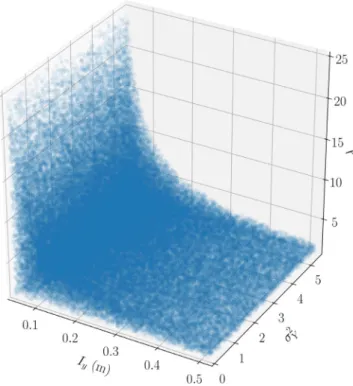
Fig. 1.Generated sample of size 𝑃=105 of geostatistical parameters m=
(𝜎2
𝑌,𝐼y,𝜆)drawnfromajointpdf𝜋(m).Eachrealizationisusedtogetherwith
anassociatedR-realizationtocreatealog-hydraulicconductivityfieldonwhich flowandtransportsimulationsareperformed.
2.4.1. Generationofhydraulicconductivityfields
The log-hydraulic conductivity field realizations 𝑌(x ) are gener-atedusing thefast circulantembeddingtechnique (seeDietrichand Newsam,1997fordetails).Agivenrealizationdependsonthe speci-fiedgeostatisticalmodelparametersandR ;a250×250arandomdraw fromastandardnormaldistribution.Thegeostatisticalmodel parame-tersdeterminethespatialregularity(smoothnessclass),while R deter-minesthelocationsofhighandlowlog-hydraulicconductivityvalues relativetothemeanvalue𝜇Yofthegeostatisticalmodel.Here𝜇Yis
fixedat-6whileremainingparametersaretreatedasrandomvariables
m =(𝜎2
Y,𝐼y,𝜆)describedbyajoint probabilitydensityfunction(PDF) 𝜋(m ).Thevariance𝜎2
𝑌 israndomlydrawnfromauniformPDFwith
sup-port[0,5.5],theintegralscale𝐼yisdrawnfromalog-uniformPDFwith
support[L/25,L/2]m,andtheanisotropyfactor𝜆 (=𝐼𝑥∕𝐼y)isdrawn
fromauniformPDFwithsupport[1,𝐿∕𝐼y](i.e.,conditionallyon𝐼y).
Thediscretizationimpliesthatheterogeneitiesobtainedwiththe small-estintegralscalesareresolvedwithatleast10cellsineachdirection. Thelog-uniformdistributionof𝐼y isherechosentofavorrealizations
withfinelystructuredfields.Thegeneratedsampleofthegeostatistical modelparametersofsize𝑃=105isrepresentedinFig.1.Notethateach
drawisassociatedwithauniqueR ,whichtogetherformalog-hydraulic conductivityfieldrealization.
2.4.2. Flowsimulations
The groundwater flow equation (Eq. (3)) is solved numeri-cally using the open-source finite-difference solver MODFLOW-2005 (Harbaugh,2005).Theprescribedboundaryconditionsareahorizontal headgradientof0.05inducingflowfromlefttorightandno-flow con-ditionsforthetopandbottomboundaries.Theheadgradientvaluewas chosensuchthatforahomogeneousfieldequaltoexp(𝜇Y)thetracer
ar-rivaltimeoccursapproximatelyathalfofthesimulatedtime-duration ofthetracerexperiment.Inthesimulations,thehydraulicconductivity betweentwoadjacentcellsistakenastheirharmonicmean.Thechosen
numericalschemeusedtosolvethesystemoflinearequationsis the preconditionedconjugategradientmethod(Hill,1990).
2.4.3. Transportsimulations
The advection-diffusion equation (Eq. (5)) is solved using the groundwater solute transport simulator package MT3D-USGS (Bedekar etal., 2016). Theinitial condition is a homogeneous con-centration field of 0.01g l−1 and the boundary conditions are: (i)
constantconcentrationof1gl−1along theleftboundary(ii)no-flux
alongthetopandbottomboundariesand(iii)free-fluxalongtheright boundary.Theporosityisassumedconstantandequalto0.3.Forthe advectionterminEq.(5),thethird-orderTotalVariationDiminishing (TVD) approach(CoxandNishikawa,1991) isused.TheTVD solver wasfoundtobeveryrobustandshowedminimalnumericaldispersion when benchmarked against planar fronts. Nevertheless, in order to mask the small numerical dispersion, the diffusion coefficient was slightly increased from 𝐷𝑚=1.6× 10⁻⁹ m2 s−1 (the standard value
forthediffusioncoefficientofsaltinwater)to𝐷𝑚=2× 10⁻⁸m2 s−1. Thelatter(larger)valueisobtainedbyfitting theanalyticalsolution foraconcentrationprofileforastepinjectionin1-D(e.g.,Ogataand Banks,1961)toaTVD-calculatedconcentrationprofileobtainedfora homogeneoushydraulicconductivityfieldequalto𝜇Ywhenthe
diffu-sioncoefficientisimposedtobetheoneofsaltinwater.Eachsimulated tracerexperimentlastsfor4×103sandduringthistimeperiod,400
equidistantsamples𝑐𝑖(x )(𝑖=1,…,400)ofthesimulatedconcentration fieldsarerecordedattimes𝑡=(𝑖−1)Δ𝑡,withΔ𝑡=4× 10³s∕400=10s.
The injected tracer typicallydoes not fully replace the initial back-groundtracerattheendofthesimulationperiod.Thisisaconsequence oftheshortsimulationtimeimposedbycomputationalconstraintsand large low-velocity regions.The meanPéclet numberis ~ 6 ×10³,
defined as 𝑃𝑒= 𝐷̄𝑢
𝑚,where ̄𝑢 is the tracervelocity for the constant
hydraulicconductivityfield.
2.4.4. Electricalsimulations
Foreachsampledconcentrationfield𝑐𝑖(x ),the2-Dsquaredomain isalternativelyexcitedbyimposinganelectricalpotentialdifferenceof 1Vwithapairoflineelectrodesalongeithertheverticalor horizon-talboundariesofthesample.Theremainingboundariesareprescribed zeroelectricalpotentialgradientnormaltotheboundaries.The result-ingelectricalpotentialfields𝜙𝐻
𝑖 (x )and𝜙𝑉𝑖(x )associatedtothe
horizon-talandverticalmodes,respectively,arecomputedbynumerically solv-ingtheLaplaceequation(Eq.(8))withthefinite-elementsolver mod-uleofthePythonlibrarypyGIMLi(Rückeretal.,2017).Forsimplicity, theinputelectricalconductivitydistribution𝜎𝑖(x ),usedforsolvingthe boundary-valueproblemsateachtimestepisassumedtobeperfectly andlinearlyrelatedtothetransportsimulationoutput𝑐𝑖(x ).The
result-ingnormalizeddimensionlesstime-seriesdenotedas𝜎H,𝜎VandMvary
within[0.01,1].Thedatagenerationissummarizedbythepseudo-code inAlgorithm1.
3. Inference problem
Weareinterestedinassessingtowhatextentthetime-series𝜎H,𝜎V
andMmayconstrainthegeostatisticalparameters m =(𝜎2
Y,𝐼y,𝜆).We
considerthefollowingfivecombinationsoftime-series:
d 𝐻∶={𝜎𝐻},
d 𝑉 ∶={𝜎𝑉},
d 𝑀∶={𝑀},
d 𝐻𝑉 ∶={𝜎𝐻,𝜎𝑉},
d 𝐻𝑉𝑀∶={𝜎𝐻,𝜎𝑉,𝑀}.
Thedatavectors d 𝐻,d 𝑉 and d 𝑀 areusedtoassesstheindividual performanceofeachtypeof time-series; d 𝐻𝑉 is usedtoevaluatethe
Algorithm 1: Datagenerationprocedure.
for 𝑗=1to105do
Draw geostatistical model realization m =(𝜎2
𝑌,𝐼y,𝜆)
andR
Generate hydraulic conductivity field𝐾(x ) Simulate steady-state Eulerian flow fieldq (x )
for 𝑖=1to400 do
Specify sampling time 𝑡 as 𝑡=(𝑖−1)Δ𝑡 Simulate concentration field 𝑐𝑖(x ) Compute𝑀𝑖,𝜎𝐻𝑖 and𝜎𝑖𝑉
end
Save 𝐾(x )
Save concentration field time-series
C =[𝑐1(x ),…,𝑐400(x )]
Save time-series of mass breakthrough
𝑀=[𝑀1,…,𝑀400] and electrical conductivity
𝜎𝐻=[𝜎𝐻
1 ,…,𝜎400𝐻] and𝜎𝑉 =[𝜎𝑉1,…,𝜎𝑉400]
end
performanceofelectricaldataaloneand d 𝐻𝑉𝑀isusedtoevaluatethe valueofusingallthedataatthesametime.Wecasttheproblemasa Bayesianinferenceframeworkasoutlinedbelow.
3.1. Bayesianinferenceframework
In a finite-dimensional Bayesian inference framework, a model is described in termsof M random variables with realizations m = (𝑚1,…,𝑚𝑀)thatcan beused asinputtoa physicalforward
simula-torproducingNsimulateddata d 𝑠𝑖𝑚=(m )(e.g.,Gelmanetal.,2013; Tarantola, 2005).Theprior probability density function𝜋(m ) is up-dated using Bayes’ theorem to a posterior probability density func-tion𝜋(m |d𝑜𝑏𝑠)afterconsidering theobserved data d 𝑜𝑏𝑠=(𝑑
1,…,𝑑𝑁)
usingalikelihoodfunction𝜋(d 𝑜𝑏𝑠|m).Thisfunctionevaluatesthe like-lihoodof any modelrealization given andthe residual error vector
e =d 𝑜𝑏𝑠−d 𝑠𝑖𝑚 andanassumedunderlyingobservational noisemodel (e.g.,Tarantola,2005).Bayes’theoreminitsunnormalizedformreads:
𝜋(m |d𝑜𝑏𝑠)∝𝜋(d 𝑜𝑏𝑠|m)𝜋(m ). (11)
In our context, the prior is given by the PDF described in Section2.4.1and d 𝑜𝑏𝑠isthenoise-contaminatedoutputoftheforward simulator,(m 𝑡),when evaluatedusing oneof thetestcases m 𝑡 de-scribedinSection4.2.Fortheelectricaltime-series,(m )isformedby thesequentialapplicationofthefollowingforwardmappings:(i)the re-alizationofthehydraulicconductivityfieldK(x ),(ii)solvingthe ground-waterflowEq.(3),(iii)theadvection-diffusionEq.(5),(iv)theLaplace Eq.(8)and(v)evaluatingtheequationsdefining𝜎H(9)and𝜎V(10). 3.2. Posteriordensityapproximation
InBayesianinference,MonteCarlo(MC)samplingcanbeusedto approximate𝜋(m |d𝑜𝑏𝑠)byaMCintegrationoverafinitesampleofthe
soughtdistribution(e.g.,MosegaardandTarantola,1995;Gelmanetal., 2013).ThesimplestapproachisAcceptance-RejectionSampling(ARS), whichconsistsofdrawingsamplesm proportionallytothepriordensity andacceptingthemassamplesoftheposteriordensityproportionally totheirlikelihood𝜋(d 𝑜𝑏𝑠|m).Thisisanexactsamplingmethod(e.g., Mosegaard andTarantola, 1995)andit canbe used off-lineusing a largeensembleofpriormodelrealizationsgiventhat,unlikeinaMarkov ChainMC(MCMC)samplingmethod,thereisnodependencebetween themodelproposals.Itsmaindisadvantageisthat,sincethe parame-tersearchis unguided(unlikeMCMC),theprobabilityof acceptance
decreasesexponentiallywiththedimensionalityMofthemodel param-eterspace.Asmoredimensionsareaddedtotheproblem,theratioof the(hyper)volumeof highlikelihoodvalues (regionsof large accep-tance probability),tothetotalvolumeof themodelspace,decreases exponentiallytozero(e.g.,Scales,1996;CurtisandLomax,2001).This so-calledcurseofdimensionalitymayresultinunrealistically-largeprior modelsamples,evenwhenaddressingonlyahandfulofparameters.In thecontextofthisstudy,weareinterestedinonlythreegeostatistical parameters(Section2.1)possiblysuggestingthatARScouldbeagood choice.
However,whenthescaleofthemodellingdomainisinsufficiently largecomparedtotheintegralscalesofthefieldY(x )under consider-ation, ergodicconditionsarenotfulfilledimplyingapotentiallyhigh dependenceonR (Section2.4.1).Thishigh-dimensionalvariableis dif-ferentforeachrealizationofY(x )anditultimatelycontrolsthe loca-tionsofhigh-andlowhydraulicconductivityregions.Evenifweare uninterestedin R assuch,itformspartofourdatagenerationprocess and,thus,itenterstheinferenceproblemasanuisancevariable(e.g., Gelmanetal.,2013)thatneedstobeaccountedfor.Consequently,our definitionoftheforwardsimulatorgivenabovehastobeexpandedto (m ,R ).Assumingindependenceof m and R examples,theactual in-ferenceproblemtosolvereads
𝜋(m ,R |d𝑜𝑏𝑠)∝𝜋(d 𝑜𝑏𝑠|m,R )𝜋(m )𝜋(R ). (12) Toobtainthesoughtdensity,weneedtomarginalize𝜋(m ,R |d)with respectto R :
𝜋(m |d)=
∫ 𝜋(m ,R |d)𝑑R . (13) Duetoitshigherdimensionality(morethan62,500variablesinour examples),theproblemexpressedbyEq.(12)ispracticallyimpossible tohandlewiththeformalBayesianARSalgorithm.Forthisreason,we resorttoanapproximateversionoftheARSthatisoutlinedinthe fol-lowingsubsection.
3.2.1. ABCacceptance-rejectionsamplingalgorithm
TheARSalgorithmimplemented withinanApproximateBayesian Computational (ABC) framework, labelled Approximate Acceptance-RejectionSampling(AARS)algorithmfromnowon,isanapproximate samplingmethodthatproducesasmoothapproximationof𝜋(m |d).The readerisreferredto(Sissonetal.,2018)foranoverviewonABC meth-ods.TheAARSalgorithmrequirestwoadditionalinputs:(i)adistance metric𝜌(d 𝑠𝑖𝑚,d 𝑜𝑏𝑠)forcomparingthecalculateddatawiththeobserved dataand(ii)akerneldensityfunction K ℎ(𝜌)forweightingthedistance metricanddefininganacceptanceprobability.Together,theyreplace thelikelihoodfunction.
Inourwork,thedistancemetric𝜌(d 𝑠𝑖𝑚,d 𝑜𝑏𝑠)istakenastheL1-norm:
𝜌(d 𝑠𝑖𝑚,d 𝑜𝑏𝑠)= 1 𝑁 𝑁 ∑ 1 |d𝑠𝑖𝑚−d 𝑜𝑏𝑠| (14)
andtheKerneldensityischosentobeauniformfunction:
K ℎ(𝜌)= {
1 0≤𝜌∕ℎ≤1
0 1<𝜌∕ℎ, (15)
wheretheacceptancebandwidthh ischosensuchthatthe0.5th per-centileofthedistributionof𝜌 orderedfromthelowesttothehighest distance areaccepted.Inourcase,thismeansthat K ℎ(𝜌)acceptsthe modelsproducingtheS=500lowestdistancesoutoftheK=105
sam-pledpriorsamples.
TheAARSalgorithm,describedinpseudo-codeinAlgorithm2, pro-ceedssimilarlytotheformalARSalgorithm.
ConsideringAlgorithm2,itcanbenoticedthattheAARSalgorithm drawssamplesfromthejointdistribution
𝜋𝐴𝐴𝑅𝑆(m ,R ,d |d𝑜𝑏𝑠)=K
ℎ(𝜌)𝜋(d 𝑜𝑏𝑠|d,m ,R )𝜋(m )𝜋(R ), (16)
Algorithm 2: Approximate Acceptance-Rejection Sampling (AARS)algorithm.
for 𝑘=1,…,𝑃 do
Draw m (𝑘) from 𝜋(m ) and R (𝑘) from 𝜋(R )
Generate a data instance d = d 𝑠𝑖𝑚 from the underlying unobserved likelihood𝜋(d 𝑜𝑏𝑠|d,m (𝑘),R (𝑘))
Accept m (𝑘) with an acceptance probability
𝐴𝑃=K ℎ(𝜌)
end
which,whenintegratedoverallgenerateddatainstancesgivestheAARS approximationofthe(R -marginalized)posteriordensity:
𝜋𝐴𝐴𝑅𝑆(m |d𝑜𝑏𝑠)=
∫ 𝜋𝐴𝐴𝑅𝑆(m ,R ,d |d𝑜𝑏𝑠)𝑑d ; (17) or,
𝜋𝐴𝐴𝑅𝑆(m |d𝑜𝑏𝑠)=𝜋(m )
∫ K ℎ(𝜌)𝜋(d 𝑜𝑏𝑠|d,m ,R )𝑑d . (18)
AspointedoutbySissonetal.(2018),fromEq.(18)theAARScanbe interpretedasaformalBayesianARSalgorithmusinganapproximated likelihoodfunctionthatisaKernelDensityEstimation(KDE)ofthetrue likelihood:
𝜋𝐴𝐴𝑅𝑆(d 𝑜𝑏𝑠|m,R )=
∫ K ℎ(𝜌)𝜋(d 𝑜𝑏𝑠|d,m ,R )𝑑d . (19)
Forbuildingtheempiricalposteriorprobabilitydensities, we per-formKDEoverthesamplesobtainedfrom𝜋𝐴𝐴𝑅𝑆(m |d𝑜𝑏𝑠).For
consis-tency,thepriorPDF(Section2.4.1)is computedbyperformingKDE overthegenerated sampleofsize𝑃 =105. TheKDEapproachis
de-scribedinthefollowingsubsection.
3.2.2. Multivariatekerneldensityestimation(KDE)
GivenasampleX ={x 1,…,x S}ofsizeSofM-variaterandomvectors
belongingtoacommondistributiondescribedbythedensityg,theKDE estimator̂𝑔ofgisgivenby(e.g.,WandandJones,1994)
̂𝑔H(x )= 1 S S ∑ 𝑖=1 K H(x −x 𝑖), (20)
withtheestimatorfunction K Hdefinedas: 𝐊𝐇(𝐱)=|𝐇|−
𝟏
𝟐𝐾(𝐇−𝟏𝟐𝐱), (21)
wherethekernelfunctionKisasymmetricmultivariatedensity. Fur-thermore,|H| isthedeterminantof theM×Mbandwidth matrix H ,
whichissymmetricandpositivedefiniteingeneraland,iftheM vari-ablesareassumedindependent,itisdiagonalwithentries H 𝑖givenas √
H 𝑖=ℎ𝜎𝑖, whereh isthebandwidthparameterand𝜎i thestandard
deviationoftheithcomponentoftherandomvariable.
TheestimatorofEq.(20)isanaverageofkerneldensitiesthatare centeredatthesamplepointsandwhosedecayiscontrolledby H .The particularchoiceofKdoesnotsubstantiallyinfluencetheperformance oftheKDEapproach,butthechoiceofthebandwidthh,defining H
(i.e.,thetailsofK),isamostcrucialaspect,giventhatunder-or over-smoothedestimatorswillbeproducedifitistakentoosmallorlarge, respectively(e.g.,WandandJones,1994).Inthepresentwork, Kis chosenasthestandardmultivariatenormalfunction
K H(x )=(2𝜋)− 𝑁 2|H|− 1 2𝑒𝑥𝑝 { −1 2x TH −1x } . (22)
Forh,acommonchoicewhendealingwithunimodaldistributions, astheonesexpectedinthisstudy,isbasedonSilverman’sruleofthumb (e.g.,Silverman,1986): ℎ𝑠=𝑀4+2 1 𝑀+4 𝑑−𝑀+41 . (23)
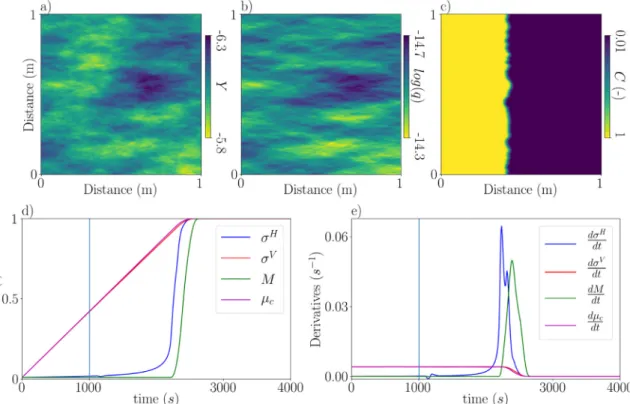
Fig.2.(Coloronline)(a)Weaklyheterogeneoushydraulicconductivityfieldwithgeostatisticalparameters(𝜎2
𝑌,𝐼y,𝜆)=(0.005,0.130m,3.179).(b)Corresponding
steady-stateflowfieldand(c)normalizedconcentrationfieldattime103s.(d)Time-seriesofthehorizontalandverticalequivalentelectricalconductivity,
mass-flux,andmeantracerconcentration,denoted𝜎H,𝜎V,Mand𝜇
c,respectively.Thelight-blueverticalline,alsopresentin(e),marksthetime103softheconcentration
fieldshownin(c).(e)Time-derivativesof𝜎H,𝜎V,Mand𝜇 c.
The reliabilityof theused information measure (Subsection 3.3) largelydependsonthequalityoftheinputdensityestimationsprovided bytheKDEapproach(e.g.,Budkaetal.,2011).Consideringthe trade-offspertainingtothechoiceofh,amanualtuningprocesswas neces-sary,whichresultedinthechoiceofℎ=0.75ℎ𝑠fortheresultspresented herein.
3.3. Informationmeasure:Kullback–Leiblerdivergence
Thedegreeofknowledgebroughtbytheobserveddatad 𝑜𝑏𝑠 pertain-ingtothegeostatisticalmodelparametersisevaluatedbycomparingour approximationof𝜋(m |d𝑜𝑏𝑠)with𝜋(m ).TheKullback–Leiblerdivergence (KLD)(KullbackandLeibler,1951),alsotermedRelativeInformation Content(Tarantola,2005),isprobablythemostwidelyused quantita-tivemeasureforcomparingPDFs:
𝐾𝐿𝐷(𝜋(m |d𝑜𝑏𝑠);𝜋(m ))= ∫ 𝜋(m |d𝑜𝑏𝑠)𝑙𝑛 ( 𝜋(m |d𝑜𝑏𝑠) 𝜋(m ) ) 𝑑m , (24)
wherethebaseofthelogarithmistakenase,givingtheinformation in unitsof nats (e.g.,Cover andThomas, 2012).The integration of Eq.(10) is performedoverthesupport ofthedensitiesandtheKLD isfiniteasthesupportof𝜋(m |d𝑜𝑏𝑠)iscontainedinthesupportof𝜋(m ) (e.g.,CoverandThomas,2012).TheKLDiszerowhen𝜋(m |d𝑜𝑏𝑠)≡ 𝜋(m )
(i.e.,thedatacarrynoinformationaboutthemodelparameters)andit increasesastheposterior becomesmorecompactwithrespecttothe priorasaconsequenceofconditioningtothedata.Notethatwhenthe priorandposteriordensitiesareGaussianwiththesamemean,butthe standarddeviationoftheposteriorishalfthestandarddeviationofthe prior,thentheKLDis0.27nats.
Sinceoursamplesaredrawnfromapproximateposteriordensities
𝜋𝐴𝐴𝑅𝑆(m |d𝑜𝑏𝑠)thatareKDE(i.e.,smoothed)versionsofthetarget
den-sities𝜋(m |d𝑜𝑏𝑠)(Eq.(18)),thechosenAARSapproachprovidesa con-servativeframeworkforassessingtheinformationcontentintermsof
theKLDmeasure,sinceitisalwaystruethat
𝐾𝐿𝐷(𝜋𝐴𝐴𝑅𝑆(m |d𝑜𝑏𝑠);𝜋(m ))<𝐾𝐿𝐷(𝜋(m |d𝑜𝑏𝑠);𝜋(m )), (25)
whichimpliesthattheinformationcontentintheconsideredtime-series isatleastaslargeastheestimatesobtainedbyouranalysis.
4. Results
Wefirstshowtwoexamplesofgenerateddataforend-membercases ofweakandstronghydraulicheterogeneity.Then,wedescribethe re-sultsobtainedfordifferentgeostatisticalparametervaluecombinations intermsoftheKLDandbiasmeasures.Indoingso,wediscussresults obtainedforone R -realization,aswellasensemblestatisticsdeduced from50 R -realizations.
4.1. Twoexamplesofgenerateddata
Fig.2showsanexampleofdataobtainedforaweaklyheterogeneous hydraulic conductivity field with (𝜎𝑌2,𝐼y,𝜆)=(0.005,0.130m,3.179)
(Fig.2a),resultinginanapproximatelyconstantflowfield(Fig.2b).The correspondingconcentrationfield,shownatthesamplingtime103s,
whenthetraceroccupiesapproximately50%ofthemodeldomain, dis-playsanoverallplanarfront(Fig.2c).
Thetime-seriesof𝜎Hand𝜎V(Fig.2d)evolveaccordingtothelower
andupperWienerbounds.Theseupscalingformulasforlaminated ma-terials(e.g.,MiltonandSawicki,2003)correspondtotheharmonicand arithmeticmeansofthelocalelectricalconductivities,respectively.The arithmeticaveraginggoverning𝜎Vismanifestedbylinearscalingwith
time.Inthiscase,𝜎Vformsanalmostperfectpredictorofthemean
salin-ity(𝜇c)withinthesample.𝜎H,onthecontrary,stronglyunderestimates 𝜇c.Forthiscase,themeanvelocityofthetracerfrontisgivenbythe
time-derivativeof𝜎V(Fig.2e),informationthatisavailablebeforethe
Fig.3. (Coloronline)(a)Stronglyheterogeneoushydraulicconductivityfield,definedwithgeostatisticalparameters(𝜎2
𝑌,𝐼y,𝜆)=(5.111,0.085m,1.028).(b)
Corre-spondingsteady-stateflowfieldand(c)normalizedconcentrationfieldattime103s.(d)Time-seriesofthehorizontalandverticalequivalentelectricalconductivity,
mass-flux,andmeantracerconcentration,denoted𝜎H,𝜎V,Mand𝜇
c,respectively.Thelight-blueverticalline,alsopresentin(e),marksthetime103s,ofthe
concentrationfieldin(c).(e)Time-derivativesof𝜎H,𝜎V,Mand𝜇
c.Thelargepeaksexhibitedby𝑑𝜎
𝐻
𝑑𝑡 and𝑑𝑀𝑑𝑡 approximatelycoincidewiththefirstarrivalofthe
tracerattheoutlet.
Theseeasilyinterpretableresultsarenowcontrastedwiththose ob-tainedforastronglyheterogeneoushydraulicconductivityfield,defined with (𝜎2𝑌,𝐼y,𝜆)=(5.111,0.085m,1.028). The resulting fieldhas
small-scale structuresandis close toisotropic(Fig.3a). Yet itsassociated flowfieldexhibitspronouncedchanneling(Fig.3b)resultinginahighly heterogeneousconcentrationfield(Fig.3c).Neither𝜎Hnor𝜎Vfollow
anyknownupscalinglaw.TheybothstarttovarymuchearlierthanM
(Fig.2d),whichonlyreactswhenthetracerarrivesattheoutlet.These earlyvariationsareclearlyseeninthetime-derivativesofthe electri-calresponses(Fig.2e),whicharenon-zerofromthemomentthetracer injectionstartsandexhibitsmallpeaksthatarerelatedtointernal con-nectioneventsofthesolutethatareinvisibletoM.Both𝜎HandMshow
asteepincreasearound103s,andalargepeakintheirtime-derivatives,
correspondingtoearlybreakthrougharrival.Forthiscase,𝜇cisatearly
timesmuchlargerthanalldataandisasymptoticallyapproximatedby
M,followedinorderofmagnitudeby𝜎Hand𝜎V. 4.2. Testcases
WenowapplytheBayesianinferenceapproachusingthreedifferent combinationsofthegeostatisticalmodelparametervalues:
(i) m 1∶=(4.70,0.06m,1.50).Thisleadstoastronglyheterogeneous
hydraulicconductivityfieldthatisapproximatelyisotropicand exhibitssmallstructures(Fig.4a).
(ii) 𝐦2∶=(0.80,0.06m,10.00). This leadstoa mildly-to-moderately
heterogeneous field that exhibits a high degree of layering (Fig.4d).
(iii) 𝐦3∶=(4.70,0.38m,1.50). This leadsto a highlyheterogeneous
fieldexhibitinglarge-scalestructures(Fig.4g).
InFig.4,examplerealizationsofgeneratedlog-hydraulic conductiv-ityfieldsforthethreetestcasesareshowntogetherwiththeir corre-spondingflowandconcentrationfields.
4.3. Informationassessmentofdatatypes
Foreachtestcaseofthemodelvectorm ,50datasetsd 𝑜𝑏𝑠𝑗 (Section3) aresimulatedusing hydraulicconductivityfieldscreatedwith differ-entR -realizations.Theforwardresponsesarecontaminatedwithnoise havingzeromeanandameandeviationof0.005representing50%of thebaselineelectricalconductivity.Theevaluationofthedifferentdata typesandgeostatisticalparametervaluesisconsideredbothinterms oftheensembleofrealizations(ensembleperformance)andintermsof randomly-pickedsinglerealizations(i.e.,thefieldsshowninFig.4).In additiontotheestimatedjointposteriorPDF,wealsoconsiderthe cor-respondingmarginaldistributionstoevaluatetheabilityofthedatato constrainindividualgeostatisticalparameters.Forthemarginal analy-sis,wealsoconsiderarelativebiasmeasure,computedastheratioof themeanbiasofthemarginalposteriors,withrespecttothetruevalues of m ,tothemeanbiasofthemarginalpriorswithrespecttothetrue values.Fromnowon,wedropthesuperscript“obs” whenreferringto theobservedconditioningdata.
4.3.1. Testcasem1
Table1summarizestheresultsobtainedfortestcase m 1.
WhenconsideringthejointKLDsobtainedfortheensembleof real-izations,wefindthat d 𝐻𝑉 hasthelargestmeanKLD,closelyfollowed by d 𝐻𝑉𝑀.Theleastinformativedatatype d 𝑀 hasameanKLDthatis ~ 75%oftheonefor d 𝐻𝑉,while d 𝐻and d 𝑉 havevaluesin-between. TheKLDstandarddeviations havesimilarvalues amongallthedata typesandrepresent ~ 20%ofthemeanvalues.
WenowturntotheresultsobtainedforthefieldsinFig.4a–candthe correspondingtime-serieshighlightedinFig.5a–c.Forthisspecific real-ization,theKLDsspanasmallrangeofonly ~ 13%.Also,theordering isdifferentandthemostandleastinformativedatasetsforthiscaseare
de-Fig.4. (a,d,f)Realizationsoflog-hydraulic conductivityfieldsand(b,e,h)associatedflow and(c,f,i)concentrationfieldsattime103s
forthethreeevaluatedtestcases(a–c)m1,(d–
f)m2and(g–i)m3.Notethatthelocationsof
high-andlowhydraulicconductivityregions aregovernedbyrandomR-realizations.
Table1
KLDsandmeanrelativebiasesofm1forthedifferentconditioningdatatypes.Columns1and2show
themean𝜇KLDandstandarddeviation𝜎KLDoftheKLDsusingtheensembleofhydraulicconductivity
realizations.Column3showstheKLDvaluesforthejointposteriorPDFsusingonerealizationof theconditioningdataobtainedfromFig.4a–candhighlightedinFig.5a–c.Thesubsequentpairsof columnsshowthemarginalKLDvaluesandrelativemeanbiasesforthemarginalposteriorsofeach componentofm1usingthisspecificrealization.
Ensemble m 𝜎2
Y 𝐼 y ( m ) 𝜆
𝜇KLD 𝜎KLD KLD KLD Bias KLD Bias KLD Bias d𝐻 0.8171 0.1445 0.7351 0.3754 0.5018 0.1418 0.7560 0.0904 0.8525 d𝑉 0.8016 0.1131 0.6418 0.2617 0.6703 0.1021 0.6760 0.0675 1.2163 d𝑀 0.6625 0.1580 0.6973 0.2153 0.8223 0.1771 0.5325 0.0980 1.1271 d𝐻𝑉 0.8830 0.1352 0.6937 0.2501 0.6716 0.1536 0.7058 0.0899 0.7971 d𝐻𝑉𝑀 0.8712 0.1318 0.6985 0.2386 0.7232 0.1537 0.7189 0.1050 0.7672
viationsoftheKLDsdiscussedabove)thestochasticvariationsthatare inherentundernon-ergodicconditions.Thevariabilityinthegenerated datadue tovariationsin the R -realizations,foragivengeostatistical model,isindicatedbytheinsetsinFig.5a–c.
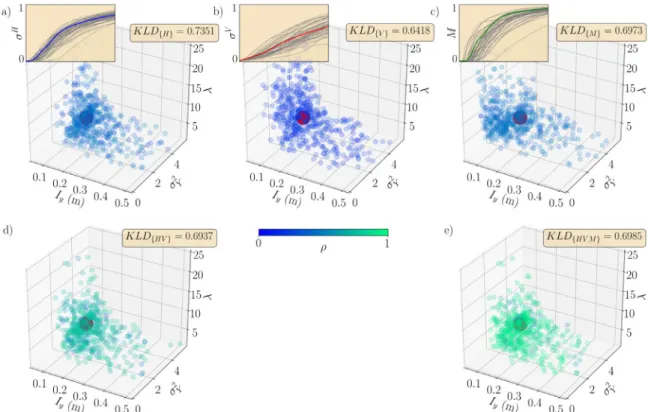
TheposteriormodelsamplesobtainedbytheAARSalgorithmand usedforbuildingtheempiricalposteriorPDFsforeachtypeofdataare showninFig.5.Thedensitydistributionofthese3-Dcloudsofpoints convey aqualitativeviewoftheabilityofthedifferentdatatypesto constrainthegeostatisticalparameters.Noeye-catchingdifferences dis-tinguishthedifferentpointclouds,reflectingtherathersimilarvalues oftheassociatedKLDs.
The KLDs computed for the marginal posterior PDFs, labelled marginalKLDsfromnowon,arethelargestfor𝜎2
Y,followedbyIyand𝜆,
thatonaverage,represent ~ 50%and~ 25%oftheKLDsof𝜎2
Y,
respec-tively.Wefindthat𝜎2
Yisbestconstrainedby d 𝐻,producingthelargest
marginalKLDandthesmallestbias.Forthisparameter,thepoorest per-formanceisachievedby d 𝑀 thathasboththesmallestmarginalKLD andthelargestbias.Thiscanbeseenintheestimatedmarginal poste-riorprobabilitydensity(Fig.6a)displayingamassdistributionwhichis thefurthestawayfromthetruevalue𝜎2
Y=4.70.ForIy,onthecontrary, d 𝑀 featuresthehighestmarginalKLDandthesmallestbias(Fig.6b). Theabilityofthedatatoconstrain𝜆 islow(Fig.6c)withd 𝐻𝑉𝑀 featur-ingthehighestmarginalKLD.Therelativemeanbiasesarenegatively correlatedwiththeassociatedKLDmeasure,showingconsistency be-tweenthetwomeasures.
Fig.5.PosteriormodelparametervectorsamplesofsizeS=500obtainedbytheAARSalgorithmfortestcasem1=(4.7,0.06m,1.5)usingdifferentdatasetsas
conditioningdata.Thecoloredcloudsofpointsrepresentthesamplesfordatasets(a)d𝐻;(b)d𝑉;(c)d𝑀;(d)d𝐻𝑉;(e)d𝑉𝑀;(f)d𝐻𝑉𝑀.Thecolormapencodesthe
L1distance𝜌 betweensimulatedandobserveddata,normalizedbytheminimumandmaximumvaluesof𝜌 ofthetestcase.Theinsetplotsof(a),(b)and(c)show,
respectively,the50realizationsoftime-series𝜎H,𝜎VandMgeneratedform
1usingdifferentR-realizations.Thedataconsideredhereforinferenceareshownby
thick-coloredcurves.TheresultingKLDvaluesaregivenforeachdataset.
Fig.6. (Coloronline)MarginalposteriorPDFsassociatedtoeachtypeofconditioningdatad𝐻,d𝑉,d𝑀,d𝐻𝑉,d𝑉𝑀andd𝐻𝑉𝑀fortestcasem1=(4.7,0.06m,1.5).
MarginalpriorandposteriorPDFscorrespondingto(a)𝜎2
Y(b)I𝑦and(c)𝜆.
4.3.2. Testcasem2
Table2summarizestheresultsobtainedfortestcasem 2.
WhenconsideringthejointposteriorKLDsfortheensemble,wefind that d HVMisthemostinformativedatasetfollowedbyd Hand d HV.Far behind,featuringmeanKLDsthatare ~ 60%ofd HVM,are d Vandd M.
Oftheindividualdatasets,wefindthat d Hismuchmoreinformative
than d Vand d M.Thestandarddeviationshavesimilarmagnitudesand represent∼ 20−35%ofthemeanvalues.
Wenowconsidertheresultsobtainedusingthetime-series(Fig.7a– c)obtainedfromthefieldsinFig.4d–f.TherankingforthejointKLDs aresimilartotheensemblemeanKLDs,exceptthat d H performsthe
best.Thepointcloudsoftheposteriorsamples(Fig.7)clearlyshows that d H(Fig.7a)constrainthegeostatisticalmodelparametersmuch
betterthan d V(Fig.7b)and d M(Fig.7c).
ThemarginalKLDsareagainthelargestfor𝜎2
Y,followedbythose
of 𝐼y and𝜆.Wefindthat𝜎Y2 is themost constrainedby d Handthe
leastconstrained by d M asreflectedbytheir marginalKLDsandthe
compactnessoftheirposterior PDFs(Fig.8a).AllthemarginalPDFs for𝜎2
Yexhibitasmallbiastowardslargervariances,withthesmallest
andlargestbiasesexhibitedfor d HVMand d M,respectively.For𝐼y,the
marginalKLDassociatedwithd Hiswell-abovetheothers(Fig.8b).The
secondmostandthirdmostbestperformingdatasetforthisparameter ared HVand d HVM,while d Mperformsthepoorest.ThemarginalKLDs
Table2
KLDsandmeanrelativebiasesofm⨙forthedifferentconditioningdatatypes.Columns1and2show themean𝜇KLDandstandarddeviation𝜎KLDoftheKLDsusingtheensembleofhydraulicconductivity
realizations.Column3showstheKLDvaluesforthejointposteriorPDFsusingonerealizationof theconditioningdataobtainedfromFig.4d–fandhighlightedinFig.7a–c.Thesubsequentpairsof columnsshowthemarginalKLDvaluesandrelativemeanbiasesforthemarginalposteriorsofeach componentofm2usingthisspecificrealization.
Ensemble m 𝜎2
Y 𝐼 y ( m ) 𝜆
𝜇KLD 𝜎KLD KLD KLD Bias KLD Bias KLD Bias dH 2.1341 0.5027 2.3829 1.3179 0.3687 0.8065 0.0573 0.5979 0.0971 dV 1.4448 0.4425 1.1625 0.7427 0.4359 0.1115 0.6425 0.1003 0.7639 dM 1.3897 0.4768 1.0892 0.4866 0.4889 0.0875 0.6883 0.0952 0.8219 dHV 2.1114 0.4465 2.0030 0.9984 0.3019 0.6399 0.1306 0.5412 0.1657 dHVM 2.2256 0.4648 2.0741 1.0955 0.2452 0.6158 0.1417 0.4410 0.2640
Fig.7. PosteriormodelparametervectorsamplesofsizeS=500obtainedbytheAARSalgorithmfortestcase𝐦2=(0.80,0.06m,10.00)usingdifferentdatasetsas
conditioningdata.Thecoloredcloudsofpointsrepresentthesamplesfordatasets(a)dH;(b)dV;(c)dM;(d)dHV;(e)dVM;(f)dHVM.ThecolormapencodestheL1
distance𝜌 betweensimulatedandobserveddata,normalizedbytheminimumandmaximumvaluesof𝜌 ofthetestcase.Theinsetplotsof(a),(b)and(c)show, respectively,the50realizationsoftime-series𝜎H,𝜎VandMgeneratedform
1usingdifferentR-realizations.Thedataconsideredhereforinferenceareshownby
thick-coloredcurves.TheresultingKLDvaluesaregivenforeachdataset.
andbiasesfor𝜆 (Fig.8b)followtherankingof𝐼y.Forthistestcase m 2,
thedatabetterconstrainthegeostatisticalparametersthanfortestcase
m 1asreflectedbygenerallymuchlargerKLDvalues.
4.3.3. Testcasem3
Table3summarizestheperformanceofthedifferentdatasetsfortest casem 3.
ConsideringtheensemblestatisticsofthejointposteriorKLDs,we findthat d HVhasthelargestmeanKLD,closelyfollowedby d HVMand
d H. Again, d M featuresthe smallestmeanKLDwith avalues thatis
~ 63% of that for d HV. The standarddeviations arevarying within
~ 15%andrepresent ~ 25%ofthemeanvalues.
Wenowconsidertheresultsfromthedatatime-series(Fig.9a–c) obtainedfromthefieldsinFigs.4g–i.ThejointKLDford Histhelargest
closelyfollowedbyd HVand d HVM.TheirKLDsare ~ 30%higherthan
theothers.Thepointcloudsofposteriormodelrealizations(Fig.9)are
rathersimilar,buttheresultsobtainedfromd H(Fig.9a)aremore
com-pactcomparedto d Vand d M.Forinstancethereisminimalscatterin
the𝜆-direction(c.f.,Fig.9b)andthehigh𝜎2
Yisbetterconstrained(c.f.
Fig.9c).
ThemarginalKLDsareagainthehighestfor𝜎2
YfollowedbyIyand 𝜆.Therelativemeanbiasesshowasimilartrend,beingsmallestfor𝜎2
Y.
Themarginalprobabilitydensitiesfor𝜎2
Y(Fig.10a)showthat d Hbest
constrainthisparameter,followedbyd HVand d HVM.ThemarginalKLD
for d Hareonly ~ 10%largerthanfor d HV and d HVM,butitsbiasis
30%lower.Notealsothatd Misstronglybiasedtowardstoolow𝜎2
Y.For Iyand𝜆,bothKLDsandbiasesindicatethat d H,d HVand d HVMarethe
Fig.8. (Coloronline)MarginalposteriorPDFsassociatedtoeachtypeofconditioningdatadH,dV,dM,dHV,dVManddHVMfortestcase𝐦2=(0.80,0.06m,10.00).
MarginalpriorandposteriorPDFscorrespondingto(a)𝜎2
Y(b)I𝑦and(c)𝜆.
Table3
KLDsandmeanrelativebiasesof𝐦⨚forthedifferentconditioningdatatypes.Columns1and2show
themean𝜇KLDandstandarddeviation𝜎KLDoftheKLDsusingtheensembleofhydraulicconductivity
realizations.Column3showstheKLDvaluesforthejointposteriorPDFsusingonerealizationof theconditioningdataobtainedfromFigs.4g–iandhighlightedinFig.9a–c.Thesubsequentpairsof columnsshowthemarginalKLDvaluesandrelativemeanbiasesforthemarginalposteriorsofeach componentofm3usingthisspecificrealization.
Ensemble m 𝜎2
Y 𝐼 y ( m ) 𝜆
𝜇KLD 𝜎KLD KLD KLD Bias KLD Bias KLD Bias dH 1.1845 0.3195 1.0166 0.4818 0.3098 0.2681 0.6388 0.2031 0.3962 dV 1.0565 0.3313 0.7459 0.3046 0.6171 0.0488 0.9635 0.0356 1.0166 dM 0.8413 0.2798 0.6205 0.2019 0.7347 0.1949 0.6983 0.1296 0.5169 dHV 1.3462 0.3491 1.0123 0.4491 0.4202 0.2680 0.6577 0.2054 0.4002 dHVM 1.2932 0.3100 1.0068 0.4200 0.4429 0.2915 0.6164 0.2245 0.3647
Fig.9. PosteriormodelparametervectorsamplesofsizeS=500obtainedbytheAARSalgorithmfortestcase𝐦3=(4.70,0.38m,1.50)usingdifferentdatasetsas
conditioningdata.Thecoloredcloudsofpointsrepresentthesamplesfordatasets(a)dH;(b)dV;(c)dM;(d)dHV;(e)dVM;(f)dHVM.ThecolormapencodestheL1
distance𝜌 betweensimulatedandobserveddata,normalizedbytheminimumandmaximumvaluesof𝜌 ofthetestcase.Theinsetplotsof(a),(b)and(c)show, respectively,the50realizationsoftime-series𝜎H,𝜎VandMgeneratedform
1usingdifferentR-realizations.Thedataconsideredhereforinferenceareshownby
Fig.10. (Coloronline)MarginalposteriorPDFsassociatedtoeachtypeofconditioningdatadH,dV,dM,dHV,dVManddHVMfortestcase𝐦3=(4.7,0.38m,1.5).
MarginalpriorandposteriorPDFscorrespondingto(a)𝜎2
Y(b)I𝑦and(c)𝜆.
5. Discussion 5.1. Generalfindings
TheabsolutevaluesofthecomputedKLDsandbiasesaredependent onthechoicesmadewhenapproximatingtheposteriorprobability den-sities(Section2.2),suchasthewidthoftheacceptancekernelofthe AARSalgorithm(Algorithm2)andthebandwidthof thekernel den-sityfunctionusedtorepresenttheprobabilitydensities.Forthisreason, wefocusourdiscussionbelowonrelativedifferencesbetweendatasets andtestcases.Wefirstsummarizethemainresultsthatapplytoalltest casesbeforediscussingthetestcasesone-by-one.Afterthis,wediscuss broaderimplicationsofthisresearch.
Consideringtheensemblestatisticsof50hydraulicconductivity re-alizationsforeachtestcase,wefindthattheinformationcontentofd H
measuredbytheKLDishigherthan d V,whichinturnishigherthan d Mforthethreetestcasesconsidered:m 1(Table1), m 2(Table2)and
m 3(Table3).Theaddedvalueofcombiningdifferentdatatypes(d HV
and d HVM)isgenerallyfoundtobecomparativelylow.When
consider-ingindividualhydraulicconductivityrealizationsandassociatedfields (Fig.4),wegenerallyobtainrelativerankingsofthedifferentdatatypes thatareconsistentwiththoseof theensemble means.Giventhatwe considernon-ergodicmodeldomains,theactuallocationsofhigh-and lowhydraulicconductivitiesgovernedbythenuisancevariableR plays animportantroleinthedata-generatingprocess.Itsimpactis mani-festedbythecomparativelyhighstandarddeviationsoftheKLD esti-mates(Tables1–3)and(inthevariabilityofthegeneratedtime-series (Figs.5a–c,7a–cand9a–c).Despitethisinherentstochasticvariability, weconsistentlyfindthatthebestconstrainedparameteris𝜎2
Y,followed
byIyand𝜆.Theindividualtestcasesarediscussedindetailbelow.
5.2. Lessonslearnedfromthethreetestcases
Testcase m 1featuresahighlyheterogeneousfield𝐾(x )with rela-tivelysmallstructures(Fig.4a),forwhichonecouldpossiblyassume thatergodicconditionsarefullfilledandconsequentlythatthe geosta-tisticalparametersarewell-representedwithinthemodellingdomain, yet itcorresponds tothe least-constrained testcase. Indeed, the R -realization playshere averyimportantrole,implyingarather weak mappingfromthetime-seriestothegeostatisticalparametersof inter-est.Tounderstandthis,notefirstthat{𝜎H}and{𝜎V}areonlysensitive
totheunderlyinggeostatisticalparametersthroughthesolutespreading patternsthattheseparametersinduce.Indeed,theelectricalresponses resultfromoptimalcurrentpatternsestablishedthroughoutthehighly
non-ergodicandtime-evolvingdistributionoflocalconcentrations(i.e., conductivities) thatare,in turn,drivenbytheflow field𝐪(x ). Asin theexampleinFig.2,thehydraulicconductivityfield𝐾(x )has small-scalestructuresandisclosetoisotropic(Fig.4a)butitsassociatedflow field𝐪(x )exhibitspronouncedchanneling(Fig.4b). Thistendencyof theflowfieldtoconcentrateinpreferentialflowchannelsforhigh𝜎2
𝑌
iswell-known(e.g.Cvetkovicetal.,1996).Hence,anergodic𝐾(x )is noguaranteeofwell-sensedgeostatisticalparameterswhenusing geo-electricallymonitoredsalinetracertests.Nevertheless,comparedtothe prior,theestimatedmarginalposteriordensitiessuggestthatthe geo-statisticalmodelthatneedsacomparativelyhigh𝜎2
Y(Fig.6a)andvery
smallorhighIy(Fig.6b)areunlikely.
Testcase m 2correspondstoalayereddistributionofhydraulic con-ductivitywithamoderate𝜎2
Y.TheKLDs(Table2),andconsequently
theconstrainingnatureofthetime-series,aremuchhigherthanfortest cases m 1 (Table1)and m 3(Table3).For m 2,thesmallestvariations
between the R -realizationsareobserved (Fig.7a–c)sincethe actual locationoftheflowchannelsisofsecondaryimportanceinthe data-generatingprocess.Thehydraulicconductivityfield(Fig.4d)andits as-sociatedflowfield(Fig.4e)arevisuallymoresimilartoeachotherthan for m 1.Thisisaconsequenceofthelargeanisotropyfactorimposing
horizontallycontinuousstructureswithinwhichtheflow-fieldchannels arenaturallydeveloped.Both{𝜎H}and{M}arehighlysensitivetothe
arrivalofhorizontalconnectionsthatareestablishedbythesolutewhen itarrivestotheoutlet.ConsideringthemarginalKLDs,wefindthathigh andlow𝜎2
Y-valuesareincompatiblewiththedata(Fig.8a),asislarge Iy.Forthistestcase m 2,𝜆 isparticularlyinterestingasitstruevalueis
highand,therefore,oflowpriorprobability(Fig.8c).Weseeastrong abilityofalltime-seriesincluding{𝜎H}toconstrainthisparameter.
Testcase m 3isahighlyheterogeneoustestcasethatdistinguishes itselffrom m 1 byitslarger Iy.Aconsequenceof theresulting larger
structuresisthatthegenerateddatavarywidelybetweenthedifferent hydraulicconductivityrealizations(seeinsetsinFig.9a–c).YettheKLDs (Table 3) arehigherthanfortestcase m 1.Consideringthemarginal
posteriorPDFs,alldatasetsindicate thattheunderlyinggeostatistical modelhasahigh𝜎2
Y(Fig.10a),atleastamoderatelyhighIy(Fig.10b)
and(thatthefieldisclosetoisotropic(Fig.10c).
5.3. Physicalinsightsandopenquestions
Inouridealizednumericalinvestigation,wefoundconsistentlythat geoelectricaldataperformedbetterthanmassbreakthroughdatain con-strainingthegeostatisticalparameters.Thisisaconsequenceofthefact that,foragivengeostatisticalmodel,theactualpositioningofhigh-and
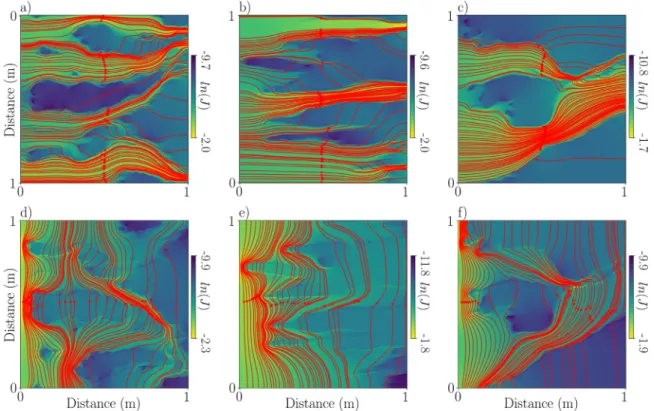
Fig.11. Naturallogarithmoftheabsolutevalueofthecurrentdensityfields(andtheirstreamlines)resultingfromexcitingthesamplebothinthe(a–c)horizontal and(d–f)verticalmodes.TheelectricalconductivitydistributionisgivenbythesalineconcentrationfieldsshowninFig.4,thatis,attime103sforthethree
evaluatedtestcases(a,d)m1(column1),(b,e)m2and(c,f)m3.
lowhydraulicconductivityfields,governedbythenuisancevariable R , hasalargerimpactonthemassbreakthroughdatathanonthe geoelec-tricaldata(e.g.,comparetheinsetsinFig.9a–c).Weunderstandthis asaconsequenceofthelocalflux-averagednatureofthetracer break-through,comparedtothemoreintegrativenon-linearvolume-averaging of theelectrical responsesover theconcentrationfield.Additionally, since{M}isonlysensitivetothetime-evolutionofthesolute concen-trationfieldattheoutlet,itcannotdeterminethecausalityofthearrival times,thatis,iftheyoriginatefromlargehorizontalcorrelationscales orfromhighvariance,forinstance.
Wealsofoundthat{𝜎H}always hasa higherconstrainingpower
than{𝜎V}.Thiscanbeunderstoodbynotingthat{𝜎H}issensitiveto
electricalconductionpathscreatedbytheconcentrationfieldintheflow direction,leadingtoaverystrongsensitivitytotracerarrivalsatthe outlet(e.g.,Fig.2e,orthegenerallysteepslopesinthegenerated time-seriesin theinsetsof Figs. 5a, 7aand9a). InFig.11we plotthe generatedcurrentdensitydistributionsdetermining{𝜎H}and{𝜎V}for
theconcentrationfieldsshowninFigs.4c,fandj.Weseethatfor{𝜎H}
(Figs.11a–c)thesupportofthecurrentdensityfield(i.e.theregions of highcurrent flow)is almostcoincidentwiththeareaoccupiedby theinvading tracerdrivenbytheflow-field. Thisdoesnot occurfor {𝜎V}(Figs.11d-f),indicatingwhy{𝜎H}ismoreinformativethan{𝜎V}.
Clearly,{𝜎V}resultsfromcurrentpatternsthataremainlyconstrained
byverticalconnectionbottlenecksthatbecomemorecommonfurther awayfromtheinletregion.Thiscanbeappreciatedbythehighdensity ofcurrentfieldstreamlinesobservedattheinletregionsinFigs.11d, 1111eand11f.Thissuggeststhatthemainabilityof{𝜎V}tosensethe
geostatisticalparametersisthroughitssensitivitytothetrailingendof thetracerfront.Again,itistheconnectivity-aspectoftheelectricaldata thatisatplay.
Ourresultsalsosuggestastrongdependenceontheinjectiontype. Forapulseinjection,weexpect{𝜎H}tobemuchlessinformative,
com-paredtothepresentcontinuousinjectioncase,astherewillbeno hor-izontalconnectionsofsalinitytosense.Thatis,theconnectivity
cre-atedbyestablishingacontinuousconcentrationfieldacrossthedomain isveryhelpfulforelectrical-basedinferenceofgeostatisticalproperties fromtracertests.
Foralltestcases,wefindthat𝜎2
Yisthebestconstrainedparameter.
Thisisexplainedbythefactthat𝜎2
Ycontrolsthespreadingrateofthe
solute(e.g.,GelharandAxness,1983)andis,thus,afirst-orderfeatureof thetime-series.Itwilldeterminethetime-spacingorpaceofoccurrence ofthehorizontalconnectioneventsassensedparticularlywellby{𝜎H}.
However,alsothetrailingpartofthetracerfieldassensedby{𝜎V}is
affectedby𝜎2
Y.
Oneopenquestionistowhatextenttheelectricaldatacanconstrain mixingandspreading.Intuitively,thereshouldbeastrongsensitivity tothespreadingwidthas𝜎Hishighlysensitivetothefrontofthetracer
plumeand𝜎Vtoitsend.Sincesolutespreadingultimatelycontrols
so-lutemixing(e.g.,Villermaux,2019),thehighsensitivityoftheelectrical datatotheformerindicatesthatthesedataareabletoatleastquantify themixingpotentialofthesolute(e.g.,deDreuzyetal.,2012).This willbethetopicoffutureresearch.Furthermore,theequivalent electri-calconductivitytensortime-seriesisdeterminedbythetime-evolution oftheconcentrationfield,whichinturnisdrivenbytheflow-field.This suggeststhatthattheelectricaldatamightbemorestronglyrelatedwith theflow-fieldthanthegeostatisticalmodeloflog-hydraulic conductiv-ity.Inthefuture,weplantostudythegeoelectricalsensitivityto flow-fielddescriptors(e.g.,Koponenetal.,1996;Englertetal.,2006). Sim-ilarly,wewouldliketorelatetheelectricaldatatoconcentrationfield descriptors.However,astheconcentrationfieldistime-variant,thisis morechallengingtosummarizethanthesteady-stateflowfield.One possibilityistorelateittothespatialdistributionoflocalizedtemporal momentsofthesoluteconcentrationfield(CirpkaandKitanidis,2000).
5.4. Implicationsforfield-basedstudies
Ourworkhasseveralimplicationsforfield-basedand laboratory-basedelectricaltime-lapsemonitoringof tracertests.Thefirstisthat