ExoMars Entry Descent and Landing Demonstrator Module
(EDM) Science
NOI Number: ## ESA-NASA
NOTICE OF INTEREST
Principal Investigator E-mail Address Phone Number
David Mimoun [email protected] +33-561338108
Affiliation City Country
Institut Supérieur de l’Aéronautique et de l’Espace (ISAE)
Toulouse France
Investigation Name
MARS MICROPHONE 2016
Outline: The Mars Microphone is a very simple and exciting experiment, whose primary objective is to achieve
a world premiere during the short life of the ExoMars EDL payload: retrieve sounds from Mars. While built in Europe, with students involvement, the Mars Microphone will also strongly rely on the heritage of the previous Mars Microphone experiments, led by Berkeley SSL and the Planetary society for the Phoenix, Mars Polar lander and NetLander missions. This experiment will therefore feature a unique combination of outreach, educa-tional initiative and scientific objectives, particularly suited for the EDM payload context. In synergy with this
experiment, we also propose to use the EDM engineering data to investigate the static instability of the entry
phenomenon. The comparisons of flight data to predictions will allow assess finely current models used for de-fining the aerothermodynamics environment in Martian entry.
Experiment configurations and scientific objectives
The stringent resource constraints lead us to propose 3 possible configurations for the Microphone which will eventually depend on the possible on–board resources allocation. The following table makes a synthesis of the proposed options:
Option Configuration Science objectives Remarks
Baseline Electronic box + 1 mi-crophone
First Sounds from Mars + Core Science
This proposal (about 50 grams) Option #2 Electronic box + 2
mi-crophones (stereo)
First Sounds from Mars + Extended Science
Adds 5 g to the mass (additional mi-crophone and wire) – Allows stereo recording
Option #3 Electronic box + 3 (TBD) microphones + synergy with EDL sensors
First Sounds from Mars + Extended Science + De-scent Science
To enable descent science, the micro-phone shall be powered ON during the descent (this implies an implementa-tion in the EDL engineering system)
Sound environment on the Martian surface
A thorough synthesis of the expected sound environment for the Mars microphone was given by (William, 2001) for the Mars Polar Lander Microphone. Sound behaviour at the Martian surface is expected to be very similar to the Earth stratosphere, with an average atmospheric pressure between 6 and 8 mbar and a mean tem-perature about 240 K. In absence of in-situ measurement, main expected attenuation sources are classical and molecular absorption, but also the effect of the carbon dioxide viscosity. As a consequence of this, a strong at-tenuation is foreseen: most sounds in the human ear sensitivity window will not propagate over more than some dozen of meters. However, the situation improves in the lower frequencies, and infrasounds, either related to dust devils or to other sources are expected to propagate over kilometre ranges.
Expected signals
With this strong attenuation of sounds, expected signals are due to the interaction between the lander structure and the Martian wind. Main aeolian tones will be related to the main size of the lander and to the size of the lander elements exposed to wind (Curle, 1955). Noise level will be mainly related to atmospheric turbulence next to the lander (William, 2001). As we expect a sandy environment in the vicinity of the lander, the noise of the particles against the lander structure or directly against the microphone (depending on the wind direction) could also be monitored. A random activation of the microphone will therefore most likely bring back wind and saltation related noises. In addition, several less probable phenomena could also be witnessed, especially if the EDM operational scenario allows operating an automatic “switch on” triggered by a event of some intensity: dust devils, thunderstorms, asteroid impacts. The most common expected events are dust devils, witnessed on Mars since Viking (Ryan & Lucich, 1983) with typical sizes ranging from tens to hundreds of meters; Mars ex-ploration rovers have also captured several dust devils trajectory on their way (e.g. [2]). Dust devils are known
Mars Microphone 2016 Date: 11/01/2011 Pag.: 2/3
ExoMars EDM Science AO
to generate both infrasounds (detectable over long ranges) and high frequency sounds (short ranges) Arnold et al (1976) reported dust devil activity in the audible range [2000 Hz] for Earth dust devils. The microphone has therefore a good chance of capturing such sounds, and, in its stereo version, to provide data on its trajectory. Melnik and Parrot (1998), as well as Mills (1977) also stated that dust storms could lead to lightning through cloud dust charging: an acoustic counterpart (thunder) may be detectable.
Static Instability during the EDM’s entry investigation
Finally, in the case (option #3) where the microphone is enabled during the descent phase (and depending of course of the microphone implementation location), it will, in synergy with the on-board engineering sensors, improve the monitoring of this critical phase, and investigate the static instability in the sound range. It may also record the high frequency structural noise or the parachute deployment. Static instability was first observed dur-ing the flight of the Mars Pathfinder (Gnoffo et al., 1998). On-board accelerometers have pointed out a brief sign change in the pitching moment coefficient at two flight points of the Pathfinder’s trajectory. In the case of the ExoMars EDM, with a very similar geometry to Mars Pathfinder EDM, a similar analysis has conducted to the prediction that a static instability should occur at a specific point of the EDM trajectory (Vérant et al, 2010). Flight data acquired by the EDM’s engineering sensors during the entry will allow the validation and refinement of the numerical modelling.
Experiment description and Heritage
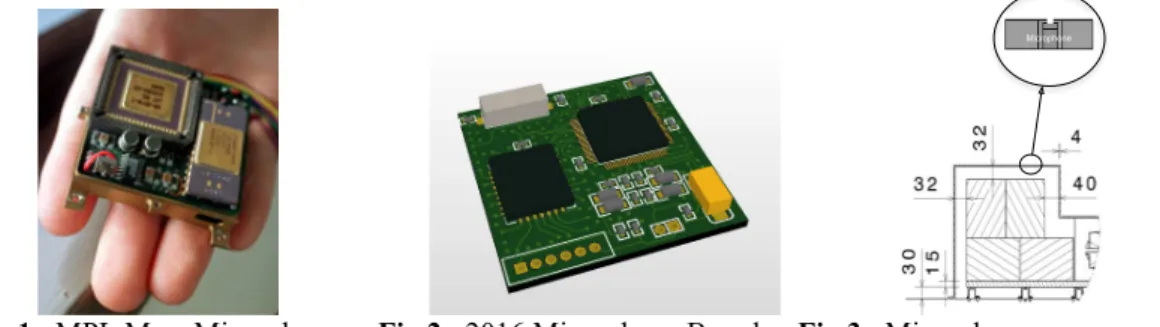
The design is on-purpose very simple, and following the previous design, relies primarily on a COTS compo-nent. It offers the required functionality together with the required low power consumption (150 mW), and a sufficient reliability for short life duration. In its baseline configuration, the Mars Microphone weights 50 g, and is composed of an electronics board enclosed in a 50x50x20 mm aluminium box. The microphone compo-nent is accommodated “outside”. A simple serial bus interfaces with the internal payload unit.
estec
ExoMars Project
Doc. No: EXM-DM-IPA-ESA-00001 Issue: 1 / 0
Date: 08/11/2010 Page: 18/85
ESA UNCLASSIFIED – For Internal Use
Figure 4-8. Surface Platform, on which is mounted the warm compartment, showing the baseline configuration of the model payload.
Figure 4-9. Central Bay supporting structure
4.4.2 Surface Payload Accommodation Concept
The Surface Payload will consist of instrumentation/sensors, service subsystems (primary battery and Common Electronic Unit (CEU)), harness, mechanical fittings and thermal insulators as necessary. Sensors are accommodated on the ESP Propulsion Bay
Microphone
Fig 1 : MPL Mars Microphone Fig 2 : 2016 Microphone Board Fig 3 : Microphone sensor accommodation
The proposed design has its heritage in previous Mars Microphone implementations, first on-board Mars polar Lander, and then on-board Phoenix: same microphone elements, same class of COTS components. It allows therefore a high TRL and a very good confidence in the development scheme. The operational scheme is also very simple: after landing, the microphone will be switched ON for a fixed sequence of recording, preparing for the first upload session. During the first and the second pass, and during the extended mission (if any) the mi-crophone will be in sleeping mode, waiting for a sound over the threshold intensity to be switched on. This will allow recording dust devils or other events, while preserving the payload module energy.
Preliminary Team description
The Mars Microphone 2016 team includes a wide panel of scientists and engineers, interested in both science and outreach. The core team (PI, PM) is led by the Institut Supérieur de l’Aéronautique et de l’Espace, and in-cludes participation from the University of Padova, Berkeley Space Science Laboratory (funded by the Plane-tary Society) and ONERA. Outreach will be coordinated with the PlanePlane-tary Society and Europlanet. G. Delory (SSL) will lead the Science Advisory group (all co-I), and a senior Advisory group will include JP Lebreton (ESA) and Lou Friedman (Planetary Society). Please also note that CNES is aware of this proposal.
Student Involvement – Outreach
Following the successful example of Cassini-Huygens, we will put a large emphasis on outreach activities. The strong design heritage of previous versions will also allow us to have a student involvement in the development and in the tests of the Mars Microphone 2016.
Mars Microphone 2016 Date: 11/01/2011 Pag.: 3/3
ExoMars EDM Science AO
Submitting Organisation Information
Organisation Company Division
Institut Supérieur de l’Aéronautique et de l’Espace (ISAE) Université de Toulouse
DEOS
Street Address City State/Province Postal
Code
Country
10, avenue Edouard Belin TOULOUSE N/A 31400 FRANCE
Team Members
Role Name E-mail Address Phone Number Organisation
PI David Mimoun [email protected] +33-561338108 Toulouse U ISAE(F)
Co-I Gregory Delory [email protected] + 1 (510) 642-7297 U Berkeley – US Co-I Bruce Banerdt [email protected] +1-818-354-5413 JPL, US Co-I Jean-Jacques Berthelier
[email protected] +33 1 45 11 42 42 LATMOS/IPSL,F
Co-I Bruce Betts [email protected] + 1 626-793-5100 Planetary Society -US
Co-I Stefano Debei [email protected] +39049-8276802 U Padova- I
Co-I Véronique Dehant [email protected] +32-2-373 0266 Royal Observatory of
Belgium
Co-I Francesca Ferri [email protected] +39-0498276858 U Padova - CISAS (I)
Co-I François Forget Francois [email protected] +33 1 44 27 47 63 LMD, France
Co-I Louis Friedman [email protected] + 1 626 793-5100 Planetary Society -US
Co-I Christian Krause [email protected] +49-2203-601 3048 DLR, (D)
Co-I Jean-Pierre Lebreton [email protected] +31 71 565 3600 ESA
Co-I Philippe Lognonné [email protected] +33-145114131 IPGP, F
Co-I Sylvestre Maurice [email protected] +33 5 61 55 75 50 IRAP , F Co-I Aymeric Spiga [email protected] +33 (0) 1 44 27 28 47 LMD, France Co-I Klaus Seidensticker Klaus [email protected] +49-2203 601 3104 DLR, D Co-I Frédéric Sourgen [email protected] +33 (0)5 62 25 28 44 DLR, D
Co-I Stephan Ulamec [email protected] +49-2203 601 4567 DLR, D
Co-I Colin Wilson [email protected] +44-01865272086 Oxford U, UK
References
[1] Ryan, J. and R. Lucich Possible dust devils, vortices on Mars. J. Geophys. Res. 88, 1983 [2] http://marsrovers.jpl.nasa.gov/gallery/press/spirit/20050819a.html, retrieved 01/2011 [3] Williams, JP Acoustic Environment of the Martian Surface, JGR, vol 106, 2001
[4] Curle, N The influence of solid boundaries upon aerodynamic sound, Proc.R. Soc.London.Ser A 231 505-514, 1955
[5] Melnik, Parrot Electrostatic discharge in Martian dust storms, JGR 103, 1998
[6] Arnold, R. T., H. E. Bass, and L. N. Bolen, Acoustic spectral analysis of three tornadoes, J. Acoust. Soc. Am., 60, 584-593, 1976.
[7] Mills, A. A., Dust cloud and frictional generation of glow discharges on Mars, Nature, 268, 614, 1977 [8] Vérant, J. L., Exomars Capsule Aerodynamics Analysis, 10th AIAA/ASME Joint Thermophysics and Heat Transfer Conference, Chicago (IL), July 2010
[9] Gnoffo, P. A., Prediction and Validation of Mars Pathfinder Hypersonic Aerodynamic Data Base, AIAA paper 98-2445, 7th AIAA/ASME Joint Thermophysics and Heat Transfer Conference, Albuquerque (NM), June 15-18, 1998