HAL Id: tel-00958566
https://tel.archives-ouvertes.fr/tel-00958566
Submitted on 12 Mar 2014
HAL is a multi-disciplinary open access
archive for the deposit and dissemination of
sci-entific research documents, whether they are
pub-lished or not. The documents may come from
teaching and research institutions in France or
abroad, or from public or private research centers.
L’archive ouverte pluridisciplinaire HAL, est
destinée au dépôt et à la diffusion de documents
scientifiques de niveau recherche, publiés ou non,
émanant des établissements d’enseignement et de
recherche français ou étrangers, des laboratoires
publics ou privés.
Design, optimization and control in systems and
synthetic biology
Gregory Batt
To cite this version:
Gregory Batt. Design, optimization and control in systems and synthetic biology. Quantitative
Methods [q-bio.QM]. Université Paris-Diderot - Paris VII, 2014. �tel-00958566�
UNIVERSITÉ PARIS DIDEROT - PARIS 7 INRIA Paris-Rocquencourt
Habilitation à Diriger les Recherches
Spécialité : Biologie des systèmes
Mémoire présenté par
Grégory BATT
Design, Optimization and Control
in Systems and Synthetic Biology
Soutenue le 7 mars 2013 devant un jury composé de Reiner Veitia Président Université Paris Diderot
Vincent Danos Rapporteur Edinburgh University/CNRS Paris Frédéric Devaux Rapporteur Université Pierre et Marie Curie Olivier Gandrillon Rapporteur CNRS Lyon
Hidde de Jong Examinateur INRIA Grenoble - Rhône-Alpes Mustafa Khammash Examinateur ETH Zürich
"Restons ce que nous avons toujours été : des gens libres. C’est devenu suffisamment rare pour qu’on s’accroche ne serait-ce qu’à l’idée." Enki Bilal
Acknowledgments
First I would like to thank the members of my HDR committee: Frédéric Devaux and Reiner Veitia for being active promoters of quantitative biology amongst biological communities that are not (yet!) fully supportive, Vincent Danos and Olivier Gandrillon for sharing excitement of interdisciplinary research, and Mustafa Khammash for his inspirational work at the crossroad of control, computational sciences and quantitative biology. In the context of an habilitation à diriger les recherches, the presence of the former PhD adviser has a special significance. I’m very pleased to have here the opportunity to express all my gratitude to Hidde de Jong. In addition to all the scientific and technical skills I learned from him, he constantly demonstrated an exemplary rigorous and ethical attitude. In highly complex and competitive scientific fields, these two qualities are essential. He also set the standard for PhD supervision quality. Quite high actually. I simply hope I will be able with time to reach his level of guidance.
Regarding PhD supervision, I consider myself extremely lucky to be the (co-)supervisor of out-standing students: Francois Bertaux, Xavier Duportet, Artemis Llamosi, Jean-Baptiste Lugagne and Jannis Uhlendorf. What makes supervision really enjoyable is that knowledge flows in both ways. I hope they learned from me, but I also learned a lot from them. Close collaborators have also played a critical role regarding the type of research I have done and the pleasure I had to do it. I am particularly grateful to Valentina Peschetola and Szymon Stoma, and Dirk Drasdo, Pascal Hersen, and Ron Weiss, with whom I co-supervise students. It is striking to see how collaborations can develop throughout the years when people share scientific interests and mutual understanding. A significant part of my research is now carried out in tandem with Pascal. I am convinced that on the long-term this collaboration will have a major impact of the scientific value of my work. I’m grateful to INRIA that provided support at a time when it was needed to start collaborations, and to the Contraintes/Lifeware group that provides, under the aegis of Francois Fages, a very pleasant working environment where the pleasure to do research reigns.
The research material presented in this manuscript is the result of a large collaborative effort. In addition to the people I mentioned above, many others contributed directly or indirectly to this research and the one to come. Therefore I would like to thank Alessandro Abate, Kirill Batmanov, Calin Belta, Claudine Chaouyia, Eugenio Cinquemani, Alexandre Donzé, Samuel Druhle, Giancarlo Ferrari-Trecate, Hubert Garavel, Hans Geiselmann, Blaise Genest, Andres Gonzalez, Jean-Luc Gouzé, Jean Krivine, Cédric Lhoussaine, Ariel Lindner, Oded Maler, Radu Mateescu, Clément Nizak, Michel Page, Delphine Ropers, Brian Teague, P.S. Thiagarajan, Denis Thieffry, Ilya Tkachev, Cristian Versari, Jake Wintermute, Boyan Yordanov, and all members of Contraintes and Lifeware groups.
Research is not just pure science. Therefore I would like to thank Francoise de Connick, Nadia Mesrar, Stephanie Aubin, and Assia Saadi for their help (and patience!) on all administrative aspects throughout the years.
... and life is not just research. I am extremely grateful to my family and close friends for their constant support. And above all, none of this would have been possible without the love and understanding of Céline. Her importance in my life cannot be expressed in words. I dedicate this thesis to her.
Contents
1 Introduction 7
2 Testing the consistency of regulatory interactions in medium-scale gene networks 10
2.1 Qualitative models of large gene networks . . . 10
2.2 Reasoning with qualitative constraints on parameters . . . 10
2.3 Model validation . . . 11
2.4 Scaling up . . . 12
2.5 Significance and perspectives . . . 12
3 Optimization of simple synthetic genetic circuits 15 3.1 Quantitative yet robust analysis of synthetic genetic circuits . . . 15
3.2 Reasoning with quantitative constraints on parameters . . . 15
3.3 Optimization of synthetic circuits: in silico studies . . . 16
3.4 Significance and perspectives . . . 17
4 Investigating dynamical properties of complex networks 18 4.1 Quantitative analysis of large biological networks . . . 18
4.2 Reasoning with large sets of trajectories . . . 18
4.3 Application to robust timing of a synthetic transcriptional cascade . . . 19
4.4 Application to the comparison of different apoptotic responses in different cell types 19 4.5 Significance and perspectives . . . 20
5 Computer-assisted control of biocellular processes 23 5.1 Real-time control in systems and synthetic biology . . . 23
5.2 Proof of principle: controlling gene expression in yeast . . . 23
5.3 Significance and perspectives . . . 24
6 Conclusion and future directions of research 27 6.1 Cells as members of a population . . . 27
6.2 Cells within their environment . . . 28
6.3 A platform for well-controlled physiological perturbations . . . 29
1
Introduction
"Le véritable voyage de découverte ne consiste pas à chercher de nouveaux paysages, mais à avoir de nouveaux yeux" Marcel Proust Since 50 years, biology is undergoing a revolution. Driven by technological progress, the pos-sibility to investigate the functioning of biological processes at the cellular level are expanding at an ever-increasing pace. Over the second half of the last century, the expansion of molecular and cellular biology has been stunning. It is now possible to sequence whole genomes for a few thou-sands of dollars [81], to get access to the mRNA content of cells in a routine manner [64], to get access to the protein content of whole tissues [58]. One can also observe protein and mRNA levels and locations in single cells for extended durations [54, 70]. Besides observing biological processes, one can also manipulate them with unprecedented capabilities. One can construct and integrate large genetic circuits [43, 56], synthesize entire genomes [40], hijack metabolism to efficiently pro-duce biomolecules [69]. These techniques offer enormous opportunities [52]. In biotechnology major research efforts are invested for the production of biofuel or of high-value biomolecules, and for the development of biosensors or of bioremediation systems. In medicine, virus-based or cell-based therapies are envisioned using reprogrammed biological systems that exploit and expand their nat-ural capabilities to create artificial tissues or even organs. The development of biosensors for drug screening and design is another application of high interest.
The technological push in modern biology is so strong that it has cleaved the historical domains of biology, ranging from biochemistry to physiology, into two broad areas: small-scale and large-scale biology [16]. In a nutshell, small-scale biology -also known as bottom-up systems biology- focuses on gathering detailed information on the specific components of a particular dynamical process. Data is often acquired with high temporal resolution and at the single cell or even single molecule level. Large-scale biology -also known as top-down systems biology- aims at getting a snapshot of the state of the cell for all biological processes. Because not everything can be observed at the same time, one distinguishes genomics, transcriptomics, proteomics, metabolomics, etc, according to the focus on the particular method employed [98, 45]. One of the main issues of large-scale approaches is that they often offer extensive but disconnected views of biological processes. The integration of these different views is often extremely challenging at such a scale [98, 45]. Actually, rather than bringing an increased understanding, these methods have revealed that the complexity of the functioning of cellular systems was even greater than originally assumed. This currently limits the usefulness of the "omics" approach. On the contrary, small-scale biology has been more successful in providing explanations on the functioning of biological processes thanks to a more integrated view [82, 65]. Naturally, it lacks extent. The integration of individual processes in the context of the functioning of the whole cell is still drastically missing. Therefore, it appears that any form of "mid-scale" biology that offers a better compromise in depth and breadth of information than existing methods has a significant potential to contribute to systems and synthetic biology.
Extending the depth/breadth frontier is precisely what modeling can do. Indeed, constructing a model that involves observed inputs and outputs, and unobserved variables is precisely a way to test assumptions on unobserved quantities. A striking example is the work of Suter and colleagues in which promoter properties are deduced from the observation of protein levels [90]. The main conclusion of the paper is that mammalian genes are transcribed with widely different bursting kinetics, yet transcription is never directly observed. In this case, modeling and carefully crafted experimental design were the critical elements that enabled linking an observed quantity, protein levels, with other, unobserved quantities, transcription rate and promoter bursting. A second example is the work of Spencer et al [86]. Here the authors relate observed variability in protein concentrations and in time of cell death via modeling apoptotic pathways and conclude that the naturally occurring differences in the levels of proteins regulating receptor-mediated apoptosis are the primary causes of cell-to-cell variability in the timing of death. Here again, the joint use of an appropriate model and of question-driven experiments has been instrumental to draw the proposed conclusions. Because models can push the depth/breadth frontier beyong what is currently possible by direct observation, modeling
has a potentially critical role in biology. One should note however, that genuine contributions of modeling to biology are still rare. One possible explanation is that it necessitates the combination of a well-defined biological question, of a question-driven experimental approach, and of the use of an appropriate modeling framework. Although this seems obvious, in practice, putting together these three aspects so that they fit perfectly together is an exquisitely delicate work.
Even if it is still rarely the case that modeling can provide solid evidence to draw new conclusions, it is often the case that modeling is effective to detect inconsistencies between existing data and current understanding. For example data has been accumulated for many years on bacterial adaptation to a variety of environmental stresses. Many papers explained adaptation to nutritional stress and the subsequent changes in expression of many genes by the combined effects of positive and negative transcription regulators. Yet, careful modeling of the various genetic regulatory interactions that were assumed to underlie the observed global response lead to inconsistencies and motivated the systematic analysis of the expression levels of all key genes involved in the nutritional stress response. This work lead to the striking conclusion that the large majority of expression changes were due to global changes of the gene expression machinery, rather than to specific control by transcription factors [15]. Therefore models have a significant role to play in testing the consistency of current understanding with actual experimental data. it is a critical tool to ensure that novel information can be aggregated with previous ones on a solid ground.
I started my PhD in 2002 and since then my research deals with computational systems biology. I addressed a number of diverse problems, ranging from model validation, hypothesis testing, robust-ness assessment, system design, optimization and control. My contributions include the development of novel mathematical methods, their implementation in publicly-available tools, the application of advanced modeling techniques, developed by myself or others, and the joint development of experi-mental plans and computational procedures to obtain a good integration of wet lab and dry lab data. Even if the overall objective of my work is to better understand the functioning of cellular processes, there is a marked trend towards problems that allow for a tight integration between experiment and modeling. In a sense my research has followed over the years the global trend of systems biology of being more and more quantitative. But more specifically, I focused on problems that enabled a good match between modeling predictions and experimental data. If modeling is expected to play an important role, the experimental setup and the computational framework should be jointly selected by the wet lab and dry lab biologists.
A second evolution of my research is to gradually evolve from method-driven research to problem-driven research. In the first case, the object of the research is a methodological tool, such as a theorem that applies to a particular class of dynamical systems, that is then applied to the most promising problems. In the second case, the object of the research is a particular biological process that one wants to understand, hijack for application purposes or control. This problem is solved using any methods that are appropriate. Naturally, both type of research are of value and both directions should be pursued. In my experiment, the second direction is superior on a critical aspect: it guarantees biological relevance of the work. Its potential drawback is that it does not guarantee the generality of the solution. On a personal level, I found that the first aspect is more important than the second. Both aspects can of course be combined and it could be argued that the main task of the person in charge of directing research is to select the most interesting problems, namely those that originate from a genuine biological question and whose resolution can be generalized to other related problems. Those problems are probably the most challenging to solve, but also will guarantee that the research will be original and innovative. They also require broad expertise to appreciate the specific difficulties on all aspects. On the biological side, the most critical domains of expertise are molecular and cellular biology. A good knowledge of existing experimental methods is required as well. On the methodological side, the important domains of expertise are dynamical systems and control, and computer science. One of the main objective of my research work was to gain some expertise in these various domains, that strengthen and complement my initial background in biology and computer science.
In the remainder of this manuscript, I will present and discuss a selection of my works that I consider representative of my contribution to the domain of computational systems biology and of my research path. As it will appear I started by considering rather abstract models of gene networks,
adapted to the level of information that is generally available in systems biology (Chapter 2), then considered better characterized systems such as synthetic gene networks and extended the previous framework to a more quantitative setting (Chapter 3). When one assumes that an even more complete knowledge is available, one can work with distributions of parameters and investigate the robustness of various properties (Chapter 4). In all the previous works, the work was done in tight collaboration with biologists, but the biological relevance of the work was assessed based on existing biological data. The application of modeling to practical control problems offered me the opportunity to co-supervise, in collaboration with Pascal Hersen (MSC lab CNRS/Paris 7) interdisciplinary work combining wet and dry lab biology (Chapter 5). I am now importantly involved in the continuation of this work in several directions and in two other collaborative projects with the Weiss lab for synthetic biology (MIT) and with the Drasdo group on multicellular system modeling (Bang, INRIA). In the near future, I plan to continue the development of these research directions that combine modeling and experiment in an intricate manner (Chapter 6).
2
Testing the consistency of regulatory interactions in
medium-scale gene networks
"All models are wrong but some are useful" George Edward Pelham Box
2.1
Qualitative models of large gene networks
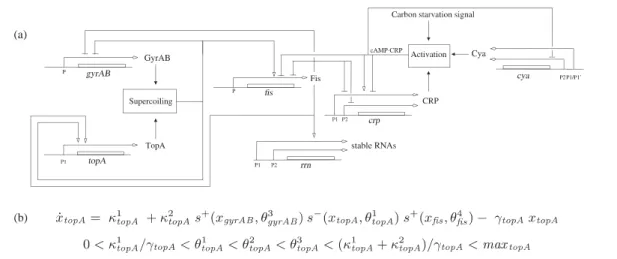
During my PhD I worked on a method developed for the modeling of relatively large genetic reg-ulatory networks (up to 10-15 genes). These networks are made of genes coding for proteins, mostly transcription factors, and of regulatory influences of the proteins on gene expression. This framework is appropriate to describe a number of processes that mostly rely on intricate gene regulations. A number of developmental processes falls into this realm. On can notably mention the responses to environmental changes, like the sporulation decision in B. subtilis [26] or the adaptation to nutri-tional stress in E. coli [78] (Figure 1(a)), developmental processes, like flower morphogenesis [61] or drosophila development [79], and oscillatory behaviors, like cell cycle [35, 25].
For such complex cell processes, the information needed to develop quantitative models is seldom available. This seriously challenges the biological relevance of the standard quantitative framework used to model such networks: Hill-type models. These models are differential equation models where sigmoidal functions (Hill functions) are used to describe regulatory influences of proteins on gene expression, and more precisely on promoter activity. In particular, when genes are regulated by several transcription factors, obtaining a quantitative description of the regulation function is particularly challenging [80]. In most cases however, qualitative information is available on the "logic" of gene regulation. (a) P1/P1’ CRP P Fis P P1 P2 P1 P2 TopA P2 P1 Supercoiling Activation Carbon starvation signal
GyrAB gyrAB topA crp cya stable RNAs cAMP·CRP Cya rrn fis (b) ˙xtopA= κ1topA + κ 2 topAs +
(xgyrAB, θ3gyrAB) s−(xtopA, θtopA1 ) s +
(xfis, θ4fis) − γtopAxtopA
0 < κ1
topA/γtopA< θ1topA< θ 2 topA< θ 3 topA< (κ 1 topA+ κ 2
topA)/γtopA< maxtopA
Figure 1: Gene regulatory networks and PADE models. Network of key genes, proteins, and regulatory interactions involved in the nutritional stress network in E. coli [78]. (b) Piecewise affine differential equation and parameter inequality constraints for one protein in the network, the topoi-somerase TopA. This model uses step functions s+.
2.2
Reasoning with qualitative constraints on parameters
Several modeling frameworks have been proposed to deal with this problem, most notably logical regulatory models [91] and qualitative piecewise-affine differential equations (PADE) systems [28] (Figure 1(b)). The key idea of PADE system modeling is to abstract Hill functions appearing in Hill-type models by step functions. Step functions do capture the non-linearity and the saturating aspects of Hill functions, which are two critical features of Hill functions for biological relevance. However, the specific shape of the regulatory function, which is generally not known, is abstracted
away. This framework leads to switched affine systems. In each region of the switched system the dynamics can be described and solved very easily. More precisely, transitions from one region to another region can be inferred from qualitative information on parameters. Stated differently, the globally complex problem is recast in a set of locally simple problems. The analysis of such systems relies on the computation of a state transition graph that represents the dynamics of the system in the state space. States represent a partition of the state space into a set of hyperrectangular regions and transitions represent local reachability between regions.
One of the main issues with this and related formalisms arises from the simplifications that are employed. The dynamics of the system changes when protein concentrations cross threshold con-centrations. Within threshold hyperplanes the dynamics is not defined. Even if the set of all regions that are in one or more threshold hyperplanes, called singular regions, is of measure zero in the whole state space, these regions cannot be neglected because they often contain attractors of the dynam-ics. Several attempts to define the dynamics in these regions have been made in PADE and related formalisms [62, 73]. A mathematically satisfying solution has been proposed by Gouzé and Sari us-ing Filippov regularizations [42]. In short, the dynamics is defined in sus-ingular regions as the convex combination of the dynamics in neighboring regular regions. This extension leads to differential in-clusions, defined everywhere, instead of differential equations, defined only almost everywhere [42]. Unfortunately, the analysis of this class of systems necessitated quantitative information on param-eters. Gouzé and de Jong found that using rectangular combinations in place of Filippov’s convex combinations makes it possible to compute the state transition graph representing in an abstract manner the dynamics solely by reasoning with the relative order of the model parameters [28]. This is critical to solve the original problem in a mathematically well grounded manner with qualitative reasoning only.
2.3
Model validation
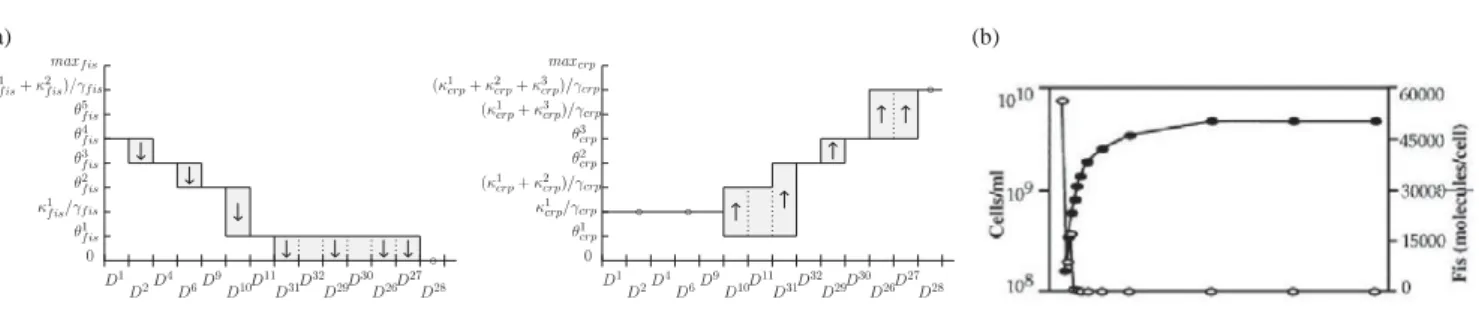
This qualitative framework is ideally suited to test the consistency of our understanding of the functioning of complex biological processes and on the often heterogeneous and qualitative available experimental information. Indeed, because one reasons for large sets of parameter values, simply defined in terms of ordering relations, the predictions obtained by this method are by essence very robust. Therefore, if an observed behavior is not accounted for by a qualitative model, it seriously calls for model revision. Developing an approach for testing the validity of qualitative models of genetic regulatory networks was precisely the topic of my PhD work. The objective is to encode the observed property in some formal framework and test whether the model satisfies this property in an automated and efficient manner. This is precisely the objective of model checking [23]. Over the years, the formal verification community has developed extremely efficient methods for testing whether discrete transition systems are satisfying dynamical properties, often encoded in temporal logic [22, 17]. Temporal logics are flexible languages able to express a broad range of dynamical properties [72]. Therefore this framework is well suited for our problem. However, because the available information is almost exclusively available in arbitrary units, it is important to be able to exploit the information on the direction of the variations. Stated differently, although the exact value of the measures we have is generally meaningless, the information on their change in time contains valuable information. Unfortunately, the level of abstraction of the classical analysis made on PADE models, and the one used by similar formalisms, are too coarse to develop discriminant model validation approaches: often, the sign of the derivative of the variables is unknown, and so could be matched with any observation. The main technical contribution of my thesis is therefore to show that with the existing information on parameters, one can make a finer-grained analysis that leads to a more detailed representation of the dynamics in which derivative signs are known. This lead me to reimplement the core of the qualitative simulator Genetic Network Analyzer1(GNA) developed
by the Helix (now Ibis) group at INRIA [27, 8]. This approach has been applied to the validation of two models of bacterial stress adaptation responses: sporulation in B. subtilis [26] and nutritional stress response in E. coli [78]. In the first case, the comparison with experimental data [71] revealed
that the observed expression pattern of a protein, Hpr, is incompatible with the model. Further analysis showed that this observation is also in contradiction with the role generally assumed for Hpr [89], calling for the experimental validation of Hpr expression pattern. In the second case, we obtained different discrepancies between model and observations during the entry of E. coli cells into stationary phase [73]. This motivated the group to initiate an ambitious research program that lead to the finding that the global regulation of gene expression, neglected in our model as in the vast majority of the experimental studies, has a major role in the adaptation to nutritional stress [15].
θ1 f is θ2 f is κ1 f is/γf is θ3 f is θ4 f is θ5 f is (κ1 f is+ κ 2 f is)/γf is maxf is 0 D28 D26 D29 D31 D6 D2 D10 D1 D4 D9 D11 D32 D27 D30 D28 D26 D29 D31 D6 D2 D10 D1 D4 D9 D11 D32 D27 D30 θ1 crp κ1 crp/γcrp (κ1 crp+ κ 2 crp)/γcrp θ2 crp θ3 crp (κ1 crp+ κ 3 crp)/γcrp (κ1 crp+ κ 2 crp+ κ 3 crp)/γcrp maxcrp 0 ◦ ◦ ◦ ◦ (a) (b)
Figure 2: Model validation. Temporal evolution of the concentration of proteins in the nutritional stress response network during the transition to stationary phase. (a) Predictions for Fis and CRP in a path in the state transition graph generated by qualitative simulation. (b) Observation of Fis concentration (open circles) during the growth-phase transition, as indicated by cell density (closed circles) [4].
2.4
Scaling up
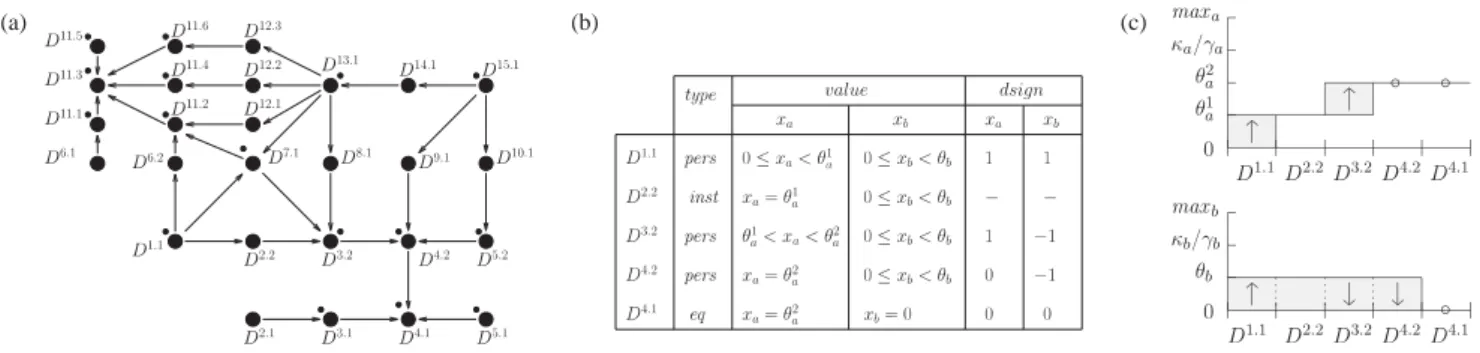
The proposed approach is based on the automated analysis of a class of differential inclusion systems obtained by regularizing the dynamics of differential equation systems with discontinuities. Recently, we found that huge computational gains are possible by using extended step functions [11]. Stated simply, the idea is to define the system directly using differential inclusions, instead of defining the dynamics with differential equations and regularizing it afterwards. Although, this comes at the price of a second (modest) over-approximation, it greatly simplifies the presentation of the approach and, most importantly, the computations to be done. This step has been critical to propose a fully symbolic representation of the dynamics that enabled the use of highly-efficient symbolic analysis tools [21]. The computational gains have been obtained this way significantly extended the class of problems that are solvable via this approach [11]. As often with theory, it takes a lot of efforts to find a simple solution to a complex problem. But then, thanks to its simplicity, or more precisely to its high regularity, this solution then offers key advantage for the resolution of the problem.
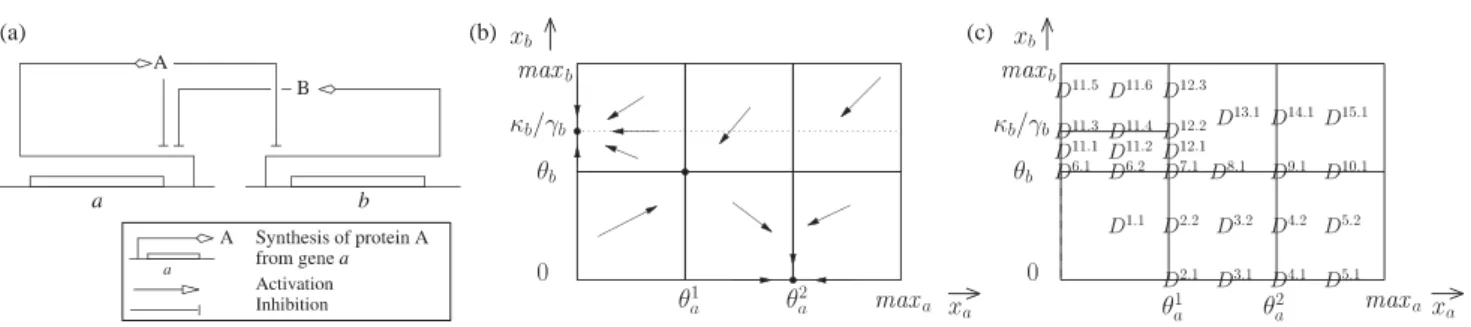
To illustrate the effectiveness of the approach, we considered the problem of parameter search for qualitative models (Figure 3(a)-(b)). By considering all possible parameter orderings, it is possible to explore exhaustively the parameter space. The challenge naturally comes from the combinatorial explosion of the number of parameter orderings -that is of models to analyze- with the increase of the size of the system, that is with the number of genes. The efficiency of the approach has been demonstrated on the redesign of one of the largest synthetic genetic regulatory network constructed so far [18] (Figure 3(c)-(d)). We have been able to find among thousands of possible qualitative parametrizations a handful of parameter orderings that guarantee (in theory!) the robust control of the behavior of the synthetic system.
2.5
Significance and perspectives
Proposed in 2003, the formal verification approach I developed during my PhD was one of the very first work proposing the application of model checking to systems biology problems [9, 10]. Since then model checking approaches for systems biology problems became quite popular (for reviews, see e.g. [30, 46, 36]). To the best of my knowledge, the approach I developed during my PhD
(a) (b)
(c) (d)
Figure 3: Network optimization. (a) Representation of the dynamics of a simple gene network, represented in the state space, for different parameter orderings. (b) Abstract representation of the dynamics of the system, represented by a state transition graph, for different parameter orderings. (c) The IRMA network in yeast: a network for in vivo assessment of reverse-engineering and modeling approaches [18]. (d) Representation in temporal logic formulas of the experimentally-observed gene expression profiles in IRMA.
for the validation of genetic regulatory network models is still the sole approach able to generate a fine grained representation of the dynamics adapted to model validation against real-life experimental data. In retrospect, I explain this by the fact that the approach aiming at defining the problem at the continuous level, solving the various issues that arise at this level, and then abstracting is more effective for solving the issues raised by the discretization of the dynamics than those aiming at defining the dynamics directly at the abstract level. This approach is still lacking the capability to reason in a compositional manner, so as to exploit the modularity in biological systems, as done in [60].
Even if the proposed approach is still one of the most attractive approach to make value of the (essentially qualitative) data that has been produced so far on biological networks, it is not in phase with a strong global trend in molecular and cellular biology: being more and more quantitative. Even if the biological relevance of quantitative precision offered by the novel experimental methods is still often largely questionable (lack of reproductibility, imperfect experimental designs, . . . ), in terms of perspective it is of high interest to develop approaches that can account for all the available information. In this respect, synthetic biology can be considered as a niche for developing model-ing approaches for quantitative systems biology since systems are constructed to be manipulated, observed and optimized. Therefore, during my postdoctoral stay at Boston University I worked on adapting the idea of PADE system analysis to the quantitative problems found in synthetic biology. This line of research is described in the following chapter.
Validation of qualitative models of genetic regulatory networks by model checking: Analysis of the nutritional stress response in E. coli (2005)
G. Batt, D. Ropers, H. de Jong, J. Geiselmann, R. Mateescu, M. Page and D. Schneider Bioinformatics, 21(Suppl 1):i19-i28
The modeling and simulation of genetic regulatory networks have created the need for tools for model validation. The main challenges of model validation are the achievement of a match between the precision of model predictions and experimental data, as well as the efficient and reliable comparison of the predictions and observations. We present an approach towards the validation of models of genetic regulatory networks addressing the above challenges. It combines a method for qualitative modeling and simulation with techniques for model checking, and is supported by a new version of the computer tool Genetic Network Analyzer (GNA). The model-validation approach has been applied to the analysis of the network controlling the nutritional stress response in Escherichia coli.
Efficient parameter search for qualitative models of regulatory networks using symbolic model checking (2010)
G. Batt, M. Page, I. Cantone, G. Goessler, P. Monteiro and H. de Jong Bioinformatics, 26(18):i603-i610
Investigating the relation between the structure and behavior of complex biological networks often involves posing the question if the hypothesized structure of a regulatory network is consistent with the observed behavior, or if a proposed structure can generate a desired behavior. The above questions can be cast into a parameter search problem for qualitative models of regulatory networks. We develop a method based on symbolic model checking that avoids enumerating all possible parametrizations, and show that this method performs well on real biological problems, using the IRMA synthetic network and benchmark datasets. We test the consistency between IRMA and time-series expression profiles, and search for parameter modifications that would make the external control of the system behavior more robust.
3
Optimization of simple synthetic genetic circuits
"It doesn’t matter how beautiful your theory is, it doesn’t matter how smart you are. If it doesn’t agree with experiment, it’s wrong." Richard P. Feynman
3.1
Quantitative yet robust analysis of synthetic genetic circuits
The number of biological processes that have been quantitatively studied with an accuracy that enables the development of biologically relevant quantitative models is still limited. Nevertheless their number is steadily increasing and it is likely that this trend will become a major direction in systems biology in the coming years. This is particularly true in the field of synthetic biology. The objective of synthetic biology is to develop methods that facilitates the engineering of biological systems implementing useful functions [3, 84]. Important potential application domains include the production or biofuels or of other types of biomolecules of technological or medical interest [69], or the development of novel therapeutic strategies like cell or tissue based therapies [38].
The correct functioning of such systems often involves quantitative aspects, constraining for example the minimal output amplitude or the maximal response time of synthetic systems. Therefore the qualitative approaches presented in the previous chapter are not appropriate for such applications. However, because of the intrinsic noisiness of the functioning of biological systems and the fact that they should accomplish their functions despite fluctuating environments, traditional quantitative engineering methods, based on numerical simulation of ordinary differential equation systems, are not appropriate either. One should design systems that behave robustly for sets of parameters or perturbations.
3.2
Reasoning with quantitative constraints on parameters
This objective can be met by using an extension of the previously-presented PADE method. In PADE systems the nonlinear responses of promoter activity, often represented via Hill functions, is abstracted by step functions. The idea here is to use a less drastic abstraction and use instead so-called ramp functions, a class of piecewise affine function. By using many segments, Hill functions can be approximated to any degree of accuracy. As previously, regulation functions describing the promoter activity as a function of the concentrations of its regulators are constructed by combining these elementary functions. This leads to a class of piecewise multiaffine (PWMA) models [6, 13]. This class of models has a nice mathematical property: in entire regions of the state and parameter space, the flow of the system is a convex combination of the flow at extreme points (vertices) of the region [14, 44]. Therefore, it is easy to identify that the flow is monotonic in some regions: the flow at all vertices point in the same direction. A more quantitative version of this intuition states that, given an appropriate partition of the state and parameter spaces, the derivative everywhere in each region is included in the convex hull of the derivatives at the vertices of this region. It is then possible to use the same idea as with qualitative PADE models: defining the state transition graph in which states represent regions of the partition and transitions represent the possibility for the system to go from one region to another. This graph can again be efficiently analyzed by model checking. This allows to identify parameter sets for which one can guarantee that a given behavior is necessarily present or impossible. Because of the approximations that are made, the approach is conservative. When parameter sets are identified as valid, one has the guarantee that this holds. But valid parameters might be missed. This happens when because of the approximations, the approach cannot prove their validity.
To improve the efficiency of the (exhaustive) exploration of the parameter space, one can extend the approach previously sketched as follows. Instead of fully partitioning the parameter space and testing each parameter region, one can partition the parameter space in a dynamic manner. Parameter constraints are added only when needed, leading to a hierarchical approach in which parameter space partitioning and model verification alternate. This approach has been shown to be much more
(but are unions of equivalent classes) and non-trivial theoretical extensions have been needed [12]. This approach has been implemented in the tool RoVerGeNe (standing for robust verification of gene newtorks)2.
(a)
TetR LacI CI EYFP
tetR cI eyfp
aTc
lacI
(b)
˙xtetR= κtetR−γtetRxtetR,
˙xlacI = κlacI ,0+ κlacI(rlacI ,1(xtetR) + rlacI ,2(uaTc) − rlacI ,1(xtetR) rlacI ,2(uaTc)) − γlacIxlacI,
˙xcI = κcI ,0+ κcI rcI(xlacI) − γcIxcI,
˙xeyfp= κeyfp,0+ κeyfpreyfp(xcI) − γeyfpxeyfp,
˙uaTc= 0.
Figure 4: (a) Synthetic transcriptional cascade constructed and characterized in the Weiss lab [48]. (b) Piecewise-multiaffine model of the cascade in (a). This model uses so-called ramp functions r.
3.3
Optimization of synthetic circuits: in silico studies
This approach has been applied to the analysis of a genetic circuit made of a cascade of repressing transcriptional factors [48] (Figure 4). We first generated constraints on protein synthesis parameters so as to optimize the input/output response of the circuit. We found a set of constraints on protein production parameters (Figure 5(a)), suggesting biological modifications of the network, such as tuning ribosome binding sites. Then, we tested the robustness of the newly parametrized system with respect to variations of all its parameters. We found that the systems is guaranteed to satisfy the desired behavior for a relatively large set of parameters: the expected property is satisfied by the system for any parameter fluctuations in ±10% ranges around their nominal values.
101 102 103 104 102 103 104 105 106 [aTc] [EYFP] (a) (b)
Figure 5: (a) Valid parameters in the parameter space as identified by RoVerGeNe (rectangular regions) or by brute-force sampling (dots). κlacI, κcI, and κeyfp are production rate parameters for
three proteins of the transcriptional cascade. (b) Steady-state input/output behavior of the cascade for extreme parameter values in the valid parameter sets represented (a) showing that relevant parameter constraints have been identified by the approach. The output is expected to remain between the bounds represented by dotted lines.
2. RoVerGeNe is freely available for academic research. It can be downloaded from the address: http://iasi.bu.edu/∼batt/rovergene/rovergene.htm
The property of interest stated that at steady state the output of the system should remain between given bounds, these bounds depending on the input (Figure 5(b)). Therefore, to express this property in temporal logic, one typically states that eventually some constraints hold and that they will then remain always true. To test whether a property eventually hold, one should consider trajectories of the system where the time diverges (ie is unbounded). Because time is abstracted away in the state transition graph that is analyzed by model checking, a specific analysis of the divergence of time in the regions where the attractors lie need to be done before model checking [7]. An extension to capture more quantitative constraints on the time spent in regions of the state space has been carried out subsequently using timed automata and timed logics instead of discrete transitions systems and temporal logics [59].
3.4
Significance and perspectives
One should insist here on the computational difficulty of the problem. Indeed one tries to prove that a global dynamical property holds for a 4 dimensional nonlinear system and for all parameters in an 11 dimensional parameter space. We have demonstrated that the approach is computationally feasible for systems of reasonable complexity as typically encountered in the field (the typical size of synthetic gene network is 2 to 6 genes). Yet, scalability to larger systems would be an issue, since the complexity of the approach scales exponentially with the dimensionality of the system.
However, the main drawback of this and the previous approach on PADE models is that the discrete abstractions suffer from the well-known transitivity problem. In short, the problem is en-countered when solutions can go from a region A to a region B, and from a region B to a region C, but no solution traverses the A, B, and C regions. Such information will be lost in the abstractions in which transitions from A to B and from B to C will exists. There is no information to infer that the sequence of transition A→B →C is not valid. As a consequence, one might not be able to prove that some property hold based on the state transition graph. For large classes of properties of interest the conservativeness of the approach might prevent from performing informative analyses. This is an intrinsic limitation of any approaches using discrete abstractions. A second limitation comes from the treatment of parameter uncertainties. In our models, parameters are assumed to lie in sets, however, they can in principle vary in a unbounded manner in these sets across time. While it is true that parameters are likely to fluctuate in time, assuming that all temporal variations are admissible within the given bounds leads to overly conservative results. An alternative approach is to work with parameter distributions. That is, instead of set-valued uncertainties we consider probabilistic uncertainties. This second approach is employed in the next chapter.
Robustness analysis and tuning of synthetic gene networks (2007) G. Batt, B. Yordanov, C. Belta and R. Weiss
Bioinformatics, 3(18):2415-2422
The goal of synthetic biology is to design and construct biological systems that present a desired behavior. The construction of synthetic gene networks implementing simple functions has demon-strated the feasibility of this approach. However, the design of these networks is difficult, notably because existing techniques and tools are not adapted to deal with uncertainties on molecular con-centrations and parameter values. We propose an approach for the analysis of a class of uncertain piecewise-multiaffine differential equation models. This modeling framework is well adapted to the experimental data currently available. Moreover, these models present interesting mathematical properties that allow the development of efficient algorithms for solving robustness analyses and tuning problems. These algorithms are implemented in the tool RoVerGeNe, and their practical applicability and biological relevance are demonstrated on the analysis of the tuning of a synthetic transcriptional cascade built in Escherichia coli.
4
Investigating dynamical properties of complex networks
"Un état dangereux : croire comprendre" Paul Valéry
4.1
Quantitative analysis of large biological networks
In my previous works, I considered methods that enabled to reason for sets of parameters. The preeminent advantage of these approaches is that they provide robust predictions of the possible behaviors of the biomolecular system under study. Given the usually high level of uncertainty on precise mechanisms of biomolecular reactions, initial conditions and parameter values, this aspect is of utmost importance for systems and synthetic biology applications. By using highly efficient tools from formal methods, one can exhaustively test dynamical properties of interest in the whole state and parameter spaces. The exhaustiveness of the search is important for model (in)validation. We have been able to identify that a previously-proposed qualitative model of nutritional stress response in E. coli cannot account for the observed protein variations during and after the transition to stationary phase or to propose robust network modifications to improve the all-or-none response of a synthetic transcriptional cascade in E. coli.
However, these approaches suffer from discrete abstraction problems. In both cases, the idea is to partition the state space, compute local reachability properties (ie reachability between regions of the partition), and define a state transition graph where nodes are regions and transitions represent the possibility to go from one region to another. Therefore this state transition graph is an abstract representation of the dynamics: to each trajectory of the original system corresponds a path in the graph. The problem comes from the fact that the converse does not necessarily hold: some paths in the graphs correspond to no real trajectory. The fact that one trajectory can reach region B from A and that another con reach region C from B will result in the presence of a path reaching C from A in the graph irrespectively of the existence of trajectories of the original system reaching C from A: discrete abstraction creates spurious trajectories. They often severely limit the prediction capabilities of discrete-abstraction-based approaches.
A well-known alternative to model parameter uncertainty is to work with the set of trajectories that one obtains by considering dynamical systems with parameter distributions. The behavior of such systems can then be seen as an (infinite) number of trajectories forming "tubes" of various densities in the state space. Like discrete abstraction methods, scalability is an issue. When the size of the system increases, the volume of the space to analyze or to sample increases exponentially. Moreover, because biologically-relevant distributions for parameters and initial conditions have generally an unbounded support (e.g., normal and log-normal distributions), a very broad diversity of behaviors are possible with low probability. Therefore one is then confronted to the analysis of a large number of trajectories to systematically investigate and visual inspection rapidly becomes impractical. The strategy we developed is to use temporal logic to define the properties of interest and (a quantitative version of) model checking to test whether (or more precisely how well) the trajectories satisfy the expected properties.
4.2
Reasoning with large sets of trajectories
Typical properties that interest systems and synthetic biologists include verifying that the output of a three-stage transcriptional cascade in E. coli has reached the desired value in at most 7 hours, or that caspase-3 is never activated before caspase-8 during apoptosis in certain mammalian cell lines. Then, how can one relate these biological properties with the (infinite) set of trajectories generated by the corresponding models? Because parameter distributions are generally unbounded, asking that such properties always hold does not make much sense. In fact, one would like to get a score on how well trajectories satisfy the properties of interest so that statistics or optimization can be made, typically for robustness evaluation or optimization purposes.
The solution that we proposed is to use temporal logic to encode the desired dynamical properties and a quantitative interpretation of their satisfaction or violation. The notion of satisfaction degree
of a temporal logic property captures whether a specific behavior satisfies (or violates) robustly the property. With this tool, one can then represent graphically in the space of parameters or of initial conditions the satisfaction degree of various properties, use them to perform statistics or optimization, or even apply global sensitivity analysis methods to identify the parameters that are most influential for the property [76, 88].
In what follows, this idea is applied to two problems. In the first case, we propose to use temporal logic as a property specification language and present a computational framework that enables the computation of the robustness of many properties in a unique setting. In the second case, we show that temporal logics can be used to encode precisely observed system behaviors and that this enable to systematically challenge model predictions for various experimental observations and cell types.
4.3
Application to robust timing of a synthetic transcriptional cascade
In a seminal paper Kitano defined the robustness of a property a of a system s with respect to a set of perturbations P as the average of an evaluation function Dsa of the system over all perturbations
p ∈ P, weighted by the perturbation probabilities prob(p) [53]: Rs a,P =
R
p∈Pprob(p) D s adp
Unfortunately, Kitano does not provide much information on how to define the so-called evaluation function Ds
a of the system. This function should determine if the system still maintains its function
under a perturbation and to what degree. The evaluation function needs to be defined for each specific problem in an ad-hoc manner. In [74, 75] we introduce the notion of satisfaction degree sd(Tp, φ) of a trajectory Tp of the system under perturbation p with respect to the temporal logic
property φ and show that one can then provide a generic computational for the robustess simply by using sd(Tp, φ) in place of Das in Kitano’s definition.
In [75] we investigate whether the transcriptional cascade constructed in [48] and presented in the previous chapter can robustly be used as a biological timer. The response of the cascade to the addition of an inducer is characterized by a rapid increase of the fluorescence preceded by a significant lag-phase. This system could therefore be used as a timer for synthetic biology applications, for example for developmental programs. Unfortunately, the heterogeneity of the cell responses may prevent its robust use as a timer. Indeed, having even a low proportion of cells sending a signal too early or too late might compromise the correct functioning of the whole system.
To investigate the robustness of the "well-timed" behavior of the cascade, we developed a Hill-type model and searched for parameter distributions that fitted the observed mean and variance. Then simulation and model checking showed that the property was not fully robustly satisfied and global optimization was used to optimize the robustness of the behavior of the cascade. Interestingly, with the proposed parameter modifications, the variability is reduced at moments that are important for the specification as expected, but increased at less constrained times, suggesting the existence of a robustness/fragility trade-off.
Finally, we used global sensitivity analysis to study how parameter changes affect the robustness of the property. Our analysis suggested that heterogeneities in growth rates have a strong influence on the robustness of the property and that the performance of the cascade is limited by the fact that one repressor is not fully able to robustly repress its target gene.
4.4
Application to the comparison of different apoptotic responses in different
cell types
In higher eukaryotic cells, a given environmental signal is processed in different manners in different cell types. Although the identification of the exact origins of such differences is still an open problem of major importance, experimental evidence indicates that subtle differences in the concentrations of signal transduction proteins may have an important impact. In [1], Sorger and colleagues provide detailed experimental data on extrinsic apoptosis in three cell types and propose a model of this pathway for these three different cell types. In agreement with the current understanding, cell type models have the same set of reactions but different initial protein concentration distributions. However, in [1] model predictions have not been systematically compared with the produced data.
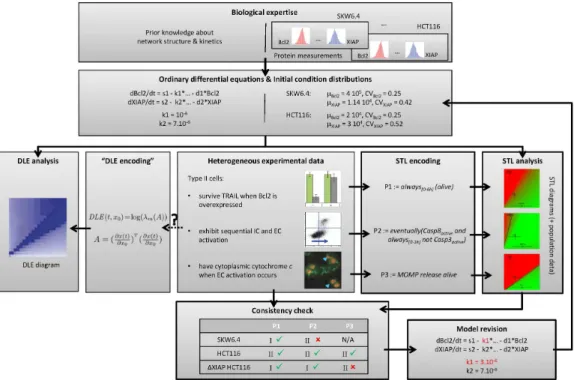
In [88], we encode in temporal logic a set of observation dealing with the relative order of caspases activation, the necessity of mitochondria outer membrane permeabilization (MOMP) for effector caspase activation, and the survival of cell lines overexpressing Bcl2. All these properties deal with the role of mitochondria in cell death and are interchangeably used to classify cell lines in two types: type I (mitochondria independent death) and type II (mitochondria dependent death). Then, using simulation and model checking, we systematically tested the consistency of all observed behaviors with respect to all cell lines. This systematic procedure illustrated that these three properties are not equivalent and therefore result in inconsistent type I/II cell line classifications.
Figure 6: Property-based model analysis framework. Heterogeneous observations on the system are formalized as STL properties. Consistency between model and experimental observations is tested via STL diagrams and population data. Inconsistencies can be resolved via property-guided model revision. In contrast to the DLE-based approach proposed by Aldridge and colleagues [1], STL properties explicitly encode specific aspects of cell’s response, in our case, of the role of mitochondria in type I/II apoptosis.
4.5
Significance and perspectives
The analysis of large ODE models is challenging. To obtain a reasonable picture of the dynamics, one needs to simulate many trajectories for many different initial conditions and parameter values. Visual inspection of the resulting set of trajectory then becomes impractical.
Temporal logics are property specification languages. They allow to express a broad class of observed or expected behaviors in a precise manner. Moreover recent theoretical developments introduced the notions of satisfaction degree for temporal logic formula evaluated on numerical traces. This is a significant contribution since the usual tools for the analysis of high dimensional systems (global sensitivity analysis, global optimization, etc) operate on real-valued quantities. Using the natural Boolean interpretation of temporal logic formulas would be inappropriate. A last advantage of temporal logics is their simplicity. A number of interesting properties can be expressed in an intuitive manner. On the negative side, the apparent simplicity to express properties can be misleading. It is
sometimes difficult to identify that what one has written is not exactly what one intended to write. Still, one should hope that these formal methods will be widely adopted by computational biologists working in systems and synthetic biology communities.
In comparison to the set-based approached presented in the previous chapters, deterministic models with parameter distributions adopt an other extreme view on parameter values. As seen previously, in set-based approaches, parameters can vary in an arbitrary manner across time within given bounds. That is, the model does not exclude behaviors in which parameters would jump at each time instant between two extreme values. This is obviously not realistic. In the probabilistic models that we presented here, parameters are initially sampled according to distributions, but then keep their values in time. Given that the physiology of the cell necessarily changes in time, let alone because it ages, this assumption is certainly not valid either. Therefore efforts should be made to develop a modeling framework in which parameters could slowly change in time. Experimental efforts should accompany these modeling developments to provide data to constrain the novel parameter fluctuation models. This will be all the more important that the duration of the experimentation increases.
A general computational method for robustness analysis with applications to synthetic gene networks (2009)
A. Rizk, G. Batt, F. Fages and S. Soliman Bioinformatics, 25(12):i169-i178
Robustness is the capacity of a system to maintain a function in the face of perturbations. It is essential for the correct functioning of natural and engineered biological systems. Robustness is generally defined in an ad-hoc, problem-dependent manner, thus hampering the fruitful develop-ment of a theory of biological robustness, advocated by Kitano [Mol Syst Biol, 3:137, 2007]. In this paper, we propose a general definition of robustness that applies to any biological function expressible in temporal logic LTL, and to broad model classes and perturbation types. Moreover, we propose a computational approach and an implementation in BIOCHAM 2.8 for the automated estimation of the robustness of a given behavior with respect to a given set of perturbations. The applicability and biological relevance of our approach is demonstrated by testing and improving the robustness of the timed behavior of a synthetic transcriptional cascade that could be used as a biological timer for synthetic biology applications.
STL-based analysis of TRAIL-induced apoptosis challenges the notion of type I/type II cell line classification (2013)
S. Stoma, A. Donzé, F. Bertaux, O. Maler, G. Batt PLoS Computational Biology, 9(5):e1003056
Extrinsic apoptosis is a programmed cell death triggered by external ligands, such as the TNF-related apoptosis inducing ligand (TRAIL). Depending on the cell line, the specific molecular mechanisms leading to cell death may significantly differ. Precise characterization of these differ-ences is crucial for understanding and exploiting extrinsic apoptosis. Cells show distinct behaviors on several aspects of apoptosis, including (i) the relative order of caspases activation, (ii) the necessity of mitochondria outer membrane permeabilization (MOMP) for effector caspase acti-vation, and (iii) the survival of cell lines overexpressing Bcl2. These differences are attributed to the activation of one of two pathways, leading to classification of cell lines into two groups: type I and type II. In this work we challenge this type I/type II cell line classification. We encode the three aforementioned distinguishing behaviors in a formal language, called signal temporal logic (STL), and use it to extensively test the validity of a previously-proposed model of TRAIL-induced apoptosis with respect to experimental observations made on different cell lines. After having solved a few inconsistencies using STL-guided parameter search, we show that these three criteria do not define consistent cell line classifications in type I or type II, and suggest mutants that are predicted to exhibit ambivalent behaviors. In particular, this finding sheds light on the role of a feedback loop between caspases, and reconciliates two apparently-conflicting views regarding the importance of either upstream or downstream processes for cell-type determination.
More generally, our work suggests that these three distinguishing behaviors should be merely considered as type I/II features rather than cell-type defining criteria. On the methodological side, this work illustrates the biological relevance of STL-diagrams, STL population data, and STL-guided parameter search implemented in the tool Breach. Such tools are well-adapted to the ever-increasing availability of heterogeneous knowledge on complex signal transduction pathways.
5
Computer-assisted control of biocellular processes
"What I cannot control, I do not understand." Freely adapted from Richard P. Feynman
5.1
Real-time control in systems and synthetic biology
How predictive can models be? This question is critical for quantitative systems biology. The objective of this field is to propose explanation to observed phenomena in terms of well defined biological processes. Adaptation to an hyper-osmotic stress in yeast results from the activation of enzymes via a signal transduction pathway and subsequent synthesis of glycerol. To test whether our understanding can quantitatively explain observations, models are proposed that should at the very least account for the observations, and in the best cases, should predict new situations.
Yet, it is apparent that models have a very limited predictive power. It is rarely the case that a model developed to account for observation made in one specific context extends easily to obser-vations made in a slightly different context. Does it indicate that our understanding is inaccurate or is it something that is to be expected given the importance of the cellular context for biological processes? This is a very fundamental question at the core of systems biology research.
To address this problem, I proposed to consider real-time model predictive control (MPC) prob-lems. Given a target temporal profile for the output and a model of the system, the problem is to find how to play with the input so that the desired output behavior is obtained. In close collaboration with Pascal Hersen, we developed an automated experimental platform that in real time observes the current state of a biological process (outputs) and acts on it (inputs) based on algorithms for state estimation, parameter inference and active control.
With this platform, one can investigate model predictive power from different perspectives. How performance degrades when observation times are more distant in time? Answering this question will give us valuable information on the predictive horizon of our models. Can we get better performance with more detailed models? Answering this question enables us to compare the predictive power of different models.
5.2
Proof of principle: controlling gene expression in yeast
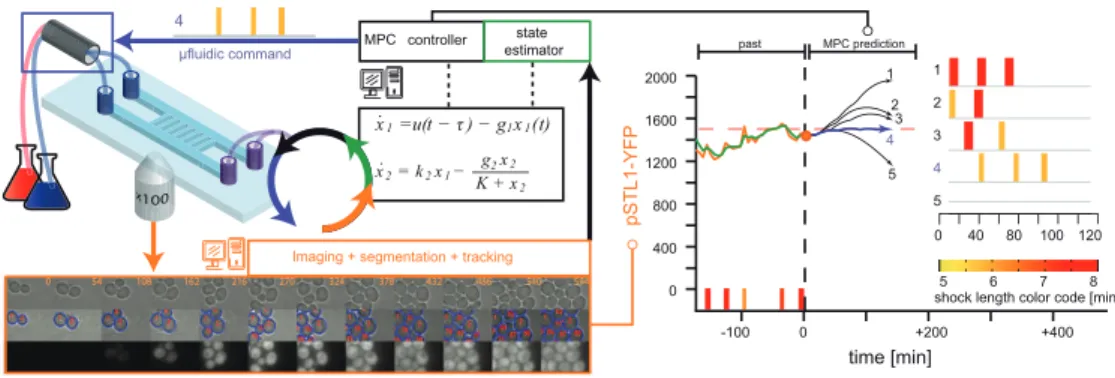
To demonstrate the potential of the approach, we considered the problem of controlling gene expression in yeast cells by using a osmoresponsive promoter and applying osmotic stresses to cells. The platform integrates microscopy for monitoring gene expression at the cell level, microfluidics to manipulate the cells environment, and original software for automated imaging, quantification, and online learning or control (Figure 7). The challenges reside in the tight integration of all the platform components and the real time constraint. In particular, the image processing step should be robust enough to be able to track single cells over the full course of the experiment (15hrs) without human assistance. Yet the image analysis process should not last longer than 2 to 3 minutes. All other elements of the platform should comply with the same robustness and efficiency criteria.
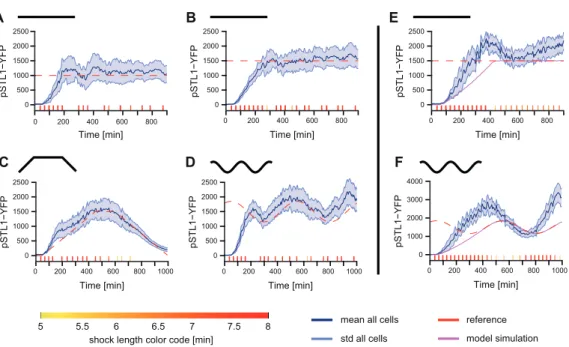
An extremely simple model of the osmostress response pathway has been used. We showed that this model alone is not able to propose temporal input profiles that lead to accurate results (Fig-ure 8(E)-(F); open loop framework). However, when one uses observations on the current state of the cell to adapt the control policy, good control performances are obtained (Figure 8(A)-(D)) [95]. To appreciate the difficulty of the control problems that we addressed, one should keep in mind that the controlled system, a yeast cell, is an extremely complex and partially known dynamical system and that the controlled process, gene expression, is intrinsically stochastic. We are currently investi-gating the effects on control performance of decreasing the sampling rate (in the current framework, observations are made every 6 minutes) or of using more complex models in the controller [97]. This should provide valuable information on the current state of our understanding of the hyperosmotic stress response pathway in yeast.
˙x2= k2x1− g2x2 K + x2 ˙x1=u(t − τ ) − g1x1(t) 4 controller state estimator 0 400 800 1200 p ST L 1 -YF P1600 2000 time [min] -100 0 +200 +400 1 2 3 4 5 1 2 3 4 5 0 40 80 100 120 shock length color code [min]
5 6 7 8
Imaging + segmentation + tracking
μfluidic command MPC past MPC prediction
Figure 7: A platform for real-time control of gene expression in yeast. Yeast cells grow as a monolayer in a microfluidic device which enables to rapidly change the cells’ osmotic environment (valve, blue frame) and to image their response. After image processing (orange frame) the measured yECitrine fluorescence, either of a single cell or of the mean of all cells, is sent to a state estimator connected to a MPC controller. A model (center, black frame) of pSTL1 induction is used to find the best possible series of osmotic pulses to apply in the future so that the predicted yECitrine level follows a target profile. At the present time point (orange disk), the system state is estimated (green) and the MPC searches for the best input profile for the next 2 hours (blue curve). The selected hyperosmotic profile is sent to the microfluidic command. This control loop is iterated every 6 minutes.
5.3
Significance and perspectives
In addition to be a valuable tool to investigate the importance of various factors on the predictivity of models, our real-time control platform is a unique tool for systems biologists to realize well-controlled physiological modifications of the level of proteins in live cells. Stated differently, this enables biologists to perturb cellular processes with an unprecedented accuracy. This can be a very important contribution to dissect the functionning of many biological processes, since identification theory clearly indicates, that the possibilities to understand (ie identify) a process is limited by the possibilities to perturb it (notion of practical identifiability) [96]. This platform also offer perspectives for synthetic biology applications. Indeed, one could separate the actual biological processes that are of interest for the biotechnology or medical application from its control. Indeed, so far, the goal of biologists is to engineer cells that implement a desired function in a fully automated way, meaning that process and control were implemented within cells. However, in many cases it turned out that implementing complex control functions in cells was challenging. Therefore, by offering the possibility to externalize part of the problem, we might offer important solutions to synthetic biology.
Despite the fact that the importance of control theory for systems and synthetic biology has been widely recognized for more than a decade [24, 50], the actual use of in silico feedback loops to control intracellular processes has only been proposed recently. In 2011, we were the first to show that the signaling activity in live yeast cells can be controlled by an in silico feedback loop [94]. Using a proportional-integral (PI) controller we controlled the output of a signal transduction pathway by modulating the osmotic environment of cells in real time. More recently, Toettcher et al. used elaborate microscopy techniques and opto-genetics to control in real time and at the single cell level
0 200 400 600 800 0 500 1000 1500 2000 2500 Time [min] p ST L 1 −YF P A 0 200 400 600 800 0 500 1000 1500 2000 2500 Time [min] p ST L 1 −YF P B 0 200 400 600 800 0 500 1000 1500 2000 2500 Time [min] p ST L 1 −YF P E 0 200 400 600 800 1000 0 500 1000 1500 2000 2500 Time [min] p ST L 1 −YF P C 0 200 400 600 800 1000 0 500 1000 1500 2000 2500 Time [min] p ST L 1 −YF P D F 0 200 400 600 800 1000 0 1000 2000 3000 4000 Time [min] p ST L 1 −YF P
mean all cells std all cells
reference
5 5.5 6 6.5 7 7.5 8
shock length color code [min] model simulation
Figure 8: Real-time control of gene expression can be achieved at the population level. (A) and (B) Set-point control experiments with different target values (red dashed line). The timeline of osmotic events is shown at the bottom of each graph (see color code for shock durations, bottom). Shock starting times and durations are computed in real-time. The measured mean cell fluorescence is shown as solid blue lines. The enveloppes indicate standard deviation of the fluorescence distribution across the yeast population. (C) and (D) Tracking control experiments. In both cases, the mean level of fluorescence successfully follows the time-varying target profile. (E) and (F) Open-loop control experiments. Two examples of open-loop control (the osmotic inputs were computed using our model, before starting the experiments) showing poor control quality. Errors accumulate over time. The simulated behavior of the system is represented in violet.
the localization and activity of a signal transduction protein (PI3K) in eukaryotic cells [92]. Also using optogenetic techniques, Milias-Argeitis et al. managed to control the expression of a yeast gene to a constant target value over several hours [63]. Their approach is based on a chemostat culture and is therefore better adapted to biotechnological applications than to probing biological processes for single-cell quantitative biology applications. These works have been reviewed in Chen et al. [20].
Long-term model predictive control of gene expression at the population and single-cell levels (2012)
J. Uhlendorf, A. Miermont, T. Delaveau, G. Charvin, F. Fages, S. Bottani, G. Batt and P. Hersen PNAS, 109(35):14271-14276
Gene expression plays a central role in the orchestration of cellular processes. The use of inducible promoters to change the expression level of a gene from its physiological level has significantly contributed to the understanding of the functioning of regulatory networks. However, from a quantitative point of view, their use is limited to short-term, population-scale studies to average out cell-to-cell variability and gene expression noise and limit the nonpredictable effects of internal feedback loops that may antagonize the inducer action. Here,we showthat, by implementing an external feedback loop, one can tightly control the expression of a gene over many cell generations with quantitative accuracy. To reach this goal, we developed a platform for real-time, closed-loop control of gene expression in yeast that integrates microscopy for monitoring gene expression at the cell level, microfluidics to manipulate the cells? environment, and original software for auto-mated imaging, quantification, and model predictive control. By using an endogenous osmostress responsive promoter and playing with the osmolarity of the cells environment, we show that long-term control can, indeed, be achieved for both time-constant and time-varying target profiles at the population and even the single-cell levels. Importantly, we provide evidence that real-time control can dynamically limit the effects of gene expression stochasticity. We anticipate that our method will be useful to quantitatively probe the dynamic properties of cellular processes and drive complex, synthetically engineered networks.