HAL Id: tel-01386405
https://hal.inria.fr/tel-01386405v2
Submitted on 10 Jan 2018
HAL is a multi-disciplinary open access archive for the deposit and dissemination of sci-entific research documents, whether they are pub-lished or not. The documents may come from teaching and research institutions in France or abroad, or from public or private research centers.
L’archive ouverte pluridisciplinaire HAL, est destinée au dépôt et à la diffusion de documents scientifiques de niveau recherche, publiés ou non, émanant des établissements d’enseignement et de recherche français ou étrangers, des laboratoires publics ou privés.
Unveiling and Controlling Online Tracking
Jagdish Prasad Achara
To cite this version:
Jagdish Prasad Achara. Unveiling and Controlling Online Tracking. Mobile Computing. Université Grenoble Alpes, 2016. English. �NNT : 2016GREAM069�. �tel-01386405v2�
THÈSE
Pour obtenir le grade de
DOCTEUR DE LA COMMUNAUTÉ UNIVERSITÉ
GRENOBLE ALPES
Spécialité : Informatique Arrêté ministériel : 7 août 2006
Présentée par
Jagdish
Prasad Achara
Thèse dirigée par Claude Castelluccia
et codirigée par Vincent Roca and Aurélien Francillon
préparée au sein d’Équipe Privatics, Inria, Grenoble-Rhone Alpes et de l’École Doctorale MSTII
Unveiling
and Controlling Online
Tracking
Thèse soutenue publiquement le 18 octobre 2016, devant le jury composé de :
Prof. Dr. Bernard Tourancheau
Professor, Université Grenoble Alpes, Président
Prof. Dr. Thorsten Strufe
Professor, TU Dresden, Rapporteur
Dr. Marc-Olivier Killijian
Directeur de Recherche, CNRS-LAAS, Rapporteur
Dr. Nikolaos Laoutaris
Senior Researcher, Telefonica, Examinateur
Dr. Vincent Toubiana
Technologist, CNIL, Examinateur
Dr. Claude Castelluccia
Directeur de Recherche, Inria, Directeur de thèse
Dr. Vincent Roca
Chargé de Recherche, Inria, Co-Directeur de thèse
Dr. Aurélien Francillon
Abstract
The main business model of free content and services on the Internet is advertising. As a result, online advertising has become ubiquitous, be it in smartphone apps or on the Web. To deal with the vast demand and supply of ads, various intermediary companies (such as ad platforms and ad exchanges) have come into existence and started to economically compete with each other. As targeted ads are believed to generate better revenues, these companies are massively tracking and profiling users. It has resulted in a privacy nightmare for most Internet users.
This thesis takes a multi-dimensional approach to tackle the problem of privacy in online advertising. First, it encompasses both smartphones and the Web as they are the two major Internet enablers. Second, we act upon all stakeholders: operating system (OS) providers, app developers, advertising and analytics (A&A) companies, webpage publishers, regulators, and users. In fact, by acting upon all stakeholders, we aim to address the privacy problems both at the origin (like the OS providers, A&A companies, and app developers) and at the end user side.
In case of smartphones, the contributions of this thesis address the privacy problems at the origin. It is done by revealing the bad privacy practices employed by different stake-holders (such as A&A companies, app developers, and OS providers) and then, proposing possible countermeasures. To detect privacy leaks on smartphones, we design and imple-ment MobileAppScrutinator, a simple yet efficient dynamic analysis technique for Android and iOS. Using it, we measure and compare user tracking and private data leaks on An-droid and iOS. This measurement study brings transparency into the system and forces app developers and OS manufactures to take action as their bad privacy practices are revealed to users as well as regulators.
We show how innocuous Android permissions can be exploited by A&A companies to track and profile users. For example, we find that 41% apps (of the 2700 most popular apps on the PlayStore) ask for ACCESS_WIFI_STATE permission even though most of them do not need it for their functionality. In fact, some apps (mostly through the included ad libraries) geo-localise users using this permission without asking for location-specific permissions. Our findings again had a direct impact as Android permission system was later changed and a US-based regulator (FTC) fined one million dollars in 2016 to an ad company (InMobi) for exactly the same issue we reported in 2014.
We also show that the list of installed apps on smartphones is very unique and therefore, there is a significant risk of re-identification of users if a pseudo-anonymised dataset of the list of installed apps is released. As this list is available to be accessed by Android apps without requiring any user permission and as A&A companies implicitly know a subset of installed apps in which they are present, we show that Android poses its users a serious privacy threat. We reported the issue to Google and hope to address the problem at the origin.
In case of the Web, the contributions of this thesis are to provide end users with tools to have more transparency and control over online tracking and advertising. In terms of transparency, these tools allow users to know what profile trackers and advertisers know about them and why an ad is delivered to them. With our proposed tools, users can also
iv
exercise fine-grained control like choosing the categories of web pages where they do not want to be tracked and the kinds of ads they do not want to receive. We believe that providing users with fine-grained control allows them to take social and economic benefits of online advertising while technically enforcing their privacy preferences at the same time. Moreover, such control can also support the current ad-supported economic model of the Web.
Résumé
Cette thèse suit une approche multi-dimensionnelle pour le problème du respect de la vie privée dans l’Internet que nous connaissons aujourd’hui. Nous considérons pour cela les deux principaux modes d’accès, les smartphones et le Web. De plus nous considérons les différents acteurs (fabricants de systèmes d’exploitation, développeurs d’applications, régies publicitaires, éditeurs de contenus Web, autorités de régulation et utilisateurs). En fait, en agissant sur les acteurs, nous essayons de corriger les problèmes de respect de la vie privée à la fois à la source (par exemple au niveau des fabricants de systèmes d’exploitation, des régies publicitaires et des développeurs d’applications) et au niveau des utilisateurs.
Dans le cas des smartphones, cette thèse contribue à corriger les problèmes à leur source, en identifiant et en révélant les mauvaises pratiques pour ensuite proposer des contre-mesures. Dans le cas du Web, nous fournissons aux utilisateurs finaux des outils permettant transparence et contrôle.
Nous avons conçu et réalisé MobileAppScrutinator comme un outil à la fois simple mais efficace d’analyse dynamique pour Android et iOS. Avec l’aide de MobileAppScruti-nator, nous avons mesuré et comparé le traçage des utilisateurs et les fuites de données personnelles des 140 applications les plus populaires à la fois sur Android et iOS. Cette étude apporte de la transparence au système et force les développeurs d’applications et fabricants de systèmes d’exploitation à prendre des mesures car leurs mauvaises pratiques sont exposées au public et aux autorités de régulation.
Nous avons montré qu’une permission d’aspect anodin pouvait être utilisée pour col-lecter des données personnelles et que 41% des 2700 applications les plus populaires de-mandaient cette permission. Nous avons trouvé que certaines d’entre elles (essentiellement au travers de bibliothèques publicitaires tierces incluses) géolocalisent les utilisateurs sans passer par la permission de collecte de géolocalisation. Nos résultats ont ici encore eu un impact direct puisque le système d’autorisation Android est modifiée et le régulateur américain a infligé à la société publicitaire une amende d’environ un million de dollars.
Enfin, nous avons montré que la liste des applications installées sur un smartphone est unique. Par conséquent il y a un fort risque de ré-identification des utilisateurs si un jeu de données pseudo-anonymisées avec des listes d’applications installées venait à être rendu public. Comme la liste des applications installées sur Android est accessible aux applications sans avoir à obtenir de permission dédiée, Android expose là aussi l’utilisateur à de sérieuses menaces en termes de vie privée.
Nous avons ensuite fourni aux utilisateur du Web des outils qui apportent transparence et contrôle vis à vis des techniques de traçage et de ciblage publicitaire. En termes de transparence, les utilisateurs peuvent savoir pourquoi une publicité leur est délivrée, quel profil les sociétés de traçage et régies publicitaires connaissent d’eux. Nos outils permettent également aux utilisateurs d’avoir un contrôle précis. Par exemple, les utilisateurs peuvent choisir les catégories de pages où ils ne désirent pas être tracés ainsi que le type de publicités qu’ils ne veulent pas recevoir. En fait, fournir un tel contrôle est essentiel pour permettre au modèle économique du Web, basé sur la publicité, de perdurer.
Mots-clés: Vie privée, Web, Smartphones v
List of Publications During the PhD
International Conferences, Workshops and Journals
Jagdish Prasad Achara, Javier Parra-Arnau, and Claude Castelluccia. MyTracking-Choices: Pacifying the Ad-Block War by Enforcing User Privacy Preferences. The 15th Annual Workshop on the Economics of Information Security (WEIS), 2016 Jagdish Prasad Achara, Gergely Acs, and Claude Castelluccia. On the Unicity of Smartphone Applications. In The 14th ACM Workshop on Privacy in the Electronic Society (ACM WPES), 2015
Gergely Acs, Jagdish Prasad Achara, and Claude Castelluccia. Probabilistic Km-anonymity: Efficient Anonymization of Large Set-valued Datasets. In IEEE Interna-tional Conference on Big Data (IEEE Big Data), 2015
Célestin Matte, Jagdish Prasad Achara, and Mathieu Cunche. Device-to-identity Linking Attack Using Targeted Wi-fi Geolocation Spoofing. In The 8th ACM Con-ference on Security & Privacy in Wireless and Mobile Networks (ACM WiSec), 2015 Jagdish Prasad Achara, Mathieu Cunche, Vincent Roca, and Aurélien Francil-lon. Short Paper: WifiLeaks: Underestimated Privacy Implications of the Ac-cess_Wifi_State Android Permission. In The 7th ACM Conference on Security and Privacy in Wireless & Mobile Networks (ACM WiSec), 2014
Jagdish Prasad Achara, James-Douglass Lefruit, Vincent Roca, and Claude Castel-luccia. Detecting privacy leaks in the RATP App: how we proceeded and what we found. Journal of Computer Virology and Hacking Techniques (Springer JCVHT), 2014
Under Submission
Jagdish Prasad Achara, Vincent Roca, Claude Castelluccia, and Aurélien Francillon. MobileAppScrutinator: A Simple yet Efficient Dynamic Analysis Approach for De-tecting Privacy Leaks across Mobile OSs. Submitted to The 32nd Annual Computer Security Applications Conference (ACSAC), 2016
Javier Parra-Arnau, Jagdish Prasad Achara, and Claude Castelluccia. MyAdChoices: Bringing Transparency and Control to Online Advertising. Submitted to The ACM Transactions on the Web (ACM TWEB), 2016
Acknowledgements
Firstly, I sincerely thank my advisers, Claude Castelluccia, Vincent Roca, and Aurélien Francillon. Without their continuous support and motivation, this work would not have been possible. They showed great patience while responding to my countless questions and were always available when I needed them. They provided me with a good balance between freedom of work and guidance. I could not have imagined having better and friendly advisors to complete this journey.
I’m sincerely thankful to all other co-authors in alphabatical order: Celestin, Gergely, James, Javier, and Mathieu. I have learnt a lot while working with them and it has indeed been a pleasant experience. If I can say one thing that I learnt from them, I would say: Gergely introduced me to the beautiful world of zeal towards learning new things (it gives me immense pleasure to learn new things now), I hope that one day I can have the same patience and organisation capabilities as Javier, and finally, I can enjoy the research as much as Mathieu by being creative and doing one thing at a time.
I would like to express my sincere gratitude to Prof. Dr. Thorsten Strufe and Dr. Marc-Olivier Killijian for reviewing this dissertation. I would also like to thank other jury members: Prof. Dr. Bernard Tourancheau from UGA, Dr. Nikolaos Laoutaris from TID, Barcelona, and Dr. Vincent Toubiana from CNIL. It is a great honor for me that they accepted to be part of my jury.
I cannot restrain myself from saying many thanks to Amrit, Levent, and Pierre. They have been very helpful to me: giving practical advices on just about anything, helping me in administrative tasks, proof-reading my papers, and many more. In the cafeteria, we had interested discussions. Merci beaucoup à vous tous. My thanks also go to others whose names I forgot to mention here.
Last but not the least, I do not have enough words to say thanks to my wife. I cannot forget her sacrifice on many occasions: when I had to work on weekends, late night deadlines, mood switches, burnouts, not responding to her calls, my absence when she needed me the most, and many more. I will always be grateful to my parents: they have been amazing and let me choose what I wanted to do in my life. Their continuous love, support, and encouragement is the key to my success. No matter how hard I would have tried, it would have been almost impossible for me to get the PhD title without the support of my family.
The work presented in this thesis was supported in part by Cappris (Collaborative Action on the Protection of Privacy Rights in the Information Society), an Inria Project Lab.
Contents
1 Introduction 1
1.1 Context of this work . . . 1
1.1.1 Online Advertising . . . 1
1.1.2 Privacy . . . 2
1.2 Problem statement . . . 2
1.3 Contributions . . . 3
1.3.1 Unveiling online tracking on smartphones . . . 4
1.3.2 Unveiling and controlling tracking on the Web . . . 5
1.4 Organisation of the thesis . . . 5
I Unveiling Online Tracking on Smartphones 7 2 Measuring Private Data Leaks using MobileAppScrutinator 11 2.1 Introduction . . . 11
2.2 Related work . . . 13
2.2.1 Tracking measurement technology . . . 13
2.2.2 Measurement of PII leakage . . . 14
2.3 MobileAppScrutinator . . . 14
2.3.1 Implementation on Android . . . 15
2.3.2 Implementation on iOS . . . 16
2.3.3 Post-analysis of SQLite Data . . . 17
2.3.4 Limitations . . . 17
2.4 Experimental Setup . . . 17
2.5 Cross-App Third-Party Tracking . . . 18
2.5.1 Unique identifiers from the system . . . 18
2.5.2 Unique identifiers generated by third-parties . . . 20
2.5.3 Comparation of third-party tracking on Android and iOS . . . 21
2.6 Collection of other personal information . . . 21
2.6.1 Android . . . 21
2.6.2 iOS . . . 23
2.6.3 Comparison between Android and iOS . . . 23
2.7 Discussion . . . 23
2.7.1 Comparing MobileAppScrutinator on Android with TaintDroid . . . 23
2.7.2 Effectiveness of various privacy safeguards . . . 24
2.8 Conclusion . . . 25
3 User Tracking through Innocuous Android Permissions 27 3.1 Introduction . . . 27
3.2 Background and Related Work . . . 28
3.2.1 Android Permission System . . . 28 xi
xii CONTENTS
3.2.2 Related Work . . . 29
3.3 User PII Inferred from Wi-Fi Data . . . 29
3.4 Android Applications Analysis . . . 31
3.4.1 Static analysis . . . 31
3.4.2 Dynamic analysis . . . 34
3.5 User perception . . . 35
3.5.1 Survey description . . . 35
3.5.2 Results of the survey . . . 36
3.6 Conclusion and Potential Solutions . . . 37
4 Measuring Re-identification Risk Posed by Smartphone Apps 39 4.1 Introduction . . . 39
4.2 Unicity as a measure of re-identifiability . . . 41
4.3 Approximating unicity with sampling . . . 41
4.3.1 Biased vs. unbiased estimation of unicity . . . 41
4.3.2 Uniform sampling of K-apps . . . 42
4.3.3 Computing the sample size . . . 44
4.4 Evaluation . . . 45
4.4.1 Dataset characteristics . . . 45
4.4.2 Results . . . 46
4.5 Unicity Generalization for larger datasets . . . 47
4.6 Related work . . . 51
4.7 Conclusion . . . 52
II Unveiling and Controlling Tracking on the Web 53 5 MyAdChoices: Bringing Transparency and Control to Advertising 57 5.1 Introduction . . . 57
5.1.1 Contribution and Plan of this Chapter . . . 58
5.2 Background in Online Advertising . . . 60
5.2.1 Key Actors . . . 60
5.2.2 Ad-Serving Process . . . 61
5.2.3 User-Targeting Objectives . . . 62
5.2.4 Cookie Matching and Real-Time Bidding . . . 63
5.3 Detection of Profile-based Ad-Serving and Profile Uniqueness . . . 64
5.3.1 Statistical and Information-Theoretic Preliminaries . . . 65
5.3.2 Detection of Profile-based Ads . . . 66
5.3.3 Detection of Profile Uniqueness . . . 72
5.4 “MyAdChoices” — an Ad Transparency and Blocking Tool . . . 74
5.4.1 Main Functionalities . . . 74
5.4.2 System Architecture and Implementation Details . . . 76
5.5 Evaluation . . . 84 5.5.1 Data Set . . . 84 5.5.2 Results . . . 84 5.6 Related Work . . . 90 5.6.1 Ad Blockers . . . 90 5.6.2 Advertising Transparency . . . 91
xiii
6 MyTrackingChoices: Giving Users Fine-grained Control over Tracking 97
6.1 Introduction . . . 97
6.2 Related work . . . 99
6.3 MyTrackingChoices . . . 100
6.3.1 New approach to ad blocking . . . 100
6.3.2 Implementation Details . . . 101
6.4 Economic Impact . . . 103
6.4.1 Analysis . . . 104
6.5 Usability and Performance Evaluation . . . 107
6.5.1 Usability . . . 107
6.5.2 Performance . . . 108
6.6 Presence of Trackers . . . 109
6.7 Conclusion and Future Work . . . 110
7 Discussion, Conclusion, and Future Directions 113 A Measuring Private Data Leaks using MobileAppScrutinator 117 B Measuring Re-identification Risk posed by Smartphone Apps 123 B.1 Proof of Theorem 1 . . . 123
B.2 Proof of Theorem 2 . . . 124
C MyAdChoices 125 C.1 Feasibility Problem . . . 125
C.2 Linear-Program Formulation of the Robust Minimax Detector . . . 125
Chapter 1
Introduction
Contents
1.1 Context of this work . . . 1
1.1.1 Online Advertising . . . 1
1.1.2 Privacy . . . 2
1.2 Problem statement . . . 2
1.3 Contributions . . . 3
1.3.1 Unveiling online tracking on smartphones . . . 4
1.3.2 Unveiling and controlling tracking on the Web . . . 5
1.4 Organisation of the thesis . . . 5
1.1
Context of this work
The context of this work is investigating and enhancing privacy in advertising on the Internet. Below we give a necessary overview of online advertising and privacy on the Internet.
1.1.1 Online Advertising
During the last two decades, the Internet has been gradually integrated into people’s daily lives, enabling new forms of communication. The so-called network of networks has become an essential communication channel not only among people, but also among businesses and their customers.
Breathing new life into traditional business activities is one of the Internet’s most relevant influences. The Internet has led to key business changes embracing the whole value chain in almost all sectors and companies. These changes have had an impact on how products are sold and also more importantly, on how companies approach customers in a personalised manner, taking into account their unique preferences.
The industry of advertising is a clear example of the transformation driven by the ever-growing sophistication of Internet technologies. In the past, ads were served directly following a one-size-fits-all approach. But due to the gradual introduction of intermedi-ary companies with extensive capabilities to track users, Internet advertising has become increasingly personalised and pervasive.
The ability of the online marketing industry to track and profile users’ Web-browsing activity is therefore what enables more effective, tailored advertising services. The intru-siveness of these practices and the increasing invaintru-siveness of digital advertising, however,
2 CHAPTER 1. INTRODUCTION
have raised serious concerns regarding user privacy and usability. According to recent sur-veys, two out of three Internet users are worried about the fact that their online behaviour is being scrutinised without their knowledge and consent [177]. Numerous studies in this same line reflect the growing level of ubiquity and abuse of advertising, which is perceived by users as a significant degradation of their browsing experience [39, 154, 171].
1.1.2 Privacy
What is privacy and why is it hard to achieve? Even though privacy can be defined in various ways, in this thesis, we define it as follows: if an individual can control the information1 others know about her, she can be said to have privacy. As we see, the definition of privacy is simple and straightforward. But privacy is hard to achieve in practice due to the inability of most users to exert their control over their information. There are multiple reasons for this inability. One reason is that inferences or consequences are not always clear in advance for most users. Another reason why individuals cannot always exert control is the lack of transparency of practices. Finally, lack of technical expertise can be one more reason why people cannot exert the control over their personal information. As most users are not trained to use computers, they do not know how to use online services in a private manner and how to have a proper control over their data. For example, installing add-ons or extensions in a browser in order to block web trackers requires some know-how that is not shared by all users.
Why is privacy important? Privacy is essential for individuals and citizens. It is a right granted to individuals that underpins the freedoms of expression, association, and assembly, all of which are needed for a free, democratic society. In other words, loss of privacy leads to loss of freedom. For example, in case of the Internet, freedom of expression is threatened if our Internet usage is surveilled, freedom of association is threatened if our online communications are surveilled, and lastly, freedom of assembly is threatened if our participation is tracked [57].
1.2
Problem statement
The problem of privacy on the Internet today is a fallout of rapid growth in the technology. The technology developed so fast that privacy could not keep the pace with it. Below we discuss the main reasons why the Internet today is suffering from privacy issues. This thesis aims to tackle these reasons:
• Lack of transparency. As already said, on the Internet, users benefit from ad-supported content and services. Marketers track and profile users because targeted ads are believed to bring more revenues. This can be a good trade-off if users are aware of ongoing data collection. But today this is not the case. Most of the time a user cannot answer questions such as: what data is being collected, for what purpose, and how is collected data processed and stored by the data collector? For example, users do not know what apps installed on their smartphones are doing [102, 103, 33, 187, 207], how and by whom they are being tracked over the Web [105], and what data OS provider companies (such as Google and Apple) are collecting [89]. If these important questions remain un-answered, users cannot take appropriate decisions. In a nutshell, the lack of transparency is at the center of the problem because it prevents users from exerting control over their information.
3
• Lack of control. While users browse the Web on their computers, they leave many digital traces. Moreover, new devices (such as smartphones or smartwatches) are being introduced in the lives of people and they generate new kinds of data about users. This data includes various information from in-built sensors, call logs, and other meta-data. Users do not have sufficient tools today to control this data and hence, their information.
• Difficulty of understanding privacy implications. Apart from the problem of transparency, the Internet privacy today suffers from lack of understanding of privacy implications. In other words, individuals may sometimes share additional information unwillingly because they cannot predict what information can be derived from increasingly sophisticated forms of data and services on the Internet [61, 208]. Users sometimes share data because they do not know that some sensitive information (which they would not like to share if they knew) can be derived. For instance, New York Taxi and Limousine Commission (NYC TLC) released pseudo-anonymised trip records for taxis in New-York [195]. Since the database includes passenger pick-up and drop-off dates/times, muslim taxi drivers can easily be identified by looking at the inactivity periods of the drivers [77]. As privacy implications of data are sometimes discovered after the data is shared, users are not always in a position to exert the control over the information they are willing to share with others.
• Lack of viable solutions/tools. Another problem with tools provided to end users today is that they do not take all the aspects into considerations and therefore are not always viable. For example, in case of online advertising on the Web, various tools (such as ad-blockers) [11, 2, 21] are proposed to counter the privacy problems but they do not consider their economic impacts. Therefore, these tools cannot be considered as viable solutions: they create more problems in the long-term than they solve in the mid-term [42].
1.3
Contributions
As privacy is difficult to achieve on the Internet due to aforementioned reasons, various attempts have been made by researchers, technologists, privacy enthusiasts, and regulators to enhance it. In particular we think that the following three directions are of particular importance:
• increase transparency, and therefore the end-user awareness, towards how data is being collected, shared and used while users are connected to the Internet;
• better understand and expose the privacy implications of data we share and services we use;
• give control back to users over their data.
The contributions of this thesis are along these lines. In terms of giving more control to the users, we advocate for making it as fine-grained as possible.
As online advertising is present both in smartphone apps and the Web, this thesis en-compasses the two. Moreover, we act upon all stakeholders to enhance privacy: operating system (OS) providers, app developers, advertising and analytics (A&A) companies, web-page publishers, regulators, and users. This is because we believe that a multi-dimensional approach can tackle the privacy problems in a faster and more efficient manner.
To better understand the global contributions of this thesis, we look at the bigger picture, with all stakeholders. We attempt to tackle the privacy problems either at the
4 CHAPTER 1. INTRODUCTION ```` ```` ```` `` Ecosystem
Approach Solving privacy problems at
the source/origin Empowering users
Smartphones
1) Measuring and revealing bad privacy practices 2) Proposing countermeasures
Transparency and fine-grained control Web
1) Measuring and revealing bad privacy practices 2) Proposing countermeasures
Transparency and fine-grained control Table 1.1: The table gives the global picture of efforts needed to be done to enhance privacy on the Internet. The gray colored cells are the ones on which this thesis contributes: in case of smartphones, we address the privacy problems at the origin whereas in case of the Web, at the user side.
origin/source (such as OS providers, app developers, website publishers) or at the end user side. To tackle the problems at the origin, we detect and measure the bad privacy practices and then, notify the results to the public, regulators, and other stakeholders. Then, to address the problems at the end user side, we provide more transparency and fine-grained control to users.
In case of smartphones, the contributions of this thesis are to tackle the privacy prob-lems at the origin by measuring and revealing the bad privacy practices of different stake-holders. This is because it is hard to develop tools for end users on smartphones as they are relatively closed in nature when compared to web browsers. To develop tools for end users that provides them with transparency and control over other apps on smartphones, one typically has to either get the root privileges on the phone or change the firmware from scratch. Both approaches are not good as they prevent large scale deployment of the tool and pose security risks to the users. However, in case of the Web browsers, we do not face the same issues and hence, we provide end users with tools.
In short, the global picture of what we need to do to enhance privacy is summarised in Table 1.1. Those cells where this thesis makes contributions are colored in gray. Next we give a detailed account of contributions in each of these cases.
1.3.1 Unveiling online tracking on smartphones
On smartphones, we address the privacy problems at the origin. To detect privacy leaks, we designed and implemented MobileAppScrutinator, a simple yet efficient dynamic analysis technique for Android and iOS, the two most popular operating systems for Smartphones. With the help of MobileAppScrutinator, we measured and compared user tracking and private data leaks by the 140 most popular Android and iOS apps. This measurement study brought transparency into the system.
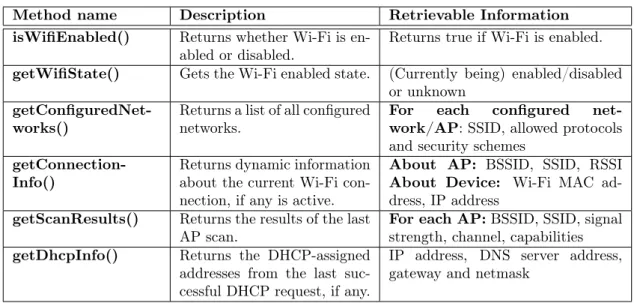
We also revealed a flaw in the Android permission system. We showed that an in-nocuously looking permission, called ACCESS_WIFI_STATE, can be used to gather user private data and that 41% out of the 2700 most popular apps (100 top apps in each 27 categories) required this permission. By statically and dynamically analysing these apps, we found that some apps (mostly through the included ad libraries) are geo-localising users without asking for location-specific permissions. Our findings again had a direct impact as Android now protects the most privacy-critical API (getScanResults()) with location per-missions so that apps can no more exploit this innocuous permission to geo-localise users. Moreover, the exact issue we reported in our study in 2014, i.e., geo-localising users with-out their permission, led Federal Trade Commission (FTC) to fine InMobi for an amount of almost one million dollars in 2016.
5
Lastly, we showed that the list of installed apps on smartphones is unique and therefore, there is a huge risk of re-identification of users if a pseudo-anonymised dataset with the list of installed apps is released. As the list is available to be accessed by Android apps without requiring a user permission, and as A&A companies implicitly know a subset of installed apps in which they are present, we proved that Android poses its users a serious privacy threat. We reported our findings to the Android security team in the hope that this issue can be fixed as soon as possible.
1.3.2 Unveiling and controlling tracking on the Web
In a second step, to enhance privacy on the Web, we also designed and provided end users with two tools: MyAdChoices and MyTrackingChoices. These tools were aimed at bringing transparency and control to users over online tracking and advertising.
MyAdChoices is a tool that aims at bringing transparency to online advertising, so that users can make an informed and equitable decision regarding ad blocking. When an ad is delivered to a user, the tool decides and lets the user know if that ad is retargeted, or is delivered based on the past browsing history of the user. It is implemented as a Web-browser extension and enables users to exert fine-grained control over advertising, thus providing them with certain guarantees in terms of privacy and browsing experience, while preserving the Internet economic model. Experimental results in a real environment demonstrate the suitability and feasibility of this tool, and provide preliminary findings on behavioural targeting from real user browsing profiles.
MyTrackingChoices provides users with fine-grained control over tracking. It allows users to select the categories of web pages that are privacy-sensitive to them (for exam-ple, health, religion) and block network connections of third-party domains (and thus, ads delivered through third-party domains) present only on such web pages. Since users will continue receiving ads on web pages belonging to non-sensitive categories, our approach es-sentially provides a trade-off between privacy and economy. Basically, MyTrackingChoices helps users to control their profile collected by different third-parties, like advertising com-panies, data brokers, or insurance comcom-panies, without totally preventing ads. We believe that our proposal can provide an appropriate level of privacy while simultaneously sup-porting the ad-based economic model of the Web.
1.4
Organisation of the thesis
This thesis is divided into two parts and is a compilation of papers with several co-authors. I was the main author for all these papers except [175]. My contributions in [175] were practical design and implementation of the whole system.
The first part of the thesis is about the work we have done to unveil the privacy problems in case of smartphones. It includes chapter 2 that discusses the MobileAppScrutinator tool, chapter 3 that discusses the privacy implications of ACCESS_WIFI_STATE android permission, and chapter 4 that discusses the re-identification risk posed by unicity of apps installed on smartphones.
The second part is about addressing privacy problems at the end user side on the Web. It includes chapter 5 that discusses the MyAdChoices tool, and chapter 6 that discusses the MyTrackingChoices tool. Finally Chapter 7 concludes this work and gives some possible future directions.
Part I
Unveiling Online Tracking on
Smartphones
Preface
```` ```` ```` `` EcosystemApproach Solving privacy problems at
the source Empowering users
Smartphones WSJ study [33], PiOS [102],
TaintDroid [102], Han et al. [123] HayStack App [178] Table 1.2: The table gives some notable projects taking two approaches: solving privacy problems at the source and empowering users. This list of projects is not exhaustive. In this thesis, we take the first approach, i.e., solving privacy problems at the source/origin. The related projects taking this approach are colored in gray.
Mobile devices have become ubiquitous and are a crucial part of our lives today. This is mainly due to the wide variety of functionalities they provide beyond telephony. They are equipped with a lot of different sensors, e.g., GPS navigation unit, Camera, Accelerometer. They handle a lot of private data such as our email communications, location. As useful as they are, they have also became a serious threat to user privacy. As very accurate profiles can be created using the vast amount of data available on them, Advertising and Analytics (A&A) companies have therefore shifted their focus from traditional desktop computers and browsers to applications running on mobile devices.
To deliver ads in smartphone apps, app developers generally include code from A&A companies in their apps. This code is typically responsible for both ad delivery and col-lecting personal data about users to create a profile of users’ interests. As the code from A&A companies run with same privileges as the app, it is difficult for users to know if their personal data is accessed by the app or the A&A companies or both. From this point of view, smartphone apps generally remain a blackbox for users.
The goal of this part of the thesis is to understand online tracking on smartphones. Specifically, we want to study how A&A companies are tracking and profiling users. There can be two approaches to do this task: scrutinise apps in the lab or give tools to the end users. In this thesis, we take the first approach because monitoring other apps on smartphones typically requires elevated (root) privileges and thus, makes the tool/solution less attractive. Indeed, asking users to get elevated privileges requires them to jailbreak the phone or modify the firmware. Evidently, this is not a scalable solution and poses security risks to the users.
Table 1.2 presents the related projects taking these two approaches. It is worth empha-sising that this list of related work is not exhaustive. These are the main projects which tried to tackle this problem of privacy on smartphones using these two approaches. The goal of all these projects was to bring transparency into the world of smartphone apps. They showed the data that is being collected by different smartphone apps, how frequently it is being collected and by whom. Below we give more details about these projects.
One of the notable projects in the first approach is WSJ study [33]. They analysed the data collected from 101 popular Android and iOS apps [33]. In this study, they found
10
that both A&A companies and app developers are collecting unique identifiers as well as location and other personal information about users. They also studied the privacy policies of these apps and found that there were a lot of discrepancies between what these apps were actually doing and what their privacy policy is saying.
Han et al. also took the first approach and shedded some light on third-party tracking on Android using TaintDroid [123]. Also, all other static and dynamic analysis tools proposed in the literature, most notably, PiOS [102] and TaintDroid [103], analysed some applications and presented a number of applications leaking user PII.
HayStack app [178] takes the second approach and tries to provide users with trans-parency on smartphone apps. It is different from studies mentioned above as the app can be installed by smartphones users without requiring elevated privileges or modifying the firmware. It lets users find the trackers present in their apps, lets them know what data the apps are collecting, and who is collecting that data. It captures the leakage of data both over clear-text and SSL. The app leverages standard VPN API and therefore, does not require root privileges.
In the end, we note that the work done in this thesis is in no way exhaustive to solve the problem of user tracking on smartphones. The problem still persists and we need to continue working on providing all stakeholders with more transparency and control.
Chapter 2
Measuring Private Data Leaks using
MobileAppScrutinator
Contents
2.1 Introduction . . . 11 2.2 Related work . . . 13 2.2.1 Tracking measurement technology . . . 13 2.2.2 Measurement of PII leakage . . . 14 2.3 MobileAppScrutinator . . . 14 2.3.1 Implementation on Android . . . 15 2.3.2 Implementation on iOS . . . 16 2.3.3 Post-analysis of SQLite Data . . . 17 2.3.4 Limitations . . . 17 2.4 Experimental Setup . . . 17 2.5 Cross-App Third-Party Tracking . . . 18 2.5.1 Unique identifiers from the system . . . 18 2.5.2 Unique identifiers generated by third-parties . . . 20 2.5.3 Comparation of third-party tracking on Android and iOS . . . . 21 2.6 Collection of other personal information . . . 21 2.6.1 Android . . . 21 2.6.2 iOS . . . 23 2.6.3 Comparison between Android and iOS . . . 23 2.7 Discussion . . . 23 2.7.1 Comparing MobileAppScrutinator on Android with TaintDroid . 23 2.7.2 Effectiveness of various privacy safeguards . . . 24 2.8 Conclusion . . . 25
2.1
Introduction
Smartphones no longer involve only the user and the communication service (GSM/CDMA) provider. The revolution of the AppStore model for application distribution brings a large number of new actors. In the literature, service providers to whom the user directly interacts with are considered as first-party, the user being the second-party. However, there are many additional actors whose services are not directly used by the end user, and whose presence is not obvious to most users, are called the third-parties. Third parties
12 CHAPTER 2. MEASURING PRIVATE DATA LEAKS USING MOBILEAPPSCRUTINATOR
are, for example, Advertisers and Analytics (A&A) companies, application performance monitors, crash reporters, or push notification senders. The situation has become even more complex with the development of new advertisement models like Mobile Ad Networks or Ad exchange networks for real-time bidding (RTB).
Depending on the service provided, a user may accept to exchange data with a first-party, in general following legal terms and conditions upon which they mutually agree. However, the data collection by third-parties without explicit user consent is more prob-lematic. Due to economic reasons, the A&A companies are the dominant third parties and the most privacy intrusive. Indeed, in order to increase their revenue, advertisers want to send personalized Ads to the user. Therefore A&A companies are incited to collect as much information as possible to better profile user’s interests and behavior. In order to achieve this goal, they need a way to identify the smartphone/user via an identifier that can uniquely be associated with a smartphone/user. This whole process of data collection is called “third-party smartphone tracking” or simply “tracking” and the process of showing user-specific Ads based on user profile is called “targeted advertising”.
Smartphone tracking and targeted-advertising are acceptable if the user is aware of it and if he agrees to receive targeted Ads based on his personal interests. Some users could also find the presence of third-parties on the smartphone beneficial. However, problems arise when A&A companies collect Personally-Identifiable Information (PII) without users’ knowledge. In fact, Ad libraries sometimes also include APIs through which an application can deliberately leak user PII [80]. This creates serious privacy risks for users. With the rapidly growing number of smartphones, people are increasingly exposed to such risks. Moreover, a smartphone is particularly intrusive, revealing all user movements as it is equipped with many sensors, and it stores a plethora of information either generated by these sensors, by the telephony services (calls and SMS), or by the user himself (e.g., calendar events and reminders). Finally, various scandals in the past (e.g.,[33, 31]) make it difficult to trust all these actors present on smartphones.
Motivation As “Tracking these trackers” has become a necessity, various tools have been developed in the past. These tools are based on either static analysis or dynamic analysis or interception of network traffic. Even though static analysis techniques scale well, they generally fail on obfuscated applications and therefore, are not suited to accurately detect and measure the ongoing tracking. Similarly, network interception is often unable to handle SSL traffic. Dynamic analysis techniques for detection and measurement of PII leaks are available on Android but not on iOS. As we lack suitable dynamic analysis tools readily available on both Android and iOS, there is no measurement study in the literature which provides concrete evidence of ongoing tracking as well as the comparision across mobile OSs.
Contributions The contributions of this chapter are threefold:
1. We present our dynamic analysis platform, MobileAppScrutinator, which detects and measure the ongoing tracking on Android and iOS. It is the first dynamic analysis platform for iOS to detect private data leakage.
2. We detect private information leaks by applications over the Internet, when they leak it in clear-text or over SSL. MobileScrutinator detects the PII leakage even if the App obfuscates the data (by hashing or encrypting) before sending over the network in clear-text or through SSL. Detection of modified PII is a key for reliable measurements as some identifiers (e.g., WiFi MAC address, AndroidID, IMEI) are often modified before being sent.
13
3. We test 140 popular applications with MobileAppScrutinator, on both Android and iOS, and report our findings with a comparision of ongoing tracking on these two platforms.
4. Finally, we discuss the effectiveness of privacy safeguards available on both Android and iOS. We show that neither Android nor iOS privacy safeguards in their present state are completely satisfying.
2.2
Related work
Our work can be compared with existing works on two axes: 1) Tracking measurement technology/tools and 2) Measurement of PII leakage. Below we discuss and compare our work with some most representative works along these two axes.
2.2.1 Tracking measurement technology
Tools to measure the ongoing tracking might be based on either interception of generated network traffic, or static analysis of the application code, or dynamic analysis of applica-tions.
Interception of generated network traffic This approach is based on snooping the network data using Man-In-The-Middle (MITM) proxy. For example, MobileScope [16], based on MITM proxy, was used in WSJ study [33] to investigate the top 100 applications on both Android and iOS. However, this technique cannot be used to intercept the SSL traffic which seriously limits the effectiveness of this approach; as we see in Sections 2.5 and 2.6 that almost half of PII leakage is through SSL. Additionally, MITM approach will not be able to detect reliably the leakage of PII generated by the system (values not known to the user and therefore, could not be searched in the network traffic). This includes different PII, for example, unique IDs generated and shared by applications and user location. Also, MITM based approach would fail in cases where user PII is modified (e.g., hashed or encrypted) before being sent (and, as we will show, this is a rather common practice). Finally, being a network packet analysis approach, it is not always easy or feasible to identify the application having generated the monitored traffic, which makes the (manual) analysis even more complex. MobileAppScrutinator, in contrast, makes analysis directly at the operating system level, and thus does not suffer from such limitations.
Static analysis Past works (PiOS [102] on iOS, FlowDroid [71], ScanDroid [113], CHEX [149], AndroidLeaks [117], SymDroid [129], ScanDal [133] and AppIntent [205] on Android) are based on static analysis to detecte a flow of data from a PII source to a network sink. These works can be classified in two categories: 1) static tainting-based (e.g., FlowDroid [71], ScanDroid [113], CHEX [149], AndroidLeaks [117]) and 2) symbolic execution based (e.g., SymDroid [129], ScanDal [133] and AppIntent [205]). Among the ones based on symbolic execution, SymDroid [129] designs a symbolic executor based on their simple version of Dalvik VM, i.e., micro-dalvik. Similarly, ScanDal [133] designs an intermediate language, called Dalvik Core, and collects all the program states during the execution of the program for all inputs. Considering the Android’s special event-driven paradigm, AppIntent [205] proposes a more efficient event-space constraint guided symbolic execution. On iOS, PiOS was designed for binaries compiled with GCC/G++ compiler and since then, Apple switched to LLVM compiler. Therefore, PiOS needs to be adapted to support the analysis of binaries compiled with LLVM. Furthermore, PiOS is not available publicly, so one needs to build it from scratch to use it to detect and measure
14 CHAPTER 2. MEASURING PRIVATE DATA LEAKS USING MOBILEAPPSCRUTINATOR
the ongoing tracking. In general, static analysis techniques do scale well but they lack dynamic information tracking and therefore, lead to false negatives.
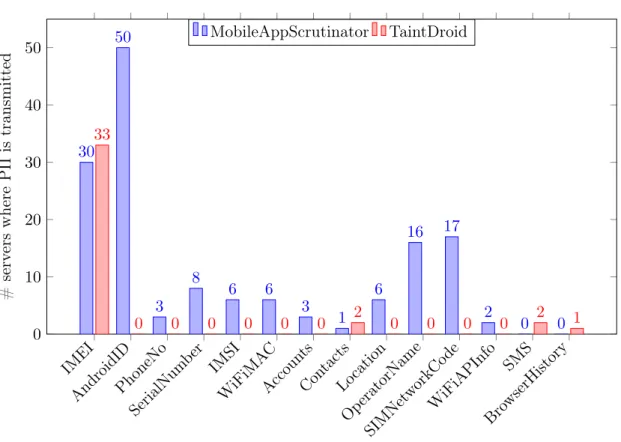
Dynamic analysis TaintDroid [103] and PMP [66] are based on dynamic analysis on Android and iOS respectively. On Android, TaintDroid is a dynamic taint-based technique to detect and measure private data leakage. However, TaintDroid has its own limitations: 1) taint-based tracking can be easily circumvented using indirect information flows [184] 2) requires to make a trade-off between false positives and false negatives ([103] did not taint IMSI due to false positives) 3) misses native code (both for taint propagation and as a source of information). On iOS, PMP [66] is a dynamic/runtime tool that offers the functionality of choosing access to what information a user is willing to share with a par-ticular application. As iOS’s own privacy control feature provides the same functionality, PMP [66] is an enhancement in terms of the number of different types of private data considered. In fact, PMP fails to notify users if the accessed information is being sent to a remote server or not. As existing dynamic analysis tools on iOS are not sufficient to measure the ongoing tracking on iOS, one possibility could have been a taint-based dynamic analysis technique. However, this is not possible to do on iOS device because the code of applications is native (C, C++ and Objective-C). Propagating taint would require to emulate native code, which involves serious changes to the system and would have a significant performance penalty. Therefore, we opted for a dynamic analysis approach, described in the next section, which can be used on both Android and iOS. To measure the effectiveness of MobileAppScrutinator on Android with TaintDroid, we perform tests on identical set of applications using TaintDroid and MobileAppScrutinator. We found that MobileAppScrutinator could detect a lot more PII leakage than TaintDroid.
2.2.2 Measurement of PII leakage
To best of our knowledge, no previous work provides a complete picture of tracking on Android and iOS. Web-browser tracking has been thoroughly studied [156, 181], but it is not the case with smartphone tracking. We are first to provide detailed analysis and measurement data for both Android and iOS. [123] sheds some light on third-party track-ing betrack-ing taken place on Android ustrack-ing TaintDroid but is not as comprehensive as ours. Also, all other static and dynamic analysis tools proposed in the literature, for example, PiOS [102] and TaintDroid [103], analyzed some applications and presented a number of applications leaking user PII, but none of them presented a complete analysis as we do in Section 2.5 and 2.6. Also, as tracking technologies rapidly change with OS revisions, it is crucial to have up-to-date tools and a recent picture of tracking technology. Furthermore, we also consider the remote servers where PII is sent and attempted to distinguish them among first and third-parties, with the available information.
2.3
MobileAppScrutinator
Design choices From tracking detection and measurement point of view, it is ideal to analyse what applications are doing at operating system level. However, we want to have a system that does not require too intrusive modifications of the OSs and does not have too many false positives (unlike dynamic tainting-based techniques). The system should work well with non-malicious application on real devices so that it can be used by anyone. Thus the design of MobileAppScrutinator starts with a simple approach: intercepting the source, sink and data manipulation system APIs. As the same approach is applied to both Android and iOS, it enables us to compare the tracking across mobile OSs. Even though MobileAppScrutinator is based on this same simple approach on both Android
15 Modified APIs in Telephony Manager Modified APIs in Location Manager Application Frameworks (Java)
etc. ModifiedAPIs in
Crypto/Hash
Modified APIs in Network stack Core libraries (Java)
etc. depends on
Service1 Service2
MobileAppScrutinator Dedicated System Application Data sent
using AIDL
Data sent using libc socket APIs
Figure 2.1: MobileAppScrutinator Android implementation.
and iOS, i.e., the basic governing philosophy remains the same, its implementation differs significantly due to the differences of these OSs.
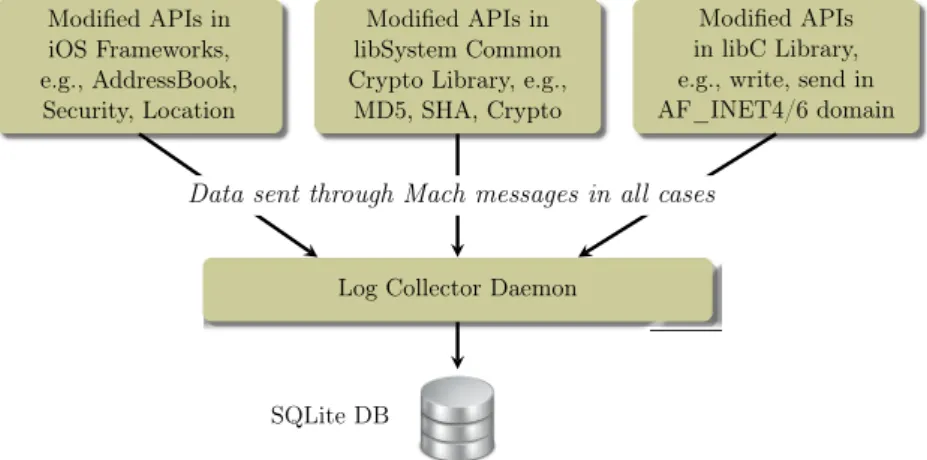
Overall architecture As developer APIs are public on both Android and iOS, we are able to identify all source and sink methods (i.e., methods related to access or modification of private data along with network operations either in clear-text or encrypted). Mo-bileAppScrutinator hooks these APIs and includes extra code to these APIs. This added extra code collects various information from the application environment. Specifically, it collects information about PII being accessed, modified, or transmitted by an application along with the information about that application. Any access, or modification, or trans-mission of PII corresponds to an event and is stored locally in an SQLite database. This database is later analyzed automatically to detect and measure privacy leaks.
In the next two subsections, we give details of how MobileAppScrutinator is imple-mented on Android and iOS.
2.3.1 Implementation on Android
As the Android source (from Android Open Source Project (AOSP)) is publicly available, MobileAppScrutinator directly modifies source code of various APIs in Java frameworks. This modified source is compiled and a new system image is generated. We develop and add a system application to this new system image. This system application runs two Android services that are responsible for receiving data from different sources. The App is also responsible for storage of data in a local SQLite database.
As described earlier, our added extra code must send data to MobileAppScrutinator system app. To do so, we use two methods: AIDL1 and socket APIs of libc library. Our extra coded added in Android application frameworks APIs uses AIDL to send data to MobileAppScrutinator system app whereas socket APIs of libc library are used in modified core Java frameworks. Here it is to be noted that Android application frameworks are written utilizing core Java frameworks, i.e., during compilation of Android source, core
16 CHAPTER 2. MEASURING PRIVATE DATA LEAKS USING MOBILEAPPSCRUTINATOR Modified APIs in iOS Frameworks, e.g., AddressBook, Security, Location Modified APIs in libSystem Common Crypto Library, e.g.,
MD5, SHA, Crypto
Modified APIs in libC Library, e.g., write, send in AF_INET4/6 domain
Log Collector Daemon
Data sent through Mach messages in all cases
SQLite DB
Figure 2.2: Overall picture of MobileAppScrutinator iOS implementation.
launchd process processstarted
dylib new C/C++ function or objective-C method original C/C++ function or objective-c method launches starts loads calls intercepte d may call initial call loaded in target process
Figure 2.3: Loading dylib into a process on iOS.
Java frameworks are compiled before the Android application frameworks. As AIDL is part of the Android application framework, the code added (by MobileAppScrutinator) in modified core Java frameworks cannot use AIDL to send data to MobileAppScrutinator system application. Therefore, to send data to MobileAppScrutinator system apps from modified APIs of core Java frameworks, MobileAppScrutinator uses socket APIs of libc library. to send data to a dedicated service running inside MobileAppScrutinator system application. Fig. 2.1 provides a broad picture of how MobileAppScrutinator is implemented on Android OS.
2.3.2 Implementation on iOS
Fig. 2.2 depicts an overall picture of implementation of MobileAppScrutinator on iOS. The APIs of interest in iOS frameworks are modified to capture and send data related to application context as well as the PII being accessed, modified, or transmitted (clear-text or SSL). The data communication between various processes running our custom code and the daemon is through mach messages. In order to execute self-signed code and get privileged access to the system, the default iOS software stack needs to be modified to remove the restrictions imposed by Apple (a technique known as “Jailbreaking” in the iOS world).
On iOS, developers may write code in C, C++ and Objective-C languages. In fact, all iOS executables are linked with the Objective-C runtime [18] and this runtime environment provides a method called method_setImplementation. We use this method to change the implementation of existing Objective-C methods whereas to change the implementation of
17
C/C++ functions, we use the trampoline technique [30]. MobileSubstrate [17], an open-source framework, greatly simplifies this task. Finally, the open-source code responsible for modification of various APIs of interest is compiled into a dynamic library (dylib) which is loaded using launchd [14], into all or a subset of running processes. Fig. 2.3 depicts how a dylib is loaded into a process using launchd.
2.3.3 Post-analysis of SQLite Data
The events stored in local SQLite database are processed by automated Python scripts. It is a two-step process: a first pass over the database on a per-application basis results into a JSON file, and a second pass over the JSON file derives various statistics.
Our first level analysis consists of the following steps: 1. Find all types of PII accessed by each application.
2. Check if PII is really sent over the network or not, and if yes, to which server it is sent to.
3. Search for the PII in the input to data modification APIs (cryptographic and hashing) and if found, look for the result in the data sent over the network.
First-level analysis results into a JSON file that stores 1) accessed PII, 2) PII passed to encryption or hash APIs 3) (un)modified PII sent over the Internet in cleartext or using SSL. Once the first pass over the database is finished, the resulted JSON file containing per-App details is processed to infer or derive various statistics. Here it is worth to mention that various PII accessed by an application are searched only in the network traffic and hash/cryptographic calls of that specific application.
In various APIs, the access to data is at byte level and in this case, the raw bytes are first attempted to be decoded using UTF-8 encoding. Since a different encoding may be used or in case of binary data, the hexadecimal representation of these raw bytes is also stored alongside. Searching in the network, or in the input to cryptographic or hash APIs is done for both UTF-8 encoded data and hexadecimal representation of the raw bytes.
2.3.4 Limitations
The PII leakage would remain undetected if the data is modified by the application de-veloper using custom data modification functions before sending it over the network. If the PII is modified using OS provided data modification APIs (e.g., encryption, hashing) before sending over network, MobileAppScrutinator would correctly be able to detect the PII leakage. As an App developer is not bound to use system provided hash and encryption APIs, MobileAppScrutinator might miss some PII leakage instances.
In addition to this, the current AppScrutinator implementation on Android only sup-ports the Java code. Therefore it currently does not detect PII leakage that involves calls to C/C++ APIs using the JNI framework. However, this is not a limitation of the ap-proach and MobileAppScrutinator could easily be extended to handle such cases. handle JNI calls.
2.4
Experimental Setup
In order to investigate the tracking mechanisms being used by third-parties, we test 140 representative free apps available both on Android and iOS (most popular Apps in each category). Experiments have been conducted on iOS 6.1.2 and Android 4.1.1_r6.
We manually ran applications for approximately one minute each. We could interact with some applications during this one minute duration as others required the user to log
18 CHAPTER 2. MEASURING PRIVATE DATA LEAKS USING MOBILEAPPSCRUTINATOR Android ID IMEI WiFi MAC Serial No IMSI PhoneNum ber 0 20 40 60 41 28 11 10 5 3 28 20 9 7 5 3 #Apps (a) Android. Pasteb oard ID AdIden tifier WiFi MAC UDID Device Name 0 20 40 60 63 58 46 7 4 63 58 12 7 4 (b) iOS. Unmodified Modified
Figure 2.4: # Apps sending System identifiers (out of 140 apps).
in or sign up. We did not sign up or log in as our ultimate goal was not to track the manually entered user PII but the seamless background tracking done without any user intervention/interaction. Also, we did not try to cover all possible execution paths, indeed third-party library code generally starts execution when the application is first launched.
Apart from device or operating system unique identifiers and information, we also entered other synthetic information such as addressbook, calendar events, accounts etc. This enables us to know if such data is accessed and transmitted by apps.
2.5
Cross-App Third-Party Tracking
Smartphone users mostly use dedicated apps rather than websites for accessing services, essentially because of the relatively small screen size and the lack of mobile-optimized web pages (even if this later aspect has largely improved). Therefore user tracking is no longer performed only through “third-party cookies” in web browsers but also in apps through dedicated identifiers. In this section, we shed some light on this ongoing user tracking in apps through stable identifiers.
2.5.1 Unique identifiers from the system
First of all, let us consider the system level unique identifiers. The situation is rather different depending on the target OS.
Android.
Various system identifiers are available on Android. A user permission is required to access hardware-tied identifiers (IMEI and Wi-Fi MAC address) as well as SIM-tied identifiers (IMSI and phone number). OS-tied identifiers (Serial Number and AndroidID) identifiers are freely available to be accessed.
Fig. 2.4a presents the number of android apps (out of a total of 140 most popular apps tested) that transmit various unique system identifiers over the Internet. We note that a significant number of apps transmit hardware-tied identifiers such as IMEI number and WiFi MAC address of the phone. IMEI number alone is transmitted by 28 apps, i.e., by 20 % apps. This is very critical in terms of user privacy because users cannot reset hardware-tied identifiers (unlike a cookie in a web browser). Android ID is the most frequently
19 Android ID IMEI WiFi MAC Serial No IMSI PhoneNum ber 0 10 20 30 40 50 50 30 6 8 6 3 36 23 6 7 4 3 8 5 0 2 3 0 # Serv ers (a) Android. Pasteb oard ID AdIden tifier WiFi MAC UDID Device Name 0 10 20 30 40 50 21 29 8 9 5 17 28 6 7 3 4 5 2 2 1 (b) iOS.
First-party Third-party Unidentified
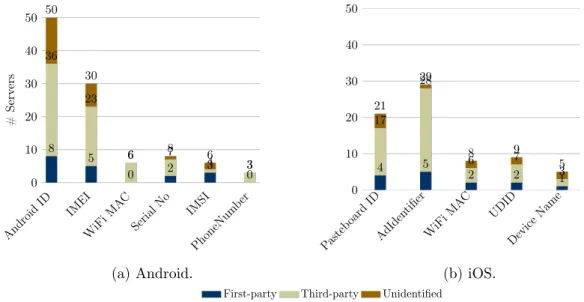
Figure 2.5: # servers where system identifiers are sent by 140 apps.
OS-tied identifier transmitted (by around 30% apps). In general, SIM-tied identifiers are the least frequently transmitted: IMSI is transmitted by five apps whereas three apps transmitted the phone number. Interestingly, we also note that most of these identifers are transmitted unmodified, i.e., without hashing or encrypting, over the Internet. This clearly demonstrates that app developers do not care at all about user privacy and the legislation is not hard enough to force the app developers to care about user privacy.
Fig. 2.5a presents the number of servers where unique system identifiers are transmit-ted by 140 Android apps. The servers are classified as either first-party or third-party or unidentified. First-party servers are those where domain name conincides with the app name, third-party servers are domains of well known advertisers and trackers, and unidenti-fied are the ones where domain name is either of content providers or ip addresses for which no hostname information is found. We note here that various unique system identifiers are transmitted to both first and third-parties. We also find that various unique identifiers are also sent to some IP addresses without any hostname information. It is not easy to identify to whom such machines belong to and why these identifiers are transmitted to them. However, we find that third-parties collect these unique identifiers more often than first-parties. In fact, depending on the app permissions, third parties try to collect as many identifiers as they can: for instance, third-party domains like ad-x.co.uk, adxtracking.com and mobilecore.com all collect and send the AndroidID, IMEI and WiFi-MAC address to their servers in clear-text. Additionally, first and third-parties both send frequently these unique identifiers over the Internet to their servers unmodified (e.g., without hashing) and in clear-text (without SSL). This is a serious threat to user privacy as a network eaves-dropper can easily correlate the data flowing through the Internet. For interested raders, Table A.1 in the appendix A of this thesis provides the whole list of servers and the cor-responding unique identifiers transmitted to them by 140 Android apps in clear-text or through SSL.
Along with these unique system identifiers, third-parties also collect and send the names of apps in which their code is present. We notice that User-Agent http header field generally contains package/App name. As knowing the apps of a user reveals a lot about user interests [188] and increases the re-identification risk [60], this is a serious privacy threat. In fact, the collection of such data is proportional to the number of apps in which third-party code is present and the number of apps sending these unique identifiers. So it is interesting to quantify the number of apps sending these unique identifiers to third-parties. Looking
20 CHAPTER 2. MEASURING PRIVATE DATA LEAKS USING MOBILEAPPSCRUTINATOR
at both Fig. 2.5a and Fig. 2.4a, it can easily be deduced that the presence of third-parties in Android Apps is huge. Globally, we find that 31% (44 out of 140) of Apps transmit, at least, one (un)modified unique identifier over the Internet.
iOS.
Fig. 2.4b presents the number of iOS apps (out of a total of 140 most popular apps tested) that transmit various unique system identifiers over the Internet. The “AdIdentifier” is transmitted the most, which is fine because it has been specifically introduced for Ad-vertizing and Analytics purposes as a replacement to the deprecated UDID. However we notice that some companies (e.g., tapjoyads.com, greystripe.com, mdotm.com, admob.com and ad-inside.com) are still using deprecated UDID. We also found four apps collecting the device name. In iOS, the device name (DeviceName) is set by the user during the initial device setup and often contains the user’s real name. Since this device name is stable (the user generally does not modify it), even if it is not guaranteed to be unique across all de-vices, it is a stable identifer that can probably be used for tracking purposes. Additionally, if it is set with the user’s real name, it may reveal user identity. We also notice that these identifiers are always collected when the user starts/stops interacting with the app. This means that third-parties can even know how long a user is using a particular app and the time when a user goes idle, revealing user habits. As, globally, 60% (i.e., 84 out of 140) of apps send, at least, one (un)modified unique identifier over the Internet, the risk in terms of privacy is huge.
Fig. 2.5b presents the number of servers where unique system identifiers are transmitted by 140 iOS apps. We find a lot of apps transmitting AdIdentifier over the Internet to their servers as well as third-parties. UDID is still being used and transmitted by a total of 9 apps. Surprisingly, the device name is transmitted to 5 servers. Out of these 5 servers, only 1 server belongs to a first-party whereas others are either third-party or identified. In case of iOS, Wi-Fi MAC address is the only hardware-tied identifier that is available to be accessed. It is transmitted to both first and third-parties. More details about servers where these unique identifiers are sent, can be found in Table A.2 in the appendix A of this thesis.
2.5.2 Unique identifiers generated by third-parties
Let us now consider unique identifiers generated by third-parties in order to bypass OS restrictions. As access to system unique identifier is limited on iOS, third-parties generate and share unique identifiers to have a mechanism to track users across apps. However, apps are sandboxed on iOS (as well as on Android) and therefore, these third-parties cannot simply share those generated unique identifiers across apps. To circumvent this limitation on iOS, third-parties use a class called UIPasteBoard [32]. This is specifically designed for cut/copy/paste operations with the ability to share data between apps. The data shared by apps with this class can be persistently stored even across device restarts. Among the Apps we tested, we found that a large number of third-parties use the UIPasteboard class to share a unique third-party identifier across apps. Looking at the names and types of pasteboards created and the servers where these values are sent, we found that 63 Apps create at least one new pasteboard entry at the initiative of a third-party library (Fig. 2.4b). Essentially, third-party code present inside an application stores a pasteboard entry with its unique name, type and value. Later, if an App containing the code from the same third-party is installed, it retrieves the value corresponding to its pastebaord name. To have a look on pasteboard names, types and values used by various third-parties present inside 140 iOS Apps tested, please refer to Table A.7 in the appendix A of this thesis. Here it is to be noted that user has no control over this kind of tracking and “Limit Ad
21
Tracking” feature of iOS is ineffective in this case.
From Fig. 2.5b, we note that these pastboard entries are transmitted to various first and third-parties even though pastboard entries are just designed for cut/copy/paste operation between apps. Moreover, we find that pastboard entries are more transmitted to third-parties than first-third-parties. This assures our assumption that third-third-parties generate these unique pastbaord entries to track users because they transmit them over the Internet.
2.5.3 Comparation of third-party tracking on Android and iOS
Comparing the identifiers transmitted by 140 most popular apps on Android and iOS re-veals that iOS apps transmit system identifiers more often than Android apps. However, iOS apps mostly transmit dedicated identifier, i.e., advertising id, for tracking and adver-tising purposes and not many apps transmit hardware-tied system identifiers as compared to app on Android. This is probably due to the fact that many system identifiers (hard-ware and SIM-tied identifiers like IMEI, IMSI, and Serial number) are not available to be accessed on iOS.
As opposed to iOS apps, we did not notice Android apps generating and sharing unique systems identifiers for tracking purposes. This is probably because various system identi-fiers are readily avaialble to be accessed by apps on Android and therefore, third-parites do not need to generate their own identifiers. Indeed, identifiers such as serial number and Android ID do not even need a permission to be accessed. As tracking through system identifiers is more reliable and accurate, trackers probably do not need to resort to this solution.
In conclusion, Android makes available wider range of system unique identifiers to apps as compared to iOS therefore it is easier for third-parties to track Android users as compared to iOS. Nevertheless, this does not stop trackers on iOS which resort to other techniques.
2.6
Collection of other personal information
To create a rich user profile, third-parties can use various means to collect a wide variety of personal information:
1. By directly collecting as much information as possible from the device (i.e., by adding the appropriate code in the libraries to be included by the app developers).
2. By retrieving it from other third-parties who have already collected this information (thereby, aggregating the user PII [24]).
3. By obtaining it from first-parties.
It is difficult to measure how much information are being shared among third-parties themselves or among first and third-parties, but we next measure in this section what kinds of data and to which extent are being collected by these third-parties directly from the smartphone.
2.6.1 Android
Various personal data of the user is available to be accessed for apps on Android so that various useful apps can be developed. Such personal data includes, e.g., location of the user, contacts or the accounts. Our experiments with 140 Android apps reveal that different kind of user personal information is being sent over the Internet to various first and third-parties.