HAL Id: tel-00757822
https://tel.archives-ouvertes.fr/tel-00757822
Submitted on 27 Nov 2012HAL is a multi-disciplinary open access
archive for the deposit and dissemination of sci-entific research documents, whether they are pub-lished or not. The documents may come from teaching and research institutions in France or abroad, or from public or private research centers.
L’archive ouverte pluridisciplinaire HAL, est destinée au dépôt et à la diffusion de documents scientifiques de niveau recherche, publiés ou non, émanant des établissements d’enseignement et de recherche français ou étrangers, des laboratoires publics ou privés.
Yahong Zheng
To cite this version:
Yahong Zheng. Supply chain management under availability & uncertainty constraints. Other. Ecole Centrale de Lille, 2012. English. �NNT : 2012ECLI0019�. �tel-00757822�
No d’ordre: 1 9 3
ÉCOLE CENTRALE DE LILLE
THÈSE
présentée en vue d’obtenir le grade de
DOCTEUR
en
Spécialité : Automatique, Génie Informatique, Traitement du Signal et Image par
Yahong ZHENG
DOCTORAT DELIVRE PAR L’ECOLE CENTRALE DE LILLE
Titre de la thèse :
Supply Chain Management under availability & uncertainty
constraints
Soutenue le 10 octobre 2012 devant le jury d’examen :
Président Slim HAMMADI, Professeur, Ecole Centrale de Lille
Rapporteur Alain QUILLIOT, Professeur, Université Blaise Pascal, Clermont-Ferrand, Rapporteur Aziz MOUKRIM, Professeur, Université de Technologie de Compiègne
Membre Bernard DESCOTES-GENON, Professeur, Université Joseph Fourier, Grenoble Membre Abdelhakim ARTIBA, Professeur, Université de Valenciennes et du Hainaut
-Cambrésis
Directeur de thèse Khaled MESGHOUNI, Maître de Conférence, HDR, École Centrale de Lille
Thèse préparée dans le Laboratoire d’Automatique, Génie Informatique et Signal École Doctorale SPI 072 (Lille I, Lille III, Artois, ULCO, UVHC, EC Lille)
à toute ma famille, à mes professeurs,
Acknowledgements
The research work presented in this PHD thesis is realized in the Laboratoire d’Automatique, Génie Informatique et Signal (LAGIS) in École Centrale de Lille, with the research team “Optimisation des Système Logistiques (OSL)”. My PhD study was supported by the cooperation between the China Scholarship Council (CSC) and the Écoles-Centrales Intergroup. I am very honored to come to france for my PHD study under their financial support.
Firstly, I would like to express my great gratitude to my supervisor, Mr. Khaled MESGHOUNI. Thanks to his insights and advices, I am able to complete this work under his supervision. His patience and understanding always make it pleasant to discuss with him.
My sincere thanks to the jury members of my PHD committee. Thanks Prof. Alain QUILLIOT and Prof. Aziz MOUKRIM, who have reviewed carefully my thesis. And my heartfelt thanks go to Prof. Slim HAMMADI, Prof. Bernard DESCOTES-GENON and Prof. Abdelhakim ARTIBA, for their helpful discus-sions and sharing of researching experience.
It is a great pleasure to be a member in the research team OSL. I have leaned much in the team meeting. Thanks gratefully all other colleges in the team.
I am also grateful to the colleges in my office, Jin, Ismahelle, Andreea, Minzhi, Yue, Tian, Daji, and the staff in our laboratory, Chistine, Brigitte, Patrick, Bernard, for their kindly help during the past three years. I would like also thank Vanessa Fleury and Virginie Leclercq who helped me with the administra-tive matters.
I wish to offer special thanks to my French teacher, Prof. Hélène Catsiapis, who contributes much in my understanding of French language and culture. Dur-ing the wonderful trips she organized, I have spent several joyful weekends with
students from different countries and visited lots of extremely scenic parts in France.
My appreciation to my friends, Huarong, Jian, Dapeng, Jinlin, Bo, Guoguang, Wenhua, Lian, Yifan, · · · , for their friendship and immense help, which bring much convenience to my life and give me peaceful mind to do research.
At last, I would like to say thanks to my parents and all my families. It is their consistent emotional support that makes me able to pass difficult moments in the research life. Their encouragement and support is the greatest consolation of my soul.
Villeneuve d’Ascq, France Yahong ZHENG 18, September, 2012
Résumé en français
Dans cette thèse je présente les résultats de mes recherches à l’École Centrale de Lille au cours des trois dernières années, de 2009 à 2012.
Le management de la chaîne logistique (supply chain management: SCM) est un thème très intéressant avec une portée internationale à la fois dans le domaine industriel et académique. La disponibilité des ressources dans la chaîne logistique n’est pas à la hauteur de nos attentes. L’essence de SCM est l’intégration des ressources pour améliorer les performances des activités de la chaîne logistique. L’SCM traditionnel est basée sur un environnement statique. Cette hypothèse idéale n’est pas adaptée à la situation réelle où existent des contraintes de disponi-bilité et d’incertitude. Beaucoup de chercheurs ont abordés l’aspect incertain dans les chaînes logistiques, mais pas d’une façon systématique et n’ont pas pro-posé de méthode générale pour traiter l’incertitude dans les SCM. Les contraintes de disponibilité et d’incertitude rendent le management de la chaîne logistique très compliqué. Nos travaux de recherche se focalisent justement sur la prise en compte de ces difficultés et de présenter à la communauté des méthodologies et algorithmes pour la résolution des problèmes d’incertitude dans le management de la chaîne logistique.
Contexte
Depuis l’émergence de la chaîne logistique, cette dernière a été beaucoup étudiée par les chercheurs et les industriels. Le premier domaine d’utilisation été l’armé pour son approvisionnement. Dans les années 90, le SCM a connu une ascension importante en attirant les attentions des gestionnaires des grandes entreprises. Les recherches menées ont permis la mise au point de l’intégration de la gestion
de logistique interne et les relations coopératives entre les différentes sociétés im-pliquées dans la chaîne de gestion. Ce concept de SCM a permis à de nombreux gestionnaires de prendre des décisions non pas seulement au point de vue de leurs entreprise, mais plutôt au niveau de toute la chaîne logistique. La maîtrise de la chaîne logistique est devenue une arme très importante pour la survie de l’entreprise. En générale, de nombreuses stratégies et activités dans SCM, telles que la planification de la chaîne logistique, la coopération des membres de la chaîne, le processus de fabrication, le transport, opèrent tous dans un environ-nement statique (certain). Toutefois, dans les faits, nous trouvons beaucoup de situations d’incertitude dans le SCM, qui se produisent dans le système de fabri-cation, la procédure de distribution, dans les marchés de l’offre et de la demande. Ces incertitudes que nous ne pouvons pas prévoir vont influencer considérable-ment les opérations de la chaîne logistique. Par exemple, l’approvisionneconsidérable-ment en retard peut affecter le temps de production, puis influencer le délai de livraison et peut-être le prix de vente. Une modification de la quantité demandée peut induire à des gaspillages de la production. Une baisse de la productivité aura un impact sur la quantité de l’approvisionnement, sur le niveau des stocks, et également sur le prix de vente. Le problème de véhicules dans le processus de distribution perturbe directement le temps de distribution. Par conséquent, l’incertitude est un facteur très important dans l’étude de SCM.
Une chaîne logistique est généralement un réseau de services et d’entreprises qui remplissent les fonctions d’approvisionnement de produits et de matières, de transformation de matières, et la fabrication et la distribution des produits finis aux clients. Plus généralement, une chaîne logistique commence à partir de la matière première et se termine par la livraison au client, elle commence donc par l’achat des matières premières, puis la fabrication, puis le stock, et ensuite la transformation et se termine par la distribution.
Bien que la structure et le degré de complexité de la chaîne logistique peuvent varier considérablement en fonction des secteurs d’activités et des entreprises, néanmoins, le fonctionnement normal et la structure sont similaires. Nous pou-vons diviser une chaîne logistique en cinq phases : l’approvisionnement, la fabrica-tion, le stockage, la distribufabrica-tion, et la demande. Dans chaque phase de la chaîne logistique, il existe différents types d’incertitudes. Ainsi, nous pouvons nous concentrer sur l’incertitude dans chaque phase pour analyser ses conséquences
RÉSUMÉ EN FRANÇAIS
et tenter de réduire son influence. Nos travaux de recherche se distinguent de l’existant par le fait que nous analysons la chaîne logistique globale même si nous résolvons le problème partiel (stock, transport, fabrication . . .).
Aperçu de la thèse
Dans chaque chapitre, nous traitons l’incertitude dans un stade de la chaîne logistique. Nous nous concentrons sur les problèmes classiques dans SCM. Pour chaque type d’incertitude, tout d’abord, nous donnons un aperçu de ce qui existe dans la littérature, puis nous introduisons l’algorithme pour résoudre le problème, et nous finissons par présenter des exemples numériques tirés des benchmarks (s’ils existent) pour démontrer l’efficacité des algorithmes que nous proposons.
Le chapitre 1 est une introduction des recherches existantes sur l’incertitude dans la chaîne logistique. Tout d’abord, nous introduisons l’importance de con-sidération de l’incertitude dans l’SCM, et nos motivations pour cette partie. Puis, nous passons en revue l’état de l’art de la recherche connexe selon notre classifi-cation de l’incertitude (notre façon de considerér cette incertitude) dans la chaîne logistique. Et nous concluons cette chapitre par présenter les enjeux et les limites de cette recherche dans la littérature.
Le chapitre 2 traite l’incertitude dans la demande. A la différence des méth-odes traditionnelles, telles que le contrôle des stocks dynamiques, l’estimation de la demande, nous proposons d’appliquer la stratégie d’ajournement pour traiter la demande incertaine dans SCM. Tout d’abord, nous simplifions le réseau normal de la chaîne logistique en plusieurs sous-systèmes avec une relation entre l’offre et la demande. Nous suivons la sens de la circulation de l’information, du consom-mateur à l’approvisionnement, pour calculer les sous-systèmes, un par un. Afin de satisfaire la demande inattendue pour chaque sous-système, nous le ferons en deux étapes, la première consiste à exécuter une réaffectation de la demande aux fournisseurs en utilisant pleinement le stock existant de ces derniers. La deuxième étape concerne le cas où la quantité demandée dépasse la possibilité de l’offre. Dans ce cas, nous appliquons la stratégie d’ajournement de l’approvisionnement ce qui conduit à autoriser un retard de livraison. La distance de transport pour la période de l’approvisionnement est utilisée comme fonction objectif pour la réaffectation des demandes.
Dans le chapitre 3 nous nous focalisons sur l’aspect incertain dans le système de production. Nous avons choisi le cas des problèmes de type job-shop pour leur pouvoir d’adapbilité aux variations des demandes des marchés. L’indisponibilité des machines est la principale incertitude dans ce type de problème (job-shop), afin de réduire l’effet de cette dernière, nous suggérons d’utiliser la maintenance conditionnelle (CBM) qui est une sorte de maintenance préventive permettant de surveiller le fonctionnement des machines et fournit des données pour la plan-ification de la machine avant l’apparition de la panne. L’application du CBM rend le problème de l’ordonnancement de job shop flexible dynamique. Nous proposons d’insérer les tâches préventive de maintenance (PM) dans un pré or-donnancement obtenu par la résolution du problème standard d’oror-donnancement du job-shop flexible (FJSP). Pour la résolution de ce dernier (FJSP), nous pro-posons trois approches: l’algorithme génétique hiérarchique (HGA), l’ algorithme génétique intégré (IGA) et enfin, un algorithme de colonies de fourmis intégré (IACO).
Dans le chapitre 4 nous nous intéressons à l’incertitude dans la distribution, et plus particulièrement au niveau du transport. Nous nous concentrons sur le problème de tournées de véhicules (VRP) qui a reçu beaucoup d’attentions ces dernières années. Le problème de tournées de véhicules avec ramassage et livraison (VRPPD) est une extension de VRP avec deux types de demandes de clients. Pour traiter cette incertitude dans la distribution pour les clients, nous modélisons le problème de transport en tant que VRPPD non apparié, dans lequel les relations de ramassage et de livraison ne sont pas déterminées à l’avance. Un algorithme de groupement génétique modifié (GGA) est développé pour résoudre ce VRPPD non apparié. À notre connaissance, c’est la première fois que le VRPPD non apparié est traité en utilisant des métaheursitques.
Pour le chapitre 5, nous traitons le problème bi-niveau du vendeur de jour-naux, ce dernier représente à lui seul une chaîne logistique miniature. Deux classes différentes d’incertitude sont considérées; l’incertitude sur la demande et celle sur le rendement (ou l’incertitude de l’offre). Dans ce problème bi-niveau, le vendeur et le fournisseur sont considérés ensemble et doivent avoir une bonne coopération car ils représentent les deux côtés de la même chaîne. Le rendement incertain est causé principalement par la quantité incertaine des produits. Nous
RÉSUMÉ EN FRANÇAIS
utilisons deux algorithmes populaires pour la résolution de ce type de problème; l’approche Bayésienne et un algorithme hybride floue intelligent.
Nos contributions
Suite à la revue de la littérature existante, nous pouvons dire qu’il existe beaucoup de travaux concernant l’incertitude dans la chaîne logistique, mais nos travaux se distinguent par leur aspect systématique qui traite l’ensemble des problèmes d’incertitude dans les SCM.
Nous avons en premier lieu, classé l’incertitude en perspectice du management de la chaîne logistique. En se basant sur des situations pratiques et réelles, la classification de l’incertitude est complète et couvrira tous les stades de la chaîne logistique. Nous donnons également les trois principales classifications de l’incertitude trouvées dans la littérature; à savoir celle de la demande, celle de la production et celle de la distribution.
En deuxième lieu, pour l’incertitude principale de la chaîne logistique, nous traitons le problème classique, cependant les méthodes que nous proposées pour résoudre les trois principales incertitudes ne sont pas des véritables méthodes parallèles. L’approche que nous proposons pour faire face à l’incertitude de la demande se situe au niveau de la stratégie appliquée aux SCM permettant de déterminer la manière de gérer les opérations de la chaîne logistique. La réalisa-tion de cette stratégie a besoin de l’aide de la part des autres étapes comme la fabrication, l’approvisionnement et la distribution. Naturellement, nos recherches se sont dirigées vers ces étapes du niveau opérationnel dans la chaîne logistique en étudiant de manière concrète de l’incertitude de fabrication à la distribution. Troisièmement, pour le traitement de l’incertitude dans la distribution aux clients, nous nous somme concentrés sur le problème de tournées de véhicules non apparié avec ramassage et livraison (VRPPD). À notre connaissance, c’est la première fois qu’une métaheuristique est appliquée pour résoudre VRPPD non apparié.
Quatrièmement, avec l’algorithme génétique intégré, testé sur des instances de benchmark nous obtenons de meilleurs résultats pour FJSP que ceux présentés dans la littérature.
Cinquièmement, nous proposons d’appliquer la maintenance conditionnelle comme méthode d’entretient préventive pour réduire l’indisponibilité des ma-chines dans le système de fabrication. L’algorithme de l’insertion que nous avons proposé pour résoudre le problème d’ordonnancement de job shop flexible avec la maintenance conditionnelle (FJSPPM) est comparable à un autre algorithme dans la littérature.
Sixièmement, nous avons démontré l’efficacité de l’algorithme génétique (GA) que nous avons utilisés dans nos trois exemples de FJSPPM. En outre, dans notre démarche de résolution de FJSPPM, nous constatons que les résultats trouvés par GA devancent ceux trouvés par l’algorithme de colonies de fourmis (ACO).
Septièmement, nous proposons deux approches différentes, l’approche bayési-enne et l’approche à base de variables floues, pour représenter l’incertitude de la demande et celle du rendement dans le problème du vendeur de journaux. Nous avons obtenu une valeur de seuil en fonction des paramètres du problème comme le prix et le coût en utilisant la méthode bayésienne.
Limitation de nos recherches
Toutefois, il existe des limites à nos recherches, tels que le manque de comparaison avec d’autres approches pour résoudre le VRPPD non apparié ainsi que dans le problème bi-niveau du vendeur de journaux. Ce manque de comparaison est dû principalement au manque considérable de recherche dans cette partie et donc l’inexistance de benchmark, ce qui prouve par la même occasion l’originalité de notre démarche. Concernant les résultats obtenus pour le FJSPPM, nous pensons qu’il est encore possible de les améliorer en utilisant de meilleurs heuristiques et/ou des combinaisons de métaheuristiques. Malheureusement, nous n’avons pas pu appliquer notre démarche aux problèmes concrets rencontrés dans le monde industriel afin de pouvoir montrer l’efficacité de nos démarches de résolution. Néanmoinsn nous espérons pouvoir le faire dans un avenir très proche.
Contents
Acknowledgements 2 Résumé en français 5 Table of Contents 11 List of Figures 16 List of Tables 19 Abbreviations 20 Introduction 231 Uncertainty in supply chain 29
1.1 Supply chain management . . . 29
1.2 Significance of considering uncertainty in SCM . . . 30
1.3 Research review about uncertainty in supply chain . . . 31
1.3.1 Uncertainty in supply . . . 32
1.3.2 Uncertainty in demand . . . 34
1.3.2.1 Factors causing uncertainty in demand . . . 34
1.3.2.2 Impact of uncertainty in demand on supply chain 34 1.3.2.3 Conventional methods to cope with uncertainty in demand . . . 35
1.3.3 Uncertainty in manufacturing . . . 38
1.3.3.1 Complexity of keeping stability and flexibility in modern manufacturing system . . . 38
1.3.3.3 Research on strategic level to consider uncertainty
in manufacturing system . . . 40
1.3.3.4 Research on operational level to consider uncer-tainty in manufacturing system . . . 42
1.3.4 Uncertainty in distribution . . . 43
1.3.4.1 Research priorities of uncertainty in distribution . 43 1.3.4.2 Research of uncertainty in transportation system 44 1.3.5 Other kinds of uncertainty . . . 45
1.4 Conclusions . . . 48
2 Coping with uncertain demand in supply chain 49 2.1 Introduction of postponement strategy . . . 49
2.2 Postponement applied to address uncertain demand in supply chain 51 2.2.1 Decomposition of supply chain . . . 52
2.2.2 Description of approach of application of postponement . . 53
2.2.2.1 Optimal fraction of total postponed demand . . . 56
2.2.2.2 Optimal fraction of supply quantity to each supplier 57 2.3 Instance of application of the approach of postponement . . . 60
2.3.1 Description of model from the original SC network . . . . 60
2.3.2 Results of calculation for the case with estimated demand 63 2.3.2.1 Calculation results of subsystem 1 . . . 63
2.3.2.2 Calculation results of subsystem 2 . . . 64
2.3.3 Results of calculation for the case with unexpected demand 65 2.3.3.1 Calculation results of subsystem 1 . . . 65
2.3.3.2 Calculation results of subsystem 2 . . . 66
2.3.4 Discussions . . . 68
2.4 Conclusions . . . 69
3 Flexible job shop scheduling problem under uncertainty environ-ment 71 3.1 Reducing unavailability of machines in FJSP . . . 71
3.1.1 Introduction and literature on FJSPPM . . . 72
3.1.1.1 Flexible Job-shop Scheduling Problem (FJSP) . . 73
CONTENTS
3.1.1.3 Flexible Job-shop Scheduling Problem with
Pre-ventive Maintenance . . . 75
3.1.1.4 Condition Based Maintenance . . . 76
3.1.2 Mathematical modeling for FJSPPM . . . 78
3.1.3 Solution approach for FJSPPM . . . 80
3.1.3.1 Hierarchical Genetic Algorithm for FJSP . . . 81
3.1.3.2 Integrated Genetic Algorithm for FJSP . . . 86
3.1.3.3 Integrated Ant Colony Optimization for FJSP . . 89
3.1.3.4 Comparing effectiveness of the three approaches for FJSP . . . 93
3.1.3.5 Complete approach for FJSPPM . . . 99
3.1.4 Numerical experiments of FJSPPM . . . 103
3.1.4.1 Results analysis . . . 107
3.1.4.2 Discussions . . . 107
3.2 FJSP with dynamic arrival jobs . . . 108
3.2.1 Inserting algorithm of new arrival job . . . 109
3.2.2 Rescheduling resting operations with new arrival jobs . . . 110
3.3 Impact of uncertain processing time of jobs to FJSP . . . 111
3.4 Conclusions . . . 116
4 Distribution problem under uncertain environment 119 4.1 Uncertainty of clients in distribution . . . 119
4.2 Vehicle routing problem . . . 121
4.2.1 Practical application of VRP . . . 122
4.2.2 Classic model of VRP . . . 123
4.2.2.1 Definition of classic VRP . . . 123
4.2.2.2 Solution approach for classic VRP . . . 124
4.2.3 Classification and extension of VRP . . . 124
4.2.3.1 Capacitated VRP (CVRP) . . . 125
4.2.3.2 VRP with Time Windows (VRPTW) . . . 125
4.2.3.3 VRP with Pick-Up and Delivery (VRPPD) . . . 126
4.2.3.4 VRP with Stochastic Demand (VRPSD) . . . 126
4.2.3.5 Other types of VRP . . . 127
4.3 Unpaired Vehicle Routing Problem with Pickup and Delivery . . . 128
4.3.1.1 Model of unpaired VRPPD for distribution stage
in supply chain . . . 129
4.3.1.2 Coping with uncertainty of clients . . . 129
4.3.2 Description of mathematic model . . . 131
4.3.2.1 Model of distribution problem . . . 131
4.3.2.2 Formulation for unpaired VRPPD . . . 133
4.3.3 Solution algorithm . . . 135
4.3.4 Experiment of numerical example . . . 138
4.4 Conclusions . . . 139
5 Uncertainty of demand and yield in bi-level newsboy problem 141 5.1 Introduction of uncertainty in newsboy problem . . . 142
5.2 Mathematical model for bi-level newsboy problem with uncertain demand and supply . . . 145
5.3 Bayesian approach for representing double uncertainty of stochas-tic variables . . . 148
5.3.1 Description of Bayesian approach . . . 148
5.3.2 Modeling of stochastic demand and yield . . . 148
5.3.2.1 Product qualification ratio . . . 149
5.3.2.2 Uncertain demand . . . 149
5.3.3 Bayesian approach to represent double uncertainty of vari-ables . . . 150
5.3.3.1 Direct information updating . . . 150
5.3.3.2 Indirect information updating . . . 151
5.3.4 Model of describing the problem with stochastic variables . 153 5.3.4.1 Discussion of relationship among different param-eters of price . . . 155
5.3.4.2 Computation based on our hypothesis . . . 157
5.3.4.3 Discussion . . . 158
5.4 Uncertainty represented with fuzzy variable . . . 158
5.4.1 Credibility theory . . . 159
5.4.1.1 Credibility measure and credibility space . . . 159
5.4.1.2 Fuzzy simulation . . . 160
5.4.2 Solutions with fuzzy variables . . . 161
CONTENTS
5.5 Numerical examples . . . 163
5.6 Conclusions . . . 169
Conclusions and Perspectives 171
List of Figures
2.1 Normal supply chain structure . . . 52
2.2 Simplified supply chain structure . . . 52
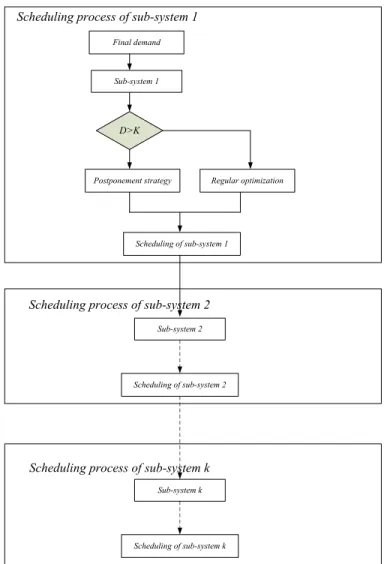
2.3 Procedure of the scheduling with the postponement strategy . . . 54
2.4 Supply chain network consisting of factories, warehouses and dis-tributors . . . 61
2.5 Simplified subsystems . . . 61
3.1 P-F curve . . . 77
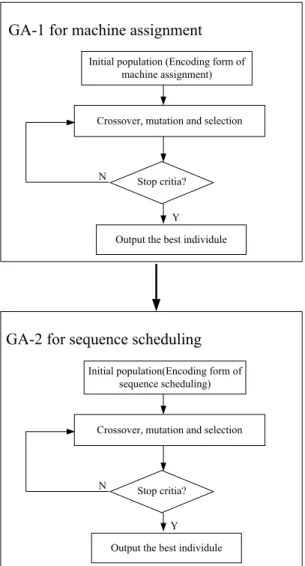
3.2 Hierarchical Genetic Algorithm (HGA) for FJSP . . . 83
3.3 Integrated Genetic Algorithm (IGA) for FJSP . . . 87
3.4 Decoding procedure . . . 88
3.5 Digraph of sequence scheduling in ACO . . . 91
3.6 Gantt chart of best solution of J8M8 . . . 98
3.7 Gantt chart of best solution of J10M10 . . . 98
3.8 Gantt chart of best solution of J15M10 . . . 98
3.9 Two algorithms of solving FJSPPM . . . 99
3.10 Compact PM to left when PM is initialized to latest moment . . . 100
3.11 Compact PM to right when PM is initialized to earliest moment . 100 3.12 Change machine to treat collision of PM and job . . . 101
3.13 Gantt chart of best solution of J8M8PM . . . 104
3.14 Gantt chart of best solution of J10M10PM . . . 106
3.15 Gantt chart of best solution of J15M10PM . . . 106
3.16 Disruption of maintenance arrives at an existing preschedule of FJSP108 3.17 Ongoing scheduling scheme before new job arrival . . . 109
3.18 Scheduling independently for new arrival job . . . 109
3.20 Rescheduling resting operations with new arrival job . . . 110
3.21 Impact of more processing time on job shop scheduling . . . 112
3.22 Impact of less processing time on job shop scheduling . . . 112
3.23 Impact of increasing processing time with 1 time unit to J8M8 . . 114
3.24 Impact of increasing processing time with 2 time units to J8M8 . 114 3.25 Optional solution 1 for J8M8 . . . 115
3.26 Optional solution 2 for J8M8 . . . 115
3.27 Optional solution 3 for J8M8 . . . 116
4.1 Distribution procedure . . . 121
4.2 Normal VRP scheduling scheme . . . 130
4.3 Unpaired VRPPD model . . . 131
4.4 Original allocation of delivering merchandizes . . . 132
4.5 Unpaired VRPPD model for distribution problem . . . 133
4.6 Encoding form for chromosome . . . 135
4.7 Crossover procedure . . . 137
4.8 Solution for an example with 30 clients . . . 139
5.1 Results of computation with GA . . . 164
5.2 Results of executing 100 times . . . 165
5.3 Change with different wholesale price . . . 165
5.4 Change with different retail price . . . 166
5.5 Comparison with different fuzzy demand . . . 167
List of Tables
2.1 Transport costs from factories to warehouses (cent/case) . . . 62
2.2 Transport cost from warehouses to distributors (cent/case) . . . . 62
2.3 Capacities of factories and warehouses . . . 62
2.4 Estimated demand of distributors (case) . . . 63
2.5 Random demand of distributors (case) . . . 63
2.6 Allocation of the demand of distributors to each warehouse in the case with estimated demand . . . 64
2.7 Allocation of demand of warehouses to each factory in the case with estimated demand . . . 64
2.8 Allocation of demand of warehouses to each factory in the case with estimated demand . . . 64
2.9 Allocation of demand of distributors to each warehouse for subsys-tem 1 in the case with unexpected demands in regular period . . . 65
2.10 Allocation of the demand of distributors to each warehouse for subsystem 1 in the case with unexpected demands in postponement period . . . 65
2.11 Optimal allocation of demand of warehouses to each factory in case 1 66
2.12 Optimal allocation of demand of warehouses to each factory in regular period . . . 67
2.13 Optimal allocation of demand of warehouses to each factory in postponement period . . . 67
2.14 Optimal allocation of the demands of warehouses to each factory in case 2 . . . 67
2.15 Optimal allocation of demand of warehouses to each factory in regular period in case 3 . . . 68
2.16 Optimal allocation of demand of warehouses to each factory in
postponement period in case 3 . . . 68
3.1 Machine assignment to operations . . . 83
3.2 Result of comparing tournament and roulette wheel in GA-1 . . . 85
3.3 Parameters of GA . . . 85
3.4 Sequence scheduling . . . 86
3.5 Result of comparing scheduling sequence methods in integrated GA on example J8M8 . . . 89
3.6 Result of comparing scheduling sequence methods in integrated GA on example J15M10 . . . 89
3.7 Parameters of ACO . . . 93
3.8 Problem J8M8 with 27 operations (partial flexibility) . . . 94
3.9 Problem J10M10 with 30 operations (total flexibility)) . . . 95
3.10 Problem J15M10 with 56 operations . . . 96
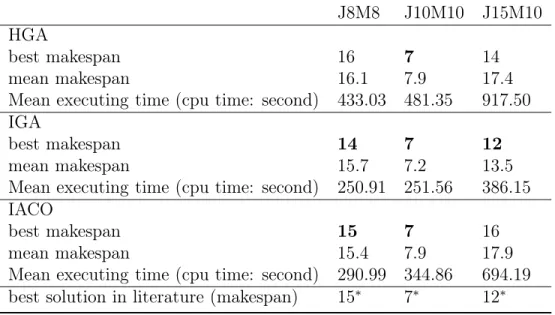
3.11 Result of three approaches applied to three examples of FJSP . . 97
3.12 Comparison of different methods of SSA . . . 102
3.13 PM tasks in J8M8PM . . . 104
3.14 PM tasks in J10M10PM . . . 104
3.15 PM tasks in J15M10PM . . . 104
3.16 Result of seven approaches applied on examples of FJSPPM . . . 105
5.1 Calculation of posterior distribution with direct information up-dating . . . 151
5.2 Price relationship for different industries ∗ . . . . 157
5.3 Results of optimal ordering quantity and potential loss with differ-ent wholesale price . . . 166
5.4 Results of optimal ordering quantity and potential loss with differ-ent retail price . . . 167
5.5 Results of optimal ordering quantity and potential loss with differ-ent fuzzy demand . . . 168
5.6 Results of optimal ordering quantity and potential loss with differ-ent qualification ratio . . . 169
Abbreviations
ABC - Artificial bee colony ACO - Ant colony optimization
AMT - Advanced manufacturing technologies CAD - Computer aided design
CAM - Computer aided manufacturing CBM - Condition based maintenance CDF - Cumulative distribution function
CIMS - Computer integrated manufacturing system CNC - Computer numerical control
CVRP- Capacitated vehicle routing problem CVRPTW - Capacitated VRP with time windows DARP - Dial-a-ride problem
ERP - Enterprize resource planning FIFO - First In First Out
FJSP - Flexible job shop scheduling problem
FJSPPM - Flexible job shop scheduling problem with preventive maintenance FMS - Flexible manufacturing system
GA - Genetic algorithm
GGA - Grouping genetic algorithm HGA - Hybrid generic algorithm IA - Inserting algorithm
IACO - Integrated ant colony optimization IGA - Integrated genetic algorithm
JSSP - Job shop scheduling problem LP - lean production
MDVRP - Multi depot vehicle routing problem
MDVRPTW - Multi depot vehicle routing problem with time windows MRP - Material requirement planning
MRPII - Manufacturing resource planning MWR - Most work remaining
NLP - Non linear programming PDF - Probability density function PDP - Pickup and delivery problem PM - Preventive maintenance
PVRP - Probabilistic vehicle routing problem SA - Simulated annealing
SC - Supply chain
SCM - Supply chain management
SDVRP - Split delivery vehicle routing problem SPT - Shortest processing time
SSA - Simultaneous scheduling algorithm SSA1 - Simultaneous scheduling algorithm 1 SSA2 - Simultaneous scheduling algorithm 2 SSA3 - Simultaneous scheduling algorithm 3 SST - Shortest starting time of operation SVRP - Stochastic vehicle routing problem TLJ - Length of unscheduled tasks in job TS - Tabu search
TSP - Traveling salesman problem TSPPD - TSP with pickup and delivery VRP - Vehicle routing problem
VRPDT - Vehicle routing problem with due times
VRPM - Vehicle routing problem with multi use of vehicles VRPPD - Vehicle routing problem with pickup and delivery VRPSD - Vehicle routing problem with stochastic demand VRPTW - Vehicle routing problem with time windows VRSP - Vehicle routing and scheduling problem
Introduction
This thesis presents results of my research in École Centrale de Lille in France during the past three years, from 2009 to 2012.
Supply chain management (SCM) is an attractive theme both in business and academy in international scope. Availability of resource in supply chain is always not so optimistic as we expected. The essence of SCM is integrating resource to improve performance of supply chain activities. Traditional SCM is based on a static environment. This ideal hypothesis is not suitable for practical situation where exist constraints of availability and uncertainty. Despite of immense re-search on uncertainty in SCM, there is no systematic rere-search, neither no general method for treating uncertainty in supply chain. Constraints of availability and uncertainty make SCM complicated. Our research is surrounding SCM taking into account these constraints. We aim to offer some reference to researchers and decision makers in this research area.
Background
Supply chain has been focused by lots of scholars and practitioners as early as the concept of logistic emerged. Logistic first emerged in army. With supply chain the army can get enough support to prepare for the war or defence. Since 1990s, SCM has become a hot topic in business. It has attracted attentions of high level managers. Research of SCM has developed from integration of inter-nal logistic management and relationship among cooperated companies to value addition of the whole value chain. This concept of SCM makes many managers of enterprizes make decision not at the standpoint of only his company as be-fore, but at the height of the whole supply chain. In the war of business, supply chain has become a strong weapon. Generally, many strategies and activities in
SCM, such as scheduling of supply chain, cooperation of members of supply chain, process of logistics, transport, manufactures, etc., are all operated in a static en-vironment imagined. However, factually in procedure of the total SCM, there are many uncertain cases occurring in manufacturing system, distribution procedure, demand markets, and supply. Uncertainties which we cannot know predictably will influence supply chain operations. For example, delayed supply may affect production time then influence delivery time and maybe selling price. Changed demand quantity may induce waste of production. Decline in productivity will impact quantity of supply, inventory level, and also selling price. Problems of vehicles in distribution process will disturb directly distribution time. Therefore, dealing with uncertainty is a very important task in SCM.
A supply chain is generally a network of facilities and companies that per-form the functions of procurement of materials, transper-formation of materials into intermediate and finished products, manufacturing, and distribution of finished products to customers. More generally, a supply chain begins from the raw ma-terials and ends at the customer, consisting purchasing of raw mama-terials, man-ufacturing, stock, transformation and distribution. Although the structure and degree of complexity of supply chain may vary greatly in different industries and in different firms, the normal function and structure are similar. We can divide a supply chain into five phases: supply, manufacturing, stock, distribution, and demand. In each phase of supply chain, there exists uncertainty. Thereby we can concentrate on uncertainty in each phase to analyze its consequence and attempt to reduce its influence. The difference of our work to existing research of distinct type of uncertainty in supply chain is that even when we concentrate on concrete problem in supply chain, we analyze the problem from the standpoint of SCM.
Outline of the thesis
In each chapter, we treat uncertainty in a certain stage of supply chain. We concentrate on classic problems in SCM. For each kind of uncertainty, firstly we give a literature survey, and then we introduce algorithm to solve the problem, at last numerical examples in benchmark in literature are used to demonstrate effectiveness of our proposed algorithms.
INTRODUCTION
Chapter 1 is introduction of existing research about uncertainty in supply chain. Firstly, we introduce the significance of research of SCM with uncertainty in consideration, which is our motivation of the research. Then, we survey the state of the art of related research according to our classification of uncertainty in supply chain. This classification is also the way we consider uncertainty in SCM. Limitations and challenges of research in literature is concluded.
Chapter 2 concentrates on treating uncertainty in demand. Different from the traditional methods, such as dynamic inventory control, estimation of demand, we propose to apply postponement strategy to treat uncertain demand in SCM. Firstly, we simplify normal supply chain network with different stages into several sub systems with relationship of demand-supply. We follow the direction of flow of information, from consumer market to material supply, to calculate the sub systems one by one. For each sub system, to satisfy unexpected demand, we satisfy them during two stages. In the first stage, we execute reallocation of demand to suppliers to make full use of existing stock of suppliers. For demand quantity exceeding supply quantity, we postpone supply to it to a delayed delivery time allowed, which is the second stage. Transport distance during supply period is considered as objective function to reallocate demand to suppliers.
Chapter 3 focuses on the problem in manufacturing system with uncertainty in consideration. Job shop, as an adaptive manufacturing mode for variation of products in consuming market, is chosen for our research in manufacturing sys-tem. Unavailability of machines is the most important type of uncertainty in job shop. To reduce this uncertainty, we suggest using condition based maintenance (CBM), a sort of preventive maintenance to monitor machines’ situation and pro-vide data to plan maintenance before machines’ breakdown. Application of CBM makes flexible job shop scheduling problem (FJSP) dynamic. We propose an in-serting algorithm to add PM into preschedule obtained in normal FJSP. To solve traditional FJSP, we propose three approaches, a Hierarchical Genetic Algorithm (HGA), an Integrated Genetic Algorithm (IGA), and an Integrated Ant Colony Optimization (IACO).
Chapter 4 highlights uncertainty in distribution, especially in transportation stage. We focus on vehicle routing problem (VRP) which is paid unabated atten-tions in last several decades. Vehicle routing problem with pickups and deliveries (VRPPD) is an extension of VRP, allowing two different sorts of demand of
clients. To treat uncertainty of clients during distribution, we model the trans-portation problem as unpaired VRPPD, in which relationship of pick up and delivery are not determined in advance. A modified grouping genetic algorithm (GGA) is developed for solving unpaired VRPPD. To our knowledge, this is the first time using metaheursitc for solving unpaired VRPPD.
Chapter 5 is an application of considering uncertainty in a supply chain. We focus on bi-level newsboy problem, which is a miniature of supply chain. Two dif-ferent classes of uncertainty are considered, demand uncertainty and yield uncer-tainty which can also be called supply unceruncer-tainty. In bi-level newsboy problem, newsboy is considered together with his supplier. Both sides are with a good cooperation relationship. Research of bi-level newsboy problem is critical and basic to the research of SCM. In newsboy problem we conclude that to the de-cision maker, the newsboy, uncertain yield of the manufacturer is caused mainly by uncertain qualification ratio of products. We adopt two popular algorithms to solve this kind of newsboy problem, the Bayesian approach and fuzzy hybrid intelligent algorithm.
Contributions of our research
From literature review, we can see that there has been immense research on uncertainty in supply chain, but our work is the first to give a systematic research. Firstly, we classify uncertainty from the perspective of supply chain manage-ment. Based on analysis of supply chain in practical situation, classification of uncertainty is complete and can cover all stages of supply chain. In addition to classification method, we give literature review for the three main classes of uncertainty, uncertainty in demand, distribution and manufacturing.
Secondly, for uncertainty in the main stage of supply chain, we focus on classic problems to treat them. However, our proposed methods for treating the three main kinds of uncertainty are factually not parallel. The approach of coping with uncertainty in demand is at the strategic level of SCM, as it determines the management manner of supply chain operations. Realization of the strategy needs assistance of other stages in supply chain, distribution, manufacturing, supply, etc. Direction of our research is naturally directed to these stages of operational
INTRODUCTION
level in supply chain. Rather than vague discussion, we consider uncertainty in concrete executing manner of distribution and manufacturing.
Thirdly, for treating uncertainty of clients in distribution, we focus on un-paired vehicle routing problem with pickups and deliveries (VRPPD). To our knowledge, this is the first time of applying metaheuristic to solve unpaired VRPPD.
Fourthly, with integrated genetic algorithm, we get a better result of an in-stance in a benchmark for FJSP than that in literature.
Fifthly, we propose to apply condition based maintenance as preventive matenance to reduce unavailability of machines in manufacturing system. The in-serting algorithm we proposed to solve flexible job shop scheduling problem with preventive maintenance (FJSPPM) is comparable with another algorithm in lit-erature.
Sixthly, we have demonstrated the effectiveness of genetic algorithm (GA) which we have used in three instances of FJSPPM. Furthermore, in procedure of solving FJSPPM, we find that GA outperforms ant colony optimization (ACO). Seventhly, we propose two different approaches, Bayesian approach and fuzzy variable, to represent uncertainties of demand and yield in newsboy problem. We have obtained a threshold value of relationship between price parameters when using Bayesian method to solve the problem.
Limitation in our research
There exist limitations in our research, such as lack of comparison with other approaches in solving unpaired VRPPD and bi-level newsboy problem. This is actually because there is no benchmark for the research, which just shows orig-inality of our research. Improvement of results in FJSPPM is needed. Better heuristic and combination of metaheuristic can be endeavored. We are look for-warding to do some research in these aspects. Furthermore, we do not have any applicatory case of supply chain to demonstrate capability of our strategy and approaches in solving practical problems. We hope there will be some case studies in this domain.
Chapter 1
Uncertainty in supply chain
Traditional supply chain management (SCM) is generally based on a static and determined environment, including deciding production plan, inventory level, dis-tribution strategy, etc. However, in practical cases, there are always some un-certain factors impacting execution of plan of decision makers. We give some examples in literature about the important sense of considering uncertainty in SCM. The significance of the research topic is just motivation of our research. In this chapter, we analyze the potential occurring of uncertainty in supply chain and propose a classification for it. According to this classification, we give a survey of research on uncertainty in supply chain in literature, the problem focused and approaches deployed to treat them.
1.1
Supply chain management
Supply chain has been focused by lots of scholars and practitioners as early as the concept of logistic emerged. Logistic first emerged in armies. With supply chain the army can get enough support to prepare for the war or defence. Since 1990s, supply chain management (SCM) has attracted attentions of the high level managers. Research of SCM has developed from integration of the internal logistic management and relationship among cooperated companies to the efficiency and the value addition of the whole value chain. SCM involves wide range of areas and multidisciplinary application. It can conclude various activities and decision making in each stage of a supply chain.
The concept of SCM in business makes managers of enterprizes make decision not at the standpoint of only his company as before, but at the height of the whole supply chain. In the war of business, supply chain has become a strong weapon. Generally, many strategies and activities in SCM, such as scheduling of supply chain, cooperation of members of supply chain, process of logistics, trans-port, manufactures, etc., are all operated in a static environment. However, in the real process of the total SCM, there are many uncertain cases occurring in manufacturing, distribution, demand markets, supply, and other stages in supply chain. Uncertainties which we cannot know predictably can easily influence sup-ply chain operations. For example, delayed supsup-ply may affect production time and consequently influence delivery time and probably selling price. Changed de-mand quantity may induce production waste. Decline in productivity may impact easily supply quantity, inventory level, and selling price. Problems of vehicles in distribution process will disturb directly distribution time. From these examples we can state that dealing with uncertainties is a very important theme in SCM.
1.2
Significance of considering uncertainty in SCM
Uncertainty may induce disturbs in SCM. If we do not consider uncertainty in planning of supply chain activities, it will not carry on in the way we expected. Uncertainty impact performance of supply chain in different dimensions. Vorst
et al. (1998) stated that SCM should be concerned with reduction or even
elim-ination of uncertainty to improve performance of supply chain. The results of case study suggested that reduction of uncertainty can improve service levels significantly. According to industrial survey conducted by Protiviti and APICS (American Production and Inventory Control Society), 66% of respondents con-sidered supply interruption as one of the most significant concerns among all the supply chain related risks. Mula et al. (2006) indicated that models for produc-tion planning which do not recognize the uncertainty can be expected to generate inferior planning decisions as compared to models that explicitly account for the uncertainty. Koh & Saad (2003) suggested diagnosing uncertainties to help get the optimum performance of delivery. Therefore, we can observe the sense of considering uncertainty in SCM. Yu & Li (2000) stated that a critical role of
1.3 Research review about uncertainty in supply chain
a logistic manager was how to make an optimization decision under uncertain, noisy, and incomplete information.
1.3
Research review about uncertainty in supply
chain
Despite of wide range of activities SCM covers, the primary task is often described as uncertainty reduction (Davis, 1993; Mason-Jones & Towill, 1998). Risk and uncertainty are synchronous. Even they are seen as synonymous (Helliar et al.,
2001). Risk may be seen as a consequence of uncertainty (Lalwani et al., 2006).
Knight (1921). In his seminal work on risk and uncertainty, he ascertained that
change in itself is not a risk but that the future uncertainties associated with change may well be risky. Risk is defined as the possibility of bringing about misfortune or loss while uncertainty is associated with those things that are not able to be accurately known or predicted (Collins Dictionary, 1996). According to this definition, uncertainty is not certain to bring misfortune to supply, but it is certainly risky. When there is a large deviation between reality and expec-tation, performance of results may not be consistent with plan. Even though reality is better than our expectation, they do not certainly bring benefits. For example, when order quantity is larger than that of forecasts, sales quantity may not increase as inventory level is set according to forecast value.
There has already been a lot of research about uncertainty in different sections of supply chain, even though the researchers do not analyze uncertainty from the angle of supply chain. We give an overall overview about it in following sub sections. Relatively, less research of uncertainty is on the standpoint of the whole supply chain. Different clusters of sources of uncertainty are identified and for each source of uncertainty, several improvement principles are identified in the work of Vorst et al. (1998). Study of applying different and balanced forms of flexibility to cope with uncertainty in turbulent environments was discussed by
Dreyer & Grønhaug(2004). They focus on empirical studies of practical industry, i.e., fish processing plants in Norway. Although it is demonstrated a successful strategy, it may conflict with other evaluation criterias. Ottesen & Grønhaug
(2002) stated that, disadvantage of vertical integration, their promising strategy to reduce uncertain supply, is that it may come at the expense of flexibility.
The two researches are on the same fish industry. It is observed that a strategy demonstrated appealing may not always be suitable. Ho et al. (2005) deployed a structural approach to measure supply chain uncertainty and their results for an e-commerce system produce a validated uncertainty scale that can help in diagnosing supply chain problems. However, the concrete approach of monitoring and assessing supply chain performance is only on way of envisaging.
We classify uncertainty in supply chain according to function of various stages. For a certain supply chain, firstly we decompose it into different phases. For a typical supply chain, it consists of initial supply of material, manufacturing, dis-tribution, and consumer market. We hence category literature about uncertainty in supply chain as follows: uncertainty in demand, supply, manufacturing, and distribution. Besides these four preliminary sorts of uncertainty, we also refer to other kinds, which are detailed in one certain scope in supply chain.
1.3.1
Uncertainty in supply
We can define supply from two aspects. One is as mentioned in our work, in the first phase of supply chain, supply of materials, parts, or semi-finished products to manufacturers. This kind of supply is of the narrow sense. The other can be considered as all kinds of supplies to demanders in any relationship of supply-demand. Such as, retailers of goods to final customers, supplier of a certain medicament to a clinic, wholesalers to distributors, are all on the side of supply. This kind of supply is of the broad sense. Literature on uncertain supply are mostly focusing on supply with broad sense. Most research of supply uncertainty is on investigating impact of supply uncertainty to performance of organizations (Boonyathan & Power, 2007; Deo & Corbett, 2010). In research of Boonyathan & Power (2007), results of analysis of a survey of two kinds of industries, prod-uct organization and service organization, show that in both industries, supply uncertainty is a more significant determinant of performance than demand un-certainty. Influence of uncertain supply and uncertain demand to performance of supply chain are compared. The implication is to make supply chain manager decide to focus on which section of supply chain.
Moreover, decision making under uncertain supply is also studied. Anupindi
1.3 Research review about uncertainty in supply chain
address the operational issue of quantity allocation between two uncertain sup-pliers and its effects on the inventory policies of the buyer. Based on the type of delivery contract a buyer has with the suppliers, they suggest three models for the supply process. Shou et al. (2009) studied three scenarios of coordina-tion of supply chains and gave proposicoordina-tions from three different levels’ strategy, the operational level, design level and strategic level. Under supply uncertainty and supply chain competition, there are different optimization decisions of order quantity in different scenarios. They treated uncertain supply as a quantified value. Decision of allocation of scarce resource under uncertain supply was stud-ied by Deo & Corbett (2010). Their model of clinics is discussed to apply into other intertemporal resource allocation decisions.
From the view of supply chain, Wilding et al.(1998) demonstrated that inter-nal supply uncertainty can be generated from parallel interactions when members at the same tier interact because of supply disruption. Lee et al. (1997);Sterman
(1989); Towill et al. (1992) have also found that supply is uncertain because of the supplier performance. There will be chain reaction of uncertain supply to the whole supply chain. However, when we analyze impact of uncertain supply, it is intuitive to observe its direct influence to its down-stream companies. There is neither little study on the impact of uncertain supply to the whole supply chain. Therefore, we can conclude that research of uncertain supply should con-centrate on the first denotation of supply we mentioned above. Our work about uncertainty in manufacturing and uncertain yield in newsboy problem, which we introduce in consecutive sections, is also based on this standpoint.
Thereby, for supply in the broad sense, we cannot uniformly discuss its im-pact, its cause and method to cope with. Concrete problems should be treated differently. For example, for supply of a supermarket, suppliers are distributors, or factory with direct supply. Uncertain supply manifests quantity, quality, and delivery time of goods. Cause of the uncertainty may be different, such as error of supplier, natural disaster in transportation, delay of supplier of upper level, short-age of goods, etc. While for a wholesaler, whose supplier is always manufacturer, supply uncertainty is mainly caused by problems in procedure of fabrication. For the uncertainty in manufacturing, we will discuss later.
For supply of narrow sense, its direct impact is affecting product planning of manufacturer. The preliminary cause is shortage of resource. The best way to
reduce this source is to find substitution for scarce resource. Another cause is competition in resource market. General treatment is to keep a certain level of inventory and profitable contract with both suppliers and adversaries.
1.3.2
Uncertainty in demand
Although Boonyathan & Power (2007) state that supply uncertainty is a more significant determinant of performance than demand uncertainty from the result of survey in both industries of products and service. From the point of SCM, it is easy to find that demand uncertainty is more difficult to treat than supply uncertainty. In supply chain, demand is market, which is dynamic and cannot be controlled.
1.3.2.1 Factors causing uncertainty in demand
Similar to supply, we also have different definitions for demand. In order to avoid reduplicative analysis as in previous section of uncertain supply, we would like to directly define demand as demand in consumer market. Uncertainties in demand are mainly oscillations and surges of demand. Because market is dynamic, un-certainty is an inherent characteristic of demand. A common theme in literature is that internal demand fluctuations are the dominant source of uncertainty in supply chains (Mason-Jones & Towill, 1998; Taylor, 2000; Towill et al., 1992). Consumer is the primary factor causing demand fluctuation. Consumers’ neces-saries, desire and anticipation of consummation, value of consuming, tendency, belief in the production, manner of consummation, as well as the degree of infec-tion between consumers can all influence the quantity of consummainfec-tion. Another factor impacting demand is the external environment, such as the policy, adver-tisement, accuracy degree of searching information, production and its life cycle, and so on.
1.3.2.2 Impact of uncertainty in demand on supply chain
Uncertainties in demand affect easily inventory level of the upstream enterprizes in supply chain, supply of raw materials, manufacturers, retailers, etc. Some re-searches verify that impact of uncertainty of demand to the retailer is larger than that to the manufacturer. Because of demand uncertainty and inaccurate and
1.3 Research review about uncertainty in supply chain
asymmetric information, there is a very universal phenomenon called “Bullwhip Effect”, which causes hard measurable consequences of poor customer service level. Meanwhile, this phenomenon deteriorates in the process of broadcasting. The distance of the broadcasting is longer, the augment of the uncertainty in-creases. Between the two ends of a supply chain, the material and the consumer, the deviation is the largest.
1.3.2.3 Conventional methods to cope with uncertainty in demand
As dealing with uncertainties in demand is so urgent, many researchers have con-sidered it in SCM. In literature, conventional methods of demand estimation and inventory control are discussed most (Campuzano et al., 2010; Choi et al., 2005;
Kevork, 2010; Reiner & Fichtinger, 2009; Strijbosch & Moors, 2006). Neverthe-less, the main disadvantage of traditional methods is that they concentrate in a small scope of optimization. Although make to order and demand-pull man-ner is superior to mass process, for many products, like daily consumer goods, their demand quantity change dynamically, the best way is still mass production and keeping enough inventory. In this case warehouse is needed and production quantity can only be determined according to a forecasting value.
In practice, production planning is usually made according to demand fore-casting. David & Peter (1994) demonstrated the importance of good forecasting in a multi-product/multi-plant production/distribution system. The importance of demand forecasting is also reflected in other social problems, like infrastructure investment, such as transportation system, concert hall, stadiums, museums, ex-hibit centers, etc. All these projects are executed on a planning scheme, in which demand forecasting is necessary. There have been immense researches contributed to development of demand forecasting. Lots of effective methods of demand fore-casting have been proposed, survey of buyers’ intentions, Delphi method, ex-pert opinion, smoothing models, time series methods, judgmental approach, etc. Forecasting is difficult to master (Ascher, 1979). Demand forecasts remained re-markably inaccurate for decades (Ascher,1979;Flyvbjerg, 2005;Flyvbjerg et al.,
2005). Flyvbjerg (2008) stated that despite all claims of improved forecasting
models, better data, etc., no improvement in forecasting accuracy seems to have taken place. In the research about “bullwhip ”ofChen et al.(2000), demand fore-casting is considered one of the two most important factors causing “bullwhip”
effect. Accuracy degree of forecasts depends not only on choice of forecasting model and quality of collected data, but also impacted by other factors, like psychological action of forecasters, bias induced by political-economic impaction, strategic misrepresentation, and so on. Reference class forecasting described by
Flyvbjerg (2008) seems to have considered more practical factors of forecasters
than conventional forecasting method. But we can see that outside view of situ-ation is actually another subject action, different in problems. Some other kinds of combined forecast are illustrated superior to single method in improving accu-racy (Bates & Granger, 1969; Granger & Ramanathan, 1984; Mahmoud, 1984). Other experts (Collopy & Armstrong,1992) have shown that rule-based forecasts produce more accurate results than combined forecasts. We can conclude that no forecasting method developed is general to all problems. The trend is to choose an optimal one among them. This is also the strategy of many firms of consultant in forecasting.
Kimball(1988) described the mechanics of a single stage that operates a base
stock policy in the face of random but bounded demand. Deployment of inven-tory as safety stock for addressing demand uncertainty was examined by Graves & Willems (2003). Yano & Robert(1987) used safety stock as protection against demand variations. Although it is maintaining desirable levels of customer ser-vice, rescheduling the material requirement planning system may impact safety stock. They indicated that safety stock may change when rescheduling the sys-tem and increasing safety stock may actually result in degraded performance when rescheduling is frequent. Sridharan & Lawrence LaForge(1989) surveyed that one approach suggested in the literature to reduce schedule instability is to introduce safety stock at the master production schedule (MPS) level to act as a buffer against differences in actual and forecast requirements. System’s performance is sensible with quantity of safety stock. Compared to the alternative of no safety stock, small amount of safety stock improved schedule stability. However, further increases in the safety stock level often lead to increases in schedule instability and a higher cost penalty. Determining appropriate stocks in stochastic multi-state production/distribution systems is a very difficult task (Inderfurth, 2002). Dynamic programming algorithm for solving the safety stock optimization prob-lem was developed by Inderfurth (2002). Moreover, uncertainty in supply chain can also impact determination of safety stock. The joint effect of lead time and
1.3 Research review about uncertainty in supply chain
demand uncertainties, as well as the effect of “fair shares ”allocation, on safety stocks is studied bySchwarz(2000). Kelle & Silver(1990) stated that the amount of safety stock required depends upon, among other factors, the average value and variability of the length of the replenishment lead time. Because of additional cost of stock, managers are always preferable to reduction of safety stock under the premise of guarantee to meet customers’ needs. Kelle & Silver (1990) used a strategy of order splitting to reduce safety stock amounts. Besides determination of amounts of safety stock, another core problem is placement of safety stock (Graves & Willems, 2000,2003).
There are close relationship between the two common strategies. On one hand, in most cases the two interact and can impact on each other. Sridharan
& Lawrence LaForge (1989) suggest that efforts to reduce setup costs and
im-prove forecasting accuracy may be useful alternatives to increasing safety stock in dealing with the schedule instability problem. On the other hand, decision of amount of safety stock is always based on demand forecasting (David & Peter,
1994; Eppen & Martin, 1988). David & Peter (1994) analyzed safety stock lev-els for a multi-product/multi-plant production/distribution system with seasonal stochastic demand which is based on demand forecasting.
Demand forecasting and strategy of safety stock are both strategies of plan ahead. However things always carry on in a track differing with plan. Control in action is needed in practice. In recent years, strategies of robustness and flexibility have become hot. Some researchers have tried to form a robust supply chain to make it immune to the uncertainties of demand. However, most of them is just a fantastic idea and hard to realize. Flexible and agile systems have also been much tried to improve the ability to cope with uncertainties in demand. Barad & Even
(2003) considered flexibility as the ability of the manufacturing system to cope with internal and external variation with high competitive competency and high economic profitability. Swafford et al. (2008) presented an approach to achieve supply chain agility through IT integration and flexibility. In their opinion, supply chain flexibility represents operational abilities within the supply chain functions and supply chain agility represents the speed of the aggregate supply chain to adapt in a more customer-responsive manner. Tang (2006) considered in his research robust strategies for mitigating operational and disruption risks and enhancing the efficiency and resiliency of supply chain management.
1.3.3
Uncertainty in manufacturing
Different to uncertain external environment like demand uncertainty, uncertain-ties in manufacturing is internal uncertainuncertain-ties, which are caused by the staff, machines or some other internal elements. Comparing with external uncertain-ties, the internal ones are rather more dependent on the structures and planning schedules of the company or factory. Although the intuitional concept of internal uncertainties seems easier to solve than that of external ones, disturbances of un-certainty in manufacturing often interrupt manufacturing process of one product or even more related products, consequently causing more lead time, and conse-quently delaying delivery time. Uncertainties in process of manufacturing mainly include (Barad & Even, 2003): machine breakdown; staffing/operator problems; unexpected orders; cancelation or modification of existing orders; early or late arrival of raw materials; modification of release and due dates; uncertainty in the duration of processing of activities.
1.3.3.1 Complexity of keeping stability and flexibility in modern man-ufacturing system
Rapid development of technologies, global competitions, variation of customers’ tendencies, and shorter product cycle time are the main factors impacting man-ufacturing enterprizes’ external environment. Availability of materials, staff, and machines are the bases to keep operations of production. Moreover, manufac-turing system is becoming more complex with development of technology and the multifunctional need of products. At present, the growing complexity is one of the most significant characteristics of manufacturing, which is manifested not only in manufacturing system, but also in the products to be manufactured, in the processes, and the company structures (Wiendahl & Scholtissek, 1994). To our knowledge, the more complex is the system, the less stable is it, i.e., it is more difficult to keep system’s stability. Stability is directly related to continuity and efficiency of production. High stability can reduce uncertainty of manufacturing system from aspect of system performance. Even for a manufacturing system with good performance, it may be disturbed by external uncertainty. Like variation of products, we need a manufacturing system robust and flexible. Flexible manufac-turing system (FMS) emerged exactly in the context of products diversification.
1.3 Research review about uncertainty in supply chain
However, FMS is with a more complicated structure than conventional manufac-turing system. Therefore, FMS is usually with a lower stability. We can observe that it is not easy to reduce external and internal uncertainties simultaneously. We should cope with different uncertainty with different strategy.
1.3.3.2 Advanced manufacturing system
From the perspective of SCM, considering realizing the most efficient manufac-turing manner and responding to production dynamics caused by disruption of uncertainty, there are some promising strategies and concepts to make production adaptable to consumer market, such as demand driven manufacturing, Kanban system, lean production, etc. The ideal systems, such as the material require-ment planning (MRP), manufacturing resource planning (MRPII) and enterprize resource planning (ERP) are recommended to get the most efficiency of resources of the companies and to realize minimization of costs and shortest lead time of manufacturing. MRPII focuses on management of resources of human, wealth and equipment within enterprize. This is a weakness in present strong competi-tion. Modern business of manufacturing relies on the superiority of technique and cooperation between the suppliers, customers and distributors as an entire supply chain. Therefore, traditional MRPII is not satisfied in this environment. Based on MRP, MRPII, ERP, lean production (LP), computer integrated manufacturing system (CIMS), agile manufacturing, and some other management theories are developed. Moreover, thanks to advanced manufacturing technologies (AMT), such as flexible manufacture system (FMS), computer numerical control (CNC), computer aided design (CAD), computer aided manufacturing (CAM), etc., pro-duction is more efficient. The rapid developed internet technology, mechanical engineering technique, electronic technique, and automatic technique, all con-tribute much to the modern manufacturing. The low level of these equipments and machines are all to help to realize the high level strategy and decision. They are the basis of realizing advanced theory in manufacturing.
However, none of these existing theories above considers uncertainties in pro-cess of manufacturing. These years many scholars and researchers have paid attention to uncertainties in manufacturing. The normal uncertainties, external late supply, internal late supply, planned set-up time exceeded, machine break-downs, labor unavailability, tooling unavailability, demand batch size enlargement
and customer design changes, were discussed by Koh & Saad (2003). They used parts delivered late (PDL) and finished products delivered late (FPDL) as the criteria of delivery performance of MRP-controlled manufacturing environment, and demonstrate the influence degree of identified uncertainties by experiments of simulation. They suggested enterprizes to implement the optimum use of buffer or slack. Also in the domain of MRP-controlled manufacturing, Minifie
& Robert (1990) developed a dynamic MRP-controlled manufacturing system
simulation model to study the interaction effects of demand and supply uncer-tainties. Brennan et al. (1994) examined the performance of MRP-controlled manufacturing environment under demand and lead time uncertainties. Kanet &
Sridharan (1998) examined late delivery of raw materials, variations in process
lead-times, interoperation move times and queue waiting times in MRP-controlled manufacturing environment. It can be concluded that in the area of exploring uncertainties in the MRP-controlled manufacturing environment, the simulation modeling appears to be the most common research methodology used.
1.3.3.3 Research on strategic level to consider uncertainty in manu-facturing system
Almost all the manufacturing companies must prepare for two kinds of business model: lot size production, multi-product and small batch. The variety of produc-tion decides the complexity of structure, and consequently induces the instability of the production system. Burns & Stalker (2009) posited that as a firm’s envi-ronment becomes more complex and/or unpredictable, there is a need for a more organic structure. Thus, firms in relatively certain and predictable environments would have a mechanistic structure with greater subdivision of tasks and simpler jobs. In contrast, firms in uncertain and unpredictable environments would have more organic structures, with less specialization and more complex jobs.
Our first task is to increase stability of system, and then the flexibility to cope with different uncertainties emerging in the production process. Flexibility is considered a multi-dimensional construct. Pagell & Krause (1999) focused on the following three types of flexibility: product mix, new product introduction and modification. Concerning on the flexibility in production, there are some distinct views. In general, many researchers deemed that there is an obvious