HAL Id: hal-01501595
https://hal.archives-ouvertes.fr/hal-01501595v2
Submitted on 29 Jun 2017HAL is a multi-disciplinary open access
archive for the deposit and dissemination of sci-entific research documents, whether they are pub-lished or not. The documents may come from
L’archive ouverte pluridisciplinaire HAL, est destinée au dépôt et à la diffusion de documents scientifiques de niveau recherche, publiés ou non, émanant des établissements d’enseignement et de
distance language learning forum
Joséphine Rémon
To cite this version:
Joséphine Rémon. Off-task space, autotelism and unveiling of the self on a distance language learning forum. QWERTY Open and Interdisciplinary Journal of Technology, Culture and Education, 2017, 12 (1), pp.12-38. �hal-01501595v2�
di tecnologia cultura e formazione 12/1/2017 Special issue Qwerty 10th Anniversary Edited by Isabel Colón De Carvajal & Audrey Mazur-Palandre
Associate Editors
Carl Bereiter (University of Toronto) Bruno Bonu (University of Montpellier 3) Stefano Cacciamani (University of Valle d’Aosta) Donatella Cesareni (University of Rome “Sapienza”) Michael Cole (University of San Diego) Valentina Grion (University of Padua) Roger Salijo (University of Gothenburg) Marlene Scardamalia (University of Toronto)
Scientific Committee
Sanne Akkerman (University of Utrecht) Ottavia Albanese (University of Milan – Bicocca) Alessandro Antonietti (University of Milan – Cattolica) Pietro Boscolo (University of Padua) Lorenzo Cantoni (University of Lugano) Felice Carugati (University of Bologna – Alma Mater) Cristiano Castelfranchi (ISTC-CNR) Alberto Cattaneo (SFIVET, Lugano) Carol Chan (University of Hong Kong) Cesare Cornoldi (University of Padua) Crina Damsa (University of Oslo) Frank De Jong (University of Tilburg) Ola Erstad (University of Oslo) Paolo Ferri (University of Milan – Bicocca) Alberto Fornasari (University of Bari “Aldo Moro”) Carlo Galimberti (University of Milan – Cattolica) Begona Gros (University of Barcelona) Kai Hakkarainen (University of Helsinki) Vincent Hevern (Le Moyne College) Jim Hewitt (University of Toronto) Antonio Iannaccone (University of Neuchâtel) Liisa Ilomaki (University of Helsinki) Sanna Jarvela (University of Oulu) Richard Joiner (University of Bath) Kristiina Kumpulainen (University of Helsinki) Minna Lakkala (University of Helsinki) Mary Lamon (University of Toronto)
Kristine Lund (CNRS) Giuseppe Mantovani (University of Padua) Giuseppe Mininni (University of Bari “Aldo Moro”) Anne-Nelly Perret-Clermont (University of Neuchatel) Donatella Persico (ITD-CNR, Genoa) Clotilde Pontecorvo (University of Rome “Sapienza”) Peter Renshaw (University of Queensland) Vittorio Scarano (University of Salerno) Roger Schank (Socratic Art) Neil Schwartz (California State University of Chico) Pirita Seitamaa-Hakkarainen (University of Joensuu) Patrizia Selleri (University of Bologna) Robert-Jan Simons (IVLOS, NL) Andrea Smorti (University of Florence) Jean Underwood (Nottingham Trent University) Jaan Valsiner (University of Aalborg) Jan van Aalst (University of Hong Kong) Rupert Wegerif (University of Exeter) Allan Yuen (University of Hong Kong) Cristina Zucchermaglio (University of Rome “Sapienza”)
Editorial Staff
Nadia Sansone – head of staff Luca Tateo – deputy head of staff Sarah Buglass, Lorella Giannandrea, Hanna Järvenoja, Mariella Luciani, F. Feldia Loperfi do, Katherine Frances McLay,
Audrey Mazur Palandre, Giuseppe Ritella
Web Responsible
Nadia Sansone
Publisher
Progedit, via De Cesare, 15 70122, Bari (Italy) tel. 080.5230627 fax 080.5237648 [email protected] www.progedit.com [email protected] http://www.ckbg.org/qwerty Registrazione del Tribunale di Bari
n. 29 del 18/7/2005 © 2017 by Progedit
Indice
Editorial
Isabel Colón De Carvajal, Audrey Mazur-Palandre 5 Off-task space, autotelism and unveiling of the self
on a distance language learning forum
Joséphine Rémon 12
Virtual co-presence in an intergenerational language-learning videoconferencing project: an exploratory pilot study
Erica Dumont 39
A proposito di classi 2.0: analisi dei risultati di un’esperienza Paola Nicolini, Idalisa Cingolani, Monica de Chiro, Michela Bomprezzi, Valentina Corinaldi, Magda Dabrowska,
Cristina Formiconi, Federica Papa 61
Technology enhances Collaborative Learning in educational and workplace contexts: the perspective of Sami Paavola
Off-task space, autotelism and
unveiling of the self on a distance
language learning forum
Joséphine Rémon*
* Université Lyon 2, Laboratoire ICAR.
Corresponding author: [email protected]
Abstract
We document, from a qualitative point of view, an off-task space in a dis-tance English as a foreign language collaborative practice on a forum. In the light of previous research linking social presence, learning and unveiling of the self, we analyze the contributions in this non-pedagogical space from the point of view of socio-affective indicators. It appears that this space can play the role of a foster-group in case of a dysfunctional work-group. It is an additional opportunity for risk-taking. Along with personal implication and risk-taking, it also seems to allow autotelic threads to take place.
Keywords: social presence, distance learning, autotelism, off-task
1. Introduction
This study focuses on documenting, from a qualitative point of view, the functioning of a non-pedagogical space in an online collaborative language learning forum. In a previous study, we analyzed how
refer-ences to the learners’ personal sphere or body appeared throughout the forum when there was no dedicated space (Author, 2016). We also noticed that when off-task topics were improvised in the 2015 ses-sion, some students seized the opportunity for language performance (Author, 2015). These elements lead us to explore whether opening a space explicitly dedicated to non-pedagogical interactions, along the on-task pedagogical spaces, can contribute to unveiling of the self, thus contributing to the overall online task.
This study is carried out in the more general context of distance learning and collaborative learning research (Chanel et al., 2016; De-velotte, & Mangenot, 2004; Dussarps, 2017; Zourou, 2007), as well as research in the field of Network-based Language learning (NBLT) (Warschauer, & Kern, 2000) or Apprentissage des Langues Médiatisé par les Technologies (AMLT) (Guichon, 2012).
Pedagogical scenario
We are both tutor and researcher for this project. Our study is based on a collaborative English/Information and Communication Tech-nology (ICT) module that spans over 8 weeks, the last of four collab-orative modules, part of a distance Educational Science curriculum for master’s students. The students therefore know each other and have already worked together in groups before when they start this last module. The main task is the collaborative creation of a virtual educational institution using an interactive fi ction generator, adven-turecow.com. The students have to negotiate in English in subgroups on the teaching platform forum to plan how they are going to design the virtual institution. Evaluation of the students is based on risk-taking and engagement and not linguistic accuracy. There is a huge discrepancy in the level of English between the students. The peda-gogical aim is language and technology practice. Each of the four col-laborative modules has a dedicated space on the general discussion board. The English/ICT forum is divided in multiple themes, one for each week and one for each work-group. We intentionally added a theme called “Here you can write whatever you want, poetry, words of praise...”.
Social presence and risk-taking
This study is in keeping with previous research linking cognitive presence, social presence and educational presence (Jézégou, 2010; Grassin, 2015) and considering social presence in pair with unveiling of the self (Grassin, 2015, p. 153; Lupi et al., 2008, p. 76; Dejean-Thircuir, 2008, p. 41).
Kehrwald (2008, p. 94) defines social presence as “the means by which online participants inhabit virtual spaces and indicate not only their presence in the online environment but also their availability and willingness to engage in the communicative exchanges which consti-tute learning activity in these environments”. In the pedagogical sce-nario that we analyze below, our aim is to develop this willingness.
Kehrwald links social presence with “feelings of safety in the on-line environment”, “exchanges which require self-disclosure” and ex-posure to social risk (ibid., p. 98). Our project of documenting the interactions taking place in an off-task online space is to be seen in the context of this link between social presence and risk-taking.
Social presence, learning and access to self
Jézégou (2010, p. 18) considers, in an e-learning context, that cog-nitive presence, i.e. collaborative problem solving, is scaffolded by socio-affective presence and enhanced in a benevolent atmosphere (ibid., pp. 25-26). In this context, learners can present themselves as “real people” (Garrison, Anderson, & Archer, 1999, p. 89). Similarly, Satar (2015, p. 485) considers that “SP ensures continuity of interac-tions, thereby providing further opportunities for language learning”. Molinari et al. (2016) analyze quality of emotional engagement and persistence in online learning, in relation with flow, the optimal experience emotion (Csikszentmihalyi, 1990). They draw attention to the “person” dimension rather than purely the skills. This can be done through activities that focus on unveiling each other’s identity, towards an “access to self” (Tassinari, & Ciekanski, 2013).
It is in the light of this research, in our position as both researcher and tutor, and within the pedagogical scenario presented above, that we created a non-pedagogical space in the hope of triggering more personal contributions, or student small talk (Dooly, & Tudini, 2016).
Student small talk and presence
Paulus (2009, p. 228) distinguishes between “types of conversational contributions which are ‘on-topic’, about the concepts to be learned, and those which are ‘off-topic’ about procedures for completing the task”. We distinguish a category of contributions which are off-task, i.e. neither about completing the task, nor about the concepts to be learned. If these contributions are related to completing the task, they are so indirectly and “likely serve an important purpose for the group” (ibid., p. 228).
In the context of a teletandem exchange, Dooly and Tudini (2016, p. 39) study student small talk in relation with collaborative learning. The authors provide “preliminary evidence that online telecollabo-rative small talk facilitates [...] collabotelecollabo-rative learning” (ibid., p. 52). They point that there are “few ‘micro’ analytic studies” on the subject. Our contribution is to further document the off-task talk that takes place in a dedicated space, and the potential of this space. We wish to contribute to studying small talk occurring alongside task-oriented contributions in a “social-institutional” environment (ibid., p. 52). Discursive playground
A space that seems non-pedagogical from the point of view of the learners is in fact a crucial part of the pedagogical intention from the point of view of the tutor, therefore we could call it an off-task peda-gogical space.
Other researchers have experimented such spaces that allow “less directly pedagogical exchanges” (Develotte, 2006b, p. 3). Develotte studies the online relationship between teacher-trainees and their tutors. She notes that the type of task has an effect on conviviality. In a topic dedicated to literary creation, which involves personal im-plication and playfulness, the relations are more laid-back, affective and playful than when the task is about transmitting knowledge and, for the student, showing learning has taken place (ibid., p. 10). Satar (2015, p. 486) also links variation of types of tasks and social presence.
Celik (2010, p. 311), in her study of an online learning environ-ment for French teacher trainees, describes an off-task space called “playground”. Celik notes that this space generated the most
interac-tive exchanges, involving up to 6 different participants and including 16 turn taking rounds. The author calls this space “space of discursive freedom”, and suggests that it takes part in establishing a community of learning (ibid., p. 337). Our contribution is to study in more details the interactions that take place in this discursive playground, in terms of who participates and through what type of language production.
2. Methodology
Develotte (2006b; 2006c, p. 88; 2006a) argued in the past that since online discourses vary according to the discursive space in which they take place, and are not yet stabilized, an empirical approach is suit-able in order to describe the discourses produced by online teach-ing. More recently, Kern (2015, p. 191) reminds us that “there is no uniform language of electronically mediated communication”. In this dynamic context, qualitative methods are relevant for Computer Me-diated Discourse Analysis (Herring, 2004, p. 338; González-Lloret, 2015; Develotte, 2012; Paveau, 2012) in the fi eld of Computer-Sup-ported Collaborative Learning, as Mangenot (2007, p. 6), Celik, & Mangenot (2004) and Celik (2010) argue.
For Celik (ibid., p. 106), in the context of a pedagogical forum, dis-course is defined as a multiadressed polylogue composed of reactive or initiative contributions. The conversation units are isolated contribu-tions (with no answer), dialogical contribucontribu-tions (two participants), and polylogal contributions, involving more than two participants (ibid., pp. 149-151). We adopt her approach which is based on traces of in-teractivity visible in discourse such as reference to a peer, mention of the group, reference to the group by plural pronouns (ibid., pp. 105-106). Indeed, along with Tassinari and Ciekanski (2013), and Halté (2013), we study engagement and presence through “affective reac-tions indicators”(Grassin, 2015, p. 152).
2.1 Corpus analysis
The total number of messages on the English/ICT forum was 1355 for 38 participants. 46 messages were published in the off-task space. These are the messages that we considered for this study. The
cor-pus was saved after the 8 week online module was over. This proc-ess generates a fi le in which the mproc-essages are classifi ed by name of student and a fi le where the messages are classifi ed by thread. This capture process is transparent for the users, but their authorization is collected beforehand. We plan to undertake similar analyses on a corpus in which we are not involved as a tutor, thus introducing more distance between the analysis and the tutoring practice. In the present study, our positioning as reasearcher and tutor has the disadvantage of cancelling that distance, but on the other hand gives us an insider’s knowledge of the module and it’s evolution over the years.
Quantitative data
In our case, there is an array of non-linguistic traces available, among which:
• the number of messages, the number of answers, the number of views,
• the connection time, the duration of each connection,
• the number of different students actually participating in a given theme.
In the figure below (Fig.1), we present, for each student taking part in the off-task space, the total number of messages on the forum, the total connection time over the eight weeks, the total number of connections over the eight weeks and the average duration of each connection.
Out of 38 students engaged in the training, 12 students post in the off-task theme (the colors show the students from a same work-group). Out of 8 constituted groups, 1 group, with the lowest number of mes-sages (46), has no students taking part at all, possibly due to a lack of linguistic skills (Satar, 2015, p. 485). 3 out of 4 students in this group have also a low individual total number of messages (18, 16 and 12 messages, the average number being 28). 1 group, with 3 students in total (students 1, 2 and 3 in Fig. 1), has all three participating, includ-ing the main actor of the socio-affective event we describe below.
From the point of view of connection time, both the student (marked in yellow in Fig. 1) with the longest connection time (206 h 44) and the student with the shortest time (3 h 42) were involved in the off-task theme. The students with the highest number of messages are involved in the off-task theme, whereas the lowest number of mes-sages for the students involved is as high as 19. This seems to indicate there might be a threshold of involvement under which socio-affective intensity does not reach.
It is difficult to say whether a student who spends 206 hours for 203 connections and 106 posts for an average connection time of 61 mn, is more present than a student who spends 3 hours and 42 mn for 150 connections and 26 posts, for an average connection time of 1 mn 48 (both in yellow in Fig. 1). Molinari et al. (2016, p. 12) link quantity of effort to behavioral engagement, and quality of effort to cognitive engagement. For example, the time between two posts can correspond to an episode of reflection more than disengagement (ibid., p. 60). It becomes obvious with such data that qualitative ele-ments are needed.
Results
A socio-affective event
The creation of a dedicated non-pedagogical space seems to trigger two unusual contributions, embedded in six threads that we will ana-lyse below. The eventful character of these two unusual contributions comes from the combination of several features:
• length of the message
• references to the personal sphere • references to the work-group • humour
• exclamation marks • pronouns
• number of replies
The theme is created by the tutor on the 11th of April. It generates
46 messages in total. The first message in this theme (Fig. 2), on the same day, after the tutor’s launching messages, is by the student called Dorothée1.
She uses exclamations marks eleven times in this message, includ-ing in the title. She uses several exclamation marks each time, up to seven in a row. The vocabulary she uses refers to the personal sphere and bodily functions, as the Wordle below shows2 (Fig. 3):
“pregnan-cy”, “hormones”, “house”, “baby”, “little boy”, “husband”, “pee”, “crying”, “hungry”, “tired”, “shower”, etc. The pronouns also indi-cate unveiling of the self: “I”, “me”, “my”.
1 The names have been changed.
2 The size of the words indicates frequency.
3 We have not corrected mistakes in student contributions.
Figure 3. Wordle word cloud showing the vocabulary used in Dorothée’s
message
The message is humorous: “Even ‘taking a shower’ require3 a
paramilitary organization when you’ve got a child”. She mentions the members of her work-group by name to thank them: “So thank you René, Denis, Flavie et Monique for being here.” She also starts her message by “Dear all”.
This message has 168 consultations (40 by the tutor) and triggers 9 direct answers, which we will study in detail below. 9 answers can seem a relatively low number, but most messages only trigger one an-swer (Celik, 2010). This is in keeping with the fact that the participa-tion framework of a forum is based on the opposiparticipa-tions silent/partici-pant and occasional/animator (Marcoccia, 2004, p. 36).
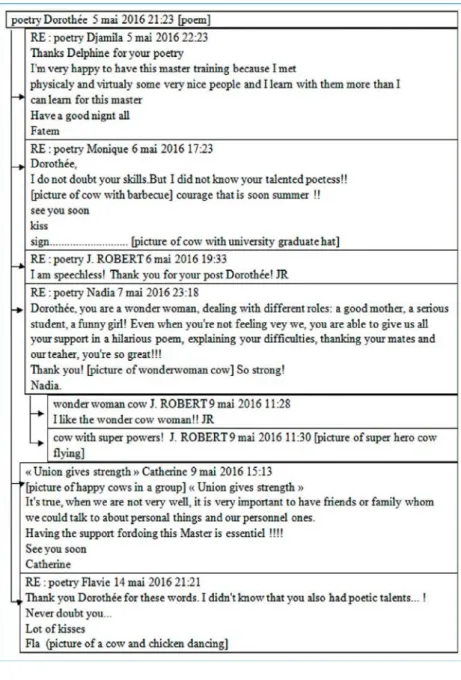
On the 5th of May, Dorothée publishes a long poem (Fig. 4), which
is consulted 37 times (8 by the tutor) and triggers 16 direct answers (detailed below).
Again, this contribution is specific due to the combination of its length, the vocabulary used, the references to the work-group, and the very fact that it is written in rhymes.
The poem starts by “Dear all” like the message in Fig. 2. The vo-cabulary used refers again to the body, the private sphere and psycho-affective or cognitive states: “brain”, “hangover”, “neurons”, “stress”, “distraction”, “exhaustion”, “motivation”, “energy”, “capitulation”, “happy”, etc. She also refers to the collaborative aspect of her situation: “not alone”, “entourage”, “help”. She mentions her co-workers, “Fla and Monique”, the tutor, and even the whole group of master students: “my master companions”, to whom she addresses a word of encourage-ment: “keep going on”.
It is difficult to say whether these messages would have been posted anyway, had this non-pedagogical theme not been created. Dorothée posts unusually long messages on the rest of the forum and her strategy is specific, connecting once a day for 8 weeks for an hour on average, and posting a message each time. But on top of this specific profile, it is reasonable to suppose that she was encouraged by the very existence of the theme, which made her become salient from the point of view of the self. Jeanneau and Ollivier (2009, p. 13) argue that the less the learners perceive the situation as pedagogical, the more they give information about themselves and communicate socio-affective elements. The creation of a dedicated non-pedagog-ical might contribute to relieving the learner from pedagognon-pedagog-ical con-straints, by creating “an online community of trust and learning” (O’Dowd, 2015, p. 68).
The two contributions analyzed above are embedded in threads that we now analyze in detail to see whether they enhance the online experience for the peers as well, i.e. whether it is a shared socio-affec-tive event that is taking place.
The threads
The contributions in the off-task space are organized in 7 episodes, that we identify according to a change of topic, and a change in the participants. This is in keeping with Marcoccia’s defi nition of dis-cussion forums as “discontinuous computer mediated polylogues” that foster fragmentation, emergence and bifurcation of conversa-tional sub-groups (2004, p. 18). Fig. 5 shows the participants in the off-task space and the number of messages in each sub-episode. The colors show which students are from the same work group. For instance, Noémie and Nadia work together on the main task. The table presents the number of messages posted by each participant in each episode. It is in the last thread that the most students are involved, 7 out of 12. It is possible that, by the end of the event, more students have become aware of what is at stake and therefore get involved.
Figure 5. Participants in the off-task space
Figure 6. Thread 1
The tutor launches the topic with “Here you can write whatever you want: poetry, words of praise, ...!”, on the 1st of April. She then reacti-vates the thread by posting a picture of a warrior cow, entitled “a brave cow” (in reference to adventurecow.com)4. On the 11th of April, as we
saw earlier, Dorothée posts a long message. It triggers an answer 3 days later, on the 14th, by Sophie, from another group, who also has a new
born baby. Still on the 14th, Flavie, from Dorothée’s group, comments on
Dorothée’s message. At 21:45, Monique, also from Dorothée’s group, posts 2 humorous pictures in relation with the previous messages. Then later in the evening (22:16) Dorothée thanks Sophie and answers Flavie’s message (22:42). She thanks Monique at 22:47. The tutor thanks Dor-othée for her text at 21:57, and comments on the happy cow at 21:58, but these messages do not trigger any new reactions, neither does the tutor’s later comment to Dorothée, on the 20th. Therefore, the core of this topic actually takes place between 4 students, 3 from the same group and one external, and spans over 7 messages.
We seem to have a glimpse here into what Molinari et al. (2016, p. 24) call an “autotelic pedagogical design principle based on the “fl ow” of the multiple participants, where the main energy is co-produced by the interactions and the contributions of all the learners”. According to Vanin, & Castelli’s model of online intervention and moderation (2009, p. 150), the tutor should indeed reduce their own intervention, by avoiding initiating discussions and favoring “pull” type interven-tions on discussions initiated by the learners.
4 We don’t show the tutor’s fi rst messages here for lack of space.
Figure 7. Thread 2, blindness to a socio-affective event
Thread 2 is an “off-topic” thread (Sotillo, 2000, p. 108) that is not emotionally oriented. It is “non-engaged”, i.e. “what was said before is ignored” (Molinari et al., 2016, p. 51, according to Barron, 2003). Indeed, the presence of a message in a topic does not mean the stu-dent is actually co-present to the peers (Quintin, & Masperi, 2010). Marcoccia (2004, p. 29) points out that the individuals involved in an interaction don’t necessarily all have the same vision of the interac-tion. Here, the student seems blind to the “wider picture” and does not seem to grasp that something is taking place that is outside of the pedagogical contract sensu stricto. On the 19th of April, Christine asks
the tutor about a task involving a blog or twitter account to follow. In fact, she published the same message in the “Week 2” theme, on the 15th of April, and there was no answer from the tutor. Had there been
an answer, this message would likely not have been posted again, and the dynamics of the non-pedagogical theme might have been slightly different. The peers, perhaps sensing the self-contained character of this message, remain silent. Only the tutor answers.
Thread 3: the off-task space as a foster-group
On the 20th of April, thread 3 is initiated by the tutor who relaunches
interaction by posting congratulations. Simone thanks the tutor and mentions her diffi culties. The tutor answers by posting a picture of a warrior cow and words of encouragement. Djamila thanks the tu-tor, and wishes courage to everybody. Valérie answers Djamila “and everybody”, and says thank you. These 3 students are from different groups, who have not participated in this topic so far and will not participate again, except for Djamila.
These messages are more tutor-oriented that in thread 1. Indeed, only Valérie’s message does not contain explicit reference to the tu-tor. It is noticeable that Valérie is the only one from her group to take part in this topic. She actually says “In fact, I actually feel a little alone in my group, which must be tired and weary”. The live creation of a group, as interactions unfold in the off-task space, seems to be able to serve the function of a foster-group in case of dysfunction of the work-group.
Figure 8. Thread 3, tutor-oriented
Thread 4: blindness to a socio-affective event
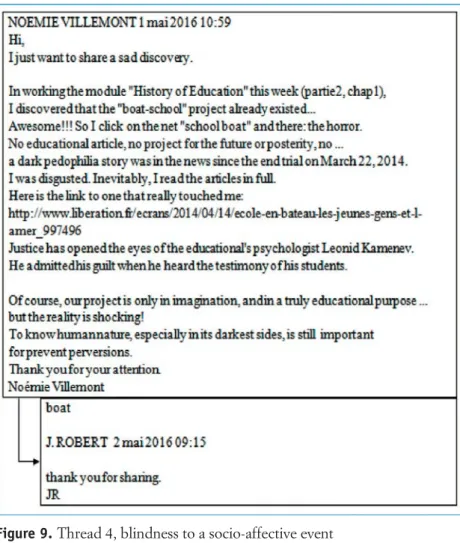
With thread 4, we have another example of an off-dynamic message. It is not related in any way to the previous messages. Noémie tries to share a discovery she made. It is a message she posted fi rst for her group (10:45), where it did not get any reactions. So she posts it in
the non-pedagogical topic as an afterthought, which can explain its off-dynamic character. Her message (1st of May, 10:59) triggers no
re-action from her peers (only the tutor thanks her for sharing), and she does not take part again in the theme. It is noticeable that she signs with her fi rst and second name instead of just her fi rst name or even a nickname like most students do.
Thread 5: tutor-student intertwined interactions
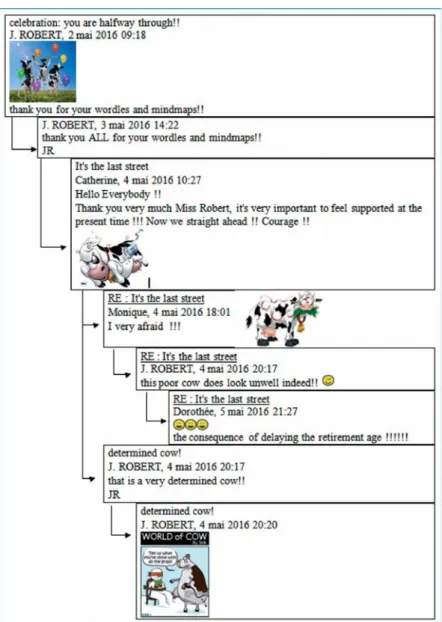
The tutor relaunches the interactions once more by posting a celebra-tory message on the 2nd of May and another on the 3rd. Catherine, the
only one in her group to take part in this new thread, has not partici-pated so far. She joins in, and will also participate in thread 6, with 2 messages. She thanks the tutor for her support and posts a humorous picture. The tutor reacts. Dorothée and Monique who had been silent during threads 2, 3 and 4, join again with 1 message each. Monique re-plies to Catherine by sending a humorous picture with the comment “I very afraid!!!”, to which the tutor reacts with a comment and a smiling emoticon. This makes Dorothée join in with a comment and 3 smiley emoticons. Here, the interactions are neither exclusively tutor-oriented, nor exclusively autotelic between peers, but intertwined.
Thread 6: a second autotelic thread
Thread 6 is launched by a student. On the 5th of May, Dorothée posts a long poem, as we saw above. This post questions the previous at-tempts by the tutor to relaunch the discussion. Indeed, had the tutor not intervened, there might have been more student relaunchings. In this thread, 6 students out of 12 participate. Nadia, who had not par-ticipated so far, joins in with one message. Out of 9 messages in this thread (including the poem itself), 6 (including 1 message by the tu-tor) refer directly to the fi rst post, the poem by Dorothée. The tutor inserts two comments in relation to the wonder woman cow posted by Nadia. Again, this insertion can be questioned in that it can po-tentially interrupt the autotelic fl ow of comments about the poem. Indeed, it is the tutor’s messages that divert the thread away from the poem to comment on a picture.
Thread 7: tutor-oriented
The section below (Fig. 12), initiated a week later, although in an-swer to the poem by structure (RE: poetry), branches off to a differ-ent topic, the fact that the studdiffer-ents deserve their degree. It is almost exclusively between the tutor and one student, Sadia, except for one fi nal message by Catherine.
3. Discussion
The non-pedagogical space seems to have triggered two autotelic threads (1 and 6), or socio-affective peeks, where the students refer to their peers’ messages, independently from what the tutor says. These
peeks do not benefi t all the students since it is the same three stu-dents, from the same group, who appear in both autotelic episodes, along with one other student in thread 1, and two other students in thread 6. Two students even seem blind to the socio-affective event at stake, creating two off-dynamic threads. Thus, participation in the off-task space does not mean autotelic participation. This analysis also allowed us to question the role of the tutor who can be a hindrance to the autotelic fl ow, unless the tutor/students contributions are really intertwined (thread 5). We have also seen that a thread in an off-task space seems to function as a live self-constituted foster-group, in case of a dysfunctional work-group.
From the point of view of risk-taking, the students are indeed showing that they can take risks because they produce language when there is no obligation to take part in this particular off-task theme. We are not talking about the risk of having a bad mark, which we could call academic risk, but the linguistic risk of making mistakes when performing language, and the social risk associated, which can be embraced in a space of trust (Green, 2005, p. 304). In the case of a foreign language pedagogical forum, there as a mild urgency created by the fact that the messages are the task. In our module, they are part of the evaluation, not from the point of view of the structural correct-ness, but from the point of view of risk-taking, given each student’s individual language capacities. We consider each post as not only part of a dialogue with the peers or the tutor, but also with the learners’ previous learning stage. Each trace of language production is a step further towards learning and this process unfolds message after mes-sage on the forum (Satar, 2015, p. 485). In this way, the act of posting on the forum has a performative function: not until I have done it, do I know as a language learner if I am capable of forming this sentence as part of this ongoing conversation.
4. Conclusion: presence and language production as a performance
Hobart and Kapferer (2005, p. 1) defi ne performance in arts, from an aesthetical point of view, as “a process that continually forms itself before refl ection, engaging those embraced in its dynamic fi eld to its
constructive and experientially constitutive force”. In a similar way, language performance is not pre-existent like the answer to a math-ematics exercise that does not vary according to traces of personal im-plication. Language performance is closely linked to “the specifi c turn of the world for a specifi c individual, their very own way of perceiving it” (Meyor, 2002, p. 91). Markee and Kasper (2004, p. 496) consider that “learning behaviors may usefully be understood as a conversation-al process that observably occurs in the intersubjective space between participants, not just in the mind/brain of individuals”. Producing language is live problem-solving, accepting to involve one’s self in the language performance. Paradoxically, maximum engagement or fl ow in a learning context might be more likely to happen when an outside element occurs, or is made possible. The study of the effects of unex-pectedness on engagement is one of possible future studies.
References
Barron, B. (2003). When smart groups fail. The journal of the learning
sci-ences, 12(3): 307-359.
Celik, C. (2010). Pratiques discursives dans une formation en ligne à la didactique
du français langue étrangère: une analyse de la communication pédagogique asynchrone. (Thèse de doctorat). Grenoble: Université de Grenoble.
Celik, C., & Mangenot, F. (2004). La communication pédagogique par fo-rum: caractéristiques discursives. Les Carnets du Cediscor, 8. URL: http://cediscor.revues.org/695.
Chanel, G., Lalanne, D., Lavoué, E., Lund, K., Molinari, G., Ringeval, F., & Weinberger, A. (2016). Grand Challenge Problem 2: Adaptive awareness for social regulation of emotions in online collaborative learning envi-ronments. In J. Eberle, K. Lund, P. Tchounikine (Eds.), Grand challenge
problems in technology enhanced learning II: MOOCs and beyond (pp.
13-16). Switzerland: Springer.
Csikszentmihalyi, M. (1990). Flow: the psychology of optimal experience. New York: Harper & Row.
Dejean-Thircuir, C. (2008). Modalités de collaboration entre étudiants et constitution d’une communauté dans une activité à distance. Alsic, 11(1). URL: http://alsic.revues.org/803.
Develotte, C. (2012). L’analyse des corpus multimodaux en ligne: état des lieux et perspectives. Actes en ligne du Congrès Mondial de Linguistique
Française. Lyon, France. 1, 509-525.
Develotte, C. (2006a). De L’analyse du discours à l’analyse du discours
multi-média Habilitation à diriger des recherches. Grenoble: Université
Stend-hal Grenoble 3.
Develotte, C. (2006b). L’étudiant en autonomie et ses professeurs virtuels: comment se personnalise la communication en ligne? Synergies Chili, 2. URL: http://halshs.archives-ouvertes.fr/halshs-00151852.
Develotte, C. (2006c). Décrire l’espace d’exposition discursive dans un campus numérique. In C. Dejean-Thircuir, & F. Mangenot (Eds.), Les échanges en ligne dans l’apprentissage et la formation, n° spécial du
Français dans le monde, recherches et applications, 40: 88-100.
Develotte, C., & Mangenot, F. (2004). Tutorat et c ommunauté dans un cam-pus numérique non collaboratif. Distances et savoirs, 2(2): 309-333. Dooly, M., & Tudini, V. (2016). ‘Now we are teachers’: The role of small talk
in student language teachers telecollaborative task development. Journal
of Pragmatics, 102: 38-53.
Dussarps, C. (2017). Étude communicationnelle de l’abandon en formation à distance universitaire. Adjectif.net [En ligne] http://www.adjectif.net/ spip/spip.php?article422.
Garrison, D.R., Anderson, T., & Archer, W. (1999). Critical inquiry in a text-based environment: computer conferencing in higher education. The
Internet and Higher Education, 2(2-3): 87-105.
González-Lloret, M. (2015). Conversation analysis in computer-assisted lan-guage learning. Special issue. From second lanlan-guage acquisition to second language use: Qualitative and mixed-methods approaches to research in CALL today. CALICO Journal, 32(3): 569-594.
Grassin, J.-F. (2015). Affordances d’un réseau social pour une formation en
Français Langue Etrangère: pratiques discursives, modes de participation et présence sociale en ligne. (Thèse de doctorat). Lyon: Université Lumière
Lyon 2.
Green, P. (2005). Spaces of infl uence: A framework for analysis of an indi-vidual’s contribution within communities of practice. Higher Education
Research and Development, 24(4): 293-307.
Guichon, N. (2012). L’apprentissage des langues médiatisé par les technolo-gies (ALMT) – Étude d’un domaine de recherche émergent à travers les publications de la revue Alsic. Alsic, 15(3). URL: http://alsic.revues. org/2539.
Halté, P. (2013). Les marques modales dans les t’chats : étude sémiotique et
pragmatique des interjections et des émoticônes dans un corpus de con-versations synchrones en ligne. (Thèse de doctorat). Metz/Luxembourg.
URL: http://www.theses.fr/2013LORR0308.
Herring, S.C. (1999). Interactional coherence in CMC. Journal of
Computer-Mediated Communication, 4(4).
Herring, S.C. (2004). Computer-mediated discourse analysis: An approach to researching online behavior. In S.A. Barab, R. Kling, & J.H. Gray (Eds.), Designing for virtual communities in the service of learning (pp. 338-376). New York: Cambridge University Press. Preprint: http://ella. slis.indiana.edu/~herring/cmda.pdf.
Hobart, A., Kapferer, B. (2005). Introduction. Aesthetics in performance: the aesthetics of symbolic construction and experience (pp. 1-23). In
Aesthetics in performance: formations of symbolic construction and expe-rience. New York: Berghahn books.
Holmer, T. (2008). Discourse structure analysis of chat communication.
Language@Internet, 5, article 10. URL: http://www.languageatinternet.
org/articles/2008/1633.
Huynh-Kim-Bang B., & Bruillard É. (2005). Vers une nouvelle interface de lecture pour des forums de discussion dédiés à des élaborations collec-tives (pp. 43-56). In I. Saleh, & C. Jean (coord.), Créer, jouer, échanger,
actes de H2PTM’05. Paris: Lavoisier.
Jeanneau, C., & Ollivier, C. (2009). Eléments infl uençant la nature des interactions en ligne des apprenants de langue. In C. Develotte, F. Mangenot, & E. Nissen (Eds.). Actes du colloque Epal 2009
(Echang-er pour apprendre en ligne: conception, instrumentation, int(Echang-eractions, multimodalité). Grenoble: Université Stendhal − Grenoble 3, 5-7 juin
2009.
Jézégou, A. (2010). Créer de la présence à distance en e-learning. Distances
et savoirs, 8(2): 257-274.
Kehrwald, B. (2008). Understanding social presence in text-based on-line learning environments. Distance Education, 29(1): 89-106. http:// dx.doi.org/10.1080/01587910802004860.
Lupi, V., Pozzi, F., & Torsani, S. (2008). La dimension sociale dans un mas-ter post-universitaire à distance: outils, animation et analyse des inmas-terac- interac-tions. Alsic, 11(1). URL: http://alsic.revues.org/853.
Mangenot, F. (2007). Analyser les interactions pédagogiques en ligne, pour-quoi, comment? In J. Gerbault (Ed.), La langue du cyberespace: de la
Marcoccia, M. (2004). L’analyse conversationnelle des forums de discussion: questionnements méthodologiques. Les Carnets du Cediscor, 8. URL: http://cediscor.revues.org/220.
Markee, N., & Kasper, G. (2004). Classroom talks: an introduction. Modern
Language Journal, 88(4): 491-500.
Meyor, C. (2002). L’affectivité en éducation: pour une pensée de la sensibilité. Bruxelles: De Boeck.
Molinari, G., Poellhuber, B., Heutte, J., Lavoué, E., Sutter, W.D., & Caron, P.-A. (2016). L’engagement et la persistance dans les dispositifs de for-mation en ligne: regards croisés. Distances et médiations des savoirs, 13. URL: http://dms.revues.org/1332.
O’Dowd, R. (2015). Supporting in-service language educators in learning to telecollaborate. Language Learning & Technology, 19(1): 64-83. URL: http://llt.msu.edu/issues/february2015/odowd.pdf.
Paulus, T. (2009). Online but off-topic: negotiating common ground in small learning groups. Instructional Science, 37(3): 227-245.
Paveau, M.-A. (2012). Réalité et discursivité. D’autres dimensions pour la théorie du discours, Semen, 34. URL: http://semen.revues.org/9748. Quintin, J.-J., & Masperi, M. (2010). Reliance, liance et alliance:
opération-nalité des concepts dans l’analyse du climat socio-relationnel de groupes restreints d’apprentissage en ligne. Alsic, 13. URL: http://alsic.revues. org/1702.
Rémon, J. (2015). Humour et production écrite dans une pratique de l’anglais LANSAD à distance. EDL LAIRDIL, 25: 103-126.
Rémon, J. (2016). Prégnance de l’intime et pratique de la langue à distance: du chaos au développement langagier (pp.165-186). In M. Berchoud, C. Collière-Whiteside, & A.-M. Voise, Apprendre de l’intime: Entre
littéra-ture et langues. Louvain-la-Neuve: EME Editions.
Satar, M.H. (2005). Sustaining multimodal language learner interactions on-line. CALICO Journal, 32(3): 480-507.
Sotillo, S.M. (2000). Discourse functions and syntactic complexity in syn-chronous and asynsyn-chronous communication. Language Learning &
Tech-nology, 4(1): 82-119.
Tassinari, M.G., & Ciekanski, M. (2013). Accessing the self in self-access learning: emotions and feelings in language advising. Studies in
Self-Ac-cess Learning Journal, 4(4): 262-280.
Teutsch, P., Bangou, F., & Dejean-Thircuir, C. (2008). Faciliter l’accès aux échanges en ligne et leur analyse, le cas de ViCoDiLi. Revue STICEF, 15. URL: http:// sticef.univ-lemans.fr/num/vol2008/03-teutsch/sticef_2008_teutsch_03.htm.
Uzuner, S. (2007). Educationally valuable talk: a new concept for determin-ing the quality of online conversations. Journal of Online Learndetermin-ing and
Teaching, 3(4): 400-410.
Vanin, L., & Castelli, S. (2009). Gli interventi del tutor in forum di discus-sione online. Da un modello teorico agli aspetti applicativi. QWERTY,
4(2): 140-159.
Warschauer, M., & Kern, R. (2000). Network-based language teaching:
con-cepts and practice. Cambridge: Cambridge University Press.
Zourou, K. (2007). Paradigme(s) émergent(s) autour des apprentissages collectifs médiatisés en langues. Alsic, 10(2), URL: http://alsic.revues. org/688.