HAL Id: tel-01258795
https://tel.archives-ouvertes.fr/tel-01258795v2
Submitted on 9 Jan 2018HAL is a multi-disciplinary open access archive for the deposit and dissemination of sci-entific research documents, whether they are pub-lished or not. The documents may come from teaching and research institutions in France or abroad, or from public or private research centers.
L’archive ouverte pluridisciplinaire HAL, est destinée au dépôt et à la diffusion de documents scientifiques de niveau recherche, publiés ou non, émanant des établissements d’enseignement et de recherche français ou étrangers, des laboratoires publics ou privés.
Coordination and reconfiguration of distributed cloud
applications
Rim Abid
To cite this version:
Rim Abid. Coordination and reconfiguration of distributed cloud applications. Networking and In-ternet Architecture [cs.NI]. Université Grenoble Alpes, 2015. English. �NNT : 2015GREAM055�. �tel-01258795v2�
THÈSE
Pour obtenir le grade de
DOCTEUR DE L’UNIVERSITÉ DE GRENOBLE
Spécialité : Informatique Arrêté ministérial : 7 Août 2006
Présentée par
Rim ABID
Thèse dirigée par Gwen SALAÜN et codirigée par Noël DE PALMA
préparée au sein du Laboratoire d’Informatique de Grenoble (LIG) et INRIA
Grenoble Rhône-Alpes
et de L’École Doctorale Mathématiques, Sciences et Technologies de
l’Informa-tion, Informatique
Coordination and Reconfiguration of
Distributed Cloud Applications
Thèse soutenue publiquement le 16/12/2015, devant le jury composé de :
Mr. Daniel HAGIMONT
Professeur à l’Institut National Polytechnique de Toulouse, Président
Mr. Christian ATTIOGBÉ
Professeur à l’Université de Nantes, Rapporteur
Mr. Pascal POIZAT
Professeur à l’Université de Paris Ouest Nanterre la Défense, Rapporteur
Mme. Fabienne BOYER
Maître de Conférences à l’Université Joseph Fourier, Examinatrice
Mr. Gwen SALAÜN
Maître de Conférences à Grenoble INP, Directeur de thèse
Mr. Noël DE PALMA
Acknowledgements
These lines present the closing of this thesis and the completion of three years of work, research, and collaboration carried out within the LIG Laboratory (Laboratoire d’Informatique de Grenoble).
Firstly, many sincerely thanks to my supervisors Gwen Salaun, associate professor at Ensimag / Grenoble INP, and Noel De Palma, professor at Uni-versity Joseph Fourier, for their advice, guidance and constant encouragement over these three years. I am incredibly grateful for all their help.
I thank the rapporteurs Christian Attiogbe and Pascal Poizat for the atten-tion they have given to my thesis. I also thank the jury members Daniel Hagi-mont and Fabienne Boyer how agreed to review and discuss this work.
Many thanks to my colleagues in the Convecs and Erods teams, making a perfect working environment. Thanks in particular to L. Ye, A. Kriouile, L. Akroun, F. Jebali, H. Evrard, and S. M. Gueye – your useful input and advice has been invaluable.
I’ d like to thank my parents Habib and Hajer. Without your financial and spiritual support during these long years as well as for giving me the oppor-tunity to have an outstanding education, I would never have stayed sane long enough to complete my studies.
Finally, massive thanks to my husband Omar and my little prince Adam, who have given unwavering support and the belief that I was able to produce this thesis. I hope you are proud of me and my work.
This work was funded by the OpenCloudware project (2012-2015), which is funded by the French Fonds National pour la Société Numérique (FSN), and is supported by Poles Minalogic, Systematic, and SCS.
Abstract
Cloud applications consist of a set of interconnected software components running on multiple virtual machines. Thus, there is a need for protocols that can dynamically reconfigure such distributed applications. We present in the first part of this thesis a novel protocol, which can resolve dependencies in distributed cloud applications, by (dis)connecting and starting/stopping components in a particular order. The proto-col also supports virtual machine failures. The virtual machines interact through a publish-subscribe communication media and reconfigure themselves upon demand in a decentralised fashion. Designing such protocols is an error-prone task. Therefore, we investigated the use of formal specification languages and verification techniques, in particular the LNT value-passing process algebra to specify the protocol and the model checking tools available in the CADP toolbox to verify it. Moreover, managing dis-tributed cloud applications is a challenging problem because the manual administration is no longer realistic for these complex distributed systems. Thus, autonomic computing is a promising solution for monitoring and updating these applications automatically. This is achieved through the automation of administration functions and the use of con-trol loops, called autonomic managers. Multiple autonomic managers can be deployed in the same system and must make consistent decisions. However, using them without coordination may lead to inconsistencies and error-prone situations. We propose a new approach for coordinating stateful autonomic managers, which relies on a simple coor-dination language, new techniques for asynchronous controller synthesis and Java code generation. We used our approach for coordinating real-world cloud applications.
Keywords. Cloud Computing, Dynamic Reconfiguration, Distributed
Applica-tions, Fault-Tolerance, Autonomic Management, Coordination, Controller Synthesis, Asynchronous Communication, Formal Verification, Process Algebra Encoding, La-belled Transition System
Résumé
Les applications reparties dans le nuage sont constituées d’un ensemble de com-posants logiciels interconnectés et répartis sur plusieurs machines virtuelles. Cet envi-ronnement nécessite des protocoles pour reconfigurer dynamiquement ces applications. Nous présentons dans la première partie de cette thèse un nouveau protocole pour ré-soudre les dépendances dans ces applications. Ce protocole consiste à (dé) connecter et démarrer/arrêter les composants dans un ordre spécifique. Il supporte les pannes des machines virtuelles et les opérations de reconfiguration se terminent toujours avec suc-cès. Ces machines virtuelles interagissent à travers un «publish-subscribe support de communication» et se reconfigurent d’une manière décentralisée. La conception de ces protocoles étant une source d’erreurs. Alors, nous avons étudié l’utilisation des langages et techniques de verification formelles. En particulier, nous avons utilisé LNT pour spé-cifier le protocole et les outils disponibles dans la boîte à outils CADP pour le vérifier. D’autre part, la gestion des applications reparties dans le nuage est une tâche complexe car l’administration manuelle n’est plus réaliste pour ces systèmes. Nous avons proposé d’automatiser certaines fonctions d’administration en utilisant des boucles de contrôle appelées gestionnaires autonomes. Plusieurs gestionnaires peuvent être déployés pour la gestion de la même application. Cependant, leur utilisation sans coordination peut conduire à des incohérences et à des situations d’erreur. Dans la deuxième partie de cette thèse, nous avons proposé une nouvelle approche pour coordonner plusieurs ges-tionnaires autonomes. Cette approche repose sur un language de coordination simple, de nouvelles techniques asynchrones pour la synthèse de contrôleur et la génération de code Java. Nous avons appliqué notre approche pour coordonner les applications repar-ties dans le nuage dans le monde réel.
Mots clés. Informatique en Nuage, Reconfiguration Dynamique, Applications
Distribuées, Tolérance aux Pannes, Gestion Autonome, Coordination, Synthèse de Con-trôleurs, Communication Asynchrone, Vérification Formelle, Encodage en Algèbre de Processus
Contents
Contents . . . i
1 Introduction 1 1.1 Industrial Context . . . 2
1.2 Scientific Results of the Thesis . . . 4
1.3 Thesis Organization . . . 7
2 Background 9 2.1 Distributed Applications . . . 11
2.2 Cloud Computing . . . 13
2.3 Reconfiguration of Distributed Applications . . . 19
2.4 Autonomic Computing . . . 21
2.5 CADP and LOTOS NT (LNT) . . . 25
2.6 Conclusion . . . 32
3 State of the Art 35 3.1 Dynamic Reconfiguration . . . 37
3.2 Coordination Models and Languages . . . 51
3.3 Controller Synthesis Techniques . . . 62
4 Dynamic Management Protocol for Cloud Applications 70 4.1 Reconfiguration Protocol . . . 73
4.2 Protocol Specification and Verification . . . 93
4.3 Experiments . . . 102
4.5 Protocol Implementation . . . 106
4.6 Conclusion . . . 108
5 Asynchronous Coordination of Stateful Autonomic Managers in
the Cloud 110
5.1 Formal Models . . . 113
5.2 Asynchronous Synthesis Techniques . . . 115
5.3 Java Code Generation and Deployment . . . 123
5.4 A Multi-tier Application Supervised by Autonomic Managers . . 124
5.5 Conclusion . . . 136
6 Conclusion 138
6.1 Achievements . . . 139
6.2 Perspectives . . . 141
List of Figures
2.1 The MAPE-K reference model . . . 22
3.1 An example of a state machine associated to a resource driver . . 42
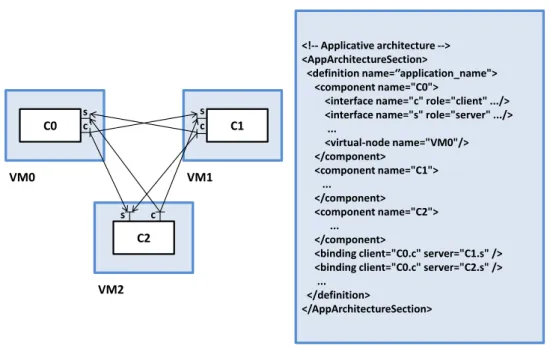
3.2 An example of an application (left) and its extended OVF descrip-tor (right) . . . 44
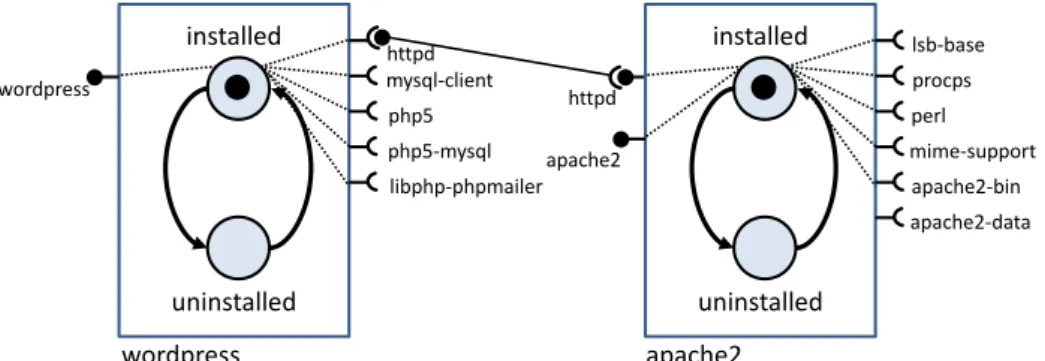
3.3 An example of packages, services, and bindings described by the Aeolus model . . . 45
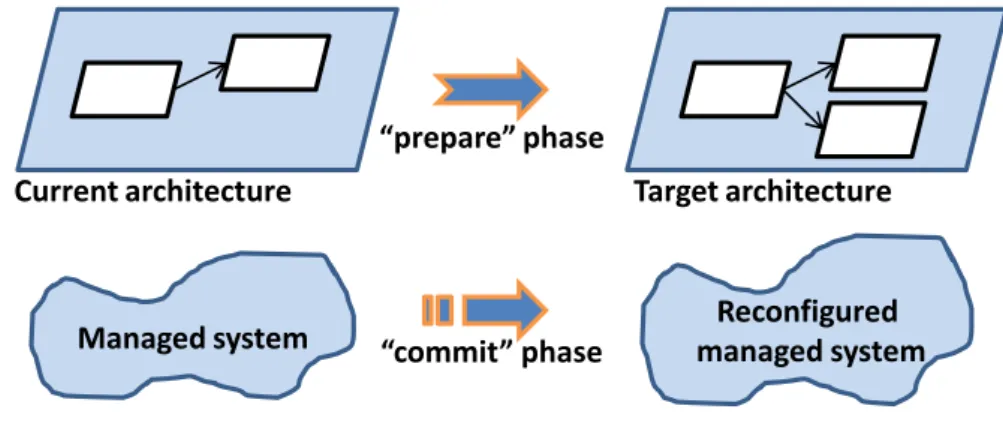
3.4 The reconfiguration steps: the prepare and commit phases . . . . 47
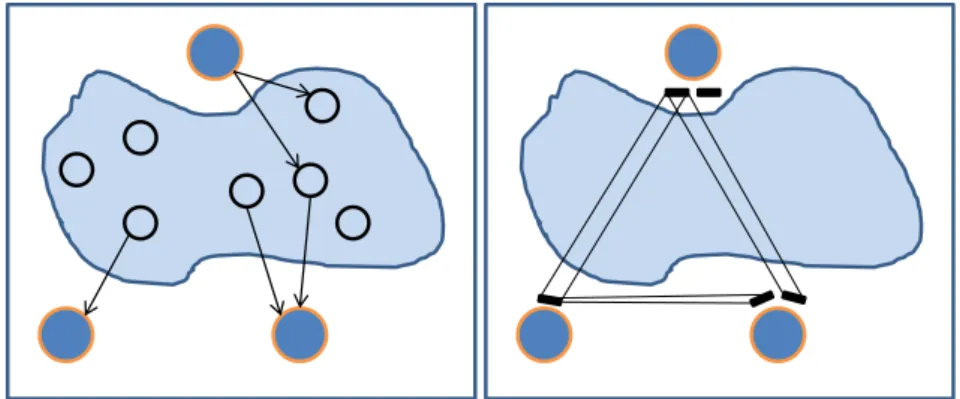
3.5 The coordination medium when: using a data driven coordina-tion language (left); using an event-driven coordinacoordina-tion language (right) . . . 52
3.6 Multi-agent architecture for establishing an energy consumption policy . . . 59
3.7 Control of a decentralized reactive system, regarded as subsys-tems, through local controllers on each subsystem . . . 67
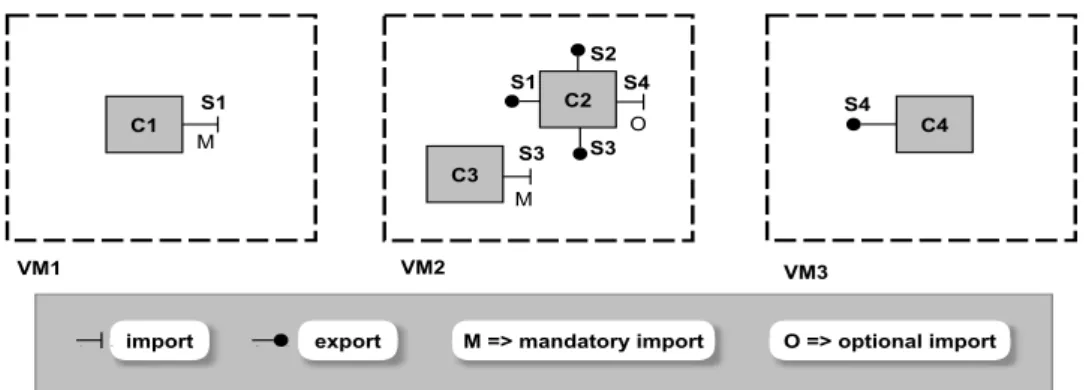
4.1 Example of an application model (before binding ports) . . . 74
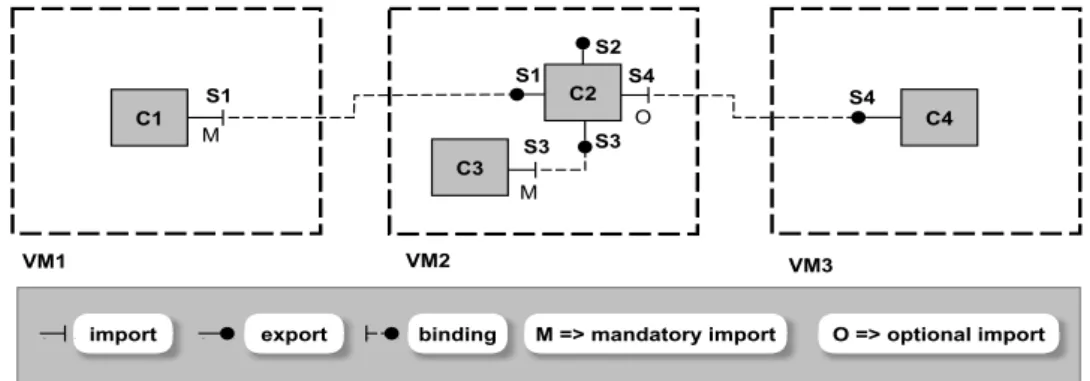
4.2 Example of an application model (after binding ports) . . . 75
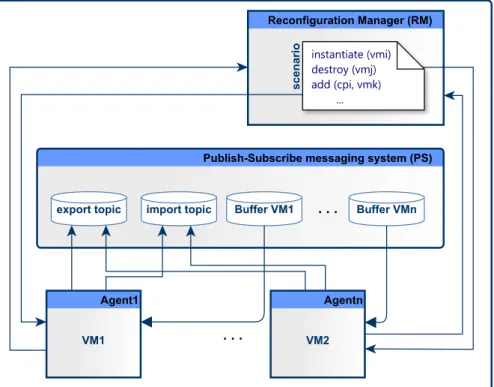
4.3 Protocol participants: reconfiguration manager, VMs, and publish-subscribe messaging system . . . 77
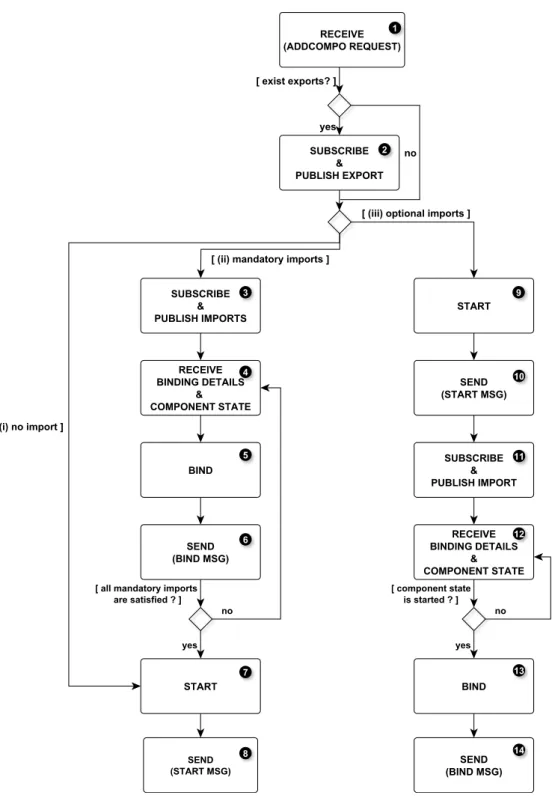
4.4 The agent behaviour when adding a new component: (i) without imports; (ii) with, at least, a mandatory import; and (iii) with, only optional imports . . . 79
4.5 Instantiating VM1 then Instantiating VM2 . . . 82
4.6 Instantiating VM2 then Instantiating VM1 . . . 83
4.7 The agent behavior when removing a component . . . 85
4.9 The RM behavior when detecting a VM failure . . . 87
4.10 The PS behavior when receiving an alert failure message . . . 88
4.11 Example of a running application composed of connected and
started components . . . 89
4.12 The participants behavior when removing the Tomcat component 90
4.13 The participants behavior when adding the Tomcat component . 92
4.14 The participants behavior when detecting the VM3 failure . . . . 93
4.15 Tool support . . . 95
4.16 Experimental results when increasing the number of VMs (left) start-up scenario without failure, (right) start-up and destruction
scenario without failure . . . 104
5.1 Overview of our approach . . . 113
5.2 Example of a manager modelled as an LTS (left), and the LNT
process encoding the initial state (right) . . . 117
5.3 Example of coordination requirements encoded into an LNT
pro-cess . . . 119
5.4 Exchange of messages between the coordination expression and
the managers . . . 122
5.5 A multi-tier application . . . 125
5.6 (left) The architecture of the self-sizing manager, (right) the
archi-tecture of the self-repair manager . . . 126
5.7 (left) Self-repair manager LTS, (middle) Self-sizing manager LTS,
(right) Application manager LTS . . . 126
5.8 Excerpt of the controller LTS for the running example . . . 132
5.9 Tomcat and MySQL failure/overload in a coordinated environment135
5.10 Number of reconfiguration operations with/without
List of Tables
2.1 Cloud Computing Definitions . . . 14
2.2 Coordination Definitions . . . 24
3.1 Comparison between the languages and approaches used for dy-namic reconfiguration . . . 50
3.2 Comparison between controller synthesis techniques . . . 68
4.1 Experimental results (with failures) . . . 105
Acronyms
A
ACP Algebra of Communicating Processes
ADL Architecture Description Language
B
BCG Binary Coded Graphs
C
CADP Construction and Analysis of Distributed Processes
CONVECS Construction of Verified Concurrent Systems
D
DADL Distributed Application Description Language
DCS Discrete Controller Synthesis
DES Discrete Event System
DSL Domain Specific Language
E
ERODS Efficient and Robust Distributed Systems
F
FSN Fonds National pour la Société Numérique
I
IaaS Infrastructure as a Service
IT Information Technology
J
JVM Java Virtual Machine
L
LNT LOTOS NT
LTL Linear Temporal Logic
LTS Labelled Transition System
M
MAPE-K Monitor Analyse Plan Execute - Knowledge
MCL Model Checking Language
N
NIST National Institute of Standards and Technology
O
OVF Open Virtualization Format
P
PaaS Platform as a Service
PS Publish-Subscribe Messaging System
Q
QoS Quality of Service
R
RM Reconfiguration Manager
S
SaaS Software as a Service
SLA Service Level Agreements
SmartFrog Smart Framework for Object Group
SVL Scripting Language for Compositional Verification
V
VAMP Virtual Applications Management Platform
1
Introduction
" Work is the only thing that gives substance to life. "
Albert Einstein
Contents
1.1 Industrial Context . . . 2
1.1.1 Presentation of the OpenCloudware Project . . . 2
1.1.2 Project Expectations . . . 3
1.1.3 Position in the OpenClouware Project . . . 3
1.2 Scientific Results of the Thesis . . . 4
1.2.1 Motivations . . . 4
1.2.2 Objectives and Main Contributions . . . 6
1.1. Industrial Context 2
T
His Ph.D. thesis research is part of the OpenCloudware project1. We presentin this chapter the OpenCloudware project, a brief survey of its expecta-tions, the thesis positioning in the project and, in a second part, we introduce the problem statement, the main contributions, and the thesis organization.
1.1 Industrial Context
1.1.1 Presentation of the OpenCloudware Project
The OpenCloudware project is a collaborative research project. It is funded by the French authorities – specifically through the Fonds National pour la
So-ciété Numérique(FSN) and started in January 2012 for a duration of three years
and nine months. The project, known for its original approaches and technical
innovations, is endorsed by Pôles de compétitivité Minalogic2, Systematic3, and
SCS4.
The project members include 18 partners composed of academic partners (Armines, Inria, IRIT – INP Toulouse, Télécom Paris Tech, Télécom Saint-Etienne, Université Joseph Fourier, and Université de Savoie – LISTIC), indus-try leaders and innovative technology start-ups (France Telecom, ActiveEon, Bull, eNovance, eXo Platform, Peergreen, Linagora, Thales Communications, Thales Services, and UShareSoft), and a world-renowned open source commu-nity (OW2).
Each partner of the OpenCloudware project participated with one or more contributions to the project solution and had its own expectations.
1. http://www.opencloudware.org 2. http://www.minalogic.org/
3. http://www.systematic-paris-region.org/ 4. http://www.pole-scs.org/
1.1. Industrial Context 3
1.1.2 Project Expectations
The openCloudWare project intends to build an open software engineering platform. This platform will be used for the development of distributed appli-cations, e.g., multi-tier applications such as JavaEE, which need to be deployed on multiple Cloud infrastructures. The project results will be summarized as a set of software components that allow the cloud users to model, develop, and build their applications in order to obtain a multi-IaaS compliant PaaS plat-form for the deployment, orchestration, perplat-formance testing, self-management, and provisioning of the applications. These components have been made avail-able, in October 2015, as open source components through the OW2 open source community.
It is worth noting that the OpenCloudware project addresses multiple tech-nological issues and challenges that we summarize here:
– providing a complete modeling, so-called end-to-end (retro-) modeling, starting from the applications and achieving both PaaS and IaaS services on the platform of cloud computing;
– automating the orchestration of the modules that compose the platform to manage the applications life-cycle in a virtual context;
– reacting to the dynamic changes that can occur in a cloud PaaS application by means of autonomic management, which takes into account elasticity constraints, energy optimization, and also the reliability of the deployed services;
– providing an interoperable execution of multi-cloud IaaS interfaces; – optimizing the services performance and cost by taking globally coherent
decisions;
– ensuring the security in terms of application isolation, encryption, and management.
1.1.3 Position in the OpenClouware Project
The OpenCloudware project contains six technical and scientific subprojects (SP1, 2, 3, 4, 5, and 7), a validation subproject SP6, and a subproject dedicated
1.2. Scientific Results of the Thesis 4
to dissemination SP8.
Within this project, the CONVECS and ERODS teams, in which this thesis was prepared, participate essentially in SP1 and SP3. The major goal of SP1 is to de-fine an overall architecture, a model for distributed applications, services of the PaaS platform, and capacities of the IaaS infrastructures. The major goal of SP3 is to develop generic components and tools for the deployment, the automated orchestration, and the performance testing. SP3 also aims at administrating the PaaS platform, particularly the autonomic management of dynamic changes in distributed applications.
The position of this thesis in the OpenCloudware project has responded to the need for the management of dynamic models and the autonomic admin-istration of applications. It also includes the need to formalize the dynamic aspects of these models in order to experiment the administrative functions, to formally specify management protocols for cloud applications, and to ver-ify them using the model-checking and verification tools developed within the CONVECS team.
1.2 Scientific Results of the Thesis
1.2.1 Motivations
During the last few years, the IT operating costs have risen considerably in a continuous way. Therefore, companies have, increasingly, outsourced their IT services and have been reluctant to entrust them to specialists, such as cloud providers. Thus, cloud computing has been an active research topic. In terms of market adoption, it leverages hosting platforms based on virtualization and provides resources and software applications as services over the network. Cloud computing allows, on the one hand, service providers to develop and then sell distributed applications, composed of virtual machines and hosting interconnected software components, worldwide without having to invest up-front in expensive IT infrastructures. On the other hand, it allows the users to access services, to benefit from them through a Web browser, and to pay only
1.2. Scientific Results of the Thesis 5
for the services used. As a result, the software systems transform from central-ized to distributed and from static to dynamic.
The cloud users need to (re) configure and monitor applications during their time life for elasticity or maintenance purposes. Therefore, after the deploy-ment of these applications, some reconfiguration operations are required for set-ting up new virtual machines, replicaset-ting some of them, destroying or adding virtual machines, handling VM failures, and adding or removing components hosted on a VM. These tasks are required to react to changes (such as the occur-rence of a failure), to include new requirements, or to fulfill the users expecta-tions. Some of these tasks are executed in parallel, which involves a high degree of parallelism and complicates their correct execution. Moreover, in the context of the OpenCloudware project, architectural invariants (e.g., started compo-nents cannot be connected to stopped compocompo-nents) must be preserved when the reconfiguration operations are executed.
Several research studies and protocols have been proposed to support the self-deployment of cloud applications. These protocols manage static applications, which are composed of a set of virtual machines, ports, components, and con-nections between the components where the number of these elements and the involved connections are known before the application execution. However, cloud users need protocols that permit to deploy such applications and that are also able to modify these applications during their execution. The existing
protocols, e.g., [60, 62, 126] do not support the applications that require to be
changed after the deployment phase.
Moreover, today, the requirements of the cloud users are continuously evolv-ing, which leads to the increase of the complexity of the cloud applications and their management becomes a crucial feature. Therefore, the management of these applications is a challenging problem for administrators. The manual ad-ministration is no longer realistic for these complex distributed systems and en-vironments. Thus, autonomic computing has become a promising solution for observing, monitoring, and updating these applications automatically. These actions are achieved through the automation of administrative functions and the use of control loops, called autonomic managers. However, available man-agers can be designed to address the requirements of a particular application domain without coordination. This may lead the whole system to the
perfor-1.2. Scientific Results of the Thesis 6
mance degradation and some undesired situation (e.g., adding two new servers whereas one was enough as a result of a server failure). Therefore, the coor-dination of multiple control loops managing the same application, particularly distributed cloud applications, is a central issue that appears as a real need in the context of the OpenCloudware project.
1.2.2 Objectives and Main Contributions
One of the goals of the OpenCloudware project is to dynamically reconfigure cloud applications composed of interconnected software components running on different virtual machines in an automatic way. However, achieving dynam-ically the reconfiguration process is a complicated task. First, when reconfigur-ing a distributed application, it is necessary to execute the reconfiguration oper-ations, while preserving architectural invariants (e.g., a started component can-not be connected to a stopped one) at each step of the application runtime, par-ticularly when components need to be stopped in sequence across several VMs. Another difficulty with the dynamic reconfiguration of distributed applications is that these applications can be faced with a set of virtual machines or compo-nents failures that may occur during the reconfiguration process. Therefore, in this thesis, we take into consideration the fault tolerance, meaning that the re-configuration process must always terminate successfully even in the presence of a finite number of failures. Another issue, which arises when automating the reconfiguration process, is the necessity to take coherent decisions, which should not lead the system to inconsistent situations.
To automatically bring the deployment and (re)configuration tasks in dis-tributed applications, this thesis contributes with a novel, robust, and fault-tolerant protocol, which enables to execute dynamically reconfiguration tasks,
e.g., instantiate and destroy virtual machines and supports virtual machine
failures. Moreover, the protocol is decentralized in the sense that all virtual machines communicate information (e.g., binding details, component state) through a publish-subscribe communication media. The protocol also allows to start/stop the disconnected components in a particular order for preserving the application consistency (i.e., architectural invariants) at each step of its
ex-1.3. Thesis Organization 7
ecution. This first contribution is assessed through the use of formal methods and verification techniques of the CADP toolbox. Concretely, the evaluation is performed by the specification and the verification of multiple properties on different reconfiguration scenarios and a large set of case studies, ranging from simple ones to other containing several VMs and components.
A second contribution of this thesis is the integration of new controller syn-thesis techniques in the automatization of administration functions in order to reduce the manual execution of reconfiguration tasks. The automatization pro-cess is performed through the use of control loops, called autonomic managers. An autonomic manager observes the application execution, ensures a continu-ous monitoring, and reacts to events and changes by automatically reconfigur-ing the applications. This contribution proposes new asynchronous synthesis techniques in order to coordinate several managers and allow them to take co-herent decisions globally. The generation of the controller is based on reaction rules and regular expressions used to specify the coordination requirements and interaction constraints. This contribution relies on formal techniques, in partic-ular we use the verification techniques available in the CADP toolbox for gener-ating the controller, validgener-ating it, and ensuring that all managers globally satisfy the objectives. We also propose Java code generation techniques that allow to deploy the generated controller for real applications in the cloud.
1.3 Thesis Organization
We have started this dissertation with the industrial context of the thesis, a summary of the scientific motivations, and the main contributions. The remain-der of this dissertation is structured as follows:
– Chapter 2 In this chapter, we present a description of some terms (e.g., distributed applications, cloud computing, dynamic reconfiguration, au-tonomic computing, coordination, formal methods) used in the results presented in the subsequent chapters.
– Chapter 3 In this chapter, we present a literature review on dynamic reconfiguration, coordination languages, and controller synthesis tech-niques.
1.3. Thesis Organization 8
– Chapter 4 In this chapter, we present a novel dynamic protocol for re-configuring distributed cloud applications. The protocol is specified and verified using formal techniques and tools to ensure that it preserves im-portant architectural invariants (e.g., a started component cannot be con-nected to a stopped component) and satisfies certain properties (e.g., each VM failure is followed by a new creation of that VM).
– Chapter 5 In this chapter, we describe new asynchronous controller synthesis techniques allowing the generation of a centralized controller, which aims at coordinating several autonomic managers in the cloud. These techniques cover the whole development process from the expres-sion of coordination requirements to the deployment of the controller for coordinating real applications.
– Chapter 6 In this chapter, we conclude and present some perspectives for further research.
Publications
Some results of this thesis have been published in the following papers: – R. Abid, G. Salaün, F. Bongiovanni, N. De Palma, Verification of a
Dynamic Management Protocol for Cloud Applications, in: Proc. of ATVA’13, Vol. 8172 of LNCS, Springer, 2013, pp. 178–192.
– R. Abid, G. Salaün, N. De Palma, S.M. Kare, Asynchronous Coordination of Stateful Autonomic Managers in the Cloud, in: Proc. of FACS’15, LNCS, Springer, 2015, To appear.
– R. Abid, G. Salaün, N. De Palma, Formal Design of Dynamic Reconfigura-tion Protocol for Cloud ApplicaReconfigura-tions, Science of Computer Programming, 2015, To appear.
2
Background
" The point of philosophy is to start with something so simple as not to seem worth stating, and to end with something so paradoxical that no one will believe it. "
Bertrand Russell
Contents
2.1 Distributed Applications . . . 11
2.1.1 Characteristics of Distributed Applications . . . 11
2.1.2 Purposes of Distributed Applications . . . 12
2.2 Cloud Computing . . . 13
2.2.1 Cloud Computing Definition . . . 13
2.2.2 Cloud Characteristics . . . 16
2.2.3 Cloud Service Models . . . 17
10
2.3 Reconfiguration of Distributed Applications . . . 19 2.4 Autonomic Computing . . . 21 2.4.1 Autonomic Manager Definition and Implementation . 22 2.4.2 Coordinating Multiple Autonomic Managers . . . 23 2.5 CADP and LOTOS NT (LNT) . . . 25 2.5.1 Formal Methods . . . 25 2.5.2 CADP toolbox . . . 27 2.5.3 LOTOS NT (LNT) . . . 31 2.6 Conclusion . . . 32
2.1. Distributed Applications 11
I
N this chapter, we introduce techniques and definitions of some terms usedin the results presented in the subsequent chapters. First, we give defini-tions and general characteristics of distributed applicadefini-tions, cloud computing, dynamic reconfiguration, autonomic computing, and coordination. In a sec-ond step, we introduce existing formal techniques and tools that have been em-ployed to achieve the objectives and contributions of the thesis.
2.1 Distributed Applications
Since the appearance of computers in the middle of the 20th century, the ap-plication complexity has been continuously and exponentially growing. In fact, applications are more sophisticated and able to respond to new users needs and requirements in terms of Quality of Service (QoS), availability, performance,
and also productivity [83, 122]. These applications often consist of a set of
in-terconnected software components that interact together, where configuration attributes characterize each component. All components are hosted on different possibly remote machines.
2.1.1 Characteristics of Distributed Applications
Various types of distributed applications have been developed and used in different domains. All of them are characterized by the following important
features [118, 18, 37, 73]: (i) the composition of several entities, which are
dis-tributed across multiple machines or servers geographically distant; (ii) the de-ployment of that entities on heterogeneous servers; (iii) an important diversity of resources used for the decision-making process and for the reduction of the reaction time; and (iv) the ability to take into account dynamic modifications and to inter-operate with other applications deployed in the same environment. These features are fundamental to the understanding of this type of applica-tions. Furthermore, they are accompanied by a set of issues, e.g., a low auton-omy, a high administration cost, and a resource under-utilization.
First, the lack of autonomy in the administration of a distributed application has a significant impact on limiting its adaptation to the changes that may
oc-2.1. Distributed Applications 12
cur in its environment. Actually, the installation phases or application updates require, sometimes, the intervention of an expert to examine the machines used for the application deployment.
Second, each distributed application also requires the intervention of adminis-trators, who need diverse knowledge bases of hardware, middleware, and also of the application itself, in order to configure it properly. Thus, the administra-tion of the distributed applicaadministra-tions has become a critical task in terms of time
and cost. According to J. Moad [109], A. Eastwood [56], and L. Erlikh [58], the
cost of software maintenance and evolution management represents between 75% and 90% of the total budget spent on information technology.
Moreover, taking into account constraints on reliability, security, and quality of service requires that each application is deployed on a set of machines ded-icated to it, which leads to a potential under-utilization of the same hardware
resources. Referring to a recent study conducted by Kelton Research [120],
com-missioned in association with the Alliance to Save Energy, the world’s largest IT departments have 15% of servers that are not doing anything useful according to 72% of the server managers.
In this context, the OpenCloudware project aims at building an open soft-ware platform. The platform will be used for the collaborative development of distributed applications that need to be deployed on multiple Cloud infrastruc-tures. Modifications in distributed applications composed of interconnected components play a significant motivation of this work, with a focus particu-larly set on the dynamic reconfiguration and how reconfiguration operations can be executed.
2.1.2 Purposes of Distributed Applications
Distributed applications are composed of interconnected software compo-nents that interact together to access services and exchange information. To ensure interactions between the different components, five important purposes
have to be guaranteed [51]: (i) the resource sharing, which presents the ability
to easily share data, hardware, and software resources among different users with access control; (ii) the scalability, which presents the ability to provide a
2.2. Cloud Computing 13
higher load, especially when adding users, transactions, or data volume; (iii) the fault-tolerance, which presents the capacity to minimize the loss of resources when faults happen, while interactions and operations between components must still stand, even when other components have failed; (iv) the dynamicity, which presents the ability to, easily, make the system extensible by integrating or removing components during the application life cycle in order to meet new users’ requirements; and finally (v), the transparency, which presents the ability to duplicate the resources invisibly and ensure seamless access to both local and remote resources.
These purposes, especially resource sharing, fault-tolerance, and openness play a fundamental role in this thesis. As stated before, one of the major contri-butions of this thesis is designing a fault-tolerant protocol, which dynamically reconfigures distributed applications by adding or removing components to in-clude new users’ requirements.
2.2 Cloud Computing
2.2.1 Cloud Computing Definition
There exist different definitions and concepts that aim at describing cloud
computing [34, 45, 129, 140, 131, 65, 106, 71]. We present in this chapter some
notions of cloud computing proposed in the literature (Table 2.2.1) to define
a common denominator for all these concepts. In [65], J. Geelan introduces
some cloud computing definitions, which are proposed by several experts, e.g., P. Gaw, J. Kaplan, K. Sheynkman. According to K. Sheynkman, the deploy-ment, the optimization of energy consumption, and the provisioning of re-sources on-demand are the main goal of cloud computing. Other experts, such
as L.M. Vaquero [129] and the National Institute of Standards and Technology
(NIST) [106], consider the cloud as a convenient model, which enables sharing
virtualized resources, on-demand, for a large pool of users who pay only what
they consume. R. Buyya [34] and L. Wang [131] describe the cloud as a set of
2.2. Cloud Computing 14
quality of service (QoS).
Table 2.1: Cloud Computing Definitions
Author, Year Definitions
P. Gaw, 2008 [65] Cloud computing refers to the bigger picture ... basi-cally the broad concept of using the internet to allow people to access technology-enabled services.
J. Kaplan, 2008 [65] Cloud computing is a broad array of web-based ser-vices aimed at allowing users to obtain a wide range of functional capabilities on a ’pay-as-you-go’ basis that previously required tremendous hardware/soft-ware investments and professional skills to acquire. Cloud computing is the realization of the earlier ide-als of utility computing without the technical com-plexities or complicated deployment worries.
K. Sheynkman, 2008 [65] Cloud model initially has focused on making the hardware layer consumable as on-demand compute and storage capacity. This is an important first step, but for companies to harness the power of the cloud, complete application infrastructure needs to be easily configured, deployed, dynamically-scaled and man-aged in these virtualized hardware environments. R. Buyya et Al., 2008 [34] A Cloud is a type of parallel and distributed
sys-tem consisting of a collection of inter-connected and virtualised computers that are dynamically provi-sioned and presented as one or more unified com-puting resources based on service-level agreements established through negotiation between the service provider and consumers.
2.2. Cloud Computing 15
L.M. Vaquero et Al., 2009 [129]
Clouds are a large pool of easily usable and acces-sible virtualized resources (such as hardware, devel-opment platforms and/or services). These resources can be dynamically reconfigured to adjust to a vari-able load (scale), allowing also for an optimum re-source utilization. This pool of rere-sources is typically exploited by a pay-per-use model in which guar-antees are offered by the Infrastructure Provider by means of customized SLAs.
L. Wang et Al., 2010 [131] A computing Cloud is a set of network enabled ser-vices, providing scalable, QoS guaranteed, normally personalized, inexpensive computing infrastructures on demand, which could be accessed in a simple and pervasive way.
NIST, 2011 [106] Cloud computing is a model for enabling ubiquitous, convenient, on-demand network access to a shared pool of configurable computing resources (e.g., net-works, servers, storage, applications, and services) that can be rapidly provisioned and released with minimal management effort or service provider inter-action.
E. Griffith, 2015 [71] Cloud computing means storing and accessing data and programs over the Internet instead of your com-puter’s hard drive. The cloud is just a metaphor for the Internet. It goes back to the days of flowcharts and presentations that would represent the gigantic server-farm infrastructure of the Internet as nothing but a puffy, white cumulonimbus cloud, accepting connections and doling out information as it floats.
From these definitions and common concepts, we propose the following def-inition of cloud computing:
2.2. Cloud Computing 16
networks from anywhere, at any time, and on various media. It enables users to pur-chase virtualized resources on-demand, pay only what they consume, and optimize the energy consumption.
2.2.2 Cloud Characteristics
According to the NIST company [106], cloud computing is composed of
five essential characteristics, which are: (1) on demand self-services refers to the ability to consume services (e.g., email, applications, network storage), as needed, without requiring human interaction with the service provider. The consumer pays only what he uses, i.e., only for the amount of the resources he uses. (2) Resource pooling means that computer resources are grouped into a large pool, which allows to serve all the consumers. These resources are dynam-ically allocated according to the demand of users. The consumer has no control or knowledge over the resources providers and locations. (3) Rapid elasticity refers to the cloud capabilities that can be elastically released to scale outward and inward about the request. For the consumer, the required resources must be appropriated in any quantity and at any time. (4) Broad network access al-lows the availability of cloud services over the network and their accessibility through standard mechanisms, e.g., mobile phones, smartphone. (5) Measured services mean that cloud systems automatically control, optimize, and monitor the use of resources by using the model "pay only what you consume" which provides the transparency for both service provider and service consumer.
These characteristics explain the need for protocols that are not limited to the self-deployment issues where the application model (virtual machines, com-ponents, ports, and bindings between components) to be deployed exists and guides the configuration process. The cloud users need protocols that work, as automatically as possible, in all the situations where changes have to be applied on to a running application. The protocols should dynamically reconfigure the applications. The protocol developed in this thesis dynamically reconfigures and manages cloud applications, which consist of interconnected software com-ponents. Every component exports services that it is willing to provide and imports required services. Therefore, each service may be needed by several
2.2. Cloud Computing 17
components and can thus be accessible to several imports.
2.2.3 Cloud Service Models
There are different cloud service delivery models, which are provided to the
cloud users and divided into the three main following Layers [106]:
– Infrastructure as a Service (IaaS) is the basis layer, which contains all the resources provided to the cloud consumers. IaaS cloud providers of-fer these resources (e.g., CPU, memory, network) on-demand to allow the consumers to deploy and run their applications. Examples of typical IaaS
providers include Amazon EC21, Windows Azure2, Google Compute
En-gine3, and Rackspace OpenStack4.
– Platform as a Service (PaaS) is located above the IaaS layer. It contains all the tools and technologies necessary to make the cloud users build, deploy, and manage the lifecycle of their applications. It allows them to focus mainly on their applications development without taking into consideration the configuration of the other infrastructures. Examples
of PaaS providers include Salesforce.com5, Google App Engine6,
Cloud-Bees7, and Cloud Foundry8.
– Software as a Service (SaaS) is placed above the PaaS layer. It contains a set of applications used by the final consumers. These applications can be directly accessible via the Web browser. Examples of SaaS suppliers include: email providers (e.g., Gmail), office providers (e.g., Google Docs), storage providers (e.g., DropBox). The users of these applications do not have to worry about the other infrastructures such as network and op-erating systems. However, the developers have to handle their applica-tion’s configuration. They benefit from the computing power offered by 1. https://aws.amazon.com/fr/ec2/ 2. http://azure.microsoft.com/fr-fr/ 3. https://cloud.google.com/compute/ 4. http://www.rackspace.com/cloud/openstack 5. http://www.salesforce.com 6. https://appengine.google.com 7. https://www.cloudbees.com/ 8. https://www.cloudfoundry.org/
2.2. Cloud Computing 18
the cloud computing.
The protocol that we design aims to dynamically reconfigure distributed cloud applications by instantiating/destroying VMs and adding/removing components in order to include new users’ requirements or environment changes. In this context, instantiating virtual machines, which consist of in-terconnected software components, ensures the execution of these distributed applications on different IaaS layers. Indeed, the core of the system of our proto-col implementation is based on an IaaS abstraction layer, such as Amazon EC2.
2.2.4 Cloud Deployment Models
Nowadays, there is an immense growth of cloud adoption in real applica-tions. This growth is explained by the need to, increasingly reduce the control operating costs. However, before choosing and using the deployment mod-els available on the cloud, users must understand their requirements in or-der to avoid cases where the cloud can bring security risks and challenges for the systems management. The choice of a deployment model is based on the
user needs. According to the NIST company [106] and an article published in
CloudTweaks.com [49], there exist four primary deployment models in cloud
computing, which are the following:
– Private Cloud is very popular in business. It brings a large value from the security point of view, but not from the cost efficiency point of view. This model ensures data security by building and maintaining hosting only for specific clients. When there is a security problem, it is resolved through a secure-access VPN. The private model is used by the organizations, which need more control over their infrastructures. Therefore, for a critical ap-plication, it is more advisable to use a private cloud. Examples of private
cloud providers include HIPAA [3] and Sarbanes-Oxley Act (SOX) [5].
– Public Cloud is available to the general public (e.g., business, academic, and government organization). It allows to bring down IT operating cost. The public cloud provides services and infrastructures to various clients. These services may be supplied free of charge or on the pay-per-use
ba-2.3. Reconfiguration of Distributed Applications 19
sis. Examples of typical infrastructure providers of public cloud include
Google, Amazon Elastic Compute Cloud (EC2) [1], and Google App
En-gine.
– Hybrid Cloud is the composition of two or more distinct cloud infrastruc-tures with orchestration between them. It allows, for instance, the cloud users to take advantages of both private and public deployment models. In fact, it helps them to benefit from several applications and data avail-able on a private deployment model, and to to share data and applications on a public cloud.
– Community Cloud is shared across several organizations and community members that have common concerns (e.g., policy, security requirements, and compliance considerations). Using this model helps the organiza-tions to reduce the operational cost. Examples of providers of
commu-nity cloud include GovCloud [2] and NYSE Capital Market Community
Platform [96].
Finally, choosing a cloud deployment model is based on several reasons such as business requirements.
In this context, a focus of the OpenCloudware is the development of an open source platform for private, public and also hybrid clouds running across dif-ferent IaaS Infrastructures.
2.3 Reconfiguration of Distributed Applications
Nowadays, the task of reconfiguring an application (e.g., changing its con-figuration) is a real burden, especially with distributed applications, which run on different virtual machines and are enabled by scalable cloud infrastructures. The reconfiguration is a fundamental activity for administrators. Indeed, it allows them to adapt a running application by taking into account new re-quirements and environmental changes. This enables the application to move
from a configurationito another configurationi+1in some particular situations,
such as: (i) when an error is detected, faulty components may need to be re-paired, other components may need to be removed or stopped, and the system tasks may need to be reassigned; (ii) when the physical location of resources
2.3. Reconfiguration of Distributed Applications 20
or users is constantly changing, the application structure needs to be adapted;
(iii)when new requirements are added, the application must evolve by the
ad-dition of new elements or the removal of existing elements; and (iv) when main-tenance operations are required, some elements may be temporarily stopped or removed.
In all these cases, reconfiguration is needed in order to respond to new require-ments, to reassign and adapt the application structure, or to avoid undesired configurations occurred by the removal or failure of components.
We distinguish two types of reconfiguration:
– Programmed reconfiguration refers to the reconfiguration that is an-ticipated when designing the program, and that will be executed in a running application. Therefore, it is possible to predict the components that will be deployed during the application’s lifetime. This kind of recon-figuration requires the shutdown of the application in order to be applied. Programmed reconfiguration is not sufficient to satisfy the unexpected requirements and to react to sudden environmental changes. Therefore, it is not suitable for distributed applications, especially cloud applications. – Dynamic reconfiguration is not known when designing the system. It corresponds to arbitrary changes that may intervene at each step of the application runtime. This reconfiguration is introduced to satisfy new requirements or to react to environmental changes. It is crucial to per-form a reconfiguration dynamically on a managed application at runtime, where the components cannot simply be started or shut down. Dynamic reconfiguration allows the resources to be added, deleted or moved when the operating system is running, without deactivating it. This kind of re-configuration does not need the shutdown or the redeployment of all the system to update it. Therefore, the interruption of services is minimized, system availability is preserved, and so, the system can execute in a con-tinuous way. Dynamic reconfiguration is applied in different domains. This includes, for instance, complex embedded systems used in the air-traffic control systems and automotive industry. At this point, complex embedded systems used in the automotive industry contain software op-erations that require to be running in different modes. Switching from a
2.4. Autonomic Computing 21
mode to another one needs that all components, whose number can be not known a priori, are updated and form a consistent system state. This is a major challenge in the area of dynamic reconfiguration. Readers in-terested in further detailed descriptions of the utilization of the dynamic
reconfiguration within the automotive industry can consult [38].
During our work, we have specifically focused on dynamic reconfiguration, which fits in the area of distributed applications and is required in the context of cloud applications. Our goal was, first, to achieve some reconfiguration op-erations (e.g., adding a new component, destroying an existing virtual machine, and handling virtual machine failures.) and second, to automatically execute them.
The addition of new elements (i.e., components or virtual machines) does not raise particular problems. Conversely, the removal of existing elements and handling failures may modify the application structure. This can lead to the vi-olation of some architectural invariants (e.g., started components are connected to stopped components). Moreover, some of these operations are executed in parallel, which complicates their correct execution.
2.4 Autonomic Computing
IBM introduced autonomic computing in 2001 [85]. It was inspired by
the strategies used by the human nervous system. During the last few years, autonomic computing has been an active research topic. It aims to design software systems and automate as much as possible the self-management of applications and the administration functions. This paradigm is characterized by different features, such as self-healing and self-configuration, and seeks to
use automatic management approaches [76, 132]. It was particularly adopted
for the self-management of large-scale complex distributed systems, where the management is a challenging problem that cannot be ensured easily in a
2.4. Autonomic Computing 22
2.4.1 Autonomic Manager Definition and Implementation
The main goal of the use of autonomic computing is to reduce error-prone situations and to provide automated and intelligent decisions, especially in the existence of conflicting requests. In this context, the role of the human is to define a set of rules governing the autonomous process instead of controlling manually the systems, which relieve the human from complex tasks.
Autonomic computing is based on the use of autonomic managers [84] that are
built as control loops. An autonomic manager adapts and reacts to events and
changes detection, such as software failures [85,87]. Actually, it observes the
ap-plication execution, ensures a continuous monitoring, and reacts to events and changes detection by automatically reconfiguring the application. Typically, an autonomic manager is implemented using the MAPE-K (Monitor Analyze Plan
Execute - Knowledge) reference model [28] (see Fig.2.1).
Analyse Plan Execute Monitor Knowledge Managed Element Sensors Actuators
Figure 2.1: The MAPE-K reference model
The MAPE-K reference model is composed of the following main functions and a knowledge model:
1. Monitor: this function monitors the execution of the driven elements us-ing a set of sensors. It receives details and changes from the sensors and
2.4. Autonomic Computing 23
then, generates information (e.g., failure, overload, underload) which are sent to the analyze function.
2. Analyse: this function analyzes the information received from the moni-tor function and then, takes decisions to change or not the managed sys-tem. It sends the decision to the plan function.
3. Plan: this function, after receiving the decision from the analyze function, generates a reconfiguration program that contains the required reconfigu-ration opereconfigu-rations. The program is transferred to the execute function. 4. Execute: this function executes the reconfiguration operations that are
ap-plied through a set of actuators on the managed element.
5. Knowledge: this model is used by an autonomic manager as a basis for the administrative decisions. It provides information that the autonomic manager may maintain about the managed element.
The increasing complexity of applications implies the use of various and heterogeneous autonomic managers in the same system. Multiple research studies have demonstrated the importance of using autonomic managers. To-day, multiple managers are designed to ensure administrative tasks. Exam-ples of autonomic managers include the self-healing and self-protecting
man-agers [112,33,103].
2.4.2 Coordinating Multiple Autonomic Managers
Today, using an entirely autonomous system, in which all the administra-tive functions are ensured, requires the use of multiple autonomic managers. In this context, when several managers monitor the same system, they should necessarily take coherent decisions. Therefore, we must coordinate all the used managers in order to enable them to make coherent self-management decisions.
We present in Table2.4.2some definitions of coordination proposed in the
2.4. Autonomic Computing 24
Table 2.2: Coordination Definitions
Author, Year Definitions
A. H. Bond and L. Gasser, 1988 [24]
Coordination is a property of interaction among some set of agents performing collective activities.
N. Carriero and D. Gelern-ter, 1989 [67]
Coordination is the process of building programs by gluing together active pieces. Where each active piece means a process, task, data object, agent or ap-plication. The main goal of the glue is to allow all in-dependent activities to communicate and to synchro-nize together. The role of a coordination language is to provide this kind of glue.
T. Malone and K. Crow-ston, 1994 [100]
Coordination is the process of managing dependen-cies among activities.
F. Arbab, 1998 [13] Coordination is the study of the dynamic topologies of interactions among Interaction Machines, and the construction of protocols to realize such topologies that ensure well-behavedness.
From these definitions and common concepts, we define the notion of coor-dination as follows:
Definition 2. Coordination is a solution allowing the interaction between several
enti-ties, e.g., agents, applications. It allows them to manage dependencies and take globally (i.e., for the system rather than for themselves) coherent and optimal decisions, which avoid performance degradation and system consistency problems, and also limit the en-ergy consumption.
In [13], F. Arbab distinguishes different characteristics of coordination
lan-guages:
1. a coordination language that may be data - or control-oriented, where the coordination is the result of the interaction with the data. In that category, the data handles the activation and deactivation of the control flow;
2.5. CADP and LOTOS NT (LNT) 25
2. a coordination language that may be endogenous or exogenous, where the endogenous language may provide some concrete primitives neces-sary for the semantic of computation. Examples of endogenous languages
include Linda, introduced by D. Gelernter in [66]. An exogenous
lan-guage may provide primitives required for the coordination of entities without depending on the computations models. Examples of exogenous languages include Manifold, introduced by F. Arbab, I. Herman, and P.
Spilling in [15]
The use of autonomic managers for automating the execution of reconfig-uration tasks in the context of this thesis will be presented, in Chapter 4. A part of this chapter also provides a holistic vision of our approach for coordi-nating stateful autonomic managers in the cloud. This approach is based on re-action rules and regular expressions for describing coordination requirements, and new techniques for asynchronous controller synthesis.
2.5 CADP and LOTOS NT (LNT)
2.5.1 Formal Methods
During the past three decades, several formal methods have been proposed.
J. Rushby [123], J. Woodcock [138], and C.L. Heitmeyer [77] define formal
meth-ods as follows:
Definition 3. Formal methods are based on the use of mathematical techniques and
formal logic to specify and verify requirements and designs for computational systems (software and hardware) at any part of the program life-cycle (e.g., specification, archi-tecture, implementation, testing).
A guidebook presented by the NASA agency [82] gives some tips and
ap-proaches for a successful application of formal methods for developing high-quality systems at a reasonable cost. The suggested approaches have the role of reducing and optimizing the cost of making computer systems and also im-proving their quality.
2.5. CADP and LOTOS NT (LNT) 26
In [113], the authors introduce two important characteristics of formal methods:
first, formal methods are based on mathematical notations and objects (e.g., sets, sequences), with the intention of formalizing the system description. Second, formal methods allow to check the consistency of a system description, while verifying whether the properties defined by the analysts meet the system re-quirements. Indeed, they ensure the detection of defects earlier in the software development life-cycle, which is cheaper than detecting them later (e.g., during the implementation). Finding the defects early helps to validate the correctness of the system description. Some defects can be detected through formal
meth-ods and not through conventional design methmeth-ods [50].
These characteristics show that for safety-critical and high-assurance soft-ware systems, it is better to supplement the use formal methods, e.g. static anal-ysis, formal proof, and enumerative model checkers. We explain below how these three tools can provide a guarantee that a given design does not contain specific flaws:
– Static analysis aims to analyze the source code of a program while taking into account the semantics of the language in which the program is written. Examples of static analysis techniques include abstract inter-pretation, which is applied to the compilation of programs in order to verify the correctness of optimizations and the certification of programs. Among the static analysis tools, we can mention The Astrée Static
Ana-lyzer [52] released in 2001 by École Normale Supérieure, and the Polyspace
Verifier [57] released in 1999 by Gemplus Research and ID-IMAG Labs.
– Formal proof aims to prove that a program satisfies properties using a system of rules. The tools that provide proofs of theorems are called computer proof assistants. Examples of computer proof assistants include
the Coq formal proof system [6] and Isabelle [4].
– Model checker allows to build an explicit model representing all possi-ble executions of the system that will be verified. Most of the time, it is a concurrent system that contains parallelism. Model checking and equiv-alence checking are among the main approaches in the field that verify
2.5. CADP and LOTOS NT (LNT) 27
the proper functioning of the system. Model checking is a widespread ap-proach for verifying temporal logic formulas of reactive programs. Equiv-alence checking is a Rule-Based approach for verifying the equivEquiv-alence of a concurrent system with another desired model, such as an external
behavior. Examples of model checker tools include SPIN [78] which is a
generic verification system that supports the design and the verification
of asynchronous process systems, SMV [104] which is a symbolic model
checker that allows the automatic verification of programs, Uppaal [20]
which is a toolbox for verifying real-time systems based on the theory of
timed automata, and CADP [64] which is a toolbox for the design of
asyn-chronous concurrent systems.
Among these approaches, we focus on model checking in the subsequent chapters for an important reason. Actually, model checking is able to provide a large set of automated tools reasoning in the programs handled and also in the properties that can be checked on these programs. We focus particularly on CADP. This toolbox is developed by the CONVECS team, in which this thesis was mainly prepared. In the remainder of this chapter, we give an overview of
the CADP toolbox (Section 2.5.2) and the syntax and semantics of LOTOS NT
(LNT) (Section2.5.3), which is an input language of CADP.
2.5.2 CADP toolbox
CADP [64] (Construction and Analysis of Distributed Processes) is a formal
verification toolbox for designing asynchronous concurrent systems (e.g., dis-tributed systems, communication protocols, asynchronous circuits, etc.). An important number of industrial projects and academic institutions utilize the CADP toolbox in several application fields and in many case studies. Various complementary tools developed within the Open/CÆSAR environment have been connected to CADP. The CADP tools can be used to make different analy-sis, such as model checking, equivalence checking, test case generation, compo-sitional verification, interactive simulation, rapid prototyping, and performance evaluation.
2.5. CADP and LOTOS NT (LNT) 28
2.5.2.1 Process Algebras
CADP uses process algebras for formally modeling concurrent systems. Pro-cess algebras rely on well-defined semantics. It allows us to verify properties of concurrent systems, which communicate and exchange data with synchro-nization and also, to describe systems execution in terms of Labelled Transition Systems (LTSs). In this context, transitions figuring in the LTSs represent the communication between different processes. Leading examples of process
alge-bras include CCS (Calculus of Communicating Systems) [107,117], CSP (Theory
of Communicating Sequential Processes) [31], and ACP (Algebra of
Communi-cating Processes) [21]. Some languages, such as OCCAM [35], µCRL (micro
Common Representation Language) [72], and LOTOS (Language Of Temporal
Ordering Specification) [80], combine concepts from process algebraic with
fea-tures from classical programming languages.
Initially, CADP used LOTOS as main specific language. The recent versions of
CADP use LOTOS NT (LNT) [42], which is a simplified and improved version
of LOTOS. An automatic translator is developed within the CADP toolbox that ensures the transformation of LNT specifications to LOTOS specifications. Each LOTOS specification can be compiled into a Labelled Transition System (LTS), which enumerates all the possible executions of the corresponding
specifica-tion. Last but not least, CADP provides scripting languages (e.g., SVL [64]) for
describing verification scenarios.
2.5.2.2 CADP Tools
CADP is a rich toolbox, which provides several tools and libraries dedicated to the manipulation of LOTOS and LNT specifications, of Labelled Transitions
Systems (explicit9 and implicit10), and of temporal logic formulas. It
imple-ments a broad range of optimized state space exploration techniques and
verifi-cation tools that can be used to make various kinds of analysis [63], e.g., model
9. An explicit LTS usually describes an expected service, where the states and transitions composing it are listed exhaustively.
10. An implicit LTS usually describes a protocol, where states and transitions are given in comprehension.
2.5. CADP and LOTOS NT (LNT) 29
checking and equivalence checking.
Tools for Labelled Transition Systems
CADP contains several tools dedicated to the manipulation of explicit (such as Bcg graphs) and implicit (explored on the fly) LTSs.
Bcg (Binary Coded Graphs) is a format for the LTSs representation and a soft-ware environment for handling this format. It has a central role in CADP. It includes several tools, e.g., Bcg_draw, which gives a graphical representation of Bcg graphs, Bcg_edit, which allows to modify manually the graph generated by Bcg_draw, and Bcg_min, which reduces graphs via strong or branching bisim-ulation.
Open/CÆSAR is a generic software environment that has the advantages of de-veloping tools, which explore graphs on the fly. Open/CÆSAR plays a central role in CADP. It allows connection to the CADP tools (language-oriented tools and model-oriented tools). Examples of tools written in the Open/CÆSAR framework include Bisimulator (for comparing two LTSs modulo a given equiv-alence), Reductor (for eliminating tau-transitions/duplicate transitions and de-terminizing graphs), Evaluator (the on-the-fly model checker of CADP), and Executor (a random execution tool).
The connection between explicit and implicit models is ensured by several com-pilers, such as CÆSAR.OPEN for models expressed as LOTOS specifications, Bcg_OPEN for models represented as Bcg graphs, EXP.OPEN for models ex-pressed as communicating automata, and SEQ.OPEN for models represented as execution traces.
Tools for equivalence checking
Equivalence checking is a verification technique that consists of comparing the description of a system behavior with the description of its desired
exter-nal behavior modulo a given equivalence relation [81]. It also targets
mini-mizing explicit graphs. Examples of tools dedicated to equivalence checking include Bcg_min, for minimizing explicit LTS, Bcg_cmp for comparing two ex-plicit LTSs, and Bisimulator for comparing two LTSs modulo a given equiva-lence.
2.5. CADP and LOTOS NT (LNT) 30
Tools for model checking
Model checking is a verification technique, which explores all the possible
states of a system [95,17] and checks that the system satisfies a set of properties
represented by temporal logic formulas. Classical tools used for model check-ing include XTL (eXecutable Temporal Language), which explores and queries explicit LTSs presented in the Bcg format, Evaluator3, and recently Evaluator4, which handles formulas described in the temporal logic formalism MCL (Model
Checking Language) [102]. MCL presents an extension of alternation-free
µ-calculus and is equipped with regular expressions, data-based constructs, and fairness operators. In this thesis, we used MCL to specify two groups of proper-ties: (1) those allowing us to verify the protocol that we propose to reconfigure dynamically distributed cloud applications (Chapter 4); and (2) those allowing us to verify the controller generated with the new asynchronous synthesis tech-niques we propose (Chapter 5). We use model checking to verify that these properties are respected.
Tools for Visual checking
Visual checking is a technique that allows the visualization and edition of Bcg graphs. CADP tools dedicated to visual checking include Bcg_draw and Bcg_edit.
Tools for compositional verification
Compositional verification is a technique implemented within CADP and used to fight state explosion when applying enumerative verifications of com-plex concurrent systems. Examples of tools that support the compositional checking include EXP.OPEN, projector, and SVL (Script Verification Language), which aims at automating the generation, minimization, hiding, and verifica-tion of the LTSs.
Tools for LOTOS and LNT
CADP contains several compilers, which allow the transformation of the LOTOS and LNT specifications to other languages and graphs, such as C or fi-nite graphs. Multiple transformations are ensured using lnt2lotos, which trans-lates a source program, described as a set of LNT processes, into either LOTOS.