HAL Id: tel-00608229
https://tel.archives-ouvertes.fr/tel-00608229
Submitted on 12 Jul 2011
HAL is a multi-disciplinary open access
archive for the deposit and dissemination of sci-entific research documents, whether they are pub-lished or not. The documents may come from teaching and research institutions in France or abroad, or from public or private research centers.
L’archive ouverte pluridisciplinaire HAL, est destinée au dépôt et à la diffusion de documents scientifiques de niveau recherche, publiés ou non, émanant des établissements d’enseignement et de recherche français ou étrangers, des laboratoires publics ou privés.
Research of Nonlinear System High Order Sliding Mode
Control and its Applications for PMSM
Yi-Geng Huangfu
To cite this version:
Yi-Geng Huangfu. Research of Nonlinear System High Order Sliding Mode Control and its Applica-tions for PMSM. Chemical and Process Engineering. Northwestern Polytechnical University (Chine), 2010. English. �NNT : 2010BELF0130�. �tel-00608229�
A Dissertation for the Degree of Philosophy Doctor
Research of Nonlinear System High Order
Sliding Mode Control and its Applications
for PMSM
by
Huangfu Yi-geng
Supervised by
Prof. Abdellatif MIRAOUI
and
Prof. LIU Wei-guo
University of Technology of Belfort-Montbéliard
And
Northwestern Polytechnical University
ACKNOWLEDGMENTS
My great gratitude goes primarily to my adviser, Professor Abdellatif MIRAOUI and Professor Weiguo LIU, for intellectual support, encouragement, and enthusiasm which made this dissertation possible.
I also wish to thank my committee members, Professor Taha BOUKHOBZA and Professor Ruiqing MA, for their valuable advices on this dissertation.
Further, I am grateful to my parents for their prayers, guidance and support throughout my education. Their inspiration and encouragement has been invaluable. Finally, thanks to my wife, Di WU, for her love, support and patience especially during the write-up and viva preparation when she has to handle all the housework alone.
I thank Chinese Scholarship Council (CSC) for their financial support when I studied in France.
ABSTRACT
Nonlinear system control has been widely concern of the research. At present, the nonlinear system decoupling control and static feedback linearization that based on the theory of differential geometry brought the research getting rid of limitation for local linearization and small scale motion. However, differential geometry control must depend on precise mathematical model. As a matter of fact, the control system usually is with parameters uncertainties and output disturbance. In this thesis, nonlinear system of control theory has been studied deeply. Considering sliding mode variable structure control with good robust, which was not sensitive for parameters perturbation and external disturbance, the combination idea of nonlinear system and sliding mode controls was obtained by reference to the large number of documents. Thus, it not only can improve system robustness but solve the difficulties problem of nonlinear sliding mode surface structure. As known to all, traditional sliding mode had a defect that is famous chattering phenomenon. A plenty of research papers focus on elimination/avoidance chattering by using different methods. By comparing, the document is concerned with novel design method for high order sliding mode control, which can eliminate chattering fundamentally. Especially, the approach and realization of nonlinear system high order sliding mode control is presented in this paper.
High order sliding mode technique is the latest study. This thesis from the theory analysis to the simulation and experiment deeply study high order sliding mode control principle and its applications. By comparison, the second order sliding mode control law (also known as dynamic sliding mode control, DSM) may be effective to eliminate the chattering phenomenon. But it is still unable to shake off the requirement of system relative degree. Therefore, arbitrary order sliding mode controller is employed, whose relative degree can equal any values instead of one. The robot car model adopted high order sliding mode is taken as an example. The simulation results show that the tracking control is effective.
In the control systems design, it is very often to differentiate the variables. Through the derivation of sliding mode, the expression of sliding mode differential value is obtained. The simulation results certificate sliding mode differentiator with robustness and precision. At the same time, the differentiator for arbitrary sliding mode is given to avoiding conventional complex numerical calculation. It not only remains the precision of variables differential value, but also
obtains the robustness. A direct application is simplification for high order sliding mode controller.
Due to its inherent advantages, the permanent magnet synchronous motor (PMSM) deserves attention and is the most used drive in machine tool servos and modern speed control applications. For improving performance, this paper will applied nonlinear high order sliding mode research achievement to MIMO permanent magnet synchronous motor. It changes the coupling nonlinear PMSM to single input single output (SISO) linear subsystem control problem instead of near equilibrium point linearization. Thereby, the problem of nonlinear and coupling for PMSM has been solved. In addition, Uncertainty nonlinear robust control system has been well-received study of attention. Because the robust control theory is essentially at the expense of certain performance. This kind of robust control strategy often limits bandwidth of closed loop, so that system tracking performance and robustness will be decreased. So, sliding mode control is an effective approach for improving system robust. This thesis first proposed a robust high order sliding mode controller for PMSM. The system has good position servo tracking precision in spite of parameters uncertainties and external torque disturbance.
On this basis, According to the principle of high order sliding mode, as well as differentiator, the state variables of PMSM are identified online firstly and successfully. The results of simulation indicate observe value has high precision when sliding mode variable and its differentials are convergent into zero. The same theory is used in external unknown torque disturbance estimation online for PMSM. As if, load torque will no longer be unknown disturbance. System performance can be improved greatly. It establishes theoretical foundation for the future applications.
At the end of paper, using advanced half-physical platform controller dSPACE to drive a PMSM, hardware experiment implement is structured completely. The experiment results illustrate that PMSM adopting precious feedback linearization decoupling and high order sliding mode controller can realize system servo tracking control with good dynamic and steady character.
Keywords: Nonlinear system, Differential geometry theory, Precious feedback linearization, High order sliding mode, Differentiator, Permanent magnet synchronous motor, dSPACE
CATALOGUE
ACKNOWLEDGMENTS ... II ABSTRACT ... III CATALOGUE ... 5 Chapter 1 Introduction ... 7 1.1 Introduction ... 71.2 The developing history and present state of nonlinear control theories ... 11
1.2.1 The developing history of nonlinear control theories ... 11
1.2.2 The present state of nonlinear control theories ... 12
1.3 The basic principle of sliding mode control theory ... 13
1.3.1 Basic concepts ... 14
1.3.2 The principle, merits and drawbacks of sliding mode control ... 18
1.3.3 Chattering problem and solving ... 21
1.4 The application and research of nonlinear sliding mode control systems ... 27
1.5 The main research contents of the paper ... 28
Chapter 2 Nonlinear system high order sliding mode control ... 31
2.1 Second order sliding mode control... 32
2.2 Simulation example (levant,2003) ... 36
2.3 Arbitrary order sliding mode control ... 41
2.4 Simulation example ... 43
2.5 Quasi-continuous high order sliding mode control ... 47
2.6 Summary ... 51
Chapter 3 Robust exact high order sliding mode differentiator ... 52
3.1 Robust sliding mode differentiator ... 52
3.2 Numerical simulation ... 54
3.3 Arbitrary order sliding mode differentiator ... 56
3.4 Simulation example ... 58
3.5 Summary ... 60
Chapter 4 Application — Nonlinear permanent magnetic synchronous motor high order sliding mode control ... 62
4.1 Mathematical model of PMSM ... 63
4.3 State variable estimation for PMSM ... 74
4.4 Disturbance torque estimation for PMSM ... 81
4.5 Summary of this chapter ... 83
Chapter 5 Experimental system based on dSPACE ... 84
5.1 Introduction of dSPACE control platform ... 84
5.2 PMSM control system based dSPACE ... 85
5.3 Development steps of control system... 87
5.4 Experiment results and analysis ... 89
5.5 Summary of this chapter ... 95
Chapter 6 Summary ... 96
6.1 The chief work and research results of the paper ... 96
6.2 Several issues to be resolved ... 98
Reference... 100
Chapter 1 Introduction
In recent years, the robustness control of nonlinear system has already become one of the main research areas for numerous researchers. At present, the ideas applied
to solve the problem mainly include nonlinearH ,adapting control,stepping control, ∞
sliding mode control and so on. The document makes an intensive study into nonlinear system control theories, and meanwhile combines with a technology named high order sliding mode, which ensures the accuracy of decoupling control and improves the robustness of systems.
The contents of chapter 1 are shown as follows. Section 1 simply summarizes the application of nonlinear system and its technology background. Section 2 introduces the development and current situation of nonlinear system control theories. Section 3 presents the fundamental principles of sliding mode control technology. Section 4 analyzes the application of sliding mode control in nonlinear system. Section 5 shows chief research contents, structural arrangement and creative points of the paper.
1.1 Introduction
The historical process in which human beings know and change the world is always a gradual developing process from low class to top grade, from simplicity to complexity, from surface to inner. And the same to the aspect of control area, the early research on control system is all linear. For example, Watt steam-engine regulator, adjusting the liquid level and so on. It was limited by the current knowledge of human being on the natural phenomena and the ability to deal with the practical problems, for the linear system’s physical description and its mathematical solving is much easier to achieve. In addition, it has already formed a perfect series of linear theories and research methods. By contrast, for nonlinear systems, except for minority situations, so far there hasn’t been a feasible series of general methods. Even if there are several methods that will only solve problems belonging to one category, they can’t be applied generally. Accordingly, that is to say, how we study and dispose the nonlinear system control is still staying at the elementary stage on the whole. Besides, from the viewpoint of the accuracy we need to control the system, it will get a satisfactory result within limits to utilize the linear system theories to deal with the most technology problems in engineering at present. Therefore, the nonlinear factors of one
real system are often neglected on purpose or substituted for various linear relations. To sum up, that is the principal cause which prompts the linear system theories to develop quickly and become correspondingly perfect day by day and restricts the nonlinear system theories from getting much attention and developing over a long term.
The present system has become more and more complicated, integrative and intelligent, while the request on its performance has become more and more strict. The research on the motion laws and analytical methods of the nonlinear system has already become a significant branch in the automatic control theories. Strictly speaking, the real systems mostly belong to nonlinear system. By contrast, linear systems are ideal models in order to simplify the mathematic problems. The contrast between linearity and non linearity is that the last one is a "non propriety". Yet, this main characteristic is a negation of propriety and cannot be used to have any unification in the methods or techniques used to analyze and control such systems. As a result, it determines the complexity on research. For nonlinear systems, in the past the researchers adopted the method of approximate linearization to linearize them, such as Taylor unfolding method, Jacobian matrix method and so on. These methods should be applied to nonlinear systems under the better initial value and the higher accuracy, which are effective to dispose the systems with the working point moving on a small scale. At the same time, the working point in practical systems is always moving. If the point moves beyond the scale or some component works in the nonlinear area, the output will bring strange phenomenon which can not be explained by linear theories. In addition, there are still some running behaviors such as asynchronous suppression, bifurcation, chaos, strange attractors from complicated systems which belong to nonlinear phenomenon in substance. Obviously, they can’t be analyzed by means of linear models. Therefore, the nonlinear problems in mathematics should be solved with the theories and methods in the nonlinear science.
During the last two decades of the 20th century, differential geometry theory and its applications have developed fast, so that the research on nonlinear system control theories and their applications got a breakthrough improvement. With the help of
differential geometry theory, necessary and sufficient conditions (Hermann,1977;
Isidori,96) of controllability and observability and were set up systematically via the research on the dependency relationships among the state, input and output of nonlinear system, which were studied by the basic tools such as Lie bracket. The
research models of differential geometry control theory get rid of partial linearization and movement on a small scale and realize the global analysis and synthesization on the dynamic systems. Nonlinear system control theory based on differential geometry theory realizes the linearization of nonlinear systems by means of state feedback and coordinate transformation under some conditions on the control. The point that doesn’t neglect any high order nonlinear item in the linearization progress is different from traditional approximate linearization methods. So the linearization is not only accurate but also global, that is to say, it can be applied to the whole scale with
definitions (Howze,1973). Among others, the linearization based on differential
geometry theory in the algorithm still need the accurate nonlinear system models. However, it’s impractical to use an accurate mathematic model to describe the dynamic character for a system. So it’s inevitable to exist the factors such as parameter uncertainty, time-varying parameters, time delay, external disturbance which will have an influence on controller design. Accordingly, it’s also considerably crucial to research on the robustness of nonlinear systems.
In the recent years, nonlinearH robust control, the fuzzy control, expert ∞
system, neural nets, adapting control, stepping control, sliding mode control and etc. have become the main research aspects. In addition, there are still several research results from some literatures which combine the control technologies together to improve them. Meanwhile, they are all accomplished under the more restrictive conditions on mathematic models. Among the researches on various nonlinear control techniques, each one has its own property. For it’s not sensitive for the changing structure of sliding mode to react on the perturbation of system parameters and external elements, while for it’s of strong robustness and its control structure design is simple to come true, sliding mode control has been an indispensable branch in the system robustness control theories. How to utilize the nonlinear coordinate change of diffeomorphism to devise sliding controllers is a point for the sliding mode control of nonlinear systems. In the process, it’s supposed to ensure sliding mode to be strong robustness, to realize the linearization easily and to be immune to uncertain system parameters.
As we known, permanent magnet synchronous motor has so many advantages such as compact structure, high power density, high air-gap flux, no conversion spark
and high torque inertia ratio, which is widely used in servo systems (Caravani,1998;
a nonlinear system with MIMO and coupling, which includes the product term of angular velocity and d-q axis current, it must achieve decoupling and linearization of the system to get the accurate control performance. Adopting permanent magnet synchronous motor as a typical application example in nonlinear kinetic control servo systems has universal significance. Permanent magnet synchronous motor is a MIMO and nonlinear time-varying system. In the past, adopting the traditional linearization can only realize partial approximation to get a mathematic model which can not describe the dynamic and static process of system accurately. The practice demonstrates that control method based on approximate linearization is so limited that it can not adjust to the converting system parameters and satisfy the request of wide speed regulation. And feedback linearization based on differential geometry overcomes the shortcoming of traditional linearization that the balance point can only keep steady on a small scale. So it’s desire to need a control algorithm with good robustness to adapt the uncertain parameters. Recently, sliding mode control method which basically overcomes the shortcomings of system in theory is widely used in
control systems of permanent magnet synchronous motor(), for it is not sensitive to
the inner parameters and external interferences when motor runs dynamically and can avoid the conversion of load and parameters from affecting the dynamic performance of motor. But chattering problem exists in traditional sliding mode control when sliding mode surfaces switch, which would affect the stability of system if severe. Accordingly, experts in each country advance several new type sliding mode control methods with little or no chatter.
To sum up, the thesis shows that there are still some issues to study and solve in the applications of nonlinear high order sliding mode control in the kinetic servo system of permanent magnet synchronous motor as follows.
1. The feedback linearization of nonlinear system state needs the accurate mathematic model of the system, that is to say, it’s a robustness problem of nonlinear servo control.
2. If we can’t ensure that chattering exists in sliding mode control system, while we must assure the global constringency, how to reduce or eliminate the chattering effect as possible.
3. Permanent magnet synchronous motor is a typical nonlinear system with MIMO and coupling. To realize the accurate control of motor servo system, decoupling and linearization should be the main problems in the study of controller
design.
4. Because of some factors such as surroundings, the parameters of permanent magnet synchronous motor will not steady. How to devise a strong robustness controller is so critical under the external load disturbance.
5. Make good use of the advantages of sliding mode control to launch the research on some key technologies of permanent magnet synchronous motor, such as parameter identification, state estimation, load disturbance estimation and so on.
6. Adopt the advanced dSPACE semi-physical real-time experimental platform to accomplish the construction of permanent magnet synchronous motor system based on high order sliding mode control and demonstrate the validity of high order sliding mode control and the ability to eliminate chattering.
The paper will make a deep study on the above problems.
1.2 The developing history and present state of nonlinear control theories 1.2.1 The developing history of nonlinear control theories
In the 1930s to the 1940s, so many scholars such as Nyquist, Bode, Weiner, Nichols, Routh, Hurwitz strived to construct classic control theory based on frequency domain method and root locus technique. They adopted Laplace conversion as the mathematic tool and mainly studied the linear time-invariant system of SISO. They also converted the differential equation and difference equation which describe the system into complex number field in order to get transfer functions of the system. Generally speaking, they used feedback control to form the so-called closed loop control system. But there were still several obvious limitations in classic control theory. Especially, the theory is very difficult to apply in time-varying systems and nonlinear systems availably and to show the much deeper characteristics. Consequently, the above promote modern control theory to develop.
In modern control theory, the multi input multi output system was studied thoroughly. And then it is pretty significant to construct basic theory which depicts the essences of control systems such as controllability, observability, realization theory, decomposition theory and so on. Meanwhile, it prompts control to develop from a class of engineering design methods to a new science. Based on state-space method, modern control theory adopts linear algebra and differential equations as the main mathematical tools to analyze and design control systems. The state-space method is
essentially a time domain approach, which not only describes the external characteristics of the system, but also describes and reveals the internal states and performances of the system. The goals of analysis and synthesis are to reveal the inherent laws of the system and then to realize the optimization of the system in a certain sense. In principle, it can be a single variable, linear, time-invariant and continuous, and it can also be multi-variable, nonlinear, time-varying and discrete. At the same time, its existence is to solve many practical control problems at a high level from theory to application and to promote nonlinear control, adaptive control, robustness control, etc. to be an independent science branch with fruitful achievements.
Before the development of nonlinear control theory, nonlinear controller has been applied in industry, such as a variety of relay control because of its reliable structure and good performance. Early, the study of nonlinear system control has made some significant progress. Main methods are describing function method, phase-plane method and Lyapunov method. These methods have been widely used to solve the practical problems of nonlinear systems. However, these methods still can not become a general method to analyze nonlinear systems.
To summarize the study results in the historical stage, the researching problems principally center on the absolute stability of the system, which limit the nonlinear term to a fan-shaped domains and allow a linear function to replace the nonlinear function.
1.2.2 The present state of nonlinear control theories
Since the 1970s, nonlinear control system theory and its application research have achieved a breakthrough development. The successful application of modern mathematical tools such as modern differential geometry and differential algebraic theory played a key role in the area. For the input and output response of a nonlinear system, Slotine, Khalil, Isidori and others adopted state feedback approach and used Lie algebra to linearize it accurately.
Feedback linearization: its basic idea is to use algebraic transformation to
convert the motion characteristics of a nonlinear system all or partially into linear dynamic characteristics. As a result, it can be analyzed by well-known linear control theory. This approach is completely different from approximate linear method. The difference is that, feedback linearization is achieved by means of the rigorous state
conversion and feedback rather than the linear approximation of dynamic characteristics. Feedback linearization can be considered as a method that transforms the original system model into the form of a relatively simple equivalent model.
The design method of feedback linearization also has some limitations. For example, it does not apply to all nonlinear systems, when it only applies to the system which is a smooth nonlinear system with precise mathematical model. When parameters are uncertain or model dynamic characteristics are not created, the system robustness will not be guaranteed. In order to overcome the above shortcomings, people are launching the ongoing active research to process nonlinear essence and then use feedback linearization to control, but also extend the feedback linearization into the non-minimum phase system or the weak non-minimum phase system. At the same time, we are also introducing robustness control, adaptive control and sliding mode control to feedback linearization system in order to increase the robustness of the system with uncertain parameters.
1.3 The basic principle of sliding mode control theory
The concept of sliding mode control first appeared in Russian literature in the fifties of the twentieth century. The former Soviet Union experts Emelyanov first proposed the concept of sliding mode variable structure. In fact, before that, 1932, V. Kulebakin used in variable structure control and DC generator for an aircraft in 1934; Nikolski used the relay to operate the ship trajectory, these can be considered as
earlier "Sliding Mode Control" (Utkin, 1999). Later, Utkin has written an English
summary of papers on the sliding mode control (Utkin, 1977). Then, the sliding mode
control theory was widely disseminated to the different areas. Seventies, sliding mode variable structure system with its unique advantages and characteristics attracted western scholars’ attention, which was subsequently a number of scholars from different theoretical point of view, using a variety of mathematical tools for their in-depth research. They make the sliding mode control theory gradually developed into an independent research branch.
In the linear system control theory, after the single-input single-output (SISO) and multiple-input multiple-output (MIMO) system establishing standard type, the
sliding mode control strategy had been further in-depth study (Edwards,1998;
Utkin,1992; Utkin,1999). In which, R. A. DeCarlo designed the sliding mode
nonlinear systems differential geometry had been developed (Isidori,1995). This theory will soon be applied to sliding mode control and related fields. The sliding mode control itself is a nonlinear controller, so its application is not limited to linear systems, also applies to nonlinear systems. If a nonlinear system using approximate linearization into a linear system, then designing sliding mode controller, the effect is clearly not as good as designing a controller for nonlinear system directly. However, for the nonlinear systems, it should be converted to standard affine form usually, which is not all nonlinear systems can be accomplished. Proceeding from the practical problems, Slotine, who has designed a sliding mode based on input-output decoupling
controller (Slotine,1983; Slotine,1993), whose sliding mode surface is composed by
the Hurwitz polynomial on output error and error derivatives.
Differential algebraic theory first appeared in Fliess research results in (Fliess,
1990a; Fliess, 1990b). He has opened up a new direction for nonlinear systems sliding mode control, who proposed a general algorithm about nonlinear system converting into a controllable standard form. The algorithm used the dynamic system state and input output decoupling. Sira-Ramirez presented a controllable standards design approach based on sliding mode control, using this method designed a special sliding
surface (Sira-Ramirez, 1992; Sira-Ramirez, 1993; Sira -Ramirez, 2002). X.Y. Lu and
S.K. Spurgeon also raised the standard model based on general sliding mode control strategyof nonlinear control system (Lu, 1998).
1.3.1 Basic concepts
The sliding mode control is the essence of high-frequency switching feedback control. The switching value of its control law switches over according to the system state. The design the sliding mode controller is composed mainly by two parts, the sliding surface and control law. So that the dynamic system have been bound at the sliding mode surface. This kind of state also is known as sliding mode state, which is only relative with the choice of sliding surface. The dynamic system of the sliding state is without outside influence.
1. Linear sliding mode and nonlinear sliding mode
The sliding mode control is to make the system slide into the sliding surface, and thus into the sliding state. In other words, when the system goes into the sliding state, the sliding mode variable also is able to converge to zero. In engineering applications, people commonly use the error between control objectives and the reference input and
its derivative to form the sliding surface. If the sliding surface is the linear combination of the error and its corresponding differentiation, it becomes a linear sliding surface. In a similar way, if the sliding surface is the nonlinear combination of the error and its corresponding differentiation, it becomes a nonlinear sliding surface
(Man, 1997). The linear sliding surface of the system state is an asymptotic convergence into the reference, while the system requires input relative degree equal to 1. But the nonlinear sliding surface S( tx, ) is a finite time convergence into zero
(Bhatt, 2000; Tang, 1998), it is not restricted by the relative degree.
For demonstration purposes, take an affine nonlinear system as an example.
1 3 2 2 1 ) ( ) , ( ) , ( x y t u t x g t x f x x x x x n = + = = = (1.1) Where, n n R x x x
x=( 1, 2, )∈ is the system state vector, u(t) is the system
input, y is the system output. Both of f( tx, ) and g( tx, ) are smooth bounded
functions. The control object is to let the system output track the reference trajectory ref
y .
Set the sliding mode surface
s=S( tx, ) (1.2) Here, S( tx, ) is differential equation defined on state variable x. And t is the system running time. Through the sliding mode control law, the system will enter in sliding mode state on the sliding mode surface. In this way, the system can converge into origin progressively or within limited time. When the system enters in sliding mode state, it satisfies
S(x,t)=0 (1.3) Take linear sliding mode as an example, the design usually is
e c e c e c e s n 0 1 2 ) 1 ( + + + + = − … (1.4)
Where, e= y−yref. It is the error between system output and reference value.
polynomial. From this expression, when the sliding mode variable s=0, the error
will converge into origin progressively. It means e= 0→ y= yref . Thus, object track
is achieved. However, the linear sliding mode surface requires the relative degree of input must equal to 1. The reason is
∑
− = + + + − = 2 0 ) 1 ( ) ( ( , ) ( ) ) , ( n i i i n ref ce g x t u t y t x f s (1.5)The next step of controller design should make the system (1.5) stable. At this time, the tracking trajectory of n order affine nonlinear system (1.1) is transformed into the solution of 1 order dynamic system stabilization. Because the linear sliding mode surface strictly requires the relative degree of system input to equal to 1. The nonlinear sliding mode surface design will be explained by following chapter.
2. Linear control law and nonlinear control law
The aim of the control law is to drive the system into sliding mode surface (also called sliding mode manifold). And it retains sliding mode surface without influence of parameters uncertainty and external disturbance. In other words, the controller achieves sliding mode state as quickly by adjusting its control parameters. The method of Lyaponov provides a dynamic system stable analysis approach. If we can construct a positive definite function V so that its derivative V <0, the system is stable. This kind of method is usually used to design sliding mode controller.
Suppose the positive definite Lyapunov function selected as
2 2 1 s V = (1.6) Thus, V =ss (1.7) So, the convergent condition of sliding mode variable is
ss<0 (1.8) The equation (1.8) expresses the convergence condition of sliding mode surface.
The general definition about convergence condition is found in (Lu,1997b; 高为
炳,1996). In order to let the sliding mode variable s satisfy convergence condition, the
control law can be designed by following equations, where both of k and 1 k are 2
s=−k1sgn(s) (1.10) s=−k1s−k2sgn(s) (1.11)
If the control law satisfy above conditions, it guarantees ss<0 . The
convergence speed is decided by positive constant k1. Equation (1.10) and (1.11) are
nonlinear sliding mode control law, which let the sliding mode variable converges into
origin within finite time. And the convergence time is relevant to constant k1, k2
and system initial state.
3. Equivalent control
The equivalent control is average control in fact. This is not the actual control applied but represents the average sense of the applied control. Its main idea is to
suppose the system existing ideal sliding mode state s=0. In this case, the solution
of control vector is called equivalent control, written as ueq.
The expression of equivalent control can be solved from equation (1.5)
( , ) ( ( , ) 2 ) 0 ) 1 ( ) ( 1
∑
− = + − − + − = n i i i n ref eq g x t f x t y ce u (1.12)The equivalent control is not control input in actual system, but a mean value of
actual control. The system goes along sliding mode state s=0 to the equilibrium
under the equivalent control. The actual control should be composed by the equivalent control and sliding mode control.
u=ueq+g(x,t)−1s (1.13) For example, if the system adopts nonlinear control law (1.10), the actual control should be
u=u −g(x,t)−1k1sgn(s) k1 >0
eq (1.14)
Now, we can design the parameter k to converge into origin within limited 1
1.3.2 The principle, merits and drawbacks of sliding mode control
In order to clearly illustrate the work principle and advantage of sliding mode control, a simple 2 order dynamic system is taken as an example to declare.
x+a2x+a1x=u+ f(t) (1.15)
Where, a and 1 a are system parameters; 2 u is control input; x is system
variables; f(t) is external bounded disturbance, which has || f(t)||<ε. Suppose x
x1 = , x2 =x, the original 2 order dynamic system can be transformed to following
state equations. ( ) 1 0 1 0 1 0 2 1 2 1 2 1 t f u x x a a x x ⎥ ⎦ ⎤ ⎢ ⎣ ⎡ + ⎥ ⎦ ⎤ ⎢ ⎣ ⎡ + ⎥ ⎦ ⎤ ⎢ ⎣ ⎡ ⎥ ⎦ ⎤ ⎢ ⎣ ⎡ − − = ⎥ ⎦ ⎤ ⎢ ⎣ ⎡ (1.16)
If the sliding mode surface is selected as
s=x2+cx1 (1.17) Then,
s=x2+cx1 =(c−a2)x2−a1x1+ f(t)+u (1.18) Set the sliding mode control law as
u=−k1sgn(s) (1.19)
According to the Lyapunov Second Law, the function V =s2/2 is constructed,
thus s s k t f cx x x x a ca c cx a x a c s k t f x a x a c cx x s s V ) sgn( ) ( ) ( ) ( ) ( )] sgn( ) ( ) )[( ( 1 1 2 2 1 1 2 2 2 1 1 2 2 2 1 1 2 2 1 2 − + + − − + − − = − + − − + = = (1.20)
Suppose system variables x and 1 x are bounded, with 2 ||x1||<X1max ,
max 2 2||
||x < X . Where, X1max and X2max are constants, expressing the maximum of
system variables. Then,
| | ) ( ) ( )
( 2 2 2 1 1max 2max 2max 1max 1
max 1 1 2 max 2 2 X acX c ca a X X X cX k s a c V < − − + − − + + ε − (1.21)
From the equation (1.21), it can be seen that V <0 if choosing parameter k . 1 In other word, the new system is stable. The sliding mode control is arriving at sliding
mode surface s=0 from the initial value after a period time t . The sliding mode r
trajectory is shown in figure 1-1.
1 x 2 x 0 1 2+ = =cx x s o
Fig. 1-1 Phase plane trajectory of system sliding mode control
When the system goes into sliding mode motion, with s=x2 +cx1=0, we can
get the solution
( ) 1 1 ( ) r t t c r e t x x = − − (1.22)
From the equation (1.22), it is can be seen that the solution has nothing to do
with parameter a , 1 a and disturbance 2 f(t). It also illustrates the controller is
insensitive to system parameter and disturbance with robustness. At the same time, original 2 order dynamic system is transformed to 1 order system by sliding mode control, achieving system deflation. The sliding mode controller design is very easy only with a sign function, which is easy to realize. Because of these advantages, the sliding mode control is widely spread in control field.
However, from the figure 1-1, the drawback is chattering problem due to the discontinuous control law acting on the sliding mode when system goes into sliding mode state. This is harmful in engineering control. For example, it can increase the loss and reduce the life of component. So it is should be overcome as possible as we can.
According to the above design step of sliding mode control, we do the simulation
for the 2 order dynamic system. Selecting sliding mode surface as s=x2 +x1, we use
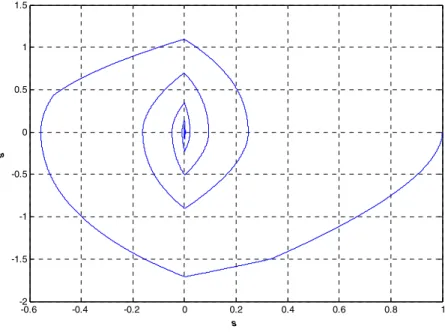
and 0x2(0)= . Then, the phase plane of system is shown in figure 1-2. If we amplify the partial sliding mode surface s=0, the figure 1-3 displays the chattering.
-0.2 0 0.2 0.4 0.6 0.8 1 1.2 -1 -0.8 -0.6 -0.4 -0.2 0 0.2 x1 x2 0.08 0.082 0.084 0.086 0.088 0.09 0.092 0.094 0.096 0.098 0.1 -0.096 -0.094 -0.092 -0.09 -0.088 -0.086 -0.084 -0.082 x1 x2
Fig. 1-2 Phase plane of second order system Fig. 1-3 Partial enlarged drawing SM surface
The figure 1-4 shows that the system variables will converge into origin after a short time. When the control law converges, the system is stable as well. The figure 1-5 is the sliding mode control law, which is a nonlinear discrete control like a relay. That’s the reason why the sliding mode control has chattering phenomenon.
In order to illustrate the high robustness of sliding mode control, the system is injected uncertain disturbance f(t)=5e−0.2tsin(2t) that is shown in figure 1-6. The figure 1-7 declares that sliding mode trajectory just is different in spite of the disturbance. When it reaches sliding mode state, the situation is the same. It illustrates the system with high robustness.
0 1 2 3 4 5 6 7 8 9 10 -1 -0.8 -0.6 -0.4 -0.2 0 0.2 0.4 0.6 0.8 1 time (second) x1 x2 0 1 2 3 4 5 6 7 8 9 10 -5 -4 -3 -2 -1 0 1 2 3 4 5 time (s)econd u
0 1 2 3 4 5 6 7 8 9 10 -4 -3 -2 -1 0 1 2 3 4 5 tiem (second) f( t) -0.2 0 0.2 0.4 0.6 0.8 1 1.2 -0.8 -0.6 -0.4 -0.2 0 0.2 0.4 x 1 x2 wihtout disturbance with disturbance 2 x 1 x
Fig. 1-6 Uncertainty bounded disturbance Fig. 1-7 System phase plane with disturbance
1.3.3 Chattering problem and solving
The sliding mode control actually is the structure of feedback controller occur changes according to certain rules when the system state passes across the different regions in state space. It makes the control systems has a certain adaptive ability to the internal parameter variations and external disturbance so that the system performance achieves the desired targets. However, due to the sliding mode control law with a discrete switch control, it has chattering. Moreover, the ideal switching frequency of sliding mode control is infinity, which can not be realized in the actual system. In addition, in practical applications, the switch with time-delay, discontinuous sampling, system inertia, and even the error of state measurement will cause the chattering phenomenon in sliding mode control. In this way, the sliding mode control system is equivalent to high gain system accompanied by high frequency jitter, which could bring a very harmful consequence for control systems.
Therefore, the chattering phenomenon has become the biggest developing obstacle of sliding mode control technology. The academics have continued to weaken or prevent the chattering without interruption. In order to reduce or eliminate chattering, a large number of researchers have put a lot of hard work in their respective areas of research. To sum up, it is mainly in the following several ways.
Pseudo-sliding mode: to reduce the chattering, the first thought is to improve
the control law to weaken the impact of chattering. Literature (Slotine,1983)
introduced a concept of "pseudo-sliding mode" and the "boundary layer". It adopted saturation function sat(s,δ) instead of sign function sgn(s) to realize the sliding mode control.
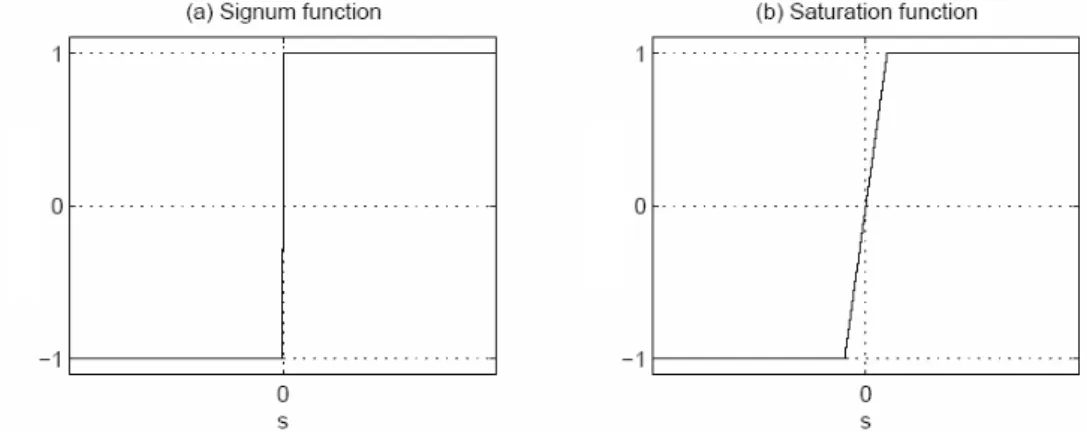
0 | | / | | ) sgn( ) , ( > ⎩ ⎨ ⎧ ≤ > = δ δδ δ δ s s ifif ss s sat
Outside the boundary layer, it uses switch sliding mode control. Otherwise, inside the boundary layer, it uses continuous state feedback control. In this way, it reduces the chattering, but loses the finite time convergence. The figure 1-8 is the saturation function and sign function.
Fig. 1-8 sign function sgn(s) and saturation function sat(s,δ)
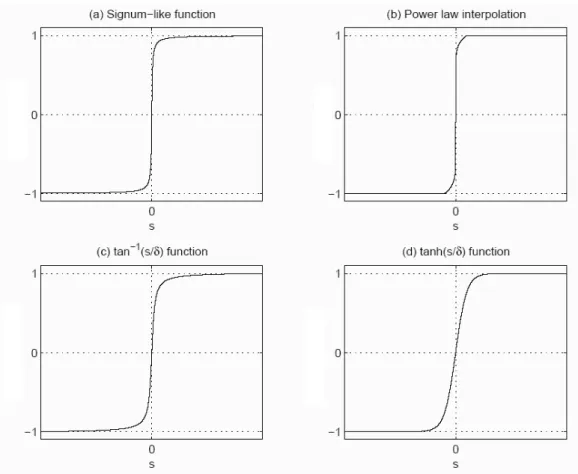
After that, many scholars start to study the switch function and boundary layer. Some of them propose serialization of unit vector.
δ δ + = | | ) , ( s s k s u (1.23)
Some literature calls it signum-like function. Where, the choose of δ can guarantee
precision. Besides, there is power law interpolation.
⎪ ⎩ ⎪ ⎨ ⎧ ∈ = ≤ < > = − [0,1) 0 0 | | 0 ) sgn( )| | ( | | ) sgn( ) , ( ( 1) q s s s s k s if s k s u δ q δ δ δ (1.24)
In addition, there are arc tangent function u(s,δ)=k⋅tan−1(s δ), hyperbolic curve )
tanh( )
,
(sδ s δ
u = and etc. instead of original switch function sgn(s). Their aim is
to reduce or remove the chattering. The various approximate functions are shown in figure 1-9.
Fig. 1-9 Approximated function effect schematic plan
The smaller the boundary layer, the control effect will be better. But, at the same time, this will enlarger the control gain and chattering enhancement; On the contrary, the greater the boundary layer, the chattering will be smaller. But they will decrease the control gain, and the effect of control become worse. In fact, this approximate sliding mode control is the balance between the system performance and robustness.
Approach law: Prof. Gao Weibing proposed approach law (高为炳,1996) in
1989. Take the exponential approach law s=−εsgn(s)−ks as an example, through
the adjustment of parameter k and ε, it can not only guarantee the dynamic quality
of sliding mode arrival procession, but also weaken high frequent chattering of control signal. But if the ε is too great, it will result in chattering. The approach law is used to study dynamic quality of arrival procession, when the system converges from the any initialization within limited time. According to the different system, we can design the various approach law, such as
Uniform approach law s=−εsgn(s)
Power approach law s=−k|s|α sgn(s)
General approach law s=−εsgn(s)− f(s)
Where, the parameter of these approach law require ε >0, k>0, 1>α >0 and
0 ) ( >
⋅ sf
s . The literature (翟长连,2000) analyzes the chattering reason caused by
approach coefficient, when the exponential approach law is used to the discrete system. It also made quantitative analysis for the relationship between approach coefficient and chattering. He proposed self-adaptive adjustment algorithm of
approach coefficient ε. And the literature (于双和,2001) proposed the combinative
control strategy of discrete approach law and equivalent control. The discrete control law just acts at the approach procession. When the system arrives at sliding mode state, the discrete control law is used to guarantee good quality of approach sliding
mode state. The literature (Jiang,2002) brought the fuzzy control into exponential
approach control law. Through the analysis of the fuzzy relation between switch function and coefficient in approach law, he adopted fuzzy rule to adjust coefficient of exponential approach law, in which the absolute value of switching function is taken
as the fuzzy rules input. The coefficient of exponential approach law k and ε are
taken as fuzzy rule output. In this way, it ameliorates the quality of sliding mode so that remove the high frequent chattering. Most of the domestic literature on sliding mode control techniques are used is this approach.
Filters: through the use of filters, smoothing the control signal is an effective
way to eliminate chattering. Literature (Kachroo,1996; Kang,1997; Yanada,1999)
adopt a low-pass filter to smooth the switch function. It effectively eliminates the chattering and suppresses high-frequency noise, and to ensures system stability as
well. The literature (Krupp,1999), in order to overcome the chattering caused by
unmodeled dynamics character, designed a new type of sliding mode controller, whose output achieve a smooth output signal through a second-order filter. Where, the auxiliary coefficient of sliding mode surface is obtained by sliding mode observer.
Literature (Xu,2000) proposed a new control law, which is consists of three parts:
namely the equivalent control, switching control and continuous control. In the control law the two low-pass filters are used. A low-pass filter gets the switched gain, another low-pass filter get the equivalent control. It also analyses the convergence and stability to effectively restrain chattering and achieve high-performance control of multi-joint robot. As the filter design parameters more complicated, as well as the delay and other factors of the filter itself, its application is limited.
items has become a study to solve the chattering problem. The literature (Kawamura,
1994) designed a new type observer of disturbance. Through feedforward
compensation for the external perturbation injected, it greatly reduced switching gain of sliding mode controller, and effectively eliminated the chattering. Y. S. Kim designed a disturbance observer based on binary control theory. In this paper, the disturbance observed was used for feedforward compensation to reduce the chattering.
(Kin,1996). In addition, the literature (Edwards,2004) designed a sliding mode observer to achieve a fault detection and fault-tolerant control.
Neural Sliding: neural network is a nonlinear continuous time dynamic system. It has a very strong self-learning function and a powerful mapping ability for nonlinear systems. The neural networks used for the sliding mode control, can reduce
the chattering. The literature (Morioka,1995) used neural network to estimate the
uncertainty and unknown external disturbance, and achieve the equivalent control based on neural network. It effectively eliminated the chattering as well. The literature
(Ertugrul,2000) proposed a new type neural network method of sliding mode control, using two neural networks to approach equivalent control and switch control of sliding mode control respectively without the object model. It effectively eliminates the chattering, which has been successfully applied to robot trajectory tracking. The
literature (Huang,2003) used the approximation capability of neural networks,
designed a sliding mode controller based RBF neural network. It will take the switch function as network input. And the controller is realized entirely by continuous RBF
function, which eliminates the switching chattering. In the literature (Da,2000), the
sliding mode controller is divided into two parts. One part is for the neural network sliding mode controller, the other part is a linear feedback controller. Using fuzzy neural network sliding mode control to replace the output of the switching function, it ensures the continuity of the control law, essentially eliminates the chattering.
Fuzzy sliding mode: According to experience, the fuzzy rules design can effectively reduce the chattering in sliding mode control. Fuzzy sliding mode control often the control signals, change the discontinuous control signals to continuous one. It can reduce or avoid the chattering of sliding mode control. The fuzzy logic sliding mode control can achieve parameters self-adjusting. The input of fuzzy control is not
) ,
( ee but ( ss, ). Through the design of fuzzy rule, it drives sliding mode surface to
zero, so that remove the switching part of the sliding mode control. Literature (Ha,
fuzzy sliding mode controller. In the fuzzy controller, the design of fuzzy rules reduces the impact of the switching control, effectively eliminates the chattering.
Literature (Zhuang,2000) took the use of fuzzy control system to estimate the
uncertainty items online, achieving fuzzy switching gain self-adjust. It guarantees the sliding mode to reach the condition satisfied as far as reducing the switching gain.
Literature (Ryu,2001) established the chattering indicators of sliding mode control in
order to reduce chattering to design fuzzy rules. The fuzzy rules, input indicators for the current chattering size of the output of fuzzy rules for the boundary layer thickness, through the fuzzy reasoning, realize the adaptive adjustment of boundary layer
thickness. Literature (张天平,1995) proposed a fuzzy logic based on continuous
sliding mode control method, using continuous fuzzy logic switch instead of non-continuous sliding mode control to avoid chattering.
Higher-order sliding-mode: the high order sliding mode control is a new
method proposed in last decade (Levant,1993). The switch function in traditional
sliding mode control is generally dependent on the system state, has nothing to do with the control input. Discontinuous items will be directly transferred to the controller. But, the high order sliding mode control constitutes a new sliding mode surface using the sliding mode control variable and its differentiations, transfers the discrete items to the first order or higher order derivative of sliding mode variable. That is expressed by S ={s=s= =s(r−1) =0}. It should be clear is that when the differential order of sliding mode variables equals to 2, it is called the second order
sliding mode control in some reference (Koshkouei,2005;晁红敏,2001;吴玉香,2006).
Sometimes, it also is known as dynamic sliding mode control (dynamic sliding mode ,
DSM). Literature (Bartolini,1998; Bartolini,2001) through the design of the second
order derivative of sliding mode variable, it achieves to sliding mode control without chattering in the un-modeled dynamics and uncertain systems. And the method is extended to multiple-input multiple-output system. The high order sliding mode controller has the advantage of simple design, easy to implement, without precise mathematical models. It can effectively eliminate the chattering and improve the convergence precision as well.
Using high order sliding mode control, it not only eliminates the chattering problems that exist in the traditional sliding mode, but also avoids the requirements of relative degree that must be equal to 1 in the control law design. In this paper, after the analysis and comparison of several sliding mode control techniques, high order
sliding mode control is mainly used to eliminate chattering, implement model uncertain robust control for nonlinear systems. The thesis also focuses on multi-input multi-output nonlinear systems robust decoupling control.
1.4 The application and research of nonlinear sliding mode control systems
The sliding mode control system has strong robustness to the uncertainties in the system. Therefore, there is a great deal of applied research on sliding mode control theory in aviation, aerospace, electrical motor and power systems, robotics and
industrial control (Shtessel,1996; Galzi,2007; Laghrouche,2003).
Actually, the sliding mode control of nonlinear systems in the industry control field has received considerable attention. In the initial stage of variable structure, it’s mainly applied to the field of industry control. With the development of industrial technologies, the requirements of control precision and robustness to multi-variable, nonlinear practical equipments has gradually increased day by day and the application of sliding mode control in the industry control field has prompted step by step
(Corradini,2000; Kim,2004; Rios-Gastelum, 2003). For the first time in 1983, the sliding mode control was applied into robot control by Slotine, who designed the sliding mode controller of time-varying referring trajectory. Subsequently, he combined the sliding mode control and the feedback linearization technique to extend research results to the sliding mode controller design of more general rigid-body robot and to achieve the referring trajectory tracking control. Yeh studied the sliding mode
tracking control of satellites (Yeh,2000). Calise learned the robust sliding mode
control of helicopter movement system with uncertain nonlinear system. Lu X.Y. designed trajectory tracking robust controller for the control problem of large aircraft
from aerospace controller (Lu,1997). Y.B. Shtessel used robust sliding mode control
to achieve the missile guidance control and wing flight control of F18 (Shtessel,2007).
Toumes achieved a high altitude rocket navigation control. McDuffie designed
decoupled sliding mode observer for satellite attitude control (McDuffie,1997). These
controllers must be strong robustness to the system parameter variations and external disturbances. In recent years, the sliding mode control for nonlinear systems has been widespread paid much attention and become a research hot spot.
There are so many characteristics for permanent magnet synchronous motor such as compact structure, high power density, high air-gap flux and high-torque inertia ratio, which in the servo system has been widely used. But the permanent magnet
synchronous motor is a nonlinear system, which includes the product term of angular velocity and d-q axis electric current, it must achieve decoupling and linearization of the system to get the accurate control performance. So, the feedback linearization in nonlinear control theory can transform nonlinear systems into linear systems
(Bodson,1993). However, the parameters in motor dynamic model will be affected by the complex environment and the effect is still changing. Accordingly, the robust control has become an effective way to improve performances. M. Kadjoudj designed a high performance permanent magnet synchronous motor with an adaptive fuzzy
controller (Kadjoudj,2001). J. Xu designed a robust adaptive stepping controller to
improve motor performance (J. Xu,1998). S. Laghrouche adopted second order
sliding mode control to design a nonlinear robustness controller for permanent magnet
synchronous motor (Laghrouche,2004). These high performance robust controllers in
synchronous motors have been very successful in the application. But because permanent magnet motor is affected by external influences and its own changing parameters and many other factors, there are still many issues worth studying, such as motor parameter identification, state estimation, perturbation estimation and so on.
The requirements in the applications to the control performance point out the direction for further study of sliding mode control theory and should be of great significance to the development of sliding mode control. As there are a large number of nonlinear problems in engineering, approximate linear model can not describe the dynamic characteristics of the system. In the real production, because of the environment in which a number of nonlinear controlled objects work is very complex, many internal uncertainties and external disturbance affect the control systems. Therefore, the robust control of uncertain system is an important research area in nonlinear sliding mode control.
1.5 The main research contents of the paper
Based on the research of the current sliding mode control theory applied to nonlinear systems, it chiefly launches an in-depth study and exploration in allusion to several facing issues of nonlinear sliding mode control theory and gives the corresponding research findings and results.
1. The thesis shows the research background and systematically introduces the history and the current development situation of nonlinear control and sliding mode control theory. At the same time, it describes the control superior advantages of their
combination. Meanwhile, it analyzes the problems in the current sliding mode control and sum up various research directions to overcome the chattering. On this basis, it illustrates the study significance of the topic.
2. It introduces the basic theory of differential geometry as well as the latest research results of exact feedback linearization field in detail. The decoupling control of nonlinear MIMO system has always been a critical study of nonlinear problems. In sequence, decoupling controllers are designed for each nonlinear system. Through simulation study, it has established a basic theoretical research for further application of multi-variable complex systems.
3. As the chattering phenomenon which exists in the traditional sliding mode controller is extremely negative to industrial control, adopting high order sliding mode control algorithm can not only guarantee the control precision but also eliminate the chatters. Besides, it uses simulation experiments to demonstrate the validity of research results.
4. In the controller design, we frequently encounter the problem of solving variables’ different order differentiations. But the traditional numerical method needs a large quantity of calculation and its accuracy level is not high. We study the sliding mode differentiator which uses high order sliding mode algorithm to achieve the variable derivative of arbitrary order. In engineering, the differentiator with strong robustness and high accuracy can not only greatly simplify the calculation of the workload but also ensure the calculation accuracy. At last, the paper designs a precise sliding mode differentiator and carries out application simulation research for MIMO nonlinear systems.
5. It takes research results of the sliding mode control for nonlinear systems studied to apply to servo system of the MIMO permanent magnet synchronous motor system, and combines the multi-variable nonlinear decoupling control and recent studied high order sliding mode control with strong robustness. In addition, it designs the robust sliding mode controller for the system under the parameters uncertain and external torque disturbance, in order to improve the performances of the motor. Meanwhile, for several current research focused on synchronous motor, it uses high order sliding mode control and its differential algorithm to achieve the items of state estimation, parameter identification and disturbance torque estimation for permanent magnet synchronous motor.
physical verification to robust sliding mode servo driving control MIMO system of the permanent magnet synchronous motor, in order to validate the consistency of experimental and theoretical research.
Chapter 2 Nonlinear system high order sliding mode control
In the introduction of first chapter, we have known the sliding mode control with the strong robustness for the internal parameters and external disturbances. In addition, the appropriate sliding surface can be selected to reduce order for control system. However, due to the chattering phenomena of sliding mode control, the high frequency oscillation of control system brings challenge for the application of sliding mode control. On the other hand, the choice of sliding surface strictly requires system relative degree to equal to 1, which limits the choice of sliding surface.In order to solve the above problems, the introduction of first chapter also illustrates the current developments and research methods in this field. This chapter focuses on a new type of sliding mode control, that is, higher order sliding mode control. The technology not only retains advantage of strong robustness in the traditional sliding mode control, but also enables discontinuous item variables transmit into the first order or higher order sliding mode derivative to eliminate the chattering. Besides, the design of the controller no longer must require relative degree to be 1. Therefore, it is greatly simplified to design parameters of sliding mode surface.
Emelyanov and others first time propose the concept of high order differentiation of sliding mode variable, but also provide a second order sliding mode twisting
algorithm, and prove its convergence (Emelyanov,1996). Another algorithm is super
twisting, which can completely eliminate chattering (Emelyanov,1990), although the
relative degree of sliding mode variable is required to equal to 1. In the second order
sliding mode control, Levant proved sliding mode accuracy is proportional to o(τ2)
the square of the switching delay time. It has also become one of the merits of high
order sliding mode control (Levant,1993). Since then, the high order sliding mode
controller has been developed and applied rapidly. For example, Bartolini and others propose a second order sliding mode control applied the sub-optimal algorithm
(Bartolini,1997; Bartolini,1999). After the concept of high order sliding mode control
was applied to bound operator in (Bartolini,2000). Levant used high order sliding
mode control in aircraft pitch control (Levant,2000) as well as the exact robust
differentiator (Levant,1998). About the summary of high order sliding mode control is
also described in the literature (Fridman,2002).
control that eliminate the chattering essentially; 2.2, Give simulation examples of the actual system against the algorithm of 2.1; 2.3, Introduce the algorithm arbitrary order sliding model control in detail; 2.4, Take simulation research to the algorithm of 2.3; 2.5, Give a quasi-continuous high order sliding mode control algorithm so that state variable can be more smooth; 2.6, Summary of this chapter.
2.1 Second order sliding mode control
Strictly speaking, second order sliding mode control is a special kind of high order sliding mode control actually. But, in the design of the controller, the highest order of sliding mode variable is 2, so called second order sliding mode control (SOSM). Some literatures also call it as the dynamic sliding mode control (DSM).
Without losing generality, considering a state equation of single input nonlinear system as ) , ( ) ( ) ( t x s y u x g x f x = + = (2.1)
Where, x∈Rn is system state variable, t is time, y is output, u is control
input. Here, f(x), g(x) and s(x) are smooth function. The control objective is
making output function s≡0.
Differentiate the output variables continuously, we can get every order derivative of s . According to the conception of system relative degree, there are two conditions.
I. Relative degree r=1,if and only if ≠0
∂
∂ s
u
II. Relative degree r≥2,if () =0 ( =1,2, −1)
∂ ∂ s i r u i ,and ( ) ≠0 ∂ ∂ sr u
If the relative degree r=1, traditional sliding mode control can be used to
design controller. Else, it needs to design a second order sliding mode controller. Second order sliding mode control is able to eliminate chattering.
Suppose system relative degree equals 1, differentiate sliding mode variable twice continuously, then
( , ) s(x,t)[f(x) g(x)u] x t x s t s + ∂ ∂ + ∂ ∂ = (2.2)
u x x u t x s u u x g x f t x s x t x s t s x x ) ( ) ( ) , ( ] ) ( ) ( )[ , ( ) , ( ) ( ) ( γ ϕ γ ϕ + = ∂ ∂ + + ∂ ∂ + ∂ ∂ = (2.3)
In order to achieve this aim of eliminating chattering, the u derivative of
control input u is made as actual control variable. The discontinuous control law u
will drive sliding mode variable s=0 in the second order sliding mode surface S2.
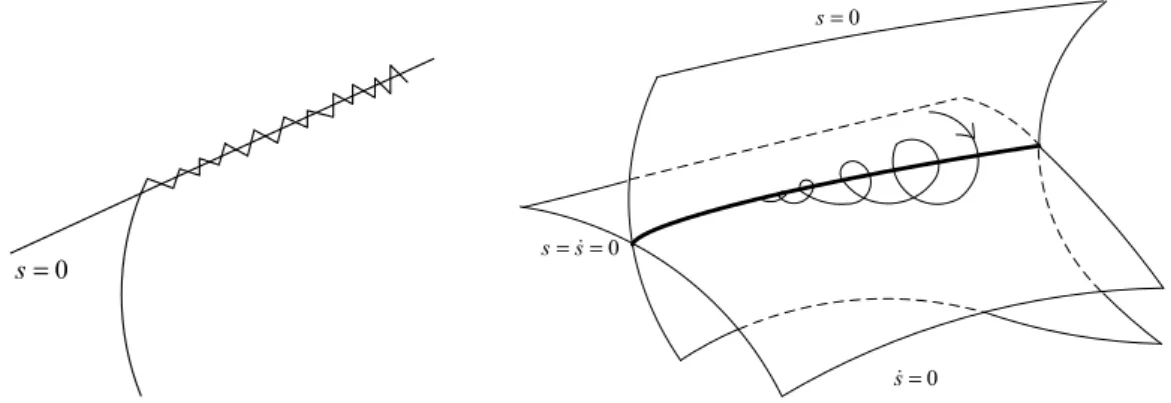
In this way, chattering is eliminated. Figure 2-2 shows trajectory of second order sliding mode control. It will convergent into origin point along the intersection of
sliding mode surface s=0 and s=0 in the limited time. Comparing with
traditional sliding mode (Fig. 2-1), second order sliding mode control removes the chattering. 0 = s 0 = s 0 = s 0 = = s s
Fig. 2-1 Traditional sliding mode trajectory Fig. 2-2 Second order sliding mode trajectory
Definition 2.1.1 Suppose given sliding mode variable is s( tx, ), second order sliding mode surface (or called sliding mode manifold) is defined as
S2 ={x∈X |s(x,t)=s(x,t)=0} x∈Rn (2.4) To illustrate the tightness of control algorithm, the following conditions must be met
a) u is continuous and bounded norm function;;
b) || f(x)||2 and ||g(x)||2 are bounded,and γ(x)>0;
In meeting the above bounded conditions, there must be positive constants Γ , m
M Γ , and Φ so that Φ ≤ Γ ≤ ≤ Γ < | ) ( | ) ( 0 x x M m ϕ γ