ةيبعشلا ةيطارقميدلا ةيرئازجلا ةيروهمجلا
Democratic and Popular Republic of Algeria Ministry of Higher Education and Scientific Research
University of Tlemcen Faculty of Letters and Languages
Department of English
Dissertation submitted as a partial fulfilment in candidacy for the degree of MASTER in Language Studies
Presented by Under the Supervision of Salma BENSAAD Prof. Zoubir DENDANE
Board of Examiners:
President: Mr. Abderrahmane BASSOU MC (B) Tlemcen University Supervisor: Mr. Zoubir DENDANE Prof. Tlemcen University Examiner: Mr. Nassim NEGADI MC (A) Tlemcen University
2015/2016
The Acquisition of Morpho-syntax as a Component of Literacy
Development in Algeria: Case of First Grade Classroom in
ii
ةيبعشلا ةيطارقميدلا ةيرئازجلا ةيروهمجلا
Democratic and Popular Republic of Algeria Ministry of Higher Education and Scientific Research
University of Tlemcen Faculty of Letters and Languages
Department of English
Dissertation submitted as a partial fulfilment in candidacy for the degree of MASTER in Language Studies
Presented by Under the Supervision of Salma BENSAAD Prof. Zoubir DENDANE
Board of Examiners:
President: Mr. Abderrahmane BASSOU MC (B) Tlemcen University Supervisor: Mr. Zoubir DENDANE Prof. Tlemcen University Examiner: Mr. Nassim NEGADI MC (A) Tlemcen University
2015/2016
The Acquisition of Morpho-syntax as a Component of Literacy
Development in Algeria: Case of First Grade Classroom in
iii Dedication
I dedicate this research work to those who have
Loved me unconditionally and
Supported me continuously,
And more importantly,
Those whom I love the most
To my Mom and my Dad
iv
Acknowledgements
First and foremost, I thank and praise Allah, the almighty, the merciful, the only and most powerful, for granting me the will, the ability and more importantly the
passion to accomplish this.
My gratitude is offered especially to my teacher and supervisor, Prof. Zoubir Dendane for his patience and guidance throughout this extended essay. This research work would not have been completed without the generous contribution and the nicely offered help from the collective of teachers in Meddah
Kaddour primary school, particularly, Mme. Souafi Karima who was never reluctant to advise and guide me.
I owe great thanks to all my teachers, starting by those who introduced me to the world of knowledge, they taught me how to read and write. I especially thank those
who taught me in Tlemcen University and contributed to the growing of the researcher’s identity in me. It is due to your efforts that I could accomplish this
extended essay.
I wish to extend my thanks and appreciation to my family, mainly my parents and my sisters for having always supported me, throughout the good and the bad times,
my wellbeing and the worst I ever experienced, and for enduring my good as well as my bad temper; I thank you all.
I am sure that I would not have been able to accomplish this without the most beautiful support of my dearest friends; I cannot thank you enough, but still…
v Abstract
The present research work highlights the impact of the diglossic linguistic situation in the Algerian community on the field of literacy development and second language acquisition of Modern Standard Arabic (MSA). In the Algerian primary classrooms, teachers resort, in some cases, to Algerian Arabic (AA) when interacting with their pupils instead of using MSA, the language of instruction. Psychologists argue that this creates an intimate relationship between the teachers and their pupils which results in better teaching/ learning circumstances. Previous exposure to MSA is yet another reason which alleviates the transition between primary and secondary socialization. This is mainly achieved through parents’ individual efforts and participation in their children’s language development, by introducing them to some linguistic elements of MSA during domestic interactions; in addition to the benefits of media such as televised programs, animations, and storytelling. For the sake of accomplishing the above purposes, a forty mixed ability classroom containing first grade pupils from both genders was observed and subjected to an experiment. To obtain information about the pupils’ grammatical achievements, an analysis was conducted on their documents. Teachers too provided a substantial amount of information, which stems from their experience in the field of education; data was gathered by means of a questionnaire and a set of two interviews. Research findings suggest that parents are unaware of the importance of pre-school MSA exposure for their children. Literacy in Algeria is restricted to the two skills of reading and writing, which are more or less developed successfully by pupils. Relying on a model of acquisition for grammar teaching is likely to succeed, however results indicate a lack of resources; this entails teacher preparation and environment shaping.
vi
List of Acronyms AA=> Algerian Arabic
AL=> Academic Literacy
CAH=> Critical Age Hypothesis DA=> Dialectal Arabic
EL=> Emergent Literacy FL=> First Language H=> High
L=> Low
MSA=> Modern Standard Arabic SL=> Second Language
SLA=> Second Language Acquisition TL=> Target Language
vii
List of Tables
Table 1.1. A Comparison between the High and the Low Varieties of Diglossia (Adapted from Ferguson, 1959)
Table 1.2. Comparisons between Derivation and Inflection Table 1.3. Sound Verb Derivations (al-awzān) in SA.
Table 1.4. Irregularity in Arabic Verb Derivation (adapted from Zerrouq, 2006) Table 1.5. Passive Derivations in SA
Table 1.6. Verbal Inflections in SA Table 1.7. Personal pronouns of SA
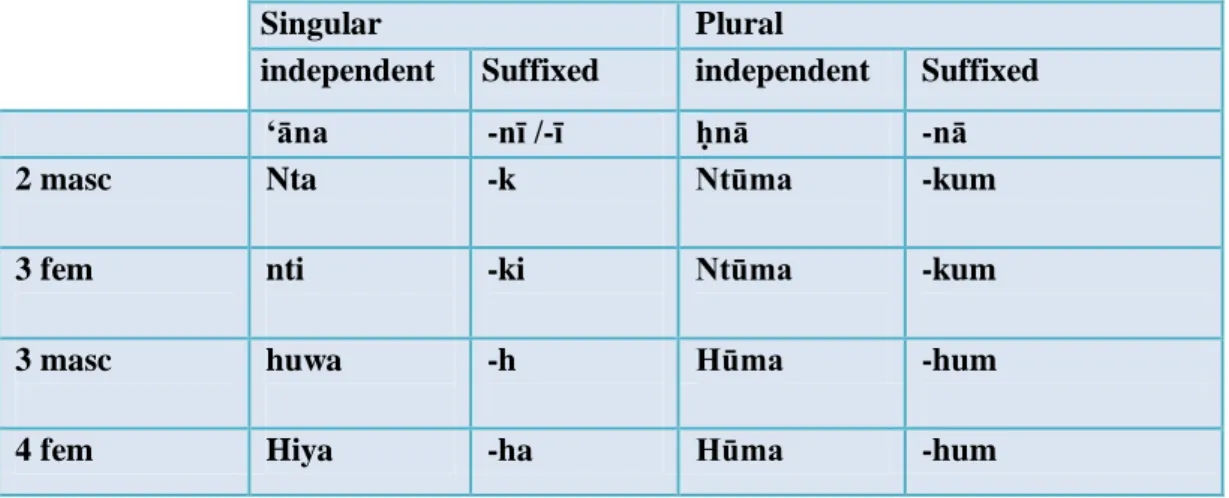
Table 1.8. Personal Pronouns of AA (dependent and independent) Table 2.1. Linking the Methodology to the Research Question One. Table 2.2. Linking the Methodology to the Research Question Two. Table 2.3. Techniques Employed with First Grade Classrooms. Table 2.4. Categorisation of Difficulties
Table 2.7. Pupils’ level of SA Comprehension.
Table 2.5. The Frequency of occurrence of the Learners’ Mistakes. Table 2.9. Learners’ Mistakes: Drawn From the Document Analysis
---
List of Figures
Figure 1.1. First Language Acquisition Stages
Figure 1.2. Model for Adult Second Language Performance (Krashen, 1981) Figure 1.3. Some Arabic word forms
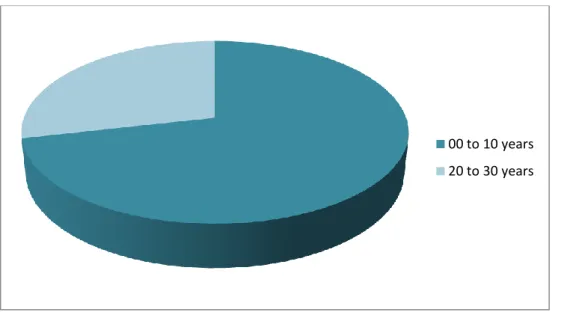
Figure 2.1. Teachers’ Work Experience
Figure 2.2. The Elements Comprised in the Teacher Training Figure 2.3. Pupil’s Reaction to School Enrolment
Figure 2.4. Pupils’ Demonstration of Print Tendency
Figure 2.5. Literacy Development Difficulties Encountered by Pupils Figure 2.6. Pupils’ Possession of MSA Linguistic Items
Figure 2.7. Teachers’ AA use in Classrooms Figure 2.8. Pupils’ answers: Yes or No
viii
List of Symbols Used for Arabic Script
Letter IPA Letter IPA
ء Ɂ ض ḍ ا Ā ط ṭ ب b ظ ẓ ت t ع ʕ ث θ غ ɣ ج ʤ ف f ح ħ ق q خ X ك k د d ل l ذ ð م M ر r ن n ز z ه h س s و w/ū ش ʃ ي y/ī ص ṣ
ix
Table of Contents
Dedication……….. iiv Acknowledgment………. iv Abstract……… v List of Acronyms………. vi List of Tables...vii List of Figures...viiiList of Symbols Used for Arabic Script... ix
Table of Contents... x
General Introduction... 1
Chapter One: Morpho-syntactic Acquisition as a component of Literacy Development in Algeria 1.1. Introduction... 6
1.2. The Notion of Academic Literacy... 6
1.2.1. The Scope of Academic Literacy... 7
1.3. Literacy Development in Algeria... 8
1.4. The Grammatical Dimension of Literacy... 10
1.4.1. Branches of Grammar... 11
1.4.2. The Importance of Grammar in Literacy... 12
1.5. Grammar within the Arabic Linguistic Tradition... 13
1.5.1. The Arabic Linguistic Tradition... 14
1.6. Grammar Development in the Algerian Primary School... 16
1.6.1. Second Language Acquisition... 16
1.6.2. Second Language Grammaticalization... 18
1.7. Grammaticality of the Arabic Varieties of Algeria... 18
1.7.1. Morphology of Modern Standard Arabic... 19
1.7.1.1. Verbal Derivation... 20
1.7.1.2. Verbal Inflection... 21
1.7.1.3. Nominal Derivation... 21
1.7.1.4. Nominal Inflection... 23
1.7.2. Syntax of Modern Standard Arabic... 23
x
1.7.3.1. Morphology... 25
1.7.3.2. Syntax... 26
1.8. Grammar Instruction... 27
1.8.1.1. Methods Used in Algerian Primary School... 28
1.8.1.2. Teacher-related Issues...29
1.8.1.3. Learner-related Issues... 31
1.9. Probable Grammar Learning Difficulties... 32
1.9.1. Contrastive Analysis... 32
1.9.2. Error Analysis... 33
1.9.3. Language-external Difficulties... 33
1.10. Conclusion... 34
Chapter Two: Research Methodology and Data Analysis 2.1. Introduction... 37
2.2. Methodology and Research Design... 37
2.2.1. Research Design... 37
2.2.2. Sampling Procedures... 38
2.2.2.1. Teachers’ Profile... 39
2.2.2.2. Pupils’ Profile... 39
2.2.2.3. Context Description... 39
2.3. Data Collection Instruments... 40
2.3.1. Teachers’ Questionnaire... 41
2.3.2. The Interview... 42
2.3.2.1. Teacher A’s Interview... 43
2.3.2.2. Teacher B’s Interview... 43 2.3.3. Classroom Observation... 44 2.3.4. Pupils’ Experiment... 45 2.3.5. Documentation... 46 2.4. Data Analysis... 46 2.4.1. Questionnaire... 46 2.4.1.1. Rubric One... 47 2.4.1.2. Rubric Two... 49 2.4.1.3. Rubric Three... 51 2.4.2. Interviews... 55 2.4.2.1. Teacher A... 55 2.4.2.2. Teacher B... 57 2.4.3. Classroom Observation... 57 2.4.4. Experiment... 59 2.4.5. Document Analysis... 60
xi
2.5. Interpretation of Main Results... 61
2.5.1. Diglossia in the Algerian Mind... 61
2.5.2. Emergent Literacy Development... 62
2.5.3. Child School Integration... 62
2.5.4. Pedagogical Concerns... 63
2.5.5. Academic Literacy Development... 63
2.5.6. Language-related Issues... 64
2.5.7. Developing the Grammar of Standard Arabic... 64
2.5.8. Teacher-related Issues... 66
2.5.9. Methodological Concerns... 66
2.6. Suggestions and Solutions... 67
2.6.1. Emergent Literacy Development... 67
2.6.2. Creating a Transitional phase... 67
2.6.3. Academic Literacy Development... 68
2.6.4. Curriculum Design... 68 2.6.5. Teacher Preparation... 69 2.7. Conclusion... 69 General Conclusion... 70 Bibliography... 75 Appendices... 79
1
2 General Introduction
A nation rises and flourishes as a result of positive contributions made by its members. This positive contribution comprises such domains as politics, economy, social participation, family life, etc. (Dugdale and Clark, 2008). Nevertheless, were individuals to participate in the wellbeing of their nation, they must resort to successful scientific strategies. In other words, ‘we need knowledge-based societies’1
which refer to scientific methods when attempting to solve problems; i.e., we need literate societies.
Literacy refers to the possession of two skills: writing and reading. It is developed through schooling; however, its preliminaries are set earlier, i.e., in the family environment. Since Arabic societies are diglossic, literacy entails knowledge of the standard which is taught in schools, i.e., Modern Standard Arabic (MSA). Nevertheless, not all the citizens have full access (if at all) to literacy, thus one cannot expect illiterate parents to prepare their children for academic literacy (AL) and school enrolment, let alone the resulting linguistic problems pupils may face in classrooms which may comprise different areas, such as, language comprehension, language acquisition, and language production.
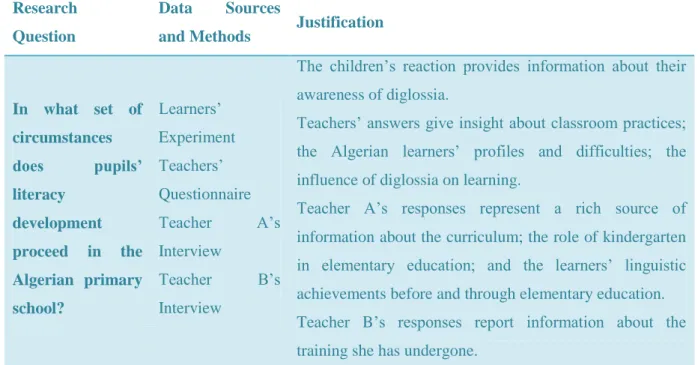
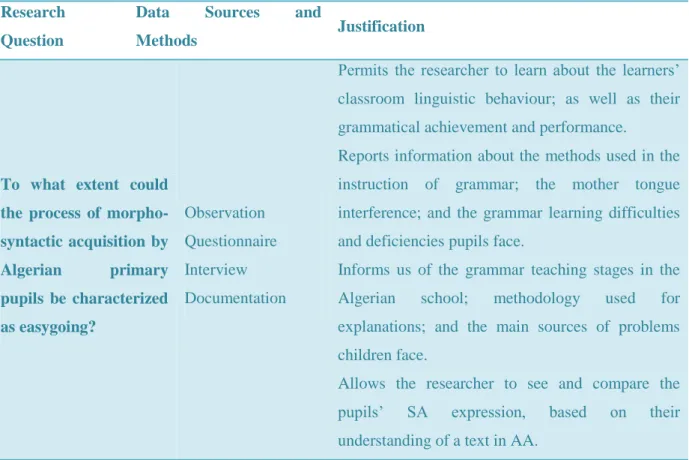
The present study is conducted with the purpose of exploring the intricacies involved in the process of literacy development in the Algerian primary school as well as the role that pupils’ prior-to-school experience plays in their school enrolment. Concerning the linguistic aspect, this paper examines the pupils’ grammatical achievements in MSA, particularly in the first grade; then through the years on a more general basis. All-in-all, this research seeks to answer these two questions:
1. In what set of circumstances does literacy development proceed in the Algerian primary school?
2. To what extent could the process of morpho-syntactic acquisition by Algerian primary school pupils be characterized as easygoing?
3
As an attempt to formulate a preliminary answer for these questions, the researcher hypothesizes the following:
1. In Algeria, literacy is developed in diglossic circumstances; this affects the learners’ psychological state and academic achievement.
2. Pupils acquire morpho-syntax during the five years of primary schools, and they are likely to encounter difficulties which stem from several sources, such as not being accustomed to MSA, mother tongue transfer, and pedagogical issues.
In order to answer the research questions and test the relevance and validity of the hypotheses, a triangulation of data collection methods was employed. Learners were subjected to observation, which focused on the levels of comfort they display in the classroom, as well as their linguistic achievements. Another means of data collection which was interested in learners was the experiment; by providing an unusual set of classroom circumstances, mainly exhibiting a text in AA on the blackboard. This method allowed the researcher to assess the learners’ reactions, thus come up with subject-relevant conclusions. The researcher resorted to learners’ document analysis as well, which provided an insight into their linguistic achievements regarding the morpho-syntactic level, by verifying the types of grammatical errors and mistakes they made. A close- and open-ended questionnaire was administered to a set of teachers; it focused on some pedagogical issues such as teacher preparation, literacy development and morpho-syntactic acquisition. And finally, two different interviews were addressed to two different teachers, the first focused on the teacher’s experience in teaching, whereas the second was interested in teacher preparation.
The sample for this study comprised a forty-pupil mixed-ability first grade classroom; it was selected via non-probability procedures. It also comprised a set of eight female teachers who represent the whole working-staff of the targeted primary school. All the teachers were asked to fill in the questionnaire, i.e., they were randomly selected. Conversely, the interviews were conducted for a more specific
4
purpose, thus two teachers were selected because their profiles showed that they were the most adequate.
The research paper comprises two chapters, which deal with the subject from two different perspectives. The first chapter displays the theoretical basis for the research and thus is organised in the form of a literature review. It provides definitions for several notions such as: diglossia, literacy, and morpho-syntax; and it describes their application in the Algerian context, for instance how diglossia functions in Algerian society, the way literacy development proceeds, and the methods used to teach grammar in the Algerian classroom.
On the other hand, the second chapter provides information about the methodology used to answer the research questions and to explore the issues dealt with; such as data collection and analysis, which were both qualitatively and
quantitatively conducted. It also discusses the main results in order to draw adequate interpretations and conclusions.
5
Chapter One
Morpho-syntactic Acquisition as a component of Literacy
Development in Algeria
1.1. Introduction... 6
1.2. The Notion of Academic Literacy... 6
1.2.1. The Scope of Academic Literacy... 7
1.3. Literacy Development in Algeria... 8
1.4. The Grammatical Dimension of Literacy... 10
1.4.1. Branches of Grammar... 11
1.4.2. The Importance of Grammar in Literacy... 12
1.5. Grammar within the Arabic Linguistic Tradition... 13
1.5.1. The Arabic Linguistic Tradition... 14
1.6. Grammar Development in the Algerian Primary School... 16
1.6.1. Second Language Acquisition... 16
1.6.2. Second Language Grammaticalization... 18
1.7. Grammaticality of the Arabic Varieties of Algeria... 18
1.7.1. Morphology of Modern Standard Arabic... 19
1.7.1.1. Verbal Derivation... 20
1.7.1.2. Verbal Inflection... 21
1.7.1.3. Nominal Derivation... 21
1.7.1.4. Nominal Inflection... 23
1.7.2. Syntax of Modern Standard Arabic... 23
1.7.3. Algerian Arabic Particularities... 25
1.7.3.1. Morphology... 25
1.7.3.2. Syntax... 26
1.8. Grammar Instruction... 27
1.8.1.1. Methods Used in Algerian Primary School... 28
1.8.1.2. Teacher-related Issues...29
1.8.1.3. Learner-related Issues... 31
1.9. Probable Grammar Learning Difficulties... 32
1.9.1. Contrastive Analysis... 32
1.9.2. Error Analysis... 33
1.9.3. Language-external Difficulties... 33
6 1.1. Introduction
Secondary socialization generally refers to the placement of children in school, an entirely new environment, in which they are expected to adapt and integrate; they are also expected to develop a set of competencies which include literacy. Literacy development is not an easy process; especially in Algeria which is diagnosed with diglossia, the case of all Arab societies. This chapter aims to discover the intricacies involved in the learning of Standard Arabic in primary schools as a part of literacy development. It first investigates the methods used in the fulfilment of this purpose, reviewing the psychological impact of diglossia on primary school pupils. Secondly, it reviews the main steps pupils undergo when acquiring the grammatical system of MSA, and the main difficulties they face. The reason behind selecting the morpho-syntactic structure is that it has been subjected to different pedagogical changes in the search for the most adequate method to teach it. The current trend tends towards making learners acquire the system rather than learn it, i.e., the debate is whether grammar should be explicitly or implicitly instructed.
1.2. The Notion of Academic Literacy
In folk linguistics1, and for a long period of time, the definition of literacy stated that it is the ability to read, write and calculate. Collins (2006: 246) states that the fact that “literacy understood as the making or interpreting of inscriptions has a history of many millennia, and is closely associated with long-term and large-scale enterprises, such as cities and states, armies and schools, extensive markets and world religions”. However, it is hardly sufficient to consider someone literate in the 21st century only because they can associate between symbols and their corresponding sounds. In fact, the true meaning of literacy extends to include such skills as: reading, writing, speaking, listening, and viewing, thinking, and critically analyzing school subjects (Cooper, 1997; Wang, 2015).
The belief that literacy development starts in school is misguiding. Literacy is an ongoing process, which begins in the early childhood and continues all the way
1 Folk linguistics studies the overt knowledge and comments about language from non-language specialists.
7
through adulthood; in order to fully explain this idea, a distinction between Emergent Literacy (EL) and Academic Literacy (AL) must be made. When children first realize that sounds are somehow reflected in print, they are developing an EL, which may thus be defined as the initial awareness of an existing connection between sounds and print (Wang, 2015). Were parents to contribute in their children‟s EL development, it is important that they arrange a print-rich environment for them through activities such as: providing them with print materials and reading to them on a daily basis. Children who have successfully acquired EL are observed to show more tendencies towards reading and learning. The task of EL, thus, lies in preparing children to be future learners, particularly by initiating their AL development, whereas AL, as its name implies, is strongly related to academic settings, particularly schools. AL entails that students possess a set of linguistic skills: such as field-specific vocabulary, explanation and argumentation, distinguishing relevant from irrelevant information, and the like. 1.2.1. The Scope of Academic Literacy
AL is not solely regarded when one looks at what pupils write, but also when listening to their utterances, apparently, the later is restructured when the skills of literacy are being developed. In this vein, Michaels (1981: 424) states that “in order to be regarded as literate in school, children must be able to shift from the face-to-face conversational discourse strategies appropriate in the home, to the more written-like strategies of discursive prose.” She further explains her view by revealing the skills that characterize literate speech, namely that children rely on grammar and lexicon to communicate information usually comprehended via nonverbal cues such as intonation, stress and pitch register; and that they adopt a „non-face-to-face perspective‟ by declaring all the subject-relevant information, without regard neither to the interlocutor nor to the fact that they knew the information being delivered.
The level of literacy children develop defines the success of their school achievements, i.e., if pupils fail to understand the language used to instruct them, how can one expect them to grasp the subjects taught? This view was attested by many scholars (such as Wong-Fillmore, 2007). Wang claims that academic language, which he defines as “the language used in school to learn content in various subjects” (2015:7), is a basic element in academic literacy. He even describes it as its „important
8
groundwork‟. In the same line of thought, Richards and Schmidt (2002: 2) claim that academic language involves “learning specific terms, text types, discourse features and speech registers in different fields of study (e.g. history, maths)”, and associate its mastery with literacy and academic achievement. If indeed, the reliance of literacy development on academic language is as strong, then what are the methods most suitable to build this skill? And what role do educators and learners play in the fulfilment of such task?
Academic literacy is acquired through teacher-learner daily interactions, which occur face-to-face within classroom settings; it requires that all the actors in this situation, namely educators and children, invest whatever means needed for success. The teachers‟ responsibility lies in selecting the most adequate methods for the majority of students, taking into consideration their linguistic backgrounds as well as their differential access to literacy. Michaels (1981, 424) for instance, observed that some children have less to learn than others because they “[…] come to school with a discourse style that is closer to the literate standard”; thus, teachers need to adapt and simplify their style to meet that of their learners. Children, too, have a significant role to play, for they must be active elements who engage cognitively in the learning situation, it is their job to develop an academic language which directs them towards educational success.
The importance of academic language as a skill of literacy is in no way taken for granted, this is applicable to all educational settings in all societies, including Algeria. So how does literacy development proceed in Algeria? And what are the main social factors that influence the development of this process?
1.3. Literacy Development in Algeria
In order to understand the course of literacy development within schools in a specific society, one must first draw on an analysis of its linguistic situation. Nowadays, Algeria is a multilingual country wherein “at least three languages are in competition” namely Arabic, French (the colonial linguistic heritage), and Berber (the language of the indigenous people of North Africa) (Aitsiselmi, 2006: 159). According to the constitution, MSA is the only official language of the country
9
despite the fact that it is not the native tongue of Algerians; this paradox may be explained using Ferguson‟s terminology.
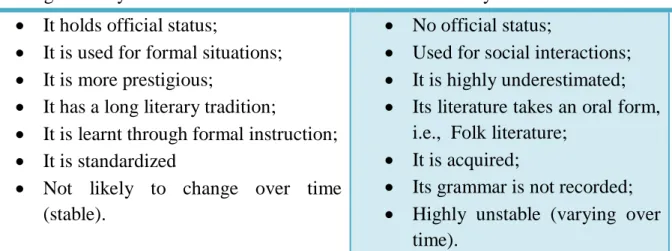
In his article entitled „Diglossia‟ Ferguson (1959), reported on a study attesting that Arabic is a diglossic language. This entails that it exists in at least two divergent varieties within the same speech community, which are complementarily distributed, i.e., each one performs a certain set of functions in the society. The two varieties are named in terms of high (H) and low (L) and are marked by some unique characteristics, which are clarified in Table 1.1.
Table 1.1 a Comparison between the High and the Low Varieties of Diglossia (Adapted from Ferguson, 1959)
The High Variety The Low Variety
It holds official status;
It is used for formal situations; It is more prestigious;
It has a long literary tradition; It is learnt through formal instruction; It is standardized
Not likely to change over time (stable).
No official status;
Used for social interactions; It is highly underestimated; Its literature takes an oral form,
i.e., Folk literature; It is acquired;
Its grammar is not recorded; Highly unstable (varying over
time).
In Algeria, the H variety is MSA whereas the L is AA, their functional distribution is extremely visible, but is hardly noticed by the community, Ferguson claims that this situation is regarded as the norm rather than a „problem‟ until the appearance of „some trends‟; among these trends is directed towards literacy.
In order to be regarded as literate in Algerian schools, children must possess competence in MSA, which functions as the official language of instruction, because “[N]onstandard varieties are not acceptable in the classroom and are not written” (Miller, 2006: 662). Children, before school, are rarely or never acquainted with MSA (Abu-Rabia, 2000); this is due to the fact that AA is the language acquired and used by Algerians within their social environment, which includes interaction between family members, among friends, and even with strangers. Thus children are only, extensively, introduced to MSA during educational enrolment; this is likely to make the task of
10
literacy acquisition more difficult for such children chiefly “[B]ecause nonstandard and standard differ massively in syntax and vocabulary” (Miller, 2006: 662). This language „of school’ is also the means in which new content on various school subjects is delivered, which is likely to delay the learning rate. Nevertheless, it is possible to avoid this setback by using adequate methods to equip children with the necessary linguistic elements, which bridge the gap between the language of home and that of school. One of these elements is grammatical structure, which embodies one of the most striking differences between H and L; Ferguson (1959: 32) maintains that “H has grammatical categories not present in L and has an inflectional system of nouns and verbs which is much reduced or totally absent in L.”
1.4. The Grammatical Dimension of Literacy
Grammatical competence in a language (also called structural competence) refers to the possession and fluent manipulation of its grammatical system; it is an integral component of literacy because a literate speech requires correctness and precision which is mostly accomplished through the rules of grammar. Snyder (2008: 14) defines grammar as “the art of speaking and writing correctly and the art of speaking and writing well”. Nonetheless, not any grammar is suitable for literate language contexts; Miller (2006), for instance, makes a distinction between home-language grammar and school-adequate grammar:
Unplanned speech is distinguished by simple syntactic constructions, a restricted range of vocabulary, and the extensive use of fixed expressions and collocations. In contrast, theories that invoke rich innate knowledge are based on complex generative models of grammar designed to handle the most complex constructions. These complex constructions occur not in unplanned speech but in written language. The latter is, arguably, learned rather than acquired. (P, 663-664)
The Cambridge Advanced Learner‟s Dictionary, defines grammar as “the rules about how words change their form and combine with other words to make sentences.” This definition suggests that a sound grammatical investigation should include two layers of language structure, namely words and sentences; word-level grammar is called „Morphology‟ whereas „Syntax‟ is interested in sentence structure.
11 1.4.1. Branches of Grammar
Morphology is the branch of grammar that deals with the internal structure of words. Morphemes, the minimal distinctive units of grammar, are the raw material of morphological analysis. One of the fields receiving major interest in morphology is word formation which, as stated by Crystal (2008: 523), “refers to the whole process of MORPHOLOGICAL variation in the constitution of words2”. The use of „morphological‟ here entails the two generally recognized processes of word formation:
Inflections signal grammatical relationships of a word without changing its lexical category, as in: changing verb tenses to the past or present participle (include → included → including).
Derivation changes the lexical categories of words through adding affixes such as: deriving verbs from nouns (e.g. danger → en-danger) or deriving nouns from verbs (e.g. write →writer).
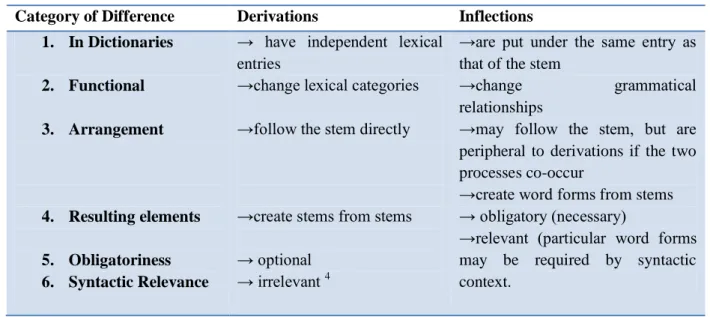
Booij3 (2006) mentions many differences between the two processes, which are identified in Table 1.2
Table 1.2 Comparisons between Derivation and Inflection
Category of Difference Derivations Inflections
1. In Dictionaries 2. Functional 3. Arrangement 4. Resulting elements 5. Obligatoriness 6. Syntactic Relevance
→ have independent lexical entries
→change lexical categories
→follow the stem directly
→create stems from stems
→ optional → irrelevant 4
→are put under the same entry as that of the stem
→change grammatical relationships
→may follow the stem, but are peripheral to derivations if the two processes co-occur
→create word forms from stems → obligatory (necessary)
→relevant (particular word forms may be required by syntactic context.
2 Capitalized In the source 3
G Booij, Vrije Universiteit Amsterdam, Amsterdam, The Netherlands
4 Booij (2006) claims that one the possibility for derivation-syntax relevance must not be completely denied,
12
Syntax, the second branch of grammar, is also interested in words, although it perceives them from a different angle. It is concerned with the structures that can be made from words rather than the words themselves, i.e., “the ways in which words combine to form sentences” and the rules which govern the formation of sentences, making some sentences possible and others not possible within a particular language.” (Richards and Schmidt, 2002: 535). Syntax is also used to refer to the sets of rules which describe and explain sentence structure, making some sentences possible and others not possible within the framework of the language in question (Koenig5, 2006; Richards and Schmidt, 2002). Several competing suggestions for an exhaustive grammatical theory have been formulated with the aim of explaining all the existing natural languages, not without some inconvenience, however. Such rules include models like: Phrase Structure Grammar; Transformational Grammar (Government and Binding); Transformational Grammar (Minimalism); Generalized Phrase Structure Grammar; Lexical Functional Grammar, etc. (Müller, 2016).
Despite the fact that syntax investigates, and formulates, language structure, its functional importance lays rather in meaning; i.e., a syntactically incorrect form of language is consequently marked by semantic ambiguity and indistinctness. Thus, if a speaker wishes the expression he/she utters to deliver the intended meaning appropriately, the “lexical items must fit into particular slots in the syntactic structure of that expression.” (Hinzem, 2006:150). The study of the relationship between form and meaning is undertaken under the heading „Syntax-Semantics Interface‟ (Koenig, 2006: 428).
1.4.2. The Importance of Grammar in Literacy
Grammatical knowledge is, of course, not the only requirement for the accomplishment of a literate oral and written discourse, Cushing-Weigle (2005), for instance, mentions many others, such as having a „fluent access‟ to vocabulary and orthography. However, the lack of the grammatical constituents in a sentence is indeed very striking, and may limit speech comprehension. Swan (2002) states that educators must not ignore grammar teaching for two „good reasons‟, the first being comprehensibility, by which he means that no speaker utters speech unless they intend
5
13
to be understood by their audience. As a result, being understood (as well as understanding what is being said) entails learning certain grammatical structures and applying them in conversation. Whereas the second reason is acceptability, i.e. the desire to be acknowledged as a competent speaker by specific groups of people, which may be compromised if one ignores the rules responsible for the correct combinations of linguistic elements.
1.5. Grammar Within The Arabic Linguistic Tradition
Kempson6 (2006: 449) states that a grammar of a language is “[…] a formal model of the properties of language that are intrinsic to the words of the language and the way they can be combined”. Within the framework of such definition, then, a sound grammatical theory would be one that can describe its word structures and the patterns in which they are arranged. However, he continues to raise the dilemma as to whether the scope of grammatical theory was really as limited “Is it enough to provide a formal account of language structure, or should a grammar reflect general cognitive underpinnings, with the theory of grammar seen as part of a theory of mind?” (2006:450).
This question highlights two views of linguistic (grammatical) theory; the first, considers that the structure of separate languages must be seen as part of the whole entity of „human language‟ which is capable of drawing on an understanding of the development of the cognitive language faculty. The strongest representative of this vein is that of Chomsky, who argues that the grammatical theory must extend beyond a structural description of language to include setting an „explanatory‟ basis for grammar within human underlying cognitive system; he states that:
Linguistic theory is concerned primarily with an ideal speaker-listener, in a completely homogenous speech-community, who knows its language perfectly and is unaffected by such grammatically irrelevant conditions as memory limitations, distractions, shifts of attention and interest, and errors [...] in applying his knowledge of the language in actual performance (Chomsky, 1965:3)
6 R Kempson, King’s College London,
14
The world witnessed the first indication for a potential relationship between grammar and the brain in Chomsky‟s review of Skinner‟s „Verbal Behaviour‟ (1959), where he argued that there is an innate predisposition in the human brain, which is responsible for language-related cognitive activities, i.e., that the linguistic capacity to acquire and produce language is a biological endowment. By so doing, Chomsky was the first to defy the behaviourist view of language acquisition, which suggests that it occurs by means of imitation and habit-formation (Newmeyer, 1996). In 1965, Chomsky elaborated his idea by introducing the terms competence (the speaker‟s ability to produce and understand correct sentences) and performance (the externally visible output of such competence), which entails that the grammar used in speech generation may assist in answering the eternal question of how the brain functions. Chomsky‟s approach considers grammar to be an observable behaviour which provides the opportunity to investigate a non-accessible internal faculty; grammar thus permits us to cast a glance inside the human brain. The second view, on the other hand, is interested exclusively in describing the structural aspect of language; it is particularly represented here by the Arabic linguistic tradition.
1.5.1. The Arabic Linguistic Tradition
In this school, syntax represents a structural mapping of the language being investigated; its role is to formulate rules that distinguish grammatical sentences from non-grammatical ones. Thus, syntax is a systematic procedure whose sole objective lies in constructing combinations of phonological complexes and denotational7 contents, for linguistic units that are likely to enlarge progressively, from words to sentences (Kempson, 2006).
Arabic grammar is structural in nature, i.e., its task is limited to the description of word forms and explanation of word formation processes; this is mainly due to the fact that it was conducted for the purpose of preserving the Arabic language, the medium in which the Qur‟an is written. Ryding (2005: 3) affirmed that “Arabic was [...] permanently sacralized; as the chosen language for the Qur’ān, it became the object of centuries of religious study and exegesis, theological analysis, grammatical
7
Denotation is used as part of classification of meaning; a denotational meaning of a word is equal to its literal meaning (dictionary meaning). It is usually opposed to Connotation, which refers to the association of a specific word to personal or social entities, phenomena or incidents.
15
analysis and speculation.” The focus at first was on meaning clarification, and on composing correct explanations for the divine texts; it was the appearance of Sībawayhi‟s (8th
C) language treatment, that paid explicit attention to the grammatical aspect of Arabic.
The Arabic linguistic tradition is strongly attributed to Sībawayhi‟s analysis of Arabic in his Kitāb (i.e., book), which was primarily inspired from the teachings of his mentor Al-Khalil8. It “covered the entire structure of the language” (Versteegh9, 2006: 435) and remains till the day “the authoritative source for all succeeding [Arab] grammarians” (Ibid). Sībawayhi‟s10
work was written in a very simple style, designed in the form of an explanation directed to an interlocutor. It was categorized in successive chapters, which described the structure of Arabic and explained its different linguistic phenomena.
In the Arabic linguistic analysis, „Naḥw‟ is the word considered equivalent to grammar, the same term, however, is used to refer to one of its subfields, namely syntax. Morphological analysis, on the other hand, is undertaken within the framework of „Ṣarf‟. The two branches of grammar were dealt with thoroughly in different sections by Sībawayh, as he talked about syntax from pages eight (8) to two hundred and eighty four (284), while morphological analysis extended from page two hundred and eighty five (285) to four hundred and seventy six (476).
Sībawayhi‟s book is perceived as the first comprehensive work which, although not limited to the structural aspects of the Arabic language, managed to describe and explain all its specificities. Nowadays, besides being an all-inclusive course book of Arabic, it has major contribution in the western linguistic theorising; Aronoff (1994: 3) maintains that “all Western linguistic morphology is directly rooted in the Semitic grammatical tradition.”
8
Abu ‘Abd-al-Rahman al-Khalil ibn Ahmad ibn ‘Amr ibn Tammam al Farahidi; he compiled the first dictionary of Arabic: Kitāb al-‘Ain.
9
University of Nijmegen, Nijmegen, The Netherlands
10 Sībawayhi’s Kitāb was re-published by al-khandji library, Egypt (3rd ed, 1988). Realized and explained by
16
1.6. Grammar Development in Algerian Schools
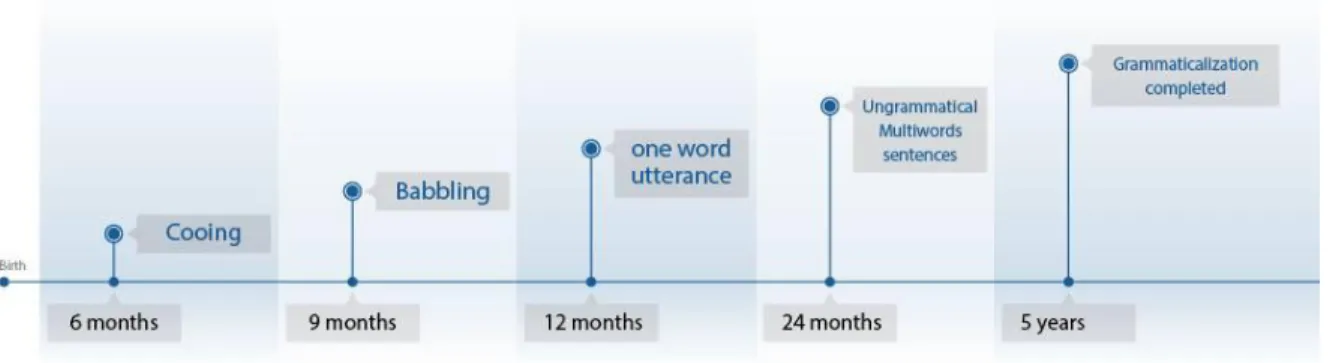
Algeria is a diglossic society; this entails that almost all its population possesses grammatical competence in two different varieties of the same language: AA and MSA. Nevertheless, the attained levels of proficiency are likely to be uneven. This is due to the fact that the grammars of the two systems were accumulated in different periods of the child‟s age via different processes. AA is the acquired first language of Algerians; it develops by means of primary socialisation, i.e., the process of first language acquisition (FLA); it proceeds through five stages. (Shown in figure 1.1)
Figure 1.1 First Language Acquisition Stages
When grammaticalization is completed, one may proclaim that the child has successfully acquired his/her mother tongue; the only remaining task is the lexical expansion, which is a process that continues progressing through the lifespan. Children‟s lexicon may expand cross-linguistically, i.e., as part of second language acquisition (SLA) along with its morphology and its syntax, were they to choose to learn a second language. However, acquiring a second language (SL) is not a matter of choice for Algerians; they rather have to learn it when they are enrolled to schools. 1.6.1. Second Language Acquisition
SLA research is interested in the psychological development of any non-native language, regardless of whether such a language is attributed any status in the learner‟s locale or not. The distinction between consciously learning and unconsciously acquiring a second language was first made by Krashen in (1981). Acquisition is different from learning, because it is similar to the process by which children learn their native tongue, relying mostly on social interaction. The concern of the language acquirer is delivering the message fluently rather than accurately, i.e., on content rather than form; thus neither errors nor mistakes are deliberately corrected by the teacher.
17
The difference between errors and mistakes, here, is rather strict, i.e., they are not considered as synonyms. Errors are systematic; they occur because of the learner‟s unawareness of the correct forms, which is either due to the fact that they haven‟t dealt with the lesson yet, or that they have learnt the incorrect form. Whereas mistakes occur in the form of slips of a tongue, i.e., the learner forgets and is likely to self-correct right after committing the mistake. Rather than dictating grammar rules, teachers and care givers set up an input-rich linguistic environment for learners who, by means of exposure to authentic language, accumulate the feeling of a correct linguistic element, rather than a knowledge of the rules that constitute its correctness.
Besides putting a distinction between learning and acquiring, Krashen‟s theory involves four other aspects; the first, called the natural order hypothesis, states that SLA proceeds following a predictable order by all learners, on a scale from easy to difficult. The extensive exposure to the target language may result in the acquisition of some incorrect forms; Krashen claims that it is the role of the language monitor11 to rectify such false learning. Furthermore, the input hypothesis states that learners should be exposed to an i+1, i.e., a „comprehensible input‟ which is above their levels of understanding, in order to push them to the next level of acquisition. The final hypothesis as suggested by Krashen is that of the affective filter, it refers to the affective factors which may affect the process of acquisition, such as the levels of anxiety and the quality of motivation. According to Krashen then, SLA should first proceed in a teaching-free language environment, which allows acquirers to construct fluency and an understanding in the target language. The acquired system undergoes a structural revision and improvement through direct instruction of rules, resulting in a refined language output, and thus signalling a successful SLA. (See Figure 1.2)
Figure 1.2 Model for Adult Second Language Performance (Krashen, 1981)
11
18 1.6.2. Second Language Grammaticalization
An acquisition-based Second Language Grammaticalization would proceed through the following stages:
Intensive exposure to the target language (TL);
Encouraging acquirers to perform activities in the TL;
Acquirers manage to build the basic linguistic skills in the TL;
During the first stages of SLA, structure is rarely emphasized, mainly because of the efforts to assimilate it with FLA, Nassaji and Fotos (2004: 127) state that “similar processes underlie both first and second language (L2) learning and that, if first language (L1) learners do not require formal instruction to learn languages, neither should L2 learners.” However, once the acquirers are noticed to have acquired TL fluency and understanding, they are ready to receive some direct grammatical instruction, mainly regarding inflectional morphology (verbal and nominal categories) and syntactic structures.
1.7. Grammaticality in the Arabic Varieties of Algeria
Algeria is a multilingual society where a set of diversely-originated languages coexist, such as Berber (Kabyles; Chaouias; Touaregs; Oasis Berber12); and Indo-European (French); Semitic (Arabic) (Aitsiselmi, 2006). Each of these languages occupies a special position in the society, Berber, for instance, is spoken regionally, whereas French functions as the second language of the Francophone community of Algerians; the same, however, cannot be said about Arabic, because of the diverse forms it takes and the limitless functions it fulfils.
Basically, there are three forms of Arabic in all the Arab-world: Arabic, MSA, and Dialectal Arabic (DA). The domain of Arabic is restricted to religious and literary situations, MSA is functional in written and formal speech, whereas social interactions are carried out by means of the various dialects; nevertheless, this classification is still non-consensual among Arabic linguists. The main controversy results from the fact that Arabic and MSA share the same structural properties: phonological, morphological, and syntactic. Indeed, MSA evolved as a result of the “adaptation [of Arabic] to the needs of modern culture by the introduction of new terms, deep changes
12
19
in phraseology, and marginal ones in syntax” (Bau, 1969: 1). Thus, the differential between the two varieties lies merely on the stylistic and lexical levels: MSA writing uses less complex forms; and some lexical items of Arabic (Classical) may be regarded as old-fashioned by MSA either because they are not used at all, or they were replaced by loan words from foreign origins (Ben Zerrouq, 2006)13. This section describes the morpho-syntactic system of MSA. It then reviews the aspects in which AA, the language imprinted in the mind of all Algerians, diverges from MSA.
1.7.1. Morphology of Modern Standard Arabic
Being a member of the Semitic language family14, Arabic shares its morphological system, which is mainly characterized by the derivational process of root-and-pattern (Hackett, 2006). Aronoff affirms that:
The formative nature of linguistic morphology is especially clear when we look at the Semitic languages, where roots are mere collections of consonants from which all individual word forms are quite dramatically given form by the laying of templates and affixes. (1994: 3)
The root is by definition a stable consonantal sequence, which expresses the content meaning of the word; whereas the pattern is usually a sequence of vowels and consonants which carries the functional meaning (Watson, 2006). Indeed, almost all lexical items of the language are obtained from the interspersion of a set of patterns within the triconsonantal roots of the language, where roots behave as preliminary raw material that is subjected to the shaping and moulding of the patterns; exhibiting a “rigorous and elegant logic” (Ryding, 2005: 45). The Arabic roots are usually triconsonantal15; they take a specific order which cannot be modified, for that would jeopardize its meaning. This does not, however, reject the possibility of the existence of bilateral lexemes indeed some complete words in Arabic have only two consonants, such as: رأ (Ɂax=> brother); بأ (Ɂab=> father); ذج (ʤad=> grandfather); etc. Patterns, too, are bound morphemes made up of an organized set of vowels, which are inserted within the root consonants; they can also contain additional consonants such as إ (i-),
13
The original text is in Arabic: PhD dissertation year (2006/2007).
14
Semitic languages are part of the Afro-asiatic language family. Cf., see: Concise Encyclopedia of Languages of the World (929: 2009).
15
20
دسإ (ista-), etc. The root-and-pattern combination represents the foundation of a rich lexicon, comprising verbs (various types) and nouns (verbal nouns, active participles, names of instruments, etc.) which, along with particles, form the three categories of speech that constitute the language. Because grammatical categories can only be operational on verb and noun stems, derivation in Arabic is prior to inflection. Arabic inflectional processes indicate eight grammatical categories, namely, number (singular, dual, and plural); gender (male and female); case (nominative, genitive, and accusative)16; tense/aspect (perfect and imperfect); mood (indicative, subjunctive, and jussive); voice (passive and active); state (definite and indefinite); and person (اَأ =>anā, ًه =>hiya, اًرَأ =>antumā, etc.).
1.7.1.1. Verbal Derivation
Most Arabic verbs are derived from tri-consonantal roots (with a few quadric-consonantal ones) through introflection and/ or affixation, and are then subjected to inflectional processes in order to indicate grammatical categories. For deriving verbs, a set of ten patterns (ٌاسولأا =>al-awzān) is widely used with triconsonantal roots, whereas another three are employed in the few cases of quadriconsonental ones. For instance, the verb kataba is the result of applying the pattern aaa on the root √ktb (cf. See Ben Zarrouq, 2006). The process of verbal derivation entails that Arabic is a highly systematic language (Ryding, 2005); however, there are some exceptional types of verbs which cause a derivational change, in other words, an irregularity. On one hand, there is an irregularity within the sound verbs, particularly: hamzated verbs and doubled (or geminated) verbs, whose derived structure diverges from that of the regular sound verbs, e.g., ذخأ (Ɂaxaḍa: he took)=> ذخأٌ (yaɁxuḍu: he takes). The second category expressing derivational irregularity is the weak verbs, which, by definition, are those containing the weak consonants „w‟ and „y‟, e.g., عات (bāʕa: he sold)=> عٍثٌ (yabīʕu: he sells).
Arabic passive form is constructed through the process of Ablaut, which is a set of word-internal vowel changes, Richards and Schmidt (2002: 1) define it as: “a process by which an inflected form of a word is formed by changes in the vowel of the stem. For example, the past tense of sing is sang and the plural of goose is geese.” In
21
most cases, ablaut occurs through changing „a‟ for „u‟ and „i‟ for „a‟, e.g., عفَر(rafaʕa: he lifted)=> عفُر (rufiʕa: it was lifted)=> عفزٌُ (yurfaʕu: it is being lifted).
1.7.1.2. Verbal Inflection
Arabic is a highly inflectional language; in verbs, inflection indicates six grammatical categories:
Tense/aspect: there are two tenses in Arabic: the Perfect which indicates a complete action; whereas the Imperfect indicates an ongoing action. The future is formed through adding the prefix َص (sa)or the particle فىس (sawfa17)to the imperfect form
Person: verbs in MSA inflect for 13 persons (Table, 1.6)
Gender: MSA add the prefix (-t) to the feminine verbal inflection in order to discriminate it from that of the masculine.
Number: inflection in MSA indicates three numbers, which are singular, dual, and plural
Mood: whereas the perfect is static, the imperfect form of Arabic verbs has four different moods, which are differentiated by means of different suffixes: indicative (-u); subjunctive (-a); jussive and imperative share the same suffix marking (Ɵ); and the energetic, which is mostly used in Arabic.
Voice: MSA verbs are inflected in both the active and the passive voices. 1.7.1.3. Nominal Derivation
Arabic pronouns are differentiated according to the number (singular, dual and plural) and gender (masculine and feminine), which excludes anā (I) and antumā (the two of you). However, in AA the dual is completely abandoned, and the feminine does not inflect in plurals (consult Table 1.7).
17
22
Table 1.6 Personal pronouns of MSA
Singular Dual Plural
independent Suffixed Independent Suffixed Independent Suffixed Ɂanā (انأ) -nī )ين(
/-ī (يأ)
/ / naḥnu (نحن) -nā (ان)
2 MASC
Ɂanta (تنأ) -ka (ك) Ɂantumā (امتنأ)
-kumā (امك) Ɂantum (متنأ) -Kum (مك)
3 FEM Ɂanti (تنأ) -ki (ك) Ɂantumā (امتنأ) -kumā (امك) Ɂantunna (نتنأ) -Kunna (نك) 3 MASC Huwa (وه) -hū /-h (ه) Humā (امه) -humā (امه)/ - himā (امه)
Hum (مه) -hum (مه)/-him (مه)
4 FEM Hiya (يه) -hā (اه) Humā (امه) humā (امه)/ -himā (امه)
Hunna (نه) -hunna (نه)/ -hinna (نه)
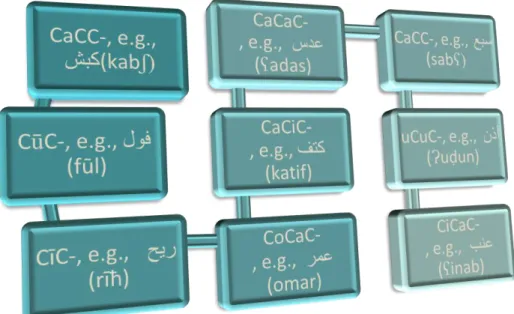
The most remarkable feature in the nominal system in SA is the existence of a diverse set of noun forms. Each form (wazn) is used to express a category of nouns; Some of these forms are demonstrated in Figure 1.
Figure 1.3 Some Arabic word forms.
In addition to the several nominal forms seen above, Arabic resorts to derivation for lexical expansion. Thus, big chunks of the Arabic lexicon are generated by means of root-and-pattern. This category of nouns is called substantives; which is “traditionally defined as „substances‟, i.e. names of persons, places, things, etc.”
23
(Crystal, 2008: 463). Some of the substantives which exist in MSA are the active participle ةذاك (CāCiC- => kātib: writer), diminutives ةٍرك (CuCaiC- => wulaid: little book), nouns of place ةركي (maCCaC- => maktab: office), etc.
1.7.1.4. Nominal Inflection
Nouns in Arabic comprise adjectives, substantives and numerals; they inflect four grammatical categories: gender, number, case, and definiteness/ indefiniteness:
Gender: in Arabic nouns, including those signifying objects, are also marked as either being masculine or feminine; however, a distinction is made between genuine and metaphorical gender. An example of genuine female is جإزيا (imraɁa=> woman) which is contrasted withمجر (radjul=> man), whereas بات (bāb=> door) is considered masculine, as opposed to جذفاَ (nāfida=> window). Number: there are three nominal numbers in Arabic: the singular is not subjected
to any marking; the dual is indicated by the suffix (ān); the and plural: Sound Masculine Plural ٌىثذاك ( kātibūn=> male writers) Sound Feminine Plural خاثذاك (Kātibāt=> female writers), and the Broken Plural which exists in several types18
. Case: three cases may be attributed to the noun in Arabic: nominative حًض (-u);
حذرفaccusative (-a), and the genitive جزسك (-i);
Definiteness/ indefiniteness: definiteness in SA is expressed by the prefixation of the definite article (al-), whereas indefinite nouns are nunated19; e.g., صأكنا ٍي دتزش (ʃaribat minal-kaɁsi=> she drank from the cup) (definite) as opposed to: ٍي دتزش صأك(ʃaribat min ka’sin=> she drank from a cup) (indefinite).
1.7.2. Syntax of Modern Standard Arabic
Arabic linguistics categorises sentences depending on the word with which they begin; in this respect, there are two main structures: a) those beginning with a noun, they are called حًٍسإ مًج (jumal ismyya: nominal sentences) and take the SVO word order; there are cases when it is rather VOS, particularly when the subject is not emphasised (Prochāzka, 2006). b) Sentences which begin with a verb, i.e., حٍهعف مًج (jumal fiʕlJJa: verbal sentences) and are in the form of OVS. This classification, however, does not take into consideration sentences which do not contain a verb,
18 There is a large number of broken plural patterns, such as CuCuC; CuCaC; CuCūC; etc. 19
24
Abboud and McCarus maintain that “Arabic sentences are of two types, those with verbs, called verbal sentences , and those not containing verbs, called equational sentences” (emphasis in original; 1983, Part 1:102). Equational sentences take very simple structures, containing a definite noun called أذرثًنا )al-moubtada: subject or topic) and an indefinite one which is زثخنا (al-xabar: predicate). Both constituents in an equational sentence take the nominative case, e.g., لٌمًٍج ُوىٍنا (al-yawmu djamīlun: the day is beautiful). However, there are some structural additions which change the case of either the topic or the predicate to accusative, particularly: kana wa aḥawātuhā for instance, لاًيًٍج ُوىٍنا ٌاك (kana l-yawmu djamīlan: the day was beautiful); and اهذاىخأ و ٌإ inna wa aḥawātuhā, e.g., inna l-yawma djamīlun (for more forms, see Ryding, 2005: 59).
The Arabic sentence structure is ruled by two main principles: the government principle which entails that some elements (governors) make others behave in a specific way, Ryding maintains that “[T]ypical „governors‟ (Ɂwāmil مياىع) in Arabic are verbs, prepositions, and particles” (2005: 58). Verbs, when transitive, govern objects into the accusative case, such as: صرذنا زًع ةرك (kataba omaru a-ddarsa: Omar wrote the lesson), Prepositions such as زجنا فوزد (ħurūf al jar) and which changes the case of the following word to genitive, e.g., دٍثنا ًف (fil-bayti: at home), دذذ حنواطنا(taħta aṭṭāwilati: under the table); and وشجنا فوزد (ħurūf al ʤazm) which change it to the jussive, e.g., بْةهذٌ ىن (lam yaḍhab=> he did not go)
lam yaf’al. The second principle is the agreement principle, which states that some words share the same properties as others, such as verb- subject agreement (regarding number and gender) and خىعًُنا و دعُنا (an-naʕt wal-man’ūt: adjectives) case agreement.
In MSA, negation is formed when the one of the particles ىن (lam), ٍن (lan) is added to the verb in question, e.g., حسرذًنا ىنإ ةهذٌ ىن (lam Jaḍhab ilā l-madrasah: he did not go to school).
As for Question formation, it occurs through adding several types of question words (or particles), such as, ٍي (man: who), ٌٍأ (ayna: when), ىري (matā: when), etc. Each question word is used to inquire about a particular part of speech, such as, the subject and object, the place, and the time. For instance,
25 ؟قراطنا ٍي (man aṭṭāriq : who is at the door)
؟زًع ٍكسٌ ٌٍأ (ayna yaskunu Omar: where does Omar live) ؟زًع ءاج ىري (matā ʤāɁa Omar: when did Omar come) 1.7.3. Algerian Arabic Particularities
Because AA is one of the many dialects of Arabic, the manner in which the two diverge from each other is very feeble; both on the morphological and the syntactic levels (Ibrahim, 2003).
1.7.3.1. Morphology
Regarding derivational processes AA is in most part identical to SA, except for a few structural changes and omissions which are caused by the dialectal tendency towards „extreme’ simplification (Zerrouq, 2006). Prochāzka maintains that “Morphological derivation by applying the principle of root and pattern has been slightly simplified (there are fewer patterns compared to CA), but has remained productive.”(2006: 428). Indeed, in all the derived verb forms, AA agrees with SA; although with variable rates of use, and some slight structural differences, mainly restricted to vowels (such as replacing u and i by a), vowel quality (AA assimilating a to ǝ), vowel and consonant omissions, as in: ىقسرسا (istasqā => stasqa: he asked for water) (Zerrouq, 2006). As for verbal inflections, it is noted that the passive form of verbs is completely absent in AA; if an AA speaker wished to express passive meaning, however, the pronoun hūma would be used to replace any agent, e.g., مٍق(qīla=> it was said) => ىناق (qālū) or ىنىقٌ (yqūlu=> they say). Concerning tense/aspect, AA shares the same regular and irregular patterns as those of SA, proving further how similar the two varieties are (Zerrouq, 2007). Verbal conjugation to the future tense takes the same form as that of SA, however different particles are used according to the dialectal belonging, such as: حار (rāħ); خٌار (rāyaħ); ًشاي (māshi); يداغ(ɣādi20
).
There are only ten personal pronouns in AA, this is due to the lack of the dual form and the plural feminine, in most the dialects (Prochāzka, 2006) (See table, 1.7).
20
26
Table 1.8 Personal Pronouns of AA (dependent and independent)
Singular Plural
independent Suffixed independent Suffixed
‘āna -nī /-ī ḥnā -nā
2 masc Nta -k Ntūma -kum
3 fem nti -ki Ntūma -kum
3 masc huwa -h Hūma -hum
4 fem Hiya -ha Hūma -hum
Feminine marking in AA takes the same form as that of SA, i.e., by adding the prefix t-. Due to the omission of case marking (final-consonant movement) and the employment of sukūn instead21, thus AA has no case system Prochāzka (2006: 428) attests that “[T]he most striking morphological difference between CA/MSA and all dialects is the lack of a case system.”
The absence of the definite article l- is the only marker for indefiniteness in AA, mainly because nunation does not occur in the dialects, e.g., صاكاي دتزش (ʃarbat mel-kās: she drank from the cup) (definite) as opposed to صاكي دتزش (ʃarbat m-mel-kās: she drank from the cup) (indefinite)
1.7.3.2. Syntax
In AA, both SVO and VSO are used, e.g., مصو ذًذي (Mohammad wsal), and ذًذي مصو (wsal Mohammad) (Mohammad arrived); their use is not done randomly, however, Brustad (2000: 361) claims that „„VSO represents the dominant typology in event narration, while SVO functions as topic-prominent typology that is used to describe and converse‟‟ (qd in Prochāzka, 2006: 430)
AA also manifests this phenomenon; however it only employs some of the sisters of kana (ٌاك kāna; َم żalla; خات bāta; جثصأ asbaħa; لاساي māzāla; واداي mādāma).
21
27
Furthermore, the neglect of AA towards consonant movements does not show such particularities, e.g., باثش وىٍن ٌاك (kan lyūm chbab22). Indeed, one of the features that are known to AA is that it eliminates almost all consonant movements, thus all the words in the sentence take the unvowelled form which is marked by a pausal form.
The process of forming negation in AA proceeds through adding the particle اي (mā: not) before the verb, to which is the suffix ش (ʃ) is added, e.g, اج (ʤā) => شاج اي (mā ʤāʃ: he did not arrive). As for Questions, there are several particles to use depending on the part of speech around which the question revolves, for instance, ٌىكش (ʃkun: who) is used for the subject, شاو (wāʃ: what) is used to inquire about the object, and شيع (ʕlāʃ: why) is used to ask the question why. E.g., ؟اج ٌىكش (ʃkun ʤā: who came)?
1.8. Grammar Instruction
Within the field of language education, grammar instruction seems to be the most controversial; for it has been viewed differently, ranging from the two extremes of being the raison d'être of language teaching to being completely neglected. In the pre-communicative era of language teaching, language was viewed as a “formal system of rules or structures to be mastered” (Wesche and Skehan, 2004: 208), thus language teaching was practiced through direct instruction of grammar rules. However, with the communicative turn in language teaching (Hymes‟ communicative competence), grammar was understood as an obstacle to the acquisition of fluency (Krashen, 1981), consequently, grammatical form was completely neglected and Communicative Language Teaching (CLT) was thoroughly implemented in schools. Richards observes:
Grammatical Syllabuses were superseded by communicative ones based on functions or tasks; grammar-based methodologies such as the Presentation-Practice-Production (P-P-P) lesson format underlying the situational approach gave way to function- and skill-based teaching; and accuracy activities such as drills and grammar practice were replaced by fluency activities based on interactive small-group work. (2002: 153)
Through time, however, the focus on function with the complete neglect of form proved to be inefficient. Indeed, empirical research showed that implementing form
22