MINISTRY OF HIGHER EDUCATION AND SCIENTIFIC RESEARCH University of Mohammed Seddik Ben Yahia/ Jijel
Faculty of Letters and Languages Department of English
Thesis submitted in partial fulfilment of the requirements for the Master Degree in Language Sciences
Candidates: Supervisor: - Bahiyya BELIBEL Zahia BOUCHAIR - Ibtissam HECHICHE
Board of Examiners:
Chairperson: Safia NEGHIZ University of Mohammed Seddik Ben Yahia/ Jijel Examiner: Loubna KOUIRA University of Mohammed Seddik Ben Yahia/ Jijel Supervisor: Zahia BOUCHAIR University of Mohammed Seddik Ben Yahia/ Jijel
2016
An Investigation of English Foreign Language Students’
Spelling Problems:
The Case of Second Year Licence Students at the Department of English, University of Mohammed Seddik Ben Yahia/ Jijel
Dedication
In the Name of Allah, the Most Merciful, the Most Compassionate This work is dedicated to:
The only person with the exception of God nothing is more important,my beloved mother; My father, may Allah rest his soul;
My dear grandmother for her prayers;
My dear brother Abdelhamid for his assistance and help;
My adorable sisters: Hafida, Aziza, Hanan, and Hanifa for their love and help; My lovely nieces and nephews: Marwa, Hania, Lamis Nada, Younes, and Ayoub; My dear friends with whom I shared the university life with its lights and shadows:
Bahiyya, Amirra, Mouna, Nassira, Leila, Ismahan, Samia, and Wassila.
Ibtissam
The candle that lights my life, to my mother for her countless love, support and patience. My father whose words of encouragement and push for tenacity and hard work ring in my
ears.
A feel of gratitude to my lovely sister Hanine and my brothers Salah Eddine and Al Haccen for their unconditional support and encouragement to pursue my education.
To all my relatives who prayed for me and were with me in the ups and downs. To all the people who have been walking alongside me during the five years at university
Among them I mention: Ibtissam, Nassira, Leila, Ismahan, Wassila, Meriem, Mouna, Samia and Wafa..
Acknowledgement
Above all, we would thank Allah, the Almighty for providing us with patience and will to finish this work.
We owe million thanks and tremendous debt of gratitude to many people who made this dissertation possible.
We would like to express our deepest and infinite gratitude to our supervisor Mrs. Zahia BOUCHAIR, to whom we respect deeply, for her precious guidance,insightful feedback, encouragement, advice and patience.
We expressopen-hearted gratitude to Mrs NEGHIZ Safia and Mrs KOUIRA Loubna for the time and efforts spent in reading and judging this humble work.
Our modest appreciation goes to Ms. NassiraBoukerreche for accepting to administer the tests and the students’ questionnaire in her sessions, and for her receptive students, English second year students group one and two, for donating time and help in the accomplishment of both the tests and the questionnaire.
We would like to take this opportunity to forward our sincere thanks to Dr. Joanne Rudling for her help and care through replying to all the emails we sent to her.
It is with intensive pleasure to extend ourdeepest gratitude to all the teachers in the department of English who have accepted to fill in the questionnaire.
Last but not least, we must acknowledge the debt we owe to our families and friends and all who have stood incredibly supportive and very encouraging.
Abstract
Owing to a remarkable revival of interest in English Foreign Language learners’ spelling errors, the present study aimed at investigating the spelling problem among second year students at the department of English, university of Mohammed Seddik Ben Yahia/ Jijel, and identifying the commonest types and likeliest causes of their spelling errors. Moreover, the study aimed at investigating both students’ and teachers’ perceptions of the spelling problems that students encounter. Furthermore, it attempted to shed light on the spelling strategies used by the students. The study was based on the hypothesis that if students’ were aware of their spelling problems and used a variety of strategies to improve their spelling, they would not experience serious spelling difficulties. In order to achieve these aims, the researchers opted for a dictation test, a translation test, a questionnaire for students and another one for teachers. The findings of the study revealed that the frequency of students’ spelling errors is high and therefore students are experiencing serious difficulties in spelling English words. The major causes behind students’ poor spelling performance were found to be the irregularity of English spelling system, the complexity of rules and exceptions as well as confusing words, students’ ignorance of spelling rules, students’ carelessness and their lack of interest to learn spelling. Moreover, the obtained results demonstrated that the students use a narrow range of spelling strategies with great reliance on phonological strategies which have further complicated of the problem. The analysis of the research findings confirmed that the students face great difficulties in spelling because they are not aware of their spelling problems and they use limited strategies to improve their spelling. Based on the results of the study, some pedagogical recommendations were suggested for further research.
List of Abbreviations and Symbols %: Percentage
Am E: American English Br E: British English
CVC: Consonant-Vowel-Consonant EFL: English as a Foreign Language EA: Error Analysis
L1: First Language L2: Second Language
Q: Question
List of Tables
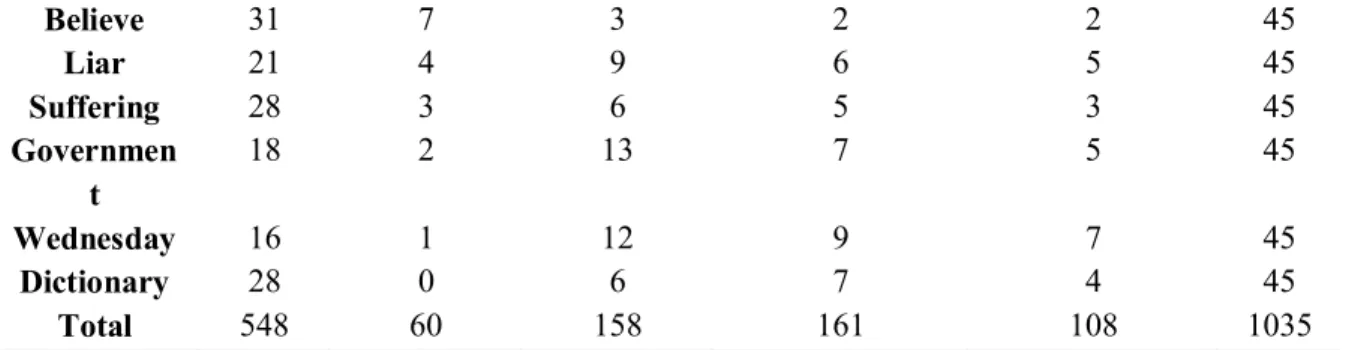
Table 01: Students’ Performance in the Dictation Test: Focus on Students ………...54
Table 02: Students’ Performance in the Dictation Test: Focus on Words………...56
Table 03: Spelling Errors According to their Types………...….59
Table 04: Examples of Salient Spelling Errors According to their Categories………....…59
Table 05: Students’ Performance in the Translation Test: Focus on the Students ...…...…64
Table 06: Students’ Performance in the Translation Test: Focus on the Words………..…65
Table 07: Comparison between Students’ Performance in Both Tests………..….66
Table 08: Students’ Gender……….……….68
Table 09: Years of Studying English………...………68
Table 10: Students’ Self Evaluation of their Writing Skill………..……69
Table 11: Students’ Self Evaluation of their Spelling Ability……….……69
Table 12: Students’ Familiarity with British Spelling and American Spelling………..…..70
Table 13: Students’ Use of British English and American English Spellings………….…70
Table 14: Students’ Perceptions about the Importance of Correct Spelling………71
Table 15: Students’ Perceptions on the Degree of Difficulty of Learning English Spelling……….………72
Table 16: Students’ Attitudes towards the Importance of Reading in Developing their Spelling………..…...73
Table 17: Students’ Views on the Importance of Correct Spelling when Sending Emails or when Chatting………...73
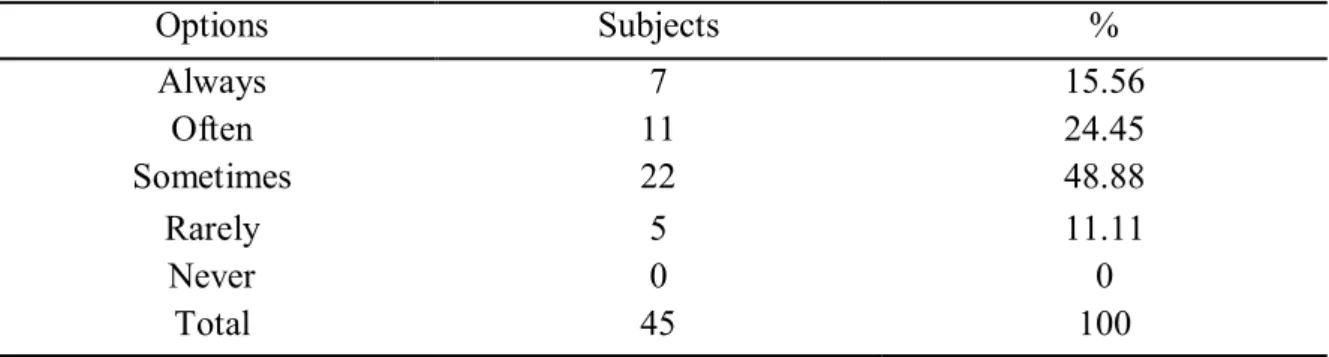
Table 18: Students’ Frequency of Making Spelling Errors……….………….74 Table 19: Reasons Attributed to Students Spelling Errors……….………….75
Table 20: Students’ perceptions on the Effect of Tiredness and Boredom on their Spelling Performance……….…76
Table 21: Students’ Perceptions on the Effect of the Examinations on their Spelling Performance……….…76 Table 22: Students’ Views on their teachers’ Responses to their Spelling Errors performance……….…….77 Table 23: Students’ Responses when Facing Difficulty to Spell a Word………...….78
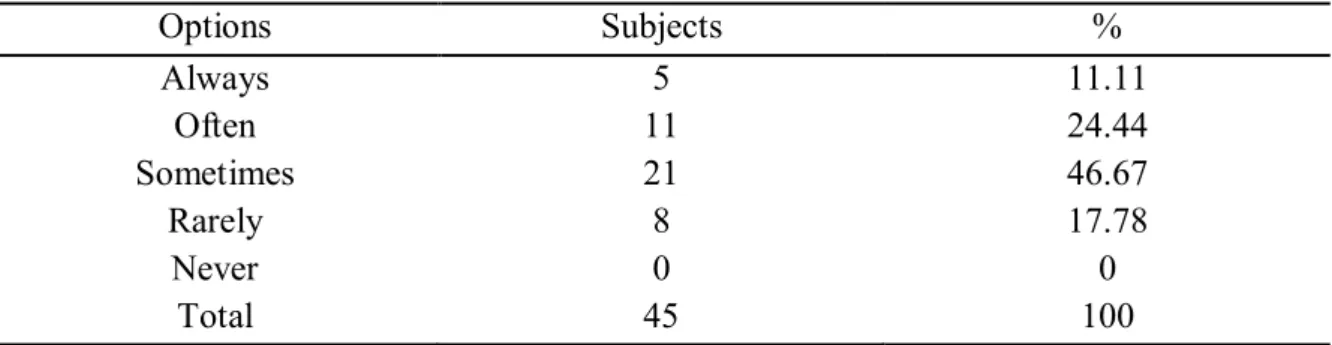
Table 24: Way of Spelling Words Students usually do not Know how to Spell………….79 Table 25: Students’ Frequency of Writing a Word they do not Know how to Spell the First Way it Comes to their Head and Keep Going………..79
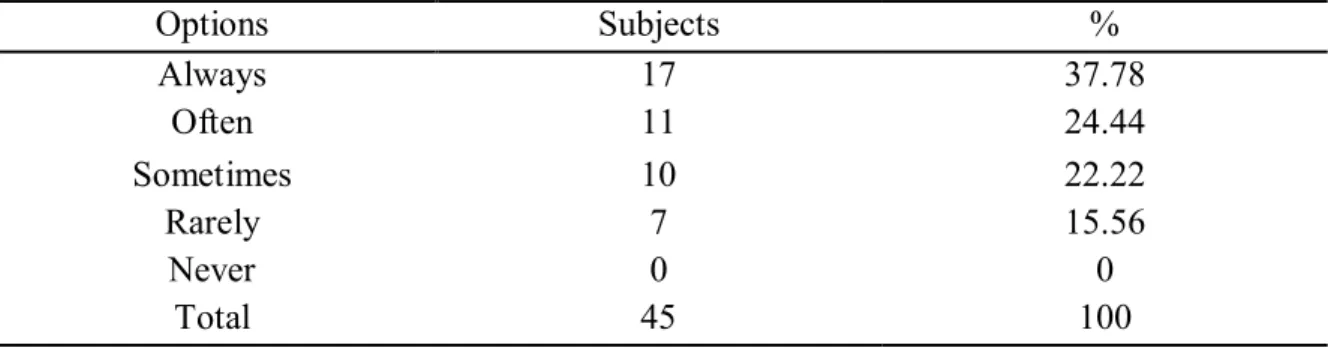
Table 26: Students’ Frequency of Checking the Right Spelling of Words…………..……80 Table 27: Students’ Frequency of Difficulties they Face when Writing Words they do not Know how to Spell………..……….81 Table 28: Students’ Frequency of Noticing the Spelling of Words while Reading…...…..81 Table 29: Students’ Frequency of Noticing Unexpected Spelling of Words while Reading……….82
Table 30: Students’ Frequency of Thinking of Ways for Remembering the Spelling of New
Words………..83
Table 31: Students’ Frequency of Proofreading their Written Work……….…….83
Table 32: The Effects of Proofreading on Overcoming Spelling Errors…..………84
Table 33: Students’ Use of Spelling Strategies to Improve their Spelling………. .84
Table 34: Teachers’ Gender……….85
Table 35: Teachers’ Qualifications………..…86
Table 36: Teachers’ Experience………..86
Table 37: Teachers’ Evaluation of their Students’ Writing Ability in English………87
Table 38: Teachers’ Evaluation of their Students’ Spelling Performance………...87
Table 39: Teachers’ Perceptions about the Importantance of Correct Spelling…………...88
Table 40: Teachers’ Views on the Difficulty of English Spelling………..….………89
Table 41: Teachers’ Views about the Responsibility of Improving Students’ Spelling at the University………89
Table 42: Teachers’ Views about Students’ Awareness of the Use of British and American Spellings………..90
Table 43: Teachers’ Views about the Students’ Consistency in their use of British and American Spellings………..91
Table 44: Teachers’ Views about their Students’ Frequency of Committing Spelling Errors………...91
Table 45: Teachers' Responses to the Reasons Attributed to their Students’ Spelling
Errors………92
Table 46: Teachers’ Responses to their Students’ Interest to Improve their Spelling………...93
Table 47: Teachers’ Responses to the Decrease of Students’ Spelling Errors as they Move to Higher Level……….94
Table 48: Teachers’ Responses to their Students’ Spelling Errors……….….94
Table 49: Teachers’ Responses to the Kind of Errors they usually Point Out………95
Table 50: Rate of Teachers who Penalize Students for Spelling Errors………..95
Table 51: Teachers’ Frequency of Drawing the Students’ Attention to the Rules of English spelling………..………...96
Table 52: Teachers’ Frequency of Drawing the Students’ Attention to Common Spelling Patterns……….….……..96
Table 53: Teachers’ Responses to Raising Students’ Awareness to Irregular Spelling and Silent Letters………97
Table 54: Teachers’ Responses on Drawing the Students’ Attention to the Differences between British and American spellings………..……97
Table of Contents Dedication………I Acknowledgments……….II Abstract………III List of Abbreviations………IV List of Tables………V Table of Contents………IX General Introduction………..……….1 Introduction………..………..1
1. Background of the Study……….2
2. Statement of the Problem………..…………..………….4
3. Aims of the Study……….……..…….4
4. Research Questions………..………..…..5
5. Research Hypothesis………..…………..5
6. Significance of the Study ………..………….5
7. Research Methodology………..…………..6
8. Structure of the Study………..7
Chapter One: General Considerations about Spelling: Focus on the English Spelling……….………8
Introduction………..8
1.2. Importance of Spelling………9
1.3. Spelling and Other Skills………...….11
1.3.1. Spelling-Writing Connection………..………..…...11
1.3.2. Spelling-Reading Connection……….………….13
1.4. Learning Spelling………15
1.4.1. Stages of Spelling Development……….15
1.4.2. Spelling Strategies……….………..……17
1.4.2.1. Definition of a Strategy………..………….17
1.4.2.2. The Importance of Spelling Strategies………..…..….18
1.4.2.3. Effective Spelling Strategies………..……….18
1.5. The English Spelling………..20
1.5.1. The History of English Spelling………..20
1.5.2. Features of English Spelling……….……..21
1.5.3. British and American Spelling Styles………..…….………..23
Conclusion………25
Chapter Two: Learners’ Spelling Errors………...26
Introduction………..26
2.1. Error Analysis………..………...26
2.1.1. Definition……….………..26
2.1.2. Significance………27
2.1.3. The Concept of Error………..…………28
2.1.4. Errors Versus Mistakes………...………29
2.2. Classification of Spelling Errors……….…………29
2.2.2. Orthographic, Phonological, and Morphological Errors………..………..30
2.2.3. Classification according to the Placement of the Error………..………31
2.2.3.1. Omission Errors………..………..31
2.2.3.2. Substitution Errors….………..……….……31
2.2.3.3. Transposition Errors ……….………..…….32
2.2.3.4. Addition Errors………..………..32
2.2.4. Others Types of Spelling Errors………...………..32
2.3. Causes of Spelling Errors………..……..33
2.3.1. Developmental Factors………..…….33
2.3.2. Irregularity of English Spelling………...…...33
2.3.3. The Confusion of English Spelling………..…..35
2.3.3.1. Confusion with Words………..…..35
2.3.3.2. Confusion with Letters………36
2.3.3.3. Confusion with Numbers and Symbols………..….38
2.3.4. The Influence of L1………..…..39
2.3.5. The Influence of Learners’ Pronunciation………..……41
2.3.6. Ignorance of Spelling Rules………...……….42
2.3.7. Lack of Motivation and Interest ……….43
Conclusion………..….44
Chapter Three: The Field Work...46
Introduction……….46
3.1. Research Methodology………46
3.1.1. Population and Sampling……….………..………46
3.1.2.1. Test………..……47
3.1.2.1.1. Dictation Test……….47
3.1.2.1.1.1. Description of the Dictation Test………48
3.1.2.1.1.2. Administration of the Dictation Test………..……….48
3.1.2.1.2. Translation Test……….……….49
3.1.2.1.2.1. Description of the Translation Test……….…….50
3.1.2.1.2.2. Administration of the Translation Test………..………..50
3.1.2.2. Questionnaire……….50
3.1.2.2.1. Students’ Questionnaire……….51
3.1.2.2.1.1. Description of the Questionnaire……….51
3.1.2.2.1.2. Administration of the Questionnaire………..……..52
3.1.2.2.2. Teachers’ Questionnaire………..52
3.1.2.2.2.1. Description of the Students’ Questionnaire………..……...53
3.1.2.2.2.2. Administration of the Students’ Questionnaire………53
3.2. Analysis of the Results………53
3.2.1. Analysis of Dictation Test……….53
3.2.2. Analysis of Translation Tests………64
3.2.3. Students’ Questionnaire Analysis……….68
3.2.4. Teachers’ Questionnaire Analysis……….…85
3.3. Discussion of the Results………...……….99
3.4. Pedagogical Recommendations……….104
3.5. Limitations of the Study………105
Conclusion………..……106
References Appendices: Appendix A Appendix B Appendix C Appendix D Résumé ﺺﺨﻠﻣ
GENERAL CONSIDERATIONS ABOUT SPELLING: FOCUS ON THE ENGLISH SPELLING
Introduction
1.1. Definition of Spelling 1.2.Importance of Spelling 1.3.Spelling and Other Skills
1.3.1. Spelling-Reading Connection 1.3.2. Spelling-Writing Connection 1.4. Learning Spelling
1.4.1. Stages of Spelling Development 1.4.2. Spelling Strategies
1.4.2.1.Definition of a Strategy
1.4.2.2.The Importance of Spelling Strategies 1.4.2.3.Effective Spelling Strategies
1.5.The English Spelling
1.5.1. The History of English Spelling 1.5.2. Features of English Spelling 1.5.3. British and American Spelling Styles
GENERAL INTRODUCTION Introduction
Unquestionably, English, as an international language, plays a vital role in every sphere of life as technology, business and education in particular. Therefore, language learners around the world are striving to acquire it and to improve their English language proficiency. In fact, the basic component of this proficiency is improving the ability to communicate accurately and fluently with others. In fact, this communication can take two forms, either spoken or written. The quest for a good written product is of great importance, especially in higher education and in the workplace where it is used extensively.
As an important component of writing, spelling poses a major challenge to most learners that results misspelled words and incoherent sentences. Errors in spelling may sometimes lead to obscurity and this makes comprehension virtually impossible; hence, spelling is crucial for everybody to communicate his or her ideas and thoughts. In other words, spelling is not merely a representation of words by a combination of letters; rather it is plainly a bridge between the writer and the reader.
Obviously, English spelling is a struggle for native speaker and nonnative speaker alike. Actually, English has frequently been criticized for the complexity of its spelling rules and for the lack of system and consistency in the relationship between the sounds of the spoken language and the symbols of the written language. Thus, English spelling can be described as, most of the times, illogical which cause confusion to learners.
1. Background of the Study
Spelling is a complex skill in writing and causes difficulty to learners, particularly EFL ones. Owing to its necessity to improve writing, the topic of spelling has studied by a great deal of researchers who examined the spelling errors committed by learners of English and the major causes behind such errors. Therefore, it is worthwhile to cite some studies that have been carried on the topic of learners’ spelling problems.
Miressa and Dumessa (2011) investigated the causes of grade nine students’ spelling errors at Donbosco High and Preparatory School in Batu, Ethiopia. They included fifty-two students in the study usingsimple random sampling techniques, and ten teacherswho taught other subjects in English were selected using availability sampling. The research revealed that the origin of English Language words is one of the causes for the students’ failure to spell words correctly because they lack uniform and consistent spelling rules. Besides this, the discrepancy between the pronunciation and written form of many English words along with less emphasis given to the spelling lesson contributed a lot to the students’ spelling errors. The study suggested that teachers should teach and motivate students to learn thecorrect spelling. Moreover, students should give attention to learn the correct spelling of English words. It is important to expose students to spelling rules and practice exercises in their text books to help them to learn correct English spelling.
In addition to the study mentioned above, another study was made by Bancha (2013) who investigated the types of spelling errors and causes of misspellings found in first year students’ writing at Prince of Songkla University in Thailand. For collecting data the students were required to read three books printed by Oxford Publisher which contained short stories, vocabulary items, and grammar rules with exercises. The students were asked to make up sentences using the target words and later the teacher corrected them. After twenty days, the students were given an hour to write forty-five sentences which should
contain eighty target words. The analysis of the obtained data showed that there were ten types of spelling errors in students’ writing namely consonant substitution, vowel substitution, space inaccuracy, confusion in writing scripts, inaccurate double consonants, inflectional endings, letter reversals, vowel omissions, and consonant omissions. In addition, the results of the study revealed that the differences between the English and Thai writing systems were not the only causes of students spelling errors. Actually, phonological problems, the lack of morphological awareness, and limited knowledge of orthography or spelling were the main causes of students spelling problems. Accordingly, the researcher suggested that the best way for teaching Thai students English spelling is through the focus on how words are spelled and pronounced (Bancha, 2013).
Likewise, Benyo (2014) made a study which aimed at investigating English spelling errors committed by first year students at the University of Dangola, Sudan. The researcher stated that English spelling performance of university students became a problematic area when teaching English as a foreign or second language. It was noticed that first year students of Dongola university has an obvious weakness in English spelling which has resulted in poor performance of basic behind spelling problems facing students. The study was built on the assumption that spelling errors were due mainly to the English sound recognition and its uses as well as the English spelling rules. After collecting and analyzing data, the study revealed that students’ spelling errors were particularly noticeable in vowel sounds and students were struggling with English sounds that do not exist in Arabic language. Also, the study indicated that the factors behind committing spelling errors were overgeneralization and misapplication of spelling rules. On the basis of these results, the researcher recommended that students should be taught correct pronunciation and basic spelling rules and exceptions of English spelling (Benyo, 2014).
On the whole, all these findings make it crystal clear that EFL learners encounter several spelling problems due to a variety of variables. The influence of L1, the complexity of English spelling rules, the mismatch between sounds and letters,and the lack of knowledge of the English spelling were found to be the major causes behind learners’ spelling errors.In fact, there has been a large and growing body of literature that has investigated English spelling difficulties among EFL learners in different contexts with different data collection tools. Nevertheless, the exiting literature does not reflect the Algerian context because each context has its own specificities.
2. Statement of the problem
Many EFL students at university of Mohammed Seddik Ben Yahia-Jijel face difficulties when writing. Among the most noticeable difficulties are related to spelling. In fact, English spelling performance of university students at Saddik Ben Yahia has recently been declining and has become a problematic area in the process of teaching. It has been noticed that students have serious weakness in English spelling. These students make a lot of spelling errors, also it has been noticed that they are incapable of performing even basic
writing task without noticeable and glaring spelling errors. . A review of literature on spelling errors reveals a dearth of researches and shows that very
few studies in Algerian context have investigated the difficulties that Algerian students have with spelling when learning English as a foreign language. The scarcity of research with regard to EFL students calls for a research study to be conducted of investigation of the problem of spelling for EFL students spelling in the Algerian context.
3. Aims of the Study
The current study aims at investigating EFL students’ spelling level at Mohammed Seddik Ben Yahia University-Jijel. Besides, it attempts to shed light on the different types of
spelling errors as well as the major causes attributing to students’ spelling problems and possible solutions that could help to overcome students’ spelling errors.
4. Research Questions
The present study is conducted in order to provide plausible answers to the following research questions:
1) To what extent are students experiencing spelling problems? 2) What are the types of students’ spelling errors?
3) What are the major causes behind students’ spelling errors? 4) What are the students’ perceptions of their spelling problems?
5) What are the teachers’ perceptions of their students’ spelling problems? 6) What are the spelling strategies used by students?
5. Research hypothesis
On the basis of the questions mentioned above, it is hypothesized that:
If students’ were aware of their spelling problems and used a variety of strategies to improve their spelling, they would not experience serious spelling difficulties.
6. Significance of the Study
To learn how to write correctly and to be an effective writer are the most important objectives for both teachers and learners, especially at university level. Since writing is used in almost all the subjects for EFL learners at Mohammed Saddik Ben Yahia, writing was a major interest and Students’ poor performances in writing have become the core problem which needs an urgent remedy.
The research has significance in a number of areas. First, the research in hand will be of immense importance to learners who have difficulties with their spelling. It will provide them with clear explanation of their spelling problems and thereby will raise their awareness to the area of difficulty in English spelling. Also, it will provide solutions in order to overcome this problem for learners. Also, students will be aware of the importance of being skilled spellers in order to be good writers.
Moreover, the study attempts to shed light on the factors causing spelling problem for EFL learners. Consequently, teachers will be aware of the expected areas of difficulties in English spelling and how they can be addressed, considering the method that help students to deal with their spelling errors and to find solutions to this problem. Apparently, it would provide suggestions, useful insights to teachers and find teaching procedures that would minimize this problem.
7. Research Methodology
To achieve the aims of the present study, different tools were used. In order to assess the spelling performance of EFL learners at Mohammed Seddik Ben Yahia, types of spelling errors, and likely causes, a dictation spelling test was conducted followed by a translation test. This study is rooted in both the qualitative research design and quantitative techniques. Besides, a questionnaire was administered to students in order to inquire about their perception about spelling, mainly spelling problems. Moreover, to validate the findings of the students’ questionnaire used in the study and get a comprehensive picture of the sources of difficulties in making spelling errors, a teachers’ questionnaire was conducted.
8. Structure of the study
The study falls into two main parts. The first part is theoretical while the second is rather of a practical orientation. Preceded by an overall introduction, the first part is the theoretical foundation of spelling. It is divided into two chapters. The first chapter highlights some general consideration about spelling, focusing on English spelling. The second chapter deals with learners' spelling errors that cover many aspects, mainly types and major causes of spelling errors. The second part of the study involves field investigation. It describes the population and description of the instruments used in the study. Also, it displays the finding sorted from the tests (dictation and translation test) and two questionnaires, one for the students and another for the teachers to get their perceptions about spelling problem. Lastly, it ends with the main research findings, limitations, and pedagogical implications.
LEARNERS’ SPELLING ERRORS Introduction
2.1.Error Analysis 2.1.1. Definition 2.1.2. Significance
2.1.3. The Concept of Error 2.1.4. Errors Versus Mistakes 2.2.Classification of Spelling Errors
2.2.1. Intralingual and Interlingual Errors
2.2.2. Orthographic, Phonological, and Morphological Errors 2.2.3. Classification according to the Placement of the Error
2.2.3.1.Omission 2.2.3.2.Substitution 2.2.3.3.Reversal 2.2.3.4.Addition
2.2.4. Other Types of Spelling Errors 2.3.Causes of Spelling Errors
2.3.1. Developmental Factors
2.3.2. Irregularity of English Spelling 2.3.3. The Confusion of English Spelling
2.3.3.1.Confusion with Words 2.3.3.2.Confusion with Letters
2.3.3.3.Confusion with Numbers and Symbols 2.3.4. The Influence of L1
2.3.5. The Influence of Learners’ Pronunciation 2.3.6. Ignorance of Spelling Rules
2.3.7. Lack of Motivation and Interest Conclusion
CHAPTER ONE: GENERAL CONSIDERATIONS ABOUT SPELLING: FOCUSON THE ENGLISH SPELLING
Introduction
Spelling is of paramount importance in the process of writing and all learners are required to become proficient spellers. This chapter is a review of the literature that concerns spelling in general and English spelling in particular. First, it highlights the concept of spelling, mainly its definition, importance, and its relation with writing and reading. In addition, it introduces the stages of spelling development and the spelling strategies used by learners to improve their spelling. Second, this chapter provides a clear understanding of both the history and the features of English spelling and a comparison between the British and the American spelling styles.
1.1.Definition of Spelling
Various writers provided different definitions of the word ‘spelling’. Such definitions have evolved from diverse perspectives, interests and needs.According to Mc Arthur (1992), the origin of the word ‘spelling’ is not peculiar to a specific language. It may come from Old French “espeller” (modern “épeler”), probably from Germanic “spellôn”, or from ancestor Old English “spel. In Middle English, spelling was a term used to signify reading books and casting spells, and reading in that time was known as ‘spelling a book’. Selling is defined as “the act, process, or system of relating speech sounds to letters and to the written form of words” (p. 969).
Oxford learner’s online dictionary defined spelling as the correct combining of individual letters to form a word. It is also the way a particular word is written. Similarly, Webster dictionary(1993) defined spelling as the process of writing words by using
lettersdepending on accepted usage of their formation. That is, the way a particular word is written is not random; rather it comprises conventionally accepted form of words.
Moreover, various writers suggested different definitions of spelling. For example, Al Saedi (1989) defined spelling placing letters of each word in the correct sequence order; it is also the ability to write words correctly depending on the memory. In other words, spelling is associated with the ability to recall words from memory. In addition, Perfetti (1997)defined spelling as “the encoding of linguistic forms into written form”(p.22). Hornby (2000) defined spelling as the formation of words correctly from individual letters. That is, letters must appear in a correct sequence to be meaningful. According to Savage (2007), spelling is a written language skill which involves the visual representation of spoken sounds by written symbols and letters. That is, spelling is a visual skill and learners must see the pattern of the language then presenting it in the written form.
As already mentioned, the definition of spelling is to a great extent standard for most researchers even for those in different theoretical background. However, spelling is more sophisticated and related to other aspects of the language. Hoien & Lundberg (2000) pointed out that spelling, as a process, is very complex. It consists of many sub-processes, including phonological, morphological, semantic, and orthographic skills (as cited in Wai & Chan, 2014).
1.2.Importance of Spelling
Spelling has always been a controversial area of learning. Some educators claimed that it does not matter if a person spells correctly, spell checkers can correct errors anyhow. However, other educators argued that spelling is extremely important for good learners and the disability to spell correctly can be regarded as a sign of learning failure.
According to Corder (1981), the ability to spell properly has a crucial role in mastering the writing system of any language. Making spelling errors may lead to obscurity affecting the audience comprehension of the written product, that is, bad spelling is a hindrance for the reader to get the meaning. Therefore, conveying the intended meaning requires essentially the correct spelling of vocabulary words. In addition to that, Simon (2004) argued that learning to spell is necessary because correct spelling is a component of the whole process of learning any language.
Moreover, spelling is extremely important for everyone to communicate his ideas, thoughts, and feelings. Al-Khaffaji and Al-Shayib (1987) stated that “to spell correctly makes written communication easier while misspelling might lead to interruption of communication and misunderstanding” (p.7). That is, good spelling contributes to conveying the meaning of the text, while bad spelling impedes the writers’ ideas.
Finally, spelling plays a momentous role in the social life. Writing letters and emails to friends can embarrass the writer if they contain glaring errors. Besides, spelling is highly important when writing job applications and supplementary written tests, or for jobs that call for communication in writing (Westwood, 2008). Spelling, in some occasions, is also necessary as when looking up words in dictionaries, writing notes that others may read, or even playing parlour games (Moats, 2005).
To sum up, spelling is very important in all written languages. Making spelling errors or mistakes may affect the written product and therefore may lead to ambiguity and breakdown in communication. As a result, all learners around the world should strive to get mastery in spelling.
1.3. Spelling and Other Skills
Spelling cannot be treated as an isolated skill in the process of learning any language. Actually, its relation with writing and reading has been a topic for several researchers who have delved into their main shared features and the effects they have on each other.
1.3.1. Spelling-Writing Connection
The writing process consists of producing a piece of writing by placing ideas into printed ones. Kessler and Treiman (2003) asserted that accurate spelling is most connected and critically required for everyday writing. That is, through writing, thoughts and ideas are communicated. In order to communicate them clearly, accurate spelling is necessary. Fagerberg (2006) pointed out that one misspelled word may change the meaning which the writer intended to convey in his/her writing product. In other words, good spellers are able to express their thoughts and feelings clearly and easily more than learners with poor spelling proficiency.
Apel (2001) pointed out that student’s with poor spelling proficiency resort to writing few words and composition products of lower quality. Writers who struggle to remember spelling often limit themselves to words they can spell. Pratley (1980)asserted that “those who do not have proper spelling accuracy tend to make their writing simple and very short because they are not familiar or ensure of how some words are spelled and this prevent them from expressing their thoughts and ideas accurately and academically”(as cited in Al Harrasi, 2012, p.97). Writers who struggle with spelling often limit themselves to words they can spell, loosing expressive power of words.
In addition, Abell (1994) claimed that those who are not proficient at spelling often feel embarrassed about allowing others to see what they have written. That is, students’ perception of their spelling ability strongly affects their self- esteem and students with poor
spelling proficiency resist sharing their ideas freely. Whereas, good spelling can increase learners’ confidence in communicating with others in written forms.
Fall (1998) asserted that students when writing should not be too concerned about spelling; rather, they should focus on their ideas. According to Westwood (2008), students who pay too great attention to accuracy in spelling may even show the lack of desire to write and create comprehensible and clear messages. Too much attention to spelling can undermine their motivation to write. Fall (1998) pointed out that proofreading step is the appropriate time for learners to revise their copies from any spelling mistakes.
On the other hand, spelling ability may be enhanced through writing. According to Boras (1982), writing is an effective technique to enhance spelling skills because writing requires students to apply their knowledge of how to express thoughts on papers by spelling words accurately. Wollet (1993) claimed that via writing workshop, students are supplied with various opportunities by teachers to write and explore spelling via writing and pair work activities that allow peers to spot on spelling errors. By writing and giving feedback by teachers, learners learn how to spell and figure out conventions about spelling. Writing also affords the teacher the opportunity to scaffold spelling for students. That is, thanks to regular practice of writing, learners can automatically and legibly write alphabet letters and match sounds to letters.
Another factor that may affect spelling performance is the legibility of person handwriting. Legible handwriting assists spelling. It follows that students who write and who are consistent and logical in letter formation may benefit from their handwriting. Children with legible handwriting spell better than children with illegible handwriting (Sue, 1994) (cited in Boras, 1982).
To conclude, spelling and writing are reciprocally related; that is, spelling supports writing and vice versa. Good spellers are most of the time good writers and one of the very important factors to consider with writing competency is spelling. Since one single misspelled word can change the entire meaning of the sentence; to produce competent writing students should write accurately with less spelling mistakes. Hence, Students with poor spelling may be reluctant to write while good spelling can increase learner’s confidence in communication with others in written form. Hence, there should be an awareness of the importance of the correct spelling among learners.
1.3.2. Spelling-Reading Connection
Reading and spelling are two important aspects of language learning and the relationship between the two has been discussed through several studies in the field of L1 and SLA research. Studies with young ESL learners have revealed that there is a close relation between English spelling knowledge and English word reading skills (Chiappe et al., 2007). Moats (2005) argued that leaning to read and learning to spell are built on much the same underlying knowledge of representing words such as the relationship between sounds and letters.
Previously, spelling was considered a by-product of reading experiences in the sense that, while reading, children build a memory bank of words known by sight and those words can be later written or spelled simultaneously (Westwood, 2008). Wilde (2004) stated that reading is the only important factor for developing the spelling skill. He argued that reading provides children with words in print and, thus, they will acquire a good knowledge of orthographic units (as cited in Westwood, 2008).
This idea was strongly criticized and a considerable amount of research has acknowledged that the ability to rapidly recognize words determines to a substantial extent
L2 reading fluency and comprehension (Birch, 2002; Koda, 1996; Paran, 1996) (as cited in Fender, 2008). Ehri (2005) stated that when the connection between well-formed spelling representations and corresponding phonological and semantic forms is tightly established, word recognition fluency will emerge. Once the spelling of a word becomes familiar, the graphic form will function much the same as a whole graphic unit. In other words, spelling representations are built in memory as graphic forms and they can be retrieved automatically when they are encountered in reading (as cited in Fender, 2008).
Accordingly, spelling ability seems to have a large impact on learners’ reading fluency and reading comprehension. Bad spellers are most of the time bad readers (Fender, 2008). This indicates that proficiency in spelling supports reading (Moats, 2005). Therefore, it is proposed that instruction in spelling will enhance children’s reading in the earlier years of schooling (Gentry, 2004).
However, some researchers have admonished that poor spelling ability does not necessarily entail that learners are poor readers. Good readers can decode more words than they can spell or encode (Berninger, Abbott, Abbott, Graham, & Richards, 2002) (as cited in Reed, 2012). Westwood (2008) suggested that there is some evidence in this. It is, perhaps, because spelling and reading are two different and separate processes, despite the fact that they rely on some of the same underlying knowledge and skills. In fact, reading relies on some contextual clues to support word recognition, while spelling depends on accurate retrieval and production of a combination of letters which cannot be guided at all from the context.
All in all, the impact of spelling on reading cannot be totally ignored. Many researchers have provided evidence that there is a strong relation between spelling and reading.
According to many studies, having problems in spelling may have negative effects on learners’ reading proficiency and fluency in both L1 and L2 acquisition.
1.4. Learning Spelling
1.4.1. Stages of Spelling Development
Learning spelling was considered merely a process of rote memorization, but after the pioneering work of Read (1971), Henderson and Beers (1980), and Ehri and Wilce (1985) spelling has been realized as a developmental process (as cited in Westwood, 2008). The field of research suggested that the process of spelling development occurs in various stages. According to Masterson and Crede (1999), “the development of spelling skill is not random, but rather evolves in stages” (p.243). This clearly indicates that learners go through a series of stages when acquiring their spelling knowledge.
Henderson (1990) suggested a model of spelling development, in which he divided the developmental process into five phases. In his model, each stage was given a name and a description of learners’ behaviours at a particular time; the five stages were called prephonemic stage, letter-name stage, within-word-pattern stage, syllable-juncture stage, and derivational-constancy stage.
Similarly, Gentry and Gillet (1993) outlined five stages of spelling development. The stages were characterized by the changes which reflect the learners’ gradual development of their spelling ability. According to Westwood (2008), each stage of spelling development reflects a progress in knowledge which concerns “phonemes, letters and letter-strings, and units of meaning within words” (p.21). He added that the stages reflect to what extent children have acquired different strategies to analyse, check, and correct words by themselves.
Actually, there is no agreement between researchers on the numbers of stages of spelling development; some researchers have proposed four stages, others as many as seven. Also, they have used different terms to label the various stages, but the most common ones can be summarized as follows.
The first stage is called pre-communicativestage, alsopre-phonemic stageor preliteratestage. In this stage, children’s writings consist of only drawings, and scribbles; and the relationship of symbol to sound has not yet developed to construct real words. Upper-case letters and letters that are found within a child’s name are the most used letters in this stage (Treiman et. al, 2001).
The second stage is called semi-phonetic stage, also early phonetic stage. Children start gradually to understand letter-sound correspondence and use sounds that are assigned to letters in an attempt to make words (Westwood, 2008). According to some researchers, children at this stage use only one letter to represent a whole syllable because children at this stage do not recognize that syllables include other sounds (Cardoso-Martins et. al, 2006).
The third stage is called phonetic stage. During this stage, children use letters to represent all the sounds heard in the word usually with the form Consonant-Vowel-Consonant, which enable them to spell some words correctly (Dorn, French, & Jones, 1993). As children progress in this stage, they develop a mental image of how words look in print. That is, they start to use their visual memory on the way words are spelled (Shea, 2011).
The fourth stage is called transitional stage, or syllable juncture stage. This stage indicates a transition from a single reliance on sounds for spelling words to use of visual information and understanding of words (Shea, 2011). At the level of this stage, learners
will be able to spell single-syllable words correctly with a difficulty in double consonants and adding affixes (Lyon & Moore, 2003).
The last stage is called correct stage, or independence stage. Reaching this final stage, learners become proficient spellers, even for spelling complex and difficult words. Using a wide range of strategies to correct spelling is available and proofreading skills are increasingly developing through this stage. At the end, most learners have acquired accurate use of orthographic units from which they can draw some spellings of unfamiliar words; thereby, learners now have an ability to spell all common words correctly (Westwood, 2008).
1.4.2. Spelling strategies
Spelling is believed to be more difficult than other language tasks. According to Perveen and Akram (2014), despite the fact learners have received a lot of drilling and training in their schools, they are still producing a lot of spelling errors. This indicates that spelling instruction is insufficient and learners should develop their spelling abilities by themselves. Therefore, students are recommended to use some spelling strategies that can help them to improve their spelling.
1.4.2.1. Definitionof a Strategy
A strategy can be defined as “a mental plan or action that enables an individual to approach a particular task in a systematic manner” (Westwood, 2008, p. 25). More specifically, in the context of learning, strategies are defined as “specific actions, behaviors, steps, or techniques used by students to enhance their own learning” (Scarcella & Oxford, 1992, p. 63). When learners consciously select some strategies that fit a specific language task, these strategies can improve their performance of a given area in language learning.
1.4.2.2. The Importance of Spelling Strategies
Actually, there is evidence that good spellers rely on a variety of strategies for solving spelling problems, while poor spellers use a narrow range of strategies (Hughes & Searle, 1997; Davidson, 2005; Westwood, 2008; Baleghizadeh & Dargahi, 2010; and Langon, 2011).According to a study conducted by Baleghizadeh and Dargahi (2010) with EFL children, there was variability in strategy use among good and poor spellers. Good spellers used multiple and complex strategies to spell words, whereas, poor spellers resorted to use only few and limited ones. Furthermore, Westwood (2008) argued that when learners apply a variety of strategies for producing and verifying words in combination, they guarantee to achieve accurate spelling.
1.4.2.3.Effective Spelling Strategies
A great deal of research has cited countless strategies for spelling improvement taking into account the different sub-skills and processes involved in spelling as well as the role of memory in learning. The most common strategies suggested by researchers are the following: sound-based or phonetic strategies, rule-based or orthographic strategies, visual strategies, morphemic strategies, and spelling by analogy.
To start with, many learners use phonological spelling strategies. They sound out the words when they spell them, that is, they rely on the relationship between the sounds or phonemes and their corresponding letters or graphemes (Treiman, 1993). However, reliance on only this strategy is insufficient and may not be adaptive to yield correct spelling in many cases (Read, 1971). Furthermore, as pointed out by Anderson (1991), poor spellers usually rely heavily on this strategy. It would appear, then, that there is a necessity for alternative spelling strategies.
In addition to the strategy mentioned above, rule-based or orthographic strategies which focus on learning the rules and the regularities of spelling can be a successful strategy to learn spelling. Hudges and Searl (1997) stated that English spelling should be viewed as a system that has regularities and thereby spelling problems can be solved. According to Davidson (2005), poor spellers usually lack the knowledge of the rules and regularities of the English language and accordingly, once learners understand the spelling rules and their exceptions, they will easily spell words.
Another strategy learners may use is the visual strategy. Some researchers (for example, Searl & Johnson, 1986) maintained that the visual strategy is very effective in teaching students to spell. Using this strategy, learners rely on their visual memory to remember the characteristics of words (Westwood, 2008). Barron (1980) reported that learners retrieve the essential information as a whole by using the visual image of the word which is stored in their memory.
Additionally, morphological strategies are among the most important strategies used by learners to enhance their spelling abilities. Such strategies involve using the knowledge of the root word to aid in spelling a related or derived word (Treiman, Cassar, & Zukowski, 1994). Some experts (Elbro & Arnbak, 1996; Teaching & Learning research Project, 2006) argued that the most effective way to store words in memory is by their morphemes rather than by their whole-word forms because morphemic units can be produced easily in some spelling cases (as cited in Westwood, 2008).
Finally, within the research literature, spelling by analogy is among the most frequently cited spelling strategies. According to Westwood (2008), knowing the correct spelling of a word helps to spell other words that are related by sound or visual patterns. Therefore, if students learn how to apply this strategy, their spelling ability will be enhanced.
It is worth mentioning that using such spelling strategies is not enough to enhance learners’ spelling performance. In fact, students are required to make mare efforts in order to develop their spelling abilities. As stated by Davidson (2005), learning the origin of words, using dictionaries, practising, proofreading, and making spelling books can be very beneficial for developing students’ spelling performance.
1.5.The English Spelling
1.5.1. The History of English Spelling
According to Davidson (2005), Modern English started 1500 years ago with Old English, or Anglo-Saxon. Despite the fact that Old English had an Alphabet of 27 letters with a sound system of about 40 different speech sounds, there was a correspondence between its spelling and pronunciation. As the Vikings arrived to Northern and Eastern England, there was no great change in the Old English spelling because both the languages of the Vikings and Anglo-Saxon were nearly related to each other.
Since 1066, there was a remarkable change in English language with the introduction of the Norman invasion. The Normans spoke a variety of French which had a Latin root, that is why the Norman French was quite different from Old English in terms of vocabulary, pronunciation, and spelling. Then, many Anglo-Saxon words had been replaced by French words, a large number of French origin Words had been introduced into English, and even some Anglo-Saxon words had been respelled according to the French spelling rules (Davidson, 2005).
The development of Printing in the 15th and the 16th centuries grossly complicated the situation. Many early printers were foreign, particularly from Netherlands, without any knowledge of English, and thereby led them to use their own spelling when printing English. Actually, the difficulty and complexity of English spelling were not due only to
external historical factors, but there were two main purely English ones. The first one was the strong influence of the language variety of London on the development of English which brought some mismatches between sound and spelling. The second one is the changes that had occurred in the English pronunciation without a corresponding change of the writing system to keep pace with them resulting in a mismatch again between sound and system. In addition to that, there were many scholars in the 16th century who thought the glory of ancient words, from Latin and Greek origin, should be reflected in new ones and, thus, they decided to add silent letters to some English words(Davidson, 2005).
To sum up, English spelling is not chaotic and confusing as people may think. In fact, it comprises different spelling systems mixed together, including words derived from Anglo-Saxon, Latin, and Greek. Furthermore, English spelling had borrowed a whole bunch of words from different languages which had different spelling systems such as French and Italian.
1.5.2. Features of English Spelling
Spelling is an area of learning that often provokes vigorous debate among researchers. Under the gloomy account of the history of English, English spelling was derived from different sources resulting in a spelling system that appears random and perplexing. Therefore, it is suggested that English has irregular spelling system. Meanwhile, there are others who claimed that English spelling is highly predictable.
English has a writing system based on the Roman alphabet. “Although English orthography is an alphabetic system, it is not an ideal one and far from it” (Savants, 2000, p.45). That is, there is no sound-letter correspondence. Knowing the pronunciation of a word does not presuppose knowing its spelling unlike. Most of the modern languages with a few exceptions, such as Chinese and Japanese, adopt the alphabetical principle for their
writing systems like Finnish. In fact, English language has 26 letters of the alphabet that can produce approximately 44 sounds (phonemes) that are represented in 250 different spellings. All these phonemes have to be presented by 26 graphemes either singly or in combination (Ball & Blachman, 1991).
Hasan (2000) stated that English is not a phonetic language. That is, it is not written as it is spoken or it does not have closer phoneme-grapheme correspondence. This is mainly because of the fact that English has different ways of representing the same sound such as a sound can be represented by a letter or different letters. Also, the same letter or letter combination as well can represent more than one sound. The reasons for this irregularity are complex and largely historical.
The main complexity in English orthography is the spelling of vowel sounds. For instance, /i:/ can be spelt in diverse ways as in believe, receive, machine, be, see, sea, key, and phoenix. Conversely, the symbol ‘a’ in father, hate, anchor, ate, all, are, and many other words has different pronunciation (Baugh and Cable, 1996). In addition, the same diversity in consonant is very confusing to the language learner. Dakhs and Mitchel(2011) acknowledged that the /k/ sound can be represented by ‘k, c, ck’ or ‘ch’, depending on its position in the word as in kite, cat, duck, and Christmas.
However, some scholars argued that English spelling is more consistent. Hildreth (1962) believed that although the non phonetic nature of English causes most of the spelling problems, English is not completely non-phonetic. He stated that about eighty five percent of words in English contain regularly sounded elements that consistently occur in English. Similarly, Templeton and Morris (1999) argued that there are frequent patterns in English spelling that provide a level of consistency. These patterns complement the alphabetic level in providing information about how sounds are spelled such as ‘de, an, er, dis, con’, and ‘tion’ and these regular patterns can be easily and directly taught to students.
Paul, Jean, Richard, and Edwin(1966) stated that spelling is not arbitrary. About fifty percent English words are based on sound-letter predictability correspondence. Another thirty four percent of words are predictable except for one sound, and in case words origin and meaning are taken into account only four percent of English words are highly irregular and thereby difficult to be learnt. In addition, there are rules which may be effective to spell many regular words, but problematic for many irregular words (Emery, 2005). According to Savants (2000), there are no official spelling rules that can be applied to all words. In each rule there is an exception to it like the rule of ‘i’ before ‘e’ except before ‘c’.
To sum up, English spelling has provoked many debates among researchers while some believed that English spelling is irregular and inconsistent and others who claimed that English spelling is highly regular and predictable. In fact, English is not truly phonetic language and not controlled one-to-one letter sound relation. However, Crystal (2003) came in between and asserted that English spelling is highly predictable with just a small number of irregular forms causing a disturbance. He argued that English spelling appears to be more irregular because many of the most frequent used words have irregular spelling. To conclude, English spelling is not inconsistent, rather it is complex.
1.5.3. British English and American English Spelling Styles
American and British English are both variants of the English language; they are studied by most EFL and ESL learners around the world. In each country when English is taught as a foreign of second language, only one variety of English language is adopted by educational authorities; consequently, teachers of English may consider the spelling of words according to other varieties as a spelling error.
There are many differences between British and American English. According to Mickletwait (2005) those differences are traced back to the time when the British colonized America.At that time, English spelling was not widely standardized. The British standard began after the introduction of some influential dictionaries in 1755 such as Samual Johnson’s “A Dictionary of the English Language”, and the American standard followed the work of Noah Webstor “An American Dictionary of the English Language”. The British has kept the spelling of words that have been taken from other languages; whereas, the American English has changed the spelling to make a match between sounds and written forms.
In fact, the spelling differences between American English and British English are not random; rather, they are divided and organized by rules. Some of the common spelling differences are words ending in –our in Br E usually end in –or in Am E as colour/color, words ending in –re in Br E often end in –er in Am E as centre/ center, words ending, verbs ending in either –ise or –ize in Br E always end in –ize in Am E as naturalise/naturalize and organize/organize, words ending in –ence in Br E end in –ense in Am E as in licence/license, and the use of double “l” in Br E while Am E spelling use only one “l” as travelled/traveled. However, there are some exceptions of the previous spelling rules for instance the pattern –ence and –ense are, in some cases, reversed as in practise(v) in Br E and practice(v) in Am E, also while the American English spelling tend to be shorter, the word fulfil in Br E is spelled fulfill in Am E. Some spellings, nevertheless, do not obey any systematic rule.Thus, they must be memorized by heart. To give examples, some differences are cheque(Br E)/ check(Am E), plough(Br E)/ plow(Am E), and Tyre (BrE)/tire(AmE) (Tottie, 2002).
Conclusion
The current chapter has offered a review of the literature related to general considerations about spelling and a look at the English spelling. In fact, the concept of spelling has attracted several researchers who have provided different definitions and explanations of this concept, as well its significance either in educational settings or in the social life. In addition, there is considerable evidence that spelling has strong correlation with both writing and reading. Spelling has, also, been realized as a developmental process in which learners go through a sequence of stages in their acquisition of spelling development, as they resort to use different strategies during this process. A review of the history of English spelling has made it clear that the English spelling is not arbitrary and chaotic as many may think; rather it is a victim of a complicated history which resulted in irregular and complex spelling system of English. Finally, it has been pointed out the commonest differences between British and American English spelling styles that learners may confuse in their writing.
CHAPTER TWO: LEARNERS’ SPELLING ERRORS Introduction
As already mentioned in the previous chapter, English spelling is considered, to great extent, difficult due to its irregular and complex features. Consequently, many EFL learners are prone to commit spelling errors. Obviously, many researchers have perceived a great value in analyzing spelling errors. Teachers in trying to understand spelling errors, rely on essential sources of information and ways to analyze them. Error Analysis is one of these sources. This second chapter is mainly a review of Error Analysis, in terms of definition, significance, the concept of errors, errors versus mistakes, and spelling errors’ classifications suggested by different researchers as well as the major causes of spelling errors.
2.1.Error Analysis
In the late 1960s and early 1970s, the influence of Contrastive Analysis began to fade due to the fact that it failed to describe all errors in language learning, as it is not likely to ascribe all errors to differences between L1 and L2. As a result, there was a need for an alternative to Contrastive Analysis which took the form of Error Analysis (EA).
2.1.1. Definition
EA is a branch of applied linguistics which was first introduced by the British applied linguist Stephen Pit Corder (1967). It is a linguistic analysis that examines errors made by L2 learners. The analysis of learners’ errors provides an opportunity for teachers to determine the main areas that need reinforcement in second language teaching-learning process (Corder, 1967). In addition to L1 interference, EA accepted other sources of errors such as intralingual interference, overgeneralization, inadequate teaching, and the effect of
some variables of age, attitudes, aptitudes, and motivation (Shastri, 2010) (as cited in Tomková, 2013)
2.1.2. Significance
It is important to stress that EA is useful in the process of second language learning because researchers who were interested in studying learners’ errors argued that errors contain valuable information on the process of learning a foreign language.
According to Corder (1967), errors are evidence that learning is taking place. He argued that the study of learners’ errors cansystematically provide significant insights into how a language is learnt or acquired. He added that the analysis of students’ errors has a practical application for language teachers. Once errors provide feedback, teachers will deduce something about the effectiveness of their teaching.
Moreover, Sharma (1980) stated that EA is an effective support to remedial teaching; it reveals both the successes and failures of the teaching programme. Similarly, Dulay et al (1982) mentioned that EA helps teachers, syllabus designers, and textbook writers to reveal the problematic areas. Therefore, they can design remedial exercises and focus more attention on the trouble spots (as cited in Khansir & Jajeri2012).
Finally, Richards and Schmidt (2002, 184) pointed out that EA may be carried out for the following purposes:
● identify strategies which learners use in language learning;
● try to identify the causes of learner errors;
● obtain information on common difficulties in language learning as an aid to teaching or in the preparation of teaching materials.
In general, EA has several implications for the handling of learners’ errors in the classroom. Accordingly, studying learners’ errors should be considered as something positive for both teachers and learners.
2.1.3. The Concept of Error
EFL learners’ errors are a major area of study in the field of Second Language Acquisition research. Countless researchers of language learning have come-up with different definitions of an error, always with reference to different aspects of the error.
Hendrickson (1978) defined an error with reference to error correction and the teacher when he stated that an error is “an utterance, form or structure that a particular language teacher deems unacceptable because of its inappropriate use or its absence in real life discourse” (p. 387). In this definition, the teacher has the ultimate authority to decide on what is right or wrong.
Another definition is proposed by Lennon (1991) with reference to the native speaker. For him, an error is “a linguistic form or combination of forms which in the same context and under similar conditions of production would, in all likelihood, not be produced by the speaker’s native speaker counterparts” (p. 182).
Some researchers when defining errors have taken into account the target language norms. Worth (1987) defined errors as “systematic deviation from the norms of the language being learned” (p.87). Similarly, Dulay et al (1982) stated that “errors are the flawed side of learned speech or writing” and that “they are those parts of speaking or writing that deviate from some selected form or mature language performance.” (p.138)