HAL Id: hal-03016554
https://hal.archives-ouvertes.fr/hal-03016554
Submitted on 20 Nov 2020
HAL is a multi-disciplinary open access
archive for the deposit and dissemination of
sci-entific research documents, whether they are
pub-lished or not. The documents may come from
teaching and research institutions in France or
abroad, or from public or private research centers.
L’archive ouverte pluridisciplinaire HAL, est
destinée au dépôt et à la diffusion de documents
scientifiques de niveau recherche, publiés ou non,
émanant des établissements d’enseignement et de
recherche français ou étrangers, des laboratoires
publics ou privés.
Access to Optically-Pure Benzosultams by
Superelectrophilic Activation
Bastien Michelet, Ugo Castelli, Emeline Appert, Maude Boucher, Kassandra
Vitse, Jérôme Marrot, Jérôme Guillard, Agnès Martin-Mingot, Sébastien
Thibaudeau
To cite this version:
Bastien Michelet, Ugo Castelli, Emeline Appert, Maude Boucher, Kassandra Vitse, et al.. Access to
Optically-Pure Benzosultams by Superelectrophilic Activation. Organic Letters, American Chemical
Society, 2020, 22 (13), pp.4944-4948. �10.1021/acs.orglett.0c01301�. �hal-03016554�
Access to Optically-Pure Benzosultams by Superelectrophilic Activation
Bastien Michelet,
a* Ugo Castelli,
aEmeline Appert,
aMaude Boucher,
aKassandra Vitse,
aJérôme
Mar-rot,
bJérôme Guillard,
aAgnès Martin-Mingot,
aSébastien Thibaudeau
a*
a Université de Poitiers, UMR-CNRS 7285, IC2MP, Equipe Synthèse Organique, 4 rue Michel Brunet, TSA 51106, 86073
Poitiers Cedex 9 (France)
b Institut Lavoisier de Versailles, UMR CNRS 8180, 45 avenue des Etats-Unis, Versailles 78035 Cedex (France)
Supporting Information Placeholder
ABSTRACT: Through superacid activation, N-(arenesulfonyl)-aminoalcohols derived from readily-available ephedrines or amino
acids undergo an intramolecular Friedel-Crafts reaction to afford enantiopure benzosultams bearing two adjacent stereocenters in high yields with a fully-controlled diastereoselectivity. Low-temperature NMR spectroscopy demonstrated the crucial role played by the conformationally-restricted chiral dicationic intermediates.
Benzosultams are prominent scaffolds in organic synthesis and have found many applications, especially in medicinal chemis-try (Figure 1).1 In light of the growing demand for
enantioen-riched benzosultam-based therapeutics, versatile methodolo-gies for their synthesis have been developed, including metal-catalyzed asymmetric cyclization, enantioselective addition to
N-sulfonyl imines, reductive amination or C–H bond
amina-tion.2 Although demonstrated to be efficient approaches to
gen-erate enantioenriched benzosultams exhibiting one sterocenter, expeditious methods to control multiple continuous stereocen-ters of enantiopure benzosultams are still on demand.3
Figure 1. Selected examples of biologically-active benzosultams.
One of the simplest route to nitrogen-containing heterocycles is probably the intramolecular Friedel-Crafts alkylation of alkenes or alcohols.4 We previously demonstrated that under superacid
conditions, N-allyl-arenesulfonamides cyclize to ben-zolsutams.5 This process is promoted by the in situ formation of
superelectrophilic ammonium-carbenium dications that can re-act with very poor aromatic nucleophiles such as arenesulfona-mides despite the strong deactivating character of the sulfamoyl group (Figure 2A).
Figure 2. A. Previous work on superacid-mediated synthesis of
racemic benzosultams. B. Dihydroisoquinolinone derivative synthesis in concentrated sulfuric acid. C. Highly diastereose-lective intramolecular Friedel-Crafts alkylation induced by ben-zylic strain. D. Strategy envisioned for the diastereoselective synthesis of optically-pure benzosultams by superelectrophilic activation (this work).
Interestingly, starting from a N-aroyl derivative of (-)-ephed-rine, Trepanier demonstrated the formation of an enantiopure
dihydroisoquinolinone derivative after reaction in concentrated sulfuric acid (Figure 2B).6 This reaction suggested the
implica-tion of a strong electrophilic benzylic carbocaimplica-tion and moti-vated this work. By taking advantage of the stability of benzylic carbocations and of benzylic strain, Bach7 and others8
devel-oped highly diastereoselective inter- and intramolecular reac-tions that can be considered as guides for further developments (Figure 2C). We envisioned that starting from simple N-(arenesulfonyl)-ephedrine derivatives 1, conformationally-re-stricted dicationic key intermediate A could be generated in su-peracidic conditions. It would react diastereoselectively to fur-nish enantiopure benzosultams (Figure 2D). This strategy would also be amenable to a higher level of complexity starting from amino acids in very few steps, making this method one of the rare examples of enantiopure benzosultams synthesis from the chiral pool.9-12
First, our initial hypothesis was evaluated by testing the reac-tivity of ephedrine derivative 1a, bearing a relatively electron-rich tosyl group, to various acidic conditions (Table 1).
Table 1. Optimization of the acid-promoted diastereoselective
syn-thesis of benzosultam 2a.
Entry Acid Conditions [2a]a [2b]a
1 HF/SbF5 (7/1)b -40 °C, 0.5 h 70% - 2 TfOHb -40 °C, 0.5 h 70% - 3 TfOH (2 equiv.) -40 °C, 16 h 10% - 4 TfOH (2 equiv.) 20 °C, 0.5 h -c 32%d 5 TfOH (2 equiv.) 20 °C, 16 h - 45%d 6 FeCl3 (2 equiv.) -40 °C, 16 h - - 7 FeCl3 (2 equiv.) 20 °C, 0.5 h - 48%d 8 FeCl3 (2 equiv.) 20 °C, 16 h - 89% 9 FeCl3 (1 equiv.) 20 °C, 16 h - 38% 10 FeCl3 (0.1 equiv.) 20 °C, 16 h - - 11 AlCl3 (2 equiv.) 20 °C, 16 h - 18% 12 BF3OEt2 (2 equiv.) 20 °C, 16 h - - 13 CeCl3 (2 equiv.) 20 °C, 16 h - - 14 Ce(OTf)3 (2 equiv.) 20 °C, 16 h - - 15 Bi(OTf)3 (2 equiv.) 20 °C, 16 h - - 16 Sc(OTf)3 (2 equiv.) 20 °C, 16 h - - 17 H2SO4 (95%)b 10 °C, 16 h 14% 14% 18 CF3CO2Hb -14 °C, 16 h - -
a Yield of isolated product unless stated otherwise. b Used as solvent. c Traces. d Determined by 1H-NMR analysis using p-anisaldehyde
as internal standard.
Using neat HF/SbF5 superacid,5 we could obtained the desired
cyclized product 2a after only 30 min at -40 °C in a good 70% yield with a fully-controlled diastereoselectivity (Table 1, entry 1). Delightfully, switching HF/SbF5 to the safer
trifluoro-methanesulfonic acid allowed to afford 2a in similar yield and again, as a single diastereomer (Table 1, entry 2). However, any attempts of using lower amounts of trifluoromethanesulfonic acid in CH2Cl2 led to poor yields or formation of the
regioiso-mer 2b when the reaction was carried out at higher temperature (Table 1, entries 3-5). Such isomerization is a well-known drawback of Friedel-Crafts alkylations and can be explained by intramolecular rearrangement within the arenium ion generated by subsequent protonation of the kinetic product 2a to the most
stable product 2b.13 Nevertheless, the formation of byproduct
2b can be prevented by keeping the reaction mixture at -40 °C
allowing the isolation of 2a as a single regio- and stereoiso-mer.14 We next evaluated the reactivity of 1a with excess of
Lewis acids. FeCl3 was found inactive at -40 °C and carrying
out the transformation at higher temperature afforded again the undesired regioisomer 2b (Table 1, entries 6-10). The use of other Lewis acids from the main group, transition metal or lan-thanide series led to poor yields or no conversion at all (Table
1, entries 11-16). Decreasing the protonating ability of the
sys-tem by running the reaction in sulfuric acid or trifluoroacetic acid was shown to be detrimental to the reaction, a result which supports our initial hypothesis and the necessity to use super-electrophilic activation to perform this transformation (Table 1, entries 17-18). In order to avoid the formation of any regioiso-meric byproducts and for better reproducibility, we selected the use of neat trifluoromethanesulfonic acid at -40 °C as the opti-mal conditions (Table 1, entry 2).
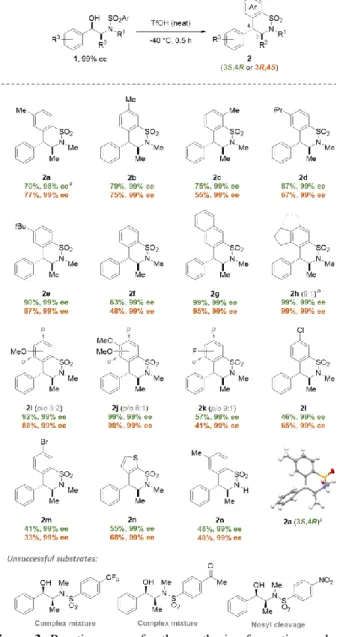
Figure 3. Reaction scope for the synthesis of enantiopure
ben-zosultams derived from ephedrines. a A 63% yield was obtained on
1 g scale (see SI for full details). b Major regioisomer depicted with
solid bonds; minor regioisomer depicted with dashed bonds. c
El-lipsoids are drawn at 50% probability level and hydrogen atoms are represented as fixed-size spheres of radius 0.30 Å.
The scope and functional group tolerance of this diastereoselec-tive intramolecular Friedel-Crafts cyclization was next evalu-ated (Figure 3). Ephedrine derivatives 1a-e, exhibiting alkyl electron-donating groups on the aromatic ring, were smoothly converted to the corresponding enantiopure benzosultams in good to excellent yields. The presence of electron-donating group on the arenesulfonamide is not essential for the cycliza-tion, as shown by the clean conversion of substrate 1f to its cy-clic analogue 2f. Naphthalene and indane derivatives 2g and 2h were also generated in very good yields by exploiting this reac-tion. The reaction proceeded equally well with electron-rich methoxy-substituted arenesulfonamides affording compounds
2i and 2j in excellent yields. Noteworthy, the two regiosiomers 2jp and 2jo could be isolated separately after flash column
chro-matography. While products 2k-m were generated in generally lower yields, their formation – which must involve the nucleo-philic addition of the halogenated deactivated aromatic rings – further reinforces the hypothesis of the transient formation of a highly reactive cationic intermediate. However, strongly-deac-tivating substituents such as CF3, C(O)Me or NO2 completely
inhibited the cyclization (Figure 3, bottom). Heteroarene could also be used as nucleophile as exemplified by the preparation of benzosultam 2n, an analogue of the antiglaucoma agent brinzo-lamide. Norephedrine derivative 1o, bearing no methyl group on the nitrogen atom, reacted in the optimized conditions to af-ford benzosultams 2o, albeit in moderate yield, opening new synthetic perspectives through further N-functionalizations. The structure and stereochemistry of these chiral compounds were confirmed by X-ray analysis of the collected crystals of 2a generated after reaction of substrate 1a.15 To highlight the
ver-satility of the method and verify the enantiopurity of every products, the reaction was carried out with each enantiomer of starting material. With success, the corresponding cyclic prod-ucts were generated in enantiopure form in similar yields. One step further in complexity, substrates bearing more hin-dered alkyl substituents at the stereogenic center as well as sub-stitutents on the phenyl ring were selected (substrates 1p-s,
Fig-ure 4). Using the corresponding aminoacids as chiral platform,
successive tosylation / reductive amination / reduction / aryl Grignard addition led to the clean formation of enantiomers
1p-r. A slightly modified procedure from proline derivatives led to
the formation of product 1s. The Grignard addition was fairly diastereoselective (dr from 4.7:1 to > 20:1) and the major syn diastereomers 1p-s could be isolated cleanly by flash chroma-tography on silica gel.16
Figure 4. Synthesis of benzosultam precursors 1p-s from amino
acids.
The superacid-promoted cyclization applied to 1p and 1q grat-ifyingly demonstrated the compatibility of the method with hal-ogenated ephedrine derivatives (Figure 5). However, substrates exhibiting vinyl or electronically-enriched p-methoxyphenyl substituents led only to complex mixture of compounds. In the latter case, the enhanced stability of the postulated benzylic cat-ion seems detrimental to the process, leading to the formatcat-ion of degradation byproducts upon hydrolysis. Performing this re-action with FeCl3 (conditions from Table 1, entry 8) afforded
only N-(methyl)tosylamine in 97% yield which confirms the lower reactivity of the cationic intermediate towards Friedel-Crafts alkylation. As illustrated by the transformation of 1r and
1s, respectively synthesized from leucine and proline, the
dia-stereoselectivity of the reaction is maintained with bulkier α-substituted amines. Furthermore, the formation of enantiomers
2s proves the efficiency of this strategy to generate enantiopure
conformationally-rigid sultams of interest.17
Figure 5. Reaction scope for the synthesis of enantiopure
ben-zosultams derived from aminoacids.
From a mechanistic point of view, this reaction most-likely pro-ceed through the formation of a benzylic carbocation.7d The
ste-reochemical information borne by the hydroxy-substituted ben-zylic carbon should therefore play only a minor role in the out-come of the transformation. When the tosyl-pseudoephedrine
1a’ (diastereomer of 1a) was reacted in the optimized
condi-tions, benzosultam 2a was isolated in a similar yield (83% vs. 70-77%) as starting from 1a, thus confirming our hypothesis (Figure 6A). Then, we explore the hypothetical formation of any dicationic intermediate in superacid solutions. To this end, preventing the substrate from any cyclization by substituting the arenesulfonyl moiety with a trifluoromethyl group, we initiated our investigation by exploring the behavior of N-(arenesul-fonyl)ephedrine 1t in TfOH by low-temperature in situ NMR analysis. Unfortunately, in TfOH, no clean 1H or 13C NMR
spectra could be collected from this experiment. Considering that the lifetime of the generated cations in these conditions dis-allow any observation at the NMR time scale, the same experi-ment was conducted in weaker nucleophilic conditions18 by
submitting the same substrate to HF/SbF5 superacid solution. In
these conditions, 1H, 13C and HSQC NMR analysis of the crude
reaction mixture provided strong evidences for the formation of the key dicationic species At (Figure 6B).191H NMR spectrum
displays a doublet (J = 9.7 Hz) at 8.10 ppm characteristic of a carbocationic benzylic C–H bond7d as well as a broad signal at
6.37 ppm attributed to the protonation of the sulfonamide moi-ety.20 The signal of the N-methyl substituent is now a doublet (J
= 4.6 Hz) slightly shielded to 1.79 ppm (compared to a singlet at 2.79 ppm for 1t in CDCl3). This species is also characterized
by a benzylic carbenium ion at 198.4 ppm in the 13C NMR
spec-trum.7d, 8d Interestingly, both 1H and 13C NMR spectra show
non-equivalent signals for the phenyl substituent indicating a restriction of rotation around the phenyl–carbocation bond.7b
Luckily, the 1H NMR spectrum was sufficiently well-resolved
to allow a NOESY experiment which showed a correlation be-tween the benzylic proton and an aromatic ortho proton as well as a correlation between the proton at the stereogenic center and another aromatic ortho proton. Altogether, these NMR observa-tions supported our initial hypothesis on the generation of con-formationally-restricted superelectrophiles in superacid. The carbon atom in para position displays a strong downfield shift to 168.1 ppm (compared to 128.1 ppm for 1t in CDCl3)
indicat-ing a strong delocalization of the positive charge to this carbon atom. This observation might be explained by the propensity of the aryl group to tackle the destabilization of the benzylic car-bocation induced by the proximity of the second cationic charge located on the nitrogen atom.8d Collectively, these data suggest
that a right balance between conformational stabilization and sufficient electrophilic character must exist to favor the intra-molecular diasteroselective nucleophilic substitution.
Figure 6. A. Synthesis of benzosultam 2a from
tosyl-pseudoephed-rine 1a’. B. Low-temperature 1H NMR (top) and 13C NMR
(bot-tom) analysis of ephedrine derivative 1t in HF/SbF5 (1/1) at -40 °C.
Acetone-d6 is used as external standard.
To conclude, taking advantage of the chiral pool, a series of op-tically-active N-(arenesulfonyl)-aminoalcohols were efficiently converted to enantiopure benzosultams exhibiting a wide array of functions and substitution patterns. Demonstrated by low-temperature NMR spectroscopy, this process exploits the super-electrophilic character and the privileged conformation of chiral benzylic dications in superacidic solution.
ASSOCIATED CONTENT
Supporting Information
The Supporting Information is available free of charge on the ACS Publications website.
General experimental procedures, reaction setup, characterization data, low-temperature NMR spectra and spectra for all key com-pounds (PDF).
AUTHOR INFORMATION
Corresponding Author
Sébastien Thibaudeau − Université de Poitiers, IC2MP UMR
CNRS 7285 / Superacid Group – Organic Synthesis Team/ 4 rue Michel Brunet 86073 Poitiers cedex 9, France ; orcid.org/0000-0002-6246-5829; E-mail: [email protected]
Bastien Michelet − Université de Poitiers, IC2MP UMR CNRS
7285 / Superacid Group – Organic Synthesis Team/ 4 rue Michel Brunet 86073 Poitiers cedex 9, France ; orcid.org/0000-0002-3248-5781; E-mail: [email protected]
Author Contributions
The manuscript was written through contributions of all authors. All authors have given approval to the final version of the manu-script.
ACKNOWLEDGMENT
We great fully acknowledge the French Ministry of research and education for PhD grant (for U.C.). We also acknowledge the Uni-versity of Poitiers, the Centre National de la Recherche Scien-tifique, the European Union (ERDF), the Région Nouvelle-Aqui-taine and the French Fluorine Network.
REFERENCES
(1) For recent selected examples, see: (a) Tang, J.; Chen, H.; He, Y.; Sheng, W.; Bai, Q.; Wang, H. Nat. Commun. 2018, 9, 3383. (b) Aldrich, L. N.; Kuo, S.-Y.; Castoreno, A. B.; Goel, G.; Ku-balla, P.; Rees, M. G.; Seashore-Ludlow, B. A.; Cheah, J. H.; Latorre, I. J.; Schreiber, S. L.; Shamji, A. F.; Xavier, R. J. J.
Am. Chem. Soc. 2015, 137, 5563. (c) Shan, W.; Balog, A.;
Na-tion, A.; Zhu, X.; Chen, J.; Cvijic, M. E.; Geng, J.; Rizzo, C. A.; Spires Jr., T.; Attar, R. M.; Obermeier, M.; Traeger, S.; Dai, J.; Zhang, Y.; Galella, M.; Trainor, G.; Vite, G. D.; Gavai, A. V. Bioorg. Med. Chem. Lett. 2016, 26, 5707. (d) Desbordes, P.; Dubost, C.; Dufour, J.; Gourgues, M.; Holstein, P.; Lempe-reur, V.; Miege, F.; Rinolfi, P.; Rodeschini, V.; Toquin, V.; Villalba, F.; Wachendorff-Neumann, U.; WO2018007323, 2018. (e) Liu, F.; Martin-Mingot, A.; Lecornué, F.; Jouan-netaud, M.-P.; Maresca, A.; Thibaudeau, S.; Supuran, C. T. J.
Enz. Inhib. Med. Chem. 2012, 27, 886.
(2) For recent reviews, see: (a) Majumdar, K. C.; Mondal, S.
Chem. Rev. 2011, 111, 7749. (b) Debnath, S.; Mondal, S. Eur. J. Org. Chem. 2018, 8, 933. For recent selected examples, see:
(c) Song, B.; Yu, C.-B.; Ji, Y.; Chen, M.-W.; Zhou, Y.-G.
Chem. Commun. 2017, 53, 1704. (d) Sun, Y.-T.; Zhu, D.-X.;
Rao, X.; Xu, M.-H.; Org. Chem. Front. 2020, 7, 340. (e) Hu, Y.; Lang, K.; Li, C.; Gill, J. B.; Kim, I.; Lu, H.; Fields, K. B.;
Marshall, M.; Cheng, Q.; Cui, X.; Wojtas, L.; Zhang, X. P. J.
Am. Chem. Soc. 2019, 141, 18160.
(3) For the recently reported rare examples, see: (a) Hou, L.; Kang, T.; Yang, L.; Cao, W.; Feng, X. Org. Lett. 2020, 22, 1390. (b) Pan, J.; Wu, J.-H; Zhang, H.; Ren, X.; Tan, J.-P.; Zhu, L.; Zhang, H.-S.; Jiang, C.; Wang, T. Angew. Chem. Int. Ed. 2019,
58, 7425. (c) Chen, Y.-H.; Lv, X.-J.; You, Z.-H.; Liu, Y.-K. Org. Lett. 2019, 21, 5556. (d) Song, B.; Chen, M.-W.; Zhou,
Y.-G. Org. Chem. Front. 2018, 5, 1113. (e) Jeran, M.; Cotman, A. E.; Stephan, M.; Mohar, B. Org. Lett. 2017, 19, 2042. (4) (a) Rueping, M.; Nachtsheim, B. J. Belstein J. Org. Chem.
2010, 6, 6. (b) Heravi, M. M.; Zadsirian, V.; Saedi, P.; Momeni, T. RSC Adv. 2018, 8, 40061. (c) Naredla, R. R.; Klumpp, D.
Chem. Rev. 2013, 113, 6905.
(5) Liu, F.; Martin-Mingot, A.; Jouannetaud M.-P.; Zunino, F.; Thibaudeau, S. Org. Lett. 2010, 12, 868.
(6) Trepanier, D. L.; Sunder, S. J. Med. Chem. 1973, 16, 342. (7) (a) Mühlthau, F.; Schuster, O.; Bach, T. J. Am. Chem. Soc.
2005, 127, 9348. (b) Mühlthau, F.; Stadler, D.; Goeppert, A.; Olah, G. A.; Prakash, G. K. S.; Bach, T. J. Am. Chem. Soc. 2006, 128, 9668. (c) Stadler, D.; Bach, T. Chem. Asian J. 2008,
3, 272. (d) Stadler, D.; Goeppert, A.; Rasul, G.; Olah, G. A.;
Prakash, G. K. S.; Bach, T. J. Org. Chem. 2009, 74, 312. (e) Rubenbauer, P.; Bach, T. Chem. Commun. 2009, 2130. (f) Stadler, D.; Mühlthau, F.; Rubenbauer, P.; Herdtweck, E.; Bach, T. Synlett 2006, 16, 2573.
(8) (a) Chung, J. Y. L.; Mancheno, D.; Dormer, P. G.; Variankaval, N.; Ball, R. G.; Tsou, N. N. Org. Lett. 2008, 10, 3037. (b) Chung, J. Y. L.; Steinhuebel, D.; Krska, S. W.; Hartner, F. W.; Cai, C.; Rosen, J.; Mancheno, D. E.; Pei, T.; DiMichele, L.; Ball, R. G.; Chen, C.; Tan, L.; Alorati, A. D.; Brewer, S. E.; Scott, J. P. Org. Process Res. Dev. 2012, 16, 1832. (c) Chénard, E.; Hanessian, S. Org. Lett. 2014, 16, 2668. For an earlier re-port on Friedel-Crafts reactions of ephedrine derivatives with benzene, see: (d) Klumpp, D. A.; Aguirre, S. L.; Sanchez, G. V.; de Leon, S. J. Org. Lett. 2001, 3, 2781.
(9) (a) Rayabarapu, D. K.; Zhou, A.; Jeon, K. O.; Samarakoon, T.; Rolfe, A.; Siddiqui, H.; Hanson, P. R. Tetrahedron 2009, 65, 3180. (b) Ullah, F.; Samarakoon, T.; Rolfe, A.; Kurtz, R. D.; Hanson, P. R.; Organ, M. G. Chem. Eur. J. 2010, 16, 10959. (c) Rolfe, A.; Samarakoon, T. B.; Hanson, P. R. Org. Lett. 2010, 12, 1216. (d) Loh, J. K.; Asad, N.; Samarakoon, T. B.; Hanson, P. R. J. Org. Chem. 2015, 80, 9926. (e) Faisal, S.; Maity, P. K.; Zang, Q.; Samarakoon, T. B.; Sourk, R. L.; Han-son, P. R. ACS Comb. Sci. 2016, 18, 387.
(10) (a) Chen, W.; Li, Z.; Oua, L.; Giulianott, M. A.; Houghten, R. A.; Yu, Y. Tetrahedron Lett. 2011, 52, 1456. (b) Dadiboyena, S.; Nefzi, A. Tetrahedron Lett. 2012, 53, 6897. (c) Foschi, F.; Tagliabue, A.; Mihali, V.; Pilati, T.; Pecnikaj, I.; Penso, M.
Org. Lett. 2013, 15, 3686.
(11) Ishida, N.; Shimamoto, Y.; Yano, T.; Murakami, M. J. Am.
Chem. Soc. 2013, 135, 19103.
(12) Laha, J. K.; Jethava, K. P.; Dayal, N. J. Org. Chem. 2014, 79, 8010.
(13) Olah,G. A.; Farooq, O.; Farnia, S. M. F.; Olah. J. A. J. Am.
Chem. Soc. 1988, 110, 2560.
(14) Partial isomerization was observed with TfOH or FeCl3 even
at -20 °C; data not shown.
(15) CCDC 1994486 (2a) contains the supplementary crystallo-graphic data for this paper. These data can be obtained free of charge from The Cambridge Crystallographic Data Centre. (16) See SI for more information.
(17) Blahun, O. P.; Rozhenko, A. B.; Rusanov, E.; Zhersh, S.; Tol-machev, A. A.; Volochnyuk, D. M.; Grygorenko, O. O. J. Org.
Chem. 2020, doi: 10.1021/acs.joc.9b03394.
(18) Krossing, I.; Raabe, I. Angew. Chem. Int. Ed. 2004, 43, 2066. (19) See SI for full NMR spectra.