HAL Id: hal-00297817
https://hal.archives-ouvertes.fr/hal-00297817
Submitted on 20 Sep 2005HAL is a multi-disciplinary open access
archive for the deposit and dissemination of sci-entific research documents, whether they are pub-lished or not. The documents may come from teaching and research institutions in France or abroad, or from public or private research centers.
L’archive ouverte pluridisciplinaire HAL, est destinée au dépôt et à la diffusion de documents scientifiques de niveau recherche, publiés ou non, émanant des établissements d’enseignement et de recherche français ou étrangers, des laboratoires publics ou privés.
Halogens in porewater of peat bogs ? the role of peat
decomposition and dissolved organic matter
H. Biester, D. Selimovi?, S. Hemmerich, M. Petri
To cite this version:
H. Biester, D. Selimovi?, S. Hemmerich, M. Petri. Halogens in porewater of peat bogs ? the role of peat decomposition and dissolved organic matter. Biogeosciences Discussions, European Geosciences Union, 2005, 2 (5), pp.1457-1486. �hal-00297817�
BGD
2, 1457–1486, 2005 Halogens in peat porewater H. Biester et al. Title Page Abstract Introduction Conclusions References Tables Figures J I J I Back CloseFull Screen / Esc
Print Version Interactive Discussion EGU Biogeosciences Discussions, 2, 1457–1486, 2005 www.biogeosciences.net/bgd/2/1457/ SRef-ID: 1810-6285/bgd/2005-2-1457 European Geosciences Union
Biogeosciences Discussions
Biogeosciences Discussions is the access reviewed discussion forum of Biogeosciences
Halogens in porewater of peat bogs – the
role of peat decomposition and dissolved
organic matter
H. Biester1, D. Selimovi ´c1, S. Hemmerich1, and M. Petri2
1
University of Heidelberg, Institute of Environmental Geochemistry, INF 236, 69 120 Heidelberg, Germany
2
Zweckverband Bodensee-Wasserversorgung, Betriebs- und Forschungslabor, S ¨ußenm ¨uhle 1, 78 354 Sipplingen, Germany
Received: 16 August 2005 – Accepted: 1 September 2005 – Published: 20 September 2005 Correspondence to: H. Biester ([email protected])
BGD
2, 1457–1486, 2005 Halogens in peat porewater H. Biester et al. Title Page Abstract Introduction Conclusions References Tables Figures J I J I Back CloseFull Screen / Esc
Print Version Interactive Discussion
EGU
Abstract
Peatlands are one of the largest active terrestrial reservoirs of halogens. Formation of organo-halogens is a key process for the retention of halogens by organic matter and halogen enrichment in peat is strongly influenced by climatically controlled humi-fication processes. However, little is known about release and transport of halogens
5
in peat bogs. In this study we investigated the release of halogens from peat in three peat bogs located in the Magellanic Moorlands, southern Chile. Peat porewaters were collected using a sipping technique, which allows in situ sampling down to a depth of more than 6 m. Halogens and halogen species in porewater were determined by ion-chromatography (IC) (chlorine) and IC-ICP-MS (bromine and iodine). Results show
10
that halogen concentrations in porewater are 15–30 times higher than in rainwater suggesting that their release from peat during diagenesis is the major source of halo-gens in porewater. Mean concentrations of chlorine, bromine and iodine in porewater were 7–15 mg l−1, 56–123 µg l−1, and 10–20 µg l−1, which correspond to mean propor-tions of 10–15%, 1–2.3% and 0.5–2.2% of total concentrapropor-tions in peat, respectively.
15
Organo-bromine and organoiodine were predominant in porewaters, whereas the re-lease of organo-chlorine compounds from peat appears to be of minor importance. Results show that the release of bromine and iodine from peat depend on the degree of peat degradation, whereas this relationship is weak for chlorine. Relatively higher release of bromine and iodine was observed in less degraded peat sections, where
20
the release of dissolved organic carbon (DOC) was also the most intensive. Here, proportions of released iodine and bromine follow proportions of released dissolved or-ganic matter (DOM) indicating that the release of halogenated DOM is the predominant process of iodine and bromine release from peat.
BGD
2, 1457–1486, 2005 Halogens in peat porewater H. Biester et al. Title Page Abstract Introduction Conclusions References Tables Figures J I J I Back CloseFull Screen / Esc
Print Version Interactive Discussion
EGU
1. Introduction
For a long time halogens were seen to behave mostly conservative in the soil and aquatic environment. Today halogens are known to be involved in a large number of biogeochemical processes related to the transformation of organic matter and some of these processes are basic for the understanding of the biogeochemical cycling of
5
halogens. Natural formation of organohalogens in nearly all aquatic and terrestrial en-vironments is widely accepted to be a key process of the retention and enrichment of halogens in soils ( ¨Oberg, 2002) and peatlands (Keppler and Biester, 2003; Biester et al., 2004). Enzymatic processes such as haloperoxidases and halogenases are thought to be the major source of natural halogenated organic compounds in the
envi-10
ronment (e.g. Shaw and Hager, 1959; Gribble, 2003; Van P ´ee and Unversucht, 2003). Most recent studies on the behavior of halogens in the soil environment are focused on chlorine and much less is known about the fate of bromine and iodine. Studies on the dynamics of iodine and bromine in soils indicate that both elements form sta-ble organohalogen compounds through interaction with humic substances (Whitehead,
15
1984; Yuita, 1994) and laboratory studies have also shown that iodine in seepage wa-ter from soils and in brown wawa-ters from bogs is preferentially bound to humic acids (R ¨adlinger and Heumann, 2000).
Ombrotrophic peat bogs, which receive all elements exclusively through atmospheric deposition, are widely used as environmental archives. Being solely built up by organic
20
matter, they are ideal natural laboratories to study the role of organic matter transfor-mation processes in the biogeochemical cycling of halogens. Data on halogens in peat are still limited to a small number of studies (Maw and Kempton, 1982; Shotyk, 1997; Silk et al., 1997; Chagu ´e-Goff and Fyfe, 1996; Keppler and Biester, 2003; Biester et al., 2004).
25
Some recent studies have shown that formation of organohalogens is the major pro-cess of halogen retention by peat (Silk et al., 1997; Keppler and Biester, 2003, Biester et al., 2004). For example, Keppler et al. (2004) demonstrated that peat has a large
BGD
2, 1457–1486, 2005 Halogens in peat porewater H. Biester et al. Title Page Abstract Introduction Conclusions References Tables Figures J I J I Back CloseFull Screen / Esc
Print Version Interactive Discussion
EGU
capacity to retain atmospheric iodine through formation of organoiodine and that mires and bogs are major terrestrial sinks for iodine. Moreover, concentrations of organically bound halogens in peat strongly depend on the degree of peat decomposition (Biester et al., 2004). In this context it was found that highest halogen concentrations in peat were correlated with relatively dry periods, when bog wetness is lower and peat
de-5
composition is high. Thus, historical records of halogen concentrations in peat bogs do reflect changes in peat decomposition, rather than changes in atmospheric fluxes.
Besides investigations on changes of halogen concentrations or accumulation rates in peat bogs the release of halogens from peat to peat porewater during diagenesis of the organic matter is of major interest to estimate halogens fluxes from peatlands into
10
rivers and streams. Many porewater investigations in peat bogs were carried out using in situ diffusion equilibrium samplers (peepers) (e.g. Bendell-Young and Pick, 1997; Steinmann and Shotyk, 1997). The idea that porewater in bogs reflects the release of solutes from surrounding peat is based on the assumption that water does not flow through the deeper parts of peat bogs because the hydraulic conductivity of many peats
15
is too low (Ingram, 1982). Other studies have shown that climate fluctuations of short duration may temporarily reverse the vertical direction of fluid flow through the peat, although this has little effect on porewater chemistry (Romanowicz et al., 1993). On the other hand, longer periods (3–5 years) of droughts can produce significant changes in porewater chemistry (Siegel et al., 1995).
20
Only a small number of studies have focused on the fate of halogen in peat bogs. Shotyk (1997) has investigated halogens in peat and porewater in two bogs in Scotland and concluded that chlorine is conservative in bogs, whereas bromine is not. However, these investigations were focused on inorganic halogen species and did not consider organohalogen compounds in porewater or the role of dissolved organic matter
re-25
leased from peat.
Processes of halogen release from organic substrates have been mainly investigated in context with techniques to clean up groundwater contaminated with chlorinated or-ganic solvents or other specific pollutants and only little is known about dechlorination
BGD
2, 1457–1486, 2005 Halogens in peat porewater H. Biester et al. Title Page Abstract Introduction Conclusions References Tables Figures J I J I Back CloseFull Screen / Esc
Print Version Interactive Discussion
EGU
of natural formed organohalogens. Laboratory studies have shown that dehalogena-tion can occur under aerobic and anaerobic condidehalogena-tions and that halogens are cleaved enzymatically from the organic substrate. An overview on dechlorination processes can be found in Winterton (2000) and in Van P ´ee and Unversucht (2003). However, natural processes of formation and dehalogenation of organobromine and
organoio-5
dine compounds in peat bogs are mostly unknown.
As a first step to understand the fate of halogens in peat bogs we investigated the distribution and speciation of halogens in porewater of three peat bogs located in the Magellanic Moorlands, Chile. Based on data of peat decomposition obtained in previ-ous studies we investigated to which extend the release of halogens from peat depends
10
on the degree of peat humification or the release of dissolved organic matter (DOM).
2. Methods and materials
2.1. Sampling locations
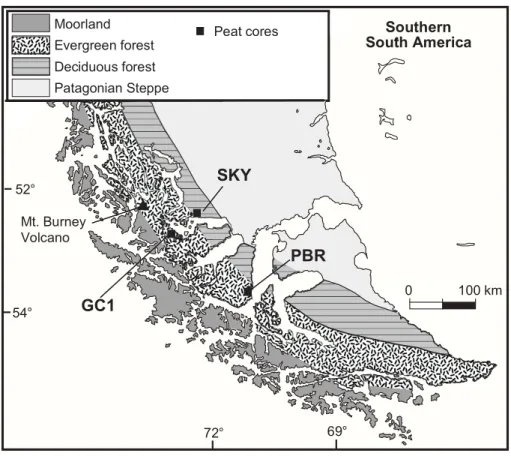
Porewater samples were collected from three ombrotrophic bogs (GC1, SKY and PBR) located in different climatic zones of the Magellanic Moorlands, southernmost Chile
15
(Fig. 1). The GC1 bog is a cushion plant bog, which is typical for the super-humid area (S 52◦47.4430/W 72◦56.6160). The bog is characterized by intense atmospheric deposi-tion of sea-salt aerosols due to the high precipitadeposi-tion rates in this area (>6000 mm yr−1) (Schneider et al., 2003). SKY is a raised bog located in the transition zone between the extremely humid zone of the Magellanic Moorlands and the dry Pampa grasslands
20
(precipitation rates <500 mm yr−1) (S 52◦30.6680/W 72◦07.5050). Precipitation rates at the SKY location (1000–1500 mm yr−1) are much lower than at the GC1 location and previous studies on peat humification have shown periodically dry falling of the bog’s surface (Biester et al., 2003). The PBR bog is a typical raised Sphagnum bog located on Peninsula Brunswick at the Strait of Magellan (S 53◦38.2810/W 70◦58.0290). One or
25
BGD
2, 1457–1486, 2005 Halogens in peat porewater H. Biester et al. Title Page Abstract Introduction Conclusions References Tables Figures J I J I Back CloseFull Screen / Esc
Print Version Interactive Discussion
EGU
eruptions of the volcanoes Mt. Burney, Hudson and Reclus, all located in the southern Andes (Kilian et al., 2003). A detailed discussion of the ombrotrophic nature of the bogs and geochemical characteristics of the peat is given elsewhere (Biester et al., 2003).
2.2. Sampling of porewaters
5
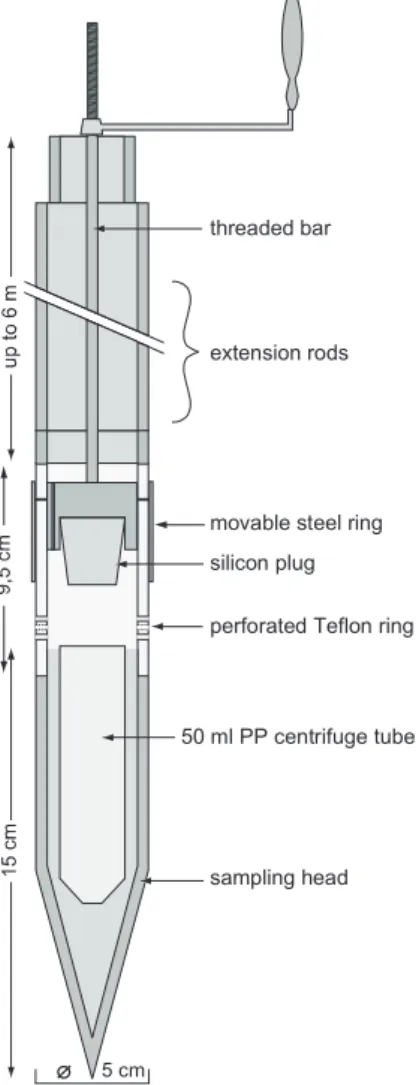
Porewaters in peat bogs are usually collected by means of in situ diffusion equilibrium samplers (peepers), which allow collection of interstitial waters. In other studies sipper techniques have been proposed to collect porewater from peat (Romanowicz et al., 1993). In our study we used a self-constructed device, which allows porewater sam-pling down to a depth of >6 m by sipping. The device consists of a samsam-pling head and
10
extension rods all made of aluminium (Fig. 2). The sampling head contains an inter-mediate perforated (Ø 1–5 mm) Teflon ring, which allows lateral inflow of surrounding porewaters. The porewater flowing into the sampling head is collected into a 50 ml polypropylene centrifuge tube (Fig. 2). All parts inside the sampling head, which come in contact with inflowing porewater, are made of Teflon or polypropylene. The
perfo-15
rated Teflon ring can be closed or opened by a movable steel ring, which is connected to a threaded bar inside the extension rods. The openings in the sampling head can be opened or closed from the bog surface by turning the threaded bar by means of a crank handle (Fig. 2). After the head has been positioned at the required sampling depth the inlet is opened and porewaters are allowed to flow into the centrifuge tube for
20
5–30 min. The openings are then closed and the sampler is pulled out. The threaded bar is connected to a silicon plug which seals the sample tube when the sampling head is closed. The tube was removed from the sampling head and closed. Yields of pore-water varied between 10 and 50 ml depending on porepore-water flow, which was lowest in deeper bog sections. Porewater samples were taken in 15 cm depth increments. The
25
holes for porewater sampling were located about 20 cm next to the holes where the peat cores were extracted. Porewater samples were filtered (0.2 µm) and stored cold
BGD
2, 1457–1486, 2005 Halogens in peat porewater H. Biester et al. Title Page Abstract Introduction Conclusions References Tables Figures J I J I Back CloseFull Screen / Esc
Print Version Interactive Discussion
EGU
(4◦C) until analyses.
2.3. Determination of halogens and dissolved organic carbon in rain and porewater Total chloride in porewater and rainwater was determined by means of ion-chromatography and chloride detection through conductivity (Dionex, Germany). Total bromine and iodine in rain and porewater was analyzed by ICP-MS (Perkin-Elmer/Sciex
5
Elan 6100 ICP-MS). In contrast to previous studies (Biester et al., 2004), Rhenium in-stead of103Rhodium was used as an internal standard for bromine and iodine analysis by ICP-MS as the Rhodium signal shows shifts dependent on DOC concentrations in porewater. Analyses of inorganic bromine and iodine species were performed by IC-ICP-MS according to the method of Sacher et al. (1999). Measurements of bromine
10
and iodine were validated by comparison to a certified reference sample (CRM 611). All measurements of total bromine and iodine (indicative values) and bromide and io-dide were in the range of the certified (indicative) values. Amounts of organobromine and organoiodine in porewater were calculated as the difference between total concen-trations and the sum of concenconcen-trations of inorganic species determined by IC-ICP-MS,
15
respectively. Halogens in peat were determined by differential thermal analyses and ion-chromatography. A detailed description of this method is given elsewhere (Biester et al., 2004). Dissolved organic carbon (DOC) in porewater was determined in the filtered samples using a Shimadzu TOC 5000 analyzer. Methods of carbon and nitro-gen determination in peat, peat dating and sampling of rainwater were described in
20
BGD
2, 1457–1486, 2005 Halogens in peat porewater H. Biester et al. Title Page Abstract Introduction Conclusions References Tables Figures J I J I Back CloseFull Screen / Esc
Print Version Interactive Discussion
EGU
3. Results and discussion
3.1. Halogens in rain and porewater
A major purpose of this study was to evaluate to which extent halogen concentrations in porewater of peat bogs reflect atmospheric deposition of halogens or the release of halogens during decomposition of the organic substrate. Halogen concentrations in
5
rain were determined at the GC1 and the SKY location, where weather stations have been operated since 1999 (Schneider et al., 2003). Concentrations and deposition rates of halogens at the two locations are given in Table 1. At GC1 and SKY, 84 and 60% of the total iodine in rainwater, respectively, was iodide; the remainder was an unidentified, assumingly organic iodine species (Biester et al., 2004). Halogen data in
10
rain from the PBR location were not available. Deposition rates of chlorine, bromine and iodine at the GC1 were by factors of 5, 4 and 2.6, respectively, higher than at SKY, which is attributed to higher precipitation rates at the GC1 location (super-humid site). Retention of chlorine in peat ranged between 0.2 and 2.0%, whereas bromine and iodine show much higher retention rates of 30 to 50%. A detailed description and
15
discussion of the halogen data in rain and peat at the two bogs is given in a previous study (Biester et al., 2004).
Literature on halogens in porewater at bog sites is rare. Shotyk (1997) investigated chlorine and bromine concentrations in the uppermost meter of two oceanic bogs in Scotland using peepers. There, halogen concentrations in rain- and porewater were
20
generally higher than those found at our sites. Shotyk (1997) found that chlorine and bromine concentrations in porewater were higher than in rainwater and assumed that this is attributed to additional inputs by fog or dry deposition of seasalt aerosols.
In the GC1 and the SKY bogs, mean halogen concentrations in porewater were on average a factor of 15–30 higher than in rainwater (Table 1) indicating that halogen
25
concentrations in porewater do not solely reflect atmospheric inputs. The largest di ffer-ence (factor of ∼30) between rain and porewater concentrations was found for chlorine and bromine at the GC1 site. At the SKY bog the difference in chlorine and bromine
BGD
2, 1457–1486, 2005 Halogens in peat porewater H. Biester et al. Title Page Abstract Introduction Conclusions References Tables Figures J I J I Back CloseFull Screen / Esc
Print Version Interactive Discussion
EGU
concentrations between rain and porewater was only about half of what was found at the GC1 site. Iodine shows a similar enrichment factor in porewater of ∼20 at both sites (Table 1). The higher enrichment factors of halogens in porewater of the GC1 bog are mainly attributed to the generally higher halogen deposition rates at this site and the resulting higher concentrations of halogens in peat (Biester et al., 2004).
5
The enrichment of all three halogens in porewater indicates that halogen concen-trations in porewater do not directly depend on concenconcen-trations in rain, but seem to be mainly determined by sorption and desorption processes in peat. Additional in-puts by fog or dry deposition, as suggested in other studies (Shotyk, 1997), are assumed to be of minor importance at the Magellanic Moorlands, especially at the
10
GC1 site, where precipitation rates are constantly high throughout the year (6000– 10 000 mm yr−1, Schneider et al., 2004). The assumption, that halogens in porewater are mainly controlled by their release from peat and not by rainwater is supported by the fact that 51–69% of bromine and 88–93% of iodine in porewater do exist in organic forms (soluble organohalogens or halogenated dissolved organic matter), whereas in
15
rainwater both halogens exist predominately in inorganic form. As conditions in the catotelm are anoxic, reductive dehalogenation was expected to be one of the potential processes of halogen release from peat. From the physical and chemical characteris-tics of the three halogens, such as ionic radii and the polarity of the carbon halogen bonds, one might expect that dehalogenation of organic matter proceeds in the order
20
iodine, bromine and chlorine. Studies on dehalogenation processes in anaerobic sed-iments have demonstrated that e.g. brominated biphenyls are better dehalogenation substrates than chlorinated biphenyls (Bedard and Van Dort, 1998). However, as most bromine and iodine in our porewater samples exist as organohalogens we concluded that reductive dehalogenation is of minor importance for the release of bromine and
25
iodine in anoxic peat.
Organochlorine compounds in porewater were not determined in this study. Con-centrations of organochlorines in lakes and rivers were reported to range between 11 and 185 µg l−1, and highest values were found in streams draining peatlands
(As-BGD
2, 1457–1486, 2005 Halogens in peat porewater H. Biester et al. Title Page Abstract Introduction Conclusions References Tables Figures J I J I Back CloseFull Screen / Esc
Print Version Interactive Discussion
EGU
plund, 1991). Moreover, it was shown that fulvic acids play an important role in trans-port of organochlorine in the environment by binding of chlorine to aromatic structures (Dahlmann et al., 1993). Assuming that similar amounts of organochlorine occur in our porewater samples less than 1.4–3% of total chlorine in porewater would exist as organochlorines, only. Thus, most chlorine in our porewaters exists as chloride
indi-5
cating that reductive dehalogenation and release of chloride is the major process of chlorine release from anoxic peat.
3.2. Halogen ratios
Molar halogen ratios in the porewater samples also show that the distribution of halo-gens in porewater is independent from concentrations in rain. Although mean molar
10
halogen ratios are similar to those found in rain, the wide range of variation indicates that concentrations in porewater must be influenced by halogen release from peat dur-ing peat diagenesis (Table 2). The highest Cl/Br, Cl/I and Br/I ratios were observed in the uppermost peat layer and in the tephra layers of the GC1 and the SKY profiles, which are attributed to the high release of chloride from decaying plants and weathering
15
of pumice layers. Release of bromine and iodine from decaying plants at the surface layer was found to be much lower than for chlorine, because plant uptake of chlorine is much higher than that of bromine and iodine. Halogen ratios in peat were generally lower than in porewater or rain, due to the higher retention of bromine and iodine by peat compared to chlorine. Thus, more of the atmospherically derived chloride will stay
20
in the liquid phase and Cl/Br and Cl/I ratios in porewater are generally higher than in peat, whereas Br/I ratios are more similar in peat and porewater (Table 2).
Shotyk (1997) observed lower average Cl/Br ratios in living plants (20–70) compared to Cl/Br ratios in porewater (84–324), from what he concluded that plant uptake is the main reason for the higher retention of bromine by peat. However, organohalogens in
25
BGD
2, 1457–1486, 2005 Halogens in peat porewater H. Biester et al. Title Page Abstract Introduction Conclusions References Tables Figures J I J I Back CloseFull Screen / Esc
Print Version Interactive Discussion
EGU
3.3. The influence of halogen concentrations in peat
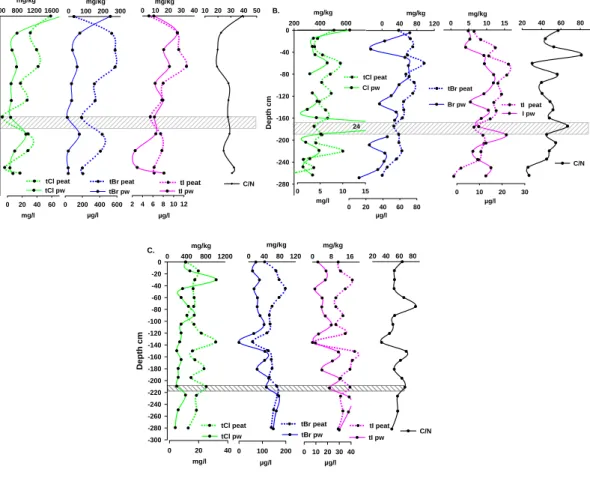
Concentrations of halogens in porewater show intense changes and steep concen-tration gradients throughout the peat profiles (Fig. 3). This implies that diffusion of halogens within the bogs is probably of minor importance. The largest variations in halogen concentrations were found in the GC1 core, where values vary by factors of
5
16 to 22. Here, the highest concentrations of chlorine and bromine were found in the uppermost peat layer due to the release of Cl and Br in the early phase of plant material decay (Fig. 3a). In contrast, high concentrations of chlorine and bromine in the upper peat section could not be observed in the other two bogs (Figs. 3b, c). We assume that the cushion plants, which are dominant in the GC1 bog, contain larger amounts of
10
chlorine and bromine than Sphagnum mosses, which are dominant in SKY and PBR peat. Lower variations in halogen concentrations were observed in the SKY and PBR profiles, where chlorine concentrations vary by factors of up to 16 and 8, bromine con-centrations by factors of up to 6 and 3 and iodine concon-centrations by factors of up to 4 and 6, respectively. As stated earlier, high concentrations of chlorine and bromine were
15
found in the tephra layers of the GC1 and SKY bogs (Figs. 3a, b), which we attribute to additional release during weathering of the pumice.
A clear relationship between total halogen concentrations in peat and in porewater could not be found in any of the three bogs. Thus, varying halogen concentrations in peat alone cannot explain the variations of halogen concentrations in porewater. In
20
general, profiles of chlorine concentrations in porewater show different patterns than bromine and iodine (Fig. 3). In all three bogs, chlorine concentrations in porewater show a tendency to follow their concentrations in peat. This trend is comparatively clear in the GC1 profile (Fig. 3a), but weaker, or nearly absent in the SKY and PBR profiles (Figs. 3b, c). Bromine and iodine concentrations in the SKY and PBR porewater profiles
25
tend to be inversely related to concentrations in peat, whereas this trend could not be observed in the GC1 profile, where bromine and iodine concentrations in porewater also seem to follow their concentrations in some sections of the core (Fig. 3a). These
BGD
2, 1457–1486, 2005 Halogens in peat porewater H. Biester et al. Title Page Abstract Introduction Conclusions References Tables Figures J I J I Back CloseFull Screen / Esc
Print Version Interactive Discussion
EGU
results suggest that different release processes of chlorine on one side, and of bromine and iodine on the other side control halogen concentrations in porewater.
The assumption of different release processes is also supported by the different ex-tent to which chlorine, bromine or iodine is released from peat. To calculate proportions of released halogens the amount of halogens in 1 litre of porewater was related to the
5
amount of halogens in the mass of peat found in the same volume. Due to its high water content (∼80–95%) the mean mass of solid matter in a volume of 1 litre of fresh peat is only 60–150 g. In all three bogs the proportion of chlorine in porewater (10– 15%) is by a factor of 7 to ∼10 higher than proportions of bromine or iodine (0.5–2.1%) indicating that the release of chlorine from peat is more intensive than that of bromine
10
and iodine (Table 1). There might be some additional chlorine added to the porewater by chloride release from plants in the early phases of decay. Plants are known to be able to enrich chlorine to a large extend (Bowen, 1979).
Proportions of released halogens show strong variations throughout the profiles and appear to be largely independent from halogen concentrations in peat (Figs. 3 and 4).
15
From this we assume that there must be another factor that controls the release of halogens from peat. Previous studies have shown that halogen concentrations in peat strongly depend on the degree of peat humification and that they increase during peat decomposition as a result of carbon loss (Biester et al., 2004). This implies that the release of halogens from peat is related to the degree of peat humification and the
20
chemical properties of the organic material.
3.4. Influence of peat decomposition on the release of halogens
Sorption and desorption processes of halogens, especially of bromine and iodoine, to and from humified organic matter, particularly under anoxic conditions, is not well in-vestigated. It has been reported that the formation of organochlorine compounds and
25
decomposition of organic matter are congruent processes and that chlorine is predom-inately released as chloride during decomposition of chlorinated organic matter in soils (Flodin et al., 1997). Processes of bromine or iodine release from organic matter
dur-BGD
2, 1457–1486, 2005 Halogens in peat porewater H. Biester et al. Title Page Abstract Introduction Conclusions References Tables Figures J I J I Back CloseFull Screen / Esc
Print Version Interactive Discussion
EGU
ing decomposition are largely unknown. As organobromine and organoiodine are the predominant forms of these halogens in porewater, one might expect that their release from peat is related to the release of DOM. For example, iodine bound to soluble hu-mic substances has been shown to undergo hu-microbial induced changes, where iodine is bound to different molecular weight fractions of the organic matter during different
5
stages of ageing (Heumann et al., 2000). However, these results were obtained from experiments under oxic conditions, whereas microbial activity in waterlogged anoxic peat sections is restricted to anaerobic pathways.
Organic matter turnover, peat formation and mass loss is most intensive in the uppermost, aerated peat section (acrotelm). We proposed in a previous study that
10
organohalogens, which are the predominant form of halogens in peat, are mainly formed and enriched in this section (Biester et al., 2004). On the other hand losses of halogens during oxidation of the organic matter has to be taken into account and it is not known how much of the initially formed organohalogens are volatilized, de-halogenated, or decomposed in the surface layer. Enrichment of organically bound
15
halogens was found to be highest during low water levels, when the uppermost peat sections fall dry and mass loss is highest due to intense mineralization of the aer-ated organic matter (Biester et al., 2004). We expected to find a similar relationship for halogen concentrations in porewater assuming that halogen release from peat is linked to peat decomposition processes. As conducted in previous studies, we used
20
carbon/nitrogen ratios (C/N) as a measure of the degree of peat humification to eval-uate the influence of peat decomposition on halogen concentrations, where low ratios indicate high humification and vice versa (Biester et al., 2004).
To understand the relationship between peat decomposition and halogen release to porewater in peat bogs it must be kept in mind that the degree of decomposition of
25
a peat section is determined at the time of peat formation and this degree of decom-position is preserved when the peat enters the catotelm (Malmer and Wall ´en, 2004). Decomposition of organic matter in the acrotelm is controlled by factors such as oxy-gen supply, water table fluctuations and peat growth rates. Humification processes
BGD
2, 1457–1486, 2005 Halogens in peat porewater H. Biester et al. Title Page Abstract Introduction Conclusions References Tables Figures J I J I Back CloseFull Screen / Esc
Print Version Interactive Discussion
EGU
occurring in the anoxic zone (catotelm) are slow if compared to decomposition in the acrotelm. This is expressed by the difference in intensity of mass loss in the two sec-tions. It has been estimated, that more than 90% of the initial plant mass are lost as a result of organic matter mineralisation in the acrotelm (Clymo, 1992), whereas 50% of the remaining peat mass is lost during peat decomposition under anoxic conditions
5
in the catotelm (Kuhry and Vitt, 1996). Accordingly, C/N ratios in the catotelm predom-inately reflect the hydrochemical conditions and also the degree of humification at the time of peat formation at the bogs surface; hundred to thousands of years ago. Con-centrations of halogens in porewater, however, predominantly reflect the present day equilibrium between peat and porewater assuming that there is no significant vertical
10
downward transport of halogens in the catotelm and that advective movement of pore-water solutes in the catotelm is negligible. However, Siegel et al. (1995) could show that severe droughts (>3–5 years) can have strong effects on the exchange of porewa-ter in bogs due to large changes in waporewa-ter-table mounds. From this, Siegel et al. (1995) concluded that the chemical composition of bog waters might not truly reflect the
long-15
term hydrological state of bogs, but rather a transient climate signal that occurs several years before the time of porewater sampling. Falling-dry effects are not important for the porewater chemistry of the GC1 and PBR bogs, but may have occurred at the SKY bog, where periodical falling-dry events have been deduced from peat decomposition patterns (Biester et al., 2003, 2004).
20
Halogen concentrations in peat of the Patagonian bogs increase with increasing de-gree of peat decomposition, which means that concentrations are inversely related to C/N ratios (Biester et al., 2004). Based on this it might be expected that halogen concentrations in porewater are also high when peat decomposition is high (low C/N ratios). However, relationship between C/N ratios and halogen concentrations in
pore-25
water was generally week or absent in all three bogs (Figs. 3a–c). In some sections of the PBR profile Br and I concentrations appear to follow C/N ratios, which indicates that more Br and I is released from relatively lower decomposed peat (Fig. 3c). This coherence becomes more evident if proportions of released halogens instead of
con-BGD
2, 1457–1486, 2005 Halogens in peat porewater H. Biester et al. Title Page Abstract Introduction Conclusions References Tables Figures J I J I Back CloseFull Screen / Esc
Print Version Interactive Discussion
EGU
centrations are compared to C/N ratios. Figure 4 shows that the profiles of proportions of released bromine and iodine follow the changes of C/N ratios in nearly all parts of the SKY and PBR cores. This trend is clear in deeper sections, but is less pronounced in the upper 100 cm of the two profiles (Figs. 3b, c), where we assume that mixing of porewaters is possible due to the high macro-porosity in the acrotelm.
5
In the GC1 bog the relationship between bromine and iodine in porewater and peat decomposition patterns is much less pronounced than in the other two bogs (Figs. 3a and 4a). One reason for that might be that decomposition of GC1 peat is generally higher and more uniform than of peat from the other two bogs. Thus variations in the degree of humification in this bog are probably too small and the material is too highly
10
condensed to have a significant influence on the release of halogens.
In all three bogs, profiles of chlorine in porewaters show different patterns than those of bromine and iodine (Fig. 3). A consistent relationship between chlorine in porewa-ter, or between the proportion of released chlorine and peat decomposition patterns could not be observed, although proportions of chlorine in porewater seem to follow
15
changes in C/N ratios in some sections of the bogs (Fig. 4a). Assuming that reductive dehalogenation is the primary process of chlorine release from peat, a relationship to peat decomposition patterns cannot be expected.
3.5. DOC and halogens in porewater
The observation that most Br and I in porewater exist as organobromine and
organoio-20
dine compounds suggests a relationship with the release of dissolved organic matter (DOM). Decomposition, humification and stabilization of organic matter are closely re-lated to the dynamics of DOM in soils (Zech et al., 1997). Kalbitz and Geyer (2002) could show that DOM release from peat is related to the degree of peat decomposition and that DOM release from less degraded peat is higher than from highly degraded
25
peat. The degree of peat decomposition, as expressed by C/N ratios (means) is simi-larly high in the SKY and the PBR bogs (high C/N: 48 and 58), but significantly higher (low C/N: 27) in the GC1 bog. Mean concentrations and mean proportions of released
BGD
2, 1457–1486, 2005 Halogens in peat porewater H. Biester et al. Title Page Abstract Introduction Conclusions References Tables Figures J I J I Back CloseFull Screen / Esc
Print Version Interactive Discussion
EGU
DOC (related to total carbon in peat) are also high in SKY (48 mg l−1, 0.11%) and PBR (41 mg l−1, 0.1%) porewater, but are by a factor of ∼2.5 lower in GC1 porewa-ter (22 mg l−1, 0.04%), which reflects the higher degree of peat decomposition of GC1 peat. Concentrations of DOC in the bogs show only a vague relationship with peat decomposition patterns. However, if proportions of released DOC are compared to
5
C/N ratios a clearer dependency of DOC release from the degree of peat decompo-sition can be observed (Fig. 4). This relationship is clear in the SKY and the PBR bogs, where proportions of released DOC follow C/N ratios in most parts of the profiles (Figs. 4b, c) indicating that more DOC is released from relatively low degraded peat (high C/N ratios) and vice versa. The strong variations of DOC in the SKY and PBR
10
bogs indicate that DOC in porewater depends on the degree of peat decomposition of single peat sections and that continuous vertical transport of DOC in the investigated bogs is of minor importance. DOC concentrations and also proportions of released DOC in GC1 peat show no clear relationship with peat decomposition (Fig. 4a), which we attribute to the low variation and the generally high degree of peat decomposition
15
in this bog.
Proportions of released chlorine appear to follow proportions of released DOC in some section of the three profiles, but this trend is weak if compared to bromine and iodine, which show a much clearer trend. As mentioned earlier, it is assumed that only a small proportion (<3%) of released chlorine is organochlorine so that a correlation
20
with the release of DOC was not expected. In contrast, the occurrence of high amounts of soluble organobromine- (42–68%) and organoiodine compounds (88–93%) in pore-water substantiates the relationship between the release of DOC and that of bromine and iodine. This relationship is pronounced in the SKY and the PBR profiles, where proportions of released bromine and iodine are in phase with proportions of released
25
DOC and also with C/N ratios in most parts of the profiles (Figs. 4b, c). Figure 5 shows the correlation between percentages of DOC and halogens released from peat at all three sites. It is evident that the release of bromine and iodine from peat is controlled by the release of halogenated DOC and that both parameters depend on the degree of
BGD
2, 1457–1486, 2005 Halogens in peat porewater H. Biester et al. Title Page Abstract Introduction Conclusions References Tables Figures J I J I Back CloseFull Screen / Esc
Print Version Interactive Discussion
EGU
peat humification. In the GC1 bog the similarity between the profiles of proportions of bromine, iodine or DOC release is again not pronounced, because of the low variability of all three parameters (Fig. 4a). However, the large proportion of organobromine and organoiodine in porewater of this bog (Table 1) indicates that both components are also associated with DOM.
5
No direct dependency between proportions of released bromine and iodine, and proportions of released DOC could be observed if the three bogs are compared among each other. The bromine and iodine release from PBR peat is twice as high as from SKY peat, despite that the mean proportions of released DOC is almost the same (Table 1). Moreover, release of DOC is lowest in the GC bog, but the extent of bromine
10
release is similar to what is found in the SKY bog, which show two times higher DOC release. The most likely explanation for this is that bromine or iodine concentrations in peat have influence on the halogen concentrations of the released organohalogens, too. Mean total halogen concentrations are by a factor of 2–3 higher in GC peat than in the other two bogs and halogen concentrations in PBR peat are by 25–47% higher
15
than in SKY peat (Table 1). The influence of halogen concentrations in peat on halogen concentrations in DOM is expressed by the DOC/organohalogen ratios (Br and I) in porewater. They are significantly lower in GC1 and PBR where halogen concentrations in peat are higher than in SKY peat independent from the amount of released DOC (Table 3).
20
The amount of bromine and iodine released from peat is therefore controlled by two major factors, which are the amount of released DOM and total halogen concentrations in peat. The influence of both factors is largely determined by the degree of peat de-composition. Halogen concentrations will be high, but the release of DOC will be low, when peat is highly decomposed and the release of DOC will be high in relatively low
25
decomposed peat, but halogen concentrations will be relatively low. Due to the corre-lation between peat decomposition, released DOC and bromine and iodine it seems that the release of DOC is the predominant factor determining the extent of bromine and iodine release from peat in the catotelm.
BGD
2, 1457–1486, 2005 Halogens in peat porewater H. Biester et al. Title Page Abstract Introduction Conclusions References Tables Figures J I J I Back CloseFull Screen / Esc
Print Version Interactive Discussion
EGU
The finding that halogens, DOC release and decomposition patterns of peat show a clear relationship within single peat sections indicates that vertical transport of pore-water solutes plays a minor role in Patagonian bogs. Intense advective transport of solutes causes mixing, and thus differences in porewater composition will be small, only. Moreover, the observed relation between chemical parameters in peat and
pore-5
water shows that the used sipping technique allows sampling of deep vertical profiles of porewater from definied peat sections, and that mixing effects during sampling can be mostly excluded. However, in the upper sections of the SKY and the PBR profiles the relationship between peat decomposition and porewater chemistry seems to be weak, or absent. The upper 50–70 cm of those cores consist of only slightly decomposed
10
litter with a high active porosity and macro-pore openings adjacent to roots, which can at least locally increase the hydraulic conductivity. Thus, halogen, or DOC concentra-tions in this section give rather average values of the whole section than of single peat slices.
4. Conclusions
15
This study has shown that concentrations of halogens in peat porewater are predomi-nately controlled by their release from peat as a result of peat diagenesis and that they are largely independent from their concentrations in rain. Processes of halogen release from peat appear to differ between chlorine, bromine and iodine. Most chlorine in pore-water is inorganic, but concentrations in porepore-water are generally higher than in rain
20
indicating that a significant proportion of chlorine in porewater is released from peat. Bromine and iodine in porewater were found to occur mainly as soluble organohalo-gens. Their release from peat is generally low (<2.5%) and is mainly controlled by the release of DOM. Proportions of released DOC and bromine and iodine are strongly influenced by the degree of peat degradation. Accordingly, the release of halogens
25
from peat bogs has a strong climatic component (bog wetness) reflected by the de-gree of peat decomposition and the potential to release DOM. Following the concept
BGD
2, 1457–1486, 2005 Halogens in peat porewater H. Biester et al. Title Page Abstract Introduction Conclusions References Tables Figures J I J I Back CloseFull Screen / Esc
Print Version Interactive Discussion
EGU
of increased DOC release from peat bogs during wet and warm periods (Freeman et al., 2001), higher release rates of halogens, especially of bromine and iodine, have to be expected during such climatic conditions. We therefore postulate that the release of halogens will increase from those bogs where wetness increases under present day warming. On the other hand, climate warming may cause increasing frequency
5
of drought events and dry falling of peatlands, which will diminish export of DOC and therefore also of halogens.
Acknowledgements. This work was funded by the Deutsche Forschungsgemeinschaft, grant BI
734 to H. Biester. We like to thank, C. Franzen and R. Kilian for their support during fieldwork.
References
10
Asplund, G. and Grimvall, A.: Organohalogens in nature, Environ. Sci. Technol., 25, 1346– 1350, 1991.
Bedard, D. L. and Van Dort, H. M.: Complete Reductive Dehalogenation of Brominated Biphenyls by Anaerobic Microorganisms in Sediment, Applied and Environmental Microbi-ology, 64, 940–947, 1998.
15
Bendell-Young, L. and Pick, F. R.: Base cation composition of pore water, peat and pool water of fifteen Ontario peatlands: implifications for peatland acidification, Water, Air and Soil Pollut., 96, 155–173, 1997.
Biester, H., Martinez-Cortizas, A., Birkenstock, S., and Kilian, R.: Historic Mercury Records in Peat Bogs – The Role of Peat Decomposition, and Mass Losses, Environ. Sci. Technol., 3,
20
32–39, 2003.
Biester, H., Keppler, F., Putschew, A., Martinez-Cortizas, A., and Petri, M.: Halogen retention, organohalogens, and the role of organic matter decomposition on halogen enrichment in two Chilean peat bogs, Environ. Sci. Technol., 38, 1984–1991, 2004.
Bowen, H. J. M. (Ed.): Environmental Chemistry of the Elements, Academic Press, London,
25
1979.
Chagu ´e-Goff, C. and Fyfe, W.: Geochemical and petrographical characteristics of a domed bog, Nova Scotia: a modern analogue for temperate coal deposits, Organic Geochemistry, 24, 141–158, 1996.
BGD
2, 1457–1486, 2005 Halogens in peat porewater H. Biester et al. Title Page Abstract Introduction Conclusions References Tables Figures J I J I Back CloseFull Screen / Esc
Print Version Interactive Discussion
EGU Clymo, R. S.: Preliminary estimate of long-term carbon accumulation and loss in 25 boreal
peatlands, Suo, 43, 127–136, 1992.
Dahlmann, O., M ¨orck, R., Ljungquist, P., Reimann, A., Johansson, C., Bor ´en, H., and Grim-vall, A.: Chlorinated Structural Elements in High Molecular Weight Organic Matter from
Un-polluted Waters and Bleached-Kraft Mill Effluents, Environ. Sci. Technol., 27, 1616–1620,
5
1993.
Flodin, C., Johansson, E., Boren, H., Grimvall, A., Dahlman, O., and M ¨orck, R.: Chlorinated Structures in High Molecular Weight Organic Matter Isolated from Fresh and Decaying Plant Material and Soil, Environ. Sci. Technol., 31, 2464–2468, 1997.
Freeman, C., Evans, C. D., Monteith, D. T., Reynolds, B., and Fenner, N.: Export of organic
10
carbon from peat soils, Nature, 412, 6849, 2001.
Heumann, K., R ¨adlinger, G., Erbes, M., Heiber, I., Obst, U., Filip, Z., and Claus, H.: Ageing of Dissolved Halogenated Humic Substances and the Microbiological Influence on this Process, Acta hydrochimica et hydrobiologica 28, 193–201, 2000.
Ingram, H. A. P.: Size and shape in raised mire ecosystems: a geophysical model, Nature, 297,
15
300–303, 1982.
Kalbitz, K. and Geyer, S.: Different effects of peat degradation on dissolved organic carbon and nitrogen, Organic Geochemistry 33, 319–326, 2002.
Keppler, F. and Biester, H.: Peatlands: a major sink for naturally formed organic chlorine, Chemosphere, 52, 451–453, 2003.
20
Keppler, F., Biester, H., Putschew, A., Silk, P., Sch ¨oler, H. F., and M ¨uller, G.: Organoiodine for-mation during humification in peatlands: a key process in terrestrial iodine cycling, Environ. Chem. Lett., 1, 219–223, 2004.
Kilian, R., Hohner, M., Biester, H., Wallrabe-Adams, C., Stern, C. R.: Holocene peat and lake
sediment tephra record from the southernmost Chilean Andes (53–55◦S), Revista Geologica
25
de Chile, 30, 2003.
Kuhry, P. and Vitt, D. H.: Fossil Carbon/Nitrogen ratios as a measure of peat decomposition, Ecology, 77, 271–275, 1996.
Malmer, N. and Wall ´en, B.: Input rates, decay losses and accumulation rates of carbon in bogs during the last millenium: internal processes and environmental changes, The Holocene, 14,
30
111–117, 2004.
Maw, G. A. and Kempton, R. J.: Bromine in soils and peat, Plant and Soil, 65, 103–109, 1982. Meharg, A. and Killham, K.: The burning of coastal peats – a major pre-industrial revolution
BGD
2, 1457–1486, 2005 Halogens in peat porewater H. Biester et al. Title Page Abstract Introduction Conclusions References Tables Figures J I J I Back CloseFull Screen / Esc
Print Version Interactive Discussion
EGU source of dioxins and furans, Nature, 421, 909–910, 2003.
Myneni, S.: Formation of Stable Chlorinated Hydrocarbons in Weathering Plant Material, Sci-ence, 295, 1039–1041, 2002.
¨
Oberg, G.: The natural chlorine cycle – fitting the scattered pieces, Appl. Microbiol. Biotechnol., 58, 565–581, 2002.
5
Oktay, S. D., Santschi, P. H., Moran, J. E., and Sharma, P.: 129I and 127I transport in the Mississippi River, Environ. Sci. Technol., 35, 4470–4476, 2001.
R ¨adlinger, G. and Heumann, K. G.: Transformation of Iodide in Natural and Wastewater Sys-tems by Fixation on Humic Substances, Environ. Sci. Technol., 34, 3932–3936, 2000. Romanowicz, E. A., Siegel, D. I., and Glaser, P. H.: Hydraulic reversals and episodic methane
10
emissions during drought cycles in mires, Geology, 21, 231–234, 1993.
Sacher, F., Raue, B., and Brauch, H.-J.: Trace-level determination of bromate in drinking water by IC/ICP-MS, in: Disinfection by-products in drinking water, edited by: Fielding, M. and Farrimond, M., The Royal Society of Chemistry, Cambridge, 91–97, 1999.
Schneider, C., Glaser, M., Kilian, R., Santana, A., Butorovic, N., and Casassa, G.: Weather
15
observations across the Southern Andes at 53◦S, Physical Geography, 24, 97–119, 2003.
Shaw, P. D. and Hager, L. P.: Biological Chlorination IV. Peroxidative nature of enzymatic chlo-rination, J. Am. Chem. Soc., 81, 6527–6528, 1959.
Shotyk, W.: Atmospheric deposition and mass balance of major and trace elements in two oceanic peat bog profiles, northern Scotland and Shetland Islands, Chemical Geology, 138,
20
55–72, 1997.
Siegel, D. I., Reeve, A. S., Glaser, P. H., and Romanowicz, E. A.: Climate-driven flushing of pore water in peatlands, Nature, 374, 531–533, 1995.
Silk, P. J., Lonergan, G. C., Arsenault, T. L., and Boyle, C. D.: Evidence of natural organochlo-rine formation in peat bogs, Chemosphere, 35(12), 2865–2880, 1997.
25
Steinmann, P. and Shotyk, W.: Chemical composition, pH, and redox state of sulfur and iron in complete vertical porewater profiles from two Sphagnum peat bogs, Jura Mountains, Switzer-land, Geochim. Cosmochim. Acta, 61, 1143–1163, 1997.
Van P ´ee, K.-H. and Unversucht, S.: Biological dehalogenation and halogenation reactions, Chemosphere, 52, 299–312, 2003.
30
Whitehead, D. C.: The distribution and transformations of iodine in the environment, Environ-mental International, 10, 331–339, 1984.
BGD
2, 1457–1486, 2005 Halogens in peat porewater H. Biester et al. Title Page Abstract Introduction Conclusions References Tables Figures J I J I Back CloseFull Screen / Esc
Print Version Interactive Discussion
EGU natural cycles, Green Chemistry, 2, 173–225, 2000.
Yuita, K.: Overview and Dynamics of Iodine and Bromine in the Environment, JARQ, 28, 90–99, 1994.
Zech, W., Senesi, N., Guggenberger, G., Kaiser, K., Lehmann, J., Miano, T. M., Miltner, A., and Schroth, G.: Factors controlling humification and mineralization of soil organic matter in the
5
BGD
2, 1457–1486, 2005 Halogens in peat porewater H. Biester et al. Title Page Abstract Introduction Conclusions References Tables Figures J I J I Back CloseFull Screen / Esc
Print Version Interactive Discussion
EGU
Table 1. Mean total concentrations of halogens in rain, porewater and peat, atmospheric
de-position rates, proportions of released halogens and DOC from peat (expressed as percent of total halogens and carbon concentrations in peat).
Cl (mg l−1) Br (µg l−1) I (µg l−1) DOC (mg l−1) C/N
Mean Mean Mean Mean mean
Rain GC1 0.5 3.9 0.48 n.d. / SKY 0.4 3.8 0.68 n.d. / PBR n.d. n.d. n.d. n.d. / Deposition ratesa mg m−2yr−1 mg m−2yr−1 mg m−2yr−1 mg m−2yr−1 GC1 3000 23.4 2.6 n.d. / SKY 600 5,7 1 n.d. / PBR n.d. n.d. n.d. n.d. / Porewater Cl (mg l−1)/% Br (µg l−1)/% I (µg l−1)/% DOC (mg l−1)/% GC1 15/8 122/0.5 6.8/0.54 22/0.03 SKY 4/11 47/1 11/1.1 48/0.1 PBR 10/15 97/2.2 21/2.1 42/0.1 Cl (mg kg−1) Br (mg kg−1) I (mg kg−1) C/N Peat GC1 1065 158 16 27 SKY 405 48 10 48 PBR 596 60 13 58 n.d.=not determined
BGD
2, 1457–1486, 2005 Halogens in peat porewater H. Biester et al. Title Page Abstract Introduction Conclusions References Tables Figures J I J I Back CloseFull Screen / Esc
Print Version Interactive Discussion
EGU
Table 2. Molar ratios of halogens in rainwater, peat and porewater collected at the locations
GC1, SKY, and PBR.
Cl/Br Cl/I Br/I
mean/range mean/range mean/range
GC1 (rainwater) 289 3734 13 SKY (rainwater) 235 2108 9 GC1 (porewater) 293/152–624 8576/1117–42 735 29/6–137 SKY (porewater) 257/80–750 2541/290–12 699 9/1.5–33 PBR (porewater) 262/62–825 2072/478–6355 7/5–11 GC1 (peat) 32/7–67 305 (222)/135–1130 22 (7.7)/3.8–166 SKY (peat) 58.7/11–674 176/100–446 7.4/0.46–12.3 PBR (peat) 32.6/12–227 157/104–200 7.7/4–12
BGD
2, 1457–1486, 2005 Halogens in peat porewater H. Biester et al. Title Page Abstract Introduction Conclusions References Tables Figures J I J I Back CloseFull Screen / Esc
Print Version Interactive Discussion
EGU
Table 3. Mean molar ratios of dissolved organic carbon (DOC) and organically bound bromine
(oBr) and iodine (oI) in porewater sampled at the locations GC1, SKY, and PBR.
DOC/oBr DOC/oI
GC1 2214 37 550
Sky 6965 54 090
BGD
2, 1457–1486, 2005 Halogens in peat porewater H. Biester et al. Title Page Abstract Introduction Conclusions References Tables Figures J I J I Back CloseFull Screen / Esc
Print Version Interactive Discussion EGU
28
Figure 1
Moorland Evergreen forest Peat cores Deciduous forest Patagonian Steppe 52° 54° 69° 72° Mt. Burney Volcano SKY 0 100 km Southern South America GC1 PBRFig. 1. Locations of the sample sites GC1, SKY, and PBR in the Magellanic Moorlands, Chile.
BGD
2, 1457–1486, 2005 Halogens in peat porewater H. Biester et al. Title Page Abstract Introduction Conclusions References Tables Figures J I J I Back CloseFull Screen / Esc
Print Version Interactive Discussion
EGU extension rods
50 ml PP centrifuge tube perforated Teflon ring movable steel ring silicon plug
sampling head threaded bar
5 cm
BGD
2, 1457–1486, 2005 Halogens in peat porewater H. Biester et al. Title Page Abstract Introduction Conclusions References Tables Figures J I J I Back CloseFull Screen / Esc
Print Version Interactive Discussion EGU 30 Figure 3a 400 800 1200 1600 Depth cm -160 -140 -120 -100 -80 -60 -40 -20 0 tCl peat 0 20 40 60 tCl pw 0 100 200 300 tBr peat 0 200 400 600 tBr pw 0 10 20 30 40 tI peat 2 4 6 8 10 12 tI pw 10 20 30 40 50 C/N mg/l mg/kg mg/kg mg/kg µg/l µg/l A. 31 Figure 3b mg/kg 200 400 600 Dept h cm -280 -240 -200 -160 -120 -80 -40 0 tCl peat 0 40 80 120 tBr peat 0 20 40 60 80 Br pw 0 5 10 15 Cl pw 0 5 10 15 tI peat 20 40 60 80 C/N 0 10 20 30 I pw mg/kg mg/kg mg/l 24 B. µg/l µg/l Figure 3c 0 400 800 1200 Dep th cm -300 -280 -260 -240 -220 -200 -180 -160 -140 -120 -100 -80 -60 -40 -20 0 tCl peat 0 20 40 tCl pw 0 40 80 120 tBr peat 0 100 200 tBr pw 0 8 16 tI peat 0 10 20 30 40 tI pw 20 40 60 80 C/N mg/kg mg/kg mg/kg mg/l µg/l µg/l C.
Fig. 3. Total halogen concentrations (tCl, tBr, tI) in peat and porewater (pw) in three
om-brotrophic peat bogs GC1(A), SKY (B), PBR (C) located in the Magellanic Moorlands
com-pared to C/N ratios indicating differences in the degree of peat decomposition. Gray bars indicate tephra layers.
BGD
2, 1457–1486, 2005 Halogens in peat porewater H. Biester et al. Title Page Abstract Introduction Conclusions References Tables Figures J I J I Back CloseFull Screen / Esc
Print Version Interactive Discussion EGU 12 16 20 24 28 32 Depth cm -160 -150 -140 -130 -120 -110 -100 -90 -80 -70 -60 -50 -40 -30 -20 -10 0 DOC 0,02 0,04 0,06 DOC % 0,0 0,4 0,8 1,2 I pw % 4 8 12 24 36 Cl pw % mg/l DOC -1 0 1 2 9 12 Br pw 15 25 35 45 C/N % % % ~ 1890 AD 510 +/- 8 BP 1130 +/- 150 BP 1410 +/- 63 BP 1880 +/- 48 BP 2210 +/- 90 BP 2470 +/- 70 BP % A. 40 60 80 D e p th c m -300 -280 -260 -240 -220 -200 -180 -160 -140 -120 -100 -80 -60 -40 -20 0 DOC conc 0 10 20 30 40 Cl pw % 0 1 2 3 Br pw % 0.0 0.1 0.2 DOC % mg/l 0 1 2 3 I pw % C/N % % % % 4250 +/- 120 BP Mt. Burney 1090 +/- 52 BP 1850 +/- 27 BP 5960 +/- 32 BP B. SKY Figure 4c 20 30 40 50 D e pt h c m -280 -240 -200 -160 -120 -80 -40 0 DOC mg /l 0 10 20 30 Cl pw % 0 1 2 3 4 5 6 Br pw % 0 1 2 3 4 5 6 I pw % 0,0 0,1 0,2 DOC % C C/N mg/l % % % % 860 ± 69 BP 1480 ± 41 BP 4250 ± 120 BP c.
Fig. 4. Concentrations of DOC in porewater and proportions of DOC, chlorine, bromine and
iodine released from peat in the peat bogs GC1(A), SKY (B), PBR (C) located in the Magellanic
Moorlands. Gray bars indicate tephra layers.
BGD
2, 1457–1486, 2005 Halogens in peat porewater H. Biester et al. Title Page Abstract Introduction Conclusions References Tables Figures J I J I Back CloseFull Screen / Esc
Print Version Interactive Discussion EGU DOC [%] 0.02 0.03 0.04 0.05 0.06 0.07 C l [% ] 2 4 6 8 10 12 14 16 18 20 22 B r a n d I [ % ] 0.0 0.2 0.4 0.6 0.8 1.0 1.2 1.4 Cl Br I A r = 0.08 r = 0.26 r = 0.44 DOC [%] 0.04 0.06 0.08 0.10 0.12 0.14 0.16 0.18 0.20 0.22 C l [% ] 0 10 20 30 40 B r a n d I [ % ] 0.4 0.6 0.8 1.0 1.2 1.4 1.6 1.8 2.0 2.2 2.4 Cl Br I B r = 0.21 r = 0.62 r = 0.7 DOC [%] 0.02 0.04 0.06 0.08 0.10 0.12 0.14 0.16 0.18 0.20 0.22 C l [% ] 8 10 12 14 16 18 20 22 B r a n d I [ % ] 0 1 2 3 4 5 Cl Br I C r = 0.69 r = 0.22 r = 0.88
Fig. 5. Correlation between proportions of released halogens and DOC in porewater
sam-pled at three ombrotrophic peat bogs GC1(A), SKY (B), PBR (C) located in the Magellanic