HAL Id: hal-01167192
https://hal.inria.fr/hal-01167192
Submitted on 24 Jun 2015
HAL is a multi-disciplinary open access
archive for the deposit and dissemination of
sci-entific research documents, whether they are
pub-lished or not. The documents may come from
teaching and research institutions in France or
abroad, or from public or private research centers.
L’archive ouverte pluridisciplinaire HAL, est
destinée au dépôt et à la diffusion de documents
scientifiques de niveau recherche, publiés ou non,
émanant des établissements d’enseignement et de
recherche français ou étrangers, des laboratoires
publics ou privés.
CEL0: a continuous alternative to l0 penalty
Emmanuel Soubies, Laure Blanc-Féraud, Gilles Aubert
To cite this version:
Emmanuel Soubies, Laure Blanc-Féraud, Gilles Aubert. CEL0: a continuous alternative to l0 penalty.
Signal Processing with Adaptive Sparse Structured Representations (SPARS), Jul 2015, Cambridge,
United Kingdom. �hal-01167192�
CEL0: a continuous alternative to
ℓ
0
penalty.
Emmanuel Soubies and Laure Blanc-F´eraud
UNS, CNRS I3S, UMR 7271, Sophia Antipolis, France. {soubies,blancf}@i3s.unice.fr
Gilles Aubert
UNS, CNRS J.A.D, UMR 7351, Nice, France. [email protected]
Abstract—This paper presents a new way to address the NP-hard combinatorial ℓ2-ℓ0 problem by minimizing a continuous
relaxed functional preserving the minimizers of the initial en-ergy. We propose the Continuous Exact ℓ0 penalty (CEL0), an
approximation of the ℓ0 norm leading to a tight continuous
relaxation of the ℓ2-ℓ0 criteria whose global minimizers contain
those of the ℓ0penalized least-squares functional. Links between
local minimizers of these two functionals are also investigated. This short communication summarizes the main results of our recent work [1].
I. CONTEXT
In this work we deal with the followingℓ0 penalized least
squares problem ˆ x = arg min x∈RN G ℓ0(x) := 1 2kAx − dk 2 2+ λkxk0, (1) where A ∈ RM×N, M ≪ N, d ∈ RM , k · k0 denotes the
ℓ0-counting “norm” and λ > 0 is an hyperparameter allowing
a trade-off between data fidelity and sparsity. This NP-hard combinatorial problem and its constrained form (not equiva-lent) are of fundamental importance in many applications such as coding, compressed sensing, source separation or variable selection.
During the last decades, many researchers proposed meth-ods and algorithms, with some theoretical guaranties in terms of convergence, to find a good approximate solution of (1). The
most popular are theℓ1convex relaxation[2], the greedy
algo-rithms[3] and the continuous nonsmooth nonconvex penalties
widely used to replace the ℓ0-norm in (1). Particularly, some
authors have recently proposed an exact reformulation of ℓ0
regularized problems as DC programs [4]. The following work comes within this framework of exact reformulation were a
new penalty, called Continuous Exactℓ0(CEL0), is proposed.
This penalty leads to a tight continuous relaxation preserving
the minimizers of Gℓ0.
II. MAIN CONTRIBUTIONS
Let us first introduce some notations used in the sequel:
• IN ={1, · · · , N},
• ai∈ R M
denotes the ith column ofA∈ RM×N ,
• σ(x) :={i ∈ IN; xi6= 0} defines the support of x ∈ R
N , • σ−(x) := n i∈ σ(x) : |xi| < √ 2λ/kaik o a part of the support.
A. Orthogonal case analysis
When the matrixA is orthogonal, one can compute
analyt-ically the biconjugate G⋆⋆
ℓ0 which is the convex hull of Gℓ0.
Simple calculations [1,§3] lead to,
G⋆⋆ ℓ0(x) = 1 2kAx − dk 2 + ΦCEL0(x) , (2)
whereΦCEL0denotes the CEL0 penalty defined by
ΦCEL0(x) := N λ− X i∈IN kaik2 2 |xi| − √ 2λ kaik !2 1{|xi|≤ √2λ kaik} . (3) Therefore, in the case of orthogonal matrices, the convex
hull of Gℓ0 is obtained by replacing the noncontinuous
ℓ0-norm by the continuous CEL0 penalty given in (3). In
this case, sinceG⋆⋆
ℓ0 is convex, all minimizers are global and
we can deduce from them the sparsest solution of (1) which
is given by thresholding the entries of AT
d [1, §4.3]. The
resulting thresholding rule can be seen as a generalization of the well-known hard thresholding rule [5].
However this result is false when A is not orthogonal.
Indeed, in this case, replacing theℓ0norm in (1) by the CEL0
penalty (3) leads to a nonconvex functional denoted GCEL0.
Nevertheless, this functional has interesting properties which are analyzed in the following.
B. Links between minimizers of GCEL0 andGℓ0
Let A be an arbitrary matrix of RM×N. Based on the
description of the minimizers of Gℓ0 given in [6], the two
following theorems characterize the links between minimizers
ofGℓ0 andGCEL0. Proofs can be found in [1].
Theorem 1: Letd∈ RM
andλ > 0,
(i) the set of global minimizers of Gℓ0 is included in the
set of global minimizers of GCEL0,
arg min
x∈RNG
ℓ0(x)⊆ arg min
x∈RN GCEL0(x) (4)
(ii) conversely ifˆx∈ RN
is a global minimizer ofGCEL0, let
ˆ x0 be defined by ∀ i ∈ IN, ˆx 0 i = ˆxi1 {|ˆxi|≥ √2λ kaik}, (5) thenxˆ0
is a global minimizer ofGℓ0 and
GCEL0(ˆx) = GCEL0(ˆx
0
) = Gℓ0(ˆx
0
Theorem 2: Let d ∈ RM
, λ > 0, and GCEL0 have a local
minimum (not global) at ˆx ∈ RN
. Then ˆx0
(defined by (5))
is a local minimizer (not global) of Gℓ0 and (6) is verified.
Theorem 1 gives an “equivalence” between global minimiz-ers of the two functionals while Theorem 2 partially extends this result to local minimizers: from all local minimizers of
GCEL0we can easily extract a local minimizer ofGℓ0. However
the converse is false and we observed experimentally that an
important amount of strict local minimizers of Gℓ0 are not
critical point of GCEL0 [1, §4.2]. In particular GCEL0 eliminates
the strict local minimizers ˆx of Gℓ0 such thatσ
−(ˆx)
6= ∅. Note that, since from [6, Theorem 4.4 (i)], the set of global
minimizers of Gℓ0 is nonempty, Theorem 1 (i) ensures the
existence of global minimizers forGCEL0.
Then from Theorem 1 and 2 we conclude that it is prefer-able to address problem (1) by minimizing the continuous
functional GCEL0 instead of Gℓ0 since the global minimizers
of GCEL0 containthose ofGℓ0 and that GCEL0 has “less” local
minimizers thanGℓ0.
C. How to minimize GCEL0 ?
The continuity ofGCEL0allows to use nonsmooth nonconvex
algorithms (e.g. [7], [8]) for minimizing GCEL0 and thus Gℓ0.
Usually, such algorithms converge to a critical point of the minimized functional. Consequently, they cannot ensure the
convergence to a minimizer of GCEL0. However, the following
lemma provides a relation between some critical points of
GCEL0 and minimizers ofGℓ0.
Lemma 1: Letˆx∈ RN
be a critical point ofGCEL0verifying
σ−(ˆx) =
∅. Then it is a (local) minimizer of Gℓ0 and
GCEL0(ˆx) = Gℓ0(ˆx).
Therefore, from any state of the art algorithms verifying a sufficient decrease condition and the convergence to a
critical point of GCEL0 (e.g. [7], [8]), we can define a macro
algorithm[1, Algorithm 1] which adds an outer loop to move
iteratively from a critical point of GCEL0 to another one while
decreasing the cost function and converging to a pointˆx such
that σ−(ˆx) = ∅ [1, Theorem 5.1]. From Lemma 1, such a
point is a (local) minimizer ofGℓ0.
Using the Iteratively Reweightedℓ1 (IRL1)[7] or
Forward-Backward Splitting (FBS) [8] as inner algorithm within the
proposed macro algorithm, numerical experiments [1, §5.1]
compare its performances with the Iterative Hard Thresholding (IHT) algorithm which is also ensured to converge to a (local)
minimizer of problem (1) (see [5], [8]). A part of the
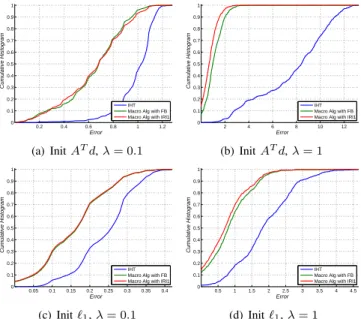
experiments conducted in [1, §5.1] are reported on Fig 1.
We can see the interesting behaviour of the proposed macro
algorithm which converges to (local) minimizers of Gℓ0 with
a lower function value than those obtained with IHT. This shows that the macro algorithm is more “robust” against local
minimizers of Gℓ0 than IHT.
0.2 0.4 0.6 0.8 1 1.2 0 0.1 0.2 0.3 0.4 0.5 0.6 0.7 0.8 0.9 1 Cumulative Histogram Error IHT Macro Alg with FB Macro Alg with IRl1
(a) Init AT d, λ= 0.1 2 4 6 8 10 12 0 0.1 0.2 0.3 0.4 0.5 0.6 0.7 0.8 0.9 1 Cumulative Histogram Error IHT Macro Alg with FB Macro Alg with IRl1
(b) Init AT d, λ= 1 0.05 0.1 0.15 0.2 0.25 0.3 0.35 0.4 0 0.1 0.2 0.3 0.4 0.5 0.6 0.7 0.8 0.9 1 Cumulative Histogram Error IHT Macro Alg with FB Macro Alg with IRl1
(c) Init ℓ1, λ= 0.1 0.5 1 1.5 2 2.5 3 3.5 4 4.5 0 0.1 0.2 0.3 0.4 0.5 0.6 0.7 0.8 0.9 1 Cumulative Histogram Error IHT Macro Alg with FB Macro Alg with IRl1
(d) Init ℓ1, λ= 1
Fig. 1. Cumulative histograms of the error|Gℓ0(ˆx) − Gℓ0(x
⋆
)| where ˆx is the estimated solution andx⋆
is a global minimizer ofGℓ0. The histograms
are computed from1000 random matrices A ∈ R7×15
and d∈ R7 generated from an uniform distribution (the random seed is fixed at the same value for the four configurations (Init, λ) in order to generate the same sequence of problems). Two different initializations are considered:x0
= AT d (Init ATd) and
x0
= xℓ1 (Init ℓ1) the solution of the ℓ1 relaxed problem. The
experiment is repeated for two values of λ (0.1 and 1). For each configuration the estimation is performed using the IHT algorithm (blue) and the macro algorithm combined with IRL1 (red) or FBS (green).
The theoretical analysis of the proposed tight continuous
relaxation GCEL0 of Gℓ0 and the numerical experiments
con-ducted on low dimensional examples are promising for the development of new algorithms to deal with problem (1) taking
benefit from the nice properties of theGCEL0 functional.
REFERENCES
[1] E. Soubies, L. Blanc-F´eraud, and G. Aubert, “A Continuous Exact ℓ0 penalty (CEL0) for least squares regularized problems,” Preprint
hal-01102492, 2015.
[2] D. L. Donoho, “For most large underdetermined systems of linear equations the minimal ℓ1-norm solution is also the sparsest solution,”
Communications on Pure and Applied Mathematics, vol. 59, no. 6, pp. 797–829, 2006.
[3] V. N. Temlyakov, “Greedy approximation,” Acta Numerica, vol. 17, pp. 235–409, 2008.
[4] H. A. Le Thi, H. M. Le, and T. P. Dinh, “Feature selection in machine learning: an exact penalty approach using a difference of convex function algorithm,” Machine Learning, pp. 1–24, 2014.
[5] T. Blumensath and M. E. Davies, “Iterative thresholding for sparse approximations,” Journal of Fourier Analysis and Applications, vol. 14, no. 5-6, pp. 629–654, 2008.
[6] M. Nikolova, “Description of the minimizers of least squares regularized with ℓ0-norm. Uniqueness of the global minimizer,” SIAM Journal on
Imaging Sciences, vol. 6, no. 2, pp. 904–937, 2013.
[7] P. Ochs, A. Dosovitskiy, T. Brox, and T. Pock, “On Iteratively Reweighted Algorithms for Nonsmooth Nonconvex Optimization in Computer Vi-sion,” SIAM Journal on Imaging Sciences, vol. 8, no. 1, pp. 331–372, 2015.
[8] H. Attouch, J. Bolte, and B. F. Svaiter, “Convergence of descent methods for semi-algebraic and tame problems: proximal algorithms, forward-backward splitting, and regularized gaussseidel methods,” Mathematical