HAL Id: hal-01417793
https://hal.archives-ouvertes.fr/hal-01417793
Submitted on 15 Dec 2016
HAL is a multi-disciplinary open access
archive for the deposit and dissemination of
sci-entific research documents, whether they are
pub-lished or not. The documents may come from
teaching and research institutions in France or
abroad, or from public or private research centers.
L’archive ouverte pluridisciplinaire HAL, est
destinée au dépôt et à la diffusion de documents
scientifiques de niveau recherche, publiés ou non,
émanant des établissements d’enseignement et de
recherche français ou étrangers, des laboratoires
publics ou privés.
SOFYA: Semantic on-the-fly Relation Alignment
Maria Koutraki, Nicoleta Preda, Dan Vodislav
To cite this version:
Maria Koutraki, Nicoleta Preda, Dan Vodislav. SOFYA: Semantic on-the-fly Relation Alignment.
EDBT 2016, 2016, Bordeaux, France. pp.690-691, �10.5441/002/edbt.2016.89�. �hal-01417793�
SOFYA: Semantic on-the-fly Relation Alignment
Maria Koutraki
University of Versailles France[email protected]
Nicoleta Preda
University of Versailles France[email protected]
Dan Vodislav
University of Cergy-Pontoise France[email protected]
ABSTRACT
Recent years have seen the rise of Web data, in particular Linked Data, with, up to now, more than 1000 datasets in the Linked Open Data Cloud (LOD). These datasets are mostly of entity-centric na-ture and are highly heterogeneous in terms of domains, language, schema, etc. Hence, the vision of uniformly querying such re-sources in the LOD has a long way to go. While equivalent entity instancesacross datasets are often linked by sameAs links, rela-tionsfrom different datasets and schemas are usually not aligned.
In this paper, we propose an on-line instance-based relation alignment approach. The alignment may be performed during query execution and requires partial information from the datasets. We align relations to a target dataset using association rule mining approaches. We sample for equivalent entity instances with two main sampling strategies. Preliminary experiments, show that we are able to align relations with high accuracy, even if accessing the entire datasets is impossible or impractical.
1.
INTRODUCTION
As of April 2015, the publicly accessible part of the LOD project counts more than 1000 knowledge bases (KB), which together store more than 30 billion facts. The datasets span across different do-mains, such as social Web, government data, geographic data, or the life sciences. Many of these KBs can be accessed through a SPARQL endpoint. However, the datasets are highly heterogeneous in terms of schemas, of quality of the data, and only 2% of the schemas are aligned to other KBs [6].
Motivation. Successful examples include well known knowl-edge bases like DBpedia, YAGO, and Freebase, which com-prise factual statements about real world entities. These facts are typically stored as triples hsubject, relation, objecti (e.g hFrank_Sinatra, wasBornIn, USAi). Yet, even for such KBs, the same entity can have different identifiers (e.g. Frank_Sinatra_(Singer) or Sinatra). Similarly, equivalent relations across KBs use different names (e.g., wasBornIn and bornInCountry), hence makes them non-interoperable, such that queries cannot join information across KBs.
Challenges. Several approaches have been proposed to align re-lations across datasets [9, 7, 3], but in all these cases alignment is performed on the entire KB snapshot. In the real world, however,
ACM ISBN 978-1-4503-2138-9. DOI:10.1145/1235
one may not always have access to the entire dataset. First, KBs are typically quite large (e.g. YAGO, requires 100GB of space on disk), and it is rather impractical to download several entire KBs just to answer a single query. Second, performing relation alignment on KB snapshots, may miss out KB updates. For time-sensitive data, it is better to query the data dynamically. Finally, not all KBs can be freely downloaded. Some providers allow users to issue a lim-ited number of queries to KB via a SPARQL endpoint, but do not allow them to download the entire dataset. In this line, [5] focus on discovering schema alignment on data streams, however, this does not represent any guarantee that one can align any relation given the stream of data.
Contributions. In this paper, we propose an instance-based on-the-flyapproach for relation alignment between two KBs. Our method requires only a SPARQL endpoint for each dataset. Given a relation name in a source KB, e.g. coming from a query on that KB, our method automatically finds corresponding relations in the target dataset, without any need to download the data. Since our method works with few queries, it could be used at query time.
The main idea behind our approach is to use samples of data from both KBs in order to identify candidate relations, then rely on inductive logic programming (ILP) to validate them. Existing work [1, 8], use ILP to mine rules in order to align hierarchies of entities. We go beyond this goal, and want to express more complex mappings, by mining logical rules such as kb1:wasBornIn(x, y) ⇒ kb2:bornInCountry(x, y).
In particular, we perform two types of alignments, subsumption and equivalence, which can be expressed as logical rules. However, as we will show below, such rules cannot be solely mined with standard ILP approaches from small samples of instances. Hence, we develop smart sampling methodologies that are geared to this type of problems. Experiments with real-world datasets show that we can align relations with more than 90% precision, based on only very small samples.
2.
APPROACH
2.1
Rule Mining
Given two KBs K and K0, a relation r in K and the set E of sameAs entity equivalences, we want to find rules r0in K0 sub-sumed by r, i.e. r0⇒ r. Candidate relations r0may be found by sampling r(x, y), then considering all r0such that r0(x, y) for some sample. Equivalence of relations is expressed as a double subsump-tion: r0⇔ r, iff r0⇒ r and r ⇒ r0.
In this work we use two ILP techniques to validate subsumption between relations. A vanilla association rule mining approach [2] could simply regard all absent data as counter-examples (closed world assumption), which yields the following confidence measure:
cwacon f(r0⇒ r) :=#(x, y) : r
0(x, y) ∧ r(x, y)
where #(x, y) :A is the number of pairs (x,y) that fulfill A . The second technique [4], works under a open world assumption and considers that a KB knows either all or none of the r-attributes of some x. In this case, we count as counter-examples for a rule r0(x, y) ⇒ r(x, y) only instances (x, y) such that x has r relations, but not r(x, y). The confidence measure is:
pcacon f(r0⇒ r) := #(x, y) : r
0(x, y) ∧ r(x, y)
#(x, y) : ∃y0: r0(x, y) ∧ r(x, y0) (2)
2.2
Instance Sampling
Simple Sample Extraction. We propose a baseline solution that computes a (pseudo-) random set of samples to check if a candidate relation rsubfrom K0satisfies rsub⇒ r. First, we extract from K0a
set of samples entities that are subjects in rsubfacts:
Srsub= {x1| rsub(x1, y1) ∈ K
0, ∃x
2, y2∈ K : x1≡ x2∧ y1≡ y2}
The same query extracts the actual rsubfacts where the sample
en-tities occur. More precisely, it extracts the set: K0rsub
S = {rsub(x1, y1) |x1∈ Srsub∧ rsub(x1, y1) ∈ K
0}
The actual SPARQL queries that are used to extract the two sets depend on the nature of the relation rsub. For entity-entity
rela-tions, we select for a subject x1 all the facts rsubfor which there
are sameAs links to entities in K for both the subject and the ob-ject. Since we do not want to punish the score of the alignment because of incomplete information, we ignore the rsubfacts where
the sameAs links to entities in K are missing.
In the next step the subject and the object of a rsubare translated
to the equivalent entities in K and create the set: Prsub
S = {(x2, y2) | ∃x1, y1: x2≡ x1, y2≡ y1, rsub(x1, y1) ∈ KS0rsub}
then corresponding r instances are extracted: Krsub
S = {r(x2, y2) | r(x2, y2) ∈ K, ∃y02: (x2, y02) ∈ P rsub
S ∧ r(x2, y02)}
Note that if for some pair (x2, y02) from P rsub
S a fact r(x2, y02) is
dis-covered in K, then we need to select all the other facts r(x2, y2) of
x2. This is required by the pcaconf measure. For simplicity, in this
presentation we assumed that the inverse relations have been added to the two KBs. This is why we only consider direct relations.
If rsubis an entity-literal relation, we retrieve from K facts of
the samples Srsub and apply string similarity functions to align the
literals. Once the sets K0rsub
S and K rsub
S are retrieved, we can run the
pcaconfand the cwaconf scores on the coalesce of the two sets. Unbiased Sample Extraction (UBS). The random selection of the samples is a fair objective approach, but several cases require a more careful selection of unbiased samples when using pcaconf.
Mining subsumptions that are not equivalences. Con-sider the example of a mined subsumption K’:composerOf ⇒ K:creatorOf. When checking the reverse implication to test equivalence, if the sample includes composers that only created musical compositions, we will find that the two relations are equiv-alent under pcaconf, while if a composer is also a writer the reverse implication is false. A way to avoid such missing samples is to dis-cover in K0a relation subsumed by K:creatorOf whose domain overlaps with the domain of K’:composerOf. For instance, we can take the relation K’:writerOf and consider for sampling the composers that are also writers.
Mining overlappings that are not subsumptions. Consider in K0the relations hasDirector for movies and their directors and hasProducer for movies and their producers, then in K the rela-tion directedBy for movies and their directors. Since it often hap-pens that the same person directs and produces the same movie, we might wrongly infer that K’:hasProducer ⇒ K:directedBy. To filter out such cases even under pcaconf, we may include in the sample movies whose producer and director are different.
To deal with both unbiased samples cases above, our method lays on candidate relations K0: r0and K0: r00, subsumed by K : r for simple samples. Unbiased samples will include facts for K0: r0and K0: r00that share the same subjects but have different objects.
More precisely, unbiased samples would contain x such as r0(x, y1), r00(x, y2), ¬r0(x, y2). In the first case, the existence of
r(x, y1) and r(x, y2) filters out the wrong equivalence. In the
sec-ond one, the csec-ondition to filter out the wrong subsumption is to have r(x, y1) but not r(x, y2). We used here the same identifiers for
equivalent entities in K and K0.
3.
EXPERIMENTAL EVALUATION
Datasets. We conduct our experiments on two KBs, with 92 relations from YAGO2 and 1313 relations from DBpedia.
Baselines. As baseline solution we consider the (pseudo) ran-dom selection of Simple Sample Extraction described in Section 2. On the coalesce of the sets of samples retrieved from the two KBs, we have run the two ILP techniques cwaconf and pcaconf.
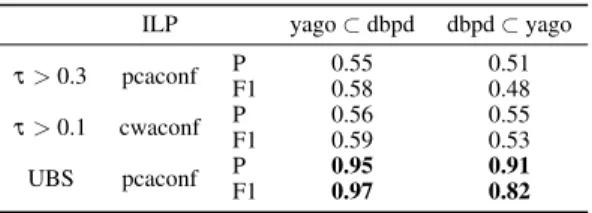
We evaluate the algorithms for a sample size of 10 samples (sub-ject entities). Table 1 reports our preliminary results. For the two measures cwaconf and pcaconf, we have selected the thresholds τ that led to the highest average F1 score for both ways implications, yago⊂ dbpd and dbpd ⊂ yago.
Unbiased Sample Extraction. The method that we propose ex-tends the baseline solution of pcaconf by implementing the two strategies for filtering wrong candidates. To eliminate a “wrong" relation we need only one case which shows that there is a contra-diction. The results of this method are indicated by the label UBS in Table 1. The results suggest that our method consistently prunes wrong candidates.
Table 1:Alignment subsumptions – YAGO and DBpedia relations ILP yago ⊂ dbpd dbpd ⊂ yago τ > 0.3 pcaconf P 0.55 0.51 F1 0.58 0.48 τ > 0.1 cwaconf PF1 0.560.59 0.550.53 UBS pcaconf P 0.95 0.91 F1 0.97 0.82
4.
REFERENCES
[1] J. David, F. Guillet, and H. Briand. Association rule ontology matching approach. Int. J. Semantic Web Inf. Syst., 3(2), 2007. [2] L. Dehaspe and H. Toivonen. Discovery of frequent datalog
patterns. Data Min. Knowl. Discov., 3(1), 1999.
[3] L. Galárraga, N. Preda, and F. M. Suchanek. Mining rules to align knowledge bases. In AKBC, 2013.
[4] L. Galárraga, C. Teflioudi, K. Hose, and F. M. Suchanek. Amie: association rule mining under incomplete evidence in ontological knowledge bases. In WWW, 2013.
[5] S. Jaroszewicz, L. Ivantysynova, and T. Scheffer. Schema matching on streams with accuracy guarantees. Intell. Data Anal., 2008.
[6] M. Schmachtenberg, C. Bizer, and H. Paulheim. Adoption of the linked data best practices in different topical domains. In The Semantic Web–ISWC 2014. 2014.
[7] F. M. Suchanek, S. Abiteboul, and P. Senellart. Paris: Probabilistic alignment of relations, instances, and schema. PVLDB, 5(3), 2011.
[8] C. Tatsiopoulos and B. Boutsinas. Ontology mapping based on association rule mining. In ICEIS (3), 2009.
[9] O. Udrea, L. Getoor, and R. J. Miller. Leveraging data and structure in ontology integration. In SIGMOD, 2007.