J
OURNAL DE
T
HÉORIE DES
N
OMBRES DE
B
ORDEAUX
K
U
-Y
OUNG
C
HANG
S
OUN
-H
I
K
WON
The imaginary abelian number fields with class numbers
equal to their genus class numbers
Journal de Théorie des Nombres de Bordeaux, tome
12, n
o2 (2000),
p. 349-365
<http://www.numdam.org/item?id=JTNB_2000__12_2_349_0>
© Université Bordeaux 1, 2000, tous droits réservés.
L’accès aux archives de la revue « Journal de Théorie des Nombres de Bordeaux » (http://jtnb.cedram.org/) implique l’accord avec les condi-tions générales d’utilisation (http://www.numdam.org/conditions). Toute uti-lisation commerciale ou impression systématique est constitutive d’une infraction pénale. Toute copie ou impression de ce fichier doit conte-nir la présente mention de copyright.
Article numérisé dans le cadre du programme Numérisation de documents anciens mathématiques
The
imaginary
abelian number fields with class
numbers
equal
to
their
genus
class numbers
par KU-YOUNG CHANG et SOUN-HI KWON
RÉSUMÉ. Titre
français :
Sur les corps abéliens dont le nombre de classes estégal
au nombre de genres.Nous savons
qu’il
n’existequ’un
nombre fini de corps abéliensimaginaires
pourlesquels
le nombre de classes estégal
au nombre de genres. Ceux de ces corps qui sontcycliques
et nonquadra-tiques ont été classés dans
[Lou2,4]
et dans[CK].
Dans cetarti-cle,
nous déterminons tous les corps abéliens noncycliques
dont le nombre de classes estégal
au nombre de genres. Cela achève la classification des corps abélienspossédant
une classe par genre,sauf dans le cas des corps
quadratiques
imaginaires.ABSTRACT. We know that there exist
only
finitely
many imagi-nary abelian number fields with class numbersequal
to their genus class numbers. Suchnon-quadratic cyclic
number fields arecom-pletely
determined in[Lou2,4]
and[CK].
In this paper we de-termine allnon-cyclic
abelian number fields with class numbersequal
to their genus classnumbers,
thus the one class in eachgenus
problem
issolved, except
for the imaginaryquadratic
num-ber fields.1. Introduction
For an abelian number field N the narrow genus field
GN
of N is the maximal abelian number fieldcontaining
N such that the extensionGN/N
is unramified at all finiteplaces.
Thedegree
~GN : N]
is called the genus class number of N and is denotedby
gN . The genus class number of N is easy todetermine,
namely,
gN = where ep is theramifica-tion index of p in N. In
particular,
when N isimaginary,
the genus field of N is contained in the Hilbert class field ofN,
whence gN divides the class number of N. In[Loul],
Louboutin hasproved
that there existonly
finitely
manyimaginary
abelian number fields with class numbersequal
towith class numbers
equal
to their genus numbers have beenrecently
classi-fied ([Lou2, 4], [CK]).
It is known that under a suitablegeneralized
RiemannHypothesis,
there areexactly
65imaginary
quadratic
number fields with class numbersequal
to their genusnumbers([We]
and[Lou5]).
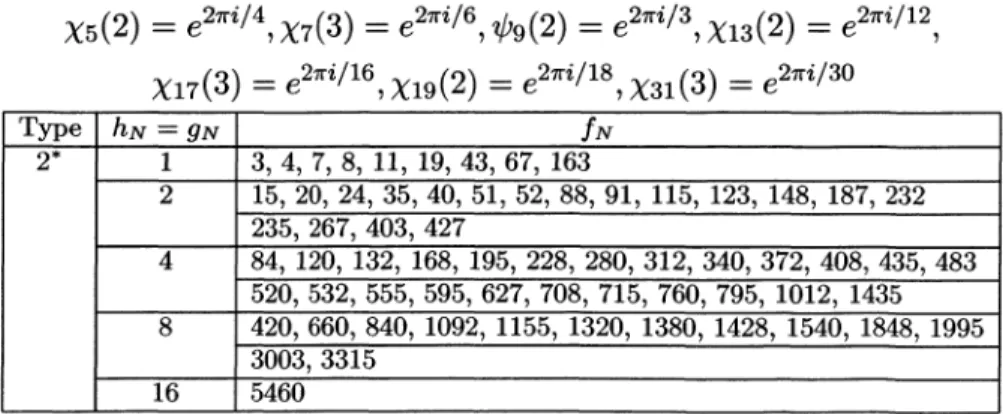
These fieldsare listed in Table I. The aim of this paper is to prove the
following
result: Theorem 1. There areexactly
424 imaginary
non-quadratic
abeliannum-ber
fields
with class numbersequal
to their genus class numbers:77 outof
them are
cycdic
and347
arenon-cyclic.
Theirdegrees
are less than orequal
to
24,
their class numbers are1, 2
or4.
The conductorsof
thesefields
areless than or
equal
to 65689. Thesefields
are listed in tables at the endof
this paper.
We note that in
[M]
under theassumption
of the Generalized RiemannHypothesis, Miyada
has determined allimaginary
abelian number fieldsN with class numbers
equal
to their genus class numbers such that the Galois groups areelementary
2-groups.
(There
seems to be onemisprint
in
[M,
Table2]:
the field K= Q
(~/~2,
V-37)
appearstwice,
i.e. for9K
= hK
= 1 and forgK
= hK
= 2. Infact,
gK
= hK
=2.)
However,
we do not need any
assumption
for theproof
of Theorem 1. This paperis
organized
in thefollowing
way. Section 2presents
some well-knownfacts on
imaginary
abelian number fields. In Section 3 we illustrate ourcomputations.
Throughout
this paper thefollowing
notation will be used.For an
imaginary
abelian number fieldK,
letK+,
fK,
hK,
Wx,GK,
9K,hK,
QK
be the maximal realsubfield,
theconductor,
the classnumber,
the number of roots ofunity
inK,
the genusfield,
the genus classnumber,
the relative class number and the Hasse unit index ofK,
respectively.
For anodd
prime
p let Xp be an odd Dirichlet character of conductor p, ofdegree
p - 1. When p >
2,
letqbpp
be an evenprimitive
Dirichlet character ofconductor
pP,
of order with = For theprime
p =
2,
let X4be the odd Dirichlet
quadratic
character of conductor 4. Whenp > 3,
let02P
be an evenprimitive
Dirichlet character of conductor2P,
of order2p-2
with
9)p
=2. Preliminaries
In this section we review some well-known facts
concerning imaginary
abelian number fields.
Proposition
1.(1)
Let F be an abelian numberfield. If
hF
=gF, then
hM
=gM
for
anysubfield
Mof
F.(2)
Let F be animaginary
abelian numberfield,
XF the groupof
primitive
Dirichlet characters associated to F and
XF
the subsetof
X E XF such thatX( -1) =
-1. For a X EXF let us
denote the conductorof
Xby
fx.
We have(3)
If F is
animaginary
cyclic
numberfield,
thenQF =
1. Let F c Kbe the two
CM-fields.
If
(K : F]
isodd,
thenQK
=QF.
(4)
Let F be animaginary
cyclic
numberfield of degree
2m.If
hF
= gF,then
Proof.
(1)
See Lemma 1 in[M]. (2)
See Theorem 4.17 in[W]. (3)
For the first statement see Satz 24 in[H].
For the second statement see Lemma 2in
[HY1]. (4)
See[Lou2
and4]
and(CK~ .
D3. Proof of Theorem 1
Let N be an
imaginary
abelian number field with Galois group G. Whensay N is of
type
(pP, 1, - - - ,
p2 i, - - - ).
In addition weput *
when thecorresponding
subfield isimaginary.
Forexample,
if N isof
type
(4*, 2),
then N is thecompositum
of animaginary
cyclic
quartic
field
Ml
and a realquadratic
fieldM2
withMl
nM2 = Q.
Then themaximal real subfield N+ is of
type
(2,2).
If N is oftype
(4*, 2*),
then N isthe
compositum
of animaginary
cyclic
quartic
fieldMl
and animaginary
quadratic
fieldM2 .
In this case,N+
is oftype
(4).
A field N oftype
(2*, 2, 2)
can be either oftype
(2*, 2*, 2)
or(2*,
2*,
2*).
However weprefer
to say that N is of
type
(2*, 2*, 2*)
with as many aspossible *
for a technicalreason to be seen later.
Let N be an
imaginary
abelian number field oftype
(2m*,
,2m:,
nl , Inr)
with ml 2: ... 2 ms. We may assume 2ms for n2 whichis a
2-power.
In order to describe N wegive
the associated group ofDirich-let characters
(71,... ,
Ts , ~p 1, - - - , Here -rl, - - - , Ts are oddprimitive
Dirichlet characters of order for 1 i s and Wl, - - - , cpr are the even
primitive
Dirichlet characters of order nj for1 ~ j ~
r. For eachprime
plet
G(P)
be thep-Sylow subgroup
of G. LetN(2)
be the maximal subfield ofN of
2-power
degree.
The scheme of ourproof
of Theorem 1 is as follows.In 3.1 we determine all
imaginary
abelian number fields N withhN
= gNsuch that
G~2~
is anelementary 2-group.
According
to Theorem 2below,
if
G~2~
is anelementary
2-group,
then the 2-rank ofG (2)
is less than orequal
to 3. In 3.2 we determine allimaginary
abelian number fields N withhN
=gN such that
N (2)
is oftype
(2’ni ,
2 M2)
with mi > m2 2: 1. Moreoverwe prove that if N is an
imaginary
abelian number field withhN -
gN,then 2-rank of
G (2)
is less than orequal
to 3. If it isequal
to3,
thenG~2~
isnumber fields N with such that
N(2)
is oftype
(2’~i , 2’~l )
withml 2: 2 and ml 2: m2.
Finally
it remains to determine all fields N withhN
= 9N such thatN~2~ _
(4*, 2*, 2*).
These fields are treated in 3.4. Ourdeterminations
rely
on thecomputations
of the relative class numbersh jo
of N. The class numbers
hN+
ofN+
which we need are known in~G~ , ~L~ ,
[Ma]
and[Mä].
In theremaining
part
of this paper we saybriefly
"characterof order m" instead of
"primitive
Dirichlet character of order m" .3.1.
N(2)
is oftype
(2~,... 2*).
Proposition
2. Let N be animaginary
abeliannumber field,
G the Galoisgroup
of
N /Q.
Assume that G is notcyclic
and that the2-Sylow subgroup
of G is cyclic. If hN
=gN, then N is
of type
(2*, 3, 3)
and N is associatedwith
(X3~9,~)’
·Proof.
First,
we claim that ifhN -
9N, then N is oftype
(2~3, -"
~3).
According
to[CK]
there are 4imaginary
cyclic
number fields ofdegree
10with class numbers
equal
to their genus class numbers.By Proposition
I . ( I )
we cannot have a field N with
hN
= 9N such that N is oftype
(2*, 5, 5).
By
the same
argument
if N is oftype
(2*, 7, 7),
(2*, 9, 9),
(4*, 3, 3)
or(4*, 5, 5),
then gN .
According
toProposition
1. ( 1 )
it follows that ifhN
=9N,
then N is of
type
(2*, 3,’-’ ,3).
Let us now consider with the fields oftype
(2*, 3, 3).
Let x
be an oddquadratic
character,
two cubiccharacters,
N the field associated with(x,
~2)-
LetMi, M2, M3
andM4
be the subfields associated with and(X, ’P2),
respectively.
The fact thathN
implies
thathMi
= gM; for 1 ~ i ~ 4.According
to(Lou4) ,
there isonly
one N such that N = with9Mi for
1 ~
i ~ 4. Thatis,
N =MiM2M3M4 = MiA/2,
whereMl, M2, M3
andM4
are associated with(x3~9~(X3,X~:B:3~~9~
and(X3?X~)
respectively.
Weverify
that this field hashN
=9N = 1. Since
there is
only
one field oftype
(2*,
3, 3)
with class numberequal
to its genusclass
number,
there is no field oftype
(2*,3,3...3),
ofdegree 2:
54 withclass number
equal
to its genus class number. DTheorem 2. Let N be an
imaginary
abelian numberfield
such that theGalois group G is an
elementary 2-group.
Assume that 9N =hN .
Then wehave
, , __ - , - o
Proof.
See Theorem 1 in[M].
DProposition
3.(1)
Let N be animaginary
bicyclic biquadratic
numberfield
and letkl
andk2
be twoimaginary
quadratic subfields. If
hN
=(2)
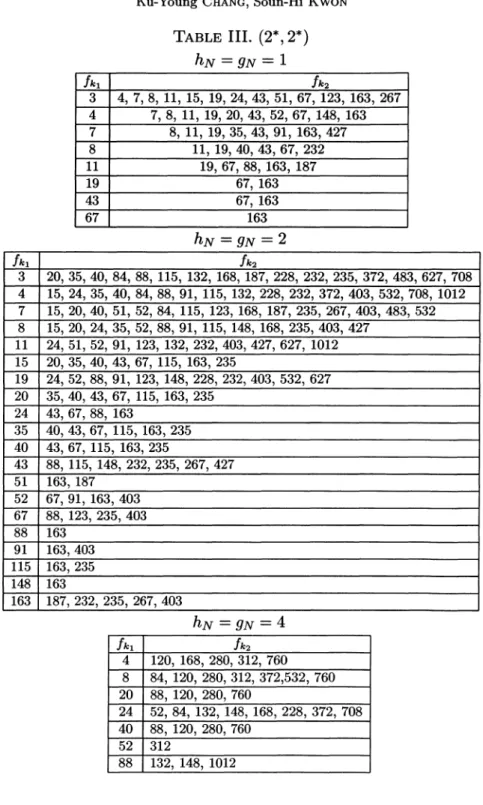
There areexactly
219bicyclic biquadratic
numberfields
with classnumbers
equal
to their genus class numbers. Thesefields
are listed inTable III.
(3)
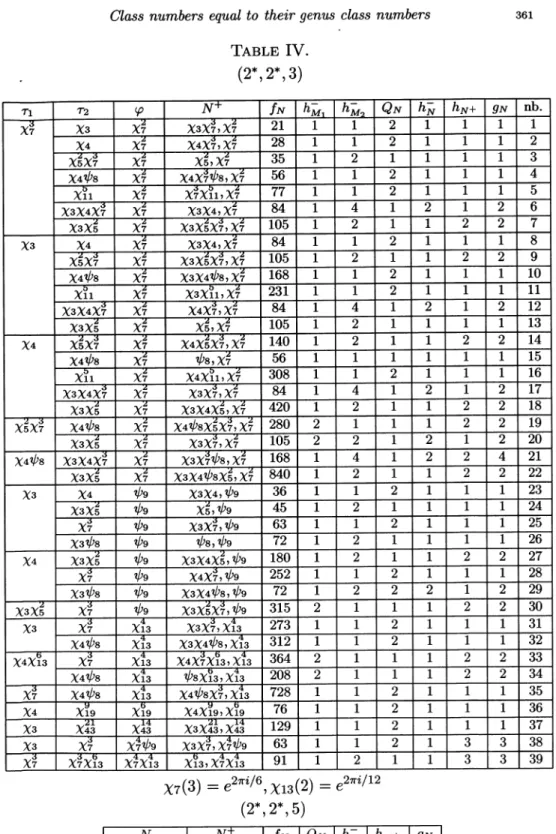
There existexactly
42 imaginary
abelian numberfields
Nof degree
> 4 with class numbers
equdl to
their genus numbers such thatN (2)
is
of
type
(2*,
2*).
Thesefields
are listed in Table IV.Proof.
(1)
Suppose
thathN
= gN and 8. SincehN =
9.¡-hkl hk2’
we must have
4,
QN =
1,
8,
hk2 = 1
andh~,+ =
1.By
[Corollary
1,
M],
there exist at most three rationalprimes
ramifiedin N. The fact that
hN
=9N = 4
= ~
IT
ep
implies
that there existexactly
three ramifiedprimes
including
2 with e2 = 4. This leads acontradiction. Since the fact that e2 =
4,
hk2
= 1 andhN+
= 1implies
k2 E
and N+ E
with p == 1 mod
4,
there exist at most two ramifiedprimes
in N =k2N+.
(2)
There are 81imaginary quadratic
number fields with class numbers1,
2 or
4(~51,2~
and[A]).
Among
these 81 fields there are 51 fields withclass numbers
equal
to their genus class numbers. In order toget
allbicyclic
biquadratic
number fields with class numbersequal
to theirgenus class numbers it is sufficient to examine the
composita
of two of those 51quadratic
fields. Note that we do not assume the GeneralizedRiemann
Hypothesis.
(3)
Let N be animaginary
abelian number fields ofdegree >
4. Assumethat
hN
=gN and is of
type
(2*, 2*).
Bearing
in mind theimaginary
cyclic
fields with class numbersequal
to their genus class numbers andProposition
2 it remains to consider the fields N oftype
(2*, 2*, 3)
or(2*, 2*, 5).
i)
Let Tl, T2 be two oddquadratic characters,
cp a cubiccharacters,
Nthe field associated with
(Tl, T2, p) .
LetMl
andM2
be theimag-inary
sextic subfields associated with and(T2, W),
respec-tively.
Let E be theimaginary
bicyclic
biquadratic
subfieldasso-ciated with
(Tl, T2),
kl
andk2
theimaginary quadratic
subfields associatedwith 71
and T2,respectively. Using
[Lou4],
we make alist of
(Ml,
M2)’s
such thathMl
=gMl,
hM2
=g,yl2 and
hE
= gE.There are 40
pairs
of(Ml, M2)
satisfying
hm,
=gMl,
h,yl2
=9M2 and
hE
=9E. For these 40 fields we determine
using
the facth-
h-that
hN=
andQN = QE.
The class numbers of WM1 WM2real sextic number fields are known
by
[Mä].
There are 39 fieldsN of
type
(2*, 2*, 3)
withhN
=gnr.
(The
remaining
field isas-sociated with
X51, x7).
This field has class number 3 andii)
By
the same method asi)
weverify
that there are threeimaginary
abelian number fields N of
type
(2*,
2*,
5)
withhN
= gN.D
Proposition
4. There areexactly
19imaginary
abelian numberfields
Nwith class numbers
equal
to their genus class numbers such that thesubfield
N (2) is
type
of
(2*, 2*,
2*).
There areexactly
17fields of
type
(2*, 2*, 2*),
and two
fields of
type
(2*,
2*, 2*,
3).
Thesefields
are listed in Table V.Proof.
Let N be animaginary
abelian number field N with classnum-ber
equal
to its genus class number such that the subfieldN (2)
istype
of(2*,
2*,
2*).
According
to[Lou4]
and[CK],
if p >
11,
thenG(P)
is trivial. Let usbegin
with the fields oftype
(2*, 2*, 2*).
If N is of
type
(2*, 2*, 2*)
and ifhN
=9N, then
hN
= 1 or 2.Let
~2, k3
andk4
be the fourimaginary
quadratic
subfields of N. SincehN =
wherehi
=hz
and wi
is the number of roots ofN i= Wi
unity in ki
for i=1, 2, 3
and4,
there are at least threeimaginary quadratic
subfields ki
with 4 among the fourimaginary
quadratic
subfields of N. It remains us to consider thecomposita klk2k3
of threeimaginary
quadratic
subfields ki
with class numbers1,
2 or4,
i =1, 2
and 3. Thereare 18
composita
N =ki k2k3
satisfying
thefollowing:
i)
hki
=1, 2
or 4 for i=1, 2, 3.
ii) hki
for i= 1,2,3.
iii)
For the siximaginary
bicyclic biquadratic
subfields M of N we havehM
=9M.
Computing
the unit indicesQN by
[HY3]
andhN+
by
[Satz
5,
K]
for these 18 fieldsN,
weverify
that there areexactly
17 octic fields N withhN
= gN.Consider now the fields of
type
(2*,
2*, 2*,
3).
Let 71,72,73 be threeodd
quadratic characters, cp
a cubiccharacter,
N the field associated with(71,72,73,
LetMl, M2, M3
andM4
be the fourimaginary
sextic sub-fields of N associated with(7i,~),(72~)?(73,~),
andrespec-tively.
Let E be the subfield associated with(Tl, T2, T3~.
According
to[Lou4],
there areonly
two fields N such thath~2
=gM2 for 1 i 4 and
hE
=gE. For these two fields we
compute
hN
andhN+ .
The results aresummarized in Table V.
Finally,
it is sufficient to notice that there is no field N oftype
(2*, 2*, 2*, 5)
withhN
= gN. DProposition
5.(1)
There are 15imaginary
abelian numberfields of
type
(4*,
2)
with class numbersequal
to their genus class numbers. These(2)
Let m be an oddinteger
with m > 3. There is noimaginary
abeliannumber
field of degree
8m with class numberequal
to its genus class number such that thesubfield N (2)
isof
type
(4*, 2).
(3)
There is nofield of
type
(8*, 2)
with class numberequal
to its genusclass number. There is no
field of
type
(16*, 2)
with class numberequal
to its genus class number.Consequently, if
N is animaginary
abelian nurrzber
field
withhN
= gN such that thesubfield N (2)
isof
type
(2’"’~i, 2’"’’2)
with ml > m2 >1,
then N isof
type
(4*, 2).
(4)
There is noimaginary
abelian numberfield of
type
(4*,
2,
2)
with classnumber
equal
to its genus class number.(5)
If
N is animaginary
abelian numberfield
withhN
= gN, then the2-rank
of C(2)
is less than orequal
to 3.Moreover,
if
the 2-rankof
C(2)
isequal
to3,
, thenG(2) =
(2*,
2*,
2*)
or(4*,
2*,
2*).
-Proof.
(1)
Let cp be an oddprimitive
character of order4,
X an evenprimitive
quadratic
character,
N the associated field with(rp, X).
LetMl
andM2
be twoimaginary
cyclic
quartic
subfields of N associated with(cp)
and(CPx),
respectively.
The realquadratic
subfields ofMi
andM2
coincide. In order to obtain N withhN
=gN it is sufficient to
consider the
composita
Ml M2
such thathMl
=gMl and
hM2
=There are 35 fields N such that N =
MlM2,
hMl
=9Ml and
hM2
=9M2. The Hasse unit indices
Qnr
areeasily
obtained from Sätze 15and 22 of
[H].
The relative class numberhN
can beexpressed
asThe class number
hN+
can becomputed
following
~K~ .
It remains 15fields N such that
hN
=gN.
Similarly
weverify
(3).
(2)
Let N be animaginary
abelian number field ofdegree
8rrL, containing
a subfield oftype
(4*, 2).
Suppose
hN
=gN.
According
to[CK],
we have m = 3. Let
p, x and w be an odd character of order
4,
aneven
quadratic
character and a cubiccharacter,
respectively.
Assumethat N is associated with
(p,
X,w).
LetMl
andM2
be the subfields associated with(pw)
and(CPxw),
respectively.
Using
Table II in[CK],
we
verify
that there is nopair
of(Ml, M2)
such thathMl
=gMl and
hM2 =
9M2 - O(4)
Letcp be
an oddprimitive
character of order4,
Xl and x2 two evenprimitive
quadratic
character,
N the associated field withx2~.
LetMl, M2, M3
andM4
be fourimaginary
cyclic
quartic
subfields ofN associated with
(cp~,
(WX1),
(px2)
andrespectively.
The fieldsMi,1 i 4,
have the same realquadratic
subfield.Suppose
that
hN =
gN . Then we havehMi
=gM; , for 1 i
4,hMIM2 =
and
hM3 M4
= Weverify
that there is no suchquadruple
of(Mi,M2,M3,M4).
(5)
By
(3)
and(4)
it is sufhcient toverify
that there is no field N oftype
(4*, 4*, 2*)
withhN -
gN.Suppose
that there is a field N oftype
(4*,
4*,
2*)
withhN
9N. Let cpl and p2 be two oddprimitive
characters of order
4, X
the oddquadratic
character such that N is associated to the group(~pl, ~p2, x) .
Then we would have three fieldsof
type
(4*, 4*)
with class numbersequal
to their genus classnumbers,
i.e. the fields associated with
(Wl,
~p2),
((Pl,
and~cp2,
This contradictsProposition
8. ( 1 )
below.0
3.3. is of
type
(2’ni , 2m2 )
with 2 and m2 ·Bearing
in mindProposition
5.(3)
ifhN =
gN andN(2)
is oftype
(2’ni , 2m*)
with m2 2::2,
then ml =m2 = 2. We need
only
consider N such thatN~2~
is oftype
(4*, 2*), (8*, 2*), (16*, 2*)
or(4*, 4*).
Proposition
6. There exist 39imaginary
abelian numbersfields
N withhN
= gN such that thesubfield N (2)
isof
type
(4*, 2*):
36of
them areof
type
(4*, 2*)
and 3of
them areof
type
(4*,
2*,
3).
Thesefields
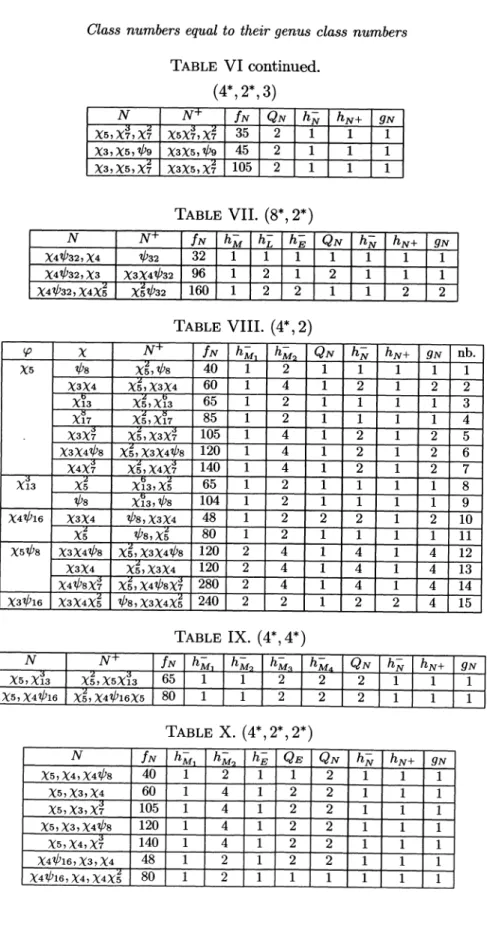
are listed inTable VI.
Proof. According
to[CK],
if N is animaginary
abelian number field withhN
= gN such that the subfieldN (2)
is oftype
(4*, 2*),
then[N : Q]
40. Our firststep
is to determine all fields oftype
(4*, 2*).
Let p be an oddcharacter of order
4, X
an oddquadratic character,
N the field associatedwith
~~p, x) .
Let M be the field associated with(p)
and letki
andk2
be the two
imaginary quadratic
subfields associated with(X)
andrespectively. Using
[Lou2]
we make a list of N such thathM =
gM andhE
=gE, where E is the field associated
(p2,
x .
We use the formula/.... ’B. 7-....
To determine
Qnr
we use the tables in~H~,
[YH1]
and[YH2]
for the fieldsof conductors
200,
and Satze 15 and 22 in[H]
for the fields of conductor > 200. Forexample
let us considerQN
for the field N which is associatedwith
X 3).
We haveN+ = Q
~7
(5
+ and N =N+
(H).
In order to determine
Q N
it is sufficient to know whether theprime
ideal ofN
lying
above 7 isprincipal
or not.Using
the functionIdealIsPrincipal
ofKASH([KT])
we know that thisprime
ideal isprincipal.
Hence we concludethat
QN
= 2. On the otherhand,
the class number of realquartic
fields associated with(cpX)
are knownby
[G].
Using
the above results we caneasily
determine all fields oftype
(4*,
2*,
3)
andverify
that there is no fieldof
type
(4*,
2*,
5)
with class numberequal
to its genus class number. Thecomputational
results arecompiled
in Table VI. DProposition
7.(1)
Let N be animaginary
abedian numbersfield
withhN
=gnr. If
thesubfield N (2)
isof
type
(8*, 2*),
then N isof
type
(8*, 2*).
There exist threeimaginary
abelian numberfields of
type
(8*, 2*)
with class numbersequal to
their genus class numbers. Thesefields
aregiven
in Table VII.(2)
There is noimaginary
numberfield of
type
(16*, 2*)
with class numberequal
to its genus class number.Proof.
(1)
According
to[CK]
we know that for an oddinteger
m > 3 there is noimaginary
cyclic
number field ofdegree
8m with classnumber
equal
to its genus class number. Let cp be an oddchar-acter of order
8, X
an oddquadratic
character,
N the fieldasso-ciated with
(W,X).
LetM, L, F, E, kl,
andk2
be the subfieldsas-sociated with
(W),
(W2X), (W2,
X),
(cp4,
X),
(X)
andrespectively.
By
[Lou2],
Propositions
3 and 6 we have three fields N such thathim
== 9L, and
hE
=9E. These fields are listed in
Table VII.
Using
the formulawe obtain
immediately
The class numbers of realcyclic
fields ofconductor 100 are known
by
[Ma].
The class number of the realabelian number fields of conductor 160 in Table VII is
equal
to 2according
to Theorem 3 of[L].
(2)
It is clear from the fact that there isonly
oneimaginary
cyclic
num-ber field of
degree
16 whose class number isequal
to its genus classnumber ( ~Lou2~ ~ .
D
Proposition
8.(1)
There are twoimaginary
abelian numberfields of
type
(4*, 4*)
with class numbersequal
to their genus class number.These
fields
aregiven
in Table IX.(2)
Let m be an oddinteger
with m > 3. There is noimaginary
abeliannumber
field of degree
l6rrc with class numberequal
to its genus class number such that thesubfield N(2)
isof
type
(4*, 4*).
Proof.
(1)
Let cpl and p2 be two oddquartic
characters,
N the fieldasso-ciated with
(Wl, W2).
LetMl, M2, M3
andM4
be the fields associated with((Pl), ((P2),
and(cpicp2),
respectively.
We haveonly
twofields N such that
hMz
=gmi for 1 i
4,
hJB11M3
=9MIM3 and
hMzM4
=(2)
It followsimmediately
fromProposition
5. (2) .
D 3.4.
N~2~
is oftype
(4*, 2*, 2*).
Proposition
9.(1)
There are 7imaginary
abeliannumber fields of
type
(4*, 2*, 2*)
with class numbersequal
to their genus class numbers. Thesefields
aregiven
in Table X.(2)
Let m be an oddinteger >
3. There is noimaginary
numberfield of
degree
16m with class numberequal
to its genus class number such that thesubfield N(2)
isof
type
(4*, 2*, 2*).
Proof.
(1)
Let cp
be an odd character of order4,
X, and x2 two oddquadratic
characters,
N the field associated with LetMl, M2, Fl, F2, L and
E be theimaginary
subfields associated with~~P~ ~
xl>
>x2>
>XlX2)
and~~2,
Xl,X2),
respectively.
Using
[Lou2],
Propositions
4 and 6 weverify
that there are 7 fieldsN with
hm, =
gmi >hm2 = 9M2’ hFl =
9F2’ hL =
9L andhE
=gE. For these 7 fields we
compute
hN
andhN+ .
Note that(2)
Theproof
of(2)
is similar to that ofProposition
5.(2).
0
To
conclude,
theproof
of Theorem 1 iscompleted by
Propositions
2-9. Allcomputations
were carried outusing
PARI-GP[P]
and KANTV4~KT~.
Acknowledgements.
The authors wish to express theirgratitude
toS. Louboutin and K. Yamamura for
suggesting
theproblem
and for manystimulating
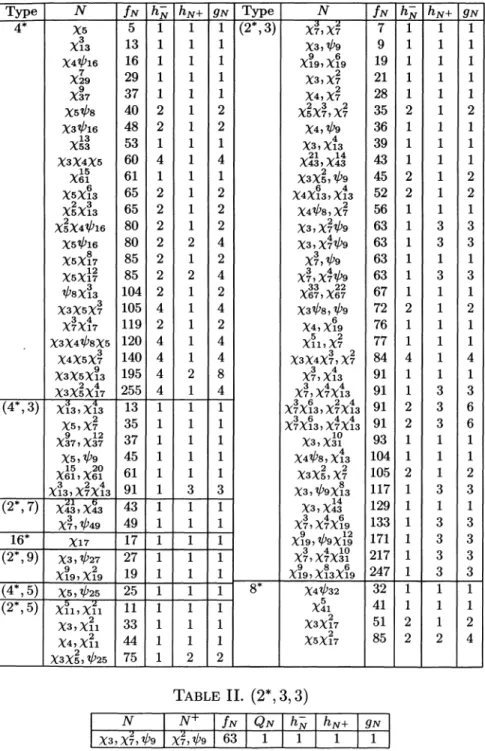
conversations.4. Tables
TABLE I continued.
TABLE V.
TABLE VI continued.
TABLE VI I.
(8*, 2* )
TABLE VIII.
(4*, 2)
TABLE IX.
(4*, 4* )
References
[A] S. ARNO, The imaginary quadratic fields of class number 4. Acta Arith. 60 (1992), 321-334.
[CK] K.-Y. CHANG, S.-H. KWON, On the imaginary cyclic number fields. J. Number Theory
73 (1998), 318-338.
[G] M.-N. GRAS, Classes et unités des extensions cycliques réelles de degré 4 de Q. Ann. Inst. Fourier (Grenoble) 29 (1979), 107-124.
[H] H. HASSE, Über die Klassenzahl abelscher Zahlkörper. Academie-Verlag, Berlin, 1952.
Reprinted with an introduction by J. Martinet: Springer-Verlag, Berlin (1985).
[HY1] M. HIRABAYASHI, K. YOSHINO, Remarks on unit indices of imaginary abelian number
fields. Manuscripta Math. 60 (1988), 423-436.
[HY2] M. HIRABAYASHI, K. YOSHINO, Remarks on unit indices of imaginary abelian number
fields II. Mamuscripta Math. 64 (1989), 235-251.
[HY3] M. HIRABAYASHI, K. YOSHINO, Unit indices of imaginary abelian number fields of type
(2,2,2). J. Number Theory 34 (1990), 346-361.
[K] T. KUBOTA, Über den bizyklischen biquadratischen Zahlkörper. Nagoya Math. J. 10
(1956), 65-85.
[KT] M. DABERKOW, C. FIEKER, J. KLÜNERS, M. POHST, K. ROEGNER, K. WILDANGER, KANT V4 J. Symbolic Comp. 24 (1997), 267-283.
[L] F.. VAN DER LINDEN, Class number computations of real abelian number fields. Math.
Comp. 39 160 (1982), 693-707.
[Lou1] S. LOUBOUTIN, A finiteness theorem for imaginary abelian number fields. Manuscripta Math. 91 (1996), 343-352.
[Lou2] S. LOUBOUTIN, The nonquadratic imaginary cyclic fields of 2-power degrees with class numbers equal to their genus class numbers. Proc. Amer. Math. Soc. 27 (1999), 355-361.
[Lou3] S. LOUBOUTIN, Minoration au point 1 des fonctions L et determination des sextiques
abéliens totalement imaginaires principaux. Acta Arith. 62 (1992), 535-540.
[Lou4] S. LOUBOUTIN, The imaginary cyclic sextic fields with class numbers equal to their genus class numbers. Colloquium Math. 75 (1998), 205-212.
[Lou5] S. LOUBOUTIN, Minorations (sous l’hypothese de Riemann généralisée) des nombres de classes des corps quadratiques imaginaires. Application, C. R. Acad. Sci. Paris Sér. I Math. 310 (1990), 795-800.
[M] I. MIYADA, On imaginary abelian number fields of type (2,2,... , 2) with one class in each genus. Manuscripta Math. 88 (1995), 535-540.
[Ma] J.M. MASLEY, Class numbers of real cyclic number fields with small conductor. Compo-sitio Math. 37 (1978), 297-319.
[Mä] S. MÄKI, The determination of units in real cyclic sextic fields. Lecture notes in Math.
797, Springer-Verlag, Berlin and New York (1980).
[P] C. BATUT, D. BERNARDI, H. COHEN, M. OLIVIER, PARI-GP, version 1. 38.
[81] H.M. STARK, A complete determination of the complex quadratic fields of class number
one. Michigan Math. J. 14 (1967), 1-27.
[S2] H.M. STARK, On complex quadratic fields with class number two. Math. Comp. 29 (1975), 289-302.
[W] L.C. WASHINGTON, Introduction to cyclotomic fields. GTM 83, 2nd Ed., Springer-Verlag
(1996).
[We] P.J. WEINBERGER, Exponents of the class groups of complex quadratic fields. Acta Arith. 22 (1973), 117-124.
[Y] K. YAMAMURA, The determination of imaginary abelian number fields with class number
one. Math. Comp. 62 (1994), 899-921.
[YHll K. YOSHINO, M. HIRABAYASHI, On the relative class number of the imaginary abelian number field I. Memoirs of the College of Liberal Arts, Kanazawa Medical University,
[YH2] K. YOSHINO, M. HIRABAYASHI, On the relative class number of the imaginary abelian number field II. Memoirs of the College of Liberal Arts, Kanazawa Medical University, Vol. 10 (1982) .
Ku-Young CHANG, Soun-Hi KwoN
Department of Mathematics Education Korea University
136-701, Seoul Korea