HAL Id: halshs-00368334
https://halshs.archives-ouvertes.fr/halshs-00368334
Submitted on 15 Apr 2009
HAL is a multi-disciplinary open access archive for the deposit and dissemination of sci-entific research documents, whether they are pub-lished or not. The documents may come from teaching and research institutions in France or abroad, or from public or private research centers.
L’archive ouverte pluridisciplinaire HAL, est destinée au dépôt et à la diffusion de documents scientifiques de niveau recherche, publiés ou non, émanant des établissements d’enseignement et de recherche français ou étrangers, des laboratoires publics ou privés.
dependence in multivariate financial data
Dominique Guegan, Jing Zhang
To cite this version:
Dominique Guegan, Jing Zhang. Change analysis of a dynamic copula for measuring dependence in multivariate financial data. Quantitative Finance, Taylor & Francis (Routledge), 2010, 10 (4), pp.421-430. �10.1080/14697680902933041�. �halshs-00368334�
measuring dependence in multivariate
financial data
D. Gu´egan1 and J. Zhang2⋆
1 PSE - CES-MSE - Universit´e Paris 1 Panth´eon-Sorbonne, 106 Boulevard de
l’Hˆopital 75013 Paris, France. [email protected]
2 East China Normal University, Department of Statistics, 200063 Shanghai, China.
celine chang [email protected]
Abstract. This paper proposes a new approach to measure depen-dences in multivariate financial data. Data in finance and insurance often cover a long time period. Therefore, the economic factors may induce some changes inside the dependence structure. Recently, two methods using copulas have been proposed to analyze such changes. The first ap-proach investigates changes inside copula’s parameters. The second one determines sequence of copulas using moving windows. In this paper we take into account the non stationarity of the data and analyze the im-pact of (1) time-varying parameters for a copula family, (2) sequence of copulas, on the computations of the VaR and ES measures. We propose some tests based on conditional copulas and goodness-of-fit (GOF) tests to decide the type of change, and further give the corresponding change analysis. We illustrate our approach using Standard & Poor 500 and Nas-daq indices in order to compute risk measures, using the two previous methods.
Keywords:Dynamic copula; Goodness-of-Fit test; Change-point; Time-varying parameter; VaR; ES.
JEL:C51 - G12
1
Introduction
Determining the dependences between assets is an important domain of research. It is useful for portfolio management, risk assessment, option pricing and hedging. The correlation matrices have been a lot considered to quantify the dependence structure between assets,
but it is now well known that this kind of approach is only satis-factory when we work inside a Gaussian or an Elliptical framework.
The recent work ofEmbrechts et al. (2001) proposing the concept of
copulas to measure dependence between financial data has opened the routes to a very interesting research domain, which has shown its ability to improve the domain of quantitative finance.
Assuming stationarity of a data set X1,· · · , Xd, its joint distribution
function H(X1,· · · , Xd) is totally determined using copulas. Indeed,
the idea of separating H into two parts, one describing the depen-dence structure and the other one describing the marginal behavior
only, has lead to the well known concept of copulas, Joe (1997) and
Nelsen(1999). To determine such copula under stationary has alredy
been studied using different criteria such as AIC criterion, Akaike
(1974), D2 diagnostic, Caillault and Gu´egan (2005).
Furthermore, most of data sets cover a reasonably long time period and economic factors may induce some changes in the dependence structure: we can observe tranquil periods and turmoil periods for
instance, and then the notion of strict stationarity fails, Gu´egan
(2007). To take into account this phenomenon, the notion of
dy-namic copula has also been introduced in risk management by Dias
and Embrechts (2004),Jondeau and Rockinger (2006), andGranger et al. (2006). The dynamics are introduced inside the copula’s pa-rameters using some time-varying function of predetermined vari-ables. In all these cases the family of the copula remains changeless.
Recently, Caillault and Gu´egan (2009) proposed a new method to
take into account the possibility of changes of the copula’s family and changes inside the parameters, using moving windows. On a se-quence of subsamples, a sese-quence of copulas (adjusted with respect to the AIC criterion) is selected. However, some problems remain opened such as the choice of the width of the moving window or the detection of the change points. These choices influence the accuracy of the results for the copula’s adjustment, and by the way for a risk management strategy.
In this paper, we develop a new approach to use the concept of ”dy-namic copula”, which contains copulas with time-varying parameters
or sequence of copulas, in order to compute risk measures like the Value at Risk (VaR) or the Expected Shortfall (ES). Looking at a data set, in order to compute its distribution function using the con-cept of copula, we proceed in two steps. First we adjust a copula on the whole sample and test if it changes. If not we try to adjust some dynamics on the parameters of the copula. If the copula changes all along the sample, we adjust a set of copulas to model the dy-namics of the data set. In order to detect the change type of the copula robustly, we propose a series of nested tests based on
condi-tional copulas, Anderson (1969), Fermanian (2005). Our procedure
is as follows. At first, we test whether the copula changes during a given time period. If the copula appears changeless, we keep the copula and we deal with the changes of copula’s parameters. Now, if we detect some changes in the copulas, then we apply the so called binary segmentation procedure to detect the change time and to build a sequence of copulas. If only the copula parameters change,
we apply the change-point analysis as inCs¨org˝o and Horv´ath(1997),
Gombay and Horv´ath(1999) andDias and Embrechts(2004). In this latter case considering that the change-point tests have less power in the case of “small” changes, we assume that the parameters change according to the time-varying functions of some predetermined
vari-ables. We summarize our procedure in Figure 1.
In order to illustrate this new approach, we apply it to Standard & Poor 500 and Nasdaq indices. We study their dynamic dependence and use it for risk management, providing risk measures such as the VaR and the ES measures whose values can be totally different with respect the method used.
The paper is organized as follows. In Section 2, we review some useful notions and specify the notations. Section 3 presents a series of tests for detecting the copulas’ change. Section 4 analyzes the details for every change type, including the change time, the copulas and the change value of the parameter, etc. In section 5, we provide some empirical research applying the previous method on two real data sets and we associate their dynamic risk measures. Section 6 concludes.
tdata:two time series with dependence
tstatic case:choose the best copula ?
tdynamic case:test the copula changes ?
t
no change: remain the result in the static case
t
change:
study the copula in a dynamic way
@@R
t
change type:
test the copula family changes
?
t
no change:
parameters change with static copula family
t
1.detect change point or/and 2.define time-varying
parameter function
?
tchange:
copula family changes
@@R
t
1.detect change point or/and
2.study the change on subsamples using binary segmentation
?
Fig. 1. Change analysis of copula
2
Preliminaries and notations
In order to detect the change of dependence structure, we use con-ditional copulas. We recall some definitions and introduce some no-tations. We specify some assumptions useful to apply the Goodness-of-Fit tests.
2.1 Conditional copulas
Following Patton (2006), the conditional copulas are defined as the
following.
Definition 1. A d-dimensional conditional copula is a function C:
[0, 1]d → [0, 1] such that for some conditioning set F:
1. For every u = (u1, u2, . . . , ud) ∈ [0, 1]d, C(u|F) = 0 when at
least one coordinate of u is zero, and if all coordinates of u are
2. C is d-increasing conditioned on F,
The Sklar’s theorem (Sklar, 1959) can be extended for conditional
distributions and conditional copulas, then we get:
Theorem 1. Let H be a d-dimensional conditional distribution
func-tion with continuous margins F1, F2,· · · , Fd, and letF be some
con-ditioning set, then there exists a unique conditional d-copula C: [0, 1]d
→ [0, 1] such that for all x = (x1, x2,· · · , xd) in R
d
,
H(x|F) = C(F1(x1|F), F2(x2|F), · · · , Fd(xd|F)). (1)
Conversely, if C is a conditional d-copula and F1, F2,· · · , Fd are
univariate conditional distribution functions, then the function H
defined by Equation (1) is a d-dimensional conditional distribution
function with margins F1, F2,· · · , Fd.
2.2 Assumptions and Goodness-of-Fit (GOF) tests
We specify some assumptions in order to use the GOF tests. For
a d-dimensional stationary process with n observations (Xn)n∈Z =
{(Xi1, Xi2, . . . , Xin) : i = 1, 2, . . . , d}, let H be its cumulative
dis-tribution function. A GOF test permits to distinguish between two
hypotheses. We denote H0 a known cumulative distribution
func-tion, andH = {Hθ|θ ∈ Θ} a known parametric family of cumulative
distribution functions, then the GOF test is:
1. H0 : H = H0, againstHa: H 6= H0, when the null hypothesis is
simple; or
2. H0 : H ∈ H, against Ha : H /∈ H when the null hypothesis is
composite.
The assumptions are:
Assumption 1. Let be K, a probability kernel function on Rd, twice
continuously differentiable, which is the product of d univariate
ker-nels Ki(i = 1, 2, . . . , d) with compact supports.
Assumption 2. Let be hn= (h1n, h2n, . . . , hdn) a bandwidth vector,
nh4+d
n → 0 and nh
3+d/2
n /(ln(ln n))3/2 → ∞ as n → ∞.
Assumption 3. Let be (Xn)n∈Z, and ϕn−1 = σ((X1,s, X2,s, . . . , Xd,s) :
s ≤ n − 1) the conditional information set available at n − 1 and
ϕi,n−1 = σ(Xi,s: s ≤ n − 1) the conditional information set, for the
i-th variable, available at n− 1.
Assumption 4. Let be C0 the true copula associated to (Xn)n∈Z.
For ∀ u ∈ [0, 1]d, we denote c
0 = c0(u, θ) its copula density function,
and θ the parameter vector. In addition, the first two derivatives
of c0 with respect to u are assumed to be uniformly continuous on
Υ (uj)× Υ (θ0), where Υ (uj) represents an open neighborhood of the
points (uj)j=1,2,...,m ∈ [0, 1]d, (m∈ Z), Υ (θ0) denotes an open
neigh-borhood of θ0.
3
Tests for copula’s change
In this section we introduce a series of specified GOF tests to apply on the copulas.
3.1 Test to detect the change of copula
Using the previous notations and the notion of the conditional cop-ula, we test the null hypothesis,
H(1)0 : For every n∈ N, C(·|ϕn−1) = C0(·),
against
H(1)
a : For some n∈ N, C(·|ϕn−1)6= C0(·),
where C0 has been introduced before.
In order to apply this test, we need to build an estimate of the
con-ditional density c0(uj|ϕn−1) at point uj. Assuming that we observe
an n-sample, the estimate is equal to: ˆ c(uj|ϕn−1) = 1 nhd n n X i=1 K(uj − Ui hn ), (2)
where hnand hnare claimed in Assumption 2 and the kernel function
K is claimed in Assumption 1. The vector Ui is such that
Ui = ( ˆF1(X1,i), ˆF2(X2,i), . . . , ˆFd(Xd,i)),
i = 1, 2 . . . , n, and ˆFl is the empirical l-th marginal cumulative
dis-tribution function of (Xn)n∈Z, for l = 1, 2, . . . , d:
ˆ Fl(Xl,i) = 1 n + 1 n X p=1 1{Xlp<Xli}. Now we introduce the test statistics:
T = (nhd n) m X j=1 {ˆc(uj|ϕn−1)− c0(uj|ϕn−1)}2 σ2(u j) , (3)
where σ(uj) satisfies:
σ2(u
j) = c20(uj|ϕn−1)·
Z
K2.
Under the null hypothesis H(1)0 , the statistics T defined in equation
(3) tends to a Chi-square distribution with m degrees of freedom
when n → ∞,Fermanian (2005). Through this test based on T , we
can detect whether or not the copula changes during a considered time period.
Note that the points (uj)j=1,2,...,m ∈ [0, 1]d are chosen arbitrarily.
Clearly, the power of the test T depends on the choice of the points
(uj)j=1,2,...,m, which is a drawback as also the choice of cells in the
usual GOF Chi-square test. Without a priori, given an integer N , it is
always possible to choose an uniform grid of the type (i1/N, i2/N, . . . , ik/N ),
for every integers 1≤ i1, i2, . . . , ik ≤ N − 1.
3.2 Test to detect the change type of the copula
If we reject H(1)0 , then we should study the dependence structure
inside the d-dimensional vector, in a dynamic way. Thus, we test
copulas and θn−1 the parameter depending on the past information
set of the process.
Let be the null hypothesis,
H(2)0 : For every n∈ N, θn−1 = θ(ϕn−1), C(·|ϕn−1) = Cθn−1 ∈ C,
and the alternative,
H(2)a : For some n∈ N, C(·|ϕn−1) /∈ C.
We use the same notations as before and we introduce the statistics associated to this test:
R = (nhdn) m X j=1 {ˆc(uj|ϕn−1)− cθˆn−1(uj|ϕn−1)}2 ˆ σ2(u j) , (4)
where uj (j = 1, 2, . . . , m) is described in Assumption 4, the
σ-algebra ϕn−1 is introduced in Assumption 3, and ˆθn−1 is the
con-sistent estimator of θn−1. cθˆn−1(uj|ϕn−1) denotes the density of the
conditional copula Cθˆn−1, and ˆc(uj|ϕn−1) is the empirical copula
den-sity given in Equation (2). Moreover,
ˆ
σ2(uj) = c2θˆn−1(uj|ϕn−1)·
Z
K2.
Under the null hypothesis H(2)0 , the statisticsR defined in Equation
(4) tends to a Chi-square distribution with m degrees of freedom,
when n → ∞. If we reject H(2)0 , the copula family changes. On the
other hand, if we do not rejectH(2)0 , the copula family remains static,
then we say that only the copula’s parameters change. After
deter-mining the change type of the copula by testing H(2)0 , we analyze in
details the copula’s changes.
Note that if we consider the Archimedean copula familyC = {Cθ, θ ∈
Θ}, the parameter θ can be estimated using the Kendall’s tau.
4
Detail analysis for the copula change
According to the test results for the hypotheses H(1)0 and H(2)0 , we
determine the change type of the copula during the time period. Here, we analyze two kinds of changes.
4.1 Detail analysis for the change of copula’s family
If we rejectH(2)0 , then the copula’s family may change. We apply the
so called binary segmentation procedure to detect the change point.
This procedure proposed by Vostrikova (1981) enables to
simulta-neously detect the number and the location of change-points. The procedure can be described as follows. Firstly, we choose the best copula according to the AIC criterion on the whole sample. Then the sample is divided into two subsamples, we choose the best cop-ulas on these two subsamples respectively. If the two best copcop-ulas are different from the copula on the whole period, we continue this segmentation procedure, i.e., we again divide each subsample into two parts, and do the same work as in the previous step. Finally, the procedure stops when all the best copulas on each subsample have been adjusted. Therefore, we get all the change points for the family changes.
4.2 Detail analysis for the change of copula’s parameters
IfH0(2)is not rejected, the copula’s family remains changeless.
There-fore, we say that only the copula parameters change. Then, we need to deal with the analysis of the time-varying parameters.
To find the change time, we apply the change point technique
intro-duced byDias and Embrechts(2004). Let u1,· · · , unbe a sequence of
independent random vectors in [0, 1]dwith univariate uniformly
dis-tributed margins and copulas C(u; θ1, η1),· · · , C(u; θn, ηn),
respec-tively, where θi and ηi represent the dynamic and the static copula
parameters satisfying θi ∈ Θ(1) ⊆ Rp and ηi ∈ Θ(2) ⊆ Rq. We test
the null hypothesis
H(3)0 : θ1 = θ2 = . . . = θn and η1 = η2 = . . . = ηn
against
H(3)
a : θ1 = . . . = θk∗ 6= θk∗+1 = . . . = θn and η1 = η2 = . . . = ηn.
Here k∗ is the location or time of the change-point if we reject the
likelihood ratio, that is, the null hypothesis would be rejected for small values of the likelihood ratio:
Λk =
sup(θ,η)∈Θ(1)×Θ(2)Q1≤i≤nc(ui; θ, η)
sup(θ,θ′,η)∈Θ(1)×Θ(1)×Θ(2)Q1≤i≤kc(ui; θ, η)Qk<i≤nc(ui; θ′, η) ,
where c is the density of copula C. The statistic Λk is carried out
through maximum likelihood method, all the necessary conditions of
regularity and efficiency have to be assumed, Lehmann and Casella
(1998).
If Lk(θ, η) =P1≤i≤klog c(ui; θ, η), and L∗k(θ, η) =
P
k<i≤nlog c(ui; θ, η),
then, the likelihood ratio equation can be written as
−2 log(Λk) = 2(Lk(ˆθk, ˆηk) + L∗k(θ∗k, ˆηk)− Ln(ˆθn, ˆηn)).
The hypothesis H(3)0 is rejected for large values of
Zn= max
1≤k<n(−2 log(Λk)).
PursuingGombay and Horv´ath (1996), the following approximation
holds: P(Z1/2 n ≥ x) ≈ xpexp(−x2/2) 2p/2Γ (p/2) · (HL − p x2HL + 4 x2 + O( 1 x4)), as x→ ∞, where HL = log(1− gn)(1− ln) gnln , gn= ln= (log n)3/2/n,
Dias and Embrechts (2004).
If we assume that there is exactly one change point, then the
esti-mate for the change time is given by ˆkn = min{1 ≤ k < n : Zn =
−2 log(Λk)}.
Considering that the change-point test has less power for small changes, we analyze the dependence more specifically by assuming a time-varying behavior for the corresponding parameter. In order to show how it works, we provide now the dynamics of the parameters for the copulas that we use in the applications. The definitions of the
copulas are recalled in an Annex.
Using the dynamic Gaussian copula, we define the time-varying cor-relation as :
ρt= h−1(r0+ r1x1,t−1x2,t−1+ s1h(ρt−1)), (5)
where (x1,t)t and (x2,t)t are the samples, r0, r1, s1 the parameters
estimated by maximum likelihood, and h(·) the Fisher’s
transforma-tion such that h(ρ) = log(1+ρ1−ρ), to ensure that −1 < ρ < 1.
If we work with the dynamic Student t-copula, the time-varying degrees of freedom ν can be defined as:
νt = l−1(r0+ r1x1,t−1x2,t−1+ s1l(νt−1)), (6)
where r0, r1, s1 are parameters estimated by maximum likelihood
method, and l(·) is a function defined as: l(ν) = log( 1
ν−2).
For the dynamic Gumbel copula, the time-varying parameter δ can be described as:
δt= w−1(r0+ r1x1,t−1x2,t−1+ s1w(δt−1)), (7)
where r0, r1, s1 are parameters estimated by maximum likelihood
method, and w(·) is a function defined as: w(δ) = log(ν−11 ).
5
Empirical work
We apply now the above change analysis of dynamic copula to Stan-dard & Poor 500 (S&P500) and Nasdaq indices. The sample data sets contain 2436 daily observations from 4 January, 1993 to 30 Au-gust, 2002 for both assets. The log-returns of these two indices are
shown in Figure 2.
From Figure 2, it is observed that the outliers of the two underlying
S & P 500 log-returns 1993 1994 1995 1996 1997 1998 1999 2000 2001 2002 -0.06 -0.02 0.02 Nasdaq log-returns 1993 1994 1995 1996 1997 1998 1999 2000 2001 2002 -0.10 -0.02 0.06 0.12
Fig. 2. Log-returns for S&P500 (up) and Nasdaq (down) Indices
direction. We observe that both assets fluctuate a lot from the mid-dle of 1997 when the Asian financial crisis burst out.
Let ri,t(i = 1, 2) be the daily log-returns for S&P500 and Nasdaq
respectively. In order to filter the observed instability, we fit a uni-variate GARCH(1,1) model to each log-return series, that is:
ri,t = µi+ ξi,t with ξi,t = σi,tεi,t,
σ2
i,t = αi,0+ αi,1ε2i,t−1+ βi,1σ2i,t−1,
εi,t|ϕi,t−1∼N (0, 1),
(8)
where µi is the drift, αi,0, αi,1, βi,1 are parameters in R. The
estima-tion of the parameters using likelihood method are given in Table1.
5.1 Dynamic copula for S&P500 and Nasdaq indices
In order to investigate the dependence between these two data sets, we firstly adjust the best copula for the standard residual-pairs
(ε1,t, ε2,t) over the whole period using AIC criterion. The set of
ulas includes Gaussian, Student t, Gumbel, Clayton and Frank
Table 1. Estimates of GARCH(1,1) parameters
Parameter S&P500 Nasdaq µ 6.013e-04 (1.633e-04) 9.395e-04 (2.116e-04) α0 6.018e-07 (1.579e-07) 1.486e-06 (2.877e-07)
α1 7.947e-02 (6.670e-03) 1.157e-01 (8.902e-03)
β1 9.201e-01 (6.761e-03) 8.849e-01 (8.596e-03)
Figures in brackets are standard errors
copula has the smallest AIC value, the estimation, unfortunately, does not converge, therefore, Gaussian copula provides the best cop-ula for the whole sample.
Table 2. Copula fitting results
Copula Parameter AIC Convergence Gaussian 8.116e-01 (2.684e-02) -2615.196 T Student t 8.143e-01 (3.384e-02);
13.668 (5.078e-01) -2642.88 F Gumbel 2.461 (4.090e-02) -2505.374 T Clayton 1.659 (5.280e-02) -1867.982 T Frank 8.391 (1.878e-01) -2419.844 T
Figures in brackets are standard errors, for Student t copula, the first parameter is correlation, the second one is degree of freedom, and “T” means “True”, “F” means “Fault”.
In a first step, we test the stability of this copula. We use the test
developed in Section 3.1 and the statistics T defined in Equation
(3). We assume that the true copula is the Gaussian one specified in
Table 2. To apply the test, we choose a kernel function K given by
K(u) = (15 16) 2 2 Y i=1 (1− u2i)21{ui∈[0,1]}, with bandwith ˆhn = p(σ2 1+ σ22)/2 n1/6 , and σ 2
l will be the empirical
in Assumption 4, we choose m = 81 points on the uniform grid
(1/10, 2/10, . . . , 9/10)× (1/10, 2/10, . . . , 9/10).
Using this approach, the p-value for the null hypothesisH(1)0 is equal
to 0. Thus the null hypothesis is rejected and the copula for the data set does not remain static.
In a second step, we detect the changes of copula’s family using the
binary segmentation procedure described in Section 4.1: we are able
to detect all of the time changes for the copula’s family that we have
detected. The results are given in Table 3.
Table 3. Changes of copula’s family
Period Copula Parameter Change time 04/01/93-24/10/97 Gaussian 7.716e-01 (3.632e-02) -24/10/97-11/01/99 Student t 8.497e-01 (3.636e-02);
8.355 (2.071) 24 Oct. 1997 11/01/99-18/08/99 Gumbel 3.06275 (2.027e-01) 11 Jan. 1999 18/08/99-06/12/99 Gaussian 8.429e-01 (1.595e-01) 18 Aug. 1999 06/12/99-24/03/00 Student t 6.317e-01 (1.462e-01);
14.564 (1.644) 6 Dec. 1999 24/03/00-09/08/00 Gumbel 2.81704 (2.384e-01) 24 Mar. 2000 09/08/00-22/12/00 Gaussian 8.630e-01 (1.481e-01) 9 Aug. 2000 22/12/00-20/02/01 Student t 9.115e-01 (2.844e-01);
1.693383 (9.324e-01) 22 Dec. 2000 20/02/01-08/06/01 Gaussian 8.673e-001 (1.709e-01) 20 Feb. 2001 08/06/01-30/08/02 Student t 8.948e-01 (1.200e-01);
24.506 (1.134) 8 Jun. 2001 “Period” shows the start and end time of the observations within the corresponding subsamples, in the form of Day/Month/Year, where “Year” is represented by the last two numbers of the year, i.e., “99” represents the year 1999 for instance. Figures in brackets are standard errors, and for Student t copula, the first parameter is correlation, the second one is degree of freedom.
The results in Table3provide the change periods for copula’s family
– 24 Oct. 1997: copula family changes from Gaussian to Student t. This date corresponds to 27 October, 1997 when the Asian financial crisis came to a head.
– 11 Jan. 1999: copula family changes from Student t to Gumbel. This date corresponds to the introduction of Euro as the unit European currency.
– 24 Mar. 2000: copula family changes from Student t to Gum-bel. This date corresponds to the technology-heavy Nasdaq stock market peaked on 10 Mar. 2000 and S&P 500 peaked on 24 Mar. 2000.
– 8 Jun. 2001: copula family changes from Gaussian to Student t. This date corresponds to the subsequent 9.11 attacks and the recession lasted from March 2001 to November 2001 in the United States.
Thirdly, for each corresponding period within which the copula’s family does not change, we detect the change points for the copula’s
parameters in the way introduced in Section4.2. We provide the
re-sults in Table 4. zn1/2 is the corresponding observation value for the
statistics Zn1/2.
Table 4. Change-point for copula’s parameters
Period Copula zn1/2 P H(3)0 Change time
04/01/93-24/10/97 Gaussian 3.134 7.250e-02 × 15 Oct. 1997 24/10/97-11/01/99 Student t 1.240 4.214e-01 X -11/01/99-18/08/99 Gumbel 2.253 3.471e-01 X -18/08/99-06/12/99 Gaussian 2.938 6.331e-02 × 1 Dec. 1999 06/12/99-24/03/00 Student t 1.255 6.648e-01 X -24/03/00-09/08/00 Gumbel 2.761 1.054e-01 X -09/08/00-22/12/00 Gaussian 2.298 2.829e-01 X -22/12/00-20/02/01 Student t 2.547 1.272e-01 X -20/02/01-08/06/01 Gaussian 3.398 1.702e-02 × 4 Jun. 2001 08/06/01-30/08/02 Student t 1.818 7.743e-01 X -“Period” shows the start and end time of the observations within the corresponding subsamples, in the form of Day/Month/Year, where “Year” is represented by the last two numbers of the year, i.e., “99” represents the year 1999 for instance. P denotes the probability P (Zn1/2> z1/2n ) in Section4.2, the null hypothesis H(3)0 is rejected at a
The change points for the copula’s parameter shown in Table4reflect some financial events, which are:
– 15 Oct. 1997: corresponds to the Asian financial crisis beginning from July 1997;
– 1 Dec. 1999: corresponds to the preparation of the unit European currency, euro;
– 4 Jun. 2001: corresponds to the recession beginning from March 2000 to November 2001, when the real gross domestic product in the United States dropped by 0.2% total from the fourth quarter of 2000;
Finally, notice that the above change-point analysis only detects “large” changes in the parameters thus, we further study the dy-namic parameters using the appropriate time-varying functions
in-troduced in Equations (5), (6) and (7). The results are given in Table
5.
5.2 Risk management strategy
This systematic change analysis permits to detect changes inside the dependence structure of the financial data. Thus, it can be used to improve the computation of the VaR and ES risks measures provid-ing their evolution in time.
Recall that, for a given probability level α, 0 < α < 1, VaRαis simply
the maximum loss that is exceeded over a specified period with a
level of confidence 1− α. If X is a random return with distribution
function FX, then
FX(VaRα) = P{X ≤ VaRα} = α.
Thus, losses lower than VaRα occur with probability α. The
Ex-pected Shortfall represents the expectation of loss knowing that a
threshold is exceeded, for instance VaRα, and we define it as:
ESα(X) = E{X|X ≤ VaRα}.
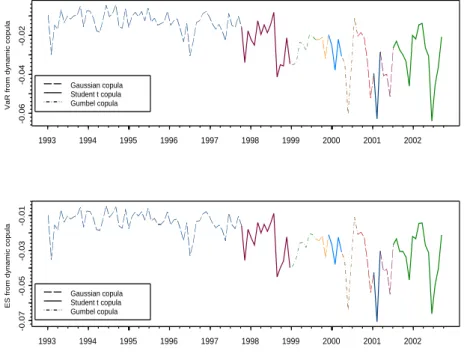
For the portfolio of S&P500 and Nasdaq with equal weight, we com-pare the VaR and ES values using the static copula and the dynamic
Table 5. Estimates for time-varying parameters
Period Copula Parameter r0 r1 s1
04/01/93-24/10/97 Gaussian dynamic ρ 2.620e-02 (4.961e-02) 4.160e-02 (5.347e-02) 9.735e-01 (2.689e-01) 24/10/97-11/01/99 Student t ρ= 8.249e-01 (2.264e-02) ; - - -dynamic ν 8.915e-01 (8.238e-01) -1.632e-01 (1.389e-01) 3.313e-01 (1.226e-01) 11/01/99-18/08/99 Gumbel dynamic δ -1.263 (2.194e-01) -5.236e-03 (1.129e-01) -7.700e-01 (3.890e-02) 18/08/99-06/12/99 Gaussian dynamic ρ 3.266 (1.495) 3.081e-02 (3.636e-03) -3.557e-01 (3.291e-02) 06/12/99-24/03/00 Student t ρ= 5.433e-01 (2.938e-02) ; - - -dynamic ν 7.228e-01 (5.977e-01) 4.033e-01 (1.428e-01) -6.784e-01 (2.584e-01) 24/03/00-09/08/00 Gumbel dynamic δ -8.134e-01
(5.823e-01) -3.892e-02 (3.937e-01) -4.400e-01 (5.333e-02) 09/08/00-22/12/00 Gaussian dynamic ρ 3.317 (3.055e-02) 1.104e-01 (2.343e-03) -3.147e-01 (7.314e-01) 22/12/00-20/02/01 Student t ρ= 9.387e-01 (5.236e-01) ; - - -dynamic ν -1.922 (1.485) 1.276 (1.893) -5.806e-01 (5.530e-01) 20/02/01-08/06/01 Gaussian dynamic ρ 4.236e-02
(6.874e-01) 3.808e-02 (5.258e-02) 9.792e-01 (2.180e-01) 08/06/01-30/08/02 Student t ρ= 8.747e-01 (2.711e-02) ; - - -dynamic ν -5.764e-01 (5.540e-01) -3.595e-01 (8.683e-01) -1.025 (3.303e-01) “Period” shows the start and end time of the observations within the corresponding subsamples, in the form of Day/Month/Year, where “Year” is represented by the last two numbers of the year, i.e., “99” represents the year 1999 for instance. Figures in brackets are standard errors, r0, r1 and s1 have been estimated using maximum
sequence of copulas. In the static case, we use the Gaussian copula
obtained in Table 2, estimated on the whole period. In the
dynam-ical case, we use the time-varying parameters provided in table 5,
assuming that the copula’s family does not change in each
subsam-ple (the families of copulas are provided in Table 3). We calculate
the VaR and ES values per 20 days in order to take into account the time evolution. The results obtained from the static and
time-varying parameters copulas are shown in Figure 3 and Figure4.
VaR from static copula
1993 1994 1995 1996 1997 1998 1999 2000 2001 2002
-0.024
-0.016
-0.008
static Gaussian copula
ES from static copula
1993 1994 1995 1996 1997 1998 1999 2000 2001 2002
-0.025
-0.015
-0.005
static Gaussian copula
Fig. 3. VaR and ES using static copula for the portfolio of S&P500 and Nasdaq Indices for a confidence level α = 0.05%
On Figure3 and Figure 4, we observed that the VaR and ES values
fluctuate a lot. Through comparison, some conclusions are summa-rized below:
VaR from dynamic copula 1993 1994 1995 1996 1997 1998 1999 2000 2001 2002 -0.06 -0.04 -0.02 Gaussian copula Student t copula Gumbel copula
ES from dynamic copula
1993 1994 1995 1996 1997 1998 1999 2000 2001 2002 -0.07 -0.05 -0.03 -0.01 Gaussian copula Student t copula Gumbel copula
Fig. 4. VaR and ES using dynamic copulas for the portfolio of S&P500 and Nasdaq Indices for a confidence level α = 0.05%
1. The dynamics of the VaR and ES using the static copula only come from the volatilities of the GARCH model, while using the dynamic copulas, the dynamics of VaR and ES still depend on the dynamic dependence structure;
2. The VaR and ES from the static copula have generally smaller ab-solute values than those from the dynamic copulas, which means that the dynamic copula model takes into account more risk in-formation than the static one.
3. After the middle of 1997 when the Asian financial crisis broke out, the VaR and ES values calculated from the dynamic copula vary a lot, while this phenomenon does not distinctly appear when we use the static copula. Thus, the dynamic copula permits to
include the shocks when they appear and as frequently as they appear, which is not the case in the satic setting.
From the above remarks, it appears that the dynamic changes inside the dependence structure of a portfolio can play an important role in risk management. To model dynamic changes inside copulas has
already shown its interest in multivariate option pricing,Gu´egan and
Zhang (2009).
6
Conclusion
In this paper, we introduce a new approach to detect the best dy-namic copula which characterizes the evolution of several data sets. It is based on a series of nested tests using conditional copula and GOF tests. This approach permits to determine the change type of the copula using the binary segmentation procedure, the change-point analysis and the time-varying parameter functions.
The method is illustrated using S&P500 and Nasdaq indices. The computations of risks measures using the method developed in this paper show its importance for risk management strategy: indeed, it appears that the values of the risk measures can be drastically different with respect of the copula used.
7
Annex
7.1 Gaussian copula
The copula of the d-variate normal distribution with linear correla-tion matrix R is
CGaR (u) = ΦdR(Φ−1(u1), Φ−1(u2),· · · , Φ−1(ud)),
where Φd
R denotes the joint distribution function of the d-variate
standard normal distribution function with linear correlation
ma-trix R, and Φ−1 denotes the inverse of the distribution function of
the univariate standard Gaussian distribution. Copulas of the above form are called Gaussian copulas. In the bivariate case, we denote ρ
as the linear correlation coefficient, then the copula’s expression can be written as CGa(u, v) = Z Φ−1(u) −∞ Z Φ−1(v) −∞ 1 2π(1− ρ2)1/2 exp{− s2− 2ρst + t2 2(1− ρ2) }dsdt.
The Gaussian copula CGa with ρ < 1 has neither upper tail depen-dence nor lower tail dependepen-dence.
7.2 Student-t copula
If X has the stochastic representation
X= µ +d
√ ν √
SZ, (9)
where= represents the equality in distribution or stochastic equality,d
µ∈ Rd, S ∼ χ2
ν and Z ∼ Nd(0, Σ) are independent, then X has a
d-variate tν distribution with mean µ (for ν > 1) and covariance matrix
ν
ν−2Σ (for ν > 2). If ν ≤ 2 then Cov(X) is not defined. In this case
we just interpret Σ as the shape parameter of the distribution of X.
The copula of X given by Equation (9) can be written as
Ct
ν,R(u) = tdν,R(t−1ν (u1), t−1ν (u2),· · · , t−1ν (ud)),
where Rij = Σij/pΣiiΣjj for i, j ∈ {1, 2, · · · , d}, tdν,R denotes the
distribution function of √νY/√S, S ∼ χ2
ν and Y ∼ Nd(0, R) are
independent. Here tν denotes the margins of tdν,R, i.e., the distribution
function of √νYi/
√
S for i = 1, 2,· · · , d. In the bivariate case with
the linear correlation coefficient ρ, the copula’s expression can be written as Cν,Rt (u, v) = Z t−1ν (u) −∞ Z t−1ν (v) −∞ 1 2π(1− ρ2)1/2{1+ s2− 2ρst + t2 ν(1− ρ2) } −(ν+2)/2dsdt.
Note that ν > 2. And the upper tail dependence and the lower tail dependence for Student t copula have the equal value.
7.3 Gumbel copula
The Gumbel copula is defined as
CGu(u, v; δ) = exp{−[(− ln u)δ+ (− ln v)δ]1/δ}, δ ∈ [1, ∞).
It has the properties:
1. δ = 1 implies CGu(u, v; 1) = uv;
2. As δ → ∞, CGu(u, v; δ)→ min(u, v);
3. Gumbel copula has upper tail dependence: 2− 21/δ;
4. Gumbel copula has no lower tail dependence.
The Gumbel copula belongs to the Archimedean copula,Joe (1997)
Akaike, H., 1974. A new look to the statistical model identification. IEEE Transactions on Automatic Control, AC-19, 716-723. Anderson, T. W., 1969. Statistical inference for covariance matrices
with linear structure. Proceeding in the Second International Sym-posium on Multivariate Analysis, ed. P. R. Krishnaiah. Academic Press, New York, 55-66.
Caillault, C. and Gu´egan, D., 2009. Forecasting VaR and Expected Shortfall using dynamical systems: A risk management strategy, Frontiers in Finance,in press.
Caillault, C., Gu´egan, D., 2005. Empirical estimation of tail depen-dence using copulas: Application to Asian markets. Quantitative Finance, 5, 489-501.
Cs¨org˝o, M., Horv´ath, L., 1997. Limit Theorems in Change-point Analysis. Wiley, Chichester.
Dias, A., Embrechts, P., 2004. Dynamic copula models for multivari-ate high-frequency data in finance. Manuscript, ETH Zurich. Embrechts, P., McNeil, A., Strausmann, D., 2001. Correlation and
dependence in risk management: properties and pitfalls. Risk Man-agement: Value at Risk and Beyond, ed. M.A.H. Dempster, Cam-bridge University Press, 176-223.
Fermanian, J-D., 2005. Goodness of fit tests for copulas. Journal of multivariate analysis 95, 119-152.
Gombay, E., Horv´ath, L., 1996. On the rate of approximations for maximum likelihood test in change-point models. Journal of Mul-tivariate Analysis 56, 120-152.
Gombay, E., Horv´ath, L., 1999. Change-points and bootstrap. Envi-ronmetrics 10, 725-736.
Granger, C.W.J., Ter¨asvirta, T., Patton, A. J., 2006. Common fac-tors in conditional distributions for bivariate time series. Journal of Econometrics 132, 43-57.
Gu´egan, D., 2007. Global and local stationary modelling in finance: Theory and empirical evidence. Working Paper, CES, Universit´e Paris 1 Panth´eon - Sorbonne,France, 2007.54.
Gu´egan, D., Zhang, J., 2009. Pricing Bivariate Option under GARCH-GH Model with Dynamic Copula: Application for Chi-nese Market, to appear in European Journal of Finance.
Joe, J., 1997. Multivariae Models and Dependence Concepts. Chap-man & Hall, London.
Jondeau, E., Rockinger, M., 2006. The copula-GARCH model of con-ditional dependencies: An international stock market application. Journal of International Money and Finance 25, 827-853.
Lehmann, E. L., Casella, G., 1998. Theory of point estimation, sec-ond edition. Springer, New York.
Nelsen, R., 1999. An introduction to copulas. Lecture Notes in Statis-tics 139.
Patton, A. J., 2006. Modelling asymmetric exchange rate depen-dence. International Economic Review 47, 527-556.
Silverman, B. W., 1986. Density Estimation for Statistics and Data Analysis. Chapman & Hall, CRC.
Sklar, A., Fonctions de r´epartition `a n dimensions et leurs marges. Publications de l’Institut de Statistique de L’Universit´e de Paris. 8, 229-231.
Vostrikova, L. J.,1981. Detecting “disorder” in multidimensional ran-dom processes. Soviet Mathematics Doklady 24, 55-59.