Developing For Demand- An Analysis of Demand Segmentation Methods and Real Estate Development
by
Michael Burr Tilford B.A., History, 2003 Gonzaga University M.B.A, Marketing, 2008
Boston University School of Management
Submitted to the Center for Real Estate in Partial Fulfillment of the Requirements for the Degree of Master of Science in Real Estate Development
at the
Massachusetts Institute of Technology September, 2009
©2009 Michael B. Tilford All rights reserved
The author hereby grants to MIT permission to reproduce and to distribute publicly paper and electronic copies of this thesis document in whole or in part in any medium now known or hereafter created.
Signature of Author_________________________________________________________ Center for Real Estate
July 24, 2009
Certified by_______________________________________________________________ Brian A. Ciochetti
Professor of the Practice of Real Estate, Thesis Supervisor
Accepted by______________________________________________________________ Brian A. Ciochetti
Chairman, Interdepartmental Degree Program in Real Estate Development
Demand Segmentation: Adapting a Marketing Method to Real Estate Development by
Michael Burr Tilford
Submitted to the Center for Real Estate on July 24, 2009 in Partial Fulfillment of the Requirements for the Degree of Master of Science in Real Estate Development
ABSTRACT
Marketing is commonly mistaken in the real estate development industry for the practice of advertising and sales. In reality, marketing is a set of concepts and methods created primarily in the consumer packaged goods industry that start with a focus on the consumer. Many of these concepts and methods can be used in the real estate development process to create more thoughtful and competitive projects. This thesis focuses on the marketing concept of demand segmentation and whether the real estate development process could be better served through a more defined focus on identifying specific consumers through demand segmentation techniques. Specifically, this thesis will answer the following questions:
What is the existing structure for real estate market analysis? What is the concept of demand segmentation and how might it apply to real estate development? How has consumer segmentation specifically been applied in real estate development ventures? What are some important considerations to be aware of when developing real estate for a specific consumer segment?
To answer these questions, this thesis reviews current thinking on demand segmentation through a review of relevant, marketing related literature for both the real estate and consumer packaged goods industries. This thesis also examines three subject developments that are examples of completed real estate development projects that serve the specific needs of a deliberately identified demand segments. The intention of this thesis is to define current marketing practices, analyze how a concept commonly used in the consumer packaged goods industry can be adapted for real estate and discover a body of questions and conclusion that can advance the practice of demand segmentation on real estate development.
Thesis Supervisor: Brian A. Ciochetti
Table of Contents
INTRODUCTION...4
CHAPTER 1: An Examination of Real Estate Market Analysis...6
CHAPTER 2: Expanding on the Market Analysis- The Hourglass Model... 10
CHAPTER 3: The Real Estate Industry’s Focus on Supply... 14
CHAPTER 4: The Marketing concept and how it applies to real estate?... 18
CHAPTER 5: Defining The Process of Demand Segmentation... 20
CHAPTER 6: Revisiting The Hourglass Model... 30
CHAPTER 7: An Introduction to Selected Cases... 35
CHAPTER 8: The Block Hotel... 37
I. Introduction and Background... 37
II. Applying the Demand Segmentation Method... 40
III. The Consumer Response... 44
IV. Conclusion... 47
CHAPTER 9: The Press Club... 49
I. Introduction and Background... 49
II. Applying the Demand Segmentation Method... 52
III. The Consumer Response... 56
IV. Conclusion... 58
CHAPTER 10: The LAB Anti-Mall... 60
I. Introduction and Background... 60
II. Applying the Demand Segmentation Method... 63
III. Customer Response... 65
IV. Conclusion... 66 CONCLUSION... 68 BIBLIOGRAPHY... 70
INTRODUCTION
Marketing is an often misunderstood term in real estate development. Most development professionals mistakenly believe that marketing is solely focused on advertising and sales and is best left to brokers and consultants. However, marketing is not the process of creating glossy flyers, buying magazine adds and showing model units to potential customers. Marketing is a professional discipline that emerged from the consumer packaged goods industry and is characterized by a set of concepts and methods that inform the creation, design, distribution and sale of a product. The modern practice of marketing, as used in the consumer packaged goods industry, offers concepts and methods that can be used by the real estate industry to improve due diligence, underwriting and proforma analysis, building design, selection of amenities and features, pricing and finally sales.
Underlying the practice and methods of marketing is a philosophy developed in the 1960’s called the ‘marketing concept’ that dictates “marketing strategies must be based upon consumer needs and wants.” This is a consumer centric view where the needs of the target customer dictate the product, position place and price decisions made by a firm. Real Estate professionals tend to focus solely on supply based concepts of marketing. Developers want to know how much of a broadly defined product, like office, exists in a specific market and whether the rents are going up as an indicator of market demand. At best, this way of thinking leads to broad conclusions that do not critically question who or what is driving demand for additional space. The concept of who drives sales of a product is a primary consideration in the consumer packaged goods industry. That is not to say that marketers of consumer packaged goods do not ignore supply, they simply review it after examining demand.
The focus on supply or demand is a primary point of distinction between the real estate industry and the consumer packaged goods industry. While the structures of these two industries are very different, the marketing concepts that drive them don’t necessarily have to be. This thesis deals primarily with the concept of ‘demand segmentation’ and how it can be applied to the practice of real estate development. Demand segmentation is but one of many concepts commonly used
by marketing professionals in the consumer packaged goods industry that can be helpful to real estate developers. Like consumer packaged goods, Real Estate can also be conceived of as a product defined by a consumer buying space and time. Demand segmentation is a process that can help a developer define who the consumer is and what they value or need.
This thesis begins by examining the current form of real estate market analysis through the commonly used market and marketability study. It goes on to introduce the Hourglass model conceived of by Emil E Malizia and Robin A Howrath to provide a contextual framework to organize the concepts of demand segmentation and how they relate to real estate development. The thesis continues by defining the concept of demand segmentation, examining methods of segmentation and discussing some of the potential benefits of segmentation as they relate to real estate. Finally, the thesis examines three cases of real estate developers who used demand segmentation to varying degrees to create a hotel for snowboarders, a co-op wine tasting room for time constrained, San Francisco tourists and a shopping mall created for generation X and Y shoppers. These examples are a limited selection of projects that have been created for defined demand segments. However, they represent a spectrum of success. One project recently closed, the other is struggling in the face of a disappearing demand segment and the last project has been fully leased for 15 years. The examples are intended to help illustrate how demand segmentation has been used to create new projects and review the experiences of customers and developers in an effort to draw conclusions and questions about how to further the practice of adapting demand segmentation to real estate development.
CHAPTER 1: An Examination of Real Estate Market Analysis
Market research and marketing reports serve a myriad of functions within the real estate industry from appraisals of a single property to an economic base study that “analyzes the entire economy of a given nationi.” Each reports serves a specific need and is analyzed with different goals and viewpoints. This section of the thesis presents what is commonly known as the real estate market analysis, generally composed of two smaller reports called the marketing study and the marketability study. The relationship is shown below in Figure 1. The structure and composition of the market analysis is based upon a review of relevant academic and industry literature on real estate marketing.
FIGURE 1: Composition of The Real Estate Market Analysis
The real estate market analysis is used primarily by developer’s considering speculative developments or the repositioning of an existing asset. Composed of the market study and marketability study, the market analysis “is an important risk management technique in that it provides the backup for the set of assumptions used in the cash flow analysis and therefore reduces or at least delineates the riskiness of projected cash flows.ii” Its fundamental purpose is to inform a developer considering a new speculative venture about the applicable market conditions and how they relate to the proposed project. The real estate market analysis should
ALL REAL ESTATE MARKET
REPORTS
MARKET STUDY MARKETABILITY STUDY THE REAL
ESTATE MARKET ANALYSIS
present a comprehensive overview of both the existing supply of potentially competitive properties to the subject project as well as the nature of the demand for the proposed space. The first and most logical contextual element that a market analyst must consider is geography. The geography can be defined by a region, city, sub area or neighborhood depending on the type of project being considered. For example a regional mall’s relevant geography would be different than the relevant geography for an apartment building. The historic emphasis that developers and investors have placed on location, location, location is born of the reality that “unlike all other products, people cannot take real estate home. Instead, the customer must move to the product, which offers a distinctive locationiii.” This seemingly simple insight helps explain why the real estate market analysis starts with some geographic definition. While the point of the real estate market analysis is to help a developer make a decision about a particular speculative development project it “considers only properties within a certain geographic boundary. Thus even a general market study must have some geographic referent.iv” The geography is best defined by the market analyst in conjunction with the developer based on local market knowledge and a thoughtful review of the project.
With the geography defined, the real estate “market study” can be prepared with the goal of providing aggregate supply and demand data to assist the developer in “understanding the effective supply of and demand for space of a broadly defined user groupv.” For example, the study for a multifamily development should quantify the number of rental units within the defined geographic area as well as the number of potential renters. In terms of defining the existing supply, a market study should also examine the quality of existing space, space under construction, vacancy rates of the subject supply, recent absorption of space, market rents and lease terms and other applicable criteria that can help define the existing product in a market. In terms of demand, the market study should provide a basic overview of a market’s population, employment, income and macroeconomic factors to put market wide demand in context. Both the supply and demand conclusions should be based on some combination of primary and secondary data, “as reliance solely on secondary data produces an ‘arm chair’ analysis which is likely to be inadequatevi.”
In their paper Clarifying the Structure and Advancing the Practice of Real Estate Market Analysis, Emil E. Malizia PhD and Robin A. Howarth advocate additional rigor in the practice of market studies through the incorporation of quantitative forecasts to establish demand for additional space over some period of time. According to Malizia and Howarth, a sound market study should also analyze historic rates of absorption and create a “causal model” that is capable of forecasting space absorption based on correlated economic trends. Additionally, current and forecasted supply of comparable properties should be incorporated into a thorough market study because it is just as critical to make informed assumptions about future supply as future demand. The rigorous additional steps advocated by Malizia and Howarth are rarely undertaken in practice but would certainly offer greater clarity as to whether or not a development was worth pursuing.
The point of the market analysis is to determine whether a development concept is feasible when considered in the context of broad market realities. If market researchers and developers determine that their concept has potential, then they outline a series of important questions that are not answered in the market study and undertake the second part of the real estate market analysis, called the marketability study. The marketability study answers the specific questions posed by the market study and brings an additional level of rigor to the market analysis process. The marketability study “focuses on a specific property in the attempt to maximize the property’s competitive position in the marketvii.” The first step in a marketability study is to analyze the demand within a market and segment it in a manner that divides different potential customers into groups that are likely to have similar needs and exhibit similar preferences. The marketability study should include a “segmentation of analysis [that] generates knowledge of the characteristics of targeted consumers.” Once the characteristics of the potential customer are identified, the marketability study should define the features and benefits of the proposed projectviii. Malizia and Howarth emphasize a “careful exercise of market segmentation and product differentiation when moving from the level analyzed in a market study to the narrower definitions of demand and supply considered in a marketability study.”
The basic framework used by developers and marketing professionals to analyze a speculative development begins with a defined geography and consists of a market study that examines the macro economic forces that impact a potential development and a marketability study that makes micro level recommendations for a specific property about space users, appropriate features and amenities and pricing. While not always used or consistently applied, this framework represents the effort undertaken by marketing professionals and developers to determine whether a speculative project is feasible and if so how it should be specifically positioned within a market. This structure for real estate market analysis, if properly applied and conducted, provides a comprehensive market overview and important specifics necessary to build a profitable and competitive project. The proceeding chapters of this thesis will present a graphical model to further explain market analysis as well as focus on a series of recommendations to improve the relevance of the marketability report.
CHAPTER 2: Expanding on the Market Analysis- The Hourglass
Model
The basic composition of the real estate market analysis is simple enough to understand, but a graphical model presented by Malizai and Howarth in their paper, Clarifying the Structure and Advancing the Practice of Real Estate Market Analysis, helps present the market research process and its intended effects in a more thorough manner. Further, it aids in the discussion of specific recommendations made by industry practitioners and academicians on how to improve the real estate market research process. Figure 2 below shows the Malizai and Howarth Hourglass model with a detailed explanation of its meaning
FIGURE 2: The Malizia and Howarth Hourglass Model Demand (The Market) Supply (Competition) Subject Project Product Differentiation Market Segmentation
According to Malizia and Howarth, the “lengths at the top and bottom of the hour glass represent forecasted demand and supply in a specific market. An analyst begins the demand side analysis with market segmentation. Each relevant segment is identified by describing the characteristics of potential consumers more completely and by directly considering their tastes and preferences. As specificity increases, the segment represents an increasingly smaller portion of the overall market. (I.e. moving from the top of the hourglass downward). At the same time, however, the directly competitive supply also decreases. With the process of product differentiation, a market analyst moves form a more generic subject project considered in the market study (e.g. garden apartments, specialty retail) to a more differentiated subject project in a marketability study (e.g. two story apartments with specific unit features and external amenities, specialty retail with a specific tenant mix). As differentiation helps to better define a subject project (located at the center of the hour glass), it also eliminates supply to leave only competitive projects (movement from the bottom of the hourglass upwardsix.”
The purpose is not necessarily to reach the intersection of the hourglass but is instead to intentionally position the subject property within the Hourglass based on market segmentation and a clear definition of the target customer. The intersection of the Hourglass labeled “Subject Property”, can be likened to a ‘build to suit’ project. The demand is perfectly matched to the supply. The development project is defined exactly by what the build to suit client wants so no market or marketability study is necessary. However, when considering a new development, the market and marketability study are necessary to determine if a projects is worth pursuing and if so how best to position the project within the market. The marketing process is designed to mitigate or at least quantify that risk by positioning the subject development within the spectrum of supply and demand.
The Hourglass model offers an intuitive, graphical representation of the purpose of real estate marketing and the end result of the market and marketability studies. The top and bottom line of the hourglass represent a market’s supply and demand, which are quantified and described through the market study. The marketability study analyzes demand within a market and identifies appropriate customers segments for the subject property. The process of market segmentation occurs in the upper part of the Hourglass and defines a specific customer for the
project. Once a specific customer is identified, their needs are assessed in the marketability study and recommendations are made to inform a developer of how to create a project that appeals to the target segment. The marketability study should define the customer segments based on “a distinctive combination of people, lifestyles, purchasing power and place.”x The marketability study can then recommend specific rents, design features, amenities or any characteristic that appeal to the target segment. The resulting product is thus defined in the bottom portion or differentiated supply section of the hourglass. The process of customizing the subject property for the subject demand segment moves the project up the bottom of the hourglass towards the hourglasses intersection making the project more differentiated within the market.
The following commonly accepted sequence emerges to analyze a real estate market and position a project accordingly. The specific sequence includes:
1. Perform a market study that specifies supply and demand as represented by the tops and bottom of the hourglass. The outline of the hourglass now represents the market
2. Perform a marketability study and identify a target consumer segment who’s needs are unmet or underserved in the market. The process of segmenting the market and identifying a specific customer segment moves the demand target away from everyone at the top of the market to a more specific group towards the intersection of the hourglass. 3. This process of creating a property based on addressing the segments needs and
preferences results in the projects position moving from the bottom of the hourglass away from the general supply and towards a more differentiated position in the market and the intersection of the hourglass
4. The overall process results in making the subject project (supply) more specifically suited to the target customer segment (demand)
The following modified hourglass, Figure 3, shows how the commonly used market analysis process defined in the first section of this thesis specifically applies to the Malizia and Howarth model and demonstrates the mechanics of demand segmentation. Again, the result is the creation of a project (supply) that is meaningful to a specific consumer segment (demand)
CHAPTER 3: The Real Estate Industry’s Focus on Supply
Few real estate marketing professionals and developers take full advantage of the process of demand segmentation. The lack of demand segmentation analysis is a lost opportunity and adversely impacts how the real estate industry uses market and marketability reports to define projects within a marketplace. According to Malizia, “in real estate, we study supply to understand demand which makes no sense. No one in real estate studies demand to understand demand.xi” Understanding demand requires direct, consumer level research which is expensive and time consuming. Many developers claim they “just know” what the market wants and will rely upon input from brokers and consultants to design a project. Further, they use brokerage reports to define market rents and trends but very rarely speak with a potential tenant.
Traditionally, Real estate development has “been a spatially segmented industry: most developers only worked in a few locations and constructed one or two product types.xii” Accordingly, a structure for supply has emerged for all of the core property types supported by widely accepted industry trade group definitions. Within any market, property supply segments are differentiated among easily identifiable, use based classifications including office, retail, residential, industrial, hotel and institutional. These easily defined use based classifications are then divided by property type classifications. For example, residential includes single family, multifamily rental and condos. After a property is defined by its sub category some product types are segmented within a spectrum of quality like office class A to class C. Accordingly, a basic framework for classifying the natural differentiated supply can be defined by primary use, property type and spectrum of quality.
Industry trade groups including the Urban Land Institute (ULI), International Council of Shopping Centers (ICSC) and the Building Owners and Managers Association (BOMA) have described various property types but don’t generally have a system that can define the spectrum of quality. In some cases, the sub classifications of property are still subject to a great deal of debate. Senior Resident Fellow at ULI, Michael Beyard, believes that “the characteristics that are often used to describe lifestyle centers are so vague that they could be used to describe any
number of other type of shopping centers.xiii” Ultimately the term has become so ambiguous that it is meaningless as a classification and instead has become lost as marketing and sales jargon. Even if a property type is well defined, like a regional mall, the spectrum of quality is subjective. Brokers and building managers frequently use terms like class A or luxury to describe their newest listing. BOMA defines Class A offices as the “Most prestigious buildings competing for premier office users with rents above average for the area. Buildings have high quality standard finishes, state of the art systems, exceptional accessibility and a definite market presence.xiv” This a broad definition subject to a great deal of interpretation however it is frequently used in the market.
These commonly used supply segments offers an organizational framework that helps expand on the Hourglass model and further the discussion of real estate market research practices. Figure 4 below shows the Hourglass figure, integrating the commonly understood differentiation of supply to present the natural or common state of real estate market analysis where supply is partially defined or differentiated but little effort has been put into examining and segmenting the demand.
FIGURE 4: The Hourglass Model With Common Real Estate Supply Differentiation
Often times, market researchers and developers analyze and segment the demand section of the hourglass solely through census tracks, area median income or other broad based market demand information from secondary sources. The marketability study rarely involves consumer level research or even asks important questions to identify demand beyond simple demographics. Marketability should include questions like, who is the customer? Who uses this space and what features and amenities can the developer provide to distinguish the project so it directly appeals to the target consumer? Are there enough target tenants available in the subject market? If developers undertake thorough, consumer level market research and target a specific consumer segment, they can make more informed decisions that distinguish their development within a market.
A developer’s segmentation decisions are usually only supply oriented, generally stop at the quality spectrum and rarely involve much demand level analysis Decisions about amenities,
Demand (The Market) Supply (Competition) Subject Project Product Differentiation Market Segmentation
Use Based Differentiation Property Type
design, layout and finishes that ultimately position the project, are informed by brokers and design professionals as opposed to direct consumer research. Some property types, like hotels, are better than others in researching the needs of their target consumer but most developers tend to create a generic product with certain features and amenities that design professionals identify as important. How a consumer values these decisions is rarely known in any detail and a potential opportunity to create a superior product for a defined consumer segment is lost.
While real estate supply focused approach has certainly worked in the past, it often results in the creation of a commodity product subject to competition from anyone else willing to build a similar project in the same trade geography. One of the purposes of marketing, specifically demand segmentation and building a project for a target customer, is to “protect the developer from the uncertainty of competitive pricing…so that as a developer, one is not forced to use price cutting as a primary device to acquire business.xv” By not effectively using marketing and demand segmentation, developer’s run the risk of creating an undifferentiated project at the bottom of the market hour glass without a specific customer. This failure to effectively use marketing and demand segmentation is at best, a lost opportunity.
When considering new developments, the “competitive edge depends on finding a true unmet need of a consumer group. It is not an edge obtained through gimmicks and cleverness on the part of the designer or the developerxvi.” Analyzing and segmenting demand presents an opportunity to position a project thoughtfully within a market. Real estate developers do not always capitalize on this opportunity partially because the industry has historically been divided, studied and understood in the context of supply. The concept of demand analysis and consumer segmentation, while common in the manufactured goods industry, is not well understood by the real estate community. An analysis of how marketing and demand segmentation is applied in other industries will further develop the hourglass model and explain the importance and methods of demand segmentation.
CHAPTER 4: The Marketing concept and how it applies to real
estate?
As the process of real estate development and investment has matured into a professional industry, business concepts commonly found in other industries have been integrated with traditional real estate practices. ULI’s text, Real Estate Development Principles and Process, states that “attention to classic notions of marketing helps bring greater structure and discipline to real estate development.” While there are important differences in the economic structures of real estate and consumer packaged goods, there is not necessarily a need for a distinction in marketing methods. Similar to manufactured goods firms “people-employees- create and manage marketing campaigns to achieve a companies objectives – no less in real estate development companies than at Microsoft or General Foodsxvii.”
While numerous academics and marketing professionals have advocated the integration of marketing concepts and techniques commonly used in other industries, many real estate professionals operate under the mistaken impression that marketing is a discipline used solely in advertising and sales. ULI’s textbook, Real Estate Development Principles and Process, elaborates on the misconception and states that “marketing objectives ought to be part of most [real estate] management functions. In practice, however, the task of finding and keeping customers is at times solely left to the marketing staff- which, in real estate development means leasing agents or sales people.” It is important to highlight that marketing is not the very limited practice of advertising and sales. Marketing specialist Philip Kolter emphasizes the point by explaining that marketing “should not be narrowly construed as the process of selling products but more broadly understood as satisfying human wants and needsxviii.” Kolter’s description of marketing as a study and response to fundamental human needs, stems from an idea introduced the 1960’s by Pillsbury Company marketing executive Robert Keithxix, called the “marketing concept.”
The marketing concept is “the philosophy that marketing strategies must be based upon consumer needs and wantsxx.” It is a demand-centered concept that dictates that an “organization
should endeavor to satisfy the needs and wants of customers through a coordinated set of activities that allows the organization to achieve its goals at a profit.xxi” ULI’s Real Estate Development Principles and Process, attributes the popularization of the marketing concept to US companies efforts in the 1980’s to regain market share lost to emerging manufacturing powers like Japanxxii.
This customer centric way of thinking helps inform every aspect of the real estate process including due diligence, proforma underwriting, design, entitlement, construction and finally advertising and sales. More importantly, it forces the marketing practitioner and real estate developer to ask the critical question, who is our customer? This question should be answered in the marketability study along with a set of recommendations to tailor a real estate project to that customer. Once demand is segmented and the definition of the customer moves further down the Hourglass model, then the resulting project becomes differentiated within a market and moves up the Hourglass model with the target customer and real estate project moving toward the intersection of the hourglass.
The marketing concept is completely customer centric and emphasizes the examination of potential consumer needs and preferences to determine if there are unmet or underserved needs that a firm can capitalize on. In real estate, developers focus heavily on supply related information and only have a very general sense of who their customer is. Real Estate development does not embrace the focus on the end user to the same degree as the consumer goods industry. Even if the marketing concept were embraced by the real estate community, where projects were created based on a thorough analysis of demand, does not answer the fundamental question of who is the target customer? As advocated by Malizia, Howarth Graaskamp, Carn and Miles in previous chapters, the key to identifying the consumer is the practice of segmentation. While advocated by some academics and practitioners, segmentation is not widely practiced.
CHAPTER 5: Defining The Process of Demand Segmentation
Market segmentation “is the process of partitioning markets into segments of potential customers with similar characteristics who are likely to exhibit similar purchase behaviorxxiii.”
Segmentation allows a firm to identifying and target specific consumer groups that are underserved by existing products or have unmet needs or preferences. If the target segment has sufficient numbers to form a compelling market a firm undertakes research to determine how to create a product that better serves the needs and preferences of the market. This leads to the creation of a new product that is thoughtfully positioned within a market and specifically customized based on thorough research. Market segmentation is a well established marketing method used frequently in the manufactured goods industry. This chapter will present and explain the concept, methods and benefits of segmentation as they apply to both consumer products and real estate.
Similar to the philosophy behind the marketing concept, the process of segmentation “is customer oriented and dependant upon market demand while product differentiation (not a segmentation strategy) is supply side oriented.xxiv” For example, a car company does not design a car based solely on what models are available from their competitors. Instead, they start by asking who are buying cars and whether their specific needs are served by the types of cars that are currently available? If they identify a group of people who’s needs are underserved and if the group of people have sufficient numbers to form a viable market, the car company undertakes extensive research and designs the appropriate product.
The differences between the consumer of the Toyota Prius and the Hummer H2 offer an intuitive example of consumer segmentation based on psychographics and lifestyle. Again demand segmentation is not supply based and this example is not a comparison of the two cars. It is an example that highlights the differences in the needs and preferences of the customers to establish defined customer segments. The cars are a byproduct of this segmentation and analysis of demand. Car consumers have very different needs and preferences and the Prius and H2 were designed to appeal directly to the consumer segments identifies by Toyota and Hummer. Prius
drivers value fuel efficiency and the perception of environmental sensitivity while H2 drivers value size and the perception of safety. The important point is Hummer and Toyota recognized differences in consumers and took advantage of these unique consumer needs and preferences to design more directly meaningful product for their customer segment. The segmentation process involves identifying a unique group of customer, researching their needs and preferences and then designing the product to accommodate those needs and preferences.
Ultimately, businesses engage in market segmentation in order to “analyze markets, find a niche, and develop and capitalize on a superior competitive positionxxv.” Segmentation was born of the realization that no product, except commodities, serves all consumers equally. Products are often composed of a variety of features and options and consumers value these features and options differently. If a developer’s segments a market and identifies a large group of customers who are physically active and engaged in athletics, the developer can install meaningful amenities that fit their lifestyle like an expanded workout room or indoor pool. These amenities do not appeal to every apartment renter equally but in this example they appeal to the athletic consumer segment identified by the developer through market segmentation. The apartment is more relevant and meaningful for this target segment consumers than the average consumer. The more specific the segmentation of the consumer the more specific the nature of the amenities and characteristics of the apartment building,
According to Art Weinstein, a leading researcher in the field of consumer segmentation, a firms has “two basic choices: to segment the market or treat the entire market as potential customers… This latter option, known as aggregation, means that the firm uses an undifferentiated marketing strategy. There are few firms that can minimize their cost and maximize their returns with an aggregation strategy.” The idea of marketing a product with mass appeal to every person is best suited for commodity products. Accordingly, these products are subject to risk from similar competition and price fluctuations based on market cyclicality.
A developer may build a more generic building including amenities and unit fit and finish that may not appeal directly to any particular consumer segment but are sufficient for many consumers. While this will lead to a broad appeal, it does not distinguish the project in any meaningful way and the building becomes a commodity product that may be more sensitive to
market pricing based on market supply, which is beyond a developer’s control. However, an apartment targeted at a specific consumer segment may not be as subject to pricing volatility from the introduction of additional generic supply (more apartment buildings) because it is designed for a specific segment. According to James A. Graaskamp, consumer segmentation based marketing “is intended to protect the developer from the uncertainty of market based pricing……so that as a developer, one is not forced to use price cutting as a primary device to acquire business xxvi.”
Art Weinstein’s book Market Segmentation: Using demographics, psychographic and other segmentation techniques to uncover and exploit new markets, defines two general segmentation categories including physical attributes and behavioral attributes. Within each attribute category are description of the most commonly used methods of consumer segmentation. This section will review the basic definitions of these segmentation methods and introduce an emerging concept called tribal marketing that is both enhancing and challenging commonly held notions about demand segmentation.
Physical Segment Attributes: The following are brief descriptions’ of the most commonly used physical segment attributes and their associated characteristics.
1. Geographics: This is the simplest form of physical attribute segmentation and involves the division and selection of a market based on geography. As discussed in chapter I, all real estate market analysis begins with a market referent so this geographic segmentation is usually well defined in real estate.
2. Demographics: The term demographic is based on the field of demography, defined as the statistical study of human populationsxxvii. Demographic segmentation focuses on easily identifiable characteristics including number and size of households, age, marital status, sex, race, nationality and religion. Demographic segmentation is one of the easiest ways to analyze a market partially because of the extensive data that is easily accessible. The US census provides very specific data that can be sorted and analyzed in any number of combinations.
3. Socioeconomics: Socioeconomic characteristics are closely related to demographics and are used to analyze a market based on economic and related social classes. Commonly used socioeconomic characteristics include education, occupation, income, homeownership factors and social class. Similar to demographics, there is an abundant supply of accurate, secondary data.
4. Geodemographics: Geodemographics are a composite of the three physical attributes, geography, demographics and socioeconomics. Some demographers don’t draw a significant distinction between the three physical segment attributes and use geodemographics to offer a complete picture of a target segment that accounts for the obvious interrelationships of the three physical segment attributes.
Behavioral Segment Attributes: The following are brief descriptions’ of the most commonly used behavioral segment attributes and their associated characteristics.
1. Psychographics: The concept of psychographics was first introduced by Emanuel Demby in the 1960s to present a segment attribute that would go beyond the realm of physical description and examine the psychological traits of a customer including self-concept, attitudes, interests and opinions. According to Demby, sought to “describe the human characteristics of consumers that may have bearing on their response to products.xxviii”
2. Lifestyle: Lifestyle attributes “describe how individuals spend their time, what they consider important about their immediate surroundings, their opinions on various issues and their interestsxxix.” Though broadly defined and closely related to psychographics, lifestyle attributes help complete the spectrum of behavioral segmentation. While psychographics may be innate psychological characteristics of the person, lifestyle attributes are based on conscious choices.
Emerging Concepts: Marketing theory continues to evolve to adapt to changing social trends and patterns of consumption. The following is a description of one of the most compelling new marketing concepts, called tribal marketing.
Within the last few years, the concept of Consumer Tribes has been introduced as a new way to think about consumption and marketing. Tribal theory defines a group of people in a target market by their tribal identity as opposed to their segment identity. Tribal theory suggests that the focus of segmentation should not be on identifying customers based on individual physical or behavioral attributes but instead should be examined in the context of a community. Bernard Cova, a leading theorist and researcher in the field of tribal marketing defines a tribe as “a network of heterogeneous persons- in terms of age, sex, income, etc. – who are linked by a shared passion or emotion.xxx” This is an important distinction from Cova’s characterization of
consumer segments defined through the more traditional attributes defined in this chapter as a “group of homogenous persons- they share the same characteristics- who are not connected to each other.” Tribal theory is based on a dynamic community engaged in a common passion making a member of a tribe an advocate as opposed to a member of a segment who is merely a consumer. A passion can be an activity, sport, hobby or brand that unifies a group of people who share that interest and form a community.
Helpful examples that illustrates tribalism as it exists today are Harley Davidson motorcycle riders and Fans of Manchester United. Owners of Harley Davidson have extremely diverse physical and behavioral attributes but are all drawn to and participate in the Harley Davison brand. Tribal theory is very appealing as a way to understand and organize a market because it captures a wide breadth of potential consumers or “advocates”, organized around the singularity of a community. Manchester United is a famous football club with extremely passionate fans who travel all over the world to support their team. The fans identity is inextricable linked to the identity of the football club. Manchester United fans have greater demographic specificity than Harley riders but they are still defined by their passion and community affiliation.
The community as a focal point allows marketers to easily identify and quantify a target market and assess potential unmet needs and wants. However, it is a new concept that is still emerging
and lacks any comprehensive or definitive data sources. Similar to the elusive elements of behavioral segmentation, the only way to learn about tribes is through direct, human level research. Still, it offers a compelling way to organize and understand demand. In term of real estate, it may be a question of where do tribes live and what sort of space do they need?
Choosing the specific attributes to segment a market depends upon the market and industry being considered. It is common for marketing professionals to mix attributes to develop their customer segment or profile. In addition to identifying a target consumer segment, firms have to choose from a spectrum of segmentation intensity. Weinstein defines three levels of segmentation including differentiation, concentration and atomization.
1. Differentiation Strategy- If a firm employs a differentiation strategy it “actively markets its products or services to different segments of the market based on different needs. For example, a computer retailer that separately targets the home user, business professional and small business.” In this case a firm offers multiple products but tailors their marketing, promotional and sales efforts to a few select segments.
2. Concentration Strategy- A concentration strategy occurs when a “firm decides to serve one of several potential segments of the market.” This requires the firm to choose a narrowly defined segment at the cost of attracting other potential customers. According to Weinstein, “concentrated marketing is less expensive than differentiated marketing and may be the appropriate choice for new business with limited resources.”
3. Atomization Strategy- Atomization occurs when a firm “breaks down the market to the finest detail – often to the individual customer level. This strategy may be appropriate for highly costly and specialized equipment.”
Demand segmentation is a multi step process that requires a marketing professional or developer to make deliberate decisions throughout the market analysis. First, a market is segmented based upon one or some combination of segment attributes. Once the market is segmented, the individual segments must be analyzed to determine if their needs are unmet or underserved by existing products. If there is unmet needs within a segment, then that specific segment is targeted
for further study on preferences and needs. The marketing professional or developer then uses the information about unmet needs and preferences to design a product specifically for the target segment. This process involves a great deal of analysis of secondary sources and in some cases expensive, direct, consumer level market research. The process is graphically presented in Figure 5 below:
FIGURE 5: Segmentation Attributes Characteristics and Process
The end result of this process is the creation of a product that is meaningful to a target segment and thoughtfully positioned within a marketplace. Despite the effort and expense, market segmentation presents an opportunity for a developer to make an informed decision about how to position their development within the market place and potentially realize the benefits offered by a thoughtful and well executed market segmentation effort.
Professor Art Weinstein, a leading researcher in the field of market segmentation, presents the following benefits of market segmentation in his book, Market Segmentation: Using demographics, psychographics and other segmentation techniques to uncover and exploit new marketsxxxi:
1. Designing responsive products to meet the needs of the marketplace- The firm places the customer first and refines its product and service mix to satisfy the needs of the market providing customer satisfaction at a profit.
2. Determining effective and cost efficient promotional strategies: As a planning tool, segmentation, identification, and analysis is extremely valuable in developing the firms communication mix. Appropriate advertising campaigns can be designed and targeted to the right media vehicles.
3. Evaluating Market Competition: A segmentation study explores the firms market position- how the company is perceived by its customers and potential customers relative to the competition.
4. Providing insight in present marketing strategies: It is important to re-evaluate your marketing efforts to ensure that your conclusions are still relevant in the market.
The consumer segmentation method and process is just as applicable to real estate as it is to any other industry. The process is driven by a customer centric way of thinking where the product is a by product of thorough demand analysis as opposed to supply analysis. The result is the creation of real estate development projects that are targeted at well researched consumers and incorporate meaningful features, amenities, and tenancy for the target segment. Some of the potential, real estate specific benefits of market segmentation include:
1. Above average market rent- If the new building offers meaningful and well researched options that the target segment values over nearby apartments that offer more generic amenities, than the target consumer may pay more for rent.
2. Informed design- As opposed to spending money on costly features and amenities that the consumer segment does not value, the developer only has to provide meaningful amenities that drive higher rents.
3. Reduced vacancy- If the apartment suits the needs of the target segment better than nearby competitive buildings, lease up and stabilization should occur faster, structural vacancy may be lower.
4. Reduced Sales and marketing expense- With a well defined and researched consumer segment, the developer can select advertising and media outlets that the target segment knows and uses as opposed to a broad based marketing campaign. Further, the developer can tailor their message specifically for the target segment making the message more informative and relevant.
5. Improved Underwriting- If a developer targets and properly researches a consumer segment they will likely have a more informed sense of what a target consumers is willing to pay for rents as opposed to relying on market comparables. The improved underwriting may help demonstrate a project’s viability to debt and equity providers. 6. Informed Market Measurement- A defined consumer segment allows the developer to more accurately quantify the potential market for tenants and make intelligent forecasts on how the potential growth or decline of the market in the future. Once a specific segment is clearly identified, it can also be quantified.
Whether a developer realizes any of the real estate specific benefits in segmentation is a question of how thoroughly they engage in the process of demand segmentation. If nothing else, the process of segmentation will help a developer better understand the demand side of a market and focus on the important task of specifically identifying a consumer. As an industry, real estate has a great deal of access to supply side data from brokerage houses and research firms. Real estate also has advanced econometrics firms like PPR and CBRE Torto Wheaton that can make
informed forecasts of market conditions. However, there is little industry emphasis on exploring demand at the consumer level. Real estate market researchers and academicians like Malizai and Howarth advocate for this level of research, yet industry practitioners have not thoroughly or consistently embraced it.
While real estate developers and marketing professionals have used physical attributes to understand markets for years, particularly in retail, they rarely use behavioral segments. In retail, median income and trade area population are closely examined during the due diligence process but this is the extent of the research. Even if a developer did a thorough job of identifying physical attributes, they rarely went through the process of selecting a market segment based on an evaluation of a consumers needs and preferences or perform any direct consumer level research. Using consumer segmentation to develop real estate, similar to how consumer goods manufactures use it to create new products, is an opportunity that is largely ignored in real estate development.
Marketing research professionals have developed sophisticated and quantifiable methods to explore consumer preferences, purchasing motivations and their decision making process. These techniques include conjoint analysis, ZMET studies and advanced survey techniques. This thesis does cover market research methods and interested parties should consult with consumer research firms to learn more.
CHAPTER 6: Revisiting The Hourglass Model
This chapter will summarize the major points from the preceding chapters and present a modified Hourglass model to aid in the explanation of the selected development examples in Section II of the paper. Chapter I established the purpose of the real estate market analysis as a marketing effort to determine whether or not a developer should pursue a speculative development or repositioning project and if so, make specific recommendations on how to position the project within a market. Chapter 2 introduced a graphic Hourglass model developed by Emil E. Malizia PhD and Robin Howarth that helped to explain the process of real estate market analysis and advocate for the use of demand segmentation to better inform the marketability study of the real estate market analysis. Chapter three reviewed the real estate industries focus on markets based on supply and presented trade industry classifications that segmented supply by property use, property type and sometimes by quality. Chapter 4 advocated for demand segmentation and the adoption of modern marketing techniques and concepts frequently used in the manufactured goods industry. Chapter 5 elaborated on the methods and concepts used in demand segmentation and defined a four step process and briefly explained commonly used segmentation attributes and introduced the emerging concept of tribal segmentation.
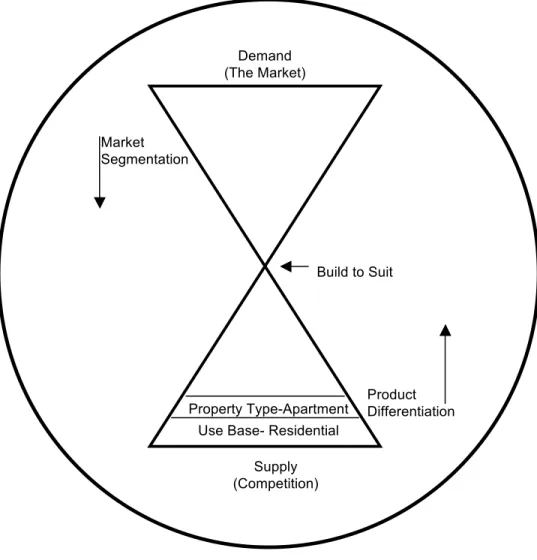
Maliza and Howarths Hourglass model has been presented in an evolving form throughout the first half of this paper to help illustrate the existing real estate market analysis process and demonstrate the mechanics of demand segmentation. The following version of the hourglass model presents a comprehensive summary of changes and modifications made to the model as well as a review of the mechanics. The changes made to the model and interpretation of its mechanics have been approved by Emil E. Malizia with the exception of one concept that will be discussed later in this chapter. The modified Hourglass is not intended to replace Malizia’s original model but is instead intended to assist in the presentation and organization of the selected development examples presented later in this thesis. Figure 6 below shows the modified hourglass model with a sequential explanation of the changes made so far.
FIGURE 6: The Modified Hourglass
Additions to the hourglass Model:
The first addition consists of the circle around the entire hourglass to represent the specific geography selected by the market analyst and developer. As established in chapter one, the selection of a specific geography is the first step in the real estate market analysis. The second addition is the inclusion and description of the naturally occurring supply segmentation that occurs within real estate as discussed in chapter 3. The third addition or change is the renaming of the intersection of the hourglass as the Build to Suit point. In the interpretation resented in this thesis, the intersection is the singularity where supply perfectly meets demand. However, Professor Malizia prefers to think of the intersection as the project that is intended to be developed. As further explained by Professor Malizia, the “build to suit represents a specification from the prospective tenant/buyer that defines exactly what you build. Therefore the build to suit
Demand (The Market) Supply (Competition) Build to Suit Product Differentiation Market Segmentation
Use Base- Residential Property Type-Apartment
is a demand specification where there is presumably no exact match (supply) in the market.” For the purposes of this thesis, the intersection of the hourglass will represent a build to suit project. Interpretations and Clarification of the Hourglass Model:
As discussed in earlier chapters, the outline of the hourglass represents the market as defined by the market study. Malizia points out “a symmetrical hour glass implies supply-demand balance including natural vacancy. Those line segments could be of unequal length indicating excess demand or supply.” Conceptually, the hour glass could be severely skewed at the top and bottom lines, defining market demand and market supply respectively should be proportionately related to the quantity of supply and demand within a market.
Mechanics of the Market Analysis with Demand Segmentation Using the Hourglass Model: The following is a sequential list of tasks to complete a thorough market analysis using proper demand segmentation techniques. Each task corresponds to some point on the Modified Hourglass model.
1. Establish Market Geography- Represented by the circle
2. Conduct Market Study- Outline of hourglass including the natural segmentation of real estate supply as defined by use and property type.
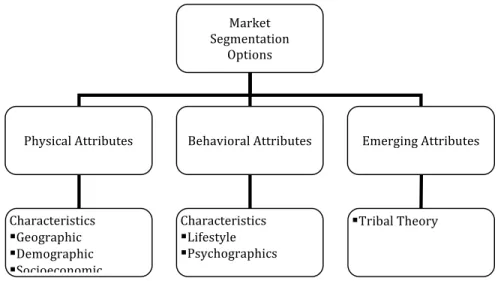
3. Conduct demand segmentation based on a selection of the attributes and characteristics shown in Figure 7 below
FIGURE 7: Demand Segmentation Options and Sequence
4. Once the market has been segmented the marketing analyst or real estate developer attempts to identify unmet or underserved needs and preferences among the segments and select this segment for further study. Identifying the segment is the process of moving from the top of the hourglass within the demand section toward the intersection of the hourglass. Once a target segment has been identified, the market professional engages in a thorough consumer level research effort to determine what features and amenities can make a potential development more relevant or meaningful to the subject segment. The by product of this research effort positions the project within the demand section of the hourglass somewhere in between the naturally occurring “property type” segment and the intersection of the hourglass.
Step 4 of this process is where the specific real estate product is created. So far, this paper has discussed this step as the research and inclusion of meaningful and relevant features and amenities that will appeal to the target segment. How does a real estate developer determine what is meaningful and relevant? Defining where a speculative development should lie within the supply differentiation section of the hourglass is the final part of the process. There are a myriad
Market Segmentation
Options
Physical Attributes Behavioral Attributes Emerging Attributes
Characteristics Geographic Demographic Socioeconomic Characteristics Lifestyle Psychographics Tribal Theory Market Segmentation Process • Divide market with one or a combination of segmentation attributes & characteristics • Select a target segments based on unmet or underserved needs • Research target segment to determine what will make a product meaningful • Design product or project based on findings in step 3
of ways to customize a real estate development for a specific demand segment including design, layout, lease length and terms, common area amenities, tenancy and programming and management. How a developer decides to customize a project should depend on the research efforts in step 4. Proceeding chapters in this thesis reviews three select projects that were developed for a specific demand segment and explores the real world application of demand segmentation in real estate development.
CHAPTER 7: An Introduction to Selected Cases
So far, this thesis has reviewed the practice of real estate market analysis and advocated for more extensive use of demand segmentation to better position speculative development or repositioning projects in a market. This second and final section of the thesis reviews three select examples of real estate projects, developed for specific demand segments. Each development review includes a description of the project’s concept, a physical description, an overview of the business model, a specific description of the target demand segment, a discussion of the way the project was designed to serve the target segment and finally a qualitative evaluation of the projects success or failure based on online consumer ratings websites like Tripadvisor.com and Yelp.com as well as interviews with project principal’s and owners.
Determinations about a projects success or failure have to be considered in context. Online ratings sites, while informative, are not statistically valid as they are limited to reviewers who have internet access and are willing to post reviews online. This is not a randomly selected pool and the number of reviews is not sufficient to make valid statistical conclusions. However, these sites are still valuable to review as they provide some measure of direct consumer acceptance. Without a concerted customer assessment program, there is no way for an organization or developer to know how their development is being perceived by customers. Also, not all of the reviews are from a developments target segment. As presented later, many people clearly not in the target consumer segment review these projects unfavorably. Despite their negative reaction, this information can still be used to make informed speculation about how a development is being received and why it is popular or unpopular.
Regardless of a projects popularity, it has to be economically viable. This thesis does not try to establish economic causality or claim that using demand segmentation will result in a more financially successful project. There are too many interrelated variables to make determination about the specific causes of a projects success or failure. One of the development reviewed in this thesis, The Block Hotel, had to recently close both locations due to a failure to pay a municipal Transit Oriented Tax. The project obviously failed due to insolvency but it would be
difficult to establish if this was due to a failure of the project concept, a failure in management or due to the significantly weakened condition of the economy. This thesis relies on the representations of the principals and owners to determine why a project succeeded or failed. Accordingly, all conclusions about a projects success or failure should be examined in context. Ultimately, the purpose of the reviews is to move the discussion of demand segmentation from the theoretical to the practical to demonstrate how it is has been applied in the real estate market.
CHAPTER 8: The Block Hotel
I. Introduction and Background
The Block in South Lake Tahoe was a 52 room, courtyard motel located near multiple Tahoe casinos, night clubs and ski resorts. Purchased in 2003 by founder, Liko Smith, The Block was positioned as the world’s first hotel for snowboarders by snowboarders. Smith, an experienced hotel manager, recognized “that by 2015 there will be no skiers on the slope. ….more than likely first time users and neophytes are gonna start off snowboardingxxxii.” This optimistic but compelling view on the market is supported in the 2008 IBISWorld Industry Report on Ski Resorts in the US. IBISWorld states that, “Snowboarding is one of the industry's fastest growing activities. According to industry sources, there were about four million snowboarders in 2001 compared to about one million in the early 1990sxxxiii.” Tahoe is a national, four seasons, recreation destination with 12 ski resorts situated along the California Nevada border. According to Smith “Tahoe [had] all kinds of places for skiers but there was very few places for snowboarders. Snowboarders were staying in what I call Kennels… wherever they could stayxxxiv.”
The Block’s South Lake Tahoe location opened in 2004. Smith partnered with celebrity snowboarder Marc Frank Montoya to help promote the hotel to his core tenant segment. To Smith, “the brand had to be relevantxxxv.” To bolster The Block’s authenticity and brand
meaning, Smith found other celebrity snowboarder investors who would regularly hang out in The Blocks lobby and participate in Block sponsored events. He even allowed pro snowboarders to stay at The Block for free. The entire customer experience from giving new guests a free Pabst Blue Ribbon upon check in and a hangover kit every morning was designed to cultivate a meaningful hotel experience for The Blocks target segment.
In addition to running the hotel, Smith focused heavily on promoting snowboarding events called “Block Parties,” featuring celebrity entertainers and professional snowboard competitions. G4 networks created a reality television show based on The Block’s staff and their challenges while working in the hotel. Smith cross promoted his hotel with as many related companies as possible all in an effort to create a snowboarding epicenter and recognizable brand name for future expansion. When contrasting The Block’s brand to other well known hotel brands like the ultra hip W hotel, Smith says “People don’t want to know how cool you are, they want to know how cool you make them feel …. that’s the key. They want to come in and feel like they are learning something about your brand by being involved in your brand …being part of a greater story and being cool for being therexxxvi.”
The Blocks initial success lead to the opening of The Block in Big Bear, CA in 2007. The Block was designed to be a scalable concept that could be developed in major ski resorts and adapted in different markets for other youth oriented segments like skateboarders and surfers. Smith’s management company, Rouge Hospitality, scouted other well traveled snowboard destinations and looked into expanding their concept to new markets while refining their brand.
Despite the growing strength of The Block brand and Smith’s claim that he was capable of charging market premiums of up to $200 a night for roomsxxxvii, The Block abruptly closed both its locations in January of 2009. The city of South Lake Tahoe shut down the Tahoe location due to the failure to pay over $200,000 in transit oriented taxes. Smith contends the failure to pay taxes was due to the loss of important records after changing bookkeeping companies. Regardless of why The Block closed, Smith’s combined success and failures provide important insights into segment based real estate development. Smith has no intention of abandoning The Block and plans to maintain his customer focus but reformat the business model based on his