1
Developing a Long Term Strategy for a Warehouse Network
by Patrick Johnson
B.S. Industrial and Systems Engineering, Auburn University, 2008
Submitted to the Sloan School of Management and the Institute for Data, Systems, and Society in partial fulfillment of the requirements for the degrees of
Master of Science in Engineering Systems And
Master of Business Administration
In conjunction with the Leaders for Global Operations Program at the Massachusetts Institute of Technology
June 2017
© 2017 Patrick Johnson. All rights reserved.
The author hereby grants to MIT permission to reproduce and to distribute publicly paper and electronic copies of this thesis document in whole or in part in any medium now known or hereafter created Signature of Author ____________________________________________________________________
MIT Sloan School of Management, Institute for Data, Systems, and Society May 12, 2017 Certified by __________________________________________________________________________
David Simchi-Levi, Thesis Supervisor Professor of Engineering Systems, Institute for Data, Systems, and Society Certified by __________________________________________________________________________
Donald Rosenfield, Thesis Supervisor Senior Lecturer, MIT Sloan School of Management Accepted by __________________________________________________________________________
John N. Tsitsiklis, Clarence J. Lebel Professor of Electrical Engineering IDSS Graduate Officer Accepted by __________________________________________________________________________
Maura Herson, Director, MBA Program MIT Sloan School of Management
2
3
Abstract
This thesis addresses the question of how to create a pro-active, long term, network centric warehouse strategy. This thesis will present an inventory model built to understand the capacity needs of Amgen’s warehouses over the time period of 2017-2023 to support this mission, along with
recommendations based on scenario analysis from this model to analyze and quantify the impacts of multiple scenarios in support of an efficient, effective, nimble supply chain.
With worldwide operations supporting a global customer base, Amgen’s operational philosophy is to ensure serving “every patient, every time”. Amgen’s warehouses play a vital role with this
mission, storing raw materials to ensure production with safety stock and various levels of Work in Progress (WIP) based not only on operational safety stock, but also strategic safety stock to ensure demand is always met, even with unforeseen risks.
In order to understand the impacts of growth on warehouse utilization, a relational database inventory model was created and linked to the long range forecast of supply and demand. This inventory model linked the Bill of Materials (BOMs) to the product forecast in order to to understand the quantity of raw materials required to meet the supply. The database also calculates the WIP and finished product levels of Amgen’s products. This model considers inefficiencies in the warehouses, as warehouse pallet spaces do not always store the maximum capacity of the material.
This inventory model calculated the capacity required for each warehouse over the forecasted ranges of FY 2016 to FY 2023. The findings of this model were used to create Amgen’s long term warehouse strategy. The model demonstrated a +- 10% accuracy to 2017 planning.
We developed a strategy that mimics Amgen’s operational strategy. Amgen’s operational strategy is to reduce fixed costs, and focus on flexibility with variable based costs. Based on this, we found the best strategy was to work with 3rd party logistics providers (3PLs) to mitigate the capacity gaps in a variable based manner. This option is preferred over investing in expanding capacity at warehouses already in use for all three scenarios of optimistic, baseline, and pessimistic demand profiles.
The biggest lever to gain warehouse capacity is to improve inventory policies and the flow of communication. Inventory policies whose aim is to reduce inventory can be viewed as a sensitive topic at a company like Amgen. But, if done in a scientific manner, and moving from a Months on Hand (MOH) approach to a scientifically calculated inventory, then moving to a multi-echelon inventory optimization, inventory and risk can be reduced. The following are ways that can be used to reduce inventory and risks.
Track forecast error to understand variation of demand Lead time reduction of raw materials and work in progress
Risk Pool Drug Product (DP) “nude” vials and decrease lead time from DP to customer Re-order point frequency increases
Reduction of demand variability through:
o Better communication of demand forecasts between marketing, global supply chain and site supply chain teams.
o Reducing variability of manufacturing planning
Seek commonality of raw materials to lower safety stock levels Multi-Echelon Inventory Optimization
4 By accomplishing these activities, Amgen has a scope to reduce 3PL storage requirements by 20k pallet-year spaces over the same time period. This will lower the expense of 3PL costs, and overall risks, over the same time period by $11 M. Considerable work will have to be accomplished, but the benefits will outweigh the costs.
Thesis Supervisor: Donald Rosenfield
Title: Senior Lecturer, MIT Sloan School of Management Thesis Supervisor: David Simchi-Levi
5
Acknowledgements
No man is an Island - John Donne
I’d like to thank the Leaders for Global Operations Program for its support of this work. Amgen has been a gracious company throughout this project with support, encouragement, and proper feedback. More specifically, I’d like to thank Delia Sander for her never-ending support with all of the knowledge and experience she brought to this project. Tarun Bhatia was instrumental in keeping the high level impact of this project at the forefront, ensuring we focus on the big picture. As the saying goes, “I apologize for the long letter, as I didn’t have the time to write a shorter one.” Tarun has ensured we communicated the main message of this project to the network effectively. Venkat Subramanian was a tremendous help in ensuring focus and support on this project, navigating a tricky software procurement process with ease. Cathryn Shaw-Reid was gracious with her time sharing the bigger impact of how this project fits in with Amgen, and how I can help support that mission.
David-Simchi Levi, Sean Willems, and Donald Rosenfield, three brilliant professors, were always just an email or phone call away to offer light when I seemed lost in the dark. Two LGO alumni, Steve Fuller and Seth White, were so important in helping to determine which data to use to support the model displayed in this paper and where to find it. They also ensured I understood the limitations of this data.
Lastly, I’d like to thank Megan Johnson for her constant encouragement and support, being patient as I ruined another hike with her by thinking out loud about the intricacies of the model developed in this paper. She has always been ready for another adventure, and this certainly was one as we moved across the country to pursue this challenging opportunity.
6
Table of Contents
Abstract ... 3 Acknowledgements ... 5 Table of Contents ... 6 List of Tables ... 8 List of Figures ... 9 List of Equations ... 10 1 Introduction ... 11 1.1 Project Situation ... 11 1.2 Project Motivation ... 12 1.3 Problem Statement ... 12 1.4 Thesis Goals ... 12 1.5 Thesis Scope ... 13 1.6 Thesis Overview ... 13 2 Operations at Amgen ... 14 2.1 Company History ... 14 2.2 Company Therapeutics ... 15 2.3 Operations Overview ... 18 2.4 Manufacturing Overview ... 212.5 Warehouse Operations Overview ... 24
2.6 Supply Chain Operations Overview ... 27
2.7 Long Range Plan Overview ... 31
3 Literature Review ... 33
3.1 Amgen’s Operations in Literature ... 33
3.2 Broader Themes in Literature relevant to this case... 34
4 Methodology ... 42
4.1 Current State Analysis ... 42
4.2 Baseline Warehouse Capacity Model Creation ... 43
4.3 Warehouse Capacity Scenario Creation ... 48
5 Results and Recommendations ... 52
5.1 Model Results... 52
7
5.3 Supply Chain Communication ... 56
5.4 Risk Mitigation Plan ... 57
6 Future Work ... 57
7 Conclusion ... 59
8 References ... 62
Appendix 1: Warehouse Capacity Model Details... 64
Baseline Model... 65 Inputs: ... 65 Queries: ... 65 Outputs: ... 67 Risk Assessment ... 67 Inputs: ... 68 Queries: ... 68 Outputs: ... 68
Optimistic and Pessimistic Scenarios ... 68
Inputs: ... 68
8
List of Tables
Table 1: Comparison of Amgen’s Financial Metrics vs. Other Bio-tech Companies ... 21
Table 2: Comparison of Safety Stock levels through lead time reduction ... 40
Table 3: Column Name and Column Descriptions of model output ... 52
Table 4: Capacity Utilization of baseline model for each warehouse by temperature type ... 53
Table 5: Model Predictions of over-utilization associated expense based on demand scenarios ... 53
Table 6: Model predictions of over-utilization associated expense of warehouse network ... 54
9
List of Figures
Figure 1: Breakdown of Amgen’s Therapeutics by Revenue for FY 2015 (Amgen, 2016) ... 16
Figure 2: Conditional Probability of Success for Drug Trials 2000-2013 ... 17
Figure 3: A Simplified Example of Amgen’s Supply Chain Operations ... 20
Figure 4: Manufacturing Process Flow of Bio-Technology and the Corresponding Inventory ... 22
Figure 5: Hypothetical Material Consumption Forecast ... 23
Figure 6: cGMP Raw Material Checklist ... 25
Figure 7: Global View of Amgen’s Commercial Manufacturing, Warehousing, and Distribution Centers . 26 Figure 8: Distribution of Last Stock Placement (in Days) for Amgen’s Warehouses ... 27
Figure 9: Amgen’s Work in Progress Inventory Levels ... 28
Figure 10: Distribution of frequency of lead time (in days) of raw materials ... 31
Figure 12: The Three Frontiers of Inventory Optimization (Willems, 2015) ... 36
Figure 13: Example of a bull whip effect from point of sale to manufacturer ... 37
Figure 11: Biopharma demand and forecast variation analysis (Rosenfield, 2014) ... 39
10
List of Equations
Equation 1: Average Cycle Stock Calculation ... 28
Equation 2: Order Size Calculation ... 28
Equation 3: Calculation of Safety Stock ... 29
Equation 4: Calculation of Projected Balance ... 32
Equation 5: Inventory equations from demand forecast and lead time ... 39
Equation 6: Safety Stock Reduction through Lead Time Reduction ... 40
Equation 7: Months on Hand Calculation ... 45
Equation 8: Calculations of Pallet spaces required for Pipeline Therapeutics with no known BOM’s ... 45
Equation 9: Pallets of Projected Balance ... 45
Equation 10: Calculation of Raw Material ... 46
Equation 11: Calculation of WIP Inventory ... 46
Equation 12: Pallet Efficiency ... 47
Equation 13: Warehouse Capacity Utilization ... 47
Equation 14: Pallets over Capacity summation ... 47
Equation 15: 3PL Cost for adding additional capacity ... 47
Equation 16: Net Present Value Calculation ... 48
Equation 17: Equation for Commercial and Therapeutics Multiplier ... 49
Equation 18: Warehouse Capacity Adjustment for Optimistic and Pessimistic Scenarios ... 50
Equation 19: Warehouse Capacity Utilization at Standard Utilization ... 51
11
1
Introduction
1.1 Project Situation
The sea gets deeper as you go further into it – Phoenician Proverb
This thesis is a result of a research project with Amgen in Thousand Oaks, California as a fellow in the Massachusetts Institute of Technology Leaders for Global Operations program. The research project is a research-based component of the two year duel-degree program for a Masters of Business Administration and a Masters of Systems Engineering.
Amgen is a biopharmaceutical company whose mission is to “Serve Patients”. Their operating philosophy is to serve “every patient, every time”. They take this philosophy seriously, being only one of two bio-tech companies who have never stocked out of their life saving therapeutics for patients. This philosophy is shown in the balance sheet, with over $2.4B in inventory on $20.9B of revenue for Fiscal Year (FY) 2015 (Amgen, 2016). Amgen has a network of global warehouses that store inventory in support of this mission. These warehouses not only store raw materials with the corresponding
operational safety stock and work in progress (WIP), but also strategic safety stock. This strategic safety stock is WIP at different stages of manufacturing stored to ensure patients will be served if any
manufacturing capacity is lost to unplanned risks.
Amgen has a highly variable ten year forecast of their existing therapeutics, called the Long Range Plan (LRP) due to the following:
A strong pipeline of developing drugs that may or may not be approved by the FDA. A propensity for acquisitions of other late stage drug therapeutics from other
companies.
Offering its therapeutics to more global markets, serving more countries.
Amgen currently has an excel-based model for individual warehouses that will show capacity utilization monthly over a rolling two years, but no pro-active, network-centric model or warehouse
12 strategy exists in support of the Long Range Plan. Due to this, warehouse managers and global supply chain managers make sub-optimal decisions when it comes to the storing of therapeutics, where some warehouses buy extra capacity in their respective local markets due to being over utilized, while at the same time other warehouses are underutilized.
1.2 Project Motivation
The motivation for this project is to ensure Amgen will be able to serve “every patient, every time” with a superior warehouse strategy. By creating a robust model that runs scenarios to simulate variations in demand profiles and changes in operating variables, an analysis can be created to identify over-utilization of capacity in the warehouse network and identify the best solutions to mitigate costly reactive decisions.
1.3 Problem Statement
Currently, there is no pro-active, long term, network centric strategy for Amgen’s warehouses. Warehouse managers manage their respective warehouses and supply chain managers flow their respective therapeutics through warehouses without regard to the entire network. This leads to some warehouses being over-utilized; which in turn leads to storage at 3rd Party Logistics providers (3PL’s); while other warehouses suffer from underutilization. Amgen forecast for future demand is highly variable, leading to reactive decisions in order to ensure warehouse capacity is available to store both raw materials and therapeutics.
1.4 Thesis Goals
The goal of this thesis is to create a warehouse strategy that will allow Amgen to nimbly, efficiently, and efficiently serve patients. To support this strategy, a model of the warehouse inventory requirements linked to Amgen’s Long Range Plan will need to be created. This model will identify the capacity gaps based on a variety of scenarios and the effects of capacity gap mitigations on the network.
13 Recommendations will be analyzed and given to ensure an efficient, effective, and nimble strategy is thoroughly communicated.
1.5 Thesis Scope
The scope of this analysis will be Amgen’s internal commercial production and warehouse system. More specifically, the capacity of Controlled Room Temperature (CRT)/ Ambient and 2-8°C warehouse storage. Due to 3rd party manufacturing and distributors storing raw materials, WIP, and finished therapeutics at their own sites, they are out of scope. Due to the nature of clinical productions unknown demand and frequent schedule changes, clinical production and storage are out of scope. Also out of scope are the warehouse freezers and warehouse hazmat storage, as this storage is relatively small, and additional capacity can be added relatively quickly. The impacts of financial costs of moving inventory frictionless from one global location to another are also out of scope. Due to this significant factor, no new shipping lanes (nodes) were created or analyzed, as the impacts of the tax situation could possibly outweigh the benefits of lowering over-utilization.
1.6 Thesis Overview
This thesis is categorized by chapters in a way to understand the project first from a high level view of the industry and company, then dive deeper into the finer details of the warehouse strategy creation through model developed. The contents of each chapter can be briefly described as follows:
Chapter 2 will begin with an overview of the Amgen’s history, line of therapeutics, and future therapeutics. This chapter will also provide an overview of Amgen’s operations, and more specifically, warehouse and supply chain operations and the Long Range Plan.
Chapter 3 will provide a review of literature to showcase best practices for strategy creation and warehouse operations, along with a review of research on warehouse networks. It will also include a review of standard inventory policies.
14 Chapter 4 will detail the approach to solving the problem statement. This chapter contains the detailed steps of building the warehouse capacity model to support the strategy development, along with the equations. This chapter will also detail the scenarios built to understand the implications of changes in key assumptions in the model, along with scenarios to mitigate overutilization of the capacity.
Chapter 5 will detail the results and implications of the baseline model, along with the different scenarios. It will also detail recommendations for best practices and how to alleviate overutilization of the warehouse capacity. This analysis will be used to craft the strategy, which will be detailed.
Chapter 6 will detail future projects that could be taken on to ensure warehouse capacity is available in the foreseeable future, along with a path forward for inventory optimization to ensure an efficient, effective, and nimble supply chain.
2
Operations at Amgen
2.1 Company History
Amgen Inc. (Applied Molecular Genetics) is an American multinational biopharmaceutical company headquartered in Thousand Oaks, California. William Bowes, a frustrated manager at Cetus Corporation (Author Unknown, 2016), left Cetus and recruited Winston Salser, a UCLA scientist, to begin Amgen in 1980. Bowes was able to recruit a powerful scientific advisory board and gain initial seed capital of $200K from venture capitalists. Bowes’ next step was to recruit George Rathmann from Abbott Laboratories to be the CEO of Amgen. Rathman was able to gain secured private equity funding from Abbot and Tosco Corporation, which gave confidence to venture capitalist, who in turn invested $19.4M in the new company. In 1983, Amgen tendered an IPO raising $42.3M.
15 With the financing now in hand, Amgen went to work on genetic engineering. Amgen was able to isolate and clone the erythropoietin gene, which stimulated red blood cell production. Since they had enough financing, they were able to forgo licensing the resulting drug (Epogen), and after a lengthy FDA approval process, gained the right to begin selling Epogen. In 1985, Amgen created a joint venture with Kirin Brewery to gain access to manufacturing technology in exchange for international marketing rights. With this manufacturing technology in hand, Epogen became the first biopharmaceutical to gross over $1B in annual revenue. Amgen has since grown to 20,000 employees with revenues of $21B for FY 2015 (Amgen, 2016), and a market cap of $128B.
2.2 Company Therapeutics
Amgen currently offers 15 innovative therapeutics with a wide variety of applications and modalities. Figure 1 describes the largest Amgen therapeutics by revenue and the corresponding revenue growth of those therapeutics. These therapeutics encompass every stage of the therapeutics life-cycle; from Epogen, which was approved for marketing in 1989 to Kyprolis, which was approved for treating patients with refractory multiple myeloma in 2016. These therapeutics are encountering growing competition as some therapeutics are coming off patent which brings on the creation of bio-similars. A bio-similar is a biological therapeutic that is highly similar to an FDA-approved biological therapeutics and has no clinically meaningful differences in terms of safety and effectiveness from the reference therapeutics (Amgen Pipeline, 2016).
16 Figure 1: Breakdown of Amgen’s Therapeutics by Revenue for FY 2015 (Amgen, 2016)
Amgen’s main therapeutics, corresponding markets, and uses are the following:
Enbrel – Marketed primarily in the United States, it is used primarily for the treatment of adult patients with the following conditions
o Moderately to severely active rheumatoid arthritis, o Chronic moderate – to – severe plaque psoriasis patients o Active psoriatic arthritis
Neulasta – Marketed primarily in the United States and Europe, it is used primarily to help reduce the probability of infection due to low white blood cell count in people with non-myeloid cancer who receive chemotherapy.
Aranesp – Marketed primarily in the United States and Europe, it is used primarily for the treatment of anemia.
Epogen – Marketed primarily in the United States, it is used primarily to treat a lower-than-normal number of red blood cells in patients on dialysis.
17 Sensipar/Mimpara – Sensipar is primarily marketed in the United States and Mimpara is
primarily marketed in Europe. It is used primarily for the treatment of Secondary hyperparathyroidism in adult patients with Chronic Kidney Disease on dialysis.
Xgeva - Marketed primarily in the United States and Europe, Xgeva is used for prevention of bone failure in patients with bone metastases from solid tumors and
Prolia- Marketed primarily in the United States and Europe, Prolia is used for treatment of postmenopausal women with osteoporosis.
Neupogen – Marketed primarily in the United States, Canada, and Europe, it is used primarily to help reduce infection due to a low white blood cell count in people with non-myeloid cancer who receive chemotherapy.
In addition to a strong commercial offering, Amgen has 40 pre-clinical and clinical targets with strong genetic support (Amgen Pipeline, 2016). New and innovative therapies face regulatory approval from each market before being able to market to the general public. This process is risky, with the success rate estimated to be 9.6% (David W. Thomas, 2016), as detailed in Figure 2, and an estimated cost to bring one drug to market at capitalized cost of $1.8 B (Paul, et al., 2010).
Figure 2: Conditional Probability of Success for Drug Trials 2000-2013
Phase one clinical trials investigate safety and proper dose ranges of a therapeutics candidate in a smaller number of human subjects. Phase two clinical trials investigate side effect profiles and efficacy
18 of a therapeutics candidate in a large number of patients who have the disease or condition under study. Phase three clinical trials investigate the safety and efficacy of a therapeutics candidate in a large number of patients who have the disease or condition under study. As of November 2016, Amgen presently has fifteen therapeutics candidates in phase one trials, seven therapeutics candidates in Phase two trails, twelve therapeutics candidates in Phase three trails, and six therapeutics candidates being developed as Bio-similars. Based on the conditional probabilities for success from Figure 2 Amgen has an expected value of 8.4 novel therapeutics candidates emerging from trials to approval.
A bio-similar, or follow-on biologic, is a biologic medicine designed to have active properties similar to one that has been previously been licensed by another company. Bio-similars follow a different regulatory review pathway than innovative therapeutics and indications. These products do not command the gross margins that patented products command, but do not face the high development costs, and risks that that entails, either.
2.3 Operations Overview
Amgen’s operational philosophy is to serve “every patient, every time”. They take great pride in focusing on the patient, with posters of patients around the office, and most staff meetings starting with patients talking about how Amgen’s therapeutics have positively impacted their lives. These words are not taken lightly, and this is shown in their balance sheet and operational strategy. Amgen uses inventory for the following reasons:
Reduce risk of variation in demand Reduce risk of variation in supply
Reduce risk of supplier shutdown’s for single-sourced suppliers Reduce risk of long, variable lead times
19 Certain variables add large uncertainty in the needs of warehouse utilization over the long term.
Amgen’s capacity utilization of its warehouses is growing over the next ten years due to the following: Increased pack sizes of its therapeutics
Amgen’s marketing has identified that patients are looking for more than just the drug itself, valuing the esthetics of the package along with new technologies and drug delivery devices. New packs sizes to deliver these new devices can be 2 to 3 times larger than the traditional vials and syringes.
Therapeutics SKU growth for new markets
New markets are being developed, which adds complexity due to meeting new countries regulatory requirements.
New therapeutics being organically developed or acquired through acquisition. As discussed in Figure 2, Amgen has a large pipeline of drugs that may or may not gain marketing approval from regulators. Amgen could also choose to acquire new promising late stage drug therapeutics.
Operations Strategy is changing from Large, Fixed Costs manufacturing to Disposable, Variable Cost manufacturing
Amgen is moving away from large, steel batch sized bio-reactors to disposable variable costs manufacturing in order to reduce the capital outlays and improve speed and flexibility to the patients. This technology has shown to require larger amounts of storage needs for raw materials.
Some of Amgen’s therapeutics are coming off patents, and the competitive space of the industry is increasing.
With a net profit margin of 33.13% for FY 2015 (Amgen Profitability Analysis, 2016), Amgen would only have to increase revenue by 3% (=.01/.3313) to achieve the same result as reducing
operating costs by 1%. Clearly the larger the profit margins, the less important it is to focus on reducing operating costs. Therefore, when approaching this problem, costs are not the predominant factor in developing the strategy. The goal of the project is to ensure warehouse capacity under a variety of different scenario’s.
Viewed through Amgen’s strategic lens, the operations team faces many challenges of organizational layout. Amgen’s greatly simplified supply chain organization is detailed in Figure 3.
20 Figure 3: A Simplified Example of Amgen’s Supply Chain Operations
External Supply Chain
Site Supply Chain Team
Sites Manufacturing
Site Supply Chain Team Global Sales Warehouse Leadership Manufacturing Leadership Global Supply Chain
Leadership
Raw Materials & Devices Team Global Supply Chain
Team
Operations Executive Leadership
Marketing Team
CEO
Global sales, among other things, determines the forecast of demand for all of Amgen’s therapeutics. They communicate this demand to the global supply chain team. Under the Vice President of global supply chain, global supply chain managers determine the supply required by manufacturing to meet this demand, and which location of manufacturing and storage for each step of manufacturing. The raw materials & devices team handles the supplier relationships and sourcing opportunities, determines the strategy for raw materials, creates a high level inventory recommendation based on forecasted demand and supply, and then communicates these recommendations to the different manufacturing sites supply chain teams.
The different manufacturing sites supply chain teams review the recommendations for
21 They then place the orders into the ordering system to trigger the orders to the suppliers. The
warehouse leader works with the site’s supply chain teams to understand the short term forecast in order to understand the warehouse capacity required to accept raw materials, work in progress, and finished therapeutics when it is shipped to them.
Amgen’s inventory turnover ratio is 1.74, leading to an average days of inventory at 210 days (Amgen, 2016). Based on a study performed in 2013 (REL , 2013), The U.S. Biotech industry has the 2nd highest Days of Working Capital (85 days) of all industries, right behind aerospace. Comparing inventory ratio’s to other bio-tech companies, Amgen has a lower inventory turnover, lower working capital turnover, higher days of inventory, and a longer cash conversion cycle, as shown in Table 1. While this table shows that Amgen has room for improvement among its peers, it should be noted that Amgen is only 1 of 2 bio-tech companies to have never stocked out of thereputics to patients.
Table 1: Comparison of Amgen’s Financial Metrics vs. Other Bio-tech Companies
2.4 Manufacturing Overview
Amgen’s manufacturing operations are a tremendous competitive advantage. The high level manufacturing flow for bio-tech begins with selecting a cell from a cell bank with the given medicinal properties. The cell is transferred to a beaker and fed various ingredients as the cell enters geometric growth. This growth is the bottleneck of the process, where cells double every 24 hours. The cells are systematically transferred to larger and larger vessels ensuring proper oxygen levels, pH, and
temperatures for optimal growth. When the cell produces the protein, and the cells are at the necessary volume, the cell is broken up and the protein is harvested. Stabilizing ingredients are
AMGEN Merck Gilead
Inventory Turnover 1.74 3.18 2.05
Working Capital Turnover 0.7 3.74 2.16
Days of Inventory 210 115 178
22 introduced with the proteins to mitigate protein “clumping” and ensure the protein does not degrade over time. This solution is called drug substance (DS), and DS has a shelf life on average of 18 months.
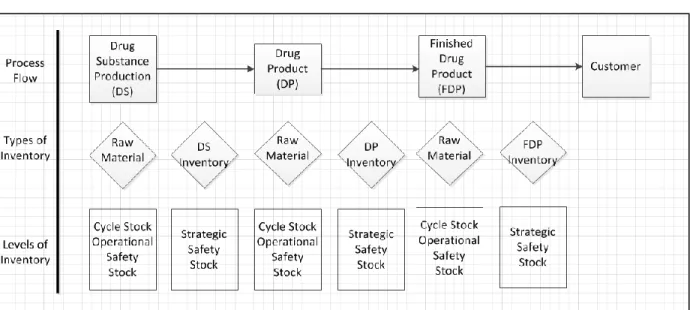
Drug substance is sub-divided into patient sized syringes or vials and shipped to the next stage of manufacturing as drug product (DP). The DP can also be called “nude” vials, as they do not have market specific labels placed on these vials. The DP is packaged, labeled, and boxed to the final customer configuration with the proper instructions for that market and is prepared to be shipped as finished drug product (FDP) for the specific market(s) that Amgen serves. DP and FDP have a combined 24 months of shelf life. These steps detailed in Figure 4 have raw materials that flow in to support each process step, and each step has certain levels of WIP inventory, along with a strategic safety stock (SSS) to ensure that the philosophy of “every patient, every time” is met.
Figure 4: Manufacturing Process Flow of Bio-Technology and the Corresponding Inventory
Amgen’s operational strategy is transitioning from large fixed costs manufacturing as demonstrated in Amgen Rhode Island, which produces up to 10,000 kgs of DS in large steel vats to a variable costs manufacturing, as demonstrated in Amgen Singapore, which produces 2,000 kgs of DS in small, disposable bags for small batches. This variable cost production is a competitive advantage for Amgen for two reasons: speed and flexibility. The ability for Amgen to manufacture any therapeutic
23 rapidly is due to smaller, quicker manufacturing batches which can be used to meet demand for highly variable markets, and the disposable plastic bags can be set up quickly at greenfield sites in the event of manufacturing plants being incapacitated due to unforeseen risks. This new approach also has great environmental advantages such as a reduced footprint and reduced waste due to the reduced water and chemicals needed for cleaning large vessels.
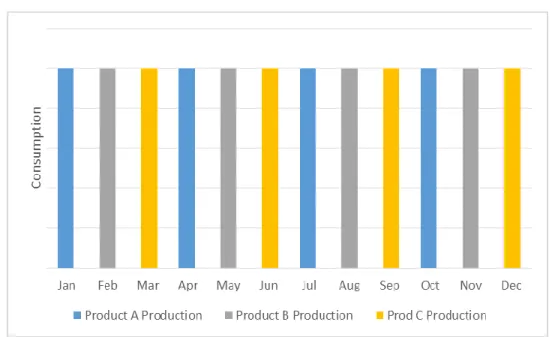
Currently, the large fixed costs manufacturing is planned as campaigns. Since the manufacturing is batched, the demand for therapeutics, and the corresponding raw materials is also batched. This leads to manufacturing cycles like the following demonstrated in Figure 5. Manufacturing campaigns leads to difficulty in using standard deviations to calculate safety stock and leads to sites utilizing a different method in calculating safety stocks as detailed in Chapter 2.6. On top of this, manufacturing has been known to switch scheduled production runs due to not having raw materials for the baseline schedule.
24 Variable cost production relies on one therapeutic being produced with a steady, non-variable production cycle. This deterministic manufacturing will ease the burden on the supply chain and allow for lower levels of operational safety stock.
2.5 Warehouse Operations Overview
Amgen is a global company with global operations, and as such has a global footprint. Amgen’s therapeutics are manufactured in 3 main manufacturing facilities and flows through 6 different
warehouses. For FY 2015 (Amgen, 2016), Amgen stored $2.4B in inventory broken out in the following: $201M in raw material, $1.5B in work in progress, and $705M in finished therapeutics. Amgen has used this inventory very effectively, if not efficiently, being one of two biotech companies to have never stocked out of therapeutics to their customer.
These warehouses hold raw material, and different stages of work-in-progress and finished therapeutics; all which have different storage temperature requirements. All warehouses have the same basic layout and storage temperature types. The aggregated storage temperature requirements are the following:
CRT/Ambient – This is Controlled Room Temperature/ Ambient warehouse space. This space is used to store mostly raw materials.
2-8°C – This is cold storage warehouse space. This space is used to store mostly WIP from DP to FDP and finished therapeutics. There are some raw materials that need to be stored in this temperature range.
Freezers – This space is either walk in freezers, or stand – up freezers that range from 10°C to -80°C. This is used to store mainly DS and certain DP and FDP
Haz-Mat – This is a special case of the above temperature settings where acids, bases, and flammables must be stored in segregated areas for safety reasons
25 Warehouses in the biotech industry face a large set of requirements from the Federal Drug Administration (FDA) that ensures the safety and efficacy of the therapeutics to the consumer. These requirements contain guidelines and inspection requirements, and are listed in Figure 6.
Figure 6: cGMP Raw Material Checklist
Current Good Manufacturing Practice (cGMP) guidelines are set by FDA. Other considerations for warehouse operations is storage of Non-Bill of Material (BOM) related items like cleaning solutions and PPE, Material samples for quality tests, and material and therapeutics rejection cages.
Amgen’s warehouse operations are broken into two types of warehouses. Amgen has
warehouses that support the production system and distribution centers to store finished therapeutics before being sent on to the distributors, who usually have 2- 3 weeks’ worth of inventory (Amgen, 2016) to buffer against demand variability. As shown in Figure 7, Amgen’s manufacturing, warehousing, and distribution center have global reach. One of the opportunities discussed is how to leverage the entire network of the storage facilities to lower over-utilization of the warehouses. This can be seen as a network problem.
26 Figure 7: Global View of Amgen’s Commercial Manufacturing, Warehousing, and Distribution Centers
Amgen has internal commercial operations and supporting warehouses in California, Rhode Island, Massachusetts, Kentucky, Puerto Rico, Ireland, The Netherlands, and Singapore. The California facility also provide clinical operations. This internal network plus its collection of contract manufacturers are webbed together to provide risk mitigation production capabilities to support the operating principle of every patient, every time. For manufactured WIP, once manufacturing produces the DS, DP, or FDP, the manufacturing sites warehouses will store the therapeutics for a certain time period to ensure that the quality inspections are verified, then pack for transportation by air, sea, or land to the downstream manufacturing centers warehouse for further processing or to be distributed to customers. The average number of days that a product will sit in the warehouse is 134 days, or 4.5 months. The warehouses receive raw materials from distributors, and then store these materials in the warehouse until manufacturing requests the materials. The warehouse operations team will pull the requested raw materials from pallets, and stage them for manufacturing to consume. The average number of days that a raw material will sit in the warehouse is 162 days, or 5.4 months. The distribution of days since last
27 movement is shown in Figure 8. Based on this analysis, there does seem to be a decent amount of outliers, as this distribution has very long tails. A project should be initiated to investigate if any of these outliers really need to be in the warehouses, or could they be scrapped to open up additional capacity. Figure 8: Distribution of Last Stock Placement (in Days) for Amgen’s Warehouses
2.6 Supply Chain Operations Overview
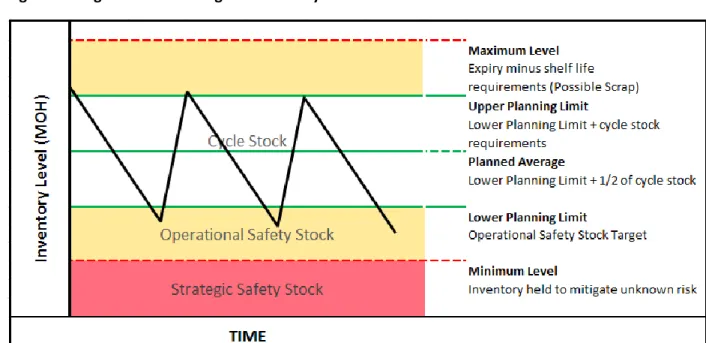
Amgen utilizes the following three main types of inventory: cycle stock, operational safety stock, and strategic safety stock. Cycle stock is the average amount of inventory to meet demand between the production cycles. Operational safety stock is inventory stored to ensure the variation of supply and demand is met between the production cycles. Strategic safety stock is a special type of inventory for Amgen. It is used for risk mitigation purposes, to ensure that if a manufacturing site is unable to manufacture therapeutics due to geo-political concerns or natural disasters, the inventory will be able to supply demand until manufacturing is restored at the affected site or delegated to an
28 alternative site to meet demand. Figure 9 demonstrates the inventory stock levels that Amgen uses for production.
Figure 9: Amgen’s Work in Progress Inventory Levels
Cycle Stock:
This inventory is the inventory used to fulfill the anticipated demand until more can be produced. The average cycle stock can be detailed in Equation 1.
Equation 1: Average Cycle Stock Calculation
𝐴𝑣𝑒𝑟𝑎𝑔𝑒 𝐶𝑦𝑐𝑙𝑒 𝑆𝑡𝑜𝑐𝑘 =𝑂𝑟𝑑𝑒𝑟 𝑆𝑖𝑧𝑒 2
The order size can be calculated from a given order frequency and desired production level detailed in Equation 2.
Equation 2: Order Size Calculation
𝑶𝒓𝒅𝒆𝒓 𝑺𝒊𝒛𝒆 = 𝑷𝒓𝒐𝒅𝒖𝒄𝒕𝒊𝒐𝒏 𝑹𝒂𝒕𝒆 𝑶𝒓𝒅𝒆𝒓 𝑭𝒓𝒆𝒒𝒖𝒆𝒏𝒄𝒚
29 The order frequency is the number of orders per year, and the production rate is set as the supply required to meet the demand plus the strategic and operational safety stock.
Operational Safety Stock:
This inventory is kept on hand to manage the variability of supply and demand, along with allocations for scrap and quality issues that could occur. The centralized raw materials team utilizes Equation 3 to set safety stock levels. The Z value is the inverse of the cumulative standardized normal one-tailed distribution. Currently, Amgen utilizes a 95% probability, which translates into the value of 1.64. The question is whether a 95% value is appropriate. To address this, we can draw upon the concepts of the newsvendor problem. Given the critical fractile approach, which balances overage and underage costs, to inventory, Amgen’s optimal safety stock inventory levels can be found. The
newsvendor model determines the service level that a company should utilize by finding the minimum cost between underserving the market leading to lost sales, and overserving the market leading to excess inventory and scrap. In the bio-tech industry, underserving the market could lead to much graver situations, including market backlash, loss of reputation for other products, accelerated regulatory approval of competitor products, and up to patient’s death, hence the philosophy of ensuring “every patient, every time”. Analysis of Amgen’s optimal service level based on the newsvendor problem was found to be 99% (Yang, 2015). Based on this analysis, Amgen is using the incorrect service level of 95%, but due to the site supply chain managers ordering more safety stock then prescribed, it is unclear whether the correct safety stock is being held. Manufacturing has been known to switch scheduled production runs due to not having raw materials for the baseline schedule.
Equation 3: Calculation of Safety Stock
30 The B in this equation is based on risk-pooling theory and is described in more detail in Chapter 3. Reflecting on the operations philosophy of serving “every patient, every time”, and the newsvendor model results, manufacturing sites supply chain managers utilize safety stock to cover the most that could be needed, and usually does not consider the typical probabilistic approach dictated in Equation 3.
Factors that influence the site supply chain managers’ decisions are sourcing diversification, ease of sourcing, supplier financial health, and a history of supply disruptions. At Amgen, safety stock is combined with cycle stock and treated as a variable that could be known as Months on Hand (MOH) of inventory. This is basically a blanket setting to ensure that there is enough raw material inventory on hand for X months of production.
Strategic Safety Stock:
To calculate strategic safety stock inventory, a risk team calculates the probability of an event that would incapacitate the manufacturing plant; whether it be fire, flood, storm, geo-political, or other disaster. The time period until production can be restored at that site, or another site, is calculated from the time the event occurs to the time manufacturing capacity can be restored. The amount of inventory to ensure that the demand is met during that time period is calculated as months of forward coverage, or MFC. This inventory is stored for every stage of therapeutics work in progress from DS to FDP detailed in the above section, and is not to be utilized except for risk mitigation purposes. A project should be explored for understanding the Time to Survive (TTS) for each manufacturing plant and compared to the Time to Failure (TTF) to ensure TTS>TTF. This idea is explored in Chapter 3.
Amgen’s lead times for raw materials is widely variable, and with a median lead time of 61 days and an average lead time of 63 days. The distribution of lead times for raw materials is shown in Figure 10.
31 Figure 10: Distribution of frequency of lead time (in days) of raw materials
Based on this, significant opportunities do abound to reduce lead times, and correspondingly, safety stock levels at warehouses. This analysis is explained in Chapter 3.
2.7 Long Range Plan Overview
Amgen’s LRP is created by the sales and marketing organization in conjunction with the supply chain organization. This plan is updated multiple times throughout the year when new information is made available, such as new market opportunities or current commercial therapeutics are allowed to be marketed to new indications. It is important to note that no forecast error is created for successive iterations of the LRP. With a proper forecast error, scientific formulas for inventory could be created and utilized to better ensure “every patient, every time”.
The following bullets detail how each portion of the LRP is calculated:
Demand - Marketing and supply chain managers build a ten year annual forecast of all customer demand from the different markets of each therapeutic over the next ten years. This is
32 aggregated for each manufacturing site and therapeutics and its respective demand for a given year.
Supply - Operations calculates the downstream supply (i.e. in order to make 1,000 FDP, it requires X DP units and Y DS lots ) required to make the final therapeutics to ensure demand is met plus a projected balance for risk mitigation, lead times, and anticipated scrap. This is aggregated from the separate markets for each manufacturing site based on its respective supply for a given year.
Projected Balance - The projected balance is the amount of therapeutics that will be stored to ensure the variation of demand is met and provide risk mitigation of unforeseen events. This is detailed in Equation 4.
Equation 4: Calculation of Projected Balance
33
3 Literature Review
Research is to see what everybody else has seen, and to think what nobody else has thought.
-Albert Szent-Gyorgyi
Prior to and during the development of the warehouse strategy, and corresponding model to support the strategy, much effort was expended to research the existing approaches. We will start with research close to Amgen’s operations, then discuss the broader literature available to support a robust solution to the problem statement.
3.1 Amgen’s Operations in Literature
Two warehouse models have already been detailed from previous MIT Leaders for Global Operations program thesis. Jason Choi in “Raw Material Inventory Planning in a Serial System with Warehouse Capacity” (Choi, 2014) discusses the inventory management policies and corresponding warehouse capacity required for one warehouse at Amgen. To reduce inventory at that warehouse and gain additional capacity, Choi recommends the following:
Batch size optimization based on available warehouse space
Safety stock reduction due to removal of demand variability by fixing the production system Reduce Stock Keeping Units (SKU) complexity through commonality of raw materials, which will
lead to lower levels of safety stock
Utilize Vendor Managed Inventory (VMI) to reduce inventory
Utilize 3rd party logistics (3PL) in series to minimize warehouse transfers
Maxine Yang realizes in “Optimization of Warehouse Operations and Transport Risk Mitigation for Disposable Bioreactor Bags to Support Launch of Amgen Singapore Manufacturing” (Yang, 2015) the significant amount of safety stock being held at a specific warehouse, forecast changes that increased the demand, and how Bill of Material (BOM) changes affected storage capacity. She then proposes an excel-based model that will calculate the storage requirements based on lot production rates,
34 capacities, efficiencies, and forward coverage (safety stock levels). Her model calculated warehouse over-utilization in the near future, and recommended the following steps to reduce overutilization.
Store raw material inventory at supplier’s warehouses Reduce lead time of raw materials
Increase raw material delivery frequency Random assignments of pallet spaces Utilization of 3PL to store materials
Reduce testing and release times for raw materials
According to the World Bank (Unknown, The World Bank, 2016), the average time to build a warehouse is 160 days. This is widely variable across countries. An internal study (Unknown, 2007) at Amgen revealed the average fixed cost to build a warehouse is around $29M, with an average fixed cost per pallet location space is around $5,000 with a standard deviation of $2,700. Warehouses are capital intensive cost centers, and therefore are not readily invested in unless truly needed.
3.2 Broader Themes in Literature relevant to this case
When building a prediction model, a good starting point should be Daniel Kahneman’s and Amos Tversky’s, “On the Psychology of Prediction” (Tversky, 1973). They summarize that the best way to create a prediction is to perform the following steps:
1) Understand the prior information, or base rate. 2) Understand the specific evidence about the base case. 3) Determine the expected accuracy, or range, of the prediction.
Given this understanding, it’s important to understand the current state, the equations driving the current state, and for the predictor to give a knowledgeable range of the prediction to ensure a proper model. Tversky and Kahneman describe how graduate students were given information about a person who scored on the 99th percentile on an IQ test, but the test had a known error. The students were asked to estimate a range of the true IQ score. The students gave an interval that was equal
35 around the 99th percentile, not realizing that the average score was at the 50th percentile. Therefore, the range should have been a heavily tilted toward the base rate. This type of bias leads to faulty models.
Sean Willems states in his paper, “Demystifying Inventory” (Willems, 2015) that using metrics such as MOH are wrong.
“That is, the [MOH] is calculated by determining how many [Months] into the future existing inventory on hand can satisfy. This corporate metric, which has some value, reinforces the incorrect intuition to focus on forward-looking parameters when setting inventory targets. So while we have definitively shown that forward [Months] of coverage is a bad metric to use for inventory planning purposes, its value as a corporate metric reinforces its incorrect usages for safety stock target setting.”
He further states the hardest step in optimizing inventory across the end-to-end supply chain is moving from ad hoc unscientific MOH to a scientifically derived inventory targets. He recommends moving from the 1st frontier to a 3rd frontier of inventory optimization:
1) Ad Hoc “Heuristics” Inventory Policies
2) Single Stage Scientifically Calculated Inventory Policies 3) Multi-Echelon Inventory Policies
36 Figure 11: The Three Frontiers of Inventory Optimization (Willems, 2015)
Proper inventory levels have been detailed heavily in operations, and one of the more frequently studied issues is the bull whip effect. The bull whip effect is due to variations in demand travelling upstream in the distribution system. This leads to increases in variation at each step in the supply chain, leading to large swings at the source. Research indicates a fluctuation in demand of +/- 5% at the point of sale can lead to a +/- 40% change in demand at the source (Hau L. Lee, 1997). This can be pictured in Figure 12 to showcase how small changes in demand propagate through the supply chain. The consequence of this typically leads to either stock-outs or excessive inventory. To counteract this problem, it’s necessary to extend the visibility of customer demand as far back in the supply chain as
37 possible, and use proper demand driven inventory policies such as Kanban principles, and to align channels through such activities as Vendor Managed Inventory (VMI).
Figure 12: Example of a bull whip effect from point of sale to manufacturer
Probability Theory of Risk- Pooling is a proven method to reduce inventory while simultaneously reducing risk. Risk pooling effectively gives you lower inventory with a higher service level. As detailed in “Using Forecast Variability and Risk Pooling to Determine Optimal Safety Stock Levels within a Supply Chain” (Roza, 1998), the variance of the sum of two random variables is not the sum of the individual variances when correlation is present. More importantly, unless the variables are perfectly correlated, the sum of the standard deviations are larger than the standard deviation of the sums This feature allows for a lower safety stock when delaying production to the next step when one step produces many varieties in the next step. For example, when delaying production of FDP at the nude vial stage, the amount of safety stock can be greatly reduced. Assume for a demonstration purpose, two markets of FDP for a single drug therapeutic, where each market requires different configurations of labeling and packaging. With no risk pooling, the probability that no stock-out will occur is 0.99*0.99 = 98%
38 𝑍(𝜎1+ 𝜎2) ∗ √𝑟 + 𝑙 . With risk pooling, the probability of meeting demand with the each therapeutics
inventory is 99%, and the amount of inventory to be held would be 𝐼𝑛𝑣𝑅𝑖𝑠𝑘𝑝𝑜𝑜𝑙𝑖𝑛𝑔 = 𝜇1+ 𝜇2+ 𝑍(𝜎𝑇) ∗
√𝑟 + 𝑙 where 𝜎𝑇= √𝜎12+ 𝜎22+ 2𝜌12𝜎1𝜎2, and 𝜌12 is the correlation value between the demand of 1
and 2. Given the ranges of 1 to -1 for 𝜌12, the safety stock can range from a worst case of 𝜎𝑇 = 𝜎1+ 𝜎2
when 𝜌12= 1 to the best case of 𝜎𝑇 = 𝜎1− 𝜎2 when 𝜌12= -1.
To understand the base case of inventory, an inventory model should understand how product demand is built up. Rosenfield states, (Rosenfield, 2014)
“The driver of inventory is forecast error. If forecast error is high, then more inventories is required to address the uncertainties. To establish how inventory varies, [an] analysis of three types of relationships should be studied:
The relationship between inventory and forecast error
The relationship between forecast error and the lead time over which it is calculated
The relationship between forecast error and product volume First, inventory increases as forecast error increases, because reserve stocks or safety stocks are generally proportional to the magnitude of forecast error. Because reserve stocks or safety stocks are typically the predominant part of inventory, we assume that inventories will behave as reserve stocks behave and thus be proportional to the magnitude of the forecast error. We can thus use standard inventory models for safety or reserve stocks”
Rosenfield further states that the “variance of the demand forecast is proportional to the average total demand. Hence the square root of the variance, the standard deviation, is proportional to the square root of the average total demand.” (Rosenfield, 2014) This leads to the same result of the equation detailed in the above paragraph. Not only does this mean that demand forecast should be
proportional, but also that lead times should be proportional. Although these two relationships do not always follow a square root relationship, there is a concave relationship between demand variation and forecast error and lead times, which is due to correlations of these two variables. These concave
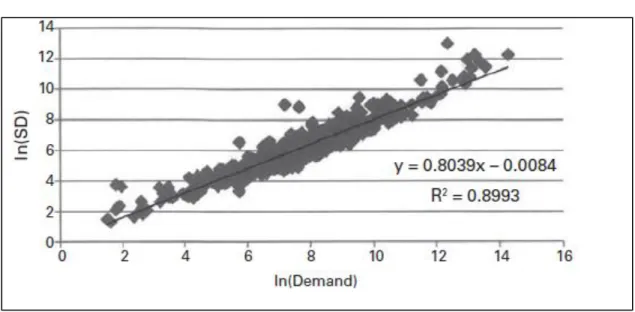
39 relationships can range from 0.5 all the way up to 1. Rosenfield follows this up by showing that the values should be 0.8 for the the biopharma industry as shown in Figure 13.
Figure 13: Biopharma demand and forecast variation analysis (Rosenfield, 2014)
This shows that as demand increases, inventory should only increase by a factor of .8. This could also be stated as inventory as a percent of demand. This relationship can be expressed by the following:
Equation 5: Inventory equations from demand forecast and lead time 𝑰𝒏𝒗𝒆𝒏𝒕𝒐𝒓𝒚 = 𝑲𝑫̅−(𝟏−𝜶)𝒕𝜷
where K is a constant of proportionality depending on the variability of the demand and the service level (in our case the Z value). This is the basis for the equation detailed in Equation 3
Another valuable project that will allow better forecasting is to begin tracking of the LRP forecast error. Roza states in his paper (Roza, 1998) the following:
“While a forecast error that is different both in magnitude and direction for each [therapeutic] flavor makes [a company’s] current process chaotic, it is just the scenario that would make risk-pooling effective. Risk-pooling under these conditions would allow the negative correlation between demand streams to mitigate the individual forecast errors inherent in the current forecast. For example, if all the [therapeutics] were held in a generic format, the under forecast of one flavor would cancel the over forecast of another flavor. Even if the demand streams were independent of slightly positively correlated [the]
40 sheer aggregation tends to decrease total variability and thus the required
safety stock.”
Lead time reductions also offer lower inventory levels and increased flexibility without any additional risk. This can be accomplished with better inventory management policies like implementing Kanban systems. With shorter lead times, production can choose to delay shipment of items they do not need until later if the production schedule needs to be shifted, providing flexibility. Shorter lead times also decreases the time an item is not exposed to risks in shipments. Given the calculation for safety stock levels in Equation 3, the equation for determining the safety stock reduction through lead time reduction is listed in Equation 6.
Equation 6: Safety Stock Reduction through Lead Time Reduction ∆𝑆𝑆= 1 − (
𝐿𝑁𝑒𝑤
𝐿𝑂𝑙𝑑)
𝐵 Where B ranges from 0.5 to 1
Given this equation and a value of B as 0.7, Table 2 can be produced.
Table 2: Comparison of Safety Stock levels through lead time reduction
Multi-Echelon Inventory Optimization (Willems, 2015) is the third efficient frontier is the supply chain frontier. In this setting, we now optimize safety stock targets across the supply chain. This requires a new level of communication and management, coupled with a multi-echelon inventory optimization engine, to facilitate the determination and use of the new targets. By strategically placing safety stock
Original Lead Time (Days)
Revised Lead time (Days)
Reduction in Safety Stock (%) 100 100 0% 100 90 7% 100 80 14% 100 70 22% 100 60 30% 100 50 38% 100 40 47% 100 30 57% 100 20 68% 100 10 80%
41 inventory in the supply chain nodes, safety stock could be reduced at other nodes due to the lead time of the safety stock being able to bridge the needs of the following nodes. This is best accomplished by decoupling safety stock before a major value add step of manufacturing where the product is relatively cheap, and removing safety stock at the following levels until safety stock is held for the customer. The mathematical basis of reducing inventory through multi-echelon inventory optimization is the same as risk pooling in the previous paragraphs on risk pooling, but instead of optimizing two stages of the supply chain, MEIO minimizes costs across the entire supply chain while still ensuring “every patient, every time”.
For the optimization of inventory in a multi-echelon system, the following optimization program should be used (Sean Willems, 2011):
𝑷 min ∑ 𝑐𝑗(𝑆𝐼𝑗,𝑆𝑗) |𝑁| 𝑗=1 𝒔. 𝒕. 𝑆𝑗− 𝑆𝐼𝑗≤ 𝑇𝑗 ∀𝑗∈ 𝑁 𝑆𝐼𝑗− 𝑆𝑗 ≥ 0 ∀(𝑖, 𝑗) ∈ 𝐴 𝑆𝑗≤ 𝑠𝑗 ∀𝑗: ∄𝑘 ∈ 𝑁| (𝑗, 𝑘) ∈ 𝐴 𝑆𝑗, 𝑆𝐼𝑗≥ 0, 𝑖𝑛𝑡𝑒𝑔𝑟𝑎𝑙 ∀𝑗∈ 𝑁
Where 𝑇𝑗 is the time required to complete the processing requirements of stage 𝑗, 𝑆𝐼𝑗 is the longest
outgoing service time from upstream adjacent stages quoted to stage 𝑗, 𝑆𝑗 is the delivery time stage 𝑗
quotes its adjacent downstream stages, and 𝑠𝑗 𝑖𝑠 𝑡ℎ𝑒 𝑚𝑎𝑥𝑖𝑚𝑢𝑚 𝑜𝑢𝑡𝑔𝑜𝑖𝑛𝑔 𝑠𝑒𝑟𝑣𝑖𝑐𝑒 𝑡𝑖𝑚𝑒 𝑎𝑡 𝑠𝑡𝑎𝑔𝑒 𝑗.
Each stage has a cost function𝑐𝑗(𝑆𝐼𝑗,𝑆𝑗) which is a function of its incoming and outgoing service times,
and is the costs of holding inventory at the stage.
The objection function minimizes the total stage cost. The first constraint ensures the outgoing service level for each node is below the quoted service time plus its own lead time. The second
constraint ensures the incoming service level for each node to be at least as large as the longest outgoing service time quoted to the node. The third constraint enforces an upper bound on a demand nodes outgoing service time. The final constraints require service times to be nonnegative and integer.
42 Time to Survive (TTS) analysis could be used to right-size the strategic safety stock levels at Amgen (Simchi-Levi, 2010). Amgen has already analyzed and found the Time to Recovery analysis, which is the time it takes to recover manufacturing capacity after an unforeseen disaster to its supply chain. TTS represents the time a supply chain system can continue to operate while its sources of supply are disrupted. Instead of focusing and holding a strategic safety stock, Amgen could perform a study on the TTS of its supply chain, and as long as TTS> TTR, the strategic inventory above that mark could be reduced. This exercise could also be used to identify risks to the supply chain.
4
Methodology
4.1 Current State Analysis
Amgen’s current warehouse strategy is reactive, with each warehouse site director managing their individual warehouse capacity, with therapeutic supply chain managers flowing their respective therapeutics through specific warehouses. This is all done with limited communication among warehouses, reactive decisions to add capacity, no common tools among the warehouses to study improvements to capacity, and with little consideration of the network. This leads to network
inefficiencies, with some warehouses being over utilized, resulting in costly 3rd party storage, while other warehouses are run at low capacities, meaning low economies of scale, especially for cold storage.
An existing warehouse capacity utilization model has been constructed for each individual warehouse on a rolling month to month 24 month forward looking basis. Amgen’s Operations Strategy Planning & Risk (OSPR) group created these models, and updates these models monthly based on new planning updates. OSPR has reached out to train each warehouse site to run the model, but the model complexity is a labor intensive, technically complex spreadsheet that most warehouse site personnel do not have the time to understand the complexity driving the model. The models are used by the sites to
43 help understand the capacity utilization of individual sites. Each site has a representative that works with the site director to ensure the model reflects reality, and is used to plan capacity upgrades.
4.2 Baseline Warehouse Capacity Model Creation
A model is a lie that helps you see the truth – Howard Skipper
In order to create a strategy for Amgen’s warehouse network, the networks capacity needs must be understood over the time period in question. In order to fulfill this need, a model was constructed to understand the capacity requirements over an 8 year period, understand what is driving the capacity, and understand the different scenarios to alleviate capacity overutilization. Chapter 4.2 will detail the baseline model creation through its inputs, queries, and outputs, along with the simulation of different scenarios for business case evaluation. The model was chosen to be created in Microsoft Access®, a relational database tool that allows large streams of data to be linked together for custom reports. Access was utilized due to the ease of use, ease of access (as this project was over a six month period, speed was essential), and its ability to integrate with other Microsoft Office tools such as Excel® which the OSPR group is more readily experienced in.
4.2.1 Model Inputs
The Baseline Warehouse Capacity model utilizes tables that were either variables that the model builder can update, or constants that come from planning. The following are tables with either a (V) to label it as a table that contains variables, or a (C) to label it as a table full of constants. The variable tables can be updated by the user to provide scenario based model runs. I.e. what would happen if each site warehouses would increase their pallet utilization to 85%?
Site Planning Tables (C) – These tables (1 table for each site) are from the LRP detailed in Chapter 2.7. They contain the total demand for each site therapeutics by therapeutics by year, the
44 supply by therapeutics being manufactured at that site for each year, and the projected balance being held on site each year1.
BOMs (C) – This table is the Bill of Materials (BOMs) for each therapeutics. This provides the raw materials required with the quantity in order to make each therapeutics by site. This table also contains a normalized quantity of the required amount of raw materials required to make therapeutics. (i.e. In order to make 1,000 FDP units of Therapeutics A, utilize 2,000 of raw material A.)
Material Master (C) – This table provides the temperature requirements for every raw material and therapeutics, and the quantity of material or therapeutics that makes up a pallet.
Warehouse Capacity and Pallet Utilization – This table provides the pallet utilization (V) and capacity (C) of each warehouse by temperature storage type. The pallet utilization table details how efficient the warehouses are at storing pallets at an aggregate level. i.e. If a pallet space can hold 10 filters, but only 5 filters are stored there, the pallet utilization is 50%. Each warehouse provided its own pallet utilization that it calculated over the past six months by temperature storage type.
Months on hand (V) – This table is the months on hand (MOH) of raw material and therapeutics aggregated by material sub-group (i.e chemicals, excipients, filters…) or therapeutics by months on hand for each site. As detailed in Chapter 2.6, this is a combination of cycle stock and safety stock. As even sites supply chain managers do not use the standard equations to determine inventory levels, a formula was calculated to approximate the MOH. These values were calculated by comparing the average inventory on hand over time (minimum 6 months) to the supply required for that year by site. This calculation is detailed in Equation 7. The 𝐴𝑣𝑒𝑟𝑎𝑔𝑒(𝐴𝑐𝑡𝑢𝑎𝑙 𝑝𝑎𝑙𝑙𝑒𝑡𝑠 𝑜𝑛 ℎ𝑎𝑛𝑑𝑀𝑎𝑡𝑙_𝑆𝑢𝑏_𝐺𝑟𝑜𝑢𝑝) was found
from the short term model for the 24 month period for each Matl_Sub_Group.
1 Note: Due to 2016 being 75% of the way done in October 2016, the 2016 year’s balance is only 25% of the
annual. This leads to some interesting results for year 2016. The models output should only be considered for years 2017 onwards.
45 Equation 7: Months on Hand Calculation
𝑀𝑜𝑛𝑡ℎ𝑠 𝑜𝑛 𝐻𝑎𝑛𝑑𝑀𝑎𝑡𝑙_𝑆𝑢𝑏_𝐺𝑟𝑜𝑢𝑝=
𝐴𝑣𝑒𝑟𝑎𝑔𝑒(𝐴𝑐𝑡𝑢𝑎𝑙 𝑝𝑎𝑙𝑙𝑒𝑡𝑠 𝑜𝑛 ℎ𝑎𝑛𝑑𝑀𝑎𝑡𝑙_𝑆𝑢𝑏_𝐺𝑟𝑜𝑢𝑝)
(𝑃𝑎𝑙𝑙𝑒𝑡𝑠 𝑟𝑒𝑞𝑢𝑖𝑟𝑒𝑑 𝑡𝑜 𝑚𝑒𝑒𝑡 𝑎𝑛𝑛𝑢𝑎𝑙 𝑆𝑢𝑝𝑝𝑙𝑦/12)
Manual Updates (V) – This table is a catch all table used to allocate any non-BOM materials by year i.e. PPE, Shipping Containers, Quality Samples, and any other pallet space quantities that are word of mouth. To calculate the manual updates, the team worked with sites and future forecasts to find the average amount of pallets needed to allocate to warehouses over the next 8 years. This also included pipeline therapeutics that did not have BOM’s for the raw materials needs. To calculate this, the demand for the pipeline therapeutics was compared to a similar therapeutics with a known BOM, and the ratio of demands and raw materials MOH’s was used to find the unknown pallet spaces as detailed in Equation 8.
Equation 8: Calculations of Pallet spaces required for Pipeline Therapeutics with no known BOM’s 𝐷𝑒𝑚𝑎𝑛𝑑𝑃𝑖𝑝𝑒𝑙𝑖𝑛𝑒
𝐷𝑒𝑚𝑎𝑛𝑑𝑆𝑖𝑚𝑖𝑙𝑎𝑟𝑃𝑟𝑜𝑑𝑢𝑐𝑡
= 𝑃𝑎𝑙𝑙𝑒𝑡 𝑆𝑝𝑎𝑐𝑒𝑠 𝑅𝑒𝑞𝑢𝑖𝑟𝑒𝑑𝑃𝑖𝑝𝑒𝑙𝑖𝑛𝑒 𝑃𝑎𝑙𝑙𝑒𝑡 𝑆𝑝𝑎𝑐𝑒𝑠 𝑅𝑒𝑞𝑢𝑖𝑟𝑒𝑑𝑆𝑖𝑚𝑖𝑙𝑎𝑟𝑃𝑟𝑜𝑑𝑢𝑐𝑡
4.2.2 Model Queries
There were over 30 queries created for this model due to the complexity of the BOM’s, detailing the inventory types, and creating custom reports based on customer requests. The following will be high level queries to determine the different types of inventory. Many sub-queries were created to filter out certain items for further processing or the author lacked the knowledge of how to simplify the queries.
Projected Balance – The projected balance of therapeutics to be stored at each site annually was converted to pallet quantities and matched with the storage temperature requirements as detailed in Equation 9.