K. Reusser
Success and failure in school
mathematics: effects of instruction and
school environment
Kurt Reusser (Y) Institute of Education University of Zurich Gloriastr. 18 a 8006 Zurich, Switzerland E-mail: [email protected] http://www.unizh.ch/paedAbstract Given the stubborn phenom-enon of many childrenÕs serious diffi-culties and failure in mathematical learning, the hypothesis of develop-mental delay, or neurocognitively based deÞciency should be complemented by
further explanantions of childrenÕs weaknesses and substandard perform-ance in mathematics. One obvious explanantion is that schooling and instruction for low ability children and for children with special needs is often inadequate. The present contribution examines selected research on mathe-matics learning under a cognitive instructional (didactical) perspective. Constructivist learning theory, the root-ing of meanroot-ingful learnroot-ing in concrete modeling activities, the balancing of understanding and practice in mathe-matics instruction, diagnostic and
adaptive teaching, computer-assisted instruction, and the role of nonmathe-matical stumbling-blocks are discussed as principles and factors of effective mathematics learning and teaching.
Key words Mathematical learning Ð mathematics teaching Ð mathematics education Ð mathematical problem solving Ð classroom culture in mathe-matics instruction Ð sense making in mathematics Ð mathematical learning difficulties Ð didactics of mathematical learning difficulties Ð elementary mathematics instruction
Introduction
Mathematics learning and instruction Þgure prominently in the concern of the public discourse on education. Given that math-ematics pervades modern civilization, the life of a student who persistently performs poorly in mathematics achievement can become a nightmare. Sometimes, the suffering has a name Ð developmental dyscalculia. However, compared to the wide-spread phenomena of failure in mathematics learning by stu-dents of all age and grade levels, only a few types of apparent weaknesses and learning disabilities related to arithmetics and mathematical problem solving might have a neurological basis at all. Research on its genetic or neuropsychological basis are still far from being clear-cut (14). The cognitive components (e.g., Òfact retrievalÓ, ÒcountingÓ, Òconceptual knowledgeÓ, Ònumber senseÓ) underlying mathematical ability not only rely on the functioning of neurocognitive systems, but are also heavily sensitive to instructional and environmental factors.
Given the rich body of research literature on mathematics learning and teaching (see, e.g., (15, 21)) there is convincing evidence that
O Most observed failures and substandard performance in mathematics learning are not due to genetic factors at all but to insufficient teaching-learning environments, i.e., to inadequate schooling;
O Even learning difficulties with a neuropsychological diag-nosis (of deÞciency or developmental delay of cognitive components) are substantially reinforced and shaped by environmental inßuences, e.g., insufficient measures taken by the instructional and educational support systems.
Mathematical learning difficulties, even if proven to have a genetic or hereditary component, do not appear Òout of the blueÓ but manifest itself, as combinations of environmental and neurodevelopmental problems, in instructional and
socio-cultural contexts (14, 32). There is a common Òmisunder-standing to think that genes determine outcomes in a hard-wired, there-is-nothing-that-we-can-do-about-it wayÓ (32, p. 235). Larger than the group of neurocognitively disabled children in ordinary mathematics classrooms is the group of the children whose motivational dispositions and attitudes toward doing mathematics, and whose self-concept of ability related to mathematical learning has been damaged (or are in danger of doing so) by the low quality of educational and instructional environments. The educational design of effec-tive learning and teaching environments Ð or simply, good teaching Ð should, thus, be considered a key factor both in the prevention and remediation of a wide class of mathematical learning difficulties. According to a recent meta-analysis of treatment outcomes of intervention research on students with learning disabilities (46), effective teaching methods identiÞed in the general literature on learning and instruction are also effective for disabled children.
The goal of this contribution is to present a view on the teaching and learning of mathematics that has emerged from theoretical and empirical research, such as studies on learning as a constructive, cumulative and meaningful activity embed-ded into sociocultural contexts. There is a consensus in current learning theory (not only mathematical) that the importance of domain-speciÞc knowledge and skills, the orientation toward understanding, problem solving and social interaction are among the most critical dimensions with regard to the design of effective teaching-learning environments. This is consid-ered to be valid not only for students of various grade levels but also of all levels of mathematical ability, including children with mathematical learning disabilities.
A cognitive-constructivist perspective on learning and instruction
The most basic idea in current learning theory is that learning is an active and constructive process. Even if treated in many schools as rather passive recipients of information, children are active individuals who genuinely construct and modify their mathematical knowledge and skills through interacting with the physical environment, materials, teachers and other chil-dren. Verbs such as observe, explore, express, describe, elab-orate, justify, represent, re-arrange, paraphrase, investigate, cooperate, discuss, review, negotiate and predict can be used to convey this mindful involvement by children. According to
radical forms of constructivism (16), students construct on
their own/for themselves the meaning of mathematical con-cepts and practices through interaction with the physical world and during social interaction and dialogue, and develop con-ceptual and procedural schemata that are unique.1Opposing all forms of direct instruction, radical constructivism, in some of
its proposed didactic consequences, comes close to radical progressive education which goes along with an idealized, almost mythical view of the self-constructive nature of learn-ing. Less radical and more pragmatic forms of
knowledge-based constructivism(2, 33) emphasize the role of socially shared prior knowledge and of teacher guidance to the forma-tion of concepts and skill structures. Knowledge-based con-structivism acknowledges that both procedural (skill-related) and conceptual learning require extensive practice on a whole range of tasks and examples, and it also acknowledges the need for a balance in instruction between skill-orientation (forms of drill and practice) and orientation toward learning with understanding. Simply exposing children to (often enough) poorly designed (social) situations and materials, and telling them to (inter)actively construct mathematical meaning is not enough. Students will not construct, or discover in a few hours what has taken culture years or centuries to develop. Or, with regard to any elementary mathematical skill: there are merely slow constructive processes in which the elements of a simple procedure partly and gradually becomes integrated into a mastered skill. Only under intelligent support structures, where teachers act as structural and procedural role models, as domain experts, scaffolds and learning coachs Ð more gener-ally, as impulse-givers and facilitators of learning Ð can (co-) constructive learning of nondisabled children as well as of children located in the lower segments of mathematical per-formance be expected to be productive. It is a common mis-conception that constructivist learning goes along with a deemphasis of practicing basic cognitive skills and with the fading of the role of the teacher. Given that learning is an active and constructive process, the role of teachers is to design
dis-course-oriented learning environments encouraging children
to (inter-)actively explore, express, develop, discuss, and prac-tice mathematical ideas. They need to be sensitive to childrenÕs curiosity and their physical and mental efforts of sense mak-ing, and be able to mediate the development of mathematical thinking of students.
1Epistemiological constructivism, which is rooted in the work of Immanuel Kant, was introduced into modern psychology by Jean Piaget (29). One of its fundamental assumptions is that no child and no learner can be forced by any teacher, or tool, to any insightful understanding of a concept, or to any intrinsic and deeper learning. According to Piaget, any developmental change as well as any knowledge building activity is
building relationships (Òmise en relationÓ), thus a genuine constructive
activity that every child always has to do on his/her own, and that nobody ever can do for the child.
From concrete modeling to symbolic computation
According to Piaget and Szeminska (31), the development of abstract conceptual structures, such as mathematical thinking, is rooted in infancy and in early childhood. Mathematical thinking only slowly emerges from informal acting and intu-itive reasoning, including the use of ordinary language and qualitative world knowledge, a developmental pass which Piaget (30) framed as Òabstraction ˆ partir de lÕactionÓ or Òreßective abstractionÓ (abstraction rŽßŽchissante). To acquire the concepts of elementary mathematical operations means learning to focus on the protoquantitative aspects of goal-directed acting and real life situations. Children acting intelli-gently (i.e., in goal-directed, task- and context-speciÞc ways) in everyday situations acquire a considerable amount of pro-tomathematical knowledge with real objects by collecting, joining, taking-away, distributing them, before they enter school and master mathematical language. As Staub and Stern (44) point out:
ÒLong before children receive systematic instruction in school, they can compare sets at least qualitatively by stating which one is bigger: they can reason about increases and decreases of sets; and they possess a protoquantitative part-whole schema that allows them to understand that quantities can be composed of each other. As children integrate their protoquantitative reasoning with the separately developed competency to count objects, they begin to operate with quan-titative schemata. Finally, given that children encounter situa-tions that encourage participation in corresponding discourse, children also learn to reason about numbers and operators without immediate reference to actions and physical quanti-ties. In discourse about numbers and there relations, numbers obtain the status of purely conceptual entitiesÓ (p. 70).
Mathematical operations are developmental derivatives of sensorimotor actions; they are Òinteriorized abstract actionsÓ (1, 35). Concrete actions, expressed by verbs such as giving, getting, selling, or losing sets of objects are seen as bearing the abstract relational ideas that are inherent in elementary math-ematical operations like adding, subtracting, multiplying and dividing. The responsibility of elementary teachers consists of building onto this existing protomathematical experience of children, i.e., to mediate the development from concrete phys-ical modeling to progressively higher levels of abstraction. Skillful guidance of children from direct acting (including the studying of phenomena in the real world)2to symbolic com-putation, requires expert teachers who know that children must learn to trust their own abilties of mathematical sense making, and that a premature rush to impose formal mathematical lan-guage is to be avoided. As experienced teachers know: swot-ting up on number facts is fast and doable for everyone, however, hardly productive, while learning by understanding needs time Ð and skillful scaffolding and mediation. Through-out the early years, teachers should give students widespread
opportunities to develop, use, and practice their mathematical capacities by providing (or letting them Þnd) intelligible forms of representation, and by letting them physically model, coop-eratively discuss and reßectively think about situations. How-ever, simply using materials in barely structured ways does not ensure understanding. The teacherÕs role is to make students become aware of the mathematical structures they are pro-ducing while physically modeling concrete situations, and to elicit studentsÕ thinking, communication, and reasoning (c.f. (26)).
Learning with understanding andpractice to mastery
It is a widely accepted idea that students should learn mathe-matics with understanding, actively building new knowledge from experience and prior knowledge (22, 27). An increas-ingly less widely accepted idea is that student should practice to mastery what they might be able to understand. The educa-tional philosophy of radical constructivism currently shatters the beliefs of many mathematics teachers about the pedagog-ical value of drill and practice, that is, of fostering basic skills, such as immediate retrieval of number facts and the ßuent exe-cution of elementary mathematical operations. From a point of view of knowledge-based cognitive constructivism, which goes along with the appreciation for prior knowledge and basic skills, meaning construction with understanding and
auto-maticity in the execution of procedures are just two sides of a single coin. According to Hiebert and Carpenter (22),
under-standing not only enhances transfer but also promotes remem-bering, as by reducing the amount of pieces (ÒchunksÓ) of knowledge that must be held at the same time in short-term memory.
LetÕs take number sense Ð understanding numbers, recog-nizing the relative magnitude of numbers and the effect of operating on numbers, ways of representing numbers, multi-ple relationships among numbers and operation properties, number systems (27, 43) Ð as an example. Number sense or ßexibility in thinking about numbers and operations refers to a well-organized network of numerical knowledge allowing numbers to be used and represented in multiple ways, includ-ing relatinclud-ing them to each other, composinclud-ing and decomposinclud-ing them, or embedding them in various contexts of mathematical operations and problem solving.3For example, the numbers 4,
2C.f. also the framework of Realistic Methematics Education (11, 47). In this perspective, basic mathematics is in the Þrst place a human activity connected to real life situations. Mathematical learning starts out from the modeling of situations and phenomena in the real world. Higher levels of conceptual abstraction are progressively acquired through cooperative interactive, and reßective learning.
5 and 9 may appear in contexts where the problem is to add 4 + 5, or to subtract either 9 Ð 4, or 9 Ð 5. While some students solve the small arithmetic problems by just retrieving Ònum-ber factsÓ from memory, or by counting and other informal cal-culational procedures, most students, hopefully, will be able to derive in an inventive process the unknown from already known facts, i.e., to understand the multiple relationships of
numbers and operations. In developing the meanings of
num-bers and operations and how they relate to each other, children should encounter the properties of these mathematical entities that constitute the basic elements of mathematical knowledge. Learning to calculate is more than memorizing and retrieving number facts; even learning the most trivial arithmetical knowledge means to construct, elaborate and ßexibly mentally walk through networks of numerical connections. The more structured and interconnected the networks, the fewer pieces of knowledge that need to be retrieved separately. Moreover, accessing single parts of the network may lead to the retrieval of the whole network. That is, transparently structured and tightly interconnected arithmetic networks not only are bene-Þcial for deep conceptual understanding but also, by reducing the processing demands, for remembering and the fast execu-tion of subroutines.
Children in their Þrst two years of school need to under-stand how numbers relate to each other, and how mathemati-cal operations (beyond the mere manipulation of numbers) represent relationships. Moreover, they need to develop a solid understanding of the base-ten numeration system and place-value concepts (13, 27). It needs many instructional experi-ences and a lot of practice to develop the sense for numeros-ity and operational relationship which allows, on demand, children to go back and forth between conceptual under-standing and fact memorization, and which ensures Ð beyond learning in a rote manner Ð both transferable and persistent mathematical knowledge.
Adaptivity and empathy in teaching
ÒThe success of education depends on adapting teaching to individual differences among learnersÓ (7, 42). Even if theories about instructional adaptation have been vague, and no systematic procedures have been available to solve this profound and pervasive problem, there is enough evidence supporting the hypothesis that macro- and microadaptive, indi-vidualized teaching is crucial to the success and failure of children Ð especially of low ability children or children with special needs Ð in school learning. Microadaptation refers to the moment-to-moment decisions of teachers aiming at tailor-ing instruction to the needs of different learners. As research indicates, expert teachers deÞne themselves in part as experts with regard to their craft to reach individual students, i.e., to
make their teaching responsive to individual differences (17). There are many ways effective teachers can make both their thinking and their behavior responsive to differences in stu-dents. According to Corno and Snow (7, p. 613f) teachers can qualitatively or quantitatively vary and adjust
O The organizational structures of the class Ð by manipulat-ing the groups, the learnmanipulat-ing centers, the reward structures Ð so long as grouping is short-term and not stigmatic; O The manner in which information is presented in recitation4
Ð prompting students to organize lesson materials for them-selves, or to provide their own examples of principles learned; or to use self-monitoring or self-reinforcing tech-niques and other aspects of self-regulation;
O The materials they chose to present information or to guide problem solving Ð their examples, analogies, and points of emphasis, review, and summary;
O The support materials they use Ð aides, media, and so forth, and the level and form of question asked (e.g., higher order questions that prompt students to go beyond information given in their answers);
O Reinforcement given for correct responses, the level of explanantion provided for incorrect responses, the push to take a second try;
O The types of prompting student questions to aid in diagno-sis;
O Instructional processes to individual student responses but also to their growing conception of student cognition and motivation with respect to learning the tasks at hand; O The amount of time spent with different students on the
same problem;
O The amount of time students are encouraged to spend with other students or media;
O The number of questions asked to assess learning; O The amount of feedback given for particular responses, and
pacing;
With regard to low performing students in mathematics, adap-tive teaching is generally associated with remedial instruction provided to individual students depending on their speciÞc
3In the Curriculum and Evaluation Standards for School Mathematics (NCTM 1989), number sense is described as Òan intuition about numbers that is drawn from all the varied meanings of numberÓ (p. 39, quoted from Sowder (43), p. 381).
4The term ÒrecitationÓ refers to a basic pattern of repeated instructional steps that can be observed in almost all teaching. The three teaching ÒmovesÓ corresponding to the pattern are: (i) ÒstructuringÓ (explanantory presentation of information), (ii) ÒsolicitingÓ (diagnostic monitoring and evaluating student learning, (iii) ÒreactingÓ (providing adaptive feedback to student responses) (4; quoted from Corno & Snow (7)).
weaknesses. An important prerequisite for remedial learning and instruction is diagnostic monitoring resulting in a cogni-tive instructional analysis of speciÞc difficulties and problems of an individual learner. Teachers should attune to each stu-dentÕs strengths and weaknesses, styles of problem solving, and relevant prior knowledge in order to obtain a Þne-grained proÞle of the general and task-speciÞc problems, conceptual misunderstandings and procedural deÞcits before selecting and/or designing appropriate alternative materials for remedi-ation. That is, effective teaching requires understanding what individual students know what they still need to learn and what their problems and difficulties are.
Adapting teaching should, moreover, include the study of student errors while solving mathematical tasks. Errors ought to be treated as a diagnostic and as a windows into their math-ematical thinking. A pedagogical task of teachers is to estab-lish a Òpositive error cultureÓ (see (3)), i.e., errors should less be seen as indicators of failure Ð often enough negatively feed-ing back to motivation and self-concepts of students5Ð but as learning opportunities and as challanges to clarify conceptual misconceptions. Most errors that appear consistently and that evolve over a long period of learning have their history in the childÕs prior systems of knowledge and meaning. Overviews on a whole range of diagnostic instruments for mathematics-speciÞc learning difficulties including error proÞles of stu-dents, as well as on remedial strategies, measures and materi-als that are designed on a cognitive psychological basis (con-tent and process analysis) can be found in Grissemann (19, 20, 25). Long-term cognitive instructional monitoring and adap-tive, task-speciÞc remedial teaching which are responsive to the difficulties of individual learners should be seen not only as the backbone of professional teaching but also as a signiÞ-cant prevention of more severe types of disorders in arithmetic skills.
Learning and teaching with computer tools
A type of instruction that holds the promise to provide learner-sensitive microadaptation more immediately and more sys-tematically than do classroom teachers is computer-assisted instruction. Even if the high expectations that were raised with
the advent of intelligent tutoring systems in the 1980s have not been fulfilled, computer-based learning programs can be designed to make moment-to-moment microadaptations in the sense that subsequent information is selected conditioned on different learnersÕ responses to previously presented informa-tion (7, 23). There are many programs available, nowadays, most of them drill-and-practice programs, that can be used to acquire and practice elementary mathematical operations. Typical drill-and-practice programs provide children with sequences of tasks and immediate feedback about the correct-ness of responses; some programs even with adaptive help and verbal comments. There is evidence of a moderate effective-ness of computer-assisted learning with regard to motiva-tional, attitudenal, and performance measures (for a meta-analysis see (24)). Given the fragility of the self-concept of stu-dents with a negative learning history and the accompanying side-effects of suffering teacher-student relationships, com-puter programs behaving entirely unauthoritarian, being end-lessly patient, not getting tired of poor responding from stu-dents, and never distributing negative moral sanctions and reinforcements, may be beneÞcial especially to slow learners or to children with negative motivational patterns. Technology may also help students with special needs to develop number sense. For example, students having difficulties with place-value concepts can Ð cooperatively or together with the teacher - observe values displayed by a computer program, or on a cal-culator and focus on (discuss, share) which digits (units digit, tens digit) are changing if certain numbers are added or sub-tracted, or if a target number must be reached (27; p. 81f).
“From words to situations to equations”:
non-mathematical stumbling-blocks of mathematical learning
Word problems are used at critical points of childrensÕ school careers to assess situated mathematical problem solving. As textual entities, word problems consist of two interwoven semiotic layers: a story-like description of some event in the real world, and a latent web of mathematical relations. Both textual worlds are related by a problem question deÞning a variable, the value of which has to be determined. Under-standing and solving even of simple mathematical word prob-lems has been proven to be a complex and highly inferential process that requires skillfull interaction of at least three kinds of knowledge: linguistic, situational (real world semantic), and mathematical; and it entails transforming natural-language texts into some canonical form of mathematical expression, e.g., an equation, or in a form of representation which on an elementary level allows for the application of counting strate-gies. In this process of transformation, the underlying logico-mathematical deep structure of a word problem is only one
5Research (c.f. (10, 26)) has persistently shown the problematic inßuence of motivational patterns and non-cognitive apitudes Ð low interest, low self-efficacy and self-concept, high anxiety, an external locus of control, a tendency to internalize failure Ð on performance and achievement. Cognitive-behavioral intervention, thus, should extend to non-cognitive factors of performance.
constraining factor for arriving at the right calculation strate-gies. As numerous studies have shown (c.f. (45)), factors other than arithmetical skill are a major source of difficulty with word problems. Two groups of nonmathematical factors have been shown to heavily inßuence problem difficulty: semantic factors and wording factors (ibid.). Semantic factors refer to the nonmathematical action or situation structure underlying word problems. As studies show, problem difficulty varies with the type of familiar or unfamiliar, intuitively meaningful or more abstract, realistic or artiÞcial, static or dynamic situa-tion described in a word problem. Wording factors refer to the linguistic (lexical, syntactic) surface structure, or presenta-tional structure of tasks. Even minor variations in the use of speciÞc linguistic means may have a signiÞcant impact on problem difficulty that cannot be explained by the logico-mathematical structures (34).
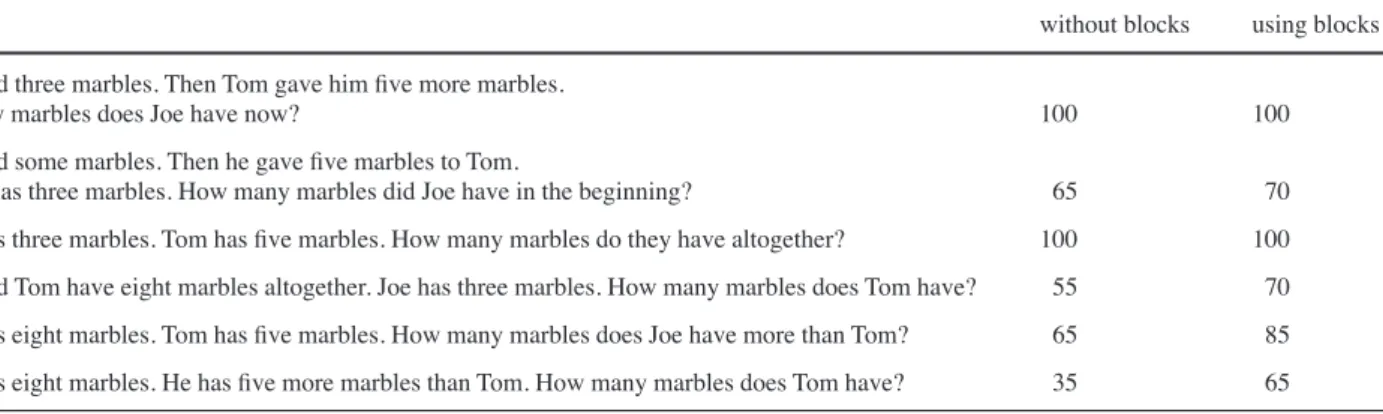
As an example, consider the problems in Table 1. They have some similarities and some differences both on the surface level of wording (presentational structure) and on the deep structural level (semantic and logico-mathematical structure), but are solvable by simple arithmetic operations (adding, sub-stracting). P1 through P3, e.g., may be solved by adding 3 and 5. Yet the semantics of the three problems are quite different. The Þrst and the second involve joining and separation, i.e., some literal action of change, in which a portion of objects is added to or removed from a set, and the task is to discover what the resulting set (P1) or the initial set (P2) is, or was, respec-tively. P3 is semantically different, involving part-whole rela-tions. Here the task is to use information on the two subsets to obtain the number of the whole. Similar observations can be made with P4-P6 that may be solved by subtracting 5 from 8. Yet the conceptual strucures of the three problems again are different. While P4 is semantically similar to P3 (even if Ð because of the changed location of the unknown Ð leading to a different formal arithmetic operation), P5 and P6 constitute a third type6 of conceptual deep structure, requiring the identiÞcation of a difference set (P5) or the reference set (P6) in a compare situation.
Despite the fact that the formal solution methods for P1ÐP3 (adding) and P4ÐP6 (subtracting) are identical Ð and trivial, by connecting merely two numbers Ð their underlying deep struc-tures differ radically. Moreover, there are wording factors which contribute to problem difficulty. It is known that young children have particular difficulties in understanding words that refer to quantity, such as some, more or more than, or to time concepts, such as temporal adverbs, or the expression of tense (8, 45) Ð a fact that also relates to what is known about language development in children (6).
Finally, it should be noted that solving the same (and many other) types of problems with and without manipulatives makes a signiÞcant difference in difficulty. This is important for the instruction of disabled and nondisabled children who have difficulties in selecting and integrating relevant pieces of problem information, in building adequate mental representa-tions of acrepresenta-tions and problem episodes, or in storing interme-diate results in short-term memory. One of the advantages in solving mathematical word problems with manipulatives is that external aides, as blocks, allow for the concrete modeling of problem situations and thus reduce the load of working memory.
Successful mathematization in solving word problems includes the construction of several interrelated mental repre-sentations, each of which being able to become a major deter-minant of childrenÕs difficulties: a textbase as a propositional representation of the linguistic input, an episodic situation
model as a qualitative representation of the nonmathematical
Òreal-lifeÓ content, a mathematical problem model as the abstract gist of the situation, and an equation (35). It is well
Table 1 Percentage of solved problems by 2nd graders, either using manipulatives (blocks) or not (37)
without blocks using blocks P1. Joe had three marbles. Then Tom gave him Þve more marbles.
How many marbles does Joe have now? 100 100
P2. Joe had some marbles. Then he gave Þve marbles to Tom.
Now Joe has three marbles. How many marbles did Joe have in the beginning? 65 70 P3. Joe has three marbles. Tom has Þve marbles. How many marbles do they have altogether? 100 100 P4. Joe and Tom have eight marbles altogether. Joe has three marbles. How many marbles does Tom have? 55 70 P5. Joe has eight marbles. Tom has Þve marbles. How many marbles does Joe have more than Tom? 65 85 P6. Joe has eight marbles. He has Þve more marbles than Tom. How many marbles does Tom have? 35 65
6The three types of problems represented in Table 1 are CHANGE (P1ÐP2), COMBINE (P3ÐP4), and COMPARE problems (P5ÐP6). The problem types differ in their situation semantics and in the location of the unknown (c.f. (36)).
known that students who are severely lacking in all types of relevent knowledge and skills Ð reading and language com-prehension skills, real world knowledge, diagramming and problem representation skills, metacognitive organization of problem solving, arithmetic-fact retrievel and counting skills Ð are not able to easily go through these necessary steps of rep-resentation, and adopt many types of coping strategies that bypass the logic of mathematical sense-making activities. For example, there are many students who just plug numbers into some equations or perform various kinds of ÒmagicÓ number work. Since students with learning disabilities, including poor reading comprehension, belong to this group, they need the guidance of effective pedagogical settings.
An important requirement is that problems are presented in contexts that are meaningful to the child. This implies that, to a certain degree, other types of problems and contexts Ð more familiar and realistic ones than the impoverished diet that can be found in many textbooks Ð are selected or created by the teacher. Furthermore, in order to improve the problem-solving skills of slow learners and of children with learning disabili-ties, instruction should help those children to analyze, reßect Ð and, above all, to practice Ð the overall required sequences
of steps in understanding and solving different types of word
problems, including the reßective discussion of errors. Steps that should be included in the (remedial) teaching of mathe-matical problem solving are
O Careful reading of the problem text, and putting what is read into a childÕs own language, allowing them to connect its semantic content with their everyday and intuitive concepts and experience;
O Building an episodic situation model, i.e., a concrete and vivid representation of the nonmathematical content of the problem, of what the text is about;
O Focusing on critical words and phrases carrying informa-tion with regard to the underlying deep structure of the problem;
O Stating the mathematical goal associated with the speciÞc problem, by analyzing the explicit question (or by generat-ing one if no question is given);
O Constructing a reduced and gradually abstract mathema-tical understanding of the problem, including the use of drawings and diagrams;
O Mapping the abstract problem model onto a formalized canonical notation, such as an equation, or onto the appli-cation of arithmetic procedures.
Mathematical sense making and the culture of schooling
Mathematical behavior is shaped by the instructional context and the social and historical culture of schooling in which it
takes place. In quite contrast to an idealistic understanding of classroom problem solving as insightfully following the fac-tual logic of things, or the inner requirements of situations (48), there is a growing body of research showing that school-ing also follows a social or contextual logic. There is ample evidence showing that learning in many mathematics class-rooms is hardly optimally directed toward mathematical mod-eling or deep conceptual understanding. Many students con-ceptualize and solve mathematical problems in a rather rote manner, without going back to a level where they are trying to understand its mathematical and/or real world meaning. Among the evidence documenting studentsÕ failure in mathe-matical understanding are studies showing that, e.g., students readily ÒsolveÓ unsolvable, even absurd, problems if presented in ordinary classroom contexts (34, 40), almost never ask themselves if a problem given to them is solvable (47), and frequently use superÞcial key word strategies in order to solve a problem (28).
Consider the following nonsense problem from a French source that was given to 76 Þrst and second graders in a school setting (34; p. 324f):
O There are 26 sheep and 10 goats on a ship. How old is the captain?
Although being clearly absurd, more than three of four stu-dents produced a numerical answer to it. A similar problem goes as follows: ÒThere are 125 sheep and 5 dogs in a ßock. How old is the shepherd?Ó The following quote from a fourth grade student working the problem out loud speaks for itself:
O 125 + 5 = 130 ... this is too big, and 125 Ð 5 = 120 is still too big ... while 125/5 = 25 ... that works ... I think the shepherd is 25 years old.
Reusser and Stebler (37) asked in two studies 180 Swiss students from 4th/5th, and from the 7thgrade level to work a list of ten ill-deÞned or unsovable problems. Examples were
O Steve has bought 4 planks of 2.5 m each. How many planks of 1 m can he get out of these planks?
O JohnÕs best time to run 100 m is 17 sec. How long will it take him to run 1 km?
O A man wants a rope long enough to strech between two poles 12 m apart, but he has only pieces of rope each 1.5 m long. How many of these pieces would he need to tie together to make the rope long enough to strech between the poles?
More than 90 % of the studentsÕ responses to the problems were numerical solutions. Only 18 % of the 4th/5thgradersÕ and 42 % of the 7thgradersÕ answers reßected the inclusion of some real-world knowledge into the solving of the problems. That
is, most students from 4thand 5thgrade and still a majority of 7thgrade students gave answers that simply do not make sense if one takes the problem statements seriously. Asking the 4th and 5thgrade students afterwards to comment on the problems and to evaluate the correctness of their solutions, revealed the result that most of the students reported that they understood most of the problems well, that they did not have difficulties solving them, and that they were not wondering whether the tasks were solvable or not. Very few students spontaneously expressed the opinion that one or several problems were the least bit out of the ordinary.
Note that the reported behavior stems from nondisabled students from regular classrooms.7 If nondisabled students apparently disregard considerations of reality and fail to to note any ill-deÞnedness, unsolvability, or meaninglessness of simple problem statements (see (34, 40), for further examples), one can easily imagine what the difficulties of disabled stu-dents are or might be, if being left with the solving of irregu-lar Ð and reguirregu-lar (!) Ð mathematical problems.
What can be learned from this research on Ònon-realistic mathematical behaviorÓ? The Þrst lesson is that the docu-mented Òsuspension of sense-making is anything but anom-alous. It is, rather an all-too-frequent occurrence ... that devel-ops in school, as a result of schoolingÓ (41, p. 316f, com-menting on the empirical Þndings of Reusser 34). That is, the explanantion of this kind of mindless behavior should not be sought in some cognitive deÞcit of the children but in the web
of conventions and everyday practices of the mathematics classroom (18, 34, 41). The second lesson is instructional (didactical) support of mathematical modeling. Realistic
mathematical modeling that is based on understanding the meaning of mathematical tasks and situations is a highly demanding, however, in almost any respect /aspect of diffi-culty, clearly underestimated activity. In a subsequent study,
Reusser and Stebler (38) transformed Þve out of the ten prob-lematic (equivocal, unsolvable) tasks that were used in their previous study (37) Ð including the three above mentioned problems Ð into hands-on performance tasks. That is, the still verbally formulated problems were, in addition, presented as practical tasks, accompanied by appropriate concrete material (as real planks with saw and meter stick, stop watch, rope, scis-sors, etc.). Instead of merely solving the problems with paper and pencil, two classes of 6th and 7th grade students were instructed to do a hands-on-performance of each tasks Ð with the result that realistic reactions (explicitely noticing that and/or why the problems were unsolvable or equivocal) almost
tripled compared to a baseline (paper and pencil) collected
from the same students at the beginning of the study. The study shows that changing the modeling perspective Ð from a merely verbal to an interactive presentation of tasks Ð immediately had a signiÞcant impact on performance. The third lesson is to change the socio-mathematical norms within the classroom community (18), by the use of more realistic problems8, and by varying instructional methods and socio-cognitive support structures including, e.g., small-group interactions, whole-class discussions, and various forms of communicative scaffolding and coaching. It implies a critical stance towards any shallow practices of mathematization in classrooms, and it includes breaking with some Òtacit sets of beliefs and values that are perpetuated by the day-to-day practices and ritualsÓ (40; p. 82) of schooling over a considerable period of time Ð practices that apparently lead to undesirable effects of mathematical learning and socialization.
Schooling and school culture are not the only inßuence on childrenÕs academic behavior. A complementary, even more basic determinant of the socialization of strategies, habits, beliefs and values related to learning in general as well as to subject-matter-related learning, is family culture. What expec-tations for mathematical performance parents have, what their relative emphasis on ability versus effort is, in what direct and indirect ways school learning is cognitively stimulated and assisted by the home environment, greatly affects childrenÕs beliefs, attitudes, and behavior (12, 14). Thus, to intervene, as a didactician, as a cognitive instructional psychologist, or as a medical person in the case of serious mathematical learning difficulties, requires one to study the individual socio-systemic
context of learning and instruction. The learning of basic
mathematical skills, its long-term success Ð or failure Ð is the least shaped by our genes alone, but by the systemic factors of educational and instructional culture, and by our ability to cre-ate supportive learning environments for all children.
7The whole range of student ability and school types were included into the study.
8C.f. also Freudenthal (11; p. 70): ÒIn the textbook context each problem has one and only one solution: There is no access for reality, with its unsolvable and multiply solvable problems. The pupil is supposed to discover the pseudo-isomorphisms envisaged by the textbook author and to solve problems, which look as though they were tied to reality, by means of these pseudo-isomorphisms. WouldnÕt it be worthwhile investigating whether and how this didactic breeds an antimathematical attitude and why the childrenÕs immunity against this mental deformation is so varied.Ó
1. Aebli H (1980) Denken. Das Ordnen des Tuns (Thinking Ð Bringing order into action). Zwei BŠnde. Stuttgart: Klett 2. Aebli H (1987) Mental development:
Con-struction in a cultural context. In: Inhelder B, de Caprona D, Cornu-Wells A (eds) Piaget Today. Hillsdale, NJ: Erlbaum, pp 217Ð232
3. Althof W (1999) (ed) Fehlerwelten. Vom Fehlermachen und Lernen aus Fehlern. Opladen: Leske + Budrich
4. Bellack AA, Kliebard HM, Hyman RT, Smith FL (1966) The Language of the Classroom. New York: Teachers College Press
5. Bishop AJ (1996) (ed) International Hand-book of Mathematics Education. Dor-drecht: Kluwer
6. Clark HH, Clark E (1977) Psychology and Language. New York: Harcourt, Brace, Yovanovich
7. Corno L, Snow RE (1986) Adapting teach-ing to individual difference among learners. In: Wittrock MC (ed) Handbook of Research on Teaching. New York: Mac-millan, pp 605Ð629
8. Cummins D, Kintsch W, Reusser K, Weimer R (1988) The role of understanding in solving word problems. Cognitive Psy-chology 20: 405Ð438
9. De Corte E, Verschaffel L, Greer B (1996) Mathematics, learning, and Instruction of. In: De Corte E, Weinert FE (eds) Interna-tional Encyclopedia of Developmental and Instructional Psychology. Oxford: Elsevier, pp 535Ð538
10. Dweck CS (1986) Motivational processes affecting learning. American Psychologist, 41 (10): 1040Ð1048
11. Freudenthal H (1991) Revisiting Mathe-matics Education. Dordrecht: Kluwer 12. Fuligni AJ, Stevenson HW (1996) Home
environment and school learning. In: De Corte E, Weinert FE (eds) International Encyclopedia of Developmental and Instructional Psychology. Oxford: Elsevier, pp 597Ð601
13. Fuson KC, Wearne D, Hiebert JC, Murray HG, Alwyn OI, Carpenter TP, Fennema E (1997) ChildrenÕs conceptual structures for multidigit numbers and methods of multi-digit addition and subtraction. Journal for Research in Mathematics Education 28: 130Ð162
14. Geary DC (1994) ChildrenÕs Mathematical Development. Research and Practical Applications. Washington, DC: American Psychological Association
15. Ginsburg HP, Klein A, Starkey P (1998) The development of childrenÕs mathemati-cal thinking: Connecting research with practice. In: Damon W, Siegel IE, Renninger KA (eds) Handbook of Child Psychology. Volume 4: Child Psychology in Practice. New York: Wiley, pp 401Ð476 16. Glasersfeld E von (1995) Radical Con-structivism. A Way of Knowing and Learn-ing. London: The Falmer Press
17. Good TL, Grouws D (1979) The Missouri Mathematics Effectiveness Project: an experimental study in fourth grade class-rooms. Journal of Educational Psychology 71: 355Ð362
18. Greer B (1997) Modelling reality in math-ematics classrooms: the case of word prob-lems. Learning and Instruction 7 (4): 293Ð307
19. Grissemann H (1996) Dyskalkulie heute. Bern: Huber
20. Grissemann H, Weber A (1993) Grundla-gen und Praxis der Diskalkulietherapie. Bern: Huber
21. Grouws DA (1992) (ed) Handbook of Research on Mathematics Teaching and Learning. New York, Oxford: Macmillan 22. Hiebert J, Carpenter TP (1992) Learning
and teaching with understanding. In: Grouws DA (ed) Handbook of Research on Mathematics Teaching and Learning. New York, Oxford: Macmillan, pp 65Ð97 23. Kaput JJ (1992) Technology and
mathe-matics education. In: Grouws DA (ed) Handbook of Research on Mathematics Teaching and Learning. New York, Oxford: Macmillan, pp 515Ð556
24. Kulik JA (1994) Meta-analytic studies of Þndings on computer-based instruction. In: Baker EL, OÕNeil HF (eds) Technology Assessment in Education and Training. Hillsdale, NJ: Erlbaum, pp 9Ð33
25. Lorenz HJ, Radatz H (1993) Handbuch des Fšrderns im Mathematikunterricht. Hannover, Schršdel
26. McLeod DB (1992) Research on affect in mathematics education: a reconceptualiza-tion. In: Grouws DA (ed) Handbook of Research on Mathematics Teaching and Learning. New York, Oxford: Macmillan, pp 575Ð596
27. National Council of Teachers of Mathe-matics (2000) Principles and Standards for School Mathematics. Reston, VA: The National Council of Teachers of Mathe-matics
28. Nesher P, Teubal E (1975) Verbal cues as interfering factors in verbal problem solv-ing. Educational Studies in Mathematics 6: 41Ð51
29. Piaget J (1950) Introduction ˆ l'ŽpistŽmolo-gie gŽnŽtique. Paris: Presses Universitaires de France
30. Piaget J (1970) Genetic Epistemology. New York: Columbia University
31. Piaget J, Szeminska A (1941) La gen•se du nombre chez lÕenfant. Neuch‰tel: Delachaux et NiestlŽ
32. Plomin R (1999) Behavioral genetics. In: Bennett M (ed) Developmental Psychol-ogy. Achievements and Prospects. London: Psychology Press, pp 231Ð252
33. Resnick LB, Hall MW (1998) Learning organizations for sustainable educational reform. Daedalus 127 (4): 89Ð118 34. Reusser K (1988) Problem solving beyond
the logic of things: contextual effects on understanding and solving word problems. Instructional Science 17: 309Ð338 35. Reusser K (1990) From text to situation to
equation: cognitive simulation of under-standing and solving mathematical word problems. In: Mandl H, De Corte E, Ben-nett N, Friedrich HF (eds) Learning and Instruction in an International Context. Vol. II. New York: Pergamon Press, pp 477Ð498 36. Reusser K (1992) Kognitive Modellierung von Text-, Situations- und mathematischem VerstŠndnis beim Lšsen von Textaufgaben. In: Reiss K, Reiss M, Spandl H (Hrsg) Maschinelles Lernen. Modellierung von Lernen mit Maschinen. Berlin, Springer 37. Reusser K, Stebler R (1997) Every word
problem has a solution Ð the social ration-ality of mathematical modeling in schools. Learning and Instruction 7 (4): 309Ð327 38. Reusser K, Stebler R (1997) Realistic
mathematical modelling through the solv-ing of performance tasks. Paper presented at the 7th European Conference for Research on Learning and Instruction (EARLI), Athens, Greece. University of Zurich, Institute of Education
39. Riley MS, Greeno JG (1988) Developmen-tal analysis of understanding language about quantities and of solving problems. Cognition and Instruction 5: 49Ð101 40. Schoenfeld AH (1989) Problem solving in
context(s). In: Charles RI, Silver EA (eds) The Teaching and Assessing of Mathemat-ical Problem Solving. Hillsdale, NJ: Erlbaum, pp 82Ð92
41. Schoenfeld AH (1991) On mathematics as sense-making: an informal attack on the unfortunate divorce of formal and informal mathematics. In: Voss JF, Perkins DN, Segal JW (eds) Informal Reasoning and Education. Hillsdale, NJ: Erlbaum, pp 311Ð343
42. Snow RE (1996) Individual differences, learning, and instruction. In: De Corte E, Weinert FE (eds) International Encyclope-dia of Developmental and Instructional Psychology. Oxford: Elsevier, pp 649Ð660 43. Sowder J (1992) Estimation and number sense. In: Grouws DA (ed) Handbook of Research on Mathematics Teaching and Learning. New York, Oxford: Macmillan, pp 371Ð389
44. Staub FC, Stern E (1997) Abstract reason-ing with mathematical constructs. Interna-tional Journal of EducaInterna-tional Research 27 (1): 63Ð75
45. Staub FC, Reusser K (1995) The role of presentational structures in understanding and solving mathematical word problems. In: Weaver CA, Mannes S, Fletcher CR (eds) Discourse Comprehension. Essays in Honor of Walter Kintsch. Hillsdale, NJ: Lawrence Erlbaum, pp 285Ð305
46. Swanson HL, Hoskyn M (1998) Experi-mental intervention research on students with learning disabilities: a meta-analysis of treatment outcomes. Review of Educa-tional Research 68 (3): 277Ð321
47. Treffers A (1987) Three dimensions: A Model of Goal and Theory Description in Mathematics Instruction Ð The Wiskobas Project. Dordrecht: Reidel
48. Wertheimer M (1945) Productive Thinking (enlarged edition, 1982). Chicago: Univer-sity of Chicago Press